
Skip to content
  • Home
  • Subscribe / donate
  • Events calendar
  • Business Directory
  • FAQ
  • News
    • Local
    • National
    • Israel
    • World
    • עניין בחדשות
      A roundup of news in Canada and further afield, in Hebrew.
  • Opinion
    • From the JI
    • Op-Ed
  • Arts & Culture
    • Performing Arts
    • Music
    • Books
    • Visual Arts
    • TV & Film
  • Life
    • Celebrating the Holidays
    • Travel
    • The Daily Snooze
      Cartoons by Jacob Samuel
    • Mystery Photo
      Help the JI and JMABC fill in the gaps in our archives.
  • Community Links
    • Organizations, Etc.
    • Other News Sources & Blogs
  • JI Chai Celebration
  • JI@88! video

Recent Posts

  • Or Shalom reopens its doors
  • JFS from past to future
  • Need holistic approach
  • Sharing stories, advice
  • Journalist shares fears
  • Skills to live together
  • Road to independence
  • Cutting grass with scissors
  • Zionism as a solution
  • Deceit, desire & the divine
  • Reclaiming sacredness
  • Creative project ideas
  • Summer squares and cobbler
  • Thou shalt … summer commandments
  • Legal help for students
  • Revisiting myth of Lilith
  • Wrong person rebuked
  • Canada’s mixed messages
  • Questions for museum
  • Symposium on antizionism
  • Making soccer political
  • CJPAC lauds Pulver’s impact
  • City recognizes Vrba’s legacy  
  • Organ donation saves lives
  • Theodore’s March premiere
  • A healing Shabbaton
  • Supplying healthy food
  • A chime of metal tags
  • Yellowknife seder a first
  • Ishai energizes, unifies
  • A Lag b’Omer to remember
  • Expanding the healing
  • Hannah Senesh – a unique hero
  • Community milestones … May 2026
  • Sharing her testimony
  • Fall fight takes leap forward

Archives

Follow @JewishIndie
image - The CJN - Visit Us Banner - 300x600 - 101625

Author: Cynthia Ramsay

Royal City welcomes Tevye

Royal City welcomes Tevye

Jewish community members in Royal City Musical Theatre’s production of Fiddler on the Roof, left to right: Erin Palm, Warren Kimmel and Zach Wolfman, with Michael Wilkinson in front. The show runs April 7-23 at Massey Theatre. (photo by Tim Matheson)

This year’s Royal City Musical Theatre production is Fiddler on the Roof. Playing the legendary lead character of Tevye the Milkman is Jewish community member Warren Kimmel.

Addressing the community, Kimmel acknowledged that Fiddler is “one of those pieces of art that have just become part of the culture almost by osmosis.” But, he added, “Fiddler on the Roof is an intensely Jewish musical and, although musical theatre is hugely populated by Jewish composers and performers, Fiddler is perhaps the only mainstream musical that deals directly with the Jewish experience. So, although your children might know ‘If I Were a Rich Man’ by cultural absorption, I would urge you to bring them all to see this piece. It’s a fundamental part of who we are and I think it’s going to be a great production.”

Directing and choreographing the RCMT show is Valerie Easton and the musical director is James Bryson, who will lead a full orchestra. Kimmel will be joined by three other Jewish community members on stage: Michael Wilkinson (Fiddler), Zack Wolfman (Perchik) and Erin Palm (Fruma Sarah). They and the rest of the cast have a challenge in making their iconic characters their own.

“I have made the character my own by growing a real beard!” said Kimmel, noting that it took three months to grow and has changed his life. “Seriously though, the fact that the role is iconic has been a real issue for me because I actually grew up watching that movie and I think that it is not for no reason that Topol is world-famous from only one identifiable role. I think it’s a brilliant movie and a landmark performance, so it has been quite difficult not to copy what he’s doing. At the same time, I think what would be worse would be to try and do something different just for the sake of being different. So, what I’ve tried to do, and I guess what I always try to do, is find the truth of the story for that character and play that. But they are big boots to fill, no doubt, and an even bigger beard!”

“It’s definitely hard when there is a fixed idea of how a character should be,” Wolfman said. “I am steering clear of the trap by approaching the role like I would any other. I look at the words on the page and the circumstances the character finds himself in. The show is iconic because the characters and story are well written, and it makes our jobs easier as actors because that information is all on the page for us to use…. When I say the same words in the same order, it is the character, and I suppose it will become my own when it comes out of my mouth!”

For her part, Palm said she loves “when an actor really takes risks and brings new life to the characters they play. I think I make Fruma Sarah my own by really trying to understand what she wants, in the most honest way possible.”

Fiddler on the Roof was one of the first musicals Palm ever saw. “It made a huge impact on me,” she said. So, for her, part of the fun of being in this production “comes out of years of being excited about the opportunity to do the show and then getting a chance to do it. I love the music and the story.”

Part of the challenge is to convey the time and place of the action. Based on Tevye and his Daughters and other stories by Sholem Aleichem, Fiddler is set in 1905 in Anatevka, a fictional Russian village. It centres around Tevye and his efforts to maintain Jewish traditions while trying to keep his wife and five daughters happy and safe.

“Being that we don’t live in Anatevka and it is 2016,” said Palm, “it’s relating to those social and economic differences and times that makes it a challenge … capturing the old world feeling in a way that is truthful and heartwarming, that’s what sweeps you away to Anatevka, that’s the charm of the show.”

For Wolfman, “Having the opportunity to play a character that is playing against the traditional values of the characters in the play is fun. Perchik has more modern sensibilities and, in a way, he acts as a proxy for the audience to see the differences in beliefs on stage. It is fun to play a character with a strong point of view who is willing to fight for what he believes in…. The challenge for me has been finding the balance between the Perchik who is warm and loving, and the hard-nosed revolutionary. Of course, both sides exist within the character, so it’s interesting to grapple with what comes out at what times. It’s an ongoing question for me so, as my old acting professor Stephen Heatley would say, I’m ‘keeping the questions open and active.’”

In a somewhat similar vein – trying to find balance within a character – Wilkinson said, “It’s been very fun and exciting for me to find the way the Fiddler fits in as a metaphor in Tevye’s mind but also has a personality and character of his own.”

Not only does Wilkinson have to figure that out, but he is also playing a Russian dancer in the song “To Life.” He said that Easton “has given us wonderful choreography and the Russian dancing is particularly fun, but also challenging – especially since most of us don’t have training in Russian dance!”

Kimmel described Easton as “one of the real jewels of this city’s theatre community and we have worked together enough times now that I know I can allow her to guide me in my performance and that, if I trust her, she will make it a better one. That’s meant to be the director’s job, I guess, and it’s what you always hope for as an actor, but it doesn’t happen nearly as often as you would hope.”

Last year, Kimmel worked with both Easton and Bryson on RCMT’s My Fair Lady. “Both brilliant,” he said. “Also, there are a few cast members from My Fair Lady that have reappeared in Yiddish garb and large beards and it’s always great to be on stage with people you know and trust. However, all the people I have close relationships with in the piece – my wife and five daughters – are all performers I’ve never worked with before and that’s quite exciting.”

It is also Wilkinson’s second production with Easton, Bryson and RCMT. He was in the ensemble of Annie in 2014. “The Vancouver theatre community isn’t huge, so usually there are some familiar faces when a new production starts rehearsals. I’ve met a bunch of new wonderful people in this production, as well as a few with whom I’ve worked before.”

Wolfman was at the University of British Columbia with a couple of the other leads, including Jenika Schofield, and has acted before with several members of the cast. “In fact,” he noted, “Jenika actually played my love interest in Titus: The Light and Delightful Musical Comedy and now she’s playing Hodel, who falls in love with Perchik. Crazy, right?!”

While this is his first time working with Easton and Bryson, Wolfman said, “Patrick Ray, our piano player, accompanied a show I did in the past, and maybe saved my life musically more than once.”

Palm worked with Easton right after graduating from Capilano University. It was in an Arts Club on Tour production of the musical The Thing About Men, where, she said, “I played 13 different characters, that was a highlight of my career. I just love her as a director. She’s just so present and physical in her directing skills. She’s very giving, she’s very much an actor’s director…. Also, I am a big fan of female directors. There are so few of them and so, when you get an opportunity to work with a director with such a clear vision who is a woman, I celebrate that.”

Palm also knows some of Fiddler’s cast from previous acting work, she took voice lessons for awhile with Sylvia Zaradic (Yente) and did a video with Natasha Zacher (Tzeitel) and others called Finding Face Time: A YouTube Musical!, which is online.

In the casting process, Palm was called back for two different roles: Tzeitel and Fruma. She said she is grateful to have been chosen “as part of the vision of the show and cast as Fruma Sarah.”

“I think the casting is very well put together and I couldn’t imagine the show being cast any other way,” she said. “We really have worked together as a collective, the chorus is really strong. There are a lot of talented actors and singers in this show, lots of young and up-and-coming talent, too, who really bring something special, new and exciting to the roles they play.”

Initially, Wolfman wasn’t sure for which role he would audition. During Oliver! at Theatre Under the Stars last summer, he said, “[M]any of the cast members in the show were buzzing about Fiddler on the Roof auditions during the run. A fellow cast mate, Kat Palmer, said I should go out for Perchik if I got a chance, so the show fell on my radar. When I first auditioned, I was thinking about Motel and Fyedka as possible roles, but after re-reading the script, I definitely had my heart set on Perchik and that’s what happened!”

When Wilkinson auditioned, he said, “I had to sing a song in front of the directing team and take part in the group dance call. I didn’t go in with a specific role in mind and was just hoping to be a part of the show in some capacity. It worked out well and I’m having a great time being a part of the production.”

As for the patriarch of the show, Kimmel said, “I originally auditioned for the role of Yente the Matchmaker but I lost that role, unfortunately, and had to settle for Tevye. No, in reality, I think Tevye has always been one of the roles that I felt I would have to do at some point or other, being Jewish for a start, and just loving this play since I was a child. So, I asked Val if I could audition. Honestly, I thought I was a bit young for the role and I still feel I struggle with the [emotional] weight of Tevye…. Also, there are a few performers in town that have been very successful playing the role and I was pretty sure they would be offered it, but it seems my audition – together with a large cheque made out to Val – clinched it for me.”

RCMT’s Fiddler on the Roof takes place at Massey Theatre, 735 Eighth Ave., in New Westminster, Wednesday-Sunday, April 7-23. Ticket are $47 ($38 seniors/students, $29 children 13 and under) from ticketsnw.ca and 604-521-5050.

Format ImagePosted on April 1, 2016March 31, 2016Author Cynthia RamsayCategories Performing ArtsTags Erin Palm, Fiddler, Michael Wilkinson, RCMT, Royal City, Tevye, Warren Kimmel, Zack Wolfman
Iran dominates AIPAC talks

Iran dominates AIPAC talks

Republican presidential hopeful Donald Trump upset AIPAC organizers when he criticized President Barack Obama. (photo by David Zam)

There were clear signs of discord in Washington, D.C., as representatives of AIPAC publicly rebuked presidential hopeful Donald Trump after he harshly criticized the sitting president.

At the pro-Israel organization’s policy conference last month, in front of some 18,000 attendees, visibly upset AIPAC president Lillian Pinkus admonished Trump on stage for his remarks a day earlier.

“Whatever policy disagreements we may have, we must not condemn the sitting president on stage,” she said. “There are people in our AIPAC family who were deeply hurt last night and, for that, we are deeply sorry.”

Chairman of the board Robert A. Cohen said that booing and clapping speakers when they attack another person was unacceptable at the event, and that “AIPAC doesn’t pick sides.”

Trump, who was cheered wildly for noting that it was President Barack Obama’s last year in office, said that “Obama rewards our enemies” and “Hillary was a total disaster as secretary of state…. Obama and Hillary have been very bad to Israel. Obama may be the worst thing to happen to Israel.”

Every major party candidate for president spoke at the dais, except the senator from Vermont, Democrat Bernie Sanders, who is Jewish. All candidates who spoke placed heavy emphasis on Iran.

GOP frontrunner Trump didn’t mince words. He called the Iran deal brokered by the P5+1 – the United States, China, Russia, France and the United Kingdom plus Germany – “awful” and “bad for Israel, the Middle East and the world.”

The $150 billion channeled to Iran in the agreement, by his reckoning, was “unbelievable” with “nothing in return,” and that the Islamic Republic will have a nuclear bomb within several years.

As president, Trump said he would “stand up to Iran’s aggression” because “I know how to deal with aggression and that’s why I’ll win.”

The Middle East’s terror activity has Iran’s fingerprints all over it, he continued, including Hezbollah in Lebanon, Hamas in Gaza, reward money for Palestinian terrorists, and influence in at least two dozen other countries.

“I will dismantle Iran’s global terror network,” Trump said. “We will enforce this deal like you’ve never seen a contract enforced before.”

The New York billionaire mogul and reality TV host took aim at two other threats to Israel, the United Nations and Palestinian terror activity.

“The UN is incompetent and no friend of Israel,” he said. “A [peace] agreement imposed by the UN would be a total disaster. And the U.S. must use our veto, which I will use 100%.”

The Jewish state, he said, has always been willing to strike a deal with its neighbors, noting that prime minister Ehud Barak in 2000 offered nearly the entire West Bank as a Palestinian state, but the offer was dismissed by then-PLO leader Yasser Arafat. Other times, he said, “Palestinian leadership has rejected very good offers.”

Trump noted that, under his purview, the U.S. embassy would move “to the eternal capital of the Jewish state, Jerusalem.”

Texas Senator Ted Cruz, trailing a distant second to Trump in GOP delegates, began his speech, “America will stand with Israel and defeat Islamic terror.”

He spoke about his three trips to Israel as senator, including a visit to Israeli hospitals that treated Syrian refugees. He noted that he had proposed legislation to ban the Iranian ambassador to the UN from entering the United States since he was involved in the 1979 Iranian hostage crisis. It passed in both the Senate and House.

Taking a jab at the Obama administration, he said it was “unjust” for them to impose a travel ban on Israel in the summer of 2014. He further called out Democrats for boycotting Israeli Prime Minister Binyamin Netanyahu’s speech last year at AIPAC.

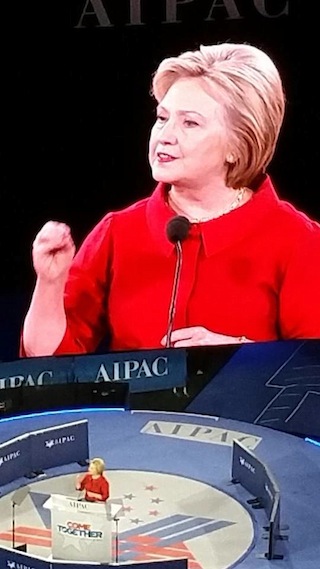
photo - At AIPAC, Democrat frontrunner Hillary Clinton advised a three-pronged approach to global security, focusing on Iran, extremism and the attempts to delegitimize Israel
At AIPAC, Democrat frontrunner Hillary Clinton advised a three-pronged approach to global security, focusing on Iran, extremism and the attempts to delegitimize Israel. (photo by David Zam)

Hillary Clinton, the Democratic presidential frontrunner, was taken to task for saying that Hamas fires rockets from civilian areas because Gaza is tight for space. “Rather,” said Cruz, “it’s because Hamas are beasts who use human shields.”

As for the “fundamentally immoral” Iran deal, Cruz said he will “rip it to shreds on the first day,” since the Islamic Republic won’t follow it anyway.

“Hear my words Ayatollah Khomeini: If I am president and Iran launches a missile test, we will shoot that missile down,” said Cruz. “And, in January 2017, we will have a commander-in-chief who says under no circumstances will Iran be allowed to acquire nuclear weapons: either you will shut down your nuclear program or we will shut it down for you.”

Cruz compared the Iran deal to the failed 1938 agreement between British prime minister Neville Chamberlain and Adolf Hitler, which led to the Third Reich’s takeover of Czechoslovakia and allowed its continued military build-up.

If elected president, Cruz said he would move the U.S. embassy from Tel Aviv to Jerusalem, yank federal funds from schools that boycott Israel and veto any UN unilateral declaration of a Palestinian state.

Governor of Ohio John Kasich, running third in the GOP delegate count, noted his 35-year support for Israel and his role in helping erect a Holocaust monument in his state.

He called for the suspension of the Iranian nuclear deal, particularly after recent test missiles in contravention of international treaties. As president, he would “defeat ISIS and stop arms flows to Hezbollah.”

He also spoke out against the boycott, divestment and sanction movement, and antisemitism on campus. On Israel, he noted the “culture of death that the Palestinian leadership has promoted for decades,” and that “Palestinians cannot continue to promote hatred.” In sum, he called Jerusalem the eternal capital of Israel.

When she took to the stage, Clinton noted that the “the ideological gap between the parties has increased, but there’s still common agreement on Israel.”

She took a three-pronged approach to global security: Iran’s aggression, the growing tide of extremism, and efforts to delegitimize Israel. “The deal with Iran is making the world safer, including Israel,” she said. “The supreme leader still calls all the shots in Iran, but we should support voices who want to bring change in Iran.”

Regarding other parts of the region, she said that “ISIS must not be contained; it must be defeated.”

On the issue of Israel, she noted that Palestinian leadership has to stop inciting violence. “Children should not be taught to hate in schools,” she said, adding that she would oppose any attempts to “push a [unilateral two-state] solution,” including in the UN. “Palestinians should be able to govern themselves in their state,” she said, while adding that Israeli “settlements are not helpful to peace.”

She condemned BDS and said, “we have to fight against it” because “antisemitism has no place in American society.”

Meanwhile, U.S. Vice-President Joe Biden took a risk mentioning to the 18,000 attendees at the policy conference that Israeli “settlements are a barrier in the way of a two-state solution.” That risk was welcomed by a chorus of boos – despite attendees being cautioned by AIPAC leadership to not do so.

Biden insisted that, notwithstanding political differences, the United States is “united in our unwavering commitment to the Jewish state of Israel.”

However, “violent acts of retribution must stop,” he continued, “terror is terror is terror … and it must be stopped.”

The White House “stands with Israel against delegitimization” and believes that “Israel is stronger today because of the Obama-Biden administration,” he said.

Biden touted last year’s Iran deal as a “success,” explaining that many “Iranian facilities are dismantled and destroyed” and that “Iran is further away from the possibility of being nuclear. If Iran violates [the deal] there will be consequences.”

Speaking by video link from Israel, Netanyahu both criticized, and suggested salvaging, the U.S.-brokered Iranian nuclear deal.

“Those who worked for the deal and against the deal can work together to ensure that the deal is followed,” he insisted, noting that, in March, Iran tested a missile that posed a threat to Israel.

“The writing isn’t just on the wall; it’s on the missile,” said Netanyahu.

He said that Israel is singled out for condemnation at the UN and said he hopes the United States will continue its moral voting record at the Security Council.

With regard to Israel’s neighbors, he said Palestinian children are taught to hate, and showed a video of television broadcasts that illustrate his point.

“We cannot compromise with terror and must defeat it,” he said. “We need a two-state solution with a demilitarized Palestinian state.… We are ready for negotiations anywhere and anytime without preconditions.” But, he said, Mahmoud Abbas, the leader of the Palestinian Authority, “isn’t ready or willing to come” to the negotiating table.

David Zam has covered political, cultural and historical events for Landmark Report, including the 50th anniversary of the Selma to Montgomery voting rights march as White House-approved press, two AIPAC policy conferences and several other political conventions. He has degrees in history and law.

Format ImagePosted on April 1, 2016March 31, 2016Author David ZamCategories WorldTags AIPAC, Donald Trump, Hillary Clinton, Iran, Israel, Netanyahu
More work left to do

More work left to do

Call It Democracy speakers, from left to right, Mira Oreck, Margot Young and Sharon Abraham-Weiss. (photo by Zach Sagorin)

“From the Holocaust, there is a lesson we can all agree about: ‘Never again.’ There are two paths: never again to us or never again to anybody,” said Sharon Abraham-Weiss, executive director of the Association for Civil Rights in Israel.

Abraham-Weiss was speaking at the event Call it Democracy, held at Temple Sholom on March 14. She was joined by Mira Oreck, director of public engagement at the Broadbent Institute, and Margot Young, a University of British Columbia law professor, who served as facilitator.

About Israel, Abraham-Weiss said, “The Declaration of Independence from 1948 is the establishment for this democracy, promising equality for all its citizens. When I’m saying citizens, 20% of the citizens of Israel are Palestinian-Israelis, Arab-Israelis, people that were in Israel in 1948. Speaking about the occupied territories, it’s a different story.”

She said, in contrast to Canada, Israel “does not have a constitution … so, our toolkit, as lawyers, [is] the Basic Laws that we consider higher laws.” Additionally, she said, “We don’t have any separation between state and religion and this is something very important to understand.” For example, “the only way to get married … is in the Orthodox rabbinical system for Jews or other religious systems for non-Jews.”

Moreover, she continued, “In 1967, we occupied areas known today as ‘the occupied territories,’ Judea and Samaria, Palestine, you can name it. There are about two million people there, Palestinians. When I speak about democracy, it does not apply to the occupied territories. It’s different [there] because these people do not have the status of citizens, they are refugees.”

Oreck thanked the Coast Salish peoples, “whose territory we are gathered on tonight,” when she began her remarks. “I think it’s a relevant acknowledgement to the conversation around civil liberties, civil rights and human rights.”

Oreck described the notion of civil liberties as a political one. “These are political decisions that are made from country to country and we often think of civil liberties in a fairly narrow sense. What are the personal guarantees and freedoms that the government cannot infringe on by law?” she asked, listing freedom of conscience, religion, press, the right to security. “We don’t necessarily think about poverty and housing and other rights that we may think of more generally as human rights that don’t fall into our more narrow definition of civil liberties,” she said.

Young shifted the conversation to the balance between security and liberty.

“Can security reasons be justified by everything we are doing? Abraham-Weiss asked. “The answer from my perspective is no, not at all, it has to be balanced. Can we completely dismiss the idea of security reasons? And the answer is no.” She spoke about profiling at airports as an example. “It’s hard, for on one hand, we don’t want any terror attacks; on the other hand, 20% of our population belongs to the Arab minority. Can we generalize … that they are all suspects?” She said, “How do you bring your citizens to be part of the society when you always blame them? How do you bring your citizens to be part of the society when their schools, per capita, are less than the schools I am going to in west Jerusalem and other places?

“In 2010, the government of Israel joined the [Organization for Economic Cooperation and Development] and the OECD said that, if you want to be a member of the developed countries, you must show us better numbers of Arabs in the job market and better participation of ultra-Orthodox in the job market. [With] this incentive, we showed better numbers … and this, in a way, is balancing the security risks.”

In the Canadian context, Oreck referred to the passing of anti-terrorism Bill C-51, noting that the NDP was the only party that voted against it. “There are real conversations around how we address very real security threats and what the tension is,” she said. “But, also, what are we willing to trade away?… Frankly, who would be in violation of that security based on C-51?… Would people that are protesting pipelines, for example, be a threat to national security? And, if so, who are those people? Who is being threatened? Who is being protected?”

Another prominent Canadian security discussion has been about the Syrian refugees, said Oreck. “When the new government talked about bringing in Syrian refugees, well, what is the threat?… There are still many questions around what the screening process was, should men be able to come in, or should families be prioritized?”

In Canada, there is the Charter of Rights and Freedoms, Young noted in changing the topic from security to equality. “We do have a lot of these questions being decided by our Supreme Court of Canada in an authoritative way,” she said.

In Israel, explained Abraham-Weiss, “Our main tool is the Basic Law of Human Dignity [and Liberty] and, when we take things to the Supreme Court … although it is about freedoms, the word that is not [there] is the word equality and the reason equality is not there, it is because … the Orthodox were against the word equality because of women’s rights.”

She explained how equality was written “into dignity” in the 1990s. “Humiliation and discrimination harms your dignity and that is how it was justified. It is a very famous case,” she said, referring to that of Alice Miller, who wanted to be a pilot in the Israel Defence Forces. “She was rejected because she was a woman. Now, the interesting story about her … is that she was a pilot already, she just made aliyah. She moved from South Africa and she was holding a civil pilot license and they told her she can’t be a pilot, and she said, I am.” Miller became Israel’s first female pilot.

In Canada, said Oreck, “we are probably also dealing with an outdated version of gender and needing to really reevaluate the way that we look at gender rights, what does that mean.” She pointed to some advances, commending “the work the Vancouver School Board has done around gender-neutral bathrooms.” She said, “What is once at the margins, eventually, becomes mainstream.”

“Our job as a human rights organization is to find out what is … marginalized, outlined, and bring it to the heart of the consensus,” agreed Abraham-Weiss. “I think especially as minorities, it’s important to be consistent and put question marks on things that can be taken for granted.”

Abraham-Weiss used the example of administrative detention. She said it “was used, traditionally, against Palestinians and, whenever we brought it up, they would say [for] security reasons. Now, recently, it is used against right-wing settlers, Israeli-Jewish settlers. Now we are consistent about it … we are consistent about the procedure and part of the reason we have success is that we are not partisan … we work in the parliament of Israel with various members of the political spectrum. So, on children’s rights, our best ally is from [Avigdor] Lieberman’s party, which is right-wing. On International Human Rights Day, we held a conference in the Knesset held by … two members of the Knesset, one was from the joint Arab-Jewish party … and the other was Likud.”

Abraham-Weiss said, “In terms of human rights, within Judaism, we are more tolerant, [but] we are still not doing good enough, with Ethiopian Jews for example.… It takes time, but I think we are moving to it.”

Young asked Abraham-Weiss and Oreck to discuss the “elephants in each of the country’s rooms, really, really tough issues that that people dance around on, but don’t always talk about.”

Abraham-Weiss said, “The elephant in the room is the Palestinian-Israeli conflict, so, while we have tolerance and multiculturalism within Judaism, we are less tolerant to multiculturalism with the Palestinian-Israelis and their culture and I have to admit … the last couple of years, we have been dealing with what we call the shrinking democratic space in Israel due to the conflict.”

During Protective Edge, the 2014 Israel-Gaza conflict, Abraham-Weiss said, “We saw that there were voices against the war and, the voices, people were calling to marginalize them. So, they were opening Facebook pages calling to fire these people from their workplaces. Now, these are private places.… Look at the government. There were ministers saying: ‘Hey, don’t let anyone do demonstrations against the war, it is not a good time for demonstrations.’ When is a good time if this is the idea? Now that bothers me in a democratic country. In a pluralism of ideas, we have many voices. If you do have only one voice, you don’t call it a democracy anymore.… [Recently], there was an idea, a draft bill, to impeach the elected minority. So, the elected majority, the Jews, can impeach the elected minority, the Arabs?… I think this is a problem in a democracy.”

Oreck said, “Canada views itself and prides itself on being a multicultural country and yet … multiculturalism is, of course, from the ’70s … was about immigrants and was about new Canadians and it never dealt with First Peoples of this country and it never addressed the historical inequalities that we are dealing with now through reconciliation…. I think that, as a Jew anyway, that makes a challenge in some ways.

“For many of us,” she said, “Canada was a refuge and our families came here for safety and security and yet, at that exact time, of course, kids were being taken from their homes and sent to residential schools. So, how do you reconcile, how do you pride yourself on multiculturalism when, for many people that time was a very dark history.… We are still really addressing those challenges. I would argue that not having clean water on reserves is a failing of multiculturalism and I would argue that the Cindy Blackstock case on the underfunding of First Nations education is a failing of multiculturalism.… There is clearly still enormous work to do.”

Similarly, Abraham-Weiss said, “I can criticize Israel because I care about Israel. I want a better Israel and I think we all deserve a better Israel.”

Call it Democracy was co-sponsored by the New Israel Fund of Canada and Temple Sholom with Beth Tikvah Congregation, Ameinu, Hillel BC Society and Or Shalom. NIFC president Joan Garson concluded the event.

Zach Sagorin is a Vancouver freelance writer.

Format ImagePosted on April 1, 2016March 31, 2016Author Zach SagorinCategories LocalTags Abraham-Weiss, Canada, civil rights, democracy, Israel, Margot Young, Mira Oreck

In the UN, on campus

Canada’s foreign minister has called on the United Nations Human Rights Council to review the appointment of Canadian law professor Michael Lynk as its special rapporteur on human rights in Palestine.

Last week, Stéphane Dion tweeted (because that is how diplomacy happens these days): “We call on @UN_HRC President to review this appointment & ensure Special Rapporteur has track record that can advance peace in region #HRC.”

The Centre for Israel and Jewish Affairs has denounced the appointment of the University of Western Ontario academic, who has been associated with anti-Israel activities in Canada. Lynk has said that Israel should be prosecuted for “war crimes,” he accused Israel of “ethnic cleansing,” has spoken at conferences that reject a two-state solution and serves as a leader in a group that promotes Israel Apartheid Week.

While Dion questioned the wisdom of appointing Lynk, CIJA went further, arguing that the position itself is illegitimate.

“It is ludicrous that this is the UN’s only special rapporteur focused on the human rights of a particular community,” said Shimon Koffler Fogel, CIJA’s chief executive officer. “It is likewise shameful that the special rapporteur refuses to investigate the abuse of Palestinian rights by the Palestinian leadership, particularly Hamas in Gaza. In so doing, the special rapporteur obscures genuine human rights violations in the Middle East and the underlying obstacles to Israeli-Palestinian peace.”

A related conflict blew up in academia last week. Just as the appointment of an avowed anti-Zionist as UN rapporteur surely will not advance peace between Israelis and Palestinians, the complete disavowal of the existence of antisemitism on campuses will not promote intellectual discourse or peace.

In the wake of ongoing efforts by the BDS movement to boycott Israeli academics and force universities to divest from Israeli holdings, while occasionally nastily intimidating Jewish students on campuses across North America, the University of California board of regents recently passed a statement condemning antisemitism, along with 10 principles against intolerance as a whole. It is the result of several months’ research and consultation.

The statement that introduces the principles is an amended version of an earlier expression that would have condemned anti-Zionism. Instead, it condemns “antisemitic forms of anti-Zionism.” If the only state in the world targeted for elimination is the only Jewish one, it should be an uphill battle to continue the charade that anti-Zionism is not equivalent to antisemitism, or at least driven by it to a large degree. Nevertheless, the regents’ statement is a starting point for increased civility on campuses that have seen, they note, “an increase in incidents reflecting antisemitism…. These reported incidents included vandalism targeting property associated with Jewish people or Judaism; challenges to the candidacies of Jewish students seeking to assume representative positions within student government; political, intellectual and social dialogue that is antisemitic; and social exclusion and stereotyping.”

Some critics say the statement is designed to stifle opposition to Israeli policies. Others say it could harm free speech. Yet others say it didn’t go far enough, in that it didn’t condemn bigotry against other specific groups.

None of these objections holds water. While the working group’s report might have been initiated by concerns over antisemitism, the document speaks to many other forms of intolerance: “University policy prohibits discrimination based on race, color, national origin, religion, sex, gender, gender expression, gender identity, pregnancy, physical or mental disability, medical condition (cancer-related or genetic characteristics), genetic information (including family medical history), ancestry, marital status, age, sexual orientation, citizenship, service in the uniformed services, or the intersection of any of these factors.”

As for free speech, including, presumably, that about Israel, the document stresses the importance of freedom of expression and of inquiry: “The university will vigorously defend the principles of the First Amendment and academic freedom against any efforts to subvert or abridge them.” And, it notes: “Each member of the university community is entitled to speak, to be heard and to be engaged based on the merits of their views, and unburdened by historical biases, stereotypes and prejudices.”

But: “Regardless of whether one has a legal right to speak in a manner that reflects bias, stereotypes, prejudice and intolerance, each member of the university community is expected to consider his or her responsibilities as well as his or her rights … mutual respect and civility within debate and dialogue advance the mission of the university, advance each of us as learners and teachers, and advance a democratic society.”

The UN – and many others – could learn a thing or two from UC’s regents.

Posted on April 1, 2016March 31, 2016Author The Editorial BoardCategories From the JITags antisemitism, BDS, boycott, CIJA, free speech, Israel, Koffler, racism, United Nations

Antisemitism’s blurry lines

Avi Benlolo, president of the Canadian Friends of the Simon Wiesenthal Centre for Holocaust Studies, was recently quoted in the National Post saying that Jewish university-bound applicants should consider options other than Toronto’s York University. The reason? A faculty association executive proposal to divest from weapons manufacturers. The proposal didn’t mention Israel by name.

According to Benlolo, this is a “campaign of censorship against Israel and the Jewish people.” The organization also issued a statement declaring that, in the wake of the proposal, it was “concerned for the safety and security of [York’s] Jewish students and faculty.”

I recently combed through the 2015 report of the Simon Wiesenthal Centre on antisemitism on American campuses, headlined: “A Clear and Present Danger.” Over the 26-page document, I discovered a few antisemitic incidents over the eight preceding years. (I selected an eight-year period to represent two generations of students at a four-year university or college.)

As the report detailed, at Harvard in 2013, to raise awareness of Palestinian home demolitions, activists slipped mock eviction notices into dorm rooms. There was no evidence to suggest whether Jewish students were targeted. And, in 2014-2015 at University of California-L.A., Rachel Beyda, a Jewish student, was barred admission to a judicial position by the student council following accusations that her Jewish heritage made her biased. After an uproar, the administration pressured the council to reverse itself. A similar dynamic played out at Stanford in 2014, when Molly Horwitz was asked, “Given your strong Jewish identity, how would you vote on divestment?”

The report also noted a “decade” of “increasing hostility” at the University of California-Berkeley in 2015, “including “vandalizing Jewish property, spitting at Jewish students, threatening violence, and physically assaulting Jewish supporters of Israel.”

Incidents like these should be called out strongly. But every other event chronicled since 2007 in the Simon Wiesenthal Centre report described political activity directed against Israel or its policies – not instances of antisemitism.

The latest mudslinging debate in the antisemitism wars is more nuanced. It concerns a talk by gender studies scholar Jasbir Puar at Vassar College, an event that authors of a Wall Street Journal op-ed described as antisemitic and a blood libel.

In the talk (of which I received a transcript), Puar made two particularly jarring claims. About the bodies of 17 Palestinian youth that Israel kept for two months at the end of 2015, Puar said, “Some speculate that the bodies were mined for organs for scientific research.” (These youth, it is important to note, had been attacking Israelis. Puar described these Palestinian youth as having been involved in “stabbing” and as part of a “peoples’ rumble” but called their deaths “field assassinations.”)

Puar also suggested that Israel engages in “weaponized epigenetics, where the outcome is not so much about winning or losing nor a solution, but about needing body parts, not even whole bodies, for research and experimentation.”

Puar did not respond to my requests for comment or clarification regarding her accusations.

While academic freedom is a principle meant to protect scholarly speech from legal censure, there is an equally important norm requiring a scholar to provide evidence when making empirical claims. On this, Puar failed.

But is Puar’s scholarly breach antisemitic?

Joshua Schreier, an associate professor of history at Vassar and part of the steering committee of the Jewish studies program that was one of the co-sponsors of the talk, doesn’t think so. He attended the event. “It’s really important,” he told me, “to protect free speech and protect academic speech,” adding that “we have a responsibility, as academics, when we talk about speculation, to note … whether it’s substantiated, whether we’re trying to give new life to those rumors, or not, but none of that makes it antisemitic.”

Unfortunately, the unsubstantiated charge of using “body parts for experimentation” cuts close to the bone of blood libel myths. It is also uttered in the context of a cultural moment on campuses when most criticism of Israel is inappropriately being cast as antisemitic. This surely means that there will be fallout from the talk that will serve to distract debaters from the pressing issues around the ills of occupation. It also means that amid the hyperbolic rhetoric about antisemitism on campuses, actual antisemitism is becoming more difficult to spot when it does occur.

Meanwhile, hundreds of faculty members from across the United States have issued a statement to Vassar’s president asking her to “write a letter to the Wall Street Journal … condemning in no uncertain terms the unjustifiable attack on Vassar and on Professor Puar.”

For its part, the Anti-Defamation League had nothing more damning to say about Puar’s appearance at Vassar than that she has sometimes accused Israel of pinkwashing.

Ian S. Lustick, a professor of political science at University of Pennsylvania, told me by email that he signed the statement “to show solidarity against the campaign to restrict the space of politically correct discussion on anything pertaining to Israel and Palestinians.” About the claim of organ harvesting, Lustick said that “the speculations about horrific

Israeli behavior with respect to organ harvesting from Palestinian bodies are as unlikely to be true as they are likely to be circulated as long as Israel refuses to quickly return bodies of dead Palestinians to their families.”

Debate over campus discourse on Israel (and even on things like armaments, weirdly perceived by some to represent Israel) will continue. Vassar’s president, for her part, invited parents and alumni to an online forum to discuss “current issues and tensions within our community related to the Israeli-Palestinian conflict.”

As for whether actions on campuses over the last decade constitute antisemitism, the ledger is mixed. Verbal or physical harassment directed at Jews for reasons related to their ethnic or religious identity is antisemitism. Same with leveling dual loyalty charges against Jewish students.

But consideration of divestment from weapons companies is not antisemitism. Criticism of Israeli policy is not antisemitism. Criticism of the occupation is not antisemitism. Criticism of violence – whether it is state-sponsored violence or violence carried out by individuals or groups – is not antisemitism.

Presenting unsubstantiated claims against agents of a state in a public lecture is irresponsible. And, if the symbolism chosen for these non-evidenced charges quacks like an infamous antisemitic myth, it will, not surprisingly, be heard by many as redolent of that scourge. But that does not necessarily make it, in and of itself, antisemitism.

Mira Sucharov is an associate professor of political science at Carleton University. She is a columnist for Canadian Jewish News and contributes to Haaretz and the Jewish Daily Forward, among other publications. A version of this article was originally published on haartez.com.

Posted on April 1, 2016March 31, 2016Author Mira SucharovCategories Op-EdTags antisemitism, BDS, Benlolo, blood libel, boycott, free speech, Israel, Simon Wiesenthal Centre

Fifth in Korczak series

The fifth lecture in the Janusz Korczak series “How to Love a Child” was titled Janusz Korczak’s Enduring Legacy: Social Pediatrics in Canada and Vancouver, and it was most enlightening.

The subject was building and nurturing a network of support around the child – the “Circle of the Child” discussed by pediatrician Dr. Gilles Julien, one of the keynote speakers on Feb. 18.

Julien is the president and founder of the Fondation du Dr. Julien, and he is affiliated with McGill University and the Université de Montreal. He has made it his mission to help children from disadvantaged backgrounds develop harmoniously and reach their potential. And he has created a preventive approach – community social pediatrics – to try and guarantee that each of a child’s fundamental rights as set forth in the Convention on the Rights of the Child will be respected. Over the years, he has mobilized people from Montreal’s lower-income neighborhoods by founding two social pediatric centres, one in Hochelaga-Maisonnueve and one in Cote-des-Neiges. The model of social pediatrics that he initiated has helped shape programs across Canada.

In Julien’s own words: “Janusz Korczak’s spirit remains with us in working to build strong children. He was, and still is, a powerful inspiration for all of us who strive to prevent children from being left hanging in limbo, and obtaining [for them] the services and accompaniment to enable them to fulfil their developmental needs and preserve their rights in accordance with the United Nations Conventions of the Rights of the Child.”

The second keynote speaker on Feb. 18 was Dr. Christine Loock, a developmental pediatrician at Children’s and Women’s Health Centre of British Columbia, including Sunny Hill Health Centre for Children and B.C. Children’s Hospital, where she is medical director of the cleft palate and craniofacial disorders program and specialist lead for the social pediatrics RICHER (Responsive Intersectoral Children’s Health, Education and Research) initiative. She is an associate professor in the department of pediatrics at the University of British Columbia faculty of medicine and a recipient of the 2012 Queen’s Diamond Jubilee Medal for community service awarded by the Governor General of Canada.

Early in her medical training at Harvard University and the University of Washington, Loock developed an interest in social pediatrics. Her early clinical and research work focused on children and youth with congenital conditions and developmental disorders, including fetal alcohol spectrum disorders and birth defects prevention. Over the past decade, she has been engaged in collaborative interdisciplinary research and practice to develop the RICHER health service delivery models for socially vulnerable children and families in Canada. The child- and family-centred model takes into consideration a family’s particular needs and circumstances when determining the provision of care, linking services to specialized care, if needed, and community-based support networks.

Ardith (Walpetko We’dalks) Walkem rounded out the panel of speakers. A member of the Nlaka’pamux nation, which stretches from the B.C. Interior into Washington state, she has a master of laws from UBC, with a research focus on indigenous laws and oral traditions. Walkem has practised extensively with different indigenous communities, assisting them to assert their aboriginal title and rights and treaty rights, with a focus on helping them articulate their own laws and legal systems. She has worked as parents’ counsel on Child Family and Community Service Act cases, and as counsel for indigenous nations in matters involving their child members. She has also helped design systems based on indigenous laws for children and families.

Moderating the evening’s program was Dr. Curren Warf, a clinical professor of pediatrics and head of the division of adolescent health and medicine of the department of pediatrics at B.C. Children’s Hospital and the UBC faculty of medicine. He has a longstanding involvement in the care of adolescents and working collaboratively with community agencies.

Finally, I spoke briefly about Korczak, how he reached out far beyond the core of his specialization as a pediatrician to care for needy children and how he filled many varied roles necessary to the well-being of children.

The final lecture in the series – How to Love a Child: Turning Rights into Action – will be held on April 6, 6:15 p.m., at the Robert E Lee Alumni Centre at UBC. There will be a wine and cheese reception, exhibits and speakers. For more information and to register, visit jklectures.educ.ubc.ca.

Lillian Boraks-Nemetz is a Vancouver-based author and a board member of the Janusz Korczak Association of Canada.

Posted on April 1, 2016March 31, 2016Author Lillian Boraks-NemetzCategories LocalTags Gilles Julien, JKAC, Korczak, Loock, pediatrics, Walkem
Mamma Mia! in town

Mamma Mia! in town

Yael Reich understudies the role of Sophie and is in the ensemble of Mamma Mia!, which is at Queen Elizabeth Theatre until Sunday. (photo from Broadway Across Canada)

Yael Reich is making her national tour debut with Broadway Across Canada’s Mamma Mia!, which has returned to the Queen Elizabeth Theatre stage, and runs to Sunday.

Featuring more than 20 ABBA songs, Mamma Mia! is set on an island in Greece. Bride-to-be Sophie wants to find her father, who she has never met, so that he might walk her down the aisle. From her mother’s diary, she narrows her search to three men, all of whom she invites to the wedding to figure out which one is her dad. The situation threatens both her relationship with her mom, and her wedding.

Reich understudies the role of Sophie and is also in the ensemble of the tour, produced by Work Light Productions, that has made its way to Vancouver.

“Being an understudy is one of the most incredible things I have had the privilege to do,” Reich told the Independent. “It’s both challenging and rewarding. Probably one of the most challenging parts of being an understudy is maintaining focus on your own role in the show while becoming fluent in your understudy role.

“I’ve been a part of companies before where we’ve had to do four and five shows at a time in repertory – a different show each night – which can be confusing. I’ve actually found it more challenging to maintain two roles in one show because, often times, my ensemble character will be on stage at the same time as Sophie.

“I’ve had the privilege of going on for Sophie a few times so far and have had an absolute blast!” she continued. “It is extraordinarily rewarding to finally get the chance to embody a role that has been encompassing my headspace for months. It was particularly special getting to do the role with this company. The artists we are surrounded by in the cast and crew are all beyond supportive and encouraging, and it was incredible to have the opportunity to exchange dialogue, intention and creativity with them.”

Reich made her professional theatre debut with Bigfork Summer Playhouse in Montana. She played Anita in West Side Story in the summer of 2014 and returned to play Aldonza in Man of La Mancha and Lily St. Regis in Annie in 2015. “Between those two professional engagements,” she said, “I had the privilege of making my debut at the Hippodrome Theatre in Gainesville as part of their winter season.”

Reich received her bachelor of fine arts in musical theatre summa cum laude from the University of Florida in May 2015. By that time, she had already been working for more than 15 years.

“I began singing jingles for my father in 1999 and have been a lead vocalist for his advertising company, Sound Branding Ideas, ever since,” she said. “I got my start in theatre at age 8 with the Galaxy Centre for the Arts in Seminole, Fla. My training there ranged from pop voice, piano, percussion, studio recording and dance, alongside the shows we would put on. I auditioned for the arts magnet program and attended the Pinellas County Centre for the Arts for high school, majoring in musical theatre. Having specific major coursework at that age was incredibly valuable because it instilled a sense of purpose and perseverance in me, which has proven instrumental in the cutthroat professional world.”

Also instilling a sense of purpose and a strong foundation from which to face the world is her upbringing.

“Both Judaism and Jewish culture have always played a significant role in my life,” she said. “Coming from an incredibly traditional and religious family, I was brought up with strong beliefs. I spent most of my time in the synagogue and Jewish day school studying Judaics and practising Jewish rituals, most of which involved singing. I actually managed to lead every service involved in my bat mitzvah weekend, including the majority of the Torah portions and the Haftorah.

“Recently, having spent so much time focusing on my career and training, I have devoted much less attention to the religious aspect of Judaism, but have come to find a much greater appreciation for the cultural aspect. The Jewish people are such an incredibly resilient, eclectic and unique people. Their sense of community and commitment to the people as a whole is what I find most important.”

Remaining performances of Mamma Mia! include shows Friday and Saturday, 8 p.m.; Saturday and Sunday, 2 p.m.; and Sunday, 7:30 p.m. Tickets start at $35 and are available through ticketmaster.ca or 1-855-985-5000.

Format ImagePosted on April 1, 2016March 31, 2016Author Cynthia RamsayCategories Performing ArtsTags Broadway Across Canada, Mamma Mia!, musical, Yael Reich
Adults ruin friendship

Adults ruin friendship

Samar, left, and Linor like each other from their first conversation. (photo from R2R)

If only adults could be as brave as children sometimes. The Israeli documentary Almost Friends screens as part of Reel 2 Real’s International Film Festival for Youth April 8-15. It shows just how insidious fear and racism can be, and how much a parent or grandparent can influence a child, for better and worse.

Bat mitzvah-age girls from two Israeli schools – a religious Jewish school in Tlamim and a mixed secular school in Lod – were brought together in a pen-pal program. For most, if not all, of the religious girls, this is their first exchange with non-Jews.

The success of the written exchanges leads to the Lod girls being bused to Tlamim to meet their pen pals. The teachers take the students through a couple of trust-building exercises and then give them time to interact. It is on this day that Arab-Israeli Samar and Jewish-Israeli Linor meet and become friends. They continue to write each other afterward, but the influence of Linor’s grandmother and mother overwhelms Linor and she stops writing. Samar’s concern for Linor’s safety, lest there be a terrorist attack if Linor visited her, consoles Samar over the loss of the friendship.

The most interesting development is Linor’s change of perspective. Initially, her mother is supportive of the pen-pal program and assures a then-worried Linor that there is nothing to fear from Arabs. Her grandmother is close-minded from the beginning, warning Linor that there will always be “a sting” in the Israeli-Arab relationship. Once Linor bonds with Samar, the ingrained distrust, racism, fear and insularity of Linor’s family presents itself. Their words sway Linor who, before the letter exchange, was calming her friends’ concerns about Arabs. After the negative reactions from her mom and grandmother, she is the one telling her friends how dangerous Arabs are, while one of her friends tries to convince her, “We’re alike. We’re brothers.”

There are many things powerful about this documentary. One is the reminder of how separate from each other most Arabs and Jews live in Israel. Another is how people who are kind and loving in so many ways can also be hateful and hurtful. But the documentary also reveals cause for hope – in both the religious girls’ reactions to their Lod peers and the friendships that do exist among Jews, Arabs and Christians in the Lod school.

Almost Friends is recommended for ages 13+. The hour-long film will be followed by a discussion with R2R artist-in-residence filmmaker Jessica Bradford and an R2R board member. It screens Wednesday, April 13, at noon, at Vancity Theatre. Tickets are $9 ($6 child/youth/senior, $5 each for groups of 10+) from 2016.r2rfestival.org or 604-224-6162.

Format ImagePosted on April 1, 2016March 31, 2016Author Cynthia RamsayCategories TV & FilmTags interfaith, Israeli-Palestinian conflict, peace, R2R, Reel 2 Real
Understanding Onegin

Understanding Onegin

Lauren Jackson as Olga Larin and Josh Epstein as Vladimir Lensky in Arts Club’s Onegin. (photo by David Cooper)

Generally, I don’t think background research is something that should be required in order to fully enjoy a performance; but every now and then a play really needs context, and the viewer becomes lost without it.

So, I would suggest – even to those with extensive Russian literature under your belts – if you have not read Alexander Pushkin’s dramatic poem, “Eugene Onegin,” start there before you see the musical Onegin. The poem contains descriptions of the characters, homes and countryside that add depth of interest that could simply not be communicated on stage.

That’s not to say that Onegin (pronounced “Onyegin”), the musical interpretation of the poem, can’t stand on its own. The singular creation by Veda Hille and Amiel Gladstone, combining the poetry of Pushkin and the opera of Tchaikovsky, is highly entertaining from start to finish.

The supremely talented group of seven performers, including the Jewish community’s own Josh Epstein, executes so many complex harmonies and moving solos, I certainly wasn’t walking out at intermission.

Set in 1819 St. Petersburg, the poem centres on four main characters: a self-proclaimed rakish womanizer, Eugene Onegin; Vladimir Lensky, a romantic poet; Vladimir’s love interest, Olga; and Tatyana, Olga’s sister, who’s in love with Onegin.

At first, Onegin rejects Tatyana, breaking her heart, and turns his attention to Olga, incurring Vladimir’s jealousy and bringing about a duel. Years later, after extensive traveling, Onegin returns to St. Petersburg and wants to be with Tatyana. But, by then, she’s already married, and Onegin realizes he’s wasted his life chasing women he doesn’t care about.

Taking place primarily in rural vacation homes, these well-to-do look for anything to “deal with the boredom of long winters” and come up with hunting, dancing, dueling and falling in and out of love.

The script includes quite a bit of play-by-play, where explanations of who’s who and what’s going on are interspersed with the action on stage. One by one, we’re introduced, in song, to the characters, with tongue-in-cheek descriptions. At one point, even the details of an impending pistol duel are sung to audience – just in case we were a little rough on the regulations.

These “asides” help with the background and also offer some great comedic breaks, often picking up on the satire that winds its way through Pushkin’s original work.

As an added bonus, guests are encouraged to bring their alcoholic drinks into the theatre and raise a glass for a sip every time someone says lebov (love in Russian). This is even facilitated by the cast handing out cups of vodka during the performance.

But there are also some bizarre non-sequiturs, such as when a singer in what looks like a boudoir is given a mic and electric guitar to continue her performance. Though it provided a chuckle, the reason for that choice went over my head.

While the script tries to provide the context I mentioned, it simply can’t make up for what’s lost from the poem, and I couldn’t help feeling “left out” of the framework.

For example, according to one translation of the poem, Onegin’s house is described: “All of the rooms were wide and lofty/ Silk wall paper embellished the drawing room/ And portraits of czars hung on the walls / The stoves were bright with ceramic tiles / There was no need for these things at all / Because he would yawn with equal distraction / At an ancient pile or a modern mansion.”

This paints such a great picture of the lifestyle and ennui of the main character, but not one that I caught onto in the musical.

Besides detailed description of scenery, the poem delves extensively into philosophical discussions, particularly about love, that would come across far better on stage as verbal jousting rather than a sing-song.

Onegin runs until April 10 at BMO Theatre Centre. Visit artsclub.com.

Baila Lazarus is a freelance writer and media trainer in Vancouver. Her consulting work can be seen at phase2coaching.com.

Format ImagePosted on April 1, 2016March 31, 2016Author Baila LazarusCategories Performing ArtsTags Amiel Gladstone, Josh Epstein, Onegin, Pushkin, Russia, Veda Hille
עדיין נחשב לידיד קרוב של ישראל

עדיין נחשב לידיד קרוב של ישראל

תצפית אל דרום הכנרת מהכביש היורד מיבניאל. (צילום: אלה פאוסט)

ג’סטין טרודו: מברך את העם היהודי לחג הפורים, מתקומם על החרם נגד ישראל, אך מתנגד להתנחלויות בשטחים

ראש ממשלת קנדה מטעם המפלגה הליברלית, ג’סטין טרודו, מביע לאחרונה את דעתו בפומבי בנושאים שקשורים ליהודים ולישראל. שלא כמו קודמו בתפקיד, סטיבן הרפר, טרודו לא עומד אוטומטית מאוחרי ישראל בכל עניין ועניין והוא אינו חבר של ראש ממשלת ישראל, בנימין נתניהו, אבל עדיין נחשב לידיד קרוב של ישראל.

טרודו פרסם בשבוע שעבר אגרת ברכה לאזרחים היהודים בקנדה לקראת חג הפורים. בברכה נאמר: “חג הפורים מציין את סיפורה של אסתר המלכה והדוד שלה מרדכי, אשר הצילו את העם היהודי בתקופת פרס העתיקה. אירוע זה מזכיר לנו שוב את כוחו ועוצמתו של העם היהודי, אשר שרד וגבר על הרדיפה הבלתי הנתפסת הזו. בזמן שאנו קוראים את מגילת אסתר אנו מאשרים מחדש את המחויבות הקיימת שלנו לנקוט פעולה ולעמוד נגד האנטישמיות, נגד ביטויים אחרים של שנאה ואפליה בקנדה ומחוצה לה”.

רק לפני כחודש חזר טרודו על הבטחתו מקמפיין הבחירות שלו להתנגד לכל חרם על ישראל. טרודו ומרבית חברי המפלגה הליברלית שבראשותו תמכו ב-22 בפרואר בהצעת המפלגה הקונסרבטיבית מהאופוזיציה, לגנות את כל מי שמחרים את ישראל. הפרלמנט הקנדי אישר את ההחלטה הזו ברוב גדול של 229 מול 51 מתנגדים. לפי הצעת הקונסרבטיבים על הממשלה הקנדית לגנות כל ניסיון לקדם את תנועת החרם והסנקציות נגד ישראל בקנדה ומחוצה לה. עוד נאמר בהחלטה כי תנועת החרם הבינלאומית של ‘הבי.די.אס’ פועלת לעשות דה-לגיטימציה ודמוניזציה של מדינת ישראל. שר החוץ הקנדי, סטפן דיון, אמר מספר ימים קודם לכן בצורה ברורה כי העולם לא ירוויח דבר מהחרמת ישראל ויש להילחם באינטישמיות על כל צורותיה השונות.

לעומת כל זאת טרודו לא מהסס להעביר ביקורת פומבית של מדיניותה של ישראל בשטחים. הוא אמר לאחרונה כי ישראל עושה דברים מזיקים כמו למשל ההתנחלויות הבלתי חוקיות. טרודו: “יש זמנים שאנחנו לא מסכימים עם בעלי הברית שלנו, ואנחנו לא נהסס לומרת זאת בקול רם. זהו עניין שחברים צריכים לדעת לעשות. כמו למשל ההתנחלויות שהן בלתי חוקיות”. שר החוץ דיון אמר באותו נושא קודם לכן את הדברים הבאים: “ההתנחלויות פוגעות ביכולת להגיע לפתרון צודק באזור”.

בנושא טרודו והרפר כתב ניצן הורביץ בעיתון ‘הארץ’ בין היתר: “ראש הממשלה החדש הוא איש פתוח, מתקדם ובעל חוש הומור. תשע השנים הרפר היו די והותר לקנדים. הם הבינו שהמדיניות התקציבית המרסנת שלו וההסתמכות העיוורת על חברות אנרגיה הביאו אותם אל עברי פי פחת. לעומת זאת טרודו נמצא בצד הנכון של ההיסטוריה. הוא כבר הציג ממשלה שווה של נשים וגברים”.

האם פיצה גנובה טעימה יותר: שישה שליחי פיצה נשדדו בססקטון לאחרונה

שישה נהגים שמובילים פיצות בריכבם נשדדו החל מסוף פברואר ובמהלך מרץ בעיר ססקטון. באחד מסופי השבוע נשדדו ארבעה שליחים ולאחר מכן נשדדו עוד שניים. המשטרה המקומית מאמינה שיש קשר בין כל ששת המקרים בהם משתתפים שני שודדים. המשטרה קוראת לנהגים להגביר את הזהירות ואמצעי האבטחה. עדיין לא ידועה זהות השודדים שכנראה גם מכורים למגשי פיצות חמות וטריות.

השודדים כנראה ממוצא אינדיאני (בגילאי 18-20) לבושים בשחור ופניהם מכוסות במסכות, פועלים בשעות הבוקר המוקדמות וחמושים בשלל של כלים מאיימים: צמידים מברזל, מפתח צינורות, מוטות מברזל וסכינים. צמד השודדים מאיים על הנהגים המופתעים וגונב את הכסף שבידם עם חלק מהפיצות שברכבם.

Format ImagePosted on March 30, 2016March 30, 2016Author Roni RachmaniCategories עניין בחדשותTags antisemitism, BDS, boycott, Israel, Netanyahu, pizza, Purim, robbers, Saskatoon, settlements, Trudeau, אינטישמיות, התנחלויות, חרם, טרודו, ישראל, נתניהו, ססקטון, פורים, פיצה, שודדים

Posts pagination

Previous page Page 1 … Page 527 Page 528 Page 529 … Page 670 Next page
Proudly powered by WordPress