Skip to content
  • Home
  • Subscribe / donate
  • Events calendar
  • News
    • Local
    • National
    • Israel
    • World
    • עניין בחדשות
      A roundup of news in Canada and further afield, in Hebrew.
  • Opinion
    • From the JI
    • Op-Ed
  • Arts & Culture
    • Performing Arts
    • Music
    • Books
    • Visual Arts
    • TV & Film
  • Life
    • Celebrating the Holidays
    • Travel
    • The Daily Snooze
      Cartoons by Jacob Samuel
    • Mystery Photo
      Help the JI and JMABC fill in the gaps in our archives.
  • Community Links
    • Organizations, Etc.
    • Other News Sources & Blogs
    • Business Directory
  • FAQ
  • JI Chai Celebration
  • JI@88! video

Recent Posts

  • Sharing her testimony
  • Fall fight takes leap forward
  • The balancing of rights
  • Multiple Tony n’ Tina roles
  • Stories of trauma, resilience
  • Celebrate our culture
  • A responsibility to help
  • What wellness means at JCC
  • Together in mourning
  • Downhill after Trump?
  • Birth control even easier now
  • Eco-Sisters mentorship
  • Unexpected discoveries
  • Study’s results hopeful
  • Bad behaviour affects us all
  • Thankful for the police
  • UBC needs a wake-up call
  • Recalling a shining star
  • Sleep well …
  • BGU fosters startup culture
  • Photography and glass
  • Is it the end of an era?
  • Taking life a step at a time
  • Nakba exhibit biased
  • Film festival starts next week
  • Musical with heart and soul
  • Rabbi marks 13 years
  • Keeper of VTT’s history
  • Gala fêtes Infeld’s 20th
  • Building JWest together
  • Challah Mom comes to Vancouver
  • What to do about media bias
  • Education offers hope
  • Remembrance – a moral act
  • What makes us human
  • המלחמות של נתניהו וטראמפ

Archives

Follow @JewishIndie
image - The CJN - Visit Us Banner - 300x600 - 101625

Author: Rebeca Kuropatwa

Taking on the Regal mantle

Taking on the Regal mantle

Mimi Grad at the Jewish Community Centre of Greater Vancouver’s pro-shop. (photo by Cynthia Ramsay)

As an independent sales ambassador for Regal Home and Gifts Inc., Mimi Grad told the Independent, “I don’t sell anything. I educate people on what is available and what the items can be used for.”

Grad was born and raised in Vancouver, as were her four siblings. They are third-generation Jewish Vancouverites – both of their parents were born in Vancouver and their maternal grandmother was born at Vancouver General Hospital in 1899.

“My parents were heavily involved in the local Jewish community, as my maternal grandfather was instrumental in the building of the Beth Israel Synagogue,” said Grad.

This is what led to Grad’s involvement in United Synagogue Youth as a teen and her going on the USY Pilgrimage to Israel in 1973.

“As an older teen,” she said, “I went back to Israel in 1976 for a six-month kibbutz-ulpan program and, as an adult, I was part of Canadian Hadassah-WIZO in Vancouver. The local Hadassah Bazaar never ran without Mimi in the Food Building … as the supplies assistant, beginning at the age of 12, or as the food chair.”

Grad and her partner, Gordon Jay, have been together for 21 years, and live in Burnaby. She has held several jobs over the years, including being a swimming instructor and a lifeguard at the Jewish Community Centre of Greater Vancouver.

Currently, Grad is the pro-shop coordinator at the JCCGV, a position she has held since September 2015, and also works as a cashier at the Real Canadian Superstore. Both jobs satiate Grad’s need to interact with different people.

“It was many years ago when I walked into a Regal warehouse on Prince Edward Street, just south of Southeast Marine Drive,” recalled Grad. “I was looking for plastic hole protectors for my shower curtain, as I had one hole that was ripped and I really liked that particular shower curtain.

“At that time, you could just walk in off the street and purchase goods there. The cashier told me that I could save 15% if I registered as a sales rep for Regal. What the heck, why not? And, it was free to do. Then, they started sending me catalogues, and I could buy more of them to share with people.”

Grad was not yet ready to be a sales representative at that point but reencountered the idea about 10 years ago.

Her mom was looking for another source of income in her senior years. “She figured she’d try Regal,” said Grad. “However, she wasn’t getting out much by then, nor was she (or my dad) driving at night. She even asked me to sign up and help her.

“Unfortunately, I was too busy with work, the hubby and life in general to be of much help. And then, dad stopped driving. When mom and dad moved into care, they couldn’t do business there. And then, Regal went bankrupt.

“Another company purchased it in 2005 and, lo and behold, that company went into receivership in August 2016.”

By November 2016, the Regal name was purchased and a new company – Regal Home and Gifts Inc. – started building a catalogue. It was up and running with its first catalogue just under two months ago.

The company behind Regal Home and Gifts has another online business and put many of their products into the first Regal catalogue.

“Regal started in Canada in 1928 as a stationery company. The Regal name has been associated with retailing and direct sales ever since,” said Grad. “Regal Home and Gifts is a newly formed corporation that returns the Regal brand to Canadian ownership, offering Canadian consumers functional and attractive houseware products and gifts through a network of dedicated ambassadors (independent sales representatives), a tradition of the Regal brand.

“They’ve been known over the years for selling kitschy items and plan to have more items like that with their next few catalogues. Like any new business, they’re experiencing growing pains and feeling out the consumers.”

As Grad is almost 60 and eyeing retirement, she felt that her savings needed a boost and decided to be proactive, finding a job she could do from home on her own time. “Honestly, Regal is my retirement plan,” she said.

“I’ve organized my schedule, so, between the JCC and Superstore, I’m generally off work by 2:30 p.m., leaving me with lots of time for my honey and for Regal.”

Grad is excited to spend her days meeting with people – helping them find what they are looking for, placing orders, and even doing evening deliveries. With Regal’s four to six catalogues per year, Grad is looking forward to being out and about most of the time, introducing new people to the products and the company.

“It is then their choice if they want to buy something or not, filling their need for an item,” said Grad.

“I’ve always felt that women made the best car salespeople, because I believe we’re more consultative … not just asking questions like, ‘Which car do you want to buy?’ but ‘Why do you need a car?’

“And, as always, all commissions are made from catalogue sales. Nothing is paid for introducing someone to this business.”

One can buy from the Regal catalogue almost anywhere in Canada. The company is still waiting for direct sales licensing in a couple of provinces, but has completed that process here.

“The first thing I’m always asked is, ‘Can I have a catalogue?’” said Grad. “Everyone wants to see what’s new.”

Anyone interested can peruse the online catalogue and purchase from Grad’s personal Regal website at regal.ca/?amb=9742420.

Rebeca Kuropatwa is a Winnipeg freelance writer.

Format ImagePosted on March 31, 2017March 31, 2017Author Rebeca KuropatwaCategories LocalTags catalogue sales, Mimi Grad, Regal Home and Gifts
Pioneering mutism solutions

Pioneering mutism solutions

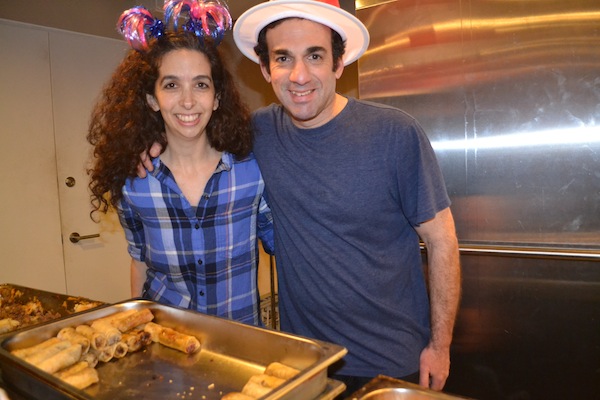
The Bayit joined forces with Chabad of Richmond in an emoji-themed Purim celebration held at Richmond’s City Centre Community Centre March 12. Pictured here, left to right, are Chabad of Richmond’s Rabbi Yechiel Baitelman, Bayit president Mike Sachs, Yoav Rokach-Penn and the Bayit’s Rabbi Levi Varnai. (photo by Lauren Kramer)

In every community, and ours is no exception, there are folks who frequently capture the spotlight for their work while others quietly get things done behind the scenes, flying below the media radar. In our new Kibitz & Schmooze profile, we’ll try to highlight members of Greater Vancouver’s Jewish community who are doing outstanding, admirable and mention-worthy work out of view of the general public. If you know of profile subjects who fit this description, please email [email protected].

Kids and anxiety go hand-in-hand, but, when kids’ anxiety gets out of control, many parents turn to Annie Simpson.

The 39-year-old Vancouver Talmud Torah mom boasts a PhD in psychology and 10 years’ experience in pediatric psychology. She founded the Cornerstone Child and Family Psychology Clinic in Vancouver in January, where she works with nine other psychologists. But Simpson’s focus is on young patients with anxiety disorders, including obsessive-compulsive disorder, panic disorder, selective mutism and depression.

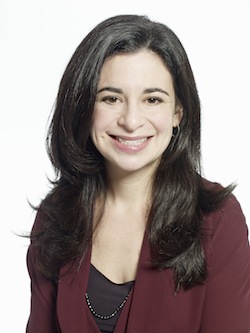
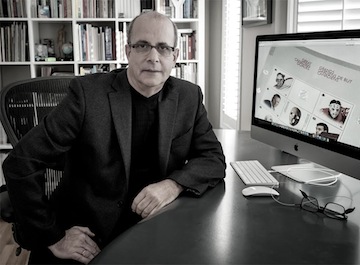
photo - Dr. Annie Simpson
Dr. Annie Simpson (photo from Annie Simpson)

Her interest in selective mutism, an impairment defined as an inability to speak in some social situations despite speaking perfectly fine in others, began six years ago. That’s when Simpson started getting referrals of children with the impairment and wanted to gain a better understanding of how to help them. She traveled to New York to confer with world-renowned expert Dr. Steve Kurtz, helped run one of his camps for selectively mute kids and came back enthusiastic about applying his cognitive behavioural therapy methods in Vancouver.

Within two years, Simpson ran the first camp of her own at the Jewish Community Centre of Greater Vancouver and soon started receiving calls from all over North America, from parents who wanted to enrol their children. Just under one percent of kids have selective mutism.

Simpson’s summer clubs are annual now, and in high demand. “I see a wide variety of impairment, from kids who only speak to one parent to kids who cannot speak at school,” she says. “At the camps, we develop a trusting relationship with the children and then expose them gradually to the feared situation, rewarding their success.”

Camp is Simpson’s favourite week of the year because the progress is so rapid. “The children are improving so quickly and they get so excited about their success,” she says. “With the right supports in place back home, the kids continue to thrive after the camp.”

For parents who don’t seek help for selectively mute kids, Simpson warns that the mutism gets more challenging to treat the older a child gets, and is particularly difficult when kids become teens and have had so many years of not talking.

When she’s not counseling patients, you’ll find this enterprising Vancouverite at B.C. Children’s Hospital, where she’s a staff psychologist in the pediatric OCD Program; at Simon Fraser University, where she’s a clinical associate in the department of psychology; or consulting for AnxietyBC.

*** 

photo - Café 41 put on a fabulous Argentine-style Purim dinner that was well-attended by members of the community March 12. Yamila Chikiar and Daniel Presman (pictured) own the café with Menajem Peretz
Café 41 put on a fabulous Argentine-style Purim dinner that was well-attended by members of the community March 12. Yamila Chikiar and Daniel Presman (pictured) own the café with Menajem Peretz. (photo by Lauren Kramer)


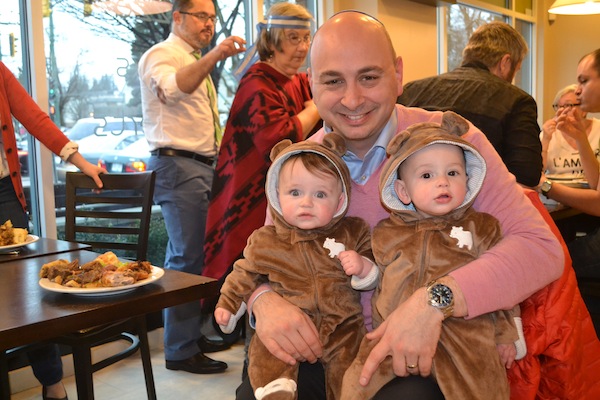
photo - Jewish Federation of Greater Vancouver chief executive officer Ezra Shanken with his nine-month-old twin boys at Café 41 for Purim
Jewish Federation of Greater Vancouver chief executive officer Ezra Shanken with his nine-month-old twin boys at Café 41 for Purim. (photo by Lauren Kramer)
Format ImagePosted on March 31, 2017March 31, 2017Author Lauren KramerCategories LocalTags Anne Simpson, Bayit, Café 41, Chabad of Richmond, Jewish Federation, mutism, Purim
The truest act of kindness

The truest act of kindness

Howard Jampolsky tells the story of how community members came together to support a family after the death of their husband, father. (photo from Schara Tzedeck Cemetery Board)

Taking care of the deceased is known as a chesed shel emet, or “the truest act of kindness.” The Schara Tzedeck Cemetery Board and Chevra Kadisha practise this every day.

We take care of our community’s deceased, and help their families from the time of death through the funeral service. Of course, because we have financial obligations like any other organization, we charge for our services. However, every family is charged the same price for burial plots and funeral services, and we only offer a traditional burial with all the proper rites. We treat every deceased person and their families equitably.

This practice varies only if a family is not in a financial position to pay the full costs. Sometimes, families simply need an extended period to pay for the funeral – for example, when funds are only available from the estate. Sometimes, families cannot pay the full amount, as this would cause a significant hardship. And then, there are times when a family is simply not able to pay anything at all. In all of these cases, we provide the same services as we provide everybody: it is our core belief and mission to provide a full and proper Jewish funeral according to all the customs and laws.

We carry out about 125 funerals each year and, while each is unique, there are some that truly stand out. This chronicles one such story.

On a cold and rainy day in October, I received a call from Rabbi Hillel Brody, who serves as the religious leader of the Louis Brier Home and Hospital. He told me there was a resident who was dying and his wife, who we will call “Margaret” (names have been changed in this story to protect privacy), was worried for a variety of reasons. Margaret and her husband “Shmuel” had moved to Vancouver about 10 years earlier and, because of Shmuel’s failing health, much of their time was spent visiting doctors and caring for him. They tried to connect with the community, but were unable and, earlier that year, Shmuel was moved into the Louis Brier. Margaret began to find some connection to people just by being in the more active setting of the home, but, still, her focus was almost entirely on caring for Shmuel. This devotion to her husband was admirable, but it came with a price – they did not have any close friends.

Margaret had no idea where to begin when it came to planning for Shmuel’s burial. To make matters worse, Margaret and Shmuel did not have the money to pay for a funeral or a burial plot. Rabbi Brody assured Margaret that the Schara Tzedeck Cemetery Board and Chevra Kadisha would take care of things. He told me that the only family was a daughter, who lived in Toronto, and he told me that she had decided to visit a few weeks earlier to see her father and say her goodbyes while he was still alive. As she could only make one trip, she had made this difficult choice, and was not going to be able to come for the funeral.

When Shmuel passed away, I called Margaret and arranged to meet her at her apartment to go over the details and get all the necessary paperwork signed. Margaret and Shmuel had been together for almost 50 years, and life had always been hard. They were both Holocaust survivors, both were born in Hungary. Shmuel had been held by the Nazis as a very young boy of less than 10 years old and, because of the conditions that he and other Jews were under, he became very ill from malnutrition and as a result of Nazi torture. He was fortunate to not have been murdered by the Nazis, as so many were, but though he survived and was rescued, he never truly recovered.

Margaret and I completed the paperwork required for registering Shmuel’s death, and talked about the funeral. She was shocked and humbled when I told her that we would provide Shmuel with a full and proper Jewish funeral and she would not have to pay anything. Her tears flowed again, but this time from relief.

Margaret told me she did not even know how she would be able to get to the cemetery. She had sold her car some years earlier, and would take the bus every day to be with Shmuel at Louis Brier. I told her that Rabbi Brody had offered to drive her to the cemetery. Again, she was surprised and grateful.

At this point, the funeral would be one of the smallest I had ever attended. It was looking like Margaret, Rabbi Brody and I would be the only people there. I knew that Margaret needed more help. The thought of her being dropped off at her small apartment to be alone after burying her husband was upsetting. She needed more support, and I asked Margaret if it would be OK if we purchased an airline ticket for her daughter, “Monica,” to come to Vancouver to be here for a few days, including for the funeral.

Margaret was at first confused by the question. I’m not sure she even comprehended what I was saying. But Monica accepted our offer and, later that day, an airline ticket was purchased for her.

With Monica in town, Margaret would be able to get to the cemetery, as Monica’s good friend, “Bill,” had agreed to drive them. Two more people would be there to help bury Shmuel.

I went home that evening feeling both exhausted and energized. I had worked hard that day to make sure everything would work for Margaret, but the weight of the day was offset by the buoyancy of the good deeds that were also done. Margaret was going to get through this a little easier now, and it felt good.

On arrival the next morning at shul, I saw Rabbi Brody. He told me he was inspired by what we had offered Margaret, and mentioned that he had advised Congregation Schara Tzedeck’s Rabbi Andrew Rosenblatt that the funeral was taking place the following morning. He said he had asked Rabbi Rosenblatt to announce the funeral to his congregation and, if anyone could attend, they should contact me.

I approached a congregant who is a wills and estates lawyer, and he offered to provide Margaret with legal help in dealing with her husband’s affairs, for no charge.

At the end of the service, another congregant approached me and asked me to contact Omnitsky Kosher and order food for the family to be sent over following the funeral, with the bill directed to her.

Neither of these people had ever heard of Margaret, or Shmuel, or Monica. They just were part of a community that was beginning to rally around a fellow community member to give her the support we would all need in such a situation.

The weather was forecast to be very windy and wet for the Sunday funeral, but we were lucky that it was still dry. Monica had told me she let a few people know about the funeral, and that they may come, so I was not surprised when I saw two people walking into the small cemetery. As they approached, I asked them if they were friends of Monica. They told me they did not know anyone by the name of Monica, but had heard there was funeral this morning for a Holocaust survivor, and that there would be only a few people here, and they wanted to come to support the family.

A few moments later, another car drove up – a man with his two sons arrived for “a funeral they had heard about.” Car after car arrived. More and more people gathered, some who had driven almost an hour to lend support to a total stranger and to participate in the mitzvah of laying Shmuel to rest.

When the funeral started at 11 a.m., there were close to 30 people there – none of whom had ever met Shmuel, Margaret or Monica.

The beauty of a chesed shel emet is that everyone gains. I know that everyone at the funeral, and everyone who helped in some way or another, benefited from this experience. But, most of all, Margaret benefited and will continue to benefit from a community that supported her in her darkest hour, and will continue to help her.

Margaret will mourn and grieve. She does not know how she will be able to live on without Shmuel, and cannot imagine ever recovering from this physical and emotional blow.

But she will.

Howard Jampolsky is executive director of Schara Tzedeck Cemetery Board.

Format ImagePosted on March 31, 2017March 31, 2017Author Howard JampolskyCategories LocalTags bereavement, chesed shel emet, death, Judaism, Schara Tzedeck
Teens enjoy N.Y. Shabbaton

Teens enjoy N.Y. Shabbaton

CTeen members with Rabbi Chalom Loeub. (photo from Chabad of Richmond)

Did you know that Richmond Jewish teens have a group of their own? It’s CTeen, which stands for Chabad Teen Network. CTeen Richmond, a program sponsored and hosted by Chabad of Richmond, is led by Rabbi Chalom Loeub.

“CTeen is open to all Jewish teens, regardless of their religious affiliation,” said Loeub. The international program run by Chabad Lubavitch is aimed at teens in grades 8 to 11. CTeen Richmond is currently comprised of a small group of teens, but wants to expand its numbers.

This unique program includes Sunday night learning, volunteering and socializing. Participants volunteer by cooking and baking for the Light of Shabbat meals, which are delivered to elderly Jews and those who have trouble cooking for themselves. The CTeens also cook and bake for the Smile on Seniors program at Chabad of Richmond.

Six CTeen youth from Richmond recently attended a CTeen Shabbaton in New York. This Shabbaton gathered 2,000 teens from around the world. It included Friday night programs, where they learned about Jewish history, as well as how Judaism relates to science. They also learned a bit about the Tanya, ate great food, met lots of other teens, sang, danced and had lots of fun. One of the Richmond CTeens described it as “inspirational.”

Friday afternoon, the teens got to explore New York in groups. Saturday evening, with stringent security, the CTeens took over Times Square for two hours, where they held Havdalah, sang and danced, and listened to motivational speakers on topics like Torah and the importance of doing mitzvot. Richmond teen Daniel Davydova, who went with his brother Itay, took from this experience the message that “together, we are the future.” He described the experience as “enlightening.” After the talks, the teens toured New York on buses.

The highlight of the Shabbaton for most of the Richmond group was visiting the Ohel, the holy site of the Lubavitcher Rebbe’s grave. The teens found it extremely spiritual, and got the chance to write letters asking G-d for blessings for themselves and others. It was here they also wrote their personal “resolutions,” and committed to carrying these out.

Dana Sander, a Richmond CTeen member, called the visit “amazing” and said she’d recommend the CTeen Shabbaton to everyone. Fellow member Aaron Benatar said he loved “connecting with other Jewish teens from around the world.” He said that “standing shoulder to shoulder as a group” was very powerful. He said it “rekindled his Jewish spirit, and made him feel even more committed to helping the Jewish community through doing mitzvahs.”

The Richmond CTeen program focuses on Torah study and the importance of helping others. Eyal Levy, who’s been part of the program for a few months, is very enthusiastic about it. “I love the cooking most of all,” he said. “We get to cook for seniors who need it. I also love the socializing and games. Plus, we get to talk to the rabbi about topics that interest us.”

According to Rabbi Yechiel Baitelman of Chabad of Richmond, “CTeen harnesses the incredible potential of teenagers by offering awesome programs that bring teens together to give back to their communities. CTeen welcomes every Jew and creates a sense of belonging.” The CTeen Network views the teenage years as a time not just for partying and frivolity, he added, but as a time of purpose and self-discovery. The goal is to connect participants to anything and everything Jewish.

For more information, contact Loeub at 778-712-7703 or email [email protected].


Format ImagePosted on March 31, 2017March 31, 2017Author Chabad of RichmondCategories LocalTags Chabad, Chalom Loeub, CTeen, Judaism, Richmond, youth
Celebrating Canadian teams

Celebrating Canadian teams

In 2012, Avi Dunkelman and his business partner, Joseph Gault, won a five-year contract from Canada Post to create a postage stamp series celebrating 100 years of the National Hockey League. (image from Avi Dunkelman)

It was as if he had come full circle, when Israeli-born Avi Dunkelman won a five-year contract from Canada Post in 2012 to create a postage stamp series celebrating 100 years of the NHL, focusing on the seven Canadian teams in the league.

Dunkelman was born in Haifa in 1954 and, at an early age, started collecting the stamps from the postcards his father sent him on his travels in Europe. The stamps gave Dunkelman a great appreciation for graphic design, so much so that he opted to go to art school.

“After I finished my military service, I decided to see if I could get some work in graphic design,” he told the Independent. “I soon realized that what I had learned in high school was not enough. I needed to study this very seriously in order to make a career out of it.”

photo - Avi Dunkelman
Avi Dunkelman (photo from Avi Dunkelman)

Dunkelman first thought to pursue his studies in the United States but, as all of his mother’s family lived in Toronto, he chose to go there to study for a year. During this time, he also worked on improving his English language skills, with the intention of continuing his studies in the States.

Three weeks after he arrived, in 1977, he was attending Ontario College of Art and Design. He then pursued a post-graduate degree in Switzerland, at one of the top graphic design schools in the world at the time – they only accepted eight students per year.

In 1984, he made his way back to Toronto and got married, opening his own graphic design firm in 1986, called Avi Dunkelman Design Group. In 1987, he began teaching at Ontario College of Art and Design, where he has worked ever since – he’ll be celebrating 30 years there this spring.

“In 2010, I formed a partnership with my business partner, Joseph Gault, who studied with me in Switzerland,” said Dunkelman. “We’ve known each other for 37 years, and decided to form a creative partnership under the brand of Mix Design Group.

“We were invited to compete in designing the stamp for the Year of the Snake in 2011 – we won four design awards for it. In 2012, we were asked to compete on a five-year project celebrating or commemorating the 100th anniversary of the NHL. We submitted our design concept and we won the competition.”

Over the five years, Dunkelman and Gault designed 69 stamps, 32 first editions, about 15 booklets, and all kinds of other materials. It is the largest program that Canada Post has ever tasked.

Dunkelman did not grow up with hockey in Haifa. Instead, soccer was the sport of choice. He recalled, “I saw a glimpse of hockey, but never got to really understand the game like some Canadians do. I don’t know how to skate.

“My business partner is a hockey buff. His father was actually a professional hockey player in Scotland. He’s Canadian-born and grew up playing hockey with his father coaching him. He knows a lot more than I do.

“I think that the fact that I look at it from a layman’s perspective gives us an advantage … looking at things in a different way. And this is what my contribution to this project is.

image - One of the biggest challenges for Dunkelman was working with six different player photos at a time, editing them so that they work seamlessly together
One of the biggest challenges for Dunkelman was working with six different player photos at a time, editing them so that they work seamlessly together. (image from Avi Dunkelman)

“The way we work is we sit and brainstorm some ideas,” he said. “Then, we work independently on some ideas, designs, get together, analyze them, and decide what works and what doesn’t.”

One of the biggest challenges for Dunkelman was working with six different player photos at a time, editing them so that they work seamlessly together.

“That’s a challenging process,” he said. “If you look at the photograph on the stamp and the original, they sometimes look totally different.”

Over his more than 30-year career, Dunkelman has had to learn how to incorporate computers into the design process. The first computers came onto the scene as he graduated from the school in Switzerland and Dunkelman recalled that one of his teachers received four computers from Steve Jobs as a gift. While not so useful at the time – it was the mid-1980s – as software and computers developed further, Dunkelman began using them in his design process.

“Obviously, I had to adapt to computers, as the technology was growing, too, and going through its own growing pains,” he said. “I’d say I’m not unique in that. I think most designers had to do the same thing. When I was starting out on computers, Photoshop wasn’t around … wasn’t as complex and sophisticated as it is now. So, there were a few things I was integrating at the same time … taking an image, doing something, printing it, re-photographing it, re-modifying it, going back and forth between the computer and the work table.

“By the way, that’s part of the way I teach at school now … because my message to the younger generation is that the computer is not the answer for everything. The idea is not to develop a dependency on it. Depending on the nature of the project and what the opportunities present you with, even today, there are certain things to do in an analogue way.”

Dunkelman works with a production person. “I don’t have the time to get the ins and outs of every little update of software coming my way,” he said. “I try to keep up, but, to do this effectively, I’d need to devote my entire time to it. It’s not feasible for me.”

According to Dunkelman, graphic design has changed a lot in the computer era, opening up opportunities for more people to be in the industry. However, he said, “It’s a little disappointing to me how graphic design in general is going back. A lot of things look the same because people are using the same software, the same tools, fonts and colours. Especially with website design being template-oriented … it’s becoming more about information management and data management, as opposed to creating.”

Dunkelman has a long list of clients, including the Ontario Chamber of Commerce, the Royal Canadian Mint, the University of Toronto and many private companies.

“Right now, I split my time between teaching and working,” he said. “Going forward, the professional work I’m doing is probably going to slowly diminish by choice, while still teaching and being a mentor for the next generation.

“This is one of the things I’m focusing on for my students – mentoring them to a point where I still keep a strong connection with former students who seek advice. They know I’m always available, open and willing to help. This is what I really enjoy seeing – the next generation and my former students getting ahead in their own careers and taking charge of the industry … hopefully, to become leaders.”

Rebeca Kuropatwa is a Winnipeg freelance writer.

Format ImagePosted on March 31, 2017March 31, 2017Author Rebeca KuropatwaCategories Visual ArtsTags Avi Dunkelman, Canada Post, Hockey, NHL
New legion slate, and more

New legion slate, and more

Left to right: John Collier, Ralph Jackson (president), Alan Tapper (first vice-president) and Marc Perl (second vice-president) at Royal Canadian Legion Shalom Branch 178’s January general meeting. (photo from the legion)

At its general meeting in January, Royal Canadian Legion Shalom Branch 178 elected its new management slate: Ralph Jackson (president), Alan Tapper (first vice-president), Marc Perl (second vice-president), Jenica Neamu (secretary) and Jeff Simons (treasurer). The executive officers are, in alphabetical order: Libbera Amram, Eugene Edelman, Maurice Elharrak, Rosemary Harkins, Frank Long, Angela Miller, Danny Redden and Larry Shapiro.

The next general meeting will take place at the legion, 2020 West 6th Ave. For information on it and becoming involved, call Tapper at 604-263-8498 or email [email protected].

* * *

photo - Minister Gilad Erdan, left, and Moshe Teitelbaum
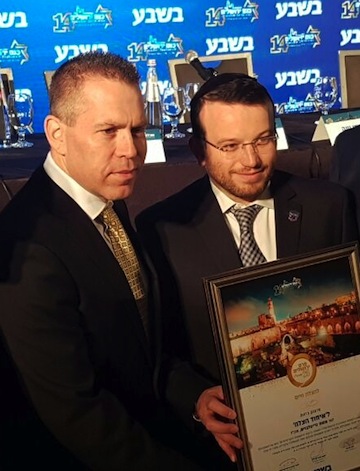
Minister Gilad Erdan, left, and Moshe Teitelbaum. (photo from United Hatzalah)

On Feb. 13, Israel’s national volunteer emergency medical services organization, United Hatzalah, received the Jerusalem Prize for excellence in lifesaving. The director of United Hatzalah, Moshe Teitelbaum, received the award in honour of the 3,200 volunteer EMTs, paramedics and doctors who work with the organization. The award was presented by Gilad Erdan, Israel’s minister of public security, strategic affairs and information.

Among the reasons given by the judges with regards to why United Hatzalah was selected for the award, the judges explained: “United Hatzalah is receiving this prize due to the activation and operation of its volunteers, and providing first-response emergency medical treatment in the first few minutes after an emergency occurs, before the arrival of an ambulance.”

United Hatzalah president and founder Eli Beer welcomed the prize and the recognition of the efforts of the volunteers.

“This prize was given to us due to our volunteers,” he said. “It is they who deserve it for their hard work and dedication to saving lives across Israel. They leave their beds, homes, workplaces, family and friends in order to answer the call of others and save the lives of those who need it most in their communities. Our volunteers work tirelessly, often long into the night, in order to provide fast and professional emergency response in under three minutes. May Israel be blessed with more people like our volunteers.”

* * *

Limmud, the international network of Jewish learning communities, will be awarded the Jerusalem Unity Prize in the Diaspora category on Unity Day, June 7.

President of Israel Reuven Rivlin will bestow the award in Jerusalem, recognizing Limmud’s global success in bringing Jews together. The prize is a joint initiative between Jerusalem Mayor Nir Barkat, Gesher and the families of Eyal Ifrach, Gil-ad Shaer and Naftali Fraenkel, z”l.

“We are grateful for this fabulous honour,” said Limmud chair David Hoffman. “Limmud promotes Jewish unity by offering an inclusive cross-communal space for Jews of all ages and backgrounds, to meet, learn, volunteer and build community. Unity is about celebrating our diversity while working together to build community and create a dynamic Jewish future. This is what Limmud does.”

Founded in the United Kingdom in 1980, Limmud today has spread to 84 communities in 44 countries on six continents. In 2016, Limmud’s 4,000 volunteers produced 74 Jewish learning festivals and events around the world, which drew more than 40,000 people.

A core tenet of Limmud is that everybody is an equal member of the community, whether layperson or rabbi, communal leader or educator, adult or child. Limmud’s values stipulate that it is a community of learning, recognizing that far more can be achieved together than individually. Everyone can contribute and all are responsible for one another and the communities that are created.

“Today, when deep schisms separate Jews – politically, religiously, within communities and between the Diaspora and Israel – the Limmud model and message is more necessary than ever,” stated Limmud board member and head of strategic development David Bilchitz, who is based in South Africa. “Building and sustaining unity takes hard work and a constant effort to understand and bridge our differences. Owing to Limmud’s shared values, Limmud offers a platform to explore, understand and discuss differences, emphasizing common denominators and what we can learn from each other. It is thus a beacon of light in building the future of community through respect and accepting diverse Jewish identities.”

Apart from its work in the Diaspora, Limmud has been embraced by thousands of Israelis, where nine Limmud communities bring together people across the religious spectrum and from all ethnic origins – Ashkenazim, Sephardim, immigrants from the Former Soviet Union, and many others.

The Jerusalem Unity Prize and Unity Day recognize individuals, organizations and initiatives in Israel and throughout the Jewish world that advance mutual respect among the Jewish people.

Format ImagePosted on March 31, 2017March 31, 2017Author Community members/organizationsCategories LifeTags health, Jerusalem Prize, Jerusalem Unity Prize, Limmud, Shalom Branch 178, United Hatzalah
History, literature vital

History, literature vital

Rachel Seelig, author of Strangers in Berlin: Modern Jewish Literature Between East and West, 1919-1933. (photo by Lauren Kurc)

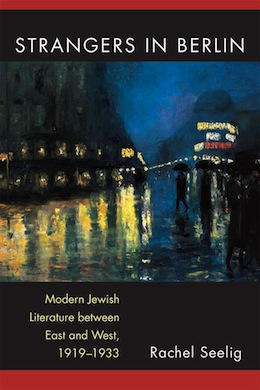
Rachel Seelig’s Strangers in Berlin: Modern Jewish Literature Between East and West, 1919-1933 (University of Michigan Press, 2016) encompasses so many ideas – some very nuanced, others technical – that a reader will enjoy it on their own, but will learn much more if they can discuss and analyze it with others.

Strangers in Berlin uses the example of four poets – Ludwig Strauss, Moyshe Kulbak, Uri Zvi Greenberg and Gertrud Kolmar – to examine the influence that Berlin during the Weimar Republic had on Jewish literature.

“The relationship between German Jews and East European Jews in Germany typically has been depicted in terms of … German Jews figuring as reluctant hosts, cultural insiders who viewed the so-called Ostjuden as outsiders or even infiltrators,” writes Seelig. “Strangers in Berlin is aimed at destabilizing these designations by presenting Berlin as a border traversable in both directions…. Foreigners arriving from abroad availed themselves of artistic inspiration and anonymity in order to cultivate new forms of culture, while those native to Germany ascertained their increasing estrangement from the fatherland, which they similarly channeled into artistic production. Whether they were coming or going, exiled in Germany or soon-to-be-exiled from Germany, these writers experienced Berlin as a transitional site between a moribund pre-World War I political order and an increasingly divided, nationalistic European reality.”

Seelig told the Independent that she “chose to focus on four poets who are not necessarily remembered as key figures in Weimar culture but who had considerable influence in their own day.”

She explained, “One of the reasons that these poets are relatively neglected is that they are not easily categorized according to national literary boundaries. Two of them, Strauss and Greenberg, immigrated from Europe to Palestine and wrote in more than one language (Strauss in German and Hebrew and Greenberg in Yiddish and Hebrew) and the other two, Kulbak and Kolmar, produced highly diverse, avant-garde bodies of work that do not align with what we tend to see as the dominant literary trends of their day. So, these writers weren’t just ‘strangers in Berlin’ – that is, writers who are located on the margins of the cultural milieu in which they had either permanently or provisionally settled – but also strangers to us as readers in the 21st century.

“I suppose I made it my mission to bring their extraordinary writing to light, and the best way to do so was to group them together within this context of intense transition and transformation,” she said. “For all four, the experience of living in Weimar Berlin – even if only briefly – left a profound imprint on their work and on their national identity. For all four, Berlin was a place in which they were forced to renegotiate identity. Taken together, I think their works provide a fascinating glimpse into the multiplicity of images of Jewish homeland that emerged during this very fruitful yet volatile period in history.”

Weimar Berlin brought together German, Hebrew and Yiddish literature and Strangers in Berlin examines “the impact of migration – of individuals, languages and cultural concepts – on Jewish national consciousness between the world wars,” writes Seelig. She chose to focus on poets, in part, “because establishing an autonomous and multifaceted poetic tradition was a crucial component of modern national movements.”

Whereas both the Westjuden and Ostjuden “initially viewed Germany as the wellspring of liberal, Western values, by World War I, they had begun to ‘re-orient’ their gaze toward the ‘East,’ extending temporally and geographically from the ancient Near East to contemporary Eastern Europe,” writes Seelig. “Plagued by the uncertainty of national homelessness and the terror of rising antisemitism, both groups looked eastward with a combination of nostalgia, hope and despair in a effort to come to terms with the failure of the West to fulfil the promise of coexistence predicated on the liberal principles of Enlightment. Indeed, melancholic longing for the ‘East’ betrayed profound dislocation in the ‘West,’ which in turn fueled the search for a new national homeland, whether real or imagined.”

Vancouver-born and -raised, Seelig received her undergraduate degree in comparative literature at Stanford University, then worked for a time in New York. She earned her master’s and PhD in Jewish studies at the University of Chicago, spending her last couple years of graduate school in Tel Aviv. She received the Ray D. Wolfe Postdoctoral Fellowship in Jewish Studies at the University of Toronto and then, after that, returned to Israel, where she was a Mandel Postdoctoral Fellow at the Hebrew University of Jerusalem. Currently, she is a fellow at the University of Michigan’s Frankel Institute for Advanced Judaic Studies. She speaks English, Hebrew, German and Yiddish. From even this brief bio, it is no wonder that Seelig is interested in borders and thresholds.

“We live in a world today that is both utterly divided and, in a sense, borderless,” she told the Independent. “The phenomena of globalization and mass migration have made us keenly aware of the ways in which borders are, on the one hand, more easily traversed, and, on the other hand, rigourously enforced and policed. Borders have always been sites of contestation and conflict, but a border can also be seen as a threshold that one crosses from one reality to another and a productive site of transfer and transformation.

“I myself migrated across several borders as this book came into being. It started to develop as a doctoral dissertation in Chicago, which I finished writing in Tel Aviv. It became a book – one that changed shape continuously – in Toronto, Berlin and Jerusalem, and was ultimately published in Ann Arbor, Mich. My own nomadic experience as an academic (and I realize, of course, that mine is a kind of privileged nomadism) made me particularly attentive to the impact of changing surroundings and of transitions on one’s thinking, work and identity.”

While accessible, Strangers in Berlin’s dissertation origins are evident, and there are some sentences people will have to read more than once for understanding.

“Strangers in Berlin is first and foremost an academic book, which grew out of my doctoral dissertation, acknowledged Seelig. “But, in the process of transforming the dissertation into a book – and I should point out that the book departs fairly dramatically in terms of content and argument from the dissertation – I made a concerted effort to make the text engaging and highly readable by simplifying the language and peppering every chapter with interesting anecdotes. It will be used by researchers and teachers within the academic context, but I also very much hope that it will be read by lay readers who are interested in modern Jewish culture and the history of the Weimar Republic, which is such a vibrant and captivating time period. I also think that the themes of homeland and migration, which are at the centre of the book, are extraordinarily relevant today, and I hope that readers will find this glimpse into Weimar culture and history resonates with our own political reality today.”
book cover - Strangers in BerlinCertain parts of Strangers in Berlin will make readers shiver with a sense of déjà vu. In the chapter on Kolmar, for instance, Seelig writes that, in the poet’s one novel, Die jüdische Mutter (The Jewish Mother), “Kolmar offers a pained reflection on the impossibility of salvaging a viable German-Jewish female identity in an era when both Jewishness and femininity were under siege.” Seelig notes, “Conservatives seeking to safeguard their middle-class privileges and to rebuild a healthy Germany Volkskörper (national body) regarded independent women and integrated Jews as similarly ‘decadent’ social elements…. The result of this campaign was a new form of male repression, which was often shrouded in xenophobic sentiments.”

Readers will see similarities between the Weimar period and what is currently happening in some European countries and in the United States. As it happens, Strangers in Berlin’s launch took place the day after the U.S. presidential election.

“A few hours before the event,” she said, “I was reading an article by Chemi Shalev in the Israeli newspaper Haaretz, in which he commented that many millions of Muslims, Mexicans and Jews now feel like ‘strangers in the country they call home.’ Obviously, his statement resonated very strongly with me and with my book.

“The book deals with a historical moment, nearly a century ago, when Berlin emerged as a major metropolis that attracted large swaths of immigrants, who were often seen as unwelcome infiltrators. In this respect, 1920s Berlin isn’t such a far cry from Berlin or Toronto or New York City of today. The book really does resonate with what’s going on in the U.S. and in so much of the world.… We are witnessing the rise of nativist sentiments and attendant xenophobia and bigotry that are oh so reminiscent of interwar Europe. And we’re seeing the way in which various forms of bigotry (anti-immigration, antisemitism and misogyny, all addressed in the book) have a tendency to intersect and even merge when these nativist sentiments are bolstered by political power. I realize it’s a cliché, but it really is remarkable to see how history repeats itself. It’s such a shame that the humanities, specifically history and literature, are under attack today (Trump just eliminated funding for the National Endowment for the Humanities from his proposed budget) at a time when we so desperately need them.”

Strangers in Berlin’s four poets struggle, as we all do, with the impossibility of being one thing – a German (or any other nationality), a Jew (or any other religion), for example. Not to mention the different conceptions of what comprises a “real” German (Canadian, American, etc.) or an “authentic” Jew (within the ranges of observance, belief). From all the research Seelig has done – her work, travel, ability to speak multiple languages and negotiate various cultures – has she any theories as to why humans have such trouble, in general, with multiplicity, ambiguity, a lack of borders?

“I wish I knew why we as humans have such a hard time with ambiguity,” she said. “This is something that affects our lives not only in terms of cultural, national or political identity but also in terms of relationships, career paths, place of residence, etc. On the one hand, we have more freedom than ever before to dwell ‘between’ identities, or to inhabit more than one identity, and yet that’s somehow deeply unsettling to us as creatures that crave order, certainty and security.

“I think there’s so much to be learned by the figures in my book, who didn’t have the luxury to choose where they would live or which system of beliefs to subscribe to (at least not without the risk of persecution), and who were profoundly shaped by the contingencies and vicissitudes of life. Each of the four main writers in the book represents more than one identity and, for each one, this was certainly a source of anxiety but also a source of profound inspiration and enrichment.”

Format ImagePosted on March 31, 2017March 31, 2017Author Cynthia RamsayCategories BooksTags history, poetry, Rahel Seelig, Wiemar Republic
Mystery photo … March 31/17

Mystery photo … March 31/17

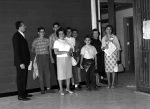
Jewish Community Centre of Greater Vancouver, 1950. (photo from JWB fonds, JMABC L.11154)

If you know someone in this photo, please help the JI fill the gaps of its predecessor’s (the Jewish Western Bulletin’s) collection at the Jewish Museum and Archives of B.C. by contacting [email protected] or 604-257-5199. To find out who has been identified in the photos, visit jewishmuseum.ca/blog.

Format ImagePosted on March 31, 2017March 31, 2017Author JI and JMABCCategories Mystery PhotoTags history, JCCGV, Jewish Community Centre, JMABC
Water expertise helps

Water expertise helps

During an installation of a solar water pumping system at Nyanza Village, Uganda, Innovation: Africa’s engineer and project manager celebrate as clean water flows. (photo from Innovation: Africa via Israel21c.org)

Using ingenuity to overcome its serious water challenges, Israel has become the go-to expert for a world facing an impending water crisis. To celebrate World Water Day on March 22, Israel21c took a look at 10 of these innovative water projects, and Israel’s leadership role.

This year’s WATEC expo and conference, to be held in September in Tel Aviv, is expected to attract 10,000 stakeholders from 90 countries seeking Israeli solutions for water issues. Israel exports $2.2 billion annually in water technology and expertise. In addition, these commodities are shared on a humanitarian basis through training courses, consultations and projects. Keren Kayemeth L’Israel-Jewish National Fund (KKL-JNF) often hosts delegations from around the world – most recently, from California, Argentina and the European Policy Centre – to see how Israel’s system of treatment facilities and 230 reservoirs has achieved the world’s highest ratio of wastewater reuse. About 92% of Israeli wastewater gets treated and 75% is used for agricultural irrigation. Israel plans to recycle 95% of its wastewater for irrigation by the end of 2025.

“During the 1980s, recycling wastewater was a revolutionary concept and many people were skeptical. Today, nearly half of the irrigation in Israel comes from recycled wastewater,” said KKL-JNF development project director Yossi Schreiber.

Israeli water-tech companies are planning and building agricultural and municipal water infrastructure in countries including Angola, Ghana, Serbia, China, Spain and the United States. Here are 10 recent examples.
1. The nonprofit group Innovation: Africa won a United Nations award for transforming lives in seven African countries using Israeli technologies, such as Netafim irrigation systems, that enable farmers to grow more crops with less water; and solar energy systems that pump water from aquifers, saving villagers (mostly women and children) countless hours previously spent finding and fetching water.

2. IsraAID launched its WASH (Water, Sanitation and Hygiene) project about four years ago to tailor-make solutions for communities from Fiji to Haiti to Myanmar.

In the rain-dependent South Pacific island nation of Vanuatu, a March 2014 cyclone contaminated reservoirs and destroyed water-harvesting systems. Among other steps, IsraAID strategized the engineering of a low-tech gravity system, built and maintained by locals, to bring water from mountain springs down into two villages encompassing more than 600 people and one school. IsraAID is working with the World Bank to construct three more gravity systems.

In Kenya’s Kakuma Refugee Camp and Uganda’s Gulu township, which struggle with waterborne disease and water contamination, IsraAID trains unemployed or underemployed people to be water technicians. Graduates work with local nongovernmental organizations or water companies, or start their own businesses, to contribute their new expertise in anything from drilling wells and building latrines to teaching hygiene.

3. A massive landslide in September 2015 damaged a major irrigation canal partially built by Israeli NGO Tevel b’Tzedek in an impoverished Nepali village. Tevel staff repaired the damage with funding from the Rochlin Foundation and Jewish Coalition for Disaster Relief, and worked with the local water council to strengthen the canal walls, reestablishing and assuring water supply to 224 households (about 1,300 people) and subsistence farmers.

Also in Nepal, Tevel is fighting the effects of flash floods – which deplete water available for drinking and irrigation – by building irrigation pools and setting up zero-water-waste systems enabling villagers to conserve water through Israeli methods, including drip irrigation learned by Tevel’s native Nepal director at Ben-Gurion University of the Negev. Tevel also is teaching village farmers less water-intensive professions, such as beekeeping.

4. Israel’s Ministry of Foreign Affairs (MFA) has partnered with Caesarea-based GAL Water Technologies to provide free water-treatment products to African nations for more than 20 years. In 2016, MFA donated GAL mobile water purification, storage and distribution vehicles to drought-stricken Papua New Guinea and to the Pacific Marshall Islands.

5. Earlier this month, the MFA’s MASHAV-Israeli Agency for International Development Cooperation established the Kenya Israel Drought Resilience Agriculture Centre to help in capacity-building with the latest Israeli irrigation and water-resources management know-how.

6. MASHAV’s special envoy for water and food security went to Swaziland this month with the director of overseas training, programs and research at MASHAV-affiliated Centre for International Agricultural Development Cooperation to conduct a water survey by request of Swaziland’s prime minister. The experts are identifying possible areas of cooperation in combating drought and a shortage of water for agriculture.

7. Following a May 2016 earthquake in Ecuador, IsraAID brought a new Israeli water-purification technology from NUFiltration to several affected villages. Instead of having to buy bottled drinking water, residents can use the NUF system to turn washing water into purified drinking water without electricity. NUF was first piloted by the company in Ghana as a humanitarian project to prevent diseases from contaminated water.

8. The Tel Aviv University chapter of Engineers without Borders designed and built a rainwater collection and purification system in a Tanzanian village where the drinking water had dangerously high amounts of fluoride. Since the project was finished in 2014, it has been supplying safe drinking water to more than 400 children daily.

9. The Technion Engineers without Borders chapter designed and implemented a safe drinking-water system serving more than 600 Ethiopian schoolchildren in a rural village with no reliable source of water for drinking and handwashing. The Israelis taught the older children how to maintain the system and treat the water, and continue to provide support to assure a safe and sustainable water supply.

10. In June 2015, the Israeli Ministry of Economy committed $500,000 to the World Bank Group’s Water Global Practice to help developing countries overcome complex water security challenges. The agreement has included two years of study tours and other activities for World Bank staff and officials of various governments.

Israel21c is a nonprofit educational foundation with a mission to focus media and public attention on the 21st-century Israel that exists beyond the conflict. For more, or to donate, visit israel21c.org.

Format ImagePosted on March 31, 2017March 31, 2017Author Abigail Klein Leichman ISRAEL21CCategories WorldTags Israel, tikkun olam, water
Working to get to Olympics

Working to get to Olympics

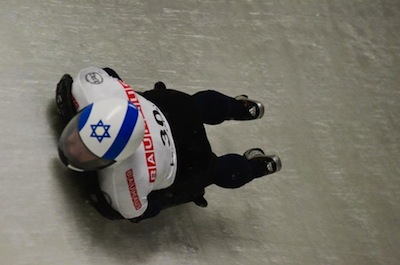
Joel Seligstein is one of four Israeli skeleton athletes aiming for the 2018 Olympic Games in PyeongChang, South Korea. (photo by Erin Murphy)

What began as a dream 15 years ago – when David Greaves helped establish an Israeli presence in the bobsled and skeleton world – finally received the approval, recognition and support of the Israeli Olympic Committee this past December.

Greaves was a member of the Israeli bobsled team that fell short of qualifying for the Olympics in 2006, although they did compete in two world championships.

“When I retired from the sport,

I felt I wanted to continue in some capacity,” Greaves told the Independent in an interview earlier this year. “So, I took over as head of the federation, of which I’m now the president. It’s called Bobsled Skeleton Israel, which is the Israeli bobsled skeleton federation.

“I wanted to stay involved in the sport and to try to provide an opportunity for other Jewish athletes to experience something of what I did – the pride of wearing the Magen David on your jacket and competing for Israel internationally.”

The experience changed the trajectory of Greaves’ life – he was working in the sales and high-tech industry. It also made him realize what was important for him as a Jew and an Israeli.

“I came back from that experience deciding I wanted to leave the world of high-tech and focus my efforts on Jewish community and working for Israel,” he said. “That led me to volunteering for the Jewish Federation of Winnipeg. This soon led to me working on a contract basis for them, which turned into a full-time role. I became a fundraiser for the Jewish community.”

Greaves spent 10 years fundraising for Winnipeg’s federation and then for the Jewish Foundation of Manitoba, before starting his own business in 2014. Called Protexia, it helps nonprofits and charitable organizations fundraise.

With the refocus in his professional life also came a refocus in his involvement with Bobsled Skeleton Israel. As the organization’s volunteer president, he is in regular contact with the Israeli Olympic Committee as they gear up for the Winter Olympics in PyeongChang, South Korea, in 2018.

“The challenge was finding an athlete interested, sometimes from another program … the American program, whatever it happened to be. Some of the bigger programs are so deep, you can be a great athlete … but may not have an opportunity to make the big leagues and would likely not ever get the opportunity that they have now … to compete at the highest level, for a smaller nation,” said Greaves. “But now, I have four athletes competing at different levels around the world … and that’s more than most small nations have.”

While many people compete for Israel from around the world, most are not directly connected to the Israeli Olympic Committee, but, with the completion of the process in December, Bobsled Skeleton Israel is now an official Olympic sport under its umbrella. Last September, the committee had accepted Greaves’ recommendation to recognize the criteria established by the International Bobsled and Skeleton Federation as the Israeli criteria.

“It was almost anticlimactic,” said Greaves. “I was working on this for 13 years and I’d never had the opportunity to present to the Israeli Olympic Committee before, with the opportunity of them possibly accepting our recommendation. Needless to say, I was over the moon and ecstatic.

“So, now, I feel confident talking about our future, because the only step left for us to be competing at the Olympics is for one of my athletes to qualify. If we have an athlete that qualifies, then we’ll be going to Korea for the Games, as he will have met the criteria.”

To get to the Olympics, the athletes will need to be in the top 60 internationally. For the current season, the goal is to get two athletes into the top 75 world ranking, which would position them for next year. They currently only have one.

All of the Israeli athletes in the federation are competing on their own in skeleton.

“It’s been easier for us to find skeleton athletes from a budgetary standpoint, because we don’t fund our athletes,” said Greaves. “We’d love to have a bobsled team, too, but it’s a bit more work for us to really develop that program. Given I’ve got a full-time day job and we don’t at the moment have any prospects for bobsled athletes, our efforts have solely focused on developing our skeleton program.”

Israeli skeleton athlete Bradley Chalupski in action
Israeli skeleton athlete Bradley Chalupski in action. (photo from Bradley Chalupski)

Bobsled Skeleton Israel is a nonprofit in the United States, enabling them to fundraise there for their athletes. These athletes can fundraise within their circles and the organization can provide a tax receipt to donors.

“We’ve been pretty successful in the last few years in raising more money than we have in the past,” said Greaves. “It’s been allocated out to the athletes based on need. Essentially, they get reimbursed, in very small part, for their costs. If we have $5,000 or $10,000 in the bank, so to speak, and an athlete has just come back from a week of training, then they can submit a portion of their expenses. But, it’s very modest.

“We’re looking to have a fundraiser this spring in Winnipeg. There’s also now – because we’re now officially a member within the Olympic movement in Israel – the possibility for funding from the state if an athlete qualifies for funding.”

In that case, the athlete will be eligible for a few Israeli shekels a month. Even so, about 95% of the money spent in this sport by Israeli athletes is money that they themselves have raised, either through their own personal supporters or their own savings. According to Greaves, his athletes have given up the last two or three years of their lives to compete and train.

Contributions are deductible in Israel and the United States, and there is an Indiegogo campaign currently underway. Greaves is in discussion with a few Jewish organizations with the hope that they may be able to assist in accepting Canadian donations.

“We want people to understand we’re in this because of a love for Israel and a love for sport,” he said. “Our ultimate dream is to walk into the Olympic stadium with the Israeli flag. There’s such a pride that’s hard to convey. We do this out of a sense of pride and love for Israel.

“I once was asked in an interview years ago, when I was competing, if I had a choice to compete for Canada or for Israel, who would I pick? I’m a dual citizen. I said, without a doubt, I’d want to do it for Israel. There’s a special connection between my Jewishness, my connection to Israel and my Zionism. The other guys on my team feel the same way as well. Am Yisrael might make this a different experience than other athletes might have … not to take away from how amazing it would be for any athlete to represent their country.”

For more information and to follow the athletes – Bradley Chalupski, Adam (A.J.) Edelman, Joel Seligstein and Larry Sidney – visit facebook.com/israelibobsledandskeletonfederation. To contact Greaves, email [email protected].

Rebeca Kuropatwa is a Winnipeg freelance writer.


Format ImagePosted on March 31, 2017March 31, 2017Author Rebeca KuropatwaCategories WorldTags David Greaves, Israel, Olympics, skeleton, sports

Posts pagination

Previous page Page 1 … Page 453 Page 454 Page 455 … Page 667 Next page
Proudly powered by WordPress