Skip to content
  • Home
  • Subscribe / donate
  • Events calendar
  • News
    • Local
    • National
    • Israel
    • World
    • עניין בחדשות
      A roundup of news in Canada and further afield, in Hebrew.
  • Opinion
    • From the JI
    • Op-Ed
  • Arts & Culture
    • Performing Arts
    • Music
    • Books
    • Visual Arts
    • TV & Film
  • Life
    • Celebrating the Holidays
    • Travel
    • The Daily Snooze
      Cartoons by Jacob Samuel
    • Mystery Photo
      Help the JI and JMABC fill in the gaps in our archives.
  • Community Links
    • Organizations, Etc.
    • Other News Sources & Blogs
    • Business Directory
  • FAQ
  • JI Chai Celebration
  • JI@88! video

Recent Posts

  • Sharing her testimony
  • Fall fight takes leap forward
  • The balancing of rights
  • Multiple Tony n’ Tina roles
  • Stories of trauma, resilience
  • Celebrate our culture
  • A responsibility to help
  • What wellness means at JCC
  • Together in mourning
  • Downhill after Trump?
  • Birth control even easier now
  • Eco-Sisters mentorship
  • Unexpected discoveries
  • Study’s results hopeful
  • Bad behaviour affects us all
  • Thankful for the police
  • UBC needs a wake-up call
  • Recalling a shining star
  • Sleep well …
  • BGU fosters startup culture
  • Photography and glass
  • Is it the end of an era?
  • Taking life a step at a time
  • Nakba exhibit biased
  • Film festival starts next week
  • Musical with heart and soul
  • Rabbi marks 13 years
  • Keeper of VTT’s history
  • Gala fêtes Infeld’s 20th
  • Building JWest together
  • Challah Mom comes to Vancouver
  • What to do about media bias
  • Education offers hope
  • Remembrance – a moral act
  • What makes us human
  • המלחמות של נתניהו וטראמפ

Archives

Follow @JewishIndie
image - The CJN - Visit Us Banner - 300x600 - 101625

Author: Pat Johnson

B.C. NDP leader talks with JI

B.C. NDP leader talks with JI

B.C. NDP leader John Horgan (photo from B.C. NDP)

Horgan says he likes how British Columbians have come together across racial and religious differences during recent times of strife. In a wide-ranging interview with the Independent, the New Democratic party leader also promised to restore the B.C. Human Rights Commission, said he would like to see religious studies in the school curriculum, expressed opposition to boycotts against Israel and said ethnocultural groups play an important role in the delivery of social services.

Horgan, the provincial opposition leader who hopes to be premier of British Columbia after the May 9 election, said that public reactions to antisemitic and anti-Muslim incidents recently have been encouraging.

“What I’ve been seeing … is an unprecedented coming together of diverse groups – ethnic and people of faith – to support each other, whether it be [after] the horrific shootings in Quebec City or the threats of bombings here in the Lower Mainland,” he said. “I’ve seen people crossing traditional faith boundaries to embrace one another and that gives me great hope and optimism for the future here in B.C. When I look south of the border to the rise of hatred, antisemitism, Islamophobia – and without it being brought into check by the leadership, at least the executive branch of the United States – I’m absolutely concerned about that. But I think the advantage for us here in Canada and in B.C. is it gives us an opportunity to reaffirm our tolerance. I’ve been quite moved by it.”

Leaders, he said, have a role not only in legislating but in expressing attitudes that should exemplify the values of the community they serve. “The broader public often criticize politicians for participating in ethnic celebrations or ceremonies,” he said. But he believes it sends a crucial message about respect for multicultural and faith communities, so he attends Chanukah menorah lightings at the legislature and Kristallnacht commemorations, as well as events of many other communities.

Horgan said there must be a means for people who believe their human rights have been violated to seek redress and a body to spearhead education about human rights. An NDP government, he said, would re-establish the Human Rights Commission that the B.C. Liberals dismantled in 2002.

“Every other jurisdiction in the country has a commission for educational purposes, for bringing forward examples of human rights abuses, and I don’t know why British Columbia wouldn’t have that opportunity,” he said.

Also on the education front, Horgan said he would like to discuss with stakeholders the potential for adding religious studies to the B.C. school curriculum.

“I’m a student of history, I have a master’s degree in history and I look back as much as I look forward in terms of shaping my personal views,” he said. “I would see some benefit to having part of the curriculum have a religious studies component in the middle school or high school curriculum.” It might not be a mandatory course and he would seek consultation with school boards, teachers, parent advisory committees and others, but, he said, the idea has come up repeatedly in conversations with members of different religious communities.

Governments partner with community agencies to ensure culturally sensitive and appropriate delivery of services such as addiction, settlement and immigration and seniors’ programs, and this is something Horgan strongly favours.

“It’s not just ethnocultural and faith-based organizations,” he said, “it’s community organizations. In my world, the role of government is to try to unite and bring people together whenever possible and foster understanding and tolerance. You don’t do that by not having discussions or relationships with various organizations, you do that by stimulating that participation.”

Providing culturally appropriate foods for patients in the medical system is a small example of accommodation, Horgan said, but one that has been made more difficult by the outsourcing of food services in the health-care system.

On the security front, Horgan supports the $100,000 the province recently announced in funding for Jewish community security, though he would have done it differently had he been premier, he said.

“Anytime we can improve security for any community, I would support that,” he said. “I don’t want to take shots of the government in this interview but, for me, I would have reached across the floor and said to my counterparts, were I in the premier’s office, this is something that we’re going to do, can we have a resolution of the legislature to make this cross partisan lines, rather than making it a statement of, ‘the Liberals are doing this and the NDP or Greens or Conservatives are not.’ But, beyond that, I support it, absolutely.”

Horgan said he personally opposes the anti-Israel boycott, divestment and sanctions (BDS) movement, but he’ll let party members have their own opinions.

“On these issues, as a provincial leader, what I try to do is allow people to have their point of view. I don’t necessarily have to agree with them,” he said, adding that foreign affairs is a federal matter. “I hold fast to the hope that our federal government, which has diplomatic responsibility for these issues, will show leadership that divestment and sanctions are not a solution.”

He added: “I believe in a two-state solution to the challenges in the Middle East and that’s a personal view and I’ll share that with anyone who asks me. But I try in my interactions with various community members to focus on how do we provide unity here in British Columbia. I look at, just as an example, the sanctions on Cuba. They’re not comparable, I appreciate that, but it is an attempt to have a state outcome in another jurisdiction based on economic pressure, and all that’s happened as a result of that is increased poverty and a lack of understanding. I think we want to reduce poverty wherever possible and increase understanding and, by cutting ties, severing relationships, you’re never going to achieve that. My approach, personally, is always to engage rather than disengage, so I think the BDS movement is not something I support, but people have their own personal will. They can choose to invest their resources wherever they want to.… My own personal view … is that reducing interactions never leads to a better understanding, it leads to less understanding.”

Horgan noted he has met with several organizations in the Jewish community on issues around economic cooperation and trade with Israel.

“I’m excited about the prospects of increasing our ability in British Columbia to take advantage of the cultural linkages we have to grow stronger economic linkages,” he said.

As British Columbians ponder their electoral choices, Horgan said he wants Jewish voters to know that “what they want for themselves and their community I want for them as well.”

“That’s a tenet of social democracy,” he said, paraphrasing J.S. Woodsworth, an early leader of the Canadian left, who said, “What we desire for ourselves, we wish for all.”

“That is a tenet of the Jewish faith and that is something that I think those who have not looked to the NDP in the past may want to do so in the coming election campaign,” he said. “I want growth and prosperity for our communities, I want tolerance and peace and understanding – and those are the issues that I think most British Columbians want, regardless of their faith. I believe that if we focus on the mainstream values that unite us, rather than the issues that divide us, we’ll all be better off here.… My answer is to lead by example and to highlight always tolerance and welcoming and cooperation over intolerance, hate and division.”

The Jewish Independent’s provincial election coverage continues with interviews with other candidates in future issues.

Note: This article has been edited to reflect that the B.C. government allocated $100,000 for security measures in the Jewish community.

Format ImagePosted on March 31, 2017April 4, 2017Author Pat JohnsonCategories LocalTags BC NDP, education, Election, Israel, John Horgan, multiculturalism, politics, security
Don’t miss this Parade

Don’t miss this Parade

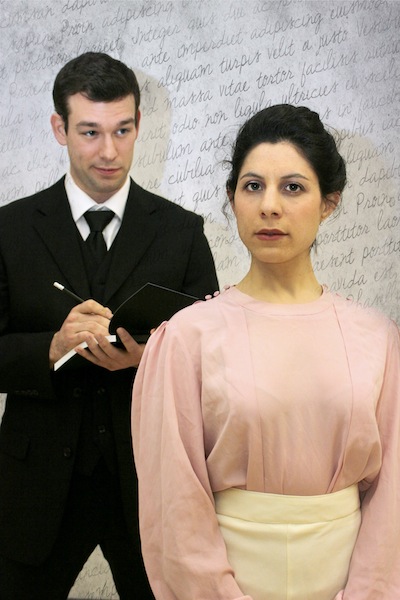
Left to right are Kaila Kask (Mary Phagan), Emily Smith, Rachel Garnet and Alina Quarin with Riley Sandbeck (Leo Frank). (photo by Allyson Fournier)

On Aug. 17, 1915, 31-year-old Leo Frank was kidnapped from the Georgia State Penitentiary in Milledgeville by a Ku Klux Klan lynch mob and hanged by his neck until he was dead. His alleged crime: the rape and murder of 13-year-old factory worker Mary Phagan. His real crime: being Jewish, successful and a northerner in an impoverished Deep South still reeling from the humiliation of the Civil War and looking for retribution against its perceived oppressors.

The case has been the subject of novels, plays, movies and even a mini-series. But who would have thought that you could make a musical out of such a tragedy. Author Alfred Uhry (Driving Miss Daisy) and Broadway producer Hal Prince (Cabaret) did. Thus Parade was born, with music and lyrics by Jason Robert Brown. It opened on Broadway in 1998, won two Tonys and went on to be produced across America to much acclaim.

Now, Fighting Chance Productions, a local amateur theatre company, is bringing this compelling story to Vancouver audiences for its Western Canadian première at the Rothstein Theatre April 14-29. Director Ryan Mooney and lead actor Advah Soudack (Lucille) spoke with the Jewish Independent about the upcoming production. But first, more background, because it is an incredible story.

Frank was a slight man – five feet, six inches tall, 120 pounds – with a nervous temperament. Born in Texas and raised in Brooklyn, he graduated from Cornell University with a degree in mechanical engineering and was enticed to move to Atlanta in 1908 to run the factory owned by his uncle. There, he met and married Lucille, a 21-year-old woman from a prominent Jewish family. The newlyweds lived a life of privilege and wealth in a posh Atlanta neighbourhood, Frank became the president of the local B’nai B’rith chapter. However, having been brought up in the vibrant Yiddish milieu of New York, he always felt like an outsider amid the assimilated Southern Jewish community.

The journey to his tragic demise started the morning of Saturday, April 26, 1913, when little Mary put on her best clothes to attend the Confederate Memorial Day Parade in downtown Atlanta. On the way, she stopped at the National Pencil Factory, where Frank was the superintendent, to pick up her weekly pay packet from his office. That was the last time she was seen alive. Her body, half-naked and bloodied, was found in the basement of the factory later that day. Shortly after, Frank was arrested by the police and charged with the crime along with the African-American janitor, Jim Conley.

The trial was a media circus fueled by a zealous district attorney, Hugh Dorsey, who was looking for a conviction in a high-profile case to popularize his bid for the governorship of Georgia, and Tom Watson, a right-wing newspaper publisher who wrote virulent, racist editorials against Frank, casting him as a diabolical criminal and calling for a revival of the Klan “to do justice.” Frank was convicted by an all-white jury on the testimony of Conley – who had turned state’s evidence in exchange for immunity – and sentenced to death in a trial that can only be characterized as a miscarriage of justice replete with a botched police investigation, the withholding of crucial evidence, witness tampering and perjured testimony. This was America’s Dreyfus trial and Frank was the scapegoat.

The conviction appalled right-thinking people and mobilized Jewish communities across America into action. William Randolph Hearst and New York Times publisher Adolph Ochs campaigned on Frank’s behalf. The conviction and sentence were appealed. Georgia governor John Slaton was lobbied to review the case. For two years, Frank sat in jail not knowing his fate until, one day, he heard that Slaton had commuted his death sentence to life in prison. In response, frenzied mobs rioted in the streets and stormed the governor’s mansion. A state of martial law was declared and the National Guard called out to protect the city. Against this backdrop, Frank was transferred into protective custody at the state penitentiary but that did not stop the lynch mob, some of whom had been jurors at the trial.

It wasn’t until 1986 that Frank was (posthumously) pardoned by the Georgia State Board of Pardons and Paroles.

Jewish Independent: What attracted you to this play?

Ryan Mooney: Parade has been a favourite musical of mine for as long as I can remember. I was drawn to it because it is such a fascinating story, it speaks so much to its time and continues to speak to us. When people see it, they will want to know more. It has beautiful soaring music, is very emotional, but also it is real, so relatable. It will take you on a journey that will touch you in many ways.

Advah Soudack: The songs, the music. When I was going through the script and getting used to the music, I could not get through some of the songs without choking up, it was so emotional, beautiful and real.

JI: How would you classify it as a theatrical piece?

photo - J.P. McLean (Britt Craig) and Advah Soudack (Lucille Frank) are part of the 25-person cast of Parade, which will have its Western Canadian première at the Rothstein Theatre April 14-29
J.P. McLean (Britt Craig) and Advah Soudack (Lucille Frank) are part of the 25-person cast of Parade, which will have its Western Canadian première at the Rothstein Theatre April 14-29. (photo by Allyson Fournier)

RM: It is, in essence, a love story about a young man and a woman who learn through tragic circumstances to have a deeper love for each other and to appreciate each other’s kind of love.

AS: Leo sees love as a service, being a provider, while Lucille looks for love in spending quality time together and physical intimacy. Over time, their two loves unite.

JI: This isn’t your typical musical. It has a very dark side. It covers the kind of subject matter usually covered in narrative plays. Do you think people want to see this kind of musical theatre?

RM: Our company, as our name states, takes chances and we are taking a chance on this, but I think the risk is worthwhile and that audiences will appreciate the story. It seems to do very well wherever it plays – Broadway, London. We thought the Rothstein Theatre would be the perfect venue and we hope that the Jewish community will support us.

JI: Is this strictly a Jewish story?

RM: It is not necessarily just a Jewish story, it could be about anybody, anywhere. It is a fascinating look at a historic event through a musical lens. I don’t think Prince was trying to make a political statement when he produced the show but rather to educate people about the event. At the time of its first production, 1998, shows like Ragtime and Showboat were on Broadway alongside Parade. It seemed to be a time for examining how mainstream America treated those people it considered lesser citizens.

JI: What was it like to cast?

RM: The production requires a large cast: 25. I needed people who could sing and act. Lots of people auditioned and we ended up with a great cast, with the members spanning the ages of 18 to 60. What makes this show very relevant is that we have actors playing roles for their real ages, not trying to be someone younger or older, and that makes the production more realistic. I wanted at least one of the leads to be Jewish and Avdah was perfect for the role of Lucille.

AS: When I heard about this show, I jumped at the chance to apply. I had been out of theatre for about 10 years and I really wanted to get back into it. I was lucky enough to get a callback after my first audition and felt very proud of my performance the second time around. I was thrilled when I got the role.

JI: What is it like to deal with a true event as opposed to a fictional account?

RM: Because it is a real life story, there is so much more research you can do to make sure you get it right. I read Steve Oney’s And the Dead Shall Rise: The Murder of Mary Phagan and the Lynching of Leo Frank and gave it to members of the cast to read to get a feel for the characters and some background information. There is some material that did not make it into the musical but the play does essentially honour the accuracy of the event.

AS: I am reading the book right now and it is so fascinating to get the story behind the character and be able to use that as an actor.

JI: How are Leo and Lucille portrayed in the script?

RM: He is not portrayed that sympathetically. At the trial, he is really cold and does not look repentant but, ultimately, we see him break. If he were just shown as a martyr and everyone else a villain, that would not be interesting for the audience. Instead, the audience sees his flawed human character and that is why it is a great story to tell – [he’s] a person with faults that anyone can relate to.

AS: She is a Southern woman and a product of the American melting pot, more assimilated than Jewish, and that is how she survives. America wants you to become American first and everything else second. People like her thought like that and assimilated. Then, she is thrust into this case, where horrific things are being said against her husband on a daily basis in the newspapers and she has to deal with that. Yet, she stands by him and is one of his biggest supporters. She even went to the governor’s mansion to personally lobby him to intervene in the case. For a young Southern Jewish woman, that was a big step. So, you see her grow into this strong, independent woman.

She comes across very strong in the play, perhaps stronger than she really was in real life, but she was so committed to Leo’s cause and to him. She came every day to jail to visit him and bring him food. The circumstances of the tragedy allowed her the opportunity to become a heroine.

JI: What will the staging be like?

RM: The set is a long wall with platforms set at different levels. The lights will move through the different levels from scene to scene to create more of a cinematic flow, more like a movie than live theatre. We did not want the story’s flow to be interrupted by the audience clapping after every song. Of course, we do hope the audience will give a standing ovation at the end of the show.

JI: What do you expect audiences to take away from the musical?

RM: I want them to walk out with questions and want to look up more information about the case, but I also want them to leave with the understanding that all good art finds the grey in life and that everything is not black and white. One of the biggest issues in America today is the mentality that you are either with us or you are against us. The world is going in that direction and it is a hard place to be. You have to be able to see issues from all angles if you want to see any positive growth. There are some ambiguities in the show but there are also strong life lessons about the dangers of prejudice and ignorance.

For tickets to Parade, visit fightingchanceproductions.ca.

Tova Kornfeld is a Vancouver freelance writer and lawyer.

Format ImagePosted on March 31, 2017March 31, 2017Author Tova KornfeldCategories Performing ArtsTags Advah Soudack, antisemitism, history, Leo Frank, musical theatre, racism, Ryan Mooney

What now, with arrest?

A teenager was arrested last week in relation to the scores of bomb threats against Jewish institutions throughout North America and elsewhere. There was widespread relief over the arrest, on the assumption that most, if not all, of the threats had emanated from this one individual.

There was also astonishment and heartbreak, though, when the alleged perpetrator was identified as a Jew with dual American and Israeli citizenship. Very little is known beyond the basic facts of the arrest and that the young man, who lives in Ashdod, in southern Israel, has a brain tumour that affects his cognitive abilities.

The bomb and other threats, the graffiti, hate materials and cemetery desecrations experienced in various parts of the world recently have combined to create a sense of unease unprecedented in the memory of most North American Jews. If a young Jewish man was indeed the cause of much of this anxiety for so many, how are we supposed to respond to this news? Would we prefer it were a Ku Klux Klanner who did these deeds? Does it make a difference?

Certainly it makes a difference.

Rational or not, there is more of a sense of shame, betrayal and even fear. And, as a commentator wrote in the Forward, there is the question, “Will people take seriously future antisemitic threats, or will our concerns be dismissed if it’s another Jew who is responsible for them?” This idea – that future threats to our community could be dismissed because these repeated incidents emanated from a Jew – is threatening in itself.

The arrest brought confusion for many. How to respond? If these deeds were the doings of a Jew, is it antisemitism, or something else? The Anti-Defamation League was unequivocal.

“These were acts of antisemitism,” said Jonathan A. Greenblatt, chief executive officer of the ADL. “These threats targeted Jewish institutions, were calculated to sow fear and anxiety, and put the entire Jewish community on high alert.”

While it remains to be seen what personal, ideological or other motivations may have inspired these (and other) threats, their impacts are clear. The arrest does not erase the experiences of parents rushing their children out of swimming pools or seniors hurrying to evacuate buildings.

Beyond this, though, the sad circumstance is part of a larger narrative. Not only have current events given people with antisemitic ideas apparent permission to express these, we see the president of the United States hesitating and equivocating in condemning antisemitism and, worse, openly engaging in discriminatory statements and actions against Muslims and Mexicans.

Neither is the social disease of discrimination absent in Canada, as demonstrated by anti-Muslim comments and threats over – ironically – a parliamentary motion against Islamophobia, as well as the anti-Jewish remarks of some Muslim clerics in Ontario and Quebec.

But, Canadians can be proud of at least one thing. As British Columbia’s NDP leader John Horgan said in an interview with the Independent (see jewishindependent.ca/b-c-ndp-leader-talks-with-ji), these incidents have encouraged our elected leaders and ordinary citizens to stand together to reiterate our commitment to diversity and tolerance.

The best antidote to the bad things we see in the world is all of us standing up to do more of these good things.

Posted on March 31, 2017March 31, 2017Author The Editorial BoardCategories From the JITags antisemitism, bomb threats, security

Israeli authorities arrest teen

A Jewish teenager with dual Israeli and American citizenship living in the southern Israeli city of Ashkelon was arrested March 23 in connection to the more than 100 bomb threats against Jewish community centres and other Jewish institutions across North America since the beginning of 2017.

The suspect, 19, was arrested by Israel’s Lahav 433 police unit in the wake of a months-long investigation by Israeli authorities, who worked alongside the FBI and other international law enforcement agencies. Authorities did not release the suspect’s name. Additionally, police detained the suspect’s father on suspicion that he knew of his son’s activities.

Authorities believe the suspect was also behind a bomb threat against two Delta Airlines flights between New York and Tel Aviv in January 2015, the Times of Israel reported.

The JCC Association of North America said on March 23 that it is “gratified by the progress in this investigation” and praised law enforcement agencies’ “commitment and leadership.” But the umbrella organization for the community centres added that it is “troubled to learn that the individual suspected of making these threats … [is] Jewish.”

During a raid on the suspect’s home, authorities found an advanced computer lab with sophisticated equipment, including voice-altering technology, encryption methods and a large antenna that he likely used to phone and email bomb threats to Jewish institutions in the United States, Canada, Australia, New Zealand and Israel.

It is believed the suspect has lived in Israel for several years, and that the Israel Defence Forces refused to draft him “on personal grounds after finding him unfit for service,” Haaretz reported.

Israel Police spokesman Mickey Rosenfeld said this arrest was part of a coordinated international operation. “This specific investigation was complex in terms of the suspect and its nature, and there was a significant breakthrough in the investigation, which led us to make the arrest of the suspect, who lives in southern Israel,” he told the Jerusalem Post.

Rosenfeld added that “he was the main suspect behind the numerous amount of threats which were made to different Jewish communities and organizations around the world.” Investigators, he said, will continue to “see if and how he was connected to the different Jewish communities in the U.S. That directs the investigation to the American connection. We are looking to see if there was an incident which triggered him to carry out threatening those communities.”

Israeli Public Security Minister Gilad Erdan congratulated police on the arrest and expressed his hope that it would bring an end to the threats against Jewish institutions.

U.S. Attorney General Jeff Sessions, meanwhile, said the Department of Justice “is committed to protecting the civil rights of all Americans, and we will not tolerate the targeting of any community in this country on the basis of their religious beliefs. I commend the FBI and Israeli National Police for their outstanding work on this case.”

Earlier this month, U.S. authorities arrested Juan Thompson, a 31-year-old former news reporter from St. Louis, in connection with eight bomb threats against Jewish institutions. At the time, law enforcement officials said Thompson was not believed to be the main suspect behind the threats, an assertion that is purportedly confirmed by the latest arrest.

Following the March 23 arrest in Israel, Anti-Defamation League chief executive officer Jonathan Greenblatt said that, even though “it appears that the main culprit behind the majority of these attacks has allegedly been identified, antisemitism in the U.S. remains a very serious concern.”

He said, “No arrests have been made in three cemetery desecrations [that occurred in early 2017] or a series of other antsemitic incidents involving swastika graffiti and hate fliers. JCCs and other institutions should not relax security measures or become less vigilant.”

– for more international Jewish news and opinion, visit JNS.org

***

Canadian reactions

“We are relieved and grateful that authorities have located the individual believed to be responsible for these false threats. At the same time, we are shocked and outraged to learn that the alleged perpetrator of these crimes, which terrorized our community, is a Jewish dual American-Israeli citizen. He appears to have acted alone, and we unequivocally condemn his behaviour.

“While Israeli authorities deserve credit for arresting this individual, he was apprehended following a lengthy and complex global investigation that included Canadian and other global law enforcement partners. We remain deeply appreciative of the work of Canadian government, police and security agencies in supporting our community.

“While these threats proved to be false, the Jewish community remains a target of hate. We encourage communal institutions to remain vigilant and follow their existing security protocols.”

– David J. Cape, Centre for Israel and Jewish Affairs

“If the allegations are true, it would prove to be shameful and disheartening.”

– Avi Benlolo, Canadian Friends of Simon Wiesenthal Centre


Posted on March 31, 2017March 31, 2017Author Sean Savage JNS.ORGCategories WorldTags antisemitism, bomb threats, JCC

The work is not solely ours

Music is an amazing tool for learning. When I was a kid, I learned a lot of Jewish music. It wasn’t choir music, or strictly for prayer. No, I learned “everything” Jewish through music. I sang parts of Pirkei Avot (Sayings of our Fathers), Israeli pioneering songs from kibbutz life, Torah verses, Israeli pop songs and commercials, and even, yes, a lot of liturgy.

It happened on autopilot. I wasn’t forced into anything. There was no strong emphasis on performance. It was “Naaseh v’nishmah,” “We will do and we will hear.” (Exodus 24:7) When you participate and enjoy singing, sometimes the words sink in. I remember my mom putting on records (of Jewish music) and I’d roll around the living room rug, listening and singing.

When Christian classmates were busy memorizing Bible verses to earn rewards at church, they’d ask me how many I could recite. I had no idea what to say. “Oh,” I’d say, “We don’t do that.” We did do that, I realize now, but it was so intuitive, so much a part of our daily experience, that I never even noticed what was happening. I knew the words, in Hebrew and English. I understood them, but I never thought of it as reciting religious text. It was part of a summer camp song session, or a regular Sunday at religious school, or in the prayers we sang at services.

Years later, I still have that musical memory bank. It comes in handy. Recently, exhausted and stressed, I was able to sing along without thinking when someone introduced a new tune at services. It might have been new to others, but I’d heard it before. I also used this treasure trove to dig up something I needed to think about – work/life balance.

Rabbi Tarfon said the day is short and there’s a lot of work, and the workers are lazy and the reward is great and the master of the house is pressing – it’s not your responsibility to finish the work, but neither are you free to desist from it. (Pirkei Avot 2:15)

I remembered the whole quote by hearing a bit of the tune in my head. Suddenly, I was singing to myself on the street as I walked to an errand. I went home to look it up on sefaria.org, an online nonprofit that offers open-source access to Jewish texts.

The bigger issue that I wrestled with was that of work and community involvement. How much is enough? How can we decide where to invest our time and why?

I don’t think of myself as a big volunteer, but lately I’ve become overwhelmed. I had to reduce my volunteer load. Managing my work, household, kids, community commitments and health felt like too much. Only one thing might need more time – an extra freelance job, a couple kids sick with viruses or a volunteer gig – and the whole tower of cards will tumble.

As a relative newcomer to Canada, I cannot call up a family member in the neighbourhood or a longtime friend to bail me out. Our extended families are far away. Although some friends might be able to help, they, too, are caring for kids, juggling jobs, etc. It’s my observation that many newcomers feel this way. The process that recruited them to Canada felt very positive, but after that? It can be a daily struggle. It’s hard to find a place in a community where long-established families have strong roots.

So, what does Rabbi Tarfon have to do with this? Well, this song helped me realize that, while I felt deep responsibilities towards my commitments, I couldn’t “finish them” on my own. I could work, volunteer and try to help, but our effort has to be a communal one. It’s not all my personal responsibility – and if my health or family’s well-being is at stake, that has to come first.

Bringing a good attitude to the work we do is important. We can’t all be like the curmudgeons on the Muppets. Those grouchy men are the ones who sit in the balcony, scowls on their faces, as they criticize all the other Muppets who put on the show. Instead, we need to each do our share, because the grouchy puppets in the corner aren’t contributing.

We have to stop ourselves when our efforts to contribute become too much, too taxing and risk our well-being. When we start criticizing everyone else? It’s time for a break – because we aren’t finishing all that work by ourselves, in any case.

What we are doing is contributing to a whole, healthy (Jewish) community. And, if you keep reading, Rabbi Tarfon says, “If you have learned much Torah, your reward will be much.” This is an interesting circular argument. The rabbi suggests we work hard, and we do our share. Then we’re rewarded for our learning. Guess what? My reward for stepping back from volunteering was more time to study Rabbi Tarfon’s wisdom. I learned it again – and now offer it to you. That’s a sign of a healthier work cycle.

Joanne Seiff, a regular columnist for Winnipeg’s Jewish Post and News, is the author of a new book, From the Outside In: Jewish Post Columns 2015-2016. This collection of essays is now available for digital download, or as a paperback from Amazon. See more about her on joanneseiff.blogspot.com.

Posted on March 31, 2017March 31, 2017Author Joanne SeiffCategories Op-EdTags Judaism, Pirkei Avot, work-life balance
Young Judaea at 100

Young Judaea at 100

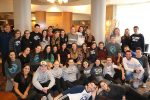
Canadian Young Judaea’s National Leadership Conference in February, which had participants from Vancouver, Montreal, Toronto and Halifax. (photo from CYJ)

Many of Metro Vancouver’s residents are from other parts of Canada. It is no surprise, therefore, that many members of Vancouver’s Jewish community are familiar with Canadian Young Judaea (CYJ). But the memories of CYJ date back even further than most anyone can recall because CYJ is celebrating its 100th anniversary.

Started by 11-year-old Dov Joseph in 1910 in Montreal as a Zionist club, CYJ was officially proclaimed at the 15th Zionist Convention in Winnipeg in 1917. Within eight years, there were 75 clubs across Canada and, by 1935, national membership reached 5,000. Jews in small towns like Timmins, Ont., and Melville, Sask., formed groups and organized activities.

“There was a ken (group) in every city that had a Jewish population,” said CYJ national director Risa Epstein about the organization at its peak. “In Ontario alone, CYJ was active in Niagara Falls, St. Catharines, Sarnia/Petrolia, North Bay, Sudbury, Peterborough, to name a few. In the West, you could find CYJ in Vancouver, Edmonton, Calgary, Winnipeg, Saskatoon, Moose Jaw, Regina and many smaller communities and, of course, it was in every small town in the Atlantic region.”

In the beginning, the appeal of CYJ was its purpose, its focus on Zionism at a time when antisemitism was rampant throughout Europe and in Canada (and elsewhere) as well. The Zionist dream was that of young Jews taking control of their fate, according to acclaimed Canadian poet A.M. Klein, who served as the editor of The Judaean from 1928-32. Klein wrote in 1931, “Jewish life, as at present constituted, with barrenness and emptiness, its utter meaninglessness, its haphazard activity, stands as an imperious challenge to Canadian Jewish youth.”

Epstein described the nature of CYJ in less fiery terms. “It was born out of the desire of young Jews in Montreal to have a group to come to and discuss and dream about a Jewish homeland,” she said. “It later grew from a city-based organization to summer camps and Israel programs.”

The camps were established as early as 1942 in Quebec, followed by Camp Kadima in Nova Scotia in 1943. Ontario, Manitoba, Saskatchewan and Alberta also had CYJ-affiliated camps. British Columbia was the last to add a camp, in 1956, known originally as Camp Hatikvah-Massada in Oyama.

After the establishment of the state of Israel in 1948, the Zionist dream was realized and CYJ took steps to affiliate with youth group Hanoar Hatzioni in Israel. As a result of the newfound excitement about making aliyah, a number of Young Judaeans went to study in Israel. In the 1950s, camps were established across the country that simulated the kibbutz experience.

Today, according to Epstein, CYJ has more than 2,000 members (7 to 18 years old) from across Canada. As the concentration of the Jewish population has shifted, so have the active centres for CYJ activities. They are now active in the major centres of Toronto, Montreal and Vancouver and are still operating in Halifax. Their summer programming engages close to 750 staff (18 to 22 years old), many of whom are alumni of CYJ camps.

Programming during the non-summer months is organized by age groups. The offerings include leadership-training opportunities, which often parlay into jobs at summer camps. CYJ also provides some programs for parents, alumni events and special training for program directors of the camps.

Every city where CYJ has a presence has JOLT (Jewish Outreach Leadership Training). “It consists of two meetings a month,” explained Epstein. “The first is an educational session and the second is an outreach related to the topic of the first. An example is learning about Jewish veterans in Canada and a bake sale to raise money for the veterans.” She mentioned that participation in JOLT is growing in Vancouver and elsewhere.

CYJ has an historic link with another uniquely Canadian grassroots Zionist organization: Canadian Hadassah-WIZO (CHW). CYJ is and has always been the youth arm of CHW. Epstein said the Biluim Israel trip raises funds for CHW daycares in Israel and includes a day spent volunteering at one of those daycares. In turn, CHW provides funding for some CYJ activities.

Along with this year’s regular programming, including camps and trips to Israel with Biluim Israel, national CYJ is planning a centennial celebration on Aug. 27 at Camp Shalom in Gravenhurst, Ont. The event will run from 11 a.m.-4 p.m and is intended for families. “There will be food, camp-like activities, displays, shira [singing] and rikud [dancing]. It will be an amazing event and we are hoping that there will be over 400 people,” said Epstein.

All Young Judaeans are invited to the celebration. For more information, contact the national CYJ office at 416-781-5156 or e-mail Epstein at [email protected].

Michelle Dodek is a freelance writer living in Vancouver.

Format ImagePosted on March 31, 2017March 31, 2017Author Michelle DodekCategories NationalTags Camp Hatikvah, CHW, CYJ, Israel, Young Judaea
No simple dichotomy

No simple dichotomy

Amna Farooqi speaks at Temple Sholom during her March 13-14 visit to Vancouver. (photo by David Berson)

Amna Farooqi, a rising peace activist who aims to transcend the division between being pro-Israeli and pro-Palestinian, was in Vancouver March 13-14 to speak at Temple Sholom and at the University of British Columbia.

Last year, Farooqi, a Muslim-American woman from a Pakistani family, made international headlines when she was elected head of J Street U, the student organizing arm of J Street, which calls itself “the political home for pro-Israel, pro-peace Americans.” She presents a unique perspective: she is against the boycott, divestment and sanction movement and is pro-Zionist, while also being against the occupation, critical of settlements and deeply concerned for Palestinian dignity and human rights. Temple Sholom, the Progressive Jewish Alliance, Or Shalom, Ameinu Canada and JSpaceCanada sponsored her visit to Vancouver.

Farooqi, who finished her term at J Street U as she graduated from the University of Maryland, continues to be active in J Street and spoke at their annual conference last month, which also included Bernie Sanders as a speaker.

Farooqi told the Jewish Independent that she grew up in a religious but progressive Muslim home where politics were a constant topic of discussion. “Have tea and talk politics,” she said. “Very much like Israelis.”

After 9/11, the topics shifted from things happening in India, Pakistan and throughout the Muslim world to American politics and the condition of American Muslims, she said. “In middle school, I began wearing a headscarf to school. I liked wearing the hijab to provoke conversation, and to say that one can be Muslim and American, one does not have to choose one or the other.”

In high school, Farooqi, who had been raised with a concern for Palestinians, began learning more about the Israeli-Palestinian conflict and fiercely sided with the Palestinians. In 2011, when the Palestine Liberation Organization made a bid for statehood at the United Nations, Farooqi supported it and found herself in an emotional fight with a Jewish friend that came to raised voices and tears. “I realized then that I did not know enough about the conflict,” she said.

Farooqi took Israeli studies courses in college, heeding her parents’ advice that the situation was complex and she should refrain from becoming involved in the debate unless she first studied it in detail. Farooqi’s turning point came when one of her professors had students take part in an involved role-playing exercise, where pro-Palestinian students studied and defended a Zionist (hers was David Ben-Gurion) and pro-Israel students the opposite. This was the beginning, she said, of her “falling in love with Zionism,” without losing her deep concern for the Palestinians.

Over time, Farooqi got more involved with the J Street U chapter at her university, and she spent a semester abroad in Israel studying at Hebrew University, as part of an international student exchange program; the first of several trips.

“My first trip to Israel was an emotionally intense experience from start to finish,” she told the Independent. “There is not a moment in Jerusalem where you are not exposed to diverse perspectives. Everywhere you go there is history, tragedy and beauty.”

She had a Passover seder with a settler family and dined with families in the West Bank. “I remember one visit to the West Bank with some Jews concerned about Palestinian human rights. We visited one family bringing gifts. A young Palestinian child approached my Jewish friends with wonder, and said, ‘You are Jews?’ Bewildered, the child pointed to a nearby house of settlers. ‘But they are Jews.’”

Asked what she perceives as the way forward in today’s increasingly volatile climate, Farooqi said, “It’s a difficult moment. I think the path forward lies in investing in civil society on all sides. None of the governments involved is in a position to show real leadership at the moment.”

Farooqi said the key will lie in building relationships on the ground and in looking at a holistic picture of what drives people on both sides whose behaviour is bstructing peace. “You cannot understand settlers unless you understand the need for affordable housing in Israel,” she said, “and you cannot understand Palestinians who join Hamas unless you understand it may be the only way for them to put food on the table.”

Farooqi said she is excited by the rise of a new Sephardi left in Israel, which she hopes will help inspire a “new, young left” in the country, with ideas that go beyond those of previous generations. And she would like to see more done to help younger Palestinians understand that many Israelis value their rights. “Younger Palestinians need to know that,” she said. “It will change the elections of the future. Palestinians need economic opportunity, and they need real vision and hope. They must be given a real political and economic horizon.”

Speaking of the international Jewish community, Farooqi said, “If you are a pro-Israel, pro-peace, two-state solution person, invest in communal support for that and be careful [about] who we host, who we support, what message are we sending out.”

Even though she is against BDS, she disagrees with the recent Israeli travel ban of BDS supporters. “I oppose the travel ban because going to Israel and actually talking to Israelis made me more pro-Israel,” she said.

She added, by way of warning, that “Diaspora Jews underestimate the far-right in Israel. Many moderates have become disengaged on Israel, whereas big supporters on the far-right have not.”

Speaking of Sanders’ talk at the recent J Street conference, Farooqi said, “I thought it was a great speech, significant for lots of reasons. Sanders talked about 1948 in a beautiful way, talking of the progressive vision of Zionism and his experiences on a kibbutz, but also talking of the effect on the Palestinians. You can acknowledge both. It is rare for a U.S. politician to do that.”

Now that her term at J Street U is over, Farooqi is turning her attention to affairs at home and looking to get involved in organizing in the United States. “We have our own crisis of democracy to deal with,” she said.

Matthew Gindin is a freelance journalist, writer and lecturer. He writes regularly for the Forward and All That Is Interesting, and has been published in Religion Dispatches, Situate Magazine, Tikkun and elsewhere. He can be found on Medium and Twitter.

Format ImagePosted on March 31, 2017March 31, 2017Author Matthew GindinCategories LocalTags Amna Farooqi, Israeli-Palestinian conflict, J Street, peace
Anti-Jewish remarks

Anti-Jewish remarks

Sheikh Muhammad bin Musa Al Nasr is captured in a YouTube video dated Dec. 23, 2016, addressing a prayer meeting at Dar Al-Arqam in Montreal East. (screenshot from cjnews.com)

More videos of anti-Jewish sermons being delivered in mosques in Canada have come to light, the latest from the Dar Al-Arqam mosque in Montreal and the Al-Hikmah mosque in Toronto.

Sheikh Muhammad bin Musa Al Nasr is captured in a 20-minute YouTube video dated Dec. 23, 2016, addressing a prayer meeting at Dar Al-Arqam in Montreal East.

According to a translation of the Arabic by the Toronto-based online publication CIJNews, he says Jews are “the most evil of mankind” and that Allah has ordained that they be killed by Muslims.

“At the end of time when the Muslims will triumph over the most evil of mankind [and] the human demons, the stone and the tree will say: O Muslim, O servant of Allah, O Muslim, O servant of Allah, there is a Jew behind me; come and kill him; but the tree Gharqad would not say, for it is the tree of the Jews,” the translation says.

Musa Al Nasr is identified as a visiting Jordanian cleric.

Similar messages have been delivered by Sheikh Abdulqani Mursal, an imam at Al-Hikmah in North York, reports CIJNews editor Jonathan Halevi, who is described as a reserve lieutenant-colonel in the Israel Defence Forces and a senior researcher of radical Islam at the Jerusalem Centre for Public Affairs.

Apparently drawing from Islamic scripture, Mursal taught that “the fate of the Jews is … to be killed by Muslims,” Halevi writes.

He read a hadith, or saying of Muhammad, that: “You will fight against the Jews and you will kill them until even a stone would say: Come here, Muslim, there is a Jew [hiding himself behind me], kill him.”

Whatever the source of these sentiments, Jewish groups decry them as hateful, incitement, possibly hate crimes.

The Centre for Israel and Jewish Affairs (CIJA) said the published excerpt of Musa Al Nasr’s talk “mirrors, word for word, a similar genocidal declaration” in the charter of Hamas, which is designated as a terrorist organization by Canada.

“We are deeply troubled and angered that yet another imam has dehumanized Jews and glorified violence against them,” stated CIJA Quebec co-chair Rabbi Reuben Poupko.

Even more disturbing, he said, is that the mosque would disseminate Musa Al Nasr’s “incitement to violence and hatred” on the internet.

CIJA has submitted the latest material to police to determine if it violates Canada’s Criminal Code.

“We condemn these appalling sermons which … are a dangerous rejection of Canada’s core values of tolerance, pluralism and non-violence,” he said. “In light of similar incidents recently exposed in Montreal and Toronto, there is a real concern that the airing of hateful rhetoric – including antisemitism – has become routine at some mosques.”

B’nai Brith Canada has filed a formal complaint with police because it believes that this is hate speech. Musa Al Nasr is a “prominent member of the hardline Salafist movement in Jordan, where he lectures at the al-Ahliyya University in Amman,” it asserts.

According to B’nai Brith’s research, he delivered lectures more than a dozen times at Al-Arqam, which were recorded and uploaded on YouTube.

B’nai Brith chief executive officer Michael Mostyn expressed frustration that police have yet to lay charges in connection with a complaint it made in February when a video was exposed of another imam at another Montreal mosque pleading for the death of Jews.

The 2014 sermon by Sayed AlGhitawi, a guest imam at the Al-Andalous Islamic Centre, called on Allah “to destroy the accursed Jews” and “kill them one by one.”

“When will Canada finally recognize that we are not immune to racism and antisemitism, and that it is this type of rhetoric that directly leads to radicalization all over the world?” Mostyn asked. “What will it take before charges are laid for criminal incitement in Canada?”

– For more national Jewish news, visit cjnews.com

Format ImagePosted on March 31, 2017March 31, 2017Author Janice Arnold CJNCategories NationalTags antisemitism, mosques
Team Israel’s fairytale run

Team Israel’s fairytale run

Josh Zeid during the game against Japan. (photo from worldbaseballclassic.com)

Team Israel had a great run at the World Baseball Classic tournament. The ballplayers with a David vs. Goliath approach came out swinging hard and stunned the world with four consecutive wins in the preliminary and second rounds. But two losses in a row – an 8-3 loss to Japan March 15 and a 12-2 clobbering by the Netherlands on March 13 – made advancing to the finals a dream for the next global tournament.

The March 15 game started with five scoreless innings, but Japan blew open a lead in the sixth with five runs and added three more for good measure in the eighth. Israel scored all its runs in the top of the ninth.

The World Baseball Classic is a tournament in which the best baseball players in the world compete. Team Israel had bookers betting against it even making the main event, but the blue-and-white uniformed ballplayers, who were ranked 41st going into the Classic, not only made it to the preliminary rounds but won an astounding four in a row at the tournament.

Dubbed the Cinderella team of the contest, Team Israel stunned Cuba 4-1 in the first WBC quarterfinal game at the Tokyo Dome and, before that, swept the first round of games by beating South Korea, Taiwan and the Netherlands.

Only three of Team Israel’s 28 players are Israeli; the rest are Jewish Americans. According to WBC rules, anyone eligible to hold citizenship in a country can play for its national team. There are other teams with players who do not hold passports for the country for which they’re playing.

“The players love playing for Israel,” Israel Association of Baseball president Peter Kurz told Israel21c. “A lot of them want to come and visit after the tournament or after they retire.”

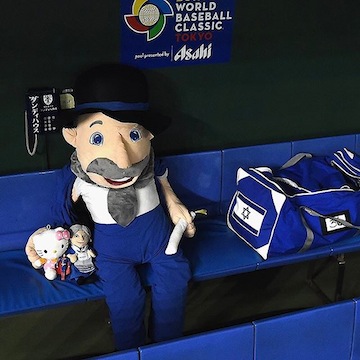
photo - Mensch on a Bench – the Israeli team’s mascot – waits for the game to begin
Mensch on a Bench – the Israeli team’s mascot – waits for the game to begin. (photo from worldbaseballclassic.com)

For fans, that the ballplayers are proud to wear “Israel” on their uniforms and represent the country is more than enough.

“I am a lifelong baseball fan, and it’s thrilling to see Israel competing on a world stage. But Israel’s participation in the World Baseball Classic is about so much more than baseball,” said Elie Klein, an associate partner at Finn Partners Israel who calls himself a “rabid New York Mets fan.”

“While baseball fans around the globe have taken notice of Team Israel due to their surprising athletic prowess, Jews around the world – many of whom have never watched a single inning of baseball – are drawn to Team Israel out of deep Jewish pride. Not because they are Israelis, but because they aren’t – they are largely American Jews who have decided to wear uniforms emblazoned with the Jewish star and don kippot during Hatikvah, to identify as Jews in such a public way,” said Klein.

American rapper Kosha Dillz (Rami Matan Even-Esh) even made up a song about Team Israel. And Team Israel will also be remembered for its mascot, Mensch on a Bench, a stuffed doll that was the Jewish answer to the popular Christmas toy and story Elf on the Shelf.

On March 22, the United States team beat Team Puerto Rico to win the championship.

Israel21c is a nonprofit educational foundation with a mission to focus media and public attention on the 21st-century Israel that exists beyond the conflict. For more, or to donate, visit israel21c.org.

Format ImagePosted on March 31, 2017March 31, 2017Author Viva Sarah Press ISRAEL21CCategories WorldTags baseball, Israel, Mensch on a Bench, sports
Medication alert innovation

Medication alert innovation

The system concept for CuePath’s sensor-monitored blister packaging for dispensing medications. (photo from CuePath)

When blister pack medication dispensing came onto the market years ago, it was hoped that it would solve the issue of people not taking their medication on time. However, while this plastic packaging method has become commonplace, people are still forgetting to take their medicine.

One Vancouver-based start-up has come up with a solution. CuePath Innovation is creating a sensor that monitors when each blister pack is opened – connecting the sensor to care providers wirelessly. CuePath’s Jeff Nider is charged with marketing the concept.

Nider grew up primarily in Richmond. “My late father, who passed away in 2014, was a pharmacist and he had a number of different pharmacies in the Vancouver area over the years,” he told the Independent. “I grew up in and out of the pharmacy – working with my bubbie, manning the cash register, or pre-packaging medications for nursing home customers. That’s where I spent most of my summers, working in the pharmacy with my father.”

Nider earned his degree in biology at the University of British Columbia, and then his father asked him to manage one of the pharmacy locations. When they came across the blister pack technology, which makes the administering of medications more safe, they jumped at the chance.

“At the time, we had one nursing home client, and so we saw a future for the technology and decided to purchase the machine required to package it,” said Nider. “At this point, I started my sales career, going and selling … to basically convince … nursing homes to allow us to be their pharmacy provider.

“Each nursing home needs to have a single pharmacy provider for all of their residents. So, we had this technology along with some other software…. We were able to grow the business from one nursing home client to over 40, representing 1,700 residents.”

In 2012, they sold their business to a Toronto-based company and Nider stayed on as the business development manager for Western Canada. Last summer, Nider left that role after having been introduced to CuePath Innovation.

“It’s a start-up for monitoring medication for seniors living at home and in retirement communities,” he said about CuePath. “Based on the expertise I had in the pharmacy and geriatrics business, it made sense to me to get involved. So, I was approached to be essentially the third employee of the company, aside from the two co-founders, who have no pharmacy backgrounds … to take it from an idea and approve the concept through pilots and its commercial launch, which will happen in the second quarter of this year.”

CuePath’s sensor monitors each individual cell of the pack and indicates whether or not a person has broken the seal.

photo - CuePath’s Jeff Nider grew up in and around his father’s pharmacy
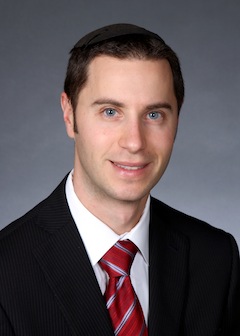
CuePath’s Jeff Nider grew up in and around his father’s pharmacy. (photo from CuePath)

“We also provide an alert for seniors at home, when it’s time to take their medications,” said Nider. “If they don’t take them by the appropriate time, a text message will be sent to [a] family member, so they can call and remind the family member to take them.

“If you’re an 85-year-old woman living alone, your daughter might be in Toronto or Winnipeg and have no idea what’s happening – worrying about whether or not you’re taking your meds on time, because there’s a bunch of stats on our website in respect of medication adherence: less than 50% of medications are taken as prescribed, and 22% of nursing home admissions are a result of non-adherence to medication. So, it’s very important that people take their medications the way they’re prescribed and at the right time.”

According to Nider, in some cases, just before care providers come each week, seniors will punch out all the medication in the blister pack that they have forgotten to take during the week. Therefore, everything might appear to be fine when, in actuality, it is not.

“This happens because they know you come every Sunday,” said Nider. “So, on Saturday, they go and punch out the whole card. When you come, everything looks like it’s been taken – but, it’s been taken out the day before and flushed down the toilet.”

Nider pointed out that the CuePath sensor monitors the punching of the plastic only – it does not monitor whether or not the medication was ingested. Though that addition is on the horizon.

The CuePath technology is a clip on a Bluetooth transmitter connected to the back of the blister pack. “Basically, it’s a label that the pharmacist applies to the back, which has some conductive materials in it to send the transmission as to whether or not those have been opened,” said Nider.

The service has a monthly fee and an initial hardware cost but, considering the alternative – paying a care provider to administer the medication – it is much more affordable, according to Nider.

“It runs around $30 a month; $200 for the initial gateway hardware cost,” he said. “There’s a bunch of different models right now. We are still in pilot stages, running various pilots in various forms in different retirement communities.

“In a lot of ways, this will help you avoid needing to get a caregiver and finding a time when a caregiver is necessary. We’ve seen that medications are indicators of other things as well. So, if people are taking their medications on time, they’re probably able to manage many of the other tasks, too. But, as soon as they start to slip with taking them on time, it’s usually a good indication that they may not be able to manage their cooking, they may not be doing their laundry…. It also puts them at a higher risk for falls and other issues if they aren’t taking their medications properly. It’s a good indication that now’s the time to hire a caregiver. It gives you data to what is actually going on with the senior.”

The CuePath gateway unit does not need an internet connection, as it connects to the cellular network. Each gateway comes with three Bluetooth clip transmitters that will be rotated with the pharmacy. The app that accompanies the device allows caregivers access to statistics in terms of percentage of medications taken on time and other data.

“You can see how this month compares to last month,” said Nider. “Then, this information can be printed out and brought to the physician’s office … shared with the pharmacy … so they have the information.”

Rebeca Kuropatwa is a Winnipeg freelance writer.

Format ImagePosted on March 31, 2017March 31, 2017Author Rebeca KuropatwaCategories LocalTags CuePath, health, Jeff Nider, seniors

Posts pagination

Previous page Page 1 … Page 452 Page 453 Page 454 … Page 667 Next page
Proudly powered by WordPress