Skip to content
  • Home
  • Subscribe / donate
  • Events calendar
  • News
    • Local
    • National
    • Israel
    • World
    • עניין בחדשות
      A roundup of news in Canada and further afield, in Hebrew.
  • Opinion
    • From the JI
    • Op-Ed
  • Arts & Culture
    • Performing Arts
    • Music
    • Books
    • Visual Arts
    • TV & Film
  • Life
    • Celebrating the Holidays
    • Travel
    • The Daily Snooze
      Cartoons by Jacob Samuel
    • Mystery Photo
      Help the JI and JMABC fill in the gaps in our archives.
  • Community Links
    • Organizations, Etc.
    • Other News Sources & Blogs
    • Business Directory
  • FAQ
  • JI Chai Celebration
  • JI@88! video

Recent Posts

  • Sharing her testimony
  • Fall fight takes leap forward
  • The balancing of rights
  • Multiple Tony n’ Tina roles
  • Stories of trauma, resilience
  • Celebrate our culture
  • A responsibility to help
  • What wellness means at JCC
  • Together in mourning
  • Downhill after Trump?
  • Birth control even easier now
  • Eco-Sisters mentorship
  • Unexpected discoveries
  • Study’s results hopeful
  • Bad behaviour affects us all
  • Thankful for the police
  • UBC needs a wake-up call
  • Recalling a shining star
  • Sleep well …
  • BGU fosters startup culture
  • Photography and glass
  • Is it the end of an era?
  • Taking life a step at a time
  • Nakba exhibit biased
  • Film festival starts next week
  • Musical with heart and soul
  • Rabbi marks 13 years
  • Keeper of VTT’s history
  • Gala fêtes Infeld’s 20th
  • Building JWest together
  • Challah Mom comes to Vancouver
  • What to do about media bias
  • Education offers hope
  • Remembrance – a moral act
  • What makes us human
  • המלחמות של נתניהו וטראמפ

Archives

Follow @JewishIndie
image - The CJN - Visit Us Banner - 300x600 - 101625

Author: Rebeca Kuropatwa

Ackerman keeps on winning

Ackerman keeps on winning

Estee Ackerman wins gold at the 2016 Junior Olympics in Houston. (photo from Estee Ackerman)

A Jewish Orthodox New Yorker is quickly becoming a legend – and she is not even 15 years old yet. Her name is Estee Ackerman and she is currently one of the hottest names in table tennis.

In 2013, Ackerman even beat one of the world’s greatest tennis players – Rafael Nadal – in an exhibition table tennis match during the American Open. Nadal went on to win the American Open that year. “So, I could say I was the only one who beat him in New York,” joked Ackerman.

A sophomore at Yeshivah University High School for Girls, also known as Central, Ackerman is a nationally and internationally ranked table tennis star.

Her passion for the sport began at a young age, as a fun way for her and her family to pass the time on Saturday afternoons in their basement.

“My dad wanted to do something fun with my brother, Akiva, and I that did not involve electronic gadgets,” Ackerman told the Independent. “He says everyone is looking down [at their gadgets] these days. We figured, what can we do? In the wintertime, we can’t go out so much and we were young kids at the time … we can’t do wrestling, we’re not tall enough for basketball.

“My dad started with my brother, Akiva, who is also now an amazing player. They really just had a fun family activity, as we had a table in our basement. One day, I went down and I said, ‘Let me give this a try.’ I was about 8 years old at the time and I was also so little that they just saw the racket going back and forth … I was under the table.

“Just playing with them about an hour each night was how it began. After doing this for a few months, a few days a week, we saw improvement. From there, we took it to the next level. We went to professional ping pong clubs. I compare it to how some people get piano lessons … I got the ping pong lessons, with top coaches from China.”

Ackerman recalls feeling “star struck” when she entered these clubs. “I was definitely at the bottom in the club leagues,” she said. “But, as the coaches said I had talent and that I should continue, I went to them a few times a week, and that’s how we saw much improvement to keep going.”

Balancing school and play is no easy feat, but, with Ackerman’s success, Central was willing to accommodate her traveling for tournaments, sometimes missing a week of school at a time.

“I would say that when I get back from these weekly tournaments, all the teachers are so happy … they’re so willing to sit down with me and catch me up on the notes I missed,” said Ackerman.

“Besides my friends wanting to know how I did in the tournaments, they’re eager to sit down with me, because they know that missing 11 classes a day for a week is not so easy to catch up on. But, I’m happy to say that Central is very supportive in all I do.”

Ackerman’s dad takes her to all the tournaments and practices, and ensures she has whatever she needs.

As for Ackerman’s fellow table tennis playing brother, he has put the sport on hold in order to continue his Torah studies in Israel. But, he may return to ping pong in the future, as he has plans to study at Yeshivah University after his time in Israel.
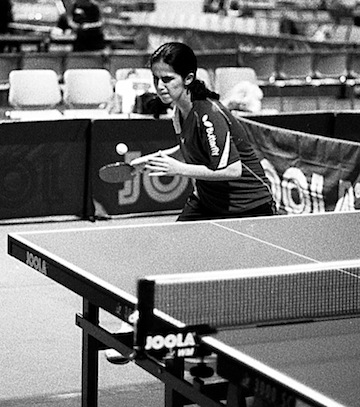
photo - Estee Ackerman in action
Estee Ackerman in action. (photo from Estee Ackerman)

In Ackerman’s professional career to date, she has already achieved successes that few even dare to dream about, including winning the Nationals in Las Vegas in 2015.

“This probably is one of my biggest accomplishments,” she said about those games, “as I was competing against 250 players in that event – transferring from the round robin group all the way to the single elimination matches.”

Last summer, Ackerman entered the U.S. Open playing hardbat. “That is like the old school way,” she explained. “If you know, a ping pong racket is usually made with smooth rubber, but a hardbat is usually made with pimples [an outer layer of rubber covered in dots]. I had never played in tournaments with hardbats [before that].

“Believe it or not, I did win the Women’s Open hardbat event. I came in second in the mixed doubles hardbat event. And, I won the gold medal in the women’s doubles hardbat event. So, I can definitely say that, in America, I’m the best female hardbat player.”

In February 2016, Ackerman was one of 16 women invited to the American Rio Olympics trials. But, as she could not play on Shabbat, she was not able to get enough wins to make the team.

“Being at the Olympic tryouts was already great enough to me,” she said. “Me being with the best players in our country – warming up with them, seeing them in the locker room – it doesn’t get better than that. I was playing on the biggest stage of my life.”

Now, Ackerman has her sights set on 2020 in Tokyo. But, in the meantime, she is busy accomplishing other feats, such as winning gold in the Junior Olympics, for girls under the age of 16 in singles and for girls under the age of 16 in doubles.

Ackerman is also thinking about whether or not she will go to the Maccabiah Games or stay in the local circuit for now. And, of course, she is focusing on graduating in 2019.

As it happens, Ackerman’s first trip out of the United States was in 2014 for a tournament in Markham, Ont. “I was representing the United States competing against Canada in the Junior Cadet Open,” she said. “As that was the first time I left the country, I was very excited, especially to be representing America.

“We did hear of a tournament taking place two weeks ago in Vancouver, but, as it was only a two-day event and one of the days was on Shabbat, we didn’t go. Other tournaments are four days or a week long, so just to compete for one day is a little much for the amount of travel.”

Asked if she has any advice for other young sport hopefuls, Ackerman said, “One should always dream big and just believe. I know that if one can put in countless hours and hard work, and they really love what they do, they can accomplish their goals. If they really want to be the best they can be, they have to put in the amount of hours that it takes.

“Although I love the sport of table tennis, I always say it’s my second priority. My religion, Judaism, is my first priority.”

As far as playing ping pong on Shabbat, Ackerman feels it is totally OK when her friends come over to have fun. But, when it comes to competing in a national tournament – with the uniform, with the media – she does not feel that it is right to participate on Shabbat.

Ackerman recently made it onto the world ranking. She is 466th in the world and 171st for her age group of under 18. To follow her career, visit teamusa.org/usa-table-tennis.

“I know to be really up there in the world rankings, you really have to travel worldwide – to France, Poland and Switzerland,” said Ackerman. “As I am in yeshivah, it’s a little tough. But, as I get any opportunity, I’d love to be there.”

Rebeca Kuropatwa is a Winnipeg freelance writer.
Format ImagePosted on March 31, 2017March 31, 2017Author Rebeca KuropatwaCategories WorldTags Estee Ackerman, ping pong, sports, table tennis
Journey of memory and loss

Journey of memory and loss

Yuri Dojc and Katya Krausova found classrooms, textbooks, a synagogue, prayer books, clothing and ritual ornaments, all lovingly cared for, undisturbed, unmolested and somehow cherished since the scooping up of three-quarters of the Jews in the towns of Slovakia in 1942. (photo by Yuri Dojc)

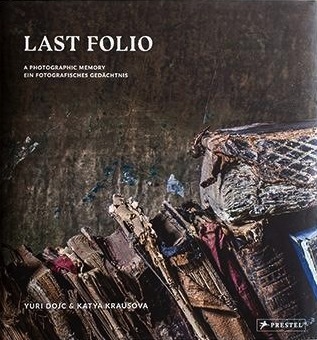
Fascination, horror, admiration, exaltation are the words that come to mind when I search to describe the emotions I felt reading Michael Posner’s book review of Last Folio: A Photographic Memory by Yuri Dojc and Katya Krausova (Indiana University Press, 2011) in Queen’s Quarterly (Winter 2016). The personal saga of Krausova, a cinematographer, and Dojc, a photographer, the horror of the Holocaust in Slovakia and the discovery of remnants of the vibrant Jewish communities stripped of their Jews, their culture and their religion, provoked my curiosity and my imagination.

Dojc and Krausova found classrooms, textbooks, a synagogue, prayer books, clothing and ritual ornaments, all lovingly cared for, undisturbed, unmolested and somehow cherished since the scooping up of three-quarters of the Jews in the towns of Slovakia in 1942.

“It was as if he were entering a time capsule, classrooms frozen at almost the precise moment that Nazi transports had taken the students to the concentration camps – and almost certain death,” writes Posner. “Except for the mould and the yellowed, tattered pages, everything was exactly as they had left it: a bowl of sugar on the shelf, books inscribed with childhood signatures, notebooks filled with essays on their aborted life ambitions.”

book cover - Last FolioYet, for me, there was something more than photographs and meetings with Holocaust survivors that were being revealed. I rushed to buy the book. It is a work of art filled with dramatic testimony and the saga of an epic journey of chance meetings and breathtaking discoveries resulting in exquisite photographs, as well as a documentary film – labours of love and devotion by Dojc and Krausova.

After reading the text and examining the photographs – the most beautiful I have ever seen – I began to meditate on the fact that all these images were found in places abandoned in 1942; their Jewish owners and community members wiped out by the Nazis. Strange place names like Bratislava, Bardejov, Sastin, Michalovce and Kosice became familiar to me, as the tallit, tefillin, prayer books, mikvah and Torah fragments came alive in my eyes. One of the most haunting images is that of a book fragment with the Hebrew word הנשאר, “that which remains,” clearly legible on the delicate paper.

The essays that follow by Azar Nafisi and Steven Uhly commemorate and honour the murdered Slovak Jews and their collective memory. Yet, there was still something that I was missing. I reread the text by Krausova and stopped on the following lines:

“Mr. Bogol’ tells us that he is the warden of the Protestant church, that he and his wife have lived in the same block with the Simonovics for more than 40 years and that following the death of Mrs. Simonovic’s brother, he became the keeper of the keys of a building in the town…. Time stopped still in this building, which housed a Jewish school a long time ago, almost certainly in 1942, the day when Bardejov Jews vanished forever. Mr. Bogol’ proudly shows us how he and his wife have been painstakingly cleaning each bench, each light, each seat, finding – and preserving – every object, religious or otherwise.”

And, they find another building filled with books, also preserved and protected; waiting for Dojc and Krausova to discover them.

photo - Last Folio is a work of art filled with dramatic testimony and the saga of an epic journey of chance meetings and breathtaking discoveries resulting in exquisite photographs
Last Folio is a work of art filled with dramatic testimony and the saga of an epic journey of chance meetings and breathtaking discoveries resulting in exquisite photographs. (photo by Yuri Dojc)

Here was my phantom question, here was the missing link! How is it that these empty, cold, barren places were taken care of for more than 70 years? Who would do such a thing? Why would they do it? Were the guardians of these precious objects waiting for someone? Why didn’t the municipality tear down the buildings or strip them of everything and renovate them? Who paid for the maintenance and taxes on the buildings?

The guardians and the keepers of the keys took these responsibilities upon themselves, year after year, until they bumped into Dojc and Krausova, convincing the harried and exhausted researchers to take a look.

Embossed on the inside cloth cover of the book we read: “Last Folio Charts a Personal Journey in Cultural Memory / A Reflection on Universal Loss as a Part of European Remembrance.”

These unheralded, unacknowledged guardians were the protectors and defenders of the memory of the Jews of Slovakia and their Jewish community. To them, we owe enormous gratitude.

To see an extended trailer of the 81-minute documentary about Krausova and Dojc’s research and the making of the book and photo exhibition, visit youtube.com/watch?v=0vZeL63l1ok.

Dolores Luber, a retired psychotherapist and psychology teacher, is editor of Jewish Seniors Alliance’s Senior Line magazine and website (jsalliance.org). She blogs for yossilinks.com and writes movies reviews for the Isaac Waldman Jewish Public Library website.

Format ImagePosted on March 31, 2017March 31, 2017Author Dolores LuberCategories BooksTags history, Holocaust, Katya Krausova, Slovakia, Yuri Dojc
Past leads to present

Past leads to present

For many of us, it is hard to get excited about a subject until we can experience it, or meet someone who has. Historical fiction can bridge the gap between simply memorizing dates and names to empathizing with those affected and taking what we learn into our lives.

Two recent Second Story Press publications do an excellent job of teaching and engaging younger readers. They also provide a starting point for these readers and their parents, family, friends and educators to discuss difficult and sensitive topics that not only relate to the past, but to current situations, as well.

The Ship to Nowhere: On Board the Exodus by Rona Arato (for ages 9 to 13) tells the story of the ship Exodus 1947 through the eyes of 11-year-old Rachel Landesman. I Am Not a Number by Jenny Kay Dupuis and Kathy Kacer and illustrated by Gillian Newland (for ages 7 to 11) tells the story of 8-year-old Irene Couchie, who is forcibly taken from her First Nations family and home to live in a residential school in 1928. Both Rachel and Irene are real people.

Sadly, their stories are representative of what also happened to countless others. And, even more sadly, what continues to happen. The Ship to Nowhere could lead to a conversation about the Syrian refugee crisis and antisemitism in Canada and elsewhere. I Am Not a Number brings to mind some parallels between the Holocaust and the attempted genocide of Canada’s First Nations, as well as the inequalities that still exist in Canada, the treaties that have not been ratified, the reconciliation over the residential schools that is long overdue and has barely begun.

Given the ages of their intended readers, both of these books tread lightly – that said, they deliver powerful messages and succeed in their missions to educate.

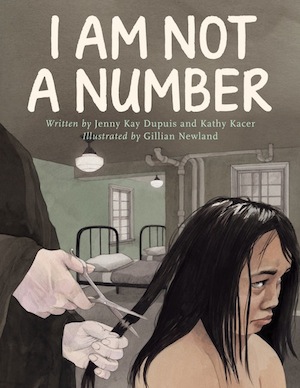
book cover - I Am Not a NumberThe illustrations in I Am Not a Number, a hardcover picture book, are as revealing as the text. Irene and her siblings, as they huddle behind their father when the government agent comes to take her and two of her brothers away; the sadness on Irene’s face as a nun cuts her hair, the anger as she sits in church; and the unbridled joy when she and her brothers are back at home after a tortuous year – these are just some of the emotions Newland movingly captures.
And Kay Dupuis tells her grandmother’s story with such love. This was a family that was strong and, in the end, luckier than many, in that Irene and her brothers didn’t return to the residential school – when they came home for the summer, their family kept them hidden from the government agent.

I Am Not a Number includes a brief overview of the residential school system, and mention of the Truth and Reconciliation Commission. Kay Dupuis also tells readers a bit more about her grandmother in an afterword, where there are a few photos of the Couchie family.

The Ship to Nowhere has photos throughout, and Arato uses the author’s note at the end to let readers briefly know what happened to Rachel, Rachel’s mom and sisters (her dad was killed in the Holocaust), the ship’s captain, Yitzhak Aronowicz (known as Captain Ike) and one of the journalists who doggedly reported to the world the Exodus’s journey, Ruth Gruber.

Since it is for older young readers, there are parts of The Ship to Nowhere that are quite graphic – the incredible brutality of the British is well-depicted, as are Britain’s efforts to prevent the ship’s 4,500-plus Holocaust survivors from knowing what the media were reporting on their treatment. Even with the passage of time, the anger boils in reading about how these survivors were tear-gassed and beaten (in some cases to death) on the Exodus, forced to live as captives on three other ships after they were turned out of Palestine, and again beaten and manhandled if they refused to leave their ships in Germany, where the British took them eventually, to live in refugee camps.

There are many touching moments between the crew and their passengers and between fellow refugees. It is important to be reminded that France offered to take in all of the refugees; an offer that was declined. And it would be nice to think that, at the least, the Exodus’s plight positively influenced some United Nations members to vote in favour of the creation of Israel.

Format ImagePosted on March 31, 2017March 31, 2017Author Cynthia RamsayCategories BooksTags British Mandate, Exodus 1947, history, Israel, reconciliation, residential schools, youth

3,000 years of a language

Let’s say it at the outset: this book is a gem. Every page of The Story of Hebrew by Lewis Glinert (Princeton University Press, 2017) is packed with information about the language, from its beginnings through post-1948 Israel. In addition to this longitudinal approach, Glinert, a professor of Hebrew and linguistics at Dartmouth, also approaches his subject laterally, focusing on various lands where Jewish/Hebrew life and culture thrived, like early Palestine, Babylonia, North Africa, Spain, Europe and Russia, the United States and Israel.

The book shows us how living under Greek and Roman domination affected Hebrew and how vocabulary from those occupiers seeped into the language. Two examples, the first mine, the second Glinert’s: the simple word for shoemaker in Hebrew, sandlar, which comes from the Latin sandalrius; and Sanhedrin, the Jewish High Court, which stems from the Greek synedrion. Jews did not shy away from these foreign influences; their Hebrew language embraced them.

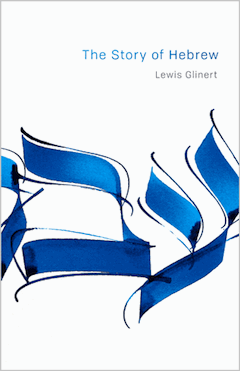
book cover - The Story of Hebrew by Lewis Glinert Glinert also traces the changes in the use of the language from biblical times through the Mishnah (before and after 200 CE), where the Hebrew of that period was more direct and seemingly more colloquial, as can be seen by comparing a text from the Mishnah with any chapter in the Bible. During the next two or three hundred years, written Hebrew then moved on from the Hebrew-only Mishnah to the two-language Talmud, with its mix of mostly Aramaic and much less Hebrew. (In all of this, of course, we only have written texts to go by.)
With sacred books passing from generation to generation orally, correct pronunciation might be lost or distorted. Along came the Masoretes (from the Hebrew word, masorah, tradition), who, by the year 1000, had created above- and below-the-letters signs that ingeniously indicated pronunciation, melody, accent and phrasing.

Jews also contributed to scientific learning by writing about medicine in Hebrew. I am sure it will surprise many readers, as it did me, that in Italy’s first medical school, in Salerno, founded in the ninth century, the languages of instruction were Hebrew, Greek, Latin and Arabic. And, in southern France, in Arles, Narbonne and Montpellier, the official language of instruction in these medical schools was Hebrew.

Religious attitude also influenced how Hebrew was used. Glinert delves into this divide by showing that, during the 11th and 12th centuries in Ashkenaz (in northern France and the Rhineland), the accent was on liturgy and Torah scholarship – the works of Rashi, for instance – while in Sepharad (Spain) and Italy secular Hebrew poetry flourished, influenced by Arabic poetry, exemplified by Yehuda Halevi and other poets.

The book devotes two remarkable chapters to the interaction of Christians with Hebrew.

In one of these unholy intersections, two of the noted translators of the Bible from Hebrew, the church father Jerome (fourth century) and Martin Luther (1534), respected Hebrew but disparaged Jews and Judaism. In his notorious 1542 book On the Jews and Their Lies, Luther asserts, “Jews should be expelled before they poison more wells and ritually abuse more children.”

A better relationship ensued with English translators. William Tyndale was the first to render the Five Books of Moses (1530) into English directly from the Hebrew. In so doing, he defied a bishop’s ban on a translation other than the Latin Vulgate. Tyndale’s translation led to the classic 1611 King James version of the complete Bible, whose English rhythms, cadences and even sentence structure enormously affected English.

As Glinert elegantly puts it: these two translations would “inject a Hebraic quality into the syntax and phraseology of English literary usage without parallel in any other European culture.” The author further adds that echoes of this biblical English can be seen from Walt Whitman’s Leaves of Grass poetry collection to Martin Luther King’s “I Have a Dream” speech.

Hebrew also made its mark in the early history of the United States. The Pilgrims saw themselves as the New Israelites, giving their towns name like New Canaan and Salem – even their Thanksgiving was a belated Sukkot to celebrate a bountiful harvest. And Hebrew was at one time ensconced as a mandatory subject in the Ivy League colleges. I recently read that at graduation ceremonies students would deliver orations in Hebrew, Greek and Latin, and university presidents, like Ezra Stiles of Yale, would also occasionally give their commencement talks in Hebrew.

Glinert writes that the door to modernity in Europe was opened in 1780 by two books published on different sides of Europe. One, in Germany, was Moses Mendelssohn’s Biur, the first volume of his translation of the Torah into German; the other, in a small town in the Ukraine, was a book in Hebrew about Chassidic thought.

Slowly, from the advent of the Haskalah, the Jewish Enlightenment movement, through newspapers, magazines and books, modern Hebrew was being reshaped, culminating with Jews resettling Palestine in the late 19th century, along with Eliezer Ben-Yehuda’s call, at the turn of the 20th century, for Jews to speak only Hebrew. Glinert shows us how the thrust for Hebraization continued once the British got the Mandate for Palestine in 1922 from the League of Nations. They recognized Hebrew as the language of instruction for public schools, broadcasting, the courts and civil regulations. With the founding of the state of Israel in 1948 and mass immigration, Hebrew – which throughout the centuries had always been read, studied and written, and only occasionally spoken – reached its efflorescence.

The Story of Hebrew is a superb book, meticulously researched and beautifully written. Two of my favourites among the many text-enhancing illustrations and photographs are a photo of a page from one of Sir Isaac Newton’s notebooks, where he has a phrase in Hebrew written in his neat printed script; and a page from Franz Kafka’s Hebrew notebook, with two columns of nicely calligraphed Hebrew words on one side with their German translation (in longhand) on the other.

Read this marvelous study – perhaps, if you don’t know Hebrew, it will inspire you to learn it and become part of a more than 3,000-year tradition of transmission.

Curt Leviant’s most recent books are the novels King of Yiddish and Kafka’s Son.

Posted on March 31, 2017March 31, 2017Author Curt LeviantCategories BooksTags Hebrew, history, Israel, Lewis Glinert
Great editor, great memoir

Great editor, great memoir

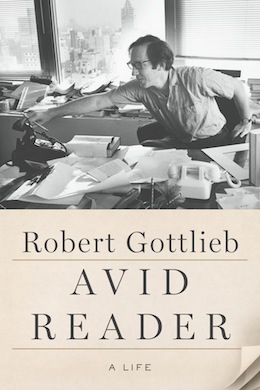
Robert Gottlieb is the most renowned American book editor and publisher in the latter half of the 20th century, much as was the legendary Max Perkins in the first half. And in his riveting memoir – Avid Reader: A Life (Farrar, Straus and Giroux, 2016) – Gottlieb traces the trajectory of his long and productive life with books and reading.

Gottlieb was born in New York in 1931 to a middle-class Jewish family. His mother was a public school teacher; his father, a lawyer. Little Bobby grew up listening to radio and devouring books. As he asserts in Avid Reader, he didn’t care much for nature or sports. It was reading he loved and this love is summed up in one memorable line: “From the start words were more real to me than real life, and certainly more interesting.”

Since the family was atheistic, Judaism played no role in his life. Yet he considered himself a New York Jew, a terse, self-identifying phrase that occurs like a leitmotif a number of times in his memoir.

Gottlieb went to a private school in Manhattan, whose students were mostly Jewish. “On the High Holy Days,” he writes, “out of my class of 39 only the four gentiles and atheistical me would be in attendance.” When one teacher wondered why so many students were absent, she was told, “It’s Yom Kippur.” Which prompted her to say, “Ridiculous. This isn’t a Jewish school.”

Gottlieb’s parents wanted him to go to Harvard. He applies but flunks the interview. And then, he adds, “there was the notorious Jewish quota. And I was the worst kind of Jew – a New York Jew.”

book cover - Avid Reader: A Life by Robert GottliebHe attends Columbia, majors in English literature and edits the school’s literary magazine. Later, he gets a yearlong fellowship to Cambridge, where, for the first time in his life, he gets a whiff of antisemitism. He is aware of the “casual antisemitism that punctuates English literature,” but that’s in books and here was real life. The English Jews he met, Gottlieb notes, considered themselves “the other,” and he, too, senses the English disdain of foreigners and Jews.
Later, when he’s an established editor, he has an encounter with children’s book author Roald Dahl, one of whose many nasty anti-Jewish remarks was: “There is always a reason why anti-anything crops up; even a stinker like Hitler didn’t just pick on them for no reason.” He also has an incident with John le Carré. With both English authors, he briefly recalls what he had felt in England.

Back in the United States, Gottlieb gets his first job as an editor with Simon and Schuster, where he would stay 11 years and publish amazing books, including one of my all-time favourite novels, Joseph Heller’s Catch-22. That unique title deserves mention. Heller had called his manuscript Catch-18, until Gottlieb saw that a new novel by Exodus author Leon Uris would be called Mila 18. The number in Heller’s title would have to be changed. Heller suggested 14, but that number was nixed as flavourless. In the middle of the night, Gottlieb had a revelation: 22. He called Heller: “I got it. 22. It’s even funnier than 18.” The book went on to sell millions of copies.

With his success at Simon and Schuster, Gottlieb was invited to head Knopf. He was only 36 and looked years younger. By this time, he was so famous that his move to Knopf was front-page news in the New York Times.

For Gottlieb, this was a dream job. For him, Knopf was the great literary house of the century. He had been nurtured on the great novelists Knopf was respected for Thomas Mann, Franz Kafka, Albert Camus, Jean-Paul Sartre, D.H. Lawrence. Under his leadership, the house brought in celebrities like Katherine Hepburn, Lauren Bacall and Washington Post publisher Katharine Graham to write their memoirs, all of which, with Gottlieb’s magic touch, became bestsellers. Also added to the Knopf list were writers like Gabriel García Márquez and Milan Kundera.

For Gottlieb, editing is not shaping a book according to the editor’s wishes but making it the best book the writer can write. The key to Gottlieb’s success is his constant devotion to his writers, often spending days with them to help them with their books.

Other famous Americans of Jewish origin who are adamantly secular have tried to hide their Jewishness. Gottlieb does not. It bubbles throughout his entire career. Even when he is coaxed into going to Marlene Dietrich’s funeral in Paris and to Berlin by a fellow editor, who is editing a book about the famous German entertainer, his Jewish sensibility is engaged and his trip to Berlin is full of qualms: “I’d never been to Berlin – a child of World War Two, and Jewish, I’d never got past my resistance to everything German (except the music) and had stayed away.” He notes that the Germans had mixed feelings about Dietrich. “On the one hand, she was probably the most famous and admired woman in their history; on the other, she had vehemently sided with the Allies against them during the war.”

Another one of the blockbuster books – two million copies sold – Gottlieb edited at Knopf was Bill Clinton’s autobiography. From the outset of their meetings, he decided to call him Bill. “I couldn’t envisage myself saying things like, ‘I think we need a semicolon here, Mr. President.’” And, when Clinton describes himself as very easy to work for, Gottlieb feels “that was the moment of truth.” In his view, if equality and balance between writer and editor is not established, the relationship will fail. And so, Gottlieb “cheekily” tells Clinton, much to the shock of Clinton’s aides, “Actually, I have to point out that, in this instance, I’m not working for you, you’re working for me.”

What is most revealing about Gottlieb’s irresistible personality and talent for friendship is that he goes on to form personal relationships with the writers he’s met that last for decades.

From Knopf, Gottlieb was appointed editor of The New Yorker (again front-page news in the Times), where he stayed for five years before finally retiring.

In the dozen or so years since, Gottlieb has nurtured another of his passions, classical ballet. “Dance liberated me,” he writes, “from the bondage of language, and balanced my life.”

After writing a biography of his hero, the great choreographer Georges Balanchine, Yale University Press lured Gottlieb to write the first biography in their new series, Jewish Lives. His assignment, Sarah Bernhardt, whom he calls “the most famous of all French women other than Joan of Arc.” Although this book is the bestselling short biography of that series, in typical Gottlieb self-denigration, he asserts that its success is not so much about him as it is about the book’s heroine.

Only a great editor like Gottlieb would have the sensitivity to list in the acknowledgments pages all the editors and assistants, friends and colleagues who helped him with Avid Reader.

It’s hard to believe that Gottlieb is 86 years old; he doesn’t look it, and his energy and creative spirit belies that advanced number. Some people are just fated to remain 44 – or 22 – forever.

Curt Leviant’s most recent books are the novels King of Yiddish and Kafka’s Son.

Format ImagePosted on March 31, 2017March 31, 2017Author Curt LeviantCategories BooksTags Robert Gottlieb
Nidje Israel – a hidden gem

Nidje Israel – a hidden gem

Nidje Israel – now called Sinagoga Histórica – was built by Eastern European Jews who came to Mexico in 1930. (photos by Rubén López Vargas)

photo - The ark, where the Torah is located, surprises the visitor with its golden columns crowned by the tablets of the law
The ark, where the Torah is located, surprises the visitor with its golden columns crowned by the tablets of the law. (photo by Rubén López Vargas)

Walking around the historic centre of Mexico City, where the main buildings are Catholic churches and convents, I am surprised to find in a small square called Loreto, a synagogue surrounded by two churches – Loreto and Santa Teresa la Antigua. The synagogue is easily overlooked at first glance, since its exterior is of a neo-colonial style that blends in with its surroundings, and one only realizes that the building is related to the Jewish people from the two Stars of David at the top of its main door.

Synagogue Nidje Israel was built by Eastern European (Ashkenazi) Jews who came to Mexico in 1930. It opened for services on Sept. 14, 1941, and closed its doors at the end of the 1970s. It was abandoned for about three decades, until a renovation was begun in 2008. Months of hard work culminated in the synagogue’s reopening on Dec. 13, 2009, and, today, it serves as a cultural centre, and is called Sinagoga Histórica (Historic Synagogue).

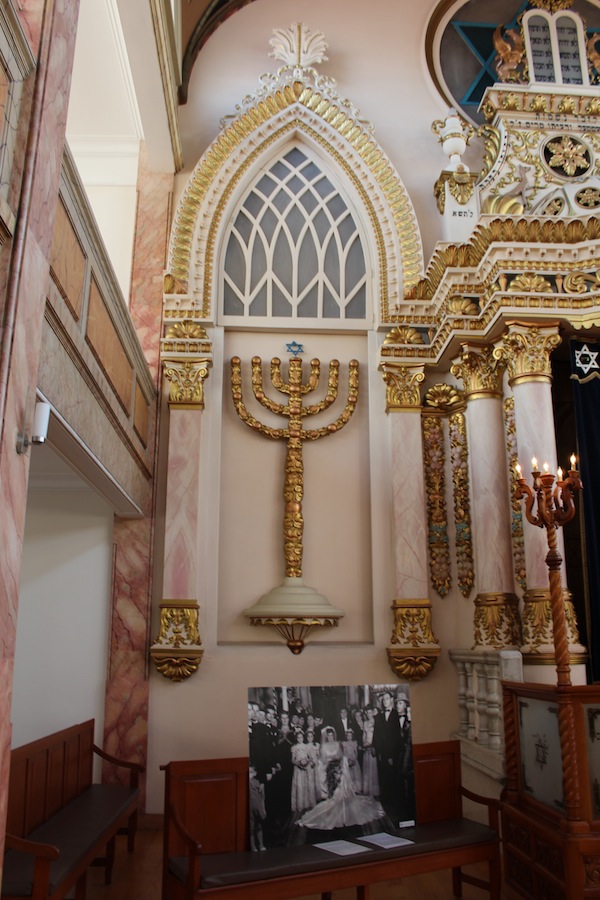
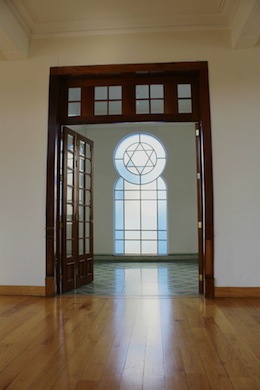
On entering, I am greeted with great cordiality and informed of the rules that must be followed inside. I pass a small patio that serves as a divider, and encounter the main façade, with its neo-Romantic style. Inside the synagogue, I walk into a salon, where celebrations are carried out in a traditional fashion. There is currently a photography exhibition of festivities celebrated in days gone by.

photo - Synagogue Nidje Israel was built by Eastern European (Ashkenazi) Jews who came to Mexico in 1930
Synagogue Nidje Israel was built by Eastern European (Ashkenazi) Jews who came to Mexico in 1930. (photo by Rubén López Vargas)

The first floor welcomes me with its open doors, and the first thing I see is the bimah. Located in the centre of the enclosure, it is the largest in Mexico, elaborated in fine woodwork, with stained glass images depicting musical instruments, alluding to Psalm 149.

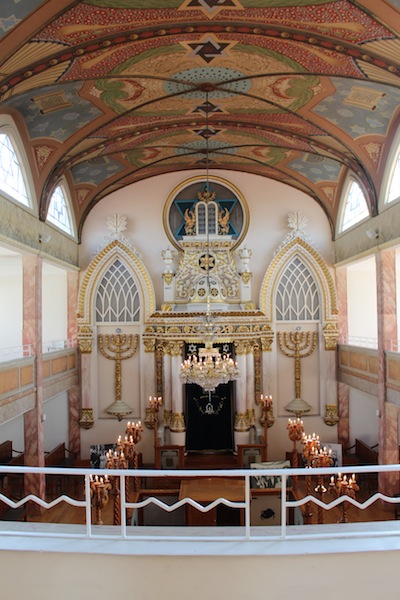
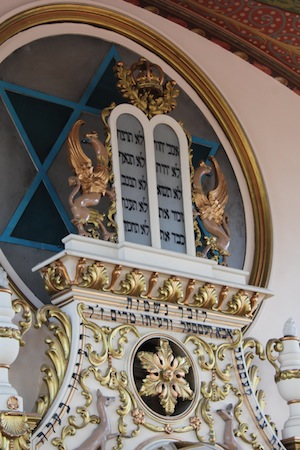
The ark, where the Torah is located, surprises the visitor with its golden columns crowned by the tablets of the law. These are sustained by two mythological animals. The cape that covers the ark door is embroidered with golden thread. The two menorot on each side of the ark enhance the beauty of the whole.

The ezrat nashim, the area reserved for women, is on the second floor, as is the mural depicting the Garden of Eden, on which I notice that there are no representations of humans, but only of animals.

photo - The ezrat nashim, the area reserved for women, is on the second floor
The ezrat nashim, the area reserved for women, is on the second floor. (photo by Rubén López Vargas)

When I stand next to the bimah, my attention is caught by two spectacular elements: the beautiful ceiling painted with vivid colours, with a great number of Jewish symbols, and the majestic candelabra, which was the most difficult element to restore, but an important aspect to remind us of the old synagogues.

I sit for a moment just to imagine what it would be like to take part in a religious service in this synagogue full of people. I stand and walk to the exit door, and stop once more to observe for the last time the beauty of the building that continues to amaze me.

I want to thank everyone who made it possible to restore this place and open it to the general public, to make better known the culture and identity of the Jewish people in this part of the world.

To find out more about Historic Synagogue, visit sinagogajustosierra.com.

Rubén López Vargas was born in 1972 and is a lifelong resident of Mexico City. He dedicates himself to photography of social events, historic monuments and colonial architecture. He loves dancing, reading of all kinds, and traveling throughout Mexico. This article was translated by Carl Rosenberg.

photo - Sinagoga Histórica is currently hosting a photography exhibition of festivities celebrated in days gone by
Sinagoga Histórica is currently hosting a photography exhibition of festivities celebrated in days gone by. (photo by Rubén López Vargas)
Format ImagePosted on March 31, 2017March 31, 2017Author Rubén López VargasCategories TravelTags Judaism, Mexico, Nidje Israel, synagogues
Nature, adventure close up

Nature, adventure close up

If you’re coming for the natural splendours of Costa Rica, you won’t leave disappointed. (photos by Lauren Kramer)

This travel story comes with a caution: if you’re visiting Costa Rica for any reason other than its nature, don’t bother.

Don’t come for the food, which is easily forgettable. The most popular dishes are gallo pinto, which is rice and beans, and fried pork skins known as chicharrones. While local Costa Ricans love this food, if you’re not from here, you might well be mystified by its appeal.

Don’t come for the driving conditions either, as the winding back roads leading to the coastlines and volcanic regions inland can be perilous, with bathtub-sized potholes and no streetlights out of the city.

Costa RicaBut, if you’re coming for the natural splendours of this small Central American country, you won’t leave disappointed. A tropical jungle filled with lush palms, massive ferns, strangler fig trees and unexpected bursts of bright heliconia, it’s a scene straight out of a Tarzan movie, complete with howler monkeys swinging shyly from the drooping vines and sloths cradled sleepily in tree branches. A quarter of the country’s landmass is protected from development, and its verdant beauty is nothing short of spellbinding.

We were grateful to leave the dense bustle of San Jose, Costa Rica’s capital and a city unremarkable but for a handful of colonial-style architectural buildings easily seen from a bus on the way out of town. Our destination was the Pacuare River, two hours east, where we’d signed up for a whitewater river rafting adventure, one of the hallmark tourism experiences in Costa Rica. Over the course of two days, we’d travel 18 miles over Class 3 and 4 rapids, spending a night at an eco-lodge, where we’d be hushed to sleep by the thrum of rushing water.

The rafting was thrilling, with adrenaline-pumping rapids around every bend and, between them, a few serene, calmer stretches where we could hop overboard. With one hand on the raft, we’d drift gently in the soft current, watching the iridescent turquoise wings of blue morpho butterflies as they flitted across the river. By early afternoon, we reached the eco-lodge, a series of rustic treehouse-style rooms located on the river bluffs. Once we’d swapped wet clothes for dry, there were hikes we could venture on, but it was prudent to exercise caution, our guide Jonny warned us. “There are snakes around here and they get active this time of day,” he said. “Just a few days ago, I killed a very poisonous one outside the dining hall.”

Costa Rican eco-villageAs evening fell, we gathered at candlelit tables in the thatched dining hall for dinner with other travelers. The air was thick with moisture, the jungle was shrouded in misty clouds and a steady rain made the palm fronds glisten in the fading light. It felt magical spending a night on the riverbanks, surrounded by tropical jungle and just a two-hour hike from the Cabecar Indians, the closest isolated indigenous community. “We have an arrangement with them,” Jonny explained. “They allow us to stop along the river and prepare meals for our rafting guests, but if there’s any food left over, we leave it for them.”

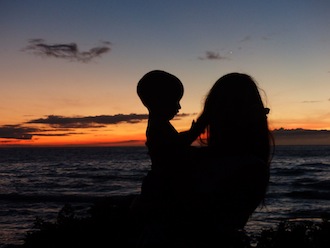
I wanted to spend Shabbat in San Jose, which is why we headed back there on the dusty Costa Rican roads a few days later. We’d been invited to spend the night at the Hotel Presidente, an establishment owned by the Mikowski family, third-generation Jewish Costa Ricans.

“My great-grandfather left Poland in the 1930s and somehow ended up in Costa Rica, where he sold clothing door-to-door,” said Daniel Mikowski. Daniel’s late father, Jaime, was the architect behind Hotel Presidente’s expansion and, before his death in 1998, he designed another hotel three hours northeast. Tabacon, located on the slopes of the Arenal Volcano, started as a 30-room establishment with beautiful gardens and hot springs fed by the diversion of thermal water to the property. Today, the five-star, 100-room property is in high demand and known to be the best accommodation in the area.

As dusk approached, we made our way to the Centro Israelita Sionista de Costa Rica, a massive complex whose high security walls include administrative offices for various Jewish agencies, the Jewish museum and an impressively grand Orthodox Ashkenazi synagogue. I’d sent my passport and filled out a questionnaire months prior to arriving for Friday night services, but security was tight, passports were inspected and I was still questioned by an Israeli guard before being waved through. Later, at the Shabbat table of the gracious local Jewish family I’d been invited to join, I asked if there was any hostility towards Jews that might justify such high security. The adults at the table shrugged. They couldn’t remember any instances of antisemitism in Costa Rica, a democratic country that prides itself on its high literacy rate, its emphasis on conservation (25% of the land is protected and 11% is national parkland) and the fact that it has no army.

I’m used to daydreaming through rabbinical sermons and this time I had the perfect excuse: it was delivered in Spanish, so the possibility of comprehension was nonexistent. Still, I loved the familiarity of the Shabbat songs that washed over me during the service, and the warmth of community members who were happy to welcome visitors. After a week of barely mediocre restaurant meals, it was blissful to eat challah at a local table, where the menu included kosher tamales wrapped in banana leaves, a labour-intensive exercise but a culinary favourite.

Over the course of the evening, I heard of the kinds of issues that pester Jews the world over. The handsome medical student that drove me to dinner complained there weren’t enough Jewish girls in town. Others mentioned that the pews at the synagogue were full only on the High Holy Days, and that the Jewish day school was more secular than it needed to be.

Still, by all appearances, Costa Rica’s is a tight Jewish community and, though many of its young Jewish people head to the United States for their studies, Mikowski said most of his friends have chosen to stay in Costa Rica. At the Friday night table, I asked the young parents around me if, given the opportunity, they’d rather live elsewhere. One suggested Israel, but everyone else concurred they were happy staying put. Which makes perfect sense, when you think about it – according to the Happy Planet Index, Costa Rica is the happiest country on earth.

Lauren Kramer, an award-winning writer and editor, lives in Richmond. To read her work online, visit laurenkramer.net.

Format ImagePosted on March 31, 2017March 31, 2017Author Lauren KramerCategories TravelTags Costa Rica, nature
A trip to a garden paradise

A trip to a garden paradise

If you are seeking a mecca for happiness, and are going to take your first trip with your baby, you might want to consider a relaxing and beautiful place like Hawaii. (photos by Masada Siegel)

According to a 2014 Gallup poll, the hypothetical happiest American was described as a tall, Asian-American man over 65 years old, who lives in Hawaii, is married with children, owns a business, earns a household income of more than $120,000 a year – and is an observant Jew.

photo - Hawaii - mother and sonWhile I don’t fit most of the criteria, I thought why not investigate on my own. Hawaii was a mere plane ride away. And if you are seeking a mecca for happiness, and are going to take your first trip with your baby, Hawaii might just be a more relaxing place to start than, say, New York City.

Upon arrival in Kona on the Big Island, we were whisked away and taken to the Four Seasons oceanfront luxury resort in Hualalai. Our check-in was completed on comfy couches, where we were presented with thirst-quenching drinks, tasty treats and sweet-scented leis.

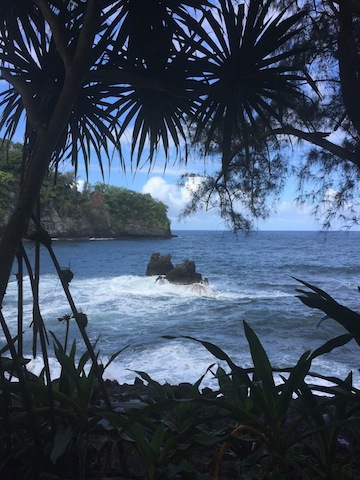
At our oceanfront cabana, the view was endless, only broken by palm trees caressing the skyline. There were black and white rocks dotting a shoreline filled with fine white sand. This along with the soft sound of the wind dancing over the water made me realize I had come to a paradise. One of the most relaxing aspects of our quarters was the outdoor lava rock shower decorated with pink and white orchids.

We strolled towards the beach, and I held my baby close. I put him down to stand on the sand and, as his eyes looked up, he gasped. My husband and I recited the Shehecheyanu. It was our son’s first time seeing the ocean. The enormity of the vast blue blanket of water, with its gentle crashing waves topped in blues, greens and greys also made me stare with wonder and awe. It was as if I were also viewing the world through my nine-month-old baby’s eyes.

The next morning, we found our way to King’s Pond, a perfect place for snorkeling, as there are more than 4,000 tropical fish to see and to swim among, and it is mere steps away from the beach. After a quick dip, I held my son’s hand as he grinned and walked on the sand towards the water. We played and giggled in the ocean under swaying palm trees until our stomachs growled.

The majestic breakfast buffet was our next stop and it was overflowing with fresh papaya, star fruit, mangos, blueberries, melons, croissants, buttery rolls, Hawaiian pastries, meats, cheeses, smoked salmon and an entire breakfast selection just for children. After rushing through breakfasts for the last many months, the outlandish spread was a sight for sore and hungry eyes.

My plate was crowded with delicacies; I gazed at the ocean and sipped on my coffee. It was among the best coffees I had ever tasted from around the globe. It was called Buddha’s Cup and was 100% Kona coffee.

photo - Hawaii - flower The Big Island is dotted with coffee plantations, both large and small. Visiting one and learning how coffee was made was on the adventure to-do list once we completed the relaxing part of the trip.
A few days later, we met up with the rest of our family at the gorgeous Fairmont Orchid, which is a family-friendly resort on the coast. The sandy lagoon with its azure waters is filled with snorkelers, an endless number of colourful fish and they even host yoga classes on paddleboards. If you are in the mood for a scenic stroll, walk past the golf course to experience a spectacular coastal trail filled with brilliant views. Every afternoon, anywhere from five to eight Hawaiian Green Sea Turtles appeared, to catch some rays as the setting sun hit the shoreline.

We elected to stay on the Gold level, which was a great move, as not only is the food delicious, it is plentiful and there are meals and snacks provided daily, so no need to waste time looking for restaurants.

Now, the touring began in earnest. The Big Island is filled with stunning sites, interesting activities and untold beauty.

One morning, we set out towards Hilo with a few scenic stops in mind, one being the Hawaii Tropical Botanical Gardens. Their creator, Dan J. Lutkenhouse, discovered the Onomea Valley in 1977 while vacationing with his wife, Pauline. He purchased the area, an overgrown jungle choking with wild invasive trees, weed and thorn thickets and strangling vines. After eight years of backbreaking work on the part of Lutkenhouse, his assistant Terry Takiue and two helpers, the garden was opened to the public in 1984.

The 40-acre valley is filled with trails, a tropical rainforest and streams, and it boasts more than 2,000 species of plants. Visitors are treated to several waterfalls and the waves of the ocean along the rugged Pacific coast.

Another coastal must-see area is Hawaii Volcanoes National Park, a World Heritage Site comprising two active volcanoes: Kilauea and Mauna Loa. Founded in 1916, the park encompasses 333,000 acres from the summit of Mauna Loa to the sea. There are 150 miles of hiking trails through volcanic craters, scalded deserts and rainforests. Visitors can also tour a museum, see petroglyphs and experience a walk-in lava tube.

photo - Hawaii - oceanBecause of the rich volcanic soil, Hawaii is filled with an enormous variety of flora and fauna. It also is the perfect place for coffee trees to thrive. Recalling the taste of that Buddha’s Cup, while we were en-route to somewhere else, I asked my sister Audrey and brother-in-law Gabriel to add it to our tour itinerary for the day. They agreed and, without a thought to call and see if they were even open, I Googled the address. We drove up a tiny, windy road until we were completely surrounded by coffee trees in all directions on what seemed to be the top of the mountain.
We saw construction and, moments later, a woman appeared and asked us what we were looking for and where we were from. Her name was Christine Coleman, and she was the owner. She explained that the visitors centre was being renovated, but invited us for a personal tour, where she shared that they not only grow coffee beans but also macadamia nuts.

The area was full of large trees with flowers dangling down, and greenery as far as the eye could see. It was clear even under construction that the facility was going to be gorgeous.

Since our visit, the coffee plantation has reopened, and it provides guests free tea and coffee tastings. Additionally, visitors can pay a small fee and go on a four-wheel-drive educational tour of the plantation.

Meanwhile, I have returned to reality from my Hawaii paradise relaxation vacation. At home, alas, there are no long lingering breakfasts by the beach filled with exotic fruits and someone serving me. However, once in awhile, I brew Buddha’s Cup and, for a brief moment, it all comes rushing back, and it makes me smile. Finding happiness is easy in Hawaii, but you don’t have to live there to take home its bubbling spirit.

Masada Siegel is an award-winning journalist and photographer. Follow her @masadasiegel and visit her website, masadasiegel.com.

Format ImagePosted on March 31, 2017March 31, 2017Author Masada SiegelCategories TravelTags Hawaii
A Jewish gladiator?

A Jewish gladiator?

A painting from Pompeii showing gladiators fighting. It is housed in the National Archeology Museum in Naples. (photo by Deborah Rubin Fields)

Among the fabulous finds of Pompeii is the helmet of an apparently Jewish gladiator. Who would have thought?

As many readers might know, Pompeii was the unfortunate recipient of Mount Vesuvius’s 79 CE wrath. Many gladiator helmets have been dug up in Pompeii’s excavations. (Unfortunately, this collection is kept in storage at Naples’ National Archeology Museum.)

In the paper “A Jewish Gladiator in Pompeii,” historian Dr. Samuele Rocca notes that one of these stored helmets stands out for its unique decoration. While there are images on other recovered helmets and weapons, they usually come from pagan iconography. On this one helmet’s forehead relief, however, there is a seven-branched palmetto tree with a cluster of dates on each side.

During the time of the gladiators, the palmetto symbol was apparently employed in only one other place – as an engraving on Judaean coins. These coins, Rocca says, were associated with Jews. Indeed, the symbol was jointly chosen by the local Jewish leadership and the Roman procurator. Thus, the palm tree symbolized both the religious and secular ideals of the late Second Temple Jewish leadership.

photo - The amphitheatre in Pompeii
The amphitheatre in Pompeii. (photo by Deborah Rubin Fields)

Moreover, Rocca reports that a small number of other Jews came to Pompeii both before the exile of 70 CE and afterward. In Pompeii, they did not form a Jewish community as such, but apparently Jewish women lived at Pompeii.

Remarkably, archeologists have excavated lists of Pompeian names. Apparently, during this time, Maria was a Jewish name. One Pompeii woman bearing that name worked with textiles.

Another woman with the same name lived in the Casa dei Quattro Stili, although her rank and societal position remain a mystery. It is theorized that the most well-known Maria was a prostitute, who worked in the Thermopolium of Asellina, in Via dell’Abbondanza.

While Prof. Andrew Wallace-Hadrill, in Herculaneum, Past and Present, writes that food could not have stayed hot in the thermopolia’s terracotta containers, others maintain that the thermopolia were the precursors of today’s restaurants. In brief, this explanation makes a case for Maria to have been a barmaid or waitress.

Estimates are that, in 70 CE, Titus took 20,000 Jewish slaves to Rome, so it is not surprising that Jews arrived in Pompeii as slaves. In fact, from the many documents salvaged from Herculaneum – another town severely affected by that same Vesuvius eruption – we know that Roman society was organized along the lines of freeborn, enslaved, freed and those holding a special status. According to Wallace-Hadrill, “It is a society in which your legal status has an overwhelming importance…. But a society characterized by movement between status groups … the third group comprised those who were neither freeborn nor regularly set free … but who had nevertheless … been promoted to full citizenship.” On still-legible marble panels listing residents’ names, he writes, “only a sixth of the Roman male citizens in Herculaneum could name their freeborn fathers … it leaves them massively outnumbered.”

After Mount Vesuvius’s horrific 79 CE eruption, you may well wonder how so much Herculaneum documentation is still available. Wallace-Hadrill explains, “Pompeii was blanketed in ash and pumice pebbles, while Herculaneum was covered in the fine, hot dust of pyroclastic surges and flows, result[ing] in the extensive preservation at Herculaneum of organic material – principally wood, but also foodstuffs, papyrus and cloth.”

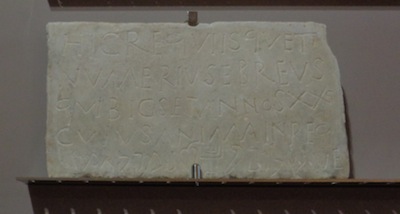
photo - The tombstone for the young Jewish Numerius, written in both Latin and Hebrew, which can be seen at the National Archeology Museum in Naples. Note the menorah in the middle of the bottom line
The tombstone for the young Jewish Numerius, written in both Latin and Hebrew, which can be seen at the National Archeology Museum in Naples. Note the menorah in the middle of the bottom line. (photo by Deborah Rubin Fields)

As somewhat of an aside, Salvatore Ciro Nappo, in Pompeii, notes that the Pompeians apparently did not consider Mount Vesuvius dangerous. One indication of this is that the House of the Centenary has a lararium (shrine niche for household gods) fresco in the servants’ rooms showing Bacchus, a thyrsus (a type of staff or wand) and a panther in front of the mountain. Vineyards entirely cover the mountain, presumably indicating Vesuvius brought festivity and prosperity.

Today, archeology is, for the most part, an appreciated study, but that was not always the case. According to Wallace-Hadrill, when medieval rulers wanted to tunnel down into the ruins of Pompeii, they ran into opposition from the Inquisition. Sanctioned excavation – haphazard as it first was, with some kings taking “the good stuff” or even going so far as to destroy finds so as not to share the wealth – did not begin until the 1700s.

Archeology has shown that nearby Naples, located 14 miles southeast of Pompeii, had a bona fide Jewish community pre-dating the Jewish arrival in Pompeii. For trade reasons, Jews started settling in this port city in the first century BCE. Life was tolerable for them, even as the Roman Empire started falling apart. When, in the late fifth and sixth centuries CE, Justinian tried to regain the Roman Empire from the Germanic Ostrogoths, the Jews of Naples fought against Justinian.

These Jews apparently “blended in” to the extent that they inscribed their tombstones almost entirely in Greek or Latin. Significantly, while the travertine (the land-formed version of limestone) grave markers at Naples’ National Archeology Museum are usually not in chiseled Hebrew, they do contain obvious Jewish symbols such as menorot, lulavim, etrogim and shofarot. On one tombstone, the inscription reads: “Here lies Numerius, a Jew, who lived for 26 years and whose soul is in peace. Shalom, Numeri[u]s, amen.”

The French Angevins oppressed the Jews in the 13th century, but their Aragon successors (in the 1400s) basically left them in peace. Naples thus became a major centre of Jewish book production during the 15th century. Then, as happened in other European countries, the Jews were expelled in 1541, only allowed back in generations later. In the 1800s, the Rothschilds, who were the banking concern in Naples, helped restart the Jewish community. In the 1920s, the community grew to 1,000. While 80% of Italian Jewry survived the Holocaust, Naples’ current Jewish population is about half its former size, with even fewer people belonging to Naples’ synagogue.

Deborah Rubin Fields is an Israel-based features writer. She is also the author of Take a Peek Inside: A Child’s Guide to Radiology Exams, published in English, Hebrew and Arabic.

Format ImagePosted on March 31, 2017March 31, 2017Author Deborah Rubin FieldsCategories TravelTags archeology, gladiators, history, Pompeii
About the Passover cover art

About the Passover cover art

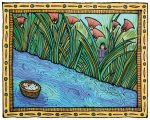
“Basket on the Nile” by Carol Racklin-Siegel. “She could not hide him any longer, so she took for him a wicker basket and smeared it with clay and pitch; she placed the child into it among the reeds at the bank of the River.” (Exodus 2:3)

This image – created with gutta resist and fabric dyes on silk – is the cover art for The Brave Women Who Saved Moses, the eighth book in a series of children’s Bible books published by EKS Publishing. The books are available on Amazon or from ekspublishing.com.

You can see more of Racklin-Siegel’s artwork on pomegranatestudios.com or “The Artwork of Carol Racklin-Siegel” on Facebook.

Format ImagePosted on March 31, 2017March 31, 2017Author Carol Racklin-SiegelCategories Celebrating the Holidays, Visual ArtsTags art, Judaica, Judaism, Passover

Posts pagination

Previous page Page 1 … Page 454 Page 455 Page 456 … Page 667 Next page
Proudly powered by WordPress