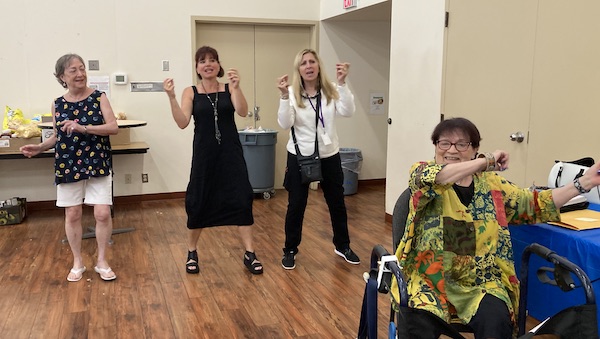
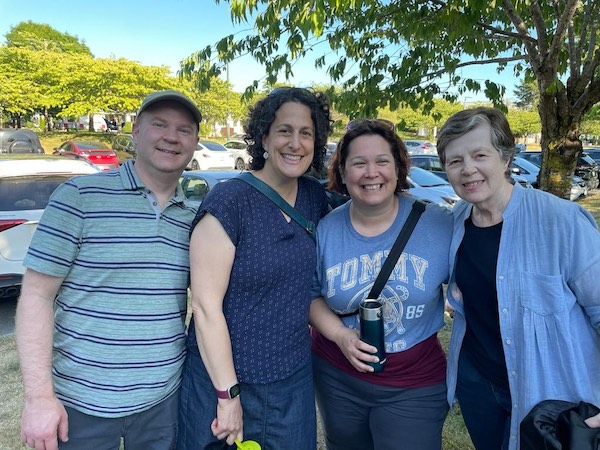
From left to right: Leslie Rosen, Toby Rubin, Tammy Klass and Marilyn Berger dance to the music of singer and pianist Miriam Davidson. (photo from JSA)
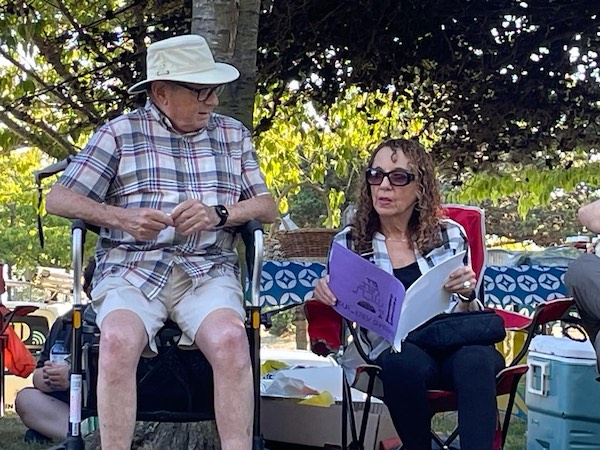
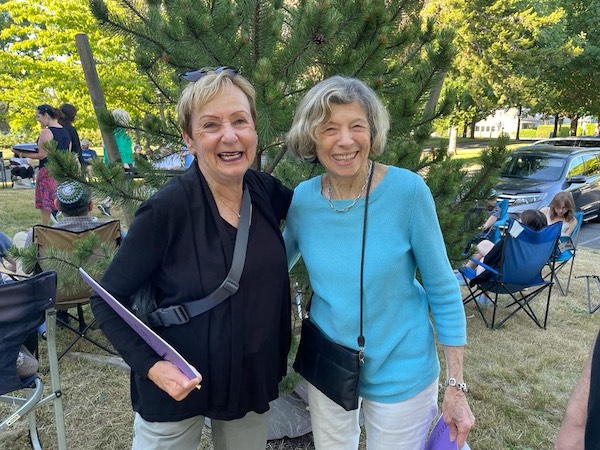
The last session of the Jewish Seniors Alliance-Snider Foundation Empowerment 2022-23 season was held on June 26 at Beth Tikvah Synagogue in Richmond. It featured Miriam Davidson playing and singing show tunes, and people joined in and even danced.
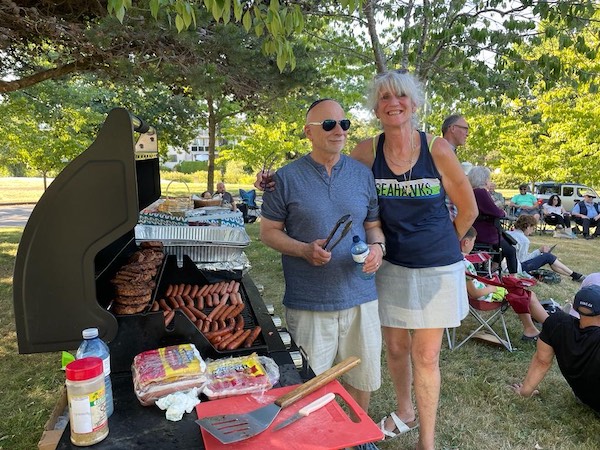
The event was co-sponsored by JSA, Kehila Society’s Seniors Program and Beth Tikvah. Attendees were treated to a BBQ lunch of hamburgers, hot dogs and veggie dogs with all the trimmings. More than 60 seniors from around the Lower Mainland attended.
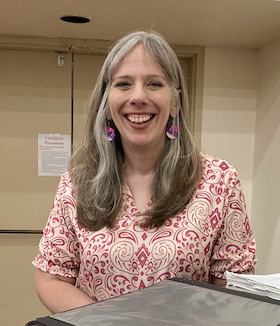
Miriam Davidson (photo from JSA)
The crowd was welcomed by Toby Rubin, the coordinator of the Kehila program. She explained that Lester Soo, the scheduled entertainer, was unable to perform, but that Davidson, a pianist and vocalist, was able to step in.
Davidson began with some songs from The Sound of Music that were very familiar to the audience, and she encouraged everyone to sing along. The program included such tunes as “Ain’t Misbehavin’,” “Fly Me to the Moon” and “Only a Paper Moon.” She played “Memory” from the musical Cats and a request for Abba’s “Dancing Queen” had the audience swaying and waving their arms in time to the music. There was even a bit of dancing.
The concert ended with “Here Comes the Sun” by the Beatles.
The afternoon wrapped up with greetings from Tammi Belfer, president of the JSA, and a thank you to Davidson, who was wonderful.
Shanie Levin is a Jewish Seniors Alliance Life Governor. She is also on the editorial committee of Senior Line magazine.
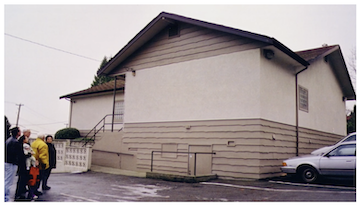
Screenshots from Burquest: Past, Present & Future.
The 37-minute film Burquest: Past, Present & Future – about Burquest Jewish Community’s history – includes photos and interviews with founders and past leaders, and is scored with original music written by Burquest members and supporters. It premièred at a wine and cheese event on June 25 and is now available at burquest.org.
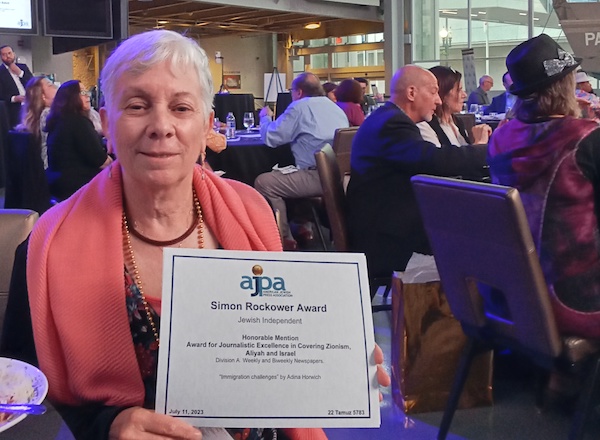
Adina Horwich at the 42nd annual Rockowers Awards. She received an honourable mention for journalistic excellence in covering Zionism, aliyah and Israel. (photo from Adina Horwich)
The Jewish Independent won four Simon Rockower Awards for Excellence in Jewish Journalism this year. The awards, which are given out by the American Jewish Press Association, were for work done in 2022. The JI has had a few Rockower hat tricks in its history, but this is the first time the paper has garnered four honours in one year.
The awards were presented on July 11 at the Higgins Hotel and Conference Centre in New Orleans, La., where the AJPA’s annual conference was held. The JI mainly competed in the division of weekly and biweekly newspapers, but there were some categories for which the competition was between all types of media (print and online); awards were given for first and second place, and sometimes honourable mention.
Writer Adina Horwich traveled from her home in Israel to New Orleans to receive her award in person. She won the JI an honourable mention for journalistic excellence in covering Zionism, aliyah and Israel for her article “Immigration challenges” (jewishindependent.ca/immigration-challenges-2). The piece both reviews Adi Barokas’s Hebrew-language graphic novel, The Journey to the Best Place on Earth (and Back), about Barokas’s experience trying to immigrate to Vancouver from Israel, and shares Horwich’s experience making aliyah from Canada. The jury commented: “Extremely readable story, that skilfully explores from a personal perspective the nitty gritty of making aliyah.”
The JI’s Pat Johnson also received an honourable mention – his article “Oasis in the Caucasus” (jewishindependent.ca/oasis-in-the-caucasus) garnered recognition for excellence in writing about Jewish heritage and Jewish peoplehood in Europe. The jury said about his piece:
“A terrific look into the Jewish community of Azerbaijan that most of us, unfortunately, don’t have on our ‘Must-Go Places to Visit.’ Pat Johnson’s very nice story strongly suggests otherwise. Johnson paints a wonderful picture of this tucked-away ‘shtetl’ where the residents say they have never faced antisemitism. If only we could feel so lucky here in the United States! And while most of us do well playing ‘Jewish geography,’ actual world geography is often more of a challenge. Having Johnson admit having to Google Azerbaijan before traveling there to report this story added a nice touch that connects with readers who may also be unfamiliar with the country – but now more knowledgeable thanks to this feature.”
Johnson was recognized for another of his articles, “Maus not too graphic” (jewishindependent.ca/maus-not-too-graphic), which placed second for excellence in education reporting. Johnson sat in on Anna-Mae Wiesenthal’s Holocaust and Genocide Studies class at King David High School, and listened as students discussed the graphic memoir Maus by Art Spiegelman.
“Lots of people laughed when a Tennessee school board pulled Maus from the curriculum because of the drawing of a naked cat. That was too much for board members and they banished the Pulitzer Prize-winning graphic novel,” wrote the Rockower jury. “Viewing the book through the eyes of five students at a Jewish high school subtly portrays the board decision’s absurdity.”
Rounding out the JI wins was a first place for excellence in editorial writing – where all entries competed in the same division. The JI editorial board of Johnson, Basya Laye and me were honoured for the set of editorials that included “Every person has a voice” (about Elon Musk, hatred and misinformation online, and how people can counter such forces), “Extremism not helpful” (about New Democratic Party leader Jagmeet Singh’s views on the Israeli-Palestinian conflict) and “New era in U.S. politics” (about the U.S. Supreme Court’s rejection of a woman’s right to reproductive self-determination, as well as the Jewish perspective on abortion).
About these editorials the Rockower jury wrote: “These pieces are good examples of what editorials should be – thoughtful examination of pressing issues, using clear reasoning in looking at both sides, then coming to a well-reasoned conclusion. Local tie-ins strengthen opinions.”
All of us at the JI appreciate the AJPA’s recognition of the hard work that goes into producing an independent Jewish newspaper, magazine or website, and we congratulate all of our colleagues on their achievements. For the full list of Rockower winners, visit ajpa.org.
The JI couldn’t do what we do without our subscribers, donors and advertisers – thank you for all your support. For readers who are thinking about subscribing, donating or advertising, please consider doing so to help us continue producing a high-quality, independent Jewish newspaper that connects community members from across the religious and political spectrums; covers lifecycle events and local, national and international news; and documents our community history as it happens. Visit jewishindependent.ca/support-the-ji, email cramsay@jewishindependent.ca or call 604-689-1520.
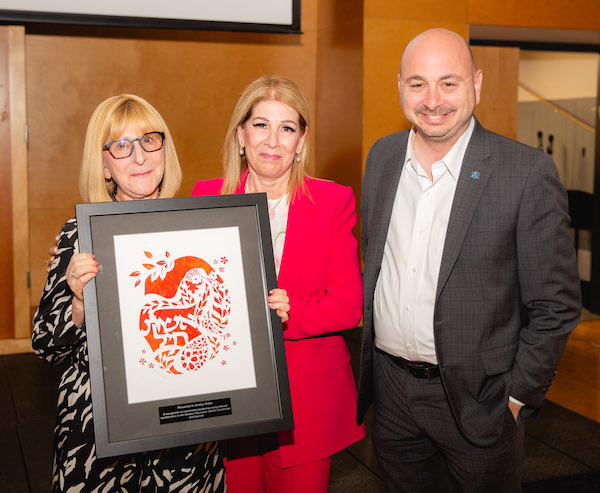
Shelley Rivkin, left, Candace Kwinter and Ezra Shanken
Jewish Federation of Greater Vancouver’s annual general meeting on June 27 at King David High School celebrated Shelley Rivkin, vice-president of local and global engagement, for her contributions to the community. The meeting also honoured several volunteers for their leadership and contributions: Catherine Epstein (Dennis Frankenburg Award), new board chair Lana Marks Pulver (Harry Woogman Award), Stan Shaw (Bob Coleman Award), Brent Davis (Young Leadership Award) and SUCCESS (Community Partner of the Year).
In an email sent after the meeting, chief executive officer Ezra Shanken and immediate past board chair Candace Kwinter shared their joint message that will appear in Federation’s 2022-2023 annual report. In it, they cover much ground, noting that the organization’s “impact resonates farther afield than what the ‘Greater Vancouver’ in our name might suggest. From the Sea-to-Sky to Langley, and all points in between, Jewish community life is thriving – and we are proud to be at the centre of it through our Connect Me In program. On Vancouver Island and in Kelowna, we are now providing security training for volunteers and professionals in their growing Jewish communities.
“As part of her role on the Jewish Agency’s board of governors, Candace traveled to Ethiopia and accompanied some of the 3,000 Jews who were making aliyah. Together, we traveled to Mexico City with the Jewish Agency to see more of their international work, and from Ukraine to Turkey and Syria and beyond, we helped those in need when disaster struck.
“We continued to improve the quality of life for residents of our partnership region in northern Israel. Our work is focused on strengthening the region’s development and regionalism through leadership development and capacity-building while investing in academic excellence. Our long-term investments are helping residents tackle some of the most difficult and complex challenges they face living in Israel’s periphery.
“The political situation in Israel has proven challenging for many in our local community who care deeply about the country,” continue Shanken and Kwinter. “We and our partners have offered multiple events over many months to help people learn more about what is happening and to facilitate discussions.
“Here at home, inflation continued to take a toll on our partners and the people they serve. Across the board, our partners report that inflationary pressures are affecting every part of their work. Ninety-one percent are concerned or very concerned that inflation will affect community members’ ability to fully participate in Jewish life. And 100% of our social service partners are concerned or very concerned that inflation will affect their ability to support their clients’ needs.
“For five years, we have been bringing community together around issues of affordability. Together with key partners, we co-hosted an Affordability Summit on the experiences of children and youth in low-income homes. The three areas of focus identified by our planning council are advocacy for a national breakfast program, creation of a single application point for assistance from multiple organizations, and development of more inclusive, respectful processes.
“This year, we made strides in combatting antisemitism. We were proud to see Vancouver city council and Richmond city council adopt the International Holocaust Remembrance Alliance (IHRA) working definition of antisemitism and the province of B.C. commit to using it as a tool to identify and combat hatred. Identifying antisemitism is the first step in combatting it, which makes these milestones important for all of us, and we want to thank our partners and our advocacy agent, the Centre for Israel and Jewish Affairs, for their work on this.”
Federation also has started “an organizational design initiative intended to build significant capacity within the Federation over the next several years with greater potential for scalability, efficiency, excellence and agility going forward.
“Our unparalleled impact is possible thanks to the strength of our partnerships and the cherished trust of our donors,” Shanken and Kwinter write. “Collective giving is deeply rooted in our tradition, and we play a leadership role in raising the funds our community needs to grow from strength to strength. We invest strategically in initiatives that keep our community strong today, tomorrow and for years to come – as well as in times of crisis. Our partners depend on us to generate the support they need to deliver the vital programs and services on which thousands of people rely.”
The 2022 annual campaign generated more than $13 million for the community: $10.24 million directly through the campaign and $2.91 million in additional support, including special project funding, community relief and emergency relief. The Jewish Community Foundation’s contributions this year surpassed $12.7 million.
“This is more than double the contributions received in the previous fiscal year, which itself exceeded the contributions of the year before that,” write Shanken and Kwinter. “The Foundation strategically disbursed a total of $3.7 million into local, national and worldwide causes, including funding for the Foundation’s Unrestricted Grant Program, which allows response to critical emerging needs in the community.
“JWest also achieved unprecedented milestones. As one of the three lead organizations working together to bring JWest to life, we are excited at the progress made this year. From announcing the capital campaign cabinet to securing $75 million in funding and philanthropic gifts to a $36 million matching gift, this project has gained tremendous momentum.”
* * *
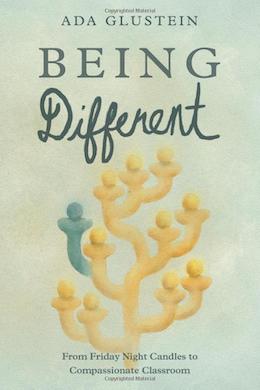
Ada Glustein received a silver medal for Canada-West Region, non-fiction, in this year’s Independent Publisher Book (“IPPY”) Awards for Being Different (self-published).
The “IPPY” Awards are a broad-based, unaffiliated awards program open to all members of the independent publishing industry worldwide who produce books written in English that are appropriate for the North American market. The awards are intended to bring increased recognition to the thousands of exemplary independent, university and self-published books released each year.
A memoir, Being Different tells a universal story about feeling different and longing to belong. Glustein recounts tales of growing up in a Jewish immigrant family during and following the Second World War, and the experiences that stand out during her school days, not knowing how to fit in to the world beyond home. She reflects on her years of teaching diverse children who also experienced life as “different.” She finds her own sense of belonging through helping those children find theirs.
* * *
Barbara Adler
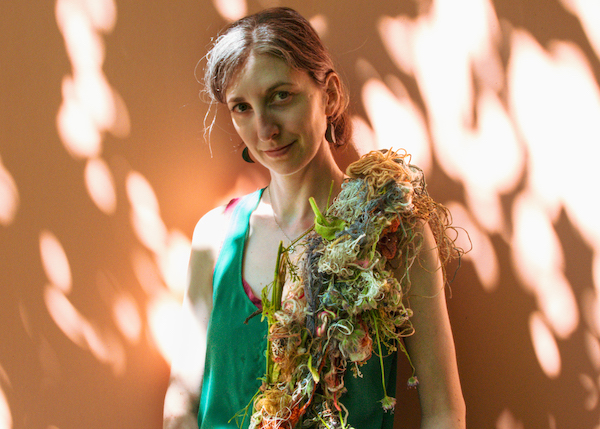
Barbara Adler is the new artistic director of the Only Animal Theatre.
“After a rigorous national search by a leadership transition committee comprising board members and affiliated artists, we are delighted to have Barbara take the lead at the Only Animal,” said board chair Eleanor Stacey. “When we began the search process, we knew it would be an immense challenge to find a successor to founding artistic director Kendra Fanconi, who built such a visionary and essential company. Barbara’s distinctive combination of experience, artistry and vision for the future positions her uniquely to lead the company into its next chapter.”
Adler is an interdisciplinary artist and performer whose practice incorporates text, music, event-making and design. Recent projects centre slow and process-led creations that focus work around relational time and seasonal cycles. As a poet and musician, Adler spent over a decade touring North America, Europe and rural British Columbia as a solo artist and with ensembles, including the Fugitives, Proud Animal and Ten Thousand Wolves. She holds a master of fine arts (interdisciplinary studies) and a bachelor’s in art and cultural studies from Simon Fraser University.
Adler is “thrilled to join a company whose irresistible artistry and deeply held ecological values have brought both innovation and care to the climate crisis.” She added, “The Only Animal’s vision of enduring environmental stewardship reminds me that none of us will individually finish the work. I am honoured to add myself to the beautiful story that Kendra and the company have told for 17 years, and humbled by this opportunity to prepare the way for the next generation of voices in the climate struggle.”
* * *
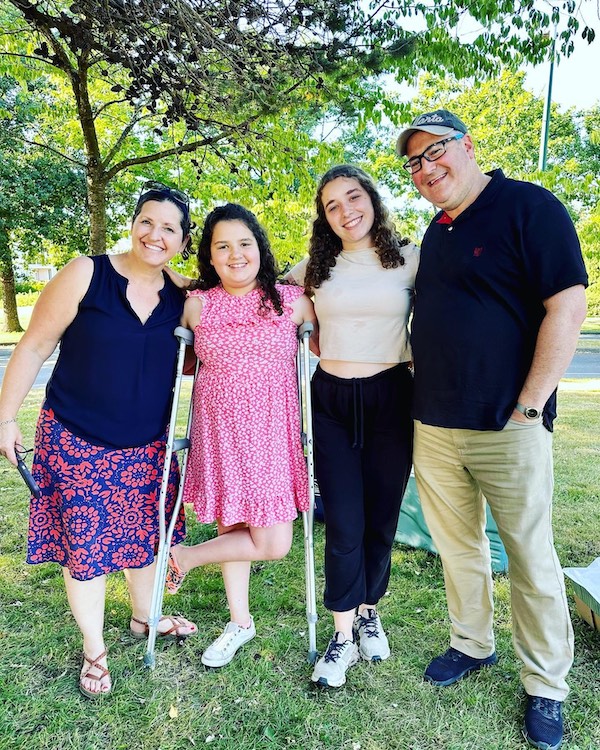
Rabbi Susan Tendler, her husband Ross Sadoff and their kids.
Beth Tikvah Congregation brought the community together for a Shabbat BBQ at Gary Point Park July 7. Sponsored by the Sadoff family in honour of Ross Sadoff’s birthday and under the leadership of Rabbi Susan Tendler, the event drew around 100 attendees. Amid a picturesque setting, the atmosphere buzzed with ruach(spirit). Laughter and joy filled the air as families and friends relished the food, conversations and Shabbat traditions.
Left to right: Ian Felgar, Elena Felgar, Yvette Tarko-Sabi and Donna FelgarRoy Freedman and Caryl KoshenEstelle Bleet, left, and Ann KramerJeff Rothberg and Stacey Kettleman of Star Catering.Libby Seltzer, left, and Mindy Zimmering
As in the instance of many complicated issues, we cannot begin a discussion of specific issues without providing background and context. Earlier this month, the Israel Defence Forces entered Jenin, located in what many Jews call Judea and Samaria. This portion of the originally mandated territory is in Area A under the governing authority of the Palestinian Authority in accordance with international agreements called the Oslo Accords.
This agreement was voluntarily implemented by Israel because the accords were never signed by the PA, then under the leadership of the now-deceased Yasser Arafat. At that time, there was the international aspiration that there might be a two-state solution to the Israeli-Palestinian conflict. Under the agreement, the disputed territory occupied by Israel after three wars was divided into three areas. Area C, the largest piece, was essentially vacant land with little population and was solely under Israeli governance. Area B was under joint Israel-PA governance. Area A, which was the most populated and had all-Arab cities, was under sole PA governance. Jenin is one of those cities.
Under the accords, Israel retained overall responsibility for security, including responsibility for maintaining security for all borders.
Over the years, Israel made a number of offers to the PA to resolve differences. The PA declined to consider any of them. They insisted on a return to 1948 Armistice borders and independent statehood with their own armed forces. Based on Israel’s experience with Gaza and Lebanon, this was unacceptable to Israel.
The goodwill toward Palestinians that was evidently held by an important element of the Jewish population seems mostly to have been forfeited over time. An appreciation has grown that there is no acceptable solution for the Arab side that would allow for a viable Jewish state. Consequently, for many, the idea of a two-state solution is no longer feasible.
Meanwhile, the PA has maintained a hostile attitude to Israel, educating young Arabs to hate Jews and to aspire to murder them, and paying the families of deceased and jailed terrorists substantial pensions. Many suicidal activists have been incentivized in their actions by these awards for their families. These payments are a part of the PA budget.
Further, popular support from the Arab population has shifted from the PA to the terrorist organizations headquartered in Gaza and in Beirut, Lebanon. Elections for PA leadership have continually been postponed to avoid the takeover by Hamas that occurred in Gaza. Hezbollah controls the government of Lebanon. Both these entities are now financed by Iran, which has publicly announced their intention to eradicate the Jewish state.
The situation has been aggravated by the increasing incapacity of current leadership. PA President Mahmoud Abbas is reportedly in ill health. There is now competition as to who will replace him. This has caused further internal conflict, which has impaired PA functioning. Measures aimed at controlling terrorist operations or crime gangs would not encourage popularity.
With this background, we can turn to consideration of the Jenin event.
While there is theoretical cooperation with the PA on security matters, more and more it has fallen to Israeli forces alone to carry out this task. Although the PA claims statehood, more and more it has failed to build the infrastructure required. Particularly over the last two years, security in the major Palestinian centres under their jurisdiction has been lacking. Crime is rife and terrorist organizations have used the vacuum to establish a network aimed at destroying Israel, financed primarily by Iran.
In recent months, Israel has suffered 58 attacks having their origins in Judea and Samaria. Often, the perpetrators escape to hide in sanctuaries established within the Arab population centres in the region. Arms and monies have been smuggled into that area from Jordan. One diplomat from Jordan has been arrested and charged in this regard.
The IDF exercise involving a brigade-strength force is likely the first of a number that will try and establish a return to law and order in Area A, in Judea and Samaria. Remarkably, the IDF was able to carry out its mission in densely populated Jenin while avoiding any civilian casualties. Sadly, there were two IDF fatalities.
The failure of the PA to carry out its responsibilities leaves Israel with no alternative. Even with the IDF’s efforts, many of the terrorists in this specific area escaped. Four locations in the local network were disrupted, one of them located in a mosque basement. Arms caches were removed along with funds that were found, which were being used to finance terror activities. Almost 100 operatives were arrested and 18 were killed – all were combatants.
The situation indicates that this is only the first of similar necessary exercises to discourage attacks on innocent civilians. We will probably see this not only in Jenin but in other population centres in the region. We may see the program carried out despite efforts by many parties around the world seeking to vilify the Jewish state.
Max Roytenbergis a Vancouver-based poet, writer and blogger. His book Hero in My Own Eyes: Tripping a Life Fantastic is available from Amazon and other online booksellers.
The greatest triumph of our summer so far is moving 10 cubic yards of gravel. Obviously, there’s a story in this! When we moved to our present house, we knew that the landscaping (along with the plumbing, electricity, insulation, boiler and more) needed work. A previous owner created rock-filled beds in both the front and backyards. This wouldn’t have been our chosen landscaping technique, but, when we moved in, these beds had so many weeds and enough scattered rock that it would be hard to remove them, so we chose to improve on what was here already.
We found an advertisement offering an entire dump truck’s worth of (slightly used) gravel for a low price. I made bad geology jokes about “new” versus “used” gravel after that, but we called them up. Soon after, we received two huge piles of gravel in our driveway, dumped efficiently by a Hutterite colony that found they had too much on hand. We had saved cardboard and put it down to kill weeds. Then the cardboard was covered with the slightly dusty and dirty (used) gravel.
The first pile of gravel, for the front of the house, was moved by the end of May long weekend. Through trial and error, I found a successful system that one mom (me) and twins (age 12) could manage. It involved using beach sand buckets and plastic flowerpots. Each person filled up two of these, and we pretended to do weightlifting as we marched from the pile to the landscape bed, over and over. My much larger partner filled a heavy wheelbarrow full of gravel with a shovel and moved it instead. We also had help from a kind neighbour who loaned us a second garden cart, which could be operated by the twins if (and only if) they cooperated.
The backyard gravel pile took longer. It wasn’t in the way as much, not as publicly in view and, well, some of our enthusiasm for the project had worn off. We finally moved it all into the backyard by mid-July. There are, of course, people who hire landscapers using Bobcats, or workers with multiple wheelbarrows, but we did the physical labour, for free, as a team. It worked for us. As neighbours commented on the hardworking “mama and twins” and the disappearing piles, we felt proud of our efforts.
This gravel experience reminded me of other Jewish traditions around summer, with Tisha b’Av coming. This day of mourning, where we remember the destruction of the Temple in Jerusalem, has a lot of upsetting stories attached to it. One reason the rabbis give about why the Temple was destroyed is “sinat chinam” or “baseless hatred.” In other words, there was so much infighting between Jewish factions that it caused the Romans to be able to destroy Jerusalem and the Temple.
The Roman Empire was big and powerful. Probably there were many reasons its leaders wanted to conquer more territory, including Jerusalem and the Temple. Yet, the talmudic rabbis give multiple examples of how individuals’ bad behaviour resulted in the fall of the entire Jewish world. Was every single one of these painful stories of bad behaviour completely historically factual? Well, maybe not. It’s hard to say from here.
Regardless, the personal stories of hatred remain powerful thousands of years later. I thought of this stuff as we trudged back and forth with our little buckets of stones. I also nearly joked with my children about Sisyphus, forced to push his rock uphill for eternity, as they occasionally complained, but Sisyphus was Greek, not Roman, and I didn’t want to mix metaphors while hauling gravel.
What I found most interesting about moving the gravel, or cleaning up construction messes as a family, is that, after initial grumbling, we all settle down into a rhythm together. We put in the work. We all pull in the same direction and, well, with all four of us working, things get done.
This struck me as the absolute opposite of sinat chinam, or baseless hatred. We are faced so often with hard tasks – as individuals, as families, in neighbourhoods or in the wider Jewish community. Not every task is physical labour either. It’s easy to fall apart and bicker over everything instead of finding a common cause and working efficiently together. However, if we search for what we have in common, including big goals, it’s amazing what we can accomplish.
Jewish people are like everyone else – we’re all very different individuals, prone to disagreement and conflict. Some of us will avoid haircuts, washing clothes, eating meat and then fast on Tisha b’Av. Others may skip those rituals altogether. Whatever we do or don’t do for Jewish holiday observance, we also might forget that we have things in common, too. If we choose to pull in the same direction to make changes about things that matter to us, we can do it.
I’m not claiming to know what matters for all of us or how to fix it, because in my mind, that, too, is part of our work. The work we have to do together, as people who care about one another, as part of a larger community. Perhaps identifying common goals is a hard part of our task, too.
This summer, my family moved gravel. It wasn’t world peace and it didn’t end homelessness or poverty. It was just a step closer to restoring our character home, which needs so much more done to it. Each time I see my family working together, wiping up endless drywall dust or moving small stones, I think about how much we accomplish and build as a family “team” and how proud I am to be a part of this one.
As community members, we’ve also got a “team” and, together, we can do so much to improve the world if we pull in the same direction. If we base our efforts in love, we can find common ground and work together. It might not bring about the rebuilding of the Temple in Jerusalem (and not everybody even yearns for that) but it might make the world we live in a much better place in the meanwhile.
Joanne Seiffhas written regularly for CBC Manitoba and various Jewish publications. She is the author of three books, including From the Outside In: Jewish Post Columns 2015-2016, a collection of essays available for digital download or as a paperback from Amazon. Check her out on Instagram @yrnspinner or at joanneseiff.blogspot.com.
חזרתי מביקור של שבועיים באירופה במהלך חודש יוני והופתעתי לרעה עד כמה היה חם ביבשת זו. הביקור כלל את הערים ציריך שוויץ ואמסטרדם הולנד. לא חשבתי כלל שכבר בחודש יוני החום בערים אלה יהיה גבוה מאוד וממש בלתי נסבל
דווקא באמסטרדם אותה אני מכיר היטב ובעבר הרביתי לטייל בה החום הפעם העיק בצורה קשה והגביל את תנועתי. במקום לצאת מהמלון בשעות הבוקר ולחזור בחשיכה נאלצנו בתי זוגתי ואנוכי לחזור מדי צהריים למלון, כדי לנוח מהחום הקשה, להתקלח וליהנות קצת מהמזגן, עד היציאה בערב. ובקיצור שעות לא מעטות בוזבזו על החדר במלון, במקום על הליכה בעיר
אל החום הכבד הצטרפה עם לחות גבוהה כך שהטמפרטות באמסטרדם עברו בקלות את רף השלושים מעלות. וזה לא נעים. בדרך כלל במדינות אירופה במרכז ובצפון שרר באביב מזג אוויר נוח, אך לא הפעם
פגשנו באמסטרדם לא מעט מקומיים שהתלוננו אף הם על החום הקשה שהם לא רגילים בו. במקרה אחת מלצרית בבית קפה עשתה טעות בחשבון שהוגש אלינו. להגנתה היא טענה שהחום אשם בכך
בביקור בציריך גם כן החום היה גבוה במיוחד ולצערנו במלון שם לא היה מזגן ולכן נאלצנו לפתוח את החלונות כמעט לכל אורך חמשת הימים שהיינו בו
אם החזרה לוונקובר פגשנו מזג אוויר נוח יותר שאפשר לנו חזרה קלה יותר לחיי היום יום והעבודה
אך לא שכחנו את המראות בחדשות באירופה על שריפות ענק בקנדה לאורכה ולרוחבה, שגרמו לאובך קשה מאוד גם בארצות הברית השכנה
השריפות שפשטו בקנדה במהלך יוני שרפו יחד כמעט אחד עשר מיליון דונם, שזה פי חמש עשרה מהשטח הממוצע הנשרף בתקופה הזו של השנה. בקוויבק לבדה כבר עלו באש יותר משני מיליון דונם. עונת השריפות הנוכחית היא חסרת תקדים בקנדה, לא רק בשל היקף השטח; היא החלה מוקדם במיוחד השנה, מספר מוקדי השריפה השונים הוא חסר תקדים, וגם מיקומן. בעוד שריפות יער במדינה בוערות בדרך כלל באזורים מרוחקים ודלים מאוכלוסייה, מאות מהן השנה בוערות גם סמוך לאוכלוסייה עירונית
בקנדה לא הצליחו לשלוט לבד בגובה הלהבות, ונאלצו להזעיק עזרה בינלאומית. כארבע מאות כבאים מצרפת, ארה”ב וספרד הגיעו לקוויבק. עשרות אלפים נאלצו להתפנות מבתיהם, ומעבר לגבול, ערים ובהן ניו יורק, וושינגטון די.סי ופילדלפיה חוו גם כמה מאיכות האוויר הגרועה ביותר שלהן זה שנים
בסך הכל ברחבי קנדה בערו כארבע מאות וחמישים שריפוץ. רוחות בדרך כלל נושאות עשן משריפות באזור קוויבק מזרחה והחוצה לים, אך אזור לחץ נמוך הוביל את העשן דרומה לארצות הברית. תחזית ממשלת קנדה מציבה את המדינה כולה בסיכון גבוה מהממוצע לשריפות בחודשי הקיץ, מאלברטה במערב ועד נובה סקוטיה על קו החוף האטלנטי
השריפות המשמעותיות בקנדה אינן אירוע בודד, וייתכן כי בעתיד אירועים אלו ילכו ויתגברו, וכך גם הנזק ההיקפי אותו הם גורמים. שינויי האקלים שנגרמו על ידי האדם מעלים את הסבירות לאירועי שריפות משמעותיים, שכן הם מתדלקים את תנאי מזג האוויר המניעים שריפות עוצמתיות. החום הגובר והבצורות המתמשכות הופכים סביבה רגישה יותר לשריפה, שכן טמפרטורות חמות יותר מתנדפות יותר לחות מהאדמה והצמחייה, מייבשות עצים, שיחים ועשבים והופכות נשורת עלים וענפים שהתייבשו על הקרקע לחומר בעירה. מדענים מזהירים שאירועים דוגמת השריפות בקנדה עתידים להמשיך לשבש את חיי היומיום ככל שכדור הארץ מתחמם וליצור את הסביבה האידאלית לשריפות קשות ותכופות יותר
Nathan and Sidi Schaffer at the opening of their photography exhibit at the Zack Gallery June 22. (photo from the artists)
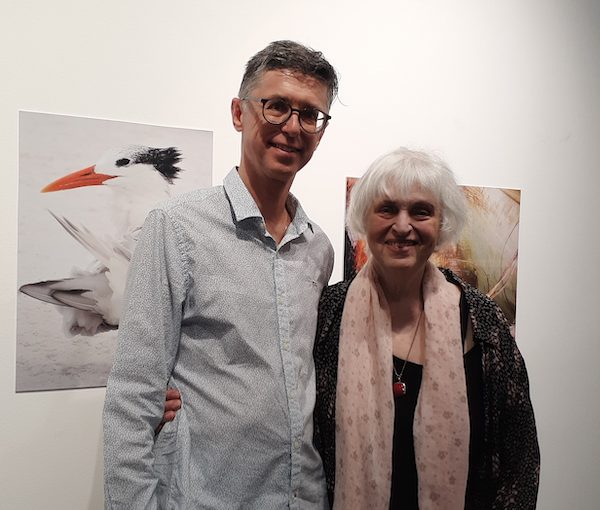
Painter, printmaker and mixed media artist Sidi Schaffer has a new show at the Zack Gallery – a photography exhibit with one of her sons, Nathan Schaffer. Eye Love Nature invites viewers to see the beauty and wonders of the natural world, and for us to recognize the dangers we pose to it.
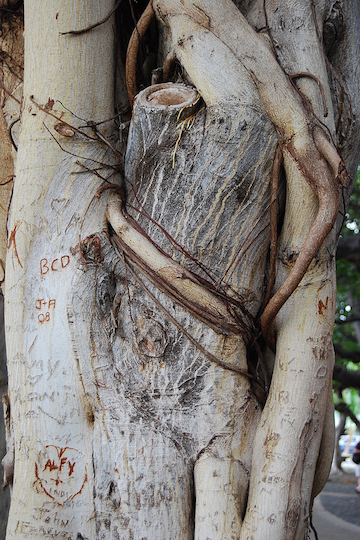
Embraced and Loved” by Sidi Schaffer
Rather than nature as something separate, we see ourselves in the Schaffers’ photos. Sometimes, the animals are doing something that we enjoy doing, like the three whales in Nathan’s “Family Swim,” only their fins visible in the misty ocean. Other times, we can empathize with what a tree has endured, but also our part in hurting it, as in Sidi’s “Embraced and Loved,” which shows a gnarled tree not only tightly wrapped by a vine, but also scarred by the initials, including a pair in a heart, that many people have carved into it.
The titles of some of the photos bring a smile, but also a sense of responsibility. The overall feeling of the exhibit, however, is uplifting, hopeful.
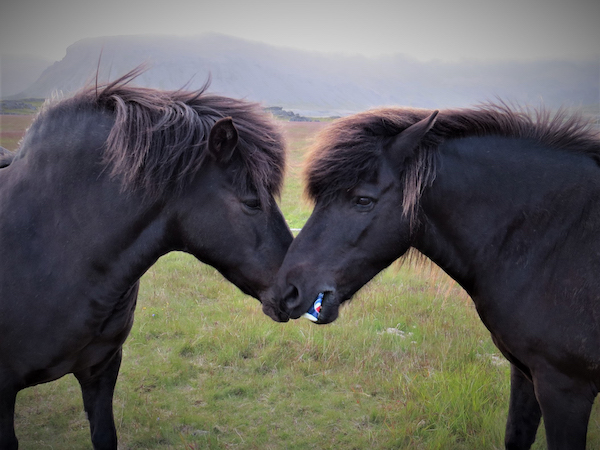
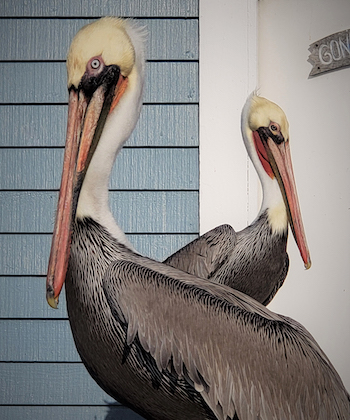
“I have a fondness for word play and puns as a way of expressing humour. I find it helps keep a positive environment when interacting with others and, at times, deal with sensitive issues in a less threatening manner,” Nathan told the Independent. “Artistically, my goal is to engage the audience both visually and with language. ‘The Pepsi Challenge’ [in which two horses tussle over a Pepsi cup] in my mind ‘can’didly raises concerns about human garbage and pollution straight from the ‘horse’s mouth,’ so to speak. In ‘I’m Stumped,’ there is also a bit of fishing line on the stump under the bird’s foot – again a reminder that human pollution is unfortunately prevalent in the lives of wildlife and sometimes it can feel like we are stumped trying to deal with it.”
“The Pepsi Challenge” by Nathan Schaffer
Eye Love Nature is the first photography exhibit for both Schaffers. Sidi said, “as I age, I wanted to see my photos on a gallery wall and share our joy creating them with the people in the community.” Nathan writes in his artist’s statement: “I very much hope the viewers enjoy the photos and that positive emotions arise and carry forth.”
Both Schaffers thanked Zack Gallery director Hope Forstenzer and the selection committee, as well as their friends and family, “for providing guidance and supporting this,” said Nathan, who works as a psychiatrist treating adults at a community mental health clinic.
“The resilience of many patients inspires me to search for strength and marvel at beauty in nature,” he said. “I often recommend spending time in nature as a way of reducing distress from inner turmoil, both to patients and family. I also enjoy my photography as a way of expressing latent artistic interests, as I haven’t improved my drawing beyond a rudimentary level. It is a counterweight to the stress associated with my work.”
For Sidi, who is a career artist, the skills involved in painting/printmaking and photography overlap to some extent.
“The combination of a good eye and imagination can help in both forms of art expression,” she said. “[But] the trigger when taking a photo is coming from outside. It is your sudden surprise of what your eye sees in front of you at a certain moment, in a certain light or shadow. It can be a landscape, people or clouds in the sky. It can be a design that the power of nature created on a tree bark, or a gentle breeze moving the petals of a flower. You can be enchanted by a flower’s seeds that hide themselves from the elements.
“Burst of Colour” by Sidi Schaffer
“As compared to painting or printmaking, with photography, it’s presented to you, you only have to look and explore,” she said. “When I am in front of a canvas or paper, it’s usually in front of a white surface that waits for my imagination, for my expression of freedom to choose the subject or design that comes from inside me. It takes me even more into my inner self, into a world that brings me satisfaction, reflection and peace. Physically, painting is more challenging; my whole body is involved in the making. I love both mediums and hope to combine them in my mixed media works.”
While Eye Love Nature is Sidi’s first photography exhibit, she has been a photographer since childhood. Sidi was born in Romania – her mother studied photography before the Second World War.
“After the war, coming back home from the camps, my parents opened a photo studio,” said Sidi. “From then on, even as a little girl, I immersed myself in their world. I assisted my father in the dark room; I helped colour the black and white photos with watercolour. I learned from my mom how to touch up the negatives. Today, we would call it Photoshop. In my later years, here in Canada, at the University of Alberta, in addition to painting and printmaking, I also studied photography. I will always be thankful to my parents, who exposed me to the magic of photography.”
It was Sidi who gave Nathan his first camera when he was young. “But the love of nature, the curiosity, his investigative spirit and his good eye, he developed through his life, step by step,” she said. “He was always surrounded by art and love of the natural beauty of our world.”
When asked if he had been lucky enough to meet his grandparents, Nathan said, “Yes, I have vivid childhood memories of helping them develop negatives in a darkroom with a red light and strong vinegar-like smell. I very much enjoyed spending time with them while watching photos gradually appear during this process.”
Of course, photography has changed much since that time.
“Through the years, I’ve worked on film and in dark rooms,” said Sidi. “With the explosive development in photography these days, I switched very happily to the digital camera. This way, I have a more direct and faster approach to picture taking. My aim is to stay true to what I see and not manipulate the image except maybe to crop or lighten/darken if necessary. We are surrounded by enough fake images and news these days. I want to be far from all that. The truth gives us freedom.”
More than 40 photographs comprise Eye Love Nature.
“Some Days I’d Rather Be Fishing” by Nathan Schaffer
“For this show, we picked images where we were primarily appreciative observers rather than creators,” said Nathan. “We only attempted to correct minor blemishes, in keeping with our parenting style,” he said with a smile.
There were many candidates for inclusion in the exhibit. “Like in nature, Darwin’s rule of survival of the fittest was the main guiding force,” said Nathan. “Some couldn’t compete due to technical issues such as file size or being unfocused; others lost out due to not being as captivating. Hope, the JCC gallery director, also helped in selecting the final choices.”
As for the choice of where to direct any profits made from the show, the Schaffers have decided to divide them equally between the Canadian Cancer Society and the Canadian Parks and Wilderness Society.
Both organizations, said Nathan, “do their work in what appears to be very different areas; however, they share an important similarity. Cancer is essentially resident cells going rogue and taking over space and resources from the body, thereby putting it in serious danger. Civilization and humans can have a similar destructive impact on nature and wilderness by urban spread and taking of natural resources without limits. Controlling these rogue processes is needed in order to save and heal patients and nature. These organizations share in a mission of tackling some of the major problems we face.”
Eye Love Nature is at the Zack Gallery until July 24.
The Oot n’ Oots band helps launch Mission Folk Music Festival. (photo from Mission Folk Music Festival)
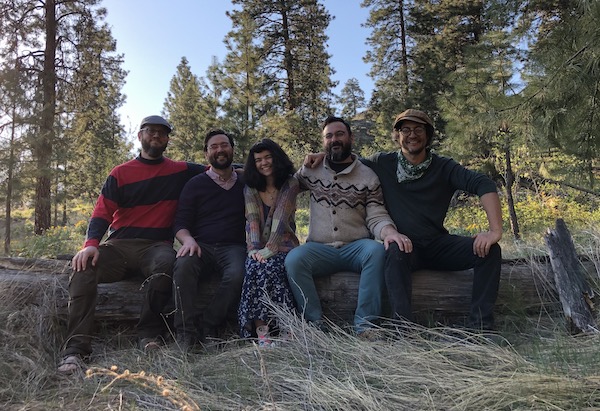
Family band the Oot n’ Oots helps kick off the Mission Folk Music Festival on July 21, as part of the main-stage lineup that opens the weekend of concerts and workshops. Several other Jewish community members are also participating over the weekend, including Boris Sichon, Jesse Waldman and Abigail Lapell, who helps close out the annual event on the evening of July 23.
The theme of this year’s festival builds on last year’s, said artistic director Michelle Demers Shaevitz, also a member of the Jewish community.
“In 2022,” she said, “I programmed a festival that reflected the experience of homecoming, the coming back together of our community, our festival family. This year, I’m digging into the process and ideas of connection and reconnection, as we move through our experiences beyond that initial homecoming and return to the festival. For me, the idea of reconnection speaks to getting to know who we are as a community post-pandemic and how we have changed/emerged as a result of our experiences.
“I was drawn to our 2023 artists through the ways they express their connection to their homelands, their languages, their heritage and cultures, and musical traditions,” she continued. “It’s how Okan celebrates their roots to their homeland of Cuba and her languages and stories, while Terra Spencer sings of the Maritime landscapes and communities around her.
“It could be reconnecting to language, as Cedric Watson and Jourdan Thibidoux explore their roots in the Creole community based in Louisiana alongside Wesli, who sings in his Haitian Creole of home and in French from his newly adopted community in Quebec.
“It’s the ways that Leonard Sumner and Twin Flames sing their connections to their heritage or how Alysha Brilla presents her identity in her songs.”
And, she said, it’s how the Jewish musicians weave their Jewishness into their stories and songs.
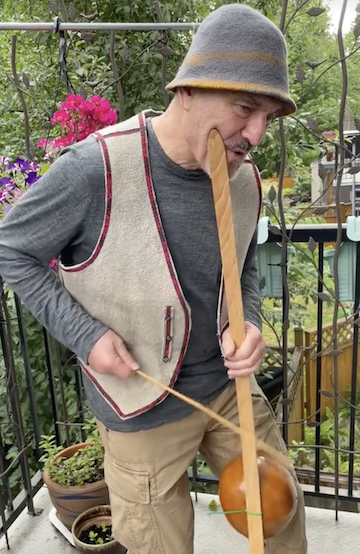
Boris Sichon on TikTok, playing an instrument he made himself. (screenshot)
Sichon, a classically trained percussionist, plays more than 400 different instruments from around the world, many of which would send most of us to the internet to find out what they are, such as mayuri, zurna and agogo bells. He can also make music from wrenches, plastic containers, kitchen bowls and even rocks – basically, anything. His TikTok videos are quite entertaining and mind-broadening. It’s easy to see why he is in demand for school and other educational workshops. He told the Independent he is currently “in the process of preparing a new program with an accent on voice and wind instruments.”
“I love to perform for kids,” he said. “It gives them an opportunity to travel around the world with exotic musical instruments.”
In performances, Sichon sings songs about “love, friendship and freedom [in] Ukrainian, Gypsy, Russian and Yiddish.” He also plays klezmer, and has taken part in the International Klezmer Festival in Jerusalem for many years. He has played at and collaborated with the Mission folk fest many times and, at this year’s festival, he takes part in a Sunday afternoon session, called Global Routes, with Dongyang Gozupa and Robin Layne & the Rhythm Makers.
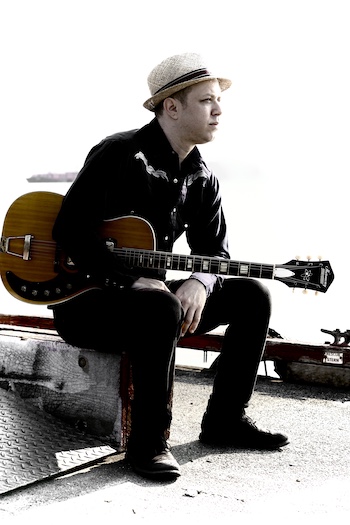
Jesse Waldman (photo from Mission Folk Music Festival)
Earlier that Sunday afternoon, Waldman takes to the stage as well. A blues and folk artist, the Independent spoke with him ahead of his participation in the 2019 festival (jewishindependent.ca/blues-klezmer-at-mission). A couple of years ago, he shared more about himself and the importance of family in a piece for the JI about being inspired by his great-grandmother, Adele Waldman, to reimagine the Yiddish song “Papirosen” (jewishindependent.ca/a-great-grandmothers-song).
Making her debut at the Mission Folk Music Festival is Lapell, with a shared session on Saturday (with Alysha Brilla) and on Sunday (with Terra Spencer), as well as being part of the festival closing concert. She said “there’s so much great music on the lineup – personally, I’m especially excited for the workshop stages, to have a chance to collaborate with and get inspired by artists from across Canada and beyond.”
Based in Toronto, Lapell’s latest album, Stolen Time, which came out last year, earned her a 2023 Canadian Folk Music Award for English songwriter of the year. She was similarly recognized in 2020 for her album Getaway and she received a CFMA for contemporary album of the year in 2017 for Hide Nor Hair.
“I’m always trying to challenge myself as a writer and collaborator,” she said. “I’ve had the chance to work with so many great players and personnel on these albums and I think it’s really helped me grow from one project to the next.”
Lapell has always sung.
“Singing and writing songs is very intuitive to me and definitely a big source of comfort and community,” she said. “Ultimately, I think it’s such a primal thing, singing and sharing music – for me, it’s a way of connecting with myself, with nature and with the world at large.”
Abigail Lapell (photo by Jen Squires)
Her Jewishness finds its way into her work subtly.
“I find my writing is infused with a lot of biblical and natural imagery,” she said. “I’m very drawn to stylized, sometimes repetitive language, whether prayerful or playful or both. I was raised in a religious Jewish family, and I think there’s a reverent spirit to my music – and sometimes a touch of gentle dissonance or wry humour – that reflects some of the Hebrew and Yiddish traditions I grew up with.”
For the Oot n’ Oots – 16-year-old Ruthie Cipes (voice, ukulele) with her dad Ezra (voice, guitar, keys) and uncles Ari (voice, guitar, keys), Gabe (voice, bass) and Matthew (voice, drums) – Judaism and Jewish community are important parts of their lives, but don’t necessarily influence their music.
“We’re grateful for the wisdom of our ancestors and the culture bestowed since Abraham,” wrote Ezra and Ari in an email interview with the Independent. “It’s a great gift that makes our lives rich and meaningful. We’re members of the Okanagan Jewish Community and supporters of Chabad Okanagan.”
The family lives in Kelowna.
“Our parents moved us from Westchester County in New York to Kelowna, B.C., in 1987,” said the brothers. “They wanted to get off the money-go-round and be farmers living in connection with the earth. They ended up founding Summerhill Estate Winery.”
The Oot n’ Oots was formed in 2007, when Ruthie was born, “but it really got going in 2015 once Ruth joined the band. We released our first album in 2016, although it was mostly recorded back in 2007. Then we made two more albums after our elder brother Matthew joined the band on drums.”
The group is currently recording their fourth album. Their third album, Ponderosa Bunchgrass and the Golden Rule, was nominated for a 2023 CFMA for children’s album of the year and it also garnered a 2022 Juno Award nomination – they were named Children’s Artist of the Year at the 2022 Western Canadian Music Awards.
“We write songs to make each other laugh and to inspire each other. That’s what we’ve always done and it’s what we continue to do,” said the brothers. “It’s a practice that’s ongoing. We want it to continue to be meaningful as we all grow.”
While the awards may refer to children’s music, the Oot n’ Oots describe their music as “all generations together music.”
“That’s the sweet spot for us – when it’s toddlers, teenagers, parents and grandparents all on the dancefloor together,” said Ezra and Ari. “We have a couple of other musical projects that we do, but the Oot n’ Oots is our focus because it seems to provide the most tangible value, and it feels really good to bring that energy of joy to the world.”
In addition to the festival opener, the Oot n’ Oots play a few sessions with other musicians over the weekend, which takes place at Fraser River Heritage Park. The festival includes food and artisan market vendors, as well as a licensed bistro, and attendees can choose to camp in the park for an additional fee. For the full lineup and tickets, visit missionfolkmusicfestival.ca.
Jews have been called “the people of the book.” It was the power of and devotion to the received and unfolding written word that ensured the Jewish people’s unity (and diversity) across almost 2,000 years of exile. But who reads books anymore?
If you are perusing these pages, you probably belong to what has become a somewhat exclusive club – readers. Beginning with the advent of radio, picking up speed with the development of television, then supercharging connectivity while reducing attention spans with the advent of internet and social media, books have, for many people, ceased to be the primary go-to source for entertainment, pastime, learning or self-improvement.
When social media took off, in the early 2000s, most people, experts and us ordinary folks, didn’t really fathom the impact it would have on our society or on our physiology. Now, a few short years later, science is demonstrating that the speed with which images and ideas flash into our senses may be literally changing how our brains work.
It may be safe to say that giant leaps in artificial intelligence just in the last few months will have at least the same breadth of impact on societies and individuals.
Skeptics among us, who have dabbled a little in public interfaces like ChatGPT, have come away gobsmacked by the capabilities we have discovered – which are clearly just the tip of the iceberg. Perhaps the most wondrous (and scary) thing about artificial intelligence is that it may represent the beginning of an exponential, self-sustaining explosion. The Industrial Revolution began less than 300 years ago. Every modern convenience – practically everything we have outside of turnips and animal-skin garments – is a result of that explosive growth in human capability. For better and worse. For all the incredible advancements we have made, the price we are paying appears to be the future of our planet itself. All this in a mere three centuries. Artificial intelligence, even if we do not understand it now, will likely speed up change in ways that make today’s offerings look like the cotton gin.
The written word is just a small part of what artificial intelligence can do. Because it is one of the easier things to access for most laypeople, this component of ChatGPT is the one that most of us have probably played around with. Professors, employers and others are suddenly confronted with uncharted moral territory in dealing with brilliantly written submissions from students, employees and other correspondents, any of which may or may not have been written by human hands and minds. As one professor commented in media recently, what tipped him off to the problem was how dazzling some of the essays he received were.
And the time-saving! Artificial intelligence can write a letter to a recalcitrant employee, a grandparent, an old friend or a government official in a tiny fraction of the time it would take the ordinary person to draft a letter of far lower quality.
But who is going to read all these words?
Already, plenty of people have largely abandoned books. Even Jews, the people of the book, find much to do beyond reading. Just a little microcosm in our own community tells us this. Look at the corners of the Vancouver JCC that are the busiest at any given time. History and stereotypes should suggest that the Isaac Waldman Jewish Public Library would be packed with people from morning to night. It’s got a devoted and steady clientele, do not misunderstand, but, judging by foot traffic, you might think 21st-century Jews would be better known as the “people of the gym,” “the people of the pool” or “the people who gab endlessly in the boardroom.”
The bigger issue is, at some point with the advent of technology that just keeps producing more words, we will reach a tipping point at which there are more “writers” (human or otherwise) than there are readers. If a tree falls in the forest and there is nobody to hear it fall, it has been asked, does it make a sound? If words are put to paper (or screen) and never read, might it be as well if they had never been written at all?
Again: we use words as an example here because that is the field we know best. AI is set to upend almost every facet of our society. It feels like we are at a moment much more significant than that time 20 years ago when we first encountered social media, or 30 years ago, when most of us first ventured onto the World Wide Web. We can only barely fathom the good and bad (and indifferent) changes imminent.