Four more questions to ask

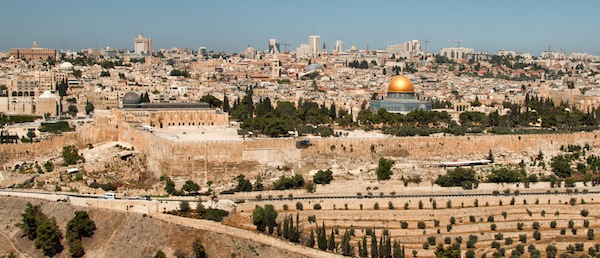
One of the four additional questions that the Centre for Israel and Jewish Affairs suggests we ask ourselves this Passover is: As we solemnly intone “Next year in Jerusalem,” how can we express the significance of the land of Israel in our Jewish Canadian identity? (photo by IRR Photography)

Traditional celebrations of recent Passover seasons were certainly curtailed, and even canceled, by the pandemic. For those of us fortunate enough to have emerged from COVID-19 with our families intact, we now – finally – will have an opportunity to come together to celebrate the holiday as it should be – among extended family and old friends.

The limits placed on us by the pandemic, however, have not curtailed the Centre for Israel and Jewish Affairs’ work. Ensuring increased COVID funding for frontline charitable organizations helping the elderly, ill and all others among our most vulnerable was paramount in our advocacy to governments at all levels. Supplemental funds are never quite sufficient, but these extra funds were realized in federation agencies across the country.

The disturbing surge in antisemitism that came with the pandemic became another focus of our work. Last summer, as a founding member of the Canadian Coalition to Combat Online Hate, we organized the federal government-|sponsored Emergency Summit on Antisemitism that brought together government, media, academic and other experts in combating online hate that so often leads to real-life violence.

Connected to pervasive hate online is spreading distortion and even outright denial of the Holocaust. A poll commissioned by the Canadian charity Liberation75 showed that, of 3,600 students in grades 6 to 12, a shocking 33% were either uncertain about the Holocaust, thought that the death toll was exaggerated or questioned whether the Holocaust even happened. In Ontario’s largest school board – and in others from the West to the Maritimes – incidents of antisemitism have begun to be reported almost weekly.

This kind of disturbing trend requires focused, strategic action. CIJA has received a grant to leverage the expertise of historians, teachers and Jewish scholars to create a curriculum for Ontario middle-school students that will teach them about the Holocaust – and about modern-day antisemitism. Most recently, CIJA has urged support for MP Kevin Waugh’s private member’s bill that proposes Canada follow the example of other countries – including France and Germany – to make Holocaust denial an offence under Canada’s Criminal Code.

To spur discussion about what such legislation could do, CIJA hosted a national webinar about reasons to criminalize Holocaust denial, the challenges posed, and what we can learn from jurisdictions where similar laws have been enacted. With experts from Canada, France and Israel espousing various perspectives, the discussion was informed, civil and productive.

Discussion. Now that’s an area where Jews tend to feel both comfortable and motivated. And that brings me to the Pesach celebration awaiting us this year. Of course, we will delight in visits with our loved ones. Some of us will see children or grandchildren, newly arrived or grown significantly since our last Passover seder together. Many will have questions – not only the traditional four we ask annually, harking back to our historic connections to Israel, but also questions about being Jewish today, in Canada.

We think Jews in communities large and small have lots to talk about, and we want to facilitate engaged, thoughtful discussions responding to four more questions we’ve proposed for this Passover. We propose, this Passover seder, that Jewish families and friends think about the issues CIJA, as the advocacy agent of Jewish federations across Canada, has been prioritizing.

More background is available, along with suggested responses, at cija.ca/4morequestions, but here are the questions:

Looking at increased denial and distortion of the Holocaust, our most recent enslavement, how can we stop Holocaust denial and distortion? In the realm of online hate and antisemitism, we remember numerous historic efforts to destroy the Jewish people. What can Canadians do to combat online hate and antisemitism today? Turning to community security, as a once-enslaved people, we ask, what does a safe space for Jewish Canadians look like? And, as we solemnly intone “Next year in Jerusalem,” how can we express the significance of the land of Israel in our Jewish Canadian identity?

That’s a lot. But that’s what we are up against, even living in Canada, one of the safest places for Jews anywhere.

As we gather this year, whether part of a small family, an extended clan of young and old, or among friends, let us celebrate the joy of our survival and how, together, we can work to shape our future.

May your Passover be a peaceful, thoughtful, and happy one. Chag Pesach sameach!

Judy Zelikovitz is vice-president, University and Local Partner Services, at CIJA, the Centre for Israel and Jewish Affairs.

Puddle splashing and balance

If you’ve ever slogged through a spring melt in a place, like, say, Winnipeg, you know about the odd balance … the one where it’s best if the snow melts slowly, even painfully, with a freeze at night. Why? Too fast a melt and everything is flooded.

On the prairies – or, frankly, any place without good drainage – basements, wellies and everything else can be in trouble if a big pile of snow hits a too-warm sunny spring. In these places, and I’ve lived in three, now that I think of it: Buffalo and Ithaca, New York, and also Winnipeg … spring is both desperately, sorely anticipated and, well, sometimes gross. It’s full of dirty snow, big puddles and treacherous ice.

Yet we continue, every winter, to long for spring and better weather to come. It’s like we have amnesia and forget this long dirty shoulder season. Years ago, I told myself that, obviously, the snowbirds had it wrong. The best time to travel, if it could ever be managed, would be during the puddle period.

I was thinking about the puddles, Passover and, also, the talmudic tractate I am currently studying as part of Daf Yomi, a page of Talmud a day. From now until the summer, that tractate is Yevamot – the tractate that deals with the notion of levirate marriage. What’s that, you say? It’s the ancient obligation for a childless widow to either marry her husband’s brother to produce a child after her husband’s death, or perform a ceremony called halitzah, in which she is freed from this obligation.

This is probably the first time in more than two years of doing this Daf Yomi study when I seriously just wanted to quit. Yes, studying an ancient text, no matter how holy or intellectually stimulating, can sometimes feel irrelevant. Yevamot goes way beyond “slightly boring” or irrelevant. It wanders into the gross, mucky puddles for me. It’s right up there in the news articles that come with trigger warnings because of issues containing abuse. For a modern person, particularly a woman, some of these rabbis’ discussions in Yevamot really wear me down – because rape, child marriage and other issues really unacceptable to the modern reader arise frequently.

I was proceeding, reading late at night out of duty, and using an approach I perfected in graduate school. This involves skimming the thing as fast as possible so that, if one day I am ever asked about this in a weekly seminar, I can nod somewhat knowingly and bring up the one or two points I can remember. This worked when the professor assigned three academic tomes a week and expected us all to discuss them. (Later, I learned he did this in hopes we would drop the course due to the workload. He felt guilty when we all took it anyway and bought us coffees while we soldiered onwards.)

Of course, I’m learning for the sake of learning now, not because I expect to be tested or, heaven forbid, asked to lead the seminar at a moment’s notice.

This is one of those few times when I was saved by social media. I was on Twitter and, because I follow others who are also learning this way, I started seeing their comments. Several of them summed up, in 280 characters or less (or a TikTok), that they too were struggling. Eye-rolling and other more disgusting noises may have come out of their mouths at some of this. I had a huge sense of relief. I wasn’t alone. Others felt exactly the way I felt. We were part of some internet club I’d forgotten I’d joined. Whew.

There’s a reason why, traditionally, Talmud is studied in a hevruta, a pair or group setting. Some of the topics are hard to understand, for all sorts of reasons. I don’t have a physical study group. Heck, that’s OK, I’ve done nearly this entire thing during a pandemic. I’m a busy mom who stays up too late to read this stuff. I’m lucky to have access to it at all, as a woman, and also for free, online at Sefaria. There’s a lot of support online now that got me to this point, since this kind of study was traditionally dominated by men.

However, I know that feeling a sense of camaraderie and the insights that come from studying with others are important. They certainly helped spur me to continue when I thought the subject matter of Yevamot wasn’t for me and I wanted to quit.

To bring this back to those dirty spring puddles, well, this time of year, while it can be a slog, is also prime time to prep for Passover. This, too, can feel like a struggle. However much preparation you take on for this holiday, it can feel too hard. Cleaning up and scrubbing and eating down your chametz (bread products) can get to be too much.

For many, there’s pressure from those more traditional. Have you cleaned between the sofa cushions thoroughly? How about the stroller?

Those who are secular or less involved pressure me in another way, asking why I make myself “crazy” with any of this.

Passover preparations can feel like one long walk through Winnipeg’s springtime: navigating endless icy puddles, black ice and snow mold.

What helps me continue? It’s that whiff of spring air, or maybe the matzah ball soup, cooked in advance of the holiday. It’s the photo or long ago trip to a warmer climate, where the flowers were already in bloom. Also, it’s taking myself back to the Babylonian Talmud, in Yevamot 13. That’s the page with the reminder that the rabbis teach us not to divide ourselves into factions. That is, we are to value our diversity, our various customs, rather than let our disagreements divide us.

Some people love Passover. Some people love splashing in puddles. Life is a balancing act, and we’re lucky that we’re all unique and different. There’s sometimes a huge sense of shame that rises up when we admit that, actually, no, this text/season/holiday might not be the best thing since, say, sliced bread. Finding out, via a study partner, a friend or even a stranger online that we’re not alone can be so reassuring.

We’re not all the same, but the rabbis encouraged us not to create factions or separate ourselves unnecessarily, either. This is useful wisdom because, after Passover, Shavuot’s not far behind. Pesach’s cold in Winnipeg, and even Lag b’Omer picnics can be snowed or rained out. But Shavuot? That’s a holiday I love. It takes all kinds, as we teeter totter our way through the Jewish year, balancing between seasons. That balance is what makes our holiday observances, and even the talmudic tractates I struggle through, rich indeed.

Joanne Seiff has written regularly for CBC Manitoba and various Jewish publications. She is the author of three books, including From the Outside In: Jewish Post Columns 2015-2016, a collection of essays available for digital download or as a paperback from Amazon. Check her out on Instagram @yrnspinner or at joanneseiff.blogspot.com.

Know Hatzaad Harishon?

Journalist and author Sybil Kaplan, who is a regular contributor to the Jewish Independent’s special holiday issues, was, in her younger years, the first leader of Hatzaad Harishon, a Jewish youth group that was formed in the 1960s in New York. She led the group for five years. At some stage in the 1970s, the organization ceased to exist.

Kaplan has written a book about Hatzaad Harishon but would like to augment it with the memories of more of its former members. She is hoping that they would share some of their recollections. If you or someone you know is familiar with Hatzaad Harishon or you were a member and would like to connect with Kaplan, she can be reached at sybilkaplan1938@aol.com.

Trying to fix broken wings

Not fitting in. Being misunderstood and miscategorized. These are recurring themes in Flying Camel: Essays on Identity by Women of North African and Middle Eastern Jewish Heritage, edited by Loolwa Khazzoom, a Seattle writer, musician, activist and occasional contributor to the Independent.

image - Flying Camel book coverThe book was first released in the 1990s and was recently re-released.

“I wish I could say that this book is no longer as revolutionary, cutting-edge, or as needed as it was when I began compiling it in 1992, but, unfortunately, that is not the case,” writes Khazzoom, the daughter of an Iraqi Jew, in the new introduction. “Even though there have been changes – shifts in consciousness, language, and even representation – Mizrahi and Sephardi women remain overall excluded, in theory and practice, from spaces for women, Jews, Middle Easterners, people of colour, LGBTQI folk, and even Mizrahim and Sephardim. In addition, so many of the presumably inclusive conversations about us seem basic and superficial, with an undertone of it being a really big deal that these conversations exist at all.”

Khazzoom’s struggle to fit in led her to Seattle, in large part because it is home to one of the largest Sephardi communities in the United States. But even in that milieu she found herself an outsider.

“In June 2014, however, on the first sh’bath [Sabbath] after driving my U-Haul up the coast from Northern California, I was appalled by a sermon so sexist – where women were equated with ‘meat’ – that I walked out of the Sephardi synagogue, just 15 minutes after arriving,” she writes.

“I have been a hybrid all my life, forever caught between two or more worlds,” writes Caroline Smadja in her contribution to the collection. It is a state of being that is shared by many of the writers.

Yael Arami, born in Petah Tikvah to parents from Yemen, speaks of others’ perceptions of her.

“In Germany, I have had to avoid certain areas, fearing local skinheads’ reaction to my skin colour. In France, I have been verbally ridiculed and insulted for being yet another ignorant North African who does not know French,” she writes. “In California, people’s best intentions have resulted in a number of social blunders: When I left a tip in a San Francisco café, I got a courteous ‘gracias’ from the politically correct Anglo waiter. After a predominantly African-American gospel group sang at a Marin County synagogue, several members of the congregation approached me, to express their admiration for our wonderful gospel performance! It seems that wherever I go in white-majority countries, I am, in accordance with local stereotypes, seen as the generic woman of colour – Algerian in France, African-American or Puerto Rican in California.”

Rachel Wahba, an Iraqi-Egyptian Jew, calls out politically correct hypocrisy.

“Sometimes, when I bring up the oppression of Jews in Arab countries, progressive Jews get strangely uncomfortable – as if recognizing the Jewish experience under Islam would make someone racist and anti-Arab,” she writes. “During my mother’s cancer support group intake, I listened as my mother told her story of living in Baghdad and surviving the Farhud. She ended with an ironic ‘I survived the Arabs to get cancer?’ The Jewish oncology nurse was shocked that my mother was so ‘blunt.’

“Should we revise our history? Leave out the details of our oppression under Islam? Pretend my mother never saw the Shiite merchants in Karballah wash their hands after doing business with her father, because he was a ‘dirty Jew?’”

The book’s title comes from an essay by Lital Levy, “How the Camel Found Its Wings” and an Israeli film of the same name.

The metaphor involves the repair of a broken statue of a flying camel, which actually stood at the entrance to the international fairgrounds in Tel Aviv in the 1930s. In the film, the two wings of the camel become stand-ins for a dichotomy that mostly excludes Mizrahi/Sephardi Jews and yet still casts them in a negative light.

“By the end of the screening, the camel had found two new wings, and I got to thinking,” writes Levy. “I started putting my own pieces together – making my own flying camel out of the remnants of the past, borrowing missing pieces from the present, and using my imagination and willpower to try to make it all stick together. The pieces of my own American childhood, the histories that preceded it in Israel and in Iraq, and the challenges I see before me in my work are the various fragments I have been remembering and re-membering into an integral whole. I do not yet know its shape – camel, dromedary, llama, yak – but I do not care, as long as it will fly.”

Dutch family’s secrets

“Twins run in the family, you know,” Stella ter Hart’s mother, Sophia, said to her nonchalantly when Stella was pregnant with her first child. That this was news to Stella is a first sign that there was a great deal about her family she did not know. In fact, she wasn’t aware she had much family at all.

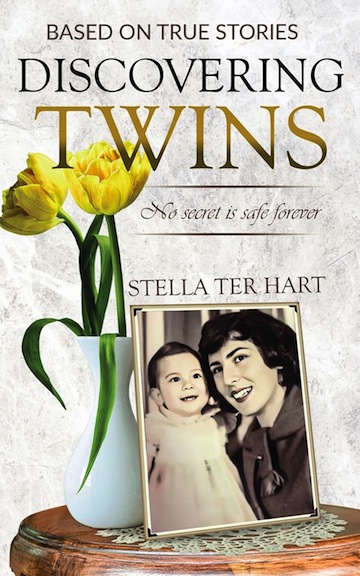
image - Discovering Twins book coverThus begins Stella ter Hart’s book Discovering Twins: A Journey into Lives.

As a high school graduation gift, Stella and her mother made the trip from Estevan, Sask., to Holland. There, she meets an endless web of confusingly related kin – almost all on her father’s side. A visit to the home of family on her mother’s side raises questions in the teenager’s mind.

“‘Oom Jacob and Tante Becca are Jewish,’ I stated rather than questioned, ‘no one other than Jewish people are named Jacob and Rebecca.’

“And, in a style completely out of character for her, almost resignedly, my mother replied, ‘Yes, they are.’

“There was no further clarification of her answer, no offering up of a tidbit of a childhood memory, as might be expected when revealing so vast a thing as religiously specific relatives for the first time.

“‘So, if Oom Jacob is your first cousin, and he has the same last name as your mother’s maiden name, then he is the son of your mother’s brother,’ my new skill of dissecting family relationships now sharply honed, I added, ‘so your mother must have been Jewish, too.’

“In a split second, she came back at me, her voice strident with an unexpected, insistent, and lashing response, ‘NO! My mother was NOT Jewish. According to the Germans, she was Italian because she married an Italian.’”

Whether that logic ever truly convinced her mother, Sophia, it did not sit well with ter Hart. After her mother’s death, ter Hart began a genealogical quest. Slowly and excruciatingly, she pieces together the tragic fates of almost the entire maternal line.

“Our extended circle of family, formerly numbering over 1,200, was reduced to the less than 20 who returned, or were known to have survived, creating a psychological tsunami shock-wave impacting existing and future generations,” writes ter Hart.

The book recreates ter Hart’s prewar extended family, flashing back from postwar comfort in Canada. She captures what must have been a dawning realization among Dutch Jews in the earliest months of what became the Holocaust, as relatives who were relocated to the east inexplicably never wrote back.

“How many ‘workers’ did this totalitarian German regime require for its slave labour force? Where was the food to feed them all going to come from and the rooms to house them all? Supplies were already hitting dangerous lows in the cities, and rationing was strictly enforced.

“The unsettling sentiment echoing throughout the community for months raised its voice again. What in heaven’s name would the Germans do with grandparents and babies? This didn’t seem like a necessary part of war. This was something else.”

As ter Hart’s research expands, numbers and dates leap off the page.

“The ages and dates are, each time, an emotional shock. The eye at first does not even see, let alone accept, the horrific truths the numbers expose. Mothers with all their young children around them all killed at the same time, or an elderly couple, obviously arrested and deported together, also murdered together. The gruesomeness and cruelty of it all is staggering and overwhelming,” she writes.

On Sept. 30, 1942, 103 family members were murdered at Auschwitz, the youngest 15 years old, the oldest 54. On June 11, 1943, 64 family members were gassed at Sobibor, aged 2 to 68.

The author seeks to build suspense, but her discoveries are, generally, no surprise to those with knowledge of the history. The emphasis on twins – across generations, the family seems to have an occurrence of twins about twice the average – gives the reader an anxious sense that, at some point, some family members are going to fall into the hands of the monstrous Dr. Josef Mengele.

“Not wanting to know, but needing to know, I researched the lists of Mengele Twins, now publicly available. None of our family were on that list, as most had been deported and killed before Mengele began his murderous experimentations. Small comfort,” she writes.

The narrative at the beginning of the book devolves near the end into something of a genealogist’s notebook, with records, short biographies and charts. Generally, the book hangs together, though an editor’s hand could have been firmer, to avoid easily avoidable clangers like misspelling Anne Frank’s name.

About the 2022 JI Passover cover

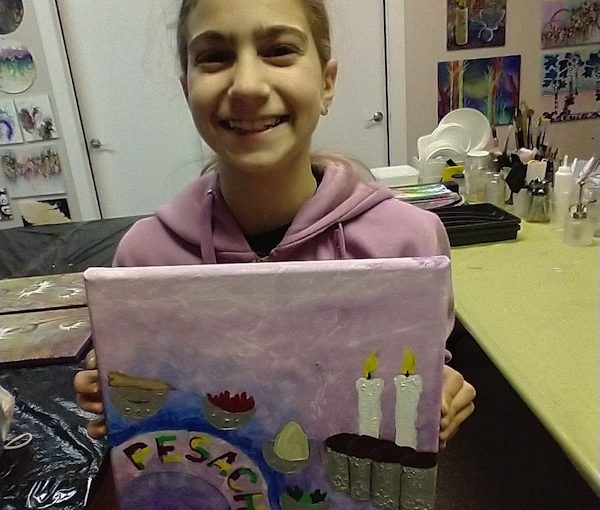
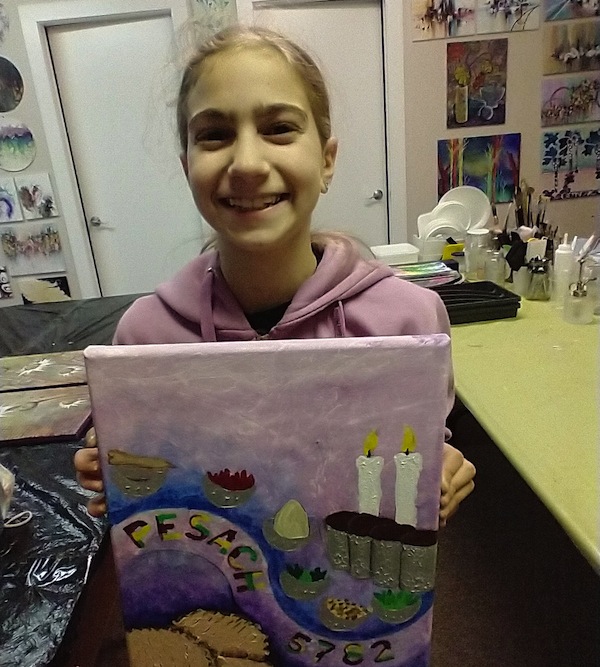
Liba Baitelman, the 2021 JI Chanukah Cover Art Contest winner, was commissioned to create this year’s cover of the Jewish Independent’s Passover issue. (photo by Merle Linde)

Liba Baitelman, daughter of Rabbi Yechiel and Chanie Baitelman, is a fun-loving, always religiously correct and mischievous 10-year-old. Her artistic talent and vision of a completed painting is not taught, it is spontaneous. She is so receptive to learning new techniques and this year’s Pesach cover showcases her skills.

When Liba started her Pesach painting with pencil sketches, she knew she wanted: two candles, four cups of wine, six seder plate symbols and three round shmura matzos. What worried her was her lack of drawing skills. To overcome this, she used templates throughout the design: margarine tub lids for the curves of the ribbons, flattened paper cups for the goblets, small plastic cups dipped into silver paint for the dishes, self-adhesive vinyl letters used for outlines and diligently painted with a very thin brush.

Her joy and pride with the completed painting should spearhead a lifelong hobby.

– Courtesy Merle Linde – Malka’s Studio

Different pharaoh, different story?

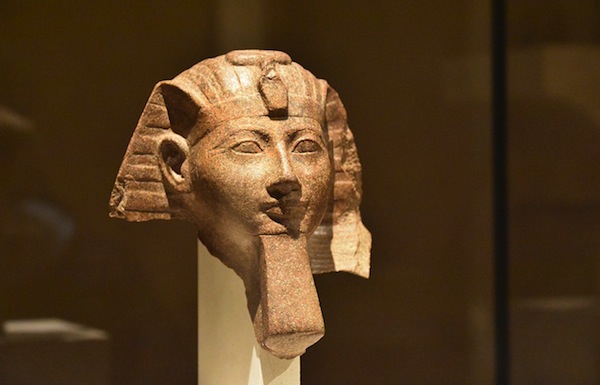
The head of Hatshepsut, in Pergamon Museum, Berlin, 2018. (photo by Richard Mortell, 2018)

As we all know from the Passover story, Pharaoh was one stubborn guy. On five occasions, Moses and Aaron tried to persuade Pharaoh to let the Hebrews go, but Pharaoh wouldn’t budge. In Exodus 7:13 and 7:22, Pharaoh hardens his heart in response to Moses’ pleading. Moreover, Pharaoh made his heart heavy in three other instances, as described in Exodus 8:11, 8:15 and 8:28. What would have happened if Moses and Aaron had come up against a female Pharaoh? Would the story have played out differently?

Let us begin by recalling that, if it hadn’t been for the curiosity and kindness of Pharaoh’s nameless daughter – though, in Judaism, she is later referred to as Thermuthis and even later as Bithiah – Moses would not have been rescued from his floating basket. The future leader of the Hebrew exodus from Egypt would not have lived, and the exodus would not have occurred as we know it.

There were at least six female rulers during the long period in which pharaohs ruled, and perhaps as many as 12. From what has been pieced together, these women sometimes had to disguise their female identity. Some adopted king titles, others exercised force to get their way.

Take Hatshepsut, for example, who was pharaoh of the New Kingdom, or Egyptian Empire, from circa 1479 BCE to 1458 BCE. She nominated herself and then filled the role of pharaoh by claiming her father (the earlier pharaoh) had wanted her to take over from him. Probably understanding that her position was tenuous – both by virtue of her sex and the unconventional way in which she had gained the throne – she reinvented herself. In visual art, she had herself portrayed as a male pharaoh, and ruled as such for more than 20 years. (See “The queen who would be king” at smithsonianmag.com.)

Initially depicted as a slim, graceful queen, within a few years, she changed her image to appear as a full-blown, flail-and-crook-wielding king, with the broad, bare chest of a man and the false beard typical of a male pharaoh. But Prof. Mary-Ann Pouls Wegner notes, however, in a 2015 article on toronto.com, that Hatshepsut’s statues have thin waists, “with nods to her female physique.”

Hatshepsut also took a new name, Maatkare, sometimes translated as truth (maat) is the soul (ka) of the sun god (Re). The key word here is maat, the ancient Egyptian expression for order and justice as established by the gods. Maintaining and perpetuating maat to ensure the prosperity and stability of the country required a legitimate pharaoh who could speak directly with the gods, which is something only pharaohs were said to have been able to do. By calling herself Maatkare, Hatshepsut was likely reassuring her people that they had a rightful ruler on the throne. She seemingly succeeded, as her 20-plus-year reign was a more or less peaceful time.

One important way pharaohs affirmed maat was by creating monuments, and Hatshepsut’s building projects were among the most ambitious of any pharaoh’s. She began with the erection of two 100-foot-tall obelisks at the great temple complex at Karnak. She likewise had important roads built. Still, her most ambitious project was her own memorial. At Deir el-Bahri, just across the Nile from Thebes, she erected an immense temple, used for special religious rites connected to the cult that would guarantee Hatsheput perpetual life after death. (See livescience.com/62614-hatshepsut.html.)

In life, Hatshepsut felt compelled to depict herself as a male ruler. In death, however, her true colours (pun intended) seem to surface. Exams conducted on her mummy reveal that, at the time of entombment, she was wearing black and red nail polish. Furthermore, according to sciencedaily.com, Michael Höveler-Müller, former curator of the Bonn University Egyptian Museum, reports that a filigree container bearing the queen’s name may have contained the remains of a special perfume, an incense mixture.

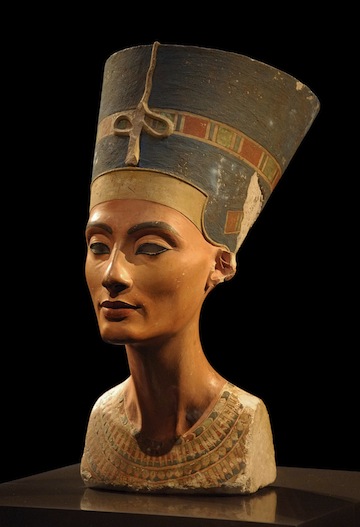
Nefertiti similarly hid her femininity, even though today she is the most visually reproduced ancient Egyptian female ruler. According to Prof. Kara Cooney, author of the book When Women Ruled the World: Six Queens of Egypt, Nefertiti cleaned up the mess that the men before her had made. She wasn’t interested in her own ambition, it seems, as she hid all evidence of having taken power, ruling alongside her husband. Yet, at the Karnak temples, there is twice as much Nefertiti artwork as there is of Akhenaten, her husband, who was king from about 1353 BCE to 1336 BCE. There are even scenes of her smiting enemies and decorating the throne with images of captives.

photo - The Nefertiti bust in Neues Museum, Berlin
The Nefertiti bust in Neues Museum, Berlin. (photo by Philip Pikart, 2009)

Despite her great power – she and her husband had pushed through a monotheistic form of pagan worship – Nefertiti disappears from all depictions after 12 years of rule. The reason for her disappearance is unknown. Some scholars believe she died, while others speculate she was elevated to the status of co-regent—equal in power to the pharaoh – and began to dress herself as a man. Other theories suggest she became known as Pharaoh Smenkhkare, ruling Egypt after her husband’s death, or that she was exiled when the worship of the deity Amen-Ra came back into vogue.

The Cleopatra clan sharply contrasts with the above two peacekeeping female pharaohs. In a December 2018 National Geographic interview about her book, Cooney explains that, when it comes to incest and violence, Cleopatra family members were no slouches. Cleopatra II (who ruled in the second century BCE) married her brother, but then they had a huge falling out and the brother/husband ended up dead. So, Cleopatra II married another brother. Her daughter, Cleopatra III, then ended up overthrowing and exiling her mother. Cleopatra III took up with her uncle, Cleopatra II’s brother, who sent Cleopatra II a package containing her own son, cut up into little bits, as a birthday present. Eventually, they all got back together for political reasons. (See nationalgeographic.com/culture/article/queens-egypt-pharaohs-nefertiti-cleopatra-book-talk.)

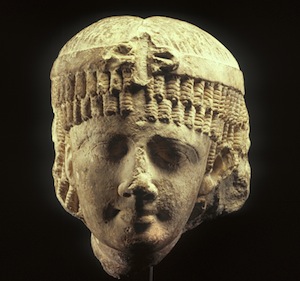
photo - Shown wearing a heavy wig, the queen also has a headband with a coiled uraeus serpent above her brow. Of the seven Ptolemaic queens named Cleopatra, this head may represent Cleopatra II or her daughter, Cleopatra III
Shown wearing a heavy wig, the queen also has a headband with a coiled uraeus serpent above her brow. Of the seven Ptolemaic queens named Cleopatra, this head may represent Cleopatra II or her daughter, Cleopatra III. (photo from Walters Art Museum)

It’s time to return to the question posed at the beginning of this article, about whether the exodus story would have turned out differently if there had been a female pharaoh in charge.

Rabbi Danya Ruttenberg, on myjewishlearning.com, analyzes the actions of the pharaoh Moses and Aaron encountered. She reminds us of what Rabbi Simon ben Lakish wrote about this pharaoh. In Exodus Rabbah, ben Lakish states, “Since G-d sent [the opportunity for repentance and doing the right thing] five times to him and he sent no notice, G-d then said, ‘You have stiffened your neck and hardened your heart on your own…. So it was that the heart of Pharaoh did not receive the words of G-d.’ In other words, Pharaoh sealed his own fate, for himself and his relationship with G-d.” Only at this point does G-d intervene by hardening Pharaoh’s heart, so that the plagues can end and the Hebrews can leave Egypt.

According to When Women Ruled the World author Cooney, the emotionality of female pharaohs is key. In that 2018 National Geographic interview, she says, “that ability to cry or feel someone else’s pain…. It is that emotionality that causes women to commit less violent acts, not want to wage war and be more nuanced in their decision-making. It is what pulls the hand away from the red button rather than slamming the fist down upon it. These women ruled in a way that kept the men around them safe and ensured their dynasties continued.”

There is the possibility then that, had Moses and Aaron encountered a female pharaoh, she might have concluded that all the pain and suffering from the plagues wasn’t worth it – neither for herself, personally, nor her Egyptian subjects. Perhaps without a big fuss, or at least with less of one, she would have let Moses lead the Jews out of Egypt.

Deborah Rubin Fields is an Israel-based features writer. She is also the author of Take a Peek Inside: A Child’s Guide to Radiology Exams, published in English, Hebrew and Arabic.

The Chiribim-Chiribom feud

Many years ago, in the village of Chelm, there were two families, the Chiribim and the Chiribom. They were enemies. They fought over everything. They fought over land, they fought over water, they fought over cows and horses and chickens. They fought over air.

The Chiribim and Chiribom didn’t talk to each other. They were stubborn. They didn’t look at each other.

In the synagogue and village hall, they would sit on opposite sides of the room and glare or shout or scream. Or spit. It was disgusting.

The feud had been going on for years, decades, perhaps centuries. No one knew where it began or how it had originated. What insult had provoked the first Chiribim to scorn the first Chiribom? It was long ago and long forgotten.

Sometimes the anger came to blows, but, fortunately, so far no one had been seriously injured or killed.

Rabbi Kibbitz, the oldest and wisest of leaders, was sick of it. He was tired of the malice, tired of the hatred, tired of the tension. He was tired of mopping spit off the floor of the synagogue.

So he decided to solve the problem. The Chiribim and Chiribom needed to come together to work out their differences. They were farmers, they worked the land. They were neighbours, living so close to each other but so far away.

The problem was that he couldn’t get them all in the same room without someone blowing up.

It had been pouring rain for most of the week of Passover, and everyone was cranky.

In those days, after a long rain, everyone in the village would go out into the woods to pick mushrooms. Mothers, fathers, grandmothers, grandfathers, aunts, uncles, cousins, brothers and sisters would all pack up their lunches, bring along empty baskets, and hunt for wild treasure. The youngsters would find dozens of kinds of fungi, and the elders would teach them which ones were tasty, which were revolting, and which might kill you.

During the rainstorm, Rabbi Kibbitz sent a note to the Chiribim, asking them to join him in the forest for lunch. He also sent a note to the Chiribom, asking them to join him for lunch in the same place, at the same time.

Early the next morning, the rabbi pulled on his boots, put a basket over his arm and plodded into the Black Forest. First, he would find the Chiribim and then the Chiribom. And then they would work it all out.

Unfortunately, he forgot his glasses, so he was having a hard time seeing where he was going.

Soon, he came upon a group of people.

“Chiribim?” he asked them.

They shook their heads. “Chiribom,” they answered.

Sighing, the rabbi continued his search.

He realized he should change his tactics. He would meet with the Chiribom first, and then the Chiribim.

Soon, he came upon another group of people. “Chiribom?” he asked them.

They shrugged, “Chiribim.”

“Hmm.” The rabbi wandered off, muttering, “Chiribim bom bim bom bim bom.”

Another group of people were asked, “Chiribom?” and they answered, “Chiribim.”

The next group were queried, “Chiribim?” and they replied “Chiribom.”

The rabbi was getting frustrated. “Ai Chiribiri biri bim bom bom! Ai Chiri biri biri bim bom bom!”

Back and forth the rabbi went racing through the forest. If he asked, “Chiribim?” they told him, “Chiribom.” If he asked “Chiribom?” they told him, “Chiribim.”

“Ai Chiri biri biri bim bom bom. Ai Chiri biri biri bom!”

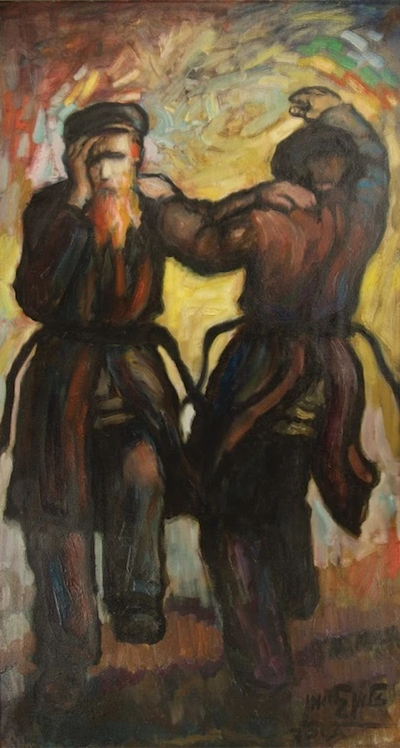
image - “Chassidic Dance” by Zalman Kleinman, 1964
Until Rabbi Kibbitz decided to put an end to their feud, one could never have imagined the Chiribim and the Chiribom speaking, let alone dancing together. (“Chassidic Dance” by Zalman Kleinman, 1964)

The Chiribim and Chiribom were stubborn. They loved an argument, and neither group liked to be pinned down or admit to anything. Perhaps they were playing tricks on the rabbi. Perhaps they were just being obstinate.

“Bim!” the rabbi shouted.

“Bom!” they answered.

“Bom?” the rabbi yelped.

“Bim!” came a chorus.

“AAAGH! Bim bom bim bom bim bom!”

He began to twirl about.

He asked another group, “Bom?”

They answered, “Bim!”

The next had to be … “Bom?”

“Nu. Bim!”

“Impossible! Bim bom bim bom bim bom!”

The rabbi was running and twirling, almost dancing. “Ai Chiribiri biri bim bom bom.”

His hair was everywhere. His coat was open. “Ai Chiri biri biri bim bom bom. Ai Chiri biri biri bim bom bom. Ai Chiri biri biri bom.”

Well, the Chiribim and the Chiribom started laughing. They couldn’t help themselves. Their rabbi, this wise old man, was acting like a chicken with his head cut off, like a frog trying to escape a pack of curious boys, like a school teacher with a cube of ice dropped down his back. All the time he was muttering to himself like a crazy man, “Chiribimbombimbombimbom.”

They laughed and they grinned and they smiled, and then they looked up.

Across the forest they saw something that they had never seen before.

They saw each other smiling and laughing and grinning.

They looked and they realized that they all wore the same kind of clothes. They had the same kinds of shoes and hats and hair. They all held baskets full of mushrooms.

So the Chiribim and the Chiribom came together in the middle of the forest and shook hands, and they kissed cheeks, and they hugged.

And, of course, they had a Passover lunch.

Such a feast! Chopped liver on matzah with fresh-picked mushrooms. Beet salad. Brisket. And Mrs. Chaipul’s light-as-a-feather lemon meringue pie. So delicious!

When they were done eating and finished cleaning up, they lifted the poor rabbi up on their shoulders, because he was still too dizzy to walk, and all together they carried him back to the village of Chelm, singing: “Ai Chiri biri biri bim bom bom….”

From that day on, they were no longer known as the Chiribim or the Chiribom, but as the Chiribimbombimbombimbom…. Bim…. Bom.

“Ai Chiri biri biri bim bom bom.

“Ai Chiri biri biri bim bom bom.

“Ai Chiri biri biri bom….”

Izzy Abrahmson is a pen name for author and storyteller Mark Binder, who lives in Providence, R.I., and tours the world – virtually and in-person. Abrahmson’s Winter Blessings: Warm Stories from the Village was a National Jewish Book Awards finalist. This story about Chiribim and Chiribom is from his latest book in the Village Life Series, The Village Feasts: Ten Tasty Passover Stories, which is available on Amazon and at books2read.com. To listen to the audio version of this story, narrated by Binder, visit izzyabe.com.

Pesach sweets ’n’ side dishes

Cauliflower rice, ready to serve. (photo from cookingclassy.com)

With Passover approaching, the meal planning has begun. Looking into my Passover folder for something new to share, I found a few side dishes – and many desserts. I hope you are able to try some of them out, and that you enjoy the ones you do. Chag Pesach sameach!

CAULIFLOWER RICE
(From foodnetwork.com. Makes 4 servings.)

1 large cauliflower separated into 1-inch florets
3 tbsp olive oil
1 finely diced medium onion
1 tsp salt
2 tbsp finely chopped fresh parsley leaves
juice of half a lemon

  1. Trim cauliflower florets, cutting away as much stem as possible. In three batches, break up florets into a food processor and pulse until mixture resembles couscous.
  2. Heat oil in a large frying pan. Add onion and stir to coat. Continue cooking, stirring frequently, until onions are golden brown at the edges and have softened, about eight minutes.
  3. Add cauliflower and stir. Add salt and continue to cook and stir three to five minutes, until cauliflower has softened. Spoon into a large serving bowl. Garnish with parsley, sprinkle with lemon juice, salt to taste. Serve warm.

LEEK PATTIES
(From the Jerusalem Post, April 2015. Makes 12 servings.)

2.2 pounds leeks
1 large, peeled boiling potato
3 large beaten eggs
3 tbsp matzah meal
salt and pepper to taste
oil

  1. Wash leeks carefully, slicing then vertically to remove all the grit. Dice the white base and the palest green part of the leaves.
  2. Place water and salt in a saucepan and bring to a boil. Add leeks and cook for five minutes then drain.
  3. Place water in a saucepan and bring to a boil. Add potato and cook until it is soft. Drain.
  4. Place potato and leeks in a processor and blend. Add eggs, matzah meal, salt and pepper. Remove to a bowl and form into patties.
  5. Pour oil into a frying pan and heat. Spoon patties into the oil and fry until golden brown on each side. Drain on paper towels and serve immediately.

PASSOVER SQUASH PUDDING
(From Annice Grinberg. Makes 6 servings.)

2 pounds peeled summer squash
2 peeled carrots
1 1/2 cups matzah farfel or broken matzot
1/4 cup oil
3 eggs, separated
salt to taste

  1. Preheat oven to 350°F. Grease a casserole or baking dish.
  2. Heat oil in a frying pan. Add farfel or broken matzot and brown.
  3. Place squash and carrots in a saucepan with water, cook until soft. Drain and mash. Add farfel or browned matzot, salt and egg yolks.
  4. Beat whites in a bowl until stiff. Fold into vegetable mixture.
  5. Spoon into a greased casserole or baking dish and bake for one hour, until golden.

MOM’S CREAM PUFF BUNS
(Makes 9-12 servings.)

2/3 cup water
1/3 cup oil
1/4 tsp salt
1 tbsp sugar
3 eggs
1 cup matzah meal

  1. Preheat oven to 350°F. Spray a cookie sheet with Passover vegetable spray.
  2. Place water, oil, salt and sugar in a saucepan. Bring to a boil.
  3. Add matzah meal and one egg at a time. Blend well.
  4. Spoon dough in pieces on a cookie sheet. Bake for 30 minutes.
  5. When cool, cut a little off top of each. Fill with a favourite custard.

ALMOND CAKE WITH CITRUS SYRUP
(From Chef Peter Hoffman, in Food & Wine. Makes 6 servings.)

citrus syrup:
2 1/2 tbsp sugar
2 tbsp fresh lemon juice
finely grated zest of half a large lemon

cake:
1 1/2 tsp oil
1 tbsp matzah meal
1/2 cup sugar
1/2 cup ground almonds
1/4 cup finely chopped blanched almonds
finely grated zest of half a large lemon
4 eggs, separated
confectioners sugar (optional)

  1. Combine sugar, lemon juice and lemon zest with 1/4 cup water. Bring to a boil, stirring to dissolve sugar. Simmer over moderately low heat for two minutes. Remove from heat.
  2. Preheat oven to 325°F. Oil a springform pan bottom and sides, and line bottom with parchment paper. Oil the paper. Evenly coat bottom and sides with matzah meal. Refrigerate the pan.
  3. With a wooden spoon in a large bowl, mix sugar, almonds, lemon zest and egg yolks.
  4. In another bowl, whisk egg whites until stiff peaks form. Stir one-quarter into almond mixture. Gently fold in remaining egg whites in three additions.
  5. Pour mixture into prepared pan and bake on lowest shelf of oven for one hour or until cake tester inserted into the centre comes out dry. Cool for 10 minutes. Run a knife around the edge of the cake, remove pan sides and invert cake onto wire rack. Peel off parchment and let cake cool.
  6. Reheat and strain syrup. Transfer cake to a plate and prick all over with a fork. Pour syrup over cake and let sit at room temperature for at least three hours or overnight. Sift confectioners sugar over cake (optional).

MIRIAM’S PAREVE ICE CREAM

2 10-ounce packages frozen fruit, slightly thawed (strawberries work very well)
4 egg yolks
6 egg whites
1 cup sugar (if using frozen fruit with added sugar, decrease this amount)

  1. In a bowl, beat egg yolks. Add fruit.
  2. In a second bowl, beat egg whites until peaks are formed, gradually adding sugar.
  3. Gently add fruit and yolks to whites. Place in a container and freeze. Stir once or twice to keep fruit from settling to the bottom.

PASSOVER SORBET

4 cups strawberries or other fruit
1/2 cup sugar
1 tbsp lemon juice
1 egg white

  1. Place strawberries or fruit, sugar and lemon juice in a food processor and process until mixed. Place in a container.
  2. Whip egg white in a bowl. Add to fruit. Spoon into a container and freeze.

Sybil Kaplan is a journalist, author, editor/compiler of 10 kosher cookbooks and a food writer living in Jerusalem. She leads English-language Shuk Walks in Machane Yehuda and writes restaurant features for janglo.net.

May the force be with you

In my world, you can never have enough lamb. Or, to be more specific, lamb shanks. It used to be what I called “fancy food,” for which I splurged only on special occasions, like New Year’s Eve, or a birthday ending in zero. But since the pandemic started, up is down and right is left, and every day that you’re healthy is a day that’s meant to be celebrated. Goodness knows we could all use a little splurging. So, hubby Harvey sold a kidney and bought five pounds of lamb shanks. Lest you think we’re complete chazers, let me add that we had another couple over for dinner. For the first time in two-and-a-half years.

After two years of strict isolation and adherence to Dr. Bonnie Henry’s pandemic protocols, it was a wondrous event, to be sitting less than six feet away from two close friends, masks discarded, acting as though we did this every day. There wasn’t a shred of anxiety anywhere to be seen, and it just felt so normal. To say I felt ridiculously elated and grateful at the same time would not be an exaggeration. It was pure joy. I wondered why we hadn’t done it sooner. And then I remembered … that pesky pandemic. Oh, and my COVID anxiety, which can often be seen from space.

But back to the main event. The lamb. I’d sent Harvey to the butcher to pick up the lamb and, when he returned home, he handed me the bag-o-meat. Which weighed nearly as much as me. I asked him: “So did they throw in a ram for free?” To which he replied: “I told them I wanted the biggest lamb shanks they had.” Long story short, each shank was the size of a small country. Maybe slightly bigger. All of a sudden, my four hours of estimated cooking time was looking more like half a day. Luckily, I’m an early riser.

I hauled out my biggest roaster, proceeded to dirty every fry pan, pot and utensil in the apartment – we’re talking squeezers, mincers, graters, peelers, a multitude of various-sized knives, cutting boards and a healthy shot of Scotch (just kidding about the Scotch, but after it was all said and done, I sure could’ve used a glass) – and had at it.

The recipe, which Harvey found on the internet, is called Tom Valenti’s Lamb Shanks, and it’s spectacular! I won’t bore you with the details – Google it. Never mind that it calls for a bottle of wine, four cups of broth and a whole whack of other stuff. When it was all assembled, I couldn’t even lift the roaster, never mind take it in and out of the oven every 30 minutes for the next five hours. I happily handed over the reins to Harvey to do the heavy lifting. While I sat around and ate bonbons. Not.

All modesty aside, the lamb shanks were a huge hit. But, I was left with cups and cups of gorgeous, rich, winey braising liquid, flavoured with onions, carrots, celery, garlic and thyme, to name just a few of the players. I actually considered drinking it. Is that wrong? Of course, the thyme sprigs might get caught in my teeth.

So, I did what any self-respecting 21st-century cook with a few gallons of leftover braising liquid would do – I Googled it. Which is where I found an article by Mackenzie Stratton in The Spruce Eats, called “What to do with leftover braising liquid.” Imagine that. I learned many things, like the fact that chefs often refer to braising liquid as “liquid gold” because of its ability to transform whatever it touches into something fabulous.

I know some of you will wonder why I bothered keeping the seemingly useless flotsam and jetsam of a meal. It’s because I hate throwing stuff out that I could possibly use. Operative word here is “possibly.” My father, alav ha-shalom, always used to rib me about how thrifty I am. He’s right. I hate to waste food and, if I can repurpose it, why the heck not? When I told Harvey my plans for the braising liquid, he informed me that the army used to call that a “force multiplier.” May the force be with you, too.

If Mackenzie Stratton is to be believed, you can elevate just about any dish with leftover braising “gold.” But first you have to let the “gold” cool overnight in the fridge, then skim off the fat from the top. You’ll be left with a lovely (?) gelatinous bowl of the aforementioned “gold.” Next step requires you to sacrifice your ice cube trays. Fill each one with a big glob of “gold,” freeze them, and then put the nuggets in a Ziploc baggie or in small containers for future use. This is where the “gold” comes in, because at $16 to $18 a bottle for the wine and another $60 for the lamb and the rest of the ingredients, it’s not something you relish throwing down the sink once everyone’s had a good burp.

What all can you do with these little brown, gelatinous gems? You can incorporate them into other recipes, like soups, pasta or grain dishes; use them to poach chicken or tougher cuts of meat; or put them in stews. You can also use them as the supreme weapon of decadence: boil potatoes in the thawed braising liquid, then turn them into the ultimate side of mashed potatoes. I have no words. The drool is dribbling down my chin.

I usually like to include a photo of my culinary creations/discoveries and, well, not to be crass or anything, but Harvey says these “gold” blobs look like something people pick up with those little green baggies on their hand. Need I say more? Now just try and un-see that visual.

Like the thrifty Accidental Balabusta that I am, you might just be on the receiving end of my leftover braising “gold” next time you come for dinner. But you won’t know it. To paraphrase John F. Kennedy: ask not what your lamb shanks can do for you – ask what you can do for your lamb shanks.

Once again, you’re welcome. Bon appetit!

Shelley Civkin, aka the Accidental Balabusta, is a happily retired librarian and communications officer. For 17 years, she wrote a weekly book review column for the Richmond Review. She’s currently a freelance writer and volunteer.