Helping people stay at home

People are living longer and, ideally, they’d be living longer at home. Pragmatically, this means that they and their primary caretaker(s) would need support not just for medical care, but for errands and companionship, as well. Enter Rona Goodman and her small business, Bubbymobile.com.

“Bubbymobile.com is a senior concierge service that offers a multitude of non-medical services to families. They include companionship, lunch, errand running, grocery shopping, accompanying to medical appointments and check-ups, transportation, walks and more,” Goodman told the Jewish Independent.
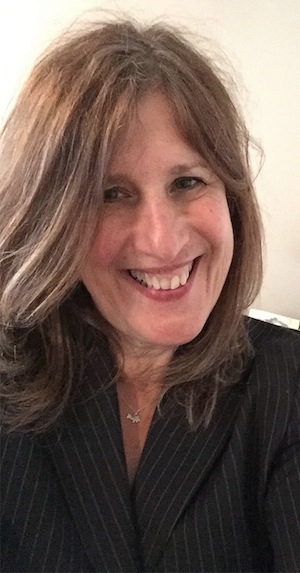
photo - Rona Goodman
Rona Goodman (photo from Bubbymobile.com)

Goodman thought of the concept for Bubbymobile.com a few years ago but waited until the pandemic subsided and it was safe to launch.

“I would say it’s been around a year since I started, and it is going very well,” she said. “It’s growing organically and that’s the way I wanted it. Mostly word of mouth and recommendations, and that’s the best advertising you can get. I would love to meet more families in the community.

“The concept came to fruition when I was visiting my friend’s mom who was in a seniors home. I would take her for walks and be her companion. I met several people in the facility who didn’t have anyone visit them or assist with their non-medical needs. After researching, I thought this service would be a great resource to complement what is already out there.”

Goodman named her business after her maternal grandmother.

“My bubby was the best and the matriarch of our family,” said Goodman. “I’m from Montreal and grew up with a close family because of my bubby and zadie. Every Friday night since I can remember, we would have dinner at their house with my family, aunts, uncles and cousins. We all grew up together and I wanted to honour my bubby with the name.”

Goodman said she had two wonderful grandmothers, but “my dad’s was my grandmother…. Both were lovely but I did spend more time with my bubby cause of Friday night dinners. But we (me, my brother and sister) did visit my grandmother and would take her out for drives and lunches/dinners and had lovely visits. She made the best coleslaw…. Both of my grandfathers passed when I was pretty young. Everyone has had a bubby or grandmother or grandfather, so it’s really in honour of them all!”

For Goodman, two of the best things about being Jewish are family and giving back. “You take care of the ones you love and give back to others who may not be as fortunate,” she said. “There was always an extra plate for dinner at Bubby’s house for drop-ins and friends. You also must be compassionate, patient, a good listener, understanding, kind and giving to do this kind of work. That’s how I walk through this world and this service is a natural fit for me. I also do volunteer work for VCDS (Vancouver Cancer Drivers Society), a wonderful organization that involves transportation.”

In addition to Bubbymobile.com, Goodman is a musician and a public-relations professional.

“My professional life has always been about passion, creativity and being of service,” she said about the common threads that tie her diverse endeavours together. “I’ve worked in the music industry for over 25 years in many areas of the business. From record labels, musician, songwriter to sales, marketing and publicity. As a PR person, I’ve learned a lot about communication, understanding people’s needs, listening to their stories and reaching out and engaging community – I think it brings out the kid in me and keeps me vibrant and young. These qualities are important when working with seniors, as it’s parallel in many ways.

“As a composer, songwriter and producer, I tell stories through music, lyrics and composition,” she added. “Music is a healer and there is nothing better to lift the soul. To be a composer, you need to write about life’s experiences and adventures. That’s why I love hearing the stories shared by my seniors. What a gift to be in their presence really. I would happily pick up my guitar and sit and play some music for someone that I’m working with. It’s fun and I’m grateful that I can give that little extra service to my clients. There is nothing better than to share the love of music.”

Ultimately, Goodman would like to be able to offer Bubbymobile’s services in every community in the province.

“In the long term,” she said, “I would like to build the business so it can develop into a franchise opportunity across Canada. The more I talk with people, the more excited they are that I’m doing this and how much it is needed. As we grow older, we are living longer, and I find it does provide some relief for families looking for that extra support. I’ve talked with families who may not be living in Vancouver who need extra assistance for their loved ones. Many are also too busy with work and raising families to visit during the week. That’s why I’m here – for that extra support.”
Avoid being scammed

Millions of dollars have been lost through the schemes of fraudsters who take advantage of trusting, isolated and vulnerable senior citizens, said guest speaker Patrick Harkness at the latest Jewish Seniors Alliance – Phyliss and Irving Snider Foundation Empowerment Series talk.

On Feb. 16, JSA, in partnership with Council of Senior Citizens Organizations of B.C. (COSCO) and L’Chaim Adult Day Centre, sponsored the program Frauds and Scams, which took place at the JSA offices at Mount Pleasant Community Centre. The program was accessible both in person and online, and about 50 people participated, the majority remotely. Its purpose was to investigate the ways in which fraudsters deceive people, especially seniors, in order to rob them of their money and possessions. The question was: what are the main types of scams, and how can people protect themselves?

Gyda Chud, coordinator of the JSA program committee, welcomed participants and introduced Barb Mikulec of COSCO, who introduced Harkness. Before he retired in 1999, Harkness worked for the provincial government in the department of safety and emergency preparedness. Now, he is a volunteer, one of many, who present workshops on topics important to the senior community through COSCO’s Seniors’ Health and Wellness Institute.

In his Empowerment Series talk, Harkness outlined some of the many types of scams perpetrated on seniors. The approaches can be made by phone, email, post and even in person, depending on the type of scam, he said. He warned that one should not respond to unfamiliar phone calls or email requests and one should not open any attachments included with these requests. He also advised people to never give out personal information or send money. If the information provided sounds too good to be true, he said, then, very likely, it is not true.

According to Harkness, here are some of the most common scams, and how to avoid them:

  1. Stealing photos from dating sites and engaging in a trusting relationship. Do not send money or photos, as the photos can be used to blackmail you.
  2. Emails or calls from the federal government indicating that you owe money and should forward it right away. Do not respond to the caller or emailer, and report the call/email to the police and to the Canadian Anti-Fraud Centre.
  3. Purchases online are fake, unless you have ordered the item(s).
  4. Calls from people claiming they are Canada Revenue Agency (CRA) agents. Do not respond – call the CRA yourself (and not on the number you received the call from) to confirm if they really called you.
  5. Prize scams. Ignore them, as you cannot win a prize for a contest that you have not entered.
  6. Do not buy lottery tickets by phone.
  7. Don’t meet with people claiming to be bank investigators, who ask you to meet in a neutral place to give them money.
  8. Grandparent or nephew scam – claiming you must pay bail money to free the relative. They often have the person’s name. But still, don’t believe them. Check with the relative in question. You will likely find that they are fine.
  9. Offers to fix your computer. Don’t accept. Chances are, it is not broken. If it is, call an authorized repair person.
  10. Scams involving cheap prescription drugs. Never give those offering the items your credit card number.
  11. Charity scams. They may say it is, for example, for Ukrainian relief, but check whether this or any other charity that’s calling is a legitimate, reputable charity, and then donate directly.
  12. Home repair people may come to your door offering their services. Be sure to check with Better Business Bureau to make sure they are licensed and legitimate.
  13. Identity theft is very common and dangerous. Thieves may try to get your social insurance number (SIN) and other identifying information from old mail that you have thrown out. Shred all items that have such information on them before putting them into the recycling bin.

As well, do not carry around a lot of personal information with you or leave your purse or wallet unattended. Choose personal identification numbers (PINs) wisely, so they are not obvious: for example, do not use birthdates or family names.

If you do fall victim to a scam, report it immediately to the police and also to the Canadian Anti-Fraud Centre (CAFC) at 1-888-495-8501. COSCO’s Seniors’ Health and Wellness Institute’s website has several resources on various topics, including frauds and scams: seniorshelpingseniors.ca.

Shanie Levin is a Jewish Seniors Alliance Life Governor. She is also on the editorial committee of Senior Linemagazine.

Research in community living

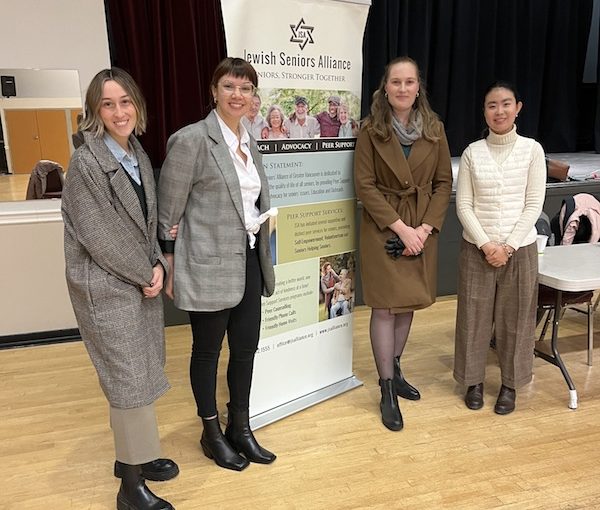
Left to right: Rachelle Patille, Cari Randa, Eireann O’Dea (Jewish Seniors Alliance board member and event moderator) and Boah Kim. (Courtesy JSA)

On Dec. 4, Jewish Seniors Alliance presented their fall symposium: Aging in Place: Gerontology Research in Community Living. The speakers – Rachelle Patille, Cari Randa and Boah Kim – and the moderator, Eireann O’Dea, are all graduate students in gerontology from Simon Fraser University and they shared their research on intergenerational connections, dementia-friendly communities and the role of informal caregivers for older adults.

The event took place at the Peretz Centre but was also available by Zoom. Aside from the JSA annual general meeting, this gathering was the first event presented in a dual format since the outbreak of COVID. Fifty participants joined online and about 20 were present in person.

Tammi Belfer, president of JSA, explained that the JSA’s fall symposium focuses on an educational theme and offers a more serious discussion than other programs. She said JSA wishes to provide outreach, advocacy and education services for all seniors, with the goal being “Seniors Stronger Together.” She then introduced the speakers and turned over the mic to O’Dea, who is a PhD candidate in gerontology at SFU. O’Dea’s interests are in social participation among older adults, particularly in volunteering and intergenerational activities; experiences among ethnocultural minority groups; and generativity. She has been a board member of JSA for three years.

The first speaker, Patille, conducts research focused on “intergenerational opportunities in bridging the gap between generations in Metro Vancouver.” She said she grew up having a lot of contact with her grandmother, and she believes that this fact led to her interest is this field. She defined intergenerational contact as a social benefit that facilitates mutual interaction and exchange between generations, and she discussed factors in society that have impeded such contact; for example, age segregation and geographic divisions among generations that lead to ageism.

Older adults living alone is the number one risk factor for isolation and loneliness, she said. These factors underline the need for connections through programming that will bring older adults into contact with other people, including other older adults. This can be accomplished through such things as home sharing, community programs, tutoring and art projects. These projects allow older adults to be part of the community through participation and mentoring, increasing the person’s feeling of self-worth. For some young people, this may be their first contact with older adults and can lead to reciprocity of social networks.

Patille spoke about generativity, which is the passing down and transfer of knowledge and information 

between generations. She will also be looking at “voluntary kin”; that is, having younger members of society replace missing family for older adults.

The next speaker, Kim, focuses her research interests on integrated care, formal and informal caregiving, continuity of care and healthy aging. One of the difficulties for older adults is navigating complex community and healthcare systems. Two-thirds of older adults have health limitations and thus need a close connection with the healthcare system, she said. A geriatric care manager could be helpful in bridging gaps in services and helping to predict difficulties, she added. Many factors such as age, background or health issues, cannot be changed, but a care manager and caregivers could help with these situations.

The third speaker, Randa, is the project manager of the Public Health Agency of Canada-funded research project titled Dementia-Inclusive Streets and Community Access, Participation and Engagement (DEMSCAPE). The focus is on inclusion of those living with dementia in the 

general community, as 70% live in their own homes. Planned inclusion in neighbourhood design is paramount in creating areas of accessibility, especially outdoor spaces, she said. Randa will be interviewing participants mostly in an outdoor setting to learn their feelings about public spaces with regard to safety and comfort. She is planning a documentary about these issues and the tools available to help, and DEMSCAPE is developing a design and planning guide to aid dementia patients in the community.

In the discussion that followed the presentations, someone noted that many countries are further ahead of Canada in a number of these areas raised. One of these is the availability of affordable home care, which would further facilitate aging in place. Jackie Weiler, a member of the JSA board and also a member of the Senior Advisory Committee for the City of Vancouver, mentioned the idea of a senior planner to promote accessibility. 

Gyda Chud, chair of the program committee, brought the afternoon to a close with a quote from her 99-year-old mother, Gallia, expressing a hope for world peace, diversity, inclusion and social justice for all.

Shanie Levin is a Jewish Seniors Alliance Life Governor. She is also on the editorial committee of Senior Line magazine.

Emotional support vital

On Nov. 30, as part of the Fraser Health Virtual Geriatric Educational Session entitled The Importance of Emotional Support for Seniors, Grace Hann, Jewish Seniors Alliance peer support services supervisor and trainer of volunteers, made a presentation that featured recorded remarks from JSA president emeritus Serge Haber.

Haber pointed out in his remarks how life changes for many older seniors once they retire. They often cease to be valued and become invisible, he said. The JSA’s Peer Support Services (PSS) program has trained seniors to provide emotional support to other seniors – active and reflective listening, encouraging the senior to talk about their issues and finding solutions on their own, but with support.

When Haber took the training course, he learned how crucial the PSS program is for the well-being of seniors. The support provided helps them deal with tremendous changes in their lives, such as loss of family, loss of position in society and health issues. Haber argued that these needs are not usually recognized. The gains made by the clients of PSS, he said, are phenomenal.

Hann pointed out that the training and volunteering also helps the seniors who become volunteers.

The second half of the presentation consisted of an explanation by Hann of the training process and a description of the PSS program, as well as other JSA activities, including education and advocacy. Charles Leibovitch, PSS coordinator and the social worker for the program, spoke about Haber’s passion for the work they are doing and how his passion has inspired many of the staff and the volunteers.

Older seniors can remain alone at home longer, if they would like to, as a result of the government’s Better at Home program. However, there is little in emotional support offered; it is not just a gap in this area, but a chasm.

Alvarez thanked everyone and mentioned the summit Fraser Health is planning in June for further discussion of these topics.

Shanie Levin is a Jewish Seniors Alliance Life Governor. She is also on the editorial committee of Senior Line magazine.

Fresh new start to year

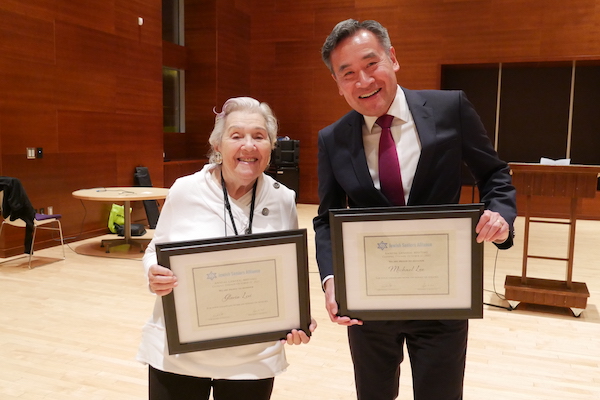
Gloria Levi and Michael Lee were honoured by Jewish Seniors Alliance for their contributions to the well-being of seniors in the community, as was Dolores Luber. (photo from JSA)

When you looked around the room at Congregation Beth Israel on Nov. 27, the pandemic of the last two-plus years would not have crossed your mind. The room was filled with more than 100 happy guests enjoying dinner together.

The occasion was the 15th annual general meeting and gala for Jewish Seniors Alliance of Greater Vancouver. Three people were honoured for their contributions to the well-being of seniors in the community: Dolores Luber, Gloria Levi and Member of the Legislative Assembly Michael Lee.

After welcoming the guests, emcee Rabbi Philip Bregman called upon Beth Israel Rabbi Jonathan Infeld to recite the Hamotzi. JSA board member Tony DuMoulin read an inspiring message from Serge Haber, the founder and visionary of JSA.

photo - Dolores Luber was awarded the first JSA Star. She received a collage made up of covers from Senior Line, a magazine she has edited for 10 years
Dolores Luber was awarded the first JSA Star. She received a collage made up of covers from Senior Line, a magazine she has edited for 10 years. (photo from JSA)

Then, Ken Levitt introduced Luber, the editor of Senior Line magazine. She is the first winner of the JSA Star for her commitment to enriching the lives of seniors through articles, book reviews, film reviews and news. Luber, who has served as the editor of the magazine for 10 years, emphasized the free hand she enjoyed in choosing the topics of the articles, artists’ profiles and other material for the magazine. Her goal was to enlarge the scope of the publication, so that it included people from many cultures and ethnic backgrounds. She was awarded a collage of select covers of Senior Line, with her and her dog, Kesem, in the centre of all the covers, which reflect JSA’s culture of diversity and support.

Levi was introduced by her friend Jane Heyman, who spoke about Levi’s fascination with seniors at the young age of 30, when she worked with the Golden Age Club. Levi went on to develop provincial programs for seniors. She is also the author of six books, most recently the creative memoir The Hotel Keeper’s Daughter, which was published this year.

Levi thanked JSA for the honour, as she received a standing ovation. She spoke lovingly about Haber, who would never take “no” for an answer.

Lee was introduced by Grace Hann, a trainer for the JSA peer support program. He was honoured for his ongoing work with seniors. Elected MLA for Vancouver-Langara in 2017 and 2020, he, along with Andrea Krombein, has launched the South Vancouver Seniors Network. This network has sponsored more than 100 webinars connecting seniors with various topics of interest and with one another.

Lee met Haber and Levitt in 2016. He was impressed with Haber’s passion and commitment and recognized the JSA as a leader in the development of seniors organizations in Vancouver.

Tamara Frankel, co-chair of the event, presented Gyda Chud and, in absentia, Larry Shapiro, with a gift in appreciation of their leadership as co-presidents of JSA over the last three years. A short video by incoming president Tammi Belfer, who spoke from Israel, was screened.

Following the dinner by Nava Catering, the winner of the 50/50 raffle was announced by Frankel – who was shocked to see that she was the winner. Frankel donated her winnings to JSA; the raffle raised more than $1,000.

Tamara Frankel is a member of the board of Jewish Seniors Alliance and Shanie Levin is a JSA Life Governor. Both Frankel and Levin are on the editorial committee of Senior Line magazine.

Weinberg Residence’s 20th

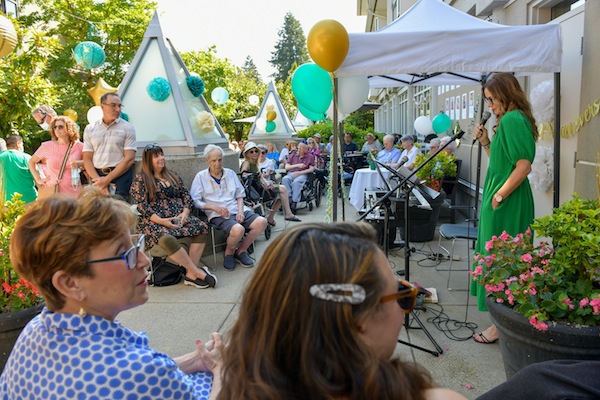
Vanessa Trester, manager of the Weinberg Residence, speaks to those gathered at the 20th anniversary party. (photos by Galit Lewinski)

The Weinberg Residence has just entered its 20th year. The assisted living and multi-level care facility opened in 2003 as the city’s first Jewish residence for people who choose the round-the-clock care and companionship they might not have at home. A celebration took place Aug. 21.

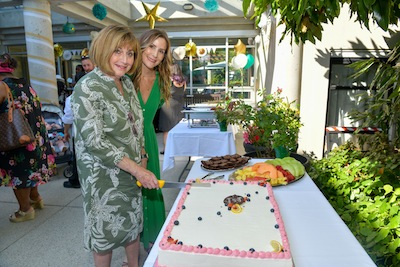
photo - Sandra Bressler, who just completed her term as chair of the Weinberg Residence board, cuts the birthday cake while Vanessa Trester, manager of the residence, looks on
Sandra Bressler, who just completed her term as chair of the Weinberg Residence board, cuts the birthday cake while Vanessa Trester, manager of the residence, looks on. (photo by Galit Lewinski)

The Weinberg is located at the Dr. Irving and Phyliss Snider Campus for Jewish Seniors, which is also the location of the Louis Brier Home and Hospital. While the residents and staff are celebrating this anniversary milestone, plans are afoot for big changes in the years to come.

The Weinberg, which is a private, but not-for-profit, facility, opened at a time when the idea of assisted living was relatively fresh. The concept is a step between fully independent housing and supportive living – residents are able to live independently but sometimes need or desire a little assistance with things like personal care, and they enjoy the liberty of not having to cook.

The Weinberg includes a kosher dining room and special meals for Jewish holidays, as well as private dining for family events. There is 24-hour staffing, as well as a range of cultural, therapeutic and recreational activities. The Chava and Abrasha Wosk Synagogue is located on the campus, with regular and holiday services available without having to leave the premises.

The multi-level nature of the facility means it can welcome people across a large span of ages and physical needs.

“What’s really unique about the 24-hour care unit is the different residency options that historically we’ve offered within the unit,” said Vanessa Trester, manager of the Weinberg Residence. In addition to the assisted living option, there is the possibility of convalescence periods, post-surgery recovery, shorter stays, including for out-of-town guests who need support, as well as palliative support.

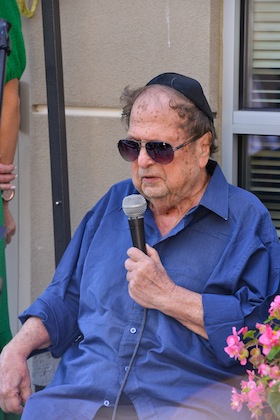
photo - Dr. Norman Stein, who has been a resident at the Weinberg Residence since it opened, speaks at the residence’s recent 20th anniversary party
Dr. Norman Stein, who has been a resident at the Weinberg Residence since it opened, speaks at the residence’s recent 20th anniversary party. (photo by Galit Lewinski)

Trends in senior living have had an impact on the Weinberg, as they have had on all such facilities. Health authorities are encouraging aging in place, with governments funding more services to keep people at home longer and out of institutional care. As a result, said Trester, residents tend to be coming to the Weinberg at a later age than they might have in times past.

“It just means people are coming later in life,” she said. People who come in their 90s, rather than their 70s or 80s, will most likely have higher needs and require additional services upon first arrival.

“We see more people who are requiring 24-hour care,” said Trester. “The longer people wait, the more their needs increase.”

The residence was built by the Jewish community, Trester stresses, who raised $11 million to make it a reality.

“We are the Jewish campus,” she said. “So there should be a lot of pride and contentment from the community.”

However, like so many other institutions in Vancouver’s Jewish community, the Weinberg and the entire Snider campus are facing dramatic changes.

The campus is located kitty-corner to the Jewish Community Centre of Greater Vancouver, whose $450 million redevelopment plan, called JWest, represents the most ambitious construction project in the history of Jewish Vancouver. Originally considered as part of that project, the 4.3-acre Snider Campus site will be revamped independently.

“There are tentative plans in place for Louis Brier redevelopment,” said Dr. David Keselman, chief executive officer of the Louis Brier Home and Hospital and Weinberg Residence. “There are assumptions of what it should be, can be and may be. It all really depends on approvals from the City of Vancouver, funding from Vancouver Coastal Health, all this kind of stuff.”

Management is in the due diligence stage, Keselman said. But even though the Weinberg Residence is far newer than the Louis Brier Home that shares the campus, both institutions are almost certain to be replaced in the future.

“The new build, of course, will be looking at going up versus horizontal,” Keselman said. “It depends on what the decisions are going to be, and approvals we get in the end, how big that building is going to be and how many beds it’s going to end up being.”

The Brier began as a seven-room seniors facility 70 years ago. It has transformed, grown and moved over the decades – and time marches on.

Timing of the redevelopment also depends on how fast approvals can be obtained, plans are finalized, costs are determined and funds are raised. “I’m going to say anywhere between eight to 12 years,” Keselman said.

Special visitors at Louis Brier

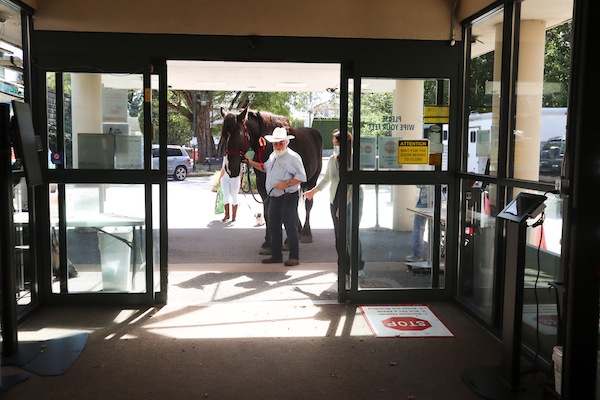
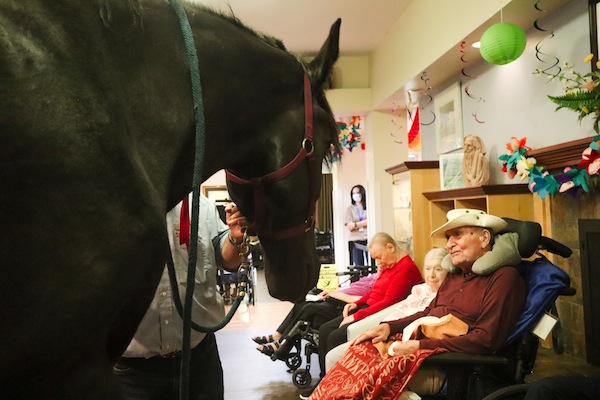
Loni the Percheron Horse comes in the entrance of the Louis Brier Home and Hospital. (photo from Louis Brier)

Loni the Percheron Horse and his side kick Beau the Shitzu visited the Louis Brier Home and Hospital the afternoon of Sept. 7. This was the third (and last) time this year that the pair visited the home.

photo - Loni the Percheron Horse's sidekick Beau the Shitzu at the Louis Brier
Loni the Percheron Horse’s sidekick Beau the Shitzu at the Louis Brier. (photo from the Louis Brier)

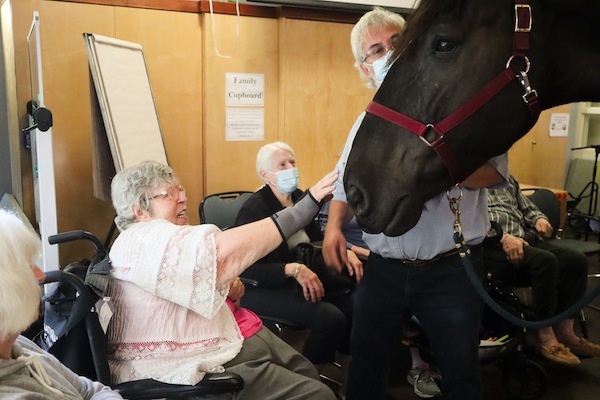
The program is designed to give residents the opportunity to have a personal experience with one of these beautiful, gentle giants – and not-so-giants – in the comfort of their own home. Horses evoke a sense of peace and tranquility, as do dogs. It is no secret that visiting with animals is therapeutic.

photo - Loni the Percheron Horse visit with residents of the Louis Brier

photo - Loni the Percheron Horse visit with residents of the Louis Brier
Loni the Percheron Horse visit with residents of the Louis Brier. (photos from Louis Brier)

Help teens with their English

Want to make a difference in the lives of Israeli teens? Consider joining Israel Connect, a program where local adult volunteers connect online, one-on-one, via Zoom, with Israeli high school students who want to improve their English conversation and reading skills. The program starts on Oct. 23 and is organized by Chabad Richmond, in partnership with the Israeli Ministry of Education. It entails a small and rewarding commitment of 45 minutes once a week.

There are currently 15 local volunteers participating in the Israel Connect program as tutors/mentors, and Chabad Richmond is looking to increase that number, since the need continues to grow.

“We’re looking for volunteer retirees, seniors or any adults with flexible schedules to join the Israel Connect program. No previous tutoring or teaching experience is necessary and the curriculum is provided for tutors/mentors,” said Shelley Civkin, local program coordinator. “If you’re an adult and a fluent English speaker, you have basic computer skills and you own a computer with a camera, that’s pretty much all you need. Oh, and, of course, a strong desire to help Israeli youth.”

Volunteers do not need to speak Hebrew and can tutor from home. Basic training and technical support are available.

Time preferences of volunteer tutors/mentors will be coordinated beforehand and sessions take place in the morning between 7 and 11 a.m. Vancouver time, any day between Sunday to Thursday. “All Israel Connect asks is a minimum commitment of one school year, in order to ensure consistency for the students,” said Civkin.

“It’s a meaningful and practical way for community members to support Israel and build bridges between diaspora Jews and Israelis,” said Rabbi Yechiel Baitelman of Chabad Richmond. “You’ll be doing a mitzvah, while investing in Israel and its young people. Plus, good English skills will give them an advantage in accessing post-secondary education and getting better jobs. English proficiency is crucial to Israeli students, since it accounts for a third of their entrance exam marks for university.”

“Partnering with the Israeli Ministry of Education, the Israel Connect program targets teens from less advantaged neighbourhoods in Israel. Most volunteers really enjoy helping their Israeli students and develop a lasting bond with them. It often goes beyond simply tutoring the curriculum, and turns into friendship and mentorship,” added Civkin. “Conversations sometimes continue long after the school year is over. This kind of one-on-one tutoring makes a huge difference in their lives, both educationally and personally…. Estimating the impact of this program on Israeli youth is, of course, speculative, but we do know for certain that it helps improve their school grades. It’s incredibly satisfying to know that you’re doing something concrete to help Israeli students better their lives.”

The curriculum consists mainly of a tour of Israel, focusing on the wealth of historically, culturally and biblically significant cities and sites. It’s not uncommon for both the students and the tutors to learn something new about Israel at each lesson.

To volunteer, or for more information, contact Deborah Freedman at Chabad Richmond, 604-277-6427, or email programs@chabadrichmond.com.

For anyone who can’t participate as a tutor, Chabad Richmond welcomes financial support for the Israel Connect program, which covers overhead costs like technical support, staffing and other administrative costs. To support the program call Chabad Richmond or email admin@chabadrichmond.com.

– Courtesy Chabad Richmond

Care for the caregiver

On Feb. 14, Jewish Seniors Alliance presented the third of its 2021/22 Empowerment Series. The event – Care for the Caregiver – was co-sponsored with L’Chaim Adult Day Centre and the Council of Senior Citizens’ Organizations of British Columbia, and the program was presented by Royce Shook of COSCO’s Health and Wellness Institute and Leah Deslauriers, administrator of L’Chaim.

Gyda Chud, co-president of JSA welcomed everyone and thanked the agency’s partners for participating.

Barb Mikulec, vice-president of COSCO, explained that COSCO is a nonprofit group for seniors helping seniors and that its Health and Wellness Institute presents many free workshops on seniors issues. She introduced Shook, who has been in the field of education for more than 40 years and has worked in curriculum studies. He advises or serves on various seniors committees/councils.

Shook spoke about the stress and burnout experienced by caregivers. In Canada, he said, there are approximately five million unpaid caregivers supporting family members; an economic value of $6 billion to $9 billion.

Caregivers provide both physical and emotional support, he said. This role could involve home management, such as bill paying, grocery shopping, driving to appointments, cooking and cleaning. For the caregivers, they may benefit from a sense of personal satisfaction and a sense of purpose. They learn more about their inner strength and gain a purpose in life by the act of helping. They can help pull family and friends together, but there will be changes in family dynamics and relationships. At times, the recipients of care may be resentful at their loss of independence and privacy.

There is an emotional impact on the caregiver in that they may worry about not being strong enough to carry the load. At the same time, they may avoid asking for help, and this could lead to burnout, Shook warned. There are a number of warning signs to watch for, such as a loss of energy, the neglect of personal needs, trouble relaxing, irritability with the senior and isolation. To avoid burnout, he advised caregivers to learn about the disease or condition plaguing the senior and take any help that is offered for that condition. Know your limits and specify them to others, i.e. family and friends, sharing the burden with them. Make sure to have regular breaks, and talk with others about your feelings.

Communication is very important, he said. Keep up to date on information from the health team. Let the recipient of the care lead, try to be a good listener and maintain eye contact. Always remember that the person has changed, so avoid giving advice or quarreling over minor issues. Do not say, “I know how you are feeling,” but instead say, “How do you feel?” Have a consent form so you can accompany the recipient to the doctor and have questions ready and take notes. There are three major areas of decision-making that need to be arranged with the recipient and not for them, said Shook. These are medical, the need for a representation agreement; legal, power of attorney; and financial, also covered by power of attorney.

Always remember to take care of yourself by accessing, for example, adult day care for respite, home help and community support groups. There is no such thing as a perfect caregiver. Always remember to respond to the present situation and not to the person you once knew. If you don’t care for yourself, you can’t care for others, he said.

After Shook completed his presentation, Eireann O’Dea introduced Deslauriers, who, prior to joining L’Chaim five years ago, was the coordinator of the seniors program at the Jewish Community Centre of Greater Vancouver. She has also been active in seniors housing issues and is a family caregiver for her parents.

L’Chaim is one of 12 adult day centres in the region funded by Vancouver Coastal Health. Referrals are made by a caseworker at the health unit and the programs provide stimulation for the recipients and respite for the caregivers.

At L’Chaim, clients arrive about 10 a.m. and have a light breakfast after which the programs begin. The morning may consist of word games, followed by news and a discussion. A full lunch is served during which socialization is encouraged. The afternoon consists of a guest speaker and/or a musical program. Clients are usually picked up about 3 p.m. Any pertinent information is passed on to the caregivers.

L’Chaim is similar to other centres but it is culturally Jewish. It is funded for 13 clients/day, three days/week and costs $10/day. More information is available at lchaim.ca.

A list of resources for caregivers will be made available on the JSA website, jsalliance.org. Also watch the website for information on the next Empowerment program, April 26, in co-sponsorship with Jewish Family Services, and the Spring Forum on May 15.

Shanie Levin is program coordinator for Jewish Seniors Alliance and on the editorial board of Senior Line magazine.

Inspiring songs and stories

Inspired by Story and Song – this was the topic of the JSA Snider Foundation Virtual Empowerment Series session held on Dec. 2, in partnership with the Louis Brier Home and Hospital.

Jewish Seniors Alliance co-president Gyda Chud welcomed the 45 Zoom participants, as well as the 35 Louis Brier residents, who joined to hear Shanie Levin’s stories and Myrna Rabinowitz’s singing.

Rabinowitz opened with a Chanukah song in Yiddish, “Drei Zich Dreidele” (“Spin Yourself Dreidel”), which was followed by Levin reading Sholem Aleichem’s Hanukkah Gelt (Hanukkah Money). In this story, Motl and his brother take part in the beloved customs of a favourite holiday: the lighting of the chanukiyah, eating potato latkes, playing dreidel, and the gift of gelt.

In the course of the program, Rabinowitz sang songs in Hebrew, Yiddish and Judeo-Spanish. She sang “Oh Hanukkah,” a song in Judeo-Spanish about the holiday’s eight candles, as well as more personal songs, including one she wrote on the occasion of her grandson’s birth and one she wrote for her father. She offered the audience a treat by singing the classic and sentimental Yiddish song by the Barry sisters from the 1950s, “Wie Nemt Men a Bissele Mazel?” (“Where Can You Get a Little Luck?”).

Levin chose the story by Abraham Karpinowitz titled Jewish Money, from the book Vilna My Vilna, which is a volume of his work that was translated into English by local storyteller Helen Mintz. Karpinowitz was known for his detailed and vivid descriptions of the city of Vilna and the odd characters who lived there.

The Spice Box is an anthology of Canadian Jewish writers and Levin read an illuminating story written in 1968 by Larry Zolf, who was a CBC personality and writer for the program This Hour Has Seven Days. The story, Boil Me No Melting Pot, Dream Me No Dreams, deals with the difference between the American and Canadian immigrant experiences.

Preposterous Papa, the final story read by Levin, was an excerpt from a book by Lewis Meyer. Meyer’s father grew up in a small town in Oklahoma, which had very few Jewish families. Unable to commute to the synagogue in the larger city, his father bought a house and converted it into a chapel, offering a place for the few Jewish families in nearby towns to socialize and pray on High Holidays.

Rabinowitz ended the program with an upbeat song in Yiddish, the title of which translates as “We Are All Brothers and Sisters.”

Nathalie Jacobs of the Louis Brier thanked the performers and expressed her wish to partner again with JSA in the future.

Tamara Frankel is a member of the board of Jewish Seniors Alliance and of the editorial committee of Senior Line magazine. She is also a board member of the Jewish Community Centre of Greater Vancouver.