Skip to content
  • Home
  • Subscribe / donate
  • Events calendar
  • Business Directory
  • FAQ
  • News
    • Local
    • National
    • Israel
    • World
    • עניין בחדשות
      A roundup of news in Canada and further afield, in Hebrew.
  • Opinion
    • From the JI
    • Op-Ed
  • Arts & Culture
    • Performing Arts
    • Music
    • Books
    • Visual Arts
    • TV & Film
  • Life
    • Celebrating the Holidays
    • Travel
    • The Daily Snooze
      Cartoons by Jacob Samuel
    • Mystery Photo
      Help the JI and JMABC fill in the gaps in our archives.
  • Community Links
    • Organizations, Etc.
    • Other News Sources & Blogs
  • JI Chai Celebration
  • JI@88! video

Recent Posts

  • Federation now across BC
  • Israel fighting for its existence
  • Deal strengthens Iran
  • Patriotic belonging diminishes
  • A campaign to engage
  • Upstanders’ first live event
  • Responding to Carney
  • Having your own home
  • Music a family tradition
  • Musical to warm heart
  • Community milestones … June 2026
  • Sharing her passion for Israel
  • Or Shalom reopens its doors
  • JFS from past to future
  • Need holistic approach
  • Sharing stories, advice
  • Journalist shares fears
  • Skills to live together
  • Road to independence
  • Cutting grass with scissors
  • Zionism as a solution
  • Deceit, desire & the divine
  • Reclaiming sacredness
  • Creative project ideas
  • Summer squares and cobbler
  • Thou shalt … summer commandments
  • Legal help for students
  • Revisiting myth of Lilith
  • Wrong person rebuked
  • Canada’s mixed messages
  • Questions for museum
  • Symposium on antizionism
  • Making soccer political
  • CJPAC lauds Pulver’s impact
  • City recognizes Vrba’s legacy  
  • Organ donation saves lives

Archives

Follow @JewishIndie
image - CJN box ad Rockowers 2026

Tag: politics

Politicon’s Jewish voices

Politicon’s Jewish voices

Ben Stein and Ann Coulter at Politicon in Los Angeles on Oct. 20. (photo by Rich Polk-Getty Images for Politicon)

From pundits to Hollywood types, there were many Jewish names on the speaker roster at this year’s Politicon, the fourth annual two-day convention in Los Angeles that ropes in high-wattage names from the left, right and centre. This year’s gathering took place Oct. 20-21.

In the panel called The Deep State, discussion revolved around the allegations of U.S. President Donald Trump’s collusion with Russia. Speakers included Dr. Vince Houghton (curator at the International Spy Museum), Dan Bongino (former U.S. secret service for George W. Bush and Barack Obama), Dr. Jason Johnson (professor at Morgan State University in Baltimore), former Trump aide David Urban and former George W. Bush speechwriter David Frum, a member of the Jewish community.

While Frum outlined some of the evidence on meetings and correspondences between Trump aides and various Russians, he also conceded that “there are things in collusion that are utterly reprehensible, which are not illegal.”

He said, “To what extent there was cooperation back and forth, remains unclear,” but he is convinced that the facts are quite damning.

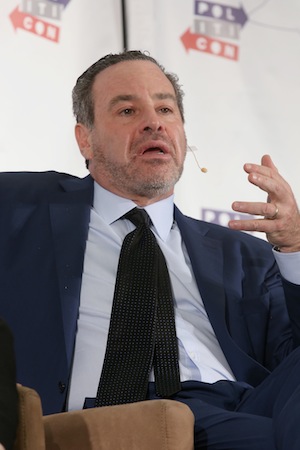
photo - David Frum at Politicon in Los Angeles on Oct. 21
David Frum at Politicon in Los Angeles on Oct. 21. (photo by Phillip Faraone-Getty Images for Politicon)

As a counterpoint, Johnson said: “I don’t think the president has such discipline or organization to pull off this kind of thing. Hillary [Clinton] lost because she ran a bad campaign, not because of a meeting with the Russians.”

Two right-wing pundits – Ann Coulter and Ben Stein – took the stage in a session called Ask Ann Anything.

Stein, the Jewish actor whose politics date back to serving as a Richard Nixon aide, said that, if he could change any numbers about America, it would be to increase the number of better-educated individuals, as well as the number of fathers marrying the women they’ve had children with.

Coulter, often appearing on media to represent the far-right, is the bestselling author of Slander: Liberal Lies About the American Right, Treason: Liberal Treachery from the Cold War to the War on Terrorism and Godless: The Church of Liberalism, among others. Her key complaint was that Trump had yet to build the wall between the United States and Mexico, as he had promised, and she holds the left responsible for the immigration crisis.

Three generations ago, she said, “immigrants would come and 30 or 40% of them wouldn’t make it, and [would] go back home. Now, they all go on welfare. The Democrats pushed the bill that promised to [enshrine this],” she said.

The biggest surprise, she said, was that “despite all the race-baiting, Trump, as I thought he would, got more of the black and Hispanic votes than either [Mitt] Romney or [George W.] Bush … considering all of the racial incitement of the campaign.”

Three different questioners harshly criticized Coulter for avoiding debate with liberals, but Coulter dismissed them outright – “they couldn’t find a New York Times bestselling author to debate me?”

Yarmulke-wearing Ben Shapiro – who was in Vancouver for talks on Oct. 30 and 31 – covered the topics of free speech, constitutional rights and racism in America in his keynote address at Politicon.

“If my speech is violence,” said Shapiro, “and the government can shut down violence, then the government can shut down speech. This is ugly stuff.”

On the #MeToo movement and abortion, he paraphrased his opponents: “Men, sit down, shut up, you don’t know anything.” But, he said, “We can’t have a conversation if you’re simply going to assume I can’t understand you because of dint of birth … identity politics throws up a roadblock in the way of it. It prevents you from having these conversations.”

He said, “If you’re going to make a pro-choice argument, then make a pro-choice argument. An argument cannot be based on a woman knows better what constitutes life than a man.”

A questioner asked why, on YouTube, Shapiro appears to fume at ideological challengers.

“There are many more examples of me talking to the left in a respectful manner than there are tapes of me ‘destroying’ anybody,” noted Shapiro. “Those are the ones we like to watch because they’re more fun, but it’s not happening on a day-to-day basis.”

In a session called The Russian Menace, Jewish actor, director and author Henry Winkler interviewed author, terrorism expert and naval expert in cryptology Malcolm Nance. This year, Nance published The Plot to Destroy Democracy: How Putin and His Spies Are Undermining America and Dismantling the West.

After Obama was elected, said Nance, Trump and a representative of Russian intelligence exchanged private Twitter messages, with the latter expressing interest in helping the U.S. change governments. “Trump responded with a picture of double thumbs up,” noted Nance.

Winkler retorted, “Not mine!” – a reference to his Happy Days character the Fonz’s signature symbol.

According to Nance, a week after this Twitter exchange, Trump registered the trademark “Make America Great Again.” Subsequently, Trump met with Russian oligarchs in Moscow for two hours, something that should raise suspicions, Nance insisted.

At one time, he said, Russians wanted the “money and luxury” that the West had, but now they employ “an old KGB strategy” of propaganda to tear down the United States.

“You don’t go at the people by invading it,” but rather, through “fake news stories,” said Nance. “You co-opt their mind; you create a new reality for them. In the old days, they used to call that brainwashing. Today, they call it Facebook.”

Evan Sayet, who has written two speeches for Trump and is the author of Kindergarden of Eden: How the Modern Liberal Thinks, told the Jewish Independent that the panel he was on, 13 Reasons Why Not to be a Liberal, could be summed up thusly:

“Everybody in America – every ethnic group in America – blacks, Asians, Hispanics, they should all be conservative. They’re family-centric, church-goers, entrepreneurs. The left has done such a great job via the entertainment industry, schools and media, of villainizing the right. Those who vote for Democrats, don’t vote Democrats. They vote against Republicans. They are so in fear of what’s been portrayed as the right.”

Other Jews to appear as speakers or panelists at Politicon included Joel Pollak (Breitbart), Jennifer Rubin (Washington Post), author Eric Golub, NBC’s Ari Melber, comedian Ben Gleib, Bill Kristol (journalist and former chief-of-staff to vice-president Dan Quayle), TV host David Pakman, TV’s Drew Pinsky, commentator Sally Kohn, mayor of Knox County in Tennessee and former wrestler Glenn Jacobs, comedian Sam Seder, actor Richard Schiff, comedian Elayne Boosler, NBC’s Jacob Saboroff, writer Jamie Kilstein, actor Josh Malina, NBC’s Gadi Schwartz and entrepreneur Fred Guttenberg.

Dave Gordon is a Toronto-based freelance writer whose work has appeared in more than 100 publications around the world.

Format ImagePosted on November 9, 2018November 7, 2018Author Dave GordonCategories WorldTags Politicon, politics, United States
We’ve got a lot of work to do

We’ve got a lot of work to do

(photo from Tracy Le Blanc from Pexels)

I am not normally someone who is especially active on social media. I am not normally someone who curates current events, even though I consume them like undergrads do coffee – habitually, obsessively, out of necessity.

For a long time, my political associations and the extent to which I follow world news have been largely separate from the image I have cultivated for public view. As far as Facebook is concerned, I am represented through dog videos, feel-good intercommunity displays of solidarity, recipes and the occasional satire poking fun at the absurd and horrifying climate we’re living in – but there has been a shift. A shift toward police brutality, transphobia, racism. A shift toward synagogue shootings.

I do not share news stories on such topics because I enjoy doing so. I don’t enjoy reading about things that make my heart heavy, nor offering vulnerabilities to people who do not see me as a person, but rather the embodiment of an idea they disagree with. I do not take pleasure in sharing pain. It is my very nature to shield myself and others from it. Although part of love is letting others learn, and that involves experiencing pain and hurt.

It is easier to stick one’s head in the sand, but it doesn’t make it right. It is important to denounce insidiousness and nefariousness when you see it, especially if it does not directly affect you. It is important to hold space for those who are impacted by the injustices of the world, to hold them up and offer your strength. In doing so, we hope others do the same for us, and perhaps that is the only way we can get through these dark times with any semblance of sanity, of humanity.

I used to make a point of sharing light-hearted, feel-good posts, cognizant of the “bad news,” which is in no short supply. I believe my intention to provide some degree of respite from the political apocalypse we’re currently observing was a good one, but I would wager also misguided. To curate news is one thing, to disengage from it is another.

It became clear to me that, just because I am kept abreast of political happenings, and that I see them all over social media, does not mean others do; a classic cognitive bias that I should have spotted much earlier. This is true of what is happening in Trump’s America, to people of colour, LGBTQ folks, indigenous peoples, immigrants and refugees, Muslim communities. This is true of issues and current events related to antisemitism – I am now startlingly aware just how little people know about it. Not only the frequency of antisemitic incidents in North America and Europe, but, at a much more basic level, what antisemitism is and how to spot it.

For many of my friends, especially those who I’ve met in London, I am the only Jewish person they know. While it shouldn’t significantly impact the way I conduct myself, the weight my actions carry is not lost on me when I am the entire schematic representation of “Jew” for many of the people I come across. There is a pressure to behave in a way that is contrary to the many persistent stereotypes that precede my traditions and my culture. I must be generous to a fault lest I be stingy. I must laugh off antisemitism and micro-aggressions lest I be perceived as a paranoid, uppity Seinfeld type. I must be soft and kind and open, I must not have strong opinions lest I be the overbearing, naggy Jewish woman. I must downplay my love of bagels (they’re so damn good).

I also must be a political chameleon, dodging demonization from the left and right for equal and opposite accusations: we are the puppet masters, yet the infiltrators. We are the root of capitalism, yet the root of communism. We are somehow the one percent who controls the world’s wealth, yet we also fund the movement that rallies against it. We are insular elitists, yet permeating globalists. Those of us who look like me have assimilated to whiteness and reap the benefits, yet we will never be “white enough” to those who would see us dead.

Over time, the belief sticks: “I must not behave in any way, shape or form, in any manner that would give credence to the ideas that this is how Jews are, as I represent them to so many.” Yet it’s as exhausting for me to keep up as it is to keep this narrative straight.

I thought that, perhaps if I wanted to be a socially engaged citizen of the world, I could avoid these pitfalls by sharing information about the world as neutrally as I could. I could be the “impartial reporter,” make the news palatable, make it sterile. I could be taken more seriously, sanitized of emotional attachment that would otherwise be paint me as “irrational,” which is the ultimate insult in political and academic discourse. (Undoubtedly rooted in sexism and undoubtedly seen as weak, as it is perceived as feminine.)

But to do this serves no one well. It is inherently more harmful to the people who are affected by the issues being reported. To be “unbiased” in the wake of something that should not be polarizing, yet somehow is, ultimately reflects complicity. It is contrary to my values as a person. It is contrary to my values as a Jew.

This confuses many people, who know I am largely secular and open in my agnosticism. How can I profess myself to be as Jewish as I do, while maintaining such a wide berth from religiosity and theism? By that definition, I’m not “that Jewish.”

I may not believe in a God, but I do believe in my people, and in the traditions that shaped me to be who I am. I am Jewish insofar as my birth and upbringing, in my values and my conduct, in my pursuit of tikkun olam, repairing the world. I am “Jewish enough” to lead services despite my relationship with my faith. I am “Jewish enough” to abstain from pork but not “Jewish enough” to abstain from shellfish or cheeseburgers. I may not be “so Jewish” as to observe Shabbat to the letter, but I am Jewish enough to be gunned down in a synagogue.

My tradition is one of orthopraxy, of deed over creed. We are meant to “pray with our feet” as well as with our words. The Talmud teaches us not to be overwhelmed by the enormity of the world’s grief, but rather to do justly now, love mercy now, walk humbly now; that we are not obligated to complete the work of repairing the fractures and chasms in our world, but neither are we free to abandon it.

There is the story in the Talmud of a man who came to the great rabbis of the day and told them to teach him Torah while he stood on one foot. He did this to mock them. He first went to Rabbi Shammai, who refused to engage when he recognized the man’s intentions. The man went next to Rabbi Hillel and made the same challenge: teach me your Torah while I stand on one foot. Rabbi Hillel knew this man’s intention as well, but he was patient. He simply said, “What is hateful to you, do not do to others; all the rest is commentary. Go and study this.”

It should be that simple. If only it were that simple. I don’t know if the reason it isn’t is because of psycho-schematic representations in our minds, or nationalism, or capitalism, or groupthink, or whataboutisms, or strawmen, or ego, or that we forget that, when we bleed, we all bleed the same. I don’t know if it’s because we’ve forgotten how to be empathetic, or we’ve stopped doing it because it hurts, or that we feel powerless and that feels worse.

A friend told me recently that they don’t engage with this stuff because they’ve become numb to the horrors of the world. I can understand that, truly. Although I think it is precisely because of the commonplace, routinized nature of these injustices that we must engage because, when we don’t, they become routine, and they become a part of the fabric of our society that we will forget shouldn’t be there in the first place.

We have a saying in Judaism, “tzedek, tzedek, tirdof,” “justice, justice, you shall pursue.” But our understanding of tzedek is different to that of mishpat or din, other Hebrew words referring to justice or law in a strictly legal sense. Tzedek is tempered by compassion, of doing not necessarily what is lawful, but what is the right thing to do. And there is an emphasis on the action, on the doing. This may very well be rooted in some of the many names Jews use to refer to God, and the concept that people are made in God’s image.

In our tradition, there are many different names for God to reflect different aspects of God’s characteristics. Elohim is common, derived from the ancient word for judge. Certainly, people who are unfamiliar with the Torah often criticize the “Old Testament” for barbarism, for a wrathful, vengeful God that falls uncompromisingly into this depiction of an impartial, removed judge who delivers reward or punishment in accordance with the word that was given. I’m not about to unpack that, that’s a whole other essay in itself.

Unquestionably, the most sacred name we have for God is one we don’t even know how to pronounce, and are not supposed to pronounce, that is often anglicized as YHVH. It is derived from the Hebrew word for “to be,” and it is sometimes understood to translate roughly as “the Essence of Being.” This name is said to reflect an intimacy, a mercy, a love that perhaps we don’t even know how to name.

These different names may suggest a God of multiple beings, or even multiple gods, but Judaism is quite strict in its monotheism, and these names are used in scripture deliberately in ways that are context-dependent: Elohim deals justice, YHVH deals in mercy.

“Genesis tells two creation stories,” writes Rabbi Mark Glickman, “in the first, Elohim is the Creator, in the second, the creator is YHVH Elohim. To reconcile the accounts, ancient rabbis argued that God first tried to create the world using only justice, and it didn’t work.”

I’m very much a Darwinist by trade, but the message of this rings true to me. To exact change, to make something sustainable, we must do so with justice that is tempered by compassion.

Now, compassion does not mean, “try to understand neo-Nazis and justify their actions.” What compassion does mean, at least in part, is to show kindness and solidarity to other groups who are being hurt, even when we ourselves are licking our wounds and trying to find our feet. It means to support one another, even when we ourselves have trouble standing. It means speaking up for those whose voices are hoarse and raw from screaming. It means using our visibility to shed light on stories that are sequestered to shadows. It means form a patchwork quilt of community, which, when stitched together and reinforced, is warm, strong and unbreakable.

These are dark times. I say this not with the intent to be dramatic or prosaic, but simply factual. But that doesn’t mean we can’t kick at it until it bleeds something more hopeful. That being said, if we want any chance of making it out alive, we’ve got to get to work.

Sasha Kaye is currently studying in London, England. An alumnus of King David High School and the University of British Columbia, she enrolled at the Royal College of Music in London in performance science after her studies in classical voice performance and psychology at UBC. She was recently awarded a master’s of science with distinction for her research on the use of simulation technology as part of an intervention strategy to manage performance-anxiety symptoms. Now a doctoral student at RCM, Kaye is working to identify areas where elite musicians may require additional support to thrive in life, rather than simply survive.

Format ImagePosted on November 9, 2018November 7, 2018Author Sasha KayeCategories Op-EdTags antisemitism, culture, Judaism, politics, secularism, social media
GA pitches softballs to Bibi

GA pitches softballs to Bibi

Israel’s Prime Minister, Binyamin Netanyahu, addresses the General Assembly of the Jewish Federations of North America, in Tel Aviv Oct. 24. (photo by Pat Johnson)

The theme of the General Assembly of the Jewish Federations of North America in Tel Aviv was “We need to talk.” The conference was explicitly dedicated to confronting the issues that divide Jews and alienate the Diaspora from Israel. But, when the moment came to meet with the most powerful man in Israel, conference organizers folded like a house of cards.

Outgoing chair of the board of trustees of the JFNA, Richard Sandler, sat with Prime Minister Binyamin Netanyahu on a stage and performed what Haaretz rightly dismissed as a “fawning” conversation. More Oprah than interlocutor, Sandler first offered belated birthday wishes to the prime minister, then proceeded with one softball lob after another, allowing Netanyahu to control the dialogue – which he could have done more effectively if he had delivered a conventional address instead of the folksy sit-down – while Sandler offered no resistance or challenge to anything the prime minister said.

The JFNA is a non-partisan organization, of course. But the very nature of this meeting was to frankly confront the very real divisions between Jewish people in the Diaspora and those in Israel.

Here was the first question: “I’m just wondering, when you were back in high school or college, did you ever imagine someday you would be the prime minister of Israel, and would you share with us a little bit of the path from that time to what got you here?”

Even Netanyahu seemed a bit embarrassed by the question and offered assurances that he was not, in childhood or young adulthood, some Machiavellian born with his sights on the levers of power. What seasoned politician would respond to such a question with, “Yes, I’ve been planning this since I toddled”?

Next question: “I’m wondering, in all the years you’ve been doing this, how do you see the relationship between our two countries, between Israel and the United States, evolving – and what concerns you most, if anything, about that relationship today?”

“If anything”? Thousands of people had traveled from North America to Israel to address the very tangible friction points between the two Jewish communities and the inteviewer effectively invited the prime minister to assert that everything is rainbows and unicorns. And Netanyahu accepted the offering. Everything is pretty great, he contended. The trajectory of American support for Israel is increasing, he said. When he and his wife walk around Central Park or visit the Strand bookstore in Manhattan, they get warmly welcomed. The audience of 1,300 at a performance of Hamilton gave him a standing ovation. (“How did you get tickets?” heckled an audience member. “My cousin’s wife works in the production,” the PM replied.)

Then it was time for the interviewer to get tough.

“One of the things that we spoke about, Mr. Prime Minister, that we’ve been talking about the last couple of days, are all the things that we have in common,” said Sandler, moving in for the kill, “We’re having frank discussions on some of the issues that concern many North American Jews and I’m sure you are aware, as I am, that we have a number of concerns about pluralism, acceptance of Reform and Conservative Jews here in Israel, the Nation State Law and.…”

At this point, Sandler’s words were drowned out by applause from an audience who seemed to think they were finally going to get some red meat. Instead, Sandler asked, “Are we missing something? And where do we have it right?”

“I don’t think you should be concerned, but I think you should be informed,” Netanyahu responded to a room filled with the leadership of every major Jewish community in North America. “So much of this is – let me be charitable – misinformation.”

Netanyahu went on to say that, from the first prime minister on down, Israel’s leaders have managed the status quo by making modest, incremental compromises.

“We have a series of slowly evolving arrangements and that reflects the evolution of the Israeli electorate,” he said. On the issue of an egalitarian prayer space at the Western Wall, Netanyahu acknowledged a delay in the opening, but insisted his goal remains a place where women and men can pray together.

On a two-state solution, Netanyahu dismissed the terminology. “I believe that a potential solution is one in which the Palestinians have all the powers to govern themselves but not the power to threaten us,” he said. “What does that mean?”

He explained by recounting a conversation with then-U.S. vice-president Joe Biden.

“Well, Bibi,” Netanyahu said, describing the discussion, “are you for two states or are you not? I said, Joe, I don’t believe in labels.”

Netanyahu committed that Israel would retain security control west of the Jordan River, envisioning a situation where Palestinians would govern themselves but that overall security would remain in the hands of the Israeli military. This is not only good for Israel, the prime minister said, but for Palestinians, including Palestinian Authority President Mahmoud Abbas. Israel uncovered and foiled a plan by Hamas to not only overthrow Abbas, but to murder him, Netanyahu said. Without Israel’s military control in the West Bank, Hamas would swoop in, overthrow Abbas’s Fatah and Israel would have another Gaza to the east.

“They’d be overrun in two minutes,” he said.

This is all true enough, perhaps, and the first job of the prime minister of Israel is to ensure the security of his country and people. But, in acknowledging that his position would negate the possibility of an independent Palestinian state, Netanyahu reduced it to a matter of nomenclature.

“Give it any name you want,” he said. “But that’s the truth. And this truth is shared much more widely across the political spectrum than people understand, because we’re not going to imperil the life of the state for a label or for a good op-ed for six hours in the New York Times.” Like a flailing comedian, Netanyahu then turned to the audience and complained, “Nobody’s laughing.”

Sandler’s final question to the prime minister was, “What are you the most proud of about Israel today that you want us to think about when we’re going home?” And Netanyahu offered a response worthy of the question, a meandering reflection on visiting a synagogue in his family’s ancestral home of Lithuania.

As the loudspeaker was trying to advise people to remain in their seats while the prime minister’s entourage departed, Netanyahu, already standing for his farewell, interrupted to take the opportunity to tell the audience that his real concern for the Jewish people was the loss of identity. “It’s not conversion,” he said. “It’s the loss of identity.”

He warned, “Jewish survival is guaranteed in the Jewish state if we defend our state. But we have to also work at the continuity of Jewish communities in the world by developing Jewish education, the study of Hebrew and the contact of young Jews coming to Israel.”

He talked about additional funding for programs to support study-abroad programs in Israel and other things the Jewish state is doing to advance the strengthening of Jewish peoplehood.

Given the last word at the close of the three-day conference – a meeting explicitly convened to address contentious issues between the parties – Israel’s prime minister took the opportunity to school the leaders of Diaspora Jewry in how their shortcomings could imperil Jewish survival. Then he departed.

Format ImagePosted on November 9, 2018November 7, 2018Author Pat JohnsonCategories Op-EdTags Diaspora, Israel, JFNA, Netanyahu, politics, Richard Sandler
Disagreeing respectfully

Disagreeing respectfully

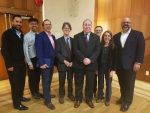
Left to right: Nico Slobinsky (CIJA Pacific Region), Rabbi Adam Stein (Beth Israel), Rabbi Andrew Rosenblatt (Schara Tzedeck), speakers J.J. Goldberg and Jonathan S. Tobin, Cynthia Ramsay (Jewish Independent), Rabbi Hannah Dresner (Or Shalom and RAV) and Rabbi Dan Moskovitz (Temple Sholom). (photo by Glen Bullard)

“We have lost the ability to listen to each other. We have lost the ability to credit each other with good intentions when we disagree…. What we must do is somehow regain a sense of community.”

In his response to the last audience question at Left vs. Right: The Battle for Israel’s Soul, Jonathan S. Tobin, editor-in-chief of JNS.org and a contributing writer for National Review, among other publications, went on to say what he hoped the audience would take away from his 90-minute debate with J.J. Goldberg, editor-at-large and senior commentator at the Jewish Daily Forward.

“You have to open yourself up to both sides,” said Tobin. “You have to relearn the ability to listen, to be open. If you agreed with J.J., maybe you should read some of the things that I write… If you agreed with me, read J.J. at the Forward and his column…. It’s not what we’re used to anymore because we live in these social media silos…. It’s what we have to model for our kids. It’s what we have to model for ourselves because, when we listen, when we open ourselves up to ideas that are different from our own, that don’t just confirm what we already thought, we are reminded of something that is always true but we often forget…. That which unites us is still stronger than that which divides us.”

Ten community organizations united to host the Oct. 23 event in the Wosk Auditorium at the Jewish Community Centre of Greater Vancouver: the Jewish Federation of Greater Vancouver, the Centre for Israel and Jewish Affairs, the JCCGV, the Jewish Independent, Ameinu, Or Shalom, Congregation Schara Tzedeck, Congregation Beth Israel, Temple Sholom and the Rabbinical Association of Vancouver (RAV).

In his response to the last question of the night – on how young people could have similar respectful dialogues on Israel, which the speakers broadened to include all community members – Goldberg stressed the importance of having self-doubt. “If you believe the other side is saying something that could bring about the end of the world, the death of the Jewish people, you’re not going to be tolerant. And, as Jonathan says, if you listen, look for the grain of truth, because then you can allow yourself not to shout and scream when you hear something you don’t like, because it’s not the end of the world.”

Rabbi Hannah Dresner, spiritual leader of Or Shalom and head of the RAV, welcomed the approximately 100 people who came to hear Goldberg and Tobin engage in a formal debate on four prepared questions, and then on a handful of questions from the audience. “Our guests hold differing points of view and speak to one another with respect and we would like all to follow their examples,” she said. While there was some audible discomfort from listeners in a couple of instances, it was a model event, made easier by the fact that it featured two journalists who may disagree on the details, but who both agree that Israel has a right to exist and that Israel has a right to defend itself. As well, neither speaker is an ardent supporter of U.S. President Donald Trump – although Tobin gave the president credit for moving the U.S. embassy to Jerusalem and reinstating sanctions against Iran to delay its attainment of nuclear weapons, he criticized Trump’s relationship with Russia. One has to separate Trump the man and his Twitter account from the policies the administration has implemented, said Tobin. “It’s clear,” he said, “that Israel can count on the United States, certainly it can count on this administration to have its back.”

Tobin made these comments in response to the first question of the night, which was about Trump and whether Israel could rely on an “unstable United States as a shield in an unstable Middle East.” Goldberg was more concerned than Tobin, saying that character counts. “Having a president who is lacking in elementary characteristics of personal ethics and grace is a problem,” he said. “It is a problem that this is a president who has no respect or loyalty for America’s allies; and says he’s in love with the dictator in North Korea, who, by the way, does have nuclear bombs; and who can’t say a bad word about the dictator of Russia…. If Canada can’t rely on the United States, and France and Germany and Sweden can’t rely on the United States, how long can Israel rely on the United States?”

Goldberg and Tobin also had opposing views as to the continued relevance of a two-state Israeli-Palestinian peace agreement and whether the construction of settlements is an obstacle to peace.

Goldberg pointed to the 2002 Arab League declaration, which outlined the terms under which they would recognize Israel and normalize relations with it; the declaration has been renewed since then and, last year, “Iran voted yes.” He said we believed the Arab countries when, in the 1970s, they were talking about “driving Israel into the sea,” and we should believe them now when they say they would accept Israel. He argued that peace negotiations have not failed but been continually interrupted, giving several examples, including the assassination of Yitzhak Rabin and Ehud Olmert’s having to step down as prime minister when he was indicted on corruption charges.

While a two-state solution is the most rational, said Tobin, he argued that Israelis have made several attempts at peace and have shown their willingness to trade land for peace, but they are rightfully not willing to trade land for terror, which is what Israel got after the withdrawal from Gaza.

On the question of how much world opinion should matter to Israel, both Tobin and Goldberg said it does. Tobin gave examples – such as diplomatic trips to Africa by Prime Minister Binyamin Netanyahu – of how Israel is not isolated, despite an increase in the world of antisemitism disguised as anti-Israel sentiment. The boycott, divestment and sanction (BDS) movement, he said, won’t hurt Israel, but us. “Their target is us – Jews, Jews here,” he said. “We are their target. That’s why resistance against BDS, fighting back against it is, I think, the issue that should unite us, if anything could. It’s not a liberal issue, it’s not a conservative issue, it’s a Jewish issue.”

Goldberg said Israel “pretty much controls events on the ground” – noting that cooperation between Israeli and Palestinian security forces has decreased the number of deaths caused by terrorism significantly – but that the Palestinians “have the advantage in international opinion: they’re the underdogs, they’re the Third World, they’re the people of colour” and they use this advantage “as a way of fighting back against Israel.”

That said, Goldberg contended that Islam aspires to rule the world and there are Muslims who believe that to the extent that they will use violence. However, he added, no matter how right Israel is to defend itself, the optics of a tank shooting at a kid throwing rocks can never “look good on television” and “antisemitism increases, in part, because people are mad at Israel.” Since Diaspora Jews are one with Israel, then they become a target: “An Arab who’s willing to blow up a bus full of children in Haifa, who had nothing to do with this, is certainly willing to blow up a Federation building in Seattle.” World opinion is a problem “because there’s a war going on and it hasn’t ended yet,” he said. “If and when Israel enters into negotiations with the Arab League … one of the things Israel can and must demand is that Saudi Arabia stop teaching the hatred of Jews that it teaches in schools and mosques around the world.”

In response to the question about how Jews should position themselves in “this polarized and hyper-partisan political culture,” Goldberg said, “If we are attached to Israel at a time when our traditional allies on the left, in the liberal world, are souring on Israel, we don’t have to accept that. If the right is becoming more extreme … there are reasons we have our social values and we don’t need to give them up to be friends with the pro-Israel forces on the right.”

Goldberg noted that we often consider antisemitism, but overlook the respect the world holds towards Jews – as evidenced by the number of Nobel Prize winners, and three Jews out of nine justices on the U.S. Supreme Court. He said we must use this respect “not only to advance our own particular interests in defending our brothers and sisters in Israel, but in also defending the things that we believe in and the things that we believe make a better world.”

Tobin, on the other hand, said, “As Jews, we have an issue that should unite us – the survival of the Jewish people, the survival of the Jewish state. That should be a priority. We are probably more divided on it than we are on abortion, as my friend [J.J.] likes to say, but that is still our first obligation. And when we put that aside and instead favour partisanship, our partisan loyalties over that, I think we’re doing a disservice to our community….”

By the end of the night, Goldberg and Tobin fielded nine questions, responding to audience members’ concerns about such issues as the health of Israel’s democracy – Tobin thinks it is not declining, while Goldberg observed that the way in which governments are elected means that a democratically elected government does not always reflect the will of the majority population. They also responded to questions about the lack of leadership on the Israeli left, the impact of the ultra-Orthodox on Israeli society in the long-term, Trump’s popularity in Israel and how we can enable young people to have such discussions as took place that night.

Format ImagePosted on November 2, 2018November 1, 2018Author Cynthia RamsayCategories LocalTags antisemitism, BDS, boycott, civil discourse, Israel, J.J. Goldberg, Jonathan S. Tobin, peace, politics, Trump
Exercise your right to vote

Exercise your right to vote

(news.gov.bc.ca)

British Columbians have been tasked, once again, with voting on whether or not to change our electoral system.

Until Nov. 30, we are being asked to choose what voting system we should use for provincial elections, whether to keep the current first-past-the-post (FPTP) system or switch to one of three proportional representation (PR) voting systems offered on the ballot. This is our third referendum on electoral reform, the 2005 and 2009 votes having chosen the status quo rather than change to a single transferable vote system. While the STV forms a component of one of our choices this time around, it is not one of the systems being proposed.

The 24-page voter’s guide from Elections BC describes our current system, FPTP: “the province is divided into electoral districts and each district is represented by one member of the legislative assembly (MLA). Voters mark their ballot for one candidate. The candidate with the most votes in the district wins and represents the district in the legislature. The number of seats a party gets in the legislature equals the number of districts its candidates win.”

In PR, however, “the share of seats a political party wins in the legislative assembly is about the same as the party’s share of the popular vote. So, if a party receives 40 percent of the popular vote, they are likely to have about 40 percent of the seats in the legislature. There are many different voting systems that are designed to produce proportional results.”

Indeed, there are dozens of variations on the PR theme, and herein lies one of the problems with the 2018 referendum. British Columbians will be asked: 1) which system, FPTP or PR, should be used for provincial elections, and 2) if a PR system were to be adopted, which of three systems – mixed member, rural-urban or dual member – we would prefer. There will be no second referendum, as there was in New Zealand, asking us whether we would prefer FPTP or the majority-chosen type of PR, with its details fleshed out by a parliamentary, expert or other committee.

We are, in essence, being asked to take our best, semi-educated guess as to which of three vaguely described PR options might yield better results than FPTP. Several key factors are “to be determined” after the referendum results, if PR is chosen, such as how electoral boundaries will change, how candidate lists would be drawn up, the total number of MLAs to be elected, how coalition governments would be formed. All of these elements determine how effective a PR system will be in producing a more responsive, diverse and balanced government. And we will not have a direct say in these decisions.

There is no way in this limited amount of space that we can satisfactorily explain all of the PR systems being put forward in the referendum. Readers should go to elections.bc.ca/referendum for the basics and research as best they can. This may not yield satisfactory results, however, because only one of the referendum’s PR options is actually in use in other countries; the other two are theoretical at this point. Mixed member PR is used in New Zealand, Germany, Scotland, Mexico and other countries, while the rural-urban system combines approaches used in various countries and the dual-member version is akin to a system Prince Edward Island once used (but no longer does) and also, according to one pro-PR website, “echoes our own voting history,” as British Columbia had multi-member ridings until the 1990s.

So, what do to then if we treat this referendum as less of a choice between which PR system we prefer and more of a choice between keeping the status quo and changing to a new system?

Vote PR BC and the No BC Proportional Representation Society each received $500,000 in government funding to advocate for and against PR, respectively. However, you will find little in-depth information from these sources. Think tanks and other groups have tried to fill in the gaps of knowledge but, perhaps not surprisingly, there’s valid-sounding evidence on both sides of the issue. For each piece of evidence supporting PR – such as it will end adversarial politics and hold politicians more to account – there is an evidence-based opposite finding. How many of us will look at all the studies, check the sources and determine how rigorous and accurate the conclusions are? Likely very few of us.

For what it’s worth, among the supporters of PR, you will find the left-leaning Canadian Centre for Policy Alternatives, the B.C. NDP and B.C. Green Party. Among those skeptical of it are the right-leaning Fraser Institute and the B.C. Liberals. At the end of the day, most of us will probably base our decision on the opinions of those people and organizations with whom we agree on other subjects. We also will consider what we know personally (as opposed to filtered through another researcher’s lens) of PR systems elsewhere in the world, such as in Israel – even though the specific Israeli form of PR is not one of those on the B.C. ballot, it is similar. Some of us might opt for change for change’s sake, and others will stick with the devil we know. It might comfort some voters to know that, if we choose change, there will be another referendum in two election cycles to see if we want to return to FPTP or stay the course.

Knowledge is power and we recommend that voters do the absolute best to educate themselves about the various alternatives. But don’t be discouraged if you’re still uncertain after your research. Both FPTP and PR have their strengths and weaknesses. However, a vital aspect of both FPTP and PR – and one that directly speaks to the health of our democracy no matter what the electoral system – is that people exercise their right to vote. Whatever your choice, please fill out your ballot when you get it in the mail.

Format ImagePosted on October 26, 2018October 25, 2018Author The Editorial BoardCategories From the JITags British Columbia, electoral reform, politics, referendum
Mayor debate all over map

Mayor debate all over map

A full house came out to the CIJA-SUCCESS townhall Sept. 23, which featured six Vancouver mayoral candidates. (photo from CIJA)

The refracted nature of Vancouver’s civic politics was on full display at a candidates meeting featuring six of the perceived front-running candidates for mayor. The near-implosion of the governing Vision Vancouver party, combined with divisions among erstwhile Non-Partisan Association members, has led to a race with both the left and right sides of the political spectrum divided and struggling to gain traction in a campaign with 21 contenders.

The afternoon event Sept. 23 was co-sponsored by the Centre for Israel and Jewish Affairs and the multicultural organization SUCCESS, which is rooted in the Chinese-Canadian community. Veteran Vancouver broadcaster Jody Vance handily moderated the occasionally raucous meeting.

Housing affordability topped the list of issues, with Kennedy Stewart, a former NDP member of Parliament for Burnaby-South who resigned that seat to run for Vancouver mayor as an independent, said his plan to attack unaffordability calls for building 85,000 new homes over the next 10 years, including affordable and market rentals.

Ken Sim, an entrepreneur who founded Nurse Next Door and Rosemary Rocksalt Bagels and who is the candidate for the centre-right Non-Partisan Association (NPA), responded by claiming that the construction industry does not have the capacity to meet Stewart’s construction schedule.

Wai Young, a former Conservative member of Parliament for Vancouver South, is running with a new party, called Coalition Vancouver, which was originated by a group of former NPA members who felt betrayed by what they call a lack of democracy in that party.

“Vancouver does not have a supply issue,” Young said about the housing situation. “There are no millionaires wandering around Vancouver that are unable to buy a house or a luxury condo. The issue is that we are not able to keep our young people, our young families, here because they can’t afford to buy a house. We have an affordability issue in Vancouver.”

“If I am mayor, we will have a three percent vacancy rate,” said Shawna Sylvester, who is running as an independent but has roots in Vision Vancouver. The rate today is about zero. She supports more co-ops, cohousing and what she called “gentle densification,” as well as addressing how the housing situation has particular impacts for women, who experience poverty in greater proportions than men.

photo - Left to right are David Chen, Hector Bremner, Wai Young, Ken Sim, Kennedy Stewart and Shauna Sylvester
Left to right are David Chen, Hector Bremner, Wai Young, Ken Sim, Kennedy Stewart and Shauna Sylvester. (photo from CIJA)

Partly related to the affordability issue is the topic of Vancouver’s reputation as a place that is welcoming of people from diverse backgrounds.

David Chen, who is running with another new party, ProVancouver, noted that racism is alive and well in the city.

“My parents were first-generation Taiwanese [Canadian],” said Chen. “I was born in St. Paul’s [Hospital] because, at that time, it was the only hospital they were allowed to go to. During this campaign, I heard somebody say to me, ‘Go home.’ Well, I am home.” He added: “We haven’t progressed as much as we should or could.”

The NPA’s Sim echoed the experience and extrapolated it to the Jewish community.

“I’m 47 right now,” said Sim, “and I still remember the hurtful comments that I faced when I was 5 years old. It was tough. I think of what’s going on to our Jewish community right now. We still have a lot of issues. I’m acutely aware of what our Jewish community goes through because, when something happens halfway around the world, our friends in the Jewish community have to worry about their physical safety. That’s terrible. We will have zero tolerance for that, as mayor of Vancouver. We’re going to work with community groups, work with the Jewish community, work with all communities identifying threats to our communities and working on solutions to protect us, to protect our communities, and we will monitor our results.”

Hector Bremner, another former NPA member now leading another new party, YES Vancouver, is the only candidate for mayor currently sitting on Vancouver city council.

“Racism is a symptom, it’s not the disease,” Bremner said. “When do racial tensions flare up, when do they happen? They happen in a time when the people feel that resources are scarce and they feel pressure economically. It’s really a function of tribalism and nativism that occurs when people feel that it’s hard for them to make it. We look for scapegoats.”

Sylvester, who among many other roles is director of the Morris J. Wosk Centre for Dialogue at Simon Fraser University, said people need to stand up to extremist voices and actions.

“There are forces in our communities, whether we want to acknowledge them or not, that are trying to divide us,” she said. “What we need to do [is] not be tolerant of any kind of hate crime, not be tolerant of antisemitism.”

Stewart said those who don’t subscribe to Canadian ideas of tolerance should be helped to change their minds.

“Immigration is really one of the best things about being Canadian,” he said. “We travel around the world and we brag about it. Multiculturalism is a Canadian word and it’s something we’ve exported. It’s something we should embrace, and most of us do. Those that don’t, we have to help them understand, change their opinions.”

Accusations of intolerance and implications of racism emerged in the debate.

Young, who had originally sought the NPA mayoral nomination, implied that her supporters, many of whom were from the Chinese community, weren’t welcome in the NPA. This brought a sharp rebuke from Sim.

“Guess what, I’m Chinese,” he said. “Here’s the real issue. When you [say] inflammatory statements like that to win a political agenda, you create divisions in our communities. People don’t like that. You put a wedge. That is a problem and you’ve got to knock it off.”

Sim went on to accuse politicians of stoking already existing embers of intolerance around foreign purchasers of Vancouver real estate.

“For political expediency, what politicians are doing is pointing at groups and blaming groups for problems,” he said. “We have a lot of issues with affordability and there are a lot of things that affect affordability and housing. I’m not saying foreign purchases do not affect housing. But, when we point to it and we blame a group, that starts a slippery slope. That’s what’s dividing our city, our province and our country. I call on everyone here to knock it off, because there are a lot of things that affect affordability – permitting delays, interest rates, the economy – but to point to something for political expediency because it wins votes is dividing people and it’s hurtful.”

The meeting took place in a SUCCESS building in Chinatown, close to the Downtown Eastside. Candidates agreed that more needs to be done to confront the seemingly intractable challenges facing that area of the city.

Young said she had visited a seniors home in Chinatown earlier in the day and was told residents are afraid to go outside.

“They can no longer walk outside of their building,” she said. “That should not happen in our beautiful city. There was a time I remember coming down here to Chinatown when it was vibrant, when it was safe, when you didn’t feel like you couldn’t be on the wrong side of the street here.… This city has gotten dirtier and grittier…. There are needles everywhere, there is defecation everywhere. We are one of the top 10 cities in the world and yet, currently, it’s embarrassing to have your friends come visit.”

She promised to be “John Horgan’s worst enemy,” referring to the B.C. premier, in demanding provincial help to address the issues in the area.

Stewart touted his connections with former NDP member of Parliament Libby Davies, who previously represented the area in Ottawa.

“Last week, I was very proud to stand with Libby Davies in the Downtown Eastside and announce that, as mayor, I would immediately strike an emergency task force to deal with the opioid epidemic and homelessness,” Stewart said. “We cannot have the number of deaths that are happening and the number of overdoses. We can’t have the impacts on the people that are suffering through illness and addiction problems.”

Another perennial issue candidates addressed was transportation and congestion.

“Vancouverites spend 88 hours of your life every year sitting in congestion,” said Young. “That’s like a two-week holiday.”

Sim promised an independent review of congestion in the city.

“The number of cars has not increased in the city in the last 20 years but congestion has,” he said. He blamed a range of factors, including bike lanes, left-hand turns, people running yellow lights and getting stopped by police, pedestrians crossing after the indicator says “don’t walk,” and roads that are closed for construction longer than necessary.

Chen said getting people to switch from cars to transit requires improving the system.

“If you use negative reinforcement, you’re not going to get people to switch,” he said. “It’s not reliable, it’s not convenient, it’s not cheaper, it’s not faster. You [improve] those four items and suddenly people may just switch.”

The would-be mayors mooted the availability of culturally appropriate services, such as seniors care, community security for institutions like synagogues and the Jewish Community Centre of Greater Vancouver, and unisex washrooms.

During the debate, Stewart repeatedly emphasized that he, Bremner and Young were the only ones with elective experience, a tack that may be motivated by the few polls on the race, which have indicated that Stewart’s toughest opponent is Sim.

Format ImagePosted on October 12, 2018October 9, 2018Author Pat JohnsonCategories LocalTags CIJA, CJPAC, elections, politics, Vancouver
Candidates for office

Candidates for office

Election day for municipal governments across British Columbia is Saturday, Oct. 20. In Vancouver, advance voting opportunities are available until Oct. 17, from 8 a.m. to 8 p.m. (photo by Cynthia Ramsay)

Members of British Columbia’s Jewish community have been involved in many pursuits over the decades. With some notable exceptions, few have pursued elective office. And this election continues the tradition. Of the hundreds of people running for city councils, school boards, regional district boards and the Vancouver park board, the Independent has identified only four members of the community running in the Oct. 20 elections, though there may be others. Here is a glance at their platforms and motivations.

Herschel Miedzygorski
Independent candidate for Vancouver city council
voteherschel.ca

photo - Herschel Miedzygorski
Herschel Miedzygorski

Herschel Miedzygorski’s priorities include clean and safe streets, increased night transit and more funding for the arts. He wants to deter real estate speculation and speed up permitting processes for middle-class homes.

Miedzygorski has had a career as a restaurateur in Vancouver and Whistler, running Southside Deli in the resort municipality for 25 years and being involved in food ventures in the city. He has sold his food interests and now represents Giant Head Estate Winery, based in Summerland, B.C., to restaurant clients.

“I was born and raised in Vancouver,” he said. “My father had a secondhand store on Main Street for 60 years, it was called Abe’s Second Hand. That was my mom and dad.… We all grew up on Main Street.”

Miedzygorski has coached football and soccer and spends time at the Jewish Community Centre of Greater Vancouver. He was asked to run with a couple of the city’s political parties, he said, but “I just want to be an independent voice.”

Ken Charko
Coalition Vancouver candidate for Vancouver city council
coalitionvancouver.ca

photo - Ken Charko
Ken Charko

Ken Charko owns Dunbar Theatre. He is president of the Hillcrest Community Centre and a director of the Motion Picture Association. He considers himself a “champion of the arts.”

“I’m very supportive of the arts,” he said. Charko wants to make arts and culture more accessible to all.

He also seeks a line-by-line review of the city’s budget and wants fair bylaws for hardworking people and small businesses.

“I’ve got good business credentials,” Charko said. “I understand small business. I’ve been there. But I’m really going to try to focus on the arts and things that matter to the arts community.”

He is running with Coalition Vancouver after breaking with the NPA because they appointed, rather than electing, their nominees.

“There is no party that completely represents all my views,” he said. But Coalition Vancouver aligns with his approach to fiscal accountability and socially progressive outlook, he said.

Steven Nemetz
Independent candidate for Vancouver park board
stevennemetz.com

photo - Steven Nemetz
Steven Nemetz

Steven Nemetz is running for Vancouver park board because the time is right.

“It speaks to me at this stage of my life – father, grandfather – and I grew up in the city,” he said. “I grew up intimately familiar – because my father was a great outdoorsman – with these parks.”

Nemetz is a lawyer and holds a master’s in business administration and a rabbinic ordination. He created the “pop-up shul” Shtiebl on the Drive for the High Holy Days this year.

Having lived in various cities, notably New York, Nemetz wants to bring to Vancouver some ideas that have worked in other places. Inspired by the High Line, a park created from an old elevated railway in Manhattan, Nemetz suggests saving the Georgia and Dunsmuir viaducts (which are slated for demolition) and creating an elevated park in the space between them and extending that park east and west. A second High Line-style recreation space could work along the Broadway corridor, he said, incorporating transit hubs, Vancouver General Hospital and other existing assets.

He advocates a “privileges card” for city residents that would mean they pay no parking fees at any parks.

“There are 650,000 residents of the city of Vancouver,” he said. “There are over 10 million visitors a year.” A slight price increase for non-residents could offset the loss of revenue from locals, he said. “The residents of the city of Vancouver pay taxes. They support their infrastructure. They shouldn’t have to pay more for the use of facilities that they primarily support by way of small nickel-and-diming, like parking at Kitsilano Beach and Jericho.”

Nemetz looks at Mountain View Cemetery, 106 acres at the heart of the city, and sees potential for repurposing it to respectfully accommodate more living residents.

“We are not talking amusement park,” he said. “It could be something very unique, world-class in a way, that’s different.”

Norman Goldstein
Richmond First candidate for Richmond school board
richmondfirst.ca

photo - Norman Goldstein
Norman Goldstein

Norman Goldstein is a former Richmond school trustee seeking to return to the board.

“The best thing for all people, including the Jewish people, is an open, accountable government that adheres to the rule of law,” he told the Independent. “The laws need to be crafted by caring, competent people, who understand that the strength of a society rests on how fairly and inclusively all citizens are treated. This is what I believe and this shapes who I associate with and trust politically.”

His priorities for education include moving forward with the Sexual Orientation and Gender Identity (SOGI) policy passed by the Richmond school board.

“This has been, unfortunately, a very polarizing issue in Richmond,” he said. “To my understanding, the opposition to SOGI is based either on misunderstanding what the policy says – please, read the policy – or on deep-seated prejudice that is not self-recognized as such.”

Goldstein holds a doctorate in mathematics and taught and researched at the university level. He later completed a master’s of computer science and spent 21 years at MacDonald Dettwiler and Associates in Richmond, retiring in 2013.

“The Richmond School District has had a long, proud history of inclusion,” he said. “A major tool in this endeavour has been to integrate all learning levels into the same classroom. This socializes students to understand and appreciate each other.”

Election day for municipal governments across British Columbia is Saturday, Oct. 20. In Vancouver, advance voting opportunities are available until Oct. 17, from 8 a.m. to 8 p.m. Advance voting dates and times differ by jurisdiction. More details are at vancouver.ca/vote or on the website for your municipality.

Format ImagePosted on October 12, 2018October 9, 2018Author Pat JohnsonCategories LocalTags elections, Herschel Miedzygorski, Ken Charko, Norman Goldstein, politics, Richmond, Steven Nemetz, Vancouver
Reflections on elections

Reflections on elections

(photo by Cynthia Ramsay)

Advance voting is underway across British Columbia for municipal elections that culminate Oct. 20.

There are many dedicated, informed people with excellent ideas running for office in Vancouver and in communities across British Columbia. This is especially fortunate, since this year saw what may be the greatest number of incumbents in recent memory opt not to seek reelection. Of the 10 members of Vancouver city council, for example, only three are running for reelection. (One is running for mayor.) Mayor Gregor Robertson is also leaving the scene.

A similar change is evident across Metro Vancouver, where an inordinate number of incumbent mayors and councilors have chosen not to continue serving. Part of this may be coincidence and part may be that new funding rules put in place by the province have made the task of running more challenging, in some ways. Whatever the reasons, Vancouver and many other communities face a major realignment in our local politics.

Especially at a time like this, it is a little disappointing that there are not more individuals from the Jewish community who have chosen to offer themselves for office. It has been encouraging, on the other hand, to see the number of people from the community who are volunteering on campaigns and taking a very active role in engaging with candidates. The candidates forum for several mayoral hopefuls, sponsored by the Centre for Israel and Jewish Affairs (CIJA) and the social service agency SUCCESS, was well attended. Another event, organized by CIJA and the Canadian Jewish Political Affairs Committee, allowed people to speak one-on-one with those who would like to be mayor of Vancouver.

There are, of course, not a lot of “Jewish issues” in local elections, though candidates for mayor addressed a number of things that are of concern to the Jewish community at a recent candidates forum. (For story, click here.) Ensuring that our municipalities remain welcoming, safe places for members of every ethnocultural community is a top priority. Part of that comes from people in positions of leadership leading by example. We have seen, in the United States, Europe and elsewhere, the licence that can be given to people with ill will when leaders choose to engage in incendiary language. It has been reassuring that there have, to date, been no serious incidents in local campaigns of overtly divisive language or strategies.

While the atmosphere has not been terribly divisive, division is the key word for traditional political parties in Vancouver.

Vision Vancouver, which has dominated the city for the last decade, has collapsed, not even managing to put up a candidate for mayor. The Non-Partisan Association (NPA) is a house divided, with at least two new parties emerging from disaffected former members.

The likelihood of independent candidates being elected to Vancouver city council and boards – as well as to the mayor’s chair – has probably never been greater. It could be an interesting mix for the next four years, with a constructive amalgam of different ideas coming together to synthesize into good policy – or it could be four years of chaos.

On the topic of chaos … a word about Vancouver’s at-large voting system. It is difficult enough to make an informed choice for the one position of mayor with 21 people contesting the race. It is an entirely different ballgame to try to make sense of the 137 candidates running for the 26 positions on city council, school board and park board. There is simply no way to expect reasonable, ordinary people to inform themselves adequately about this number of candidates.

Vancouverites have been floating the possibility of a ward system for decades but still face this daunting and compendious ballot every election. A ward system would not be without it faults – it could have the effect, for example, of elected officials representing their narrow constituencies against the broader interests of the city at large – but it would certainly permit average voters to become more familiar with the candidates who would represent them.

For now, though, this is the system we are in. And finding our way through it and voting with the best information we can access is the least we can do as citizens of a democracy. Despite the fact that local government is the one that has the most direct impact on our everyday lives, it is also the one that tends to attract the lowest voter turnout.

The last election saw a turnout of about 43%, which is comparatively good for a local election. (The one before that saw less than 35% turnout.) Some observers have suggested that the circus-like circumstances this year could help voter turnout, with so many new groups and independent candidates trying to get their supporters to the polls. Still, with 21 candidates for mayor – at least a half-dozen of them serious contenders – the possibility of someone taking the position with, say, 25% of the vote, is a real possibility. If turnout were to rise to a comparatively healthy level of, say, 50%, that would still mean the mayor has a mandate from a mere 12.5% of voters.

But, consider this from your perspective as a voter: the power of your one ballot to influence the outcome may be higher than ever.

Format ImagePosted on October 12, 2018October 9, 2018Author The Editorial BoardCategories From the JITags democracy, elections, politics, Vancouver

Ends and beginnings

As we come to the end of the High Holy Days, we set ourselves on paths of new beginnings. On Simchat Torah, we mark both a beginning and an end. The cycle of Torah reading ends and then immediately begins again. It is said that we read the same passages of the Torah every week, every year, but the meanings change because we are different people year after year, experiencing life and the world with different eyes and, hopefully, with increased wisdom.

The Days of Awe are a time of critical introspection. This period of teshuvah invites us to recognize our shortcomings and commit to improvement. This mission is both individual and collective. As a people, we are obligated to repair the world, and this year calls on us with no shortage of issues to collectively confront: inequality and suffering, environmental degradation, inhumane treatment of animals, the pursuit of justice.

On the latter front, our cousins in the United States are absorbed in a drama around the appointment of the next justice of the Supreme Court and things that he may have done many years ago. The senators considering his nomination heard two irreconcilable narratives last week from the accuser and the accused. The testimony from Dr. Christine Blasey Ford echoes the testimonies of so many people, mostly women but also men, who have felt empowered, motivated or obligated to share their most personal experiences in what has become known as the “#MeToo era.”

Yet the senators’ motivations hinge on more than determining who is telling the truth. Political considerations – advancing President Donald Trump’s second Supreme Court nominee to the bench before the November midterm elections – seem to be the factor front of mind for some elected officials, regardless of Blasey Ford’s testimony. It seems clear that politics may trump justice in this case.

Politics in Canada is not as brash as that in the United States, but populist and exclusionary ideas may be finding a voice here that they did not have before. A new federal political party seems prepared to amplify views that, until recently, were more limited to online discussions and whispered conversations. Meanwhile, the party that won Monday’s provincial election in Québec mooted during the election campaign the idea of throwing out newcomers who do not gain an adequate grasp of the French language within three years of arrival. Unconstitutional as such a policy may be, even voicing such ideas brings us to a new chapter in Canadian public life.

Immigration and refugees are a perennial issue, with the nature of a society at the heart of the discussion. The groups of people at the centre of the discussion – immigrants and refugees – change generation by generation. In this era, Jewish Canadians have an opportunity to bring hard-learned wisdoms to the debate. The federal government is set to formally apologize next month for a most egregious historical example of exclusion: the rejection of the passengers on the MS St. Louis. Indeed, this memory should inform our reaction to the current discussion and the realities for the millions of displaced people and refugees fleeing conflict around the world.

Personal experiences inform our political ideologies. And, through our personal actions, we can affect political affairs. This can be in obvious ways – like showing up to vote in the municipal elections on Oct. 20 or in advance polls – or in more subtle but profound ways, like educating the next generation, modeling the values we hope to advance and creating ripples of goodness across our circles of influence.

In matters of public policy and in the more private ways we behave in our lives, the holy days remind us to take stock of our own role in advancing justice and a better world.

We may feel insignificant in the grand scheme. How can we affect the powers in the White House or in Ottawa or around the world? But Jewish tradition is clear. “It is not your responsibility to finish the work [of perfecting the world], but you are not free to desist from it either,” said the Mishnaic sage Rabbi Tarfon.

Inward reflection is the first and easiest step we can take as individuals to address faults in our world. Based on this reflection, we may choose to move to action. Where it will end, we cannot always tell at the beginning. But it is our job to get the ball rolling.

Posted on October 5, 2018November 20, 2018Author The Editorial BoardCategories From the JITags Judaism, lifestyle, politics, Rosh Hashanah, Sukkot, Yom Kippur

What does power mean?

Necessity is the mother of invention. Throughout Jewish history, whenever economic or social restrictions have been applied against Jewish populations, those same targeted Jews have responded by finding means to succeed despite the hurdles placed in their way.

In notable instances, the “invention” itself has become problematic. By excluding Jews from a range of guilds and thereby denying them the right to participate in the broader economic life of the community, medieval Europe pushed Jews into marginal occupations. One such occupation was moneylending, which created a dangerous dynamic that helped define European Jewish existence for hundreds of years. Existing in a bleak place between the power of the aristocrats and dukes, on the one hand, and the rage of the peasant mobs, on the other, Jews were forced from one place to another in part because of the economic role they were forced to play in society.

More cheerfully, our ancestors understood that learning was an intangible asset that no ducal dictator or antisemitic horde could take away. Continuing the tradition of study practised by for generations, the Haskalah, the Jewish enlightenment, saw Jews turn their minds to secular studies like sciences and the humanities. In a modernizing world, this proved a tremendous advantage. Much of the success enjoyed by Jews today is founded on the collective dedication to learning that began in ancient study halls and continues this very week as Jewish kids return to classrooms all over the world.

Zionism is a natural descendant of the theory of necessity and invention. For hundreds of generations, Jews prayed for a return to Zion and Jerusalem. But when, after the Middle Ages gave way to Enlightenment and emancipation, the place of Jews in Europe still proved precarious, as Theodor Herzl concluded during the Dreyfus Affair, the idea of Jewish self-determination as a national political movement took flight. Necessity increased in the first decades of the 20th century and Zionism went from a somewhat obscure idea to one almost universally accepted by Jews, though its realization would be too slow to save six million lives.

Attacked by its neighbours at the moment of its birth, Israel was forced to pull together a military defence. The alternative was unthinkable, and the generation faced with that reality during the War of Independence had learned just a few years earlier the danger of complacency and unpreparedness.

Facing existential threat once more in 1967 with the Six Day War, Israel again triumphed. The Eichmann trial, still fresh in the collective Jewish memory from earlier in the decade, created a stark awareness in Israeli and Diaspora minds about the precariousness of Jewish existence and the determination of those who would seek to destroy us.

Since 1967, there has been no doubt that Israel is a regional military powerhouse. This truth is axiomatic. If Israel were not a regional powerhouse, it’s likely Israel would not exist. This is what makes uncategorical criticism of Israel for its militarism so infuriating, as it fails to even acknowledge that the “invention” was made necessary by the world’s unquenchable antisemitism.

And so, it seemed, this was among the messages Israeli Prime Minister Binyamin Netanyahu was trying to convey in a speech last week adjacent to Israel’s nuclear research centre, home of the country’s unacknowledged nuclear weapons program. He made some stark statements about the dangers of weakness.

“The weak crumble, are slaughtered and are erased from history while the strong, for good or for ill, survive,” he said. “The strong are respected, and alliances are made with the strong, and, in the end, peace is made with the strong.”

Some have made the case that Netanyahu’s bluster and warnings to enemies are un-Jewish, that acknowledging power, and reveling in the benefits it presents, is antithetical to Jewishness. Perhaps.

Yet, we should also realize that we are in a time of changing paradigms. In the vast scope of Jewish history, the decades since the establishment of the state of Israel are the blink of an eye. We are still recalibrating what it means to be Jewish in an age of Zionism. As Jews in the Diaspora and as Jews in the Jewish homeland, we are redefining our identities and connections in a time of incredible flux. What does Jewish mean now? How do we accommodate and respond to power? What measures must we take to redefine our relationships with non-Jews, including the leaders of other countries, in a time when we have the power to defend ourselves and no longer rely on the ephemeral kindness of strangers?

As Rabbi Irwin Kula (who will speak in Vancouver this month; see page 5) says, we who are alive in this time of extraordinary transition can be a part of “one of the great adventures in the human drama right now.”

Given an option, we may have chosen to live in duller times. But we are here now – and that necessitates us inventing ways to thrive in the world we have inherited.

Posted on September 7, 2018September 6, 2018Author The Editorial BoardCategories From the JITags antisemitism, Israel, politics

Posts pagination

Previous page Page 1 … Page 29 Page 30 Page 31 … Page 36 Next page
Proudly powered by WordPress