Skip to content
  • Home
  • Subscribe / donate
  • Events calendar
  • News
    • Local
    • National
    • Israel
    • World
    • עניין בחדשות
      A roundup of news in Canada and further afield, in Hebrew.
  • Opinion
    • From the JI
    • Op-Ed
  • Arts & Culture
    • Performing Arts
    • Music
    • Books
    • Visual Arts
    • TV & Film
  • Life
    • Celebrating the Holidays
    • Travel
    • The Daily Snooze
      Cartoons by Jacob Samuel
    • Mystery Photo
      Help the JI and JMABC fill in the gaps in our archives.
  • Community Links
    • Organizations, Etc.
    • Other News Sources & Blogs
    • Business Directory
  • FAQ
  • JI Chai Celebration
  • JI@88! video

Recent Posts

  • BGU fosters startup culture
  • Photography and glass
  • Is it the end of an era?
  • Taking life a step at a time
  • Nakba exhibit biased
  • Film festival starts next week
  • Musical with heart and soul
  • Rabbi marks 13 years
  • Keeper of VTT’s history
  • Gala fêtes Infeld’s 20th
  • Building JWest together
  • Challah Mom comes to Vancouver
  • What to do about media bias
  • Education offers hope
  • Remembrance – a moral act
  • What makes us human
  • המלחמות של נתניהו וטראמפ
  • Zionism wins big in Vegas
  • Different but connected
  • Survival not passive
  • Musical celebration of Israel
  • Shoppe celebrates 25 years
  • Human “book” event
  • Reclaiming Jewish stories
  • Bema presents Perseverance
  • CSS honours Bellas z”l
  • Sheba Promise here May 7
  • Reflections from Be’eri
  • New law a desecration
  • Resilient joy in tough times
  • Rescue dog brings joy
  • Art chosen for new museum
  • Reminder of hope, resilience
  • The national food of Israel?
  • Story of Israel’s north
  • Sheltering in train stations

Archives

Follow @JewishIndie
image - The CJN - Visit Us Banner - 300x600 - 101625

Tag: KDHS

Growing pains at KDHS

Growing pains at KDHS

King David High School has a wait pool for its Grade 8 program. (photo from facebook.com/kdhsvancouver)

King David High School has more applicants for Grade 8 this fall than they have spaces available, and some parents are upset with the way the school is handling the matter.

On Jan. 28, parents of 52 potential Grade 8 students received a message that their children had been accepted – and that $1,000 was required by Jan. 31 to confirm acceptance.

“The normal course is that King David and the independent and mini schools all release about the same time their acceptance letters,” said a parent whose child was accepted. “They’ll send out the first acceptance letters and then parents will either accept or not and then they’ll send out the second set a day or two later. That way they don’t really have a wait list and the process is relatively painless and takes place over a few days.”

The parent requested anonymity for fear that speaking out could affect their child’s future at the school and the Independent agreed to withhold the name.

“What King David has done suddenly is say we’re moving our process up about a month and to hold that spot now you need another thousand dollars, nonrefundable,” the parent said. The $1,000 deposit is on top of a $500 application fee, which increased this year from $100. Many families apply to more than one school, some of them independent and some of them Vancouver School Board specialty schools, such as mini schools, international baccalaureate or outdoor education programs. Those schools mostly send out acceptance letters in February.

“If they want to fundraise, that’s one thing,” said the parent. “But this seems to be a negative option fundraising scheme. They didn’t tell the families that they were going to do this when they applied originally and gave their deposit of $500. They didn’t tell them they were going to change the rules.”

But Russ Klein, King David’s head of school, said the intention was to alleviate stress for the families with children who are not among the 52 who received acceptance letters. He contests the idea that the $1,000 is to “hold the position.”

“We are not thinking of it as holding,” he said. “We’re thinking of it as accepting.”

He recognizes that many families hedge their bets by applying to several schools.

“They are frustrated, which I can understand, because they’re going to need to pay a deposit. That’s where they’re using the language ‘hold the spot.’ But we have families out there who are on our wait pool who are desperate to get into King David because they are not applying anywhere else. They are very frustrated at some of their peers who are holding spots that they don’t want,” said Klein. “We’re not their first choice. They’d rather get into another school and we don’t judge that. We’d just like the students who would like to be here to get the opportunity to be here.”

The school is using the term “wait pool” as opposed to “wait list” because it does not reflect an order.

“What schools are really trying to do is pick the best cohort for their group,” he said. “If, for example, a male student leaves and you’re trying to balance by gender, then we would try to get another male student in.” A wait pool implies that learning needs, particular talents and other factors that applicants bring to the cohort are weighed, rather than ranking applicants numerically.

Klein acknowledged that the process is new and has been difficult, because the school has never had so many applicants, a factor due simply to the coincidence of a population bubble in the community. Looking at this year’s Grade 6 classes at Jewish elementary schools and in the community, he said, King David expects far fewer Grade 8 applications next year. This year’s Grade 8 cohort has just 35 students.

“This is our first time through this type of challenge and we are learning a lot,” he said. The school has 26 regular Grade 8 positions and 26 accelerated positions, in which Grade 8 students complete Math 8, Science 8, Math 9 and Science 9 in a single year.

The school isn’t releasing exact numbers of how many students are in the wait pool, saying only that it is “more than 10.”

In all, the school now has well over 200 students, said Klein, and, while that presents growing pains, he hopes the demand indicates to the community that the school is successful, and said KDHS may seek to expand in the future.

Format ImagePosted on February 9, 2018February 7, 2018Author Pat JohnsonCategories LocalTags education, KDHS, King David High School, Russ Klein
Community birthdays, awards

Community birthdays, awards

Team BC Junior Olympic level 10 (16+) were bronze medalists in the 2017 Canadian Championships in Artistic Gymnastics that took place in Montreal May 25-28. Congratulations to the whole Gymnastics BC team, which included 18-year-old Rachel Rubin-Sarganis (third from the left). (photo from Gymnastics BC)

***

photo - Sylvia Hill
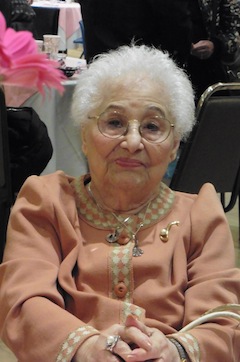
Sylvia Hill (photo from Jewish Seniors Alliance)

In the Pirkei Avot (Ethics of Our Fathers), we learn the saying, “Teach us to number our days so that the experiences of life should provide us with wisdom that only years can bring.” How fortunate we are that we have this exceptional woman, Sylvia Hill, admired by all who know her.

Sylvia has been part of the Jewish Seniors Alliance of Greater Vancouver since its inception and is an honourary life member. On June 6, Sylvia turned 103 years old. We honour her as she continues to inspire us with her staunch resolve to advocate for better lives for seniors – be it in the home where she was once president of the residents or within the community at large.

In the newsletter put out by the Snider Campus, Sylvia was called “the Face of Louis Brier” and was honoured during morning services on June 10, with a special kiddush following. On the day, we of JSA proudly wished you, dear Sylvia, a yom huledet sameach, a happy birthday, and we wish you continued good health for many years to come … beez (until) 120, and thriving, as has been the theme of JSA’s Empowerment Series this season. Continue being a beacon of light for us to follow!

With love and deep respect.

* * *

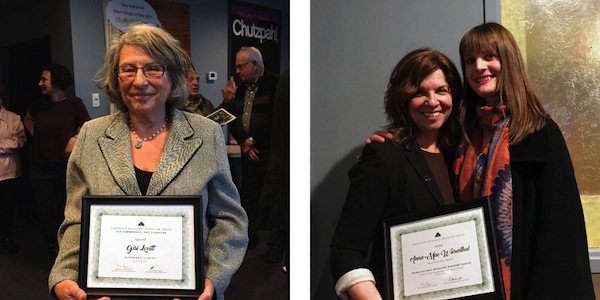
At the annual general meeting of the Vancouver Holocaust Centre Society for Education and Remembrance on June 14, Gisi Levitt received a Life Fellow Award for her 12 years of service as VHEC’s director of survivor services.

The Meyer and Gita Kron and Ruth Kron Sigal Award for Excellence in Holocaust Education was awarded to Anna-Mae Wiesenthal, who teaches Jewish history and English at King David High School. She recently worked together with VHEC on the Student Docent Training Initiative, a successful pilot project in which volunteer students from KDHS were trained to become docents. Two of the student docents, Milena Markovich and Jacqueline Belzberg, did an outstanding job of sharing with the audience their experiences of guiding their fellow students through the VHEC exhibition In Defiance: Jewish Resistance During the Holocaust.

photos - Gisi Levitt, and Anna-Mae Wiesenthal, left, and VHEC education director Ilona Shulman Spaar
Gisi Levitt, and Anna-Mae Wiesenthal, left, and VHEC education director Ilona Shulman Spaar. (photos from VHEC)

* * *

On June 20, Women in Film & Television Vancouver celebrated leaders for their outstanding work and contribution to advancing opportunities for women with their annual Spotlight Awards. This year’s recipients included Mark Leiren-Young, who received the Iris Award.

The Iris Award is given to a person who has demonstrated a commitment to the promotion of female creators and their screen-based works, either through curating or programming or through print and online media sources. Named after the Greek mythological figure Iris, associated with communication, messages and new endeavours.

Leiren-Young was also one of the finalists for the 2017 BC Book Prizes’ Hubert Evans Non-Fiction Prize for The Killer Whale Who Changed the World (Greystone Books).

Killer whales had always been seen as bloodthirsty sea monsters. That all changed when a young killer whale was captured off the west coast of North America and displayed to the public in 1964. Moby Doll – as the whale became known – was an instant celebrity, drawing 20,000 visitors on the one and only day he was exhibited. He died within a few months, but his famous gentleness sparked a worldwide crusade that transformed how people understood and appreciated orcas. Because of Moby Doll, we stopped fearing “killers” and grew to love and respect “orcas.”

Leiren-Young is a journalist, filmmaker and author. His Walrus article about Moby Doll was a finalist for the National Magazine Award and he won the Jack Webster Award for his CBC Ideas radio documentary Moby Doll: The Whale that Changed the World.

* * *

It was a banner year for the Leo Awards, which received a record 1,295 entries, from 301 unique programs in 14 different categories. Among the finalists was David Kaye – for best lead performance by a male in a motion picture for his work in Cadence and as part of the cast of Grocery Store Action Movie, which was nominated in the category of best music, comedy or variety program or series.

Format ImagePosted on June 30, 2017June 29, 2017Author Community members/organizationsCategories LocalTags Anna-Mae Wiesenthal, David Kaye, Gisi Levitt, gymnastics, Holocaust Centre, Jewish Seniors Alliance, KDHS, Leo Awards, Mark Leiren-Young, Rachel Rubin-Sarganis, Sylvia Hill, VHEC, women
Don’t “helicopter parent”

Don’t “helicopter parent”

King David High School students with Teaching for Tomorrow keynote speaker Julie Lythcott-Haims, who spoke on the topic How to Raise an Adult. (photo by Jocelyne Hallé)

Our kids are not bonsai trees that need to be clipped and sheared! That was the message Julie Lythcott-Haims delivered to a packed audience at Congregation Beth Israel in her May 17 talk, How to Raise an Adult.

The keynote speaker at King David High School’s Teaching for Tomorrow evening, Palo Alto, Calif.-based Lythcott-Haims was previously dean of freshmen at the University of Stanford for 10 years. There, she said, she saw a lot of “helicopter parenting.”

“My freshmen students seemed to be like drones in their own lives, driven by someone else and constantly tethered to home and parents by their phones, the world’s longest umbilical cord,” she reflected.

Lythcott-Haims described how parents would email asking for their children’s passwords so they could register them for classes, parents calling her “unhappy with the grade a professor gave their child” and parents wanting to know where their kids were at all times. “I would rail against this absurdity,” she said. “I’d give a speech to parents each year, telling them, ‘Trust your child, they have what it takes to thrive. Trust us at the university. And now, please leave!’”

A mother of teens herself, Lythcott-Haims realized that it’s impossible for parents to let go of their 18-year-old freshmen unless they started relinquishing their helicopter-parenting tendencies years earlier. “We love our children fiercely and we’re fearful about what the world has in store for them. But we make the mistake of thinking we must cloak them in our arms instead of preparing them to be strong out there. So, we end up being overprotective, over-directive and doing excessive handholding with our kids, being like a concierge in their lives. We treat our precious kids like bonsai trees – we plant them in a pot, but we won’t let them grow.”

Lythcott-Haims peppered her talk with anecdotes about her personal adventures parenting. She described her desire to give her kids independence and trying to balance that with the over-protectiveness of their friends’ parents. She and her husband chose a house in a particular neighbourhood, she admitted, because she wanted her kids in the “right” preschools and schools, so they would have better chances of getting into the “right” universities.

Along the way, she realized she was misguided. Her son did not tick the boxes required by the “right” universities. She saw that she was inadvertently pushing him so hard to succeed, she was losing him in the process, robbing him of happiness.

What’s at the root of this tendency to overparent? “Love and fear motivates our actions, but also ego,” Lythcott-Haims stated. “We fear being judged. Our measure of worth is saying what our kids are doing. We want to brag about them because it makes us feel we’ve succeeded as parents and in life.”

A hushed, sobered silence descended over the large synagogue auditorium as Lythcott-Haims delivered an emotional talk about her own parenting mistakes and what she learned.

“Our children are not investments, they’re humans and they deserve to know they’re loved – and not because they got a particular grade. For kids, their knees go unskinned if we catch them before they fall. When we hover over every bit of play, we get short-term wins, but the long-term cost is to their sense of self and their ability to self-advocate. They emerge chronologically as adults but they’re still kids inside.”

There are serious consequences to overparenting, she continued. “When we over-direct them and lift them to the outcomes we desire for them, it leads to higher rates of anxiety and depression. They emerge as university students who are failure-deprived and who want to have a parent tell them what to do, how to feel. Though they might look beautiful on paper, when something bad happens, they don’t have the internal sense of self that says, I’ll be OK.”

Lythcott-Haims’ message to parents was a warning to back off, particularly if they want their kids to enter the world as fierce warriors, “strong individuals who are loving of themselves and feel capable and able to keep going when things go wrong.”

Just before receiving a standing ovation, she said, “It takes humility to be a good parent. The ego has to come out of it.”

Lauren Kramer, an award-winning writer and editor, lives in Richmond. To read her work online, visit laurenkramer.net.

Format ImagePosted on June 2, 2017May 31, 2017Author Lauren KramerCategories LocalTags education, Julie Lythcott-Haims, KDHS, King David High School, teenagers
Yom Hashoah at KDHS

Yom Hashoah at KDHS

The Sir Charles Tupper Secondary School Grade 11 history class for which King David High School teacher Anna-Mae Wiesenthal (middle row, second from the right), did a presentation on the Holocaust. Their teacher, Bonnie Burnell, is to Wiesenthal’s left. (photo from Anna-Mae Wiesenthal)

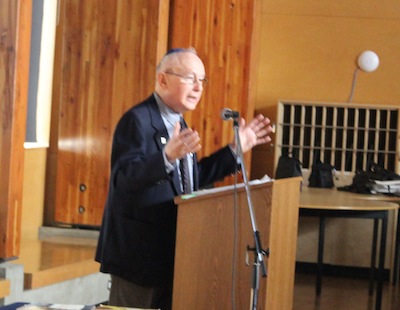
“They were in awe of the Holocaust survivor,” said Bonnie Burnell, a teacher at Sir Charles Tupper Secondary, describing the reaction of her students to survivor Robbie Waisman’s talk at a Yom Hashoah assembly at King David High School (KDHS) on April 24. “Looking at him as he spoke at the podium, they could scarcely imagine him on the inside of a Nazi concentration camp.”

Students from Prince of Wales Secondary School and, of course, from KDHS also joined the assembly, which was organized by KDHS teachers Anna-Mae Wiesenthal and Aron Rosenberg, and included Cantor Yaakov Orzech chanting El Malei Rachamim.

The multi-school initiative was led by Wiesenthal, who is currently pursuing a master’s degree in Holocaust and genocide studies. Last year, she went to Austria and Poland with the Sarah and Chaim Neuberger Holocaust Education Centre of Toronto. In addition to teaching about the Holocaust at KDHS, she has been giving presentations at various public schools. She told the Jewish Independent that students have been very engaged and have asked many questions. This outreach led to the recent assembly at KDHS, where other schools’ students were invited to attend.

photo - Holocaust survivor Robbie Waisman addresses the assembly for Yom Hashoah at King David High School on April 24
Holocaust survivor Robbie Waisman addresses the assembly for Yom Hashoah at King David High School on April 24. (photo from Anna-Mae Wiesenthal)

“My students, in general, were impressed with the ceremony and glad that they had made the decision to come,” Burnell said. “We have had a real focus on racism in our curriculum this year, and this visit definitely adds something of central importance to that subject.”

Wiesenthal, who has taught at KDHS since 2006, became interested in focusing more on Holocaust education after attending an educators seminar at Yad Vashem in 2012.

“I feel Holocaust education is about giving voice to the millions of victims who were murdered simply because of who they were, and honouring their legacy and our history,” explained Wiesenthal. “It is about remembering the vibrancy of Jewish life both before and after the war. It is about preserving memory for future generations and across cultures. It is about taking the knowledge of unprecedented horrors, and keeping them in front of us so that we remain vigilant about our humanity in the face of genocides today.”

Wiesenthal also admitted to being inspired by a possible kinship with renowned Nazi hunter Simon Wiesenthal. Her great-grandfather, Mattityahu Wiesenthal, was a Russian boy saved from forced conscription in the Russian army by being “thrown across the river” from Russia into the town of Skala in Austria-Hungary, as many boys were at that time. As an orphan in Skala, he was taken in by Moshe Efroyim Wiesenthal, who supported many such refugee orphans, and the young boy took the family name Wiesenthal to honour his patron. Wiesenthal does not know if Moshe Efroyim was directly related to Simon Wiesenthal, but the latter remains one of her heroes, and she has been in touch with his granddaughter, Racheli Kreisberg.

Wiesenthal also recently initiated a pilot project at the Vancouver Holocaust Education Centre (VHEC), in which KDHS students trained as docents (museum guides) lead other students through the exhibit.

Another project was an art exhibit at KDHS, where her Jewish History 11 class viewed a video of a Holocaust survivor’s testimony, chose an aspect of the testimony that stood out for them and then created a work of art based on that aspect. Each work was accompanied by an artist’s statement, a picture of the survivor and why the student chose the testimony they did. Contributions included painting, sculpture, writing and music. “The quality of expression was very moving,” said Wiesenthal.

Rabbi Stephen Berger, head of Judaic studies at KDHS, said he is thrilled with the work Wiesenthal has been doing.

“She shares her passion with her students and fulfils the talmudic dictum, ‘Words that leave from the heart, penetrate the heart,’” he said. “Our school and students benefit immeasurably by having her as a teacher of history and Holocaust studies.”

Matthew Gindin is a freelance journalist, writer and lecturer. He writes regularly for the Forward and All That Is Interesting, and has been published in Religion Dispatches, Situate Magazine, Tikkun and elsewhere. He can be found on Medium and Twitter.

Format ImagePosted on May 19, 2017May 17, 2017Author Matthew GindinCategories Celebrating the Holidays, LocalTags Anna-Mae Wiesenthal, Bonnie Burnell, education, Holocaust, KDHS, Robbie Waisman, Yom Hashoah
Student vote result different

Student vote result different

More than 170,000 elementary and high school students participated in CIVIX’s Student Vote program for the 2017 B.C. provincial election. (image from CIVIX)

More than 170,000 elementary and high school students participated in the Student Vote program for the 2017 B.C. provincial election, including students from King David High School and Richmond Jewish Day School.

After learning about the electoral process, researching the parties and platforms, and debating the future of British Columbia, students cast ballots for the official candidates running in their local electoral district.

As of 4:15 p.m. on election day, May 9, 1,092 schools had reported their election results, representing all 87 electoral districts in the province. In total, 170,238 ballots were cast by student participants; 163,923 valid votes and 6,315 rejected votes.

Students elected John Horgan and the B.C. NDP to form government with 60 out of 87 seats and 39.0% of the vote. Horgan won in his electoral district of Langford-Juan de Fuca with 55.7% of the vote.

Andrew Weaver and the B.C. Greens took 14 seats and would form the official opposition, receiving 28.5% of the popular vote. Weaver won in his electoral district of Oak Bay-Gordon Head with 48.9% of the vote.

Christy Clark and the B.C. Liberals won 12 seats and received 25.4% of the vote. She was defeated in her district of Kelowna West by NDP candidate Shelley Cook; Clark receiving 32.1% of votes cast, compared to Cook’s 35.8%.

Students also elected independent candidate Nicholas Wong in Delta South. Wong defeated Liberal candidate Ian Paton by 10 votes.

This is the fourth provincial-level Student Vote project conducted in British Columbia. In the 2013 provincial election, 101,627 students participated from 766 schools.

Student Vote is the flagship program of CIVIX, a national civic education charity. CIVIX provides learning opportunities to help young Canadians practise their rights and responsibilities as citizens and connect with their democratic institutions. Its programming focuses on the themes of elections, government budgets and elected representatives.

The Student Vote project for the 2017 B.C. provincial election was conducted in partnership with Elections BC and with support from the Vancouver Foundation, the B.C. Teachers’ Federation and the Government of Canada.

Format ImagePosted on May 19, 2017May 17, 2017Author CIVIXCategories LocalTags BC, British Columbia, education, elections, KDHS, RJDS, voting
A week of kindnesses

A week of kindnesses

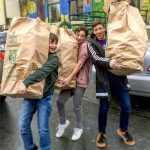
King David High School Grade 8 students Noam, Judd and Joey, collecting bread from COBS. (photo from facebook.com/foodstashfoundation)

Nov. 21 saw the start of King David High School’s now-established RAC Week. Started as part of the Random Acts of Kindness program – adapted as Random Acts of Chesed – this is a five-day celebration of paying it forward. Whether it’s picking up garbage, helping the homeless or moving furniture, every activity gives the students a chance to experience the rewards of helping others.

This year, The Giving Tree formed the basis for RAC Week’s good deeds. Illustrations from Shel Silverstein’s book about unconditional love decorated the main hall and foyer. Heartwarming messages read “Kindness is Contagious,” “Spread the Love” and “Smile! It’s RAC Week!”

RAC Week takes the students outside their comfort zones. According to the director of Jewish life at KDHS, Ellia Belson, this year’s destinations were chosen based on feedback gleaned from last year’s offerings. “The Grade 12s wanted to go where there was the greatest need,” she said.

Among the destinations were the Kerrisdale police detachment, Quest Outreach and Admiral Seymour Elementary School. At the school, which is on Keefer Street, they witnessed an unfamiliar degree of tension – and fighting – among the kids. KDHS student Ethan (Grade 10) described how he “tried to get people to play together who might not do so normally.”

photo - During RAC Week, heartwarming messages read “Kindness is Contagious,” “Spread the Love” and “Smile! It’s RAC Week!”
During RAC Week, heartwarming messages read “Kindness is Contagious,” “Spread the Love” and “Smile! It’s RAC Week!” (photo by Shula Klinger)

Under the guidance of teacher Matt Dichter, Grade 8 student Noam accompanied Food Stash Foundation on their daily rounds. Started by David Schein, a former teacher at KDHS, the foundation was created to help reduce food waste in the Vancouver area. FSF collects leftover items from grocery stores, such as Whole Foods, at the end of each work day. Food Stash then delivers the food to where it’s needed most: more than 15,000 kilograms of food since September, said Schein. On the morning of Nov. 22, deliveries were made to the Kettle Society, Mount Pleasant Neighborhood House, Tenth Church and Oasis Café.

The RAC group from KDHS rescued food from COBS Bread, Greens, Fresh is Best and a number of other sites. The numbers speak volumes. Every year, each Canadian throws away approximately 127 kilograms of food. KDHS kids rescued 135 kilograms in a single day.

“I really liked working with the kids because it is a great way to raise awareness of food waste in the younger generation,” Schein told the Independent. “Half of food waste happens at home, so they can now go home and speak to their parents, start influencing food choices.” He added, “Saving me some lifting was also nice!”

With its emphasis on community service, RAC Week is a concentrated course in educating the emotions, as well as the intellect. Noam described how “it felt good to give back.” Asked whether his work with Food Stash had had an impact on his daily life, he answered with a definite yes. His intentions were clear, as he explained, “even finishing what’s on your plate” can have an impact on food wastage.

RAC Week offers a curriculum of social responsibility best taught outside the classroom, where students develop an awareness of other kids’ lives and struggles. The conversations that take place after the outings present an opportunity to reflect on these struggles and express gratitude for their own station in life. It also allows the students to teach one another, under Belson’s guidance, about what each group learned.

While the kids spoke animatedly about their excursions, their most energetic, personal and heartfelt responses were to Belson’s simple question, “What does chesed mean to you?”

At this, it seemed that half the students raised their hands, speaking with passion and clarity about “giving and not taking” (Ella). Connell quoted from the film Fantastic Beasts and Where to Find Them, with the admonition, “Be a giver, not a taker.” Ethan spoke at length about how it’s easy to “take for granted a loving home, a loving family…. It’s a week to recognize that by giving back.” Jordana agreed, talking about the importance of seeing “how others live – even so close to us. It made a difference.”

Sometimes, the greatest lessons in life can be taught in the simplest of ways. Adi talked about “being a mensch, helping people who have less, making people feel happier, making them smile.”

Shula Klinger is an author, illustrator and journalist living in North Vancouver. Find out more at niftyscissors.com.

Format ImagePosted on December 16, 2016December 14, 2016Author Shula KlingerCategories LocalTags chesed, KDHS, King David High School, RAC Week, tikkun olam
Internet access and poverty

Internet access and poverty

On Nov. 24., writer Penny Goldsmith spoke at King David High School about PovNet, a B.C.-based anti-poverty network.

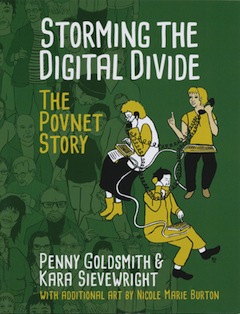
When Storming the Digital Divide: The PovNet Story was published in August by Lazara Press, the Jewish Independent received a copy. A history told in words and through illustrations about the B.C.-based online anti-poverty community network, the JI waited until school started, as it seemed the perfect topic for King David High School teacher Aron Rosenberg’s social justice class. And it was.

Once students were into the rhythm of classes and the High Holidays had passed, Rosenberg met with Penny Goldsmith – PovNet founder and a longtime community organizer and advocate – to determine how to address the subject. Goldsmith wrote Storming the Digital Divide, while B.C. artist, writer and activist Kara Sievewright – who has been PovNet’s web coordinator and illustrator since 2005 – created the images, and there are additional drawings by artist, researcher and educator Nicole Marie Burton of Ad Astra Comix, which publishes comics with social justice themes.

Before Goldsmith even did her presentation to Rosenberg’s class on the morning of Nov. 24 – appropriately enough, a day that fell during KDHS’s Random Acts of Chesed Week – the students had homework. In pairs, they had to choose a bubble from the 12-page timeline laid out in the book, which, as the book notes, highlights “selected issues that are an important part of the history of work done by the many advocates and marginalized community members who use PovNet in British Columbia. It also scans the history of technology and organizing as it affects the anti-poverty movement in British Columbia.”

The timeline goes from 1971 – “The first email is sent” – to 2015, which contains several key developments, such as the province’s first seniors’ advocate (Isobel Mackenzie) being appointed and the release of a 40-page report in which “nine social services agencies from across B.C. have asked the ombudsperson of B.C. to launch a systematic investigation into service reductions at the Ministry of Social Development and Social Innovation (the welfare ministry) that shut out many eligible people from accessing social assistance.”

For Goldsmith’s presentation, students were asked to consider their chosen bubble with respect to a few questions: “What does the information in the bubble mean for poor people? For anti-poverty advocates who work with them? For you?” Divided into groups, a table spokesperson shared some of the thoughts that arose from the brief group discussion of the questions. Student Leora Schertzer, in her role as master of ceremonies, made sure that every student who wanted to contribute aloud was invited to do so.

Alternating between group discussion and Goldsmith’s talk, which included visuals of some of the book’s illustrated pages, the students considered questions that Goldsmith and Rosenberg had prepared in advance, such as “What do you think the digital divide might mean?” “What do you think the difference is between charity and anti-poverty work?” and “How do you envision a future online world?”

Once the students had a chance to think about the issues, Goldsmith offered her thoughts, using portions of the book, beginning with an explanation of its title.

“From trying to get a job, finding adequate housing and accessing government services … to networking with fellow advocates and fighting for social change, the internet is now at the very least an essential service,” said Goldsmith. Regarding the accessing of government services, she gave the example of qualifying for welfare, which requires the completion of a 90-screen online application.

She offered a few definitions. “Collins English Dictionary defines the digital divide as ‘the gap between those people who have internet access and those who do not.’ Simple,” she said. “Dictionary.com expands the definition to include ‘the gap between those who are computer literate and those who are not.’ An important addition. Other dictionaries expand the definition to include marginalized communities in developing countries.

“According to a report from the Public Interest Advocacy Centre published in July 2016,” she said, “one-half of low-income Canadians are trading off other household goods or services in order to pay their communications bill – almost one in five (17%) indicated they went without other essential goods such as food, medicine or clothing in order to pay a communications bill.”

A lack of money is not the only barrier to internet access.

“An online space can, by its very structure, leave out marginalized communities,” Goldsmith explained. “If English is not your first language, online communication is not always as easy as being in the same room together with your peers. If accessing a computer is an issue, particularly in rural communities, if technology is daunting – people get left out of the conversation.”

It is these barriers that PovNet also works to diminish.

“PovNet is an online community of social justice advocates, activists, community workers and marginalized people who work in the anti-poverty world in British Columbia and across Canada,” said Goldsmith. “It hosts a public website that provides up-to-date information about welfare, housing and homelessness, unemployment, disability and human rights issues.

“PovNet’s community of users is vast,” she continued. “A disability rights organizer in Nelson goes to the PovNet website to get some information for a community workshop she is doing that night about changes to disability bus passes. A tenant in the Lower Mainland of Vancouver goes online to find an advocate to help him deal with a landlord trying to evict him. Several workers at a women’s centre in a small northern British Columbia town sign up for an online course at PovNetU about dealing with debt because they have so many clients coming into the women’s centre who are being harassed by a local collection agency.

“But what’s important,” she said, “is that everyone who wants to, has to have access to PovNet. That means money for computers, and government commitment to universal bandwidth and internet access. It also means that all of PovNet’s diverse communities have to feel that the network belongs to them.”

book cover - Storming the Digital DivideStorming the Digital Divide contains many illustrated stories from the online anti-poverty community, which bring the facts and figures closer to home, as well as the impact of PovNet over the 20 years since it began in 1997. While Goldsmith is no longer the organization’s executive coordinator – a post she filled for 18 years, until 2015 – she remains passionate about its work. And some of it rubbed off. Here are some of the comments students wrote after her talk.


• “Penny’s presentation exposed me to how reliant our society and greater world is on the internet…. Those who are unable to access the internet or technology are at an automatic disadvantage for workplace opportunities and almost all information.” (Justine Balin)

• “Listening to Penny’s presentation last week gave me an insight into the challenges that people without access to the internet face. Hearing about how some people have to choose between paying for internet access or having dinner made me realize how much I take having internet for granted. I also realized how big of a luxury it is to have my own computer and the privacy that comes with owning my own device. Before hearing Penny speak, I never realized how large of an issue internet access was…. Hearing about PovNet and how they advocate for internet access for those who need it really opened my eyes to a social justice issue that I would have otherwise been oblivious to.” (Talia Buchman)

• “In ‘A PovNet Timeline,’ I chose to focus on the [2008] bubble that states that over 40% of people who died in B.C. of HIV-AIDS died because they never received the necessary treatment because they were poor. Reading this bubble disturbed me quite a bit. I was mostly disturbed because we, as a country, try so hard to be the best society we can possibly be (i.e. equal rights), however still tend to fail at the situation with people living in poverty. We advertise that Canada has free health care, but do we really?” (Michelle Nifco)

• “The cost to live in British Columbia has been rising steadily and the welfare rate has also been rising but not as fast as the cost of living. I am fortunate enough to not be relying on welfare and hope that I will never need to rely on it, but many Canadians rely on welfare cheques every month to keep a roof over their head and food in their stomachs.” (Elle Poirier)

• “What I found immensely important about my experience with Povnet’s work was what they called ‘A PovNet Timeline: A Selective History of Poverty, Anti-Poverty Organizing & Technology in B.C.’ The timeline was extremely motivational and taught me that if citizens have enough passion and drive, they can influence the powers that be, even when it may seem that said powers are completely inflexible or severely rigid. This premise was explored throughout a variety of different events within the timeline.” (Anthony Schokalsky)

Storming the Digital Divide ($12.95) is available from lazarapress.ca.


Format ImagePosted on December 9, 2016December 7, 2016Author Cynthia RamsayCategories BooksTags internet, KDHS, King David High, poverty, PovNet
The future of tech, media

The future of tech, media

A concert at Deer Lake Park gets Matty Flader thinking about social media. (photo from deerlakepark.org)

King David High School’s creative writing course, taught by Aron Rosenberg, partnered with the Jewish Independent for their final unit of the school year. Students were challenged to write articles reflecting on their identity as young Vancouverites in the Jewish community. After brainstorming topics, the students agreed to focus an article on technology or print media, and how these things are changing and will continue to transform in the future. Here are some of their thoughts.

Phone-y confidence
by Matty Flader

Last night, I went to a concert in Deer Lake Park, an outdoor venue, with my sister. We went to see the Lumineers, a folk band that has become fairly popular since their debut album in 2013. I was rather excited to see the show, as I am a big fan of the band’s music and unique style.

It rained throughout the concert, which was a major annoyance. Getting soaked and standing in the mud for a few hours is not everyone’s ideal evening, but it was worth it for the music. The band was excellent at performing live and it was an amazing show. One thing that almost did ruin my experience, however, was the sea of cellphones raised above people’s heads filming the concert. Almost everyone at some point had their phones out to film the concert to share with their friends over social media.

One thing I think our parents do not understand about our generation is that social media is a competition. We constantly compete by sharing statuses, photos and videos of anything significant we do. The goal is simple acknowledgement or validation from our peers; we want them to be jealous of how amazing our lives are. The most famous of our friends – the one with the most likes and shares – is the most successful among us, though we wouldn’t admit that aloud. Our generation lives in constant fear of being forgotten or ignored, and we use social media as a way to remind our friends of how exciting we are.

It is no longer innate to live in the moment. Now that everything is expected to be documented, we live our best moments through the small screens of our phones. Concerts are just the tip of the iceberg. I have encountered this issue at graduations, parties, hanging out with friends, and even spending time with one’s parents. Although I love modern technology, sometimes I wish I could exist without the ominous anxiety of social media.

Technology today
by Eli Friedland

We live in a world where technology is the new alcohol. Rather than face reality, people stare at their screens, lost in the lives of others. Picture perfect images captured for eternity. Model-worthy smiles lighting up the screen. Are they real? That is the question most people fail to ask themselves when they zealously peruse the photos that flood their news feeds.

photo - Eli Friedland is happy to have one day a week to power off
Eli Friedland is happy to have one day a week to power off. (photo from pexels.com)

We live in a world where, rather than make conversation with those in front of us, we choose to talk to an online persona. We have closed the gap from those distant to us, yet we have distanced the gap from those closest to us. We ride the bus in silence, the only sound, fingers tapping away at screens. We receive validation from ambiguous “likes” and take pride in meaningless comments. We allow the world to pass us by as we scroll through the news in far off lands. We only see the perfect that happens to others, that which is posted online. Tired eyes scroll through vast oceans of pictures that have no end.

Constant alertness and comparisons are our 10 plagues. We need redemption from technology. I cannot bear to imagine a world in which people cannot talk, for technology has robbed us of our voices. I fear this more than anything and I know that G-d gave us a day of rest to prevent this plague from growing too large.

Every Friday at sundown, I power down. I turn my phone off, I put my laptop away and I put all electronics out of sight and out of mind. All week, I long for Friday, when I have a valid excuse to disconnect from technology. Rather than staring anxiously at my smartphone, I make myself smart. I read books, I learn from my family, friends and the rabbi’s lectures. I spend all week learning hacks for my phone but, come the weekend, I learn about people. Instead of awaiting a text or phone call that might never come, I knock on my friends’ doors and we go to the park, we walk, we talk. I play Bananagrams with my parents, I soak up the sun with my brother, I interact with humanity in a way unparalleled when phones are out. On the Jewish day of rest, I receive people’s undivided attention and they receive mine.

Death of print media
by Noah Hayes

In Canada, print media’s roots go back to the Halifax Gazette, started in 1752. Since then, print media has reigned as the dominant form of news media all over the world. But it’s no secret that digital streams of information are pushing aside the morning paper. The reality is that your kids will likely wake up in the morning and go on their electronic devices to see the latest happenings, rather than wake up to a freshly printed newspaper, waiting to be read and, eventually, discarded.

As a high school student who values media but rarely in print, I am often confronted with the question of why we don’t really need print media anymore. If you need a plumber, a painter, a lawyer or a car, you’re likely not looking in your newspaper these days. It’s not like word of mouth is a modern concept but, with the internet as a platform to share recommendations and spread ideas, newspaper advertisements are less relevant.

screenshot - Noah Hayes predicts the demise of print media, as younger people get all their information electronically
Noah Hayes predicts the demise of print media, as younger people get all their information electronically.

Some may suggest that print ads – and not just in newspapers – can be more effective because they target specific geographic regions or interest groups. For instance, if I know of a wealthier area in the city that has lots of nice cars and is mostly made up of younger people, I can advertise a more expensive car that younger people would be more interested in on a bus stop, or even on the side of a bus that goes through there. In a rougher area of the city, I can advertise an entry-level car because more people might be willing to buy it.

What’s becoming more and more the reality, however, is that the internet can do the same thing, with even greater accuracy and efficiency; data tracking in this day and age is limitless. If you’ve been searching for a new pair of shoes on a website, ads for that website can appear on the next site you’re on, even if it’s totally unrelated to shoes. You’re being tracked on most sites that you go on. It’s 2016 and, even with Edward Snowden’s notoriety, people are still unaware of the trail they create just by going on their computer. And this trail is analyzed for more than just advertising.

What about entertainment? Many read print media to stay up to date or see an interesting piece from their favorite columnist in the morning. These newspapers or magazines now almost always have websites where you can also read your favorite columnists. If you go on Twitter, you can get live updates from your favorite journalist or news source, along with a link to articles they publish. Your dearest sports team probably has a website, along with sites dedicated to covering it, and their beat writer likely has a sturdy online presence, too. If you just want a gob of information to delve into, try going on Reddit or Buzzfeed. Some sites go well beyond the impersonal newspaper and literally let you customize your own homepage to only get info on the things you’re interested in. Want pictures? Check. Want funny pictures? Check. Want funny pictures of cats doing awkward, cute poses? Check.

The biggest reason why people seem to be migrating away from print media towards the internet is cost. Though newspaper and magazine companies can still charge you for reading their websites, most digital media is free. For these companies, why produce a print version if they’re also going to put their content online? Perhaps the sense of familiarity and comfort that comes with print media is its most effective selling point. The digital world hasn’t hit its peak yet because the older generation still values the routine and ritual of the morning paper or magazines.

As morbid as it sounds, the only part of print media that doesn’t seem easily replaceable is the “In Memoriam” section of the newspaper. There are few ways to find out about lost loved ones in the community, or the anniversaries of their passing. However, the community of the internet is much larger than the local communities that find solace in the local newspaper’s “In Memoriam” section and, one day, the internet will provide this service, too.

Digital media is simply too powerful. It’s a tool that can be used in dozens of different ways, an unstoppable machine that will eventually show print media the door, and make sure that door hits its tuchus on the way out.

Print’s ironic future
by Leora Schertzer

Every day, more than two million news articles are published online. Millennials subscribe to a fast-paced lifestyle, making the internet a popular platform to read the news mere minutes after the fact. People share news and magazine articles with their friends and followers over Facebook, Snapchat, Twitter and beyond. If you were to ask the average young adult where she or he reads about the latest happenings, the answer would most likely be through the shared articles of her or his online peers. Perhaps a more cultured individual would name a specific news source that she or he frequents to maintain a sharp awareness of the world, which would also be online.

photo - Leora Schertzer thinks that print media might become cool again ... 40 years from now
Leora Schertzer thinks that print media might become cool again … 40 years from now.

Though the future of print media seems dire, I would argue that not all hope is lost. Many people still prefer paper copies of newspapers, magazines and books. Some claim that a good old physical copy feels more personal and less distracting. With access to literally millions of other articles online, users could feel rushed or anxious, knowing that there are so many more articles to be read. A real newspaper feels like your own and, with one’s options limited to one paper, consumers could feel satisfied with the articles they have read, rather than feeling they have merely grazed the tip of the iceberg of daily news.

Another reason print media may live on is for the sake of esthetic and irony, similarly to vinyl records. People still love their vinyl record collections, even though far more practical and efficient ways of listening to music are out there. Some may hang on to print newspapers and magazines for the novelty, or because they believe the “original way” is the “best way.” For this reason, print media may make a comeback within the next 40 years. Though print media will become more of a niche market in the near future, as it becomes less common or mainstream, it may ironically become more highly regarded – what becomes less viable, becomes more valuable.

Format ImagePosted on June 24, 2016June 22, 2016Author KDHS creative writing studentsCategories LocalTags KDHS, newspapers, social media, technology
Power in three percent

Power in three percent

Left to right: Esther Mogyoros, King David High School director of development; Shannon Gorski, PAC co-chair; speaker Josh Shipp; and Teaching for Tomorrow co-chairs Gaby Lutrin and Elaine Grobman. (photo from KDHS)

“What’s the difference between a watermelon and a cloud?” Josh Shipp asked the crowd. “Three percent. A watermelon is 94% water and a cloud is 97% water. All that separates them is three percent, but that little difference makes all the difference in the world. That little difference can be all that separates you from being average and being extraordinary.”

Shipp, a “teen expert” and motivational speaker, who graduated from Stanford and has lectured at Harvard and MIT, was speaking at Teaching for Tomorrow, an annual celebration of King David High School (KDHS), on May 17.

KDHS, which has 220 students and expects continued growth, is British Columbia’s only Jewish high school and one of six outside of Toronto. It is also one of the most successful Jewish high schools in Canada from the perspective of having growing enrolment each year.

The auditorium at the Chan Centre was packed, flanked on both sides by galleries full of KDHS students. After an introduction by emcee Liam Sasky, a Grade 12 student, the audience heard a concise, warm and humorous speech from school head Russ Klein. A musical interlude followed, with a duet about friends struggling with the romance that’s broken out between them. Following that came a video about KDHS and its values, focusing on the experience of current students and alumni – the students interviewed emphasized the sense of community at KDHS, and the feeling that they were known and valued personally at the school.

After that came the main event. Shipp was notable for his ability to get raucous laughter from the teens, who he seemed to hold in the palm of his hand throughout his talk. He peppered his speech with memorable images and questions, tech and pop culture references, and self-deprecating humor. Shipp, who was abandoned as a child and grew up a troubled delinquent in a series of foster homes, spoke candidly of his own horrific experiences of abuse and trauma. At the centre of his speech was the role that one caring adult can play; in his life, this was his foster father Rodney, who refused to reject Shipp, saving his life and turning it around. “All of you can be a Rodney to someone,” said Shipp. “Every child, every teenager, every human being is one caring adult away from success.”

Shipp challenged students to reach out to a “Rodney” in their own lives within 24 hours and say “thank you,” something Shipp said took him nine years to do after the day his Rodney turned his life around. Shipp also had a warning for students: face your ghosts.

“You guys are pretty serious here,” Shipp said. “I know it. I watched the propaganda video. You need to be unafraid to seek help for the things that are holding you back. This can be a problem in high-achieving communities like this. Don’t be afraid to seem weak, because talking about these things is not weak – it’s courageous.”

Matthew Gindin is a Vancouver freelance writer and journalist. He blogs on spirituality and social justice at seeking her voice (hashkata.com) and has been published in the Forward, Tikkun, Elephant Journal and elsewhere.

Format ImagePosted on June 3, 2016June 1, 2016Author Matthew GindinCategories LocalTags Josh Shipp, KDHS, King David High School, Teaching for Tomorrow, teens
Artistic Pesach midrashim

Artistic Pesach midrashim

“Question Mark” by Sydney Freedman and Rachel Pekeles  is among the works created by King David High School Grade 12 students. (photo by Nancy Current)

In conjunction with their current show at Zack Gallery, Visual Midrash, artists Robin Atlas and Nancy Current conducted a two-day workshop with the Grade 12 students of King David High School. Rabbi Stephen Berger, head of the school’s Judaic studies, and some of his more outgoing students talked to the Independent about the project.

“Every year, we do a project for Passover with our Grade 12 students,” said Berger. “The Haggadah is one of those Jewish texts that’s had the most number of interpretations throughout our history, as every generation and every family bring their own understanding. So, I ask the students every year to write their own versions, a short essay on one of the aspects of the Haggadah. This year, we decided to combine the writing with the visual component. The students pitched their ideas, which topic they wanted to explore. I tried to limit the same topics but I didn’t force anyone. They were free to choose. Now, after all the art is done, we’ll put the project online. We’re also going to publish a hardcopy as a pamphlet. One of our former students, Daniel Wiseman, is helping me with the particulars. We will distribute the copies at the JCC, at the synagogues and Jewish delis.”

The rabbi joined his students in creating his own interpretation of the Haggadah, using a sheet of matzah as the base for his artistic journey. “Matzah represents both our slavery and our freedom,” he said. His piece opens the pamphlet.

Like the rabbi, most of his students hadn’t done much visual art in years and were not going to pursue art as a career, but they enjoyed working on Visual Midrash for this assignment.

“They put so much thought into their pieces,” said Current. “Some of them first tried to come up with concrete images, but it’s hard without artistic training. Then Robin and I suggested they should think about some abstract interpretations. What ideas come to mind? What concepts are associated with those ideas? The results were amazing.”

One of the students, Izzy Khalifa, chose the most fun-filled tradition of Passover – the search for bread. “When I was a kid, it was a game in our home. I loved it,” she said. “Now that I’m older, I think it’s not simply a search for bread but it has a deeper meaning, like a search for yourself.”

“Judaism grows on you,” the rabbi remarked, and Khalifa agreed. She also liked working with the abstract concept. “People can take more from an abstract picture, interpret it in different ways,” she said.

photo - “Blue Heart” by Adi Rosenkrantz and Ashley Morris
“Blue Heart” by Adi Rosenkrantz and Ashley Morris (photo by Nancy Current)

Classmates Adi Rosenkrantz and Ashley Morris decided on more concrete imagery. Their blue heart on a blood-red background symbolizes the first plague of Egypt – the plague of blood. “The blue heart is like the heart of the Nile,” said Rosenkrantz. “The abrupt color change, from blue to red, from water to blood, disrupted the Egyptian way of life.” Their heart is almost anatomically precise. “I just did a unit on cardiovascular system,” Rosenkrantz explained, “and it was fresh in my mind.”

Ma’ayan Fadida and Shmuel Hart’s illustration was more metaphorical. They selected a controversial theme for their work – the wicked son. In their artistic interpretation, the wicked son walks a black path, which winds its way across the pink and orange brightness of other family members.

“We wanted to do one of the sons,” Fadida said. “This one makes the decision to separate himself from the others; that’s why his path is black. And the abstract allowed us to show how he was thinking.”

One of the most powerful pieces is a mixed media collage: a large black question mark with the background of newspaper snippets. Created by Sydney Freedman and Rachel Pekeles, it also touches on the story of the four sons but focuses on the son who doesn’t know how to ask.

“We wanted to take a complicated topic and present it as a symbol. The black mark blocks our ability to ask,” explained Freedman.

“The information is all there. You just have to be willing to look for it,” Pekeles elaborated. “It is a challenge. Sometimes, we choose not to ask when we should.”

Olga Livshin is a Vancouver freelance writer. She can be reached at [email protected].


Format ImagePosted on April 22, 2016April 20, 2016Author Olga LivshinCategories Visual ArtsTags Atlas, Current, KDHS, King David High School, visual midrash

Posts pagination

Previous page Page 1 … Page 4 Page 5 Page 6 Next page
Proudly powered by WordPress