Skip to content
  • Home
  • Subscribe / donate
  • Events calendar
  • News
    • Local
    • National
    • Israel
    • World
    • עניין בחדשות
      A roundup of news in Canada and further afield, in Hebrew.
  • Opinion
    • From the JI
    • Op-Ed
  • Arts & Culture
    • Performing Arts
    • Music
    • Books
    • Visual Arts
    • TV & Film
  • Life
    • Celebrating the Holidays
    • Travel
    • The Daily Snooze
      Cartoons by Jacob Samuel
    • Mystery Photo
      Help the JI and JMABC fill in the gaps in our archives.
  • Community Links
    • Organizations, Etc.
    • Other News Sources & Blogs
    • Business Directory
  • FAQ
  • JI Chai Celebration
  • JI@88! video

Recent Posts

  • Sharing her testimony
  • Fall fight takes leap forward
  • The balancing of rights
  • Multiple Tony n’ Tina roles
  • Stories of trauma, resilience
  • Celebrate our culture
  • A responsibility to help
  • What wellness means at JCC
  • Together in mourning
  • Downhill after Trump?
  • Birth control even easier now
  • Eco-Sisters mentorship
  • Unexpected discoveries
  • Study’s results hopeful
  • Bad behaviour affects us all
  • Thankful for the police
  • UBC needs a wake-up call
  • Recalling a shining star
  • Sleep well …
  • BGU fosters startup culture
  • Photography and glass
  • Is it the end of an era?
  • Taking life a step at a time
  • Nakba exhibit biased
  • Film festival starts next week
  • Musical with heart and soul
  • Rabbi marks 13 years
  • Keeper of VTT’s history
  • Gala fêtes Infeld’s 20th
  • Building JWest together
  • Challah Mom comes to Vancouver
  • What to do about media bias
  • Education offers hope
  • Remembrance – a moral act
  • What makes us human
  • המלחמות של נתניהו וטראמפ

Archives

Follow @JewishIndie
image - The CJN - Visit Us Banner - 300x600 - 101625

Tag: Judaism

Encourage menschlichkeit

The Bayit in Richmond has launched a new youth initiative, called Marc’s Mensches. Starting in September, the program aims to encourage youth in the community by rewarding them for good deeds.

The basic layout of the Marc’s Mensches program is as follows. If you witness a youth from the community (grades 5-10) doing a good deed – within either the Jewish or non-Jewish communities – enter them to be a Marc’s Mensches winner. Each month, a panel will review all the candidates and the impact their good deed has had, and they will decide a mensch for each month. The winner will be awarded a certificate of appreciation, as well as a $25 gift card to Amazon. The same candidate cannot win two months in a row.

At the end of the 10-month school year, each monthly winner will automatically be entered for the final prize. The panel will look at the each one of Marc’s Mensches and determine who has had the largest impact – that mensch will be awarded a $1,000 scholarship for Jewish education.

This program is made possible by the donations of Donald and Bonnie Dwares on behalf of their son Marc Dwares, Marshall and Sally Cramer, and Jeffrey Sachs. The Bayit is asking the entire Jewish community to participate and to give as many youth as possible the chance to be recognized for their contributions.

To submit a nominee, contact Matti Feigelstock at 604-771-8897 or visit thebayit.ca/mensches.

Posted on August 25, 2017November 1, 2017Author The BayitCategories LocalTags Judaism, tikkun olam

Teach it to your children

You’re reading the weekly congregational email. Something radical seems to have happened. Within a week, everything has changed. Well, maybe the format seems the same, ready to lull you into “services this week, events, make a donation …” but then it hits you. It’s like a revolution happened. Instead of the regular schedule, where the adult service is happening at 8 p.m. Friday night, and davening starts at 9:30 Saturday morning, it’s all changed. Imagine this:

Come for our weekly great Kabbalat Shabbat service at 4:45! Join us for prayers, story time, snack, dancing and singing. The service ends by 5:45, followed by an Oneg Shabbat with fruit, veggies, cheese cubes, challah and grape juice.

Want to stay up later? Join us in the sanctuary for a summer camp-style sing-along of Shabbat music and study the Torah portion with the rabbi and your friends.

On Saturday morning, daven with us! Services begin at 8:45, with morning prayers, movement activities, another great story (with a picture book!) and three dances to help us learn new psalms. We’ll learn the Torah portion of the week, act out some of it, and end with a rousing Adon Olam. Let’s march around and pretend we’re playing in a band.

Services end by 10:30. We’ll provide a healthy Kiddush snack, including whole grain crackers, juice and water, lots of fruits and veggies, and more. (It’s a nut-free environment, but feel free to bring along dairy or pareve snacks to share.)

If the weather’s good, after snack, let’s play outside at the shul playground. If not, we’ll run in the shul gym so you can get tired before going home to have a big Shabbat lunch and nap.

In the evening, join us for Havdalah at the shul at 5! We’ll be serving pizza and salad, with cookies for dessert. (Click here for costs, to register and for the Jewish movie of the week.) After dinner, we’ll be showing a G or PG movie in the gym for families who want to stay out late.

Also there’s a Saturday evening study session. This week: Jewish advice for managing our busy modern family life, at 6:30 in the library. (Free.)

Note: If doing the rabbi’s Saturday evening study session, please be sure one parent or friend is in the gym to supervise your offspring and enjoy the movie together.

Reminders: On Sunday morning, the shul opens bright and early as usual for religious school, yoga for parents, coffee klatch and the usual lecture series after the morning minyan.

Our congregational soup kitchen, visit to the local Jewish seniors centre, nursing facilities and once-a-month cemetery clean-up all meet on Sunday afternoons. (Cemetery group, next week is our hike at the lake, so bring your boots and bathing suit and we’ll see you on the bus – we might let others attend if there is room! Click here to register.)

See you then!

* * *

OK, as you read this, you’re thinking, this is all well and good for those few young families out there. I mean, maybe my children or grandchildren might go sometimes? But, for me, well, I feel left out. This doesn’t seem like what I’m used to.

But consider the model some congregations still use: Join us for a family Shabbat dinner! (It happens only once or twice a year.) Services start by 5:30. Food is offered, one course at a time, starting after 7. There’s no finger food or even challah on the table. The kids’ food comes after the salad course. Parents who don’t want to create a scene take their children home long before dessert is served to avoid a train wreck…. And nobody wants to come back.

Should Jewish life be all about young families? Well, no. We shouldn’t give up traditional services or customs, but the V’ahavta says “we should teach it [Judaism] to our children.” How do you do that better, so there will be Jews a generation from now? Should your congregation include positive experiences for younger people? Does that create a plan for the future?

Based on a random sampling of kids’ events in my Jewish community (Winnipeg) over the last six years, here’s a generic sampling of what I’ve seen.

If a shul schedules a Tot Shabbat irregularly – although kids thrive on routine – it happens during kid dinnertime or even at bedtime. If your preschooler eats dinner at 5:30 and is in bed at 7:30, how does that service at 6:15 work for you? Hear any angry screaming in that sanctuary?

How about the big kid events scheduled for 1-3 p.m.? Many kids are grouchy creatures around then. We love naps. If we’re skipping them, well, the activity had better be fabulous … and tolerant of crying, hitting and screaming.

Many congregations do a great job of integrating families into their activities and planning. Instead of having kids’ events as an afterthought once a year, most events are designed with whole families in mind … and preschool activities meet the needs of families with babies and small kids.

Teenagers and adults have relevant events. People of all ages have good family programming, too. Sometimes, this is all the same service. Can kids have roles in the service, like saying the Shema or leading a song? Can kids’ restless behaviour be tolerated at the same level as we tolerate adults’ conversation and restless behaviour?

How about making registration accessible and online? Include active learning as part of all events, so Judaism remains relevant?

The kicker – somebody always says: It can’t be done. This isn’t the way we do it here. It’ll be expensive. It’s not possible.

I say: dream bigger.

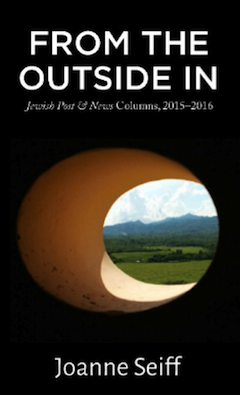
Joanne Seiff, a regular columnist for Winnipeg’s Jewish Post and News, is the author of a new book, From the Outside In: Jewish Post Columns 2015-2016. This collection of essays is available for digital download, or as a paperback from Amazon. See more about her on joanneseiff.blogspot.com.

Posted on August 18, 2017August 16, 2017Author Joanne SeiffCategories Op-EdTags continuity, education, family, Jewish life, Judaism, synagogues
The future of Jewish learning

The future of Jewish learning

A picture from Smart Money, a study intended to help the Jewish community navigate the high-tech world. (photo by Lewis Kassel courtesy of Moishe House)

By day, Liora Brosbe is the family engagement officer for the Jewish Federation of the East Bay in Berkeley, Calif., where she reaches out to the community with a menu of opportunities for “connecting to Jewish life and each other.” But when she’s not at work, Brosbe’s main job is raising three kids, ages 2, 6 and 8. Their home? A laboratory for Jewish learning strategies.

“Yes, they’re little Petri dishes,” their mom, who is also a psychotherapist, said with a laugh. “Like most families, screen time is a huge issue at our house, both for time and content, but I tell families it’s also an amazing opportunity for low-barrier Jewish engagement.”

With the avalanche of new technologies – many of them being tapped for Jewish learning – educators, funders and parents are often befuddled about where to invest their money and their kids’ or students’ time. A recent report on the implications of the wave of educational technology and digital engagement is designed to guide the Jewish community through this complex space.

Sponsored by the Jim Joseph Foundation and the William Davidson Foundation, Smart Money: Recommendations for an Educational Technology and Digital Engagement Investment Strategy examines many of these innovations and provides suggestions for navigating the high-tech world. The study’s recommendations include using virtual and augmented reality (a user could, for example, experience the splitting of the Red Sea); creating games based on alternative scenarios for “Jewish futures,” such as rebuilding Jewish life after the Roman destruction of the Second Temple; offering opportunities for students to learn coding and other technological skills, which can foster connectedness among Jewish youths and introduce them to Israeli high-tech companies; and increasingly using video, music, podcasting and other platforms.

The report is garnering far more attention than expected, according to the sponsors.

“We did not originally intend for this to be a public report,” said Barry Finestone, president and chief executive officer of the Jim Joseph Foundation, “but the substance of the findings and recommendations really challenge us, as funders, to think strategically, creatively and collaboratively about how we can utilize educational technology and digital engagement to advance our Jewish educational missions.”

For the report, Lewis J. Bernstein and Associates interviewed 50 experts, investors and educators from both the Jewish and non-Jewish worlds to create the recommendations.

“It’s a huge media marketplace out there and most Jews are exposed to the same information as the rest of the world,” said Lewis J. Bernstein, a former producer of Sesame Street and the report’s lead researcher. “Parents and educators have difficult choices to make, and Jewish learning and wisdom compete with the secular world.”

Read more at jns.org.

Format ImagePosted on August 18, 2017August 16, 2017Author Deborah Fineblum JNS.orgCategories WorldTags continuity, education, Jim Joseph Foundation, Judaism, technology
An accidental journey

An accidental journey

Salvador Litvak was in Vancouver for a Shabbaton at the Kollel last month. (photo from Salvador Litvak)

At a Kollel Shabbaton last month featuring Accidental Talmudist and filmmaker Salvador Litvak, no one was asking that age-old Jewish question, “When do we eat?” In fact, on the night of June 23, during the first of three sessions with Litvak, more than 100 attendees sat spellbound as he shared the love story of his Hungarian grandmother Magda, who survived the Holocaust in the Theresienstadt concentration camp.

Litvak, who was born in Chile and now lives in Los Angeles, recalled his grandparents’ story and how Magda’s death led to an epiphany that jump-started his spiritual journey. According to Litvak, witnessing his grandmother passing to the next world, where she was welcomed by his grandfather Imre (who was murdered in the Holocaust), was one of the seminal experiences of his life and it eventually resulted in his becoming an “accidental Talmudist,” with many detours along the way.

Litvak revealed his story in stages over the next two days at the Kollel, which brought him to Vancouver as part of its “focus on creating and promoting exciting and meaningful, social, cultural and educational programs that invite people to experience Judaism … in an inclusive, comfortable, joyful and nonjudgmental environment,” said Kollel director Rabbi Shmuel Yeshayahu.

Over the course of the weekend, Litvak shared a drash about the Torah portion, led an interactive workshop on Sunday about discovering one’s life’s mission and traced the stages in his life that led him to create the Accidental Talmudist blog, which attracts more than one million readers (Jews and non-Jews). He also spoke about how he came to embrace his Jewish and Hispanic roots.

Litvak’s journey has been an unconventional one. In fact, during the Sunday workshop, he jokingly claimed that “smoking pot got him into Harvard” because, after the incident, his father forced him to become a runner, which led to his becoming a champion cyclist. These extracurricular activities, said Litvak, helped him get into Harvard, where he took pre-med courses but ended up at New York University Law School. When he wasn’t in the classroom, he spent time in Greenwich Village. “I was a law student by day and a poet warrior by night,” he said.

Going back to his childhood, he said, “I was born in Santiago, Chile, that’s how I ended up with such a crazy name as Salvador Litvak, which is very similar to Jesus Goldberg.”

Like most kids, he was concerned about fitting in, despite several disadvantages. “I already had foreign parents, I was too tall, my hair was bright red, unruly, a mop, and there was no way I was going to fit in,” he said. So, while he agreed with his parents’ plan for him to go to Harvard to become a doctor, he made a decision in Grade 3 to use his middle name Alex instead of Salvador because “it made him feel more American.” It wasn’t until attending a Latino Students Association annual black tie gala at NYU that he would reclaim his Latino heritage.

Litvak had not attended any of the organization’s prior events because he had only felt nominally Hispanic. He attended this one with his girlfriend on a lark because he could wear his tux and get a free meal. When he found out, to his horror, that he would have to make a speech at the gala, he thought of leaving, but then realized that “all of the events of my life had actually coalesced into this moment for a reason.”

He seized the moment and shared with the audience how he’d been passing for 17 years as a white-bread American, and vowed to use his Spanish name, Salvador, from that day forward. Even though he wasn’t plugged into Judaism during his NYU days, this reclamation would be the first step for him to also reclaim his Jewish identity. “I let that moment be a key moment in my life,” he said, “because I knew that G-d was speaking to me and was saying to me, be who you are; you can’t do anything in this world if you aren’t who you really are.”

Litvak graduated, and practised corporate law for a short time before abandoning that career (much to the chagrin of his father) to become a filmmaker. This led to another milestone in his Jewish journey – producing and directing what is now a holiday comedy classic, the story of a Passover seder gone awry entitled When Do We Eat?, starring the late Jack Klugman in his final film role, as well as Lesley Ann Warren, Max Greenfield and Ben Feldman.

By his own admission, When Do We Eat? – which was realized with the help of his wife Nina and his Vancouver cousin Horatio – is a “very irreverent and raucous movie.” Even though the movie, which is about the “fastest seder in the West,” had a deep Jewish message based on sparks of kabbalah and Chassidut, it was panned by major media like the New York Times and Roger Ebert as being anti-Jewish. Nonetheless, word-of-mouth led to the film becoming a cult classic and a Passover tradition for many Jews around the world.

While Litvak had a bar mitzvah, he wasn’t particularly connected to his Jewish roots until the day he walked into a bookstore called 613 – The Mitzvah Store in the Pico Robertson district of Los Angeles and picked up a book called Berachos. It led him on the next leg of the spiritual journey that had begun with the passing of his grandmother.

He learned from the clerk at the bookstore that he had picked up the first book of the Talmud on a special day. The Talmud is read by many Jews all over the world as part of a worldwide program called Daf Yomi (literally, “Page of the Day”). It takes seven-and-a-half years to read the whole Talmud and Litvak had bought Book One on Day One of the program. He decided that this was not a coincidence and embarked on a seven-and-a-half-year talmudic journey, which led to one of his most memorable spiritual experiences: participating in a siyum (or concluding ceremony) at MetLife Stadium in New York with 93,000 Jews.

So, picking up that book of Talmud “accidentally” at a bookstore in Los Angeles set Litvak on a journey that inspired him to establish the Accidental Talmudist blog, which features Jewish wisdom and humour, and music from Jewish artists like Matisyahu, Peter Himmelman and the Moshav Band, as well as a live weekly show that is seen in more than 70 countries. Aside from connecting Jewish souls, the blog has introduced new fans to When Do We Eat? and there are plans for an Accidental Talmudist book and movie.

As we continue to ask that vital question, “When do we eat?”, Litvak will continue to connect Jewish souls one matzah ball and one page at a time.

For more information about the Accidental Talmudist, visit accidentaltalmudist.org. For information on the new Daf Yomi class at the Kollel, led by Asaf Cohen daily, at 8 p.m., visit thekollel.com.

David J. Litvak is a prairie refugee from the North End of Winnipeg who is a freelance writer, former Voice of Peace and Co-op Radio broadcaster and an “accidental publicist.” His articles have been published in the Forward, Globe and Mail and Seattle Post Intelligencer. His website is cascadiapublicity.com. He is not related to Salvador Litvak.

Format ImagePosted on July 21, 2017July 19, 2017Author David J. LitvakCategories TV & FilmTags Accidental Talmudist, film, identity, Judaism, Kollel, Salvador Litvak

Remembering gratitude

My family sat outside a museum, sharing snacks with some family friends. Their family’s preschooler offered us freeze-dried mangoes. My boys, great fans of fruit and veggies, had a mixed reaction to this novelty. As my twins ate their apples, I asked where they got these freeze-dried things.

“Oh,” our friend rolled her eyes. “I couldn’t live without Trader Joe’s.”

We had just returned from a trip to visit family in northern Virginia, near Washington, D.C. This is where I grew up, but it has changed enormously. It’s much more crowded, busy and wealthy than it was when I was a kid. It’s true that if you brave the traffic, you can buy nearly anything in its stores. Sometimes, I’m dazzled by the huge number of choices there. It’s a wide array of fresh, prepared (and sometimes even healthy) food. It’s sometimes expensive, but choice isn’t limited.

We have plenty of choice in Winnipeg, and I’m especially happy in the summer here. Whenever I can make them, I eat salads every day (a habit courtesy of spending a year on kibbutz in Israel) and we eat lots of fresh, local foods. Even so, the choices available in a very big, affluent metropolitan area can be overwhelming. When I expressed my amazement to one of my brothers, he said that, of course, I could get anything if I just ordered it from Amazon.

I didn’t get into the details of Amazon’s smaller selection in Canada, the huge distances and smaller population in our country, or the expense of doing this. I just nodded and indicated that, if we needed mango, I’d just get a fresh one.

Why is this issue in a Jewish newspaper? Our liturgy, the prayers and blessings we say at services, include multiple ways to be grateful. We’re grateful for food, for being able to get up in the morning, for not being sick, for being who we are, for peace … the list is a long one. To be honest, most people seem to say these things by rote. However, if you do go through the prayers and think about them, it’s a series of pretty meaningful things.

Teaching kids to be grateful has offered me a chance to remember to be grateful, too. When my husband and I model a “thank you, Mommy or Daddy, for this nice meal you made,” my kids learn to say thank you, too.

There are the more rare prayers – for rainbows and seeing the queen – but there’s also often a chance to say the Shehechiyanu, which is for joyous occasions and new foods. One of my boys nearly crowed the Shehechiyanu on this trip as he sat at the dinner table with all his grandparents with him at once. Then, without prompting, both boys thanked their New York City relatives for driving to see them, too.

It’s remarkable how easy it is to forget to be grateful. We often take things for granted. For instance, isn’t it amazing to have accessible fresh food that one can afford? We don’t have to go far to find Canadians who are hungry, or who live in remote places and don’t have this option.

What about clean water? Electricity? Internet? Affordable housing? The list could go on. It is a Jewish thing to acknowledge gratitude for what we have. It’s also a Jewish thing to do our best to give to those less fortunate and who need help.

It’s said that travel is broadening – and it sure is, I ate a lot on our trip! It also helps us see our daily experiences and lives better. My parents’ neighbourhood in Virginia is full of “tear downs” – perfectly decent, smaller houses that are purchased, demolished and a new “custom” home built in its place. Sure, the 1950s-era home might be dated, but the constant building, improving and affluence of the area means that old farmland becomes subdivided and all the farm stands disappear. The newly built urban homes, within a short walk of where I grew up, start selling at more than $1 million US.

So, some might say, “What’s wrong with having more? How about spending money if you have it? Doesn’t everybody need a bigger house?” (Or freeze-dried mangoes?) Practising the traditional art of reciting these prayers, the ones that encourage gratitude, help us be better at thanking G-d, our families and our communities for what we have. Reciting a prayer might remind us that being able to buy a fresh mango is a pretty good thing on its own. Even further, being grateful for what we have received might encourage us to help others with less.

It’s true that some people have more money and, therefore, can afford to spend it – but how many bedrooms and bathrooms does your family really need? Wouldn’t it be better to spend some of it on helping others have one meal a day? Housing? Clean water? Educational opportunities?

Sometimes thinking “small” – about square footage or fancy foods, for instance – really means thinking big, and helping taking care of many more in the world who have a lot less.

Joanne Seiff, a regular columnist for Winnipeg’s Jewish Post and News, is the author of a new book, From the Outside In: Jewish Post Columns 2015-2016. This collection of essays is available for digital download, or as a paperback from Amazon. See more about her on joanneseiff.blogspot.com.

Posted on July 21, 2017July 19, 2017Author Joanne SeiffCategories Op-EdTags environment, gratitude, Judaism, tikkun olam

Despair tempered by hope

On the Sabbath preceding the fast of Tisha b’Av, the ninth of the Hebrew month of Av, we read in our synagogues from Isaiah, and this reading is one of the three “Haftorahs of Rebuke.” The fast completes the cycle of the Jewish year and commemorates the destruction of the Temple in 586 BCE by the Babylonians and, 656 years later, on the same date, when the

Romans destroyed the Second Temple.

The prophet Isaiah, from whose book we read, was the son of Amos, a native of Jerusalem. He came from a respected family that moved in royal circles and was a prophet in Israel from 740 to 701 BCE. These were stirring years, for the kingdoms of Syria and Israel both fell to the Assyrians in 721 and only by a miracle was Jerusalem delivered from their grasp 20 years later. Isaiah brought the message of the holiness and sovereignty of God, seeking to interpret the crises of history in the light of Divine guidance.

On Tisha b’Av, we read from Lamentations and the writings of another prophet, Hosea. In describing Jerusalem, he wrote: “for their mother hath played the harlot … she that conceived them hath done shamefully….” (Hosea 11:7)

There is an interesting story connected with Hosea. He was married to a woman called Gomer, beautiful but faithless, who eventually ran off with one of her lovers, later becoming a slave and a concubine. Despite her degradation, Hosea continued to love her and bought her back from slavery. He did not take her back as his wife, but as a ward who he hoped would one day repent and be worthy of his protection.

During this period, Hosea had a strange awakening. He felt that this traumatic personal experience was symbolic of God’s love for Israel. The loving husband who had been abandoned by a faithless wife could be compared to God’s beneficence towards Israel, who repaid Him by worshipping the golden calf. God had redeemed the Israelites from slavery in Egypt and made them His special people. Yet, instead of keeping their part of the covenant made at Mount Sinai with God, they adopted the idolatrous practices of the Canaanites, forsaking their God for heathen idols.

However, just as Hosea continued to feel love for Gomer, he realized that God’s love for His people would not change. Just as he did not despair that his wife would one day repent, he believed that God’s everlasting mercies also encompassed His sinning people and that their exile would lead to self-knowledge and a return to God.

When Hosea realized the similarity between his wife’s conduct and that of Israel, he felt that his marriage to Gomer had been preordained and was God’s way of speaking to him.

So, while we mourn the destruction of the Temple and the many tragedies that have befallen our people through history, we can still take comfort in the fact that God’s compassion is ever available to us when we truly repent. In Judaism, despair is always tempered by hope. Because of this, we conclude the Tisha b’Av reading with the words: “Turn us unto Thee O Lord, that we may be turned. Renew our days as of old.”

Dvora Waysman is a Jerusalem-based author. She has written 14 books, including The Pomegranate Pendant, which was made into a movie, and her latest novella, Searching for Sarah. She can be contacted at [email protected] or through her blog dvorawaysman.com.

Posted on July 21, 2017July 19, 2017Author Dvora WaysmanCategories Celebrating the HolidaysTags Judaism, spirituality, Tisha b'Av
Instilling responsibility

Instilling responsibility

Vancouver Talmud Torah head of school Cathy Lowenstein Lowenstein addresses those gathered for the closing of this year’s Mitzvah of Valuing Philanthropy program. (photo by Jennifer Shecter-Balin)

On June 15, Grade 7 students at Vancouver Talmud Torah celebrated the close of the year’s Mitzvah of Valuing Philanthropy (MVP) program. Started by the late Sari Zack Weintraub Greenberg nine years ago, MVP integrates a curriculum of tikkun olam (repairing the world), rooted in traditional Jewish teachings, into the students’ educational experience.

Head of school Cathy Lowenstein said Greenberg’s work “revolutionized the school’s tikkun olam curriculum.” Greenberg encouraged the students to “lovingly expand their universe of obligation,” said Lowenstein. The program is something that the kids look forward to in their Grade 7 year, she continued, noting that “tikkun olam is a cornerstone of the school.”

Since its inception, the MVP program has raised a total of $220,000. This year’s 39 Grade 7 students raised an impressive $27,000. On top of this fundraising record, this year’s Tzedakah Project has also contributed $10,000 as a grant to “motivate and inspire” the kids to develop their passion for tzedakah (charity/justice) and chesed (loving kindness).

photo - VTT MVP Ariel Lewinski and Judy Boxer of Chimp
VTT MVP Ariel Lewinski and Judy Boxer of Chimp. (photo by Jennifer Shecter-Balin)

The MVP group expressed thanks to Cambridge Uniforms for their ongoing support of the program. This year also saw the involvement of Chimp representatives Judy Boxer and Ariel Lewinski, who offered support via the company to this generation of philanthropists. Boxer and Lewinski gave gift cards totaling $10,000 out to the members of the audience on June 15. Each card could be used to donate $100 to a charity of the recipient’s choice.

The MVP program is support by the Irma Zack MVP Endowment Fund, established by Dr. David Zack – Greenberg’s father – in memory of his late wife, and the original seed funding was donated by Sylvia and the late Lorne Cristall. It is through these funds that the school has been able to run MVP and other such initiatives.

The MVP students followed a careful process of selection of charities to support. They picked ethical commandments to work with, such as healing the sick, helping others in difficulty, or feeding the hungry. They researched the agencies that satisfied these criteria and found contacts with whom to work. Having interviewed these contacts, the kids then had 20 minutes to convince their class to contribute to their agencies, turning classrooms into boardrooms for allocation meetings.

Funds were donated to 24 different organizations this year, including household names like UNICEF and Magen David Adom, and local beneficiaries like the Vancouver Aquarium and Big Sisters. Students also selected Down Syndrome Research and CEASE, an agency that supports women victims of sexual exploitation and domestic violence.

Several students offered their perspectives on the MVP initiative to the Jewish Independent.

Asher Teperson described how “we assumed the roles of principal researchers, primary investigators, bankers and lawyers to assess the needs in our community and respond to them in concrete ways.” For the MVP students, this was a rite of passage. “We had a taste of what it means to become an adult in the eyes of the Jewish community,” said Asher.

Estie Kallner echoed these sentiments: “How often are 12- and 13-year-olds asked to make phone calls to strangers, conduct interviews in corporate offices, request clarification on financial matters and pester agency executives on their overhead costs?”

Julia Huber closed the program remarks with a reflection on how much they had grown through the experience. She described a group of “restless, nervous and confused” kids at the start of the program. However, she said, “with support and encouragement, not only did we embrace the challenge, but we exceeded even our own ambitious goals.”

As another student, Isabella Leipsic, observed, the program left them with a profound sense of their own “strength” in “moral decision-making.” She added, with thanks to the program, “our lives will never be the same.”

Shula Klinger is an author, illustrator and journalist living in North Vancouver. Find out more at niftyscissors.com.

Format ImagePosted on July 14, 2017July 11, 2017Author Shula KlingerCategories LocalTags education, Judaism, mitzvah, tikkun olam, Vancouver Talmud Torah, VTT
The two sides of surrogacy

The two sides of surrogacy

Jennifer Clarke with three of her children. (photo from Jennifer Clarke)

By the time Cyrus and Pam Mizrahi met in the summer of 2015, Pam had already gone through menopause, yet they wanted to have kids. After getting married in December of that year, the couple decided to explore their options.

“We both wanted to have children and Pam was not in a condition to have babies, so it was adoption or a surrogating program,” said Cyrus.

They chose surrogacy, Cyrus explained, because with “surrogacy you have all sorts of options when it comes to having your own kids or children. Adoption is different. You take babies from another parent.”

The Mizrahis did some research and opted for an agency in their home city of Boston, called Circle Surrogacy, an established firm that connected them with a surrogate from the City of Surprise, Ariz. Though they would have loved to have found a Jewish surrogate, none was available at the time. They consulted their rabbi.

“We contacted the rabbi who officiated our wedding,” said Cyrus. “He approved it and said it was a great idea. He said that what is more important is how we bring up our babies – providing Jewish education and raising them Jewish, if we want them to maintain a Jewish identity. It’s certainly important, of high importance, to us.”

The next step was working with the laboratory to produce the embryos. The Mizrahis wanted a boy and a girl. Luckily, both embryos took, and the twins were born on May 17, 2016.

“The first thing we did when the babies were born was we had the bris for the boy, of course,” said Cyrus. “I’ve taken them to shul a number of times and I’ll continue doing that. We have a kosher kitchen at home. We’re not Orthodox, but we observe to some degree. We’re hoping to send them to Jewish school and provide them with a Hebrew education.”

He said, “We named them after my parents’ Hebrew names. Our son is named Sol for Solomon (but only Sol) and our daughter is named Alexa. Sol is after my father – we have the tradition that we can name him after someone who is alive – and his middle name is Michael, named after my wife’s uncle. Alexa is a Hebrew name, named after my mom.” (It is an Ashkenazi custom to not name a child after a living person.)

The connection with the surrogate was very positive and strong. She has come to visit the twins and new parents three times within the past year.

“She lives far away, but she comes from time to time to visit us,” said Cyrus. “We’re always welcoming and it’s fine with us. We want to keep her as a friend in the family.”

With Cyrus having many relatives in Israel, he is anxious to take his kids for a visit there – and he and Pam are planning to do so when the twins turn 4 or 5 years old. “I have many cousins, first and second cousins,” said Cyrus. “A whole tribe. They are all over Israel – Petah Tikva, Jerusalem, Kfar Saba, all over.”

As for the surrogate, her name is Jennifer Clarke. She teaches high school Spanish just outside Surprise, which is a suburb of Phoenix.

For Clarke, the idea of surrogacy arose a few years back when she saw an ad at her church posted by a couple who could not have their own children. They were seeking a surrogate, and Clarke thought to herself, “I can have babies so easily…. I have four. I’ve never had any problems or complications, and others can’t and really want kids. So, I thought I’d offer to do that if she’d cover the medical expenses…. I talked my then-husband into it – he did think I was crazy … but he was used to my crazy ideas and eventually was accepting of it. I approached the girl about it and they had just received confirmation of getting two children from Mexico, a 3-year-old and a 5-year-old, so they didn’t need a service like that any longer.”

But, as Clarke already had made up her mind to help, she began doing some research, looking for someone else she might be able to assist. Clarke found a few companies that provide surrogacy service and went through the extensive application process.

“They want to make sure you’re mentally stable and that you’re financially sound,” she said. “You can’t be doing this if you want money … they don’t offer very much. It’s mostly just expenses plus a bonus. You can’t be in it for the money.”

The application took about two hours to complete over the phone. The company also screens the surrogacy applicant’s friends and spouse (if there is one). Everyone gets at least one hour-long phone call, to try and ensure that the surrogate has a strong support system and that there will not be an issue with the spouse or anyone else close to the surrogate. If the applicant qualifies – including being given the green light by their doctor and obstetrician/gynecologist – a profile is created of her, which is shown to “intended parents” (IPs).

The company selects some potential surrogates who match what the IPs are seeking – including factors such as how much communication they want with the surrogate, what the surrogate’s habits are (for example, diet, activity level, etc.) – and shows their files to the potential parents. “They sort of match you like a dating service,” said Clarke. “It might take a couple of interviews to find someone who fully suits you, but then you get matched and start the process of hormone treatments, implantation and such.”

Having Our Baby: The Surrogacy Boom, a documentary by Vancouver filmmaker Nick Orchard, aired recently on the Documentary Channel in Canada. While there are some differences between Canada and the United States when it comes to surrogacy, it seems that both countries’ systems work to ensure that the surrogate is entering the arrangement with mainly altruistic rather than monetary aims.

According to Orchard, infertility is often a “disability, for lack of a better word,” that couples hide. Therefore, he said, “most people are unaware of how, for some couples, it’s a real problem – conceiving and having a child of their own. So, it’s a situation where couples and gay couples and, every now and again, some single people really want to have a child, but they can’t do it without help from someone else. That’s when they reach out.”

He said, “The surrogates are doing this because they very much want to help someone. What they are doing is incredibly selfless – to put their … in many cases … own lives on the line. There are dangers involved in having a baby and to do all of that, I find it quite incredible. That was one of the things that first drew me to the topic.”

Some of the costs involved in hiring a surrogate in Canada, according to Orchard, include $10,000 to an agency; $20,000 for a surrogate’s expenses; $30,000 in fees for the clinics doing the transfers, developing the embryos, and so on; and $30,000 in legal fees for agreements drawn up between the surrogate and the IPs, to reduce the risks of having a surrogate change her mind and keep the baby once the process is done.

“You have to really want to have a child and, of course, it’s never a sure thing either,” said Orchard. “You can pay that money and you create the embryo … you might have to get the eggs from an egg donor … who you cannot pay [it is illegal]. You can get the embryos created and implant them, but, in many cases, they don’t take on the first go-around. So, you’ve just lost $10,000 and you have to start all over again.”

For more information on Orchard’s documentary and some of the facts about surrogacy in Canada, visit cbc.ca/documentarychannel/docs/having-our-baby.

Rebeca Kuropatwa is a Winnipeg freelance writer.

Format ImagePosted on July 7, 2017July 5, 2017Author Rebeca KuropatwaCategories WorldTags family life, infertility, Judaism, surrogacy
Jewish Buddhists in Halifax

Jewish Buddhists in Halifax

Isaac Greenberg grew up speaking Hebrew, and he was raised with Shambhala, as well. (photo by Alex Rose)

With his lean frame folded behind a small coffee table at Just Us Café in Halifax, with his large wire-frame glasses and thinning hair, Michael Chender looks somewhat like Larry David. But although Chender shares David’s sense of humour and perhaps some of his neuroticism, the soft-spoken and measured Chender embodies little else of the Curb Your Enthusiasm star’s notorious annoyance and impatience with other people. That is not a coincidence.

Chender is a Jewish Buddhist, or Jew-Bu, one of a number who call Halifax home. Most of the Jew-Bus in Halifax follow a tradition called Shambhala.

In Tibetan folklore, Shambhala is a mythical kingdom that represents a just and good society. It is also the inspiration for a worldwide movement, which has its headquarters in Halifax.

The movement was started by Tibetan Buddhist Chögyam Trungpa Rinpoche (Rinpoche is a Tibetan honorific). He escaped Chinese-occupied Tibet in 1959 at 19 years old, already a renowned sage. According to Chender, in Tibet, older teachers would come and ask the teenage Trungpa questions.

By the 1970s, Trungpa had settled in Boulder, Colo., where his Western following began to develop in earnest. He wanted to teach meditation in the West in a secular language. He taught that everyone was possessed with a fundamental goodness, and that life is worth living. A central philosophy of Shambhala is spiritual warriorship, which is accomplished by living a life of fearlessness, gentleness and intelligence.

Trungpa was known for both his incredible mind and for being an eccentric. He encouraged his followers to take pride in their heritage, so on Robbie Burns Day he would dress up in a kilt and celebrate with his Scottish disciples, and he would work Yiddish phrases like “oy vey” into his lectures. In 1986, Trungpa moved the headquarters of the Shambhala community to Halifax. In 1987, he died there of liver failure at the age of 48.

“He decided that Colorado was too speedy, materialistic, flashy, and that we should move to a simpler, more peaceful, calm place,” said David Greenberg, a former Jew-Bu and current Christian. He was raised outside Boston as an atheist Jew, and is conversant in Hebrew. He is the grandson of Rabbi Simon Greenberg, the founder of the University of Judaism at Los Angeles, a branch of the Jewish Theological Seminary of America.

When Greenberg was 17, he started reading Trungpa’s teachings, and joined the Shambhala community for the first time at 22. He met his wife through Shambhala and, together, they had four children. Eventually, the couple divorced and, in 2009, Greenberg converted to Christianity. Nonetheless, he said he felt more Jewish when he became a Buddhist, and even more Jewish now as a Christian; it’s allowed him to appreciate his Jewishness and not just take it for granted. For example, he said, he explains the Hebrew meanings of Bible verses to his fellow churchgoers.

photo - Michael Chender knows what he likes about Judaism and what he wants to take from it
Michael Chender knows what he likes about Judaism and what he wants to take from it. (photo by Alex Rose)

Chender feels similarly.

“I began to feel much more Jewish after I became a Buddhist,” said Chender. “My being Jewish … it’s deep in the bones, an ethnic thing. I’m very proud of my people.”

Chender calls himself an Upper West Side Manhattan product of the late 1960s – a Woody Allen-type kid who was high-strung and philosophical, the kind who was worried about the world ending millions of years in the future. For him, being Jewish meant viewing the world through Allen’s lens, not beneath a phylactery on his forehead. Religion was never a key component of his Jewish identity – he only knew one observant family growing up – but the culture and heritage always were. He is proud of the Jewish intellectual and moral tradition.

Chender knows what he likes about Judaism and what he wants to take from it. Not every Jew-Bu has such a concrete self-identity.

Isaac Greenberg is David Greenberg’s son, and a university student in Halifax. He grew up speaking Hebrew, and he was raised with Shambhala, as well. After his parents divorced, his mother moved him and his three siblings to Halifax. He was 11 at the time, and he lost his connection with Judaism for almost a decade. When his mother left Shambhala, when he was 17, he lost touch with that community, too.

“After first year of university, I kind of lost my mind … I just became totally untethered. I broke up with the person I was dating for a year-and-a-half, which set off this total spiral of insecurity and not figuring myself out. And then you just grasp the things that you know,” said Greenberg, noting that Judaism and Shambhala are his “foundations.”

Towards the end of his second year, he wanted to reconnect with Judaism. He was dating a Jewish woman, he said, “and she invited me to a seder and she was talking all about Judaism. And I was like, ‘Oh, I remember these things, and they were really great times.’”

Since then, he has been making a conscious effort to become more involved in the local Jewish scene. But he’s not entirely sure how.

“I kind of feel like an outsider,” he said.

As to why some Jews find their way to Buddhism, Chender said there are three common links between Judaism and Buddhism. The first one is appreciation for the critical mind, of inquiry and analysis. The second one is the importance of humour. The third is the truth of suffering.

“As my grandmother said to me when I was telling her about Buddhism, ‘You’ve gotta tell me this?’ We kind of know the truth of suffering in our bones,” said Chender. “So, it was like really coming home to some long-lost cousins who, actually, whatever they’ve been doing the last few thousand years, they had figured some sh*t out…. I wouldn’t go so far as to speculate where the lost tribes went or came from, but, you know.”

Alex Rose is a master’s student in journalism at the University of King’s College in Halifax. He graduated from the same school in 2016 with a double major in creative writing and religious studies, and loves all things basketball. He wrote this article as part of an internship with the Jewish Independent.

Format ImagePosted on June 30, 2017June 29, 2017Author Alex RoseCategories NationalTags Buddhism, David Greenberg, Halifax, Isaac Greenberg, Jew-Bu, Judaism, Michael Chender, religion, Shambhala

How to slow climate change

President Donald Trump has received well-deserved condemnation from, among others, leaders of many nations, many governors, mayors, environmentalists, corporate chief executive officers and Jewish and other religious organizations for withdrawing the United States from the 2015 Paris climate change pact that was agreed to by all the 195 nations that attended, including Israel, Canada and the United States. How should Jews respond to the U.S. withdrawal?

First, Jews should become very familiar with the issues involved. Ten important climate-related factors are:

  1. Science academies worldwide, 97% of climate scientists and 99.9% of peer-reviewed papers on the issue in respected scientific journals argue that climate change is real, is largely caused by human activities and poses great threats to humanity. All 195 nations at the December 2015 Paris climate change conference agreed that immediate steps must be taken to combat climate change.
  2. Every decade since the 1970s has been warmer than the previous decade and all of the 17 warmest years since temperature records were first kept in 1880 have been since 1998. The year 2016 was the warmest globally since 1880, breaking the record held before by 2015 and previously by 2014, meaning we now have had three consecutive years of record temperatures.
  3. Polar icecaps and glaciers worldwide have been melting rapidly, faster than scientific projections. This has caused an increase of elevation in oceans worldwide, with the potential for major flooding.
  4. There has been an increase in the number and severity of droughts, wildfires, storms and floods.
  5. California has been subjected to so many severe climate events (heat waves, droughts, wildfires and mudslides when heavy rains occur) recently that its governor, Jerry Brown, stated, “Humanity is on a collision course with nature.” California serves as an example of how climate change can wreak havoc.
  6. Many climates experts believe that we are close to a tipping point due to feedback loops, when climate change will spiral out of control, with disastrous consequences, unless major positive changes soon occur.
  7. While many climate scientists think that 350 parts per million (ppm) of atmospheric CO2 is a threshold value for climate stability, the world reached 400 ppm in 2014 and the amount is increasing by two to three parts per million per year.
  8. While climate scientists hope that temperature increases can be limited to two degrees Celsius (3.6 degrees Fahrenheit), largely because that is the best that can be hoped for with current trends and momentum, the world is now on track for an average increase of four to six degrees Celsius, which would result in great human suffering and significant threats to human civilization.
  9. The Pentagon and other military groups think that climate change will increase the potential for instability, terrorism and war by reducing access to food and clean water and by causing tens of millions of refugees fleeing from droughts, wildfire, floods, storms and other effects of climate change.
  10. The group ConservAmerica, formerly known as Republicans for Environmental Protection, is very concerned about climate change threats. They are working to end the denial about climate threats by the vast majority of Republicans, but so far with very limited success.

Second, Jews should consider Judaism’s powerful teachings that can be applied to environmental sustainability. These include:

  • “In the hour when the Holy One, Blessed be He, created the first man, he took him and let him pass before all the trees in the Garden of Eden and said to him: ‘See my works, how fine and excellent they are. Now, all that I created, I created for your benefit. Think upon this and do not corrupt or destroy my world. For, if you destroy it, there is no one to restore it after you.” (Midrash: Ecclesiastes Rabbah 7:28)
  • Genesis 2:15 indicates that the human role is to work the land but also to guard and preserve it. Jews are mandated to be shomrei ha’adama, guardians of the earth, co-workers with God in working for tikkun olam, healing and repairing the world.
  • Judaism teaches: “Who is the wise person? The one who considers the future consequences of his or her actions.”
  • The Jewish sages expand Deuteronomy 20:19-20, prohibiting the destruction of fruit trees in wartime to build battery rams to overcome an enemy fortification, to make a general prohibition against unnecessarily destroying anything of value.

Jews should be on the forefront of efforts to help avert a climate catastrophe. We should try to significantly reduce our individual carbon footprints by recycling, using efficient light bulbs and other items, eating less meat, reducing our use of automobiles by walking, biking, sharing rides and using mass transit, when appropriate, and in other ways. We should support efforts to increase efficiencies of automobiles and other items, shift to renewable sources of energy and make societal steps that reduce greenhouse emissions.

We should try to arrange programs on climate change at synagogues, Jewish centres and other Jewish venues, write letters to editors, speak to family members, friends, neighbours and co-workers, and take other steps to increase awareness of the seriousness of climate threats and how applying Jewish values can help reduce them. We should do everything possible to reduce climate change and to help shift our imperiled planet onto a sustainable path.

Richard H. Schwartz, PhD, is professor emeritus, College of Staten Island, president emeritus of Jewish Veg and president of the Society of Ethical and Religious Vegetarians. He is the author of several books, including Judaism and Vegetarianism and Who Stole My Religion? Revitalizing Judaism and Applying Jewish Values to Help Heal Our Imperiled Planet, and more than 250 articles at jewishveg.org/schwartz. He was associate producer of the documentary A Sacred Duty: Applying Jewish Values to Help Heal the World.

Posted on June 16, 2017June 15, 2017Author Richard H. SchwartzCategories Op-EdTags climate change, environment, Judaism, Trump

Posts pagination

Previous page Page 1 … Page 56 Page 57 Page 58 … Page 67 Next page
Proudly powered by WordPress