Turning FOMO into JOMO

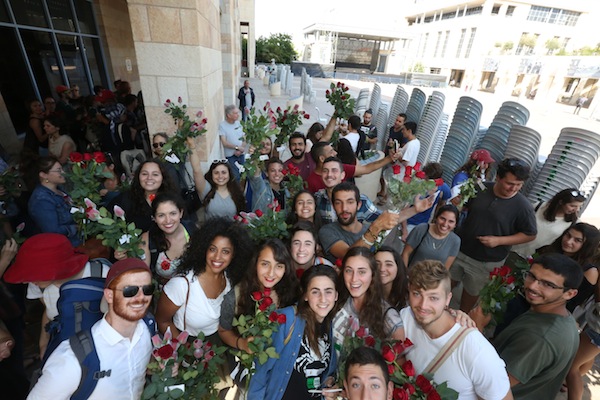
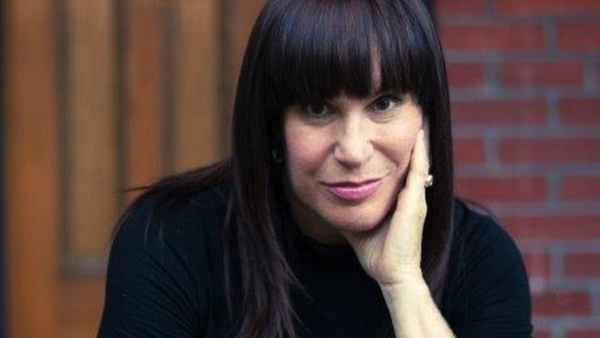
Adrienne Gold is a participant in this year’s international Shabbat Project, Nov. 15-16. (photo from Shabbat Project)

FOMO: fear of missing out. Four letters that encapsulate the human hankering for absolute control, and the profound anxiety we suffer from knowing we will simply never satisfy it.

FOMO is an impulse exacerbated by social media, by scrolling through the Facebook, Instagram and Snapchat lives of others, consciously and unconsciously measuring ourselves up to their non-existent standard of living. Comparing our brats to their seraphs, our tiresome drudgery to their idyllic island getaways, our 1980s-style kitchens to their gleaming open-plan masterpieces. And, while social media does not itself cause narcissism, it certainly can help flick the switch of those tendencies latent within us. Especially those of us who suffer from FOMO by nature.

When I was a young girl, I constantly worried that I had missed something, anything that would change the tone and balance of my carefully curated life. In our family, kids came in for the night “when the lights went on” in the street. Many of my neighbourhood friends could stay out later than that, and I remember like it was yesterday sitting in my room fretting over the potential new allegiances that would be formed without me; the stories and games and fun that I would not be privy to. I would be gripped by a terror that things would not be “as I left them” and that the next day would begin leaving me in the dark.

This mindset remained with me through my teens. Wherever I was, I wondered what was happening somewhere else. Whoever I was speaking with, at whatever party, my eyes roved the room to see what else was happening, who else was there? It was as though I had internalized that whatever I was engaged in could not possibly be where the “action” was; that I was missing something that could only happen if I were not there. And this unease continued into my dating life and well into my 20s. There was no me without my agitating the universe, without my scrambling and “hustling for worthiness.”

So, imagine my horror when, many years later, I learned about Shabbat. No phone. No computer. No car. No shopping. No way! What possible benefit could there be in living 24/6 in a 24/7 world? And what if someone needed to reach me? What would I fill those gaping 24 hours with? I was a human doing, with no clue how to be. Or who to be.

Yet, in that struggle with the very idea of Shabbat came the deep epiphany that radically changed not just my world, but my psyche. In advance of this year’s international Shabbat Project, which will be taking place in cities around the world Nov. 15-16, I’m inspired to share this journey.

I was 40 when I started to keep Shabbat. (How that came about is too lengthy and labyrinthine a tale for this space.) Married with two children, deep into my career and as afflicted by FOMO as ever. Nevertheless, I was determined to do this. While the anxiety clung in the early stages of my “disconnecting in order to connect,” it was less than a year before I began to understand something that had eluded me my entire life – apparently, the world turned and ran quite nicely without my help. The control I was seeking could be found by relinquishing it. The Mishnah tells it straight when it says, “Who is rich? He who rejoices in his lot.” I learned to be still, to rejoice in my lot, to be in the moment. I felt rich.

In short, Shabbat forced me to stop trying to play God, to stop long enough to recognize that He did just fine without me. I discovered that “letting go and letting God” gave me the freedom to find value and purpose, and even joy – not in productivity but in simply being. I felt in touch with my soul and grasped in a deep sense its primacy over the body.

Over 20 years have passed since the therapeutic benefits of Shabbat first liberated me from my FOMO and gifted me perspective and clarity on what it means to be a human being; since I first tasted the indescribable spiritual delights of the Jewish day of rest.

Today, I have the pleasure and the privilege of introducing thousands of women every year to Shabbat and more. Momentum – formerly known as the Jewish Women’s Renaissance Project – has, to date, taken more than 18,000 women from 27 countries on an eight-day journey to Israel to grow as people, connect to Jewish values, engage with the Jewish homeland, foster unity not uniformity, and return to take action as leaders in their communities.

As a leader on these trips, I have seen thousands of women try to make Shabbat more meaningful in some way or another. These women saw the power of what disconnecting in order to connect might do for their families, and for themselves.

Shabbat is the only mitzvah described in the Torah as a “gift.” Tragically, it’s a gift that too many of us never take the time to unwrap. I was one of them. What I didn’t understand was that ceasing to create would make me more creative, that not exerting myself would give me more strength, that being where I am, limited, constrained, here and nowhere else, has alerted me to the joy in my heart and in my life.

You were wondering about that pesky FOMO? It has become JOMO: joy of missing out.

Adrienne Gold, a participant in this year’s international Shabbat Project, was a fixture on Canadian television for more than 15 years, hosting her own daily fashion and beauty program. Today, she is a trip leader for Momentum (formerly, the Jewish Women’s Renaissance Project).
People are not bricks in a wall

Shabbat, Nov. 2
Noach, Genesis 6:9-11:32
Haftarah, Isaiah 54:1-55:5

W.C. Fields said, “Never work with animals or children, [they steal the spotlight].” Though no one ever accused him of being a Torah scholar, his insight was certainly applicable to last week’s Torah portion.

Parashat Noach, the second portion in the Book of Genesis (and my bar mitzvah portion) is perhaps the most universally known and, at least by children, most adored portion in the entire Torah. This is in part, no doubt, because it has not one animal, but all animals – and they come in pairs! So beloved and recognizable is this Torah portion that we tend to forget that there is more to it than the animals coming on the ark, two by two, the dove sent to find dry land, the rainbow, and our ancient ship builder, Noah. Tucked in at the end of the portion that bears his name is a small, poignant story about how the people (Noah’s descendants) focused their energies after the waters and fear receded, and they were once again on dry land.

We are told: “All the earth had the same language and the same words … they came upon a valley in the land of Shinar and settled there…. Then they said, ‘Come, let us build a city with a tower that reaches the sky, so that we can make a name for ourselves and not be scattered over all the earth!’” (Genesis 11:1-:4)

A midrash explains: “Many, many years passed in building the tower. It reached so great a height that it took a year to mount to the top. A brick was, therefore, more precious in the sight of the builders than a human being. If a man fell down and met his death, none took notice of it: but, if a brick dropped, they wept, because it would take a year to replace it. So intent were they upon accomplishing their purpose that they would not permit a pregnant woman to interrupt herself in her work of brick-making when she went into labour. Molding bricks, she gave birth to her child and, tying it round her body in a sheet, she went on molding bricks.” (“Yashar Noah,” in Louis Ginzberg, The Legends of the Jews, 1909)

How do you measure your day? I once asked my friend who is a bricklayer this question, and he explained that the universal standard for a good day of bricklaying is 1,000 bricks day. It got me thinking, what would my 1,000-brick-day look like? What is my universal standard for a successful day?

As a parent, I could say it’s getting all the kids washed, fed, off to school and then to soccer or hockey, and back home again. Then it’s getting them to do their homework, brush their teeth and get to bed at a reasonable hour.

As a working adult, I could say it’s getting to work on time and responding to all my emails and messages – the modern-day equivalent of bricks. Then it’s meeting with constituents, handling synagogue programs and business, and getting home in time for dinner with my family.

What makes those days good days is not the quantity of work I do or the number of interactions I have, it’s the quality. The bricklayer, if reasonably competent at his task, can be irritable, antisocial, half asleep and day dreaming as he lays each brick. He can take his anger out on the bricks; he can curse at the bricks as he shleps them up the wall. He can listen to music, talk on his cellphone; it doesn’t matter. As long as the wall is solid at the end of his day and it contains 1,000 new bricks, it’s a good day of bricklaying.

But people are not bricks: we can’t take out our anger on people without consequence. We can’t ignore them or tune them out if the purpose of our day is to interact with them with care, compassion and attention. The great sin of the Tower of Babel’s builders was that they treated people like bricks and bricks like people. They wasted the one thing that set them apart from machines, which, had they existed in ancient times, could have helped build the Tower even better – they neglected their own humanity. When the bricks of our life become more important than the people in it, we, too, build a tower that is an affront to the purpose of our creation.

The midrash continues that, after God confounded the people’s language and scattered the people throughout the globe, the tower

remained: “a part sank into the earth and another part was consumed by fire; only one-third of it remained standing. The place of the tower has never lost its peculiar quality. Whoever passes it forgets all he knows.” (ibid., Ginzberg)

When we treat people like bricks, we forget what we know about ourselves and about others. We forget that the measure of our day is not how many bricks we lay, how many emails we answer, how many lunches we pack, how many children we shlep: the measure of our day is whether each person we touch, including ourselves, feels valued as a person, a blessing and a gift from God in our lives – not a brick.

Rabbi Dan Moskovitz is senior rabbi at Temple Sholom and author of The Men’s Seder (MRJ Publishing). He is also chair of the Reform Rabbis of Canada. His writing and perspective on Judaism appear in major print and digital media internationally. This article originally appeared on reformjudaism.org.

From beginning again

Recently, I decided to conquer an inner anxiety and do something new. It wasn’t skydiving or anything dangerous. I was hoping to follow a pattern and sew myself some clothes. I write knitting patterns, so am very familiar with the notion of “winging it” and making my own design, but I needed to go back to the beginning with sewing.

As a teen, my mom insisted I take sewing lessons and my dad did them with me. (My dad was good at it and made himself a bathrobe and the upholstery for a convertible he restored!) The sewing assignment was to counteract my terrifying enthusiasm for my mom’s fabric and yarn stash. I’d dive into her stuff, grab scissors, cut fabric up and make things. For instance, I made myself shorts out of some old Winnie-the-Pooh curtains – and my mom was livid. Why? Well, she’d sewn those curtains for me as a kid in the first place. As a teenager, I couldn’t figure what she was saving them for, and I likely upset her by “taking her stuff” and hurting her feelings. She made something, and I remade it without asking. Worse than that, I didn’t use a pattern to do it!

My mom’s discipline as a seamstress came from required dressmaker/tailoring coursework she’d taken at Cornell University. When she was a student there, young women had to take home economics. My mom already could sew like nobody’s business, but she learned a lot from those required courses. It made her crazy to see me break all the rules.

Her reaction to my freeform creativity is probably what made me so anxious about my ability to follow a pattern as an adult. It was a mental block. Even though I am fully capable of it, I still feel anxiety when I face the tissue paper cutouts and instructions.

Now that I have sewn one dress, following a pattern exactly, I’ll let the truth out. I’m halfway through a second sort of vest/tunic based on the first dress pattern, and I’m already winging it. Once I started again from the beginning, I regained my crazy freeform gusto. I can’t hold back!

Each year, we, as a Jewish people, start something right from the beginning. We begin reading the Torah, starting with the creation of the world. We jump into B’reishit, Genesis, and we hear a familiar story. Some people roll their eyes, saying, I’ve heard this before. However, like learning anything new (sewing, for instance), the learning curve is steep. There is a lot in there.

As a sewer, I saw things I missed the first time I followed a pattern. I didn’t do something wrong, I was just less practised before; I was a beginner. Those of us who have been studying Jewish texts every year, reading the Torah portion or commentaries or Midrash – well, we all start out as beginners and eventually become more immersed in the material. There is always something rich, new and different to consider or pursue as we read it again.

It’s like rereading a favourite novel. Now that I know how it’s going to end, I don’t have to rush. I can enjoy all the twists, the foreshadowing, the way the writer uses the language in telling us the story. I see and understand things that I might have missed in a first reading.

I’m not going to lie. Just like sewing, knitting, cooking or building something you’ve made before, rereading the text can feel rote, like you are on autopilot. Sometimes reading a familiar text is actually an opportunity to meditate on something different altogether.

This morning, I dug into making that vest because I needed something with pockets to go with my Shabbat skirts or dress pants. I wanted to make something that would come out OK in a life or world that sometimes seems very unpredictable.

By the time you read this, Simchat Torah and the Canadian federal election will be weeks over, but our new year is really just beginning. It’s a time of great potential, even as the light fades earlier each day. We have so much good and creative work ahead of us. Rereading B’reishit gives a chance to relive something magical and important to our identity as Jewish people – an origin story. At the same time, the characters of Genesis offer us insights into today, into our lives, identities, families and communities.

It’s true that sewing is an old-fashioned skill that I’m getting a hold of again. However, like Genesis, we can say “Look! Everything old is new again!” and jump into learning with emotion – and enthusiasm.

Joanne Seiff has written regularly for CBC Manitoba and various Jewish publications. She is the author of three books, including From the Outside In: Jewish Post Columns 2015-2016, a collection of essays available for digital download or as a paperback from Amazon. See more about her at joanneseiff.blogspot.com.


A musical tribute to Denburg

Moshe Denburg’s music will be featured in a tribute concert by the Orchid Ensemble on Nov. 10 at the Annex. (photo from Orchid Ensemble)

The Orchid Ensemble is giving composer Moshe Denburg a most appropriate gift for his 70th birthday – a concert.

The Nov. 10 tribute at the Annex will feature Denburg’s music, as well as the world première of a new work inspired by the melody of one of his first recorded songs. Denburg has collaborated with the Orchid Ensemble over the years and has been a driving force in intercultural music in Canada, including being the founder of the Vancouver Inter-Cultural Orchestra, in 2001.

On the Orchid Ensemble’s tribute program are the three pieces Denburg wrote for the group’s Road to Kashgar (2001), which was nominated for a Juno Award; “El Adon” (2009), a four-movement work that will be performed consecutively as a suite for the first time (one movement being a world première); “Petals of the Flame” (2012), which will be performed with flamenco dancer Michelle Harding; and the North American première of “In Midstream” (2010), a solo zheng (Chinese zither) work performed by Dailin Hsieh.

The icing on the cake, so to speak, will be the performance by the ensemble – Lan Tung (erhu/Chinese violin), Hsieh (zheng) and Jonathan Bernard (percussion) – of “And Gather Our Dispersed from the Ends of the Earth,” by Denburg’s nephew, composer Elisha Denburg.

“I haven’t heard it yet, so I can’t say much about it at all!” said the elder Denburg. “As he has said, it is based on a musical melody of mine, which I set to the liturgical text ‘Gather our dispersed from the ends of the earth….’ This song appears on one of my first albums, and was recorded in New York City in the mid-’70s with a certain well-known ensemble there called the Neginah Orchestra. For many years, it received regular airplay on Kol Israel Radio. I am really looking forward to hearing what Elisha did with it. I will plug him here – he is a composer of depth and originality.”

The younger Denburg’s music has been commissioned, performed and recorded across Canada, as well as in the United States. The award-winning composer has collaborated with numerous artists and his music has aired on CBC Radio 2. Essential Opera commissioned him, with librettist Maya Rabinovitch, to create a one-act chamber opera, titled Regina, about the first female rabbi, Regina Jonas, who was ordained in 1935.

About how his uncle’s melody inspired him, Elisha Denburg told the Independent, “It is a song that invokes very specific and special memories for me, singing around the Shabbat table with him and my family when I was young. It also espouses a key Jewish value: the strength of community. This is why I always try to incorporate it into my chanting whenever I help lead Rosh Hashanah services at my synagogue in Toronto (First Narayever Egalitarian Congregation). In composing a new work for intercultural trio, inspired by this melody, I am attempting to give back to him and our community the musical and spiritual gifts I have been so fortunate to receive in my life so far.”

In looking back at his professional life and how his composing has evolved, Moshe Denburg said, “At the beginning, I was mainly a songwriter and melodist, though I did take it seriously and I still consider a good song and a well-formed melody to be a real achievement. However, over the years, I delved much more deeply into the art of composition, and by that I mean writing for larger forces (like orchestras) and utilizing a broader musical language.”

Denburg has been creating music for almost all of his 70 years; his first composition coming before he was 10 years old. “As a child,” he said, “I improvised melodies, even at the age of 4 or 5. I believe it was when I was 8, I improvised a melody to the words of the synagogue prayer ‘Hashiveinu Hashem eilecha …’ (‘God, bring us back to you …’), and it stuck. It was very cantorial, as this, being the son of a rabbi, was my first influence and inspiration – the modes of synagogue prayer.”

The interest in world music came later. “For many of my generation,” said Denburg, “this connection with and attraction to the music of other cultures started in the 1960s, with the Beatles and others, who were incorporating non-Western instruments – tabla and sitar, for example – into their works. It was a great new stream to draw upon, in order to create something new and exciting. I still think of intercultural music-making as having unlimited potential, with a much larger palette of sounds, and a noble endeavour and homage to everyone’s humanity.”

Retirement is not in Denburg’s plans. He said, “There are three prongs to my musical life, which continue unabated:

“1. Tzimmes, my Jewish music ensemble, is back in the studio, working on some tracks both old and new. Some tracks were begun in 2005-06 and have sat on the back burner for many years. Some pieces are newly composed and arranged. I hope to release them, perhaps as an album or perhaps singly online, over the next year or two.

“2. The Vancouver Inter-Cultural Orchestra (VICO) continues to be a going concern and, though I have stepped back from being hands-on in the organization, I am still involved creatively, contributing compositions and participating in a variety of concert and recording projects.

“3. Apart from the VICO, I am still a composer for hire. In fact, Lan Tung, the leader of the Orchid Ensemble and my musical colleague of many years, recently initiated a project that would see me, funding permitting, commissioned to write for another intercultural ensemble of hers, the Sound of Dragon Ensemble.”

In addition, Denburg has at least two “bucket list” items: “Writing a large-scale work of many movements for the full Vancouver Inter-Cultural Orchestra (25-30 players); continuing to record my works, both Jewish and intercultural.”

For tickets to And Gather Our Dispersed from the Ends of the Earth – Moshe Denburg Tribute Concert at the Annex on Nov. 10, at 4 p.m., visit mosheorchid.brownpapertickets.com.

A dose of humility, gratitude

Between Rosh Hashanah and Yom Kippur, there were lots of opportunities for reflection and self-examination. I had a helpful reminder when I recently taught a workshop on recycling and reuse in fibre arts.

I worked as an English, writing and adult education teacher when I was in my 20s, and I’ve taught off and on ever since. Lately, I’ve mostly taught fibre arts, but I enjoy teaching in general. Often, as we moved for my husband’s academic life, I’d give up my teaching job, uproot myself and try again in the next place we lived. It was a challenging situation. A couple of moves ago, I switched over to writing, editing and design, and only occasional teaching. Now it all has to fit in around my kids’ needs as well, so I’ve taught a lot less in recent years.

My wake-up call came when I checked in at a teaching venue. About six years ago, I helped create the festival that hosted my workshop. First, the volunteer asked who I was and what I needed. I pointed to the class list and said I was teaching. The volunteers started chatting with me, “Oh,” they asked, “Do you knit?”

“Well yes,” I replied. “I write knitting patterns.”

It went from there. They had no idea who I was at all. I explained that I had been a teacher at the festival more than once. It came up that I’d written books on the subject and, if they couldn’t take my class, as they were volunteering, they could download my designs online and learn that way.

It continued when they rushed into my classroom five minutes into the workshop to hand out name tags. (They’d forgotten them.) I smiled and said we already had them. “Oh,” they responded, “someone else gave them to her!” I had to smile back and say, “I brought them myself – something I’d learned from helping to start this festival.”

We live in an age of constant social media bombardment and self-marketing. If we aren’t always in our profession’s limelight somehow, it’s possible that no one will know us; that anything we’ve accomplished is irrelevant if we’re not at the top of somebody’s Instagram or social media feed.

This encounter reminded me that, even if I’m teaching, being paid and my bio is up on the website, well, I’m a nobody like everybody else. We all put on our pants one leg at a time. We may think a lot of ourselves, and that’s well and good, but is there any reason to think that? (In my case, not really!)

From Selichot up to Yom Kippur is when we’re supposed to focus on self-examination and make apologies. We make space and time to think about when we missed the mark and how we can do more. We have to reflect on whether we have run away from our responsibilities or failed in our lives. How can we do better at keeping our promises, and go beyond?

On Yom Kippur, we read the Haftorah portion of the story of Jonah (Jonah 1:1-4:11). This is a hard story to hear and I always find myself with conflicting emotions. I mean, who thinks they can get a direct order from the Almighty and then take a boat ride in the opposite direction? Is it normal to get thrown overboard and swallowed by a whale? Not so much. (It’s a whale of a tale!)

Once Jonah gets to Nineveh, he does what he is asked to do – and the people respond. They atone. This doesn’t please Jonah either. Jonah wishes that they were punished rather than forgiven for their previous bad behaviour. He wants retribution rather than compassion.

Jonah is human, like all of us. He learns what it means, eventually, to lose everything. He is abased and despondent. It’s miserable, but he learns a lot.

After my class, which went very well, by the way, and was a lot of fun, I realized that I was pitying myself, like Jonah. I spent time thinking, I’ve lost everything, nobody’s heard of me anymore.

Avoiding the great big pity party, I resolved that I should be grateful. I’d had fun and earned money in my classroom. When others recognized me later that day, I felt grateful and tried to celebrate the connections I had made in previous years.

For me, having twins and some health challenges has meant that I’ve had to adjust my worldview. Like Jonah, I’ve had to learn that I’m just not in control. Instead of running away from Nineveh, I gave up some volunteer activities, work commitments and other things when I discovered that I couldn’t manage it. Like Jonah, I can’t blame others who flourished in the meanwhile. Jonah had to sweat it out in the heat, alone, to learn this, but here it is: we’re not in control.

Instead of feeling angry that we’re not recognized or that Nineveh wasn’t punished appropriately for its mistakes, let’s turn the story around. It’s great that there’s a divine power at work who saves Nineveh and Jonah, and teaches him (and me) important lessons about compassion. I hope I didn’t embarrass those volunteers.

A little navel-gazing helped me realize what I needed for 5780: an increased dose of humility and gratitude.

Joanne Seiff has written regularly for CBC Manitoba and various Jewish publications. She is the author of three books, including From the Outside In: Jewish Post Columns 2015-2016, a collection of essays available for digital download or as a paperback from Amazon. See more about her at joanneseiff.blogspot.com.

When Chabad turns up

A still from The Rabbi Goes West: one of Chabad-Lubavitch Rabbi Chaim Bruk’s goals is to see a mezuzah on the door of every Jewish home in Montana.

In their documentary The Rabbi Goes West, filmmakers Gerald Peary and Amy Geller have succeeded in a difficult task – providing a balanced, respectful and entertaining glimpse into what happens in a state with a small, minimally affiliated Jewish community when Chabad-Lubavitch arrives.

A branch of Chassidism, Chabad-Lubavitch was started some 250 years ago in White Russia, in what is now Belarus. After the Holocaust, the movement began its outreach in earnest, trying to reach non-religious and unaffiliated Jews almost literally everywhere in the world. There are now approximately 5,000 Chabad emissaries in more than 90 countries.

While emissaries may receive some seed funding to start a new centre, they must raise their own funds to stay active. In 2006, Chabad Rabbi Chaim Bruk ventured from Brooklyn, N.Y. – Chabad headquarters is in Crown Heights – to Bozeman, Mont., to scout it out. Encouraged by the growing population and the amount of tourism, Bruk returned to Crown Heights to get the OK to set up a centre there. Given the green light, he and his wife Chavie did just that in 2007. The rabbi’s goal? To ensure that every one of Montana’s 2,000 Jewish families has a mezuzah on their door. One of the ways in which he makes headway on this task is by traveling all over the state, asking safe-looking strangers (who are the vast majority, he says) whether there are any Jews in the area and then, when he finds them, boldly introducing himself and his purpose.

As charming and open as Bruk seems, his presence, the ultra-Orthodox Judaism to which Chabad adheres and the movement’s expansionist mission – two more Chabad centres have opened since the Bruks arrived – are not universally welcomed by the Montana Jewish community. The Rabbi Goes West includes interviews with fellow rabbis Francine Roston (the first Conservative woman rabbi to lead a large congregation), who came to Montana from New Jersey in 2014; Allen Secher (co-founder of Chicago’s first Jewish Renewal congregation), who came to Montana after he retired in 2000 but retook the bimah when he found out he was the only rabbi in the state at the time; and Ed Stafman (a former trial lawyer), who came to the state from Florida. The film also includes commentary from local Jews from all four congregations.

While Bruk has limited involvement with the other congregations and rarely, if ever, joins their events – he contends that most of them violate some aspect of Judaism, such as the laws of kashrut, for example – the Jewish community does unite, along with other religious and secular groups and individuals in the state, when faced with neo-Nazi threats and cyberattacks.

The Rabbi Goes West is a documentary well worth seeing, both for its content and the way in which that content is presented. Sponsored by the Vancouver Jewish Film Centre, it screens at the Vancouver International Film Festival Oct. 7, 6:30 p.m., at Cinémathèque, and Oct. 8, 11:30 a.m., at International Village 10. For the full festival lineup, visit viff.org.

In solidarity with neighbours

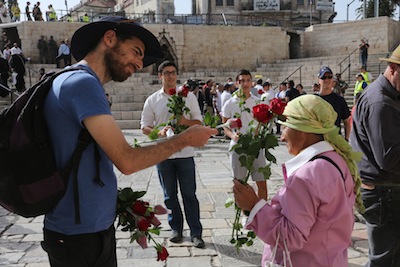
One of Tag Meir’s annual events is Flowers of Peace. Participants hand out roses on the streets of the Old City in Jerusalem on Jerusalem Day. This year, they gave out some 2,000 flowers as a message of peace to Muslims and Christians in the city. (photo from Tag Meir)

To counter what Tag Meir head Gadi Gvaryahu described as incitement by radical settlers through Tag Mechir (Price Tagging), Tag Meir (Light Tagging) was formed.

Tag Meir, which started in 2011, is operated by members of the same segment of religious Zionistic Judaism that started price tagging (attacking Palestinian property and people) in 2009. Members of Tag Meir started visiting victims on both sides of the conflict in an effort to show solidarity and repair physical and psychological damage.

Today, Tag Meir is supported by many organizations and institutions in Israel from all segments of Jewish society – secular, Reform, Conservative, Orthodox and ultra-Orthodox Jews – coming together to stand against hate and intolerance.

Though he now lives in Rehovot, Gvaryahu still considers Jerusalem home. He is the eighth generation of his family to live there.

Gvaryahu was deeply affected by the assassination of Yitzhak Rabin and the fact that the killer had come from his segment of religious Zionism, Kippot Srugot (Knitted Kippot). He decided he had to put his passion for helping animals aside – he is a farm animal behavioural researcher by training – to find ways to mend Israeli society.

“I decided it’s about time to be more involved in public business – not politics, but more education,” said Gvaryahu. “Me and a few other families initiated a synagogue, an Orthodox synagogue in Rehovot, named after Yitzhak Rabin.”

Gvaryahu realized there was something wrong with the education system when he received a call from the head of his son’s yeshivah, demanding his son apologize for an outburst.

“Six months after Yitzhak Rabin’s assassination, a famous rabbi came to my son’s school,” recalled Gvaryahu. “He said that now, with Rabin dead, all his bad things were forgiven. And he didn’t even mention that he was murdered. He just treated him like someone who’d sinned a lot, talking to the whole synagogue, like 400 students, including the head of the synagogue … and they were all silent, except one person – my son.

“My son said, ‘How dare you say that? He just passed away! And, how dare you say that he has sins? He was killed, murdered!’ Then, he left the room, crying.”

When the rosh yeshivah called, Gvaryahu commended his son’s actions and said, “This rabbi should apologize. I’m not going to ask my son to apologize.”

Eventually, they consulted a leading rabbi who declared that Gvaryahu’s son “did a wonderful job and there’s no reason for him to apologize.”

It was at that point that Gvaryahu decided they needed to start their own school.

The first time that Israelis heard the term “Price Tag” in the context of payback was in December 2009. It was dubbed so by a small group of extreme right-wing West Bank settlers who had begun indiscriminately attacking Palestinians.

Gvaryahu explained the psychology behind it: “Something happened to us by Palestinians, by the army, by politicians, whatever … someone will pay the price. The thinking is, we don’t care that you’re innocent, we don’t care that you are Christian, Muslim…. You’re not Jewish, you’ll pay the price. We’ll burn, damage your mosque, your house, your car, your olive trees, and that’s called, ‘Price Tag,’ happening almost daily in the West Bank. Most of them, we don’t hear about. But, after a terror attack by Muslims, unfortunately, we have a bunch of them in the last two months … there’s been attacks by extreme settlers.”

While Tag Mechir destroys, Tag Meir aims to rebuild and bring light. “So, we call the people, the victims, in hospitals, villages, wherever, mosques, monasteries or churches, and we create a solidarity visit,” said Gvaryahu.

photo - Flowers of Peace volunteers on Jerusalem Day
Flowers of Peace volunteers on Jerusalem Day. (photo from Tag Meir)

“Over the years, we’ve gained many, many Jewish, Christian and Muslim friends, and that’s very important. It’s important, because it’s a correct response to that crime, because they want to create terror or fear, especially among Muslims and Christians. So, those visits strengthen the relationship between Jews and Muslims and Christians. We have three Facebook pages – one in Hebrew, one in Arabic and one in English – with 35,000 followers.”

People in Israel not connected to Tag Meir have started solidarity visits by themselves, aiming to mend fences with Palestinian neighbours. “First, you know, I’m happy about Tag Meir,” Gvaryahu said about this development. “Second, that they get that this is the right way to respond to a hate crime or a price tag attack – it’s wonderful. It’s what we want to happen.

“This isn’t something that can be solved quickly. It’s education. We try to educate society, especially the Zionist society, we hope.”

This year, due to the rise in Tag Mechir attacks, Tag Meir held an education symposium on Sept. 10 at the Van Leer Jerusalem Institute, near the home of the president of Israel, Reuven Rivlin. Among the speakers were the former head of the Israeli security agency, Shin Bet, Yaakov Peri, senior rabbis from different segments of society, and the mother of one of the Jewish victims of terror, Sarah Rosenfeld.

“Her son [Malachi Moshe] was murdered and she will give her strong condemning opinion about ‘price tag,’” said Gvaryahu prior to the symposium. “When we came to visit the Rosenfeld family, she said that, if Malachi would be with us, he would join Tag Meir.

“This is very unique about Tag Meir, that we visit both settlers and victims of Tag Mechir on the Palestinian side. It’s not that pleasant an activity sometimes, but we feel it’s very important.”

One of the yearly events Tag Meir hosts is a flower giveaway called Flowers of Peace. They go out into the streets of the Old City in Jerusalem on Jerusalem Day and hand out roses. “This year, we spread 2,000 flowers all over the Old City,” said Gvaryahu. “It’s a symbolic act, sending a message of peace to Muslims and Christians in Jerusalem.”

While Gvaryahu said 40% of the people in Jerusalem are Muslim, Jerusalem Day is only celebrated by the Jewish population. He said some of the songs that are traditionally sung must irritate the Muslim population. “Unfortunately, we don’t celebrate it, in our opinion, in the right way,” he said. “We just march with Israeli flags from West Jerusalem to the Western Wall through the market. Not all the songs are horrible, but a few of them are. So, this is our response. We march with Flowers of Peace.”

For more information, visit tag-meir.org.il/en.

Rebeca Kuropatwa is a Winnipeg freelance writer.

About the cover art – Rosh Hashanah 2019

This year’s Jewish Independent Rosh Hashanah cover photo features a bumble bee on a heartleaf oxeye daisy flower – it was taken in Saanich, B.C., by David Fraser. Many native bumble bees are in decline, a concerning trend given the role they play in pollination of plants, including many food crops. Pesticides, habitat loss and introduced bee parasites and diseases are thought to play a role in this decline.

photo - Rosh Hashanah 2019 cover, by David Fraser

Apples are one of the main symbolic foods we eat on Rosh Hashanah, as we wish for a sweet year, with the help of some honey. Apples are the fruit of choice for this wish perhaps because Rosh Hashanah coincides with the sixth day of creation, when humans – Adam and Eve – were created and they ate the fruit (apple) of the Tree of Knowledge in the Garden of Eden. It could also be that apples symbolize the relationship between God and the Jewish people, as poeticized in the Song of Songs, or that the Zohar (kabbalah) describes paradise as a holy apple orchard.

Regardless of the reason for the fruit selection, apple production is dependent on bees and other pollinators. It would be fitting then for us to wish for more than a sweet, fruitful year, when we are dipping our apple slices into honey. We might consider our role in the decline of not only the bumble bee populations but of the environment at large, and what we can do to reverse it.

Pot roast for Rosh Hashanah

There’s no denying that food is an insanely large part of Jewish life. Whether we’re cooking it, eating it or writing about it, our lives inexorably orbit around it. It’s true that most religions celebrate their holidays, at least partially, through food. But we Jews have taken the concept to nosebleed-worthy stratospheric heights. If someone tells you their son is becoming bar mitzvah, our first question is not “Which shul?” but “What are you serving?” A bris? We don’t ask: “What time?” but rather, “What can I make?”

It’s not that modern-day Yiddishkeit revolves around food, but it kinda does. I’m fully aware that we’re supposed to focus on blessing and elevating the food we eat, since it is meaningless on its own. From a religious perspective, food is merely the vehicle to give us the strength to do mitzvahs and study Torah. I get it. But how can you ignore the deliciousness of a rock-star chicken soup or a melt-in-your-mouth brisket?

When you pair Rosh Hashanah and food, what do you get? Pure joy. And maybe a little indigestion, if there’s excess onion and garlic on the guest list. We all know that the High Holidays are a time to relax with family, eat lovingly prepared meals and go to shul. And, while shul is certainly important, for some, the highlight is the food.

From many years of observation, I’ve deduced that there are three main contenders at the Ashkenazi Rosh Hashanah table: matzah ball soup, brisket and gefilte fish. And maybe chicken. Or salmon, if you’re a true Vancouverite. Anything else is considered “alternative.” Seriously, when was the last time someone served tofu or sunomono at Rosh Hashanah dinner? Asked and answered.

Being firmly entrenched in the carnivore camp, I decided I’m going to make a pot roast for Rosh Hashanah this year. Being a pot roast virgin, until recently I knew next to nothing about this cut of meat or how to cook it. How did I get to be 63 years old without knowing these things? Rhetorical question. Anyway, I did what any self-respecting Accidental Balabusta would do – I Googled it. I found a recipe from the Food Network by Ree Drummond, called Perfect Pot Roast! I followed the recipe religiously (OK, minus the sheitel), except I made a mini-roast (one-and-three-quarter pounds) in case I screwed it up. And I used beef blade roast, which is the same as chuck roast, apparently. I cooked it at 275˚F for two-and-a-half hours. It turned out as scrumptious as something a bubbe would make. Only better. Modesty, wherefore art thou?

Over the years, I’ve heard gossip about pot roast: that it calls for a cheap, tough cut of meat (true); that it’s not really a Jewish cut of meat (see Snobbery 101); and that only goyim eat it (see Racism 101). I’m living proof that pot roast is a very Jewish thing. And, excuse me if I brag, but my newfound pot roast is beyond delicious. Or, to use the vernacular, a mechaye.

I feel compelled to mention something a little odd at this juncture. When I brought my first pot roast and took it out of the package, I noticed it had heavy twine wrapped around it. I wondered whether I’d purchased the B&D variety by mistake. Googling the twine part set my mind at ease. I mean, who wants to serve a kinky Rosh Hashanah pot roast?

Call me clairvoyant or, on second thought, don’t (that’s really not a Jewish thing), but I think you might be chomping at the bit for this recipe. Wait no longer. Allow me to introduce you to the Perfect Pot Roast by Ree Drummond. BTW, it calls for a Dutch oven, but any deep, covered roasting pan will do just fine. (Don’t feel bad, I had to Google Dutch oven, too.) Go ahead, cook it and tell me if this doesn’t taste Jewish.

PERFECT POT ROAST

Salt and ground black pepper
One 3-5 pound chuck roast (same as beef blade roast)
2-3 tbsp olive oil
2 whole onions, peeled and halved
6-8 whole carrots, peeled and cut into 2-inch pieces
1 cup red wine (doesn’t need to be anything fancy)
3 cups beef broth
2-3 sprigs fresh rosemary
2-3 sprigs fresh thyme
2-3 potatoes, peeled and cut into pieces

  1. Preheat oven to 275˚F.
  2. Generously salt and pepper the roast.
  3. Heat the olive oil in a large fry pan or Dutch oven over medium-high heat. Add the halved onions to the pot, browning them on both sides. Remove the onions to a plate.
  4. Throw the carrots into the same fry pan or Dutch oven and toss them around a bit until slightly browned. Set aside the carrots with the onions.
  5. If needed, add a bit more olive oil to the fry pan or Dutch oven. Place the meat in the fry pan or Dutch oven and sear it for about a minute on all sides, until it is nice and brown all over. Remove the roast to a plate.
  6. With the burner still on medium-high, use either red wine or beef broth (about one cup) to deglaze the fry pan or Dutch oven, scraping the bottom with a whisk. Put the roast back into the Dutch oven (or deep, covered roasting pan) and add enough beef broth to cover the meat halfway.
  7. Add in the onions and the carrots, along with the fresh herbs. Add potatoes, too (optional).
  8. Put the lid on, then roast it.
  9. The original recipe says to roast a three-pound roast for three hours or a four-to-five-pound roast for four hours. I personally don’t think this is nearly time enough. When I cooked two two-pound roasts in a single roaster at once, it took six-and-a-half hours to cook. The roast is ready when it’s fall-apart tender. I think the longer you cook it, the more tender it gets. It’s hard to screw this up, unless you undercook it.

Important note: don’t get too close to your Dutch oven when you lift the lid during cooking or you’ll get what I call the “pot roast facial.” I’m not sure your pores will appreciate all that meaty steam. But who am I to say? Just don’t blame me if you get third-degree facial burns. Bon appetit! Or, eat it and weep. From joy, that is.

May you all have a happy, healthy, prosperous and peaceful New Year!

Shelley Civkin, aka the Accidental Balabusta, is a happily retired librarian and communications officer. For 17 years, she wrote a weekly book review column for the Richmond Review, and currently writes a bi-weekly column about retirement for the Richmond News.

Being Jewish in Sitka, Alaska

The mountains of Sitka, Alaska. (photo by Deborah Rubin Fields)

“You have to look at Jews like Bina Gelbfish, to explain the wide range and persistence of the race. Jews who carry their homes in an old cowhide bag, on the back of a camel, in the bubble of air at the centre of their brains. Jews who land on their feet, hit the ground running, ride out the vicissitudes and make the best of what falls to hand, from Egypt to Babylon, from Minsk Gubernya to the district of Sitka.” (from Michael Chabon’s The Yiddish Policemen’s Union)

Unlike Bina Gelbfish, Lisa Busch is not a fictional character living in Sitka, Alaska. The executive director of the Sitka Sound Science Centre, she has lived in the city for 30 years. She and her husband have two daughters and are active in the local Jewish community. Busch described her congregation as laid-back.

photo - A Tlingit totem pole on grounds of Sitka’s Totem Park
A Tlingit totem pole on grounds of Sitka’s Totem Park. (photo by Deborah Rubin Fields)

The congregation functions out of people’s homes. It does not have its own building. What it lacks in a physical facility, however, it makes up for in creativity. “We share Shabbat and holidays,” said Busch. “When my kids were little, we had a tot Shabbat group of moms and kids and the kids did mitzvot, making challah for neighbours, etc.”

Also when her “kids were little, we put on a Purim play every year,” she said. “My family hosts a Passover seder every year and my husband makes homemade gefilte fish out of rock fish or halibut.”

Both of Busch’s daughters had bat mitzvah celebrations. They learned Hebrew via Skype and the family brought up a rabbi to oversee. Accordingly, the ceremonies were a mix of Jewish traditions and local ones.

Busch said Hebrew lessons are taught by whomever “we could find in town who was willing. For example, we have a Coast Guard air station and buoy tender here and, sometimes, someone was just in town for a few years and willing to pitch in with the teaching. Also, one of the more observant Jews here, David Voluck, spent time with my kids when they were older and met with them over Torah studies and Jewish ideas.”

Busch said, “I am so very appreciative of all the community members who helped educate our kids. I was raised a humanist Jew and, while I am confident in our Jewish values, there is always so much more to know, and having people around us who were willing to share what they know was so wonderful. I’m not sure I could have accessed those kinds of people or those kinds of lessons in a larger city.”

When asked who leads the congregation’s prayers and/or Torah reading, Busch said it’s the task of the person who suggests the event.

The Sitka Jewish community has contact with the congregations in Juneau and Anchorage. The city has had visiting rabbis from both places.

Nowadays, with her daughters grown up, Busch participates in Shabbat and holiday gatherings. What she likes best about her congregation is it casualness and flexibility.

photo - A Tlingit bib from a display at Sitka’s Sheldon Jackson Museum
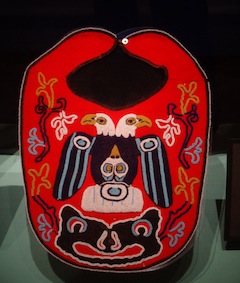
A Tlingit bib from a display at Sitka’s Sheldon Jackson Museum. (photo by Deborah Rubin Fields)

The flexibility of the Jewish congregation is reflected in the town as a whole, as today’s Sitka honours diversity. While this was not always the case – especially during the period of Russian rule (1799-1867) and when Alaska was a United States territory (statehood was achieved in 1960) – the culture of the indigenous Tlingit people is now highly respected.

There are examples, though, of acceptance that hearken to the past. One of the more humourous incidents involves St. Peter’s by the Sea, a small Episcopal church that is more than 100 years old. Before it opened in 1899, Bishop Peter Trimble Rowe and his congregants decided to include a rose window in the construction of the sanctuary. They placed an order with a glass company located in the eastern United States. They waited many months for the window to arrive. When the window finally came, they found that, instead of the Christian symbol that had been ordered as the focal point, there was a six-pointed Star of David. Considering the time it took to manufacture the window and the window’s complex dimensions, they decided to keep it. The church’s website notes that the Star of David window reminds congregants that Christianity grew out of Judaism.

photo - The United States used Sitka as a defensive base in the Second World War. Ammunition magazines, gun emplacements and the headquarters command centre may still be seen at Fort Rousseau historic site
The United States used Sitka as a defensive base in the Second World War. Ammunition magazines, gun emplacements and the headquarters command centre may still be seen at Fort Rousseau historic site. (photo by Deborah Rubin Fields)

Jews apparently began to live in Alaska shortly after the United States purchased the territory from the Russian Empire. A small group of Jews opened up shops in Sitka and, in 1868, a year after the U.S. purchase, Emil Teichman sailed to the city on behalf of the London Fur Co. He wrote in his diary: “the traders, keepers of billiard saloons and dealers in spirits … were mostly of the Jewish race and carried on a more or less illicit trade with the soldiers and Indians, evaded customs and excise duties, and were liable to prosecution at any moment had the administration of the law not been so lax.” (A Journey to Alaska) Interestingly, one Friday night, by chance, he passed a warehouse where some 20 Jewish men were conducting Sabbath eve prayers. Teichman commented: “Jews everywhere, even in the most remote countries, practise their devotional exercises. I should scarcely have expected it in Sitka among a community which engaged in such very disreputable occupations.”

Surrounded by water, temperate rainforests, wildlife and mountains, Sitka (visitsitka.org) is a very pleasant, picturesque and friendly town. It is not hard to understand why Jews have chosen to make it their home.

Deborah Rubin Fields is an Israel-based features writer. She is also the author of Take a Peek Inside: A Child’s Guide to Radiology Exams, published in English, Hebrew and Arabic.

***

Historic decision

In 1938, Harold L. Ickes, U.S. secretary of the interior department visited various parts of Alaska. He wanted to see whether the Alaskan territory could be used as a resettlement sanctuary for persecuted German Jews. Ickes maintained much of Alaska was uninhabited and underdeveloped. He believed that mass Jewish resettlement could potentially strengthen security in a U.S. territory then deemed vulnerable to attack. He had interior undersecretary Harry A. Slattery write a report, The Problem of Alaskan Development. The proposal advocated for the relocation of incoming European refugees into four main parts of Alaska. Opposition came from both within the American Jewish community and from without. Ultimately, the proposal failed, as President Franklin Delano Roosevelt did not give it his backing. Knowing today what happened to European Jewry over the next seven years, this was indeed a sad decision. See Gerald S. Berman’s article, “Reaction to the Resettlement of World War II Refugees in Alaska,” Jewish Social Studies 44 (Summer- Autumn, 1982): 271-282.

– DRF