JSA adapts to the times

The Jewish Seniors Alliance of Greater Vancouver held its annual general meeting on Sept. 10 via Zoom. Because of the pandemic, we were unable to have our usual format – the AGM followed by a gala dinner and the honouring of three volunteers, nominated by the seniors organizations with whom they work. In spite of these obstacles, we succeeded in holding a meeting that dealt with our ongoing activities and resolutions for our future. More than 50 supporters attended online.

JSA’s co-president, Gyda Chud, focused her remarks on the hard work of the peer support program volunteers, who have been putting in extra time, contacting their clients by phone several times a week. She thanked Grace Hann and Charles Leibovitch for their support of the volunteers during these demanding times. And she also thanked the rest of the JSA staff: Liz Azeroual, executive administrator; Rita Propp, administrative assistant; Jenn Propp, graphic designer and webmaster; and Wendy Lo, bookkeeper. She mentioned two new staff members – Margot Beauchamp, quality assurance liaison, and Rochelle Garfinkel, donor relations and philanthropy – and asked for a minute of silence to remember the members and supporters who had passed away over the last year.

JSA co-president Larry Shapiro explained how the formal part of the meeting would be conducted, with the use of the chat line and voting via on-screen polling. The minutes from JSA’s 2019 AGM were approved as well as the agenda for the 2020 meeting.

JSA’s financial statements were presented by treasurer Alan Marchant, then Shapiro gave a short president’s report. In it, he commented on the harmony of working with Chud, and also with the board members of JSA. He emphasized the importance of the peer support program and its work with lonely and isolated seniors. He expressed the hope that JSA’s finances would enable us to continue training and supporting the volunteers, and he urged everyone to stay in touch and to read Senior Line magazine.

Tony DuMoulin, who is in charge of governance issues, presented a special resolution for a change to the constitution. This involved removing the word “Jewish” in the section saying that JSA works with Jewish seniors, since it interacts with all seniors. He emphasized that the name of the organization, Jewish Seniors Alliance, would remain the same, and, after some discussion, the resolution was approved with 82% support.

Next, DuMoulin proposed a special resolution to change a number of the bylaws – that all donors automatically become members; meetings may be held electronically; officers would be elected by the board not by the members; and an extended term for members. These changes were approved by 88%.

Shapiro thanked DuMoulin for all his work on the bylaws, while Ken Levitt, head of the nominations committee, thanked Larry Meyer and Pam Ottem, who are retiring from the board, for their years of work on behalf of JSA. He moved that the number of directors on the board be changed from 20 to 21 and this was passed by 97%. He read out the nominations for the upcoming board and these were passed by acclamation.

Various committee chairs reported next, and these reports are available on the JSA website. The highlights include the following:

Peer support services chair Rita Roling, who is taking over from Ottem, noted that they are presently handling 100 cases and would like to increase the service.

Lyle Pullan, membership, stated that JSA has 517 members and 102 life members. He believes that many of the new members came as a result of reading Senior Line. He said new members should be listed in the magazine as an incentive.

Serge Haber reported on fundraising, including the fact that JSA has a contract with Vancouver Coastal Health for $70,000 annually to stabilize the organization. And I reported for the program committee, which is planning a fall forum for November and an Empowerment Series event in October, to be held via Zoom.

Senior Line editor Dolores Luber thanked Jenn Propp for her graphic design and collaboration, as well as the members of the editorial committee. The July issue of the magazine was different, as there had been no public events and nothing to review, but it was full and informative.

DuMoulin spoke on behalf of the advocacy committee, which has established collaboration with COSCO and anti-poverty groups. They have approached the provincial government about making the enhanced flu shot free for seniors. They want the government to make improvements in long-term care homes, increase pensions and the number of free Lifeline pendants available for low-income seniors.

After a short video showing the work of the peer support program, Haber thanked an anonymous donor, who has been giving $25,000 annually for the past five years, for helping JSA in its mission of outreach, advocacy and peer support for seniors.

Shapiro adjourned the meeting.

Shanie Levin is an executive board member of Jewish Seniors Alliance and on the editorial board of Senior Line magazine.
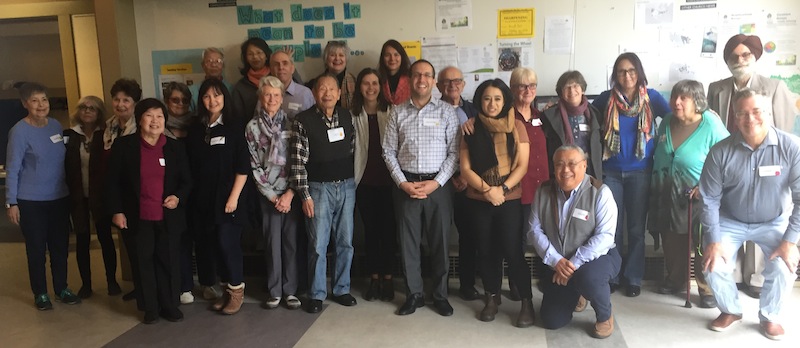
Celebrate spring with music

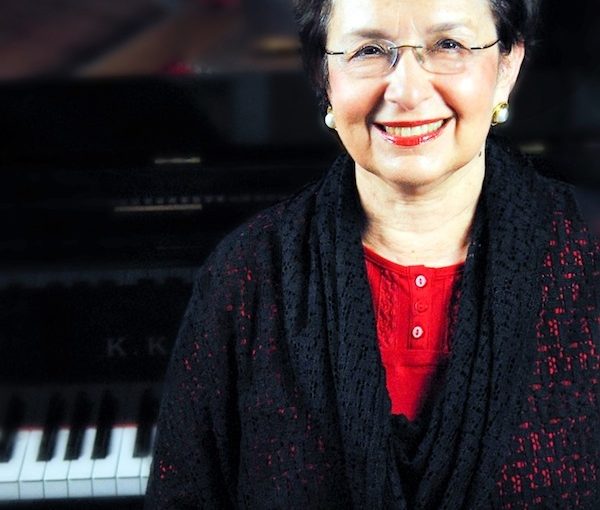
Wendy Bross Stuart leads singers Lisa Milton, Kat Palmer and David Urist in the JSA program With a Song in My Heart, which takes place March 29 at the Peretz Centre. (photo from Wendy Bross Stuart)

This year’s Jewish Seniors Alliance of Greater Vancouver Spring Forum features a concert with music director and pianist Wendy Bross Stuart and singers Lisa Milton, Kat Palmer and David Urist. The program, called With a Song in My Heart, takes place March 29 at the Peretz Centre for Secular Jewish Culture.

“We are planning a program of Jewish-related songs all pertaining to our love of music,” Bross Stuart told the Independent. “‘With a Song in My Heart’ is a famous song by Rodgers and Hart (Jewish writers) from the 1929 musical Spring is Here. Very true that, by March 29, spring will indeed be here!

“We will include that song in our program as an ensemble piece,” she said. “We will have duets – in Yiddish – ‘Her Nor Du, Sheyn Meydele’ and ‘Vu Ahin Zol Ikh Geyn’; and many solos from Jewish-themed musicals, for example Rags, Milk and Honey, The Rothschilds and a song that was deleted from Fiddler on the Roof!”

Bross Stuart has contributed to more than a dozen seasons of Theatre Under the Stars, as conductor, music director and pianist, and has been music director and pianist for many other theatre companies, including the Arts Club, the Electric Company, Famous Artists, Touchstone Theatre, Presentation House and Snapshots Collective. She has composed numerous choral arrangements and recorded four CDs of Jewish music with soprano Claire Klein Osipov.

Of the ensemble that will join her on March 29, Bross Stuart said, “These three singers are very accomplished. They must have an opportunity to sing what inspires them, but which also fits into the theme of the program.”

She noted that Milton is Klein Osipov’s younger daughter. “She spent many years observing her mother’s performances and rehearsals. She knows all the arrangements I created for Claire – perfectly. When I accompany Lisa, it’s magic,” said Bross Stuart. “I see and hear Claire! What a delight!”

In addition to being an award-winning musician, Bross Stuart is an ethnomusicologist. She has written two books – Gambling Music of the Coast Salish Indians and, with John Enrico, Northern Haida Songs. She and her husband, Ron Stuart, collaborate in the making of documentary films shot in South Africa.

“Ron and I just returned from two-and-a-half months in Cape Town, where we started working on our eighth documentary there,” said Bross Stuart. “This one is called Gugulethu Warriors – Making Things Right! It’s a documentary based on the grassroots efforts of township residents to cope with the social issues of crime, safety, unemployment and community cohesion.”

The Stuarts established Cultural Odyssey Films, notes the website culturalodysseyfilms.com, “to provide a platform for the production and distribution of documentary films about contemporary cultural groups and individuals committed to social change.”

The Stuarts also formed WRS Productions, which has numerous producing credits, including the Vancouver Holocaust Education Centre’s annual community commemoration of Yom Hashoah, Holocaust Remembrance Day. Bross Stuart said that, while preparing for the JSA Spring Forum, she, Milton, Palmer and Urist are also working on the Yom Hashoah commemoration.

“After that,” she said, “I jump into rehearsals for Theatre Under the Stars’ upcoming production of Disney’s Beauty and the Beast and Perry Ehrlich’s Gotta Sing! Gotta Dance! – year 26!

Bross Stuart is a co-founder of the Gotta Sing! Gotta Dance! musical theatre program, which is held at the Jewish Community Centre of Greater Vancouver every summer. The deadline for youth to apply to this year’s sessions is April 1.

Not one to rest on her laurels, Bross Stuart recently adapted an indie pop song. “I just completed a new choral arrangement,” she said. “Of one of my daughter Jessica’s new songs. A first for me!” (The original “Simple Little Song” can be heard at jessicastuartmusic.com.)

As to why she is making the time to perform at the JSA forum, Bross Stuart said, “The JSA is run by a group of very talented, diligent, kind and caring individuals. They provide a wonderful service to the community, where we share with one another. It is my pleasure to contribute to this.”

With a Song in My Heart starts at 2 p.m. on March 29. Refreshments will be served and underground parking is available at the Peretz Centre – cars must enter the alley from 49th Avenue, as 45th is closed to traffic. The nominal cost of the event is $5. For more information and to register, call 604-732-1555 or email office@jsalliance.org.

Similar needs across cultures

On Oct. 30, members of different cultural groups gathered to discuss issues facing seniors. (photo from JSA)

Aging Across Cultures Dialogue Tables included an Oct. 30 gathering hosted by Jewish Seniors Alliance of Greater Vancouver at the Unitarian Centre.

The B.C. Ministry of Tourism, Arts and Culture has provided funding for a focused review of services, concerns and challenges faced by organizations providing help to multicultural seniors in the Lower Mainland. In addition to the JSA, Jewish Family Services and the Kehila Society were among the groups represented, which also included ASK Friendly Society, B.C. Community Resources Network, Kitsilano Neighbourhood House, United Way-Better At Home, Collingwood Neighbourhood House, COSCO, 411 Seniors Centre Society, Gordon Neighbourhood House, Marpole Neighbourhood House, Simon Fraser University Gerontology Research Centre, Vancouver Seniors Advocate, Seniors Brigade Society of British Columbia, Seniors First B.C., South Granville Seniors Centre, Tonari Gumi, Vancouver Native Health Society, and West End Seniors Network.

On Oct. 30, Gyda Chud, co-president of JSA, welcomed participants, emphasizing advocacy, reflection and rejuvenation as illustrated in a new JSA video outlining its community services. Grace Hann and Charles Leibovitch, from JSA’s peer support services, were the facilitators for the multicultural dialogue tables. Liz Azeroual of JSA documented on flip charts the ideas and concepts put forth by the participants.

Whatever the needs of seniors in general, discussants agreed that the situation is worse for immigrants and for women; many must choose between either eating or taking their medications. Immigrant women are less likely to be accepted for financial aid. Literacy is an issue, especially when applications for help are online, and navigating the system is more difficult when English is not your first language.

Without family advocacy, many seniors are left to fend for themselves. They need places to meet other seniors who have similar language, customs and experiences. In care facilities, many immigrant seniors are forced to eat unfamiliar foods. Immigrant seniors, especially women, need advocates to get their needs met, but community-based organizations working with seniors often are not well-funded, so help is minimal. The medical system is not structured to treat the multiple problems of seniors.

Loneliness and isolation are among those issues. Family groupings are now much smaller, and young families do not live in the same area as their parents or grandparents. Some seniors are abandoned by their families, or by the death of friends and colleagues. There is a lack of social support, transportation and financial aid to address these problems. Health issues such as depression, fractures that limit mobility, and degenerative hearing and sight increase isolation. LGBTQ+ seniors may also be underserved and isolated. There is a need for better communication all round.

Low-income seniors often move into single-room facilities, if they are available, or some become homeless, living in cars or couch surfing, as they cannot afford higher rents.

Paid caregiver turnover and the deteriorating quality of some care facilities has led families to care for their loved ones at home without adequate financial support. Caregiver burnout is a major concern and accessing certain types of care is a huge challenge: palliative care, for example, requires a physician’s referral.

Population movement and growth, and changes in the healthcare industry, are taking place without adequate planning for the changing needs of the senior population. For all workers, including professionals, who come from a non-English-speaking country, language training is necessary and difficult. Families need paid work in stable jobs and so do seniors. Volunteers are hard to recruit and retain, even though it is meaningful work and can lead to other jobs. In addition to language, many new Canadians need to learn more about technology and Canada’s corporate and general culture. In many areas, discrimination is an issue faced by new Canadians.

All Canadians need to plan for retirement, which is becoming costlier, as the population ages and services become more expensive. Various healthcare agencies need adequate funding to keep the elderly out of hospitals, and the links between different levels of health care and social services (clinics, hospitals and nonprofit agencies) need to be strengthened in order to keep this population from falling through the cracks. Access to transportation is a big part of this, and caregivers should be remunerated for providing home care for seniors. Cultural and ethnic care facilities could play a larger role in reducing isolation, offering spaces where language, food and culture are familiar and where families of seniors can meet.

Seniors housing was considered the highest priority. The need for more single-room affordable housing units, more cooperatives, more roommate pairing services and stricter legislation for affordable-housing vacancy rules were discussed. It was also believed that immigrants and 55-to-65-year-old seniors needed more access to Canada Pension Plan and Old-Age Security.

At the end of the discussion, Dr. Gloria Gutman, from Simon Fraser University’s Gerontology Research Centre, stressed the needs for groups to keep communicating at all levels to help resolve these major seniors’ issues.

Pamella Ottem, MSN, worked for many years in the field of gerontology. As a retired nurse, she has volunteered in the Fraser Health Authority hip replacement program. At Jewish Seniors Alliance, she is a member of the board and chairperson of the peer support services committee.

Scammer awareness

On Nov. 3, the Jewish Seniors Alliance, with COSCO Health and Wellness Institute, presents Privacy and Security in the Internet Age. The JSA annual fall symposium has a different topic of particular relevance to seniors every year and this year’s topic aims to educate seniors on using the internet safely and securely.

There are numerous phone and internet scams that target seniors and separate them from their hard-earned dollars. The scammers often impersonate long-lost relatives or offer excellent returns on investment. One must also be wary of viruses and people trying to overtake emails.

COSCO provides workshops led by trained facilitators to seniors groups throughout British Columbia. In the case of the symposium, the presenter will be Floyd Smith. He will focus on personal privacy and the benefits and risks of technology. He will also explore mobile technology versus a desktop environment and provide an overview of home device systems.

The JSA motto is “Seniors Stronger Together,” while that of COSCO is “Seniors Helping Seniors.” Combining forces, it is hoped that the two organizations can both help and give strength to seniors in the Jewish community.

The symposium workshop takes place Nov. 3 at the Peretz Centre, with registration at 1:30 p.m. and the event beginning 2 p.m,; the cost to attend is $5. Refreshments will be served. Because of construction in the area, access to the Peretz’s underground parking is through the lane from 49th Avenue, the first alley west of Cambie Street. A parking attendant will be at the entrance of the lane at 49th Avenue to direct traffic to the lot, to which there is no access from 45th Avenue.

For more information or to register, contact the JSA office at 604-732-1555 or office@jsalliance.org.

Wonderful night of honours

Jewish Seniors Alliance’s first silent auction, which offered a selection of close to 30 items, from gift certificates from local businesses to paintings and prints. (photo by Susan Curtis)

How do you say thank you to individuals who strive to better the lives of people in the community? Jewish Seniors Alliance’s answer is an appreciation dinner, part of its annual general meeting, which comprises a tribute to three conscientious community personalities. As well, at this year’s AGM on Sept. 19, thanks were given to outgoing JSA president Ken Levitt and new co-presidents Gyda Chud and Larry Shapiro were welcomed.

Levitt’s leadership was praised by Shapiro, who noted the outgoing president’s “ever-present love of life, which inspires everyone and brings out the best in each person whom he meets.”

Chud read a poem, “Captain Ken,” written by JSA honourary life member Binny Goldman. It noted: “You listened with your ear and understood with your heart. Your experience, knowledge and judgment always saw us through successfully – you are a leader, a man above most men.”

Anne Kang, MLA for Burnaby-Deer Lake, spoke about the ongoing efforts of the B.C. government on seniors’ issues, including improved long-term care assistance and training of care workers, and the overseeing of buildings and streets, to ensure that they are accessible and safer for seniors.

Emcee Jack Altman began the honouree ceremony with a tribute to Tzvia Estrin, who was nominated by Yaffa House.

Estrin’s son Avie, who is the current president of Yaffa House, recounted the efforts of his mother and late father Aaron, who worked for 10 years to establish Yaffa House. It opened in 2001 as Western Canada’s first home dedicated to housing community members with mental illness in the context of a Jewish living environment, including kosher food. He said his mother continues full-throttle, being at Yaffa House every day, usually at 6:30 a.m. And he emphasized that “nobody could have achieved what Tzvia has attained and continues to do for the most vulnerable segment of our own community.”

Yaffa House presently oversees four homes across the city, including a newly opened women’s facility. Its mandate is to provide permanent non-transitional housing and has in-house support. It takes people off the streets and tries to keep them off the streets.

Tzvia Estrin thanked everyone and read the poem “Don’t Turn Your Back,” which emphasizes the importance of taking the time to compassionately listen to others’ needs and to help them as lovingly as one is able.

Cindy Charkow, a director of Yaffa House, noted the outstanding, much-needed service that the facility provides and stressed that, “without Tzvia, there wouldn’t be a Yaffa House.”

The second honouree, Jack Wizenberg, was recognized for his work with Tikva Housing Society, which helps lower-income Jewish people find affordable housing. He said, “Seeing Jewish individuals and families who are alone, struggling and having to rely on social insurance and the food bank to survive, touches my heart.”

Wizenberg served on the Tikva board for six years, bringing to the position his 41 years’ experience in property management, as well as a lifelong involvement in a range of Jewish organizations and causes in Calgary, Edmonton and Vancouver.

He said he felt “extremely moved” when reading a Jewish Federation of Greater Vancouver housing needs study indicating that, in 2015, 16% of the Jewish population in Greater Vancouver were living below the poverty line “and, in all likelihood, those numbers have increased over the last four years.” He emphasized that things beyond their control prevented these people from working and, in a blink of an eye, they found themselves in need and relying on social assistance to survive.

Wizenberg began his service at Tikva helping with maintenance and tenant issues at Dany Guincher House. Since the first 11-suite apartment building in Marpole was purchased in 2008, he said, Tikva has made available 18 units of mixed single and family housing in the Diamond Residences in Richmond and another 32 family townhouses will be available in the Ben and Esther Dayson Residences in Vancouver’s Fraserview area. Last year, 100 individuals were helped by the Esther Dayson Subsidy Program, which provided those in need with adequate funds to allow them to continue living in their current accommodations.

Tikva president Shelley Karrel said Wizenberg seemed to have a passion for property management and often joined the property management and/or fire-safety group when doing walkthroughs to evaluate building conditions and the need for repairs. His positions have included treasurer, building committee head and acquisitions committee head.

“He was always seeking to ensure the best for Tikva, the buildings and its tenants,” said Karrel. “He is a person who respects others, is very organized and is a great team player. We are blessed to have Jack as a board member and friend.”

Evening honouree , whose tenor singing voice has brought joy to countless individuals and organizations throughout the Jewish and general communities for more than six decades, was introduced by JSA president emeritus Serge Haber.

“We’re honouring people who love community,” said Haber. “Maurice has helped seniors so very much by enthusiastically and nobly giving his special talents, his outstanding voice to the community, and particularly to seniors. Your father, George Moses, a celebrated rabbi/cantor in Bangalore, India, would have been most proud of you. Without question, you are most deserving of this honour.”

Moses spoke of the pleasure he receives by entertaining, and especially in doing so for senior citizens, emphasizing that “our precious seniors should not be ignored and they should be entertained and respected for their countless contributions to life in the community. The only way that I can thank seniors for all they have done is through my singing. It gives me great satisfaction to see their smiling faces, their faces lighting up when I see them react to a song familiar to them.”

Moses shared some of his many religious/concert participations for seniors, including singing for 17 years at Shabbat services at Louis Brier Home and Hospital. He has sung with the Jewish Community Centre Choir, the Shiron Singers, with Elizabeth Wolak and Muriel Morris, and the Rinat Ensemble, all of which performed for seniors. He also has produced a Vision TV show, Let’s Sing Again, which featured a popular tunes sing-along aiming to revive seniors’ nostalgic memories.

He has sung and danced for the past 10 years with the seniors’ concert group Showtime, which is produced by Beryl Israel, as well as with the Vancouver Jewish Men’s Choir (VJMC), the Kol Simcha Choir (composed of members from all synagogues), at Temple Sholom services with Cantor Emeritus Arthur Guttman, at Beth Hamidrash, at Beth Tikvah Synagogue and at Chabad Richmond with Cantor Steve Levin. He is an active participant with the Choir of the Performing Arts Lodge (PAL), which stages a variety of special shows for community seniors.

Moses said his enduring love for seniors was developed by his interactions with the late Beth Israel Cantor Murray Nixon, who constantly stressed the importance of treating older people with respect.

“I am so pleased,” said Moses, “that this evening is taking place at Beth Israel, truly ‘my home away from home,’ where I served in the synagogue’s choir for 66 years under seven different cantors and six different rabbis – and with Pucky Pelman, my mentor for 45 years.”

Moses expressed appreciation to his “guest of honour,” his daughter Melissa, “who has been by my side through three bouts of cancer, making me drink lots of water, eat healthy foods, and go on long walks at the Southlands.”

He gave “a most sincere thank you” to a number of people: Arnold Selwyn, his “35-year wonderful partner in song”; Morris, a pianist with whom he has performed for 55 years; Miriam Breitman, with the Rinat Ensemble and now the PAL chorus, and PAL co-founder Bill Harvey; Binny Goldman, for her help at Louis Brier services; Stan Shear, VJMC musical director; Cantor Yaacov Orzech with the Kol Simcha Choir; and Jonathan Berkowitz of BI’s Purim Shpiel.”

He ended by singing “Let’s Sing Again” and, with Selwyn, Adon Olam.

A video on JSA’s outreach and peer support activities, produced by Cory Bretz of Heirloom Films, was screened, followed by the JSA’s first silent auction, which offered a selection of close to 30 items, from gift certificates from local businesses to paintings and prints.

The event was co-chaired by Tammi Belfer and Larry Shapiro, with committee members Tamara Frankel, Helene Rosen, Marshall and Marilyn Berger, and JSA staff Elizabeth Azeroual and Rita Propp. Catering was provided by Nava Creative Cuisine; the photographer was Susan Curtis.


Bob Markin is a longtime Jewish Seniors Alliance supporter.

Series finishes on high notes

“Dueling pianists” Lester Soo and Marilyn Glazer entertain at the last Empowerment Series session of the season. (photo from JSA)

Co-sponsored by Jewish Seniors Alliance and the Kehila Society of Richmond, the fifth session of this season’s JSA Snider Foundation Empowerment Series took place at Congregation Beth Tikvah. It more than lived up to the series’ theme this year: “Renewing and Reinventing Ourselves.”

As usual, the program was preceded by a lunch provided by Stacey Kettleman. Beth Tikvah’s Rabbi Adam Rubin did the Hamotzi and Toby Rubin, co-executive director of the Kehila Society, welcomed everyone. Among the 120 or so attendees were members of the Kehila Society and of JSA, as well as a group from L’Chaim Adult Day Care.

The entertainment portion of the program took place in the sanctuary, where Ken Levitt, president of JSA, spoke briefly and Rubin introduced the “dueling pianists”: Marilyn Glazer and Lester Soo, both of whom are accomplished musicians and piano instructors. The two have known each other for 35 years and have been playing duets for much of that time – one piano, four hands. At the Empowerment Series performance, they began with four Hungarian rhapsodies and continued with Mozart’s Eine Kleine Nachtmusik. They then played a number of Gershwin tunes and ended with Cole Porter.

Rubin thanked the pianists for their wonderful performance, which was the last event of the 2018/19 Empowerment Series. The series will begin again in the fall, with a new lineup of events presented by JSA with other seniors groups in the community.

Shanie Levin is an executive board member of Jewish Seniors Alliance and on the editorial board of Senior Line magazine.

Masks, stories and dance

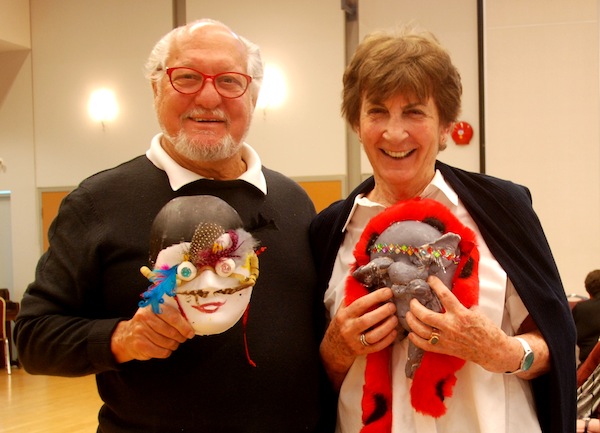
George and Tamara Frankel at Masks, Revelations and Selfhood, the spring forum of Jewish Seniors Alliance, in partnership with the Louis Brier Home and Hospital, which was held May 26 at the Peretz Centre. (photo from JSA)

Since August 2018, Louis Brier Home and Hospital residents have explored themes of personhood and creative expression, crafting masks, narratives and original dances with expressive arts therapist Calla Power and choreographer Lee Kwidzinski. The whole process was filmed by Jay Fox for a documentary.

Power, Kwidzinski and Fox, as well as Louis Brier resident Jennifer Young, who participated in the project, shared their experiences with guests at Masks, Revelations and Selfhood, the spring forum of Jewish Seniors Alliance, in partnership with the Louis Brier. The forum was held May 26 at the Peretz Centre for Secular Jewish Culture.

The four presenters brought with them many of the masks that were made by the Louis Brier residents, which they placed on tables near the audience. Everyone could examine them up close and try them on. This allowed people to experience the changes one feels when masked, hidden from others.

JSA president Ken Levitt welcomed everyone and spoke about JSA’s motto, “Seniors Stronger Together,” noting that JSA’s free peer support programs – which require the financial support of the community to continue – exemplify the power of older adults assisting other older adults. He then introduced Power, who has been working with residents at the Louis Brier for about five years.

The Masks Project lasted seven months, culminating in a program that includes masks, stories, poems, drama and dance. In her summary of the history of masks, Power said the oldest masks, dating from the Neolithic period, were found near Jerusalem several years ago. She explained that masks are used in many cultures as part of religious and/or spiritual ceremonies. In a slide presentation, she showcased masks from different cultures, including African, Indian and local indigenous cultures. Frequently, she said, those wearing the masks would represent “the gods” and be a conduit for messages from above.

Ginger Lerner, Louis Brier recreation therapist, had approached Power about making masks for Purim, obtaining a donation from the estate of Frank and Rosie Nelson that facilitated the project. Power did some research on Purim and discovered that many of the characters were masked; for example, Esther, who masked her origins, and Vashti, who refused to be unmasked. As residents engaged with the project, they discussed such topics as what parts of ourselves do we keep hidden behind a mask.

Kwidzinski, who specializes in dance movement, has 30 years of experience working with older adults, mainly those with dementia and those who are in wheelchairs. She has a dance company in Mission, and the dancers worked with the mask makers to create movements related to the masks and the residents’ ideas. The dancers became the bodies of the mask makers, who chose the movements and the music. The mask makers came on stage with the dancers for the performance.

Young, one of the mask makers, expressed how moving the entire experience had been. She said the group became close, even though they hadn’t known each other well before.

Young said she had been reluctant about the dance aspect but felt that the dancers were extremely supportive and, at the end, she said she found the movements liberating, as if she were also dancing. She said she gained energy and willpower from the experience, and thanked Power, Kwidzinski and Fox for giving her the ability and opportunity to “get up and keep going.”

Fox has produced award-winning films, documentaries, music videos and public service announcements. He was involved in the Masks Project from the beginning. He felt that the journey was as important as the film and the art produced. The film was screened at the forum, and can be viewed at youtube.com/watch?v=YspYE6juiy0.

Gyda Chud, JSA first vice-president, led the question-and-answer session. Members of the audience expressed their appreciation for the information and the beauty of the project. It was suggested that advocacy was needed to have this type of project adopted by other care homes and adult day-care centres.

I wrapped up the afternoon event with a thank you to the presenters, which was followed by snacks provided by Gala Catering.

Shanie Levin is an executive board member of Jewish Seniors Alliance and on the editorial board of Senior Line magazine.
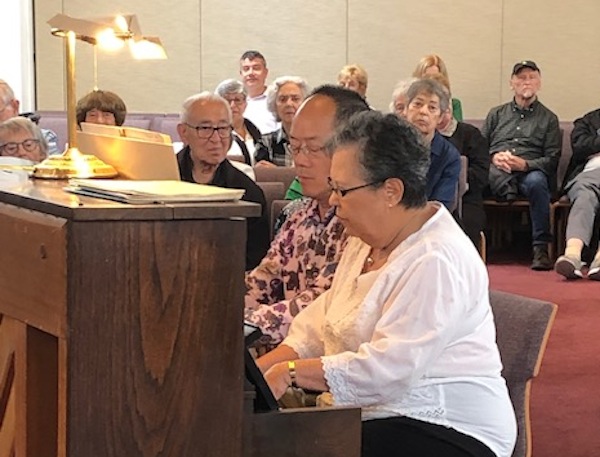
Reinventing ourselves

Keynote speaker Irene Dodek and Bill Gruenthal, from the Temple Sholom 60+ group, at the latest JSA Snider Foundation Empowerment Series event, which took place May 15. (photo by Marcy Babins)

Jewish Seniors Alliance of Greater Vancouver and the seniors group Temple Sholom 60+ co-sponsored the fourth in the 2018-19 JSA Snider Foundation Empowerment Series, which has the theme “Renewing and Reinventing Ourselves.” About 60 attendees met at Temple Sholom on May 15 for lunch, followed by a talk by Irene Dodek on Writing Our Own Stories.

Bill Gruenthal of the 60+ group welcomed the audience and announced the names of everyone who was having a birthday in April and May. He then introduced Ken Levitt, president of Jewish Seniors Alliance, who thanked Temple Sholom for the opportunity to co-sponsor the event with them and briefly outlined JSA’s programs, with particular emphasis on the Peer Support Program. He also explained that JSA’s motto is “Seniors Stronger Together.”

Gruenthal introduced Dodek, one of two charter members of the Jewish Museum and Archives of British Columbia (JMABC).

Dodek is a graduate of the University of British Columbia in anthropology and museum studies. She said she first became interested in stories while growing up in Wapella, Sask., where she heard many family tales from her grandfather and her uncles, who were homesteaders there.

Dodek has been conducting interviews for the JMABC for many years. She outlined a few of her early interviews and pointed out some of the mistakes made by beginners. She offered the following tips, stressing that the most important thing is for the interviewees to be heard. Questions must be open-ended, she said, to give the person a chance to talk and explain. Confidentiality must be maintained, as well as respect for the person, and patience in waiting for answers. Interviewers must give people a chance to think before they answer, she said.

Dodek – who said that history is her passion – was also involved in a Steven Spielberg Shoah Foundation project that required 30 hours of training in three days on how to interview Holocaust survivors. She commented that this was very different from interviewing community pioneers.

The title of her family history, which she wrote, is You’ll Always be My Darling. Dodek took the name from a note her mother once wrote in her autograph book. She did a lot of genealogical research and the book contains many maps and family photographs. The book is in the national archives in Ottawa.

After a number of questions about interviewing and also about writing, Gruenthal thanked Dodek for her stimulating presentation.

The fifth in the “Renewing and Reinventing Ourselves” series will take place on June 24, sponsored by JSA and the Kehila Society of Richmond. Called Dueling Pianists, Lester Soo and Marilyn Glazer will entertain. Lunch is at noon and the program starts at 1 p.m. at Congregation Beth Tikvah. For more information and to register, contact Toby Rubin at 604-241-9270 or the JSA office at 604-732-1555.

Shanie Levin is an executive board member of Jewish Seniors Alliance and on the editorial board of Senior Line magazine.
Volunteering’s benefits

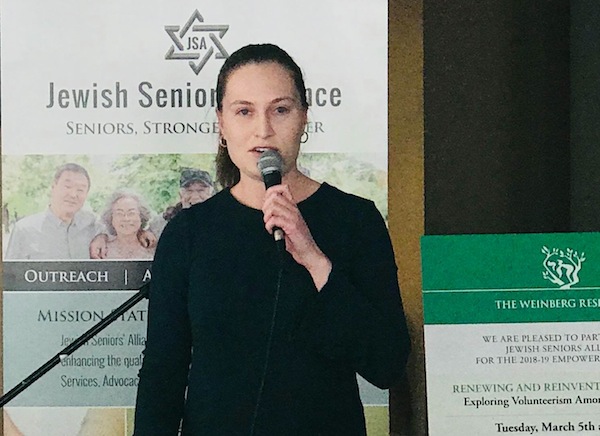
Eireann O’Dea speaks at the March 5 session of the Jewish Seniors Alliance Empowerment Series. (photo from JSA)

The following talk was delivered March 5 at the third session of the 2018/19 Jewish Seniors Alliance Empowerment Series, which took place at the Weinberg Residence. Speakers also included Larry Shapiro, JSA’s second vice-president; Jessica Bruce, volunteer coordinator for the Weinberg and the Louis Brier Home and Hospital; and Vanessa Trester, manager of the Weinberg.

It is relatively common knowledge that volunteering provides tremendous benefits to individuals and to the community at large. Volunteers have the opportunity to bring an increased sense of meaning and purpose to their lives, expand their social network, exercise unique skills and hobbies and, of course, help others in need. The presence of volunteers within a community increases social cohesion, builds trust and creates a “social infrastructure” of support, reciprocity and concern for others.

But what do volunteer roles really mean to those who participate in them? How does one start volunteering, and why do they continue? The Jewish community is exemplary in its provision of services and volunteer opportunities for children, youth, adults in mid- to late life, and the elderly. Yet the personal experiences of those who volunteer in the community, from a research standpoint, are largely unknown. This fact, along with my own experiences of working and volunteering within the community, inspired my master’s thesis, titled, An Exploration of Pathways, Motivations and Experiences Among Older Jewish Volunteers in Vancouver. The findings reflect interviews with 21 volunteers.

The majority of participants have volunteered for most of their lives. They described having parents who were community-minded, as well as adolescent experiences of being a part of Jewish youth organizations or women’s groups dedicated to community service. The expectation from others to volunteer was also discussed. Often, participants were asked to volunteer by their peers, rather than having sought out opportunities themselves. Over the years, this allowed them to experience multiple volunteer roles, as they would often be exposed to another role as a result of their status as a volunteer in the community.

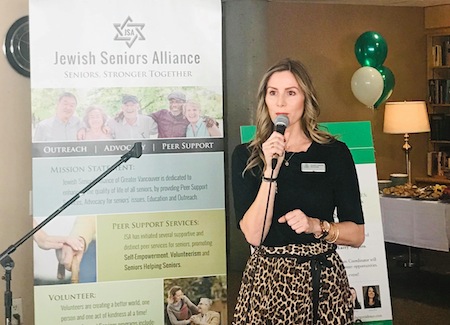
photo - Vanessa Trester, manager of the Weinberg Residence. The Weinberg hosted the March 5 JSA Empowerment event
Vanessa Trester, manager of the Weinberg Residence. The Weinberg hosted the March 5 JSA Empowerment event. (photo from JSA)

Participants found volunteering to be personally rewarding, describing how their roles made them feel better about themselves, kept them busy and productive, as well as mentally fit. Participants were also motivated to volunteer for generative reasons; that is, to help the next generation and the community at large. The desire to pass on Jewish culture was evident, with many describing their efforts and desire to serve organizations that preserved historical documents, worked to support Jewish infrastructure and educate children in the community. They felt that volunteering represented an important part of Jewish life and cited the importance of helping others within Jewish culture and religion. Tzedakah, a Hebrew phrase meaning justice or righteousness, was frequently referenced.

Participants described the connections formed with their fellow volunteers and to the community. Friendships were maintained both within and outside of the context of the volunteer role. Caring for seniors was another common experience among participants. Many took on roles that involved working with older adults, whether it was making home visits to isolated older adults, or assisting with recreational programs. It was also found that participants gravitated towards leadership roles within volunteer organizations and, in some cases, had founded their own initiatives. Participants also found their volunteer roles to be an opportunity to engage in personal interests and hobbies, as well as a chance to use skills they learned during their professional careers.

Volunteering is a highly productive way for older adults to increase their level of activity, foster their interests, help others and continue to be social and connected to their communities. As Canada continues to diversify in terms of ethnic composition, it is essential that volunteer opportunities be made accessible to and inclusive of older adults from all backgrounds. To achieve this, it is imperative that future research in this area encompasses the experiences and stories of older adults themselves.

Eireann O’Dea is a PhD student in gerontology at Simon Fraser University. Her research interests are related to community engagement among older adults, ethno-gerontology and environmental accessibility. She wrote her master’s thesis on senior volunteers in the Jewish community and has recently joined the board of Jewish Seniors Alliance.

New peer counselor grads at JSA

Recent graduates of Jewish Seniors Alliance’s peer support counseling training program. (photo from JSA)

On the evening of March 6, Jewish Seniors Alliance honoured the recent graduates of its peer support counseling training program with the presentation of certificates and a dinner.

Fourteen peer counselors completed the program, which consisted of 14 weeks of training for four hours on Sundays. The certificates were presented by Ken Levitt, president of JSA, and the program’s trainer, Grace Hann, and social worker, Charles Leibovitch. Hann and Leibovitch also serve as support workers for the counselors. They match them with clients and stay involved with their progress and offer help when needed.

Currently, JSA has 100 trained counselors volunteering to help isolated and/or homebound seniors. The counselors are usually seniors themselves and many have impressive education and experience in various fields.

The graduation evening began with Hann and Leibovitch welcoming everyone. This was followed by comments from Levitt and Serge Haber, founder and president emeritus. Three of the graduates – Nancy Bell, Lorraine Drossis and Tessie (Fatima) Rebello – spoke about how much they had learned during the classes. They all mentioned that learning empathy and active listening had contributed to their personal growth. They thanked Hann for her getting them involved and participating in the program and with one another.

Ruby Boychuk, senior peer counselor, offered remarks about seniors helping seniors and Nancy Bennett, another volunteer, was acknowledged for her contributions to the program.

Speakers from the community thanked JSA for the extensive help that its peer counseling offers. Dr. Beverly Pitman of United Way spoke of the significance of the program to the community and emphasized the importance of lobbying the provincial government for more funding. Shelley Rivkin of the Jewish Federation of Greater Vancouver talked about the positive effects of the program and how it corresponded to the Jewish values of tikkun olam (repair of the world). Dorothy Leclair of Burnaby Seniors Outreach continued on the theme of the value of helping seniors and spoke about the Burnaby program.

The final speaker was Kathryn Patterson of Vancouver Coastal Health. She asked the audience to close their eyes and hold hands, then to give one another a hug. It had the effect of relaxing everyone and making them feel as if they knew one another better.

The ceremony and speakers were followed by a buffet dinner, and music and song by David and Julie Ivaz. Many of the graduates got up and danced. As they were leaving, some of the participants remarked that they had had a wonderful evening. 

Shanie Levin is an executive board member of Jewish Seniors Alliance and on the editorial board of Senior Line magazine.