Beautifully acted film

Recent Empowerment series session featured the screening of the film A Song for Marion (Unfinished Song). (photo from JSA)

On Jan. 16, more than 60 older adults gathered in the auditorium of the Jewish Community Centre of Greater Vancouver to watch the heart-tugging film A Song for Marion (Unfinished Song), starring Vanessa Redgrave and Terrance Stamp. This was the second session of the 2018-19 Empowerment series, and it was co-sponsored with JCC Seniors.

Before the film, attendees were welcomed by the smell of fresh popcorn, provided by Lisa Cohen Quay, coordinator of JCC Seniors program. She introduced the film and welcomed the audience. The JSA’s Gyda Chud gave an introduction describing the alliance and the Empowerment series.

The film portrayed the relationship between an elderly couple, husband and wife, with very different personalities. Marion, who is suffering from terminal cancer, is an outgoing and friendly person who is very involved in a community seniors choir. Arthur, on the other hand, is a grouchy character, who is over-protective of his wife and disdainful of the choir. After Marion’s death, Arthur is lost, but he honours her memory by joining the choir that brought her so much joy. His journey of self-discovery helps him build bridges with his estranged son.

This thought-provoking, beautifully acted movie delivered several messages, one of which is to open yourself up to new experiences and not be afraid to be you; to allow yourself to think beyond the scope of what is, and reach for what could be. It was an empowering experience.

After the movie, there was coffee, pastry and shmoozing. The work of Cohen Quay, Liz Azeroual and Raylene Burke made this event successful.

This year’s Empowerment series is on the theme of renewing and reinventing ourselves as older adults. The first session, The Role of Stories, was held Nov. 30, with the Sholem Aleichem Seniors of the Peretz Centre for Secular Jewish Culture. The next event will take place on March 5, 2:30 p.m., at the Weinberg Centre.

Shanie Levin is an executive board member of Jewish Seniors Alliance and on the editorial board of Senior Line magazine.

Reinventing and renewing

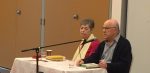
Shanie Levin and Al Stein opened the JSA Empowerment series season Nov. 30. (photo from JSA)

The first Jewish Seniors Alliance Snider Foundation Empowerment Series session of the 2018/19 year was on the theme of “Renewing and Reinventing Yourself as an Older Adult.” Held on Nov. 30, it was co-sponsored by the JSA and the Sholem Aleichem Seniors of the Peretz Centre for Secular Jewish Culture.

Thirty-five “older adults” gathered to listen to stories on the “Reinventing Yourself” theme, read by Al Stein and me. Gyda Chud, JSA vice-president and SAS coordinator, introduced the session by speaking about the goals of JSA in advocacy, education, information and peer support services. She emphasized the aim of JSA’s motto, “Seniors Stronger Together,” before welcoming the readers.

I shared that it had not been easy to find Yiddish stories translated into English that corresponded to the theme, so Al and I had to look to stories written in English by Jewish writers.

Al began with a short parable from Roman times about a 100-year-old man who was still planting trees. I continued with a story by Grace Paley called Goodbye and Good Luck, which is set in New York in the 1930s – an older woman describes her colourful life to her niece.

Al’s next story was by a Canadian Jewish writer, Jack Ludwick, which was about an older woman who is constantly drawn back to the area of Montreal where she grew up and spent her early married years. The session closed with my reading a short section from Sholem Aleichem’s Menachem Mendel.

A discussion about the pleasure and the purpose of passing on stories to the next generation followed, and then Gyda thanked everyone and invited all to tea, coffee and cookies in the lounge.

The second session in the Empowerment Series will be the film A Song for Marion (Unfinished Song), on Jan. 16, 11 a.m., at the Jewish Community Centre of Greater Vancouver with the JCC Seniors. For more information, call the JSA office, 604-732-1555, or Lisa Quay Cohen at the JCC, 604-257-5111.

The Peretz Centre sponsors a program called Exploring Jewish Authors (in English) on the second and fourth Saturday mornings of each month, as well as Reading Yiddish Authors in Yiddish on the first and third Wednesdays of the month at 11 a.m. For more information, call the Peretz Centre office, 604-325-1812.

Shanie Levin is an executive board member of Jewish Seniors Alliance and on the editorial board of Senior Line magazine.

Four volunteers fêted

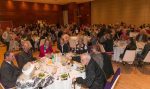
Jewish Seniors Alliance’s AGM was held on Oct. 11 at Congregation Beth Israel. (photo from JSA)

The annual general meeting of the Jewish Seniors Alliance was held on Oct. 11 at Congregation Beth Israel. As is customary, the AGM was followed by a gala dinner during which JSA honoured dedicated volunteers from three community organizations for their service to seniors in Vancouver.

The meeting was called to order by JSA president Ken Levitt. He introduced Rabbi Jonathan Infeld of Beth Israel, who gave a short d’var torah on the importance of community actions and involvement with seniors.

Levitt then asked everyone to rise in acknowledgement of JSA members who had passed away over the last year.

Several speakers offered greetings to JSA: Isobel MacKenzie, seniors advocate of British Columbia; Michael Lee, MLA for Vancouver-Langara; Ezra Shanken, chief executive officer of the Jewish Federation of Greater Vancouver; and Gudrun Langolf, president of the Council of Senior Citizens’ Organization of British Columbia (COSCO).

Reports were presented by JSA treasurer Larry Meyer; on peer support services by Gyda Chud for Pam Ottem; on membership by Binny Goldman; from Levitt, as president; and from the nomination committee by Marilyn Berger, who was especially emphatic, urging people who receive Senior Line magazine and are not JSA members to sign up.

In his report, Levitt emphasized JSA’s advocacy role and outlined five issues in particular for which JSA is advocating:

  1. For the B.C. Ministry of Health to provide the 25% more effective flu vaccine free of charge. It presently costs $75 for the high-dose flu shot.
  2. The implementation of a federal pharmacare program.
  3. For the City of Vancouver to allow applications for the provincial homeowners grant to be done in person, without use of a computer, as many seniors have difficulty using computers or do not have access to the internet.
  4. For the B.C. government to initiate a poverty reduction program similar to those that exist in other provinces.
  5. To reduce the need for food banks – JSA had made a presentation to Federation concerning the Food Security Program.

After the reports were completed, Levitt adjourned the meeting and invited everyone to be seated at the festively decorated tables. About 170 supporters of JSA enjoyed a glass of wine and a salmon or vegetarian lasagna dinner that was followed by the presentation of the awards.

This part of the evening was presented by emcee Ed Gavsie, who called upon Langolf to make the presentation to Sheila Pither. Pither has been active with COSCO for 18 years. For the past 10 years, she has coordinated the organization’s Health and Wellness Institute, promoting its expansion from one workshop topic to more than 40. Pither said she was honoured to have been chosen and was grateful to be at the ceremony with friends and family, at age 86, to accept the award.

The next awards went to Muriel Morris and Gary Zumar of JCC Showtime. Maurice Moses presented to Morris and Arnold Selwyn to Zumar.

Morris has been a volunteer piano accompanist since high school. She has accompanied more than 210 concerts since joining Showtime in 2013 and she noted the pleasure she gets when they perform at seniors facilities and she sees the people come alive to the music and the dancing.

Selwyn recounted how Zumar, with his wide experience in audio-visual technologies, has volunteered his services to many Jewish organizations. Zumar started with Jewish Heritage Players more than 40 years ago and has continued for more than 12 years with Showtime. Selwyn called him a volunteer’s volunteer. Zumar responded by thanking everyone at Showtime for this honour.

Toby Rubin of the Kehila Society then presented the final award to Pat Hoffman. Hoffman became involved with Kehila’s Monday Seniors Luncheon at Beth Tikvah 15 years ago. She has been involved in the working committee as the program has expanded to include activities such as English-as-a-second-language, fitness and entertainment. Rubin described Hoffman as the lifeline of the program, the first to arrive and the last to leave. Hoffman expressed her appreciation for the recognition and said she gets much satisfaction from being a volunteer.

While dessert was served, attendees were entertained by jazz singer Jill Samycia, the door prizes and 50/50 tickets were drawn and, after much shmoozing with old friends and dinner, everyone went home having spent the evening honouring four active seniors and again proving the JSA adage “seniors stronger together.”

Shanie Levin is an executive board member of Jewish Seniors Alliance and on the editorial board of Senior Line magazine.

Symposium provides healing

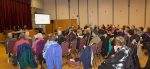
The Jewish Seniors Alliance fall symposium on Oct. 28 was about aging across cultures. (photo from JSA)

The Jewish Seniors Alliance fall symposium, Aging Across Cultures, took place on Oct. 28. The program dealt with inclusivity while Jews everywhere were trying to cope with the horrors of what hatred can do. Still newly mourning the victims of the shooting at the Tree Of Life synagogue in Pittsburgh, attending the symposium seemed strange, but it had healing properties.

The afternoon program was a time of unity and solidarity with other cultures. Attendees learned that loving and caring for seniors in our community and for our family elders is a universal value and touches all hearts in much the same way, as well as presenting similar challenges.

In welcoming the crowd, Ken Levitt, president of Jewish Seniors Alliance, turned the subject of the Pittsburgh shooting over to Rabbi Philip Bregman, who was the event chairperson. Bregman served as senior rabbi at Temple Sholom from 1980 to 2013. He is a founding member of Jewish Christian Dialogue (since 1995) and he now functions as Jewish chaplain for the University of British Columbia and is involved with Hillel BC.

Bregman spoke about the brutal murder of people at prayer. He highlighted the many calls he has received expressing sympathy and condolences. He recalled standing outside a mosque in Vancouver after the shootings at a Quebec City mosque in 2017, where six Muslim worshippers were murdered and 19 others wounded. Among the condolences he received after the murders in Pittsburgh was a message of sympathy from the imam in Quebec.

Bregman emphasized the difference between the word “killing,” which he categorized as meaning accidental, and the word “murder,” which is intentional.

“Where do we go from here?” he asked. “We bury our dead, we mourn and we meet as a community,” he said. “We must never allow hatred to win.”

The audience stood for a moment of silence in commemoration of the 11 murdered and those injured, including several police officers.

The afternoon’s program featured a panel consisting of three accomplished women of diverse ethnic origins.

• Zarghoona Wakil is the manager of the Settlement and Integration program at MOSAIC, a nonprofit organization that helps newcomers to Canada. She also supervises MOSAIC Seniors Club, which provides services to seniors of different cultural backgrounds.

• Sinder Kaur is the executive director of health services at SUCCESS, providing a continuum of quality, culturally appropriate care services to seniors with different needs. She has worked in different leadership roles with a passion to help seniors age in place.

• Deanna Lewis, known as Kalkalath, her ancestral name, was recently elected to the Squamish Nation Council, focusing on elders and their care. Kalkalath is a former teacher, working to preserve her Skwxwu7mesh culture, spirituality and language. Raised with the teachings of her grandfather, she knows the importance of knowing who you are and where you come from.

When Bregman introduced the three panelists, he asked them to share a little about themselves and to address the issue of how their various cultures celebrate seniors.

Wakil shared that she is originally from Afghanistan, then lived in Russia. She came to Vancouver 12 years ago and is now studying at Simon Fraser University for a master’s degree in public health. Kaur is Punjabi-born, lived for 20 years in Hong Kong and moved here 17 years ago. Kalkalath’s Squamish Nation family was removed from Khatsahlano (Kitsilano) in the early 1900s and her main efforts are to teach both adults and children the Squamish language.

Despite differing cultures and traditions, Wakil and Kaur both emphasized that it is seniors who hold history in their hands and only upon opening up their hearts are they able to tie generations together and build upon that knowledge for the future generations.

It was difficult to hear that Kalkalath had to learn about her heritage from others, as her history was erased and harshly taken from her elders. It was she who sought to learn about that past and is now feeling connected again, through the learning of her own language and the ways of her people from her grandfather.

A common thread between all the panelists was that grandparents and grandchildren have a special link that allows them to relax and truly enjoy one another while parents are occupied with the comfort and needs of both these family groups.

All three speakers provided vivid descriptions of the issues and areas of concern regarding elders in their cultures. JSA thanked them for their willingness to share personal stories and stories from their communities. The similarities between cultures superseded any differences.

Claudine Malto, director of community programs at Mount Pleasant Neighbourhood House, then spoke about the house’s new initiative: multicultural circles, where seniors share stories, food, textiles, cooking classes, dance and exercise. She noted that people generally like to sit in “pockets,” which creates a divide. The motivation for this project is to answer the question, “How can we best coexist?”

Larry Shapiro, JSA board member and second vice-president, wound up the afternoon with one of the best vocal advertisements for the Jewish Seniors Alliance that we have ever heard.

Attending the symposium made the sun come out, even on a rainy, tear-filled day.

Binny Goldman is an honorary life board member of Jewish Seniors Alliance.

Barbecue for JSA volunteers

Jewish Seniors Alliance board member Pam Ottem, who is chair of JSA’s peer support program, with Baruch Azeroual at the JSA volunteer barbecue. (photo from JSA)

On Aug. 22, Jewish Seniors Alliance held its now-annual barbecue for peer support services volunteers, in appreciation of their work with seniors. This year’s celebration, attended by about 50 people, was a joyous affair, with food and musical entertainment, and speeches from volunteers.

Most of the attendees at the barbecue were volunteers or staff of the peer support services program, and a number of JSA board members also joined in the festivities. The food for the meal was contributed by the volunteers.

Charles Leibovitch, JSA peer support coordinator, and Grace Hann, JSA peer support volunteer trainer and supervisor, spoke and welcomed everyone before introducing JSA president Ken Levitt, who thanked everyone for their hard work and mentioned some of the issues for which JSA is advocating, such as a universal pharmacare program.

After Levitt spoke, Leibovitch called on Serge Haber, president emeritus and founder of JSA, to say a few words. Haber spoke about the needs of seniors and how JSA is trying to advocate for and fill some of those needs.

Hann explained about a crowdshare in which some of the volunteers had participated – a listening program that takes place every second Monday, 5-6 p.m., on Bute Street at Davie. Hann also thanked everyone who helped set up the event, including JSA coordinator Liz Azeroual and Azeroual’s husband, Baruch, who did the barbecuing.

The musical trio of Dave and Julie Ivaz and their son, Harrison, provided a wide-ranging performance. They played guitar and sang many songs familiar to the audience.

For more information on JSA, its peer support services, the listening and other programs, visit jsalliance.org.

Shanie Levin, MSW, worked for many years in the field of child welfare. During that time, she was active in the union. As well, she participated in amateur dramatics. She has served on the board of the Jewish Federation of Greater Vancouver and is presently on the executive of JSA and a member of the editorial committee.

Musical season ending

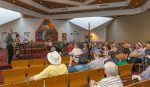
Caviar and Lace entertain at the last session of the 2017/18 Jewish Seniors Alliance Snider Foundation Empowerment Series. (photo by Alan Katowitz for JSA)

On June 25, Jewish Seniors Alliance and the Kehila Society of Richmond co-sponsored the fifth in the JSA’s Empowerment Series program. This year’s theme was “Laughter and Music: Feeding the Soul” and the subtitle for this final event in the season was “Music for our Hearts and Songs We Love.”

Toby Rubin, coordinator of Kehila, introduced the afternoon and welcomed everyone. About 100 enthusiastic attendees dug into the summertime lunch of burgers and hot dogs prepared by Stacey Kettleman.

After lunch, everyone proceeded to the sanctuary to be entertained by Caviar and Lace, comprised of Michelle Carlisle and Saul Berson. The duo performed an eclectic mix of classic, jazz and folk songs. Carlisle plays piano and Berson plays a variety of instruments, from saxophone to clarinet. They both played and sang, encouraging the audience to join in. The mix of oldies, and especially songs from the 1950s, was indeed music to the ears of the listeners, who were familiar with most of the melodies.

A new JSA Snider Foundation Empowerment Series will start in the fall.

Shanie Levin, MSW, worked for many years in the field of child welfare. During that time, she was active in the union. As well, she participated in amateur dramatics. She has served on the board of the Jewish Federation of Greater Vancouver and is presently on the executive of JSA and a member of the editorial committee.

Celebration and call to action

More than 130 people joined the Chai Tea celebrations June 10. (photo by Alan Katowitz)

“Life is not measured by the number of breaths you take, but by the moments that take our breath away.”
(Rabbi Abraham Twerski)

The Chai Tea celebration on June 10 brought together 135 people to support the work of the Jewish Seniors Alliance and to honour Serge Haber on his 90th birthday.

Educator and writer Matthew Gindin emceed the event, which took place at the Peretz Centre for Secular Jewish Culture. Shelley Rivkin of the Jewish Federation of Greater Vancouver emphasized Haber’s effectiveness in bringing the issues of seniors to the fore in the Jewish and general communities, while Grace Hann, coordinator of JSA’s peer support services (with Charles Liebovitch), described Haber as a visionary who created the program because of his love and commitment to seniors. She told the story of a woman, alone, sick with cancer, who had lost both her eyesight and hearing. Peer support services provided her with three levels of support: a peer counselor, a driver and a friendly telephone caller.

JSA coordinator Liz Azeroual and her assistant, Rita Propp, joined Hann and Liebovitch for a tribute to Haber to the tune of “This Land is Your Land.” Music by Dave and Julie Ivaz filled the room, and Julie Ivaz read a summary of Haber’s biography, which was accompanied by a slide show of some of his life experiences. The musicians then serenaded Haber with a medley of his favourite songs.

Ken Levitt, president of JSA, emphasized the importance of “reinventing oneself,” both in terms of venue and occupation. Haber is a prime example: from being a pharmacy student in Romania, to surviving the Holocaust, to reaching safety in Cuba and then, with the help of an uncle, settling in Montreal in 1950 and coming to Vancouver in 1978. Here, Haber ran Kaplan’s Jewish delicatessen from 1981 until 2000. During that time, he began working with seniors – JSA started as a subcommittee of Federation – and he continues to be productive and active.

At the Chai event, Haber recited the prayer, “Blessed art thou, O Lord our God, King of the Universe, for giving us life, sustaining us and enabling us to reach this season.” His wife Elinor passed away seven years ago; they had been married 57 years and have three children, Wanda, Geoffrey and Stephen. Haber has five grandchildren and one great-grandchild. He acknowledged with affection his friend and partner Sheila Gordon, who supports all his endeavours.

Haber lamented that, whereas JSA is in the business of prevention, the government is mainly concerned with responding to the urgent needs of seniors. A public program of prevention would prolong healthier lives for seniors, he said, and eliminate the expensive costs associated with sickness and mental decay.

The 70 volunteers who work with 175 seniors at JSA are not going to be enough, said Haber. “Sometime, somewhere in your life, rich or poor, you’ll need the services of JSA,” he said.

Throughout the afternoon, tickets were drawn for donated door prizes. The 50-50 draw was won by Carole Kline, who donated the money back to JSA. The grand prize of a night at the Grand Villa Casino Hotel was won by Julia Wallstrom.

Helene Rosen and Marie Doduck were the co-conveners of the Chai Tea. Their efforts and work were acknowledged along with that of Gyda Chud and Propp. Delightful portrait caricature drawings by artist Katie Green were available all afternoon. Gala Catering served up the sandwiches and cake. It was a memorable afternoon.

Tamara Frankel is a member of the board of Jewish Seniors Alliance. Shanie Levin, MSW, worked for many years in the field of child welfare. During that time, she was active in the union. As well, she participated in amateur dramatics. She has served on the board of the Jewish Federation of Greater Vancouver and is presently on the executive of JSA and a member of the editorial committee.

Ageism and advocacy

Wanda Morris of the Canadian Association of Retired Persons speaks at the Jewish Seniors Alliance Spring Forum May 13. (photo from JSA)

The annual Jewish Seniors Alliance Spring Forum was held on May 13 at the Peretz Centre for Secular Jewish Culture. Even though it was Mother’s Day, attendance was strong, with 70 to 80 enthusiastic attendees enjoying a lively afternoon presentation and discussion.

Ken Levitt, president of JSA, introduced the program, reminding everyone of JSA’s motto, “Seniors Stronger Together.” He explained that, among other things, JSA is involved in advocating for a national pharmacare initiative, as well as helping older adults become more self-reliant, thus enabling them to stay in their homes longer. He spoke about the Chai Tea, which was held on June 10, and honoured Serge Haber, who has been instrumental in the JSA, on the occasion of Haber’s 90th birthday. Levitt then introduced Wanda Morris, the forum’s guest speaker.

Morris is vice-president of advocacy for the Canadian Association of Retired Persons (CARP). Prior to that, she was chief executive officer of Dying with Dignity Canada, where she led a strategic campaign for legislative change, leading to the Supreme Court of Canada’s decision in the groundbreaking case Carter v. Canada for the right to die with dignity. In the process, Morris established her reputation as a key influencer and go-to commentator in national discussions on issues of importance to all Canadians, particularly on issues pertaining to aging. She brings to CARP years of successful advocacy and policy development, plus a track record of fundraising results and business expertise gained from three decades as a chartered professional accountant. Morris is a regular contributor to the Vancouver Sun.

Morris began by talking about some problems experienced by many elder adults, such as having to spend more than 30% of their income on housing, especially when that income is fixed; the high cost of prescription drugs; the long wait times for medical procedures; the long wait times in emergency rooms; and the difficulty of finding a family physician. In this context, she introduced the audience to the term “GOMER” – “get out of my emergency room.”

There are numerous challenges facing older adults and there are many more of them all the time, she said. For example, there are more Canadians over 65 years old than under 15, 1,000 Canadians turn 65 daily, and centenarians are the fastest growing demographic.

Morris pointed out that ageism is one element that is making life more difficult: it is harder to find work as we age and doctors prefer not to take on older patients, as they tend to have more health issues. There are also many safety issues that involve getting around in the community; for example, the short time green lights allow for crossing the street, the lack of benches for resting and the few public washrooms. In addition, there are often long lines in such places as airport security or in supermarkets. Ageism starts with disrespect and can lead to neglect and abuse, said Morris.

So, what are the solutions? Engagement is the most important factor, she said. Anger is not helpful but active advocacy in the areas of media, politics and bureaucracies can have an effect. The approach must be respectful and concise, she said. Point out when people make ageist jokes but do it in a non-threatening manner, she suggested. And stories of individual experiences can be more effective than long tirades – Morris gave the example of a Sears employee who had worked there for many years and was left with little or no pension.

CARP has more members across Canada than all the political parties combined, and can thus have a strong effect on the political process in their advocacy for seniors. They can work together with other seniors groups for change in such areas as pharmaceutical policy. CARP’s largest groups are in Ontario, said Morris, but the organization is hoping to revitalize the B.C. chapters.

Morris’s presentation was followed by a spirited question-and-answer period. Most of the questions focused on health care and its costs. Morris said it was reorganization rather than more money that could be the solution. As an example of this, she noted the number of seniors taking up acute care beds at a very high cost because of the lack of home care and/or live-in facilities like long-term care. Other topics touched upon were the addressing of incontinence by having more staff for regular toileting; advance directives about death and dying; using the term “rewire” rather than “retire”; and shuttle buses to bring seniors to cultural events, thereby reducing social isolation.

After the discussion, Ezra Shanken, executive director of the Jewish Federation of Greater Vancouver, gave greetings to all and JSA’s Gyda Chud thanked Morris for elevating our voices with new and powerful information focused on current and future solutions. Chud pointed out that stories, as Morris had said, are important not just for children, but also for adult learning. Everyone then enjoyed snacks and desserts by Gala and shmoozed.

JSA is dedicated to enhancing the quality of life of all seniors, by providing peer support services, advocacy for seniors’ issues, education and outreach. For more information, visit jsalliance.org.

Shanie Levin, MSW, worked for many years in the field of child welfare. During that time, she was active in the union. As well, she participated in amateur dramatics. She has served on the board of the Jewish Federation of Greater Vancouver and is presently on the executive of Jewish Seniors Alliance and a member of the editorial committee.

JSA celebrates Serge Haber

On June 10, Jewish Seniors Alliance fêtes one of its founders, Serge Haber, as well as his 90th birthday. (photo from JSA)

One of the community’s most dedicated and inspiring longtime leaders, Serge Haber, will be honoured on June 10, coinciding with a significant occasion in his life, his 90th birthday.

Haber has always cared passionately about community seniors and the Jewish people in general. Their well-being is on his mind constantly and, yes, anytime day or night, he’ll earnestly voice his concerns.

The tribute to this prominent community personality will take place at the Jewish Seniors Alliance (JSA) Chai Tea. The afternoon (2:30-5 p.m.) at the Peretz Centre for Secular Jewish Culture will see the serving of party sandwiches, fruit and dessert, live entertainment by Dave Ivaz Music, caricatures by artist Katie Green, door prizes and more.

Event co-chairs – community leaders Marie Doduck and Helene Rosen – extend “a most sincere and heartfelt welcome to all to attend this special occasion, which will celebrate all of our community’s wonderful seniors, along with the honouring of our dear Serge.”

It is most fitting that this tribute be mounted by JSA, as Haber was at the forefront of its formation and currently serves as its president emeritus. His dedication to the Judaic directive of tikkun olam (repairing the world) has continued in word and action throughout the years, as he has not only initiated JSA and helped the association, but many other Jewish causes, as well.

Current JSA president Ken Levitt stressed that one reason the organization has evolved to offer so many programs and services is because of Haber’s efforts. Among other things, Haber has championed vocally and positively for the quality of life of community seniors.

Haber’s experiences profoundly shaped his character. Born in Romania in 1928 to Leon and Liza Haber, he lived among the horrors of pogroms and the Holocaust, to which he lost family members – and which he barely survived himself, due to fortunate circumstances.

At the end of the Second World War, Haber took two years of university in pharmacy in Bucharest. An extensive “real-life education” followed, when he left Romania in 1947, traveling to and living in Austria, then Italy, France, Cuba, Montreal (in 1950) and Dallas (1967), followed by stays in Toronto, Montreal and, finally – and fortunately for our community – moving to Vancouver in 1978.

Haber attributes the impetus for his extensive community service to his beloved wife Elinor, z’l, who he met and married in 1955 while in Montreal, and to their three children.

“All of my community efforts are due to Elinor’s encouragement and participation – I couldn’t have done it without her,” said Haber. And, as to his children, he emphasized that he wanted to establish a connection to encourage “their recognition of the importance of their being a part of the community, contributing to it … and remaining strongly Jewish.”

Haber’s leadership has seen him serve for decades in key executive positions for a variety of major Jewish organizations, including the United Synagogue of Conservative Judaism (highlighted by a two-year term as vice-president), Congregation Beth Israel (with 18 years of executive, chairmanship and men’s club leadership), Vancouver Holocaust Education Society (passionately urging racial tolerance at its annual symposium and ongoing school programs) and Hillel BC at the University of British Columbia (helping bring about a much-needed new facility). Haber served 19 years on the Louis Brier Home and Hospital board and was a director of the Jewish National Fund for 18 years.

Additionally, deeply religious, Haber started a new Conservative congregation, Shaara Shalom, in Laval, Que., in 1958; continuously helped lead religious services at Vancouver’s Beth Israel; and has taken a key role in daily and Shabbat service leadership at the Louis Brier – for 25 years straight.

In recognition of these accomplishments, Haber has been honoured throughout the years by numerous organizations, including the Louis Brier, as one of its Eight Over 80 recipients; by Beth Israel, with its President’s Award for community involvement; and by Simon Fraser University, which named him Man of the Year, the first Jewish person to be so recognized.

And, he served the community even in his work – owning and operating Kaplan’s Delicatessen for 23 years.

Today, Haber’s children are “always there for him”: Wanda, a social worker, in Toronto; Geoffrey, a Conservative rabbi, in Toronto; and Stephen, in the computer field, in Marysville, Wash. As well, there is his sister, Sidonia, in Tel Aviv, and his dear companion here, Sheila Gordon.

Ever on his mind are seniors and, especially, the Jewish Seniors Alliance.

“I am trying so hard,” he has said, “to do crucial work on behalf of community seniors, whose numbers will double in the next 10 years … and I see JSA becoming the most important Jewish organization in the city because of its training services and resultant volunteers who substantially help community seniors in need.”

Haber has expressed hope that seniors here will soon have their own building, providing a variety of needed services.

“I have an unending love for the Jewish people generally and, in particular, for those in our community,” he emphasized.

Abundant numbers of people throughout the community would affirm that the feeling is mutual.

To celebrate with Haber and wish him mazal tov on his 90th, join the JSA Chai Tea on June 10. Tickets ($36) may be purchased from the JSA office at 604-732-1555 (press 1 for Rita Propp) or at the door.

Bob Markin served on the editorial staff of the Jewish Western Bulletin for 16 years, and has written numerous freelance stories and articles throughout the years. He is a member of the editorial committee of the Jewish Senior Alliance’s Senior Line magazine.

Music helps body and mind

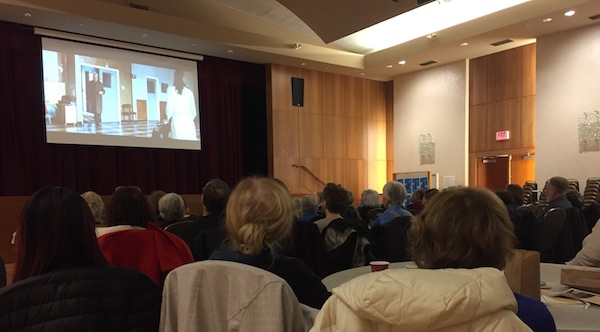
Perla Barabak gave a music workshop on April 17 as part of Jewish Seniors Alliance’s Snider Foundation Empowerment Series. (photo from JSA)

The fourth session of this season’s Jewish Seniors Alliance Snider Foundation Empowerment Series was held with the co-sponsorship of Congregation Beth Israel on April 17. The theme of “Laughter and Music: Feeding the Soul” continued with a program entitled Perla’s Music Workshop.

About 65 seniors were present to enjoy the afternoon event, which began with the regular Tuesday seniors lunch provided by Jewish Family Services. Queenie Hamovich of JFS welcomed everyone and introduced Ken Levitt, president of JSA.

Levitt reviewed some of the JSA programs, including the peer support services. He asked audience members to consider joining JSA and encouraged them to think of volunteering for some of the peer support initiaves. He then introduced the speaker for the afternoon, Perla Barabak.

Barabak believes that music helps the body and mind to relax. It also touches the heart and soul, she said, making it easier for feelings to surface. Thus, music can provide multiple benefits.

Barabak began with some exercises, asking the audience to sound out their names musically. She began with her own name and many people joined in. She talked about active and passive listening; for example, listening at a concert as opposed to hearing background music in an elevator.

Throughout history, she noted, music has been used in communication, movement and at social events (weddings, b’nai mitzvah, banquets).

Songs represent a culture, she said. In this way, music is the song the heart sings. Songs remain with us into our senior years, when other memories may fade. Songs and singing can create pleasure and empowerment.

Barabak then did a guided meditation, getting everyone to close their eyes, listen to the music and imagine a colour. Barabak – who has used music in her work as a psychologist – pointed out how relaxing this is and how music balances our thoughts and feelings. She said she feels that, where there is life, there is music.

As the event ended, many in the audience got up and danced to the music being played.

The next Empowerment Series event – Music for Our Hearts and Songs We Love – will take place on June 25 at Beth Tikvah Synagogue. Caviar and Lace, with Michelle Carlisle and Saul Berson, will perform a mix of classic, jazz and folk songs.

Shanie Levin, MSW, worked for many years in the field of child welfare. During that time, she was active in the union. As well, she participated in amateur dramatics. She has served on the board of the Jewish Federation of Greater Vancouver and is presently on the executive of Jewish Seniors Alliance and a member of the editorial committee.