Reflections on April mission

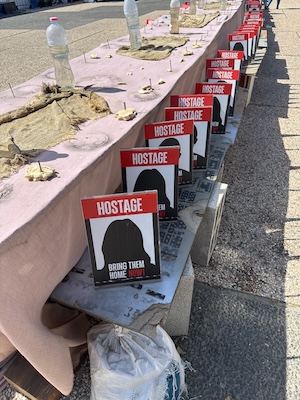
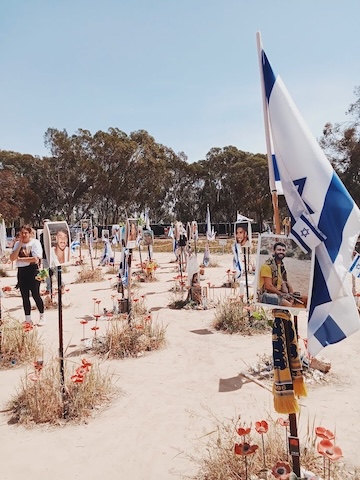
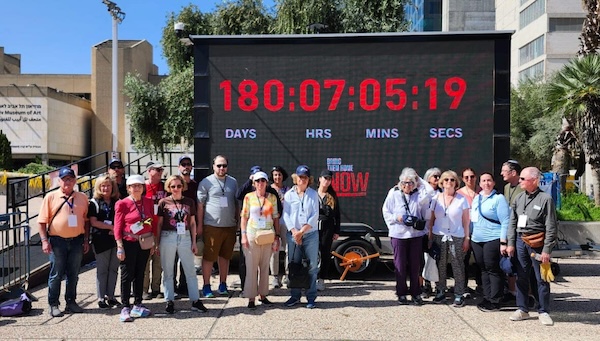
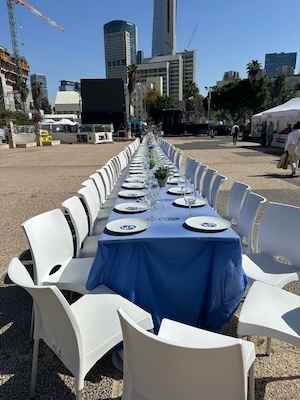
JNF Canada, Har El and Beth Israel mission participants in Hostages Square in Tel Aviv. (photo from Lorraine Katzin)

About 20 volunteers – from Vancouver, Edmonton and Toronto – went on the JNF Canada Bearing Witness Mission to Israel April 1-8. Organized by Jewish National Fund Canada, Congregation Har El and Congregation Beth Israel, the trip was led by BI’s Rabbi David Bluman and JNF Edmonton executive director Jay Cairns. On his Facebook page, Cairns thanks JNF Pacific executive director Michael Sachs, BI Senior Rabbi Jonathan Infeld and Bluman “for spearheading this important mission.” Among the volunteers were Har El members Lorraine Katzin and Karen Shalansky, who shared some of what they experienced with the Jewish Independent.

Some first impressions
(Lorraine Katzin)

Stepping onto the El Al plane from Los Angeles to Tel Aviv reminded me of the olden days of flying – a blanket, pillow, headphones and a bag with a toothbrush, toothpaste and eye mask. Two meals were served and, during the flight, you could help yourself to snacks, sandwiches and drinks.

Walking through Ben Gurion International Airport, you see photos of the hostages still in captivity. When we went through the foreign passport area, it was chilling – we were literally the only people passing through passport control. There were no tourists. Our hotel was quiet as well.

Walking on the promenade in Tel Aviv to Jaffa on our arrival, it felt as if there were no war – people were out on the beach, swimming, playing beach bats, foot volleyball, and jogging.

Tuesday, April 2, was our first full day of touring. We started at Kibbutz Kissufim in the south. We heard stories of the murders and saw the devastation made by the Hamas terrorists. One of the stories that haunts me is that of the chief fireman whose only child, his daughter, and her husband were shot to death in their safe house, then their home was burnt down. Searchers only knew by finding a nose ring and bracelet in the ashes that the bodies had been burnt. 

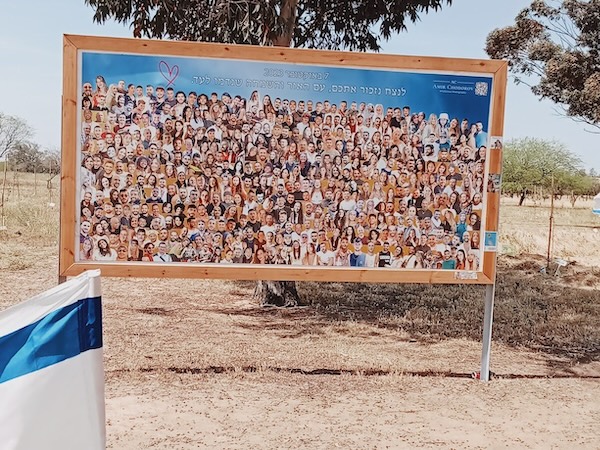
We were very close to Gaza and could hear artillery every now and again, which was scary. At the site of the Nova music festival, there was a memorial of photographs: 364 people were killed there by Hamas, 44 hostages were taken.

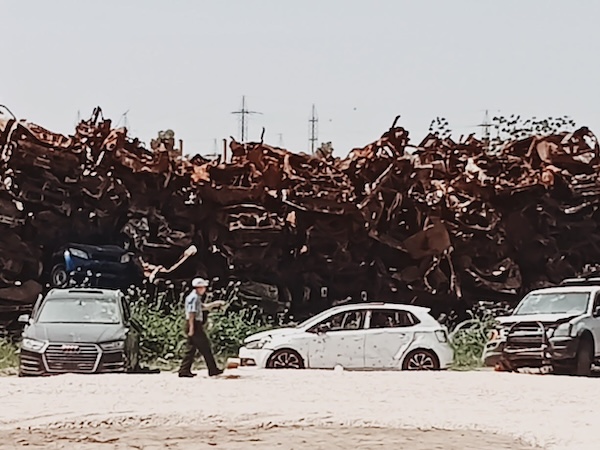
On Wednesday, we toured Adi Negev-Nahalat Eran, which is a village for children with disabilities, which JNF supports. Karen and I volunteered at the therapeutic farm, cleaning the goat pen and washing the tortoises. That day we were also taken to the car cemetery, where you see two burnt ambulances, as well as burnt and bullet-holed cars numbering more than 1,000. In Sderot, we saw where the police station used to be – the building was taken over by Hamas terrorists and then an Israeli tank destroyed the building, killing the terrorists inside.
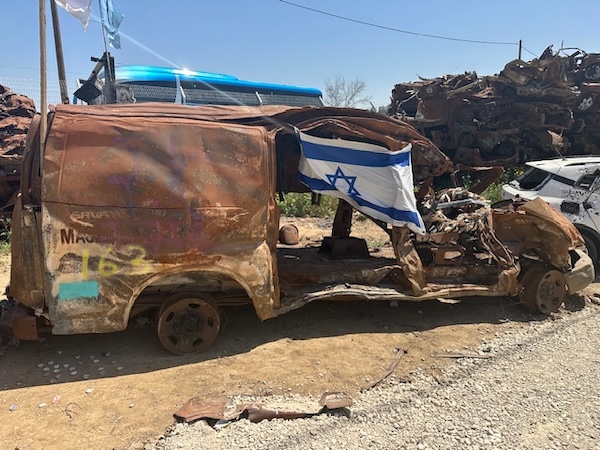
photo - A burnt-out Magen David Adom ambulance in the car cemetery near the Gazan border, where burnt and bullet-holed vehicles numbering more than 1,000 are being kept for further investigation
A burnt-out Magen David Adom ambulance in the car cemetery near the Gazan border, where burnt and bullet-holed vehicles numbering more than 1,000 are being kept for further investigation. (photo from Lorraine Katzin)

The first few days of the mission, I found it difficult to sleep, the images and stories kept going through my head.

On Thursday, we picked lemons and went to Rachashei Lev Israel Children Cancer Centre, another JNF project. We also visited Hostages Square.

Friday included a visit to Western Canada House, a No2Violence shelter for women and children fleeing domestic violence, the building of which was funded by JNF Canada supporters in Vancouver and Winnipeg. [For more on Western Canada House, see jewishindependent.ca/a-new-refuge-from-violence.] We also went to the ANU Museum of the Jewish People, which had on display models of different shuls in Europe and the United States, a replica of the Codex Sassoon and an Oct. 7 exhibit. After stopping at the Carmel Market, we went back to Hostages Square for Kabbalat Shabbat, which was very moving.

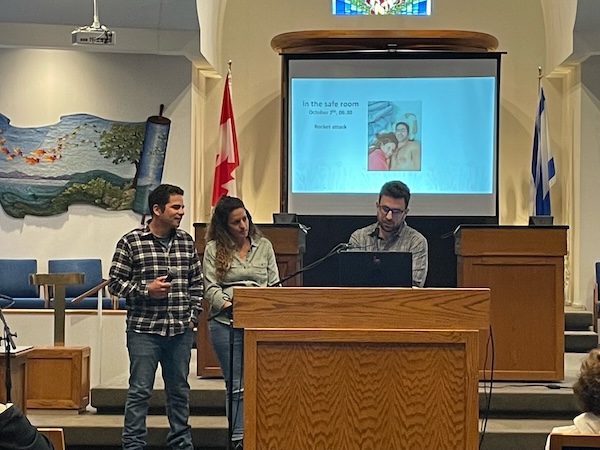
Saturday, we went to the beach in the morning and walked around Tel Aviv in the afternoon. That night, we had a survivor come speak to us and it happened to be Shalev Biton, who had come to speak at Har El and elsewhere in Vancouver a few weeks prior. Amazingly, he remembered me!

On another night, we heard from Jacqui and Yaron Vital, parents of Adi Vital-Kaploun, who was murdered on Oct. 7. Jacqui, who is a Canadian, was in Ottawa visiting family when the Oct. 7 Hamas terror attacks happened. Adi, her husband and two children lived on Kibbutz Holit in the south and Yaron had come to visit; he was put up in a room in a vacant house opposite his daughter’s. Adi texted her husband, who had gone on a hike, warning him not to return home. Adi was killed, and her two children and a neighbour were kidnapped but let go at the Gaza border, by some miracle. Yaron survived, as the terrorists had determined which homes had how many people and who had dogs, which were shot first, but the room Yaron was in was usually vacant, so went unchecked by the terrorists.
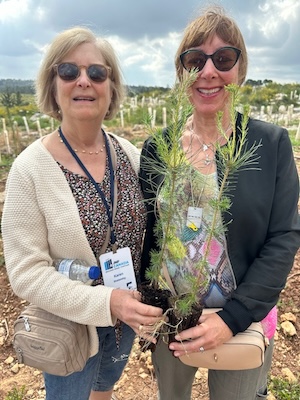
photo - Karen Shalansky, left, and Lorraine Katzin tree planting
Karen Shalansky, left, and Lorraine Katzin tree planting. (photo from Lorraine Katzin)

On Sunday, April 7, we went JNF tree planting. We visited the Black Arrow Memorial, where, from the lookout, you can see Gaza. There, we were given a briefing by retired colonel Kobi Marom, whose opinion was that the Palestinian Authority should be enlisted to run Gaza. We then traveled to the Israel Defence Forces base at Nahal Oz for lunch with the soldiers – these 19-, 20- and 21-year-olds going into Gaza are truly amazing! The soldier I sat with, his name was Daniel and he was from Eritrea. We were so close to Gaza that we could see convoys of food trucks going through the Rafah Border Crossing.

Monday, our last day, we went to Jerusalem to two places that JNF supports: the Jerusalem Hills Therapeutic Centres, which provides services for at-risk children, and the Glassman PTSD and health centre at Herzog Hospital. We then visited the market and went for a walk down Ben Yehuda Street, the Kotel and the tunnels, and had dinner at Piccolino restaurant before heading to the airport. We were joined by Jewish Federation of Greater Vancouver executive director Ezra Shanken and Rabbi Jonathan Infeld from Congregation Beth Israel.

Israel trip highlights
(Karen Shalansky)

I went to Israel to show my support in its time of need, as well as to hear the views of Israelis and their feelings toward the war. Through our many experiences, I felt I accomplished my mission.

Listening to the diverse perspectives of our guide, the young soldiers and guards on our bus, my 31-year-old cousin who made aliyah right after high school and is now fighting in the reserves, Lorraine’s Israeli friends, a retired colonel and others, I heard varying opinions on many topics. For example, should Israel invade Rafah, should there be a ceasefire, should the release of the Israeli hostages be the No. 1 priority, should there be an election, who should oversee Gaza after the war? While there was always more than one answer to every question, there were consistent feelings among everyone we met of resilience, strength and perseverance – that this war is another of many, and that Israel will carry on. As well, everyone we met was both amazed that we came during war and so happy that we had made the effort. That happiness alone made Lorraine and I feel that this trip was worthwhile. 

Some highlights of the trip for me were:

1) Visiting Hostages Square in Tel Aviv for Kabbalat Shabbat. This is a square that has Shabbat tables set up for both the released hostages (with blue tablecloth and wine glasses) and for the hostages still being held (with dirty water and stale pita). There was a wonderful band playing, with a singer, and, at one point, there was a chance for people to stand up and say something. Lorraine was our spokesperson and announced that we were on a trip from Canada to support Israel. Several Israelis came up to us afterwards to shake our hands and welcome us. When the band sang Lecha Dodi, a few people got up to dance the hora, including Lorraine and me. 
2) Visit to Shlomit settlement in the southern Negev. This was a religious settlement that JNF helped build. As an aside, JNF has been very active in rebuilding bomb shelters and kibbutzim that were destroyed on Oct 7. At Shlomit, we heard from Dana, a mother of six children, about how her husband and four other men went to a neighbouring kibbutz to fight the terrorists. While the men were successful in killing all five terrorists, her husband, unfortunately, was shot dead. Dana said she wanted her children to remember her husband as a hero, and to foster a sense of hope, not hate. In this inspirational talk, she kept emphasizing that we can’t live with hate, only with love and hope. 

3) A talk from a trauma psychologist at the Glassman centre. While post-traumatic stress has risen substantially in Israel, this psychologist told us a story of an army unit that recently returned from a three-month stint in Gaza. Prior to going home, the unit visited one of the soldier’s grandmothers, who was a Holocaust survivor. The attacks by Hamas on southern Israel have been equated to a second holocaust, but, upon asking the grandmother’s views, she said “no,” the attacks were nothing like the Holocaust. We have a country and a people that will fight for us now, whereas in 1940 we had nobody, she said. She concluded: we are never alone again, as long as there is an Israel. 
Heroic survival at kibbutz

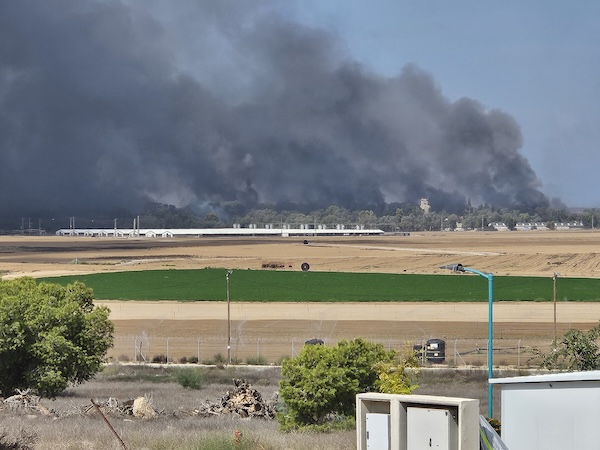
A photo Dekel Agami took Oct. 7, 2023, of Kibbutz Nir Oz in flames. (phot by Dekel Agami)

On Oct. 7, Kibbutz Magen, from which residents can see the Gazan city of Khan Yunis, was infiltrated by dozens of terrorists from Gaza. While two of the approximately 400 kibbutzniks were murdered and two seriously injured, a more horrific outcome was avoided, thanks to the heroic acts of a small squad of kibbutz civilian defenders, who held off the terrorists during a seven-hour gun battle.

A member of that response team was in Vancouver last week, sharing his story.

Kibbutz Magen is a kilometre away from Kibbutz Nir Oz, a village with a similar population, but which suffered exponentially more tragic outcomes that day – 46 Nir Oz residents were murdered and 71 taken hostage.

One reason for the less catastrophic death toll in Magen is that the terrorist infiltrators blew apart the perimeter fence a good distance from the kibbutz’s residential area. But the heroism and tireless response of Magen’s civilian emergency squad played a big role.

photo - Dekel Agami, left, and his partner Nufar Gal-Yam, share their Oct. 7 experiences with Vancouver audiences April 14. Itai Bavli, right, a University of British Columbia academic, grew up with Agami on Kibbutz Magen, near the Gaza border
Dekel Agami, left, and his partner Nufar Gal-Yam, share their Oct. 7 experiences with Vancouver audiences April 14. Itai Bavli, right, a University of British Columbia academic, grew up with Agami on Kibbutz Magen, near the Gaza border. (photo by Daphna Kedem)

Dekel Agami, who grew up on the kibbutz, and his partner, Nufar Gal-Yam, who grew up in Sde Boker, the kibbutz most noted as the home of David Ben-Gurion, had moved in together on Kibbutz Magen on Oct. 4.

Since both had grown up in southern Israel, close to Gaza, the red alerts on Oct. 7 did not disturb them unduly. Around 7 a.m., Agami, an Israel Defence Forces veteran who served in the special forces, headed out with his weapon to meet other members of the security squad, a group of civilians and off-duty soldiers ranging in age from 20 to 70. He quickly realized this was not a routine day.

As he walked to meet his colleagues, Agami saw figures near the kibbutz border. The first one he encountered was wearing an Israel Defence Forces uniform – as numerous terrorists were that day – and so he did not shoot.

He came across the head of his security team, Baruch Cohen, who had been shot in the leg. As Agami was delivering first aid, an anti-tank missile hit the vehicle they were next to. Agami does not know how they survived.

In the event of an emergency, civilian and off-duty military personnel on kibbutzim are expected to manage on their own for 20 to 30 minutes until the arrival of the IDF. On Oct. 7, the dozen emergency squad members in Kibbutz Magen battled 30 to 40 terrorists on their own from 7 in the morning until 2 in the afternoon.

The terrorists breached the fence at a location relatively remote from the residential area of the kibbutz, giving the defenders a small tactical advantage. Fighting soon moved to the terrorists’ targets, the kibbutz’s homes, and, after providing first aid to Cohen, Agami fought the terrorists from one of the houses. The kibbutzniks successfully flushed the infiltrators back to the fence, where some of them fled – maybe back to Gaza, possibly off to murder easier prey.

During the fighting, Agami took a photo of nearby Nir Oz, where multiple plumes of smoke were rising in an ominous foreshadowing of their potential fate. The photo went viral in Israel.

“When I took this picture, I thought we were next,” Agami said to an audience at Temple Sholom on the evening of April 14. He and Gal-Yam also spoke at the weekly rally earlier that day, outside the Vancouver Art Gallery.

When the IDF finally made it to Kibbutz Magen, about 2 p.m., they killed the remaining terrorists. Then the larger trauma began to dawn on Agami and his fellow kibbutzniks.

Agami’s two daughters from a previous relationship were with their mother at a moshav a few kilometres away. During the battle, he didn’t worry about them – partly because, he said, he “couldn’t go there” but more because it never crossed his mind that the battle he was engaged in was part of a much larger crisis. When he finally did get in touch, he found out the three were safe.

The Magen fighters were too occupied keeping the terrorists at bay – Agami alone expended 15 magazines, about 450 bullets – to check their phones to see what was going on elsewhere. They did, though, have cellular connectivity, which was not the case in many kibbutzim. The terrorists were strategic, first targeting army bases and bringing down communications systems.

As the smoke cleared midafternoon on Oct. 7, several stunning realities came to light.

Three wounded residents – Cohen, Nadav Rot and Avi Fleisher – had been transported by the kibbutz doctor to a nearby community, from which they were helicoptered to hospital. Fleisher did not survive. Cohen would eventually have his leg amputated. No one – including those who made the journey – understand how they made it to safety. The terrorists had taken control of all the roads in the region, killing every Israeli they encountered. Even the military had not breached the area by the time the medical transport got through.

The exhausted kibbutz defenders soon discovered that what they had experienced was a comparatively small part of the worst terror attack in Israel’s history. In just a hint of the depths of preparation that went into the attacks, the fleeing terrorists left behind not only weapons, flashlights and food for an extended siege, but even supplies of blood for infusions.

Agami and Gal-Yam were brought to Vancouver by Itai Bavli, a postdoctoral fellow and lecturer in public health at the University of British Columbia. He and Dekel grew up together in Magen.

The friends estimate that 60 alumni of their regional high school died on Oct. 7. Including those killed in the subsequent war, they estimate 100 of their circle of friends are dead, including Bavli’s stepbrother, Tamir Adar, who lived in Nir Oz.

Agami downplays his heroism, but Bavli is emphatic.

“He saved my family,” Bavli said.

Gal-Yam, who is expecting a baby in July, just completed a five-month call-up as a major in the IDF. She and Agami are now in temporary accommodations on her home kibbutz of Sde Boker. Agami spent five months relocated in Eilat.

“It’s like some area after a hurricane,” Gal-Yam said of the chaos at Kibbutz Magen, which was founded in 1949 and is one of the oldest communities adjacent to the Gaza Strip.

She has since returned to her day job, but everything has changed, she said.

“It seems unimportant to do again whatever it was I was doing before Oct. 7,” she said, noting that creating a normal routine is impossible. “Nothing is normal now. I’m not normal. I’m a completely different person. We are living completely different lives than before. Nothing is the same. Nothing at all.”

The Israeli visitors demurred from making predictions about the political or military ramifications of events.

“Some people are going to have to give answers after all this will be over,” Gal-Yam said.

The length of time the hostages have been in captivity – more than six months – is something that was unimaginable on that first, terrible day, she said. “Not a person in Israel thought it would take more than six months to bring them home,” she said. “This is a reality none of us expected.”

An audience member asked how they view residents of Gaza now.

Bavli reflected on how, before Hamas took over the Gaza Strip, workers from Gaza came to their kibbutz, even staying overnight.

“People from Gaza worked on our kibbutz and were treated as family,” he said. “We wanted to have them as neighbours, to find political solutions, to find a way to live together.

“We don’t have anything against people from Gaza,” he said. “What broke our hearts was, at Kibbutz Nir Oz, the first wave [of infiltrators on Oct. 7] was Hamas, but the second wave was just people who came to steal. But they also killed people. That’s what broke our hearts, confused us.”

For the future, Bavli sees the willingness of Gazans to live in peace as key.

“Hopefully,” he said, “there are enough good people there to find a way to live together.”

What matters on a birthday?

As I stepped out my front door for an afternoon walk, I met an older dad taking a walk with a 15-month-old baby girl in a carrier on his chest. She was wiggly. The dad leaned over so the baby could pet my (sizeable) Gordon Setter mix dog. She babbled and waved and touched. She was in on all the action.

While my kids are now 12, I was transported immediately back to the days of naps and screaming tantrum wake-ups. I remembered the power of nature walks and time in a baby wrap, which often calmed both. To this dad, I just looked like an older woman with a big dog, but, by the end of the walk, he had the picture and we’d even figured out that our spouses worked at the same university.

Before this, I’d been concentrating on work, writing an opinion piece about a Winnipeg swimming pool that faces closure and potential demolition. Its name, Happyland, felt poignant and sad. To some, demolishing an aging outdoor facility that serves our winter city for only a couple months a year seems obvious, in terms of its financial worth. Yet, for us, or anyone who has had a chance to play in the shallow end with splashing kids, eager to try out their swimming skills on a sunny day, it’s a hard loss.

These random moments make up the stories of our families, our daily lives, and maybe our bigger communities. They are small and insignificant as they happen, but, at the same time, contain so much. As the dad in his 40s talked to me about being with his partner for 21 years before having a kid, and about “this magnificently overwhelming” experience, I imagined how spectacularly their lives had changed with the birth of this child.

My daily Jewish text study is not always something relatable, but things will pop back into mind at later times. Sometimes, I study my Daf Yomi, my page of Babylonian Talmud a day, and I struggle. Each day, I get an email, an essay, from My Jewish Learning that helps me stay on track and focused on one issue on a page. For Bava Metzia 46, there’s a discussion around how we define acquiring something. Does it happen when we exchange money for the physical object? Does it happen when we “pull,” or physically take, the object? The text goes further into what amounts to an ancient currency exchange counter. 

Imagine traveling from Country A to another country, Country B, and you needed some cash. Your money from Country A is no longer good in B. Does it have value? If you exchange it, are you technically buying B’s currency with invalid currency from A? Is the money invalid because it’s no longer in use as your empire disintegrates, or because Country B doesn’t recognize it? Can these currencies, if invalid, still be used privately? (Like cryptocurrency, perhaps?) These are complicated ideas, but the rabbis saw that governments – kingdoms, provinces, countries, etc. – come and go. What is meaningful in one place might be worthless in another.

I layered this on top of Bava Metzia 39, a page that just ripped me up as I studied it. It was about who can be in charge and how to manage the assets and property of a captive when they might still be alive, and how to reassess these practical matters if word arrives that the captives have died. The page explored the details: if minor children were involved, and how to supervise a woman’s property when her mother or sister died in captivity. It was heartbreaking to read this text, codified more than 1,500 years ago, with hostages still in Gaza.

As the date of Israel’s 76th Independence Day approaches, I’m left juggling two concepts. There’s the physical reality of the state – its currency, its government and its infrastructure. Then there’s the enormous emotional, up-and-down response many Jews around the world are experiencing as we struggle as a big extended family through the current war and the antisemitism worldwide. The only thing I can liken the emotions to is that of parenthood. That gut-wrenching, desperate crying from your baby, or the shrieks of joy from your tween as he splashes towards you in a pool. The emotion is overpowering, even while you juggle the practical notions of how governments behave. My parallel universe in Winnipeg: how much municipal money it costs to repair city infrastructure and whether your money (in whatever currency) is enough to pay for ice cream after the swim. The emotional joy of an ice cream after a good splash … that’s something to dream of doing again.

About 35 years ago, I was a teenager living on a kibbutz, splashing in an outdoor swimming pool on a sunny day. When I got out, I might share a slightly melted chocolate bar with my roommate as we changed for dinner. The truth is I have no idea if that kibbutz pool still exists. I haven’t been there since I was 17, but just like Happyland in Winnipeg, it isn’t the concrete that matters, it is those powerful memories of play with my friends.

I’m not sure if it’s possible to sort out all the actual infrastructure costs and damage that Israel, Gaza, the West Bank and Southern Lebanon face. The regional rebuild after this catastrophe will be enormous. The lives of people in the region are irrevocably changed. Meanwhile, if we can avoid numbness and hold onto powerful emotions like the clasping finger of a baby, and the laughter and that cool pool water on a hot day, maybe there’s the potential to regain our equilibrium.

I wish Israel good health on this birthday … good emotional and mental health even if, physically, things are still a hot mess. If Israel were a person? I’d be leaning in for a tearful hug over the cake, saying “You know I love you, right?” 

Joanne Seiff has written regularly for the Winnipeg Free Press and various Jewish publications. She is the author of three books, including From the Outside In: Jewish Post Columns 2015-2016, a collection of essays available for digital download or as a paperback from Amazon. Check her out on Instagram @yrnspinner or at joanneseiff.blogspot.com.

A long day in multiple ways

The car graveyard at Moshav Tekuma. The vehicles – recovered from along Highway 232 and the site of the Nova music festival – are being kept for at least a year, for investigators to scour them for further evidence. (photo by Adina Horwich)

At the beginning of April, I had a very long day, which is rare for me. I rose at 5:45 a.m. to visit the Gaza Envelope with 30 others. At 7:35, the bus left Jerusalem. Our guide boarded at Latrun. We proceeded toward the Re’im Junction, also known as Masmia, then headed south to Sderot.

At Sderot, we went to the site of the destroyed police station, where many police and staffers were killed on Oct. 7. The town is slowly returning to normal function, as many evacuees have returned and schools have reopened. A new police station has been built.

Despite being the closest community to Gaza, under nearly constant fire from Hamas for nearly 20 years, Sderot has become an attractive place for young families, joining the stalwart old-timers. I was there several times a dozen years ago, when my son was a student at Sapir College, and have always enjoyed spending time there. New neighbourhoods, including high rises, have sprung up.

From a lookout on the outskirts of the city, atop Kobi’s Hill, we could see the entire length of the Gaza Strip. The lookout was consecrated in memory of four soldiers who died in Operation Protective Edge in 2014. It was impressive, if that is the word, to see Gaza  from so close. Mere kilometres.

We visited the up-and-coming city of Netivot, which is nearby. There, too, we saw much real estate, which has attracted a mostly, though not exclusively, religious sector, with Baba Sali’s gravesite and shrine a major calling card. He was a beloved rabbi and sage, particularly dear to Jews of Moroccan background. We went inside a well-tended sanctuary, to have a look and offer prayers. The place was hopping. As it was Monday, a Torah reading day, it was a suitable time to celebrate bar mitzvahs, and we caught a festive first haircutting of twin 3-year-old boys.

Afterwards, we headed to Moshav Tekuma. We did not expect to be allowed in, as there was heavy security and restricted access, but we were granted permission. Within the guarded gates, we saw what looked like a huge car junkyard – except that it is a graveyard. All the cars were recovered from along Highway 232 and the site of the Nova music festival at Re’im. They are being kept for at least a year, for investigators and forensic experts to scour them for further evidence. Many cars are smashed up, as if they had been in bad accidents, others are pockmarked, having been sprayed with bullets. Surrounding these is a huge pile of rusty scrap and charred rescue vehicles, as well as pickup trucks and motorcycles used by the terrorists to infiltrate the area.

photo - Memorial to those who were murdered at the Nova music festival by Hamas terrorists on Oct. 7.
Memorial to those who were murdered at the Nova music festival by Hamas terrorists on Oct. 7. (photo by Adina Horwich)

We drove further along the road, past Kibbutz Sa’ad and Alumim, along Route 232, and stopped just outside Kibbut Be’eri (the public is not allowed in). We looked inside one of the roadside shelters, next to a bus stop, which normally accommodates roughly eight people. On Oct. 7, some 40 people stuffed themselves inside. It was into such structures that many fled from the Re’im festival, seeking refuge, but the terrorists hurled grenades inside. At one migunit, Aner Shapira managed to throw the grenades back at the terrorists, though, in the end, he was killed, along with other young people. Inside are memorial candles, stickers with the pictures and names of victims, letters and comforting wishes are written on the walls.

photo - Site of the Nova music festival
Site of the Nova music festival. (photo by Adina Horwich)

We traveled some more, reaching the city of Ofakim. That is where a very brave woman, Rachel Edri, appeased the five terrorists who barged into her home by offering them refreshments, including her now-famous cookies. She and her husband, David, both in their 60s, were able to manage the terrorists, engaging them in conversation, plying them with more food and singing songs, over 19 hours. Whenever she could, Rachel would go to the bathroom and signal from the window to the police outside, who had surrounded the house, gauging attempts to enter. The Edris’s son is in the police force and was instrumental in finally seizing back their home. Unfortunately, during the siege, the house suffered great damage and is a total wreck; only a shell remains. And, sadly, David Edri passed away about a month ago. Rachel has gone to live with her sister-in-law.

As we were looking around, another hero appeared in the small parking lot opposite. Shuki Yosef lives across the street with his wife. He invited us to come into their building’s shelter, where he recounted how he and some of the neighbours hid for several hours, all the while hearing gunshots and shouting outside. He secured a metal bicycle frame to keep the shelter’s door closed, holding it with his own hands for hours. Later, after the ordeal had ended, he designed and fashioned a wooden plank to better fit the door hinges, in the event of future need.

The bravery of these residents is remarkable. It is worth noting that their homes are not the closest ones to the highway – which one might think would have been attacked first – but the houses and people who took the brunt of the terrorist attack are tucked well within the city. The sheer gall and number of terrorists that infiltrated, going from house to house on a murderous rampage in Sderot, in Ofakim, in the kibbutzim, on the roadsides, gunning down so many, are mind-boggling. These communities all lie within minutes of each other in a pretty small area.

It was an unusually hot day for April 1, over 30 degrees Celsius. And it was an intense excursion. Visiting made the reality a lot more tangible, but still impossible to fully comprehend. It was moving to witness and I learned much. We left the Otef (Envelope/Wrapping), as it is called, and I arrived home just before 7 p.m.

More than six months have passed since Oct. 7 and we remain in the thick of things. It is taxing and draining, even on those of us who, fortunately, are not too closely involved. Everyone is touched by the terror attacks and the war. 

Adina Horwich was born in Israel to Canadian parents. In 1960, the family returned to Canada, first living in Halifax, then in a Montreal suburb. In 1975, at age 17, Horwich made aliyah, and has lived mostly in the Jerusalem area. She won a Rockower Award for journalistic excellence in covering Zionism, aliyah and Israel for her article “Immigration challenges” (jewishindependent.ca/immigration-challenges-2).

Thought-provoking speakers

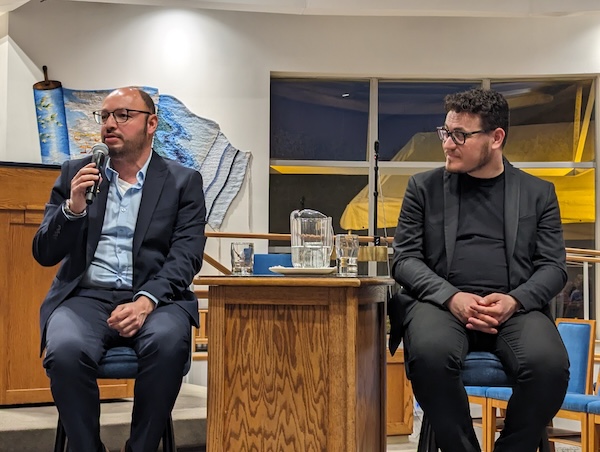
Dr. Gil Murciano of Mitvim, the Israeli Institute for Regional Foreign Policies, and Uri Weltmann of Standing Together, spoke April 17 at Temple Sholom. (photo by Pat Johnson)

For months, weekly rallies across Israel after Shabbat have demanded the return of the hostages from Gaza. These rallies have often coincided with separate protests, which have been going on much longer, against the government of Prime Minister Binyamin Netanyahu generally and its proposed judicial reforms specifically. These two streams of protesters have coalesced in recent weeks, according to an Israeli activist leader who spoke in Vancouver last week, because, he said, many Israelis are convinced that Netanyahu is not advancing freedom for the hostages, but hindering it, for his own political advantage.

Uri Weltmann, field organizer of Standing Together, made the claim April 17 during an event at Temple Sholom organized by New Israel Fund Canada. 

“What happened three weeks ago is that it stopped being two different protest movements,” said Weltmann. “They are basically changing their strategy. They are calling for early elections and for [Netanyahu’s] government to be removed and replaced with a different government. [Activists are] pointing their finger at him as the obstruction, as the obstacle toward advancing to a ceasefire agreement.”

Weltmann argues that Netanyahu is concerned not only for his political survival, but for his freedom.

“For Netanyahu, the protraction of this war, the continuation of this war, is in his political interest,” said Weltmann. “He knows that a temporary ceasefire might lead to a permanent ceasefire. A permanent ceasefire would mean an end to the war. An end to this war would bring an end to this coalition government because the extremists he huddled with have already said publicly that, if they will end the war before total victory, they will topple the government.”

The end of the current government and the ousting of Netanyahu, he said, would have more than just political ramifications for the prime minister, who opinion polls suggest would be soundly routed if an election were held now.

“New elections mean him losing the majority and him losing the majority is not only Netanyahu the politician being ousted from office. It’s also Netanyahu facing corruption charges, having his trial resume, [and he] might lose his personal liberty. For him, it’s intimately linked to the continuation of the war.”

The consensus among these activists is that Netanyahu is seeking to prolong the war and the captivity of the hostages to protect his political and personal interests, said Weltmann.

“It’s an incredibly important political development within Israel that a broad movement around the families and friends of the hostages have made this link,” he said.

Weltmann’s group, Standing Together (known in Hebrew and Arabic as Omdim Beyachad-Naqif Ma’an), was founded in 2015 and is one of the on-the-ground groups New Israel Fund supports.

Among the goals of the group is to build a grassroots movement for peace and progressive politics in Israel, including in rural and peripheral areas of the country. Making such a movement successful beyond the activist hub in Tel Aviv is the only way to advance Standing Together’s goals, Weltmann said. Even a more centrist or progressive government, if elected tomorrow, would not necessarily advance meaningful steps to peace and coexistence if there is not a broad popular movement in support of such a policy shift, he said.

Without a national movement for peace, he said, a new prime minister, however well-intentioned, would not feel the pressure to abandon the status quo and take steps for a changed future. 

“We must, as a strategic starting point in our process of progressive transformation of Israeli society, be present in the Negev, be present in the Galilee, be present in those parts of Israeli society that for too long have been the playing ground of the right-wing with left-wing actors completely non-present,” he said. “We must be there organizing local communities.”

Jewish citizens cannot do it by themselves, said Weltmann, and neither can Arab citizens. 

“We must have Jewish-Palestinian unity and cooperation within Israel for this change to be effective,” he said. An example of this strategy was a slogan adopted by a joint Jewish-Arab slate in Haifa during the recent municipal elections. The far-right Otzma Yehudit (Jewish Power) party of Itamar Ben-Gvir ran slates across the country trying to solidify the party’s roots at the civic level. The joint slate in Haifa played off Otzma Yehudit’s xenophobia with the slogan “Jewish Arab Power.”

“We are at a crossroads,” said Weltmann. “Every Israeli should choose which side am I on: the side that leads to a continuation of the status quo, a continuation of the state of affairs in which the Palestinians live in the occupied territories under military rule devoid of citizenship, devoid of rights, a situation that can lead to Oct. 7 one after another unless we put an end to it, or the reality of an Israeli-Palestinian peace that will guarantee both people safety, security and an imaginable, livable future?”

Weltmann spoke alongside Dr. Gil Murciano, an Iran expert and chief executive officer of the think-tank Mitvim, the Israeli Institute for Regional Foreign Policies, which one journalist has called “the diplomatic wing of the protest movement.”

Like Weltmann, Murciano longs for a “new majority” in Israel’s body politic. “A new majority that will allow us to advance toward a state where we live in peace, we live in dignity, we live in equality, without the occupation, without the injustices, throughout our society,” he said.

A fundamental shift in perspective is needed, argued Murciano.

“We used to speak about ‘wars of no choice’ in Israel,” he said. “We need to start thinking in terms of ‘peace of no choice.’”

On the one side, he said, the extreme right has a plan of annexation, with Bezalel Smotrich, Israel’s minister of finance and head of the far-right National Religious Party, calling for the government to “encourage” migration from Gaza to Egypt. On the other side, he said, since Oct. 7, people on the left have been motivated to seek an alternative to the status quo.

Dr. Maayan Kreitzman, a local food systems researcher and activist who moderated the event, challenged Murciano on this point. Rather than progressive voices calling for more coexistence, she said, she has heard the opposite. People that are “quite dovish” have had second thoughts about their worldview and transformed into a more hawkish, securitized attitude, she suggested.

Murciano acknowledged that all Israelis share one overriding priority. “For Israelis, it’s pretty clear,” he said. “The first, second and third priority of Israelis right now is security.”

That is a prerequisite to any advancement, he said.

Murciano proposes something he acknowledges to be “a little bit symbolic,” an international peace conference to kick off a new process between moderate Israelis and moderate Palestinians. This could be a first step to breaking an impasse that has existed in recent years, he said.

“Some people have described the last decade as the lost decade of Israeli diplomacy,” he said, a period where “conflict management” has been the priority; effectively, a maintenance of the status quo.

“I think that’s the right description, actually. It’s a strategy of not having a strategy,” said Murciano. “Coming to terms with the fact that there is no political way out and basically every couple of years we’re going to have a bit of violence.”

This approach sees Israelis forfeiting the initiative to Hezbollah and Hamas, he said, “Basically setting yourself in a situation where you only respond to a reality that is forced upon you.”

Oct. 7, he said, destroyed this conceptual framing.

Part of any future needs to include a multilateral project to “rebuild life-sustaining systems” in Gaza, he said, not a “peace-keeping force” but a “multinational force” that will be an on-the-ground part of a larger process toward peace and coexistence.

Ben Murane, executive director of New Israel Fund Canada, spoke of the emotional impacts of recent months.

“If you’re like me, what has been excruciating the past six months has been not just holding my pain, our Jewish pain, the pain of my Israeli coworkers, my family, my friends there, the pain of the Israeli people, but also, in my heart, holding the pain of the Palestinian people too,” he said.

Since the earliest days of the current war, Murane said, there have been countless glimmers of hope in the form of cross-cultural dialogue.

“In the first few months, we were astounded to see, across Israel, dozens of gatherings, conferences, events with hundreds of Jews and Palestinians standing together holding up those now-iconic purple signs saying ‘Jews and Arabs refuse to be enemies,’ ‘Jews and Arabs stand together’ or just simply ‘B’Yachad,’ together,” said Murane. “We were astounded to see Jewish citizens of Israel respond to the needs of the Palestinian citizens of Israel, Palestinian citizens of Israel making calls to families of the hostages, joint Jewish-Arab humanitarian aid missions to the south and to the north. As the war in Gaza accelerated, those Israeli voices also said, ‘We do have choices, even now. We have lots of choices with how we execute a just war justly.’”

Any long-term solution to the decades-long conflict must bring safety and dignity to both peoples, said Murane, “and anything else, anything short of fairness to both sides, will perpetuate this for another generation.”

New Israel Fund partners with and supports, according to its website, “organizations in Israel that fight for socioeconomic equality, religious freedom, civil and human rights, shared society and anti-racism, Palestinian citizens, and democracy itself.”

The April 17 event was hosted by Temple Sholom and co-sponsored by JSpaceCanada, which calls itself the advocacy voice of Liberal Zionism, Ameinu Canada, described as the voice of labour Zionism in Canada, and Canadian Friends of Peace Now, as well as the speakers’ organizations.

Rabbi Dan Moskovitz, senior rabbi at Temple Sholom, said he had received emails expressing concerns about hosting a perceived left-wing event. 

“I get the same emails when we host people to the right of centre,” he said. 

One of the purposes of a synagogue, he said, is to engage with ideas that “comfort the afflicted and afflict the comfortable.

“You may find your truth by agreeing with what you here tonight,” he said. “You may find your truth by disagreeing with what you hear tonight. The important part is to engage with it.”

Vancouver activist David Berson promoted the opportunity to listen to the Israeli guests as a chance to gain a perspective apart from the most common refrain he hears on social media and WhatsApp threads. 

“There’s another way you can look at what’s going on,” he told the Independent after the event. “Come out and hear a different perspective. I invited people to come tonight and listen to a different narrative.”

The 200 to 300 people at the event was about double what organizers had earlier expected, he said. 

New role, familiar face

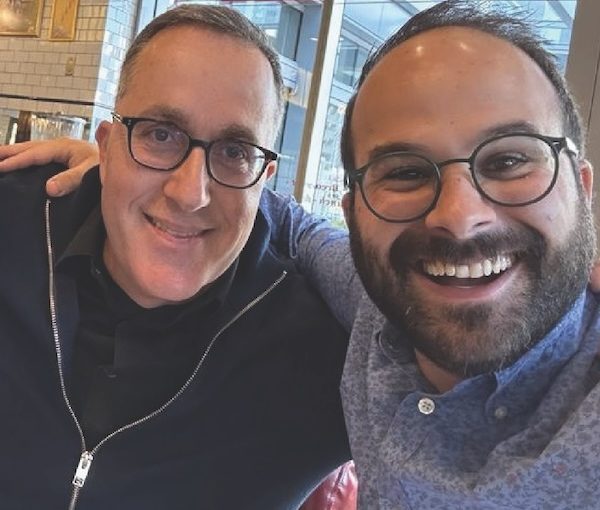
Ilan Pilo, left, and Rafi Yablonsky of the Canadian Shaare Zedek Hospital Foundation. (photo from CSZHF)

In Jerusalem, Yad Vashem stands as the foremost memorial centre to the Holocaust, dedicated to the millions of Jews murdered during the Shoah. Across the street, as if in defiant answer to the past, is one of the world’s busiest maternity centres, where 22,000 newborns meet the world every year, strengthening the future of the Jewish people. 

The maternity section is just one of Shaare Zedek Medical Centre’s many specialized departments, advancing health not only at the start of life but all through the lifespan of patients. Shaare Zedek is home to an emergency preparedness and disaster response centre. It offers a one-stop multidisciplinary and comprehensive diagnostic breast health centre. There are departments focusing on heart health, medical genetics, digestive diseases, oncology and an array of other specializations – more than 30 in-patient and 70 out-patient departments in all. The hospital sees a million patients annually and has 1,000 beds. Located in the centre of west Jerusalem, it is, among so much else, a teaching and research facility.

Western Canadians will likely be hearing more about this particular facility as the Canadian Shaare Zedek Hospital Foundation has just opened its first office in this part of the country. But, while the organization may be a newcomer as a physical presence in Vancouver’s Jewish community, it will be a familiar face sharing the Shaare Zedek story.

Ilan Pilo, who served as shaliach (emissary) and regional executive director of Jewish National Fund of Canada from 2013 to 2021, has returned from Israel as the Western Canada executive director for the Canadian Shaare Zedek Hospital Foundation.

“I was thrilled and honoured to be offered the opportunity to be the first to launch the Western office in Canada,” Pilo said.

During his time back in Israel, Pilo served as principal of a postsecondary trades and skills school and, most recently, ran the campaign for Yariv Fisher, who won an upset victory to become mayor of Herzliya, north of Tel Aviv. Municipal elections across Israel were delayed twice due to the war and, almost immediately after seeing his candidate elected, Pilo jumped on a plane and headed for Canada, spending 10 days in Toronto orienting to his new role before landing in Vancouver in March.

The hospital is 120 years old and was founded to ensure medical adherence to halachah (Jewish law), providing appropriate care for Orthodox Jews in the pre-state era. While it still provides everything religious Jews need, including minyanim, it is also, Pilo said, a “safe zone” for all people, regardless of ethnicity, nationality or religion. 

“When you look at the population in Jerusalem, you see that there are one million people – 300,000 of them are ultra-Orthodox, 400,000 are Arabs and the rest are, let’s say, secular Jews,” Pilo said. “It’s the most interesting and complex mix of people.”

That diversity is reflected not only in the patients but in the doctors and staff, Pilo said.

Right now, the hospital’s specialists in trauma are dealing with soldiers and civilians injured in the war. Since Oct. 7, Shaare Zedek has treated 300 wounded civilians and more than 700 Israel Defence Forces soldiers. In addition, hospitals in the north and the south of Israel have transferred 60 of their neonatal intensive care unit patients out of conflict regions to Shaare Zedek, where the NICU is housed in completely sheltered areas.

Rafi Yablonsky, national executive director of the Canadian Shaare Zedek Hospital Foundation, said he and the foundation’s board decided to expand operations across Western Canada because of the region’s philanthropic and Zionistic reputation. 

“We hope that more Canadians learn about the transformative and world-leading work of Shaare Zedek Medical Centre in Jerusalem,” he said. “Our goal is to grow our donor base and volunteer base with business and philanthropic leaders out West.”

This is not the first time Pilo and Yablonsky have worked together.

“Ilan and I were colleagues when we worked at JNF Canada together,” he said. “I witnessed firsthand how Ilan is highly skilled as a world-class fundraiser, also motivating groups of volunteers to do their part in our community.

“Shaare Zedek is a public hospital that is privately funded,” said Yablonsky, “and it receives very limited support from the Israeli government to upgrade equipment and technology, develop groundbreaking international research and ensure state-of-the-art medical training is available to staff. As such, the hospital relies heavily on the generosity of donors around the world to supplement $30 million needed annually.”

For more information, visit hospitalwithaheart.ca. 

Don’t leave. Engage!

Anthony Housefather has decided to remain in the federal Liberal caucus. Housefather, member of Parliament for the Quebec riding of Mount Royal, is one of only two Liberals to have voted against the NDP motion last month that called for a ceasefire, an end to Canadian military trade with Israel, as well as other positions about Israel and the current conflict.

As discussed in this space last issue, the New Democratic Party motion had some of its rough edges sanded down in order to make it palatable to almost all Liberal MPs. The rest of the House of Commons voted predictably. Conservatives unanimously opposed the motion, which they viewed as biased against Israel. The Bloc Québecois and the Green party sided with the NDP.

The daylong negotiations over amendments to the motion were a face-saving effort by the Liberal government to avoid the embarrassment of a serious schism in their caucus over foreign policy. In the end, a less inflammatory motion was passed.

Housefather, who is Jewish and represents a riding that has one of the largest concentrations of Jewish voters in Canada, was joined on the government side in opposing the motion only by Ontario Liberal MP Marco Mendocino.

Housefather was open about his frustration. Anyone who has found themselves in a place where they do not feel welcomed, based on their core identity, can certainly appreciate his feelings of isolation. However, we are pleased that he has decided to remain in the Liberal caucus.

Crossing the floor and joining the Conservatives, which he had said he was considering, would not have been advantageous to Jewish and pro-Israel voters. Since the administration of former prime minister Stephen Harper, at the latest, the Conservative party has been perceived as overwhelmingly pro-Israel. This approach has been welcomed by many Jewish Canadians.

However, this reality means that, were Housefather to switch parties, he would become just another pro-Israel voice in the Conservative caucus. By staying where he is, he will be a necessary voice for Israel and the Jewish community in the governing party. In an announcement a week ago, he said the prime minister has asked him to lead the government’s efforts in fighting antisemitism. This effort needs as much multi-partisan support as possible.

Anyone who has had difficult conversations with friends or family in recent months understands the emotional burden of being a voice for Israel in this challenging time. This, however, makes Housefather’s presence in the Liberal party that much more important.

We face a similar challenge at the provincial level. With the firing of Selina Robinson from cabinet, and her subsequent withdrawal from the governing New Democratic Party caucus, the Jewish community’s most outspoken ally, liaison and voice is gone from the government side of the legislature. Neither Robinson, who now sits as an independent, nor George Heyman, the other Jewish New Democrat in Victoria, are seeking reelection. It is entirely possible that the Jewish community will not have any community members in the next legislature.

This is not to say we do not have friends there.

Michael Lee, the MLA for Vancouver-Langara, has been a steadfast ally of the Jewish community and a stalwart presence at the weekly Sunday rallies for the Israeli hostages. Recently, when he addressed that audience, he went to lengths to warn against making Israel a political football. A community that can be taken for granted by one party and written off by another will find itself unrepresented in the halls of power. Lee reassured Jewish British Columbians that they not only have friends on the opposition side of the house, but in the governing NDP as well.

We know that there are allies for Israel and the Jewish people in the provincial NDP. It is a symptom of a larger concern that some of these people feel constrained around expressing that solidarity fully because of segments of their own party who would almost certainly single them out for that support.

As Robinson herself told the Independent last issue, she has friends and supporters in the caucus – but she wouldn’t mention them by name for fear of putting a target on their backs. This is a serious problem, of course. But it is better to have quiet allies than no allies at all. Their presence can potentially moderate extreme elements in their party. Were they not there, restraining impulses might be minimized.

As we approach a provincial election this fall, and a federal election at some unpredictable date (remember, there is a minority government in Ottawa) Jewish Canadians and allies of Israel should not abandon the parties that include voices with alternative views. We should, like Housefather has chosen to do, make sure our voices are heard in all of Canada’s diverse political venues. 

Dance as an act of solidarity

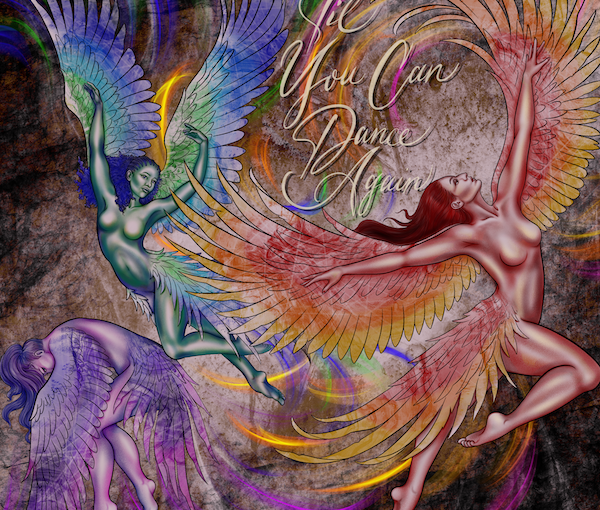
Iraqis in Pajamas’ new album is a tribute to the victims of the Oct. 7 massacre.

In the wake of the Oct. 7 massacre of Israelis…. And the celebrations that followed worldwide – glorifying the raping, burning and decapitating of my people…. 

And the subsequent mass destruction of posters raising awareness of Israeli hostages being tortured in captivity by Hamas…. 

And the simultaneous call for a violent uprising against Jews worldwide…. 

And the astronomical spike in hate crimes against Jews – among other things, leading to incessant harassment, assaults and death threats of students at my alma mater, Columbia University, and additionally leading to the murder of a kind Jewish man I knew in Los Angeles….

And the international mob chants of “From the river to the sea,” harkening back to the harrowing cries my father heard on Arabic radio stations as a child in Iraq, “We will throw the Jews into the sea.”…

And the palpable terror I then felt as a Jew, whose family had seen this before, had fled this before, in a pro-Nazi uprising in Baghdad, where a similar massacre had taken place during my father’s childhood….

And the deafening silence in the wake of all this – not even one word of care or kindness from the vast majority of non-Jewish people I had loved, had lived with, had broken bread with….

And I felt as if I had died.

I stopped journaling, stopped writing poetry, stopped writing music, stopped singing, stopped playing bass, stopped dancing. I got sick repeatedly and continuously over the course of two months, even ended up in the emergency room with symptoms of a possible stroke at 2 a.m. one night – this, after years and years of never getting sick, not once, not even when my ex got COVID and I nursed him back to health. 

I couldn’t sleep, had nightmares, woke up in the middle of the night, lying awake for hours, my mind circling around and around, imagining the horror and terror the hostages must be suffering through. I was haunted by the video image I accidentally had seen of a young Jewish woman who was naked and chained, publicly being dragged around by Hamas, as they filmed her – one of the many Jewish women they gang raped and mutilated that day, often next to the dead bodies of these women’s friends – filming that violence, too, in something akin to snuff porn. 

I could feel it in my body.

I couldn’t breathe.

I couldn’t move.

Despite the impact on me, I felt that, somehow, by energetically experiencing and, by extension, by physically experiencing the pain that my people were enduring, I was communicating a telepathic message to them: I will not forsake you, I will not forget you. 

No, I will not frolic on the beach beneath the misty grey soothing skies. No, I will not enjoy the quiet, peace and comfort of the vast rainforest just outside my door. No, I will not detach myself from something “happening on the other side of the world,” as a non-

Jewish acquaintance kindly advised, because there is no “other side of the world” when it comes to Jews. You are me, and I am you, and we are connected. I cannot control the world’s response, but I can control mine. I will face, see, hear and feel your pain, until it is gone.

But wait…. That’s exactly what Hamas wants, isn’t it? To demoralize and destroy Jews. To suffocate us, hijack our imagination. To strip us of our dignity, safety, peace and, perhaps most of all, joy.

So, to reclaim my joy is, in fact, a radical act of Jewish power and solidarity. To flip imagination on its head – instead of visualizing all the horrors and shrinking in my body, to instead expand in my body and visualize all the hostages, injured people and 

grieving families as resilient, grounded, surrounded by love, and the dead as soaring freely and peacefully, wrapping their loved ones in comfort.

Nothing is black and white, but this is an article, not a book, so I’m trying to keep it short and sweet. Suffice it to say, I actively and repeatedly attempted to turn the images around over the course of two months – to send white light, to bless the hostages, to emit some kind of protective energetic shield, but it kept seeming silly, foolish, without actual impact, perhaps just making myself feel better, like a hollow New Ager. My prayers would not stop a psychopathic Hamas gunman with absolute control over a hostage, I reasoned, because G-d gave humans both the gift and curse of free will. 

But then….

But then I went to a concert of Yemen Blues, which was more of a primal howl of freedom than a “performance,” and which featured an Israeli woman dancing with a defiant, raw ferocity that brought back to life the sanctity, dignity and power of the Jewish female body – and, with that, permission to dance.

And, after that, I started dancing again. And, after that, I started singing again. And, after that, I started frolicking with my beautiful dog beneath the misty grey, soothing skies on the beach, and through the vast rainforest just outside my door.

And I came back to life.

In this very difficult but transformative journey, I learned that life begets life begets life, and artistic self-expression is not an indulgence, but rather, a superpower. 

As I danced on the beach with my dog over a couple of days, a vision emerged – a global movement of Jews and our allies taking videos of ourselves dancing joyfully, and sending those videos to the people wounded in the Oct. 7 massacre, the families of those who died, the families of those taken hostage, and the young women and men on the frontlines defending Israel from further attack – turning “we will dance again” into “we will dance for you until you can dance again” – sharing whatever strength, freedom and joy we have to uplift those who are in the thick of it, struggling and suffering.

Having snapped out of an emotional coma of sorts, I then picked up my bass, and out poured both the melody and lyrics of a new song, “’Til You Can Dance Again.” That same day, I finally finished the song I had started a few weeks after Oct. 7, “Dear Hostages.” Not having touched my bass for the better part of three months, I played until my fingers were blistered and almost bleeding. Over the next 24 hours, I wrote two additional songs, and then worked with my band on developing a full album, ’Til You Can Dance Again, offering both my journey and my joy as a catalyst for healing and transformation.

It is through song, dance, story, prayer and food that Jews historically have not only overcome tragedy, but have taken that very experience and transmuted it into an vehicle for joy – the ultimate “f*** you” to those who have tried to destroy us. For this reason, my band released our new album on March 23, at the start of Purim, a holiday marking one of many historical traumas that the Jewish people have turned on its head and morphed into a cause for celebration. My heartfelt prayer for this album is that, as broken as we may feel right now, we shall once again rise up, sing and dance ourselves back to wholeness, and honour the victims of Oct. 7 not only through our grief and pain, but also through our fierce and irrepressible Jewish joy – emerging, once again, like that unstoppable phoenix, soaring up and out from the ashes. 

Loolwa Khazzoom (khazzoom.com) is the frontwoman for the band Iraqis in Pajamas and editor of The Flying Camel: Essays on Identity by Women of North African and Middle Eastern Jewish Heritage (theflyingcamelbook.com). She has been a pioneering Jewish multicultural educator since 1990, and her writing has been featured in the Washington Post, Marie Claire, Rolling Stone and other top media worldwide. This article was originally published in the Times of Israel.

More about the album

On March 23, Iraqis in Pajamas released the album ‘Til You Can Dance Again, as a tribute to the victims of the Oct. 7 massacre.

Its creation served as a vehicle for Khazzoom’s processing and healing, and the tone of the songs evolved as Khazzoom herself evolved from feeling despair to outrage to core power.

“Dear Hostages” is a love song to those held in captivity, in which Khazzoom pledges, I will not forsake you, I will not forget you, as she explores what it means to act in solidarity from afar. 

“’Til You Can Dance Again” is a spin on the Israeli promise, “We will dance again” – vowing to spread the life energy of dance, to help uplift the spirits of those who were shattered by the massacre. 

“Bataween” draws from a conversation with an Iraqi Muslim friend, exemplifying the healing imperative of Arab Muslims recognizing and caring about the history of indigenous Middle Eastern Jews, including the experience of Arab Muslim oppression. 

“Kids from the Sandbox” builds on that imperative, holding out a vision for Arabs and Jews to embrace the complexity of shared history, using art to express love and hate in healthy ways, effectively co-creating a new reality. 

“I’m a F***-You Jew” fuses ancient and contemporary stories of Jewish defiance and soul power in an unabashed expression of Jewish pride and strength amid an onslaught of global accusation and condemnation. 

“These Boots” is a campy spin on “never again,” calling out the left’s hypocrisy and betrayal in the wake of Oct. 7, and refusing to contribute Jewish energy and resources to those who do not offer the same in turn. 

“Bloody Cross” is a scathing critique of the Red Cross’s racism and hypocrisy in its failure and refusal to properly care for the Israeli hostages in Gaza.

For the full press release, and to listen to the recordings, visit khazzoom.com/blog and click on ’Til You Can Dance Again – New Album Release.

– Courtesy Iraqis in Pajamas

Mitzvah to return lost items

During the winter and spring in Winnipeg, sometimes one sees a child’s toy or a colourful mitten attached to a tree or hedge along a sidewalk. These are lost items. The neighbourly thing to do when you see something in a snowbank or on the packed snowy sidewalk is to pick it up and prop it up at adult eye level. It helps others. Maybe it will stop toddlers’ tears. 

Our household found somebody’s bike lock key last fall. This was harder to post. We took a piece of paper and wrote “Is this your key?” on it in large capital letters. Using clear tape, we attached the key and the sign to a powerline pole. A long time passed. One day, someone finally found their key. Relieved, we took down the sign.

I’ve been studying the Babylonian talmudic tractate of Baba Metzia, which covers civil law, including the rules around how to deal with lost items. It examines details that I often ponder. For instance, if a person finds an inanimate object, it has different obligations attached than if one finds an animal. We must return lost animals. If we don’t know how to return them, the finder must care for the animal, including feeding and watering the animal. If the animal’s upkeep is a burden, provisions exist for selling the animal and keeping the money to compensate the person who lost their animal. The particulars can be complex.

I became interested in a category that isn’t easy to describe – an object that isn’t alive or animate but still needs care. Things like books, which, in the days of the Talmud, were scrolls made of parchment made from animals. The finder had to rotate the scrolls occasionally to maintain them until they could return them. The finder couldn’t use the scrolls for study in a way that might cause undue wear on these hand-scribed texts. 

Another thing in this category, in Bava Metzia 29b, says: “If one found a garment, he shakes it once in thirty days and he spreads it out for its sake, to ventilate it, but he may not use it as a decoration for his own prestige.” As someone who makes and cares for natural fibre textiles (handspun and knit sweaters, for instance), I understood this immediately. Clothing wasn’t mass produced then. There were no factories. Everyone used spindles and spun and wove clothing. It wasn’t fast fashion. Clothes took skill and a lot of time to make. So, if someone found a garment, he knew its value. It wasn’t disposable. He must keep it well-aired, to be sure it was clean and cared for, and not attracting destructive pests like moths. Since he didn’t own or make it, he also couldn’t use the garment himself. 

Bava Metzia also explores when someone loses a garment and “despairs” of its return. That is, when one gives up entirely on getting it back.

For anyone who has seen images of the destroyed cars, homes and belongings left after Oct. 7 on the kibbutzim in southern Israel or from the Nova festival, these details hit hard. Some Israelis from these areas escaped with their lives but have “despaired” of ever getting back what they lost, they don’t want to return and try to reclaim things. Others asked for help or sifted through the remains of their homes to find precious items. Still others have managed to return home to their belongings and restart their lives.

This despair and reclamation reminded me of my in-laws and their stories of displacement after the Second World War. Their possessions, buried or left behind years earlier in Poland, were impossible to claim. Non-Jews had moved into their homes and taken their things. After four years in five different displaced persons’ camps, my father-in-law, his sisters and parents moved to the United States. Decades later, my husband’s grandmother would describe her family’s bakery in Mezritch and what they lost. Even in her despair, there was an acknowledgement that she worked daily to let go of that loss, and be grateful for a new, rich life for her family. 

This family refugee story, of loss and rebuilding, contrasts sharply with the UNRWA concept of intergenerational Palestinian refugee status. As Jewish communities have been forced to move over thousands of years, we have, perhaps, been lucky to have these talmudic guidelines, now 1,500 to 2,000 years old, on how we can claim lost items and how we can accept loss and move on. As we tell the Passover story, we remind ourselves of the many times our people have had to leave everything behind and start again. 

Teaching how to navigate lost items starts young. A PJ Library book sent to our children, called Sara Finds a Mitzva, helped us with this. Sara, the protagonist, follows through with the mitzvah (commandment) to return lost items when she finds a toy duck. She tours her Orthodox New York City neighbourhood to find the duck’s owner. My kids loved this book and its beautiful illustrations, which offered glimpses of my mother’s childhood, as well as taught a valuable lesson.

We also work with our children to help them understand that sometimes things go missing, and how to move on. After all, we say, it’s just a thing. People matter more than things. With war on our minds, we must focus on what counts most. I am praying for the safe return of the Israeli hostages. We cannot fall prey to despair – our tradition teaches that, when we despair, we have given up hope of an eventual return. Further, we must make sense of a situation where thousands of Israelis have lost their physical belongings but must now make a new life for themselves. Across the border, there are civilians in Gaza who must also rebuild their homes and lives after the war.

It’s one thing to study the rabbis’ ancient debates as an intellectual exercise. It’s another thing altogether to return pets and livestock, find belongings, and make new households amid this destruction. We have a history of past loss that offers guidance, as those affected by war are physically finding their way through this difficult experience. 

We must work together to find new paths after loss. Even if it’s familiar territory, as Jews, it doesn’t mean it’s easy. Perhaps each of us, like Sara in the children’s book, can be lucky and find something – whether it’s physical or intangible. Then we, too, can do the mitzvah of returning lost things, and observe Passover, too. Creating a joyful holiday after trauma also offers a third mitzvah, that of tikkun olam, or “repairing the world” – bringing a bit of joy back to someone who needs it. 

Joanne Seiff has written regularly for the Winnipeg Free Press and various Jewish publications. She is the author of three books, including From the Outside In: Jewish Post Columns 2015-2016, a collection of essays available for digital download or as a paperback from Amazon. Check her out on Instagram @yrnspinner or at joanneseiff.blogspot.com.

האם יהודים וישראלים נמצאים בסכנה מחוץ לישראל

(צילום – רוני רחמני)

 אירועי השבעה באוקטובר שהביאו למלחמה הקשה בין ישראל והחמאס ברצועת עזה הגבירו משמעותית את השנאה והאנטישמיות כלפי יהודים וישראלים שגרים בעולם. נשאלת השאלה האם הםנמצאים בסכנה קיומית? והאם השנאה והאנטישמיות יתמתנו לאחר סיום המלחמה בין ישראל והחמאס

לאור אירועי השבעה באוקטובר שהציגו תמונה קשה מנשוא של פעילות החמאס הרצחנית שכללה גם מעשי אונס והתעללות, ישראל, ישראלים ויהודים בחו”ל זכו לסימפטיה לתקופה קצרה שנמשכה כחודש ימים. אך כשהעולם רואה את מאות אלפי אזרחים בהם נשים ילדים רבים שנהרגו לאור הלחימה של צה”ל מול החמאס, הסימפטיה וההדה התחלפה בשנאה ואנטישמיות גלויה מול ישראל כמדינה, וכן כנגד ישראלים ויהודים שגרים ברחבי העולם. ככל הלחימה ברצועת עזה נמשכת, שמביאה להרס גדול תמונות קשות מתפרסמות בכל העולם של ילדים רעבים ורבים רבים שמתים בקרב האוכלוסייה המקומית, להבות השנאה גדלות בצורה חריפה ביותר

ישראלים ויהודים רבים בעולם המערבי שכולל את מדינות אירופה, ארה”ב וקנדה, מורידים פרופיל בחיי היום יום שלהם, מסתירים סממנים יהודים וישראלים ובודקים מי עוקב אחריהם. עד כה נרשמו הרבה תקריות נגד ישראלים ויהודים במדינות שונות וכנראה המצב אף יחריף, כל עוד נמשכת הלחימה ברצועת עזה ונרשמים הרבה קורבנות בנפש. לפי שעה אספקת מזון ומצרכים חיוניים לאוכלוסיה המסכנה של עזה רבתי, לא מספיקה

המלחמה בעזה הציתה כאמור את האנטישמיות בעולם שמגיעה לרמות גבוהות ביותר

יתכן ובמדינות דרום אמריקה זה לא מורגש אך בכל המערב זה מורגש כל הזמן וכל יום. תקריות נגד יהודים וישראלים נרשמות כל העת בערים רבות בעולם בהן ברלין, ניו יורק, לוס אנג’לס, לונדון, מונטריאול, טורונטו ועוד ועוד

ונקובר כרגע יחסית שקטה אך מדי סוף שבוע יש כבר הפגנות של פלסטינים ותומכיהם. להערכתי כשלושת אלפים משתתפים מגיעים לאירועים אלה שמתקיימים בעיקר בדאון טאון. אלפים צועדים לעבר הכיכר המרכזית בעיר – בין הרחובות רובסון ווסט ג’ורג’יה -והמשטרה סוגרת את הרחובות. זו תמונה לא נעימה כלל וכלל. הפגנות התקיימו גם בגשרים מתחברים לדאון טאון (בוארדד וגרנוויל) והתנועה התעכבה במשך שעות. הפגנות קטנות יותר מתקיימות באזורים מרוחקים יותר במטרו ונקובר

אתה אף פעם לא יודע מי יעמוד מולך ברחוב או בחנות האוכל וכידוע שונאי ישראל לא מבחינים במי תומך במדיניות ישראל במאה אחוז ומי שמתנגד למלחמה בעזה שהביאה לקורבנות רבים ורעב גדול. רבים הפכו לעיוורים לאור הסכסוך הנוכחי. וזה מצב חמור בפני עצמו

בנסיעה להוואי לא לקחתי לראשונה ספר בעברית אלה באנגלית. לא רק לטיסה אלה גם לקריאה בחדר במלון. בחדר אני לא נועל את הדברים כיוון שזה רק יכול לעורר חשד שאני מחביא משהו בעל ערך. לכן אין יותר ספרים בעברית בנסיעות

אני כידוע לא מדבר עברית ברחובות אך כשיש מפגש עם חבר או שניים דוברי עברית בקפה אין לי ברירה, כי הם לא מוכנים להסתתר ולדבר באנגלית ודווקא מבקשים לדבר בעברית

כשאני מדבר באנגלית עם מקומיים הם מבחינים במבטא שלי. רובם חושבים שאני בא מרקע צרפתי או גרמני שזה לא רע. אך אין לדעת מה יכול לקרות אם מישהו שאינני מכיר ידע שאני ישראלי לשעבר

הדברים רק הולכים ומחמירים. לא ידוע לאף אחד מאיתנו האם תירשם רגיעה במצב או השנאה והאנטישמיות אף יחריפו. להערכתי יקח עוד זמן רב עד שנרגיש להקלה במתח והחיים יחזרו למסלולם במדינות המערב. התקווה בסוף תנצח