Scientific breakthroughs

Scanning Israeli news this week has a feel of a sci-fi fantasy. Most eye-catching of all is the assertion by a Tel Aviv University researcher, in a peer-reviewed article, that hyperbaric oxygen therapy can “reverse aging” by lengthening telomeres, the structures found at the ends of chromosomes, by more than 20% on average.

“This means we can start to look at aging as a reversible disease,” Prof. Shai Efrati said, as reported in the Times of Israel. Some gerontologists are skeptical of the claims and some suggest it could open a Pandora’s box of related health issues, but, from ancient times through the 16th-century conquistador Juan Ponce de León to, apparently, contemporary Israel, humankind has dreamed of and sought out a figurative or literal fountain of youth. Whether Efrati’s research will fulfil that dream will be watched closely.

And there are other scientific headlines this week.

Also coming out of Tel Aviv University is news that scientists have destroyed cancerous cells in mice by pinpointing affected cells with “tiny scissors,” while leaving everything around them intact and with no side effects. With trials possibly to begin in humans within two years, they are hopeful that this could be a revolution that could effectively cure cancer.

A third scientific bombshell comes from Israelis in Canada. Eliav Shaked and Roy Kirshon, expatriate biomedical engineers working in Toronto, are developing a speedy, non-invasive diagnostic for patients who are likely decades away from showing symptoms of dementia. While there is no cure yet for dementias like Alzheimer’s disease, the pair believe that an early diagnosis will not only permit individuals to prepare for eventual care but allow doctors to study the progression of the disease and thereby gain valuable insights.

In these pages, we frequently highlight Israeli technological and medical advancements but the news this week really seemed like a dream sequence from a futuristic utopia. Of course, none of these initiatives is a sure bet but they read like a hat trick against some of the most damning health challenges facing our generations.

Is it a coincidence that these are all emerging from Israel? It is no secret that the tiny state is a locus of a massively disproportionate amount of the world’s achievements in a range of fields.

Some books, like Start-up Nation: The Story of Israel’s Economic Miracle, by Dan Senor and Saul Singer, and many other observers have posited that Israel’s successes are achieved not in spite of the adversities the country and its people have faced, but as a direct result of them. So many of the scientific, social and economic advances that have come out of Israel in recent decades are civilian benefits redounding from military research and development, though Israel is by no means the only country for which this is case.

No less significant are the social impacts of compulsory service in a national defence force that some have called the least hierarchical in the world. Individuals who made life-and-death choices for themselves and their colleagues at age 19 or 20 may be less timid in taking major entrepreneurial or other life risks at 25 or 30 than an average North American or European at that age. Not to discount the value of peace and all the benefits it would bring, the circumstances in which Israel exists have created a thoroughly unique social and economic environment.

Coincidentally or not, also in the news this week was a vote at the United Nations in which 163 countries, including Canada, voted for a condemnatory resolution against Israel; five voted against. It is one of 17 resolutions expected in this General Assembly session targeting Israel, while just seven country-specific resolutions are expected to be aimed at condemning every other injustice on the planet. Canadian Jewish organizations and pro-Israel commentators are furious at Canada’s vote, which directly contradicts pledges made by Prime Minister Justin Trudeau, including during the last election campaign.

While many are appalled at the hypocritical obsession with Israel, and certainly Israeli diplomats are in the fray denouncing the vote, average Israelis, it is safe to say, remain sanguine. They have seen far worse attacks than that by the world community in the comparatively impotent global parliament that the UN General Assembly has become.

While it would be nice if the world judged Israel with moral measuring sticks commensurate with those we use for every other country, in the end it doesn’t seem to make much difference, thankfully. Even through the pandemic, Israelis have continued to try and turn science fiction into scientific reality. This week’s news alone included the possibility of cures for cancer, dementia and aging itself. And the benefits of such research do not accrue solely to Israelis, but to all of us – whether the nations of the world at the General Assembly recognize and appreciate that fact or not.
Medical myth-busting

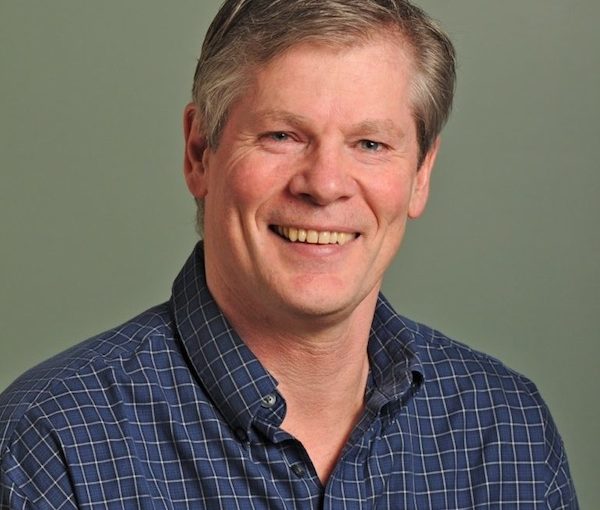
Medical myth-buster Dr. James McCormack speaks Nov. 22 via Zoom. (photo from too-much-medicine.com)

Dr. James McCormack is a bit of an anomaly as a voice in today’s medical debates. In a politically driven climate where most people tend to stand as either “all in” or “all out” with regards to their belief in science and research, McCormack’s approach is more pragmatic.

McCormack, a tenured professor in the faculty of pharmaceutical sciences at the University of British Columbia, a podcast host and a YouTube content creator, is a strong believer in evidence-based medicine. Well-known as a medical myth-buster, he dispels misinformation that often prevents doctors and their patients from making the most informed decisions possible. He will present some of his many thoughts and findings at the Jewish Seniors Alliance Virtual Fall Symposium Nov. 22, 2 p.m., which will be held on Zoom.

McCormack’s presentation will highlight some of the more common myths around what medications are actually effective and how doctors and patients can better work together to make evidence-based decisions. In a phone interview with the Jewish Independent, the doctor said his ultimate objective is to find out what the best available existing evidence is in healthcare to help doctors and patients make shared decisions on treatment plans.

This process is often “tricky,” he said, because of the many false conclusions and deceptive statistics that surround the medical field. For example, there are hundreds of clinical trials showing that statins, one of the most popular drugs in the world, help patients with high cholesterol, reducing the risk of heart attacks among 50-to-60-year-old patients from five percent to four percent.

“If you take a statin you can reduce your chance of a heart attack by about one percent,” he explained. “But what you will hear is that this is a 20% reduction in heart attacks – 20% is not a lie, but it’s misleading.

“If I come to you and say, ‘You have high blood pressure. That’s a silent killer. Do you want it to be treated?’ That’s not shared decision-making,” he argued. “If I said, ‘Your blood pressure is this number and your chance of a heart attack is 10% over the next 10 years and we can reduce it from 10% down to eight percent, what do you think of that?’ If that two percent seems like something you might want to consider, then we can try the drug, start with a low dose, make sure we don’t blow you away with any side effects, and then go from there.”

McCormack hinted at the large amount of medical misunderstanding around the world by noting his belief that at least half of all medical prescriptions are either wrong, unnecessary or the incorrect dose – a problem he says is driven by the challenges pharmaceutical companies face in getting their products to market.

“When a new drug comes onto the market, almost for sure the recommended dose is too high,” he said. “[Pharmaceutical companies] have to show that the medicine works. To show that it works, they have to recommend a dose that everybody responds to because, if you choose lower doses, you might not show enough people responding.”

He likened this process to attempting to estimate how much alcohol any specific person would need to drink in order to get drunk – a question for which there would be almost as many answers as there are people.

“This is a fundamental flaw in how we get a drug onto the market,” he said.

McCormack also brought up the alarming lack of evidence-based research on some of the most popular ideas in modern medicine and nutrition. Some of these myths include what we think about vitamins, the lack of evidence showing the health benefits of green vegetables like broccoli, and even our daily water intake.

“You see the same things with nutrition, where there are so many recommendations that are BS – like the idea of [needing to drink] eight glasses of water a day,” he noted. “Almost everyone in the world knows that’s the number of glasses of water you’re supposed to have every day, but there is not a single study that’s ever looked at that. It’s a made-up number mentioned by someone maybe 50 years ago, but it becomes incredibly powerful when everyone assumes it to be true. The evidence is pretty clear when it comes to water – you drink when you’re thirsty.”

McCormack became a myth-buster when, earlier in his career, he discovered a lack of evidence backing up the so-called facts that many of his mentors presented to him.

“I went looking for the evidence and I wondered why they were telling me this if [there was a lack of] evidence. It didn’t make any sense,” he said. “If good, smart people who are trying to do a good thing are telling me unintentional BS, why is that? So, ever since then, I’ve been very inquisitive.”

While he does his best to provide as much myth-busting content as possible to the public, McCormack warned that there’s no simple solution to helping patients understand the great nuances surrounding medical options.

“It’s very tricky,” he said. “Patients don’t feel empowered to make a decision because that’s not part of the ethos of how we do medicine. There are people who would say to their doctor, ‘Just tell me what to do.’ And that’s totally fine as long as the doctor or the pharmacist knows the best available evidence.”

While McCormack will share some of his key discoveries at the symposium, fans of his work can also listen to any of the 460-plus episodes of his podcast, The Best Science Medicine Podcast, which he has nicknamed The BS Medicine Podcast.

“We take the BS out of the BS,” he laughed, before emphasizing that he and co-host Michael Allan approach their shows with a sense of humour.

McCormack also produces various music video parodies on his YouTube channel under his own name. The videos, he said, are a labour of love. “I do [them] because I’m a tenured professor and I can do whatever I want,” he said, tongue-in-cheek. “Which is kind of nice.”

JSA members/supporters will receive an email with the Zoom link to join the virtual symposium. For more information on and to register for the JSA symposium, contact the JSA office at office@jsalliance.org or 604-732-1555.

Kyle Berger is Jewish Community Centre of Greater Vancouver sports coordinator, and a freelance writer living in Richmond.

***

Editor’s note: This article has been amended from the print version to include more detailed information on how to access the event on Zoom.

A shidduch like none other

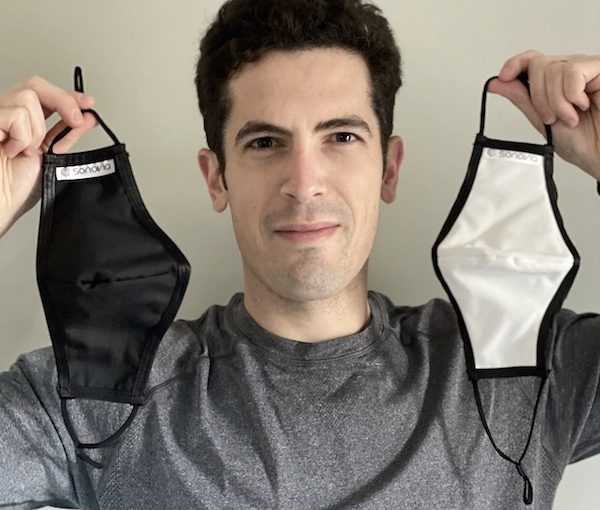
Brad Chenkis shows off a couple Sonovia masks. (photo from Tikva Housing)

It all began when Boris Chenkis, owner of After Five Fashions, was watching Israel Daily TV (ILTV) and saw an interview with Liat Goldhammer, the chief technology officer of an Israeli startup called Sonovia. She was talking about a new fabric-finishing technology for textile manufacturing developed at Bar-Ilan University, explaining that the technology could repel and kill bacteria located on clothing. Because it was in early January, a few weeks before COVID-19 became a worldwide pandemic, Chenkis just listened with interest.

On ILTV March 18, Dr. Jason Migdal, a microbiology researcher in Israel, discussed how the Sonovia technology mechanically impregnates metal nanoparticles into masks that destroy microorganisms in fabric. This was verified by two independent labs. It was also durable and washable. Now Chenkis was very interested.

With COVID becoming widespread, Sonovia had positively impacted Israeli doctors and health professionals by providing them with the technologically advanced masks. On May 12, Chenkis saw another interview about the Sonovia mask technology on ILTV – and an opportunity to get involved.

During his teenage years, Chenkis lived in Israel, studying and working at Kibbutz Rosh Hanikra. With this connection to Israel that never left his heart, he wanted to support an Israeli startup and so he purchased some masks to keep his family, friends and community safe. Soon after, he received an email from Sonovia, offering him an opportunity to help distribute the masks in Canada. Chenkis said yes. The masks were shipped from Ramat Gan to Vancouver and, within days, he was delivering hundreds to friends and family.

One of those who received the Sonovia mask was Yosef Wosk. Being both pleased and impressed with the technology, Wosk, like Chenkis, saw an opportunity to help not only the community here but also Israel. Wosk wondered how the masks could be made available locally to community members who might not be able to afford them, as they cost $65 each.

Wosk spoke with Shelley Karrel, chair of Tikva Housing, who contacted Tanja Demajo, chief executive officer of Jewish Family Services Vancouver. The need for the masks was confirmed and the shidduch almost complete.

Working with Chenkis’s son, Brad Chenkis, and with Wosk’s help, Tikva has acquired and will distribute 500 masks to residents of Tikva Housing, as well as clients of Jewish Family Services. It’s a win, win and win – tikkun olam, tzedakah and chesed.

For more information about the Sonovia masks, contact Brad Chenkis directly at inquiry@afterfivefashion.com.


We must plan for our death

While our ultimate death is a certainty, when and how we will die is unknowable. And though death is inevitable, it remains a taboo subject for most. None of us knows what the future will bring. It is better to be prepared, so that if you become unable to make medical care decisions, your designated family members and healthcare providers, if you have talked to them, will have the knowledge and confidence to make those decisions for you.

As long as you are capable of understanding and communicating effectively with your doctor, nurse or other healthcare provider, you will be asked to make your own healthcare treatment decisions. But a serious accident or illness can result in you being incapable of making your own healthcare decisions at the time care is needed. This is why thinking about your preferences and talking to your future decision-makers now is so important. Making an advance care plan is a choice that will help alleviate some of the stress your family and friends could face if they are required to make important decisions for you, including who, exactly, you want your doctor to approach to learn about your wishes.

Advance care planning begins by thinking about your beliefs, values and wishes regarding future healthcare treatment and talking about them with selected family members or friends, as well as your doctor. When people you trust know what is important to you, it will be easier for them to make treatment decisions on your behalf.

Healthcare providers will always offer medically appropriate healthcare based on clinical assessment. They will want to ensure that any symptoms like pain, dizziness, nausea, bleeding or infection are understood and addressed. As long as you can understand and communicate, your healthcare provider will explain the medically appropriate care best for you, including any risks, benefits or alternatives. They will also ask if you have any questions and if you wish to accept or refuse the proposed healthcare treatment.

Some of the hardest decisions deal with the use of life support and life-prolonging medical interventions. These can include a ventilator to help with breathing, tube feeding, kidney dialysis, or CPR to restart the heart and lungs. If you were to have a life-threatening illness or injury, would you want to accept or refuse CPR? All, some, or no life support or life-prolonging medical interventions? A trial period of life support and life-prolonging medical interventions, allowing a natural death to occur if your condition is not improving?

Your advance care plan should at a minimum include these three things:

  • Having conversations with selected family members, friends, your family doctor and, if applicable, your spiritual leader, about your beliefs, your values and your wishes.
  • Writing down your beliefs, values and wishes for future healthcare treatment.
  • Writing down the contact information for the people who qualify to be on your temporary substitute decision-maker list (see below), or, if you prefer, the contact information for the representative you have chosen and named in an enhanced representation agreement, which is the one that allows you to name a person to make personal-care decisions and some healthcare decisions, including decisions to accept or refuse life support or life-prolonging medical interventions for you. (If you choose to have a representative agreement, I recommend you seek legal advice).

Bear in mind that your health and personal circumstances will change over time. As long as you are capable, you may change or cancel your advance care plan at any time and for any reason. Be sure to notify your doctor and your family members/friends of all changes you make.

Palliative care

When thinking about what to cover in your advance care plan, you might want to expressly include your wish to receive palliative care if you are suffering from a serious illness or condition. Palliative care is specialized medical care that focuses on providing patients with relief from the symptoms, pain and stress of a serious illness, whatever the diagnosis. The goal of palliative care is not to prolong life, nor to shorten it. The goal is to improve quality of life for both the patient and the family, and can be provided in a variety of locations, including the patient’s home, in a hospice, in a residential care facility or in a hospital.

Palliative care is provided by a team of doctors, nurses and other specialists who work with a patient’s other doctors to provide an extra layer of support. While often associated with end-of-life situations, palliative care is appropriate at any age and at any stage in a serious illness and can be provided alongside other appropriate treatments.

Many people choose to stay at home right to the end of their lives while receiving in-home palliative care from specialized healthcare providers. But if you are in the last few months of your life and feel that you are no longer able to manage at home, a hospice may be a good option for you. Hospices are meant to feel more like a home than a hospital. They are designed and furnished to provide a peaceful, homelike environment for you and your family while you receive end-of-life palliative care.

For more information on the delivery of palliative care in each of these settings, search the B.C. Health Ministry website or contact your local health authority.

Medical assistance in dying

Medical assistance in dying (MAiD) was made legal in Canada in 2016. It provides eligible patients who are experiencing intolerable suffering due to a grievous and incurable medical condition the option to end their life with the assistance of a doctor or nurse practitioner.

If your beliefs and values allow you to consider MAiD in the face of intolerable suffering, you should start by speaking with your doctor or your local health authority. For a variety of reasons, not all doctors will provide MAiD, and no one is required by law to do so. For some, MAiD may conflict with their personal beliefs or professional ethics. However, a patient can expect to be provided with information on how to access this service. Healthcare providers must not discriminate against patients with beliefs or values different from their own, and must provide an effective transfer of care to another healthcare professional who does offer MAiD.

To be eligible for MAiD, a patient must meet all of the following criteria:

  • be registered under B.C. Medical Services Plan
  • be at least 18 years old and capable of making healthcare decisions
  • have made a voluntary request for medical assistance in dying that was not made under any external pressure. This request must be in writing and signed and dated in front of two independent witnesses
  • have given informed consent after having been informed of the other means that are available to relieve their suffering, including palliative care, and
  • on assessment by two independent doctors or nurse practitioners, are determined to have a grievous and incurable medical condition, which means they have a serious and incurable illness, disease or disability; they are in an advanced state of decline that cannot be reversed; the illness, disease, disability or state of decline causes enduring physical or psychological suffering that is intolerable and cannot be relieved under conditions that the patient considers acceptable; their natural death becomes reasonably foreseeable. (On Feb. 24, 2020, the Liberal government of Canada introduced a bill to further amend the Criminal Code to, among other things related to MAiD, allow eligible persons to pursue a medically assisted death whether their natural death is reasonably foreseeable or not.)

A patient who has requested MAiD must be given the opportunity to withdraw their request throughout the process, including immediately before the medical assistance is administered, and this withdrawal need not be in writing or in any other particular form. Just an indication of a change of mind will do. And be aware that only patients who are themselves capable of giving consent can request MAiD. A request by a substitute decision-maker or by way of an advance directive is not valid.

Start the discussion

There is much more information available on end-of-life options than touched on in this article, and many matters not covered herein, but there is enough here to allow you to begin a conversation with those in your life who you want to make decisions for you when you cannot.

This is a lot to cover in one conversation. You can have as many conversations as you need – just get started before unwelcome circumstances make it too late. You will be doing yourself and your loved ones a big favour.

Tony DuMoulin is a founder of the law firm of DuMoulin Boskovich, where he practised commercial and real estate law for 40 years. He has a long history of involvement in Jewish organizations and municipal projects. DuMoulin is on the executive board of Jewish Seniors Alliance, in whose magazine, Senior Line, this article originally appeared in July 2020, Vol. 27(2).

Help repair the world

I am flipping through one of my social media outlets, as I lie on my bed, cuddling my 7-month-old baby to sleep. A picture catches my eye. Garbage strewn in front of a restaurant. I look closer, puzzled as to why someone would post a picture of garbage. Then I see. Discarded needles littered amongst the garbage. I read the accompanying message. The poster says that we need to relocate addicts to a secured facility in the north. Provide them with drugs and food and medical care, but we need to get them off of our streets.

I scroll through the comments. I cringe as I read them. I see posts such as, “These people,” “Get them off of our streets,” “Decided to act against societal norms,” “Until they wish to act like proper citizens,” “Undesirables” and so much worse.

The poster is Jewish. Many of the people commenting are Jewish.

My mouth drops open. I take a sharp breath and feel a pain deep inside of me. My heart hurts. I want to cry. My hands shake. It takes all the strength I have not to respond. I am hurt and angry. I shake my head in pain.

I am a recovering alcoholic and drug addict. I haven’t had a drink or a drug in a little over 20 years.

Yes, I am one of those undesirables. So is my husband. My mother and some of my best, most cherished friends.

I was 25 years old when I found recovery. I am one of the lucky ones. I never lived on the street. I didn’t do needles. I didn’t have to experience that kind of bottom, but what being in recovery has taught me is that I am no different than those who live on the streets, than those who inject themselves with needles. Because I am an addict. Once I use, I can’t stop.

The American Psychiatric Association classifies addiction as a complex brain disease that is manifested by compulsive substance use despite harmful consequence. I have a brain disease. I will drink and drug even though it causes harm to me and those close to me. Once I use, I don’t care about anything else. I have a disease that I have to live with and battle for the rest of my life. It is painful. It is a struggle. Some days are easier than others, but the fact of the matter is, I have to live with a disease that can return at any moment. Like a person in remission from cancer.

Does the Jewish community not want me or my children because I am an addict? Am I less of a worthy Jew because of my disease? What about my children? Even as I write this, my heart is beating fast, my breathing is shaky. I think of v’ahavta l’reacha kamocha. I think of how we, as Jews, are commanded to love the stranger who dwells among us, to have one law for the stranger and the citizen, to never embarrass our fellow human beings in public, and to guard our tongues and speak no evil.

Where is the love of humankind when we classify human beings as undesirables? Where is the humanity in suggesting that we take human beings and put them into remote locations, away from civilization? Is this starting to sound familiar? Perhaps like the Shoah? When Hitler classified us Jews as undesirables? Did those Jews have a choice as to whether or not they were classified as Jews even?

I have a disease. I did not choose to be an addict. I did not know, when I drank my first drink and smoked my first joint that I would end up addicted. I was a kid. I did what almost every other teenager did. I experimented. None of my friends from high school are addicts. I am. I got it.

Addicts come from all walks of life. They are your teachers, your lawyers, your doctors, heads of companies, celebrities. They are also those living on the street and leaving their dirty needles behind. Addiction doesn’t discriminate based on your ethnicity, your socioeconomic status or your religion, yet we, as a community, want to believe that addiction doesn’t happen among our tribe. I can tell you that it does. I can also tell you that there are many Jewish addicts and their families who are afraid to come forward precisely because they are afraid that they will be looked down upon and judged as morally impaired. As undesirables.

This, to me, is morally reprehensible. We, as a community, need to act with love. Let’s help repair the world that we live in so that we can love and support all people, even when they are sick with a disease that we don’t understand. It is our duty as Jews. V’ahavta l’reacha kamocha and tikkun olam. Love your fellow as yourself and help repair what is broken.

Amanda Haymond Malul is a JACS (Jewish Addiction Community Service) Vancouver supporter.

Comfort food and COVID

There’s been an uptick in the eating of comfort food in our house since the pandemic began. Cooking and eating are a big deal during stressful times.

Now, we were “into” food pre-pandemic. I cook a lot. However, everything went up a notch when our focus turned inwards, particularly for holidays like Passover, Rosh Hashanah, Sukkot and Thanksgiving. When our neighbourhood bakery closed down in the spring, I went from making only challah to making all our bread. My kids, surprised, said, “Mommy, you made this? It’s really good!” – as they gobbled up the crusty spelt bread I turned out. Over these months, it’s gone from bread production to canning. Once the shelves filled up with jams, pickles and applesauce, autumn became baking and roasting season.

We’ve eaten too much: apple pie and crisp, sweet potato pie, cherry pies, and more. I tried for moderation – and then my husband bought Halloween candy. He started doling out two snack-sized chocolates a day. I couldn’t resist.

In the summer, I combated all this “extra” with dog walks and playing outside, but now it’s cold out again. It’s harder to take long walks. Fall virus numbers have soared, so swim lessons, gym visits and other kinds of exercise are off the table for now.

Imagine my surprise when Daf Yomi, the practice of reading a page of Talmud a day, came to the rescue! I found good advice while reading Eruvin 82b and 83b. After all, it’s not the first time in Jewish history that we’ve gone through periods of stress. When feeling out of control, it might only be natural to struggle with basics like “how much is enough to eat?”

In Eruvin 82b, a discussion emerges. To extend the eruv, the boundary of how far you can go on Shabbat, you can place food in a location, usually cooperatively, with your neighbours, so that you all “share” the space. When you establish this with your neighbours, it’s communal space, like in your house. You can carry things within a larger area. Imagine a block party potluck, and you’re understanding this.

How much food is enough? It’s supposed to be enough when each neighbour puts in enough for two meals. However, that amount must be defined. Is that food enough for two “work day” meals, when people might be doing hard labour? On Shabbat, we eat more, so do we put more out to designate the eruv? How much should it weigh? Does it need to be expensive or fancy food?

The rabbis then do math, which is always a bit dodgy, to be honest. Why? Measurements in the ancient world varied from one geographic location to another. Food staples varied, too – for instance, some places had better access to one kind of grain as compared to others. Rice bread is acceptable, for example, but millet bread can’t be used, because the rabbis say it’s hard to make edible millet bread.

Different communities couldn’t afford the same things and, even if they could afford them, in some cases, the bread they produced was simply not edible. In Eruvin 81a, there’s a discussion about a kind of mixed grain lentil bread, a concoction of wheat, barley, beans, lentil, millet and spelt as spelled out in Ezekiel 4:9. “Rav Hiyya bar Avin said that Rav said: One may establish an eruv with lentil bread.” The Gemara determines that there was a bread made like this in the days of Mar Shmuel, and even his dog wouldn’t eat it. So, the food put out for the eruv must be edible to humans (and dogs) and taste good!

The rabbis refer to the Torah and decide that the manna the Jewish people received while wandering in the desert was about an omer (two litres) each. There’s some dubious calculating to determine how much food is “enough.” The most helpful information I found was repeated by multiple sages over more than a thousand years.

In Sue Parker Gerson’s introduction of Eruvin 83 on myjewishlearning.com, she offers some context for understanding the talmudic text. The sages say, “One who eats roughly this amount [an omer] each day is healthy, as he is able to eat a proper meal; and he is also blessed, as he is not a glutton who requires more. One who eats more than this is a glutton, while one who eats less than this has damaged bowels and must see to his health.”

Maimonides, a physician and a Torah scholar more than 800 years ago, wrote a lot on healthful eating. In Gerson’s article, she includes eating tips from him, as well as from Rashi and Adin Steinsaltz. Regarding Maimonides, he said, “One should not eat until his stomach is full. Rather, he should stop eating when he has eaten close to three-quarters of his full satisfaction.… Overeating is like poison to anyone’s body.”

It’s only natural to use food to celebrate, to comfort and to cope during this crazy time of upheaval. How can we combat this temptation? The rabbis advise: remember not to overeat, eat only what is edible and healthy, and practise moderation.

This is hard. We live in a world of plenty, possibly even including leftover Halloween chocolates. But there are Jewish teachings, over generations, about avoiding overeating. Weight gain could make us more susceptible to complications from COVID-19, and so many other illnesses. It’s not good for us, but, knowing how much food is “enough” isn’t a new issue and, like everything else, it’s a Jewish one. The rabbis probably didn’t have leftover candy or sweet potato pie, but they knew the temptations we might feel to make, or eat, too much of them.

Joanne Seiff has written regularly for CBC Manitoba and various Jewish publications. She is the author of three books, including From the Outside In: Jewish Post Columns 2015-2016, a collection of essays available for digital download or as a paperback from Amazon. Check her out on Instagram @yrnspinner or at joanneseiff.blogspot.com.


JNF panelists focus on heart

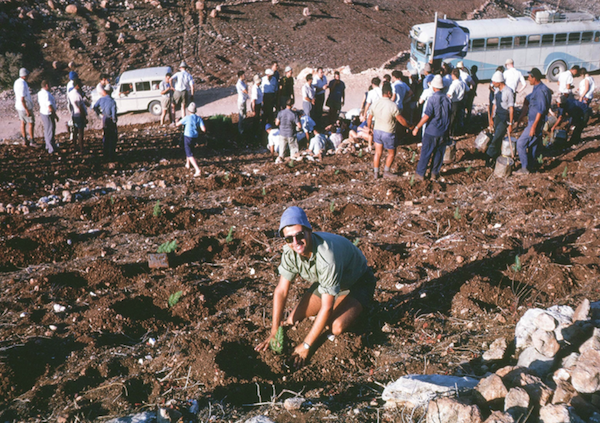
Panel speaker Dr. Arthur Dodek in 1963, planting a Jewish National Fund tree as part of the second World Jewish Youth Convention. Dodek was in Israel representing the Student Zionist Organization of North America. (photo from Arthur Dodek)

The Zoom event in Jewish National Fund, Pacific Region’s virtual sukkah on Oct. 8 was seamless and stimulating. Moderator and presenter Dr. Arthur Dodek led the presentation on heart health with a five-minute overview of risk factors. Drs. Saul Isserow, Zach Laksman and Josh Wenner each presented as well, enlightening the audience in easy-to-understand language on topics of cardiology, also in just five minutes each.

But why was JNF Pacific Region hosting a talk on heart health? Well, every year, JNF hosts a Negev Dinner, raising funds for a specific project. This year, in collaboration with the Israeli organization Save a Child’s Heart (SACH), the fundraising supports the building of a cardiac treatment room, as well as a Holter (a heart-rhythm test) room, at the Wolfson Medical Centre in Holon. The sukkah event was the second in the campaign, the first having been held on Aug. 30, for which Dr. Saul and Lindsay Isserow were honourary chairs (jewishindependent.ca/negev-campaign-goes-virtual). Isserow being a prominent cardiologist led to the idea for this second event, an educational panel on heart health.

The funds raised by this Negev campaign will help SACH focus on doing what they do best – saving the lives of some of the most vulnerable children in the world who are born with heart defects. According to Ilan Pilo, executive director of JNF Pacific Region, many of the young patients are from the Palestinian territories and some come from Lebanon and Syria. As well, there are a number of patients from African nations who have been brought to Israel for surgery, accompanied by their families. “There is a beautiful house for the families, like Ronald McDonald House, but it is an African island in suburban Israel,” said Pilo.

At the Oct. 8 panel, Dodek – using data from a variety of studies – summarized the main lifestyle and medical coronary risk factors. At the top of his list was cigarette smoking, which has decreased in prevalence by nearly 30% since 1965. Diet and cholesterol were other major factors of heart disease, with a Mediterranean or Japanese diet recommended to reduce the chance of cardiovascular events. Blood pressure is also a key issue, and Dodek touched on the benefits of a lifestyle that includes stress and weight reduction, as well as exercise.

Isserow picked up on this theme. In providing a practical, Jewish-oriented take on the best way to maintain long-term cardiac health, he said, “The best bang for your buck from a cardiac point of view is simply getting off your tuches and walking for 30-40 minutes per day.” He mentioned having a l’chaim with friends as a way to lower blood pressure, while stressing that having physical activity as part of a daily routine is beneficial not only for the heart but for myriad other areas of health.

Taking things to another level of complexity, Laksman successfully simplified the subject of atrial fibrillation (a chaotic and irregular heart beat). He spoke about the heart’s rhythm and the causes of heart rhythm disorders, as well as treatment options. He explained that age is the number one cause of atrial fibrillation, but added, “Bad habits, alcohol, probably being number one.” Other factors include genetics, really intense endurance exercise, stress and pollution. Laksman discussed how it feels to experience atrial fibrillation and offered some easy tips, including that people should learn how to take their own pulse, to determine their condition.

Wrapping up the cardiologist panel was Wenner, the youngest of the doctors. Having volunteered for Save a Child’s Heart in Israel before entering his cardiology program, Wenner had a firsthand connection with SACH’s work. But the focus of his talk was COVID-19 and the heart. One of the most important takeaways was the importance of continuing to take heart medications appropriately and regularly to maintain health regardless of rumours in the media about contraindication with COVID. One of the other points Wenner made was that people should go to the hospital if necessary. “Based on the raw data, in March and April … the overall death rate, excluding COVID patients, was significantly higher and the best theory for that is that people were staying home with their acute cardiac and other conditions,” explained Wenner.

JNF Pacific Region president Bernice Carmeli concluded the evening with a more detailed explanation of the fundraising goals and the collaboration with Save a Child’s Heart.

The event proceeded with limited breaks between speakers and short comments by the moderator. “I was asked to give my best 45-minute talk in 12 minutes and I said I can’t do it, but it turned out to be my best talk,” commented Dodek.

For those who weren’t able to attend the event, most of the program was recorded and can be accessed on YouTube or by contacting Pilo at the JNF Pacific Region office, 604-257-5155 or ilan.pilo@jnf.ca. More information can be found, and donations made, at jnf.ca/vancouver/campaigns/negev-campaign.

Michelle Dodek is a freelance writer, who also happens to be the daughter-in-law of the moderator (for full disclosure). Her husband, who is a doctor, says she has the medical knowledge of a third-year medical student.

Need more women leaders

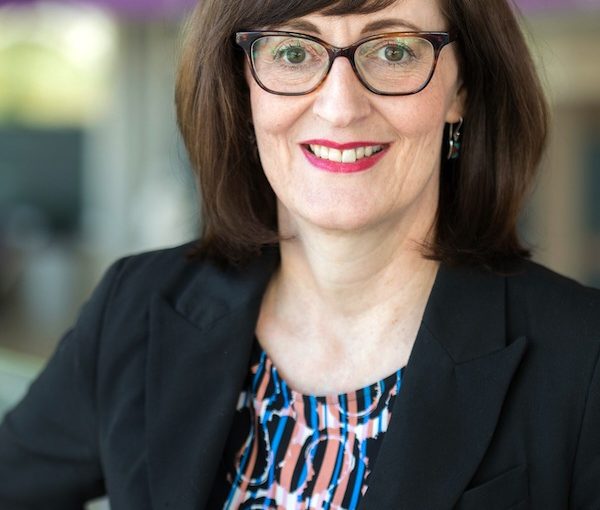
Dr. Patricia Daly (photo from vch.ca)

Dr. Patricia Daly, the chief medical officer for Vancouver Coastal Health, provided an illuminating but discouraging perspective on the status of women in leadership positions in medicine during a National Council of Jewish Women of Canada webinar Oct. 14.

A familiar media presence in Metro Vancouver since the COVID-19 pandemic hit earlier in the year, Daly touched upon the history of women in medicine in Canada and their underrepresentation at board tables and in positions of authority.

Daly, who is also a clinical professor at the University of British Columbia’s School of Population and Public Health, pointed out that, at the time she graduated from medical school in the mid-1980s, one in three students were women. “I am at the stage in my career where physicians would traditionally be in leadership positions,” she said. “Yet, when I look around the tables where I sit, I don’t see one-third of those leaders as women, and I don’t see leadership reflecting the current reality that most students are now women.”

By 1995, there were more women entering medical school in Canada than men. By 2018, 63% of the student body nationwide was female. Nevertheless, only two of 17 Canadian medical school deans were women in that year and the Canadian Medical Association board was comprised of 20 men and six women.

Some of the theories put forward as to why there is a lopsided domination by men in positions of leadership include “unconscious biases” against women, family demands and a confidence gap between the genders, said Daly.

In the Vancouver Coastal Health region, just over 40% of doctors are women, reflective of the national average. Still, she said, fewer than 20% of all VCH leadership roles are filled by women, and that percentage decreases at more senior levels.

Recommendations of how to address this problem encompass leadership training, mentorship opportunities for young female employees and the creation of structures that would incorporate, among other things, the provision of childcare.

“We need to think about how we can support women (and men) who want a work-life balance so that they can advance in their careers and they can achieve leadership roles,” she maintained.

Daly then went into a wide-ranging overview of public health, a field with the mandate of improving the health of entire populations – through prevention of disease and injury, promotion of good health, and protection from potential harms.

Among public health’s many achievements in the past century are vaccinations, family planning, motor vehicle safety, healthier foods, control of infectious diseases, fluoridation of drinking water, safer workplaces and recognition of the hazards of smoking. Recent areas of focus in public health have been climate change and the prevention of substance abuse.

According to information provided by Daly, the average lifespan of Canadians has increased by 30 years since the 1900s, much of which can be attributed to advances in public health.

She added, “A lot of the work we do is centred on maternal-child health. In order to maximize someone’s health potential, we need to start in early childhood; in fact, in utero. Brain development is most important in the first two to five years of life. About 80% of our resources, including public health nurses, are focused on early childhood, supporting women to have healthy pregnancies, to help vulnerable mothers and for childhood immunizations.”

Public health also works on what is known as the “social determinants” of health, said Daly. These include levels of education and income, social connections and risk behaviours, i.e., diet, exercise and smoking.

“People living in poverty are at much greater risk of illness and disease, as well as injuries, despite universal healthcare,” she said. “The goal of public health is to reduce these disparities and bring the system towards one of health equity.”

The third part of Daly’s lecture was about public health and how it handles pandemics. In 1918, Vancouver’s chief medical officer, Dr. Fred Underhill, had to deal with the deadly outbreak of the Spanish flu. (The photos presented at the lecture from at that time showed an exclusively male and Caucasian medical leadership.)

COVID-19 has been Daly’s primary focus for the past eight months. As is broadly known, public health policies during the current pandemic have focused on the need to isolate cases and contacts for 14 days until a person is non-infectious; restrict travel; limit public gatherings; encourage people to physically distance; and have physicians provide virtual care when possible.

“Having access to tests is an important public health measure,” said Daly. “The single most important intervention is to isolate people who test positive and to identify their close contacts and quarantine them. We are fortunate that COVID-19 has a long incubation period. If we can identify cases, then, even if they get sick, they are not going to pass the virus onto others.”

She warned, “Despite the relatively draconian measures taken, we are not going to stop this virus without a vaccine.”

Daly also brought up some of the unintended consequences of the pandemic response, such as the growing number of overdose deaths, increased social isolation in long-term care facilities, suspended elective surgeries and the effects on the broader economy.

She concluded, “The good news is that vaccine development is very promising.”

Sam Margolis has written for the Globe and Mail, the National Post, UPI and MSNBC.

Consider soul maintenance

In a recent article, I learned that Gal Gadot, the famous Israeli actor, says the prayer Modeh Ani (“I give thanks”) when she wakes up. Even famous people can be grateful for “getting their souls back” each morning.

In ancient times, sleep was considered analogous to death in some ways. As a study in contrast, the Christian response for children was: “If I die before I wake, I pray the Lord my soul to take.” The Jewish response is “Hey! Thanks so much for keeping me alive each morning!”

I have always been a morning person (annoying, I know). Although my household is busy every day, we always manage an unconventional communal Modeh Ani as we go out the door. Maybe it was before catching the school bus in those pre-COVID days or, now, just before we take a walk with the dog. In any case, by the time my kids are lining up for their pandemic screening checks and hand sanitizer, we’ve sung this happy and grateful prayer.

Once something is a part of our routine, Jewish or not, we often don’t reflect on it again – but it’s worth remembering. Reading that Gadot, also a mom, embraced a similar routine was sort of heartening. Then, I happened to be studying Daf Yomi, a page a day of Talmud, and an interesting question arose in Eruvin 70a. What if one made an arrangement with someone so that there would be an eruv, a symbolic communal space, that allowed for carrying on Shabbat, and that person died? What happens then?

Almost immediately, the Talmud discusses the person’s heir. There’s no elaboration on the details, the heir was apparently known to everyone. There’s no mention of the executor or the lawyer the family must hire. There’s none of that. I imagined what it would be like if somebody near to me died suddenly on Friday afternoon, and what might happen next.

Thousands of years ago, people didn’t live as long. They lacked the kind of warnings we usually have now, through medical diagnoses and tests and surgeries. Mortality in general was higher, although everyone still dies. Rather, without modern medication and medical interventions, one expected a fair number of infants, children and adults to die before their time.

The recent rise in COVID cases in my home province of Manitoba and the rising mortality numbers have brought all this back into focus. In the last little while, two men in their 40s have died here. My husband and I are in our 40s. We have kids in grade school. We have a dog. And a house. And….

Based on recent experiences with the deaths of relatives and friends, we often had an idea ahead of time that the person was ill or that things weren’t looking good. Yet it isn’t unusual to hear of family members still tying up the deceased person’s affairs for many months (or years) later.

This pandemic is a sobering wake-up call. A hundred years ago, during the flu pandemic, young parents died very suddenly and left orphans. There were children, spouses, siblings and parents who remained. We’re facing something similar in 2020.

On the one hand, we’re lucky because Judaism offers us very sturdy mourning practices. We’ve continued to innovate, too, relying on technology to mourn together. The last few days, I have joined a rabbi online as she says Kaddish. She waits, patiently, until she sees 10 people pop up, viewing her Twitter or Instagram live feed, thanks everyone for helping her, announces her mother’s name, and begins Kaddish. Given the pandemic’s enormous effects, this has been an intimate and surprisingly moving way to support someone in need, virtually.

On the other hand, we’re out of practise with the notion that somebody can just “up and die.” Most of us don’t have immediate plans in place, but we should. Parents all over the world are scared by the notion that they might fall ill, die and leave their kids and spouse alone. This goes way beyond how one will have an eruv on Shabbat if someone dies on a Friday afternoon or on Shabbat.

Do we have up-to-date wills in place? Emergency plans for our immediate families and long-term ideas of how to get support for those left behind? There are a lot of questions and they are scary. What’s worse, though, is that the panic caused by thinking about this can cause us to turn irrational and erratic. Fear can make us hard to be around. We become the people who can’t manage basic, polite social encounters, such as social distancing at the grocery store.

What’s the antidote? Well, while careful estate planning helps, nothing really prepares us for sudden illness. No amount of religious rituals can make us immortal. However, many circle back to countering the fear. Some of us say Modeh Ani, to be grateful – for each morning, a ray of sunshine, a toddler learning to count or an older kid triumphant after a hard test at school. It’s a taste of really good sweet potato pie or an unexpected hug.

In other words, take the win when you can get it, wherever you find it. Sometimes, it’s whimsy, like knitting a pair of mittens with lots of colours, polka dots and a thumb ring. It’s remembering why we say a prayer, even if we rush it or say it at the wrong time.

We can wears masks and social distance and wash our hands, but, right now, our souls also need positive, meaningful time and spiritual support. The next time your car needs an oil change? Consider routine soul maintenance, too.

Joanne Seiff has written regularly for CBC Manitoba and various Jewish publications. She is the author of three books, including From the Outside In: Jewish Post Columns 2015-2016, a collection of essays available for digital download or as a paperback from Amazon. Check her out on Instagram @yrnspinner or at joanneseiff.blogspot.com.

Continuing to give it a whirl

A whirligig is a top, or spinning device, something constantly changing. I don’t know about you, but I sometimes feel my head spinning. Whether we are talking about the internal – the radical changes many of us experience in our lives – or the external, the remarkable way the world around us has changed, I think I have got it right, in describing life as a whirligig.

Sometimes, I feel a churning in my insides, as I try to decide whether to laugh or cry. Isn’t it incredible that we start out as these wee things, helpless as puppies? We are even worse – we don’t, as newborns, have the survival instincts of other animals. Then, we grow up as creatures capable of organizing events that can shake the world, at least events that can shake the world around us, metamorphose the people and environment around us. I find that an astounding reality, don’t you?

Creating a new life, as some of us have been blessed with the chance to do, potentially alters all of human history every time it happens. Some humans have done that, and they were born of man and woman. Now, we are seven going on eight billion. What amazing potential lies in human hands! Who knows what intelligences currently lying outside our ken we are yet to master.

I grew up as one of the nonentities and, yet, I have affected the lives of millions who don’t even know my name. No guarantees. We could arrive here just to be another creature consuming resources. But, when I consider the trajectory of my all-too-common life, I shake and twirl, like a spinning top. What about those around us whose names we all know? They also started out on this planet as being more helpless than puppies, but became forces of nature that thrust themselves into our consciousness.

Maybe that is not the most important model. What about those unseen and unknown to us who led a life that yielded offspring, providing the continuity necessary to ensure the survival of humanity’s way of life? All of us started out as an idea that was born into flesh and blood, presenting the option of acting for good or evil. That it works out for the good so many times is astounding, when there are multiple things that can go wrong. We know about those, too. I am letting it all wash over me, making me happy and sad.

Can I talk about some of the ways in which the nature of my external world has changed? I was challenged by the existence of the computer when I was in my 50s. Before that, I remember going into a computer centre in the business I worked in. It occupied a vast air-conditioned space, tended by individuals who were regarded as acolytes of a mysterious priesthood. Today, I have more computing power in the machine I am typing this tale on than was contained in the whole of that metaphoric temple. All that data stuff held for the world’s business has vanished from their physical premises; it’s now in the “cloud,” held electronically in an obscure corner of the United States.

Nowadays, in an instant, I can be present at an event occurring in real time in a place I have never heard of that is 6,000 miles away. If I have the number, I can talk face-to-face with a person halfway around the world!

I can remember shivering in fear as the radio announced what our losses were on land and sea during the Second World War. How immediate would those things be today? We have seen it depicted on TV. Star Trek, with its once-only-imaginable technology, is coming into our living rooms and lives, in living colour. Our appliances are becoming smarter than we are. Is it any wonder that my head begins to spin when I think about it? Our grandkids take this all for granted. They stare at us in disbelief and laugh.

We don’t understand the half of what is going on. But we try to cope with all of this. I have not yet thrown up my hands. I take courses and try to learn new things. I watch webinars. I blunder about expecting failure, and experience it. Bit by bit, I learn a minimum, and I gratefully accept any help offered. I am grateful for the patience of others and try to be patient myself. I revel in small victories of understanding. I resist computer updates that may change the things I know how to work, putting off improvements that leave me at a loss. I accept that I will not learn to know it all.

So, my head is spinning on the turntable of my life, which is also spinning. I make an effort to keep in contact with others of my ilk who are in the same place. We can compare notes and share news of gains and losses. So far, my younger near and dear speak to me in languages I still understand. They make allowances for my decrepitude and hide their amusement at my distresses. I hug my Bride and friends close and closer to ensure I retain human contact. We continue full speed into an evolving future that may be even more beyond my understanding.

I know that, at some time or another, I will have to get off the turntable and hand in my IDs and passwords. Until then, I continue to give it a whirl!

Max Roytenberg is a Vancouver-based poet, writer and blogger. His book Hero in My Own Eyes: Tripping a Life Fantastic is available from Amazon and other online booksellers.