טרנד חדש: גידול משמעותי במספר המהגרים מישראל לקנדה. (צילום: DrRandomFactor)
מספר מבקשי המקלט יוצאי אפריקה שעזבו את ישראל ועברו לקנדה עלה משמעותית מתחילת שנה זו (2017), לעומת שנת 2016. זאת לפי נתוני רשות האוכלוסין וההגירה של ישראל. כך מפרסם עיתון הארץ.
בהתאם לנתוני הרשות בחלק הראשון של שנת 2017 היגרו לקנדה מישראל קרוב לאלף אפריקאים. רובם המוחלט (כתשעים אחוז) הם יוצאי אריתראה והשאר מסודן (כשישה אחוזים) וממדינות נוספות (גם כן כשישה אחוזים). זאת לעומת כתשע מאות יוצאי שתי המדינות שעזבו את ישראל ועברו לקנדה בכל שנת 2016.
המהגרים מישראל לקנדה מקבלים כאן מעמד חוקי במסגרת התוכניות לקליטת פליטים. ממשלת קנדה מעניקה להם תושבות קבע מיד עם נחיתתם באחד משדות התעופה הבינלאומיים המקומיים, כולל זכויות סוציאליות מלאות וכן גם ביטוח בריאות (מדובר ביתרון משמעותי על פני מי שמהגר לארה”ב). לאחר שלוש שנים מלאות של מגורים בקנדה מהגרים אלה יכולים להתחיל בהליך לקבל בקשה לקבלת אזרחות מקומית קבועה.
כיום קנדה היא יעד מספר אחד של מבקשי מקלט שמבקשים להגר מישראל לאחת ממדינות המערב. אחריה במרחק רב נמצאות: הולנד, שוודיה, ארה”ב ונורבגיה. בסך הכל במחצית השנה הראשונה של 2017 כאלף שלוש מאות יוצאי אפריקה עברו מישראל לאחת ממדינות המערב. לעומת זאת יש ירידה במספר יוצאי אפריקה שחוזרים לגור בארצות המוצא שלהם.
קנדה הפכה ליעד מספר אחד למהגרים האפריקאים בשל מדיניותה הנוחה לאפשר להם להגיע לכאן, להיקלט ולקבל עזרה ואף להשתקע במדינה באופן קבוע. בין התנאים לקבלת המהגרים שמציבה ממשלת קנדה כיום: 1. מתברר שהמהגר לא יכול לחזור יותר לארצו 2. המהגר עובר בדיקות רפואיות מלאות 3. המהגר מפקיד עשרים וחמישה אלף שקל ערבות שיבטיחו כי הוא יוכל להתקיים בקנדה בשנה הראשונה (גם אם לא ימצא עבודה). 4. הגוף שמסייע להמהגר להיקלט מחוייב לדאוג לצרכים הבסיסיים שלו בשנה הראשונה.
לעומת קנדה מספר מבקשי המקלט בישראל ירד משמעותית בחמש השנים האחרונות, מאז 2012 – שהיתה שנת שיא במספר המהגרים האפריקאיים שהגיעו לארץ (מספרם נאמד אז בלמעלה מחמישים ושישה אלף איש). כיום חיים בישראל לפי הערכה באופן מורשה כשלושים ושמונה אלף מהגרים אפריקאים. ממשלת ישראל לוחצת בשנים האחרונות על המהגרים אלה לעזוב את המדינה ולחזור לארצם. מי שעוזב מקבל מענק מיוחד מהמדינה בגובה שלושת וחמש מאות דולר. ישראל כידוע מקשיחה את החוקים והתקנות נגד אזרחי היבשת השחורה בשנים האחרונות.
הקלות בוצעו בהסכמי היצוא והיבוא בין ישראל וקנדה
ישראל וקנדה חתמו לאחרונה על הסכם חדש להכרה הדדית בין התוכנית “גורם כלכלי מאושר” שמפעיל המכס בישראל, לבין תוכנית מקבילה שמפעילה רשות המכס הקנדית ונקראת “שותפים בהגנה”. על פי ההסכם החדש גורמים מאושרים ישראלים, מדובר מלמעלה ממאה גופים שעומדים בקריטריונים פיננסיים, בקריטריונים ביטחוניים ובתנאי החוק (בהם יצואנים, יבואנים, סוכני מכס, שמלחים בינלאומיים, נמלים ימיים, מסופים לוגיסטיים ועוד), שיזכו להקלות בהליכי כניסת טובין ושחרור הסחורות שלהם בקנדה. בנוסף מטעניהם יזכו לסיכון נמוך ובידוק דבר שיגרום לחסכון משמעותי הן בזמן והן בכסף. במקביל גורמים מאושרים קנדיים יזכו אף להקלות דומות בדומה לגורמים הישראליים.
יצוין כי זה ההסכם הרביעי שמדינת ישראל חותמת מאז שנת 2011 בתחום הקלות ביצוא וביבוא. לישראל יש כבר הסכמים דומים עם שלוש המדינות הבאות: ארה”ב, דרום קוריאה וטייוואן. מנהל המכס הישראלי נמצא בימים אלה בהליכים מתקדמים לחתום על הסכמים דומים עם מדינות נוספות בהן סין.
Robin Esrock speaks at the Jewish Family Service Agency’s Seniors Lunch program. (photo from JFSA)
Well-known travel writer Robin Esrock gave an inspirational talk to the Jewish Family Service Agency’s Seniors Lunch program, which took place at Congregation Beth Israel on July 11.
Esrock has written for several publications, has been a TV host and his book The Great Canadian Bucket List was on the bestseller list in Canada and Australia. He told the approximately 40 guests the story of how his adventure-focused career began and how he has been very fortunate in the unorthodox path he has chosen. He also shared his philosophy, which is “you are just where you are supposed to be.”
JFSA’s Seniors Lunch program comprises a kosher meal once a month at Beth Israel and twice a month at Temple Sholom on Tuesdays at noon. All Jewish seniors are welcome. For more information and reservations, call Queenie Hamovich at 604-558-5709.
The government of Canada has apologized to Omar Khadr and awarded him $10.5 million in damages. Khadr is a Canadian citizen whose parents took him as a child to Afghanistan and Pakistan. Fifteen years ago, on July 27, 2002, a firefight took place in which Khadr, then 15, was wounded and a U.S. soldier, Sgt. First Class Christopher Speer, was killed.
Khadr was arrested and incarcerated at the U.S. prison in Guantanamo Bay, Cuba, where he pleaded guilty to throwing the grenade that killed Speer. Khadr later said he confessed falsely in the hope of returning to Canada. However, the facts of the firefight, whether Khadr was guilty or not guilty, whether he was a terrorist or a coerced child soldier-victim, are not relevant to the apology or the compensation.
The decision to apologize and pay Khadr millions of dollars is a result of a $20 million civil suit that Khadr launched after the Supreme Court of Canada unanimously determined that the Canadian government’s interrogation of Khadr while he was at Guantanamo “offends the most basic Canadian standards about the treatment of detained youth suspects.” The civil suit claimed that Canadian officials violated his rights, interrogating him when he was a minor, in the absence of legal representation. He also claims to have been subjected to torture, which would be consistent with the history of Guantanamo and evidence in the public realm.
The decision to apologize and compensate turns on this point: even if Khadr were guilty, the government of Canada did not adequately protect the rights and well-being of one of its citizens; indeed, it was complicit in their violation and acted outside of the rule of our own nation’s laws.
We can all make our own assessment of right and wrong in this case. But the Supreme Court of Canada made the key judgment about the legal foundation of Khadr’s case and the federal government – facing the alternative of almost certain failure in defending itself in the civil case, resulting in a much greater cost to taxpayers – opted to pay Khadr $10.5 million.
Whether it is First Nations land claims and residential schools payouts, symbolic payment to the Chinese-Canadian community for the head tax on their ancestors or compensation to Japanese-Canadians who were deprived of their property and forcibly sent to internment camps during the Second World War, money and an apology are poor substitutes for justice.
Money and an apology will not return lost years or family members. They cannot heal physical or mental wounds, though the money can help pay for medical and psychological treatment. Apologies and reparations cannot undo the harm done. But they can help hold our government and society accountable and, ultimately, that serves us all well.
יו”ר מועצת המנהלים של הג’ואיש פדריישן: “החלטות ממשלת ישראל פוגעות במרקם היחסים המיוחד בין הקהילות בקנדה לישראל”
“ההחלטות האחרונות שהתקבלו על ידי ממשלת ישראל פוגעות מאוד מרקם יחסים המיוחד שקיים בין הקהילות בקנדה לישראל”. דברים חמורים אלה נאמרים על ידי יו”ר מועצת המנהלים של הג’ואיש פדריישן של מטרו ונקובר, קרן ג’יימס. זאת, בתגובת להחלטות הממשלה על הקפאת מתווה הכותל שהיה אמור לאפשר להכשיר את החלקה הדרומית, שם יהיה ניתן לקיים תפילה שוויונית. וההחלטה בנושא חוק הגיור שקובע כי כל הגיורים יהיו רק במסגרת הרבות הראשית בישראל, וכן תהיה בחינה של כל הגיורים שכבר קיימים. משמעות הדבר שיהודים שמשתכיים לזרמים שונים ביהדות דבר שמאפיין את הרוב הגדול של יהדות התפוצה, יהדותם לא תהיה מוכרת על ידי ישראל. אם כן גל המחאות הקשות נגד החלטת הממשלה שהתחיל בקרב יהודי ארה”ב מתפשט גם לקנדה. יש לזכור שבקנדה יש כיום את הקהילת היהודים השלישית בגודלה בעולם, מחוץ לישראל.
ג’יימס (ילידת 1952) כיום היא אשת עסקים שגרה בוונקובר, ועבר נמנתה על נבחרת השחייה של קנדה לאולימפיאדת מינכן שערכה ב-1972, בה נרצחו תשעה ספורטאים ושני מאמנים של נבחרת ישראל על ידי טרוריסטים.
ג’יימס ביקרה בחודש שעבר בישראל כולל אצבע הגליל, במסגרת השותפות של שש קהילות יהודיות בקנדה (מוונקובר, אוטווה, קלגרי, אדמונטון, וויניפג והליפקס) עם האזור שבצפון. השותפות בין הקהילות לאצבע הגליל כוללת קצאת מיליוני שקלים לטובת מערכות החינוך והרפואה באזור, וכן פעילויות משותפות עם אחד עשר בתי ספר באזור, משלחות נוער ותורמים רבים. ג’יימס מזכירה שהקהילה היהודית בוונקובר מקיימת מערכת יחסים מיוחדת עם אצבע הגליל לאורך עשרים השנים האחרונות, שכוללת השקעות כספיות גדולות, על מנת לשפר את איכות החיים של התושבים המקומיים. “במהלך שנים אלו נבנה גשר חי בין שתי הקהילות, שכולל חברויות רבות של בני משפחה אחת גדולה, של עם אחד”.
ג’יימס מוסיפה: “כל זה עומד בניגוד מוחלט להחלטות ממשלת ישראל בנושא מרחב תפילה שיווני בכותל ובנושא חוק הגיור, שמעניק לרבנות שליטה על הגדרת מי הוא יהודי. ובכך מעמיד את הסטטוס של אלפי יהודים בסימן שאלה”. היא מדגישה כי החלטות הממשלה בסוגיות חשובות אלה פוגעות במשמעות התפיסה של מה זה להיות עם אחד, והממשלה שולחת מסר לרוב היהודים בצפון אמריקה כי היא איננה מכירה ביהדותם. “זה מעמיד את המשך תמיכתם של יהודי התפוצות בישראל במצב של סיכון משמעותי. ולכן המצב כרגע הוא חמור ביותר”.
לדברי ג’יימס היא משתייכת לאחד מבתי הכנסת הגדולים ביותר של ונקובר, בו גברים ונשים יושבים ומתפללים ביחד. וכן נשים חובשות כיפה וטלית אם כך הן חפצות. לא מעט גברים ונשים מבית כנסת זה עשו עלייה לישראל. סגנון תפילה זה המשותף לגברים ונשים הוא הנורמה המקובלת עבור מרבית היהודים החיים בצפון אמריקה. ג’יימס מסיימת בדברים אלה: “אני מאמינה כי הזהות המשותפת של כולנו כעם יהודי אחד, ללא קשר לזרם היהדות אליו כל אחד מאתנו בוחר להשתייך, גדולה ומשמעותית לגשר על כל שוני באשר הוא”.
יצויין כי הקונסולית הכללית של ישראל בקנדה, גלי ברעם, שלחה מברק למשרד החוץ בישראל כי קיבלה מסרים חריפים מבכירים בקהילות היהודיות בטורונטו וונקובר, שמזהירים כי שתי החלטות הממשלה יחמירו את הניכור כלפי ישראל, בקרב הדור הצעיר של יהודי קנדה. לדבריה אחד הרבנים בקנדה אמר לה כי סטודנטים יהודים אומרים שמה שישראל עושה זו אנטישמיות”.
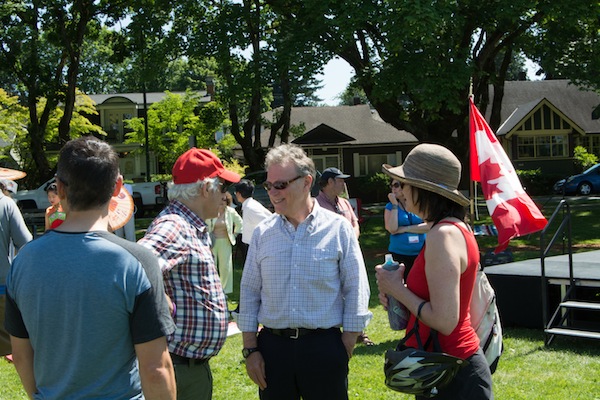
The Hon. Jody Wilson-Raybould, minister of justice and attorney general of Canada (MP for Vancouver Granville), at the Canada Day celebration in Douglas Park, which is in JI publisher Cynthia Ramsay’s neighbourhood. (photo from twitter.com/puglaas)
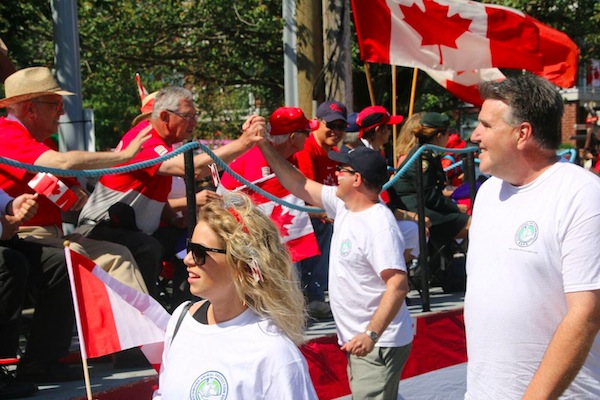
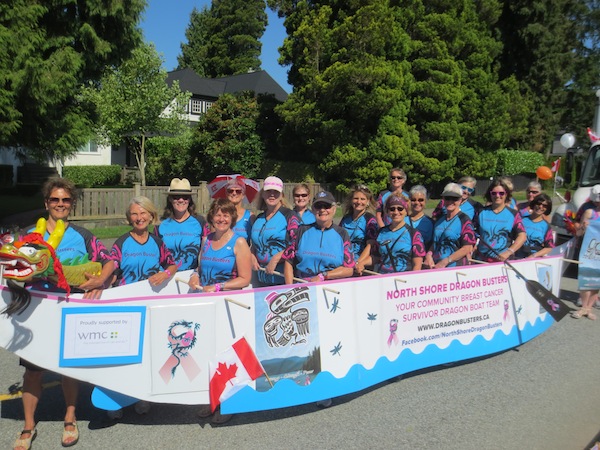
George Heyman, MLA for Vancouver-Fairview, was also at hand at the Douglas Park party. He is seen here speaking with David Berson, left, and Mary Gillis. (photo by Franco Pante)The JI’s Pat Johnson, right, helped represent the Regional Animal Protection Society in the Steveston Salmon Festival Parade on Canada Day. (photo by Alan Marchant)The JI’s Leanne Jacobsen (in the baseball cap) participated in the North Vancouver Canada Day Parade with her North Shore Dragon Busters teammates. (photo by Jonathan Ross)PADS puppy-in-training Pika, in the care of JI production manager Josie Tonio McCarthy, heads out to celebrate Canada Day. (photo by Josie Tonio McCarthy)
When Canada belatedly opened its door to Jewish refugees – to some of the surviving remnant after the Holocaust – it did so not out of an abundance of humanitarianism but because of economic necessity, the need for skilled and unskilled workers in a booming economy.
Regardless of the motivation, that influx of refugees redefined Jewish identity in Canada. The increased Jewish population and the institutions they spawned essentially built the community we know today.
As former Vancouverite Adara Goldberg described in her book Holocaust Survivors in Canada: Exclusion, Inclusion, Transformation, 1947–1955, the institutions that we now see as the organized Jewish community were created for and by the refugees and immigrants who came after the war. By contrast, those who came to the United States after the war were greeted by and largely assimilated into a strong Jewish community already in progress.
This has had several corollaries. The worldview of Canadian Jewish institutions – and, though not easily verifiable, probably a majority of Jewish Canadians individually – is imbued with the understandable anxieties imprinted on those who witnessed the rise of fascism and lived through it.
On the flip side, the Canadian Jewish community as we know it can be said to have been born almost contemporaneously with the state of Israel. Again, while Zionism is entwined with the American Jewish community, that community had many other preexisting cultural and political dimensions. In Canada, the rebirth and survival of the Jewish state occurred at the most impressionable period in the community’s history. As well, the idea of Jewish self-determination as the surest path to individual and collective security resonated powerfully with a community disproportionately made up of survivors of the Shoah. Moreover, Canada’s approach to multiculturalism, especially after 1967, differed from the American “melting pot” and suspicion of “dual loyalties.”
So, the nature of Diaspora-Israel relations is different for Canadians versus Americans. Yet, some of the challenges are the same.
A new essay by David Hazony, editor of the American Jewish magazine The Tower, takes a new tack on the topic of American Jewry’s existential challenges. The Jewish population is not only declining, he notes, but changing. The only demographic that is flourishing is the Orthodox, which is not necessarily reflective of what would have been recognized as “American Jewry” in the 1950s and ’60s. The two most-recognized paths to avoid assimilation, he says, are currently orthodoxy and aliyah – but he suggests a third way.
Hazony posits that the answer to challenges facing American Jews right now is a little more Israel. The essay reviews concerns that American (read: Diaspora) Jews and Israelis are talking across a widening divide. Hazony’s suggestion is that Americans, who have for generations viewed Israel as a political cause, begin to integrate Israeliness as a cultural characteristic and embrace it as the future of their Diaspora identity. For instance, he says, Diaspora Jews immersing ourselves in Israeli cinema, even with subtitles, will give us a remedial entry point into the culture.
Language – not an easy thing to learn, particularly for notoriously unilingual Americans, Hazony acknowledges – is another important entry point.
“Without Hebrew,” he writes, “any approach to Israeliness will be like walking into an enormous library in a foreign language but relegated to the tiny English-language section.”
He suggests a network of Hebrew language and culture centres modeled on the French example. How many times have you driven by the Alliance Française building south of Oakridge?
Finally, travel. Just 27% of Americans have visited Israel more than once, he notes. To understand a place, you have to go there.
The essay is fascinating and offers ideas that could both strengthen Diaspora communities and narrow the gap between us and our Israeli cousins.
As Canada Day festivities unfurl in the coming days, we will see the familiar dictum “The world needs more Canada.” In some ways, we can proudly say, the world would indeed be a more peaceful, cooperative and respectful place if Canadian models were emulated elsewhere. Like any country, we have our flaws, our oppressive history and current inequalities. But, as countries go, we’re pretty good.
Hazony is taking a similar tack, arguing that Diaspora Jews need a little more Israeliness.
In Vancouver, we are very fortunate that our Jewish community centre has, for longer than we can remember, recognized the vital importance of connections with Israel. A plethora of other Israel-related organizations keep these bonds strong.
While pondering what is great about Canada in the coming week, we might also reflect on the value of integrating more Israeli culture into our lives. It can enrich us individually and enhance Canadian multiculturalism, too.
Pierre Trudeau once compared living next to the United States to sleeping with an elephant. “No matter how friendly and even-tempered is the beast, if I can call it that, one is affected by every twitch and grunt,” Trudeau told the Washington press in 1969.
The former PM’s son, current Prime Minister Justin Trudeau seems to be recognizing that, under the leadership of President Donald Trump, the beast is as uneven-tempered as it has been in living memory.
The United States is currently led by a man whose foreign policy compass swings from tweet to tweet. There is no way to predict what position he will take next, having repeatedly besmirched NATO and other agencies of internationalism. The European powers have explicitly or implicitly taken the once-unthinkable position of deeming the United States no longer a dependable ally.
In successive major policy speeches last week, Foreign Affairs Minister Chrystia Freeland and Minister of National Defence Harjit Sajjan laid out somewhat new directions for the Canadian government, both seeming to concur, at least implicitly, that the United States is not the reliable ally it once was.
Sajjan promised a $62 billion boost to defence spending over 20 years, which would seem to be good news for Trump, who has criticized NATO member-nations for not pulling their weight. However, it came on the heels of Freeland’s speech a day earlier, in which she expressed concern that Americans seem prepared to “shrug off the burden of world leadership.”
It is easy to criticize American leadership – under any administration – and, admittedly, while the possibility of U.S. intervention might have given some dictators and oppressors cause for pause, American power has also strengthened dictators and oppressors when it has been in their interests. Nonetheless, the abdication of American leadership creates a frightening vacuum.
Jewish tradition includes the value of lo ta’amod al dam rei’echa, the prohibition against passivity in the face of violence to others. This rather universal concept seems likely to be diminished under the Trump presidency.
“The fact that our friend and ally has come to question the very worth of its mantle of global leadership puts in sharper focus the need for the rest of us to set our own clear and sovereign course,” Freeland told MPs. “To say this is not controversial: it is a fact.” She added: “To put it plainly: Canadian diplomacy and development sometimes require the backing of hard power.”
This is a stark shift in Canadian policy of the past 40 or so years. Without openly saying so, Canadians have been happy to keep military budgets low, knowing that our neighbour would have our back if push came to shove. Canada has little to fear in the form of foreign invasion, although our sovereignty in the Arctic could come under threat by Russia (or even the United States) at almost anytime.
More immediately, what our deflection of military might has created is a limited ability to act in ways on the world stage that reflect Canada’s stated values, which include the pursuit of justice (in Jewish tradition, bakesh shalom v’rodfehu) and the protection of human dignity. Again, when faced with Russian aggression in Ukraine and the Middle East, or with the barbarity of ISIS, or civil war in Syria, or countless other tragic flashpoints globally, Canada has been satisfied to allow our closest ally to set the terms on the ground.
We have been able to have our cake and eat it, too, for many years, calling our approach “soft power,” which means moral suasion based on a degree of global respect Canada has achieved, while leaving “hard power” to our NATO allies. Our role in Afghanistan is an exception, and a source of pride for those who believe that the people of that country should live free from oppressive entities.
This is an imperfect example, of course, since Afghanistan remains riven by terrorism and political division. That average Afghanis, particularly women and minorities, are better off now than under the Taliban is unquestionable. While our presence there has had tangible results, in the global context, it is a somewhat symbolic engagement. Our military has limited capacity to engage similarly in another theatre and would certainly be stretched to the limit if we were to be called into two or more conflicts.
Canada does not – and should not – aspire to be a global military powerhouse. But to maintain self-defence capabilities and to act on our values in a difficult world – at a time when the great power we counted on to do this on our behalf is recanting – requires us to make financial commitments.
We must balance these commitments with our ability to fund social programs and other policies of national pride. Any increased international role should be focused on trying to prevent conflicts, supporting peace efforts and on providing humanitarian and other economic aid.
On May 24, Israelis celebrated the 50th anniversary of the reunification of Jerusalem in the streets around the Jerusalem Great Synagogue. (photo from Ashernet)
Everything changed in 1967. Fifty years ago, Canada celebrated its 100th birthday, hosting an Expo in Montreal and, at least in the narrative we like to tell ourselves, came into our own as a country.
We became a country in 1867, “came of age,” historians tell us, at Vimy Ridge, in 1917, gained full autonomy from Britain’s Parliament in 1931, and adopted our very own constitution in 1982. But 1967 is when we stopped being a baby-country and became a confident, adult-like state on the world stage.
It’s possible that few Canadians pinpoint 1967 as a particular turning point. The various measures of Canadian pride – the U.S. exchange rate, hockey titles, military engagements, pop cultural contributions – have ebbed and flowed in the successive decades. National unity saw multiple flashpoints, from the October Crisis just three years after the euphoria of the Centennial, to the referenda of 1980 and 1995, the latter of which almost ended the nation. Free trade and globalization altered us once again.
“Canadianness” itself changed dramatically in this half-century, from a concept rooted in British heritage to a recognition of “two founding nations” to celebrating multiculturalism and a belated recognition of the rights and tragic history of indigenous peoples resulting directly from our national project. In this time, too, Canada has gone from a staid, comparatively conservative place to one of the most liberal countries in the world. Institutionalized antisemitism, which was still rife in the Canada of 1967, has become almost entirely absent (although incidents and acts of antisemitism, like much else, continue to occur).
While nothing really substantive changed overnight, 1967 is a symbolic moment in Canadian history.
For Israel, 1967 had symbolism but, in very real, tangible and irreversible ways, it was a year when everything changed. While it didn’t happen overnight, it did take a mere six days. The Six Day War, which began June 5, 1967, literally and figuratively reshaped Israel, the Middle East, Diaspora Jewry and global diplomacy.
In its early years, Israel experienced exponential population growth like almost no country on earth has seen. It went from the proverbial desert to a blooming success, first through innovations in agriculture and, later, in technology and almost every other sector of human endeavour. A successful nation was born. But the Jewish state was never accepted by the neighbours it defeated in 1948-’49 and, in 1967, war came again.
Yet the result was so quick and so decisive that some viewed it as a sign of Divine intervention or evidence of chosenness. More realistically, it was a people holding their ground because there was no alternative.
The experience affected not only Israelis but Jews everywhere. Canadian Jews and others in the Diaspora volunteered, sent money, prayed and organized. Less than two decades after it had begun, Jewish self-determination in the ancient land and modern state of Israel hung by a thread. And then victory.
The anxiety before and jubilation after transformed into something new and unexpected. The control by Israel over the West Bank (formerly part of Jordan) and the Gaza Strip (which had been under Egyptian control) led to a new dynamic in Israel – and in the world’s approach to Israel. Having been seen as the underdog, Israel in 1967 transformed – in the eyes of the world and, to an extent, in the eyes of Israelis themselves – into a powerful regional force.
The occupation has been the defining foreign policy concern for Israel for half a century now and affects the way Israel is treated on the global stage. Jerusalem, reunified under Israeli control during the war, is a flashpoint of local and international conflict over competing claims. Israelis will likely be forced to reckon with the legacy of 1967 for many years to come, as it seeks to protect both the democratic and Jewish natures of the state, as well as reaffirming its commitment to minority rights and to pluralism.
Despite this overarching conflict and its associated violence and threats, Israel has developed an economy and culture that is a human-made miracle of the modern world. The list is familiar and endless: scientific and academic achievement, technological innovation, global emergency response, lifesaving medical advancements. Even Israel’s intelligence capabilities, born of necessity, are so advanced that the president of the United States foolishly can’t help bragging to adversarial foreign despots that he has insider intel.
Amid all these challenges and hard work, Israelis self-report in international studies to be among the happiest people on the planet. (Canadians also rank high.) Even with room for improvement, this reality is perhaps the greatest achievement of all.
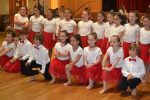
The Grade 1-3 class of Israeli dancers from Richmond Jewish Day School who participated in Festival Ha’Rikud on May 14. See more photos below. (photo by Lauren Kramer)
***
In every community, and ours is no exception, there are folks who frequently capture the spotlight for their work while others quietly get things done behind the scenes, flying below the media radar. In our Kibitz & Schmooze profile, we try to highlight members of our community who are doing outstanding, admirable and mention-worthy work out of view of the general public. If you know of profile subjects who fit this description, please email laurenkramer@shaw.ca.
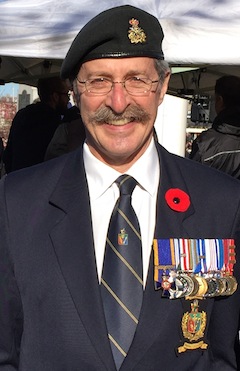
For Victoria resident Ed Fitch, the Canadian Armed Forces did more than make him a major-general. It made him more of a Jew.
Growing up in Montreal, Fitch says he took his Judaism for granted. At 17, when he joined the armed forces, it was a wake-up call. “I realized if I didn’t respect my own religion, how could I expect anyone else to? It was the beginning of my journey to become more Jewish,” he says.
Retired major-general Ed Fitch. (photo from Ed Fitch)
Fitch was open about his Judaism and, over the course of an illustrious career that saw him rise high through the ranks, he helped create institutional change that would benefit other Jews, too. There had last been a Jewish chaplain in the forces in 1945, and Fitch was determined to change that. “I made a proposal to the armed forces’ governing body for chaplains in 2003, and I asked them, do you want to be followers or leaders? Build it, and they will come!”
The result was the appointment of Rabbi Chaim Mendelsohn to chaplaincy and, a few years later, the succession of Rabbi Captain Lazer Danziger. “Rabbi Danziger will be leading Shabbat services at Alberta’s Area Support Unit Wainwright (one of the country’s busiest army bases) … with a full minyan!” Fitch says with delight.
Fitch’s proposal didn’t just benefit Jews in the armed forces. Today, there’s a Muslim chaplain serving, as well.
Fitch served Canada for 43 years in a career that spanned from 1966 through to his semi-retirement in 2006. During that time, he received the Meritorious Service Medal for his work in the former Yugoslavia, facilitating NATO’s entry. He was also appointed an Officer of the Order of Military Merit in June 1999, the military equivalent of the Order of Canada.
As a colonel in the mid-1990s, Fitch was in the former Yugoslavia when the United Nations’ peacekeeping force, of which he was part, was contracted out to NATO. “It was an astounding change that had never happened before: an in-place transition from a UN command to a NATO command,” he reflects. “It was December 1995 when we all removed our UN badges and rolled over to this NATO force, with a completely different set of rules. As a combat engineer on the land force, I was the guy on the ground preparing for the incoming 50,000 troops who needed minefields cleared, bridges built and accommodations created.”
At 50, Fitch was promoted to brigadier general and was in command of a division of 12,000 members of the military and civilians, and a land mass that stretched from Thunder Bay to Vancouver Island and up into the Arctic. “My staff enjoyed telling me that it was the largest military district in the world – happily, a fairly benign one,” he jokes. The division’s responsibilities were domestic – attending to forest fires and tornadoes – as well as deployed operations, and Fitch regularly prepared troops of 1,000 to 2,000 to fly to Bosnia, Afghanistan and other countries where they were needed.
In 2001, Fitch was appointed major-general, a rank third from the top in the Canadian Armed Forces, and relocated to Ottawa. Here, he supervised planning the restructuring and modernization of Canada’s army reserves.
Fitch had just relocated to Victoria when, in 2006, he was called up from the Supplementary Reserve in support of Operation PODIUM, the Canadian Armed Forces’ support to the 2010 Vancouver Winter Olympics. His primary duty was the leadership of the Games Red Team, a project in which he and his team synthesized a terrorist cell and created practice scenarios to prepare Olympics planning staff for a potential attack.
“Our goal was to improve the capacity of the armed forces to deal with some potentially devastating situations,” he explains. “The model behind it is, train hard, fight easy. We disciplined ourselves to be real and started giving Olympics planning staff gentle problems, upping the ante to present them with tougher and tougher problems.”
When asked if he ever experienced antisemitism in the armed forces, Fitch says that his rise through the ranks is evidence there is none. “What the forces did with me proves there is no antisemitism,” he says. “I think the Canadian Armed Forces is the purest meritocracy in this country.”
After the Winter Olympics, when his full retirement came into effect, Fitch dedicated himself to community work. As a qualified civil engineer, he was instrumental in helping with the construction of the Centre for Jewish Life and Learning (Chabad), the first new synagogue to be built on the island since 1863. He volunteers with the Victoria Jewish Cemetery Trust and the Vancouver Island Chevra Kadisha, and serves as chair of the Centre for Israel and Jewish Affairs’ national community security committee. He’s been house committee chair and treasurer of Congregation Emanu-El and a board member of the Jewish Historical Society of British Columbia.
***
The 14th annual Festival Ha’Rikud took place at the Jewish Community Centre of Greater Vancouver May 12-14 and Israeli dancers from Richmond Jewish Day School (RJDS), Vancouver Talmud Torah, Temple Sholom, Or Chadash, Orr Ktanim and a group from Miami entertained a packed house in two performances. The theme for this year’s festival was friendship and a celebration of Israeli culture in its Canadian context, in honour of Canada’s 150th birthday. Dancers delivered polished performances that testified to many hours’ practice and a great fondness for Israeli folk dancing.
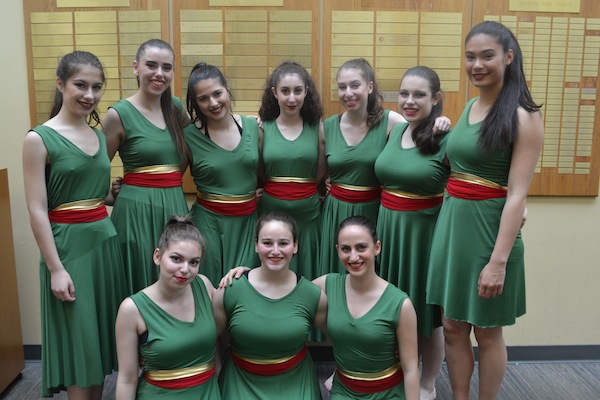
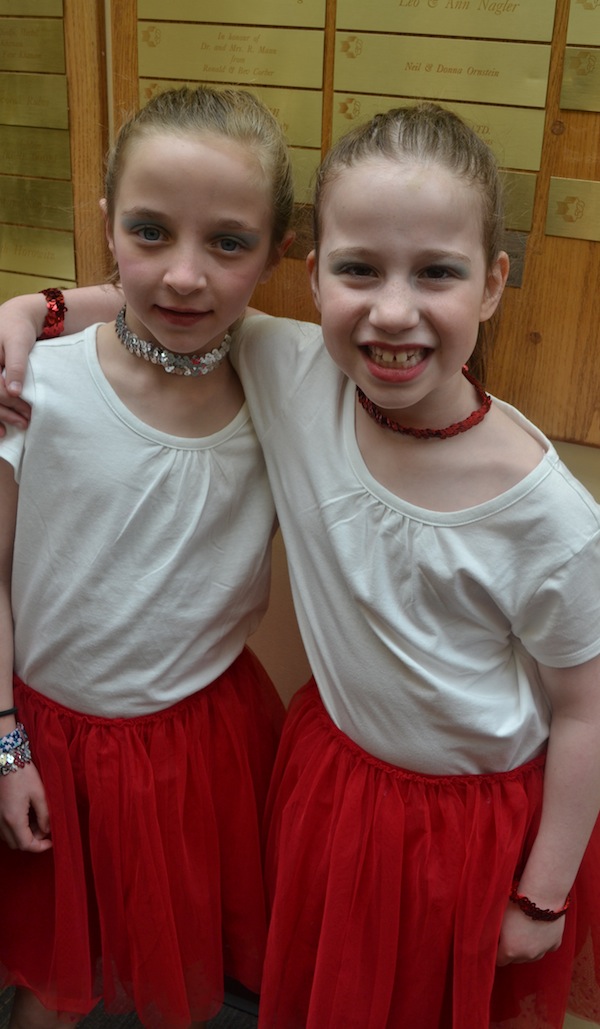
The Or Chadash dancers who participated in Festival Ha’Rikud on May 14. (photo by Lauren Kramer)The writer’s daughter, Maya Aginsky, left, with friend Tamar Berger, both in Grade 2 at RJDS. (photo by Lauren Kramer)
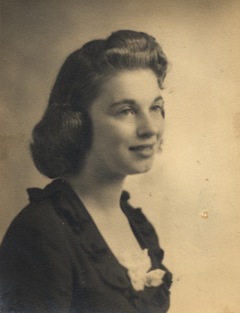
Marianne, left, with her father, Otto Echt, and sister Brigitte. (photo from Canadian Museum of Immigration [CMI] at Pier 21)
Marianne Ferguson’s family missed the train that was supposed to take them to Montreal from Halifax. Just 13 at the time, she and her sister were mostly excited at the prospect of something new, although they were sorry to leave friends and family behind in Europe. Their parents, however, were apprehensive, worried about starting a new life in a foreign country. And that was before they got stuck in Halifax – where, almost eight decades later, Ferguson, née Echt, still calls home.
In Europe, the Echts had lived in a little resort town called Brosen, just outside of the Free City of Danzig, which is today the Polish city of Gdansk. Ferguson’s father, Otto, was a pharmacist and a hobby farmer, and they lived well. Her mother, Meta, had multiple maids; the children – Marianne, Brigitte and Reni – had a nanny, and every spring and autumn a dressmaker would come into their home for a week to create new wardrobes for the upcoming season. When Adolf Hitler came to power, Ferguson’s family was relatively unaffected in the beginning. Even so, her parents saw what was coming and began making contingency plans.
Ferguson’s father kept homing pigeons on his farm. He would go to Poland to deposit money, and send the pigeons back home with coloured ribbons tied to them for Ferguson’s mother to decipher. A yellow ribbon meant he had arrived, for example, while a red ribbon meant he had deposited the money. He was able to get away with this scheme because the guards at the Polish border assumed he was entering his pigeons into competitions.
The Echts continued living in Brosen as the situation deteriorated for Jewish families. When the fair-haired Ferguson traveled to Hebrew school in Danzig with her sister, Hitler Youth would yell at her to ‘Stop walking with that Jew!’ When the Jewish children in the region were no longer allowed to attend school with their peers, the Jews of Brosen opened their own school on a local estate. The estate was at the end of a long street inhabited by Nazis, and it was understood the Jewish children all had to be in school and off the street by 8 a.m.
One day, when Ferguson was about 11 or 12, her streetcar to school was late. As she was walking alone down the long street to her school, a man sent his police dog after her. The dog attacked her, biting her on the elbow.
“And all of a sudden, somebody raised me up. Must have been an angel, really,” said Ferguson in a recent interview with the Independent from her nursing home in Halifax.
It was the milkman. He put Ferguson in his wagon, drove her to school and deposited her inside the gate. Ferguson said that man saved her life.
For her parents, it was the last straw. They decided they had to get out. A member of the Canadian consulate informed them that the country was not accepting pharmacists. Fortunately, though, the consulate worker saw their little farm and suggested sending them as farmers. And so it was that the Echts found themselves coming through Pier 21 in Halifax on March 7, 1939.
When they arrived at the pier, someone called their names and frightened Ferguson’s father. How did people here know who they were? But the woman calling them was Sadie Fineberg, from Jewish Immigrant Aid Services (JIAS). When the Echts missed their train, Fineberg put them up in a boarding house run by a Yiddish-speaking woman, and many Jewish families came to visit them.
Marianne Ferguson (photo from CMI at Pier 21)
“My parents said, ‘The people were so nice to us, and how do we know what it’s going to be like in Montreal? Maybe we should stay in Nova Scotia.’ And then they helped us with finding the farm, they drove us out … and we moved over there,” said Ferguson.
The farm was in nearby Milford, about a 45-minute drive from downtown Halifax. The Echts had to stay and work the farm for seven years as a condition of their immigration and, after their term ended, they moved to Halifax. Fineberg became a close family friend, and her nephew Lawrence became Ferguson’s husband.
Ferguson’s extended family was not so lucky. Her parents had applied to bring 11 of them over to Canada, and they were supposed to arrive later in the year. Cutting through all the red tape took time, but the process seemed to be progressing. Ferguson’s 11 family members went to meet their boat in Hamburg – but it wasn’t there. That day was Sept. 1, 1939, and the Second World War had just broken out.
“My father had bought a second farm. We were so lucky, it was right next to our farm. We thought we would all be together in the two farms. But it wasn’t meant to be. They were all killed,” said Ferguson.
When the war ended, Ferguson began volunteering with JIAS, helping Jewish refugees find their way in Canada. Many of the displaced persons were children traveling alone. Ferguson remembers one 17-year-old boy in particular who came through Pier 21 in 1948 and needed money to get to Montreal. Ferguson and her mother gave him $20 and some food. They also told him that he would become a good citizen, and he should work hard and make something of himself. Meanwhile, Ferguson continued to volunteer at Pier 21 until it closed in 1971. She began volunteering there again when it reopened as a museum in 1999.
Unbeknownst to Ferguson, the boy listened to her. His name was Nathan Wasser, and he had survived multiple camps in the Holocaust, including Auschwitz. He was trained as an electrician in Munich after the war, so that’s the work he first did after arriving in Montreal. In 1952, he met his wife-to-be, Shirley, at a parade for Queen Elizabeth, who was still a princess at the time. Together, they started a family, having a daughter and a son, and he ventured into the business world. Wasser eventually came to own his own shopping centre.
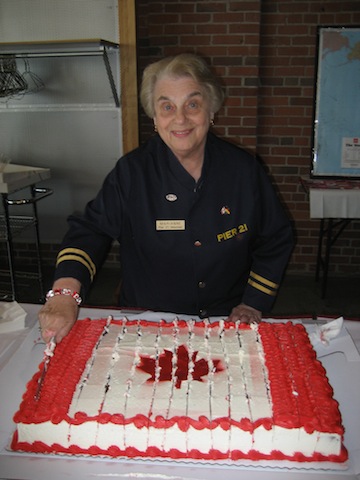
Marianne Ferguson volunteered at Pier 21 when it was an immigration facility and again when it reopened as a museum. (photo from CMI at Pier 21)
Through it all, Wasser – who passed away in 2015 – kept in mind the two women who had helped him when he first came to Canada as a scared and overwhelmed teenager.
“So I said to him, ‘You know, you have this vision of two volunteers. Would you like to go back to Pier 21?’” said his wife Shirley Wasser in a phone interview with the Independent. “And he said, ‘Well, I’ll never find anything.’”
Despite his doubts, Wasser contacted the Atlantic Jewish Council in 2003. The council connected him to Ferguson (her mother had already passed away), and they arranged to meet when the Wassers visited Halifax later that year.
On the appointed day, Ferguson and her granddaughter waited in the lobby of Pier 21 for a man with a blue shirt. Unfortunately, it seemed as if every man was wearing a blue shirt that day. Finally, a couple entered. The man was wearing a blue shirt and carrying flowers.
“My granddaughter said, ‘I think that’s for you.’ And, you know, he recognized me,” Ferguson recounted as she started to tear up.
Ferguson and Wasser stayed in touch until Wasser’s death, and she is still in contact with his wife. Whenever the Wassers came to Halifax, the Fergusons would have them over for Shabbat dinner on the Friday, then the Wassers would take out the Fergusons for dinner on the Saturday. Every birthday and holiday, Nathan Wasser would send a bouquet of flowers to Ferguson.
“He had no words for her, how grateful and how appreciative he was to the pier and the volunteers,” said Shirley Wasser. “I think [Ferguson] was one of the finest ladies I’ve ever encountered.”
“He did save his money and he listened to what we were saying. He said he owed it to us to do well. He was so grateful,” said Ferguson, speaking of her late friend somewhere between laughter and tears.
Alex Roseis a master’s student in journalism at the University of King’s College in Halifax. He graduated from the same school in 2016 with a double major in creative writing and religious studies, and loves all things basketball. He wrote this article as part of an internship with the Jewish Independent.