Skip to content
  • Home
  • Subscribe / donate
  • Events calendar
  • News
    • Local
    • National
    • Israel
    • World
    • עניין בחדשות
      A roundup of news in Canada and further afield, in Hebrew.
  • Opinion
    • From the JI
    • Op-Ed
  • Arts & Culture
    • Performing Arts
    • Music
    • Books
    • Visual Arts
    • TV & Film
  • Life
    • Celebrating the Holidays
    • Travel
    • The Daily Snooze
      Cartoons by Jacob Samuel
    • Mystery Photo
      Help the JI and JMABC fill in the gaps in our archives.
  • Community Links
    • Organizations, Etc.
    • Other News Sources & Blogs
    • Business Directory
  • FAQ
  • JI Chai Celebration
  • JI@88! video

Recent Posts

  • Sharing her testimony
  • Fall fight takes leap forward
  • The balancing of rights
  • Multiple Tony n’ Tina roles
  • Stories of trauma, resilience
  • Celebrate our culture
  • A responsibility to help
  • What wellness means at JCC
  • Together in mourning
  • Downhill after Trump?
  • Birth control even easier now
  • Eco-Sisters mentorship
  • Unexpected discoveries
  • Study’s results hopeful
  • Bad behaviour affects us all
  • Thankful for the police
  • UBC needs a wake-up call
  • Recalling a shining star
  • Sleep well …
  • BGU fosters startup culture
  • Photography and glass
  • Is it the end of an era?
  • Taking life a step at a time
  • Nakba exhibit biased
  • Film festival starts next week
  • Musical with heart and soul
  • Rabbi marks 13 years
  • Keeper of VTT’s history
  • Gala fêtes Infeld’s 20th
  • Building JWest together
  • Challah Mom comes to Vancouver
  • What to do about media bias
  • Education offers hope
  • Remembrance – a moral act
  • What makes us human
  • המלחמות של נתניהו וטראמפ

Archives

Follow @JewishIndie
image - The CJN - Visit Us Banner - 300x600 - 101625

Tag: British Columbia

Camp for those with aphasia

Camp for those with aphasia

Sea to Sky Aphasia Camp provides a three-day retreat to 30 campers and their family members at Zajac Ranch in Mission, B.C. (photo from Sea to Sky)

Aphasia is a communication impairment most often caused by stroke, but it can also be due to any brain injury. It impacts a person’s ability to speak, understand spoken language, and the ability to read and to write.

“It’s important to understand that, while communication is impaired, a person’s cognitive function is not,” said Eavan Sinden, a speech-language pathologist at the University of British Columbia, about the condition. “This is something Sea to Sky [Aphasia] Camp focuses on – that we can create a communicably accessible and supportive environment, while acknowledging the inherent competence.

“But, there are some prominent researchers in the world of aphasia now who are looking at expanding on [the] definition … so that it would include the impact of aphasia on a person’s life – the impact it has on a person’s identity, on a person’s ability to participate in social events, their ability to work, their ability to be in the role that we assume … mom, dad, daughter, whatever … changing the definition a little bit to include that impact.”

Out of the 100,000 people in Canada who will suffer a stroke this year, 35% of stroke survivors will live with some form of aphasia. Further to that, 62% of these survivors will experience depression after the stroke.

Sinden teaches and does research at UBC’s School of Audiology and Speech Sciences. One of her primary roles within the school is to coordinate the Sea to Sky camp every September. This fall, it will run Sept. 20-22.

The camp, which is entering its 10th year, provides a three-day retreat to 30 campers and their family members at Zajac Ranch in Mission, B.C., in a facility specifically designed for people with unique abilities and challenges.

To make the camp a reality, Sinden and UBC partner with Douglas College’s therapeutic recreation program, and March of Dimes Canada. “There’s a lot of support for this camp,” Sinden told the Independent. “In addition to being a camp for people with aphasia, those 30 campers come with family or friends, if they choose.

“We also have 36 healthcare-professional students who come for the weekend to learn a little bit more about what it’s like to live with a chronic impairment, such as aphasia. They are speech-language pathology students, audiology students, therapeutic-recreation students, nursing, pharmacy, dental hygiene and physiotherapy – a whole range of care students who opt, every year, to do this. Without them, we wouldn’t have enough support. It’s really great to have these layers of partnerships in the community. They really help create that communicably accessible environment.”

There is also a group of clinical leads, healthcare professionals in the community, who have been working with aphasia and who volunteer the weekend of the camp to work with the students.

A disturbing trend, according to Sinden, is that aphasia is affecting younger and younger people. “This is the frightening part,” she said. “We have people anywhere from 30 or 31 to their late 70s or early 80s, a real range, but the majority are in their 50s and 60s. It’s no longer something you’d think just happens to older people. The Heart and Stroke Foundation has written quite a few reports on that.”

At Sea to Sky, participants can do yoga, horseback riding, cooking, singing, dancing, campfires, basketball, swimming, arts and woodwork.

“A lot of our activities are run by people with aphasia, as well, who have come to the camp for many years and are now leaders in that way,” said Sinden. “The students also take a role in working on some of those activities.”

All accommodations and meals are included in the $250 cost for the weekend.

“It’s a really terrific way for people with aphasia in the community to come together, socialize and be with people who’ve been on similar journeys,” said Sinden. “Aphasia can be very isolating, so it can be incredibly powerful to meet people with whom you have a shared experience, who you can see that idea of, ‘OK, I can do this.’ Maybe, if I’m a little earlier on in my recovery and I see someone 10 years post doing something that I didn’t think would be possible … that can open up opportunities.

“We have a great core group who come year after year,” she added. “But, I have to say, especially this year, we had quite a number of newcomers, which is exciting. We’re always trying to extend our reach and support the community of people with aphasia.”

While the number of people suffering from aphasia has increased, the camp has been able to accommodate the demand – but just barely, due to space and funding.

“We’re fortunate in that March of Dimes, UBC and Douglas College support us with grants, but every year we hope to still get the funds,” said Sinden. “It’s never a sure thing. There’s a huge need for more community support. If we could take more campers or run more camps, we would also be happy to do that and it’s something on our wish list.”

This year, Sinden is starting a campaign called Sponsor a Camper, asking donors to give $250 so someone can attend the camp. Other support is raised via the Stroke Recovery Association of British Columbia and Fraser Health.

For more information, visit srabc.ca or aphasia.ca.

Rebeca Kuropatwa is a Winnipeg freelance writer.

Format ImagePosted on January 18, 2019January 16, 2019Author Rebeca KuropatwaCategories LocalTags aphasia, British Columbia, camp, Eavan Sinden, health
Exercise your right to vote

Exercise your right to vote

(news.gov.bc.ca)

British Columbians have been tasked, once again, with voting on whether or not to change our electoral system.

Until Nov. 30, we are being asked to choose what voting system we should use for provincial elections, whether to keep the current first-past-the-post (FPTP) system or switch to one of three proportional representation (PR) voting systems offered on the ballot. This is our third referendum on electoral reform, the 2005 and 2009 votes having chosen the status quo rather than change to a single transferable vote system. While the STV forms a component of one of our choices this time around, it is not one of the systems being proposed.

The 24-page voter’s guide from Elections BC describes our current system, FPTP: “the province is divided into electoral districts and each district is represented by one member of the legislative assembly (MLA). Voters mark their ballot for one candidate. The candidate with the most votes in the district wins and represents the district in the legislature. The number of seats a party gets in the legislature equals the number of districts its candidates win.”

In PR, however, “the share of seats a political party wins in the legislative assembly is about the same as the party’s share of the popular vote. So, if a party receives 40 percent of the popular vote, they are likely to have about 40 percent of the seats in the legislature. There are many different voting systems that are designed to produce proportional results.”

Indeed, there are dozens of variations on the PR theme, and herein lies one of the problems with the 2018 referendum. British Columbians will be asked: 1) which system, FPTP or PR, should be used for provincial elections, and 2) if a PR system were to be adopted, which of three systems – mixed member, rural-urban or dual member – we would prefer. There will be no second referendum, as there was in New Zealand, asking us whether we would prefer FPTP or the majority-chosen type of PR, with its details fleshed out by a parliamentary, expert or other committee.

We are, in essence, being asked to take our best, semi-educated guess as to which of three vaguely described PR options might yield better results than FPTP. Several key factors are “to be determined” after the referendum results, if PR is chosen, such as how electoral boundaries will change, how candidate lists would be drawn up, the total number of MLAs to be elected, how coalition governments would be formed. All of these elements determine how effective a PR system will be in producing a more responsive, diverse and balanced government. And we will not have a direct say in these decisions.

There is no way in this limited amount of space that we can satisfactorily explain all of the PR systems being put forward in the referendum. Readers should go to elections.bc.ca/referendum for the basics and research as best they can. This may not yield satisfactory results, however, because only one of the referendum’s PR options is actually in use in other countries; the other two are theoretical at this point. Mixed member PR is used in New Zealand, Germany, Scotland, Mexico and other countries, while the rural-urban system combines approaches used in various countries and the dual-member version is akin to a system Prince Edward Island once used (but no longer does) and also, according to one pro-PR website, “echoes our own voting history,” as British Columbia had multi-member ridings until the 1990s.

So, what do to then if we treat this referendum as less of a choice between which PR system we prefer and more of a choice between keeping the status quo and changing to a new system?

Vote PR BC and the No BC Proportional Representation Society each received $500,000 in government funding to advocate for and against PR, respectively. However, you will find little in-depth information from these sources. Think tanks and other groups have tried to fill in the gaps of knowledge but, perhaps not surprisingly, there’s valid-sounding evidence on both sides of the issue. For each piece of evidence supporting PR – such as it will end adversarial politics and hold politicians more to account – there is an evidence-based opposite finding. How many of us will look at all the studies, check the sources and determine how rigorous and accurate the conclusions are? Likely very few of us.

For what it’s worth, among the supporters of PR, you will find the left-leaning Canadian Centre for Policy Alternatives, the B.C. NDP and B.C. Green Party. Among those skeptical of it are the right-leaning Fraser Institute and the B.C. Liberals. At the end of the day, most of us will probably base our decision on the opinions of those people and organizations with whom we agree on other subjects. We also will consider what we know personally (as opposed to filtered through another researcher’s lens) of PR systems elsewhere in the world, such as in Israel – even though the specific Israeli form of PR is not one of those on the B.C. ballot, it is similar. Some of us might opt for change for change’s sake, and others will stick with the devil we know. It might comfort some voters to know that, if we choose change, there will be another referendum in two election cycles to see if we want to return to FPTP or stay the course.

Knowledge is power and we recommend that voters do the absolute best to educate themselves about the various alternatives. But don’t be discouraged if you’re still uncertain after your research. Both FPTP and PR have their strengths and weaknesses. However, a vital aspect of both FPTP and PR – and one that directly speaks to the health of our democracy no matter what the electoral system – is that people exercise their right to vote. Whatever your choice, please fill out your ballot when you get it in the mail.

Format ImagePosted on October 26, 2018October 25, 2018Author The Editorial BoardCategories From the JITags British Columbia, electoral reform, politics, referendum
Mezuzah at legislature

Mezuzah at legislature

Selina Robinson, B.C. minister of municipal affairs and housing, admires the new mezuzah on her office door, while Rabbi Yechiel Baitelman looks on. (photo from Chabad Richmond)

Born and raised in Montreal before moving to British Columbia, Selina Robinson first lived in Richmond, then relocated to Coquitlam. She was elected as the member of the Legislative Assembly of British Columbia for Coquitlam-Maillardville in 2013 and again in 2017. Robinson is a member of the B.C. NDP.

When I learned that Rabbi Yechiel Baitelman of Chabad Richmond recently helped Robinson affix a mezuzah to her office door at the legislature, I was surprised. I called to ask her how she came to invite Baitelman to help her. “I didn’t,” she replied. “He just showed up with it!”

As it happens, Baitelman was in Victoria to fix a Torah scroll. While there, he reached out to Robinson, a longtime family friend, to see if they could meet briefly. She invited him to her office, where they talked about her portfolio and how they could work together to improve housing in Richmond. Never one to miss an opportunity, Baitelman asked Robinson whether she would like to put up a mezuzah. She loved the idea, but told the rabbi she didn’t have a hammer. Without skipping a beat, he said, “That’s OK, you don’t need one. This mezuzah has adhesive on the back.”

I guess that falls into the category of “I just happen to have a mezuzah on me.” I mean, don’t all rabbis carry them around?

Robinson has known the Baitelman family for decades, through her mother’s work at Chabad Lubavitch in Vancouver years ago. She told me that the Baitelman kids used to call her mother “Bubbe Rhoda.”

While she was a university student in the 1980s, Robinson helped run Camp Gan Israel of British Columbia day camp for two years. Later on, when she was living in Coquitlam, she helped build the Burquest Jewish Community Association. She also used to work at Jewish Family Services.

Robinson’s commitment to the ideals of Jewish life and culture is resolute, and she proudly refers to herself as a “Habonimer.” Yet, her affinity for Chabad is strong, especially their dedication to helping Jews at all levels of observance.

Robinson regularly shows her new mezuzah to colleagues, and takes the time to explain what it means.

Shelley Civkin is a happily retired librarian and communications officer. For 17 years, she wrote a weekly book review column for the Richmond Review, and currently writes a bi-weekly column about retirement for the Richmond News.


Format ImagePosted on October 26, 2018October 25, 2018Author Shelley CivkinCategories LocalTags British Columbia, Chabad Richmond, Judaism, Selina Robinson, Yechiel Baitelman
About the Rosh Hashanah 2018 cover art

About the Rosh Hashanah 2018 cover art

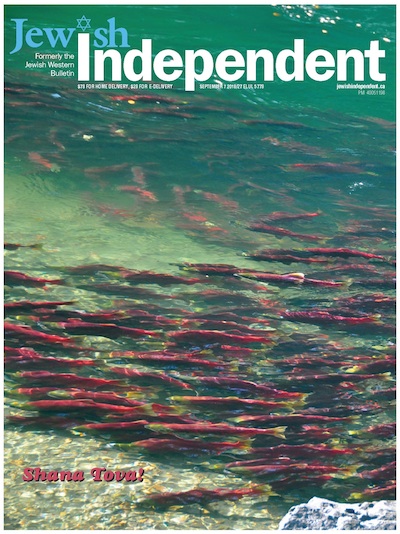
The print edition’s cover photo of the salmon run on Adams River by Leah Ramsay was taken in 2010 at Tsútswecw Provincial Park, near Kamloops, B.C. Formerly named after conservationist and author Roderick Haig-Brown, the park was renamed Tsútswecw this past June.

photo - Rosh Hashanah 2018 coverTsútswecw (pronounced choo-chwek) translates to “many rivers” and the park, established in 1977, encompasses the spawning beds of the sockeye, chinook, coho and pink salmon. Every fourth year is a “dominant” run, with millions of salmon returning – 2010, when this photo was taken, was a dominant year, as is 2018. In honour of the occasion, there is a festival held at the park, called Salute to the Sockeye, which runs this year from Sept. 28 to Oct. 21.

One of the symbols of Rosh Hashanah is the fish head – “we should be the head and not the tail.” There are the themes of creation, rebirth and renewal, as well. In the run, the salmon return from the ocean to their natal stream to spawn, after which most die, their bodies providing nutrients to the vegetation and animals, and the lifecycle begins anew. This all happens in British Columbia from September through November.

“Seeing one of the peak years of the Adams River sockeye run had been a desire for many years and it didn’t disappoint,” said Ramsay. “Even non-hardcore nature nerds are impressed – it is such a huge mass of life all moving to the same goal.”

Format ImagePosted on September 7, 2018September 6, 2018Author The Editorial BoardCategories Celebrating the HolidaysTags British Columbia, environment, photography, salmon
Consul general speaks with JI

Consul general speaks with JI

Consul General Galit Baram was in Vancouver last month. (photo from Consulate of Israel)

Galit Baram, consul general of Israel to Toronto and Western Canada, was in Vancouver last month.

“The visit was very good,” she told the Independent in a phone interview. “It included some political meetings and an academic meeting and I addressed the Jewish community and I attended the Negev Dinner of the JNF…. I had the opportunity to see the city, which is beautiful, and the weather was nice.”

Baram will be returning to Vancouver in November, when the late Dirk Pieter and Klaasje Kalkman will be honoured as Righteous Among the Nations for the assistance they provided to Jews during the Holocaust. The ceremony will be held in conjunction with Yad Vashem Canada and the Jewish Federation of Greater Vancouver.

Baram’s June meetings explored the opportunities of expanding cooperation between Israel and British Columbia in innovation and entrepreneurship.

“I believe that there is great potential in economic cooperation between Israel and British Columbia,” she said.

The provincial government, she said, “is making its initial steps now…. There is interest, there is curiosity, there is awareness of what Israel has to offer in innovation, in the medical field. When it comes to pharma, when it comes to cybersecurity, Israel is a leading country in the international arena in many of these fields.

“We had very good relations with the previous government and we hosted a mission … in November of 2016, a mission that was led by then-minister of finance [Michael] de Jong; there were representatives of different business sectors in British Columbia…. [It] is our intention to work very closely with the current government as well.”

The change in the federal government in 2015 also hasn’t affected Canada-Israel cooperation. On May 28, in Montreal, François-Phillippe Champagne, minister of international trade, and Eli Cohen, Israel’s minister of the economy and industry, announced the signing of the modernized Canada-Israel Free Trade Agreement.

Cohen spent two days in Canada, said Baram, adding, “I hope that Minister Champagne will soon reciprocate and visit Israel as well.

“I believe this is very important to have visits on such a high level … because I believe that governments can contribute greatly to bringing countries together. But we have to remember that, at a certain point, governments have to take a step back and leave it up to the business sector and the private sector to build bridges and to bring the countries together, but, as governments on both sides, Israel and Canada, we do as much as we can in order to strengthen and broaden our bilateral relations.”

Baram also sees the possibility of building a groundwork for peace in Israel through business and trade.

“I believe that economic mobility plays an integral role in bringing communities together,” she said, “and we are watching with pride the growing high-tech sector in the Israeli-Arab community, especially in the Greater Haifa area, in cities such as Nazareth…. We would like to see more Israeli-Arab students concentrating on science, concentrating on business, in business management and innovation and entrepreneurship.

“When it comes to building social bridges between Israelis and Palestinians, not necessarily Jews and Arabs, there are many activities that concentrate on that … and they are conducted by civil societies in Israel and it is heartwarming to see that. I would like to mention the activity of an organization such as Save a Child’s Heart … [which] brings children to Israel [for cardiac care] from Arab countries, from the Middle East, from Muslim countries in general, and they do wonderful, wonderful things in building bridges…. Another example I can give you is the upcoming visit of Dr. Yossi Leshem, one of Israel’s greatest experts on bird migration – he is going to be in Vancouver towards the end of August and he will be accompanied by his friends from [elsewhere in] the Middle East, and they are going to present beautiful regional projects in a conference that will be held in Vancouver…. Two other organizations that I would like to mention … are Ultimate Peace, that organizes Frisbee tournaments for youth … and another project, by Danny Hakim – Budo for Peace – teaches martial arts to Israeli Jews and Arabs, Palestinians, Jordanians and others, and they have instructors coming to Israel from Japan and from other countries…. I believe that such organizations can do so much good for Israeli society in general, for the Palestinians and for neighbouring countries in the Middle East.”

Of course, there are significant obstacles to peace, not the least of which are the ongoing altercations at the Gaza border.

“When it comes to the situation on the Gaza border, we are facing some very serious challenges,” admitted Baram. “It is an uphill battle. We see that there is sometimes a deterioration, sometimes the situation stabilizes a little bit and then there is another deterioration, the situation changes constantly.

“There are many, many challenges on a daily basis that are facing not only IDF [Israel Defence Forces] soldiers and the Palestinian civilian populations, but also the civilian population on the Israeli side of the border. Sometimes there is a tendency to forget about them but there are families, there are entire communities, that raise their children on the Israeli side of the border and because of this intifada of burning kites and balloons, they have to deal with arson cases on a daily basis, with a loss of crops and forest in the south of Israel, and it’s heartbreaking to see that because so much work has been put into making the desert bloom, especially in those regions.”

She added, “The one very disappointing thing for me to see as a former director of the department for Palestinian affairs was the fact that the Kerem Shalom border crossing that was built in the first place to enable trucks to enter Gaza was burned down by Hamas activists and by other terrorists and it’s a shame to see that because so much money was invested in that, so much effort was done in order to make trade between Israel and the Palestinian Authority, and especially Gaza, easier and simpler for us but especially for the civilian population in Gaza. And it’s difficult to see a civilian population that is being held captive by a terror organization…. Of course, there is awareness of the situation in Israel and understanding that the main enemy that has to be dealt with is definitely Hamas and not the people of Gaza.”

As for the Canadian government’s initial statements after the violent March of Return protests – in which Canada admonished Israel, saying its “use of excessive force and live ammunition is inexcusable,” and called “for an immediate independent investigation to thoroughly examine the facts on the ground” – Baram said, “I would like to mention that, after Hamas started attacking Israel, [with] renewed rocket attacks to the south of Israel, there were statements that were released by Prime Minister [Justin] Trudeau and by Minister of Foreign Affairs [Chrystia] Freeland condemning Hamas for this activity and I believe we should concentrate on these statements.”

And Canada’s reluctance to move its embassy to Jerusalem?

“When it comes to Jerusalem,” said Baram, “we believe that all countries should move their embassies to the capital of Israel and the capital of Israel is Jerusalem. Every sovereign country has the right of defining and choosing its own capital and we believe that we don’t have to prove over and over again the story connecting the people of Israel and the land of Israel, between the people of Israel and its eternal capital, Jerusalem.”

With respect to the almost 40,000 Eritrean and Sudanese asylum seekers in Israel, Baram said, “We have to remember that the first Western country that these people from Africa, from Eritrea, from Sudan, asylum seekers, work migrants – define them as you wish – the first Western country they encounter is Israel. And, several years ago, many of them came to Israel…. This is never an easy issue to deal with because the personal stories are very emotional and very difficult, and these people, many of them have been through terrible ordeals, until they reached Israel.

“The issue of migration in general … is an issue that is dealt with in Europe and in other parts of the world,” she said. “In the Middle East, for example, the issue of Syrian refugees is a very big issue that many countries deal with and, now, Syrian refugees, for example, are coming knocking on the doors of European countries, as well, but this is a problem that many Middle Eastern countries have dealt with for quite awhile, a long time now.

“With the African refugees or asylum seekers or work migrants, definitely a solution must be found in order to protect them, protect their rights. On the other hand, we have to keep the sovereignty of the state of Israel and we cannot allow floods of refugees entering Israel because we have to think about our population and … providing an answer that would satisfy all parties involved. This is not easy,” she said.

And neither is Israel’s relationship with Diaspora Jews always easy.

“When you look at Israeli society, you see that the public debate in Israel is very heated and emotional,” said Baram. “This is how we do things in Israel. People are very opinionated … they don’t hide their views and opinions, and I think this is wonderful. This is the strength of Israeli democracy.”

She recalled a statement made by Israeli President Reuven Rivlin about a year ago. “He talked about the four tribes of Israeli society, and he referred to secular Jews, to Orthodox Zionists Jews, to the ultra-Orthodox community in Israel and to Israeli Arabs…. And he called for these four tribes to join hands to discuss the future of Israeli society for the benefit of the country. Later on, he added the fifth tribe … and I believe this is very important to mention that the fifth tribe is Diaspora Jews because Israel is the homeland of the Jewish people…. I am actually very encouraged when I visit Jewish communities throughout Canada and people ask me sometimes challenging questions … about the nature of Israel and about the nature of Israeli society, and what should be done and what is done correctly, or what should be corrected in Israel. I encourage that and I welcome it, because it shows love and devotion and interest in Israel.

“And I encourage people to come visit Israel and express their opinions and to keep us Israeli diplomats on our toes … and I thank Jewish communities for participating in this ongoing discussion. I think this is vital not only for Israel by the way – this ongoing discussion is vital for Diaspora Jews as well.”

To participate in and to follow some of that discussion, follow the consulate on Facebook and Twitter.

Format ImagePosted on July 20, 2018July 18, 2018Author Cynthia RamsayCategories WorldTags asylum seekers, British Columbia, Canada, consul general, Diaspora, economics, Galit Baram, Gaza, Israel, trade

Recognition withdrawn

B.C. Premier John Horgan has withdrawn a certificate of recognition sent to a controversial Vancouver imam, following a month-long advocacy campaign by B’nai Brith Canada. In an email sent to B’nai Brith supporters, the premier’s office confirmed it had rescinded the certificate bestowed upon Tarek Ramadan, while adding, “We strongly condemn any racist, antisemitic, homophobic or discriminatory language.” The email further asserted that the premier’s office was unaware of Ramadan’s “concerning statements” before issuing the certificate and reiterated that Ramadan had also “received certificates from previous governments in past years.”

B’nai Brith first publicly called on the premier to rescind the certificate on May 16, noting that Ramadan was exploiting the governmental plaudits to vindicate his chants against “malevolent Jews” and insistence that “all of Palestine should only be in the custody of the Muslims.”

B’nai Brith exposed further antisemitism and homophobia on Ramadan’s part and called on its followers to contact the premier’s office. Ramadan had publicly posted, then later deleted, a video on Facebook that accuses the Jewish Rothschild family of controling the world’s banks and media, while justifying the Holocaust on the basis that “the Jews sold Germany down the river.”

Another post by Ramadan, still visible on Facebook, describes Israeli soldiers as “fags,” a homophobic slur.

“We are relieved that the premier’s office has finally done the right thing,” said Michael Mostyn, chief executive officer of B’nai Brith Canada. “No one who has been exposed as a hatemonger should receive recognition from a high government official in any province.

“We look forward to working with all parties in B.C. and across the country to prevent similar situations from arising in the future.”

The Muslim Association of Canada, which runs the mosque where Ramadan preached, described his conduct as “inappropriate” in a November 2017 statement.

Posted on June 1, 2018May 30, 2018Author B’nai Brith CanadaCategories LocalTags antisemitism, British Columbia, John Horgan, Michael Mostyn, Tarek Ramadan
Ballet BC brings back Bill

Ballet BC brings back Bill

Ballet BC artists perform Bill, by Israeli choreographers Sharon Eyal and Gai Behar, with musician Ori Lichtik. The company premièred the work in Vancouver 2016 and is bringing it back as part of Program 3 May 10-12 at Queen Elizabeth Theatre. (photo by Chris Randle)

What’s coming out of Israel is some of the “most exciting” dance, Ballet BC artistic director Emily Molnar told the Independent in a phone interview last week about the company’s upcoming program May 10-12, which includes the return of Bill, by Israeli choreographers Sharon Eyal and Gai Behar, with musician Ori Lichtik.

“It’s moved around the world in different generations, where the leading focus is coming from in dance,” said Molnar, “and I think that Israel is, right now, very much one of the major centres…. There is something about the way that the body is being spoken through the dance that’s coming out of Israel that is very relevant right now … it’s exploring more the sophistication and the rawness and the curiosity and the aliveness of using the body in dance.”

Ballet BC performed the Canadian première of Bill in 2016 and have since toured nationally and internationally with it, as part of an evening of female choreographers, along with Crystal Pite’s Solo Echo and Molnar’s 16 + a room. Given the response to Bill after its première here, Molnar said, “It was just one of those things that, to me, was obvious – this needed to come back to Vancouver audiences.”

And it will be a somewhat different performance than it was two years ago. “It’s more in the skin of the performers,” said Molnar. She explained that, having toured with it, the piece is “more familiar” to the dancers, “so they can take different forms of risk than they did before, when they first learnt it. And, each year, we’ve been bringing someone who is familiar with the work and close to Sharon’s work to come and work with us on it, so we keep tuning it each time we do it.”

Ballet BC has only recently returned from six weeks in Europe. The company toured the United Kingdom with the Dance Consortium, which works with their network of presenters to put together a touring circuit for international companies. “They only do two a year, and we were one of them,” said Molnar. “Then we attached that to two weeks in Germany.” In Germany, Ballet BC was the first Canadian company to be invited to perform in Wolfsburg, for the Movimentos Festival, she said.

“There are really a few festivals in Europe that really are landmarks or venues,” she explained, saying that Sadler’s Wells in London, England, where Ballet BC also performed, and Wolfsburg were two of them. “And, next year, we’re going to Luxembourg, so that’s another big one. And then we’re going to Madrid, and also to Tel Aviv, hopefully. More and more touring is coming up for the company, which is really great for us. We love being here at home, for sure, but to be able to have more shows and to diversify audiences, we get more information about what works … we learn more about what we’re trying to do.”

Touring is a relatively new phenomenon, said Molnar. When she danced with the company, they may have toured a week and, when she started as artistic director almost 10 years ago, they weren’t touring at all, she said. “Then we started touring maybe two weeks of the year, and now, this year, we’re out about six or seven, and next year could be even more. There will be a limit, because we have to build a certain amount of work in order to do each season, so we’re not going to be a company that’s constantly on tour because we have a subscription series and we love being three times a year here in Vancouver.”

In many Ballet BC programs, audiences can expect to see a piece choreographed by Molnar.

“I work very closely with the dancers, with the company,” she said of her creative process. “I will often start with proposing ideas or text or ‘what if you tried this’ … and then we start to build some vocabulary. From that vocabulary, I start to compound it and build a dictionary and, from that, I start to place it into some form of a world…. I’m not someone who goes in and shows every step; I definitely cultivate a conversation or way of thinking about a theme or a topic … and then we start to see what comes out of it. I work a lot with improvisation before I get to things that are often scored. But, when I do score something – in other words, when I set it choreographically – I do often still try to keep some things that might be improvisational, but that’s not always the case.”

She said, “It’s more about finding unusual timings, unusual possibilities in the movement. I think that, although I’m very attracted to the expression of the body … there is usually always a concept for me of what I’m working with in the way that I grid, the way that I compose.”

Where the music comes in depends on the work. Sometimes it comes first, and that is the case with the work she has created for this season’s Program 3 with Graeme Langager, conductor of the Phoenix Chamber Choir.

Molnar said that she and Langager had been looking for awhile at how they could bring Ballet BC and the choir together in a performance. “We have a lot of shared philosophy,” said Molnar, so it was a case of “when can we make this happen, and this program seemed like the right one.”

Langager proposed a few compositions, and Molnar was drawn to one by Peteris Vasks called Plainscapes. But it’s a short piece, so that has been part of the challenge of choreographing it – “it’s only 15 minutes,” she said, “and I’m working with the full company, as opposed to a duet or something like that.”

As well, she said, there are 30 voices in the choir, a cello and a violin. “It’s this very beautiful, very intimate, but driving piece of music that has a mysterious urgency to it and I took it as a reflection of a landscape of memory, this desire to want to hold on to remembering something…. The more we lose memory of something, the more we want it to exist.” In her choreography, she tries to communicate that feeling – the desire to hold on to life, on to our memories.

When putting together a triple bill, Molnar said she looks first for diversity “that will take the audience, as a full evening, on a certain type of journey, as opposed to the same tone.

“It is always a risk when we’re doing new work,” she said, “but we don’t always have new work on the program. So, for instance, in this program, I knew mine would be new, so that’s an unknown, but I knew what Bill was and I knew what Beginning After was, which is the first work of the evening, which is a piece by our resident choreographer Cayetano Soto … to the music of [George Frideric] Handel, a beautiful aria. So, all of the pieces have a certain vocal aspect to them…. That wasn’t what drew me to say, oh, this evening is about the voice, but there is a certain type of humanity because the voice is involved in the musical aspect of the show. But there are things that are very different within each of the pieces, and then there is this real attention to the individual but also to the collective throughout each of the pieces.”

Next year will be Molnar’s 10th as artistic director of Ballet BC. Even before she got the job, she said, she had hoped that “its presence as a contemporary dance company, which was very clear before I ever joined as a dancer or as artistic director, would get, not just recognition but that it would have life outside of its own city and be an ambassador for all the new work” it was creating.

“It was not as known within the community as I thought it could be,” she said, noting that, for it to become known, some barriers had to be broken down about “what it meant to walk into a theatre under the banner of a ballet company.

“There are so many ways that can be,” she said, “and I’ve been really trying to work on that, that it’s really about having a conversation and it’s about sharing and it’s about understanding what dance can be, and it’s not about ballet, it’s about dance, it’s about art, it’s about community – and these are not meant to be catchphrases. Seriously, when you bring people together in a live performance and you have a conversation that’s been meaningful for a group of artists and you try to meaningfully extend that over to an audience and they care about it, then there are a lot of really exciting things that can happen.”

And one such exciting thing will be announced at Program 3. Ballet BC will be one of the first companies to commission the work of an emerging female Israeli choreographer so that, next season, Ballet BC will be performing three Israeli works. “We have Ohad [Naharin] coming back,” said Molnar. “We have another work of Sharon’s, a new work for us, and then….” (The JI is not one to ruin a surprise.)

Program 3 runs May 10-12, 8 p.m., at Queen Elizabeth Theatre. Tickets run from $35 to $100 and can be purchased from ticketmaster.ca or 1-855-985-2787.

Format ImagePosted on April 27, 2018April 25, 2018Author Cynthia RamsayCategories Performing ArtsTags Ballet BC, British Columbia, dance, Emily Molnar, Israel
B.C. marks Yom Hashoah

B.C. marks Yom Hashoah

(photo from Vancouver Holocaust Education Centre)

Many child survivors of the Holocaust did not identify as survivors – and were not deemed so by other survivors, including their parents – until decades after the end of the Second World War. The emergence and evolution of the unique experiences of child survivors was the subject of the Yom Hashoah keynote address in Vancouver by Dr. Robert Krell, professor emeritus of psychiatry at the University of British Columbia.

Local survivors of the Shoah and their families, as well as the premier, cabinet ministers and other elected officials, joined hundreds more in Vancouver and Victoria to commemorate Yom Hashoah, Holocaust Remembrance Day, earlier this month. An event presented by the Vancouver Holocaust Education Centre took place at the Jewish Community Centre of Greater Vancouver on April 11 and another took place at the B.C. legislature in Victoria the following day.

In his presentation, Krell spoke about how he was liberated at the age of 5, having been a hidden child in the Netherlands. From the only family he knew, he was returned to the parents of his birth.

“My father and mother’s parents – my grandparents – and their brothers and sisters – my uncles and aunts – had all been murdered,” he said. “I learned about being Jewish at home, hearing stories from survivors who returned. They spoke of Auschwitz and other mysterious places in Yiddish, ably translated by my second cousin, 8-year-old Millie, who had returned from Switzerland with her parents. We heard things no child should hear and, therefore, listened all the more attentively.

“That was my introduction to Judaism, an unforgettable litany of horrors visited upon Jews that imprinted on my mind,” said Krell. “So far as I knew … being a Jew meant death, for everyone was dead, save one first cousin and Millie.”

Finding one’s way through the present with such a burden was an added challenge. “The task of being normal when you know you are not is all-encompassing,” he said. “What I did not realize then was how deeply affected we children were by the events of the Shoah and how intimately the traumatic consequences were entwined with our daily existence.”

While at UBC, in his small private practice, Krell began to see the children of Holocaust survivors. “And, from them, I learned of the impact of the Shoah on survivor families.”

During this period, he was spearheading Holocaust education initiatives in the province, including the Holocaust Symposium for high school students, which will have its 42nd iteration on May 2, and video recording survivor testimonies. “But there was one overriding issue that became the driving force of my preoccupations,” Krell said. “I discovered child Holocaust survivors. That may sound strange…. They did not need to be discovered. But they had disappeared from view. For almost 40 years, child survivors did not identify themselves as survivors. Immediately after the war, children were discouraged from talking about their experiences. In any case, said adults, you were too young to have memories, lucky you. Therefore, you did not suffer like we did.

“Other well-meaning adults urged children to forget in order to get on with their lives. That is not how it works,” said the psychiatrist. “Traumatic memories experienced in early childhood are not forgotten. They remain and they return.”

Throughout the 1980s, child Holocaust survivors began to speak with each other and to the public. In 1991, 1,600 people, primarily child survivors and their families, gathered in New York. “The workshops provided a safe environment in which participants gained self-awareness and much-needed relief,” said Krell.

Yom Hashoah corresponds to the 27th day of Nissan in the Hebrew calendar, the anniversary of the Warsaw Ghetto Uprising. This year marks the 75th anniversary of the uprising, which began on April 19, 1943. “The ghetto fighters were able to hold out for nearly a month,” said Vivian Claman, a member of the second generation at the Vancouver event. “On May 16, 1943, the revolt ended and a total of 13,000 Jews died. It was the largest single revolt of Jews during the Second World War.”

Jody Wilson-Raybould, federal minister of justice, also addressed the audience. “I want to say that we hear you, we honour your lived experiences and your stories, and we renew our commitment, and we reaffirm our vigilance to speak out against antisemitism, to speak out against xenophobia, to speak out against any form of racism or intolerance as unacceptable in this country and throughout the world,” she said.

Councilor Raymond Louie, acting mayor of Vancouver, read the proclamation from city hall. Kaddish was led by Chaim Kornfeld, a survivor. Eric Wilson played cello, and singers included Advah Soudack, Kathryn Palmer and Mia Givon. Wendy Bross Stuart played piano and, with Ron Stuart, were artistic producers. The ceremony ended, as is tradition, with “Zog Nit Keynmol,” the Partisan Song.

* * *

B.C. Premier John Horgan quoted Elie Wiesel: “To forget the dead would be akin to killing them a second time.”

“That’s why it’s so important,” said Horgan in the legislature’s Hall of Honour, “that, on Yom Hashoah, we acknowledge, as a society … that this may never happen again provided – provided – we don’t let time and the sands of history go through our fingers and we remember the words of the survivors that I was fortunate enough to hear today and we remember the millions and millions of lives that were lost because of hate, intolerance and because people didn’t stand up fast enough.”

Selena Robinson, minister of municipal affairs and housing, who is Jewish, emceed the commemoration. MLAs of all parties were present. British Columbia is the only province with a Yom Hashoah commemoration in the legislature.

“We are here today to think deeply on one of the darkest moments in human history so we can remember and, in our remembering, stop it from happening again,” she said.

Opposition MLA Sam Sullivan said, “It is only through knowledge and recognition of humanity’s worst capabilities, including the profound banality of evil, that we can strive for ensuring justice and good in the world and ensure that such heinous acts will not happen again.”

Judy Darcy, minister of mental health and addictions, shared the story of how her father hid his Jewishness with the intention of protecting his family after he survived the Second World War in Europe. Darcy shared the story with the Independent last year. (See the Feb. 24, 2017, issue.)

Temple Sholom’s Rabbi Carey Brown chanted El Maleh Rachamim and an adaptation of the Kaddish, also by Wiesel, which includes the names of camps and other places Jews were interned. Members of the audience spoke out names of places that they or family members came from or experienced.

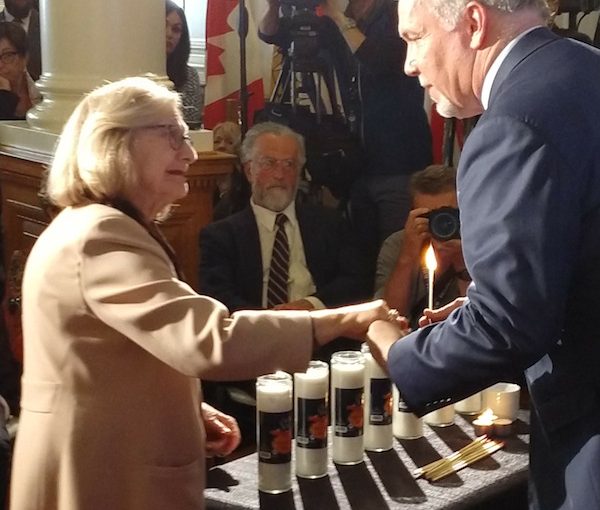
MLA Nicholas Simons played Kol Nidre on the viola while Holocaust survivors Daniel Wollner, Alex Buckman, Rita Akselrod, Suzi Deston and Edith Matous lit candles. Another candle was lit by Nathan Kelerstein, a member of the second generation. A seventh candle was lit by representatives of other groups targeted by the Nazis, including people with disabilities, who were represented by Meyer Estrin and his mother Tzvia Estrin; Peter Csicsai of the Romani Canadian Alliance; and Jonathan Lerner, in memory of gender- and sexuality-divergent peoples. A group of young people, led by Hannah Faber, sang.

Micha Menczer, a Victoria lawyer who deals with First Nations and aboriginal rights, spoke as a child of a survivor of the Shoah. His mother, he said, spoke frequently of the non-Jews who risked their lives to save or help Jews.

“I learned also that, while Jews were a central target, others were attacked, deported and killed because of their race, political or religious belief, disability or sexual orientation,” he said. “Very importantly, my mother taught me that this does not diminish the memory of the Shoah or those who perished to give full recognition to the pain of other people and to the heroism of non-Jews who helped at great risk to themselves. It takes nothing away from our collective memory as Jews to honour those people and remember others who suffered.”

Format ImagePosted on April 27, 2018April 25, 2018Author Pat JohnsonCategories LocalTags British Columbia, child survivor, Holocaust, Robert Krell, Shoah, VHEC
B.C. premier tours JCC

B.C. premier tours JCC

B.C. Premier John Horgan toured the Jewish Community Centre of Greater Vancouver on March 29, speaking with community members of all ages. (photo from Office of the Premier)

B.C. Premier John Horgan visited the Jewish Community Centre of Greater Vancouver just before erev Pesach, March 29.

The premier had visited the JCCGV before, but only to attend meetings in the boardroom, and this was his first visit as the province’s head of government.

photo - Horgan toured the building, visited the Vancouver Holocaust Education Centre, the sports facilities and spent time with children and parents at the daycare
Horgan toured the building, visited the Vancouver Holocaust Education Centre, the sports facilities and spent time with children and parents at the daycare. (photo from Office of the Premier)

Horgan toured the building, visited the Vancouver Holocaust Education Centre, the sports facilities and spent time with children and parents at the daycare.

In a statement to the Independent after the meeting, the premier said: “People drive community. Touring the centre really hit that message home.… I was glad to meet with and hear from community leaders, see the range of services being provided and visit with kids, parents and educators at the childcare centre in advance of Passover.”

On April 12, the premier also participated in a Yom Hashoah ceremony at the B.C. Legislature, which included numerous survivors of the Holocaust. In next week’s Independent, there will be more about the Yom Hashoah commemorations that took place in Victoria and Vancouver.

“Our goal was for him to get to know us and get to see our centre, get to understand the level and breadth of activities we offer,” said Eldad Goldfarb, executive director of the JCCGV. “His focus was primarily on childcare and I think he had a few more visits during that day to other [childcare] facilities.… We wanted him to see what we are doing and we wanted him to hear about our plans for the future.”

While there was no formal agenda for the meeting, after the tour, Horgan met with representatives of agencies that are located in the building. He was introduced and thanked by Alvin Wasserman, vice-president of the JCCGV.

While affordable housing was not on the agenda officially, Goldfarb said he discussed with the premier the opportunity for including such accommodations within the planned redevelopment of the JCCGV site. The new provincial government made a substantial commitment to affordable housing in its first budget, Feb. 27.

Nico Slobinsky, director of the Pacific Region for the Centre for Israel and Jewish Affairs, said Horgan was at the centre more to listen than to talk.

“He was there to learn a little bit about what the centre does and the opportunity to connect with the community since becoming premier,” said Slobinsky, who helped arrange the visit. “He hasn’t had a chance yet to do that. He did that before but not since becoming premier.

“As a community,” he said, “we have long enjoyed a great relationship with the provincial government and we are very happy to see that continue.”

Format ImagePosted on April 20, 2018April 18, 2018Author Pat JohnsonCategories LocalTags British Columbia, CIJA, Eldad Goldfarb, JCCGV, John Horgan, Nico Slobinsky, politics
Faculty boycott Hillel

Faculty boycott Hillel

Hillel House building at the University of British Columbia. (photo from Hillel BC)

The University of British Columbia Geography Students Association (GSA) recently canceled a gala that was to take place in rental space owned by UBC’s Hillel chapter, due to pressure from some of the faculty in the department of geography.

The faculty members said they insisted on boycotting the event because of what they called the “controversial” and “political” nature of Hillel, according to numerous reports. The faculty members had not been publicly identified as of press time and could, therefore, not be located to clarify their position.

The Centre for Israel and Jewish Affairs (CIJA) has accused them of boycotting the GSA gala based on the perception that Hillel supports the state of Israel, which CIJA is calling discriminatory.

“Boycotting Jews or a Jewish organization simply because you object to the state of Israel’s policies is classic antisemitism,” said Nico Slobinsky, CIJA’s director for the Pacific region.

“It is hard to believe that there is such blatant antisemitism on a Canadian university campus in 2018. There should be zero tolerance for any expressions of discrimination, racism and antisemitism on campus and anywhere else in Canada.”

Samuel Heller, the assistant executive director of Hillel BC, told the CJN that, “The actions of these faculty members have resulted in a de facto boycott of the Jewish student centre on campus. To boycott Jews based on one’s political views about Israel is discriminatory and antisemitic. Their actions have led to the resignation of the lone Jewish student on the executive of the GSA, as he felt marginalized and discriminated against because of his Jewishness.”

Addressing the claim that Hillel is a controversial and political space, Heller said, “Hillel doesn’t have any politics. What these faculty members really object to is Hillel’s support of Israel’s existence. We are a Jewish organization and Israel is a part of Jewish identity.… To demand that Jews disavow parts of our identity to placate faculty members is wrong and discriminatory.”

But not everyone accepts Heller’s characterization of Hillel as “having no politics.” The Progressive Jewish Alliance at UBC (PJA) released a statement on Facebook on March 16, saying: “While we recognize the right of the GSA to move the gala based on political considerations, we urge the GSA to recognize that Hillel is the physical Jewish space on campus, alongside having a political position. While we wait for a statement from the GSA, we would like to point out that the ramifications of their decision are alienating Jewish students on campus. Likewise, we encourage Hillel to consider how their political positions, such as an opposition to all boycotts of Israel, can alienate other Jewish and non-Jewish organizations and students.”

The PJA is referring to Hillel International’s Standards of Partnership, which state that Hillel will not partner with, house or host organizations, groups or speakers that deny the right of Israel to exist as a Jewish and democratic state with secure and recognized borders; delegitimize, demonize or apply a double standard to Israel; or support the boycott of, divestment from or sanctions against the state of Israel.

In 2012, concerns about Hillel’s refusal to partner with Jewish organizations that support the BDS movement led to the formation of Open Hillel, an organization that agitates for Hillel to end the Standards of Partnership.

Numerous controversies have broken out over Hillel boycotting groups or individuals in recent years. In one example, in March 2017, B’nai Keshet, a queer Jewish group at Ohio State University, co-sponsored a Purim fundraiser for LGBTQ refugees in the Columbus area. Because Jewish Voices for Peace, an organization that supports BDS, was one of the sponsoring groups, OSU Hillel cut ties with B’nai Keshet, due to pressure from Hillel International, prompting students on numerous American campuses to hold “solidarity Shabbats” with the LGBTQ group. In June, a letter calling for the end of the standards was signed by more than 100 rabbis and submitted to Hillel.

The UBC Progressive Jewish Alliance hopes that the controversy will not only provoke change in the GSA, but in Hillel, as well.

“We hope that both organizations take this opportunity to engage in genuine dialogue around the complexity of politics and place,” it concluded in a statement.

Philip Steenkamp, the vice-president of external relations at UBC, told the CJN that the university is “aware of concerns that have been expressed by CIJA” and “are looking into this matter and will follow due process to ensure it is appropriately addressed.”

Matthew Gindin is a freelance journalist, writer and lecturer. He writes regularly for the Forward and All That Is Interesting, and has been published in Religion Dispatches, Situate Magazine, Tikkun and elsewhere. He can be found on Medium and Twitter. This article was originally published by the CJN.

Format ImagePosted on March 30, 2018March 29, 2018Author Matthew GindinCategories LocalTags antisemitism, BDS, British Columbia, Hillel, Israel, UBC

Posts pagination

Previous page Page 1 … Page 6 Page 7 Page 8 … Page 10 Next page
Proudly powered by WordPress