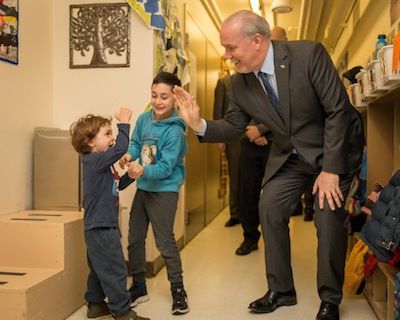
B.C. Premier John Horgan toured the Jewish Community Centre of Greater Vancouver on March 29, speaking with community members of all ages. (photo from Office of the Premier)
B.C. Premier John Horgan visited the Jewish Community Centre of Greater Vancouver just before erev Pesach, March 29.
The premier had visited the JCCGV before, but only to attend meetings in the boardroom, and this was his first visit as the province’s head of government.
Horgan toured the building, visited the Vancouver Holocaust Education Centre, the sports facilities and spent time with children and parents at the daycare. (photo from Office of the Premier)
Horgan toured the building, visited the Vancouver Holocaust Education Centre, the sports facilities and spent time with children and parents at the daycare.
In a statement to the Independent after the meeting, the premier said: “People drive community. Touring the centre really hit that message home.… I was glad to meet with and hear from community leaders, see the range of services being provided and visit with kids, parents and educators at the childcare centre in advance of Passover.”
On April 12, the premier also participated in a Yom Hashoah ceremony at the B.C. Legislature, which included numerous survivors of the Holocaust. In next week’s Independent, there will be more about the Yom Hashoah commemorations that took place in Victoria and Vancouver.
“Our goal was for him to get to know us and get to see our centre, get to understand the level and breadth of activities we offer,” said Eldad Goldfarb, executive director of the JCCGV. “His focus was primarily on childcare and I think he had a few more visits during that day to other [childcare] facilities.… We wanted him to see what we are doing and we wanted him to hear about our plans for the future.”
While there was no formal agenda for the meeting, after the tour, Horgan met with representatives of agencies that are located in the building. He was introduced and thanked by Alvin Wasserman, vice-president of the JCCGV.
While affordable housing was not on the agenda officially, Goldfarb said he discussed with the premier the opportunity for including such accommodations within the planned redevelopment of the JCCGV site. The new provincial government made a substantial commitment to affordable housing in its first budget, Feb. 27.
Nico Slobinsky, director of the Pacific Region for the Centre for Israel and Jewish Affairs, said Horgan was at the centre more to listen than to talk.
“He was there to learn a little bit about what the centre does and the opportunity to connect with the community since becoming premier,” said Slobinsky, who helped arrange the visit. “He hasn’t had a chance yet to do that. He did that before but not since becoming premier.
“As a community,” he said, “we have long enjoyed a great relationship with the provincial government and we are very happy to see that continue.”
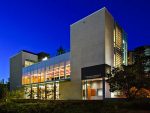
Hillel House building at the University of British Columbia. (photo from Hillel BC)
The University of British Columbia Geography Students Association (GSA) recently canceled a gala that was to take place in rental space owned by UBC’s Hillel chapter, due to pressure from some of the faculty in the department of geography.
The faculty members said they insisted on boycotting the event because of what they called the “controversial” and “political” nature of Hillel, according to numerous reports. The faculty members had not been publicly identified as of press time and could, therefore, not be located to clarify their position.
The Centre for Israel and Jewish Affairs (CIJA) has accused them of boycotting the GSA gala based on the perception that Hillel supports the state of Israel, which CIJA is calling discriminatory.
“Boycotting Jews or a Jewish organization simply because you object to the state of Israel’s policies is classic antisemitism,” said Nico Slobinsky, CIJA’s director for the Pacific region.
“It is hard to believe that there is such blatant antisemitism on a Canadian university campus in 2018. There should be zero tolerance for any expressions of discrimination, racism and antisemitism on campus and anywhere else in Canada.”
Samuel Heller, the assistant executive director of Hillel BC, told the CJN that, “The actions of these faculty members have resulted in a de facto boycott of the Jewish student centre on campus. To boycott Jews based on one’s political views about Israel is discriminatory and antisemitic. Their actions have led to the resignation of the lone Jewish student on the executive of the GSA, as he felt marginalized and discriminated against because of his Jewishness.”
Addressing the claim that Hillel is a controversial and political space, Heller said, “Hillel doesn’t have any politics. What these faculty members really object to is Hillel’s support of Israel’s existence. We are a Jewish organization and Israel is a part of Jewish identity.… To demand that Jews disavow parts of our identity to placate faculty members is wrong and discriminatory.”
But not everyone accepts Heller’s characterization of Hillel as “having no politics.” The Progressive Jewish Alliance at UBC (PJA) released a statement on Facebook on March 16, saying: “While we recognize the right of the GSA to move the gala based on political considerations, we urge the GSA to recognize that Hillel is the physical Jewish space on campus, alongside having a political position. While we wait for a statement from the GSA, we would like to point out that the ramifications of their decision are alienating Jewish students on campus. Likewise, we encourage Hillel to consider how their political positions, such as an opposition to all boycotts of Israel, can alienate other Jewish and non-Jewish organizations and students.”
The PJA is referring to Hillel International’s Standards of Partnership, which state that Hillel will not partner with, house or host organizations, groups or speakers that deny the right of Israel to exist as a Jewish and democratic state with secure and recognized borders; delegitimize, demonize or apply a double standard to Israel; or support the boycott of, divestment from or sanctions against the state of Israel.
In 2012, concerns about Hillel’s refusal to partner with Jewish organizations that support the BDS movement led to the formation of Open Hillel, an organization that agitates for Hillel to end the Standards of Partnership.
Numerous controversies have broken out over Hillel boycotting groups or individuals in recent years. In one example, in March 2017, B’nai Keshet, a queer Jewish group at Ohio State University, co-sponsored a Purim fundraiser for LGBTQ refugees in the Columbus area. Because Jewish Voices for Peace, an organization that supports BDS, was one of the sponsoring groups, OSU Hillel cut ties with B’nai Keshet, due to pressure from Hillel International, prompting students on numerous American campuses to hold “solidarity Shabbats” with the LGBTQ group. In June, a letter calling for the end of the standards was signed by more than 100 rabbis and submitted to Hillel.
The UBC Progressive Jewish Alliance hopes that the controversy will not only provoke change in the GSA, but in Hillel, as well.
“We hope that both organizations take this opportunity to engage in genuine dialogue around the complexity of politics and place,” it concluded in a statement.
Philip Steenkamp, the vice-president of external relations at UBC, told the CJN that the university is “aware of concerns that have been expressed by CIJA” and “are looking into this matter and will follow due process to ensure it is appropriately addressed.”
Matthew Gindin is a freelance journalist, writer and lecturer. He writes regularly for the Forward and All That Is Interesting, and has been published in Religion Dispatches, Situate Magazine, Tikkun and elsewhere. He can be found on Medium and Twitter. This article was originally published by the CJN.
In his first Olympic-distance triathlon, Daniel Meron placed first in the men’s 30-34-year age category. He topped his category in the University of British Columbia Triathlon March 10.
Olympic triathlons see participants swim one-and-a-half kilometres, cycle 40 kilometres and run 10 kilometres. In a sprint triathlon, which also took place the same day, participants swim, cycle and run half those distances. Meron competed in his first sprint triathlon last August.
“I did my first triathlon on a whim,” he said. “I take part in a local boot camp called November Project [a free fitness movement that began in Boston and has spread to other cities]. They exercise at Queen Elizabeth Park every Wednesday morning. I started going over the summer and just began to get to know some truly phenomenal people, people who regularly win or place in ultramarathons, which are 100-kilometre runs that take place over two or three days. I thought I would like to try some sort of event.”
Meron regularly cycles about 16 kilometres to work and has been a lifeguard and swimming teacher for the City of Burnaby since 2004.
UBC Triathlon participants were equipped with timing sensors that measured when they began and finished each segment of the competition. Results were not released on the day of the event, and Meron was pleasantly shocked when he checked his results online.
“It came as a bit of a surprise,” he said. “It was obviously a huge accomplishment just doing an Olympic distance for the first time and so, honestly, winning my age category was just gravy.”
Meron, a UBC alumnus, is a former Hillelnik and served as vice-president of the UBC chapter of the traditionally Jewish fraternity Alpha Epsilon Pi. He is also an actor and acting teacher.
He is slated to do three or four more triathlons in the coming months.
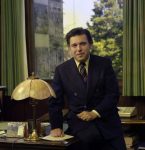
Portrait of Dave Barrett by photographer Fred Schiffer, June 9, 1975. (photo from Jewish Museum and Archives of British Columbia)
More than four decades after he led British Columbia through one of the most tumultuous and consequential epochs in the province’s political history, British Columbia’s first – and, to date, only – Jewish premier is being remembered for an extraordinary life.
Dave Barrett died Feb. 2, several years after being diagnosed with Alzheimer’s. He served as premier for a comparatively short period, from 1972 to 1975, but his policies continue to affect everyday life for British Columbians.
In 39 months – 1,200 days – Barrett’s New Democratic Party government passed 357 diverse and sometimes radical pieces of legislation, more than any single government before or since. The landmark initiatives included the creation of the Agricultural Land Reserve, the Insurance Corporation of British Columbia, a provincial ambulance service and air ambulances, Pharmacare for seniors, neighbourhood pubs, British Columbia’s first ministry of housing, rent controls, the most expansive human rights code in Canada, mandatory kindergarten, reduced teacher-student ratios and the Seabus.
Barrett’s government also proclaimed B.C. Day as a statutory holiday. It established Whistler as Canada’s first “resort municipality” and saved Cypress Bowl from logging, turning it into a provincial park. His government ended logging and mining in provincial parks and banned the export of raw logs, funded the City of Vancouver’s purchase of the historic Orpheum Theatre, raised the minimum wage from $1.50 to $2.50 an hour and created “Mincome,” which guaranteed a minimum income of $200 per month for people over 60. The Barrett record includes the expansion of community colleges, new daycare facilities, French immersion in public schools, and Robson Square, among many other things that we now take for granted.
At a celebration of life in Vancouver March 4, and in interviews with the Jewish Independent, people close to Barrett shared their reflections of the man who led the first socialist government in the province and who was a dominant figure in the life of B.C. politics from 1960 until 1993.
* * *
In his memoir, Barrett: A Passionate Political Life, the former premier recalls growing up on McSpadden Avenue, a one-block spur off Commercial Drive on Vancouver’s East Side, in a house “crammed with books and brimming with lively political discussion.”
His father, Sam, was born in Winnipeg, his mother, Rose, north of Odessa. She was brought to Canada by a Jewish refugee agency after pogroms that followed the Russian Revolution. (In his political life, Barrett would be a strong voice for Soviet Jewry.)
David Barrett was born in Vancouver on Oct. 2, 1930, the youngest of three – his brother Isador was 4 and sister Pearl, 2.
Barrett attended Laura Second elementary and Britannia high school. On weekends, he worked with his father selling fruit and vegetables from a truck and, later, in a retail-wholesale store on Powell Street. After graduating from Britannia, he went, in 1948, to Seattle University, a Jesuit institution that helped cement Barrett’s social justice orientation.
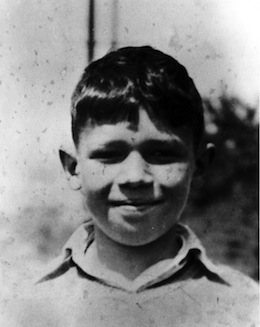
“I had a wonderful time at university, but I was on academic probation muc
Portrait of Dave Barrett as a boy, circa 1940. (Jewish Museum and Archives of British Columbia L.00029)
h of the time,” Barrett wrote in his book.
Returning to Vancouver in summer and during winter breaks, Barrett continued to help out in the family business. One year, to make money, he sold Christmas trees across the street from his dad’s store. He also worked on a CNR train between Vancouver and Edmonton and for the City of Vancouver, pouring hot tar on cracks in the road.
In 1953, he came home with a bachelor’s in sociology and a minor in philosophy.
In his memoirs, Barrett notes that education was deeply important to his family. One day, he recalls, he received a call from his mother to say that his brother Issy, “already an internationally recognized researcher in ocean sciences, had just earned a PhD with distinction.
“There was a pause and she asked if I got the message. I said, ‘No, Mom, what’s the message?’ And she replied, ‘When are you going to return to school and make something of yourself?’”
Barrett was speaking to his mother from the premier’s office in the B.C. legislature.
* * *
When he and Shirley Hackman decided to get married, when Barrett was 22, his parents did not react positively.
“He thought I was too young to get married,” Barrett recalled of his father’s response. “My mother reverted to her traditional role: she went right up the wall. This progressive mother of mine wanted me to marry a Jewish girl, and Shirley was Anglican.”
The marriage went ahead nevertheless. The couple spent $300 on the reception and scraped coins together to make ends meet in subsequent weeks. Rose’s reservations about Shirley dissolved.
“This woman, who hadn’t wanted her Jewish son to marry a gentile girl, did a complete reversal.” Barrett wrote in his memoir. “Now I was no good. I didn’t deserve this wonderful woman. They had an incredible relationship.”
Barrett got a job at the Children’s Aid Society and later worked with young offenders at Oakalla, an overcrowded provincial prison in Burnaby. But he realized he would have to continue his education to advance in the field.
After he was turned down by the social work school at the University of British Columbia, he visited an older mentor in Seattle, who advised him to apply to St. Louis University, another Jesuit institution, in Missouri. While his grades weren’t good, and he had repeated run-ins with authority figures, Barrett had apparently impressed the priests at Seattle University, whom he credited with facilitating his admission to graduate school.
In St. Louis, with a wife and newborn son, Barrett took a side job at the Young Men’s Hebrew Association, working with teenagers. When he graduated, he was offered a job back home in British Columbia, at the Haney Correctional Institute, for $355 a month. There, he created programs including sports, drama, occupational training and rehabilitation for the inmates.
But he was disenchanted with the correctional system and decided the only way to make systemic change was through politics. So, he announced his intention to run for the legislature, on behalf of the Cooperative Commonwealth Federation (the CCF, which, in 1961, became the NDP). As a provincial employee engaging in politics, Barrett was already poking the bear. He was eventually fired from his job for criticizing the corrections and social services system during his campaign for the nomination.
The Vancouver Sun ran the story big and Barrett was thrust into the spotlight, losing his livelihood but becoming a political sensation before even winning the party’s nomination – which he did, in a first-ballot landslide.
Because the general election was still some time away – and because being a member of the legislative assembly at that time was a part-time job that paid $12,500 a year – Barrett secured a position at the John Howard Society, an organization that works with people in, or at risk of entering, the criminal justice system. It was there that he met Norm Levi, who would also become an MLA and play a central role in Barrett’s government, as the one responsible for welfare policy, including “Mincome.”
Elected to the legislature in 1960 in the constituency of Dewdney, Barrett remained a fixture in Vancouver’s Jewish community through the decade. He attended the relatively short annual sittings of the legislature and spent the rest of the year balancing constituency responsibilities and working at the Jewish Family Services Agency, where his mentor was Jessie Allman, and as director of the Jewish Community Centre, even as he rose in the ranks of provincial politics and was recognized as an emerging star.
* * *
Gloria Levi worked at the JCC when Barrett was director.
“It was a riot,” she told the Independent. Gloria and her husband, Norm, had returned from a two-year stint in Israel at the end of the 1950s and the couple became fast friends with Shirley and Dave Barrett.
As Barrett’s career progressed, he would become Norm Levi’s supervisor at the John Howard Society. Gloria Levi recalled something that drew the two couples together.
“[Barrett] was very respectful and very admiring of Norm and me because we wore our Judaism on our sleeve and he didn’t,” she said. “But it meant a lot to him. I think his whole social ethic came from feeling Jewish. I think his sense of justice was definitely influenced from being Jewish. He was always the one who was seen as different because he was Jewish. He was an East Side kid and he had to fight his way a lot of times.”
The Levi and Barrett daughters, as well as the daughter of another (non-Jewish) NDP stalwart, Stu Leggett, attended Camp Miriam and remain friends today. The parents also hung out in the 1960s and ’70s, playing cards at the Barrett home in Coquitlam.
“Many a Saturday night we would go over to their house – this was when we were all elected – and we’d play poker,” Levi said. “I have to say, the person with the best poker face, who could win, was Shirley Barrett.”
The anecdote is telling not only because of what it says about the poker skills of the wife of the future premier, but because, for whatever else one might discern about Dave Barrett, he rarely would or could conceal his feelings.
* * *
Barrett became leader of the British Columbia NDP in 1969, shortly after the party lost its 12th consecutive election.
Premier W.A.C. Bennett, the Social Credit leader who had led the province since 1952, declared Barrett “the most dangerous leader the socialists have ever had in B.C.”
From the perspective of a premier who had triumphed over opponents in seven provincial elections, Barrett was indeed dangerous.
Barrett had seen how Tommy Douglas, the federal NDP leader, used humour to deflect the electorate’s fear of the left, and Barrett used his natural jocularity to his political benefit. In his memoir, Barrett claims people just laughed at Bennett’s assertions.
“Nobody saw me as a threat,” he wrote. “I was just a social worker, a little overweight, maybe, but quite jolly. A funny little guy.”
In 1972, Barrett led the NDP to victory, taking 38 seats to the Socreds’ 10. While Bennett was reelected in South Okanagan, most of his cabinet was wiped out.
The emotions on election night were overwhelming on both sides. For Social Credit, the Bennett family and their supporters, the era that had seen British Columbia’s most expansive economic growth under a seemingly invincible leader was at an end.
Among New Democrats, for whom losing elections had seemed a congenital disorder, there was disbelief and jubilation. Speaking at the celebration of life for Barrett at the Croatian Cultural Centre on Commercial Drive on March 4, former premier Dan Miller recalled the power of the moment.
“When we won in 1972, the euphoria I experienced that night has never been duplicated,” said Miller, who was premier for six months after Glen Clark resigned in 1999. “Not when I ran myself in 1986, not when we formed a government in 1991, not even when Glen Clark outsmarted and out-campaigned Gordon Campbell to give him a back-to-back victory for the first time for the NDP. And not even when John Horgan formed the government last year.”
Miller compared Barrett to Jean Lesage, the premier of Quebec who, in 1960, ended more than three decades of rule by the Union Nationale and ushered in what came to be known as the Quiet Revolution.
“I think he was transformational,” Miller said of Barrett. “He brought B.C. into the modern era – and I guess you might be able to describe his revolution as a noisy one.”
When Barrett ended the 20 years of Bennett’s premiership, the legislature had no question period, there was no Hansard (the written record of house proceedings), the entire NDP caucus was forced to share a single office with no support staff, and members of the legislative press gallery were earning pocket money writing news releases and speeches for members of Bennett’s cabinet.
Even as resource revenues were filling government coffers in the 1950s and ’60s, Bennett’s parsimony was so legendary that government travel outside the province was banned – to the extent that the premier himself (who preferred the title “Prime Minister of British Columbia”) avoided federal-provincial conferences. Even long-distance telephone calls by cabinet ministers had to be pre-approved by the premier’s office.
Among Barrett’s first acts in office was to improve conditions and funding for opposition MLAs and institute question period.
* * *
Marc Eliesen served as Barrett’s deputy minister and remained one of the premier’s closest friends and confidants to the end.
“I think, in part, the reason why the two of us connected was that we both came from Jewish working-class backgrounds,” Eliesen told the Independent. “While both of us were not religious – we were secular in belief – we had a very proud and conscious recognition historically of what our particular people had done through history in fighting for social justice and economic equality and I think that dominates basically the orientation of where he was going and what he stood for. He never detracted from that. The upbringing by his folks reflected that particular orientation, for lack of a better description, of being for the little guy and wanting to make life a little bit better.”
Eliesen knew Barrett’s parents and described Rose Barrett’s affinity for communism – and for a time, Stalin – as like a religion.
“Dave very clearly saw the extremes, which were not for him,” Eliesen said. Sam Barrett was a Fabian socialist, a gradualist, and that was the ideology that affected young Dave the most, he said. While the younger Barrett was no revolutionary – seeking change through democratic, parliamentary processes, like his father’s approach would dictate – the record of his fairly short time in the highest office was, if not revolutionary, certainly unprecedented and groundbreaking.
* * *
At the end of the emotional, laughter-filled celebration of life, local band Trooper’s 1977 hit “We’re Here for a Good Time (Not a Long Time)” blasted through the house.
While the Barrett administration predated the song by at least two years, legend has Barrett, at his first cabinet meeting, taking off his shoes, getting up on the polished cabinet table and sliding from one end to the other, demanding of his ministers: “Are we here for a good time, or a long time?”
The veracity of this story is ambiguous but, in his memoir, Barrett acknowledges that the choice was made to go for broke. The stars that aligned in 1972 – including a tired incumbent premier, who had served two decades, and a four-way split in the popular vote – might not align again in the subsequent election. (The party would, in fact, lose again four successive times, three of them under Barrett’s continued leadership, before sitting around that cabinet table again.)
“We discussed whether we were really going to make fundamental changes in British Columbia, or whether we would try to hang on for another term, rationalizing that we’d get the job done next time around. We agreed unanimously to strike while the iron was hot,” he wrote.
No government before or since has passed so much legislation or brought so much change to Victoria in so short a time.
The new government doubled the pay of MLAs to $25,000 and made the role more full-time, significantly increased welfare rates and nearly doubled human resources spending as a percentage of the budget (to 15.1% from 8.5%). The new government provided collective bargaining rights, including the right to strike, to government employees. It introduced a new labour code, established the Islands Trust to thwart uncontrolled development on the Gulf Islands, purchased the Princess Marguerite, which maintained ferry service between Victoria and Seattle, refurbished the Royal Hudson steam locomotive and made it a rail tourism attraction, created a police commission to determine policing standards in British Columbia and set out provisions for dealing with complaints against the police from members of the public.
For the first time, legislation required elected and appointed officials to disclose their financial holdings so that the public could see real or potential conflicts of interest. The government increased funding for the arts and legal aid, initiated the province’s first consumer services ministry and introduced Canada’s strongest, at the time, consumer protection legislation. Legislation eliminated succession duties on farms transferring from parents to children.
The Barrett government launched a range of self-determination initiatives for First Nations. It created a provincial Status of Women office and funded women’s shelters and health facilities, including agencies for victims of rape. It overhauled the province’s family court apparatus.
The NDP had condemned the Social Credit regime for what Barrett viewed as allowing the resources of the province to enrich the wealthy, without benefiting the general population. To address this, the government created the B.C. Energy Commission to regulate utilities and monitor oil and gas prices, upped mineral royalties and increased government royalties on coal 600%.
Alarming many in the business sector, the new government became very directly involved in the economy. The NDP government purchased two pulp mills, two sawmills and a poultry operation to prevent them from going out of business. (With the exception of the chicken business, all became profitable.) The government acquired Shaughnessy Veterans’ Hospital, which would be transformed into B.C. Children’s Hospital. And pay toilets were outlawed.
* * *
Barrett’s Jewishness was not a factor, apparently, one way or another in his election. But the fact that British Columbia – and Canada – elected its first Jewish premier was not overlooked by those with negative biases.
Marc Eliesen was raised in Montreal and served as deputy minister to Manitoba’s first NDP premier, Ed Schreyer, before being coaxed to take the same role in Barrett’s Victoria administration.
“When I was there, there was no question that antisemitism was still around,” he told the Independent. “I saw all the letters that would come in. Being the first Jewish premier … Dave never shied away from the fact of who he was. He was very conscious of people criticizing him not necessarily for the policies he was doing but for his ethnic background. I saw that front and centre and it was much more extensive than a lot of people would want to believe. It was reflected also in death threats that came through.”
Eliesen remembers the words of the mayor of Victoria at the time, Peter Pollen, who would go on to become leader of the B.C. Conservative party.
“There is the mayor of Victoria, when I was hired, making comments saying, ‘Dave Barrett could think nothing more of putting us Christians down and surrounding himself with a Jewish coterie.’ That was the kind of thing that was taking place at the time,” said Eliesen. He thought the words would spark outrage, but they didn’t.
“I’ll never forget it,” he said. “It’s one of those things that shocks you at the time.”
* * *
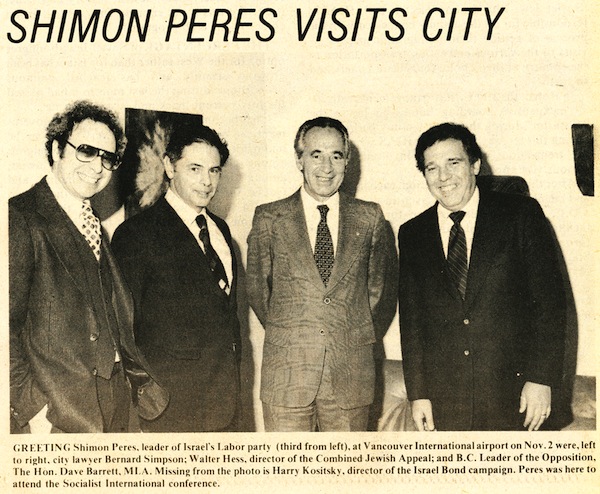
This photo appeared in the Jewish Western Bulletin Nov. 9, 1978.
Bernie Simpson, who later became an MLA in the government of Mike Harcourt, met Barrett in Jewish communal activities and was persuaded by him to join the NDP.
“From a political point of view, he was my mentor,” Simpson said. “I was with him from the very beginning.”
Under Barrett’s tutelage, Simpson became advertising director of the Democrat, the party’s official organ. Advertising sales is a notoriously tough business and that experience would lead Simpson to become one of the party’s leading fundraisers in years to come.
Simpson takes exception to suggestions from some quarters that Barrett was not connected to his Jewishness or to the community.
“There is a perception out there that he didn’t consider himself that Jewish,” Simpson told the Independent. “It’s actually the contrary. I remember distinctly how proud he was of being the first Jewish premier.”
Simpson went on to say that a core group of leaders attempted to convince Barrett to abandon politics and remain at the helm of the JCC, but, Simpson said, Barrett had determined early in the 1960s that he wanted to be premier.
Simpson recounted another memorable incident in Barrett’s time in politics.
Barrett met Shimon Peres at the Vancouver airport. The man who would become the eighth prime minister and, later, the ninth president of Israel, was tired. But the Hadassah Bazaar was on at the time, at the Pacific National Exhibition grounds, and Barrett thought Peres should see it.
Simpson recalled Peres’s initial response, “Hadassah, Shmadassah. I want to go to the Bayshore to rest.”
But Barrett convinced the Israeli leader to go to the then-annual spectacle. The former premier was mobbed. The future Nobel laureate, who had not yet reached the heights of Israeli politics but was already legendary, was largely disregarded.
“He was kind of ignored, Shimon Peres,” Simpson recalled with a laugh. “It’s not all Jews there at the forum at the PNE and Peres was pissed off. But, 15 years later, I see Peres. The first thing he says it is, ‘How is Dave Barrett?’ Remember, this is 15 years later, after we picked him up at the airport. Which goes to show you two things: one is the prodigious memory of Shimon Peres, and the second thing is the charismatic personality of Dave Barrett, that he would leave such an impression on Shimon Peres.”
Peres and Barrett actually did cross paths in Israel shortly after the Hadassah incident, when Barrett was opposition leader. In his book,
Barrett recalls an invitation to a conference in Jerusalem on international terrorism. The confab included Peres, Israel’s then-prime minister Menachem Begin, George Bush, who was then the head of the Central Intelligence Agency, and other world leaders.
For Dave and Shirley Barrett, it was the first trip to the region and, while there was plenty to see outside of business hours, it was also an opportunity to connect with mishpachah. While Barrett’s mother, Rose, had migrated to Canada, her brother had fled to Palestine. On this trip, Barrett finally met his uncle, as well as cousins and second cousins he had never known.
* * *
For all the new government’s ambitious undertakings, there was not only the domestic political situation to consider, but global realities to be faced.
The early 1970s saw a period of steep inflation, caused in part by the Organization of the Petroleum Exporting Countries, whose embargoes were sending global fuel prices through the roof. With oil prices spiking the cost of everything, wage demands naturally responded.
British Columbia was, at the time, among the most highly unionized workforces in North America. During Barrett’s term, inflation led to increasing expectations from private and public employees and, eventually, to the most intense period of labour unrest in the province’s history, with major parts of the B.C. economy halted by strikes.
Barrett brought in back-to-work legislation, an extraordinary act for an avowedly socialist government, and one from which he would not recover. The legislation was seen as an attack on collective bargaining rights and drove a wedge between the NDP and its crucial union supporters.
At the celebration of life, Jim Sinclair, a past president of the B.C. Federation of Labour, joked about the often-strained relations between Barrett’s NDP and the trade union movement.
“I would like to say that the relationship with the labour movement during that time was just rock solid,” he said. “But I think it was more rocky than solid.”
While Barrett’s government frequently clashed with union leaders, Sinclair said, “There was nothing wrong with the relationship between Dave Barrett, the premier of this province, and ordinary working people in this province.”
Meanwhile, the opposition was uniting, with three of five Liberal MLAs and one of the two Conservatives in the legislature defecting to the Social Credit caucus, now led by W.A.C. Bennett’s son, Bill Bennett.
In 1975, just over three years into his mandate, Barrett made a gut decision to go to the polls. Though he had introduced scads of popular initiatives – Mincome among them – he had disrupted every aspect of the status quo. There was probably not a sector, policy area or demographic that had not been affected by his government’s legislation. Many voters were supportive. Plenty were outraged.
Barrett jumped the gun, hoping that he might catch the strengthening opposition before they were sufficiently unified and ready. It was a miscalculation.
“There was reluctance on the part of some members, followed by a fatalistic acceptance,” Barrett writes in his memoir, acknowledging that few in his government thought the gambit would work.
If it was true that Barrett flung himself down the cabinet table at that first meeting asking if they were there for a good time or a long time, the answer came on Dec. 11, 1975. His government was defeated in a landslide and Barrett lost his home riding of Coquitlam.
* * *
Dawn Black was a young mother volunteering to reelect Barrett in Coquitlam in 1975.
She would later follow him into the legislature and to Parliament in Ottawa, where she viewed him as “den father” of the B.C. NDP caucus.
At the celebration of life, Black spoke about a contentious policy decision of the Barrett government from a personal perspective.
“As premier, Dave Barrett named Eileen Dailly as education minister and she was [also] the first woman deputy premier,” Black told the audience. “She banned corporal punishment in the schools, making us the first jurisdiction in Canada [to do so]. And not till a full 30 years later did the Supreme Court of Canada take action on that issue.”
The public blowback to Dailly’s decision, Black said, was enormous and unanticipated.
“You’d have thought they were banning blackboards and textbooks,” she recalled. “The pundits were screaming, they were hysterical that the kids would be running the schools, they’d be running roughshod over the teachers and every school in B.C. would be like a scene out of Lord of the Flies.”
But Black had a different reaction.
“I remember when I was strapped,” she said. “I remember the fury, the humiliation. And I can still feel that sting half a century later. I remember feeling so powerless in the face of the physical force of an adult.”
Banning the strap, she said, forced teachers to find better, more effective ways to keep order in the classroom and ensured that children did not come home traumatized.
“In fact, they learned a whole new lesson. There are better options – there are always better options than violence – to resolve conflict,” Black said to an enormous ovation.
Black also credited the Barrett government’s creation of the B.C. Cancer Agency.
“You are never more powerless than when one of your kids is diagnosed with cancer,” she said. “I’ve gone through that with two of my kids. I can tell you firsthand: going to the cancer agency in B.C. and knowing that your family is going to be treated to the highest standard of care in the world, that meant everything to me and it means everything to all of the other people who go through that door.”
* * *
Marc Eliesen believes part of Barrett’s success was that some people underestimated him.
“Because of his fantastic performance as an orator and an individual who was very funny and [had a] quick wit, there was often the impression that he was an off-the-cuff kind of guy and instantaneous kinds of observations would be made on contemporary political developments,” Eliesen said. “In fact, he was systematic, he was deliberate and he was rigourous. He thought very clearly as to what he wanted to do and how he wanted to do it.
“That government accomplished more than any other government in Canadian history in so little time,” Eliesen said. “I think there were a number of factors responsible for it. Number one was the overall leadership provided by Dave. He had chutzpah. He had political will. He was quite different than what you see in the contemporary political scene where politicians, regardless of their parties, tend to shift positions depending on the political winds.
“The second thing is that he had a cabinet and a caucus that wanted to do things, that wanted to deliver. He allowed a wide scope for them to initiate the kinds of things that they had collectively decided on. It wasn’t what you see today in political affairs, where things at the centre are micromanaged.”
Hindsight suggests Barrett knew he only had one shot.
“Not that there was a kind of a death wish associated with a one-term government,” Eliesen said, laughing. “But they knew the vagaries of political life and they said, look, we’ve got a majority government. We have a mandate from the people. We went out and talked about all these things. Let’s deliver. And they did it with great gusto.”
After the 1975 defeat, the Barretts and the Eliesens went to Manzanillo, Mexico, for a couple of weeks to decide what to do with the rest of their lives.
“Dave decided that, if there was support, he would go back and be the leader of the opposition, and there was support,” said Eliesen, who went on to head Ontario Hydro, Manitoba Hydro and, eventually, B.C. Hydro.
Barrett led his party to two more defeats before retiring as leader. In each of his three defeats, the share of the NDP vote was significantly higher than his winning tally in 1972, but it always came up short against the unified centre-right.
* * *
Joy MacPhail, who served in many senior cabinet portfolios in the 1990s, represented a part of East Vancouver that Barrett had also served after returning to the house in a by-election following his 1975 Coquitlam defeat.
After the NDP was routed by Gordon Campbell’s Liberals in 2001, MacPhail was leader of the opposition from 2001 to 2005, heading a caucus of two that included fellow East Van MLA Jenny Kwan. MacPhail thought she would get some sympathy from Barrett when he visited them at the legislature. Instead, she got tough love.
“He leaned across the desk,” said MacPhail, “and he said to me, ‘Listen, two of you and 77 of those sons of bitches seems like a fair match. Now get in there and do it.’ We went in there, we did it, and we never won a thing, but we felt we could, because of Dave.”
She recalled meeting with the Barretts when Dave was considering a run for federal Parliament, in 1988.
“We were sitting around, the four of us, there was lots of talk about logistics, tactics, strategy, is it good for the province, what would it be like being in Ottawa, and the three of us were talking and Shirley wasn’t saying anything. So I knew that this was not right and I turned to Shirley after a half-hour of the rest of us BSing and I said, ‘Well, Shirley, what do you think?’ And she said, ‘Listen, anything to get the clown out of the house.’”
MacPhail added: “And I want to say, it wasn’t ‘clown.’ But … we’re not allowed to say what she really said.”
MacPhail, who was appointed last year by the new NDP government to head the Insurance Corporation of British Columbia, recalled the history before the provincial auto insurer was in place.
“Working people couldn’t afford to insure their cars, so they were driving around without insurance and there were huge consequences for families in terms of when crashes occurred, and lives were destroyed,” she said. “People who survived but had no ability to heal, get healthcare and pay for the damage they’d done to other lives, as well.… To know that that was done within the first few months of the Barrett government and survives to this day … I can only hope that – and I do see it as my mandate – to bring it back to the great corporation that it once was.”
* * *
B.C. Premier John Horgan credits Barrett for his own attraction to a political career. During the Solidarity movement opposing premier Bill Bennett’s “restraint” program, Horgan went with a friend to a rally on the lawn of the legislature.
“I was not overly political at that time. Two years earlier, I had met Tommy Douglas and I had wanted to be a social worker, but transferred into political science after hearing Tommy Douglas speak,” Horgan told the Croatian centre audience. “Dave would start a little bit low, you had to lean in to hear what he had to say. Then he would start to build and the people in the audience would start to move with him, this way, that way.… That was the power of his delivery. But, more importantly, it was the power of his message. I left the legislature, I walked up Blanshard Street in Victoria, I went into the local NDP office and said, ‘What can I do to help?’”
Glen Clark, another former NDP premier, said that Barrett’s demeanour should be a model for today and he added a quip that brought down the room.
“Social injustice is worse than ever,” Clark said. “Inequality is greater than ever. There is an opioid crisis of immeasurable proportions, with record overdose deaths every year. And perhaps the greatest challenge of our time is solving climate change. In an age of unprecedented cynicism toward government, Dave Barrett taught us that it doesn’t have to be that way. These problems are man-made and, as such, they can be solved … by women.”
* * *
The support Barrett had from his family – his wife Shirley and their three kids – was brought up repeatedly during the celebration of life.
Marc Eliesen said: “Dave would often ask Shirley, ‘Shirley why do you stick around?’ And Shirley would say, ‘Dave, I just want to see what happens next.’”
Gerry Scott, who has run countless campaigns for the NDP, said: “At school, when the kids were asked, ‘What does your dad do?’ The only answer that could be consistent was, ‘He raises hell.’ And they were proud of this.”
All three adult children spoke at the event.
Daughter Jane offered a different answer to the question, “What does your father do?”
“I often told people … he was a plumber. I told him he was up to his neck in…” she said, trailing off. “My friends would say, ‘But aren’t you proud?’ Of course I was. But not for the reason people thought. Plumber, politician, didn’t matter. He was just my dad.”
Son Joe said that Barrett was the same guy at home as he was publicly.
“There was no difference. He was funny, cheerful, always supportive of us. Of course, you’re going to make mistakes in life and he would say, ‘It’s easy not to make mistakes. Just do nothing.’”
Joe Barrett said his father faced Alzheimer’s matter-of-factly.
“He accepted it, he was peaceful, he was courageous and he stoically faced that last challenge right to the end,” he said. “Dad, he celebrated life, he loved life. As the Jews say, ‘To life! L’chaim!’”
Son Dan recalled a light moment in a dark time. One of Barrett’s closest confidants and advisors was Harvey Beech. At a time when death threats against the premier were too common, the two were walking to lunch in Victoria.
“And, one day, walking up Government Street … Harvey was lagging behind and so my dad lays into him: ‘Harvey, what are you doing back there? You gotta get up in front of me. You’re protecting me. This is the premier of the province. Some guys are going to get out and shoot me.’
“Harvey said, without skipping a beat, ‘Dave, they can kill a man but they can’t kill an idea.’ This did not give my dad a whole lot of comfort.”
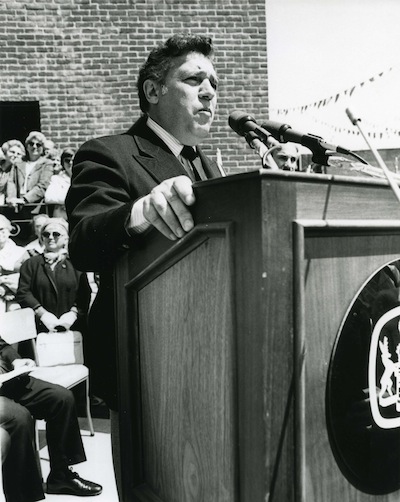
Dave Barrett, then leader of the opposition, offers greetings at the Congregation Emanu-El rededication ceremony in Victoria, June 6, 1982. (photo by Cyril E. Leonoff; Jewish Museum and Archives of British Columbia L.18490)
After the ceremony, Joe Barrett told the Independent that his dad was very proud of his Jewish heritage.
“It was a fundamental, deep part of who he was,” he said. “I was reminded yesterday, one of the very first things that the government did was remove the covenants on property titles. Up until 1972, landowners – I guess in the British Properties in particular – could write ‘no Jews, no Sikhs, no blacks.’ The very first thing they did. He knew who he was and where he came from and he was proud.”
There have not been a great number of Jewish people in B.C. politics, but there are two Jewish cabinet ministers in the current government.
“Dave Barrett, when I was a young man, made tremendous change in British Columbia,” George Heyman, minister of environment and climate change strategy, told the Independent. “The legacies that he left – the [agricultural] land reserve, ICBC, the ambulance service, things we take for granted now, recording proceedings in the legislature, question period – all of them go back to the brief period of ’72 to ’75. He was a warm, funny man. He could rouse a crowd like no one else and it’s an honour to me to have been able to have sat down with him on a couple of occasions and just have a quiet conversation.”
Selena Robinson, B.C. minister of municipal affairs and housing, is proud to note that she represents the riding of Coquitlam-Maillardville, the third Jewish MLA, after Barrett and Levi, to be elected in the area, which would not, by any demographic measure, be termed a “Jewish riding.”
“Unfortunately, I never got a chance to meet him,” Robinson told the Independent, “but I really feel connected to him.” Of Barrett’s legacy, Robinson said, “It really was about tikkun olam, it was about how to heal the world. It was what motivated him and I felt a kindred spirit.”
In a telephone interview, Shirley Barrett recalled Passover seders at her mother-in-law’s home and said her husband was “basically a humanist, but he was a secular Jew.”
“He always was proud to be a Jew,” she said. “He grew up with the values of his parents and he never relented on his heritage. He was an insatiable reader and one of the topics he returned to repeatedly was trying to understand the history of his people.
“He was a reader of everything that he could get his hands on as far as trying to understand why the Holocaust happened and why there was antisemitism,” she said. “He just was so interested in trying to figure out the human psyche.”
* * *
Barrett returned to politics as a member of Parliament from 1988 to 1993. He ran for the federal party leadership in 1989, coming a close second to Audrey McLaughlin on the final ballot.
He hosted a hotline radio program on CJOR, did stints as a lecturer at Harvard and McGill universities, and continued campaigning for New Democrats as long as his health allowed.
Moe Sihota, a former cabinet minister who emceed the celebration of life, remembered what the diversity of Barrett’s cabinet meant to a young Indo-Canadian person. In addition to the first female deputy premier, the Barrett government included two black MLAs and the first indigenous cabinet minister in B.C. history.
“We grew up as kids in Lake Cowichan, a small sawmill community … we always saw colour as a barrier,” Sihota said. “Dave Barrett came along and he never thought that colour was a barrier. Dave, together with the late Emery Barnes, Rosemary Brown and Frank Calder, made all of us kids in the Cowichan Valley believe we could make a change in society.”
* * *
On Cypress Mountain, at one of the most scenic views in this scenic province, looking down across Burrard Inlet at the city of Vancouver and beyond, is a plaque that reads:
“Throughout the 1960s, the future of Cypress Bowl was hotly debated. In 1964, a member of the Legislative Assembly [MLA] by the name of Dave Barrett pressed the minister of forests to honour a commitment to preserve forest lands and Cypress Bowl. What followed was an eight-year effort by MLA Barrett to save Cypress Bowl from chainsaws and residential development. Elected British Columbia’s premier in 1972, his dream was finally realized when his government established Cypress Park as a ‘Class A’ Provincial Park in 1975.
“Dave Barrett was elected to serve as an MLA in British Columbia from 1960 to 1975, and from 1976 to 1983. He was elected as a federal member of Parliament serving from 1988 to 1993. He was awarded the Order of Canada in 2005.”
B.C. Culture Days has announced a province-wide invitation to B.C. artists to apply to its annual Ambassador & Awards Program. Up to eight selected applicants from across British Columbia will receive $1,000 each to act as a Culture Days spokesperson and to present an activity during the Culture Days weekend (Sept. 28-30, 2018). Culture Days is a national celebration of arts, culture and heritage welcoming the public behind the scenes to discover their own creativity through free, hands-on activities for the whole family.
The B.C. Culture Days Ambassador program first began in 2013 with only one ambassador selected each year but, with the support of funders and sponsors, has since grown to allow for up to eight ambassadors, plus awards to help support their activities. Over the past five years, many ambassadors have had a profound impact on their arts and cultural community. “I believe that [Culture Days] instilled a sense of pride and created a unique framework for me to continue my mentorship with the youth in my community, continuing to build future leaders for tomorrow,” said Roxanne Charles, one of the 2017 ambassadors from Semiahmoo First Nation.
To be eligible for the ambassador program, an applicant must be: an individual artist (amateur or professional) residing in British Columbia; active in their arts, culture or heritage community; present and available to act as a spokesperson in their community during the months of May-September 2018; and prepared to register an activity to present during the Culture Days weekend.
Ambassadors are involved with reaching out to community members, such as individual artists, arts organizations, cultural organizations, heritage organizations and businesses, encouraging them to offer activities during the Culture Days weekend. They encourage public participation and discussion about Culture Days through in-person interviews with community members, blog posts and social media, including Facebook, Twitter, YouTube and Instagram. They may also be asked to help activate a local pop-up event or partner event leading up to the Culture Days weekend.
In collaboration with local community organizers and B.C. Culture Days staff, the ambassador may be asked to present an activity at a community planning session or participate in TV, radio and newspaper interviews on behalf of B.C. Culture Days, so experience with public speaking and engaging audiences is an asset.
Interested applicants can visit bc.culturedays.ca to complete the online application form. Submissions will be juried by members of the B.C. Culture Days steering committee and finalists will be called for an interview. The deadline to apply is March 21.
At Share the Journey on Feb. 6, before the official program started, left to right: Carmel Tanaka, Leamore Cohen, Penny Gurstein, Shane Simpson, Alisa Polsky, Tammy Kalla and Clark Levykh. (photo from JCC inclusion services)
“Inclusion is the framework for our community’s future,” said Shannon Gorski, executive member-at-large of the Jewish Community Centre of Greater Vancouver board of directors, at Share the Journey: An Evening of Inspiration. “The JCC was my second home volunteering since childhood,” she said in her opening remarks. “We want to make sure the JCC grows to support all who depend on its presence.”
The Feb. 6 event at the Rothstein Theatre was one of several initiatives being led by the JCC during Jewish Disability Awareness and Inclusion Month (JDAIM). It featured a few speakers, including Shane Simpson, provincial minister of social development and poverty reduction, as well as the screening of a video of the Bagel Club’s trip to Israel last year and of the film My Hero Brother.
The Bagel Club is a JCC inclusion services program. According to the website, the group is “a social club for adults with diverse needs that focuses on social and recreational activities while promoting Jewish heritage, education and community engagement.” Activities include yoga, Israeli dancing, arts and crafts, outings and music appreciation. The Bagel Club also runs a community kitchen focusing on creating “delicious and nutritional kosher-style meals” together. Eleven Bagel Club participants were present on the night of Feb. 6, with Lyle Lexier offering a few remarks on the use of language regarding differing abilities and David Benbaruj introducing the film screening.
Left to right: Kathleen Muir, Harriet Kositsky and Shannon Gorski. (photo from JCC inclusion services)
Many at the event, including Simpson, when he took to the stage, were wearing the black T-shirt the JCC made for JDAIM, which says, “Labels are for clothes,” on the front. In his remarks, the minister spoke about the importance of inclusion and diversity work throughout all of the communities of British Columbia and highlighted the work of his own department, which focuses on community-building and poverty reduction within its greater mission.
Simpson shared some of the results of the fact-finding mission his ministry had recently undertaken in 28 communities in British Columbia. He highlighted the urgent situation in the province with regard to poverty and inequality: “678,000 people live in poverty in British Columbia,” he said, “which is 15% of the population. Forty percent of those are the working poor; one in five children live in poverty. If you are indigenous or have special needs, you are twice as likely to be poor.”
The minister said “social isolation is a key piece” that needs to be addressed throughout the province. “After people with disabilities in this province tell me they don’t have enough money, they tell me they want a job, they want to contribute,” he said. “When employers reach out and hire a differently abled employee, they tell me after they made the fit, they got a remarkable employee.”
Leamore Cohen, inclusion services coordinator at the JCC, introduced the video on the Bagel Club’s Israel trip. As Omer Adam’s “Tel Aviv Habibi” pulsed in the background of the video, the audience clapped to the beat.
Tammy Kalla and Penny Gurstein then read a list of Jewish Federation of Greater Vancouver Inspiring Inclusion grant recipients. Congregation Beth Israel was given funds to hire a tutor so that children with learning challenges could learn to read Torah; Beth Tikvah to hire the appropriate professionals to enable children and youth with invisible disabilities to participate fully alongside their peers in a range of programs; the JCC for a new program called Family Yoga Fundamentals; Richmond Jewish Day School to offer a fully inclusive music program; and Vancouver Hebrew Academy to instal a wheelchair ramp to the playground equipment that has been specially designed for children of all abilities.
The evening concluded with the 2016 Israeli film My Hero Brother, directed by Yonatan Nir. It follows a number of Israelis whose siblings have Down syndrome, as they take their brothers and sisters hiking in the Indian Himalayas. In introducing the screening, Benbaruj spoke beautifully about love, community and his wish that the inclusive communities we had learned about throughout the night could be a model for the world.
Matthew Gindinis a freelance journalist, writer and lecturer. He writes regularly for the Forward and All That Is Interesting, and has been published in Religion Dispatches, Situate Magazine, Tikkun and elsewhere. He can be found on Medium and Twitter.
British Columbia lost a larger-than-life figure last Friday. Dave Barrett was the son of Russian-Jewish immigrants, he grew up in the Commercial Drive neighbourhood of East Vancouver and became British Columbia’s first – and so far only – Jewish premier.
Though he led the province for just a little more than three years, his legacy was substantial. His New Democratic Party government – another first in B.C. history – created the Agricultural Land Reserve, the Insurance Corporation of British Columbia, strengthened labour laws and substantially reformed the welfare system. His government created Pharmacare, increased the minimum wage, created the air ambulance service, introduced French immersion in the B.C. school system, initiated consumer and human rights protection legislation and – not to be forgotten – banned pay toilets.
Author Tom Hawthorn, writing a few days ago in The Tyee, said that Barrett at the podium was “by turns a rabble-rousing firebrand, an Old Testament scold and a Borscht Belt comedian.”
He infuriated many on the right and some on the left, including trade unions whose refusal to back him in 1975 helped lead to his early defeat. He also made some enduring enemies in the Jewish community. In his last interview with the Independent, Barrett acknowledged that some never forgave him for recalling the legislature on Yom Kippur.
But his self-deprecating humour made him hard not to appreciate. He liked to tell the story about how a newspaper, during one of his election campaigns, hired an astrologer to assess his and his opponents’ characters. The seer declared that Barrett must be a passionate lover. In his nightly call home, as he retold the story, he asked his wife Shirley if she had seen anything interesting in the news that day.
“No, Dave,” she said, “just the same old lies.”
Barrett was a social worker by training and vocation, but he was elected to the B.C. legislature at the age of 30 and remained active in politics for the next 33 years. Though his victories were numerous, he was no stranger to political losses. He lost his first bid to become party leader in 1969, and lost his own riding when his government was defeated in 1975. He returned to Victoria through a by-election and led the party to two more defeats before retiring as party leader. But he was not done with elective office. In 1988, he was elected to Parliament and he ran for the leadership of the federal NDP, losing narrowly to Audrey McLaughlin. He lost his seat in the 1993 election and retired from politics.
He knew that his time in power could be short and he wanted to make the biggest impact he could. Barrett was a bold leader whose drive turned out to be part of his legacy and part of his undoing. He was a model of idealism, influenced in part by his family’s heritage. It was quite a life for a working-class Jewish kid from Commercial Drive.
On Remembrance Day, pro-Nazi posters were discovered at War Memorial Gym on the University of British Columbia campus. The posters depicted Nazi soldiers with the words “Lest we forget / The true heroes of WWII.”
This incident followed the discovery earlier in the week of antisemitic drawings on a chalkboard in the forestry faculty. Rabbi Philip Bregman, executive director of Hillel BC, sent an email to the community thanking the Forestry Undergraduate Society for making a clear statement of solidarity. While this is the good news, he wrote, there is also bad news. Students are reporting that the latest incidents are a “tip of the iceberg” of similar expressions and depictions that go unreported.
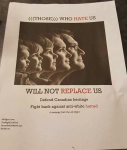
Earlier this month, white supremacist and antisemitic posters also appeared at the University of Victoria. “(((Those))) who hate us / Will not replace us,” read a poster. The use of triple parentheses is a method used online to identify Jews. The fear of white people being “replaced” by non-white people is a recurring theme in the white supremacist movement.
These incidents are local iterations of a larger and obviously deeply troubling phenomenon occurring worldwide. In part a response to the movement of refugees from Syria and elsewhere in the Middle East and North Africa, far-right groups in Europe have grown significantly in recent years. This is evident in the horrifying rally of an estimated 60,000 neo-Nazis, hyper-nationalists and racists in Warsaw, Poland, last weekend. And it is underscored by the neutrality or even affirming noises from those in positions of power at the sight of ralliers carrying signs urging “Clean blood,” “Pray for an Islamic holocaust” and “Jews out of Poland.”
Poland’s governing Law and Justice Party has informal connections with some of the extremist groups that organized Saturday’s rally. Poland’s foreign ministry, on the one hand, condemned the xenophobic, antisemitic and racist messaging, but, on the other hand, called the event “a great celebration of Poles.” The country’s interior minister called the rallying extremists “a beautiful sight.”
This sort of equivocation from leaders is perhaps as worrying, or more so, than the rallying mobs themselves. While the past year has seen numerous European far-right parties fail to live up to expectations in elections, their strength is nevertheless very concerning.
On the subject of elections … off-year elections in the United States last week delivered a strong rebuke to the U.S. president. Although polls indicate that 36% of American voters would vote for him again, no president in the history of polling has been this unpopular this early in his mandate. This is, perhaps, a sign that most Americans are turning against the divisiveness and xenophobia that this president advances.
Encouraging as that may be, possibly (wishfully) portending his defeat in 2020, the damage he is doing to the civil fabric of the country is incalculable. It is saddening to see the president of the United States overtly promote racism against Mexicans and people from Muslim-majority countries, threatening one group with a wall and the other with a travel ban that has been repeatedly deemed unconstitutional by the courts. Among his supporters are openly racist and white supremacist activists.
All of this is to say that the world is experiencing a time of extremism. Rather than throw up our hands in despair, this is a time to rededicate ourselves to the values that motivate us, the values for which Canadian and other Allied soldiers fought.
The posters at B.C. universities should be enough to sweep away any complacency we may have about our shores being free from this sort of racist ideology. This is a good thing. Canadians have a right to be proud of our comparatively decent record of multicultural harmony, but smugness is a blinder that can allow us to ignore very real undercurrents. We must be vigilant in calling out evil ideology when we see it at home and abroad.
On Nov. 9, the anniversary of Kristallnacht, a swastika and “Heil Hitler” were found written on a hallway blackboard in the University of British Columbia Forest Sciences Centre. The antisemitic graffiti was first reported to Hillel BC, who then contacted security.
This was one of several racist incidents that have occurred on B.C. campuses and across Canada in recent months, including pro-Nazi posters found at UBC on Remembrance Day. On Halloween night and in the days following, posters reading, “It’s okay to be white,” appeared on several Canadian university campuses, apparently based on instructions from a post which Vice Canada traced to the anonymous online forum 4Chan, a hub for the alt-right.
During the same week, antisemitic posters found at the University of Victoria read, “Those who hate us will not replace us. Defend Canadian heritage. Fight back against anti-white hatred. A message from the alt-right.” The word “those” was placed in triple parenthesis, a way of identifying Jews. When the posters were taken down, moderators of Anti-racist Action UVic Facebook page and others reportedly received a backlash of hateful messages online.
The election of Donald Trump one year ago this month is widely perceived as a triumph for the tangle of white supremacists, antisemites, misogynists, racists and ethno-nationalists who have come to be called the “alt-right.” In Kill All Normies, a book about the genesis of the group, journalist Angela Nagle describes an online world where cynicism, irony and absurd in-joke humour have combined with racism and misogyny to produce a “taboo-breaking anti-PC style” that has come to characterize the alt-right. Since then, the movement has tapped into latent racism and xenophobia, bolstered by the rise of people like Richard Spencer and Milo Yiannopoulos.
Not everyone is happy with the use of the term “alt-right.” Given their white supremacist beliefs, “alt-right” is somewhat innocuous. The Associated Press avoids the term because its editors think it downplays the movement’s racist goals.
Long before the 2016 election, the alt-right was gathering strength and allies. Trump granted the racists among his supporters visibility, lowering the social costs of bigotry and inspiring these supporters with a hope that their vision of “white identitarianism” could come to rule America once again. This has emboldened them and brought them out of the shadows.
In the days following the election of Trump, Canada saw a spate of vandalism, hate speech and pamphleteering directed against Jews and other minorities. As in the United States, this did not come to Canada overnight. In 2015, the CBC temporarily closed all online comments on stories featuring First Nations people because of the “staggering number of hateful and vitriolic comments” posted. In August 2016, the premier of Saskatchewan was forced to issue a plea for an end to hate speech following the second-degree murder of an aboriginal man on a farm. As a result, his own Facebook page was flooded with racist messages.
The posters at UVic were discovered by an anti-racist group on campus organized by Tyson Strandlund, who said the increasing activities of the alt-right in the public sphere are what led to his group’s creation in September. Strandlund said there has been heightened concern on campus since last summer, when an art installation meant to inspire conversations about resistance to racism was instead extensively defaced with racist slurs and had to be dismantled. He mentioned a meeting that was to take place in the Student Union Building on Nov. 15, for students and others to discuss anti-racist strategies.
David Blades, president of the Jewish Federation of Victoria and Vancouver Island, said they are “keeping close tabs” on the alt-right movement. “We have a good sense of who these people are,” he told the Independent. “What’s increasing is their public activity, not their numbers, which have remained pretty stable for years.
“Nevertheless,” he warned, “we have to be vigilant because they are also recruiting. There is no question that there is latent racism in Canadian society and it can be tapped into. My concern is that this was not isolated to the University of Victoria, this also happened at the University of Alberta and elsewhere. It was a coordinated national event. That’s my concern as Federation president. This is a shift in the overall organization of this group.”
Blades said he is “really happy with the response of UVic” and that there are plans in the works for “five days of activism against racism.”
“In some ways,” he said, “these incidents have been more effective at inspiring the opposite of what they intended: an increase in anti-racist activism.”
Matthew Gindin is a freelance journalist, writer and lecturer. He writes regularly for the Forward and All That Is Interesting, and has been published in Religion Dispatches, Situate Magazine, Tikkun and elsewhere. He can be found on Medium and Twitter.