Skip to content
  • Home
  • Subscribe / donate
  • Events calendar
  • News
    • Local
    • National
    • Israel
    • World
    • עניין בחדשות
      A roundup of news in Canada and further afield, in Hebrew.
  • Opinion
    • From the JI
    • Op-Ed
  • Arts & Culture
    • Performing Arts
    • Music
    • Books
    • Visual Arts
    • TV & Film
  • Life
    • Celebrating the Holidays
    • Travel
    • The Daily Snooze
      Cartoons by Jacob Samuel
    • Mystery Photo
      Help the JI and JMABC fill in the gaps in our archives.
  • Community Links
    • Organizations, Etc.
    • Other News Sources & Blogs
    • Business Directory
  • FAQ
  • JI Chai Celebration
  • JI@88! video

Recent Posts

  • Sharing her testimony
  • Fall fight takes leap forward
  • The balancing of rights
  • Multiple Tony n’ Tina roles
  • Stories of trauma, resilience
  • Celebrate our culture
  • A responsibility to help
  • What wellness means at JCC
  • Together in mourning
  • Downhill after Trump?
  • Birth control even easier now
  • Eco-Sisters mentorship
  • Unexpected discoveries
  • Study’s results hopeful
  • Bad behaviour affects us all
  • Thankful for the police
  • UBC needs a wake-up call
  • Recalling a shining star
  • Sleep well …
  • BGU fosters startup culture
  • Photography and glass
  • Is it the end of an era?
  • Taking life a step at a time
  • Nakba exhibit biased
  • Film festival starts next week
  • Musical with heart and soul
  • Rabbi marks 13 years
  • Keeper of VTT’s history
  • Gala fêtes Infeld’s 20th
  • Building JWest together
  • Challah Mom comes to Vancouver
  • What to do about media bias
  • Education offers hope
  • Remembrance – a moral act
  • What makes us human
  • המלחמות של נתניהו וטראמפ

Archives

Follow @JewishIndie
image - The CJN - Visit Us Banner - 300x600 - 101625

Tag: art

Community show at Zack

Community show at Zack

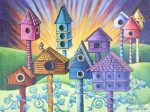
“Open Doors” by Marcie Levitt-Cooper. (photo by Daniel Wajsman)

The group show Community Longing and Belonging, which opened Jan. 15 at the Zack Gallery, marks Jewish Disability Awareness and Inclusion Month (JDAIM).

“I heard about community art shows in celebration of JDAIM in other communities,” said Leamore Cohen, inclusion services coordinator at the Jewish Community Centre of Greater Vancouver, who was the driving force behind the local exhibit.

“I thought an unjuried exhibit would be a fabulous way to honour our community-wide commitment to remove barriers, to celebrate our community members’ creative capacities,” she said.

The main idea was to open up participation to everyone – professional artists and amateurs, people of different skill levels, abilities, perspectives, faiths and socioeconomic status.

“To make participation truly inclusive,” said Cohen, “we provided each artist with a 12-by-16 wood panel. We have also been taking direction from Kickstart Disability Arts and Culture and its artistic director, Yuri Arajs, as we wanted to ensure that this event is fully accessible.”

The JDAIM inclusion initiative and month of advocacy began throughout North America in 2009, explained Cohen. The idea for the art exhibit started to take form last spring, when Cohen approached Zack Gallery director Linda Lando.

“Linda was really receptive to the idea of the show.… Once I had the green light from her, the support and use of the gallery,” said Cohen, “I began to focus more on the theme.”

The theme of community and inclusion prompted her next steps. She reached out to many different organizations and communities and invited artists from all over the Lower Mainland to participate. The call for submissions went out in late September, and the response was remarkable. Fifty-two artists are included in the show.

“We have artists from Vancouver, Burnaby, Richmond, North Vancouver, and even as far out as Cloverdale,” said Cohen. “I’ve had the good fortune to meet all these new and amazingly creative people, welcome them to our community centre, and make new friends along the way. It’s been a joy. It broke my heart that I had to turn many away because of the limited space in the gallery. I have artists who want to sign up for the next year. There is so much excitement and so much more to say on this issue.”
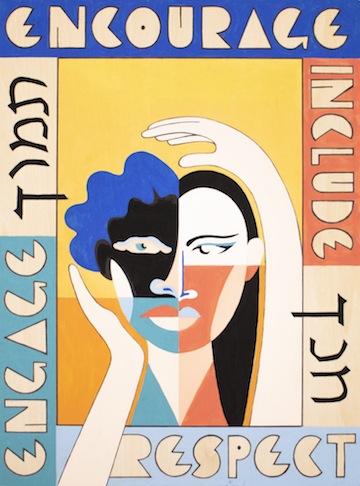
photo - “Embrace” by Evelyn Fichmann
“Embrace” by Evelyn Fichmann. (photo by Daniel Wajsman)

To frame this exhibit, Cohen posed two questions, which are being used in its promotional materials: “How do we make meaning of the concept of community, the real and the imagined spaces we inhabit? What does community longing look like and what are the possibilities for belonging in an ever-changing world?”

“This show was a challenge and an invitation to look at social problems creatively and critically,” Cohen told the Independent. “It was also an opportunity for artists living with diverse needs to exhibit their work in a professional venue and to receive exposure.

“I don’t think we are going to resolve the problems of longing and belonging, or longing for belonging, any time soon. I think we’ll always have people who are better situated and people whose social networks are more tenuous. We should just keep having the conversations and build up those connections. We create new platforms and new access points, new opportunities for people to engage and tell their stories, whatever they look like and from whatever lens, whether it be through mental health, sexual identity, ability or socioeconomic status. We all have a story to tell.”

Cohen shared one example of how the show’s theme relates to her own life.

“The ‘longing’ part of the theme resonates with a lot of people,” she said. “It resonates with me as well. It emerges from my own story of disconnection from the Jewish community during my youth and young adulthood. Fortunately, so, too, does the ‘belonging’ part of this show. The JCC is a wonderful place, a place for belonging.”

photo - “Veselye u Selu” by Daniel Malenica
“Veselye u Selu” by Daniel Malenica. (photo by Daniel Wajsman)

The theme allowed for a number of different approaches, and the skill of the various participating artists varies widely, but the utter diversity becomes its main attraction. Although the size and shape of the canvases – the wooden boards provided by the organizers – are universal, the content is anything but, and so is the media. Some pieces are oils, others acrylic; still others, mixed media. There are abstracts and figurative compositions. Some have narratives. Others evoke emotions. Some have Jewish connotations. Others don’t. Some artists participated solo, while others enrolled as a family group.

Marcie Levitt-Cooper represents one such family. Her painting “Open Doors” depicts a colony of colourful birdhouses. Every door of every birdhouse is open, creating a welcoming avian village, a festive metaphor that makes you smile. No birds appear in the image, but you can almost hear them sing. The artist’s three daughters – Rebecca Wosk, Teddie Wosk and Margaux Wosk – also exhibit in the show.

Another family of artists is mother Elizabeth Snigurowicz and son Matthew Tom Wing. “They regularly come to the Jewish Community Centre inclusion services Art Hive drop-in program, a low-barrier, free art program,” said Cohen.

Daniel Malenica doesn’t have a family in the show, but her charming, pastel-toned piece is a jubilation of the artist’s Croatian roots and her LGBTQ+ community. Two girls embrace each other in the painting, both wear Slavic costumes. The title, “Veselye u Selu,” is the English phonetic spelling of a phrase in the artist’s mother tongue, meaning “Celebration at the Village.”

In Evelyn Fichmann’s painting “Embrace,” the artist, a recent immigrant from Brazil, has incorporated words in English and Hebrew. “Encourage,” “include,” “educate,” “respect,” “engage” and “support” surround the image, all fitting descriptors of what we should strive to do in our communities.

Community Longing and Belonging runs until Jan 27.

Olga Livshin is a Vancouver freelance writer. She can be reached at [email protected].
Format ImagePosted on January 18, 2019January 16, 2019Author Olga LivshinCategories Visual ArtsTags art, disabilities, inclusion, JDAIM, Leamore Cohen, painting, Zack Gallery
Inukshuk in Jerusalem

Inukshuk in Jerusalem

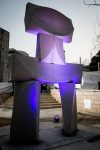
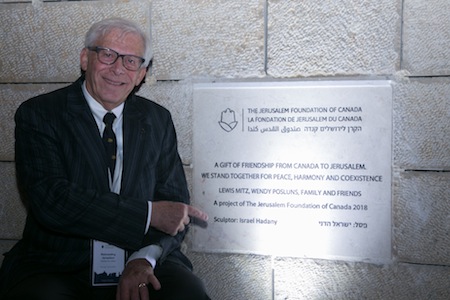
Jerusalem sculptor Israel Hadany’s modern interpretation of the First Nations beacon. (photo from Jerusalem Foundation)

The Inuit, Iñupiat, Kalaallit and Yupik peoples of the Arctic region of Canada, Greenland and Alaska built inukshuks with granite boulders to warn against danger, mark a hunting or fishing site, or stand as a direction marker. Like the traditional inuksuit erected in the treeless tundra, Jerusalem sculptor Israel Hadany’s modern interpretation of the First Nations beacon serves as a marker symbolizing friendship, family and hospitality, humankind’s responsibility toward one another.

On Oct. 17, Hadany’s four-metre-high limestone inukshuk sculpture was installed at the entrance to Canada House in downtown Jerusalem’s Musrara neighbourhood.

Hadany was the winner of a design competition celebrating 50 years of the reunification of Jerusalem, since the 1967 Six Day War. Toronto lawyer Lewis Mitz, president of the Jerusalem Foundation of Canada, initiated the challenge as part of a $4 million renovation of the Canada House community centre on Shivtei Yisrael Street, a location that is becoming increasingly popular with film and art students. Four other Israeli artists were invited to participate: David Gershoni, Ruslan Sergeev, Yisrael Rabinowitz and Ellia Shapiro. The competition jury that selected the winning design included representatives from the Jerusalem Municipality, the Israel Museum, the Jerusalem Foundation and local residents.

Toronto lawyer Lewis Mitz, president of the Jerusalem Foundation of Canada, who initiated the art competition. (photo from Jerusalem Foundation)

“The inukshuk is a communication structure. Providing vital information for people to survive in the frozen Arctic; it isn’t merely a statue, rather an enchanted entity that guides man and seals his fate,” explained Hadany in a press release. “The sculpture tries to create a fascinating synthesis between the primordial and the innovative, between the formulated esthetics and magic.”

Inukshuk, he explained in his remarks at the unveiling of the sculpture, means “helper.”

The sculptor and environmental artist insisted his inukshuk be positioned alongside the street rather than in the courtyard of Beit Canada to increase its visibility. Initially reluctant to appropriate another culture’s symbol, Hadany came to understand that, rather than being decorative in the Western context of art, an inukshuk is “an information-giving object in the space. Emphasizing a religious space, directing people to where there is good fishing. It’s actually a language. It’s sculpture that creates a language in space.”

The judges wrote in their decision that Hadany’s proposal was a “classic sculpture that is suited to and connects with its environment. The artist presents an interpretation that respects the original without copying it. It is obvious that a great deal has been invested in planning and in the use of proportion, materials, light and shade.”

The sculpture was dedicated during the Jerusalem Foundation’s international conference in October in the Canada House garden. The playground around the inukshuk, which is still being landscaped, was a gift of the Joffe family of Calgary, Alta. 

Gil Zohar is a journalist based in Jerusalem.

Format ImagePosted on December 14, 2018December 12, 2018Author Gil ZoharCategories IsraelTags art, inukshuk, Israel Hadany, Jerusalem Foundation
Empowering Negev women

Empowering Negev women

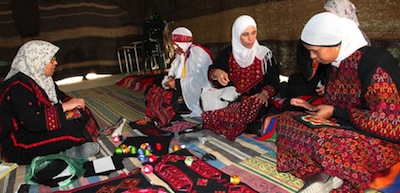
In Lakia, Israel, there are 160 women throughout the village who are responsible for designing and developing embroidery materials. (photo from Michelle Sitbon)

Our trip took us to the southern part of Israel, where we traveled to Beersheva. There is a small sign along the way, that you can miss quite easily, and it says Lakia. Lakia is one of the many Bedouin villages in this part of the country.

The Bedouins are a group of nomadic tribes who have lived in the Negev Desert for hundreds of years. Their heritage can be traced back to the traders along the ancient Spice Route, which happened to cross this region. Most traditional Bedouin hospitality experiences include camel riding, Bedouin food and staying inside a Bedouin tent overnight. However, in the village of Lakia, you are probably not going to find any of those things.

When you stop there, you are in for quite a different and unexpected experience. We arrived in Lakia in the middle of a hot summer day at the end of July and our main goal was to visit the Desert Embroidery. As we drove along the unpaved roads of the village, we quickly realized that Lakia might be small, but the Embroidery was extremely difficult to find. There was no sign telling us which direction to go, even though it is a tourist attraction.

When we finally found our destination, we got out of our vehicle and were warmly welcomed by Naama Al-Sana. She is the Bedouin woman who today runs the Desert Embroidery, and also founded the place together with other women from the community in 1996.

As we entered the visitor centre, we saw a display of beautiful art that was recently made by the local women. These women create the art in their homes in between their chores, and they use the money they earn from it to help support their families.

We were invited to sit inside a beautiful and colourful hand-woven tent, while Al-Sana offered us traditional Bedouin coffee that was scented with local spices. She was excited to hear that we had come all the way from Vancouver, as she has a sister who is currently in Canada, studying at the University of Toronto. Her sister often gives lectures about women in the Bedouin society, as a way to keep the history of this region alive.

The Desert Embroidery doesn’t offer the typical Bedouin tent experience, which includes being served a traditional meal. Instead, you will have the chance to contribute to the empowerment of Bedouin women in your own way. When you participate in one of the workshops or purchase any of their artwork, you will be actively improving the life, health and education of Bedouin women.

The Desert Embroidery was known as the Association for the Improvement of the Status of Women when it first began. The business has grown tremendously over the years and there are now 160 women throughout the village who are responsible for designing and developing embroidery materials. They also provide worker training and product marketing, and there is another group of women who work part-time to provide quality control checks on the products.

The system is very well organized. The women visit the Desert Embroidery twice a week to collect embroidery materials, drop off their finished items, learn about new patterns and designs, and participate in educational workshops and lectures. All of the women are allowed to choose how many hours they work, and they are paid by what they are able to produce within that time. A few of the women have chosen to preserve the traditional jewelry-making that was done by previous generations. They spent time learning how their mothers and grandmothers made jewelry and are now creating their own jewelry to include in the Desert Embroidery collection.

photo - With the help of the Desert Embroidery, Bedouin women in the Negev create the art in their homes, and use the money they earn to support their families
With the help of the Desert Embroidery, Bedouin women in the Negev create the art in their homes, and use the money they earn to support their families. (photo from Michelle Sitbon)

The Desert Embroidery is continuing to achieve its goal of providing employment and income for Bedouin women while empowering them and improving their self-confidence. More than 40 different artistic products can be found on display in the visitor centre, as well as other collaborations that help generate revenues for their work. An example of one of those collaborations is with Kibbutz Gan Masarik, which assists with strengthening the coexistence of Bedouin and Israelis.

The Desert Embroidery is also currently involved in improving the education and health of Bedouin children. And they want to expand to other Bedouin communities within the Negev, so that all Bedouin women can achieve economic independence. There are still so many challenges that women face in Bedouin society and this group is trying to help every woman overcome them.

The main reason I chose to visit Lakia was that I wanted to learn about this destination and the work that the Desert Embroidery is doing. My goal is to share what I have learned and to take other travelers to Lakia, so that they can see it firsthand. Of course, such activities aren’t only being done in the Negev region. In the northern part of the country, in the Galilee region, Israeli and Arab women also create traditional artwork to create a change in the lives of women.

I have made a visit to Lakia part of my itinerary in an upcoming small group tour to Israel, because I believe that travel can support and strengthen local communities. Since I am a travel agent who creates itineraries that are art-oriented, this is a perfect way to show everyone that they can appreciate art while making a difference in both children’s and women’s lives.

In the Mishnah Torah, Rambam organized the different levels of tzedakah, or charity, into a list from the least to the most honourable. Sometimes it is known as the “Ladder of Tzedakah.” The highest form of charity is to help sustain a person before they become impoverished, by offering a substantial gift in a dignified manner, by extending a suitable loan or by helping them find employment or establish themselves in business. These forms of giving allow the individual to not have to rely on others.

Projects such as those led by the Desert Embroidery can be found around the globe in places like Jordan, Mexico and Canada. When we travel, we know the many ways in which we benefit. However, I believe we should also try to find ways to benefit others as we travel, even in small ways. We should become more involved with local communities and support them in respectful ways that will, among other things, help them preserve their tradition and art.

Michelle Sitbon is an art travel adviser who organizes small group tours to Israel among other art-related destinations around world. For more information, visit yourartvoyage.com.

Format ImagePosted on November 30, 2018November 28, 2018Author Michelle SitbonCategories Israel, TravelTags art, Bedouin, embroidery, Empowerment, Negev, travel, women
Whisper Across Time

Whisper Across Time

Olga Campbell (seated) takes a break from signing books at the opening of her exhibit A Whisper Across Time, which also served as a launch of her book by the same name. (photo by Gordon E. McCaw)

The impacts of the Holocaust continue to reverberate. Even though most of the first-generation survivors have passed away, the next generations, the survivors’ children and grandchildren, remember.

Local artist Olga Campbell belongs to the second generation. Her parents survived the Holocaust, but her mother’s entire family was murdered by the Nazis. The need to give those family members a voice was Campbell’s driving force in writing her new book, A Whisper Across Time: My Family’s Story of the Holocaust Told Through Art and Poetry. Her solo exhibit with the same name, co-presented with the Cherie Smith JCC Jewish Book Festival, opened at the Zack Gallery on Nov. 15. The night also served as a book launch.

“The art in this show are mostly prints from the book,” she said in an interview with the Independent. “There are also some pieces that are offshoots on the same theme, even though they aren’t in the book.”

Campbell has always known that her mother’s family didn’t survive the war, but the emotional impact of their deaths built slowly over the years. It took decades for this book to emerge.

“In 1997,” she said, “I heard a program on the radio about the second-generation survivors. Their words about the trauma being passed between generations resonated with me.”

She embarked on an artistic journey, and she is still following a path of exploration. Her art reflects her emotional upheaval. Her paintings and statues are fragmented, with broken lines and distorted figures, evoking feelings of loss and anguish. One look at her paintings and a disquiet tension washes over the viewer. It is apparent that a huge tragedy inspired her work.

In 2005, Campbell had a show at the Zack, called Whispers Across Time. “Even then,” she said, “I knew I had to write about my family. The art show was not enough. I had to say more, but, at that time, I couldn’t. I was too raw, too emotional. But my family kept tugging at me. I needed to tell their story. I was compelled to write this book.”

Unfortunately, she knew only the bare bones of her mother’s life. So she plunged into a deep and long research period, surfed the internet, contacted Yad Vashem and other sources. After several years, the book crystallized.

“My book is a tribute to my family, the family I never knew,” she said.

“Of course, it is only one family of the millions of families killed during the Holocaust.”

Campbell spoke of the relevance of her book in today’s political climate. “Our world is a chaotic place right now, somewhat reminiscent of the period before the war,” she said. “There are over 68 million people around the world that are refugees or displaced. My book is not only about my family. It is a cautionary tale. It is about intergenerational trauma and its repercussions across time.”

image - artwork by Olga Campbell
(artwork by Olga Campbell)

She created new art for the book, wrote poetry to supplement the imagery, and also included an essay on her family members and their lives, destroyed by the war. The paintings in the book and on the gallery walls are powerful but melancholy, even distressing.

“My work always had this darkness, the sadness, but also a bit of hope,” she said. “I never know what will happen when I start a piece. I’m very intuitive. I would throw some paint on an empty canvas and let my emotions and the art itself guide me through the process. I use photos in my works and digital collages. My finished pieces always surprise me.”

When the book was ready, Campbell applied for another show at the Zack, to coincide with the book launch.

“I wanted to give it the same name as the previous show, Whispers Across Time,” she said, “but I checked the internet, and there are a couple other books already published with the same title. I decided to change it.” The book and the show are called A Whisper Across Time. “I feel a lot lighter now, after the book is finished and published,” she said.

A Whisper Across Time is Campbell’s second publication. In 2009, she published Graffiti Alphabet. She has been doing art for more than 30 years, but that is not how she started her professional career. She was a social worker until, in 1986, she took her first art class. That year changed her life.

“It was such fun. I loved it,” she said. “I went back to work afterwards but it didn’t feel as much fun. I decided to get an art education. I enrolled in Emily Carr when I was 44.”

Campbell finished the art program, continued working part-time as a social worker, and dedicated the rest of her time to painting, sculpture and photography.

“I’ve been a member of the Eastside Culture Crawl for 22 years, since its beginning,” she said. “I participated in the Artists in Our Midst for many years, too. At first, when people asked me, I would say I do art. Now, I say, I’m an artist. I must be. That’s what I do. I’m retired now, but I did art when I was working, too, and it was always very healing and rewarding – still is…. If, for some reason, I don’t paint for awhile, I feel as if something is missing.”

The A Whisper Across Time exhibit continues until Dec. 9. For more about her work and books, visit olgacampbell.com.

Olga Livshin is a Vancouver freelance writer. She can be reached at [email protected].
 

Format ImagePosted on November 23, 2018November 20, 2018Author Olga LivshinCategories Visual ArtsTags art, Holocaust, memorial, Olga Campbell, painting, Zack Gallery
A gift of holiday reads

A gift of holiday reads

Many authors of children’s Chanukah books still perpetuate two mistakes. One is that a chanukiyah is the same as a menorah, whereas the latter is actually the seven-branched Temple lamp looted by the Romans when the Temple was destroyed. The second is the rabbinic legend of the miracle of the oil, which is not actually part of the story of the Maccabean revolt and the Maccabees’ fight for the right to worship as Jews. The books reviewed here are sweet, but part of the time reading these books might be spent discussing these issues.

While Light the Menorah (Kar-Ben Publishing) by Jacqueline Jules, with illustrations by Kristina Swarner, calls the chanukiyah a menorah throughout and highlights the miracle of oil, this “manual for the contemporary Jewish family” contains sweet reflections for each night of the holiday, a form of history, games, songs, recipes, crafts and blessings geared for a family with 4-to-10-year-olds.

***

Dreidel Day (Kar-Ben Publishing), written and illustrated by Amalia Hoffman, is a cute board book for babies, infants and toddlers. It teaches readers numbers one through eight and some words related to Chanukah.

***

How It’s Made: Hanukkah Menorah (Apples and Honey Press) is by Allison Ofanansky and photographer Eliyahu Alpern. These two creative people have once again combined their talents to produce a new book in their “How It’s Made” series. Sadly, the authors only refer to the chanukiyah as a menorah. Nonetheless, this is an educational and fun book, which explains the materials needed to make a candelabra, shows examples of them and provides instructions on how to make one, as well as how to make candles and olive oil. The book ends with songs, a recipe for potato latkes, instructions for playing dreidel, a matching game and the blessings. The text is child-friendly and good for all ages, especially 4 to 8.

***

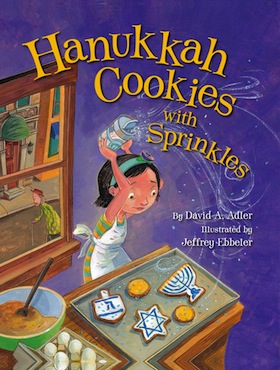
image - Hanukkah Cookies with Sprinkles book coverHanukkah Cookies with Sprinkles (Apples and Honey Press) by David A. Adler and illustrator Jeffrey Ebbeler was published a few years ago, but it was new to me, and I hope it’s new to others, as well.

Sara is a little girl who is very observant about things she sees from her apartment window. One day, she sees an old man pick up a piece of bruised fruit from a box next to the market. She then decides to leave things for him. Soon, she discovers he is the man who helps set up the chairs and collects books at the synagogue. She learns more about him as she practises the true meaning of tzedakah and spreads the idea to her family and classmates.

The book’s Note for Families provides context for the story and traditions of Chanukah, as well as the meaning of tzedakah, and challenges readers to think about ways they can give tzedakah, too.

***

Hanukkah Delight! (Kar-Ben Publishing) by Leslea Newman and illustrator Amy Husband is a board book. In it, all of the customs of Chanukah are rhymed with delight as a darling family of bunnies practises each one. The artwork is colourful and the details are really well done. The male bunnies and other male animals wear yarmulkes and the drawings of dreidels, children playing with the dreidels, latkes and presents are quite appealing. For any 1-to-4-year-old, this is a sweet way to introduce the holiday of Chanukah.

***

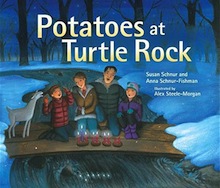
image - Potatoes at Turtle Rock book coverPotatoes at Turtle Rock (Kar-Ben Publishing) is written by Rabbi Susan Schnur and her daughter, Anna Schnur-Fishman, who are also the authors of Tashlich at Turtle Rock. It is illustrated by Alex Steele-Morgan, who also did the artwork for the Schnurs’ earlier companion book.

Potatoes at Turtle Rock is the story of a family – mom, dad, teenage son (Lincoln) and daughter (Annie) – who have, as pets, a chicken (Richie) and a goat (Ubi).

They also have their own Jewish holiday traditions. For Chanukah, the family goes to the woods, with Dad carrying a lantern, Mom carrying the chicken, Annie leading the goat and Richie pulling a sled. They make stops along the way, where Annie provides riddles.

Although a little off-beat, this book for ages 5 to 9 shows children that every family can be original and creative and create their own traditions for Jewish holidays.

***

A Hanukkah with Mazel (Kar-Ben Publishing) by Joel Stein and artist Elisa Vavouri is about Misha, a poor artist living outside Grodno, a city in western Belarus, in the late 19th or early 20th century. One cold winter night, he discovers a little cat. He takes her into the barn, where his cow lives, and then into his house. He names her Mazel, meaning luck.

Chanukah is about to arrive and he begins a painting of a chanukiyah, since he has no money to buy oil for his chanukiyah. The story evolves when a peddler stops and discovers Mazel is his Goldie.

With the themes of hope and luck, this is a very charming story for 3-to-8-year-olds.

Sybil Kaplan is a journalist, lecturer, book reviewer and food writer in Jerusalem. She created and leads the weekly English-language Shuk Walks in Machane Yehuda, she has compiled and edited nine kosher cookbooks, and is the author of Witness to History: Ten Years as a Woman Journalist in Israel.

Format ImagePosted on November 16, 2018November 15, 2018Author Sybil KaplanCategories Books, Celebrating the HolidaysTags art, Chanukah, children's books
Heart unites artworks

Heart unites artworks

Claudie Azoulai, left, and Nicole Schouela. Their work comprises the exhibit Heart to Heart, which is at the Zack Gallery until Nov. 9. (photo from the artists)

The latest show at the Zack Gallery, Heart to Heart, presents the work of two artists in two vastly different media. Claudie Azoulai makes felt tapestries, while Nicole Schouela specializes in photography. Despite the differences in material representation, however, the colour palettes and the themes are amazingly similar – places close to their heart, places that invoke love and peace. The places and the emotions they inspire consolidate the show into a seamless, cohesive whole.

“We wanted to have a shared show forever,” Azoulai told the Independent. “We’re cousins, Nicole and I. We grew up together.”

They came up with the idea of a joint show about a year ago. “The timing is perfect,” said Azoulai. “It takes me, on average, about a month to create one piece, and there are 13 pieces of mine in this show, all new.”

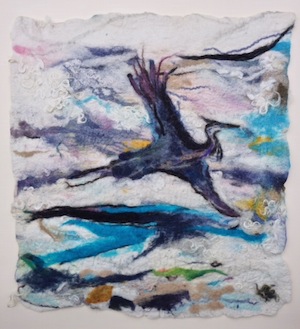
photo - “Heron” by Claudie Azoulai
“Heron” by Claudie Azoulai.

All of these pieces are related to a children’s book Azoulai has written. “The book will be called The Spring Feast. It’s about the flora and fauna of Hornby Island, one of my favourite places. I will photograph every tapestry here, and they will be the illustrations for the book,” she said.

Azoulai considers herself a part of the great pageantry of life, and Hornby Island provides her with the opportunity to experience it firsthand. One of the tapestries, “Herring Run,” reflects her connection with nature.

“Every spring, herring come to Hornby Island to spawn,” she explained. “Then salmon come to eat the herring. Seals come to eat the salmon. Whales come to eat seals. Eagles fly over to eat the roe. Everything is alive, this great circle of life, and I’m part of it, too. When I come to Hornby Island in spring, I try to stay outside all day.”

Many of the tapestries depict various birds of Hornby Island. “I work from my imagination,” Azoulai said, “but when I need a particular pose or gesture, I go to the beach to watch the birds or look at photographs.”

Azoulai dyes her wool herself, and no batch comes out of the vat exactly the same, even if all the ingredients of the dye match. “Colours of the fleece always surprise me,” she said. “They influence the images. When I’m stuck, I would dye a new batch, and the new colours might affect the image, lead to a change. The colours dictate the picture more often than not.”

She frequently experiments with new materials, incorporating silk or synthetic particles into the base of wool to add a shine or a different texture. “As long as the fleece entangles the other threads, the image stays together,” she said about that technique.

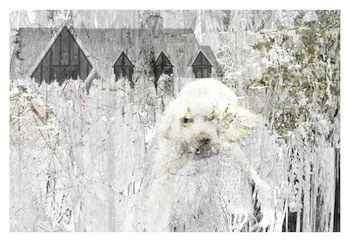
Mixing and matching is also Schouela’s preferred technique, using Photoshop to work with different parts from a multitude of photographs.

“I have nine pieces in this show,” she said. “They are places I revisit often, not by traveling far away, but the places where I live and work. The places I walk. The places I love. The places that have almost a ritualistic meaning for me.… Sometimes, they are physical places. Other times, they are mental places.”

Schouela started her artistic life as a dancer, but dance is an unforgiving art form that takes its toll on the body. She switched first to ceramics, and later dedicated herself to photography. In everything she creates – a dance or a vase or a photo collage – there is movement and transformation. The images flow through each other, striving towards abstraction and emotional truth.

photo - “Perceived Threat” by Nicole Schouela
“Perceived Threat” by Nicole Schouela.

“Photo manipulation is freeing,” she said. “I could take pieces from here and there and create a new image I want, while it still retains the essence of the originals. It might take me several months to finish one picture. I would stop working with it and then, later, I would return to it again and again, until I’m satisfied.”

She photographs places that are part of her and her search for connections and understanding. By now, she has thousands of photos in her digital archives. “Sometimes, I would use a photograph or a fragment of one years after it was taken, because it would fit one particular composition or a feeling I want to explore,” she said. “I don’t want my images to resemble the real places. The original photographs are not important by themselves. They are part of the process. Sometimes, I play with pieces of 30 to 50 photos for one picture. It is fun.”

Schouela’s abstract compositions on the gallery walls lean towards pastel or black and white, with occasional splashes of bright colour. Some are geometrical. Others tell a story or convey an emotion.

“Traditional photography doesn’t interest me anymore – anyone can take a picture now with their phones,” she said. “I don’t want my imagery to be like paintings either. Photography is a separate art form. If I wanted a painting, I would paint. No, I want my collages to keep their photographic elements obvious.”

The exhibit Heart to Heart opened on Oct. 11 and continues until Nov. 9. To learn more about the artists, check out their websites: claudieazoulai.com and nicoleschouela.com.

Olga Livshin is a Vancouver freelance writer. She can be reached at [email protected].
Format ImagePosted on October 19, 2018October 18, 2018Author Olga LivshinCategories Visual ArtsTags art, Claudie Azoulai, Nicole Schouela, photography, Zack Gallery
Divine Sparks at the Zack

Divine Sparks at the Zack

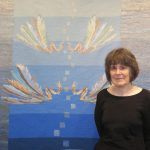
Barbara Heller’s exhibit, Divine Sparks, is at the Zack Gallery until Oct. 8. (photo by Olga Livshin)

Barbara Heller’s new solo show at the Zack Gallery, Divine Sparks, could be divided into three distinct themes, each one representative of a world culture: the Sephirot, the Mudras and the Future Reliquaries. Each of the three resonates with one of three religions, Judaism, Hinduism and Christianity, respectively, but Heller, a master weaver, sees divine sparks everywhere. Her tapestries, big and small, invite gallery guests to contemplate what unites us, no matter our ethnicity or religious affiliation.

Symbolism infuses Heller’s images, starting with the centrepiece of the show, “Tzimtzum,” or “Transcendence.” The large tapestry is a stylized ladder. The midnight blue rungs at the bottom coalesce into a dead bird, but the higher your eyes travel, the lighter the colours become. Two pairs of wings punctuate the climb of colours from dark indigo to white radiance.

“The ladder has many interpretations,” Heller told the Independent. “It can be a metaphor for our life, a liminal space between birth and death…. For me, the rungs are stepping stones on the path of spiritual attainment, of transcendence.”

Heller has shown this tapestry at several exhibitions already, to great acclaim. Recently, it won the American Tapestry Alliance Award.

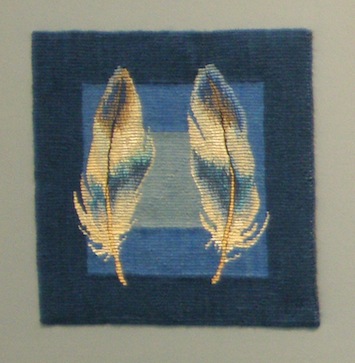
photo - Barbara Heller made a series of small tapestries of her feather collection, Sephirot, specifically for the Zack show
Barbara Heller made a series of small tapestries of her feather collection, Sephirot, specifically for the Zack show.

“Originally, I wanted to display this tapestry with real feathers piled along the bottom,” the artist said about “Tzimtzum.” “I have amassed many beautiful feathers, and friends kept bringing me more, but I discovered it was almost impossible to send real feathers anywhere. I displayed the tapestry in Poland a couple years ago, and they told me that real feathers have to be quarantined for weeks before being allowed into the country. And they can’t be from endangered species. I wasn’t sure about that.”

Since the plan involving the real feathers fell through, Heller made a series of small tapestries of her feather collection, Sephirot, specifically for the Zack show.

“I already had lots of yarn died blue for the ‘Tzimtzum,’” she said. She called the series Sephirot after the kabbalah’s spiritual qualities of understanding, wisdom, love and judgment, among others.

“Some of the feathers are almost photographic,” she said. “In the others, I played with colours and sparkles.”

The second series in the show, Mudras, obtained its name from the hand gestures prevalent in Hinduism, Asian dancing, yoga and meditation.

“Typically, mudras are used as a way to direct energy flow in the body,” Heller said. “According to yoga, different areas of the hand stimulate specific areas of the brain. By applying light finger pressure to these areas of the hand, you can ‘activate’ the corresponding region of the brain. In addition, hand mudras also symbolize various feelings and emotions.”

Heller’s Mudras is a series of small, uniform-sized round images of various hand gestures. The hands are woven of golden yarn and appliquéd to dark-green fabric with a vague “computer motherboard” pattern. Parts of real electronics – wires, chips, connectors – are incorporated into the design of every gesture, as if to emphasize the similarities between computer circuits and the neuron circuitry in our brains.

“I collect old electronics and take them apart, and use them in my weaving,” said Heller. “This series was fun to make.”

The other series, Future Reliquaries, is an older one. Also depicting hands embedded with parts of electronic devices, it reflects humanity’s developing love affair with technology.

Several tapestries of the series are rather large. In each one, a human hand in golden yarn stands out from the background of an ancient traditional pattern. “Different tapestries sport different patterns: from Persia, Indonesia, Turkey, Navajo,” Heller said.

Like in the Mudras series, the interlaced computer piece are symbolic of our interconnection with machines.

Heller wrote: “This series deals with three apparently separate but, in my mind, connected histories: weaving, computing and religion. Weaving is a binary system of up/down, just as computing is a binary system of on/off…. Religion is not only a store of faith; it is a store of history and social values…. Today, we are creating a new religion. We are worshipping the technology.”

Heller’s tapestries contemplate the future status of today’s electronic remnants in the context of ancient fabrics. “As holy relics were housed in reliquaries, often made of gold and gems, I’m trying to populate my tapestries with the future relics – the computer chips and wires.”

Beside the large hands, there is also a selection of tiny ones, where each miniscule woven hand is linked to topics such as keys or clocks, science or beauty, birth or death.

Heller’s exhibit is part of larger happenings in Vancouver this month – a symposium of the Textile Society of America. The symposium takes place Sept. 19-23, and many galleries around the city besides the Zack are displaying textile or weaving exhibitions to coincide with it.

As a well-known local artist, Heller has been one of the event organizers from the beginning. “We have a wealth of local textile artists, and about 400 people are coming to the symposium from all over the world,” she said.

The planning for the symposium began three years ago. “We made sure that the hotel reservations were available on the dates that didn’t include Yom Kippur,” she said. “Unfortunately, a year ago, the hotel informed us that they had to change our reservation dates.”

So, now, the first day of the symposium falls on Yom Kippur, as other reservations were not available, and the society has posted an apology on its website.

The Zack Gallery offers a bus tour of three textile exhibitions in the city on Sept. 20. To learn more about the tour and to register, visit jccgv.com/art-and-culture/gallery. For more about Heller, visit barbaraheller.ca.

Divine Sparks opened on Sept. 6 and continues until Oct. 8.

Olga Livshin is a Vancouver freelance writer. She can be reached at [email protected].
Format ImagePosted on September 14, 2018September 12, 2018Author Olga LivshinCategories Visual ArtsTags art, Barbara Heller, spirituality, tapestry, Zack Gallery
Stories to bring smiles

Stories to bring smiles

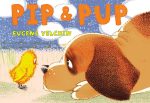
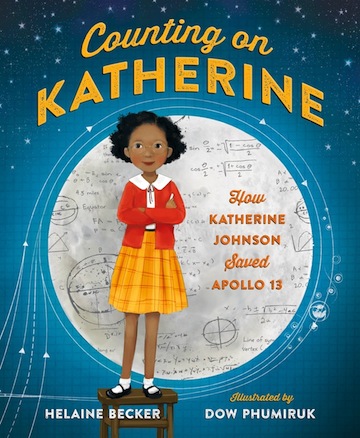
Delightful. That’s the first word that comes to my mind for two new hardcover children’s books by members of the Jewish community that will soon find their way to my youngest nieces’ bookshelves: Pip & Pup by Eugene Yelchin (Godwin Books) and Counting on Katherine: How Katherine Johnson Saved Apollo 13 by writer Helaine Becker and illustrator Dow Phumiruk (Christy Ottaviano Books).

Yelchin’s wordless book begins with a chick hatching. On a farm somewhere, having just come out of her shell, Pip sees the world for the first time. She spies a puppy sleeping under cover of a tractor. Fearless, she goes right up to Pup’s nose to say hello. When Pup awakens and barks in greeting, Pip is thrown into a panic, not quite prepared for the full size of her relatively large new friend.

When the rain starts, Pip literally climbs back into her shell, but just to stay dry. She is no longer afraid. In fact, when she sees Pup’s distress at getting wet and at the sound of the thunder and the force of the rain, she offers what help she can. The two start to play even before the sun comes out again. A broken eggshell dampens spirits momentarily, but then it’s Pup’s time to fix things, which she does.

Pip & Pup is a simple story that is evocatively illustrated using warm colours, texture and layers, combining pastels, coloured pencils and digital painting. There is a depth to the art and the story. Children and their adult readers will have fun asking each other questions as they go along. Do you think Pip is brave to say hello to Pup? Do you like the rain? How is Pup feeling right now? How would you feel if something of yours broke?

image - Counting on Katherine book coverMany questions will arise from reading Counting on Katherine, as well, though some of them will require a different kind of reflection, as the story touches upon racism, sexism and other such topics – in an age-appropriate way for readers 5 and up.

Becker interviewed Katherine Johnson, who turned 100 years old on Aug. 26, and Johnson’s family for this picture-book biography. Johnson was a mathematician at the National Aeronautics and Space Administration (NASA) and, among other things, her manual calculations were crucial in bringing the crew of Apollo 13 back to earth safely after it was damaged while in space.

In Counting on Katherine, we meet Johnson as a young girl: “Katherine loved to count. She counted the steps to the road. The steps up to church. The number of dishes and spoons she washed in the bright white sink. The only things she didn’t count were the stars in the sky. Only a fool, she thought, would try that!”

And Johnson was anything but a fool. She skipped three grades in elementary and was ready for high school at 10 years old. “But back then,” writes Becker, “America was legally segregated by race.” Johnson’s high school didn’t admit black students, so her father, by “working night and day, he earned enough money to move the family to a town with a black high school.”

Johnson’s next challenge was that, as a woman in that era, she was relegated to the teaching and nursing professions, so she became an elementary school teacher. However, in the late 1950s, the space race began, and NASA’s predecessor began hiring thousands of workers. “It even started hiring black women – as mathematicians.”

Johnson excelled at NASA and her work was integral to the United States’ space program, not just to the Apollo 13 mission, and Counting on Katherine has an epilogue that gives some additional information about Johnson. As well, Phumiruk’s imaginative digital artwork is also information-filled, clearly showing Katherine’s longing to learn, as she gazes from her bedroom window at the night sky; her joy with numbers, as she fills chalkboards with them; her anger at not being allowed to attend her town’s high school; her meticulousness, as she calculates a safe journey for Apollo 13. Counting on Katherine is a wonderful book.

Format ImagePosted on September 7, 2018September 6, 2018Author Cynthia RamsayCategories BooksTags art, children's books, Dow Phumiruk, Eugene Yelchin, Helaine Becker, Katherine Johnson, science, women
Exhibit celebrates life

Exhibit celebrates life

The paintings of Frank Levine are on display at the Zack Gallery until Aug. 31 in a shared show, called Celebration, with Melanie Fogell. (photo by Olga Livshin)

The latest show at the Zack Gallery, Celebration, showcases two artists, Melanie Fogell and Frank Levine. At first glance, they don’t seem to have much in common.

Fogell’s art is bright and flamboyant, totally abstract, and her canvases are large, while Levine’s paintings are generally smaller, more intimate, his colours more muted and his compositions tend to have recognizable figurative patterns: people, musical instruments, landscapes, cityscapes.

However, both artists celebrate life through their paintings. For years, both approached art as a hobby – it is only recently that Fogell started painting full-time, while Levine still works as an accountant. Both artists also lived for some time in Gibsons, B.C., where they met a few years ago. Fogell still lives there, while Levine has moved to Richmond.

Levine’s life has involved several drastic moves, geographic and professional. Born in England, he received his art education in London. He majored in fashion design. Upon graduation, he opened his own fashion boutique in London, but that didn’t last long in the cutthroat industry. After that, he worked for 10 years as a clothing designer for a large factory in the city.

“The clothing industry in London is very stressful and loud. Everyone shouts and screams,” he explained in an interview with the Independent. “The designers had to produce a new design every week, two collections a year. If a particular coat sold, the owners congratulated themselves at how good they were at selling. If it didn’t sell, the designers were to blame.”

After a decade of the stress and screaming, Levine switched to accounting, which he considers an occupation much less taxing on his nerves. In 1978, he moved to Canada and settled in Vancouver. “Antisemitism in England was a consideration in my decision to move,” he said.

Wherever he has lived, and whatever his day job, he has kept on painting.

“I have always painted when I had the time,” he said. “I don’t paint every day, only when I’m inspired. Once a week, my son and his children come for a visit, and we paint together.”

One of the paintings in the show, “Prism,” came from one of those weekly sessions. The small image features a blue-and-gold cityscape, happy and bright, vaguely reminiscent of a Greek city. “My son suggested the theme of prism,” said Levine.

Many of the artist’s paintings are landscapes, but he portrays them through a mesh of geometric figures. The lines creating the geometric patterns add mysticism to the trees and lakes. “I’m drawn to the images that have passion, not something everyone would paint,” he said.

Whatever his brush depicts – his backyard in Gibsons with a visiting bear, a small café in the Luxembourg Gardens in Paris or picturesque gates in China – his love for the places shines through the canvas.

Unfortunately, not many people have seen his charming work. “I didn’t do any promotion until recently and I sell maybe two or three paintings a year,” he said. “I only joined Facebook a month ago.”

Over the years, Levine has participated in several exhibitions in Gibsons and has had his paintings displayed at a Richmond community centre. This Zack Gallery show is only the second time in Vancouver that the public has had a chance to admire them, and it is his first exhibit in a Vancouver art gallery.

photo - Melanie Fogell’s art is bright and flamboyant, totally abstract, and her canvases are large
Melanie Fogell’s art is bright and flamboyant, totally abstract, and her canvases are large. (photo from Melanie Fogell)

Unlike Levine, Fogell is well known on the Vancouver art scene. She had a solo show at the Zack in 2011 and another one in 2014. Her early art education at Emily Carr University of Art + Design could have led to a career in the arts, but, like many others, she discovered that it was extremely difficult to make a living as an artist. She became a piano teacher instead.

Years later, Fogell went back to university for a master’s in women’s studies and then did a PhD in educational research. She has taught women’s studies at the University of British Columbia and piano as a private tutor, but, throughout the years, just like Levine, she has never stopped painting. She loved art too much, and the need to express herself through imagery drove her to paint. She paints full-time now.

“I did this group of paintings, the Oval Series, over the last two years,” she said about the work in the Zack Gallery show. “It began by me doodling oval shapes. Then I started thinking of possible meanings of this particular shape. The oval could stand for an egg, which is a symbol of life, a celebration of life. Or it could be a face, the beginning of a face, not ready to be recognized. They could be faces of people in my life or people I have yet to meet.”

Fogell’s paintings burst with primal colours, and her ovals seem like gladness enclosed, surrounding the viewers like a collection of exuberant eggs, or new leaves shimmering in the sunlight, or a field of tulips swaying in a breeze. They promise renewal and hope. “I paint how it feels to be connected to everything in my life, both present and past,” she said.

The exhibition Celebration opened on Aug. 9 and continues until Aug. 31. For more information, check out the artists’ websites, melaniefogell.com and franklevineart.com.

Olga Livshin is a Vancouver freelance writer. She can be reached at [email protected].
Format ImagePosted on August 24, 2018August 22, 2018Author Olga LivshinCategories Visual ArtsTags art, Frank Levine, Melanie Fogell, painting, Zack Gallery
Hesse driven to be an artist

Hesse driven to be an artist

Eva Hesse is the subject of an Aug. 31 episode of PBS’s American Masters series. (photo by Herman Landshoff)

Eva Hesse’s childhood was a rollercoaster of displacement, reunion, destabilization and trauma. In the journals she kept as a teenager and adult, the German-born, New York-based artist recognized the source of her chronic insecurity. Yet, paradoxically, and remarkably, her work evinces no anguish or suffering, and no need to expose or extinguish demons from the past. From her early, brightly coloured drawings and paintings, through the textured, abstract sculptures and installations that made her reputation, her art comprises a series of experiments in forward-looking forms of expression.

Eva Hesse screens Aug. 31 (check local listings) in PBS’s American Masters series. A palpable labour of love, Marcie Begleiter’s densely detailed 2016 documentary is a soup-to-nuts portrait that encompasses the artist’s personal life and times – New York in the 1960s – along with her professional development and impact.

Begleiter’s diligence notwithstanding, Eva Hesse never delivers the aha moment, where the person and her work snap together, and we understand exactly how Hesse’s defining childhood experiences informed her work. I’ll venture, though, that Holocaust survivors, and children of survivors, will identify with Hesse’s internalized struggles, and read between the lines of her journals and the recollections of her older sister, Helen.

In 1962, the art-school grad fell in love with and married a hard-partying Irish-American sculptor named Tom Doyle. Because her father insisted that she marry a Jew, Doyle willingly converted to Judaism.

Doyle, who was the more advanced and accomplished artist at the time, was offered a residency in Germany a couple years later, and the couple ended up living there for more than a year. Their relationship fractured abroad, in part because of his drinking and flirting, but Hesse made a major leap in her art practice from painting to sculpture.

Eva Hesse, which generally unfolds chronologically, uses this period to flash back to Hesse’s chaotic childhood. Born in Hamburg in 1936, she and Helen were sent on a Kindertransport to the Netherlands in 1938. When their parents left Germany several months later, the family reunited and fled Europe for England and, in short order, New York. They were the only members of the family to escape the Holocaust.

When Hesse’s mother, who suffered from depression and mental illness, learned in 1946 that her parents had died in the camps, she jumped from a roof to her death. (Hesse’s father had separated and remarried by this time.)

While the documentary is continually interested in its subject’s mental state, neither the filmmaker nor Hesse’s devoted artist friends are especially keen to psychoanalyze her. Perhaps she was scarred by the abandonment of her parents as a toddler, though one could also understand her self-doubt, given the establishment of male gallery owners, museum curators and critics.

Which brings us to another fundamental paradox of Hesse, namely that the insecurities she voiced in her journals, and in letters to artist, mentor and close friend Sol LeWitt, were matched by an unwavering drive to be an artist, an adherence to her muse (wherever it took her) and the awareness that she was pretty darn good at her work.

In fact, Hesse was an extrovert and a lot of fun, by most accounts. From the outset, Eva Hesse is plainly not a study of a tortured artist. Nor was she unrecognized and unappreciated in her own lifetime, for she had a major solo show and made the cover of Artforum before she died of a brain tumour in 1970. She was 34 years old.

Michael Fox is a writer and film critic living in San Francisco.

Format ImagePosted on August 24, 2018August 22, 2018Author Michael FoxCategories TV & FilmTags art, Eva Hesse, Holocaust, PBS

Posts pagination

Previous page Page 1 … Page 13 Page 14 Page 15 … Page 18 Next page
Proudly powered by WordPress