The left in Vancouver came roaring back to life last Saturday, April 5. In the civic by-election to replace two city councilors, Sean Orr, candidate of the far-left Coalition of Progressive Electors, topped the polls, with Lucy Maloney of the left-leaning OneCity coming second.
The two candidates of Mayor Ken Sim’s ABC slate finished far back. ABC candidate and Jewish community member Jaime Stein, who was bombarded with extreme antisemitic hate on social media during the campaign, came sixth, with 9,267 votes. His running mate, Ralph Kaisers, came seventh with 8,915. By contrast, Orr took 34,448 and Maloney 33,732 (all numbers are unofficial election night results).
The first results were not reported for three hours after polls closed, as officials held back counts until every voter had a chance to cast a ballot. The city was apparently caught off guard by higher-than-expected voter turnout, leading to hours-long lineups at voting stations, even after the 8 p.m. scheduled poll closing. Election day turnout was 15% of eligible voters, representing a 40% increase from the last civic by-election, in 2017.
Orr has a history of anti-Israel activism and social media posts, as well as arguably antisemitic expressions, including reposting comments such as “What does the ‘I’ in CIJA stand for?” and “Antisemitism is when I’m not allowed to chant ‘Death to Arabs.’”
The results seem to spell disenchantment with Sim’s ABC slate, which still holds seven seats on the 11-member council. ABC swept into office in 2022 on a platform of public safety, affordability and housing.
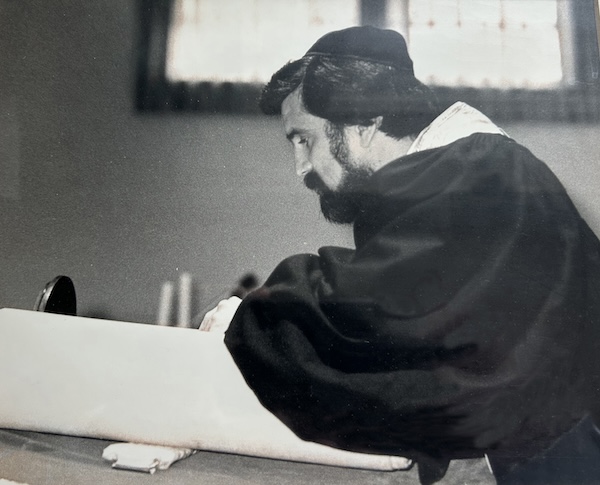
Rabbi Philip Bregman, rabbi emeritus of Temple Sholom, has spent 45 of his 50 years since ordination in Vancouver, having joined the Reform congregation in 1980. (photo from Philip Bregman)
Temple Sholom and the larger Jewish community came together on erev Shabbat, March 28, to celebrate Rabbi Philip Bregman and his wife Cathy, marking 50 years since his ordination. The dinner and Friday night services were emotional but included a great deal of laughter.
Bregman, now rabbi emeritus of the Reform synagogue, has spent 45 of his 50 years since ordination in Vancouver. Early in his career, after also receiving a master’s degree in social work, he served in New Rochelle, NY, and in Toronto, before coming to Temple Sholom in 1980.
Since retiring from the pulpit in 2013, Bregman has served as Hillel BC’s executive director and as the Jewish chaplain at the University of British Columbia. Under the auspices of the Jewish Federation of Greater Vancouver and the Rabbinical Association of Vancouver, he helped found the Other People, an interfaith and multicultural group that talks about diversity to high school students, among other strategies.
Rabbi Dan Moskovitz, who is now Temple Sholom’s senior rabbi, spoke of what Bregman has contributed to the community.
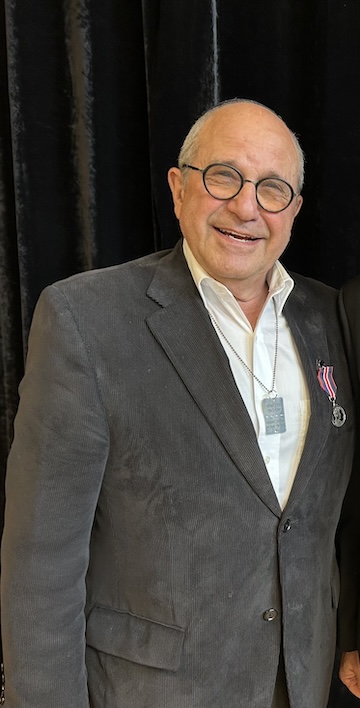
Rabbi Philip Bregman in fall 2024, after receiving a King Charles III Coronation Medal, which recognizes individuals who have made significant contributions to Canada. (photo from Philip Bregman)
“All of the things that we appreciate and love about being Jewish in Vancouver, Rabbi Bregman has had a hand in,” said Moskovitz, who came to Temple Sholom 13 years ago. Motioning his arms to the packed sanctuary, he said: “Rabbi, you have planted the seeds and this is the fruit.”
Moskovitz said he has been guided in his own rabbinate by a rule of thumb: “WWBD – What would Bregman do? And I just did that. I might have done it my own way, but I just did what Philip would do, what Rabbi Bregman would do, and that has served us all so well.”
Moskovitz shared a story about the weekend of the Tree of Life synagogue shooting in Pittsburgh, in 2018.
“I was crushed and devastated,” said Moskovitz. “After the service, I went into my office, which was his office, and I cried. Rabbi Bregman came in and he held me, and I cried on his shoulder. It wasn’t the first time. It wasn’t the last time I cried on your shoulder. Thank you for being this rabbi’s rabbi. Thank you for letting us cry on your shoulder, and for those shoulders holding us up.”
Rabbi Carey Brown, who came from the United States to become the shul’s associate rabbi, credited Bregman for helping her become, first, “a rabbi to Canadians” and, in time, “a Canadian rabbi myself.”
She said Bregman told her when she arrived: “The thing to know about Canadian Jews is Israel. Canadian Jews are very connected, strongly, to Israel.
“It’s really through your love of Israel that I have seen that so, so deeply,” she said.
Speaking on behalf of the family, Shai Bregman, the rabbi’s son and eldest offspring, joked, “I was saving all this material for the eulogy.”
“Who he is as a rabbi and who he is as a person can’t be separated,”
Shai Bregman said. “His passion for Judaism, his unapologetic Zionism, his determination to teach his grandchildren every swear word, are all what makes him who he is.”
The rabbi, said his son, is “one of the most vicious fundraisers you could ever imagine.”
“I’ve seen him raise hundreds of thousands of dollars in between baseball innings, both for the shul and for individuals in need.”
Speaking to the assembled crowd, Bregman donned a Toronto Blue Jays tallit that the congregation gave him upon his retirement 13 years ago, and reflected on the highs and lows.
On Jan. 25, 1985, at 1:30 a.m., Bregman received a call from Vancouver’s fire chief.
“Rabbi, your synagogue is entirely engulfed,” the head firefighter told him. “We believe it was a Molotov cocktail.”
There had been a previous incident and the congregation was in the process of erecting grates on the windows. Only two windows remained unprotected and one of those was where the firebomb entered. The crime remains unsolved.
For two and a half years, the congregation held its services at the Jewish Community Centre of Greater Vancouver and its religious school at Vancouver Talmud Torah. Bregman recalled being contacted by the late Rabbi Mordechai Feuerstein of the Orthodox Congregation Schara Tzedeck, offering Bregman and his staff office space for the duration.
“You’re going to catch hell,” Bregman told him. But Feuerstein insisted.
“And we paid this much rent,” Bregman said, forming a zero with his thumb and forefinger. “I will always be indebted to my beloved colleague. We had one major, major disagreement. It was not halachic. He unfortunately was a Boston Red Sox fan.”
That cross-denominational cooperation may have been a product of a uniquely Vancouver phenomenon. The Rabbinical Association of Vancouver, which encompasses congregational rabbis across the denominational spectrum, emerged from the first phone call Bregman received from outside the Temple Sholom community upon his arrival in the city. It was Rabbi Wilfred (Zev) Solomon of the Conservative synagogue Beth Israel.
“And that started the most incredible, loving, collegial friendship,” Bregman said. “Zev and I started the RAV, the Rabbinical Association of Vancouver, the collaboration that, among many things, I am most proud.”
Bregman credited the Temple Sholom community with providing a second home to his three children, who had the good fortune of remaining in one place for their entire childhoods, something that is rare for “RKs” – “rabbi’s kids,” as Bregman calls them.
The “kids’ (now adults) are daughters Shira and Jordana, and son Shai. Jordana and her husband, Itamar, are parents of Raf and Yoni. Shai and his wife, Michelle, have three children, Maya, Olivia and Talya.
Among other highlights, Bregman recalled mentoring seven individuals who went into the rabbinate and, with wife Cathy, taking “Israel virgins,” totaling about 1,000 people, to the Holy Land over the years.
Bregman credited his wife for the name of the group, the Other People, and said there was a challenge operating under the auspices of both the Jewish Federation and the RAV.
“The question was,” deadpanned Bregman, “who was going to manage him?”
The rabbi and his son, as well as other speakers, singled out Cathy Bregman as an irreplaceable force in the success of Bregman’s rabbinate and the achievements of the congregation, citing her concern for, engagement with and intuitive understanding of individual congregants.
At the dinner before Friday services, Ellen Gordon led a trivia game about events in 1975.
Anne Andrew spoke about arriving in Vancouver in 1980 and going “shul shopping.” She and her then-fiancé Eric attended the High Holiday services that year – “In those days, Rabbi Bregman was a bimah-thumper of note,” she said – and have been Temple Sholom members ever since, she serving as religious school principal when Bregman was rabbi, and Eric serving on the board, including as treasurer.
Jerry Growe, a past president of the synagogue, gave a drash on the week’s Torah portion, drawing parallels between the Book of Exodus and Bregman’s career, which included leading the congregation from the burned-out synagogue to the present structure, in 1988.
MLA Terry Yung, BC minister of state for community safety and integrated services, brought greetings from the province of British Columbia.
Taleeb Noormohamed, member of Parliament for Vancouver Granville, presented Bregman with a parliamentary recognition and discussed participating with the rabbi in interfaith work.
Former MLA Michael Lee and other members of the Other People paid tribute to the rabbi.
In February, Jewish Addiction Community Services (JACS) appointed Rabbi Joshua Corber as its new director. The Vancouver-born Conservative rabbi spent the last 10 years as a congregational rabbi in Calgary, Vaughan, Ont., and Louisville, Ky., before returning home in July 2023.
“Practically the entire time I was serving congregations, I was in recovery,” Corber said. “Prior to that, I was in active addiction. I’m in a unique position to serve the Jewish community in this way because I have the personal experience of having suffered from addiction, but I also have experience from my congregational service with pastoral counseling and, in particular, people going through severe life trauma. That will be of immense value to me in serving this community.”
Rabbi Joshua Corber is the director of Jewish Addiction Community Services Vancouver. (photo from JACS)
Corber noted that the Jewish community faces an acute risk when it comes to substance abuse. One reason is the misconception that Jews are immune to addiction, but another is the prevalence of alcohol in traditional religious observance. “There’s no religion other than Judaism in which alcohol is so present in almost all aspects of religious life,” he said.
“Alcohol is prescribed, sanctioned and encouraged in Judaism, and not just on Purim,” he continued. “There’s always a Jewish excuse for a l’chaim. For me, as a rabbi, that posed a unique danger because I could always justify it. Though halachic authorities strongly discourage drunkenness, that message won’t be absorbed by the addict, who will make a beeline for the l’chaim table – every single time.”
Corber’s polysubstance addiction, including alcohol, became acute during the pandemic. He said the most concerning addictions, that pose the most immediate threat to life, are opioids and fentanyl.
But, just as Judaism presents a risk in terms of addiction, it also has resources for recovery, the rabbi noted.
“Most of the recovery world, such as 12-step programs and AA, consider an addiction to be a spiritual problem, and spiritual problemsrequire spiritual solutions. I have a deep knowledge of the ways in which Jewish tradition and Jewish wisdom teachings can be leveraged as a critical aid in recovery.”
Corber’s first community event will be held on April 15. The Third Seder: Understanding Addiction and the Path to Freedom is a communal, seder-like meal where the rabbi will discuss the connection between addiction, recovery and spiritual freedom.“We’ll leverage and focus the Haggadah around addiction and recovery,” Corber said, adding that “everyone should come.”
“This is not just for people who are in recovery or struggling with addiction,” he said. “It’s really important that the whole community be involved in the conversation around addiction. It can’t be that shivas are the only place that we’re talking about addiction.”
When Jewish Addiction Community Service was established in 2016, its role was to help members of the community suffering from addiction. Eight years after its inception, in 2024, the organization came under the umbrella of Jewish Family Services, meaning that, operationally, it will be under the auspices of JFS.
“We needed infrastructure and clinical support, so this is a big operational shift that integrates addiction-related services with other services that JFS provides,” said Tanja Demajo, chief executive officer at JFS. “When a client comes to JFS or JACS for support, we examine their needs holistically and connect them with different resources based on their needs. Going forward, it means people can get the support they need in one place instead of going to two.”
Demajo and her team hope the new development will remove barriers to service access and eliminate the shame and discomfort associated with requests for support, because the need is certainly there, she said.
“The percentage of people impacted by addiction in the Jewish community is very similar to the wider community: we know that every third community member is impacted by someone affected by addiction. But there’s a lot of stigma and judgment, so it’s not easy to ask for help,” Demajo told the Independent. “Education and awareness are things JACS and JFS really need to work on, to normalize the need to ask for help. The more conversations we have, the more it normalizes the need for help.”
JACS has hired Corber as a full-time director, and is relying on eight therapists contracted through JFS. Demajo said, as community needs shift and change, the organization will examine taking on additional therapists if needed. “We’re at the early stage of building a full program and bringing new energy to it,” she explained.
Demajo added that she’s deeply grateful to Howard Harowitz, the founder and chair of JACS, who advocated for addiction services in the Jewish community for years.
JACS’s mission is to increase education and awareness, provide community direct service, and offer guidance and referrals. For more information, visit jacsvancouver.com.
Lauren Kramer, an award-winning writer and editor, lives in Richmond.
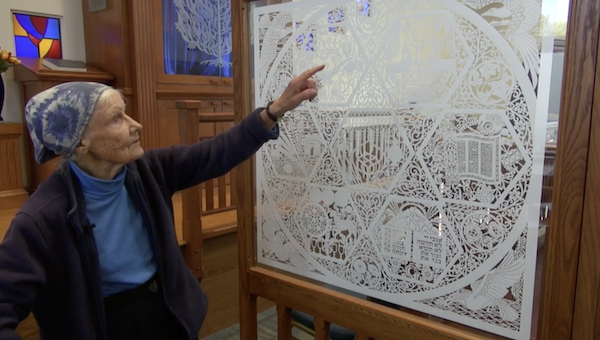
Artist Naomi Spiers explains the first panel of her wood-framed paper-cut mechitzah (partition) at the Chabad of Vancouver Island location in Victoria. A new video by David Cooperstone highlights some of Spiers’ creative path. (still from film)
Salt Spring Island sculptor Naomi Spiers, who celebrated her 90th birthday in March, is the subject of a new film, Naomi Spiers: A Legacy, released in January by Vancouver videographer David Cooperstone.
Available on YouTube, the film follows Spiers’ path from her artistic beginnings and initial work in Ontario, through to her experiences abroad and her designs found on the mechitzah (partition) at the Chabad of Vancouver Island location in Victoria.
Born in Toronto in 1935, Spiers was allowed to have a penknife, and she carved her pencils into totem poles as a child. “I carved anything I could find and, when I was 14, I got a summer job with a potter,” she recalled. “Later, I got my hands in clay and started making all kinds of things.”
Naomi Spiers (still from film)
Spiers went to the Ontario College of Art (OCA), where she studied sculpture. At the end of the four-year degree, she won a scholarship to study at the University of Edinburgh College of Art. Afterward, she returned to the OCA to assist a former instructor teaching first-year sculpture.
There, she met Reuven, a fellow artist who, along with his two brothers, had immigrated to Canada from the United Kingdom in 1952.
“I was very impressed by his talent and very astonished when he asked me to marry him,” Spiers said.
The couple opened a studio in Collingwood, Ont., on the shores of Lake Huron, and had various shows during their time there, with Reuven, whom Spiers said “was born knowing how to draw,” receiving several large commissions.
She, meanwhile, created sculptures for the Catholic Church. Though not born into a Jewish home, Spiers came from a background steeped in biblical stories. She had to memorize many of them and, because of that, she was able to make works of a religious nature.
After several trips to British Columbia, she and Reuven moved to Salt Spring Island. Reuven did house renovations, while Naomi taught at Cariboo College (now Thompson Rivers University) in Kamloops. The two would see each other on weekends in Vancouver, where, on one occasion, they met an Israeli doctor who invited them to stay at a kibbutz.
The couple fell in love with Israel and moved there in 1987, eventually settling in Safed. They refurbished a centuries-old home – with no electricity, plumbing or windows – and set up a gallery: he painting, she sculpting.
It was in Safed that Naomi began to develop an interest in paper cuts, after seeing an exhibition in Jerusalem. At this point, a light went on in her head, and Spiers thought to herself, “I could do that.”
“It was quicker and cheaper than sculpture and people used to ask me to do family trees and things like that. I sold quite a lot of them,” she said.
Their time in Israel turned out to be very successful professionally. Naomi would have liked to have remained there, but Reuven’s physical constraints necessitated coming back to Canada.
Upon their return, the couple bought and renovated another property on Salt Spring Island. In 2009, Reuven, however, became ill and passed away. Within a short period, it was decided that a monument be established in his honour, and thus the Chabad mechitzah saw its beginnings.
With the help of Reuven’s brother, Martin, who assisted with the woodwork, the five paper-cut panels that form the partition got underway, each with its own theme.
The first panel in the Victoria shul shows the seven fruits of Israel – the ones that could be offered at the Temple. The second features the 12 tribes of Israel, with the symbolism being taken from inscriptions in the Hebrew Bible.
In the middle of the partition is a Star of David panel, with hexagons that depict various Torah tales. This is followed by a panel based on the Jewish calendar – here, for example, the month of Adar takes the viewer to a scene from the Book of Esther.
The last of the panels represents the Jewish holidays: a shofar, apples and bees making honey for Rosh Hashanah; a tent for Sukkot; a menorah and oil for Hanukkah; noisemakers and masks for Purim; four cups of wine and matzah for Pesach; and the 10 Commandments for Shavuot.
“My dear brother-in-law Martin built all this lovely woodwork,” Spiers said. “It wasn’t something he had ever done before, so we went around the house and looked at things that Reuven had made and tried to get the same style he would have done if he were doing it.
“Martin went ahead and built them,” she said. “I think they’re very nice and they matched the other furniture in the shul, and they were his monument to his brother – they were very close. Between the two of us, I think we did a good job of it.”
Chabad of Vancouver Island’s Rabbi Meir Kaplan, who first met the Spierses in 2008, shortly before Reuven’s death, lauded Naomi’s work, calling it “a stunning piece of art” and “the nicest mechitzah ever created.”
Naomi Spiers’ five-panel paper-cut mechitzah she created for Chabad of Vancouver Island in Victoria. (still from film)
Spiers had approached Kaplan with her ideas after her husband’s death and, with his encouragement, she proceeded. After seeing the first panel, Kaplan said, “I was blown away. How can you do this with paper?
“As the project progressed, the works became more complex, with more wisdom and more meaning. This has become one of the masterpieces of our organization,” he said. “Local community members are proud of it and always are looking at it, trying to find some additional details and meanings in this beautiful design.”
Kaplan, who advised Spiers on religious aspects during the years-long project – he traveled to Salt Spring Island on several occasions – noted that visitors to the Victoria Chabad have been deeply impressed by the artwork, as well. He hopes that the panels will be part of the synagogue’s decor for centuries to come.
Spiers estimates that it took roughly a year to create each panel. At the time she started, Chabad of Vancouver Island had not yet moved into its present location at 2955 Glasgow St.
Acknowledging that she always likes to have a project in the works, Spiers said she would like to contribute more to the community, possibly to the new school that opened across the street from the Chabad Centre last fall.
“It was an honour creating a video about Naomi Spiers, with the focus on the incredible mechitzah she created for Chabad of Vancouver Island,” Cooperstone told the Independent. “In doing this video, I discovered her amazing talent as an artist. The intricate, detailed paper cutting which Naomi spent five years creating is a marvel to look at and appreciate. I hope this video will be an everlasting legacy to this remarkable woman.”
Cooperstone has made several videos about community members, including The Naiman Family Concert with Vancouver Jewish Folk Choir (2017), Yosef Wosk Book Launch (2023) and L. Cohen, a JCC Interview with Michael Posner (2024).
The music for the Spiers film comes from Tzimmes, the Vancouver-based ensemble. Andrea Zeitz helped to put the film together and Cooperstone gave special thanks to Michael and Dvori Balshine for bringing the film to fruition.
Sam Margolishas written for the Globe and Mail, the National Post, UPI and MSNBC.
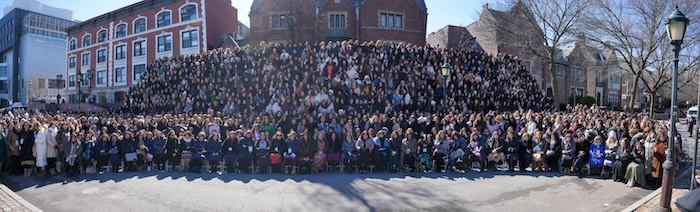
BC emissaries joined the Kinus Hashluchos in February. (photo from chabad.org)
Some 4,000 Chabad-Lubavitch women emissaries and lay leaders from around the globe gathered in February in New York for the 35th annual International Conference of Chabad Women Emissaries, the largest Jewish women’s leadership gathering in the world. BC shluchot (emissaries) who attended were Chanie Baitelman (Richmond), Malky Bitton (Downtown Vancouver), Matti Feigelstock (Richmond), Raizy Fischer (Vancouver), Chana Gordon (Richmond), Fraidy Hecht (Okanagan), Chani Kaplan (Vancouver Island), Riki Oirechman (Vancouver) and Blumie Shemtov (Nanaimo).
While the yearly conference has a celebratory atmosphere, uniting women leaders from Alaska to Zambia, this year’s gathering came during a particularly challenging time for Jewish communities worldwide. From local wildfires to ongoing war in Israel and rising antisemitism on college campuses, the women on the frontlines of Jewish communal service are confronting urgent realities.
The Kinus Hashluchos in February included a visit to the Ohel in Queens, NY, the resting place of the Rebbe, as well as the nearby grave of Rebbetzin Chaya Mushka. (photo from chabad.org)
The conference, known as Kinus Hashluchos, ran from Feb. 19 to Feb. 23, uniting women leaders from all 50 US states and more than 100 countries for five days of workshops, networking and spiritual renewal. The conference is annually timed to coincide with the anniversary of the passing of Rebbetzin Chaya Mushka Schneerson, of righteous memory, the wife of the Rebbe, Rabbi Menachem M. Schneerson, of righteous memory.
The Thursday morning saw the emissaries visit the Ohel in Queens, NY, the resting place of the Rebbe, as well as the nearby grave of Rebbetzin Chaya Mushka. The women came to pray for their families, communities and humanity at large, carrying countless prayer requests from people around the world.
Friday morning featured the iconic “class picture,” with thousands of women gathered in front of 770 Eastern Parkway, the headquarters of the Chabad-Lubavitch movement in Brooklyn, NY.
The capstone of the conference was Sunday’s gala banquet, held at the New Jersey Convention and Expo Centre in Edison, NJ. This year’s theme, “connection,” highlighted the bonds that unite Jewish people worldwide with each other and with their Creator.
In 2023, Ben-Gurion University of the Negev opened a new home in Sde Boker for the David Ben-Gurion archives. (photo from Ben-Gurion University)
For visitors to Israel – and for Israelis looking for an engaging getaway – there is a relatively new destination in the country’s south.
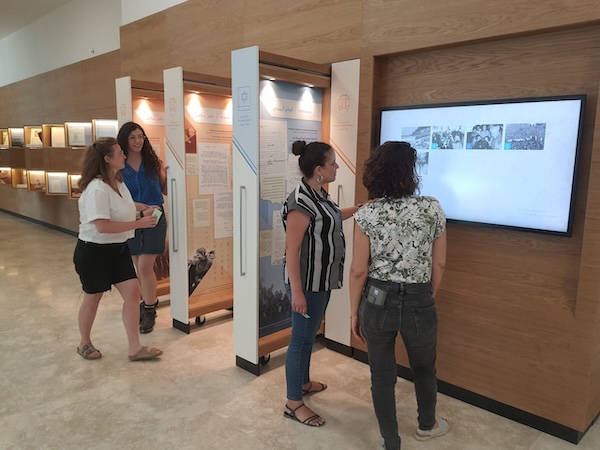
In 2023, Ben-Gurion University of the Negev opened a new home for the David Ben-Gurion archives, with a dramatic exhibition hall to attract visitors. In addition to the many artifacts and documents on display, the exhibitions include interactive activities that allow visitors to speculate how the first prime minister would have responded to various scenarios.
Ben-Gurion was Israel’s first prime minister and the dominant political figure for the country’s first decade-and-a-half, during which time he served concurrently as minister of defence. In addition, no individual is more associated than Ben-Gurion with Israel’s development of the Negev and the entire south of the country.
The new archives facility rounds out a network of Ben-Gurion-related sites in the Sde Boker area, where Ben-Gurion built a desert home and enjoyed his retirement.
David Berson, Ben-Gurion University Canada’s executive director for British Columbia and Alberta, says the facility makes Sde Boker even more of a must-see for visitors to Israel.
There had been an archive at the Sde Boker campus, allowing deep research into Ben-Gurion’s papers and other materials, but these were photocopies because the university did not have the archival capacity to accommodate the originals in the environment they required. The originals were held in Tel Aviv at an Israel Defence Forces archive.
“Everything was there, but it was a reasonable facsimile, as we like to say,” said Berson.
That changed with the opening two years ago of the purpose-built Ben-Gurion Heritage Archive, which includes a 280-square-metre (more than 10,000-square-foot) exhibition hall.
“All the real, genuine archives have been transferred there,” Berson said. “The exhibition hall is basically an interactive tale of David Ben-Gurion’s heritage and questions about things like the ultra-Orthodox serving in the army, his relationship to the diaspora, the Altalena affair, all sorts of different things, as well as his correspondence with Hebrew school students from all over the world, leaders, his perspectives on religion, etc., etc.”
The facility is a partnership between BGU and the Ben-Gurion Heritage Institute, an educational and commemorative organization committed to keeping Ben-Gurion’s ideals alive, especially his emphasis on developing the Negev. Among other things, they operate the museum at Ben-Gurion’s kibbutz home and other educational programming.
The Ben-Gurion Promenade, a project designed to honour his legacy and connect significant landmarks associated with his life, takes visitors on a 3.5-kilometre walk from his residence at Kibbutz Sde Boker to his burial site overlooking Nahal Zin, and taking in the new archives and exhibition hall. The accessible path is lined with native desert plants and interpretive signs about Ben-Gurion’s life and vision.
The David Ben-Gurion archives includes a 280-square-metre exhibition hall. (photo from Ben-Gurion University)
The archives are part of a larger complex that also houses the Ben-Gurion Research Institute for the Study of Israel and Zionism, and the Azrieli Centre for Israel Studies.
Ben-Gurion’s eponymous university has three campuses in the country’s south.
The main Marcus Family Campus, in Beersheva, is home to the university’s faculties of engineering and sciences, health sciences, humanities and social sciences, business and management, computer science and cybersecurity, among others, and several advanced research institutes. It is adjacent to the Soroka University Medical Centre, where BGU medical students train. The campus is also home to the 10-year-old Advanced Technology Park, which is a joint venture of BGU, the City of Beersheva and real estate development company Gav Yam. The park is part of a national effort to develop the Negev region into a global centre for cybersecurity, defence technologies and tech innovation.
At the Sde Boker campus, about 30 kilometres to the south of Beersheva, specialties include desert studies, environmental science, hydrology, solar energy, sustainability and climate research, and arid agriculture. It is also home to the Jacob Blaustein Institutes for Desert Research.
The Eilat campus, at the country’s southern-most tip, on the Red Sea, specializes in marine biology and biotechnology, hospitality and tourism management, regional development studies, and interdisciplinary undergraduate programs that allow students from the south to do their initial studies in the area before completing their degrees at the Beersheva campus or elsewhere.
Sde Boker has always been a sort of pilgrimage site for Ben-Gurion fans and history buffs. But, because tourism to Israel has plummeted in the past year-and-a-half, most of the visitors so far have been comparative locals, Berson said, including leaders of the security services and military, educators and other Israelis.
When tourism picks up, Berson hopes the archives will make Sde Boker even more of a destination on the visitors’ map.
“It’s a wonderful national treasure,” said Berson. “But it’s also something that’s not on people’s radar screens abroad. We really want to encourage people to come and visit there, put it on their itineraries.”
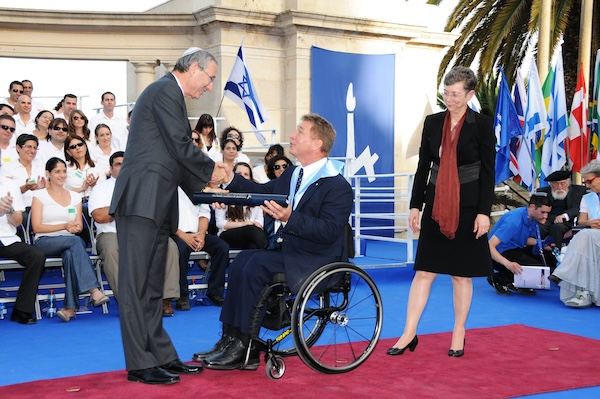
Canadian Paralympic athlete and wheelchair racer Rick Hansen, known for his work to break down barriers for people with disabilities, receives an honorary doctorate from Hebrew University from then-Hebrew U president Menahem Ben-Sasson. In December 2010, Hansen visited Hebrew U as part of the 25th anniversary celebration of his “Man in Motion” tour. (photo from Hebrew University)
The Hebrew University of Jerusalem turned 100 this month. Opening officially on April 1, 1925, the university preceded the birth of the state of Israel by more than two decades.
“There was no country yet,” said Dina Wachtel, vice-president, community affairs, for the Canadian Friends of the Hebrew University. “It’s the first daughter that gave birth to her mother.”
The history of the campus on Mount Scopus has been tumultuous, like that of the country its alumni have helped shape.
During Israel’s 1948 War of Independence, Mount Scopus became an isolated enclave, and the university was forced to relocate its main activities to facilities in West Jerusalem. In 1954, a new campus was established in the Givat Ram neighbourhood, followed by the creation of additional campuses, including at Ein Kerem, home to the institution’s medical sciences faculty, and, at Rehovot, where the agriculture department is headquartered.
Allan Bronfman, national president and founder of the Canadian Friends of the Hebrew University, with Dr. Albert Einstein, honorary president of the Hebrew University, on Sept. 19, 1954, at a Princeton conference called by Einstein to launch a $30 million dollar capital building project for the university, which was in exile from its campus on Mount Scopus in Jerusalem. (photo from Hebrew University)
After the 1967 Six Day War, Hebrew University regained access to Mount Scopus and began to restore and expand the original campus. Today, it is one of Israel’s leading research institutions, ranked among the top universities globally, and it remains a symbol of intellectual and cultural renewal in the country.
“Even the word ‘incredible’ is too small to describe the impact of the Hebrew University on the establishment of the state of Israel and on the state of Israel,” Wachtel said. “Most of the Supreme Court judges are graduates of the Hebrew University faculty of law, which was established in 1949. We have eight Nobel Prize laureates – all of them from 2000 and after.” A ninth laureate, Albert Einstein, a founder of the university, won the Nobel for physics in 1921.
The university was established by the intellectual giants of the last century, said Wachtel. These included Einstein, as well as Chaim Weizmann, the Zionist leader who would become the first president of the state; philosopher Martin Buber; American Reform Rabbi Judah Leon Magnes, who served as the first chancellor and later president of the university; founder of psychoanalysis Sigmund Freud; Ahad Ha’am, dubbed the father of cultural Zionism; poet Chaim Nachman Bialik; and Herbert Samuel, British High Commissioner for Palestine, among many others.
Einstein, Wachtel noted, left his entire intellectual estate to the Hebrew U and the university is in the process of constructing a new Daniel Libeskind-designed archive for his fonds on Givat Ram’s Edmond J. Safra Campus, adjacent to the Knesset, the Supreme Court and the Israel Museum.
“I think it will be the next tourist attraction in the city of Jerusalem,” she said.
Celebratory events will take place in Israel in June, concurrent with the Hebrew University’s board of governors meeting in Jerusalem. Happenings will include a special event at the home of Israel’s president, a special show at the Tower of David Museum, and other ceremonies.
Gail Asper, left, a Hebrew University honorary doctorate recipient and a member of the executive of the board of governors of Hebrew U, with then-Hebrew U president Menahem Ben-Sasson and guest speaker Chelsea Clinton at the 2015 CFHU Einstein Legacy Awards in Toronto. (photo from Hebrew University)
The university has been a hub for groundbreaking research, reflecting the institution’s commitment to education, scientific advancement and societal impact.
Marking the centenary, Hebrew U’s current president, Prof. Asher Cohen, credited the thinkers who initiated the school, the groundbreaking for which began in 1918.
“They and many others founded a pioneering academic institution to cultivate future leaders in research, science, public service and society – for the benefit of Israel and all humanity,” Cohen said in a statement. “From the moment this vision became a reality, the university has upheld excellence in research and education as its highest priority. Today, it continues to be a hub of knowledge, innovation and groundbreaking research across diverse fields, nurturing generations of leaders, scholars and thinkers.”
Prof. Tamir Shafer, rector of the Hebrew University, contextualized the university in Israeli society.
NBA superstar Amar’e Stoudemire visited Hebrew University in 2013, meeting with students at the Rothberg International School, and with the then-president of Israel Shimon Peres. (photo from Hebrew University)
“As a leading research institution,” Shafer said in a statement, “the Hebrew University sees itself as responsible for educating future generations, conducting groundbreaking research across nearly all fields of study, fostering extensive international engagement in both research and teaching, building strong ties with advanced industries in Israel and abroad, nurturing a diverse academic community, and maintaining deep social involvement in Jerusalem and throughout Israel.”
Diversity is a cornerstone of the institution’s success, according to Prof. Mona Khoury-Kassabri, vice-president of strategy and diversity.
“At the Hebrew University, we believe that diversity is not a substitute for excellence but a driving force that enhances it,” she said. “Our commitment to inclusion ensures that students and researchers from all backgrounds have equal opportunities to thrive, contribute and shape the future of society. By fostering a multicultural environment, we enrich both scholarship and community, proving that true innovation emerges when different voices are heard and valued.”
The centenary will also be celebrated with special events in Canada, some of which will be announced soon. Check cfhu.org for updates.
The Jerusalem Winner Marathon encompassed multiple races, from a full marathon to a 5K circuit and a 1.7K family run. (photo from Jerusalem Municipality)
On April 4, approximately 40,000 runners participated in the 14th International Jerusalem Winner Marathon, which broke all previous records for participation. Held under the theme “Am Israel Run,” the event paid tribute to the Israel Defence Forces, security forces and emergency responders, serving as a powerful symbol of resilience, hope, strength and the enduring Israeli spirit.
The winner of the marathon in the men’s category was Bohdan Semenovych, 39, from Ukraine, with a time of 2:22:47. The winner in the women’s category was Salgong Pauline Gepkirui, 37, from Kenya, with a time of 2:51:58.
(photo from Jerusalem Municipality)
Among the runners were around 15,000 IDF soldiers – both reservists and active-duty personnel – and members of Israel’s security and emergency services. The marathon drew about 1,800 international participants, all of whom ran along a course that passed landmarks including the Knesset, the Old City walls, Sultan’s Pool, Mishkenot Sha’ananim, Mount Zion, the German Colony, Rehavia, the Armon Hanatziv Promenade, Ammunition Hill, Sacher Park, Mount Scopus, the Mount of Olives, and other notable places.
(photo from Jerusalem Municipality)
Among the participants this year was the mayor of Jerusalem, Moshe Lion, who ran in the five-kilometre race.
The 14th International Jerusalem Winner Marathon featured six race categories: the full marathon, half marathon, 10K, 5K and 1.7K family run. Additionally, the event included the Community Race, an exclusive feature of the Jerusalem Marathon.
The event was organized by the Jerusalem Municipality, in collaboration with the Jerusalem Development Authority and with the support of the Ministry of Jerusalem and Heritage, the Ministry of Culture and Sports, and the Ministry of Tourism. The event’s main sponsor was Toto Winner, and Saucony partnered in the event. Additional sponsors included Hapoel Centre, Eldan, Cinema City, Reidman College and Bezeq Business. The marathon was produced by Electra Target.
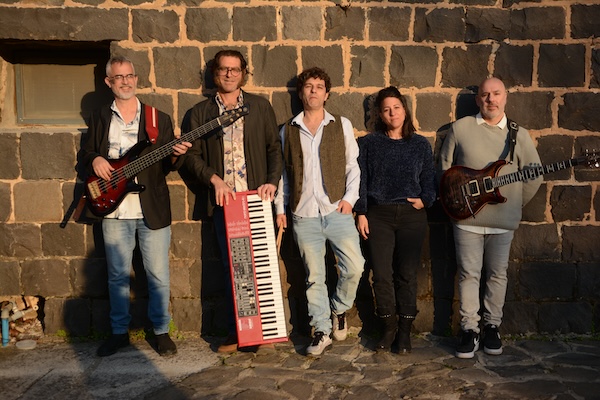
Ruchot Hatzafon members, left to right: Gil Melamood (bass guitar), Adam Halfi (keyboards), Ofir Baz (drums), Liraz Moalem (stage manager) and Eyal Shavit (vocals and electric guitar). (photo by Yannay Shifron)
“We will dance again” is the theme of this year’s Yom Ha’atzmaut community gathering on April 30 to celebrate Israel’s 77th anniversary amid the heartache that continues since Hamas’s Oct. 7, 2023, terror attacks. In addition to Nova Festival survivors, other special guests will be the band Ruchot Hatzafon, some of whose members still have not returned to their homes in Israel’s northern region because of the continued threat from Hezbollah in Lebanon.
“Better now, but it was very traumatic for everyone,” Eyal Shavit told the Independent about how he and his fellow musicians were doing since Oct. 7. “It’s difficult to put to words. We all live very close to the Lebanese border. A couple of us, Liraz [Moalem] and Gil [Melamood], live right on that border, in Kibbutz Malkiya and in Kibbutz Kfar Giladi, so they had to move to more central places in Israel and to this day they still haven’t come back to their homes.
“For the rest of us, it wasn’t as bad, but it still affected our lives in so many ways. Not to mention financially, as well as the mental trauma, the fear and the grief. However, we are among the luckiest ones in the grander scheme of things and we do what we have to do, both as individuals and as a people. We keep living, we keep moving forward and we keep celebrating our lives, all the while remembering [those] who are still held in Gaza by Hamas and grieving with anyone and everyone who has suffered the most terrible losses on that day.”
Shavit said he left his kibbutz, Kfar Szold, a couple of days after Oct. 7, “because the feeling at the time was that it can happen again at any given moment by Hezbollah in Lebanon, but, within a couple of weeks, I realized that it would be safe enough to go back … so I’ve stayed there since.”
Shavit is Ruchot Hatzafon’s lead vocalist and he plays the electric guitar. (He is also, as it happens, co-author of the book Hilarious Hebrew with Hebrew teacher Yael Breuer, which the Independent reviewed in 2016: jewishindependent.ca/from-nonsense-knowledge.) In Vancouver, Shavit will be joined by Melamood (bass guitar), Adam Halfi (keyboards), Ofir Baz (drums) and Sapir Breier (vocals).
“In this instance, Sapir will be with us in Vancouver, as Vered [Sasportas] couldn’t join us this time,” said Shavit of the band’s other primary vocalist.
Moalem is the band’s stage manager.
The group has been together about six years, and Shavit explained its evolution.
“It was a bit of luck really,” he said about his joining. “I’d just returned from the UK to Israel, having lived in Brighton, England, for 13 years, where I studied music and made my living playing gigs in pubs and events.”
Friends from high school – Melamood (who also was in a military band with Shavit during their army service) and Baz – contacted Shavit and asked him to be a part of the band, along with another high school friend, Halfi, so that they could play at an event.
“We then immediately got booked for a second event by Liraz Moalem, who then became our band manager,” said Shavit. “It was a lot of fun and a nice opportunity. We all aspired to do this for a living.”
A couple of years after that, he said, Sasportas, who they met through a mutual friend and colleague, became part of the group and, said Shavit, “she fit right in, as well as being a brilliant singer and performer.”
Ruchot Hatzafon – which translates as the Northern Winds – has two types of shows.
“One is an energetic set of very popular songs both in Hebrew and in English that everyone likes to dance to, and the other show is a tribute to Israel’s army bands, who have a huge legacy in Israeli culture and used to dominate the charts back in the ’60s up until the mid-’70s,”explained Shavit. “That show includes a bit of storytelling and mostly wonderful and famous songs by the old army bands.
“In Vancouver, we will play our party music set, along with some special requests, like ‘Yerushalayim Shel Zahav’ by Naomi Shemer, for example.”
Other songs that Vancouverites will hear on April 30 include “Ahava Besof Ha’Kayitz” (“Love at the End of Summer”) by Tsvika Pik; “Ein Makom Acher” (“No Other Place”) by Mashina; “Naarin Shuva Elay” (“My Boy, Come Back to Me”) by Margalit Tsan’ani; “Natati La Chayai” (“I Gave Her My Life”) by Kaveret; and some Israeli Eurovision songs.
“And, in English, probably ‘Think’ by Aretha Franklin, ‘I Will Survive’ by Gloria Gaynor, ‘Don’t Stop Me Now’ by Queen and more,” said Shavit.
The band members have similar musical tastes, he said, perhaps because they all grew up on a kibbutz. “We’re generally more drawn to Western-influenced rock and pop music and songs in English, rather than Mediterranean-influenced songs, which are another genre of cover bands in Israel,” he said. “We play only a few of those.”
This will be Ruchot Hatzafon’s first time performing outside of Israel. They’ll arrive April 28 and return home on May 2, but Shavit said they’re thinking about extending their stay a couple of days.
“I can say for all of us that we feel this is an honour and a privilege to be invited to play for the Jewish communities in Vancouver – especially after what we’ve all been through as a people,” Shavit said. “We are thrilled to come and celebrate with everyone there.
“In addition, we get to visit a little bit of Canada, which, personally, I’ve always wanted to visit.”
Jaime Stein hopes to bring a Jewish voice to the table at Vancouver City Hall. He is vying for one of the two seats that will be filled in a by-election April 5.
One seat opened after Councilor Christine Boyle was elected as a New Democrat to the BC Legislature in the provincial election last year. She had been the sole representative on council for the OneCity electoral organization.
The other seat opened after Councilor Adriane Carr, one of two Green party councilors, resigned, citing frustration with the governing style of Mayor Ken Sim and his ABC majority.
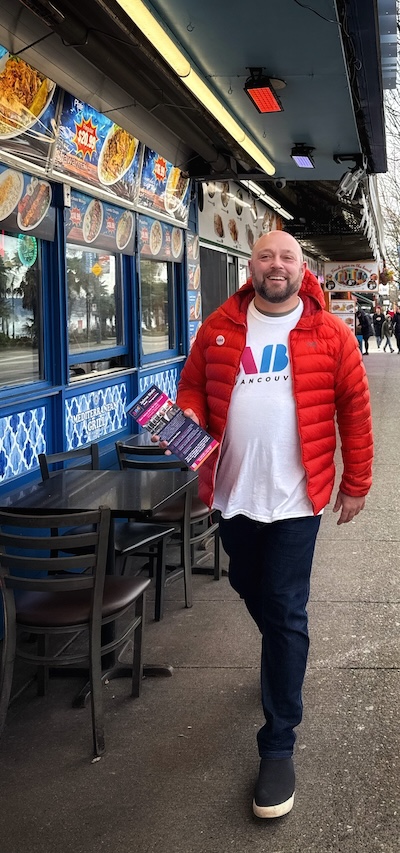
Jaime Stein said that, when meeting with a couple of hundred voters every day, he and his running mate, Ralph Kaisers, are hearing that people are “really happy with how ABC is willing to take on difficult issues.” (Courtesy Jaime Stein)
Stein is on the ABC slate, with running mate Ralph Kaisers. They hope to increase ABC’s existing majority on council. ABC currently holds the mayor’s chair and six of the 10 councilor positions.
Aiming to prevent a larger ABC majority are four electoral organizations.
TEAM for a Livable Vancouver has nominated former city councilor Colleen Hardwick and community organizer and urban researcher Theodore Abbott.
The three other groups have nominated one candidate each. OneCity has nominated schools and street safety activist Lucy Maloney. COPE, the Coalition of Progressive Electors, has nominated writer and punk musician Sean Orr. The Green party has nominated filmmaker and advocate Annette Reilly.
There are six independent candidates running: Jeanifer Decena, Guy Dubé, Charles Ling, Karin Litzcke, Gerry Mcguire and Rollergirl.
The dual by-election is the first test of the ABC majority on Vancouver city council since Sim and his party were first elected in 2022.
Stein said that, when meeting with a couple of hundred voters every day, he and his running mate Kaisers are hearing that people are “really happy with how ABC is willing to take on difficult issues, whether it’s in the Downtown Eastside or whether it’s with crime and safety or whether it’s just examining new ways to do things that maybe councils in the past haven’t done.”
He thinks there is a silent majority that doesn’t make a lot of noise but who are generally pleased with the direction the city has been taking in the past three years.
The issues that led to the ABC victory in 2022 have not changed significantly, according to Stein.
“I think the biggest issue, number one, is crime and safety,” he said. “People want Vancouver to be a safer city, one that they can get out and enjoy.”
The second most common issue he hears about, he said, is “making Vancouver open for business again.”
“That means reducing red tape for businesses,” said Stein. “It means making it easier for people to interact with the city, whether they need permits, etc., and also opening it to the world, like bringing more festivals and events here, like FIFA or Web Summit, and trying to generate tourism dollars in the city for folks.”
While Stein sees value in having a Jewish voice at the table, he said Vancouver already has Canada’s “most friendly mayor and council to the Jewish community.”
Although Vancouver’s second mayor, David Oppenheimer, was Jewish, there have never been a great many Jews in elected positions either locally, provincially or federally from British Columbia. Stein hopes his candidacy inspires other Jews to get involved.
“It’s a voice that needs to be at the table, not only to advocate for our community but also to serve as a role model for others to get involved in either the political process or in civic discourse in general,” he said.
Stein has corporate and nonprofit sector leadership experience, including in the technology sector at companies including BroadbandTV, Taplytics and Hootsuite. He partnered with Canadian Blood Services to raise $12.5 million for establishing Canada’s national public cord blood bank, inspired to do so by the loss of his father, Howard Stein, to leukemia, in 2006. He is also on the board of an agency advancing Alzheimer’s research.
In the Jewish community, Stein was selected as a 2024 Wexner Fellow, a two-year educational program focused on Jewish learning and leadership development. He chairs a committee on the Antisemitism and Israel Crisis Response Team. With the Jewish Federation of Greater Vancouver, Stein has worked with elected officials to develop public policy to strengthen community safety and security. He has been a volunteer and fundraiser supporting Jerusalem’s Shaare Zedek Medical Centre and has volunteered in different capacities with the Centre for Israel and Jewish Affairs, the Canadian Jewish Political Affairs Committee, the Jewish Community Centre of Greater Vancouver and others.
Last year, Stein was nominated as the BC United candidate in Vancouver-Langara, but did not run in the provincial election after the party folded its campaign and endorsed the BC Conservatives.
Polls are open election day, which is Saturday, April 5, from 8 a.m. to 8 p.m., but there are opportunities to vote early at Vancouver City Hall, on Tuesday, April 1, from 8 a.m. to 8 p.m., and people can also cast their vote by mail. For full details, go to vancouver.ca/vote.