Skip to content
  • Home
  • Subscribe / donate
  • Events calendar
  • News
    • Local
    • National
    • Israel
    • World
    • עניין בחדשות
      A roundup of news in Canada and further afield, in Hebrew.
  • Opinion
    • From the JI
    • Op-Ed
  • Arts & Culture
    • Performing Arts
    • Music
    • Books
    • Visual Arts
    • TV & Film
  • Life
    • Celebrating the Holidays
    • Travel
    • The Daily Snooze
      Cartoons by Jacob Samuel
    • Mystery Photo
      Help the JI and JMABC fill in the gaps in our archives.
  • Community Links
    • Organizations, Etc.
    • Other News Sources & Blogs
    • Business Directory
  • FAQ
  • JI Chai Celebration
  • JI@88! video

Recent Posts

  • Zionism wins big in Vegas
  • Different but connected
  • Survival not passive
  • Musical celebration of Israel
  • Shoppe celebrates 25 years
  • Human “book” event
  • Reclaiming Jewish stories
  • Bema presents Perseverance
  • CSS honours Bellas z”l
  • Sheba Promise here May 7
  • Reflections from Be’eri
  • New law a desecration
  • Resilient joy in tough times
  • Rescue dog brings joy
  • Art chosen for new museum
  • Reminder of hope, resilience
  • The national food of Israel?
  • Story of Israel’s north
  • Sheltering in train stations
  • Teach critical thinking
  • Learning to bridge divides
  • Supporting Iranian community
  • Art dismantles systems
  • Beth Tikvah celebrates 50th
  • What is Jewish music?
  • Celebrate joy of music
  • Women share experiences 
  • Raising funds for Survivors
  • Call for digital literacy
  • The hidden hand of hate
  • Tarot as spiritual ritual
  • Students create fancy meal
  • Encouraging young voices
  • Rose’s Angels delivers
  • Living life to its fullest
  • Drawing on his roots

Archives

Follow @JewishIndie
image - The CJN - Visit Us Banner - 300x600 - 101625

Zack Gallery’s new director

Zack Gallery’s new director

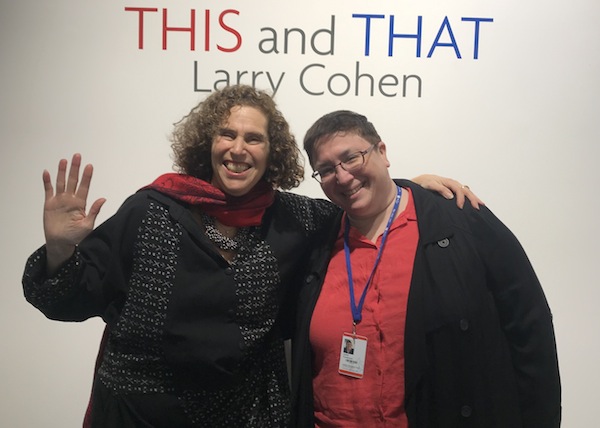
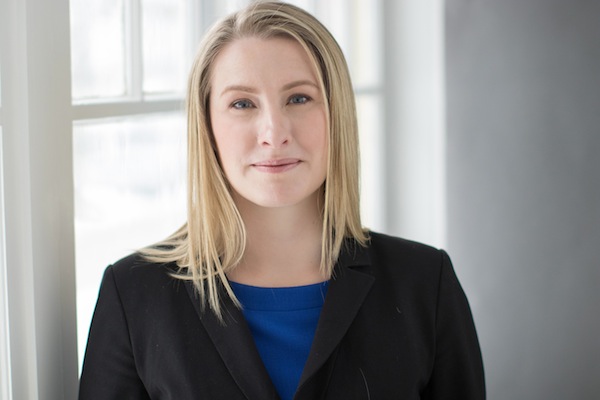
Former Zack Gallery director Linda Lando, left, with new director Hope Forstenzer. (photo by Daniel Wajsman)

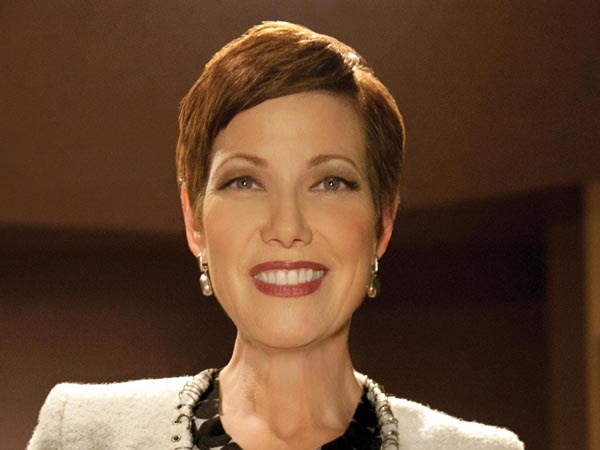
The Sidney and Gertrude Zack Gallery at the Jewish Community Centre of Greater Vancouver has a new director, Hope Forstenzer – one of the few directors in the gallery’s history to be a professional artist.

Forstenzer is a graphic designer and a glass artist; she is a member of the Terminal City Glass Co-op. She takes over the reins of the Zack Gallery from Linda Lando, who retired at the end of last year.

“I have a background in visual art and performing art,” Forstenzer told the Independent. “For years, I was the artistic director of a multimedia company in New York. We worked on short plays: judged them and then produced them around New York. It was an amazing job, very interesting, but it didn’t pay my bills. For that, I worked as a graphic designer.”

She also taught graphic design, first in the United States – New York, Seattle and Baltimore – and, later, in Vancouver, after her wife accepted a job at B.C. Children’s Hospital in 2012 and the family moved here. Forstenzer has been teaching graphic design at Emily Carr University of Art + Design and at Simon Fraser University.

The artist began working with glass in 2001, while still in New York. She liked it so much that she made it her principal medium. A number of glass shows in Seattle and Vancouver have included her pieces.

“I had two solo shows for my glass, both here in B.C.,” she added. “I also participated in a group show at the Zack in 2015.”

The life of a freelance artist is a hectic one. Forstenzer has had to juggle her teaching schedule and studio time, plus a family with young children. She longed for more professional stability.

“I started looking for a steady part-time job,” she said, “then I heard Linda Lando was retiring from the Zack. I always loved this gallery and its artists, loved the JCC. I decided to apply for the job. I’ve worked in leadership positions in the art field all my life, so this job seemed perfect, both in its essence and its timing.”

Her plans for the gallery are extensive. “I want to do at least as well as Linda did. She was a marvelous director, so I have big shoes to fill.”

Forstenzer is already working on future shows, both solo and group exhibitions, in various artistic formats. “I love diversity,” she said. “But a group show might be harder in some ways to jury and organize. Art is always subjective and, in a group show, some people will always like certain artists more than others. The trick is to make it work for the majority…. When a curator assembles a group show, it is a collaboration, like putting together a puzzle, making as little dissonance as possible from the disparate pieces. On the other hand, in a solo show, you create a flow of energy.”

With regard to the gallery and its place in the community, Forstenzer said, “I want to make sure the gallery is connected to the JCC. We are part of it, and that should be emphasized. It doesn’t mean only Jewish artists – the JCC has a diverse membership, it draws in people of all ages, skills and cultural influences. I want to reflect that in our future shows and programs. Linda started that with her amazing poetry series. I want to do more. Children’s programs. Sessions for older citizens. Workshops for families. I want interactions with the gallery. I want our visitors to be part of the shows.”

As for the artists, she said, “I want to create a nurturing environment for them in the gallery, want to encourage younger artists, not just in age but in experience. Some people only start in the arts after they retire, and their mastery in other areas makes them unique in artistic venues. I want to establish a relationship with our artists, so they will trust me.”

Forstenzer is sure that her being an artist herself is an asset for her work as gallery director. “I’m not only an artist, I’m a fan of the arts, of beautiful things of any kind. It’s not really that common. Many artists are not fans, they prefer their own art to anyone else’s, but I love art. When I visit a museum or a gallery, I want to absorb as much as I can of the other artists’ imaginations.”

Her years as an artist and as an art administrator give her a unique perspective – to see the gallery from both sides. “I can advocate for the artists,” she said, “but I also can and will represent the gallery and its patrons.”

While acting as the gallery director, Forstenzer said she will not exhibit her own work at the Zack. “It would be a conflict of interest,” she said. “I’ll never exhibit here. I will participate in the Terminal City Glass Co-op’s group shows as a glass artist, but, at the Zack, I’m the director, not an artist. I will keep a hard line between my glass-blowing and my gallery.”

To learn more about Forstenzer’s glassworks, visit her website, hopeforstenzer.com.

Olga Livshin is a Vancouver freelance writer. She can be reached at [email protected].

***

Editor’s Note: This article has been corrected to reflect the fact that Hope Forstenzer was not the first Zack Gallery director to be a professional artist, but rather is one of the few directors in the gallery’s history to be a professional artist.
Format ImagePosted on February 21, 2020February 24, 2020Author Olga LivshinCategories Visual ArtsTags art, glass-making, Hope Forstenzer, Linda Lando, Terminal City Glass Co-op, Zack Gallery
Increased cancer risks

Increased cancer risks

Libby Znaimer was the keynote speaker of the inaugural BRCAinBC event One in 40: From Awareness to Empowerment. (photo from zoomerradio.ca)

An estimated 200 people gathered at Congregation Beth Israel last month for One in 40: From Awareness to Empowerment, the inaugural event of a project to increase knowledge of the cancer risks connected to the BRCA1 and BRCA2 gene mutations.

The Jan. 8 event title is based on the fact that, for people with Ashkenazi Jewish heritage, there is a one-in-40 risk of carrying the BRCA genes, which increase the risk of genetically linked cancers. This rate is 10 times that of the general population. Elizabeth Wurzel, author of the bestselling memoir Prozac Nation, who passed away in January from breast cancer and was found to carry the gene mutation, called BRCA “the curse of the Ashkenazi Jews.”

One in 40 was organized by BRCAinBC, a provincial group spearheaded by members of the family – wife Jane and daughter Catriona – of Geoff Remocker, who died of aggressive prostate cancer. BRCAinBC’s objectives are to increase awareness among community members and health professionals, educate community members about genetic testing options and reduce the fear and stigma that can surround genetic testing. (See jewishindependent.ca/brcainbcs-inaugural-event.)

Toronto-based broadcaster Libby Znaimer, the keynote speaker, led the audience through her story. In January 2009, after enduring a six-and-a-half hour operation, the only possible cure for pancreatic cancer, she didn’t consider the odds of survival that favourable. Pancreatic cancer is the only form of cancer for which the survival rate is in the single digits, said Znaimer in her talk.

She not only has survived pancreatic cancer, but breast cancer, which was also BRCA-related.

Znaimer has made a film about her experience, Cancer Saved My Life. “It’s more than just a catchy title to get eyeballs on my documentary. It’s true. And I am living proof that, when it comes to the BRCA mutations, there is good news, in addition to the bad news,” she said in her remarks to the audience, which she shared with the Independent.

When Znaimer found out she had breast cancer in 2006, she was not surprised. Because of her family history, she knew that she was at a greater risk. However, she said, she did not think breast cancer would kill her.

“I remember being at a boozy dinner just a few days after being told I had cancer. I was very lucky that a former neighbour of mine was visiting,” she said. “She was working in the States as the head of breast radiology at one of the famous Mayo clinics and, based only on what she knew about my family history, she pointed her finger at me and said, ‘Sweetheart, you have bad genes and, if I were you, I’d bite the bullet and have both my breasts and my ovaries removed … as quickly as possible.’”

Znaimer cited a study in Toronto in which Jewish women were tested for the mutation regardless of family history. Fifty percent of those who tested positive would not have qualified for testing because of their family history. Results from similar studies in the United Kingdom and Israel produced similar outcomes.

“And, having one of those mutations doesn’t just mean you’re at an exponentially higher risk of getting those cancers once,” she warned. “You are also more likely to contract a second cancer, not a recurrence – a completely new other cancer.

“It is especially gratifying for me that my case has helped others and to be here to talk about the importance of getting tested,” she said. “It is the dawn of a new decade. My second decade as a survivor since Cancer Saved My Life.”

The Jan. 8 educational evening also included panelists Dr. Rona Cheifetz, medical lead of the Hereditary High Risk Clinic, B.C. Cancer Agency; Dr. Intan Shrader, co-medical director, BCCA Hereditary Cancer Program; Len Gross, president of the Prostate Cancer Foundation of British Columbia; and Tovah Carr, a BRCA carrier.

BRCAinBC arose from the realization that many in the Jewish community are not aware of the risks of carrying the BRCA genes. They hope to support improvements in access to genetic testing throughout the province for members of the Jewish community, and to protect BRCA carriers from the potentially negative consequences of positive carrier status; in obtaining insurance, for example. For more information, visit BRCAinBC.ca.

Sam Margolis has written for the Globe and Mail, the National Post, UPI and MSNBC.

Format ImagePosted on February 21, 2020February 19, 2020Author Sam MargolisCategories LocalTags BRCA, BRCAinBC.ca, cancer, health, Libby Znaimer, One in 40, Remocker
From Soviet to Nazi rule

From Soviet to Nazi rule

Aileen Friesen has researched how Mennonites living the area of current-day Ukraine reacted to the Nazis. (photo from Aileen Friesen)

An event titled Jews, Mennonites and the Holocaust took place in Winnipeg at the Rady Jewish Community Centre a few months ago. Organized by the Jewish Heritage Centre of Western Canada, it featured Mennonite historians Aileen Friesen, executive director of the D.F. Plett Historical Research Foundation, and Hans Werner, a retired University of Winnipeg professor, who discussed Russian Mennonite reaction as the Nazis invaded Russia during the Second World War.

“I am from a Mennonite background,” said Friesen in a post-event interview with the Independent. “That is, on both sides of my family – one side came to Canada in the 1870s, with the migration of Mennonites from the Russian Empire during that time, and the other part of my family came to Canada in the 1920s, with the migration from the Soviet Union.”

The Nov. 5 discussion focused on the area that comprises current-day Ukraine, which, during the time of the Nazi invasion, was occupied by what was then the Soviet Union. Mennonites who were in the region at that time were not of German heritage, but they spoke German and were viewed by the Nazis as allies. As well, the Russians expected that these Mennonites would be sympathetic to Germany and did what they could to relocate them to eastern Russia prior to the Nazi invasion.

“The way we think of this nation’s state … is just not what it is in the 18th century,” said Friesen. “It’s a very multi-ethnic space in which we have a lot of German speakers, and we talk about the Polish-Lithuanian commonwealth as a very multi-ethnic territory.

“We don’t have the concentration camps – we have a lot of mass shootings that are going to take place in this territory. So, Mennonites are living in a space that becomes under Soviet control, and they live under Stalinism. And then, it will become occupied by German forces, and then they will be living under German occupation.”

As the Nazis invaded, they were looking for people from the local population with German affiliation to integrate into the administrative system, while targeting the Jewish population – to have them register, to wear the Star of David and to separate them from other sections of the population.

According to Friesen, many Mennonites looked at the Nazis as liberators from the Stalinist occupation, which oppressed the Mennonite community in the area and enforced an atheistic existence. The responses of other Mennonites to the Nazi treatment of Jews were mixed: some responded in horror, but most remained silent.

“Sometimes, they say in memoirs that they said something to the German occupying forces, that they can’t do this,” said Friesen. “But, this is a time when people have been demoralized by Stalinism and have learned to keep their mouths shut…. But you will see that some people are very upset about what’s happening to the Jewish population…. Where there is a mix of Mennonites and Jews, there is also some intermarriage, so there were people who felt a great affiliation with their Jewish neighbours and felt very upset about this.

“My topic, specifically, focuses on a segment of the Mennonite population that joined into the secret police (SS), the local police, and are, therefore, implicated in the massacres that took place, as the local police were participants in these massacres.” Friesen said there were “Ukrainians, Mennonites and other types of ethnic Germans in the Ukrainian local police.”

As the Nazis invaded, they ranked the population, placing the Mennonites higher than the Ukrainian/Russian population, as they were considered by the Nazis to be Volksdeutsche (German folk). This allowed Mennonites access to more resources and they were better treated.

Before the Nazis invaded, she said, Mennonites and Jews “occupied a space together.” For example, “in Chortitza, there was a synagogue and there was also a Russian Orthodox church, and a Mennonite church that was in operation before the Soviets took power. It’s a space in which people organized and interacted with each other and, yet, these forces that get imposed upon them, there’s a reaction from within the local community that, in the case of the Mennonites, I don’t think that was a response that served them … at least some people … bought into these ideas that the Germans brought into this territory. It dovetails with some of the ideas they had of their own suffering under the Soviet regime and they accepted the dehumanization and sometimes participated in the dehumanization of others, which is really a sad story.”

Friesen encouraged readers to watch the event video on YouTube.

“There were some interesting questions and responses from the audience,” said Friesen. “We had a good turn out, from both the Mennonite and the Jewish communities, discussing these very difficult issues. I think the lectures online will give you a much better background to this story than I’ve been able to share.”

Rebeca Kuropatwa is a Winnipeg freelance writer.

Format ImagePosted on February 21, 2020February 19, 2020Author Rebeca KuropatwaCategories NationalTags Aileen Friesen, history, Holocaust, Mennonites
Blending families

Blending families

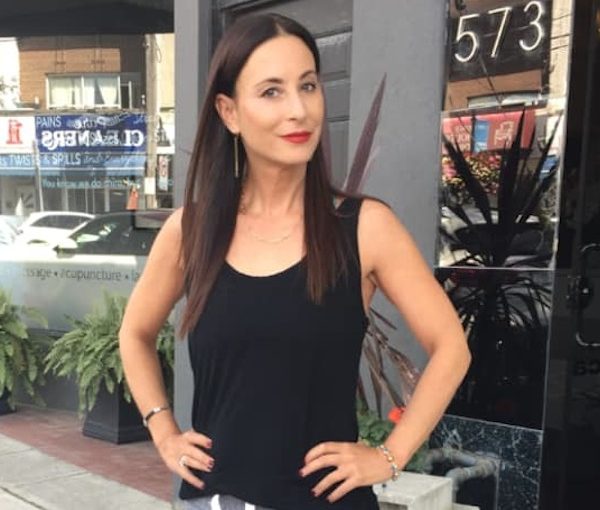
Rebecca Eckler’s latest book is one of her most candid. (photo from Rebecca Eckler)

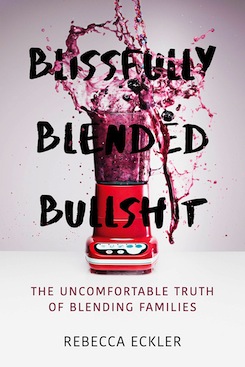
Rebecca Eckler knows firsthand the challenges of forming a mixed, blended or bonus family. Based on her experiences, the author, blogger and former National Post columnist has written Blissfully Blended Bullshit: The Uncomfortable Truth of Blending Families.

“Everyone was private messaging me saying, ‘I’m going through this with my blended family. I know you are in one. How do you handle this?’ I’m thinking, ‘People need help,’” Eckler told the Independent.

When the American television show The Brady Bunch first aired 50 years ago, its premise relied on what was then a rarity – two parents on their second marriage, each bringing three children into the same home.

“The difference with The Brady Bunch is you never saw exes. You never saw the grandparents or cousins. It was just about the family. But blended family is so many other people,” said Eckler. “There is a lot of suffering, and people in blended families don’t want to admit how hard it is,” including when parents take sides with their biological children in a tiff between siblings.

“I had no idea all the BS that pops up, and all the variations of people who have to get along,” she said.

image - Blissfully Blended Bullshit book coverEckler described this, her 10th book, as “my favourite book because it’s so candid.” During the writing process, she and her then-partner “unblended” and she discusses many of the unexpected issues that arose from the breakup. For example, the biological siblings, half-siblings and bonus children now weren’t – quite suddenly – in one another’s lives regularly. The more familiar struggles of breaking up with someone included the division of possessions; in Eckler’s case, agonizing back-and-forths over mundane items like the microwave and bed.

While she and her ex now have new partners, other difficult situations lay ahead.

“You know what was the hardest thing for me?” she said. “Telling [her daughter] Rowan’s dad that another man was moving into the house with two children. I felt like he would feel that another man is taking over the role of ‘dad’ in my daughter’s life. I could hear him choking up when I was telling him.”

Then there was the time that one of her (new) stepdaughters asked Eckler to go prom-dress shopping. While in the dressing room, the daughter took selfies and sent them to her biological mother. “So,” said Eckler, “while I was invited to come with her, it was her mother who had the final say. These are things that you don’t think about until they happen to you.”

One lesson learned through all of this was that partners need to keep open the lines of communication.

“I think one of the biggest mistakes at the very beginning is, we discussed nothing, which was ridiculous, but I had ‘love goggles’ on. He moved into my house and his kids were in my house 50% of the time. So, for them, I think it never felt like their home. To me, it always felt a little like, ‘this is my home’ that you guys have moved into. The [new] kids didn’t even get to pick their room.”

Horns locked over Jewish issues, too. When her partner wanted to bring ham into the home, discussions ensued – over the ‘December dilemma’ of a Christmas tree (she refused), Jewish versus mainstream summer camps, and to which grandparents they’d go to for the Passover seder.

“It’s almost like a cautionary tale, and it’s very juicy. It’s also a book for grandparents to read,” said Eckler. “I think I’d probably make a shitload of money if I came out with a line of greeting cards for blended families. ‘Happy bonus granddaughter’s day!’”

Dave Gordon is a Toronto-based freelance writer whose work has appeared in more than 100 publications around the world.

Format ImagePosted on February 21, 2020February 19, 2020Author Dave GordonCategories BooksTags Blissfully Blended Bullshit, family, parenting, Rebecca Eckler, relationships
רשימת מאה הערים המשפיעות בעולם

רשימת מאה הערים המשפיעות בעולם

טורונטו עשירית – רשימת מאה הערים המשפיעות ביותר מבחינה כלכלית לשנת אלפיים ועשרים כוללת שלוש ערים מקנדה (Arild Vagen)

רשימת מאה הערים המשפיעות ביותר מבחינה כלכלית לשנת אלפיים ועשרים כוללת שלוש ערים מקנדה. טורונטו שנכנסה לעשירייה הראשונה והיוקרתית וממוקמת במקום העשירי, ונקובר – ממוקמת במקום השישים וחמישה ומונטריאול – ממוקמת במקום השבעים ושתיים. את ישראל מייצגת תל אביב – שממוקמת במקום השש עשרה והמכובד.

את הרשימה הכין המגזין הבינלאומי האמריקני למנכ”לים וראשי חברות “סי.א.יאו וורד” (שיוצא לאור בניו יורק), לפי חמשת המדדים הבאים: כוח כלכלי (פעילות כלכלית כוללת), מגמה פיננסית (חוזק ענפי הכספים והבנקאות), אנשים ופוליטיקה (השפעה פוליטית ודמוגרפית), איכות חיים (פרודקטיביות, תשתית, איכות חיים, הון עצמי, הכלה חברתית וקיום סביבתי) ותחרותיות (פעילות עסקית, הון אנושי, ניסיון תרבותי ומעורבות פוליטית). מטרת הדוח לספק מידע “אובייקטיבי” של התחרותיות במרכזים עירוניים בולטים. למדד הערים להשפעה כלכלית יש משמעות חשובה למספר קטגוריות ובהן: פיננסים, אופנה, מוסיקה, סרטים, סטארט-אפים והייטק.

לפי הדוח מאה ערים המובילות בעולם מבחינה כלכלית מניבות בסך הכל כמחצית מהתפוקה הכלכלית של העולם. ואילו עשרים וחמש הערים הראשונות ברשימה אחראיות בסך הכל לשלושים אחוז מהתפוקה עולמית.

להלן העשירייה הראשונה בעולם מבחינת השפעתן הכלכלית: לונדון (בריטניה), ניו יורק (ארה”ב), טוקיו (יפן), פריז (צרפת), סינגפור (סינגפור), ברלין (גרמניה), שנחאי (סין), בריסל (בלגיה), ניו דלהי (הודו) וטורונטו (קנדה).

העשירייה השנייה: וושינגטון (ארה”ב), מוסקבה (רוסיה), סידני (אוסטרליה), דובאי (איחוד האמירויות הערביות), ריאד (ערב הסעודית), ת”א (ישראל), ציריך (שוויץ), סאו פאולו (ברזיל), אמסטרדם (נדרלנד) ואיסנטבול (טורקיה).

העשירייה השלישית: ג’קרטה (אינדונזיה), סנט פטרסבורג (רוסיה), בואנוס איירס (ארגנטינה), קהיר (מצרים), קייפטאון (דרום אפריקה), אוסלו (נורבגיה), קופנהגן (דנמרק), רומא (איטליה), לוס אנג’לס (ארה”ב), לוקסמבורג (לוקסמבורג).

העשירייה הרביעית: מקסיקו סיטי (מקסיקו), הונג קונג (הונג קונג), סן חוזה (ארה”ב), יוסטון (ארה”ב), מילאנו (איטליה), שיקגו (ארה”ב), מינכן (גרמניה), סיאול (דרום קוריאה), בייג’ינג (סין) ומדריד (ספרד).

העשירייה החמישית: פראג (צ’כיה), מלבורן (אוסטרליה), בוסטון (ארה”ב), מומבאי (הודו), בנגלור (הודו), טייפה (טייוואן), סטוקהולם (שבדיה), מנצ’סטר (בריטניה), וינה (אוסטריה) והיידראבאד (הודו).

העשירייה השישית: דבלין (אירלנד), פרנקפורט (גרמניה), המבורג (גרמניה), ורשה (פולין), טיינג’ין (סין), סאן דייגו (ארה”ב), אטלנטה (ארה”ב), ברצלונה (ספרד), ליסבון (פורטוגל) ובודפשט (הונגריה).

העשירייה השביעית: ג’נבה (שוויץ), הלסינקי (פינלנד), ריאו דה ז’ניירו (ברזיל), סן פרנסיסקו (ארה”ב), ונקובר (קנדה), אבו דאבי (איחוד האמירויות הערביות), אוסקה (יפן), אתונה (יוון), אנקרה (טורקיה) וצ’ניאי (הודו).

העשירייה השמינית: דלאס (ארה”ב), מונטיראול (קנדה), מיאמי (ארה”ב), קואלה לומפור (מלזיה), יוהנסברוג (דרום אפריקה), דוחה (קטאר), ברניגהם (בריטניה), פילדפליה (ארה”ב), בוסאן (דרום קוריאה) ובנגקוק (תאילנד).

העשירייה התשיעית: אוקלנד (ניו זילנד), קייב (אוקראינה), האנוי (וייטנאם), עמאן (ירדן), ביירות (לבנון), מנילה (הפילפינים), טהרן (איראן), בוקרשט (רומניה), מוסקט (עומאן) וסופיה (בולגריה).

העשירייה העשירית: דאקה (בנגלדש), אלמטי (קזחסטן), בלגרד (סרביה), איסלמבאד (פקיסטן), באקו (אזרבייג’ן), ניירובי (קניה), רבאט (מרוקו), קולובו (סרי לנקה), אקרה (גאנה) ולימה (פרו).

להלן המדינות עם מספר הערים הגדול בטבלת מאה הערים המשפיעות בכלכלה העולמית: ארה”ב שלוש עשרה ערים, הודו חמש ערים, גרמניה ארבע ערים, קנדה שלוש ערים, סין שלוש ערים, בריטניה שלוש ערים, רוסיה שתי ערים, איטליה שתי ערים, שוויץ שתי ערים, איחוד האמירויות הערביות שתי ערים, יפן שתי ערים, אוסטרליה שתי ערים, דרום אפריקה שתי ערים, דרום קוריאה שתי ערים, ברזיל שתי ערים, ספרד שתי ערים וטורקיה שתי ערים.

Format ImagePosted on February 19, 2020June 30, 2020Author Roni RachmaniCategories UncategorizedTags "סי.א.יאו וורד", CEOWORLD Magazine, economy, most influential cities, הערים המשפיעות ביותר, כלכלה
Survivors reflect on liberation

Survivors reflect on liberation

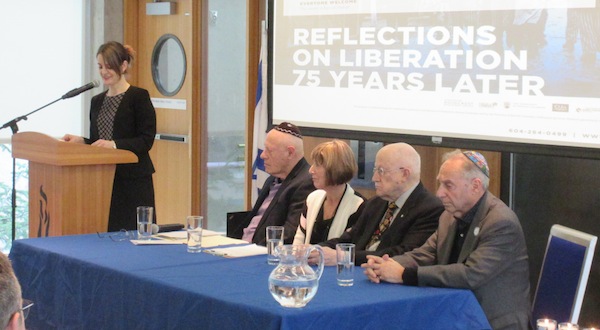
Dr. Ilona Shulman Spaar moderates a panel with Holocaust survivors, left to right, Janos Benisz, Amalia Boe-Fishman, Dr. Peter Suedfeld and Alex Buckman. (photo by Pat Johnson)

One survivor of the Holocaust who spoke at a panel recently believes that, in a generation or two, people will largely forget about the catastrophic events of that time.

“I think the world will forget about Auschwitz,” said Dr. Peter Suedfeld, a professor emeritus in the department of psychology at the University of British Columbia. “The world has already forgotten about ‘never again.’ We’ve had a fair number of genocides since 1945, in which the world did not intervene. A recent poll that I saw … apparently, the proportion of people who remember anything about how many Jews were killed in the Holocaust, what Auschwitz was, what the Holocaust was and so on, is not all that much above 50%.

“This is going to go on generation after generation,” he continued. “The survivors won’t be here to push the story any further. Their children will for awhile, but they have other things to do and other things to be concerned about and their children even more so. In a few more generations, it will be in the history books and people will say, yeah, I read about that or thought about that in grade whatever but, in terms of remembering it as something in your gut, something that arouses an emotion, something that has a personal connection to you, I don’t think it’s going to last all that much longer. I’m sorry to say that, but that’s what I think.”

Suedfeld, who weeks earlier was invested into the Order of Canada for his decades of work on the psychological and physical effects of extreme and challenging environments, was speaking at Hillel House, on the UBC campus, on International Holocaust Remembrance Day, Jan. 27. He was part of a panel of four survivors sharing their reflections 75 years after liberation.

Suedfeld, who was born in Hungary, survived under false papers and a back story as an orphaned Roman Catholic child. He recalled successive bombardments of the various sanctuaries he was in near the end of the war, as Allied bombers repeatedly blew buildings apart while Suedfeld and other children hid in the cellars.

After liberation by Russian forces, Suedfeld was eventually reunited with his father; his mother had been murdered. The lesson he took from the experience, he told the packed afternoon audience, was to cherish and defend the values of freedom.

“Freedom to be who you really are, but freedom of speech, freedom of association, freedom of religion, freedom of everything,” he said. After moving to the United States, Suedfeld became a powerful advocate of the First Amendment, which guarantees freedom of religion and expression. Since coming to Canada, he has been a similar champion of the Charter of Rights and Freedoms, he said.

Suedfeld’s admittedly pessimistic perspective on the future of Holocaust remembrance was contested by Alex Buckman, a fellow survivor on the panel.

As long as organizations exist like the Vancouver Holocaust Education Centre, which co-sponsored the event with Hillel BC, and children of survivors and others who have been touched by their experiences share the lessons they have learned, the future will be better, he said.

“Maybe our children will pick up, speaking on our behalf,” said Buckman. “Maybe they will remember because we will tell them what happened.”

Like Suedfeld, Buckman survived by being hidden by Catholics; in his case, in Belgium.

“They told us that the war was over and that we should rejoice and be happy and our parents would come and pick us up and everything would be hunky-dory,” he recalled. “At 6-and-a-half in an orphanage, nothing was that rosy. We saw parents come and pick up their children and take them home, but nobody came for us. I was there with my sister Annie and she was crying and wondering why our parents weren’t coming and I tried to tell her that I’m sure that they will come. But, like her, I didn’t know why they weren’t coming.”

The pair were moved back to Brussels and put in the care of the Red Cross, which posted the names of orphaned and unclaimed children on sheets around the city. Eventually, a paternal uncle showed up and took the two children to Annie’s parents – who, since little Alex had believed himself to be Annie’s brother, he reasonably concluded were also his parents. The truth came out in a cruel way, when another cousin, in a pique of anger, blurted out to Alex that his parents were dead and that Annie’s parents were not his.

“I took a step back and, for the first time, I realized I was alone,” Buckman recalled. His aunt and uncle did care for him, though, despite the uncle’s misgivings, because of the aunt’s insistence based on a promise she made to the heavens when she learned of her sister’s death.

Also on the panel was Amalia Boe-Fishman, who was born in the northern Netherlands in 1939 and also survived thanks to a Christian family. Like many survivors, her liberation story is not one of joyous freedom but of confusion and fear of the future.

“Liberation should have been a real happy time for me. It wasn’t,” she said. “I was told we were free, but what did that mean? What did that mean to a frightened 5-year-old girl who had been in hiding for three years? What did it mean to be free? I was told that, for the first time I could remember … I would now be able to go outdoors. I didn’t know what to expect. What was there? What was waiting for me outdoors? Indoors had become my entire life. Indoors was where I felt secure and safe. Indoors was all I knew.”

Her first venture out was harrowing. It was odd enough to be surrounded by throngs of strangers after her entire life had been confined to just a few familiar faces. After a victory parade, the girls she knew as her “sisters” decided to walk to the town centre. While crossing a bridge with scores of others – Amalia had never seen a bridge before – a rumour started that the Nazis had returned and panic swept the crowd. Pushing and shoving was accompanied by screaming and concern that the bridge was about to collapse.

“Here I was, trapped outdoors, in a crowd of panicked strangers and I was terrified,” she said. “The bridge didn’t collapse, but, as you can imagine [it was] a very long time before I would ever cross a bridge again.”

Another ostensibly joyous aspect of liberation was also clouded with confusion and fear.

“I was told that I had a real family. I had a real father, a real mother, an older brother and a baby brother,” said Boe-Fishman. “Miraculously, out of many different hiding places, all four of them had survived the war.… But who were these people? They were strangers. So, this is what liberation means to me. To leave the only family I ever had known to go outdoors to a place of terrified strangers, to strange people in a strange home.… I had to adapt to a new and also frightening world.”

For Janos Benisz, liberation was similarly conflicted. As a child, he had seen his father and his grandmother dead in the streets. His mother had been killed earlier by Nazi collaborators, during what was to have been a routine medical procedure.

Young Janos was transported from his hometown of Esztergom, Hungary, to Budapest, where Jews were divided up, many being sent directly to death camps including Auschwitz.

“I ended up in an Austrian slave labour camp,” he said, remaining there for seven or eight months before the Russians liberated them.

“I had the body of a 4-year-old,” he recalled. “At my bar mitzvah, I was under five feet.”

Making his way back to his hometown, he found squatters in the family’s house and learned that, of his immediate family of eight uncles, two aunts and 29 cousins, only Janos and one uncle had survived the Nazis.

Benisz was put in a Jewish orphanage in Budapest, then sent to Halifax, where he was put on a train to Winnipeg. He was bounced from foster home to foster home, back to an orphanage and then to a reformatory.

“I couldn’t fit in,” he said. At 18, he got a job at the Winnipeg Free Press as a copy boy.

“I spent the next 15 years in the newspaper business, then I became a salesman on my own, retired in ’71,” he said. He noted the figurative and literal centrality of the Jewish Community Centre of Greater Vancouver in his life today. He lives 40 yards from the centre, he said, and much of his social life is focused there.

“It’s my second home,” he said. “I work out there. I shmooze there. I’ve got a group of guys I call the ‘kosher nostra.’ I’m very happy. I absolutely adore this country of Canada. It’s been good to me ever since I turned 18.”

Prior to the panel, Holocaust survivors lit candles of remembrance. Vancouver Mayor Kennedy Stewart read a proclamation declaring International Holocaust Remembrance Day in the city. Rob Fleming, British Columbia’s minister of education, spoke on the importance of Holocaust education and credited the partnership of the Vancouver Holocaust Education Centre (VHEC). Student Adam Dobrer shared his family’s Holocaust legacy. Prof. Nancy Hermiston, director of voice and opera at the University of British Columbia, provided opening remarks. Nina Krieger, executive director of the VHEC, introduced the program and spoke of the importance of remembrance and the power of the memory of Auschwitz on the 75th anniversary of its liberation. Dr. Ilona Shulman Spaar, education director and curator of the VHEC, moderated the panel. Rabbi Philip Bregman, chaplain of Hillel BC, chanted El Maleh Rachamim and the Mourners’ Kaddish.

Many other commemorations and events took place throughout the province on and around Jan. 27.

Format ImagePosted on February 14, 2020February 12, 2020Author Pat JohnsonCategories LocalTags Alex Buckman, Amalia Boe-Fishman, commemoration, Holocaust, Janos Benisz, Peter Suedfeld, VHEC
A soap-opera comedy

A soap-opera comedy

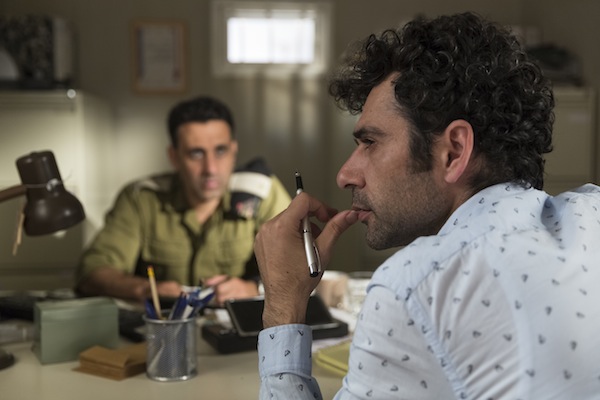
Yaniv Biton as Assi, left, and Kais Nashif as Salam in Tel Aviv on Fire, which screens Feb. 28 as part of the Vancouver Jewish Film Festival. (photo from Cohen Media Group)

Palestinian writer-director Sameh Zoabi achieves something altogether remarkable with his second feature film, particularly at this moment in time: he finds humour in the tattered relationship between Israelis and Palestinians.

“The whole idea of Tel Aviv on Fire is that we have more in common than we want to admit,” Zoabi said in an interview before his movie screened in the San Francisco Jewish Film Festival last year. It screens on Feb. 28, 1 p.m., at Fifth Avenue Cinemas, as part of the Vancouver Jewish Film Festival, which runs Feb. 7-March 8.

“We have to break these stereotypes and talk about what’s in common between us and not what divides us,” he said. “Let’s remind people how humanity can prevail in times where the politics of post-Oslo is, ‘Let’s dehumanize the other to be able to survive.’ I want to do the opposite.”

A sharp, insightful and winning comedy that juxtaposes the delicious absurdity of melodrama with the real-life absurdity of the occupation, Tel Aviv on Fire centres on an underachiever, Salam, who works as a gofer on his uncle’s hit Palestinian soap opera. Through a barely plausible combination of chance, chutzpah and desperation, the shlemiel is elevated to writer. Then he runs afoul of the Israeli commander of the checkpoint he crosses every day, whose wife is a loyal fan of the show.

Salam has to use every iota of guile and cleverness to navigate the opposing agendas that he’s caught between – and to win back the heart of a woman he had dumped. (Even while he’s landing political japes, Zoabi cheerfully seizes every opportunity to lampoon the conventions of both soap operas and movies.)

One of nine children, Zoabi grew up in a village outside of Nazareth, where people went to his grandfather’s barbershop for his humorous stories as much as for a haircut.

“In general, my village is very funny,” Zoabi related. “That’s maybe why comedy has become very easy for me, because I grew up in a place where they don’t take anything seriously.”

Zoabi studied at Tel Aviv University and then at Columbia University in New York, where he discovered the need for Palestinian stories. Returning to Israel, he made a short film, Be Quiet, in 2005 and his feature debut, Man Without a Cell Phone, in 2010. Zoabi’s experience of receiving government funding was the genesis of Tel Aviv on Fire (2018).

“You take money from the Israelis, so suddenly you are watched immediately,” he explained. “Israelis are making sure you are not becoming too Palestinian for them. And the Palestinians are watching, ‘He took money, maybe he’s a sellout, he’s doing a comedy.’”

After presenting Tel Aviv on Fire at several international festivals, Zoabi debuted the film in Haifa and in Nazareth. It was equally well received by both audiences, which didn’t surprise him. But he did have an epiphany.

“All the screenings led to this moment,” Zoabi declared. “Finally I understood – people are fed up. People are fed up of the reality that exists, which is managing the occupation.

“[The film] reminds people of the possibility that used to exist, the feeling that we can be normal people and just get along. I think that’s a fantasy that existed among the Israelis, that we can eat hummus together in Damascus one day. But they aren’t able to see the occupation as a major reason for that not to happen.”

It’s a measure of Zoabi’s skill that the current-events commentary in Tel Aviv on Fire goes down easily for viewers across the political spectrum. The means to that success, in large measure, is Salam’s evolution of necessity from hapless underdog to diplomatic savant.

“I’m attracted to people who don’t wake up knowing what they really want,” Zoabi said. “I think they’re more inspirational for me than black-and-white [characters]. Actually, people who know exactly what they want terrify me. You can’t be so certain all the time.”

For his part, Zoabi grew up in a milieu of group interaction and lots of soap operas, because those were the only two channels the family had. He wasn’t exposed to art, theatre and film until his late teens.

“I always say I’m not an artist, really,” he confessed. “I’m probably a barber of a new era in my family.”

Tel Aviv on Fire is in Hebrew and Arabic with English subtitles.

For the Vancouver Jewish Film Festival schedule, visit vjff.com.

Michael Fox is a writer and film critic living in San Francisco.

Format ImagePosted on February 14, 2020February 12, 2020Author Michael FoxCategories TV & FilmTags Israel, movies, Palestinians, peace, Sameh Zoabi, Tel Aviv on Fire, Vancouver Jewish Film Festival, VJFF
Finding ’n’ riding the WAHVE

Finding ’n’ riding the WAHVE

Sharon Emek, founder and owner of Work at Home Vintage Experts (WAHVE). (photo from WAHVE)

Sharon Emek’s company, Work at Home Vintage Experts (WAHVE), celebrates its 10th anniversary this year.

WAHVE matches experienced professionals who are transitioning into retirement with businesses that are looking for the professionals’ specific skills and expertise. One of the draws for what WAHVE calls “pretirees” is that the pretiree can work from home. “By removing the requirement that workers be in the office, we break down the walls that confine businesses to a smaller talent pool,” notes the website. “Wherever the best talent is for the job, we help make it happen.”

Company founder Emek was raised in a moderate Chassidic home, but her parents refused her request to pursue a higher education. Nonetheless, she went to university, earned a doctorate and became a professor. Being computer and tech savvy, however, she started consulting for companies that were developing efficiency procedures and protocols. In the early 1980s, she went into business for herself.

When she was consulting for brokers in New York, New Jersey and Connecticut, she said, “The insurance companies began noticing how the work I was doing helped them run a better operation, so they asked if I’d like to start my own insurance brokerage firm. They said, ‘We don’t have any women,’ so I said, ‘Great. I’ll be happy to.’ I’d never actually sold insurance before, but I know a lot of people, so I wrote a business plan.”

Emek’s agency became one of the largest female-owned agencies in the area, before it merged with a larger brokerage firm in 2003.

“The industry began to worry about a potentially huge talent drain to come … everyone was turning grey,” said Emek. “It was a huge boomer industry. Young people hadn’t come into the industry and everyone was concerned at what we were going to do and how we’d get our work done.

“For me,” she said, “for every problem, there’s a solution. The research started to show that the more active you are, the more you engage your brain, and the longer you live.”

Within a few years, smartphones came out and laptops were gaining popularity. A couple of years later, voice systems and video calls became commonplace.

“You can [work] … at home and no one would know that you weren’t in the office, so it occurred to me, why don’t people do that? I bet people want to continue to work, but they don’t want to be in an office any longer,” said Emek. “After 30 years of driving to work, they are ready to retire from the regular office setting … but they’re not ready to retire from work.

“We did a whole survey in the industry of people over 55, asking them about that. All of them said that they love what they do, that they don’t want to stop working – they just don’t want to work in the office. And, also, that they are worried they don’t have enough money for retirement. So, all that came together in my head and I woke up one day and said, ‘Duh!’”

While people were ready to work from home, brokerage firms did not know how to make that a reality, so Emek developed a methodology for qualifying people interested in going this route. Creating a matrix of questions similar to dating sites, but for business purposes, she assessed 50-to-80-year-olds and helped them create a resumé to qualify them for remote positions in the insurance industry.

For the past 10 years, WAHVE has been connecting “vintage” experts with brokerage positions, filling needs on both sides of the spectrum.

Neither side meets in person, she said, so the potential employer has no idea of the applicant’s ethnicity or physical attributes.

“Our clients fill out a whole job request that includes their work culture, their daily functions, etc.,” said Emek. “We created this very sophisticated software and the whole point is to transform how everyone views retirement. These people are ‘un-retiring’ … retiring from the office, not from work. That’s the key.”

While Emek acknowledges that many other industries could benefit from this type of worker, her focus for now is on the insurance and financial services sectors.

“People are still old-fashioned, thinking the only way to supervise is to see you in the office, but they are beginning to understand that they can have a flexible work environment. They also realize that you can’t always find the right talent in your backyard,” she said.

Although many younger people also would love the opportunity to work from home, Emek recommended that they start by working in an office, to gain experience and expertise.

“That’s the problem with millennials,” said Emek. “They want to work from home, but they don’t have institutional knowledge yet. How are they going to learn it unless they work with people? A 25-year-old has to be trained. They don’t yet have the knowledge to work from home.

“My customers will hire my people because they know they are experts with 25 or 30 years of experience. Within two days, they are 100% productive. My people fill a need immediately. And there’s no turnover, they aren’t looking for a promotion – they just want steady work for the rest of their lives.

“WAHVE is more than a placement agency,” she said. “It provides support to clients, insurance and tech support…. In a sense, it provides home office management services, so professionals can do their jobs. I call it the ‘independent contractor model.’”

Emek gave the example of a woman who contacted WAHVE several months ago. In an email of thanks, the woman shared, “I moved to be near my daughter and granddaughter. I’ve been in the business 30 years and I have excellent credentials, but, every time I walk into the office for an interview, they’d see my age and that I have a limp. So, for over a year, almost a year-and-a-half, I could not find a job. I applied on WAHVE and, within a month-and-a-half, I now have a job I love. And nobody knows how old I am or that I have a limp.”

Of this, Emek said, “That’s why, that’s the purpose of WAHVE.”

WAHVE is not yet in Canada, but Emek would like to see it branch out here and beyond. “At this point,” she said, “we are trying to finish penetrating the big insurance companies. Once we do that, we’ll head to Canada – in two years, we hope.”

For more information, visit wahve.com. 

Rebeca Kuropatwa is a Winnipeg freelance writer.

Format ImagePosted on February 14, 2020February 12, 2020Author Rebeca KuropatwaCategories WorldTags aging, business, Sharon Emek, WAHVE, workforce
Pink Rabbit opens festival

Pink Rabbit opens festival

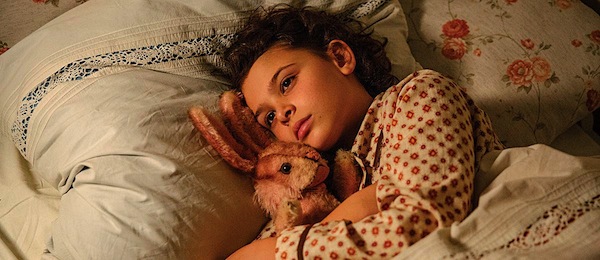
Riva Krymalowski as Anna, in the film, which opens the Vancouver Jewish Film Festival Feb. 27. (photo from betacinema.com)

The Vancouver Jewish Film Festival opens the night of Feb. 27 with the film When Hitler Stole Pink Rabbit, which offers a peek at a pivotal event in writer and illustrator Judith Kerr’s life.

Kerr passed away just under a year ago, at her home in London, England, at the age of 95. She had dozens of children’s books to her credit, including The Tiger Who Came to Tea and Mog the Forgetful Cat; Mog became a series, ultimately totaling 17 picture books.

Born in Berlin, Kerr and her family – parents and older brother – fled Germany in 1933, in the days leading up to the election that brought Hitler into power. Her father, Alfred Kerr (né Kempner), a journalist and writer, was a vocal critic of the Nazis even at that time and was warned that the police were about to arrest him. The story of the family’s journey to Switzerland, then France and, ultimately, England, is told in the children’s book When Hitler Stole Pink Rabbit, which was published in 1971.

The film, obviously, is based on that book, and it captures the fear, excitement, frustration and other feelings experienced by the family as a whole, but mainly by 10-year-old Judith – named Anna in both the book and film. We see that Anna copes, in part, by drawing and colouring pictures of disasters, such as a shipwreck or an avalanche. She, her brother and parents are close, thankfully, as they are uprooted more than once and the family unit is the only constant in their lives.

When Hitler Stole Pink Rabbit is both charming – the family’s interactions – and disturbing, in that the family is fleeing a danger that killed millions. It also raises current-day issues of what it means to be a refugee. Anna and her brother Max are given one night to pack. They are allowed one toy and two books. Anna’s choice of her stuffed dog over her pink rabbit gives the story its name.

For more on the film festival, visit vjff.org.

Format ImagePosted on February 14, 2020February 21, 2020Author Cynthia RamsayCategories TV & FilmTags children's books, Holocaust, Judith Kerr, memoir, movies, When Hitler Stole Pink Rabbit
Help save local media

Help save local media

(photo from arkells.com)

In what seems like a random act of kindness, the Canadian rock band the Arkells has put out an offer to their fans. Subscribe to a community newspaper and get a swag T-shirt from the band.

Musicians are facing their own challenges these days, as streaming services are upending the traditional royalty and revenue streams of their industry. But they are perhaps not yet at the level of near-desperation the print media sector has been facing in recent years. The advent of the internet and other factors (but mostly the internet) have made people expect for free things we used to access primarily through purchasing.

Oddly, perhaps, many of us are prepared to pay for multiple subscription services for media – Spotify for music, Netflix, Crave, Disney and an ever-growing number of video services – but most people still react to paywalls on print media by finding a free (to them) alternative. As a result, print outlets from the New York Times and the Globe and Mail to, well, the Jewish Independent have struggled to find alternative sources of revenue and the means to compensate for the reality that readers are demanding (and getting) for free what they once paid for.

In keeping with the issue-driven approach to songwriting for which the Hamilton-based band is known, it was a pleasant and heartfelt message that the Arkells – whose lead singer, Max Kerman, is a member of the Jewish community – put out to their fans.

“If you’re an engaged member of your community, you’re probably thankful for the people who report the news. And even if you’re not, you’re probably still reassured to know that someone is keeping tabs,” they write.

“Good reporting not only keeps us in the loop, but also makes sure our big wigs are held accountable – to ensure there is no sneaky biz.

“Somewhere along the way, we took this for granted. We forgot that we have to pay for this vital service, and that reporting the news isn’t free. In our own city, we’ve seen our local newspaper continue to shrink, and we worry about its future and the future of other local newspapers.”

The band invites their fans to join them in investing in “the things that truly matter.”

“Let’s start,” they write, “by supporting your local paper or a daily publication you really admire. It’s been years in the making. No more running from that paywall.”

They are asking listeners to take out a year-long paid subscription to a print or online media platform (or gift one to a friend) and to let them – the Arkells – know. Then the specially designed band T-shirt will be on its way to you.

Obviously, a gesture like this is not going to save the industry. But it is sweet nonetheless, especially to see someone without a vested interest making this case. Then again, maybe their point is that every citizen does have a vested interest in the success, or at least survival, of local media.

For the Jewish community in British Columbia … that’s us! For 90 years now, the Independent and our previous incarnation the Jewish Western Bulletin have been printing the first draft of our community’s history. At the risk of sounding self-aggrandizing, there are times when we write stories as much for posterity as for this week’s readers. We know that the archives of this paper is often the first destination for people researching aspects of our community’s history. We believe that, decades hence, researchers will see in a visit to Vancouver by a renowned researcher or an act of tikkun olam or a project by local high school students as the germ of a movement, or a way-station in the progress of an idea, that is significant in its own right but also speaks to a larger trend in our community or society. Or maybe someone will just enjoy the read. In other words, we view our work as immediate and, ideally, enduring in some manner even we cannot foresee.

While in many cities across North America, the local paper is operated by the Jewish federation, here it has been run for well more than a half-century now by independent business operators taking a not insignificant risk for the community’s benefit. Operating a Jewish newspaper was never going to be the route to riches. The remarkably small number of people who have led this endeavour over the past nine decades knew this at the outset. But the challenges of the 21st century are particularly acute.

We thank you for your support and humbly ask you to recommit to our shared enterprise in this, our 90th, year. Perhaps a gift subscription to family or friends – especially younger generations, whose engagement is critical not only for the future of our newspaper but for our community. Or simply a gift to help sustain the paper, which would mean a great deal to the small team that puts this package together each week and, we believe, to the strength and future viability of our community. Plus, you could get a cool shirt for you, your kids or grandkids if you let the Arkells know about it!

Format ImagePosted on February 14, 2020February 12, 2020Author The Editorial BoardCategories From the JITags Arkells, history, journalism, newspapers, tikkun olam

Posts pagination

Previous page Page 1 … Page 276 Page 277 Page 278 … Page 664 Next page
Proudly powered by WordPress