Skip to content
  • Home
  • Subscribe / donate
  • Events calendar
  • News
    • Local
    • National
    • Israel
    • World
    • עניין בחדשות
      A roundup of news in Canada and further afield, in Hebrew.
  • Opinion
    • From the JI
    • Op-Ed
  • Arts & Culture
    • Performing Arts
    • Music
    • Books
    • Visual Arts
    • TV & Film
  • Life
    • Celebrating the Holidays
    • Travel
    • The Daily Snooze
      Cartoons by Jacob Samuel
    • Mystery Photo
      Help the JI and JMABC fill in the gaps in our archives.
  • Community Links
    • Organizations, Etc.
    • Other News Sources & Blogs
    • Business Directory
  • FAQ
  • JI Chai Celebration
  • JI@88! video

Recent Posts

  • Zionism wins big in Vegas
  • Different but connected
  • Survival not passive
  • Musical celebration of Israel
  • Shoppe celebrates 25 years
  • Human “book” event
  • Reclaiming Jewish stories
  • Bema presents Perseverance
  • CSS honours Bellas z”l
  • Sheba Promise here May 7
  • Reflections from Be’eri
  • New law a desecration
  • Resilient joy in tough times
  • Rescue dog brings joy
  • Art chosen for new museum
  • Reminder of hope, resilience
  • The national food of Israel?
  • Story of Israel’s north
  • Sheltering in train stations
  • Teach critical thinking
  • Learning to bridge divides
  • Supporting Iranian community
  • Art dismantles systems
  • Beth Tikvah celebrates 50th
  • What is Jewish music?
  • Celebrate joy of music
  • Women share experiences 
  • Raising funds for Survivors
  • Call for digital literacy
  • The hidden hand of hate
  • Tarot as spiritual ritual
  • Students create fancy meal
  • Encouraging young voices
  • Rose’s Angels delivers
  • Living life to its fullest
  • Drawing on his roots

Archives

Follow @JewishIndie
image - The CJN - Visit Us Banner - 300x600 - 101625

Find comfort in music

Vancouver singer-songwriter Haley K. Turner will release her first full-length album on May 29.

“I have gone back and forth questioning whether now is the right time to release a new album,” she told the Independent. “But here’s the thing. Long before our lives were turned upside down, I titled my album in from the dark and, if right now is not the time to bring each other back in from the dark, I don’t know when is. This record was written with the intention of leaving people feeling a little more understood and a little less alone, myself included. So, while it feels like I am taking a huge leap of faith, releasing it while people may be too overwhelmed to notice, it also feels like I don’t have much of a choice. We don’t know what the future holds, and I happen to be fortunate to have completed the recording back in January. I want to share it with anyone who might find it comforting right now.”

A couple of singles from the album will be released earlier in May. Notably, “Loved You Perfectly” will come out May 8 for Mother’s Day that weekend. For the song video, Turner asked people to send in a short recording about their mom.

“Being privy to the sweet messages people have sent in for their moms is such a wonderful feeling,” she said. “I’m pretty sentimental, and it’s more of the thought about the moms’ reactions than the video itself that gives me little heart flutters.

“‘Loved You Perfectly,’” she explained, “is a song about motherhood, or at least my experience with it. With all the doubts and worries and mistakes, there is just as much love and growth and connection. I know I can’t be the only one who feels like I mess up all the time. And this song is my way of acknowledging that we can’t get it all right all of the time, but, even though we aren’t perfect, we love our kids perfectly. It felt like a good song to release around Mother’s Day.”

Speaking of motherhood, the Independent last spoke with Turner when she entered that phase of her life. “I went into labour with my son at 4:45 a.m. the same morning you interviewed me [by email] for my debut EP,” she said. “A couple years later, my daughter was born.” Her son is now 8, her daughter, almost 6. (For the article about the EP Ready or Not, see jewishindependent.ca/oldsite/archives/april12/archives12april06-29.html.)

“Making music and writing has always been a part of how I process emotions,” said Turner. “If I am not writing, I am usually bubbling up inside with some uncomfortable feeling and that never ends well. While it took me awhile to pick up the guitar and really get back into preparing for an album after starting a family, I was always writing in my head, even if it never made it onto a piece of paper.”

Having kids has changed her approach to life. “Well, I have a deeper admiration for my own mom now,” she said. “Yes, Mom, you! I have a greater understanding of the complexity of a mother and child relationship. I have spent the last couple of years processing who I was before kids and who I am now (hint, I’m still figuring that out) but, while a lot has changed, the really neat thing I have discovered is that, when it comes to making art, my intentions are still pretty much the same. Having little ones reinforced my ideas about media and made me more determined to create content that, hopefully, leaves this world better and not more wounded.”

The album in from the dark is more edgy than the EP Ready or Not. Last fall on Facebook, Turner posted what she described as a more cheery song than she had in awhile, but “Hey You” didn’t make the cut to the album.

“In order for me to commit to recording a song, I need to feel really connected to it,” she explained. “When I am writing, I often get emotional during the beginning of the songwriting process and that’s how I know it’s something I can stand behind. The lyrics mean everything to me, and it’s something I spend a ridiculous amount of time agonizing over.

“If I could have, I would have made a 20-song record because I have so many more songs I wish I could have included…. This album was about artistic exploration for me and testing out a few new sounds, stepping out of my comfort zone and letting my curiosity be the driving force even when my self-doubt wanted to weigh in. ‘Hey You’ felt like it would fit better on a different album, perhaps a future collection of songs for my kids, as a way to share with them all the emotions that come with parenting, along with my hope for them in this world. It felt comfortable to sing and play and I wanted to choose things that felt a bit more unsafe.

“Also,” she added, “in this recording process, my producer, Tom Dobrzanski, listened to all my demos and we chose songs that we both connected to. I believe that people have to be into what they are working on or it will be forced. So, we selected songs that felt right to both of us.”

In addition to Dobrzanski – who has worked with Said the Whale, and who used to be in the Zolas as a musician – on keyboards, Turner worked with several other notable musicians on in from the dark: Marcus Ambramzik, bass (the Belle Game, the Matinee); Brian Chan, cello (Jordan Klassen, Heis, Zaac Pick); Niko Friesen, drums (Hannah Georgas, Jane Siberry); Stephanie Chatman, violin; Julien Amar, piano on “For the Win”; and Adrian Glynn, vocals (solo artist as well as his band, the Fugitives). Turner is the lead singer and plays the acoustic guitar.

“I am beyond lucky to have had so many wonderful humans on this project,” said Turner, who reached out to Glynn a couple of years ago at an open mic.

“At the time,” she said, “I didn’t have any actual plans in the works to record, but I asked him if he would be up for singing on a song in the future. I have always loved male and female vocals together and it was on my bucket list.”

Through Glynn, she connected to Dobrzanski, who owns Monarch Studios, and, she said, “before I was even ready, I had committed to making an album!” She credits Dobrzanski for bringing “in an amazing team of Vancouver-based musicians who he had worked with before.”

Most of songs on in from the dark were written over the past few years, “and some even within the weeks leading up to recording,” said Turner. “‘Better’ is an older one of mine and it surprises me how relevant it still is. ‘Better’ is my way of processing how deeply women are affected by the expectations we have of them, specifically in our appearances. It’s about how we show up for each other, and expresses my desire to help create a world where we aren’t so hard on each other and hard on ourselves. I wrote it in my early 20s, before kids, and I am furious that it feels like it is taking forever to make these positive shifts.

“I have a background in TV and film and the constant critiques on my image and weight were damaging to say the least,” she explained. “When I released my debut EP, I had just stepped back from pursuing my career in acting because I wanted to be in creative control of the image and content I was putting out. I was so upset that I couldn’t do that as a 20-year-old actress – that it was always about looks and physique and never about my work – and so I decided to rebel by not putting my face on my album. I didn’t want that to weigh into whether people listened or not.”

Of all the songs on the album, Turner said, “‘Stay With Me (Jacob’s Song)’ holds a special place in my heart. It is dedicated to someone I loved dearly who passed away unexpectedly at the age of 8. It was the hardest song to record on the album because its essence is out of my control. I don’t think it will ever be good enough in my eyes, but I sure tried. I know that talking about people who are no longer here often brings pain and sadness to the surface. It was my hope to make a song that created space to honour and reflect and remember.”

Amid the pandemic, Turner is trying “to stay hopeful and focus on the blessings that will come out of this,” she said. “I’m processing the experiences slowly and watching for the creation and innovation that will help us heal.

“Prior to COVID-19, I was trying to engage in conversations with people, many of whom were women, about isolation, although I wasn’t phrasing it like that. Motherhood can be terribly isolating – beautiful and wondrous and lonely. Pretty much anyone anywhere can feel alone even with people swarming around them. I have been mulling over that thought for quite some time, so I ask myself, what’s different now?

“What’s different is that almost everyone is experiencing it in some form now, and perhaps it won’t be so hard to talk about it after things settle and people are able to integrate themselves back into their communities. I don’t think this feeling of isolation is new, I just think there is less to distract us right now. I really believe that, if we can be more transparent as humans, we will feel more connected. So, that’s what keeps me positive, I guess. If we felt alone before all these unexpected changes, the blessing is that we will come out with a stronger sense of what was missing and how to fulfil that for ourselves and others.”

She added, “I also have a greater appreciation for those who have shown up and worked hard to bring people together, like our teachers and artists everywhere and people in all types of service industries. Sometimes you don’t realize how much you rely on someone or something until it’s not accessible anymore. I have a better understanding of the different skill sets people have, and how I value them will be forever changed.”

For more information on Turner and her music, visit her website, haleykturner.com.



Posted on April 24, 2020October 18, 2021Author Cynthia RamsayCategories MusicTags COVID-19, Haley K. Turner, in from the dark
Emanuel busy making music

Emanuel busy making music

Megan Emanuel of the band Hello Victim. She and bandmates Adam Wilson and Spencer Daley released the single “Out of It Alive” on April 2. (photo from Megan Emanuel)

Megan Emanuel released a new single this month with her band Hello Victim and, last month, she launched a bi-weekly virtual concert series with fellow Jewish Vancouverite Andy Schichter, co-owner of Park Sound Studio.

“The concerts benefit local artists who have lost their income due to COVID-19 gathering restrictions,” Emanuel wrote in an email to the Independent. “Our weekly goal is $1,000 to split amongst the artists … to cover things like groceries and basic bills. Anything over $1,000 is donated to the Greater Vancouver Food Bank.”

The next concert will be live on Instagram (@parksoundbc) on May 2.

“Of course, the money isn’t the only important thing,” Emanuel noted, “and some of our favourite feedback from audience members has been their appreciation of the ability to feel somewhat ‘normal’ for a couple of hours, like there’s still a vibrant arts culture in Vancouver.”

Schichter has co-owned Park Sound Studio in North Vancouver with Emanuel’s fiancé, Dan Ponich, since 2017.

“When the pandemic hit, it was immediately apparent that musicians were going to be hit extremely hard,” Emanuel told the Independent. “Many artists work service industry jobs in order to maintain a lifestyle that allows for gig work and touring, and the rug was just pulled right out from under them and there seemed to be a need for relief. I contacted Andy because he is an organizational phenom and pretty familiar with putting shows together since Park Sound was hosting monthly showcases prior to all of this. We pulled the first virtual concert off days after chatting about it and were able to raise $1,200 overnight. Things have taken off immensely since.”

In addition to helping others, Emanuel is working on her own musical career. Hello Victim – comprised of Emanuel, Adam Wilson and Spencer Daley – released the single “Out of It Alive” on April 2. Produced and mixed by Ben Kaplan of Fader Mountain Sound (Mother Mother, Five Alarm Funk, Ninjaspy), the song is described as “a dramatic anthem for survivors of abuse.”

“We’ve all met the person this song is about,” Emanuel says in the press release, “That person who gives you a creepy ‘something about this is very wrong’ feeling in your gut.”

Ultimately, the song has a positive message. She explains in the release: “For those of us who are unlucky enough to become entangled with these types of people, times can get pretty scary and that toxicity stays with you for some time, even after they’re gone from your life…. This song is kind of like the phoenix’s flight; it’s the catastrophic rebirth from that very dark place when you realize that none of us gets out of this life alive, and the only justice that is in our individual power to serve is choosing to reject toxicity, move on from these people, and stop letting them live rent-free in our heads.”

Emanuel told the Independent that she first met Wilson in February 2018, while on an early-days date with her now-fiancé. As co-owner of Park Sound Studio, Ponich had been hired to handle sound for a music event at Luppolo Brewery, she said. “He texted me at some point during the night because my place was about a 10-minute walk away and, when I got there, I was introduced to a couple of his friends, one of whom was Adam (who he was playing in a band with at the time). Serendipitously, I’d made a Facebook post a matter of days prior along the lines of ‘girl seeks guitar player to write tell-all album with.’ I had just gotten out of a less-than-ideal relationship and I was at this point where I was ready to pull an Adele and sing about it where everyone could hear…. It took about five months for us to start working on music together.”

Emanuel liked the electronic compositions Wilson was creating for his Instagram stories, so she asked him if she could write a vocal melody and some lyrics for his music and, she said, “it took off from there and we went on writing remotely for awhile, sending each other voice notes of ideas over WhatsApp. When we started writing our song ‘Feel Slow,’ which we released back in July of 2019, Adam suggested we talk to his other bandmate Spencer about helping us out with writing a bass line. After working with him on that one tune, it was pretty clear he belonged in the band.”

Soon after the trio had finished a few songs, they were offered a spot at the Railway Club, which they accepted. “That ended up being my first live performance in eight years!” said Emanuel of that early 2018 gig.

“I learned a little while ago that I suffer from severe generalized anxiety disorder, so jumping back into live shows was a massive hurdle I had to figure out how to jump quite quickly,” she said. She attributed some of her ability to overcome that hurdle to Wilson and Daley, who, she said, “are not only incredible musicians, but amazing human beings who consistently make me feel safe and confident on stage.”

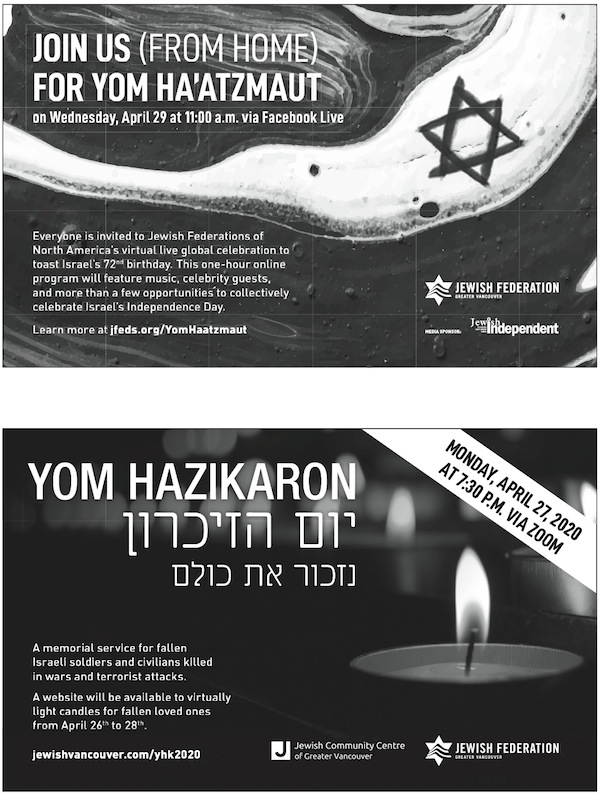
Emanuel has been in music since she was a kid, “with piano and voice lessons beginning at around 9. Pat Covernton taught me piano and Wendy Stuart was my voice teacher – both taught me for about 10 years. I also spent many, many summers in Gotta Sing! Gotta Dance! at the JCC and participated in the Jewish Federation’s events for Yom Ha’atzmaut, Yom Hazikaron and Yom Hashoah.

“Since I can remember,” she said, “being a musician is literally the only thing I’ve ever been able to identify as my ‘dream.’… I started writing music when I was 14 and went on to play small venues throughout Vancouver. In my last year of high school, I participated in the JCC’s Battle of the Bands and became the first and only solo, non-rock artist to win first place.

“After high school, I began traveling – first to Israel, then New York, then Melbourne – which meant that I put performing my music on hold, but continued to write in the absence of an audience.”

Emanuel attended both Vancouver Hebrew Academy and King David High School.

“I think my Jewish day school upbringing shaped the questions I’m looking to answer when I write music,” she said. “I wouldn’t say that my music is religious in any sense, but there’s such a distinct method of thinking within the Jewish community that I think is probably the product of generations of Talmud study, and I often find myself hearing it most when I’m writing. What’s the truth? What’s the point? Why are we here? How can I connect?”

For more information on the band and to watch the video for “Out of It Alive,” visit facebook.com/hellovictimofficial. To find out about the next virtual Park Sound Studio concert, visit parksoundstudio.com.

 

Format ImagePosted on April 24, 2020April 24, 2020Author Cynthia RamsayCategories MusicTags COVID-19, fundraising, Hello Victim, Megan Emanuel, Park Sound Studio, philanthropy
No barriers to music

No barriers to music

Victoria composer Ari Kinarthy. (photo from Ari Kinarthy)

Victoria composer Ari Kinarthy has not let spinal muscular atrophy (type 2), a condition that has confined him to a wheelchair since the age of 6, inhibit his ability to create music. In fact, the very movements he makes in the wheelchair go into producing his music.

Using Soundbeam, an interactive hardware and software system that forms sounds from movements, Kinarthy’s music is recorded into multimedia platforms. For example, movements closer to the recording device establish lower notes and movements away spark the higher notes.

“I create all my music entirely with the computer. Sometimes, I will have access to a guitar player or singer but normally the music will be all done by the samples I use. I usually start with just piano and sometimes will write out a score. I think of a melody and/or harmony and continue from there. I love making themes,” Kinarthy, 30, told the Independent.

“I got into music at age 16 with music therapy sessions. I loved creating music. I started with remixing songs and then creating my own from scratch. I wanted to see what I could create and it just continued from there,” he said.

Starting out at the music therapy department at Canuck Place in Vancouver in 2006, he moved to the Victoria Conservatory of Music in 2007, where, over time and under the tutelage of music therapist Allan Slade, Kinarthy became adept at mastering the intricacies of his device.

The Soundbeam device, which looks like a large red microphone, is stationed in Kinarthy’s studio. It transmits ultrasonic sound, i.e., sound that is inaudible to the human ear, which, in turn, intersects with motion. This then transforms the resulting sound into MIDI, a digitized protocol for electronic instruments.

In 2012, Kinarthy released his first album, A Lion’s Journey, a play on his Hebrew name, Ari, which means lion. It featured an eclectic blend of many genres, including jazz and rock, mixed through the assistive technology. Though he is inspired by several music styles, he admits to loving orchestral music, specifically what one hears in Hollywood films, with Hans Zimmer and John Williams among his favourite composers.

When Soundbeam held an international competition to mark the company’s 25th anniversary in 2013, Kinarthy was one of two winners selected by a jury of musical heavyweights, which included Led Zeppelin bassist and keyboardist John Paul Jones, conductor Charles Hazelwood and composer Edward Williams.

“Pain E Motion,” the composition he presented, was lauded by the jury. Of it, Jones said, “A very interesting idea of performing live with a pre-recorded composition. A very good piece of work in its entirety.”

It was at that moment when Kinarthy decided he would devote himself further to studying music. He enrolled in the Berklee College of Music’s online program and received his certification in orchestration and music composition in film and TV in 2017, but not before releasing his follow-up album, A Lion’s Roar, which also delved into his extensive musical interests.

Judaism, too, has an important role in Kinarthy’s creative process, and his faith has been a source of inspiration. “I recently created a piece of music to honour my local temple. Creating music to share with my congregation made me very happy. I would say that Judaism has helped me share beautiful music,” he said.

After the High Holidays last year, Kinarthy wrote a song called “Kolot Mayim,” with lyrics in Hebrew and English, taken from the Book of Psalms.

His physical challenges have not infringed on his ability to perform live, which he has done on several occasions throughout Victoria.

Presently, Kinarthy is looking for people who might need original music for their project, as well as focusing on promotion and small personal pieces for family and friends.

“I don’t know if it will ever be a reality, but composing for visual media would be a dream come true, be it film, TV or even a commercial. Other than that, I just keep composing music and maybe take some more music classes. There’s always more to learn,” Kinarthy said.

“I never thought I would be able to not only create beautiful songs but also perform them live! That’s all thanks to the technology I have in my home studio.”

To learn more about Kinarthy and hear some of his music, visit facebook.com/arikinarthymusic.

Sam Margolis has written for the Globe and Mail, the National Post, UPI and MSNBC.

Format ImagePosted on April 24, 2020April 24, 2020Author Sam MargolisCategories MusicTags Ari Kinarthy, music therapy, Soundbeam, Victoria
Community milestones … Lubavitch seders, JCC Jewish Book Award nominees

Community milestones … Lubavitch seders, JCC Jewish Book Award nominees

Ezra Shanken, executive director of Jewish Federation of Greater Vancouver, and Rabbi Chalom Loeub, chaplain of Chabad Jewish Student Centre, Vancouver, help with the delivery of seder meals. (photo from Lubavitch BC)

Lubavitch BC had its largest communal seder ever, with more than 1,000 participants. Families in Vancouver, Richmond, Surrey, Langley, Coquitlam, Burnaby, the North Shore and other areas of the province, enjoyed a complete seder with all the trimmings. And now is the time to say thank you to everyone who made this happen.

Firstly, Rabbi Yitzchak and Henia Wineberg, Rabbi Schneur and Shainy Wineberg, Rabbi Dovid and Chaya Rosenfeld thank Chabad of Richmond and the Community Kollel for partnering with Lubavitch BC to ensure that this project reached the largest number of people; Maple Grill, FortyOne Catering, Miriam Sklar and Lizzy Vaknin for their help with the organization and logistics; Sklar and Meir Jerbi for their help with packing and distribution; David and Diana Benjamin, Ezra Shanken, Glenn Berlow and numerous others for their help with the deliveries; and Rabbi Falik and Rebbetzin Simie Schtroks for coordinating the Langley and Surrey pickups and deliveries.

This project was not easy to accomplish in a short time. Extra amounts of matzah, wine, Haggadot, seder plates and Kiddush cups had to be sourced; ingredients and merchandise had to be purchased; and 1,000 meals had to be cooked and packed under the strict protocols of health and safety during COVID-19. Dozens of heartfelt notes of appreciation were received from members of the community, who shared how the project allowed them to have a wonderful Pesach under these difficult circumstances.

* * *

A program of the JCC Jewish Book Festival, the Western Canada Jewish Book Awards celebrate excellence in writing on Jewish themes and the achievements of authors from Western Canada. The shortlist for the 2020 honours was recently released. The winners were to be announced at a ceremony April 23, but that celebration has been postponed till later in the fall. The nominees are as follows.

  • The Nancy Richler Memorial Prize for Fiction: Daniel Goodwin (The Art of Being Lewis), Alex Leslie (We All Need to Eat) and Rhea Tregebov (Rue des Rosiers).
  • The Pinsky Givon Family Prize for Non-Fiction: Allan Levine (Seeking the Fabled City), Naomi K. Lewis (Tiny Lights for Travellers) and Heidi J.S. Tworek (News from Germany).
  • The Diamond Foundation Prize for Children/Youth: Jackie Mills (Little Synagogue on the Prairie), Ellen Schwartz (The Princess Dolls) and Harriet Zaidman (City on Strike).
  • The Lohn Foundation Prize for Poetry: Alex Leslie (Vancouver for Beginners), Dave Margoshes (Calendar of Reckoning) and Tom Wayman (Helpless Angels).
  • The Kahn Family Foundation Prize for writing on the Holocaust: Olga Campbell (A Whisper Across Time), Susan Garfield (Too Many Goodbyes) and Martha Salcudean (In Search of Light).
Format ImagePosted on April 24, 2020April 24, 2020Author Community members/organizationsCategories LocalTags books, JCC Jewish Book Festival, Jewish Community Centre, Lubavitch BC, Passover, tikkun olam, Western Canada Jewish Book Awards
Sidewalk Seder

Sidewalk Seder

(photo by Avi Dolgin)

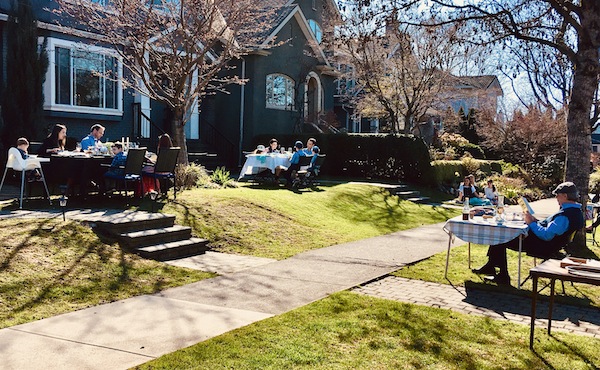
Families on 23rd Avenue in Vancouver found an innovative way to celebrate Passover. Each family brought their own meal and, while there was no sharing of dishes, everyone participated in reciting the blessings, reading from the Haggadah and singing together. The gathering was organized by Talia and Josh Bender, top left with their children, and Elana and Brian Jacobson, top right with their children.


Format ImagePosted on April 24, 2020April 24, 2020Author The Editorial BoardCategories Celebrating the HolidaysTags COVID-19, Passover
Sisterhood building bridges

Sisterhood building bridges

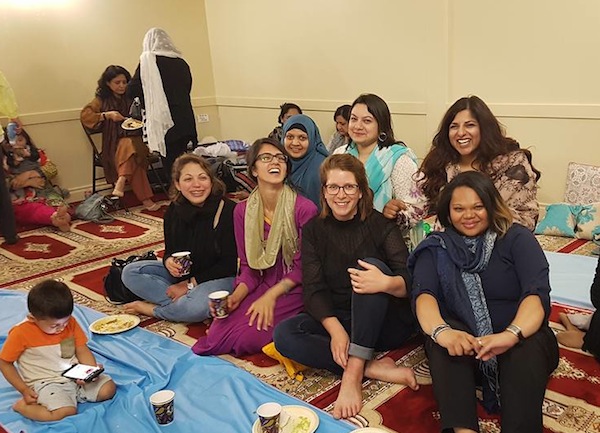
Members of Sisterhood of Salaam Shalom enjoy a Ramadan Iftar dinner together at a local mosque. Naz Qureshi is at top right and Rabbi Gila Caine is seated in the front row, second from the right. This photo was taken before the COVID-19 crisis. (photo from Naz Qureshi)

Sisterhood of Salaam Shalom, which works with Jewish and Muslim women to combat hate, stereotyping and prejudice, has chapters in the United States, England and Canada. After a trip to Israel in 2017, Naz Qureshi, who is Muslim and whose parents are from Pakistan, decided to start up a Salaam Shalom chapter in her own city, Edmonton.

“I’ve been to Israel/Palestine twice,” Qureshi told the Independent in a recent interview. “It’s one of my favourite places to go. I love to see the political dynamics, because … I can weave in and out of both sides. I’m Muslim, so the Palestinians get me. But yet, I’m very Western, so the Israelis get me, too. I don’t wear a hijab. I’m not seen as a threat. I can see it from both sides. I think that, because I’m also a South Asian Westerner, of course, the conflict is near and dear to my heart and I’m passionate about it, but I’m not as invested in it as a Middle Easterner would be.”

During Qureshi’s 2017 visit to Israel, she said, “Completely by chance, this Orthodox rabbi and I started talking about religion and we ended up becoming extremely good spiritual friends. We realized that our faiths have so much in common.”

On her way back to Edmonton, via Toronto, Qureshi happened upon an ad for Sisterhood of Salaam Shalom and reached out when she got home. She contacted Temple Beth Ora’s Rabbi Gila Caine.

“Gila was completely interested,” said Qureshi. “I said, ‘OK, this is perfect, because you’re a rabbi and you can bring the Jewish women, and I can bring the Muslim women.’”

Each leader managed to find a half dozen interested women from their communities, and they began meeting on a monthly basis in homes and places of worship.

“Initially, you don’t broach the Israel-Palestine topic, because you’re just going to have a breakdown of communication right there,” said Qureshi. “Instead, we started with similarities. And it’s not just like, ‘OK, let’s eat some baklava and hummus.’ No. You delve into really interesting topics, like our holidays, our festivals. Salaam Shalom provides you with a whole binder if you’re not able to work on your own topics. They’re really good at guiding you.”

By eliminating stereotypes and hate, and developing friendships, participants begin seeing the other’s points of view and standing up for one another.

To help create intimate friendships, chapters are kept small. “You can’t hate somebody who you end up liking,” said Qureshi. “And then you think, ‘Wow, this person is a lot like me.’

“I think that when that happens – I’ve seen it over and over again from both sides – it creates really interesting dynamics. When you see that wall fall, it’s like the Berlin Wall cracking and this realization that, ‘Oh, my God … this person is not evil, they’re really interesting and fun to be around.’”

At one of the meetings, members were asked to share a personally meaningful story from their faith tradition. “I remember one, I think it was my favourite,” said Qureshi. “We were at Gila’s house and Gila shared about the Kiddush cup. I’d brought zamzam water (Muslim blessed water) and explained its significance. We ended up toasting zamzam water in the Kiddush cup and it was amazing…. When we left, we all had that warm fuzzy feeling in our hearts.”

Just before the coronavirus outbreak, the group had planned to have an event to assess participants’ interest in continuing, but the gathering had to be postponed.

“What I really like about Salaam Shalom is the intimate, smaller group discussions,” said Qureshi. “You get past the formalities, past your name and what do you do, and you delve into real issues and gain an appreciation and learning from one another.

“There is so much Islamophobia and antisemitism on both sides and I really wish that people would just go out and make a Muslim or Jewish friend, and then you can see this closeness that exists.

“I think it’s maybe also so important for women especially to be doing this work because it’s easier for us … no matter where you fall on the spectrum, liberal, conservative … we tend to be more open.

“We can portray Muslims not in this negative stereotypical light, too,” she added. “We’re not all terrorists, we’re not all crazy…. It’s really important to sow those seeds wherever you can.

“Going back to my Israeli friend, the Orthodox rabbi, he feels so close to Palestinians he knows now … whereas before, he was a completely different person. Now, I think, from knowing me and when we talk about religion and the shared stories and our deep love of God and respect, he feels this closeness to Palestinians.”

After Qureshi’s phone interview with the Jewish Independent, she shared a message she received from her rabbi friend, which read: “The other day, when I came home after one of my rounds, I tried to park the minibus in the usual spot and there was this guy who told me that he cannot clean the area because I park there, so I parked somewhere else. Later, I go over to him and ask what days he comes to clean, so I know when not to park. He was a Muslim and he said, ‘I like you.’ He said he recognized me from before. Apparently, he used to sweep the area some time ago and remembers that I used to compliment him and say a good word. Anyway, he literally kissed me! It took me by complete surprise! Who would think of [a Muslim] kissing a Jew? Anyway, we exchanged numbers and now there’s another Muslim friend added to my list.”

Qureshi reflected, “Hearing this message made my Monday morning. I got off the train feeling elated and walked the remaining blocks to work. The sun shone a little brighter and the cooling breeze appeared to be sent directly from the heavens above! The scene was playing over and over in my mind. ‘Who would kiss a Jew?’ Why, a Muslim could and would kiss a Jew! And what had elicited such a strong emotional response? That a Jew could and did act kindly to a Muslim.”

Rebeca Kuropatwa is a Winnipeg freelance writer.

Format ImagePosted on April 24, 2020April 24, 2020Author Rebeca KuropatwaCategories NationalTags Edmonton, interfaith, multiculturalism, Naz Qureshi, peace, Sisterhood of Salaam Shalom
Israel’s soldiers not forgotten

Israel’s soldiers not forgotten

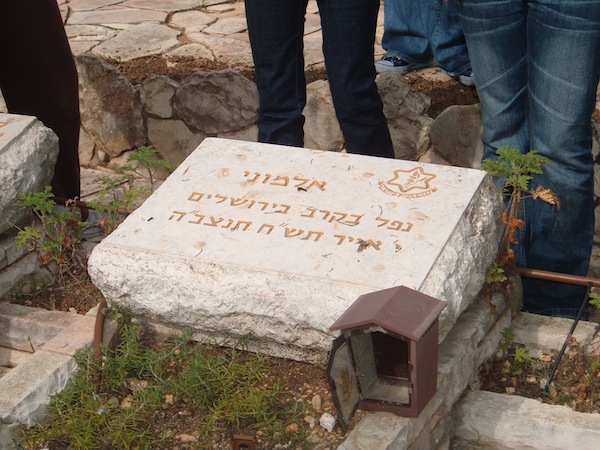
The grave of an unknown soldier on Mt. Herzl in Jerusalem. (photo by Deborah Rubin Fields)

As of Israel Independence Day last year, 23,741 Israeli soldiers had died during their service. The country has come to memorialize its fallen soldiers in one of three ways: 1) most commonly, it provides a grave and a headstone in a military cemetery, with information provided on the soldier, 2) when there is no official grave (that is, when no one really knows where the body of the deceased is), it inscribes the name either on a memorial wall or marker, and 3) it furnishes a grave and a headstone, but little or no information about the deceased is engraved on the stone.

Today, when a soldier dies, the following identification is to be established: the name of the soldier, their army identification number, national civilian identification number, army rank and army unit, as well as their job in the army. When they are buried, the headstone notes the full name of the deceased, their parents’ first names, country of birth (if outside of Israel), date of birth (according to both the Hebrew and Gregorian calendars), aliyah date, date and place of death and age at the time of death. The stone also contains the emblem of the Israel Defence Forces. In a military cemetery, the tombstone’s content reflects a high degree of uniformity. One monument pretty much contains the same details as the next one.

In pre-state Israel and in the War of Independence in 1948, these practices were not yet in place. Young men and women – many of whom had just survived the Holocaust – fought to establish the state. They (and all other soldiers) had little military training. They might not have known Hebrew very well. Not uncommonly, they were the only survivor of their families.

Times were tense, at times verging on the chaotic. The fighting left limited time for socializing, for establishing relationships. So, if a soldier died, it was not surprising to have known them only by their first name. Under the circumstances, most fellow fighters would not have been acquainted with the soldier’s parents, would not have even known their names.

At the end of the War of Independence, about 1,000 of the 4,500 fallen were considered missing. It was the chief rabbi of the IDF, Rabbi Shlomo Goren, who initiated an intensive project of identifying the dead. The establishment of military cemeteries helped the identification process move forward, but, even after that, there remained anonymous soldiers, and headstones with missing information.

Recognizing this situation, Dorit Perry and Uri Sagi started Giving a Face to the Fallen. The organization has been in existence fewer than 10 years. Its team of some 52 volunteer investigators and activists comes from a variety of backgrounds. It includes bereaved family members, friends of fallen soldiers, judges, former career army officers and others. As the organization’s website states, all volunteers believe there is “a duty to remember and, in so doing, to … repay the debt we owe to those who gave their lives for the establishment of the state of Israel.”

All of the volunteers are in a race against time, trying to piece together information on 500 soldiers who fell fighting either in pre-state Israel or in the War of Independence. They ask the following questions: Did you (or maybe your grandfather or an older neighbour) know the fighter we are researching? Maybe you fought with such person either before the creation of the state or in the War of Independence? Maybe you still have pictures of your fighting unit?

The volunteers also try to fill in blanks by asking to see old photos of youth movement activities, aliyah preparation groups (aliyah registration cards have provided investigators with correct birth dates and with the names of relatives, see blog.nli.org.il/en/baumgarten) and family albums. Some soldiers do not even have a photo on file.

Besides trying to find people still alive who were acquainted with these fallen soldiers, volunteers search archives. It is real detective work. When successful, there is the rededication of a tombstone with the added information. To date, out of the more than 800 “untraceable” soldiers, they have pieced together the missing information for 120 of them.

The stories of the fallen soldiers of this period are poignant. Take the example of Tobias Marmolstein, who came from Bitshekov, Czechoslovakia. His father had died in Tobias’s arms at Mauthausen concentration camp. Twenty-year-old Tobias was killed as his Haganah unit fought to open the road to Jerusalem. He had been in Israel for just nine days. He is buried on Mt. Herzl.

Each life story has its twists and turns. For instance, over two decades passed before Shaul Yekutiel Urbach came to be buried in Israel. He arrived in Palestine in 1939 to visit Tel Aviv relatives. When the Second World War broke out, he was unable to return to his large family in Kielce, Poland, so he volunteered to fight for the British. The British sent him to fight in Greece. There, the Germans took him prisoner. The Nazis sent him to do hard labour in Schlesien, Germany. In a revolt against a Nazi camp officer, Shaul was wounded, and he died in a German hospital. After the war, his only surviving brother, Raphael Fishel – the rest of the family had been murdered at Treblinka – tried to have Shaul’s remains brought to Israel. For 22 years, the British stalled in releasing his body from their military cemetery. Finally, in 1967, Shaul was reinterred, on Mt. Herzl.

Uri Sagi has maintained that a blank headstone or one that is missing information makes the soldier invisible. A fallen soldier, Sagi said, should not be invisible.

As time passes, it becomes harder and harder to find acquaintances and family who can fill in the blanks with firsthand testimony. For more information on Giving a Face to the Fallen, visit latetpanim.org.il.

Deborah Rubin Fields is an Israel-based features writer. She is also the author of Take a Peek Inside: A Child’s Guide to Radiology Exams, published in English, Hebrew and Arabic.

Format ImagePosted on April 24, 2020April 24, 2020Author Deborah Rubin FieldsCategories Celebrating the HolidaysTags Giving a Face to the Fallen, IDF, Israel, memorial, soldiers, terrorism, Yom Hazikaron
Culture & accessibility

Culture & accessibility

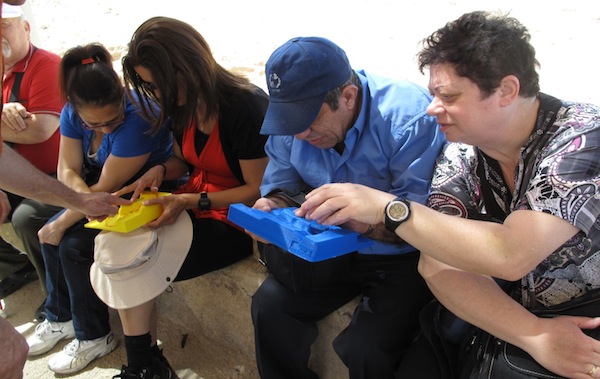
Visitors to Masada learn more about the site through Gadi Mathov’s miniature model of the landmark. (photo from Mathov Design)

What would it take to make museums, cultural sites and tourist attractions more accessible to people with visual, intellectual or developmental disabilities? For the past 25 years, Israeli professional miniaturist Gadi Mathov has been working on solving this problem using models.

At Masada National Park, for example, people with visual impairment can understand the site’s unique topographical structure and history through Mathov’s 3D tactile models.

“We also created for them miniature models of siege vessels that illustrate the Roman siege of Masada,” he explained. “The way I define it, a model is a physical representation of a product or an idea. A model is a medium that allows people to communicate and pass along ideas between them.”

Mathov Design models are used in leading cultural institutions such as the Israel Museum and sites managed by the Israel Antiquities Authority and the Israel Nature and Parks Authority. Mathov also cooperates with the Commission for Equal Rights of Persons with Disabilities, the National Insurance Institute and the Access Israel nonprofit organization.

Mathov Design’s 100-square-metre model of Jerusalem, featuring the Temple Mount, the Tower of David, the Knesset, the new Jerusalem Light Rail and other iconic structures, can be seen in Times Square in New York City as part of the Gulliver’s Gate project.

Birdwatching via models

Agamon Hula, a must-visit birdwatching and natural beauty attraction in northern Israel, is also enhanced by Mathov’s models. Here, he cooperated with Pnina Ceizler, Keren Kayemeth LeIsrael-Jewish National Fund’s northern region projects and accessibility coordinator, and KKL-JNF’s chief ornithologist Yaron Charka to make the site’s research station a place of interest for people with disabilities – visitors can see and/or feel models of the birds that migrate in the area, as well as special globes and maps that highlight migratory routes.

“There are quite a few models that we’ve created to enhance the experience for people with visual impairments,” said Ceizler. “We see that it’s useful for everyone, also for children with disabilities or with autism.”

The accessible experience at the research station has proved to be a huge hit, she told Israel21c. She tried it out on a group of people with visual impairments before opening it up to private visitors and organized trips for schools and people with special needs.

“They enjoyed this whole experience up close. They were impressed and admired everything,” she said of the accessible centre’s first visitors.

Back to the future

Mathov has worked in his profession for 37 years, but it came about quite by accident. “It was a temporary job while I was an architecture student, and then I found out that I liked it better,” he recounted.

Decades later, he’s still in love with the job. “They’ll have to take me out of here in a coffin,” he joked, speaking of his workshop in the central city of Lod.

Along with cultural institutions, his clients include the defence establishment and medical instrumentation companies.

Mathov is not worried about work drying up in the age of technological advancement. “There’s nothing more comfortable or clearer than a model,” he said. “There are dozens if not thousands of uses.”

Lately, it’s become much easier and cheaper to create a model. “The biggest development was the introduction of what we call computerized production,” Mathov explained, citing 3D printers, lasers and CNC (computer numerical control) machines. “Each of these technologies helps us create a much more complex and higher-quality product in less time and for a cheaper price.”

Mathov hopes that, one day, people will be able to print out models at home of the places they’re planning on visiting. “Today, no one goes to the store to buy music; no one goes to Blockbuster to watch a movie. I imagine that, when you’ll want a miniature model, you won’t go to a miniaturist. You’ll be able to download them and print them by yourself,” he explained.

However, printing is only the end of a process that begins with human creativity. Mathov said a model should contain “the human spark of the soul of the person who created it.”

And, while he mourns the disappearance of craftsmanship, Mathov is a firm believer in advancement. “You have to keep on looking forward,” he said. “To understand what the technologies are and where they’re heading; how to adopt them or compete against them or circumvent them.”

For more information, visit mathov.co.il/English.aspx.

Israel21c is a nonprofit educational foundation with a mission to focus media and public attention on the 21st-century Israel that exists beyond the conflict. For more, or to donate, visit israel21c.org.


Format ImagePosted on April 24, 2020April 24, 2020Author Naama Barak ISRAEL21CCategories IsraelTags accessibility, culture, education, Gadi Mathov, inclusion, Israel, tourism
Israeli start-up’s Beehome

Israeli start-up’s Beehome

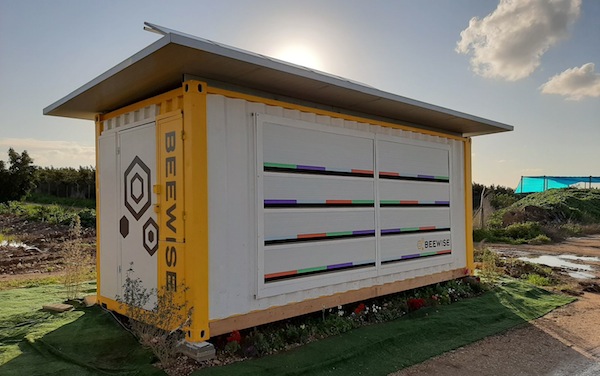
Beewise wants to replace traditional, wooden hives with high-tech, autonomous ones. (photo from Beewise)

What do cucumbers, avocados and coffee all have in common? Aside from being absolute necessities (yes, avocados, too), they’re all crops pollinated by bees. And, if things keep heading in the current direction, we’re screwed.

Bees are extremely important. About one-third of all plants and plant products consumed by humans are dependent on bee pollination. Unfortunately, the combination of modern demand and natural stresses such as climate change, pests and illness mean that the global bee population is dying at a dizzying rate, endangering our diets and well-being.

To combat this, efforts are being made to rehabilitate the bee population. In Israel, these endeavours are given a very Start-Up Nation twist, complete with computer vision, artificial intelligence and precision robotics, which are all part of the world’s first autonomous beehive, developed by Israeli start-up Beewise. Called Beehome, it’s a device that can house up to 40 bee colonies – that’s two million bees – and take care of their health and upkeep through an app on the beekeeper’s phone or tablet.

“It’s what’s called a disruptive innovation,” said Beewise chief executive officer Saar Safra. “We’re coming to replace all the beehives in the world.”

photo - Beewise chief executive officer Saar Safra
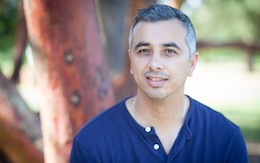
Beewise chief executive officer Saar Safra. (photo from Beewise)

The idea for an autonomous beehive came from Safra’s business partner, Eliyah Radzyner. A beekeeper by profession, Radzyner was aghast at the fact that beekeeping methods have not progressed for ages. He was convinced that a computer, machine or robot could do a much better job, and joined forces with Safra, a serial entrepreneur.

At present, most beehives around the world look like they did some 150 years ago – plain wooden constructions whose upkeep requires beekeepers to dress in full hazmat mode and light a smoker before opening them up, taking care of pests, supplying the bees with food and water and harvesting the honey. All this extensive manual labour means that commercial beekeepers, who take care of most of the bees in the world, only get to each hive about once every few weeks. Lots of bees are lost in between rounds to illness, pests and other problems.

“If you manage to identify the problem at the outset and take care of it in a specific manner, then, first off, it will be a lot less invasive; second, you’ll resolve the problem before it becomes a concern; and, third, you’ll save the bee,” Safra explained.

“We built a beehive that knows how to do these things,” he said, listing its three main components: artificial intelligence, computer vision and precision robotics.

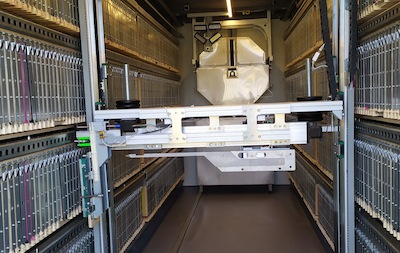
The first, he said, is in charge of recognizing and identifying problems at the very outset. A real-time response is then carried out using computer vision to detect and monitor the situation, with precision robotics executing the required solution. The only things in the autonomous hive that require a human hand are filling the water and food and collecting the honey, which is harvested by machine.

photo - In Beewise's hives, even the honey is harvested by machine
In Beewise’s hives, even the honey is harvested by machine. (photo from Beewise)

While there are other companies trying to take care of bees amid the crisis, no one else has built an autonomous beehive. Currently in beta stage, Beehome is now being used by some commercial beekeepers.

“At first, there’s skepticism, because it’s so left-field,” Safra noted. “The moment we show people the device and that it works, there’s unbelievable excitement.

“There are beekeepers who are second, third or fourth generation. The beekeeper sees how his business is disappearing before his eyes, on his watch,” he added. “Then you suddenly show him this technology, this solution, and he sees that it works. Imagine what a relief that is.

“The idea that we’re saving bees using technology is an amazing thing,” Safra said. “When you take AI and apply it to traditional industries that haven’t been touched in 150 years, the yield is incredible.”

The funding for Beewise came from venture capital funds, as well as from European and Israeli grants. And doing business in Israel has been wonderful, said Safra, who returned to the country some two years ago after 15 years in the United States.

“The ecosystem in Israel is amazing. It’s simply optimized for start-ups,” he said. “There’s also a crazy infrastructure in terms of services and everyone knows how to work in startup mode.”

Beewise aims to be the new standard, Safra said. “There are 90 million beehives around the world. They’re all wooden beehives that don’t work anymore.

“We’re doing well by doing good,” he concluded. “Every hive that I create and which functions and succeeds – the result is more bees alive.”

For more information, visit beewise.ag.

Israel21c is a nonprofit educational foundation with a mission to focus media and public attention on the 21st-century Israel that exists beyond the conflict. For more, or to donate, visit israel21c.org.


Format ImagePosted on April 24, 2020April 24, 2020Author Naama Barak ISRAEL21CCategories IsraelTags Beewise, conservation, environment, Saar Safra, start-ups, technology

Thank you to all our Israel issue advertisers!

image - Save On Foods ad April 24 issue

image - JFS ad April 24 issue
image - ZLC ad April 24 issue
image - Dexter - Liebernab & Robertson ad April 24 issue
image - Shay Keil ad April 24 issue
image - Nesters ad April 24 issue
image - Weinberg ad April 24 issue
image - Latham's ad April 24 issue
image - Dexter ad April 24 issue
image - JMABC and JBN ads April 24 issue
image - Campbell Saunders ad April 24 issue
image - Transworld ad April 24 issue
image - Web exPress ad April 24 issue
image - Imperial Paddock ad April 24 issue
image - Sar-El ad April 24 issue
image - JNF ad April 24 issue
image - Admiral Insurance ad April 24 issue
image - Glotman Simpson ad April 24 issue
image - Temple Sholom ad April 24 issue
image - Famous Foods ad April 24 issue
image - Kahn Zack Ehrlich Lithwick ad April 24 issue
image - Kierszenblat ad April 24 issue
image - CCW ad April 24 issue
image - Nancy Stern ad April 24 issue
image - United Elevator ad April 24 issue


Posted on April 24, 2020May 28, 2020Author The Editorial BoardCategories From the JITags JI, journalism, philanthropy

Posts pagination

Previous page Page 1 … Page 265 Page 266 Page 267 … Page 664 Next page
Proudly powered by WordPress