Skip to content
  • Home
  • Subscribe / donate
  • Events calendar
  • News
    • Local
    • National
    • Israel
    • World
    • עניין בחדשות
      A roundup of news in Canada and further afield, in Hebrew.
  • Opinion
    • From the JI
    • Op-Ed
  • Arts & Culture
    • Performing Arts
    • Music
    • Books
    • Visual Arts
    • TV & Film
  • Life
    • Celebrating the Holidays
    • Travel
    • The Daily Snooze
      Cartoons by Jacob Samuel
    • Mystery Photo
      Help the JI and JMABC fill in the gaps in our archives.
  • Community Links
    • Organizations, Etc.
    • Other News Sources & Blogs
    • Business Directory
  • FAQ
  • JI Chai Celebration
  • JI@88! video

Recent Posts

  • Story of Israel’s north
  • Sheltering in train stations
  • Teach critical thinking
  • Learning to bridge divides
  • Supporting Iranian community
  • Art dismantles systems
  • Beth Tikvah celebrates 50th
  • What is Jewish music?
  • Celebrate joy of music
  • Women share experiences 
  • Raising funds for Survivors
  • Call for digital literacy
  • The hidden hand of hate
  • Tarot as spiritual ritual
  • Students create fancy meal
  • Encouraging young voices
  • Rose’s Angels delivers
  • Living life to its fullest
  • Drawing on his roots
  • Panama City welcoming
  • Pesach cleaning
  • On the wings of griffon vultures
  • Vast recipe & story collection
  • A word, please …
  • מארק קרני לא ממתין לטראמפ
  • On war and antisemitism
  • Jews shine in Canucks colours
  • Moment of opportunity
  • Shooting response
  • BC budget fails seniors
  • Ritual is what makes life holy
  • Dogs help war veterans live again
  • Remain vital and outspoken
  • An urgent play to see
  • Pop-up exhibit popular
  • An invite to join JWest

Archives

Follow @JewishIndie
image - The CJN - Visit Us Banner - 300x600 - 101625

Classical pianist & educator

Classical pianist & educator

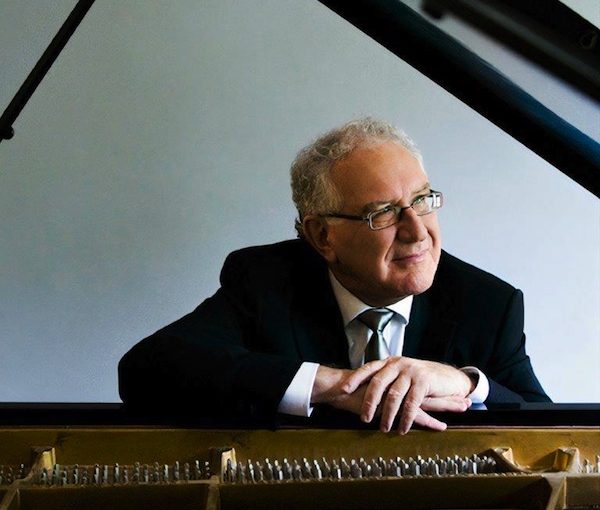
Robert Silverman is one of the musicians featured in Under the Radar, by David Eisenstadt. (photo from Robert Silverman) 

***
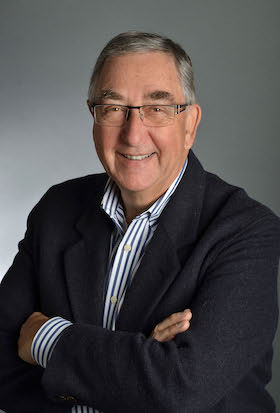
photo - David Eisenstadt
David Eisenstadt (photo from tcgpr)

Under the Radar: 30 Notable Canadian Jewish Musicians, which I wrote with Alan L. Simons (editor), takes an historical approach, covering musicians of most genres and genders, some alive and others having passed on, all skilled, but excelling somewhat out of sight. This is the first in a three-part series of excerpts from the book, which was released last November, and is available in paperback and as an ebook from amazon.ca. The excerpts feature performers with B.C. roots:  Robert Silverman, Ben Mink and Mike Kobluk.

***

Robert Herschel Silverman is one of Canada’s premier pianists. He was born in Montreal, Que., on May 25, 1938, to Jewish parents from the Ukraine and Romania. Globe and Mail reporter Marsha Lederman wrote, “when he was just 4, after seeing how he was drawn to classical music programs on the radio, he was signed up (by his parents) for piano lessons. By his second lesson, Silverman could identify notes by ear. He could read sheet music before he could read words. But even as he continued with his lessons through high school and university, he never considered a career in piano.”

At 6, Silverman played his first recital. His debut at 14 was with the Montreal Symphony Orchestra. At 23, he planned to become an engineer but decided to be a classical pianist. Lederman reported Silverman saying, “It was really, really late. It’s not the way to do it.”

He earned undergrad arts and music degrees in the 1960s from Sir George Williams (now Concordia) University. He studied with Dorothy Morton (the daughter of Silverman’s childhood piano teacher) at McGill University, and with Cecile Genhart at the Eastman School of Music, Rochester, N.Y. He also earned a Canada Council grant to enrol at the Vienna Academy of Music.

Silverman won the top piano prize at the Jeunesses Musicales Canada national competition, playing twice at Expo ’67. His Allied Arts piano competition success earned a recital debut in Chicago’s Orchestra Hall in 1970. He made his New York Lincoln Centre debut before he turned 40, in 1978, where the New York Timesdescribed him as “a polished and thoroughly finished technician and an extremely articulate [virtuoso].”

image - Under the Radar book coverSilverman performed with global and Canadian orchestras conducted by John Eliot Gardiner, Neeme Jarvi, Kiril Kondrashin, Zdenek Macal, Seiji Ozawa and Gerard Schwarz.

In his 30s, he was an artist-in-residence at Nazareth College in Rochester, N.Y.; he also taught at the University of California in Santa Barbara from 1969 to 1970, and the University of Wisconsin-Milwaukee 1970-73. He moved to Vancouver to join the University of British Columbia as professor of music (piano) in 1973. He was the director of UBC’s music school 1991-95, retiring as professor emeritus of music in 2003. Celebrating his 30-year tenure, Silverman received an honorary doctorate in 2004.

Working with Adrienne Cohen, the former music program director at Toronto’s Koffler Centre of the Arts, Silverman, in 2002, was the artist-in-residence.

“My relationship was informal with no written contract. I received an honorarium for seasonal concerts. I appreciated the opportunity to maintain a visible presence in Toronto’s music life and to help Adrienne enhance and enlarge classical music’s role. Although I’m not observant from a religious standpoint, I am keenly aware of my Jewish heritage and pleased to be affiliated with Koffler, whose programs were attuned to the Jewish community in its traditional sense,” he said.

“I grew up when many North American Jewish luminaries were visible – Horowitz, Rubinstein, Bernstein, Reiner, Heifetz, Menuhin and the up-and-comers, Fleisher, Graffman and Rabin. My musicality was shaped by their warm manner of phrasing and attention to tonal beauty, qualities I hold dear and continue to strive towards.”

He returned to Montreal in 2008 to initiate the Dorothy Morton Visiting Artist series at McGill University’s Schulich School of Music, performing there on its 10th anniversary. He and his wife also endowed a biannual Robert and Ellen Silverman Piano Concerto Competition.

His discography numbers 30-plus CDs and 12 LPs. He received an Order of Canada in 2013.

As a Vancouver-based retiree and a Steinway artist, Silverman devotes himself full-time to recordings and concerts and is heard often on the CBC and Radio-Canada networks.


Format ImagePosted on January 14, 2022January 13, 2022Author David EisenstadtCategories BooksTags classical music, music, piano, Robert Silverman, Under the Radar

Singing for my supper

Do you sing? I’ve always fancied myself as one who had a good singing voice. I love to sing. I’m always ready to join in when there’s a sing-song, particularly if I know the tune and especially if I know the words. Although I’ve never had ambitions to be a singing star, I’ve always been first in line to make a musical noise.

For me, singing is associated with all those times around the campfire. The nostalgia for those times may be the underlying reason for the positive response I have toward the whole idea. Those memories carry a strong positive emotional content.

When I was a kid, I never had the least idea about singing. I never was a fan of singers. I never bought records or tapes. I was too busy reading all those delicious books.

My greatest exposure to singing was my experience in the chorus when my high school – St. John’s Tech, in Winnipeg – annually presented operettas by Gilbert and Sullivan. I loved that. I was in the chorus every year I was at that school. I appeared in HMS Pinafore, Yeoman of the Guard and The Mikado. It was a lot of work, and we spent many hours after school in practices before we could get things right. It shouldn’t be a surprise then that some of the tunes are still with me after more than 60 years. The excitement, and even the thrill, of the performance occasions lends a rosy glow to my memories of those days.

It was only in later life, in Montreal, when I tried to repeat my vocal exploits, that I really learned to appreciate how small my talents were in this area of endeavour. I discovered that I was prone to take up the tune of anyone who stood beside me. I found out that my capacity to keep strictly to the notes of the part I was supposed to sing was variable. I had no knowledge of how one could sustain a note. In short, it was a hazardous undertaking for anyone to include me in a respectable chorus. To make things worse, I was known to become confused as to where we were in a production, and to launch myself forcefully into song when the rest of the chorus was steadfastly silent. These were the only solos I ever performed.

To the detriment of those who might be concerned about sound pollution, these small negatives have never discouraged me from forcing my voice on an unappreciative public. I leap with lusty abandon at any chance to show off my limited abilities.

Over time, I have passed from tenor to muffled baritone, and I continue to be eager to share my gifts. While I have never been offered money to do this, I feel it is my duty, nonetheless, to do so, especially when participating allows me to share in the buffet that can sometimes accompany such occasions. It is only fair that I sing for my supper.

When I am engaged in my full-throated roar, I am too busy to note the pained expressions of those around me. This is just good fun for all of us, isn’t it? I am just entering into the spirit of things, and covering for those lacking a musical sense, aren’t I? Or perhaps they are just too shy, a failing from which I do not suffer. Surely, they are enjoying the noise just as much as I am?  I worry only if people start to leave.

I sometimes sing in the rain, something like whistling in the dark, to keep up my spirits as I venture into unknown places. Let the winds blow the clouds away to deliver to us another sunny day, I say.

We were fortunate enough, at one time, to have had a second home in Arizona. Really only a trailer, it permitted us to spend the worst winter months away from the cold and dreariness of both Ireland, when we lived there, and the wet fall and winter seasons in the rain forest where we’ve lived lately. What had brightened our time even more was to have fallen in with a group of Canadians fleeing the winter cold. Wonder of wonders, one of them played the guitar and liked to sing.

Was I happy? You betcha! We were just a small group and when I was belting out songs as loudly as I could, it was as if I were back at camp. And they tolerated my enthusiasm. And, sometimes, they fed me. I was singing for my supper, again.

Now, in our current hideaway, we’ve joined a group, mostly oldsters, who meet weekly to reprise all the melodies reaching back across recorded history. My Bride is a witness – and if I perform as required, she will serve me a hearty brunch as a reward when we return home. I can do this!

Max Roytenberg is a Vancouver-based poet, writer and blogger. His book Hero in My Own Eyes: Tripping a Life Fantastic is available from Amazon and other online booksellers.

Posted on January 14, 2022January 13, 2022Author Max RoytenbergCategories Op-EdTags memoir, music, singing
It’s been a hard two years

It’s been a hard two years

Last summer, given COVID’s continued presence and restrictions, campers were especially happy to be at camp. (photo from Camp Hatikvah)

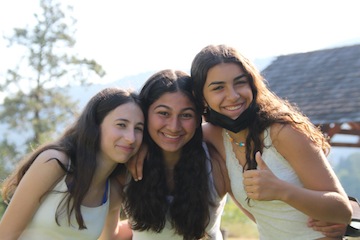
Prior to 2020, Camp Hatikvah was experiencing unparalleled success. With enrolment maximized, the organization was in the position to focus not only on capital and program development but also on long-term financial planning. According to Liza Rozen-Delman, the camp’s executive director, Hatikvah’s future had never looked brighter. “It was a period of great excitement for us,” she said. “We honestly thought that nothing could get in the way of our growth and success.”

The pandemic, however, changed everything. “The impact of COVID was immediate and devastating,” Rozen-Delman said. “We went from being on top of the world to worrying about our very survival.”

photo - Boys during a service at Camp Hatikvah
(photo from Camp Hatikvah)

Luckily for Hatikvah, donors immediately stepped in to cover the camp’s mounting financial losses. “People knew we were in trouble and they rallied around us,” said Rozen-Delman, with great emotion and gratitude. “Not only did they cover our operational expenses entirely in 2020, they made it possible for us to open in 2021 by funding all of the camp’s COVID-related expenses, like testing, site upgrades and more.”

Rozen-Delman went on to share how incredible it was to welcome campers back to camp last summer. While capacity had to be dramatically reduced to adhere to government group-size limits, close to 400 children participated in Hatikvah’s program in 2021.

“We rearranged our session lengths to make sure that every single Jewish child wishing to attend our camp was able to do so,” explained Rozen-Delman. “While this meant that each camper was at camp for a little less time than is typical, everyone was just so grateful to be there.”

“Our campers are always happy to be at camp but last summer, they were elated,” added Eden Gutterman, the camp’s associate director. “They needed to socialize, to be outdoors and to be away from technology and it was just so beautiful to watch them revel in camp and each other.”

photo - Campers at Camp Hatikva give a thumbs up
(photo from Camp Hatikvah)

Gutterman shared her favourite memory from last summer. “One Shabbat, we asked all of the campers who had their bar and bat mitzvah’s over Zoom to stand in the middle of a circle made up of the rest of the campers and counselors. We then did the hora around them as a tribute to their milestone and accomplishment. None of these campers got to celebrate their simchah in person so it was incredibly touching to see them surrounded and celebrated by their friends. It is something we – and they – will never forget.”

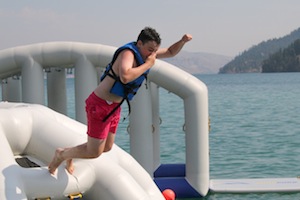
photo - Camper jumps into the water
(photo from Camp Hatikvah)

Camp Hatikvah is now busy preparing for summer 2022.

“We recognize that COVID will likely not be over by summer,” acknowledged Rozen-Delman. “And, while we wish it wasn’t the case, we feel well-prepared to deal with anything.”

Rozen-Delman shared that the Gutman family and Rockdoc Consulting Inc. have provided the funding for the camp to build a new infirmary in time for this summer.

“Given the realities of the ongoing pandemic, this gift couldn’t have come at a better time,” said Rozen-Delman. “Our new infirmary has been designed with COVID and any future infectious disease in mind and will have recovery rooms that can be used as properly ventilated isolation space if necessary. Its functional space has also been thoughtfully designed to allow us to meet and exceed current best practices in camper care. It is a gift our camp so desperately needed and we couldn’t be more grateful to Sam and Belinda and Gloria and their families for their generosity.”

Joanna Wasel, Camp Hatikvah’s board president, commented that, while she wished the world hadn’t had to experience this pandemic at all, she believes that the camp will ultimately be stronger because of it.

“We are entering 2022 with a renewed sense of purpose,” said Wasel. “Our community supported us through this challenging time because they believe in our mandate to help raise the next generation of strong, confident and resilient Jewish leaders. Their faith means everything to us and we are determined to make them proud.”

– Courtesy Camp Hatikvah

Format ImagePosted on January 14, 2022January 13, 2022Author Camp HatikvahCategories LocalTags Camp Hatikvah, COVID, Eden Gutterman, education, Gutman, health, Jewish camp, Joanna Wasel, Judaism, kids, Liza Rozen-Delman, pandemic, philanthropy, Rockdoc Consulting, summer camp
There’s no place like Miriam

There’s no place like Miriam

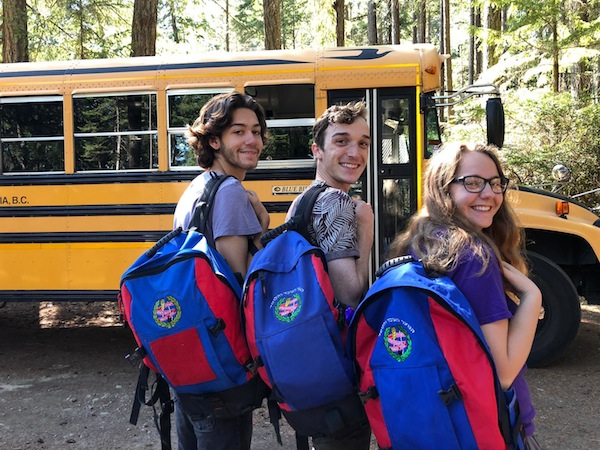
Judah Altman, left, Daniel Fine and Marina Levy all packed up for the bus. (photo from Camp Miriam)

Returning to Camp Miriam every summer is like going home. The kids shouting and laughing for joy, the bright smiles of the counselors, beautiful Gabriola Island – there’s no other place like Camp Miriam.

My first summer at Miriam was 2013. I’ve returned every summer since, more in love with the place and the people each time. I’ve grown up at Camp Miriam. I’ve grown up with the people; they are some of my best friends. I’ve grown up as a person; I’m always learning about myself and the world in ever-changing new ways. Most importantly, I’ve grown up at Camp Miriam having fun – summers at camp are what I look the most forward to most and I never want them to end.

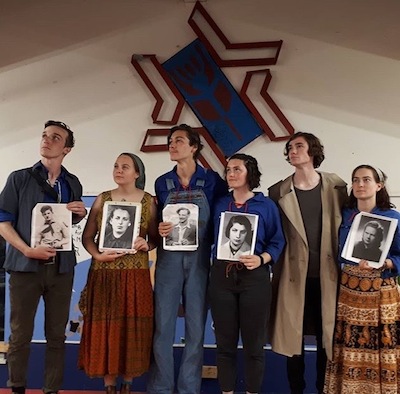
photo - Left to right are “Visionaries” Daniel Fine, Marina Levy, Judah Altman, Mira Macnair, Kieran Macnair and Mica Hastings
Left to right are “Visionaries” Daniel Fine, Marina Levy, Judah Altman, Mira Macnair, Kieran Macnair and Mica Hastings. (photo from Camp Miriam)

I’ve been a camper, a junior counselor, a counselor and, last summer, a counselor for the leadership training program. Last summer was my favourite summer yet, and I can’t wait for this coming summer. To me, Camp Miriam has always been special for two reasons: the first is the activities, and the second is the people.

This summer, as chinuch (educational director) on our youth-led executive team, or mazkirut, I will be in charge of activities for the entire camp. I could not be more excited. One of the main reasons I continue to return to Camp Miriam is the unique options it provides for campers. There are the classic undertakings – like swimming, soccer, art and music. But then there are the programs that few other summer camps have, such as special days where all camp activities run around a surprise theme, ocean swimming as the sun sets, Jewish learning, and a focus on social justice.

I’m also looking forward to seeing the new and returning campers bond with their cohorts and with their counselors. I know firsthand that Miriam friendships last forever. The people I’ve met at camp will undoubtedly remain my friends for the rest of my life. These are the deepest connections I have.

photo - Judah Altman with friends Meital Smith, left, and Rakeea Chesick Gordis
Judah Altman with friends Meital Smith, left, and Rakeea Chesick Gordis. (photo from Camp Miriam)

After two years of COVID, these connections couldn’t be more important: for counselors like me, and especially for kids. Camp Miriam empowers youth and provides a space for kids to be themselves and to continue to discover who they are. It is a place to make new friends and reaffirm old ones. It is a place to talk for hours on end about all manner of issues, and to play and be silly without fear of judgment. It is a place to learn what true friendship means.

I am excited for the summer because, once again, I will get to meet new campers and counselors and help create the community that is the essence of Camp Miriam. I also can’t wait to see all the familiar faces. I can’t wait to run memorable programming for the kids that will be fun, while also empowering them to grow as people. Camp Miriam is the most important place in the world to me – I feel so fortunate that my parents have given me the opportunity to return summer after summer.

Judah Altman is a student at Columbia University, studying philosophy and sociology. He will be chinuch, or director of education, at Camp Miriam this summer.

Format ImagePosted on January 14, 2022January 13, 2022Author Judah AltmanCategories LocalTags Camp Miriam, COVID, education, Jewish camp, Judaism, kids, summer camp
Fun and safety during pandemic

Fun and safety during pandemic

In these uncertain times, JCC Camp Shalom set out to continue to be a constant source of fun and a safe environment for the whole community. For the second year, the exceptional circumstances of the COVID-19 pandemic demanded that the camp’s plans be reevaluated and adapted, as it partnered with King David High School to move the majority of its operations to the school’s building for last summer.

Camp Shalom is an inclusive Jewish day camp serving children, youth and teens from ages 3 to 18 years old, year-round, during school breaks and professional development days. Since the inception of the Inclusive Summer Camp Experience program in 2009, more and more children with diverse needs have attended Camp Shalom and participated in group activities, including overnight camping trips.

The number of children with diverse needs who attend Camp Shalom has grown from a handful to more than a dozen per summer – and the range of assistance provided for families has grown as well. Families are able to access more camp sessions and the camp can now support a wider range of ages and needs. Huge improvements have been made in accommodating campers in a true inclusion model and in providing opportunities for more Jewish programming beyond the summer, including Sunday Hebrew schools for those who did not have access to them prior to their experience with Camp Shalom.

photo - Camp Shalom offers an inclusive setting for all ages, abilities
(photo from JCC Camp Shalom)

Thanks to the contributions of the Diamond Foundation and the Snider Foundation, Camp Shalom is able to support more campers and staff with diverse needs by providing special training sessions, mentorship programs and one-on-one support for those campers who need it. Campers who were part of the first inclusive camp experiences are now teenagers and young adults who are still connected to Camp Shalom, and some are now camp staff. This past year’s biggest achievements included engaging about two dozen children, youth and teens with diverse needs and successfully integrating them into the general camp program alongside 120 to 150 other campers in the camp’s preschool, school-age and teen programs.

JCC Camp Shalom likes to think of all youth as being in transition. It pays special attention to campers transitioning from childhood into teenagehood and those teens who are about to become counselors. Work experience is a huge milestone as they enter high school. At camp, they go from being campers to participating in the teen programs, to joining the staff team.

Regardless of their developmental stage and/or maturity level, and taking into consideration their diverse needs, these teens need more support and adaptations than any other group with which the camp works. Careful planning and consideration of their needs has resulted in a successful program that provides them with social and organizational education that will benefit them in the future, as they look for employment, as well as in other areas of their lives.

JCC Camp Shalom is the largest summer Jewish day camp for youth in Vancouver, but its responsibility continues, as the engagement with youth extends beyond summer camp to throughout the year. As teens develop, Camp Shalom recognizes their need for adults with whom they can connect, that they can trust and who can be positive role models. Staff from the summer teen camp programs are educated and qualified to sustain positive and appropriate relationships with youth as they age. The inclusion model of camp programming allows campers with diverse needs to have an unforgettable Jewish experience at Camp Shalom.

For more information about the Inclusive Summer Camp Experience or Camp Shalom’s teen programs, contact Ben Horev, camp director, at 604-813-4236 or [email protected].

– Courtesy JCC Camp Shalom

Format ImagePosted on January 14, 2022January 13, 2022Author JCC Camp ShalomCategories LocalTags Alliance for Jewish Renewal, Camp Shalom, COVID, day camp, inclusion, JCC, Jewish camp, Judaism, kids, pandemic
Back to camp, to being a kid

Back to camp, to being a kid

At summer camp, kids build community, take on challenges, become independent and develop leadership skills. (photo from Camp Solomon Schechter)

There’s a place where kids can simply be themselves. Where they build community, take on challenges, become independent and develop leadership skills. And, through it all, they think it’s just fun and friendships. That’s the magic of summer camp – a healthy dose of nature and nurture.

One year after sleepaway camps across the country were shuttered by the pandemic, many kids packed their shorts and hiking shoes once again, dug out their sleeping bags, and reunited with camp buddies to rekindle fond traditions.

We asked the directors of three Jewish summer camps in Washington state to share their perspective on the role camp plays in the social and emotional health of children, and how it was especially vital in the summer of 2021.

Welcome back to camp

“Welcoming the kids back this summer was extra special,” said Zach Duitch, director at Camp Solomon Schechter in Tumwater. “We could see it in their faces. After being online for a year-and-a-half, they were ready to be outside, with their friends, and having fun.”

Many parents were understandably concerned about sending their kids back to camp this past summer. Attendance numbers dipped somewhat, but families also recognized the value of getting their kids back to outdoor healthy summer fun, Duitch said. Away from everyday social pressures, camp staff works to create an environment that’s a safe place for kids to be their authentic selves.

“Parents trust us with their kids’ safety, security and health – and also with their spiritual and emotional needs. We take that trust incredibly seriously,” said Rabbi Ilana Mills, director at URJ Camp Kalsman in Arlington. “Camp is life-changing in so many ways. It’s an opportunity to grow as a whole person.”

Fun with lasting impact

When kids come home from one, two or three weeks at summer camp, the changes may not be immediately evident. In fact, many campers and counselors only realize as adults how much the experience has shaped them, instilling them early on with courage, compassion and independence. Kids can head off to camp as early as the summer after first grade. Many progress through the years to become counselors, taking on leadership roles as high school and college students, in what many describe as the “best job ever.”

Ask a kid and they’ll say camp is about boating, hiking, arts, sports, cookouts – and the thrill of a high-ropes course. Along with the fun, each camp has its own unique culture with familiar traditions passed down from summer to summer. Camp culture is what ties the community together with singing and celebrations, skits and games. Jewish summer camps also integrate religious observance and community into daily life.

“Camps are these bubbles – their own societies – where kids play a central role,” said Rabbi Kenny Pollack, camp director at Sephardic Adventure Camp in Cle Elum. “Our kids are immersed in the culture of camp, and it helps shape their identity.”

Healthy dose of silliness

When camp directors describe how their programs nurture kids, it can sound pretty serious. But one thing they take extremely seriously is fun.

“At Camp Solomon Schechter we do a lot of ‘shtick.’ Campers love seeing their counselors act silly,” said Duitch, as he explained a beloved trivia game that ends with participants messy and everybody laughing.

Mills described how “we really try to be as outside the box as possible. We push our counselors to teach their passion, be creative and try new things.”

She even got a chance to join the fun, playing a zombie during the culmination of their outdoor survival unit at URJ Camp Kalsman.

Leave real world behind

Kids leave their parents and their digital devices at home when they arrive at camp. There may be homesickness at first but soon their days are consumed by activities and friendships. And, since more and more camps are going device-free, campers get a break from their screens.

“Camp is a place where kids get to be their authentic selves,” said Pollack.

Each summer, as kids are reconnecting with old friends and making new ones, they’re also connecting across borders. Increasingly, camps are bringing counselors from international locations to supplement the programming with games and traditions from their home countries.

“As much as kids love their parents, camp is a great opportunity for them to learn from other role models,” said Duitch, explaining how the camp experience broadens kids’ viewpoints and connects them to lifelong friends.

Many parents, kids and camp staffers found it heartbreaking to cancel camp in 2020. That’s why camps throughout Washington banded together, lobbying the state government to make sure that camp happened in 2021 and that it would be a safe and extra-memorable summer. In the end, it may be difficult to measure the social and emotional impact of returning to camp after a trying year. But parents could no doubt see it in the hugs, the joy and the happy exhaustion as they picked their kids up at the end of camp this past year.

This article, courtesy Camp Solomon Schechter, comes from the Samis Foundation, which was established in 1994 by Samuel Israel, z”l, and is the largest Jewish philanthropy in Washington state. Grantmaking is focused on the foundation’s mission of supporting local Jewish education and initiatives in Israel. Samis is honoured to support the three Jewish overnight camps located in Washington state, working to keep Jewish children and teens engaged in their culture, religion and communities.

Format ImagePosted on January 14, 2022January 13, 2022Author Samis FoundationCategories LocalTags Camp Solomon Schechter, COVID, education, Ilana Mills, Jewish camp, Judaism, Kenny Pollack, kids, pandemic, Samis Foundation, Sephardic Adventure Camp, summer camp, URJ Camp Kalsman, Zach Duitch
Summer of a lifetime awaits

Summer of a lifetime awaits

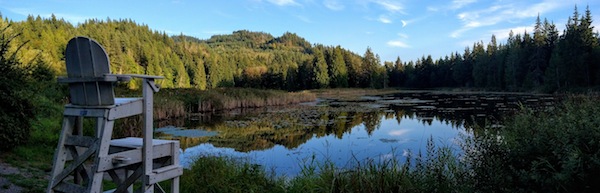
Camp Kalsman has almost 300 acres, perfect for a wide range of activities. (photo from Camp Kalsman)

Rabbi Ilana Mills, director of URJ Camp Kalsman, started attending camp when she was 8 years old. “I remember being uncertain what the experience would be like, trying to picture how it would feel to live in a bunk. It was greater than I ever imagined,” she said.

“Jewish camping helped me learn more about myself and my Jewish identity,” she added. “I learned independence that served me my whole life and what it means to be part of a community. I have experienced the powerful impact camp can have on someone’s life and now get to watch my children experience it as well.”

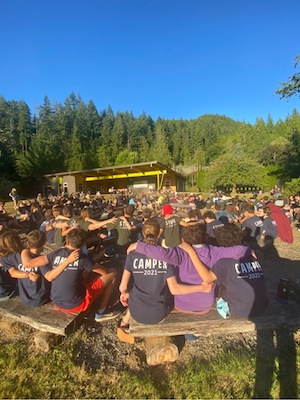
photo - Campers gather together
(photo from Camp Kalsman)

Camp Kalsman knows kids need places to be celebrated for who they are and places that help them grow. Camp Kalsman is one of those places – where a child can feel comfortable being their true self and learn independence while they climb the tower, play pool volleyball, and tie-dye.

Located in Washington, the camp has almost 300 acres, perfect for a wide range of activities: arts, sports, team-building, hiking, high ropes, guitar, and so much more. Each camper can explore all aspects of camp and participate in various programs, while exploring and gaining pride in their Jewish identity. Camp isn’t just a fun thing for kids to do when they’re out of school. Studies have shown that camp is one of the most powerful tools in a parenting toolbox for successfully launching an adult.

Discover new passions

Camp Kalsman strives to make every camper’s experience nurturing and fulfilling, and does so by making sure that every child feels welcomed and supported, while challenging themselves. Campers engage in activities and programs, develop lifelong friendships and live with a super staff. Jewish values infuse everything the camp does and, each year, new and returning staff members bring unique chugim, activities, based on their passions, so there are always more options being added to an already long list.

Arts: painting, ceramics, improv/drama, guitar, song writing/leading, digital media, Kalsman musical, photography, dance, cooking.

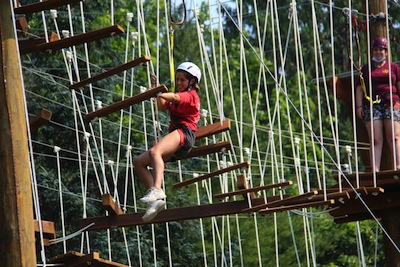
photo - Camp Kalsman ropes course
(photo from Camp Kalsman)

Sports: balloon volleyball, giant soccer, archery, Gaga, tetherball, ultimate frisbee, basketball, softball/kickball, Kalsman football (extra special/silly combination of sports).

Waterfront: pirate ball on the lake, cardboard box boat-making, mermaid contest, water polo, canoeing, kayaking, pool volleyball, pool basketball.

Teva (Nature): hiking, outdoor cooking, outdoor survival skills, wilderness first aid, gardening, animal care.

Ropes: high ropes obstacle course, tower, giant swing, zipline, low ropes team-building.

Unit programs: Israeli cooking, ice cream pool party, messy night, scavenger hunt, and so much more.

Shabbat shalom

Everyone can feel the magic that falls over Camp Kalsman every Shabbat. The entire camp community changes into white clothes and cleans up after a very busy week. The camp joins together in a Shabbat walk that ends at the outdoor beit tefilah (sanctuary). There are interactive services, a traditional Shabbat dinner in the dining hall, with challah and grape juice, and the night ends with Shabbat Shira (song session), where campers and staff alike can dance and sing the night away.

Since it is still Shabbat, Saturdays also look a bit different at camp. There is chofesh, free time, where campers can choose activities more freely and for longer amounts of time than during the full schedule of the rest of the week. They can focus on finishing their art project, challenge themselves on a different path on the high ropes course, or even chill on the quad with friends and really rest and reset for the days ahead.

– Courtesy Camp Kalsman

Format ImagePosted on January 14, 2022January 13, 2022Author Camp KalsmanCategories LocalTags Camp Kalsman, Canadian Summer Camp Research Project, COVID, Ilana Mills, Judaism, kids, pandemic, summer camp
It’s that time of year

It’s that time of year

Tu b’Shevat is a popular day to go into the fields and plant saplings. (photo from usa.jnf.org)

‘In Israel, just before the Hebrew month of Shevat, the landscape begins to change. It has been winter; the fruit trees bare, their leafless, light grey branches silhouetted against dark clouds. Then, as Shevat is ushered in, they begin to bud, and reddish leaflets burst forth. Fields that have been covered with pale crocuses, white narcissus and cyclamens give way to red anemones, tulips and broom bushes starred with flowers. And the almond trees burst into blossom – the first harbinger of spring. It is at this time we celebrate Tu b’Shevat, the 15th of Shevat, which is known as the New Year of the Trees.

Tu b’Shevat, which falls this year on Jan. 17, is mentioned in the Mishnah as one of the four “natural” new years. The first of Nisan is the “new year for Jewish kings and seasonal feasts”: that is, for calculating the reigns of Israelite kings and determining the cycle of calendar festivals. The first of Elul is the new year “for tithing cattle” and the first of Tishri is the new year for calculating septennial cycles and 50-year jubilees.

The new year for the trees was moved from the first of Shevat to the 15th in accordance with the opinion of Rabbi Hillel (30 BCE – 10 CE), for it is then that the sap begins to rise with the full moon, in Israel’s fruit trees. The Babylonian and Jerusalem Talmuds also designate Tu b’Shevat as the date to calculate taxes on fruit: “You shall tithe all the yield of your seed, which comes forth from the field year by year.” (Deuteronomy 14:22)

During the days of winter, Israel’s fruit trees are dormant. It is wet and cold and, because of the low temperatures, the trees cannot absorb the nutrients from the soil. But, regarding the 15th of Shevat: “Till this day [the trees] live off the water of the past year; from this day on, they live off the water of this year.” (Jerusalem Talmud, Rosh Hashanah 1.2)

This date is the start of the fruit’s formation. Arabs also mark it, calling it “the second ember,” when fruit trees begin to absorb water. According to Arab folklore, there are three “embers,” which began as fire falling from the sky and changed to caterpillars. The first falls from the sky when the earth begins to warm up; the second when the warmth spreads. They follow this with a third “ember,” as summer begins.

Tu b’Shevat is one of Judaism’s popular celebrations that does not involve special synagogue services. It is a day when it is customary to eat the fruits of Israel: apples, almonds, carobs, figs, nuts and pomegranates. Many scholars stay up late on the eve of the holiday, reciting biblical passages dealing with fruits or the earth’s fertility. They read from Genesis how trees were created along with all the plants of the earth; from Leviticus, the Divine promise of abundance as a reward for keeping the commandments; and from Ezekiel 17, the parable of the spreading vine, symbolizing the people of Israel.

Kabbalists hold a special seder for Tu b’Shevat and they celebrate, not so much the new year of the trees, but the New Year of the Tree, meaning the Tree of Life, which is rich with mystical connotations. At the seder, they drink four cups of wine, beginning with white wine and ending with red, with the second cup a mixture more of white and the third more of red wine. It is rather like how the landscape changes from white (the pale narcissus and crocus) to red (anemones and tulips) as Tu b’Shevat approaches.

Tu b’Shevat is a popular day to go into the fields and plant saplings. Over the last several decades, Israeli schoolchildren have helped Keren Kayemeth, the Jewish National Fund, plant 130 million trees, many of them on Tu b’Shevat, and these evergreens have become the backbone of the reforestation program.

Tu b’Shevat affirms that the soil of Israel is holy. And the New Year of the Trees reminds us annually of the wonder of God’s creation.

Dvora Waysman is a Jerusalem-based author. She has written 14 books, including The Pomegranate Pendant, which was made into a movie, and her latest novella, Searching for Sarah. She can be contacted at [email protected].

Format ImagePosted on January 14, 2022January 13, 2022Author Dvora WaysmanCategories Celebrating the HolidaysTags Israel, JNF, Judaism, new year, ritual, spring, tradition, tree-planting, trees, Tu b'Shevat
A Methuselah update

A Methuselah update

Methuselah’s roots go back to the time of Masada, and even earlier. (photo from Arava Institute)

For many years, in anticipation of Tu b’Shevat, I have written about a date palm tree in the Arava that fascinates me – Methuselah.

Methuselah’s relatively new beginnings can be attributed to London-born Dr. Sarah Sallon, director of the Louis Borick Natural Medicine Research Centre at Hadassah Medical Centre, and California-born botanist Dr. Elaine Solowey of the Arava Institute for Environmental Studies at Kibbutz Ketura.

According to Sallon, “in 2005, we were interested in rejuvenating lost flora of Eretz Yisrael. One of the lost flora is the Judaean date. I was discussing with some scientists about their work, trying to extract DNA from ancient seeds.”  Sallon asked, “If we had ancient seeds, why couldn’t we grow them?”

From 1963 to 1965, archeologists Yigal Yadin and Ehud Netzer excavated the fortress Masada, which was built by King Herod between 37 and 31 BCE and was home to almost a thousand zealots until the Romans breached the wall in 72 CE and found the bodies of the Jews who had lived there and killed themselves, rather than being taken as prisoners. At the site, Yadin and Netzer found date palm seeds, which were subsequently stored at Bar-Ilan University.

Sallon asked Netzer for a few seeds, and received five. She took them to Solowey, who took three of the 2,000-year-old seeds and planted them in January 2005. Other seeds were sent to the University of Zurich, in Switzerland, for radiocarbon dating. They were also tested to see if they had anti-bacterial, anti-viral, anti-cancer, anti-fungal, anti-malarial, anti-oxidant or other medicinal properties.

The date palm is one of the best medicinal trees. Domesticated more than 6,000 years ago, it can be male or female, and produces dates. Medicine of the date palm has been used for lung disease, colds, heart disease, hair growth and other things.

After eight weeks, in 2005, one seed successfully germinated and was named Methuselah, after the biblical person who was said to have lived 969 years.

Initially, the first leaves had white spots because of a lack of chlorophyll. At 15 months, the seedling was transferred to a larger pot. After 26 months, the plant showed normal development.

In 2011, when its exact location was being kept a secret, I was permitted to see a photograph of Methuselah. At the time, it was two metres high and in a “protected quarantine site,” due to its scientific and financial value.

In April 2011, a white flower appeared on the inner part of the tree, indicating that Methuselah was male. In 2017, there was hope for Methuselah to be bred with a female tree to produce the same date variety that was common in ancient Judea.

In December 2019, Solowey sent me an update on Methuselah – he had grown to four metres tall. Also during that year, Solowey had gotten six ancient date seeds from archeological sites: “Adam” from Masada; “Jonah,” “Uriel,” “Boaz” and “Judith” (or “Yehudit’) from Qumram; and “Hannah” from Wadi Makukh, a winter water channel in the Judean desert surrounded by high cliffs and containing a number of caves that were surveyed from 1986 to 1989.

Early that December, Methuselah was pollinated by Hannah and Solowey cultivated 111 semi-dry dates, “really nice, big, blondish, semi-dry dates from her with a honey aftertaste.”

In March 2020, Hannah flowered, and Solowey told me: “we are thinking of making a genetic line from Hannah.”

At the end of November 2021, Solowey wrote to me again. She said, “Well, we got 600 beautiful dates from Hannah (whose seed was 175 years older than Methuselah’s seed) this September. We planted Yehudit, another female, on Sukkot. We are considering tissue culture. I have two males still in the greenhouse.”

Sybil Kaplan is a journalist, lecturer, book reviewer and food writer in Jerusalem. She created and leads the weekly English-language Shuk Walks in Machane Yehuda, she has compiled and edited nine kosher cookbooks, and is the author of Witness to History: Ten Years as a Woman Journalist in Israel.

Format ImagePosted on January 14, 2022January 13, 2022Author Sybil KaplanCategories Celebrating the HolidaysTags Arava Institute, archeology, dates, Elaine Solowey, Hadassah Medical Centre, history, Israel, medicine, Methuselah, Sarah Sallon, trees, Tu b'Shevat
Studying social sense

Studying social sense

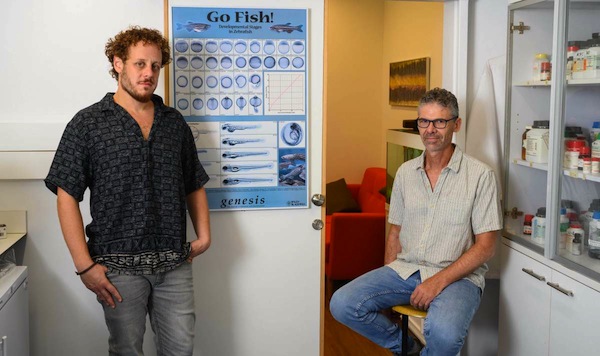
Michael Gliksberg, left, and Prof. Gil Levkowitz are among the researchers who have discovered that oxytocin in a developing zebrafish brain determines later social behaviour. (photo from Weizmann Institute)

Whenever we decide to throw a party, invite in-laws to dinner or embark on a cruise, we are driven by the most basic component of social behaviour: the desire to hang out with other humans. Considering that the drive to form groups with members of one’s own species has been conserved throughout evolution, it’s evident that social behaviour is governed by genes, at least to some degree. But our parents and teachers help us hone our social graces, so teasing apart the effects of nature and nurture on this behaviour is hard, if not impossible. By studying zebrafish, Weizmann Institute of Science researchers, in collaboration with scientists in Portugal, have managed to solve part of the riddle of how social behaviour is hardwired into the developing brain.

Zebrafish are perfect for studying the inborn basis of behaviour because they receive zero nurturing from parents. “Some fish species take care of their young, but not zebrafish,” explained Prof. Gil Levkowitz of the Weizmann Institute’s molecular cell biology and molecular neuroscience departments, who headed the research team together with Prof. Rui F. Oliveira of Instituto Gulbenkian de Ciência in Portugal. “The female zebrafish spawns several hundred eggs, which are fertilized by sperm released into the water by the male. She does provide her offspring with a ‘lunchbox’ – a protein sac, or yolk, that makes up part of the egg – but, otherwise, her message to her children is: manage on your own.”

At about four weeks of age, the centimetre-long juvenile fish, just out of the larval stage, begin to socialize. Though not as exquisitely synchronized as the schools of moonfish in the movie Finding Nemo, they do exhibit a strong tendency to swim together as a group, termed a shoal. Much like humans, they have an incentive to seek company; in their case, the group provides them with advantages in searching for food, overcoming currents, avoiding predators and finding mates. The shoaling behaviour of zebrafish requires sophisticated processing of visual and social cues, very similar to that which takes place in the brains of socializing humans. In particular, the zebrafish must be able to identify other fish as belonging to their own, “friendly” – as opposed to different or, worse yet, predatory – species.

To learn how the social behaviour of zebrafish develops, the researchers focused on the hormone oxytocin, one of the most important neurochemicals known to enhance social interactions, including bonding. Postdoctoral fellow Dr. Ana Rita Nunes and doctoral student Michael Gliksberg created a system for exploring the effects of oxytocin on the developing brains of zebrafish larvae. They produced transgenic larvae whose oxytocin-making neurons harboured a bacterial gene encoding fatal sensitivity to antibiotics. The researchers could then eliminate these neurons from the brains of the larvae at different stages of their development by adding antibiotics to the water, and they later observed the zebrafish behaviour as they became adults.

The scientists discovered that the larvae whose brains lacked oxytocin early on – specifically, in the first two weeks of life – grew into adult fish with an impaired capacity for social interaction, namely, swimming in a shoal. Although their brains regenerated the oxytocin neurons later in life, this capacity was not restored. This meant that, for adults to be capable of social behaviour, their brains had to be organized by oxytocin in a certain manner during a critical time window of brain development in which the social traits are established.

The researchers further discovered the mechanisms by which oxytocin primes the growing brain for socializing. They showed that oxytocin-producing neurons were critical to the birth of another type of neuron, one that releases the neurotransmitter dopamine, which is known to regulate feelings of reward and motivation. Zebrafish whose brains had not been exposed to oxytocin during the first two weeks of life had reduced numbers of dopamine-making neurons, as well as a reduced number of connections to these neurons, in two distinct brain areas.

One of these areas was responsible for processing visual stimuli, apparently of the kind essential for recognizing potential swimming partners. An analogous area in the brains of mammals, including humans, is involved in processing visual cues in social situations. It controls eye movements that scan, for example, different elements of the face in a particular order to decipher facial expressions. This pattern is often absent in people with autism, suggesting that their brains respond to social-based visual cues differently.

The other dopamine-deficient brain area in the zebrafish was analogous to a major reward centre in the mammalian brain, which is involved in the positive reinforcement of social interactions.

A lack of oxytocin in the critical early developmental period also disrupted a system of neuronal connections known as the social decision-making network – a group of brain areas that work together to process social information. In fish whose brains had developed without oxytocin, the synchronization patterns of neuronal activities among these centres were completely different from those of regular fish.

Nunes summarized: “Oxytocin organizes the developing brain in a way that’s essential for responding to social situations.”

– Courtesy Weizmann Institute

Format ImagePosted on January 14, 2022January 13, 2022Author Weizmann InstituteCategories IsraelTags Ana Rita Nunes, Gil Levkowitz, health, Michael Gliksberg, oxytocin, research, science, social behaviour, Weizmann Institute, zebrafish

Posts pagination

Previous page Page 1 … Page 186 Page 187 Page 188 … Page 662 Next page
Proudly powered by WordPress