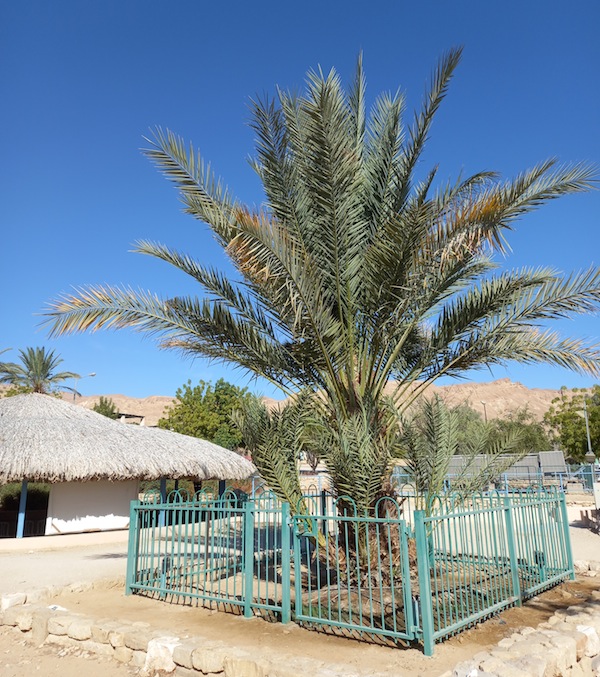

Methuselah’s roots go back to the time of Masada, and even earlier. (photo from Arava Institute)
For many years, in anticipation of Tu b’Shevat, I have written about a date palm tree in the Arava that fascinates me – Methuselah.
Methuselah’s relatively new beginnings can be attributed to London-born Dr. Sarah Sallon, director of the Louis Borick Natural Medicine Research Centre at Hadassah Medical Centre, and California-born botanist Dr. Elaine Solowey of the Arava Institute for Environmental Studies at Kibbutz Ketura.
According to Sallon, “in 2005, we were interested in rejuvenating lost flora of Eretz Yisrael. One of the lost flora is the Judaean date. I was discussing with some scientists about their work, trying to extract DNA from ancient seeds.” Sallon asked, “If we had ancient seeds, why couldn’t we grow them?”
From 1963 to 1965, archeologists Yigal Yadin and Ehud Netzer excavated the fortress Masada, which was built by King Herod between 37 and 31 BCE and was home to almost a thousand zealots until the Romans breached the wall in 72 CE and found the bodies of the Jews who had lived there and killed themselves, rather than being taken as prisoners. At the site, Yadin and Netzer found date palm seeds, which were subsequently stored at Bar-Ilan University.
Sallon asked Netzer for a few seeds, and received five. She took them to Solowey, who took three of the 2,000-year-old seeds and planted them in January 2005. Other seeds were sent to the University of Zurich, in Switzerland, for radiocarbon dating. They were also tested to see if they had anti-bacterial, anti-viral, anti-cancer, anti-fungal, anti-malarial, anti-oxidant or other medicinal properties.
The date palm is one of the best medicinal trees. Domesticated more than 6,000 years ago, it can be male or female, and produces dates. Medicine of the date palm has been used for lung disease, colds, heart disease, hair growth and other things.
After eight weeks, in 2005, one seed successfully germinated and was named Methuselah, after the biblical person who was said to have lived 969 years.
Initially, the first leaves had white spots because of a lack of chlorophyll. At 15 months, the seedling was transferred to a larger pot. After 26 months, the plant showed normal development.
In 2011, when its exact location was being kept a secret, I was permitted to see a photograph of Methuselah. At the time, it was two metres high and in a “protected quarantine site,” due to its scientific and financial value.
In April 2011, a white flower appeared on the inner part of the tree, indicating that Methuselah was male. In 2017, there was hope for Methuselah to be bred with a female tree to produce the same date variety that was common in ancient Judea.
In December 2019, Solowey sent me an update on Methuselah – he had grown to four metres tall. Also during that year, Solowey had gotten six ancient date seeds from archeological sites: “Adam” from Masada; “Jonah,” “Uriel,” “Boaz” and “Judith” (or “Yehudit’) from Qumram; and “Hannah” from Wadi Makukh, a winter water channel in the Judean desert surrounded by high cliffs and containing a number of caves that were surveyed from 1986 to 1989.
Early that December, Methuselah was pollinated by Hannah and Solowey cultivated 111 semi-dry dates, “really nice, big, blondish, semi-dry dates from her with a honey aftertaste.”
In March 2020, Hannah flowered, and Solowey told me: “we are thinking of making a genetic line from Hannah.”
At the end of November 2021, Solowey wrote to me again. She said, “Well, we got 600 beautiful dates from Hannah (whose seed was 175 years older than Methuselah’s seed) this September. We planted Yehudit, another female, on Sukkot. We are considering tissue culture. I have two males still in the greenhouse.”
Sybil Kaplan is a journalist, lecturer, book reviewer and food writer in Jerusalem. She created and leads the weekly English-language Shuk Walks in Machane Yehuda, she has compiled and edited nine kosher cookbooks, and is the author of Witness to History: Ten Years as a Woman Journalist in Israel.