Skip to content
  • Home
  • Subscribe / donate
  • Events calendar
  • News
    • Local
    • National
    • Israel
    • World
    • עניין בחדשות
      A roundup of news in Canada and further afield, in Hebrew.
  • Opinion
    • From the JI
    • Op-Ed
  • Arts & Culture
    • Performing Arts
    • Music
    • Books
    • Visual Arts
    • TV & Film
  • Life
    • Celebrating the Holidays
    • Travel
    • The Daily Snooze
      Cartoons by Jacob Samuel
    • Mystery Photo
      Help the JI and JMABC fill in the gaps in our archives.
  • Community Links
    • Organizations, Etc.
    • Other News Sources & Blogs
    • Business Directory
  • FAQ
  • JI Chai Celebration
  • JI@88! video

Recent Posts

  • Sharing her testimony
  • Fall fight takes leap forward
  • The balancing of rights
  • Multiple Tony n’ Tina roles
  • Stories of trauma, resilience
  • Celebrate our culture
  • A responsibility to help
  • What wellness means at JCC
  • Together in mourning
  • Downhill after Trump?
  • Birth control even easier now
  • Eco-Sisters mentorship
  • Unexpected discoveries
  • Study’s results hopeful
  • Bad behaviour affects us all
  • Thankful for the police
  • UBC needs a wake-up call
  • Recalling a shining star
  • Sleep well …
  • BGU fosters startup culture
  • Photography and glass
  • Is it the end of an era?
  • Taking life a step at a time
  • Nakba exhibit biased
  • Film festival starts next week
  • Musical with heart and soul
  • Rabbi marks 13 years
  • Keeper of VTT’s history
  • Gala fêtes Infeld’s 20th
  • Building JWest together
  • Challah Mom comes to Vancouver
  • What to do about media bias
  • Education offers hope
  • Remembrance – a moral act
  • What makes us human
  • המלחמות של נתניהו וטראמפ

Archives

Follow @JewishIndie
image - The CJN - Visit Us Banner - 300x600 - 101625

“We are safe,” says Shanken

“We are safe,” says Shanken

For safety reasons, Jewish Federation of Greater Vancouver is asking community members to avoid anti-Israel protests or events. (photo by Larry Barzelai)

“We are safe,” says Ezra Shanken. The chief executive officer of the Jewish Federation of Greater Vancouver reassured local Jews that, in light of massively increased tensions globally, there are no specific increased threats to the Jewish community in British Columbia.

Despite fears, no serious attacks or incidents of vandalism have been reported, with the exception of an incident in Surrey. Someone threw eggs at the home of Rabbi Falik Schtroks, spiritual leader of the Centre for Judaism of the Lower Fraser Valley, and a swastika was drawn in felt pen on a window of the home.

“One of the things that people who hurt the Jewish people … don’t realize, when that happens, we always come together,” the rabbi told CTV News.

“We’ve seen what happened to Rabbi Schtroks’ place,” Shanken said. “We take that very seriously. But, on the whole, we are safe.”

Jewish community organizations, under the leadership of the Jewish Federation in partnership with other agencies, especially those with physical spaces, like synagogues, schools and community centres, work year-round on security issues, ready for any possible local impacts that so frequently coincide with overseas conflicts.

Shanken credited Federation’s “very active” security committee and the professional security director, all of whom are coordinating among various Jewish agencies.

As he has at successive public events, Shanken heaped kavods on the Vancouver Police Department, the RCMP and other police agencies.

“The amount of resources they are expending on our community, to make sure that we are safe, is astronomical,” said Shanken. “I have just so much gratitude for them and for all they do for us, day in and day out.”

He encourages individuals who encounter police at the Jewish Community Centre, outside synagogues, schools or elsewhere, to take a moment to express gratitude.

“Go up, shake their hand, thank them, give them a hug, give them some cookies, give them some food, make them feel like they are being loved,” he urged.

In addition to simply being a kind thing to do, showing appreciation for the police, Shanken said, is a way to further demonstrate the moral divide between the Jewish community and those who are protesting Israel. Shanken said police working at anti-Israel rallies have been spat on and had things thrown at them.

“I want to make sure that there couldn’t be a clearer distinction in our community from those on the other side when it comes to how we treat our first responders and our law enforcement,” he said. “We are here to say thank you and to engage with them because they are keeping us safe.”

Although schools saw some understandable decline in turnout on the so-called “Day of Rage” called by Hamas against Jewish individuals and institutions worldwide for Oct. 13, Jewish British Columbians are going about their lives.

“People are coming into our JCC,” said Shanken. “They know they should come here and, if anything, they should be here so we’re sending a message that says we will not be dictated to on how it is that we can live within our community by others. We are going to come out and we are going to be strong, proud people within our communities, enjoying the things our community has to offer.”

In a message to the community in advance of the Hamas call for violence worldwide, Federation assured that “we will always act in a proactive, abundantly cautious manner when it comes to community security.”

The communication added that “we also recognize that these calls are also designed as a tool of intimidation and fear to harm our mental and emotional health. They are meant to stop us from going about our daily lives, regardless of whether there are specific security threats.”

The Vancouver Police Department, the RCMP and other security forces are maintaining a visible presence in front of high-profile organizations, including schools, synagogues and the JCC.

“Please note that there may not be a car present at all times and you may not see people in uniform,” the message noted.

Increased patrols are taking place around all Jewish institutions. In addition, Jewish organizations have been flagged by police as priority institutions, which means that any emergency call to law enforcement will result in an immediate and enhanced response, Federation said.

Federation is also working with partner organizations, as they do always, around security protocols.

For individuals and families, Federation is asking people to avoid anti-Israel protests or events. At Jewish community rallies or vigils, people are asked to not engage with protesters. At all times, people should stay aware of surroundings, and report anything suspicious to the police.

To ensure you are receiving all security updates and other communications from the Jewish Federation of Greater Vancouver, click the “Connect” button at jewishvancouver.com. The Federation website also includes resources for talking to children about the situation, and links to specific, up-to-the-minute news on events in Israel and elsewhere.

Format ImagePosted on October 27, 2023October 27, 2023Author Pat JohnsonCategories LocalTags antisemtism, community safety, Hamas, Israel, security, terror attacks, vandalism, war
The opposite of death is love

The opposite of death is love

Hadar Galron in Whistle, which is at the Firehall Arts Centre Nov. 14-15, as part of the Chutzpah! Festival. (photo by Nathan Yakobovitch)

“As a child I was never hugged or kissed; I think my parents did not even see me. I wrote this story to stop being an invisible child,” Israeli author Ya’akov Buchan has said about Whistle: My Mother was Mengele’s Secretary.

The play Whistle is part of this year’s Chutzpah! Festival, with performances Nov. 14 and 15 at the Firehall Arts Centre. Writer, director and actor Hadar Galron, who adapted Buchan’s story for the stage, stars in the monodrama.

“Buchan was born to two Auschwitz survivors, and began writing after he was injured in the Yom Kippur War. He’s written 18 books – four concerning the Holocaust – but he felt that people don’t read so much anymore, and that he wanted to write a play about second generation Holocaust survivors,” explained Galron in an interview with the Independent. “Dramatic writing and prose are very different techniques, and Ya’akov sent me about 30 pages of interesting and well-written content, but not dramatic enough for stage.

“The first meeting with him was out of respect – I thought I’d give him a few tips and let him take it from there,” she continued. “I remember the turning point: I said, ‘You mention twice in these pages the name Mengele. You can’t just throw in a name like that, it needs to have some dramatic payoff, or not to be mentioned at all.’ Ya’akov said nothing, just nodded. And, suddenly, I thought that maybe Mengele had tortured one of his parents. ‘Were any of your parents somehow … (how to say this?!) … connected to Mengele?’ Ya’akov looked me squarely in the eye and said, quietly, ‘My mother was Mengele’s secretary.’ That was when I knew I would take the task, and help him tell his story and the story of the second generation.”

In recent years, Galron has been working on several plays that deal with the lasting impacts of trauma. “We tend not to consider [the] second generation as traumatic,” she said, “but something as horrendous as the Holocaust leaves some people so scarred that they cannot really love anymore, even their children. Or, they love but in a different, obsessive way. The children who grow up without feeling love are traumatized, too, but their wounds are invisible.

“It’s important to understand that, whilst the trauma lasts a minute or a year or five years, post-trauma lasts a lifetime and, when considering [the] second generation, then even more than a lifetime. Long-term traumas such as [the] Holocaust are not a swing of the sword, they are more like the bite of a snake – the venom penetrates the body and mixes with the blood of the victim.”

Though she generally directs her own works, Galron said, “When I’m the actress, I need someone on the outside. At first, I thought maybe I’d direct and not act. It was Ya’akov who begged me, after seeing my stand-up cabaret Passion Killer, to act the part.”

Jaffa, Israel-born director and playwright Hana Vazana Grunwald was the first person who came to Galron’s mind to direct.

“We studied theatre together at Tel Aviv University, but that was decades ago! I had no idea where to find her,” said Galron. “We’d met a couple of times in festivals, etc., along the years. I was thinking of her on my morning walk-jog in the park by my home. In the distance, I saw a woman that reminded me of Hana and then we got closer and I saw it actually was Hana! She lives five minutes away from me, but that was the first day she decided to go out and take a power-walk before work. I don’t believe in coincidence – it’s only God’s way of remaining anonymous.”

Grunwald started out in community theatre more than 25 years ago. She is the director of the Frechot Ensemble, a collective of women creators, which she founded some 10 years ago.

“I see myself as a feminist Mizrahi (Middle Eastern Jew) writer, who brings to the forefront my personal story,” she told the Independent. “But my personal story is never just my own, it’s an inherent part of my political story, my family’s story and the collective which I belong to. I feel that my world isn’t really represented in Israeli theatre. I don’t see the household I grew up in, I don’t encounter complexities and dilemmas that interest me. I realized I have the responsibility to represent myself – I have to write these texts, I have to tell these stories. My job is to search through history and prose and to bring back the voice of all those whose voice was taken away from them.”

When Galron sent her the script for Whistle, Grunwald said, “I was immediately hooked. But, after we met again, I felt that the opportunity to work together and find connections would also be reflected in the play’s dramaturgy.

“The challenge that the play Shirika [Whistle, in Hebrew] brings to our door is how to retell the story of the Holocaust and the story of the members of the second generation, who feel transparent. Two images guided me in my search for the keys to directing the play,” said Grunwald.

“The first: whistle. Tammy, the protagonist, lost her ability to whistle, she lost her ability to love and feel loved and, as she says in the play, ‘The opposite of death is not life, the opposite of death is love.’ The way this whistle is expressed on stage is through the prop of a kettle full of boiling water. The boiling and bubbling kettle and the whistler on stage metaphorically tell the story of the Holocaust, a story that never ends.

“The second image we chose is the painting. Tammy is a painter and, when we wondered what was painted on the stage, we realized that the body is the canvas, the body treasures and carries the wounds of the past, the memories – the actress jumps from limb to limb and with the help of simple means such as brushes and paints Tammy marks national history…. This is the way in which the trauma is present again on the stage.

“It seems that precisely now the spectacle of a whistle is given a relevant meaning,” Grunwald added. “We find ourselves facing a terrorist attack in which again Israeli Jews are brutally murdered and mass murdered because of their Jewishness. We again witness horror stories in this war against Hamas. We find ourselves again, 75 years after the establishment of the state of Israel, in a shocking event that reminds us of the fear of being destroyed. The harsh scenes from both sides shake the soul, sow terror and fear, and remind us that the feeling of security is a temporary illusion and we must not forget it. I work at the Hebrew-Arab theatre in Jaffa, a theatre that gives a stage to the binational discourse, it gives a stage to both narratives, and I feel that, these days, it is the first to be hurt.”

Galron also works with artists of different backgrounds and shared one of her experiences.

“Between 2016 and 2018, I was artistic director of the Shalom Festival, a small festival that was an official part of the Edinburgh Fringe fest,” she said. “We created this festival after an Israeli production, in 2014, was shouted down by the BDS [boycott, divest and sanction movement] and, in 2015, there were no Israeli productions.”

She was inspired by Sir Rudolf Bing, founding director of the Edinburgh International Festival, from which the Edinburgh Fringe Festival has its roots. Galron explained that Bing, a Jewish-Austrian opera singer, who fled Nazi Germany, “created the festival as a cultural bridge, inviting, firstly, German artists to take part! With that in mind, I told the sponsors of the Shalom Festival that we cannot make a one-sided Shalom (Peace) Festival and that, as the artistic director, I would like to bring artists from all of Israel, including Israeli Arabs – both Muslim and Christian – and also some Palestinian artists. At first, there was big objection but, eventually, I convinced them that these are Palestinians who believe in peace, in dialogue. Until today, even in these times, I am in contact with my Palestinian friends.

“I believe art is a bridge,” she said. “I believe art and culture and theatre have the power to heal – to give us insight and create empathy. From my very first performance as a stand-up artist – my show was on the status of women in the Jewish law – I made a decision to make my art meaningful, to merge life and stage.”

Since the Oct. 7 Hamas terror attacks on Israel, Galron has been posting related videos and other items on Facebook, including “Creativity in place of survival” writing challenges. She got the idea from a course she took during COVID with Dr. Joe Dispenza. “In one of the online digital courses, he speaks of how our brain can be either in ‘survival’ or in ‘creativity’ mode,” said Galron. “The moment I heard this, I understood many things about myself and how creativity has always been for me a way of surviving. Now I know that, when we begin to be creative, we actually begin to pull ourselves out of ‘survival’ [mode] even if we are being creative whilst we try to survive. A bit like Baron Munchausen explains that he pulls himself by his hair out of the pit.”

About how she is doing since the attacks, Galron said, “I didn’t have a real answer to that question until yesterday, because everything is so chaotic. But I was speaking to a university student of mine who answered, ‘I’m committed to the good.’ I was so moved by this. She told me she adopted it from her yoga teacher. I adopted it from her. I’m committed to the good.”

For tickets to Whistle and other Chutzpah! shows, visit chutzpahfestival.com.

Format ImagePosted on October 27, 2023October 26, 2023Author Cynthia RamsayCategories Performing ArtsTags Chutzpah! Festival, Hadar Galron, Hana Vazana Grunwald, Holocaust, second generation, theatre, Ya’akov Buchan

Hope amid the conflict

We are still reeling from what happened in Israel on Oct. 7 and the war that has ensued.

Hamas carried out a brutal terror attack on Israel that targeted civilians, murdering 1,400 people and kidnapping more than 200 Israeli hostages. Jews worldwide are grief-stricken, angry and scared. It is hard to see the hope, as images of dead Israelis mix with images of dead Palestinians.

There is no doubt in our minds that Hamas needs to be incapacitated – its covenant explicitly states their intention to eliminate Israel and kill Jews. On Oct. 7, they reasserted their intention with a vengeance that cannot be ignored. Their unambiguous goal is genocide.

Posters we see around Vancouver that simultaneously accuse Israel of genocide for defending itself and call for the genocide of Israelis – “From the river to the sea, Palestine will be free!” – are abhorrent. People who support Hamas’s genocidal actions, implying, or outright stating, that Israelis deserve such cruelty do not care about humanity, do not believe in peace.

The people who are putting up the posters that ask, “Do you support indigenous rights? Then you support Palestine” are implying that Jews are colonizers and, therefore, deserve to be expelled, no matter how. But the Jewish connection to the land goes back thousands of years; we were dispossessed of it but never ceded it.

There are some two million Palestinians in Gaza, and they cannot be similarly dispossessed. More than half the population has been asked to leave their homes. Reports are that more than 4,500 have been killed from Israel’s bombing campaign.

Our hearts break at the type of war that fighting Hamas entails. The terror group uses civilians and civilian infrastructure as shields, ensuring that hundreds or thousands of innocent Palestinians die every time Israel defends itself militarily, even when it adheres to international law in its actions, including allowing humanitarian aid into Gaza.

One way or another, the people who live between the river and sea must find a way to coexist. That is quite literally the only way forward. As simplistic as this sounds, it is nevertheless true. That is impossible with Hamas as the controlling force in Gaza. But, when they are removed, what then? Replacing the figures at the top – whether in Gaza or in the Israeli government, the latter of which is something that will certainly be discussed in the aftermath of this horror – will not automatically negate deep mutual distrust among populations.

There are so many complexities and no end of theories as to how we have arrived at this point. What will happen next is less discussed, though there is the all-too-real possibility that the conflict will become regional – already the 22,000 residents of Kiryat Shmona, the largest community in the Vancouver Jewish community’s partnership region of the Upper Galilee, are being evacuated because of terrorist attacks from Hezbollah in Lebanon, which are expected to increase once Israel begins its ground offensive in the south. Some fear that the Hamas attack is less the main event than a distraction, a trap to lure Israel into an even more existential fight on multiple fronts.

Closer to home, there are security threats to Jews in the diaspora. Thankfully, Hamas’s call for a day of rage on Oct. 13 did not result in serious incidents. But the fear is real, and that is the purpose of terrorism. Jewish organizations and law enforcement agencies are working together to keep us safe. We must continue to live our lives as Jews, and not hide.

Some of our local community members have gone to Israel to fight. Other community members are rallying, marching and postering to make sure that the Israeli hostages being held captive in Gaza are returned home. More than $15 million was raised for Israel in just two weeks by the Jewish Federation of Greater Vancouver’s emergency campaign.

And, there are Israelis (Jewish, Muslim, Christian and others) and Palestinians who, despite the terrorist attacks and the war, continue against so many odds to work for peace. Groups such as Standing Together, Women Wage Peace, the Parents Circle, and others are working to shore up hope for peace, equality and coexistence. These groups deserve our support, moral and financial.

At the same time as we support our family and friends in Israel and one another here, as we call for the immediate return of the hostages and as we raise funds for aid, we must also support those activists and dreamers on the ground who advocate for a better postwar world.

Posted on October 27, 2023October 26, 2023Author The Editorial BoardCategories From the JITags evacuations, Gaza, genocide, Hamas, Israel, Kiryat Shmona, Palestinians, peace, terrorism, war
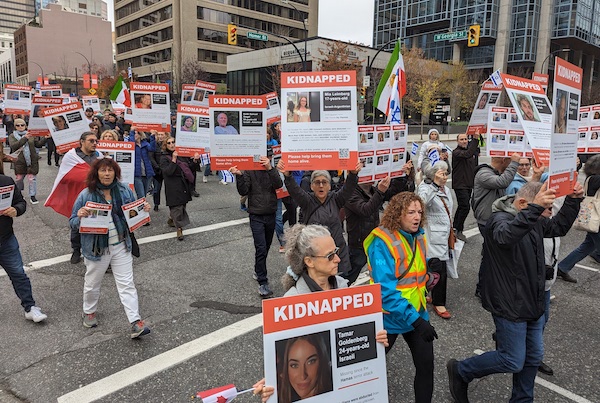
Rally and march for hostages

Rally and march for hostages

Hundreds marched on Oct. 22, calling for the release of the more than 200 Israeli hostages being held by Hamas and other terror groups in Gaza. (photo by Pat Johnson)

Erez, aged 12, and his sister Sahar, 16, had spent the night at their father’s house in Kibbutz Nir Oz when Hamas terrorists stormed the home. The kids jumped out the window and hid in the bushes while gunmen rampaged their community, shooting entire families in their beds and safe rooms. “Mom, be quiet, don’t move,” he texted his mom, Hadas. She texted back: “I love you forever. I hope you survive.”

Erez did not reply. For hours, Hadas called Erez’s cellphone repeatedly, even as she fought for her life, physically blocking terrorists from breaking down her safe room door. Then Erez’s older sister found an 18-second video circulating on social media. It showed Erez in a black T-shirt, being gripped by both arms and led into captivity.

In all, five members of the Kalderon family were taken: Erez, Sahar, their 50-year-old father, Ofer, their 80-year-old grandmother, Carmela, and 12-year-old cousin, Noya, were grabbed from another house in the community.

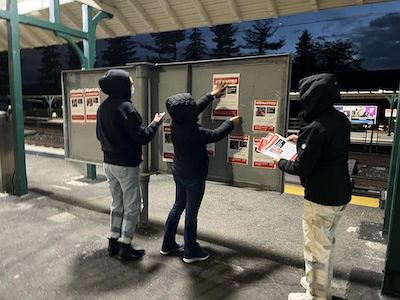
This was one of many individual stories shared at a vigil and march in Vancouver Sunday, Oct. 22, where hundreds of Vancouverites chanted “Bring them home!” and “Let our people go!” as they marched from the Vancouver Art Gallery, protected by a large police presence, along Georgia Street, over to Robson and back to the original site. The steps of the art gallery’s north side were packed with people holding posters of the hostages – and these posters represented only half of the total number of Israeli hostages held by Hamas and other terror groups in Gaza.

The faces are also seen on thousands of posters around Metro Vancouver and elsewhere. Activists in communities worldwide have downloaded and printed the sheets, plastering them around city streets. The Vancouver efforts – which have seen probably 20,000 posters distributed so far – are led by Daphna Kedem, who also initiated the Sunday afternoon event and an earlier vigil two days after the Oct. 7 terror attacks.

photo - About 20,000 posters – the cost of which was covered by two anonymous non-Jewish donors – have been put up by volunteers all around Metro Vancouver
About 20,000 posters – the cost of which was covered by two anonymous non-Jewish donors – have been put up by volunteers all around Metro Vancouver. (photo from Daphna Kedem)

Kedem is also a lead organizer of the local branch of UnXeptable, which, until the current crisis, was agitating against proposed Israeli government efforts to undermine responsible government there. Her current activism, she stressed, is done in her capacity as an individual, but she expressed gratitude to Rabbi Dan Moscovitz of Temple Sholom for helping organize, and to other synagogues, the Jewish Federation of Greater Vancouver and others for unhesitatingly jumping in to help.

Putting a human face to the hostages is the right thing to do, Kedem said.

“We have to bring it out to the public because it’s a humanitarian crisis,” she told the Independent. “Once you personalize it and you see that it’s an innocent baby or a child, you care more.”

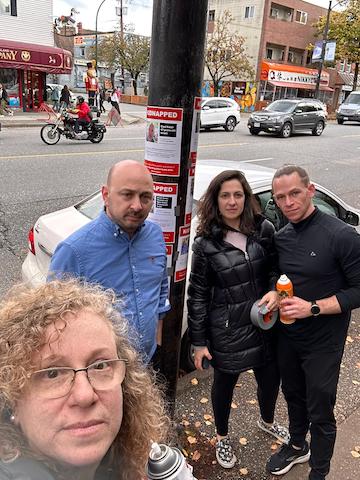
photo - Left to right: Flavia Markman, Ezra Shanken, Anet Bernadette and William Wolff. The four are among the many volunteers who have put up around the city approximately 20,000 posters with the faces, names and ages of Israelis taken hostage by the terrorist group Hamas. For more on the Bring Them Home Now effort
Left to right: Flavia Markman, Ezra Shanken, Anet Bernadette and William Wolff. The four are among the many volunteers who have put up around the city approximately 20,000 posters with the faces, names and ages of Israelis taken hostage by the terrorist group Hamas. For more on the Bring Them Home effort. (photo by Flavia Markman)

Kedem said the cost of printing the thousands of posters was covered by two anonymous non-Jewish donors and, at the rally this past Sunday, Christian clergy spoke, including a Catholic representative and two evangelical ministers.

Nevertheless, frustration over the silence of so many others was evident in the words of Moskovitz to the rally.

“Once again, Jews are being slaughtered and violently attacked and the world is silent,” he told hundreds of attendees, many carrying Israeli or Canadian flags. “Or they say, ‘Yes, but.’ There is no ‘but’ to murder. There can be no ‘but’ to hate. There can be no ‘but’ to the kidnapping of civilians, of children, of grandparents, of pregnant mothers, of disabled people. There can be no ‘but’ to that. There can be no justification for that. This is 2023, not 1943. And yet ‘Never again’ is happening again right now. The Jewish people will not be silent. You must not be silent.”

Moskovitz slammed the moral equivocation heard in commentary and seen in street rallies worldwide.

“This was not an act of resistance,” he said. “This was not a military campaign. This was not a popular uprising. This was cold, calculated and barbaric murder and rape and kidnapping of innocent civilians, the vast majority of them Jews.”

Motioning to the posters of the hostages, he added: “We call on those in our own city who cheer and celebrate what Hamas has done to these people and thousands of others on that horrible day to stop. Stop cheering the terrorists. Stop denying our grief, our human value. Stop your whataboutism. Stop tearing down pictures of children who have been kidnapped. Stop helping the terrorists. Stop justifying their brutality. Simply, stop.… Find your moral compass. Find the compassion you have for everyone and everything except Jews. Join us in this most basic of human cries: return our children to their parents, return our families to their homes.”

A WhatsApp group, “BTH – Vancouver,” is coordinating the postering activities: to join, visit bit.ly/BTH-Vancouver. Posters are downloadable by anyone at kidnappedfromisrael.com.

Format ImagePosted on October 27, 2023October 26, 2023Author Pat JohnsonCategories LocalTags Bring Them Home, Daphna Redeem, Gaza, Hamas, hostages, Israel, terrorism
Funds to help Israel pour in

Funds to help Israel pour in

Jewish Federation of Greater Vancouver chief executive officer Ezra Shanken on Victoria Rumble Room Oct. 14. Shanken has very much been the face of the Jewish community in recent days. (screenshot)

An emergency fundraising campaign in response to the devastation in Israel raised more than $15 million in Metro Vancouver in less than two weeks.

The Jewish Federation of Greater Vancouver is spearheading the Israel Emergency Campaign. In his weekly email last Friday, Oct. 20, Federation chief executive officer Ezra Shanken announced the record total that had been raised to that point. By comparison, last year’s entire annual campaign raised $10.2 million.

Shanken told the Independent that, within the $15 million-plus total, is another new record for the local community: nine gifts of $1 million and a gift of $2 million.

Despite the great success, Shanken said the money will barely begin to approach the needs created by the human and material destruction caused by the Hamas terror attacks and the ongoing aftermath.

“As excited as I want to be,” he said, “I felt like $20 million, which is where we would like to get to, is not even going to be enough. The destruction, both in human life and in physical property, is so immense in the south, the risk is so high in the north, the mental health needs are so huge over there, that those alone are multi-, multi-million-dollar needs.… The damage is so deep that it’s going to take a lot for us to be able to make an impact.”

The Jewish Federations of North America set a goal of $500 million for the combined campaign and was already well past the two-thirds mark at the end of last week. Other Israel-based and Israel-supporting charities are also raising money and delivering support through funds and on-the-ground projects.

The speed and magnitude of the local emergency fundraising effort, Shanken said, may be a consequence of the community campaign already underway for the redevelopment of the Jewish Community Centre of Greater Vancouver. He calls it the “JWest effect,” referring to the name of the redevelopment project. Sensitizing philanthropists to community needs may have sowed the field for the extraordinary generosity shown when this unanticipated catastrophe occurred. The feeling that this is an unprecedented historical moment is also a factor.

For media in British Columbia and at public events, Shanken has very much been the face of the Jewish community in recent days. Speaking personally, he described the flood of contradictory emotions he has experienced.

“This time has been a mix of incredible pride and incredible pain,” he said. “They come in different waves. I have incredible moments of pride and incredible moments of resolve and strength and incredible moments of weakness and pain and depression.”

Shanken continued: “It’s a tough time for all of us, it’s a tough time for me.… But I believe more than ever that these are the moments where we are really forged in these fires and we will be a stronger community because of what we’re going through in this moment.”

The inhumanity witnessed not only in Israel but closer to home, with protests and statements effectively supporting and celebrating the mass murders, has stiffened his resolve, he said.

“I feel a need to stand up against those who are really trying to push us down in this moment,” he said. “I feel strong, I feel determined, I feel righteous in this moment in pushing back against those who are going to minimize the deaths of these folks, that are going to make us feel that we don’t have a right to grieve, we don’t have a right to defend ourselves, we don’t have a right to care for each other. I have no stomach for that anymore and we’re not going to keep our mouths shut on this.”

Funds raised will be allocated through several different projects working directly in Israel (click here for story). While most of the devastation from the Oct. 7 attacks is in the country’s south, the Vancouver Jewish community’s partnership region, Etzba HaGalil, the Galilee Panhandle, and other parts of northern Israel, have experienced attacks from the terror group Hezbollah, from their bases in southern Lebanon. Kibbutzim, villages and towns within a several-kilometre range of the Lebanon border have been largely evacuated. In all, about 200,000 Israelis from the north and south have so far been displaced by the crisis.

“The north is a major, major concern for Israel, it’s a major concern for us,” said Shanken. “So, we are trying to get them prepped up and ready, get emergency war rooms together in community centres, those kinds of things. We’re looking at some other kind of resiliency-building pieces in subsequent tranches of money that will be sent.”

Donations to the Israel Emergency Campaign can be made at jewishvancouver.com/israel-fund.

Format ImagePosted on October 27, 2023October 26, 2023Author Pat JohnsonCategories Israel, LocalTags Ezra Shanken, fundraising, Galilee Panhandle, Israel, Israel Emergency Campaign, war

First allocation of funds

In the Vancouver Jewish community’s Upper Galilee Partnership Region, thousands of residents have been evacuated. Funds raised here will provide emergency preparedness funding, which will be directed to strengthening preparedness with emergency war rooms for community centres. A week’s worth of food and other necessities will be delivered to vulnerable families in Kiryat Shmona in the event of an attack.

The initial transfer of $2.1 million from the $15 million raised by the Jewish Federation of Greater Vancouver’s Israel Emergency Campaign has gone to the following programs:

  • Jewish Agency for Israel Victims of Terror Fund provides immediate grants to assist victims within 48 hours of their homes being damaged by rocket fire, as well as long-term rehabilitation grants to allow those impacted by terrorism to receive the post-trauma care they require.
  • Respite for Olim Living in the South provides a five-day respite period for 2,000 olim, newcomers to Israel, from absorption centres in southern Israel, so they can sleep through the night without fear of running to shelters. Olim who do not want to leave their homes can benefit from respite activities within the absorption centres, including entertainment and educational programming for children and teens to take their minds off the current situation temporarily and allow parents a few moments to themselves to address their own needs.
  • Joint Distribution Committee Support for Disabled Populations of the South delivers services for people with disabilities, including a designated hotline staffed by psychologists and social workers.
  • Israel Trauma Coalition Direct Mental Health Care provides immediate, direct care to minimize the number of people who suffer from post-traumatic stress disorder. In addition to providing their usual crisis care, ITC is supporting bereaved families, families of the missing and abducted, and injured individuals and their families.
  • Israel Association of Community Centres Emergency Financial Aid funds community centres in two southern communities to help them meet needs such as buses to evacuate residents, day outings to amusement parks and nature excursions, overnight retreats, purchasing of emergency and medical equipment and provisions, electricity generators, recreational equipment for children, food parcels, diapers, toiletries, and more.
  • Dror Israel Evacuated and Hospitalized Teens and Youngsters offers therapeutic and educational programs for children and families in Rehovot, Ashdod, Kiryat Gat and Ashkelon, with more locations opening as soon as it is deemed safe. Daycare for children of hospital workers, day camp activities at hospitals for kids ages 3-12, as well as in-person and online programming are offered. Dror Israel is working with communities in which it is already embedded and with whom the counselors already have established trusting relationships.
  • Kedma Southern Student Communities works with mental health professionals to provide on-the-ground support to the shattered communities of the south and brings students there together as a community. This includes support and informal programming to fortify community resilience and minimize risk of post-traumatic stress disorder. Funds will support 10 communities over three months.
  • United Hatzalah Protective Gear for Volunteers and Helpers will receive funding for 40 protective gear units for 40 first responders.
  • Shalva – Supporting Disabled Residents of Southern Israel is assisting more than 1,000 evacuees with disabilities from southern Israel, who are expected to arrive at the Shalva National Crisis Response Centre over the coming days. Funding will ensure they have the clothing, medications and supplies they need, while providing them with the social services support they require to process the recent trauma.
  • Beit HaLochem – Supporting Veterans from Southern Israel supports senior veterans suffering from post-traumatic stress disorder as well as newly injured veterans.

Federation will continue to monitor the evolving situation and needs in Israel to prioritize the next round of grants.

To donate, visit jewishvancouver.com.

– Courtesy Jewish Federation of Greater Vancouver

Posted on October 27, 2023October 26, 2023Author Jewish Federation of Greater VancouverCategories LocalTags aid, fundraising, Israel, terrorism, war
Two world premières

Two world premières

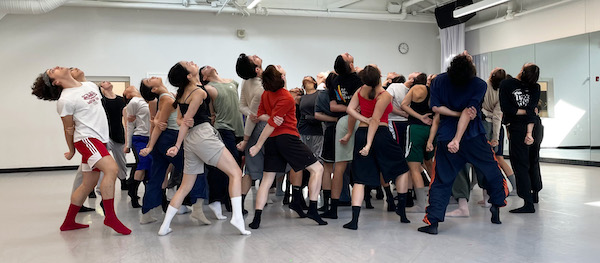
Artists of Ballet BC and Arts Umbrella practise Shahar Binyamini’s BOLERO X. Part of HERE, which runs Nov. 2-4, the work brings 50 dancers on stage for the first time in Ballet BC history. (photo by Marcus Eriksson)

Ballet BC begins its season Nov. 2-4 with HERE, a diverse program that includes two new works from choreographers who have never worked with the company before, and the return, by popular demand, of Enemy in the Figure by William Forsythe.

“Each work stands on its own, and there are no common themes, so to speak,” Ballet BC artistic director Medhi Walerski told the Independent. “It invites audiences to create their own narrative and interpretation, allows for personal engagement, and invites them to explore the scope of human connection and expression.”

One of the new works featured is the world première of Israeli choreographer Shahar Binyamini’s BOLERO X.

“I have been following Shahar’s work for awhile, and I was eager for both the company and the audience to immerse themselves in his distinctive style and choreographic language,” said Walerski.

It will be the first time Binyamini is presenting his work in North America, Walerski added, “and it is a privilege that he has chosen Ballet BC for this special occasion.”

BOLERO X brings 50 dancers to the stage – the most in Ballet BC history.

Of the logistics, Walerski said a multitude of factors come into play. “Scheduling is at the forefront, both in the studios and at the theatre. Fortunately, we’re collaborating with Arts Umbrella Dance, sharing a common vision of turning the impossible into reality.

“On the production side, the costume department is putting in tremendous effort,” he said. “Led by our dedicated head of wardrobe, Kate Burrows, our incredible team is going the extra mile to bring that vision to life. Our rehearsal directors are navigating a new experience of rehearsing many dancers at once, and they are doing this brilliantly. It shows the professionalism and dedication of our remarkable team.”

Binyamini returned to Vancouver to work with the company this week. It is important that such performances continue, even when there is a war going on “because the arts and creation are amazing bridges in order to build trust,” he said. “What we see happening could easily happen anywhere else and be used as inspiration for other conflicts to accelerate in the same direction. The crime against humanity is the destruction of trust and, in order to build trust, you need to create channels into humanity. Dance could be a very important vessel or tool to connect people. And this is what gives me the motivation to be here and working. Because what I do is important, especially now.”

“Art has this unique power to breathe life into the world, and it brings vitality into our everyday lives,” said Walerski. “It is an incredible force that transcends boundaries. It has this magical ability to bridge gaps between people, regardless of geographical or cultural differences. It’s like a vibrant thread weaving through the fabric of humanity, connecting hearts and minds. It brings a sense of unity and shared understanding, nurturing a profound connection among individuals who might otherwise seem worlds apart.”

The press material for BOLERO X says “the creation explores themes of unison and repetition, while still allowing for individuality and stand-out solo and duet performances.”

“I’m focusing more and more on the dancers’ uniqueness in relation to the large group,” said Binyamini. “There is unison, but individuality within that unison. Here at Ballet BC, I find I can explore more the individual aspects and solos. These dancers are so generous and they give you everything – all they have. It’s very rewarding.”

Maurice Ravel’s 1928 composition, Bolero, “is very repetitive, obviously, the melody itself, but the orchestration brings more layers,” Binyamini explained. “A long crescendo of something getting more intense has been very present in my work previously. It’s what turns me on. So, when I started working with Ravel, I tried various works, but got fixated on this and it felt like it really fit. It allowed me to focus on something I was already into, but gave me the anchor and licence to clear out all the unnecessary thoughts or feelings. I decided to just focus on the musicality and the playfulness, which allows the dancers to stay playful.”

Binyamini was not at all daunted by the challenge of having 50 dancers on stage.

“I felt and still feel how much of a force it is to react to, and to say yes to. To have a dialogue with 50 dancers is such a powerful thing in the studio and it enables me to be in the moment, especially with all the other things going on in my life,” he said. “I feel very comfortable working with a lot of people.”

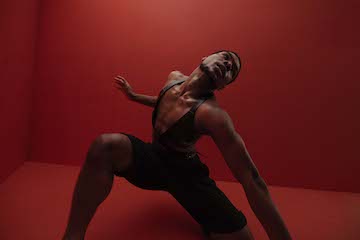
photo - Ballet BC artist Sidney Chuckas at work in the studio ahead of the season opener HERE
Ballet BC artist Sidney Chuckas at work in the studio ahead of the season opener HERE. (photo by Marcus Eriksson)

The other new creation – and world première – being presented in HERE is Stephen Shropshire’s Little Star. Originally commissioned by former Ballet BC artistic director Emily Molnar, its trip to the stage was delayed by the pandemic.

The inspiration for Little Star was composer Angelo Gilardino’s “cycle of guitar variations based upon ‘Ah vous dirais-je Maman,’ a popular children’s song originating in 18th-century France and adopted for the English-language lullaby ‘Twinkle, Twinkle, Little Star,’” explains the press release. “Shropshire’s movement language for the creation is dynamic, beginning with themes suggesting something child-like and playful, before evolving into something more intricate and complex.”

Rounding out the HERE program is Forsythe’s Enemy in the Figure, which was mounted by Ballet BC in 2018. Set to music by Thom Willems, the work involves improvisation, which means that each performance is different.

“Dance can tell a universal story, like music,” Binyamini said. “I think it’s very challenging to tell a story based on movement, but, when doing it correctly, it’s very effective and has the potential to go much deeper than words, because it’s something we all have in common. We can all relate to physical effort, and have empathy for someone that is moving. You can connect to that energy. To be able to tell a universal story through movement is a big challenge, but very satisfying.”

HERE takes place Nov. 2-4, 8 p.m., at the Queen Elizabeth Theatre. Tickets, starting at $19, are available at balletbc.com.

Format ImagePosted on October 27, 2023October 26, 2023Author Cynthia RamsayCategories Performing ArtsTags Arts Umbrella, Ballet BC, Bolero X, Israel, Medhi Walerski, Shahar Binyamini
Share delight of letters

Share delight of letters

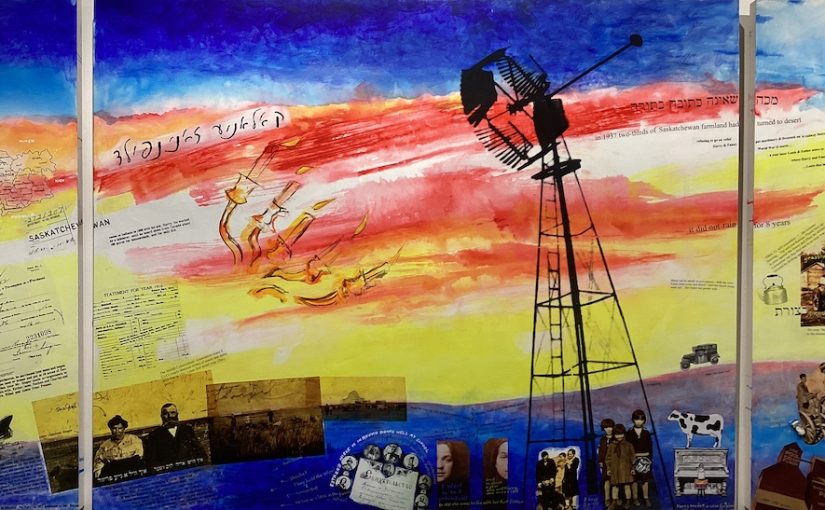
“Shabbat Saskatchewan,” by Esther Tennenhouse. Part of Otiyot (Letters), a joint exhibit with her son Joel Klassen, which is now at the Zack Gallery.

Colourful and playful, dark and ominous, Esther Tennenhouse’s artwork is engaging and thought-provoking, as she offers her take on Torah and midrash, immigration and language, orthodoxy and modernity. Otiyot (Letters), an exhibit she shares with her son Joel Klassen, opened at the Zack Gallery last week.

Tennenhouse’s sense of humour, curiosity, imagination and sincerity come through in the work on display, and in her responses to questions about the exhibit.

“Ot means ‘letter’ (of the alphabet) – it also means ‘sign’ and ‘signal,’” she told the Independent. “It was my first choice of name for the show: Ot – Starring the Letter Shin. Sounds like ‘ought,’ as in ‘thought.’ Ot was visually terse (and sounds adorable). That was why it was Ot in [the] JCC program book – I had to provide that bit before these pieces were made! Yikes! But it got changed to the longer plural in Hebrew and lost its zap. More truthful, though, as I have so many (too many) words of explanation on the wall beside each piece.”

All the works were made specifically for the exhibit, said Tennenhouse, “only for this place, for anyone who happens to walk into the JCC,” where the Zack Gallery is located.

“I was driven by my own relationship to the alef-bet: me, a quite secular, second-generation, Winnipeg-born Jew living in Vancouver, of prairie-born parents, who learned my aleph-bet as a child, quite long ago. I think many like me, with my sort of education, walk by these gallery doors, so I thought they might wander in and relate.”

Born and raised in Winnipeg, Tennenhouse went to Talmud Torah there from age 4 to 11, then to public school. She earned a bachelor’s in English and, while working at the Winnipeg Free Press, majored in sculpture at the University of Manitoba School of Art.

She moved to Aklavik, in the Inuvik region of the Northwest Territories, and then to Yellowknife, where she learned about ceramics at the Yellowknife Guild of Arts and Crafts. She later worked with translucent clays.

Moving with her family – husband Ron, son Joel and daughter Timmi – to Vancouver in 1995, Tennenhouse found a home at Or Shalom, participating in the Talmud and Torah study offered there, reengaging in Jewish education after a break of some 45 years.

Klassen also attends Or Shalom. His art background includes having drawn at home and working with painter Sylvia Oates – who he describes as a mentor – in her Parker Street studio. Klassen has had a one-man show in artist Noel Hodnett’s Parker Street studio, and he was in the Kickstart Disability Arts and Culture’s 2019 group show Nothing Without Us at the Cultch. For the past four years, he has attended the JCC’s Art Hive, which is facilitated by Kim Almond.

Klassen’s Hebrew letters and drawings are in five of the pieces at the Zack Gallery, said Tennenhouse.

“Making letters as individuals, each with their own character, was the most fun to do,” she said. “Jan Wilson, a friend and quilter, offered to help if I drew out the correctly sized letters backwards for transfer and picked the fabrics.”

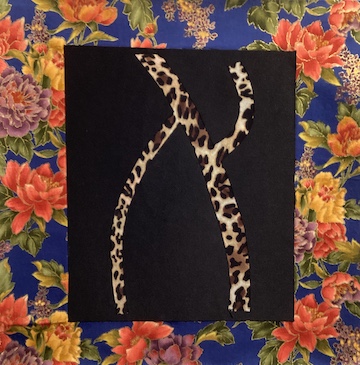
The letters comprise eight of the works on display, and offer much to think – and smile – about. Klassen’s aleph is filled in with leopard print fabric, surrounded in black with a flowered border. The word “wild” comes to mind as one looks at it, not just the wildness of animals and nature, but of human beings. The piece is called “Aleph in the Garden.”

photo - “Aleph in the Garden” by Esther Tennenhouse, Joel Klassen and Jan Wilson
“Aleph in the Garden” by Esther Tennenhouse, Joel Klassen and Jan Wilson.

“I did not shy away from diversity,” said Tennenhouse. “It’s sort of an underlying element. I felt the show had to offer something to any individual, whatever their history with the alef-bet, and it deals with very well-trodden themes. I felt a need for an element of surprise, which is one reason why Joel’s aleph became a leopard in the garden (of Eden?).”

A last-minute addition to the depictions is one of the 12 new letters for gender-neutral word endings that were created by Israelis graphic designer Michal Shomer a few years ago.

“They appeared in welcome signs outside schools and on IDF buildings, etc., but the kabbalist idea of the power of the alphabet lives on – the new letters were vigorously rejected by religious factions,” said Tennenhouse. “‘Changing the letters removes any kedusha (sanctity) the words have or any ability the words have of channeling God’s energy into the world,’ said sofer Rabbi Abraham Itzkowitz. ‘This project essentially makes Hebrew like any other language.’ Some of the signs were taken down. Religious schools were forbidden to use them.”

That said, Tennenhouse told the Independent, “What first tickled me into this aleph-bet project was the poetry and passion of the ideas of the early mystics. They conceived of letters of the alef-bet existing even before the creation of the world – all 22 were vessels of the divine, all things were created by their combinations. Meditative/ecstatic kabbalah taught that individual letters were something to meditate upon, which led to ecstasy, one of the steps to sense of union with G-d. American calligrapher Ben Shahn, who titled one of his books Love and Joy About Letters, quotes the 13th-century Rabbi Abulafia, who said the delight in combining letters is like being carried away by notes of music.”

Tennenhouse and Klassen’s “Shir” (song, poetry, chant, in Hebrew) is truly delightful, like a page out of a children’s book. A multimedia piece, it depicts several animals and the sounds they make, both in Hebrew and in transliteration, though the giraffe just “hum[s] at night.”

Two other works are striking, both on their own and in contrast to each other: Sinai 1 and Sinai 2.

photo - Detail of "Sinai 2" by Esther Tennenhouse and Joel Klassen
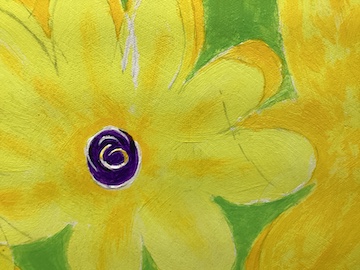
Detail of “Sinai 2” by Esther Tennenhouse and Joel Klassen.

The latter features three bright yellow flowers, surrounded by green. “It is a triangle canvas which is about the mountain bursting into bloom when Moses came down with the Ten Commandments – this was a midrash from the 1500s. The triangle has flowers by Joel. I asked him to put flowers on it, envisioning little flowers here and there – he just went swoosh woosh on it.”

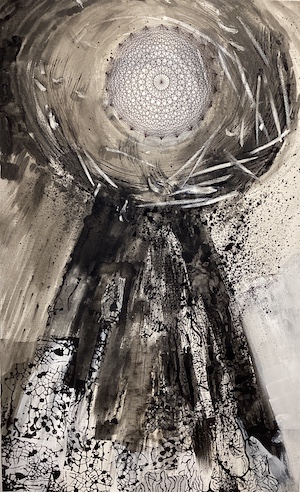
Sinai 2 is a vertical rectangle with whites, greys and blacks depicting a furious ball of activity on top of the mountain that includes the Hebrew letters.

photo - "Sinai 1" by Esther Tennenhouse
“Sinai 1” by Esther Tennenhouse.

“The Torah tells of fear, awe, the shaking mountain, seeing sounds, lightning, Moses’ anger, the breaking tablets,” said Tennenhouse. “Looking back, I overburdened the canvas [with] anger, though laying on the 231 Gates – a diagram from the Sefer Yetzirah which shows each letter combining with each other letter of the alef-bet – because I see the story of the giving of the Torah as a sort of creation story for our intense embrace of literacy. The diagram relates to Rabbi Abulafia’s talk of combination of letters but distracts visually from the anger/violence, [the] mountain, fear.”

There is so much more in this exhibit.

“Cursive Handwriting: Kovno Testament” is a stark, unfinished work, featuring the words, written in his own hand, of Lithuanian writer Eliezer Heiman, who died in the Kovno ghetto during the Holocaust. It was to have three more samples of cursive, said Tennenhouse. “I left room for them before I put on the image of Heiman’s tablets. Those spaces stayed empty. Everything else edited themselves out because of what happened in Israel on Oct. 7.”

There is the multimedia triptych “Shabbat Saskatchewan,” which Tennenhouse said “is me trying to use real photos and documents to create some presence of my mother’s grandparents and parents.”

“It ended up being centred on great-grandmother Esther Dudelzak Singer, Baba Faige (Fanny) Singer and my mother with her sisters,” she said. “Yiddish was their mamaloshen (mother tongue) and the Sonnenfeld community was religiously observant.”

“The Owl and the Pussy Cat” adds colour and vibrancy to Edward Lear’s black and white drawing of his nonsense poem, the Yiddish translation of which – by the late Marie B. Jaffe – fills the two side panels of this triptych. Tennenhouse couldn’t find much information out about Jaffe, she said, “But, thanks to Eddie Pauls at the Jewish Public Library in Montreal, [I] learned she immigrated to New York in 1909 from Lithuania.”

Tennenhouse began to see the owl and the cat in their boat as sailors braving the rough seas, traveling around the world to find “Di Goldene Medine,” “the Golden Land,” America.

“You might say ‘Saskatchewan,’ too, is about leaving home, traveling across seas and finding a new place but keeping your language and culture,” said Tennenhouse.

Otiyot (Letters) is on display at Zack Gallery until Nov. 12.

Format ImagePosted on October 27, 2023October 26, 2023Author Cynthia RamsayCategories Visual ArtsTags art, Esther Tennenhouse, Joel Klassen, multimedia, Otiyot, painting, Zack Gallery
Trauma, loss and hope

Trauma, loss and hope

Composer Rita Ueda has written an opera inspired by Barbara Bluman’s book I Have My Mother’s Eyes. (photo by Danilo Bobyk)

“In light of what is happening in the news today, we need to tell the story of Chiune Sugihara and the Bluman family more than ever,” composer Rita Ueda told the Independent. “I suspect more and more world leaders, communities and individuals will be faced with the decision to either do the easy thing, or the right thing. We need to tell ourselves more stories of compassion, courage, healing and family love.”

Ueda’s chamber opera I Have My Mother’s Eyes: A Holocaust Memoir Across Generations premières at the Rothstein Theatre Nov. 18-19, as part of the Chutzpah! Festival. Directed by Heather Pawsey, the opera tells the story of Sugihara, the Japanese diplomat who risked his own life during the Holocaust to issue visas to Jews, including members of Vancouver’s Bluman family. Its title comes from the late Barbara Bluman’s book of the same name, which was published in 2009, five years after her death from cancer.

“I don’t think I fully knew why I wanted my mother’s book published … when I immersed myself in this legacy project,” said Danielle Schroeder. “Looking back, bringing her story and my grandmother’s stories to life brought me a lot of comfort and meaning as I grappled with the profound sense of loss her death brought…. Also, at the time it was published, stories about the impact of intergenerational trauma and resilience were not being written about that much in the mainstream, so I felt my mom’s book was unique in the way it interweaves and interconnects her and her mother’s stories of trauma, loss and hope. And, of course, being able to share with the world the story of courage, generosity and compassion of the Sugihara family was also important to me.”

Ueda found out about the Bluman family in 2017, through an installation at the Maritime Museum, and reached out to George Bluman, Barbara’s brother. She was moved by the intergenerational nature of I Have My Mother’s Eyes.

“Zosia [Susan] Bluman’s escape from the Holocaust is only a part of the story,” she said. “The story of how the next two generations carried on the family legacy affected me to the core. When George suggested I expand the opera to include the story of the three generations of the Sugihara family that saved them, I became compelled to create the opera!”

“I was very touched and honoured that such a well-respected Canadian composer would want to write an opera about my mom’s book,” said Schroeder. “Especially after meeting Rita in person and learning … how my mom’s book impacted her, it was easy to say ‘yes.’”

Ueda’s opera is inspired by Barbara Bluman’s book, rather than based on it.

“Opera is best suited to convey the characters’ emotional journey,” Ueda explained. “The opera covers all three characters from the book – Zosia, Barbara and Danielle – the three generations of the Bluman women, and their love for each other in light of all the events in their lives. Materials on the three generations of the Sugihara family were based on my two visits to the Sugihara family in Tokyo. Madoka Sugihara spent over five hours with me on each visit, and she showed me many photos and books. She let me play [her grandfather] Chiune Sugihara’s collection of sheet music on his piano, and she told me many family stories. I was truly moved by the two families’ journey of survival, healing, and love for each other.”

George Bluman shared a bit about the real-life people depicted: Zosia, Barbara and Danielle on the Bluman side and Chiune, Yukiko, Hiroki and Madoka on the Sugihara side.

Bluman’s mother was born in 1920 and died in 2004. “Her story, before coming to Vancouver in July 1941, comes to life in I Have My Mother’s Eyes,” he said. “In Vancouver, she worked as a salesperson/buyer in women’s clothing at Cordell’s and Jermaine’s. She was one of the founders of the annual Warsaw Ghetto memorial program, the forerunner of the current annual Yom Hashoah commemoration. Mum is featured in the 2000 PBS documentary Sugihara Conspiracy of Kindness, as well as in the Holocaust museums in Washington, New York and Los Angeles. She loved her family, hosting raucous weekly Sunday dinners for all, often including her children’s friends.

“My sister, Barbara Bluman (1950-2001), graduated from UBC Law School in 1975, among the first large class of women. She was an independent thinker and feminist who lovingly balanced raising her children and her career in law. Her commitment to human rights was demonstrated in all of her pursuits…. Her deep dedication to Holocaust understanding led to her contribution to the Gesher Project, a second-generation cultural exploration of the Holocaust, and organizing an important symposium on the Nuremberg trials.”

Bluman said that, from 1996 to 2000, his sister made notes from 19 interviews with their mother. “Excerpts from these notes formed the basis for her book,” he said, praising his niece’s efforts in getting the book published.

“Yukiko Sugihara (1913-2008) married Chiune Sugihara (1900-1986) in 1936,” said Bluman. “In 1993, my family first met her, together with her oldest son, Hiroki (1936-2002), and Michi (Hiroki’s wife) for a few hours at the Vancouver airport during a stopover on their way to a dinner in Toronto organized by Ontario Premier Bob Rae involving the Jewish and Japanese communities. There was a spontaneous outpouring of strong emotions. To me, in her demeanour, she was an empress! She knew no English and I no Japanese, but I felt what she was saying. My mum and Barbara attended the dinner in Toronto, where the principal guest speaker was David Suzuki.”

There were a few other encounters, and Bluman said he and his brother Bob have corresponded regularly with Madoka. “I have met her twice in visits to Japan,” said Bluman, noting that Bob joined him on the second visit.

“Madoka is a very gracious person and works passionately on making the world aware of the heroic legacy of her grandparents. According to Madoka, her grandmother Yukiko played a most essential role in the Sugihara story.”

Ueda’s opera is “especially meaningful,” said Schroeder, “because it brings my mother back to life and honours her in such a profound way.”

She added, “I wouldn’t be here if it wasn’t for the Sugihara family, so to see a piece of art be created that brings our family together is moving beyond words.”

photo - Teiya Kasahara as Yukiko Sugihara and Barbara Ebbeson as Zosia Bluman in I Have My Mother’s Eyes, which is part of the Chutzpah! Festival
Teiya Kasahara as Yukiko Sugihara and Barbara Ebbeson as Zosia Bluman in I Have My Mother’s Eyes, which is part of the Chutzpah! Festival. (photo by Flick Harrison)

It has taken seven years to get to this point – the opera’s première.

“George and Danielle have been wonderful to work with,” said Ueda. “They have shown me photos (which you will see in the production) and shared family stories with me. They also introduced me to the wonderful Sugihara family.”

Ueda shared “two fun facts”: George Bluman, an emeritus math professor at UBC, trained her brother, a former math professor himself; and she has received permission to turn Yukiko Sugihara’s Midnight Sun Songs, poems that chronicle her story as the wife of Chiune Sugihara, into a sequel to I Have My Mother’s Eyes. The world première will be in Tokyo in October 2024.

Ueda has been composing since she was a toddler. “My late mother was an opera singer, so I grew up in a household with music,” she said. “My early musical ‘scores’ were crayon drawings of picture-representations of the sounds I improvised at the piano. My very first composition teacher when I was 3 (who was about 95 at the time) encouraged me to improvise at the piano and to keep on ‘drawing’ scores in crayon colours, even though his own teachers in the 1880s were Helmholtz and Tchaikovsky. He also arranged for me to see many concerts and events with composers such as Steve Reich, Earle Brown and John Cage.”

The environment, human rights and other societal issues have inspired Ueda’s work. “People in the audience do not need to agree with what I say in my music, but I want them to use the experience as a catalyst for important community dialogue,” she said.

For Ueda, opera is the perfect medium for telling a story with a strong emotional content.

“Opera cannot deliver a blow-by-blow story like a TV drama, film or documentary,” she acknowledged, “but music combined with voice can speak to you at the deepest, most profound level. Through opera, I hope to tell engaging and relevant stories that are important to us – who we are, what we stand for, and what we believe in. European opera has had a history of elitism throughout the past 400 years, but recent Canadian opera productions have been changing this. I hope I Have My Mother’s Eyes will contribute to this change.”

For tickets to see I Have My Mother’s Eyes, visit chutzpahfestival.com.

Format ImagePosted on October 27, 2023October 26, 2023Author Cynthia RamsayCategories Performing ArtsTags Barbara Bluman, Chutzpah! Festival, Danielle Schroeder, George Bluman, Holocaust, intergenerational trauma, opera, Rita Ueda, Sugihara
A mission to encourage

A mission to encourage

Aren X. Tulchinsky is Vancouver Public Library’s new writer in residence. (photo by Jeff Vinnick / VPL)

As this year’s writer in residence at the Vancouver Public Library (VPL), Aren X. Tulchinsky proudly represents his two cherished identities as a transgender man and as a Jewish person.

“I bring all of my lived experience into the residency,” said Tulchinsky in a Jewish Independent interview. “I am out and proud as a member of the Jewish community and the LGBTQ2S+ community, and I bring my identities with me into the residency. I guess you could say this is a very Jewish and queer residency. The library has been very supportive of me.”

Tulchinsky wears his heart on his sleeve or, at least his right bicep, which is ringed with a tattooed chai in Hebrew letters. “We celebrated the launch of my residency with an evening of words and music, during which I read from new and previous work, and was accompanied by local klezmer musicians,” he noted.

The 65-year-old Toronto native is probably best known for the award-winning 2003 novel The Five Books of Moses Lapinsky, under his former name, Karen X. Tulchinsky, which evokes the 1933 antisemitic riot at Toronto’s Christie Pits park. He has had a varied career in film and television writing, editing and directing, and penning short and long fiction, including lesbian romance, notably the novel Love Ruins Everything.

Tulchinsky came out as lesbian as a teenager, and has been writing stories since.

Tulchinsky was named in September to the VPL post, which was launched in 2005 to promote Canadian literature. Among past resident writers are Miriam Libicki (jewishindependent.ca/drawing-on-identity-judaism), Sam Wiebe, Rawi Hage and Gary Geddes. Last year’s appointee was Black Canadian writer Harrison Mooney, author of the critically applauded Invisible Boy: A Memoir of Self-Discovery.

Tulchinsky, who lives in Vancouver, responded to the VPL’s call for applications and was shortlisted. “Then I was called in for an interview with about 10 people from the programs and learning department at the VPL central branch,” he said.

“It was a bit intimidating to be interviewed by a whole group of people, but I must have impressed them because, a few days later, the manager of the department phoned to let me know that they had chosen me for the position.”

Asked if he thought his being transgender was a factor in his selection, Tulchinsky replied: “Not really. The only way my identity as a transman was significant is that in the posting the VPL was encouraging writers from under-represented groups to apply.

“Judging from most of their past writers-in-residence, I assumed they would give the position to a more mainstream writer, so I have never applied in the past. Their encouragement for writers from diverse backgrounds … is what motivated me to apply.”

One of his chief responsibilities is acting as a mentor to emerging writers, in particular, those from marginal communities.

“It is my mission to encourage writers from marginalized communities, specifically, BIPOC, Indigenous and LGBQ2S+ writers, to attend my (free public) workshops and apply for a spot on my one-on-one consultation afternoons,” Tulchinsky explained. “I think Jews, People of Colour and queer and trans writers all have a lot to teach the mainstream world about our lived experiences. I want writers from under-represented communities to feel comfortable to come forward and let their voices be heard.

“Traditionally, Canadian literature has been dominated by white, straight, cis-gendered men (and a few women). We have a lot to catch up on. We all gain from a more diverse society and more diverse voices in Canadian literature.”

The residency will also allow Tulchinsky time for his own writing, principally, the first draft of a novel entitled Second Son, a family saga that draws on events in his own past.

The main character, Charly (formerly Charlotte) Epstein-Sakamoto, is a biracial, transgender man coming to terms with PTSD resulting from a tragedy that devastated his family decades earlier.

“The heart of the novel is based on my own journey transitioning from female to male, a child’s death in my family, and my experiences in a long-term, interracial, cross-cultural (Jewish-Japanese) relationship,” said Tulchinsky.

“Charly knows he’s a boy, even though his parents, his doctor, his teachers and all the other kids at school insist he’s a girl. When Charly’s brother (the first son and his only sibling) Joshua is killed in a tragic bike accident, his dad is so devastated he sinks into a deep depression, his mother begins an affair with her sister-in-law, and Charly finally begins to assert his true gender identity.”

Tulchinsky is also developing another novel, based on family stories and beginning in Russia in 1941.

“As I was writing the novel and researching the Holocaust, I started thinking about how many Canadians think the Holocaust began in 1939, with World War II, but the reality is the oppression of Jews by Hitler and the Nazis began years before the war, within days of Hitler becoming chancellor of Germany in January of 1933.

“I began writing another novel that begins in 1932, when Germany – Berlin in particular – was one of the most progressive places in the world. In Berlin at that time there were numerous gay clubs and cabarets, safe places for gay men, lesbians and trans people to gather, and the Jewish community was also thriving.

“That all changed overnight once Hitler came to power. I ended up with two new historical novels that I am still working on.”

Tulchinsky’s CV is lengthy, and one wonders how he has been able to be so productive.

“To be honest, part of my diverse career has to do with the fact that I found it impossible to survive as a novelist, even though I had numerous books published,” he said. “I am a graduate of the Canadian Film Centre in Toronto, which provides advanced training in film and television. Since then, I have worked as a writer and video editor on numerous television series. I have found it more possible to make a living in film and TV than I could as a novelist. The downside is I rarely have time to work on novels. This residency at the VPL is affording me time to write, which is a real gift.”

His advice to aspiring writers is be disciplined and tenacious.

“You need discipline to sit in a chair and write or you will never finish a novel. And you need tenacity to get your work published. Most writers get a lot of rejections before they find a publisher. Every time you get a rejection, just send your work out again,” he said.

Being Jewish and queer, Tulchinsky looks with growing dismay at what is happening today.

Twenty years ago, The Five Books of Moses Lapinsky reminded Canadians of a shameful history. It remains among the top 10 Canadian books ever borrowed from the VPL.

The Five Books of Moses Lapinsky follows a Jewish family living in Toronto’s Kensington Market in the 1930s and ’40s and is set against the backdrop of a massive antisemitic riot.

“On Aug. 16, 1933, at an amateur league softball game in Christie Pits park – a neighbourhood filled at the time with Jewish and Italian immigrant families – members of the antisemitic Swastika Club showed up with a giant swastika flag, which set off a riot between Jews and gentiles that involved 15,000 people and lasted throughout the night and is the largest race riot in Canadian history,” Tulchinsky said. “Unfortunately, with antisemitism, racism, transphobia and homophobia back on the rise throughout the world, the themes in the novel are just as relevant today as they were when I originally wrote the book.”

Tulchinsky thinks the current polarizing, often acrimonious, debate over sexual orientation and gender identity (SOGI) issues is “an effort on the part of the political right-wing to inflate the importance of cultural wars to distract people from the real issues we should be focusing on, such as climate change, wealth inequality and homelessness.

“I once saw a bumper sticker that read: ‘If you’re against abortion – don’t have one.’ I think it is the same when it comes to SOGI. If you are heterosexual and cis-gendered, you can either be an ally to the LGBTQ2S+ community and actively support us and fight for our rights, or you can leave us in peace.

“As an out and proud transman, I am just living my authentic life. And I hope I can serve as a positive role model to trans and non-binary kids who are struggling with their identity.”

Janice Arnold is a freelance writer living in Summerland, BC.

Format ImagePosted on October 27, 2023October 26, 2023Author Janice ArnoldCategories LocalTags Aren X. Tulchinsky, fiction, history, Judaism, LGBTQ2S+, Vancouver Public Library, writing

Posts pagination

Previous page Page 1 … Page 113 Page 114 Page 115 … Page 667 Next page
Proudly powered by WordPress