On May 7, in Vancouver, Dr. Noya Shilo, director of Sheba Medical Centre’s Back to Life Clinic, will share firsthand insights into the journey from trauma to healing. (photo from Sheba Medical Centre)
Following the success of last September’s event featuring Sheba Medical Centre’s Prof. Amitai Ziv, Canadian Friends of Sheba are returning to Vancouver with the Sheba Promise Journey: From Trauma to Recovery, taking place May 7.
The special evening in support of Sheba Medical Centre will feature Dr. Noya Shilo, director of the centre’s Back to Life Clinic and a global leader in trauma recovery. Having led the care of returned hostages – work recognized internationally, including at the White House – Shilo will share rare, firsthand insights into the journey from trauma to healing, and how Sheba’s care extends far beyond the bedside. Additional voices from Sheba will also contribute to the evening’s conversation.
At a time when the need for mental health support is greater than ever, Sheba is leading critical initiatives, including the establishment of a clinic for children in northern Israel who are suffering post-traumatic stress disorder. Proceeds from the May 7 event will support these efforts, as well as the Bibas Healing Gardens – therapeutic environments inspired by Yarden Bibas, a survivor of the Oct. 7, 2023, Hamas attacks on Israel. Bibas was held hostage for 484 days, separated from his wife and two young children, who were murdered by Hamas during their captivity.
The Bibas Healing Gardens will support women and children through counseling, emotional care and nature-based healing. These restorative spaces will serve hundreds of families each year as part of their long-term rehabilitation journey.
The Sheba Promise Journey event will begin with an exclusive VIP reception and meet-and-greet, followed by a curated theatre-style program designed to inspire, inform and connect. Sponsorship opportunities and tickets are available, and everyone is invited to join the event and/or support the initiatives. The Sheba Promise Journey also takes place in Toronto (May 4) and Montreal (May 5).
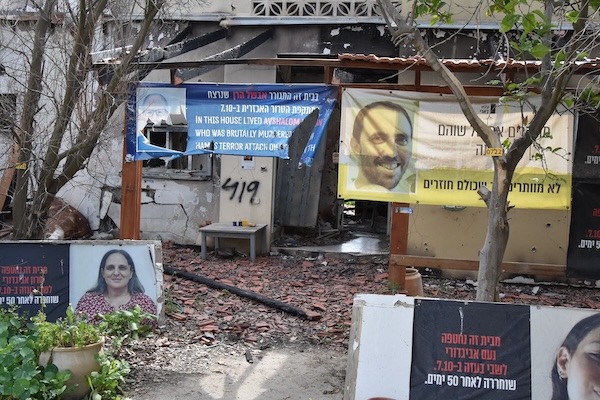
Hundreds of terrorists entered Kibbutz Be’eri. Of the 1,000-plus residents, 101 kibbutz members were killed, 30 people were abducted and one-third of the houses were severely damaged or destroyed. (photo by Larry Barzelai)
My wife and I frequently travel to Israel to visit our three grandchildren. Our interest in Be’eri comes from its special connection with Kibbutz Hatzerim, the birthplace of our daughter-in-law. I feel that the story of Be’eri is a paradigm for the story of the Jewish people, the story of building something magnificent, experiencing a great
destruction and rebuilding afterwards to create something even better. It also illustrates how, when people work together, they can accomplish greater things.
Through a mutual friend, I arranged to meet Yaron, a lifelong member of Kibbutz Be’eri and one who had survived the Oct. 7 massacre. He graciously took me on a tour of the kibbutz as he described the events of that day. Much of what follows are descriptions of the events in his own words. He’s given me permission to share them with you.
On the evening of Oct. 6, Yaron and other kibbutzniks were celebrating the anniversary of the founding of Kibbutz Be’eri. Sharing drinks later with some of his closest friends, they started planning a summer hiking trip in the French Alps.
At 6:30 in the morning of Oct. 7, Yaron heard unusual noises, as he slept with his wife and two young children – both under 5 years old. It sounded like shelling and bombing. When the red alert siren went off, they ran to join their kids in their home’smamad (reinforced security room), which is also the kids’ bedroom.
Initially, Yaron wasn’t too concerned, even after receiving a text that the kibbutz may have been infiltrated by enemies. “OK, I guess we’ll be cooped up in here for a couple of hours,” he thought.
“Messages in the different kibbutz WhatsApp groups start reporting about terrorists walking inside Be’eri,” he writes. “It is close to 8 a.m. Someone writes a message that she hears gunshots.”
Shortly after that, someone reports hearing “terrible screams from the apartment above her, then silence.” Another says that one of the houses in the kibbutz is burning.
Yaron tries to stay calm. The power goes off. Their dog, who is not inside the room, is unusually silent. They hear that someone is in their house.
“They get to the room and try to open the door. I fight over the handle, heart pounding,” writes Yaron. “They don’t succeed! Every time they try, I swing the door handle back to the upright, ‘Safe’ position.”
Eventually, the terrorists give up on opening the mamad. Yaron ignores the calls in Arabic and English to come out of the room. He and his family listen, as the terrorists sing, while wrecking the house. First, there is the smell of gasoline, then smoke enters the room.
A neighbour advises them, via Yaron’s phone, that they should close the gap under the door with wet clothes.
“I take the sheet from my daughter’s bed, pour the bucket of urine on it and jam it under the door,” Yaron writes. “Outside the room, the fire grows fierce, it consumes five years of our lives in minutes…. We are in a closed room, we have no electricity, the children are coughing. I realize that the fire in our home is probably so crazy that even those inhumane monsters can’t still be waiting outside the door. I let go of the handle and I take a deep breath and feel some oxygen flow to my brain. So far, it was the pressure and fear of the terrorists that was suffocating me, but now the smoke is becoming the main problem.”
Yaron’s wife continues to text with neighbours, calling emergency team members repeatedly.
“All of our children’s books are burning outside,” Yaron shares. “Amidst all the terror we hear one of our favourites, a sound book of Arik Einstein songs, catching fire. The fire makes it play, chillingly, one of the happiest songs we know: ‘It’s Saturday morning, a beautiful day….’”
Suffocating on the smoke, the family has no choice but to open a window of their second-floor apartment. Despite the fear of what awaits them outside, the smoke is too much and they climb out onto the metal awning below.
“The four of us are sitting on the metal. We can breathe but we are exposed 2.5 metres (eight feet) above the ground. OK, now what?” Yaron recalls.
They can’t reach the emergency team, so they jump to the ground and hide in a nearby shed. Yaron jumps first, his wife hands him the kids, then follows.
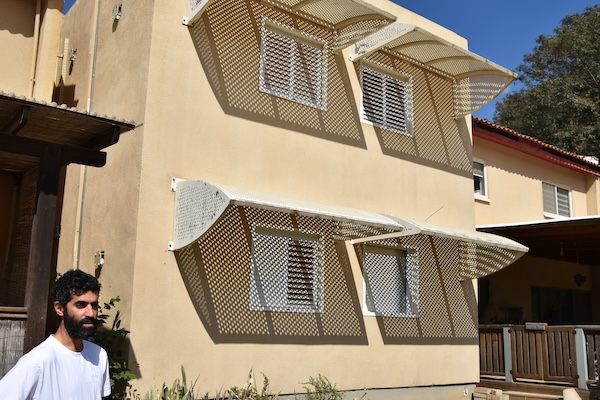
A house identical to Yaron’s, which has been demolished, that gives an idea of the window of the family’s safe room and the challenge of jumping to the ground from the second storey. (photo by Larry Barzelai)
“Another neighbour reaches out, ‘Come to my place.’ I call him. I ask him to risk his life, leave his mamad and open his house for us. He does this while we’re on the phone. We are hesitant to come outside, we are debating with our eyes, and can’t decide if we should stay hidden in an unsafe shed or try to reach a safer place but risk exposure. I ask him to risk his life even more, to take a look outside and verify there are no terrorists in sight. He bravely obliges and says it’s clear. We were in the shed for maybe five, maybe 10 minutes, maybe it was two years, who knows. The kids are silent…. My heart is racing, I open the shed door and we sprint to the neighbour’s house.”
The fire has consumed their own home, and their beloved dog. Temporarily safe at the neighbours’, Yaron sees that the fire might cross over to where they are hiding. “We decide we need to evacuate,” he writes. “At a distance, we spot a few IDF soldiers. A small company or a team…. They escort us to a nearby building where my brother lives. We contact him and he let us in together with two more kibbutz members who had gotten stuck in a similar situation.”
Around 11 p.m., soldiers returned to Yaron’s brother’s place. “They helped us out, they asked us to cover our children’s eyes to shield them from the horrors on the kibbutz lanes and they escorted us to the yellow gate.”
“We made it out,” he writes. “We made it out.”
Most of Yaron’s extended family survived the massacre, except for an aunt who was murdered. In total, hundreds of terrorists entered the kibbutz. Of the 1,000-plus residents, 101 kibbutz members were killed, 30 people were abducted and one-third of the houses were severely damaged or destroyed.
Another victim of the massacre was Winnipeg-born Vivian Silver, who had, prior to Oct. 7, driven patients from the Erez border crossing to hospitals in Israel. She learned Arabic so that she could better communicate with her Bedouin neighbours. She truly believed in a peaceful future between the residents of Israel and the Palestinians of Gaza. Sadly, she was killed on Oct. 7. Her remains were so badly burned that it took weeks to identify her by DNA analysis.
Eli Sharabi, another resident of Be’eri, was kidnapped and taken to Gaza. In his book Hostage, he describes 491 tortuous days in Hamas captivity. He was looking forward to reuniting with his family once he was freed. Instead, upon his release, he discovered that his wife and daughters had been killed on Oct. 7. He cried at their gravesites for two hours, before making the decision that he had to move forward.
Immediately after Oct. 7, Yaron and his family spent many months living in an apartment in the Dead Sea area. They were alive and they were safe, relatively free from missile attacks, but life was far from normal. To say nothing of the trauma they were dealing with, reestablishing a kibbutz lifestyle, while living in a crowded hotel with none of the amenities that glue kibbutzniks together, was challenging.
The family has since relocated to a temporary custom-built village adjacent to Kibbutz Hatzerim. Be’eri and Hatzerim are sister kibbutzim, both founded in 1946. Be’eriwas named for Berl Katznelson, a founding father of Labour Zionism, whose nickname was Be’eri; Hatzerim, after a verse in Deuteronomy (2:23) that mentions hatzerim (farms/enclosures) “as far as Gaza.”
Be’eri and Hatzerim are both traditional socialist kibbutzim, populated mainly by people on the left of the political spectrum. Thus, it was natural for Kibbutz Hatzerim to offer to build a temporary kibbutz adjacent to them for people from Be’eri to live until their kibbutz was rebuilt over a two-year period.
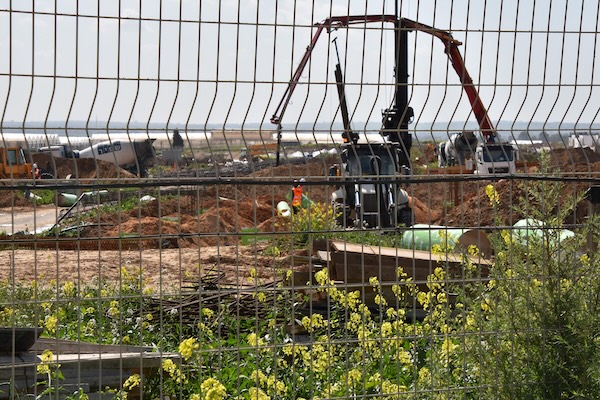
The new neighbourhood on Kibbutz Be’eri, where Yaron and his family are planning on living. The rebuilding of the kibbutz is expected to take two years. (photo by Larry Barzelai)
Most former residents of Be’eri are now living in the temporary kibbutz. Some facilities, such as medical clinics and administrative offices, are shared by the two kibbutzim. Otherwise, the temporary Be’eri has its own houses, schools and offices. Hatzerim expanded its dental clinic, seniors lounge and grocery store to accommodate the increased needs of the larger population. In typical kibbutz fashion, members of both communities met many times to jointly plan this project.
Every day, Yaron leaves his family on the temporary Kibbutz Be’eri to commute 45 minutes to the original. About 60 kibbutz members are living there now, while it’s being rebuilt, and the plan is for most members to return by the start of the school year this September. A printing factory and agriculture are the two sustaining industries on Be’eri.
Yaron’s home, along with 140 others, was destroyed on Oct. 7. Recently, members of Kibbutz Be’eri made a collective decision to tear down all the damaged buildings. They want to try and wipe away the terrible memories of Oct. 7 and build anew. As one part of the construction work, the kibbutz is building a new subdivision, where Yaron and his family are planning to live.
But Yaron isn’t sure that he wants to return. He was born on Be’eri and has lived most of his life there. However, the memory of the trauma of Oct. 7 is very strong. He’s not sure he wants to move back to this place, where so much death and destruction happened. He confided that he may want to live outside of Israel, somewhere he can anticipate a more peaceful future for his children.
Larry Barzelai is a Vancouver family physician, specializing in care of the elderly, who travels to Israel frequently to visit his three grandchildren there. He is presently co-chair of the Jewish Medical Association of British Columbia.
Israeli Minster of National Security Itamar Ben G’vir holds up a champagne bottle in the Knesset on March 30, toasting the passage of Israel’s new death penalty law. (screenshot)
On March 30, two days before erev Passover, Israeli Minister of National Security Itamar Ben-Gvir celebrated the passing of his racist, dangerous, vengeful and unjust death penalty law by raising a champagne bottle and drinking to victory. The customary toast in Jewish tradition, of course, is to exclaim “L’chaim!” (“To life!”) Partly for this reason, the name chosen for the Jewish anti-death penalty group I co-founded, which now includes thousands of members in Israel and abroad, is “L’chaim! Jews Against the Death Penalty.” Those members of the Knesset who support this law have upended the phrase meant to evoke Judaism’s core life-affirming principles.
While Ben-Gvir claims to be a pious and observant Jew, his actions once again reveal his blatant disregard for Jewish values, and an essential mockery of Jewish ritual symbolism. He might as well have screamed “Lamavet” (“To death”) for his celebratory toast. Make no mistake: the passage of this death penalty law will certainly bring death for both convicted terrorists and innocent Israelis and Jews across the world. It is an abomination that will prove disastrous for multiple reasons.
Wine at Passover
One of the most well-known facts about the Passover seder, which both Jews and many non-Jews are keenly aware of, is that it traditionally involves drinking four cups of wine or grape juice. These four cups are a mandatory rabbinic commandment, representing the four expressions of redemption God used in Exodus 6:6-7 to promise freedom to the Israelites. Consumed at specific intervals in the seder, they symbolize freedom, joy, and key stages of liberation, from slavery to becoming a nation.
Perhaps one of the most widely understood reasons for drinking wine on Passover, as on Purim and on any Jewish holiday, is its symbolism of life, joy, sanctification, and transformation used to elevate holy moments like Shabbat, holidays and weddings. It signifies “cheering the heart,” redemption (specifically the four cups at Passover) and divine blessing, while also serving as a reminder of the need for temperance and balance. By lifting a glass for death just ahead of Passover, Ben-Gvir has effectively desecrated this sacred tradition with inverted, grotesque symbolism.
Another tradition of the Passover seder highlights the extent of the sacrilege of Ben-Gvir’s celebration. It is customary for seder-goers to remove 10 drops of wine, one for each of the plagues they chant, symbolizing how the suffering that each affliction produced for our people’s enemies diminishes our joy. This list culminates in the 10th plague of the death of the firstborn of Egypt at the hands of Malakh Hamavet, the Angel of Death. Instead of honouring this Passover ritual, Ben-Gvir profaned it by using wine to glorify killing.
The 10 Plagues
It is most fitting, with Passover only recently having ended, for L’chaim to use the 10 Plagues – with which God cursed the Egyptians in response to Pharaoh’s “hardened heart” – as symbols of the many reasons to oppose the death penalty. We align these biblical maladies with 10 damning strikes against the death penalty to highlight that capital punishment itself is a plague on any society that enacts it. Capital punishment condemns any government that wields it, including Israel now, infinitely more so than any of the individuals it condemns to death.
Dam (Blood): Israel’s death penalty law could increase terrorism, making it more enticing to would-be martyrs (shahids).
Tzifatdeiya (Frogs): It will undoubtedly endanger Jews worldwide.
Kinim (Lice): From Adolf Hitler to Donald Trump, Machiavellian politicians wield the death penalty as a political tool, particularly for election campaigns, and that is the case with this law. Consider the recent examples in Israel of Ben-Gvir’s noose-shaped lapel pin and his video promoting the death penalty law, illicitly filmed at a gallows museum in Jerusalem, as well as Limor Son Har-Melech’s Nazi-inspired Purim costume featuring an injection syringe.
Arov (Wild Animals): Jewish tradition makes the death penalty virtually impossible to carry out. Passage of this law has betrayed the life-affirming core of that tradition.
Dever (Pestilence): Terms like “deterrence,” which is a fallacious delusion when applied to the death penalty, and “retributive” or “proportional” justice, are veils for vengeance. Unequivocally, revenge does not bring closure for murder victims’ loved ones.
Sh’chin (Boils): The death penalty is racist, and this law in particular is viciously discriminatory.
Barad (Hail): The death penalty inherently violates the human right to life. Relatedly, it often results in physical torture, and always is psychological torture, for individuals counting down to their execution day. There is no humane way to execute human beings against their will.
Arbeh (Locusts): Many execution methods are direct Nazi legacies, including firing squad, gassing and lethal injection.
Choshech (Darkness): Capital punishment will traumatize the executioners within the Israel Prison Service. This law also risks placing anyone involved in contravention of human rights treaties.
Makat Bechorot (Death of the Firstborn):The death penalty inevitably risks executing the innocent.
Onward toward repeal
On March 30, the same day that the Knesset passed this barbaric law, a vast coalition of Jewish organizations across Israel and the world immediately petitioned the Israeli Supreme Court to repeal it. The next day, the Supreme Court ordered that the state must respond to the petition and the request for an interim injunction by May 24. The members of L’chaim, together with Jews of good conscience and all of civilized humanity, will continue to do all we can to support this vital, sacred effort.
None other than death penalty abolitionist Elie Wiesel (1928-2016) aptly referred to capital punishment as the “Angel of Death.” It is high time to banish this medieval plague from Israel once and for all. The final uplifting song of the Passover seder is “L’shanah haba’ah b’Yerushalayim” (“Next year in Jerusalem”). It is our consummate hope and intention that next Passover, Jerusalem will see the repeal of this monstrous legislation.
Cantor Michael Zoosmanis a certified spiritual care practitioner and received his cantorial ordination from the Jewish Theological Seminary of America. He sits as an advisory committee member at Death Penalty Action and is co-founder of L’chaim! Jews Against the Death Penalty. Zoosman is a former Jewish prison chaplain and psychiatric hospital chaplain. He lives with his family in Vancouver.
A few days ago, our beloved, big, senior dog had a limp. We went to the vet, on short notice. Our regular vet was away. It was icy and snowy. I got the dog into my 23-year-old car, backed it out of the 123-year-old garage. We made it there on time. The dog got help for what is maybe arthritis or an injury, perhaps from the ice. Driving home, I wondered if I should run an errand but decided, nope, it was windy and raw. The dog should be warm and cozy at home again.
I parked the car in the driveway, got the dog inside and then returned to put my car into our narrow garage. I heaved open the left garage door, planting it into the ice. I hoped the prairie winds wouldn’t slam it shut again. When I got back into the car, it was completely dead. Wouldn’t start.
Then I realized that the heavy garage door had come off its bottom hinge. Huge screws were hanging halfway out. I closed it as best I could and locked it. Inside again, I nearly keeled over because I’d missed eating lunch.
When I warmed up, ate, triaged my work and called the Canadian Automobile Association, I anticipated the worst. The day hadn’t gone as planned.
Yet, CAA help arrived quickly. Miraculously, the fix was simple. A terminal needed to be replaced on my battery. At that moment, the raw day tempered by a cup of hot tea and a moment to think, I was seized with gratitude. What if my car had died on a busy street, with the dog inside? What if we’d been stuck at the vet? What if I’d stopped to run an errand and then been stuck with a car that wouldn’t start and a dog hurting too much to walk home?
Back inside, I looked again at a garage door photo I’d taken. It could have been even worse. What if I hadn’t noticed the screws hanging off the hinge? What if I’d shoved the heavy door and it crushed me underneath it instead? The possibilities were far worse once I’d thought about what happened. This has a happy ending. My husband will repair the hinge when that ice melts. My car now starts. My dog is on medicine and will hopefully be better soon. Gratitude felt like the only answer here.
This was midweek, and we stayed close to home through the weekend. Though we live near downtown Winnipeg, where the national NDP convention took place, we steered clear. At synagogue, one kid played baritone sax for the family service on Shabbat, as little kids danced along in their seats. My other kid greeted families in the lobby as they arrived. Before the wiggly kids got there, we spent a few moments at the main service and did the Birchot Hashachar, the morning blessings, where we thank G-d repeatedly for the good things, the everyday basics, happening in our lives.
On Sunday, our teens spent time on science fair preparation and on helping deliver Passover hampers for those in need, and we adults worked on the household. My husband cleaned steadily but managed to burn something in the microwave, break a pencil sharpener and a cereal bowl. I began to worry again about this weird bad luck, when I thought of the Birchot Hashachar. I remembered what to do. Being resilient meant pausing and finding gratitude instead.
Emergency services had to be called to the high school earlier this week for a student, but, this weekend, my kids are safe, healthy and doing productive things. Though I walked past slogans calling for radical protests at the NDP convention and a woman attendee wearing a keffiyeh at the café right near home, we’re safe, for now.
This year’s celebration of Israel’s birthday feels emotionally like a larger, more difficult version of our small misadventures. War is no joke. Israel is really going through it right now. Via social media, I see these extended family members in my tribe, my community, running for bomb shelters and fighting. Yet, I’m so impressed by the way Israelis strive for beauty and everyday normalcy – trips to the park, surfing and making music – with so much violent disruption. It’s been scary to watch, and I’m not there. That said, maybe the lesson in this birthday is seeing how, after these horrible, life-shattering events, it’s possible to practice that mind shift. The gratitude one, where strangers care for one another in bomb shelters, sharing food, music and space while struggling with what could have happened.
It’s unsettling to be Jewish near a Canadian political convention peddling antisemitic tropes. I’m reeling from seeing a premier who lives near me, who is also a parent I’ve spoken to on the playground, say deeply unsettling words on the NDP stage. Even if Wab Kinew’s “Epstein class” comment wasn’t intended to be antisemitic, his words, about this “dumb war” horrified me.
Jewish tradition teaches that all lives are valuable. Premier Kinew said North American lives shouldn’t be lost – to stop a repressive regime that has already killed thousands of its citizens. Our lives are no more valuable than theirs. Iranians deserve help, as do all the people harmed by the horrible regime and its terror proxies.
In precarious times, it’s helpful to seek the good. To remember that heavy garage door, still dangling off its hinge, the car that died, thankfully, in the driveway and was fixed, and the veterinary help that came when needed. Being grateful and practising joy, even when it’s a strain, is complicated. I want to be happy on Israel’s birthday, but it’s a complicated emotion, too. It requires practising gratitude and celebration even when times are tough, but that’s what we’re “commanded” to do sometimes.
This year, I wish for peace and everything good for everyone in Israel and its neighbours, as well as in other places where conflict reigns. Thank goodness Israel exists, as a place of refuge for all Jews, but it’s OK to wish for safer times at home in the diaspora, too. May the year ahead be an easier one, without war or complication; one in which we can all embrace less fear and more simple joy.
Joanne Seiff has written regularly for the Winnipeg Free Press and various Jewish publications. She is the author of three books, including From the Outside In: Jewish Post Columns 2015-2016, a collection of essays available for digital download or as a paperback from Amazon. Check her out on Instagram @yrnspinner or at joanneseiff.blogspot.com.
Bo begs for more cabbage. A rescue dog, he is slowly learning to trust humans. (photo by Susan Kars)
My friend Susan Kars recently got a male rescue dog from Chile so, of course, I volunteered to come over and speak to him in Spanish. As my husband and I walked into her apartment, we were greeted by a small, black 2-year-old dog with a big growl. And then, all of a sudden, he fell asleep.
“Ihave always been a proponent of animal rescue,” my friend told the Jewish Independent. “I don’t feel that people should buy dogs when there are so many rescues out there … and rescue dogs show a different level of gratitude.”
Susan began walking dogs in 2008 for friends and recently felt that it was time for her to get her own. She believes that healing is part of Judaism. She is a member of Or Shalom, a Jewish Renewal synagogue. She started going there when Rabbi Laura Duhan-Kaplan was the congregation’s spiritual leader.
“Rabbi Laura was amazing. She was really connected to a lot in the universe,” said Susan, who attended the celebration earlier this year of Duhan-Kaplan’s appointment as dean of the ALEPH Ordination Program, the Jewish Renewal seminary.
Susan decided that her new dog’s Spanish name, Bom Bom, wouldn’t work, that calling “Bom Bom” out in a park would sound too much like “Bomb! Bomb!” So, she named him Bo.
My friend volunteers at a supermarket for financially challenged folks and walks with Bo and one other dog once a day.
She tried the Spanish doggie commands I gave her with Bo and had some success. She was and is very determined to heal this dog.
When we met Bo, the poor thing had just spent 30 hours on an airplane and this was his second night in his new home. Susan got him from an organization called Homeless Pets Canada. Unmentionable things had been done to him by humans and he was very suspicious of us.
I asked Susan what kind of dog he was and she exclaimed, laughing: “He’s a mutt!” And that’s what he looked like until she gave him a haircut and a very long bath. Now, I’d say he looks like a very long terrier of some sort, but no one really knows.
Susan has found that training a rescue dog is the most time-consuming thing she’s ever done.
“I left him twice in one day and came home to a full roll of toilet paper shredded all around the apartment. But you can’t get angry at them because they don’t do it to hurt you.”
That same day, Bo “took out a piece of the wall” by pulling at the leash that was hanging on the hook.
Susan put this down to separation anxiety and fear of being in a new place but, weeks later, she also acknowledged that Bo is mischievous. For example, a few weeks after our initial encounter, I was sitting in Susan’s kitchen while she was loading the dishwasher. When she opened a cabinet near the floor, Bo didn’t miss a beat. He grabbed a small plastic funnel in his mouth and marched out into the hallway.
“He’s a sly dog,” Susan said.
Bo also acted up later in the evening. At first, everything was fine. He let me pet him for a long time, licked my hands and even sat down when I said “sientate,” which means “sit down” in Spanish. Then, I threw one of his toys for him to retrieve and all hell broke loose. He started barking and growling and trying to nip me.
Clearly this dog has post-traumatic stress disorder, I thought. And Susan agrees. But she is not allowing this to defeat her. She says it takes three days for a rescue animal to “decompress” and start to realize that they might be OK. It takes another three weeks for their personality to emerge and three months more for them to realize that they are safe and at home with a new life.
Bo already has started to give back. Recently, he comforted one of Susan’s friends whose dog was run over by a car and didn’t survive. Bo sat with the friend on the couch for a very long time.
Susan’s advice to others who adopt a rescue animal is that they should know “this is a major life decision.” She is spending about $500 a month on a long list of items, including vet fees, insurance, food, toys, bowls, mats, a blanket, puppy pee pads, poop bags, leashes, grooming, treats for training and a camera to see what he’s doing when she’s away. Bo has a bad knee, so Susan has had to buy him joint supplements and a set of dog staircases.
It’s not only costly, but time-consuming to care for Bo. But, it’s also so rewarding.
“I smile every day,” she said. “I have something to smile about. When he’s in his round bed and he gives this big release of breath at the end of the day, it’s so satisfying to hear.”
And, my husband and I have something to be happy about, too, since we’ve officially been made Bo’s adopted aunt and uncle.
Since Bo can be a fierce little dog, Susan said she will be training him as a K9 for Israeli intelligence – just kidding! He’s most definitely a Jewish dog though, said Susan, because he goes “berserk” over challah buns. They are definitely his most favourite treat. She left one on a plate for her neighbour and Bo snuck behind her and scarfed it down in seconds.
If you want to adopt a rescue dog, “just know that the hard work is worth it,” said Susan. “You are saving a life and, by taking a dog into your home, there is room for another dog in the rescue centre.”
When she was volunteering for Vancouver Orphan Kitten Rescue Association (VOKRA) about 15 years ago, Susan made T-shirts that said, “Open your heart and empty a cage.”
And that’s exactly what she’s done.
If you can’t adopt a rescue, Susan suggests donating to Homeless Pets Canada, the Society for the Prevention of Cruelty to Animals, VOKRA or other such organizations.
Cassandra Freeman is a freelance journalist and improv comedy performer living in Vancouver.
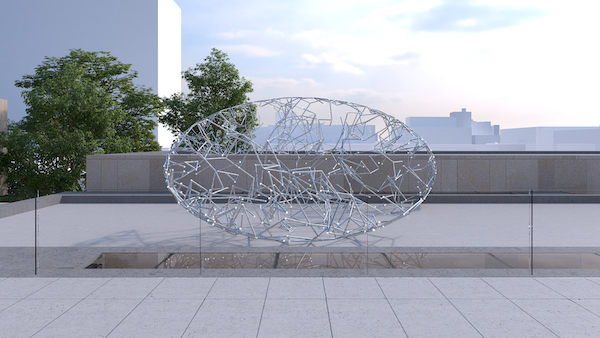
From a specific vantage point, the dispersed lines of Nicolas Baier’s Candelabra – winner of the Montreal Holocaust Museum’s public art competition for its new building – create the shape of a sphere. (photo from MHM)
The Montreal Holocaust Museum (MHM) has selected Montreal-based artist Nicolas Baier as the winner of its public art competition for its new museum opening in 2027.
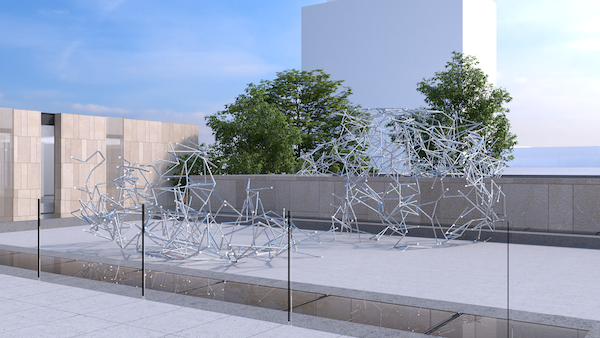
Baier’s artwork, Candelabra, will be installed on the museum’s rooftop terraces. The sculpture is a luminous, constellation-like network of polished stainless-steel lines and points of light set against the Montreal sky. The work is reminiscent of countless survivor stories about imprisonment in ghettos and concentration camps, where the only form of escape was looking to the night sky. Inspired by the human impulse to connect stars into meaningful patterns, the piece reflects bonds built between individuals, communities and generations.
Rather than reproducing traditional constellations, Baier has created a new network based on astronomical data from the sky above Montreal. From a specific vantage point on the terrace, the dispersed lines create the shape of a sphere, evoking our shared planet and humanity.
Nicolas Baier’s Candelabra. (photo from MHM)
In a museum dedicated to Holocaust remembrance, Candelabra speaks to the fragility and resilience of human connection. The Holocaust was marked by the systematic destruction of Jewish life, the devastation of whole communities and the severing of social bonds. At a time when antisemitism and other forms of hate are on the rise, the sculpture serves as a reminder that societies are shaped by the networks we build and protect, and that, even in darkness, light endures.
The competition was held in accordance with Quebec’s Politique d’intégration des arts à l’architecture et à l’environnement des bâtiments et des sites gouvernementaux et publics, which mandates that approximately one percent of the construction budget of public buildings be dedicated to the commissioning of a work of art.
The selection committee was composed of Marie-Blanche Fourcade (head of collections and exhibitions at the MHM); Adrian Sheppard (user representative); Renée Daoust (architect); Suzelle Levasseur (visual arts specialist); Stéphanie L’Heureux (ministry representative); Martha Townsend (visual arts specialist); and Helen Malkin (observer, chair and consultant for the new MHM).
“Nicolas Baier’s proposal moved us because it expresses the importance of human connection,” said Rachel Gropper, Holocaust survivor and co-president of the museum. “In a place devoted to memory and education, this work reminds us that each individual life matters, and that together we have the responsibility to uphold compassion and hope.”
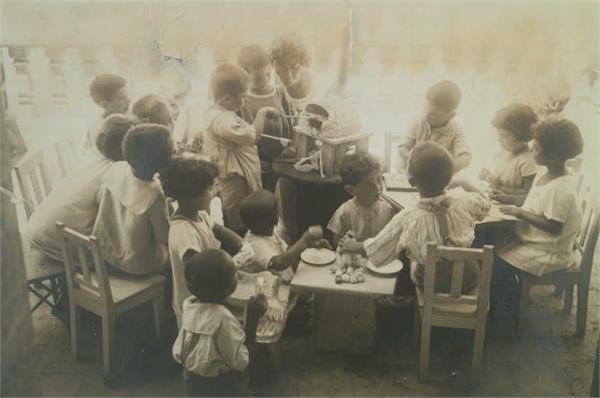
Kindergarten children preparing matzah, 1925.(photo by Joseph Schweigh, KKL-JNF Photo Archive)
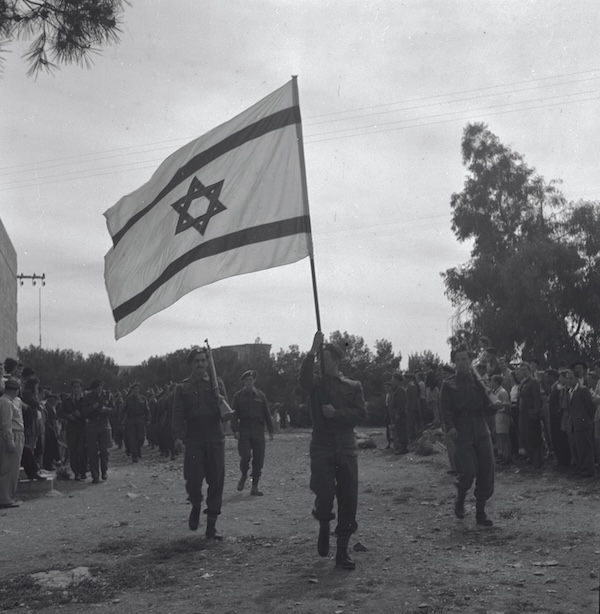
In uncertain times like these, as the war with Iran continues, attention often turns to the traditions and customs that have carried generations through both hardship and renewal. Against this backdrop, Keren Kayemeth LeIsrael–Jewish National Fund (KKL-JNF) has shared some rare images from its photo archive documenting Passover across the years. The images, dating from before the declaration of the state of Israel, reflect enduring elements of Jewish life, including tradition, education and communal practice.
A festive parade of Jewish soldiers during Passover in Jerusalem, 1948. (photo by Rudolf Jonas, KKL-JNF Photo Archive, KKL-JNF Photo Archive)
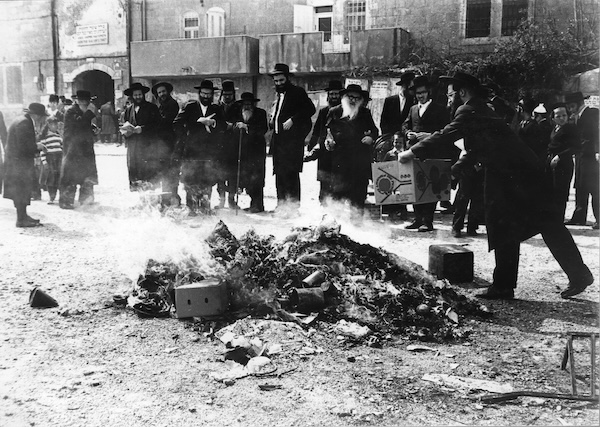
Among them are a photograph from the 1920s showing kindergarten children preparing matzah dough; documentation from a festive Passover parade for Israeli soldiers in 1948, the year of Israel’s independence; and families in Jerusalem’s Mea She’arim neighbourhood participating in the burning of chametz in 1983, a year marked by the effects of the Lebanon War. Though decades apart, the scenes show how holiday practices supported community connection and hope during periods of instability.
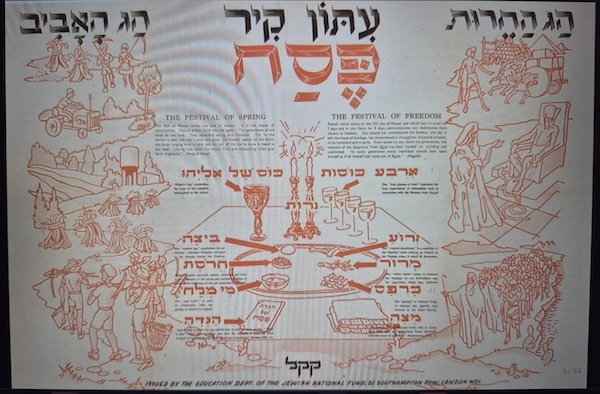
A wall newspaper produced in the 1950s and 1960s by Keren Kayemeth LeIsrael–Jewish National Fund’s education department, which was displayed in Jewish schools in England. (photo from KKL-JNF Banner collection displayed in the Central Zionist Archives in Jerusalem)
The archival materials also include a wall newspaper produced in the 1950s and 1960s by KKL-JNF’s education department, which was displayed in Jewish schools in England. The poster places the Exodus from Egypt alongside images of agricultural work, tree planting and communal life in the land of Israel, illustrating how Passover was given renewed meaning in the Zionist era as a bridge between a biblical narrative and a modern vision of national renewal.
The burning of chametz in the Mea She’arim neighbourhood in Jerusalem, 1983. (photo from KKL-JNF Photo Archive)
“These photographs show how people held onto tradition, community and hope during uncertain periods,” noted Efrat Sinai, director of archives at KKL-JNF. “Viewed today, they highlight both historical experience and the sources of resilience that continue to shape Jewish life. Passover appears here as a living educational framework, a connection between Jewish communities in Israel and abroad, and a reflection of the strength of these communities across generations.”
KKL-JNF’s photo archive, which contains tens of thousands of historical photographs, serves as a living chronicle of life in the land of Israel and beyond. Together, these materials are a reminder that the story of Israel has never been defined by hardship alone, but also by its ability to hold onto hope, tradition and the promise of brighter days ahead.
– Courtesy Keren Kayemeth LeIsrael-Jewish National Fund
RuhamaFoods’ Oven-baked Schnitzel, made by yours truly, the Accidental Balabusta. (photo by Shelley Civkin)
There has recently been some heated debate (in my living room) over what can accurately be called the national food of Israel. Family would claim it’s falafel. Outsiders would say hummus. Personally, I believe it’s chicken schnitzel. Or, as the Israelis call it: kreezpy schnitzel (heavy on the elongated “ee” sound and the “z”). Whatever you call it or however you pronounce it, it’s undeniably a culinary staple everywhere you go in Israel. Often accompanied by silky mashed potatoes and a fresh salad, there’s nothing quite like it.
Much as I love schnitzel, I detest the thought of frying food in two inches of oil. So, when I discovered a recipe for oven-baked schnitzel – on Instagram, of course – I jumped on it. There’s a popular Israeli-American content creator by the name of Ruhama Shitrit, who shares authentic Middle Eastern recipes on various social media platforms, through her brand, RuhamasFood. Her recipes are a mix of traditional and modern Mediterranean food, with marked Iraqi and Moroccan influences. Easy-to-follow and pretty much foolproof, you can’t go wrong with anything from Ruhama. Trying out her recipes, however, there was a non-schnitzel-specific learning curve for me, since I was unfamiliar with spices like ras el hanout and sumac. But I caught on pretty quickly.
Long story short (maybe not so short), I mentioned to my husband that I was thinking of making chicken schnitzel and he practically wet himself, he was so excited. And, even though I overcooked it slightly, the schnitzel was a solid eight out of 10. (I’m still getting used to my new oven, having discovered that it underheats by 10 to 15 degrees, so I always bump up the temp a bit.)
Formerly known to my friends and family as “the water-burner,” I have, to everyone’s astonishment, turned into Donna Reed. All I’m missing is the poodle skirt and kitten heels. Oh, and pearls. Now, with my dream kitchen, I love to cook and bake. Every. Single. Day. Harvey keeps saying, “Where did you hide my wife?” Not that he’s unhappy with Shelley version 2.0. His excitement when I produce a beautiful meal or “the world’s best cookies” keeps me pumped up and eager to keep on preheating that oven.
OK, OK, wait no longer. Coming to you live and direct from the Accidental Balabusta, is the one and only Oven-baked Schnitzel by Ruhama.
OVEN-BAKED SCHNITZEL
2 lbs of thin chicken breast cutlets 2 eggs 1 tsp sea salt 1/4 tsp black pepper 1 tsp paprika 1 tsp cumin 1 tbsp Dijon mustard 1 tbsp honey juice from 1/2 lemon 2 minced garlic cloves 2 tbsp olive oil
for breadcrumb mixture: 1/2 cup Panko breadcrumbs 1 cup breadcrumbs 1/4 cup sesame seeds
for the baking pan: 6 tbsp olive oil olive oil or avocado oil spray
1. Preheat the oven to 420˚F.
2. Using a mallet, pound out the chicken breast cutlets to about quarter-inch thickness (between two pieces of plastic wrap).
3. In a large bowl, put the eggs and all the spices and whisk them well.
4. Add the chicken cutlets and mix them really well so all the pieces are covered.
5. Coat each chicken cutlet with the breadcrumb mixture on both sides.
6. On a parchment paper-lined baking sheet, drizzle three tablespoons of olive oil.
7. Place the chicken cutlets on the baking sheet in one layer.
8. Drizzle three tablespoons of olive oil on top of the chicken cutlets.
9. Bake for 15 minutes, then flip them over and bake for 10 more minutes.
10. Spray the top of the cutlets with olive oil or avocado oil and transfer them to a convection broil at 450˚F for seven to eight minutes to get a nice golden colour.
I didn’t do this last step because I accidentally over-heated my oven to start with, so my schnitzels were already crispy (and overcooked) – but still plenty delicious, according to Harvey, the arbiter of all-things food-related. I know I can do better next time, now that I’m on a first-name basis with my finicky new oven. Life is trial and error, after all.
Plate the schnitzel with some lemon wedges and a side of mashed potatoes, rice, couscous or pasta, and you’ve got yourself a winner. Like they say, “Winner, winner, schnitzel dinner.”
I’m not a particularly intuitive cook, so I need the guidance of a seasoned cook to help me pair different spices with chicken, beef or fish. Left to my own devices, everything would be seasoned with salt, pepper and lemon juice, maybe a pinch of paprika. Until a couple of years ago, I’d never even used cumin, coriander or smoked paprika. But retirement, a big kitchen and lots of time on my hands has turned me into an inquisitive and relatively decent cook and baker (relatively being the operative word). I even bake challah buns when I have a few extra hours on my hands.
This is a revelation that Harvey is still attempting to wrap his head around. All he has to do is say the word cookie, and I’ve donned my apron and turned on the oven! I’m the culinary equivalent of Pavlov’s dog. I’ve been on a roll for the last couple of months, so my freezer is jammed to the hilt with cookies, muffins and soups. I’m like a Jewish survivalist. A family of four could live off my freezer for weeks, easy. No guns allowed.
My next culinary adventure might just be lamb kofta kebabs or maybe sheet pan kebab laffa. It’s like someone cast a spell on me and turned me into a fearless kitchen warrior. Six months ago, I’d never even heard the words laffa or kofta. Now, I’m throwing them around like I was born in the Middle East! Until recently, I thought laffa was something you scrub yourself with in the shower, and Benylin was something you take for a kofta. But, thanks to YouTube, Instagram and Pinterest, I have expanded my culinary vocabulary – and skills. The flip side is that I seriously must look into a 12-step program for social media addiction. You know you’re in trouble when you carry your smartphone or tablet into the bathroom with you, so that you don’t miss anything while, you know. Classic case of FOMO.
That being said, where would I be without these resources? I’d probably be eating Kraft Dinner and tuna noodle casserole. Alone. In the dark. While I’m definitely a slave to my e-devices, I do have to acknowledge their major role in my Accidental Balabusta journey. And, for that I am grateful. So is Harvey. Until next time. B’teavon.
Shelley Civkin, aka the Accidental Balabusta, is a happily retired librarian and communications officer. For 17 years, she wrote a weekly book review column for the Richmond Review. She’s currently a freelance writer and volunteer.
Kiryat Shmona musician Ben Golan will perform at the Yom Ha’atzmaut celebrations in Vancouver April 21. (photo from Ben Golan)
“Music for me is a way to say: we are still here, still alive, still building a future. It gives people a place to feel, and also the strength to keep going,” said Ben Golan, who will headline our local celebration of Israel’s 78th Independence Day, on April 21.
Golan is a musician and producer from Kiryat Shmona, a city in our community’s partnership region, the Upper Galilee, in Israel. He is the founder of the initiative Patifon.
“For 17 years,” he said, “I’ve been producing music and running a recording studio in the city. Over time, I realized that my work isn’t just about producing songs. It’s about building something that can sustain a real musical community in the north, giving a stage to local creators and creating a movement that feels connected to this place.”
Patifon, which means record player or turntable in Hebrew, serves as a hub for local artists.
“It all started simply, with jam sessions in the studio,” explained Golan. “People began coming to play, sing, meet and connect. Slowly, it grew, until the gatherings were too big for the studio to handle. There wasn’t enough space, but there was a hunger for music. Then, thanks to the youth centre and the amazing Elad Kozikaro, who gave us a budget and the perfect space, we got a shelter, which, in times like these, is a valuable commodity in the north. We moved in, completely renovated it and turned it into the most beautiful music lounge; a place where you can come and feel at home, even if it’s your first time there.”
The lounge morphed into Patifon.
“We started filming live sessions of artists and bands there, with proper sound and respect for the music,” Golan said. “All the sessions were uploaded to YouTube under Patifon and, over time, it started to catch on and reach more and more people. Suddenly, what began as a small local gathering became a stage watched by people outside the north.
“As the audience grew and we realized this needed more breathing room, we opened a community pub. Students from Tel-Hai College volunteer there as part of a scholarship program and help keep the place alive and running.”
For Golan, Kiryat Shmona is not just where he was born and grew up. He calls the city and the Upper Galilee his “inner language.”
“In this city, I learned what the rhythm of a community really is: people who know each other, who will always help you when you need something. There’s a different kind of air here,” he said.
“I have a stream right by my house. It seeped into my music without me even intending it to – a mix of rough and tender, of truth and esthetics, of wanting to shout and needing a moment of quiet to breathe,” he explained. “The nature here, the open space and the distance from the centre taught me how to really listen – not to the noise, but to what lies underneath it.
“Continuing to create in the north, especially after Oct. 7, is not a romantic choice for me – it’s a stance,” he said. “The region went through a real upheaval: fear, evacuation, uncertainty and, also, a kind of pain that people who don’t live here sometimes don’t fully understand. Out of all of that, creativity becomes a tool for connection and healing.”
Golan chose to stay in Kiryat Shmona out of a sense of mission.
“I believe the periphery holds immense talent, real hunger and stories you can’t fake – it just needs infrastructure, a home and support,” he said. “I want the young people and artists here to feel that they don’t have to leave in order to become something. On the contrary – that this place itself can become a source of inspiration, an opportunity and a creative centre that generates culture rather than just consumes it.”
Coming to Vancouver for Yom Ha’atzmaut, Golan said he brings messages of resilience and hope – and he takes those words seriously.
“Independence, for me, is also the ability to choose to create despite the difficulty, to choose community, to choose light,” he said. “I want to bring the story of the north: people who continue to build, to organize events, to create music and to hold each other up even when reality is complicated. In my music, there is room for both joy and pain, because both are part of our lives – especially in this time.”
On April 21, Vancouver band HaOptziot will also take the stage at the community celebrations, playing covers of various Israeli hits.
For tickets ($36/adult, $12/youth, $75/family pack) to the Yom Ha’atzmaut celebrations, go to jewishvancouver.com/yh2026.
Another day, another missile alert: Israelis sheltering at the Herbert Samuel Hotel miklat. The writer and his wife take refuge there, but their dog, Max, won’t leave home. (photo by Gil Zohar)
Those who think history doesn’t repeat itself may wish to WhatsApp my 97-year-old mother, Joyce, to discuss how millions of Londoners like herself sheltered in the British capital’s Tube stations during the Blitz and later in the Second World War. The Luftwaffe bombings traumatized her and her two younger sisters, Anita and Renee. Today, the same “rain” of terror is falling across Tel Aviv, Haifa and Jerusalem.
In Tel Aviv and in the neighbouring cities of Ramat Gan and Bnei Brak, nine underground stops on the Red Line of the Light Rail are open 24/7 as public bomb shelters, including on Shabbat, when there is no transportation service. Some denizens of Greater Tel Aviv have taken to sleeping on the station platforms overnight rather than returning home after each all-clear alert.
At the time of writing, the Red Line is not operating. Commuters from Jerusalem to central Israel have been temporarily required to change trains at Ben Gurion Airport before continuing to Tel Aviv.
Not surprisingly in a country where kvetching is the national sport, some people have complained that not all the underground stations have been opened to serve as protected spaces. The Ministry of Transportation has published a list of stations deemed safe, which the frantic hordes may freely enter when the missile alert screams.
The Carlebach station – named after Esriel Gotthelf Carlebach (1908-1956), the Leipzig, Germany-born pioneering journalist, founding editor of the daily Maariv, and cousin of Berlin-born troubadour Rabbi Shlomo Carlebach – has not been opened, as it is not considered suitable as a secure shelter for engineering reasons.
In the eternal capital of the Jewish people, Yerushalmis are also taking cover underground. While all the stops on Jerusalem’s single tram line are on the surface, the Navon Train Station – which is 90 metres below street level and was designed to function as a nuclear bomb shelter – is now serving its secondary purpose apart from transportation.
Home Front Command (HFC) and Ministry of Defence officials have praised the Israeli public for its resilience in quickly reaching a safe place to shelter when the siren goes off.
Israel updated its national building code in 1992 following the Gulf War the previous year, when Saddam Hussein rained Scud missiles down on Tel Aviv and Haifa from Iraq. Previously, zoning laws had required condominium apartment buildings to incorporate a basement bomb shelter, but the threat of heavier-than-air poison gas attacks made those shelters potential death traps. Thus, gas masks were distributed, and every apartment in new residential buildings is now required to have a reinforced and sealed security room, called a mamad in Hebrew. Typically, these are a bedroom protected with extra thick concrete and equipped with a steel door and heavy shutters. A wet towel placed by the door makes for a reasonably airtight seal. Some newer buildings have been designed so that the area around the elevator shaft and stairs serves as a protected miklat (shelter) for the entire floor. It’s a uniquely Israeli way of getting to know one’s neighbours.
The number of fatalities has been miraculously low in the night-and-day barrages from Iran and Lebanon since the current war started on Feb. 28. At press time, 28 people – including two soldiers – had been killed in the hundreds of missile and drone attacks targeting civilian regions in the Jewish state. More than 400 ballistic missiles had been launched. No information has been released on the number of drones fired.
Nine Israelis were killed and more than 40 injured in Beit Shemesh on March 1 when an Iranian missile hit a residential neighbourhood, destroying a synagogue and collapsing the adjoining bomb shelter. The shelter was in a pre-1991 building that had been retrofitted.
A Thai agricultural worker in central Israel and four Palestinian women in a beauty salon in the village of Beit Awwa, southwest of Hebron, were killed on March 18 by debris from an Iranian missile. Barrages employing cluster munitions have hit multiple locations – including near my home in downtown Jerusalem. More than 100 residents in Dimona and Arad were wounded in missile strikes on those two southern cities March 21; most were not in bomb shelters, according to an HFC investigation.
Train service has been interrupted at Tel Aviv’s Savidor station and in Holon, where, as well, several buses were damaged. Military censorship prohibits publishing the addresses of hits.
Max prefers to stay home when the sirens sound. (photo by Gil Zohar)
On March 15, Israel Railways reopened the train stations in Hod HaSharon-Sokolov, Bnei Brak, Rishon LeZion HaRishonim and Dimona, which had been shut down when the war began. Full service resumed on the lines from Herzliya to Ofakim, and Herzliya to Jerusalem. While the latter stops at Ben Gurion Airport, service at the international air hub remains greatly reduced. Some travelers are choosing to take a bus to Amman, Jordan, or Sharm el-Sheikh, Egypt, to fly abroad. The situation remains fluid.
For my wife and me, four overseas guests at our Pesach seder have had to say “Next Year in Jerusalem” because their flights have been canceled. We live in a charming stone building in the city centre, which was built in 1886 and has neither a miklat nor a mamad. When the siren sounds, we head to the Herbert Samuel Hotel across the street. There, the synagogue two floors below ground level doubles as the reinforced space. Last Friday, as the Sabbath approached and the air raid alert rang, a guest was playing the violin, serenading those present with the strains of “Shalom Aleichem.”
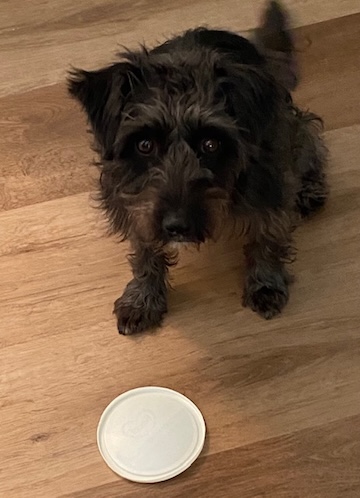
And what of our dog Max? The poor mutt refuses to leave his comfort zone – our unprotected apartment. With every second meaning the potential difference between life and death, we leave him to lie on the sofa and howl at the sirens.
Gil Zohar is a journalist and tour guide who lives in Jerusalem.