Anat Hoffman, leader of Women of the Wall, speaks with members of the media near the Western Wall on Jan. 31, reacting to the Israeli government’s passage of a new plan on egalitarian prayer rights at the Jewish holy site. (photo by Hadas Parush/Flash90 via jns.org)
The Israeli government’s passage of legislation that authorizes egalitarian prayer in a soon-to-be-created 9,700-square-foot, NIS 35 million ($8.85 million) section adjacent to the southern part of the Western Wall (Kotel) has been called groundbreaking, empowering, dramatic and unprecedented. The section could be ready in as soon as a few months or up to two years from now.
“This is a fair and creative solution,” said Prime Minister Binyamin Netanyahu after the 15-5 vote on the measure by his cabinet.
Rabbi Rick Jacobs, president of Union for Reform Judaism (URJ), said the decision would “connect world Jewry to the state of Israel.” Jerry Silverman, chief executive officer of Jewish Federations of North America (JFNA), called it a “major step forward.” Member of Knesset Merav Michaeli (Zionist Union) said the Kotel was “liberated” again; this time not by soldiers, but by women in Jewish prayer shawls.
Indeed, for 27 years, Women of the Wall pushed for women’s equality at the Kotel. Formal negotiations have been going on for almost three years. In a statement, the group said more than just an agreement has been achieved: “The vision of the new section of the Kotel is a physical and conceptual space open to all forms of Jewish prayer. Instead of splitting up the existing pie into ever more divided, smaller pieces, we are making the pie much larger.”
The new section, which will qualify for government funding, will be managed by a public council, governed by a committee headed by the chair of the Jewish Agency for Israel and comprised of representatives from the Reform and Masorti (Conservative Judaism in Israel) movements, JFNA and Women of the Wall. An administrator for the section will be appointed by the Prime Minister’s Office.
Beyond the blueprints, the ratified plan is a powerful statement about the overt impact that Diaspora Jewry and global Jewish leaders can have on Israeli decision-making.
North American Jews have traditionally served as a political lifeline for Israel, lobbying their governments on behalf of the Jewish state. Recent occurrences have shifted the relationship between the North American and Israeli Jewish communities into one of semi-equality, which includes North American Jewish leaders objectively discussing Israel’s policies rather than blindly supporting them.
Silverman called this shift evolutionary. Rabbi Gilad Kariv, executive director of the Israel Movement for Reform and Progressive Judaism, said the negotiations “prove the role that North American Jewry … can and should play in helping Israel make our country more inclusive.”
“Kudos to the unrelenting advocacy from the North American Jewish community in pushing for this,” said Rafi Rone, former vice-president of Jewish and Israel Initiatives at the Joseph and Harvey Meyerhoff Family Charitable Funds. “The dawning of a new day.”
In an interview with the Jerusalem Post, Jewish Agency chairman Natan Sharansky said that American and Israeli Jews are becoming increasingly interdependent. The U.S. needs Israel to help strengthen Jewish identity in a Diaspora community that is slowly shrinking from assimilation and intermarriage, he said. Israel, attacked daily by the international community, needs the solidarity of Jewish communities abroad, he explained.
“I am sure that the [Israeli] government must now take into account – should take into consideration – the position of world Jewry on the decisions it makes,” Hagay Elizur, senior director of Diaspora affairs for Israel’s Ministry of Public Diplomacy and Diaspora Affairs, told JNS.org.
Netanyahu might be feeling the pressure of unprecedented U.S.-Israel political tension. Last August’s Peace Index poll by the Israel Democracy Institute and Tel Aviv University showed that 48% of Israeli Jews worried that Netanyahu’s campaign against the Iran nuclear deal would damage U.S.-Israel relations.
A scene from filmmaker Reuven Brodsky’s documentary Home Movie. (photo by Yevgeny Spivak)
In 1989, the USSR’s emigration gates opened. Responsible for prying them open was a small group of tremendously courageous and patient Soviet Jews (called refusenikim for their denied exit permits) who had fought long and hard for their religious and cultural freedom, with thousands of Western Jews and non-Jewish people of conscience. The Soviet Jewry movement, which began in the United States in the 1960s and spread from there to other countries, including Canada, eventually witnessed 1.6 million Jews and their non-Jewish relations leave for Israel and the West. A thrilling climax, but then what happened?
While it is hard to say how many Jews live in Russia today, estimates are between 400,000-700,000, approximately 0.27%-0.48% of the total Russian population. Since the early 1990s, efforts to revitalize Jewish life in Russia and other former Soviet Union (FSU) countries have been ongoing.
After the dissolution of the USSR, different denominations within world Jewry started operating openly in Russia. Of all the different Jewish religious groups on the scene today, Chabad has probably worked the hardest to bring Jewish awareness to the unaffiliated. It sends its emissaries (usually a couple consisting of a male rabbi and his teacher wife) to Russia and numerous other FSU centres.
After so many years of not being able to publicly run Jewish institutions, Russian Jewish communities now have 17 day schools, 11 preschools and 81 supplementary schools with about 7,000 students. There are also four Jewish universities. The major towns have a Jewish presence, with synagogues and rabbis. In the past few years, a state-of-the-art Jewish museum even opened in Moscow and a deluxe Jewish community centre containing a small movie theatre, synagogue, mikvah, kosher gourmet restaurant and guest rooms for Sabbath observers was inaugurated in December 2015 in Zhukovka, near Moscow.
The Zhukovka Jewish Community Centre was inaugurated in December 2015. (photo from Federation of Jewish Communities of Russia via jta.org)
Yet the picture is far from rosy. In an introductory essay to An Anthology of Jewish-Russian Literature: Two Centuries of Dual Identity in Prose and Poetry (2007), book editor Maxim Shrayer critically views Jewish cultural life in post-Soviet Russia: “… my preliminary conclusion is that Jewish-Russian writers whose careers were formed during the Soviet years continue to address Jewish topics in their work, some due to a renewed personal interest as well as the freedom to write about it, others out of cultural inertia. At the same time, younger authors of Jewish origin in today’s Russia have tended to be assimilated and Russianized, resulting in a dearth of Jewish consciousness in their writing.
“Jewish-Russian literature in the former USSR might have found a temporary domain in the pages of such periodicals as the Moscow-based magazine Lekhaim … [one of the] attempts to consolidate, perhaps artificially, a critical mass of writers and readers even as Jewish-Russian culture itself spirals toward disappearance.”
In Jewish Life After the USSR (Indiana University Press, 2003), Prof. Zvi Gitelman claims that, following the breakup, Russian Jews have become increasingly less concerned about intermarriage. Ethnic identity as such seems to be based on antisemitism – even if it is unofficial, popular antisemitism rather than state-sanctioned antisemitism.
Looking to the future, the offspring of these intermarriages are likely to feel less tied to Judaism. Speculatively, they are likely to remain so unless Russian-based Jewish institutions are willing to “reach out” to people who, according to the strict reading of Jewish law, are not considered members of the “tribe,” he argues.
Since 2000, immigration to Israel and/or to the West has slowed down. But, based on past experience, immigration – provided the doors to Israel and/or the West remain open – will likely pick up if antisemitism flares up, if the Russian economy takes a real and prolonged nose-dive or if political-military strife developed in Russia as it has in the Ukraine. As Lee Yaron recently reported in Haaretz, the situation is already changing: in 2015, “15,000 immigrants … came from the former Soviet Union … an increase of over 20% from last year’s figure.”
In the post-USSR age, Jewish culture in Israel and Russia mix in unexpected ways. Gone is my grandparents’ generation who, once out of Russia, never again saw “left behind” family members. Today, many former Russian Jews living in Israel (and vice versa) frequently fly four hours to visit relatives who did not leave. According to the Israeli Ministry of Tourism, there were 60 weekly flights from Russia to Israel, as of the end of December 2015.
But the exchange is beyond familial ties. Here are four examples – two from the arts and two from the sciences.
Israeli filmmakers who left the USSR as children have begun making at least part of their films in Russia. Seven Days in St. Petersburg, written, directed and produced by Reuven Brodsky, is one case in point. Significantly, the protagonists speak both Hebrew and Russian. A few years earlier, Brodsky made the documentary Home Movie, described as, “The final chapter in the breakdown of the director’s family – one of many who did not survive the trials of immigration.”
Also in the film world, just a few months ago, Vladi Antonevicz released Credit for Murder, a documentary dealing with the topic of Russia’s neo-Nazis. As if the subject in and of itself is not dangerous enough to undertake, Antonevicz’s film apparently exposes a connection between the Russian administration and these hate groups. Antonevicz claims that certain Russian politicians are manipulating neo-Nazi activity to further their own political needs. To make this film, Antonevicz infiltrated Russian neo-Nazi groups, secretly investigating an unsolved double murder. He succeeded, but some say his small film crew has had to lay low after completing the film.
Former Russian Jews in Israel (and in the West) have likewise forged profitable positions in the start-up world. Moscow-born Prof. Eugene Kandel, outgoing head of Israel’s National Economic Council, analyzes this phenomenon. In a July 29, 2015, Forbes blog by Scott Tobin, the professor is quoted as saying, “Many Russian-born techies now working in Israel are especially innovative because the Soviet state traditionally under-invested in computer hardware and other technology, even as the state was scrambling to develop weapons and related technology to win the Cold War. That left engineers to fend for themselves and develop creative workarounds in many businesses.”
Finally, medical tourism from Russia has blossomed. Many well-to-do Russians come to Israel to be treated by Russian- and Hebrew-speaking doctors, nurses, technicians and medical secretaries (see imta.co.il).
A cause for hope and promise? Stay tuned.
Deborah Rubin Fields is an Israel-based features writer. She is also the author of Take a Peek Inside: A Child’s Guide to Radiology Exams, published in English, Hebrew and Arabic.
קנדה ואיראן פותחות בדיאלוג לאחר כשלוש וחצי שנים של נתק טוטאלי בין שתי המדינות. במסגרת זו הממשלה הקנדית החליטה להסיר כבר מספר סנקציות כלכליות נגד איראן, בהן הקשורות בשירותים פיננסיים, יצוא ויבוא. כך הכריז שר החוץ, סטפן דיון, בסוף השבוע האחרון. סנקציות נוספות יוסרו בהמשך הדרך בשלבים כולל חידוש היחסים הדיפלומטיים, תוך שקנדה בוחנת את הפיקוח של האו”ם על תוכנית הגרעין של איראן, כדי למנוע מאיראן להמשיך ולפתח אותה, כמו למנוע ממנה את הפיתוח של טילים בליסטיים ארוכי טווח. דיון ציין כי קנדה תמשיך לבדוק מה קורה באיראן ותפעיל מדיניות בשלבים להסרת הסנקציות, לאור החששות מתפקידה של איראן במזרח התיכון כולל מול בני הברית כמו ישראל, ולאור “הרקורד” של איראן בתחום נושא זכויות האדם. דיון הוסיף עוד: “אני חושב שזה טוב לישראל שקנדה תוכל לדבר עם איראן. זו הייתה טעות לחשוב כי הבידוד עדיף על קשר וקשר אינו מהווה הסכמה”.
לדברי דיון תחומים רבים של הכלכלה הקנדית ירוויחו ממערכת היחסים המחודשת עם איראן. זה לא רק תעשיית התעופה והחלל, אלה גם תחבורה, חקלאות, התעשייה הפטרוכימית, תעשיית הכרייה ותעשיות הנפט והגז. לקנדה יש עדיין חששות כבדים בנוגע לשאיפותיה הגרעיניות של איראן, ולכן ימשכו המגבלות החמורות של יצוא מוצרים רגישים שלא ישלחו לאיראן וכל היתר יצוא ישקל בכל מקרה לגופו. קנדה תמשיך אפוא לקיים הגבלות חמורות על היצוא לאיראן של מוצרים, שירותים וטכנולוגיה שנחשבים לרגישים מהבחינה הביטחונית, לרבות מוצרים שיכולים לעזור לאיראן לייצר טילים גרעיניים או בליסטיים.
בתגובה להחלטת הממשלה להסיר את הסנקציות הצרכז לענייני ישראל והיהודים בקנדה פרסם את תגובתו בנידון. המרכז מציין כי איראן ממשיכה להיות איום ממשי עבור ישראל והיהודים ברחבי העולם. הסרת הסקנציות הבינלאומיות בעקבות ההסכם על תוכנית הגרעין של איראן, תנוצל על ידי המשטר האיראני וזה מקור חרדה רציני למרכז לענייני ישראל והיהודים בקנדה ושותפיו ברחבי העולם. קיימת סכנה ממשית שהקהילה הבינלאומית, מתוך נאיביות לאור הסכם הגרעין עם איראן, תקבל את איראן כחברה לגיטמית בקהילה הלאומית, למרות שהיא ממשיכה לתת חסות לטרור, מתעללת בזכויות אדם, מחוללת כאוס באזור וקוראת להשמדת ישראל.
עמדת המרכז לענייני ישראל והיהודים בקנדה לגבי החלטת הממשלה הקנדית החדשה ברורה. איראן מהווה איום רב לשלום העולמי והביטחון העולמי, וקנדה צריכה להתעמת עימה באמצעות כלים דיפלומטיים וכלכליים.
המרכז יודע כי המפלגה הליברלית של קנדה למרות תמיכתה בעמדתה תקיפה נגד איראן, מזה זמן רב מעדיפה גישה המאופיינת במעורבות קונסטרוקטיבית בניגוד לממשלה השמרנית הקודמת שתמכה חד-משמעית בבידודה של איראן. המרכז ישאר מאוד מודאג מהמאמץ של הקהילה הבינלאומית לחידוש הקשרים אם איראן, “ואנו נמשיך להראות שדיפולמטיה ללא לחץ כלכלי לא הייתה מביאה שינוי בהתנהגותה של איראן. תפקידנו להבטיח לבחון את הציוד והסחורות שיועברו לאיראן מקנדה, כדי לבחון שחברות קנדיות לא יעזרו לתוכנית הגרעין שלה ולבניית מערך הטילים הבליסטיים שלה”.
המרכז אומר עוד: “עכשיו יותר מתמיד הקהילה היהודית בקנדה צריכה לקחת חלק במדיניות הציבורית המקומית. אנו זקוקים לחברי הקהילה באשר הם כדי שישמיעו את קולם. בימים הקרובים המרכז לענייני ישראל והיהודים בקנדה, ישיק קמפיין חדש לגיוס אזרחי קנדה שמודאגים לקרוא לשר החוץ דיון, להמשיך ולהפעיל לחץ על איראן. יש באפשרותה של הקהילה היהודית להשפיע על הטיפול הכושל של הממשלה בתיק איראן, כשנעים קדימה”.
Peter Barnett, fourth from the right, with the Variety telethon crew, in the 1970s/80s. (all photos from the Barnetts)
Variety – The Children’s Charity is holding its 50th Show of Hearts Telethon this year. The 23-hour event Feb. 13-14 will feature inspirational stories, live music and other entertainment. The funds raised will help Variety continue its support of B.C. children with special needs and the organizations that provide them care and services.
While the B.C. tent (or chapter) celebrates its 50th year, the international charity is almost 90 years old, having been started in 1927. There has always been strong representation by the Jewish community in Variety, including locally. As but examples, Howard Blank, who first volunteered when he was 13 years old, is the current B.C. president, and both Jeffrey and Peter Barnett are members of the local board of governors – they have been active in the organization for more than 45 years.
Jeffrey Barnett
“Variety’s roots were in the entertainment industry, when it all began with a baby being left in a theatre in Pittsburgh,” explained the Barnett brothers. “There were many Jewish people in the entertainment industry, from managers, performers, theatre owners, filmmakers, distributors, in the early ’30s, ’40s and ’50s. As a result, the backbone of membership was Jewish.”
Peter was the first of the Barnett family involved with Variety, said Jeffrey. “Peter first heard of Variety when he was 15 years old in London, England, where he was an apprentice at the Savoy Hotel in the food and beverage industry,” Jeffrey explained. “At the hotel, the Variety Club would host fundraising luncheons, and he would peek around the curtains to see the entertainers attending, and got a knowledge of what the charity was about and who they helped, and said to himself that he wanted to be involved in the organization.
Peter Barnett
“He moved to Vancouver and saw a notice in the Vancouver Sun looking for new members and volunteers. So, he showed up. They said, do you have $35? He said yes, and became one of the early members of the newly established tent of the Variety Club of Western Canada. It started out with 15 men who gathered together to support special needs children.”
In its early days, explained the Barnetts, membership required that a certain amount of your income be related to the entertainment industry in some way, but the charity has since expanded. Anyone can become a member for an annual fee of $75, which gives you a vote at the annual general meeting, the chance to be elected to the board of directors and membership rates for events. Volunteers, of course, are always welcome, and there are partnership opportunities for businesses, as well as for people to hold their own fundraisers for Variety and to donate at telethon time.
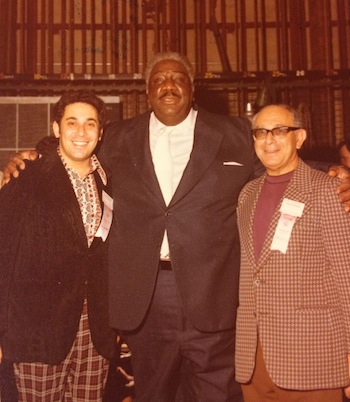
Left to right, Jeffrey Barnett, Big Miller and Jack Barnett, in the 1970s/80s.
Peter got Jeffrey involved with Variety, and Jeffrey became part of a small group that began to organize fundraising events, such as bed races on Granville Street, getting children involved with penny drives, luncheons and the annual telethon. Their father, Jack, was also a longtime volunteer, and all three men have served as chief barker/president of the Show of Hearts Telethon – Peter in 1973, Jack in 1976 and Jeffrey in 1980. Peter and Jeffrey’s mother, Edith, was a founding member of the Variety Ladies Auxiliary.
Both Peter and Jeffrey were encouraged by their parents – who served as role models in this regard – to help and contribute to the community. The brothers said their first involvement was with the Boy Scouts.
“It becomes a part of your life, relationships are developed, there is a camaraderie, and there is a lot of fun,” said Jeffrey. “It’s nice to do something selflessly to help other people. It makes me feel good.”
Among other endeavors, Jeffrey was involved in the B.C. Restaurant and Food Association, and is still involved with the annual Jewish Community Centre Sports Dinner. The Hebrew Free Loan Association has been one of Peter’s main concerns.
They both said they “enjoy the wonders of charity,” supporting, helping, contributing, and the fun they have in fundraising. Their biggest wish for Variety?
“To capture and engage young people to carry on the work that we have worked and nurtured over the many years,” said Jeffrey.
For Peter: “A wild dream – for medicine to catch up with the ills of today, that there would be no need for organizations like Variety.
Until that happens, however, there is a need, and people can help fulfil it in many ways, including by volunteering with, donating to and/or attending the Show of Hearts. Advance tickets for the telethon’s live performances at the Centre in Vancouver for Performing Arts on Saturday, Feb. 13, 7 p.m. (54-40, Aaron Pritchett, Five Alarm Funk and Vancouver Theatresports League, among others) and Sunday, Feb. 14, 2:30 p.m. (including Jim Byrnes, Chilliwack, Shari Ulrich and Colleen Rennison) are $50 and can be purchased via variety.bc.ca/ events/_entry/telethon. The entire telethon will be televised on Global BC.
Around the time of the High Holidays last year, Rabbi Shaul Osadchey, senior rabbi of Congregation Beth Tzedec in Calgary, had lunch with a congregant. Discussing various issues, they talked about the possibility of sponsoring a Syrian family.
“We decided to pursue that and have the congregation get on board and assume responsibility for a family,” Osadchey told the Independent.
With all enthusiastic and supportive of the idea, Osadchey gathered more information through Catholic Immigration Services (CIS). Later, he attended a workshop on how to sponsor a Syrian refugee family.
Rabbi Shaul Osadchey of Congregation Beth Tzedec in Calgary. (photo from Shaul Osadchey)
Through CIS, the rabbi was introduced to an executive of Armenian decent who had married a Jewish man and converted to Judaism. As the woman worked with Osadchey, she took a special interest in the congregation’s sponsorship and wanted to connect them to a particular family – a Christian Armenian family with relatives in Calgary who she personally knows.
“She had a personal connection and we thought that would be a good match, so we proceeded along those lines,” said Osadchey. “We were just simply committed to helping a Syrian refugee family and their religious background was of no particular relevance. We were prepared for Muslim or Christian, either one.” He explained that his congregation has been very active in building bridges in the local Muslim community.
After attending the workshop, the rabbi went back to the board with information about how the process works and the board unanimously passed the motion to adopt the family. Since then, they have been arranging all the paperwork, while the family to be sponsored is currently in Lebanon.
The congregation has been given some preliminary information about the family. “It’s a mother, a father and three children, ages 11 to three months old,” said Osadchey. “So, we’re preparing the various responsibility areas of helping them integrate in Calgary – things such as housing, clothing, food, transportation, jobs, and so forth.”
Osadchey has also reached out to Jewish Family Service Calgary to see if they can help with jobs; the parents are in the jewelry trade.
While the paperwork is being done, the community and congregation are offering support in many ways, from preparing to help with language needs, to collecting household furniture and other items the family may need.
While the local Armenian Christian community in Calgary is not very large (300 to 400 people), Osadchey thinks it is inevitable that the communities will form closer ties.
“I think, overall, the message that Beth Tzedec is sponsoring a family is very important, both for our members and for the community at large,” said the rabbi. “We are interested in this issue. We take it seriously. Jewish tradition calls on us to help refugees.”
Last month, leaders of Beth Tzedec had brunch with the refugee family’s Calgary relatives to learn more about them before they arrive in two or three months. It may take less time than that, depending on various factors.
“Still, we are pretty far along,” said Osadchey. “We have most of the financial commitment taken care of. It’s being underwritten primarily by one family, which is the original person I was speaking with who sort of launched the idea.”
But others in the congregation have also volunteered. For example, members of the congregation held a Chanukah party where, instead of giving gifts, they asked attendees to donate toward the sponsorship efforts. They raised $1,000.
The financial need for hosting a family of five is estimated by the federal government at $32,000, but Osadchey has been working with congregants, one of whom may be able to offer housing, which will substantially lessen this estimate.
“The $32,000 has already been raised, but we anticipate there will be other costs once they get here,” said Osadchey.
While the congregation is considering hosting more families in the future, they have decided to take it one family at a time, as this is a very new process for them.
“Somebody asked about that, and I said, ‘Go with the first family and see what the experience is like and, if we can continue to help and have support, we will do that,’” said Osadchey. “But, I anticipate it will be a very wonderful experience, both for the congregation and for the family.”
The response from the congregation has been overwhelmingly positive, and a number of prominent people have stepped forward and expressed their pride in the synagogue doing this. And the response has spilled over to Temple B’nai Tikva, which has spoken to Osadchey.
“They contacted us, but we already had the funding in place and were down the road in the process, so it wasn’t so critical that we had a partner,” he said. “We encouraged them to reach out and find someone else who might benefit from their help.”
Temple B’nai Tikva has set up a refugee assistance committee, which met last month. Committee representative Cynthia Simmons said that they have met with a couple of churches, and “we know we want to do something, but the exact nature of that something remains to be determined.”
It doesn’t require a big community to make big things happen. It just takes a few good leaders. And Saskatoon’s small Jewish community is a prime example.
JoAnn Jaffe is a University of Regina professor of sociology and social studies and leader of Congregation Agudas Israel’s social justice committee. Raised in Dayton, Ohio, she described herself as “not the most observant person in the world, but not the least either – raised in a somewhat secular Jewish home, but with consciousness of Jewish ethics.”
Prof. JoAnn Jaffe, leader of Congregation Agudas Israel’s social justice committee. (photo from JoAnn Jaffe)
In 2001, she helped form a Jewish-Muslim dialogue group in Saskatoon. Through this group, members of the synagogue and a mosque decided to join in an effort to bring a Syrian refugee family to Saskatoon.
Jaffe and another Agudas Israel member, Willow Allen, took the lead on the Jewish community side. “At one point, as we started to hear what was going on in Syria, Willow and I started thinking that it would be really great if the Jewish community could sponsor a family,” said Jaffe. “I also started hearing from other congregation and board members that they were very interested in doing this, too, so Willow and I attended a training done by the refugee sponsorship training program.”
They soon began thinking about getting the Muslim community to join them.
“We put together a proposal and presentation to the board of the congregation,” said Jaffe. “The board said they were very interested, especially if we could get the Muslim community on board. We see this as a value-added activity for us. Not only are we sponsoring this family – it is our ethical duty, what we are taught to do, welcoming a stranger and taking care of the needy – but, if we could do this with the Muslim community in Saskatoon, then we could build relationships, build the community, have each other’s backs. If problems arise, we already have relationships with each other and know each other. We have a way of working together. After all, events in the wider world tend to pull us apart.”
Once the Islamic Association of Saskatchewan accepted the invitation, it was a matter of putting together a joint steering committee with members from both communities in equal proportion. That committee would then work to involve other community members in all the different activities involved in sponsoring a family.
The joint committee – called Children of Abraham Refugee Sponsors of Saskatoon – decided fundraising should be divided between the two communities equally. Once that was decided, the synagogue was prepared to be responsible for the entire portion the Jewish community was to raise.
“They knew they weren’t going to be on the hook for that entire amount, but that’s a beautiful gesture of good faith,” said Jaffe. “Then, we started. We set aside a fund at the synagogue called the Tikkun Olam Fund that is now dedicated to our family.”
Earlier this year, B’nai B’rith announced in a committee meeting that they would match collected funds up to a total of $5,000. “There is a family here who owns a limousine service that, one evening, they took people around on tours of the Christmas lights and then donated all the money they made from that – $1,000 – and put that into our fund,” said Jaffe. “We now have over $12,000. We are looking to raise about $15,000 to be in a comfortable place.”
Further, the group is settling the terms of an apartment and continuing to mobilize their communities, with many people stepping forward to donate items for their home, clothing, housewares and more.
“It’s amazing,” said Jaffe. “Lots of people are volunteering to do tasks. Because we are hooked up with the Islamic Association, there are quite a few people who speak Arabic who volunteer to act as translators. One of the main people on our steering committee is originally from Lebanon, so, of course, she speaks Arabic as well. We feel like things are moving forward in a really great way. I feel optimistic about it. People are very dedicated to making this work.”
The Syrian family being sponsored has five children, as well as another on the way. Four were born in Homs, Syria, while the youngest child (2 years old) was born in Amman, Jordan – an indication to how many years they have spent in a Jordanian refugee camp.
They will be here by the end of the month, said Jaffe. “They know who we are. We know who they are. They know we are here and are sponsoring them.
“The husband was born in 1980, so he’s 35 years old, about. She [the wife] was born in 1988, so she’s 27. Her birthday was a couple days ago.”
In commemoration of the 50th anniversary of the Nostra Aetate, the Canadian Conference of Catholic Bishops (CCCB) and the Canadian Rabbinic Caucus (CRC) committed last year to engage in “shared and sincere dialogue.”
Passed at the Second Vatican Council in 1965, the Nostra Aetate covers the Catholic Church’s relationship with non-Christians. Among other points, the fourth section affirms Christianity’s Jewish roots, states that Jews should not be blamed for Jesus’ death and decries antisemitism. The joint declaration of CCCB and CRC, issued on Nov. 25, referred specifically to that fourth section, “which profoundly changed Catholic-Jewish relations.”
The first national, bilateral dialogue between Catholics and Jews in Canada also took place on Nov. 25, in Ottawa. The joint initiative was launched the next day. It has several goals, including the strengthening of ties and increased understanding between the Catholic and Jewish communities; opposing “antisemitism and all forms of hatred”; advancing common interests in public policy, in areas such as social justice and religious freedom; and promoting civic engagement among Canadian Jews and Catholics.
Rabbi Robert Daum is a delegate to the Catholic-Jewish dialogue initiative. (photo from Robert Daum)
The Jewish delegation to the dialogue comprises Dr. Robert Daum, Rabbi Baruch Frydman-Kohl, Dr. Victor Goldbloom, Rabbi Reuben Poupko, Dr. Adele Reinhartz and Dr. Norman Tobias, while the Catholic delegation is Bishop John A. Boissonneau, Archbishop Paul-André Durocher, Sister Anne Anderson, Father Martin Moser, Sister Eileen Schuller and Father Hervé Tremblay.
“Jews must recognize that contemporary Catholicism was profoundly changed by Vatican II and that the historic denigration and demonization of Jews has been eliminated from Catholic teaching,” said Frydman-Kohl, co-chair of the CRC – with Rabbi Jonathan Infeld and Rabbi Reuben Poupko – in a Nov. 26 statement about the dialogue. “Catholics must comprehend that contemporary Jews and Judaism can only be understood through the twin experiences of the horrors of the Holocaust and the creative existence of the state of Israel. While differences between our two faith communities still exist, we have moved from disputation to dialogue, persecution to partnership, and confrontation to cooperation.”
“The initiative represents a very serious commitment on the part of the CCCB and of the CRC, and of the individual delegates who will be meeting twice a year for the next few years,” said Daum, a fellow, diversity and innovation, Simon Fraser University’s Centre for Dialogue, and an honorary associate professor, department of classical, Near Eastern and religious studies, University of British Columbia. “I am sure that none of us would have agreed to undertake this work without an expectation that the process would make a contribution to Canadian society.”
CRC is an affiliate of the Centre for Israel and Jewish Affairs. “As faith communities active in public policy and public discourse, we have a responsibility to speak out against manifestations of hatred in society,” said Nico Slobinsky, director of CIJA Pacific Region. “Our voice is stronger when we speak out together.”
Nico Slobinsky, director of CIJA Pacific Region. (photo from Nico Slobinksy)
Slobinsky noted that CRC and CCCB wrote a letter, dated Dec. 15, to Minister of Foreign Affairs Stéphane Dion, highlighting that “Christians experience religious persecution more than any other faith group on a global scale and in absolute numbers” and requesting that the “Government of Canada make a priority of advocating for at-risk Christian communities throughout the Middle East and Africa.”
He said CIJA has been “adamant in speaking for the right of religious minorities when threatened.” He described the “range of policies CIJA advocates on, from affordable housing to government support for health care and public services run by Jewish social service agencies,” and said he can see “natural areas of cooperation with faith communities like the Catholic community.”
“In the case of antisemitism,” he added, “given the sad history of Catholic discrimination and persecution of Jews, it is particularly poignant that Catholics condemn and actively counter antisemitism today, as evidenced in the pope’s recent remarks,” which continue the path of reconciliation that started at the Second Vatican Council.
Slobinsky said the Nostra Aetate “has had a profound impact within the Church leadership and clergy, though it is largely unknown by average Catholics and Jews.”
Daum described it as “a very important document. Because of that document, for example, I worked for the American Jewish Committee and the Roman Catholic Diocese of San Francisco for three years when I was working on my PhD at Berkeley. I was a guest lecturer on the topic of Judaism in five Roman Catholic high schools, so that the students could have the opportunity to learn about Judaism from a Jewish scholar.
“Like any historic document, the impact will vary from place to place, and from decade to decade, but one has to bear in mind that this relationship goes back many centuries. And there have been some very important statements issued by Jewish and Roman Catholic scholars over the past several years, including in recent months. These are related developments, which is very encouraging and very interesting.”
As for the dialogue initiative, Daum said, “We are bringing ourselves to this initiative as Jews and as Canadians, and our dialogue partners are bringing themselves as Catholics and as Canadians – in our diversity and in our unity, we will get to know each other and each other’s community better with each meeting.”
A model of the Kaifeng synagogue at an exhibit at the Diaspora Museum in Tel Aviv in 2011. (photo by Sodabottle via commons.wikimedia.org)
With the Chinese New Year taking place next week, it is an appropriate time to reflect on the close and positive relationship between Jewish and Chinese peoples, which reaches back almost 2,000 years.
It might be simplest to begin with the fall of Jerusalem to the Romans in the year 70 of the Common Era. This was the climax of the first of three Jewish-Roman wars that would take place over the first and second centuries. The net result of these conflicts was the deaths of hundreds of thousands of Jews, the enslavement of many others, and those who managed to escape such tragedies fled as refugees. This scattering of Jews across the world we call the Diaspora ultimately resulted in the formation of the various communities we are familiar with today, such as the Ashkenazi, Sephardi and Mizrahi Jews. But there was a smaller, lesser-known Diaspora community that settled in China.
Between 206 BCE and 220 CE, China was ruled by the Han Dynasty. The Han established a vast international trading network that came to be known as the Silk Road. According to the oral history of the Chinese Jews, their ancestors first settled in China during the late Han Dynasty. Such a period would correspond with the Diaspora that followed the Jewish-Roman wars.
After the collapse of the Han Dynasty, the Silk Road trading network collapsed, but was reestablished in 639 CE during the Tang Dynasty. The Silk Road interconnected Tang Dynasty China with the wealthy states of India, East and North Africa, across Asia and into Europe. During the Medieval period, many Jews made their living as merchants. At this time, Christians and Muslims refused to trade directly with each other, and Jews earned great profits acting as intermediaries.
Many Jews traded along the Silk Road, the most prominent group of whom were the Radhanites, who inevitably found themselves in China. It is during this period that the first document indicating the presence of Jews in China has been found. It describes how a rebel leader executed foreign merchants and Jewish residents in the city of Guangzhou. Discovered at an important stop along the Silk Road in northwest China, the document dating to some point around the eighth or ninth centuries was written in a Jewish-Persian script on paper, which at the time would have only been available in China. Some historians have suggested that the Radhanites were responsible for bringing Chinese paper technology to Europe, although this theory is contested. The presence of Jews in Guangzhou at this time should not be surprising, considering it was an important port city linking Chinese and Middle Eastern trade. Guangzhou has one of the oldest mosques in the world and, at the beginning of the ninth century, may have had a population of as many as 100,000 foreigners.
In 908 CE, the Tang Dynasty fell, the Silk Road trading network again collapsed for several centuries and the prominence of the Radhanites declined. But this did not mean the end of the Jewish presence in China. Between 960 and 1279 CE, China was ruled by the innovative and prosperous Song Dynasty, with their capital city at Kaifeng. Kaifeng has been described as the New York of its day. It was a massive cosmopolitan city, a centre of global trade and the largest city in the world, reaching a population of 1.5 million people.
Though Jews would settle in other cities, such as Hangzhou, Ningbo, Ningxia and Yangzhou, most were in Kaifeng, and it became the centre of Chinese Jewry. The first synagogue was built in Kaifeng in 1163 CE. It was made of wood, in a Chinese architectural style. It would be destroyed and rebuilt many times throughout its history. The Jews of Kaifeng were held in high esteem by the Song emperors, and went on to pursue successful careers not only as merchants, but as court officials, scholars and soldiers. There is still a Kaifeng Jewish community today.
In the early 12th century, the first Jin emperor, Wanyan Aguda, unified the Jurchen, a group of tribal peoples living in Manchuria. The Jurchen waged war against the Song Dynasty and, in 1127, Jurchen forces conquered Kaifeng, an event that has come to be known as the Jinkang Incident. After this battle, the Song capital was moved south to Hangzhou, and many of the Kaifeng Jews accompanied the Song rulers in their migration. Nevertheless, there were some who stayed in Kaifeng. The Jurchen established the Jin Dynasty, and continued to wage war against the Song Dynasty for more than 100 years. Eventually, both the Jin and the Song were conquered by the Mongols in the 13th century.
In 1232, the Mongols besieged Kaifeng. During the conflict, the Jin used rockets against the Mongol invaders, which is the first use of rockets in warfare in recorded history; a technology all-too-familiar to the modern residents of Israel. In the mid-14th century, the Mongol rulers of China established the Yuan Dynasty, with their capital in Beijing. When Marco Polo traveled to Beijing in 1266, he wrote about the importance of Jewish merchants there.
In 1276, the Mongols conquered the Song capital of Hangzhou. In 1280, the Mongol emperor, Kublai Khan, issued a decree banning Jews from kosher practices and circumcision. Yuan Dynasty documents written in 1329 and 1354 issue a request of Jewish residents in China to go to Beijing to pay taxes. Though many atrocities occurred during the Mongol invasions, their rule was nevertheless marked by flourishing trade and the Jewish communities of China persisted.
At the site of the synagogue in Kaifeng, several stone steles have been recovered. The oldest, written in 1489, commemorates the construction of the synagogue in 1163. It describes how the Jews first entered China during the late Han Dynasty, and the Jinkang Incident, including how many of the Jewish population of Kaifeng fled to Hangzhou. Also inscribed on this stele were the following words: “The Confucian religion and this religion agree on essential points and differ in secondary ones.”
A second stone stele was made in 1512, which describes Jewish religious practices, which is fascinating considering it is written in Chinese. In 1642, a third stele commemorated the reconstruction of the synagogue in Kaifeng after it was destroyed by a flood. The synagogue was destroyed again by a flood in 1841, but was not rebuilt. This is likely due to the sociopolitical turmoil occurring in China at the time. It is interesting to note that, while Jews were persecuted, rejected and alienated by the nations of Europe, they were accepted and assimilated into Chinese culture.
During the 19th and early 20th centuries, persecution of Jews in Europe began again on a massive scale. The worst events of these times were the many pogroms in the Russian Empire, where hundreds of thousands of Jews were murdered, raped, robbed. Many Jews were forced to flee as refugees, some migrating to North America, some to Palestine, and some to China. The Russian Revolution in 1917 resulted in the deaths of around 250,000 Jews, and the orphaning of around 300,000 Jewish children. Many Russian Jews fled to the city of Harbin, in Manchuria, whose Jewish population reached 20,000. However, when the Japanese annexed Manchuria in 1931, many among that population left for Shanghai, Tianjin or Palestine.
Many Chinese intellectuals understood the plight of the Jewish people, and compared it to their own. The Chinese Nationalist and founder of the Republic of China, Dr. Sun Yat-sen, made the following comparison: “Though their country was destroyed, the Jewish nation has existed to this day…. Zionism is one of the greatest movements of the present time. All lovers of democracy cannot help but support wholeheartedly and welcome with enthusiasm the movement to restore your wonderful and historic nation, which has contributed so much to the civilization of the world and which rightfully deserves an honorable place in the family of nations.”
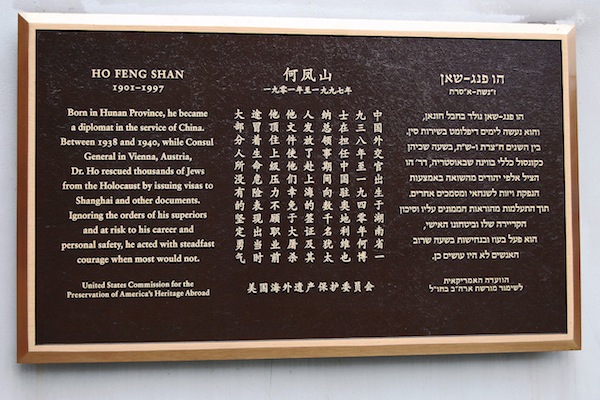
During the course of the Second World War, the Jewish population in China would swell to 40,000, many of whom resided in Shanghai. A number of Chinese diplomats helped smuggle in Jews using special protective passports. One such hero, a Chinese diplomat working in Vienna named Ho Feng Shan, helped Jews from Nazi-occupied Europe get to China, ultimately saving around 3,000 lives. Ho Feng Shan was posthumously awarded the title Righteous Among Nations by Yad Vashem in 2001.
A plaque erected at Shanghai Jewish Refugees Museum and Ohel Moishe Synagogue in China in honor of the late Chinese diplomat Ho Feng Shan (1901-1997) who saved thousands of Jews between 1938 and 1940. (photo by Harvey Barrison via commons.wikimedia.org)
In 1943, the Japanese forced the 20,000 Jews living in Shanghai into a ghetto that was around one square kilometre in size, with conditions described as squalid, impoverished and overcrowded. The Shanghai ghetto was also inhabited by some 100,000 Chinese residents.
The Nazis pressured the Japanese to execute the 40,000 Jews living in China, but the Japanese purposefully delayed the planned atrocity, ultimately saving the Jews’ lives. When the Japanese military governor of Shanghai informed the leaders of the Jewish community of the planned execution and asked them why the Germans hated them, one rabbi responded by saying “because we are short and dark-haired,” a reply that allegedly caused a smile to appear on the serious face of the governor. After the war, most of the Jews in China migrated to the newly formed state of Israel.
Ben Leyland is an Israeli-Canadian writer, and resident of Vancouver.
התאגיד הקנדי בומברדייה שמספק מזה למעלה מעשר שנים קטרים וקרונות לרכבת ישראל, החל לבדוק את האפשרות למכור מטוסי נוסעים לאיראן. (צילום: bombardier.com)
נתניהו לא אוהב את זה: קנדה החליטה להסיר הסנקציות נגד איראן בשלבים
קנדה שנחשבה עד לאחרונה ידידה קרובה ביותר של ישראל מצטרפת למחנה של מדינות המערב (בהן ארה”ב, האיחוד באירופאי ואוסטרליה), שהחליטו להסיר את הסנקציות הכלכליות נגד איראן. זאת לבקשת האו”ם לאור חתימת הסכם הפיקוח על תוכנית הגרעין של איראן. שר החוץ הקנדי, סטפן דיון, הודיע בפרלמנט לפני מספר ימים כי ממשלת הליברלים בראשות ראש הממשלה ג’סטין טרודו, תסיר את הסנקציות נגד איראן במספר שלבים. בין הסקנציות שיוסרו יכללו בהמשך גם נורמליזציה ביחסים בין קנדה ואיראן, ופתיחתה מחדש של שגרירות קנדה בטהרן. הממשלה הקודמת בראשות ידידה הקרוב של בנימין נתניהו, ראש ממשלת ישראל ומי שעמד בראשה, סטפן הרפר, סגרה את השגרירות בטהרן בספטמבר 2012 בטענה שאיראן היא איום על השלום והביטחון בעולם, במסגרת ניתוק היחסים הדיפלומטים בין שתי המדינות.
התאגיד הקנדי בומברדייה שמספק מזה למעלה מעשר שנים קטרים וקרונות לרכבת ישראל, החל לבדוק את האפשרות למכור מטוסי נוסעים לאיראן. בהקשר זה אמר דיון: “אם איירבוס מסוגלת לעשות את זה (התאגיד הצרפתי חתם על עיסקה עם איראן למכירת מאה ושמונה עשר מטוסים ר.ר) למה בומברדייה לא יהיה מסוגל לעשות זאת. באיזה דרך זה עוזר לקנדה, לאזרחי איראן או לישראל באם קנדה פוגעת בתעשייה שלה?”
בומברדייה סובל בשנים האחרונות מהפסדים כספיים גדולים שנאמדים בתשעה מיליון דולר אמריקאי, ופתיחת שוק חדש כמו איראן, יכולה לתרום מאוד לקופת התאגיד. איראן כידוע משוועת למטוסי נוסעים חדשים כיוון שצי המטוסים שלה ישן ביותר, והיא הצהירה כבר כי ברצונה לרכוש מאה ושישים מטוסים חדשים. חברות קנדיות נוספות מעוניינות לנהל מגעים עם האיראנים למכירת מרכולתם לאחר הסרת הסקנציות, והן רואות בשוק האיראני פוטנציאל גבוה, במיוחד לאור מצב הכלכלה בעולם. מומחה למסחר בינלאומי מטורונטו אומר כי חברות קנדיות רבות רואות באיראן הזדמנות גדולה לעסקים. יש לזכור ששמונים מיליון איש גרים באיראן, היא נחשבת למדינה עם חינוך ברמה גבוהה והיקף כלכלתה נאמד בארבע מאות מיליארד דולר. החברות שמגלות עניין באיראן שייכות בעיקר לתחומי ענפי הנפט, הגז, והטכנולוגיה, יצרניות מוצרי מזון ובעיקר חלב ובקר.
בינתיים ממשלת קנדה החדשה כבר כועסת על ישראל. הממשלה העבירה מסר חריף לישראל בשבוע שעבר, והביעה את דאגתה מהאלימות הגוברת בין הפלסטינים לישראלים, ומהמשך הבנייה בהתנחלויות. לדברי דיון: “קנדה כבעלת ברית איתנה וידידה של ישראל, קוראת לעשות את כל המאמצים על מנת להפחית את האלימות וההסתה ולסייע ביצירת תנאים לחזרה לשולחן המשא ומתן”.
יהודיה נדקרה באופן קשה במונטריאול אך לא על רקע אנטישמי
אישה יהודיה (בת 27) שמחזיקה בדרכון ישראלי וגרה במונטריאול, נפצעה ביום רביעי בשבוע שעבר על ידי גבר שדקר אותה. אירוע התקיפה החמור אירע בשדרות מונקלנד שבשכונת נוטרדאם-דה-גארס, בזמן שהאישה הלכה לבדה ברחוב שעות המאוחרות של הלילה. האישה שנפגעה בפלג גופה העליון הועברה במהירות לבית החולים הכללי של מונטריאול ומצבה הוגדר כקשה. היא לומדת באוניברסיטה לתואר שני ולא לבשה שום ביגוד עם סממן יהודי. לבקשת בעלה שמה לא הותר לפרסום
משטרת מונטריאול פתחה בחקירה מואצת של הפרשה והמניע לפגיעה באישה. השוטרים הצליחו לעצור את החשוד בדקירה (בן 25) שנמלט מהאזור. לדברי המשטרה לא מדובר באירוע על רקע אנטישמי. לחשוד ששמו הותר לפרסום (מתיו רוברז’) עבר פלילי והוא שוחרר בעבר על תנאי ונמצא בתקופת מבחן. רוברז’ כנראה היה נתון להשפעת סמים בעת שדקר את היהודיה.
Shuk owner Alon Volodarsky, left, and chef Evy Swissa. (photo by Lauren Kramer)
Shakshuka is not a dish that’s easy to come by in Vancouver. Until recently, that is. When Shuk opened its doors on Oak and 41st in early December, this favorite Israeli breakfast item made it to the menu, among a host of other Mediterranean foods, including house-made hummus, Moroccan fish, falafel, borekas, labneh and hatzilim.
Shuk’s owner is the multi-talented Alon Volodarsky, 35, an Israeli from Haifa who moved to Vancouver eight years ago and has had careers in professional dance choreography, carpentry and home renovation. He also has owned a store selling remote-controlled toys.
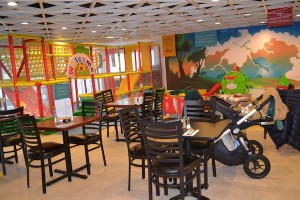
In addition to great food, Shuk has space in the large dining room to keep the 2- to 6-year-old crowd entertained. (photo by Lauren Kramer)
Soon after he arrived here, he tasted the food of chef Evy Swissa, who worked at Café 41, and quickly recognized his expertise. Volodarsky also noticed a dearth of establishments where parents could shmooze, enjoy good food and know that their kids were playing safely within eye- and earshot. So, when the opportunity arose to take over Café 41, he jumped at it. He invested $100,000 in a complete remodel and added a space for kids, with climbing structures in the large dining room to keep the 2- to 6-year-old crowd entertained. Then, he found a slab of cedar, cut and varnished it and made it a centrepiece bar in his new restaurant, Shuk. It’s a fabulous piece of carpentry.
Volodarsky hasn’t spared any expense transforming Shuk into a more sophisticated space, adding a state-of-the-art coffee machine, excellent lighting, a beautiful color scheme and quartz countertops. Dairy products are all chalav Yisrael and many of the ingredients he uses come from Israel, including
Israeli rosewater, tehina, za’atar, Moroccan spices and Turkish coffee by Elite. The kitchen is under Chabad supervision.
My shakshuka ($14.50) arrived on a skillet, presented on a wooden board accompanied by French fries in a neat stainless steel basket. (photo by Lauren Kramer)
My shakshuka ($14.50) arrived on a skillet, presented on a wooden board accompanied by French fries in a neat stainless steel basket. It was also served with pita that Volodarsky was quick to point out is deliberately Israeli-style, sourced from Toronto, and hummus, which Swissa makes in five-litre quantities daily and was so good I had to bring a container of it home. Other items on the menu included the $7 boreka plate (three borekas served with boiled egg, tahini and pickled cukes), the $14.95 falafel plate (seven balls with a side of hummus, fries, Israeli salad and pita), hatzilim ($14.50, served on top of tahini with tomato salsa and pita) and za’atar focaccia ($14.50). There’s also poutine ($7.50), French toast ($8.95), eggs benedict with salmon and avocado ($14.50), pasta and wraps containing fish or falafel.
The food is a mix of Mediterranean, Russian and Yemeni influences, Swissa said. “It’s comfort food that brings you back to Israel,” he confided, adding that the menu is fairly simple with daily specials bringing new items to the mix. The two specials the day I came in were Persian fish balls with couscous, spinach and carrots ($17.30) and flatbread with caramelized onion, goat cheese and pesto ($14).
Volodarsky looked pensively towards the children’s area, where his 3-year-old often releases energy on rainy Vancouver days. “The idea is to attract families with kids,” he said quietly. “Out front we have a quiet area for coffee and meetings, but in the back are most of our 76 seats, and Sundays it’s packed in there.”
The fact that the restaurant is kosher is a big drawcard for Vancouver’s Jewish community and Volodarsky and his team of nine are fighting the perception that kosher means “super expensive.”
“We’re really trying to keep our costs reasonable,” he said. Still, some 55% of diners are not Jewish, Swissa noted. “And they love hummus!”
Don’t miss the desserts – there’s a fabulous selection of delicacies including tahini ice cream, chocolate-banana mousse cups and butter popcorn mousse.
And, if you don’t have the time or energy for a Friday night meal, Swissa can handle that in a heartbeat, complete with the challah, for any orders, even as small as a family of one or two. “I need just 20 minutes forewarning,” he said. He makes 12 challot each Friday in three different flavors, and they disappear fast, so pre-orders are crucial.
Shuk is open Mondays through Thursdays, 8 a.m.-8 p.m.; Fridays, 8 a.m.-3 p.m.; and Sundays, 9 a.m.-8 p.m. There is free underground parking and free wifi. Before Feb. 10, Shuk’s grand opening, access to the kids play area is free. After that date it’s $5 per child, $2.50 per sibling or $30 for a month-long unlimited membership. For more information or reservations, 604 563-4141.
Lauren Kramer, an award-winning writer and editor, lives in Richmond. To read her work online, visit laurenkramer.net.