If the entire population of the United States changed their diet from a beef-heavy plan to one based on chicken, it would be possible to feed 120 to 140 million more people with the same resources. (photo from wis-wander.weizmann.ac.il)
How much does a steak really cost? Or chicken nuggets, or a plate of hummus? New research by Prof. Ron Milo and Alon Shepon of the plant and environmental sciences department of the Weizmann Institute of Science, together with Prof. Gideon Eshel of Bard College in New York, took a look at the figures – including the environmental costs – of the different foods we eat. The research appeared in Environmental Research Letters.
The data for the study came from figures for cattle and poultry growing and consumption in the United States. To compare, the researchers calculated the nutritional value of each – usable calories and protein – versus the environmental cost. The latter included the use of land for fodder or grazing and the emission of greenhouse gases in both growing the food and in growing the animals themselves.
Chickens, according to the study, produce much more edible meat per kilogram of feed consumed, and they produce their meat faster than cattle, meaning more can be grown on the same amount of land. For every 100 calories and 100 grams of protein fed to beef cattle, the consumer ends up with around three calories and three grams of protein. For poultry, that figure is about 13 calories and 21 grams of protein.
The researchers then asked what would happen if the entire population of the United States were persuaded to change their diet from a beef-heavy plan to one based on chicken. Their answer: it would be possible to feed 40% more people – 120 to 140 million more people – with the same resources.
What would happen if the same population was persuaded to adopt an entirely plant-based diet? That is, instead of using land to grow cow or chicken feed and then eating the animals, to use that land to grow nutritional crops – mainly legumes, including peanuts, soya, garbanzos and lentils. These can supply all of a person’s nutritional requirements, except vitamin B12, which can be obtained from nutritional yeast.
A separate study, published in Environmental Science and Technology – “Environmentally optimal, nutritionally aware beef replacement plant-based diets,” by Milo, Shepon, Gidon Eshel and Elad Noor – suggests that an extra 190 million people could eat off the same environmental resources in this way.
“If we changed our diet, we would change the environmental price we pay, with every meal,” said Shepon. “Eating a plant-based diet can both meet our nutritional requirements and save on land use, as well as the release of greenhouse gases into the atmosphere and excess nitrogen from fertilizers into the water supply. These are real costs that we all bear, especially when people eat beef.”
Milo’s research is supported by the Leona M. and Harry B. Helmsley Charitable Trust; Dana and Yossie Hollander, Israel; and the Larson Charitable Foundation. Milo is the incumbent of the Charles and Louise Gartner Professorial Chair.
For more on the research being conducted at the Weizmann Institute, visit wis-wander.weizmann.ac.il.
האם הנדל”ן בוונקובר הוא בועה שעומדת להתפוצץ? (צילום: Cynthia Ramsay)
יש הטוענים ששוק הנדל”ן של אזור ונקובר הוא בועה שעומדת להתפוצץ כל רגע, והם אף דואגים להזהיר את הציבור הרחב מפני כיביכול סכנה גדולה זו. הבנק השוויצי יו.בי.אס טוען שוונקובר היא העיר שנמצאת בסכנה הגדולה בכל העולם להפוך לבועת נדל”ן, לאור עליות המחירים הבלתי פוסקות של השוק. ונקובר נמצאת במקום הראשון בדירוג של הבנק שבחן שמונה עשר מרכזים פיננסיים ברחבי העולם, לפי עליית מחירי הנדל”ן בשנה האחרונה. אחרי ונקובר ברשימת תשע הערים המסוכנות כיוון שהנדל”ן בהם מוגדר כבועה (על ידי הבנק) באות: לונדון, שטוקהולם, סידני, מינכן, הונג קונג, סן פרנסיסקו, אמסטרדם, ציריך ופריז. לפחות אנו נמצאים ברשימה טובה ומכובדת של ערים מובילות וידועות בעולם, כל אחת בתחומה.
בבנק מודים כי אי אפשר להוכיח את קיומן של בועות עד שהן מתפוצצות “אך יש לבועות בשוקי הנדל”ן סימנים טיפוסים מוכרים מההיסטוריה”. למשל: התרחבות הפער שבין המחירים להכנסות המקומיות של התושבים ולדמי השכירות, ועיוותים בכלכלה הריאלית כמו הלוואות מוגזמות ופעילות בנייה. את עליית המחירים ברוב הערים שנבדקו מייחסים ביו.בי.אס למספר גורמים משותפים: ריביות נמוכות שמעודדות את התושבים להוציא יותר כסף, זרימה של רוכשים זרים (שרבים מהם באים מאסיה) שמחפשים מקום בטוח להשקיע בו, וכן אופטימיות מבחינת המשקיעים לגבי התשואות של הנדל”ן המקומי.
לטענת הבנק שוק הנדל”ן של ונקובר מונשם בצורה מלאכותית, כאשר בעשר השנים האחרונות מחירי הנדל”ן הוכפלו, וגם החלשות הדולר הקנדי מעודדת משקיעים זרים להשקיע כאן.
הפתעה מלוכלכת: בעל בית גילה שדייריו הפכו את ביתו לגן חיות
בעל בית בעיר קינגסטון שבמחוז אונטריו גילה לתדהמתו יום אחד שהדיירים שהשכירו את ביתו, הפכו את המקום לגן חיות. לאחר מאבק משפטי ממושך הוא הצליח לפנותם מביתו ולהחזיר את המקום למה שהיה – בית.
סיימון אנדרו השכיר את ביתו המרווח (שכולל שלושה חדרי שינה) לפני כשנה לזוג עם ילד, שנראו לו נחמדים ואמינים בתחילה. הוא סמך על חושיו ולא חשד בכלום. לאחר מספר חודשים אנדרו הגיע לביקור בבית ונדהם ממה שראו עיניו. הדיירים הביאו לביתו מספר לא מבוטל של בעלי חיים, והבית נראה והריח ממש כמו גן חיות. רשימת בעלי חיים בבית של אנדרו כללה בין היתר: עיזים, ארנבים, תרנגולות, ציפורים, כלבים וחתולים. הבית היה מטונף וערמות זבל וגללי צואה הצטברו בכל פינה. אנדרו דרש מייד מהדיירים להתפנות מהנכס ולאכזבתו הם סרבו בתוקף.
בצר לו נאלץ בלת הבית לפתוח בהליך משפטי לפנותם (לאחר שגם הפסיקו לשלם לו שכר דירה) שנמשך ונמשך חודשים רבים, והסתיים כעבור חצי שנה. עם הפינוי אנדרו השכיר משאית גדולה שפינתה במספר סבבים לא פחות מתשעה טון של זבל מהבית. אחרי כן הגיעה התור של חברת ניקוי לנקות את הבית בצורה יסודית ולהיפטר מריחות השתן והצואה. אחריה הגיעה חברת שיפוצים לתקן את הנזקים הרבים שנגרמו לבית. עלויות הניקוי והשיפוץ הגיעו ליותר משלושים אלף דולר. בנוסף נאלץ אנדרו לשלם את החשבונות גדולים שהדיירים לא כוסו. מדובר על חשמל בגובה של אלף ארבע מאות דולר, חשבון גז בגובה של אלף שבע מאות דולר וחשבון טלפון, אינטרנט וכבלים בגובה אלפיים דולר. אנדרו למד את הלקח היקר והוא חליט שיהיה מה שיהיה אך הוא לא ישכיר את ביתו לאיש לעולם. עתה הוא מחפש מקורות לממן את עלויות הניקוי והשיפוץ לבית שהפך לגן חיות במשך כשנה.
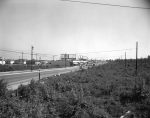
Cambie Street, looking south from 41st Avenue, 1952. (photo from City of Vancouver Archives via jewishmuseum.ca/oakridge)
On Nov. 23, the Jewish Museum and Archives of British Columbia had both its annual general meeting and launched its newest online exhibit, Oakridge.
JMABC board president Perry Seidelman called the AGM to order and noted a major absence.
“Forty-five years ago,” he said, “Cyril Leonoff became our founding president and was at our side throughout all of those years. However, sadly, this ongoing support ended this year with Cyril’s passing. There is so much that can be said about Cyril but tonight I will only say that he has been and will continue to be missed. It goes without saying that we would probably not be here tonight if it was not for Cyril Leonoff.”
Seidelman then went on to list some of the year’s accomplishments, including ongoing speaking engagements and historical tours, as well as the recording of 35 new oral history interviews and the digitization of “various family fonds, the Mountain View Cemetery Restoration Committee fonds and the Temple Sholom fonds.”
He noted that the digitization of “the oldest books from Congregation Emanu-El (1861 through 1901 approximately)” was complete and they will be online soon, that several online exhibits had been mounted during the year, and that the museum’s “largest collection by far, the Canadian Jewish Congress, Pacific Region, fonds, has begun to be processed, with immense research potential.”
The museum handled hundreds of research requests, he said, and “received donations ranging from fiction manuscripts to synagogue records to WWII records.”
Seidelman noted that longstanding JMABC member (and a past president) Bill Gruenthal was recognized by “Jewish Seniors Alliance for years of extraordinary volunteer work” and that archivist Alysa Routtenberg had “recently completed her first year as archivist as Jennifer Yuhasz’s successor. It has proven to be a nearly seamless transition with a continuing and increasing inflow of documents and interviews and regular transmission of the vast history of which we are guardians.”
He thanked JMABC administrator Marcy Babins, JMABC coordinator of programs and development Michael Schwartz, Shirley Barnett for her leadership in the restoration of the Jewish section of Mountain View Cemetery, Cynthia Ramsay for editing the JMABC’s annual journal, The Scribe, and donors and funders, including the Jewish Federation of Greater Vancouver. He bid farewell to three members of the board – Barnett, Chris Friedrichs and Barbara Pelman – and welcomed four new members: David Bogoch, Alan Farber, Alex Farber and Carol Herbert.
After the AGM was the Oakridge launch.
“With this exhibit,” said Schwartz, “we set out to document an important period in our community history; a moment when a population boom coincided with financial stability and postwar optimism to cause our community to grow both in size and stability in a way rarely seen before or since. This era set a new foundation for our community that we have built upon and relied upon ever since.
“This exhibit places this period in context with events happening both before and since. It asks why and how many Jewish families and institutions chose to establish themselves in Oakridge.”
Compiled over two years, the Oakridge research team was Erika Balcombe, Junie Chow, Elana Freedman and Josh Friedman, with Schwartz. A large portion of the exhibit comprises oral history interview excerpts from community members Harry Caine, Vivian Claman, Irene and Mort Dodek, Gail Dodek Wenner, Wendy Fouks, Debby Freiman, Sarah Jarvis, Ed Lewin, Sandy Rogen, Ken Sanders, and Seidelman.
“Irene deserves double thanks,” said Schwartz, “as we have included an excerpt of an interview that she carried out with Bea Goldberg and Marjorie Groberman in 1996. Naturally, I thank Bea and would certainly thank Marjorie were she still with us.”
Schwartz also gave thanks to JMABC colleagues Babins and Routtenberg, as well as Yuhasz, “each of whom devoted much time and energy to this project,” and the board of directors.
At the turn of the last century, explained Schwartz, “there were essentially two interconnected Jewish communities: the affluent Reform Jews in the West End and the Orthodox, working-class Jews in the East End, what today we call Strathcona…. Over time, the Jews of the East End grew more financially stable and began to relocate to the new neighborhood of Fairview in the 1920s and ’30s.”
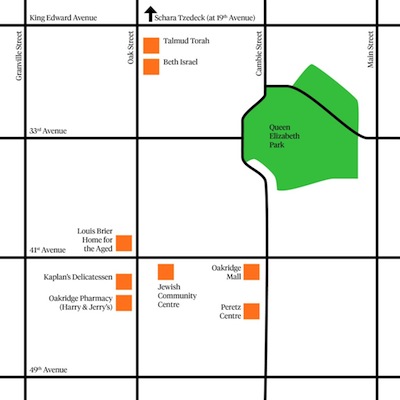
He noted, “If the Great Depression hadn’t hit, it seems likely that Oak and 12th Avenue would have been the heart of the Vancouver Jewish community. Instead, campaigns to build Beth Israel, Talmud Torah and a new Schara Tzedeck were put on hold until after the war. All three projects were completed in 1948. By that time, the city had continued to expand southward, so these three facilities were built closer to King Edward Avenue.
Oakridge Mall at 41st and Cambie opened in 1960 and provided a commercial hub for the neighborhood, which attracted many young families – Jewish and not – to the area. (image from jewishmuseum.ca/oakridge)
“This southward shift was further encouraged by another important event,” he continued. “In 1950, the CPR, the Canadian Pacific Railway, released a parcel of land stretching from 41st Avenue and Granville Street to 57th Avenue and Main Street. The city identified the middle third of this land for residential development and worked with Woodward’s and other developers to construct Oakridge Mall as an anchor for the new neighborhood.
“This neighborhood didn’t attract exclusively Jews, but it arrived at a perfect moment for our community.”
There was a lot of material from which the researchers had to choose. “The work was to pare it down to a manageable size, a representative cross-section of the community,” said Schwartz. “As you can imagine, everyone we spoke to had a very different experience. For instance, Vivian Claman and Ed Lewin shared with us the experience of survivor families.”
In the exhibit, said Schwartz, Lewin comments, “The survivors and their children were almost like a sub-community of the Jewish community. We kind of did everything together, we were like an extended family.”
“In general, the Baby Boomers we spoke to had happy memories of their childhoods,” said Schwartz, giving the example of Claman.
“We played in the street – we would be gone all day,” she says in the exhibit. “We played kick the can! I mean, those were the days that you would go outside and you would just play till it was dark or till your parents yelled and said come in for dinner. There was a lot of hanging out.”
That’s not to say everything was perfect. Schwartz noted Mort Dodek’s comments in the exhibit.
“One other thing that you have to understand is that there was a lot of antisemitism at that time,” says Dodek. “There were people who were uncomfortable living in Shaughnessy, a lot of Jewish people were not comfortable there. The Shaughnessy Golf Course was there, and it was restricted, no Jews were allowed to join that club.”
And Irene Dodek notes, “When we first moved to Vancouver in 1947, my parents went out with a real estate man to look at a house at 25th between Oak and Granville, and the real estate agent told my father, ‘This is a good neighborhood because no Jews or Chinese are allowed.’”
Schwartz also pointed out that there were divisions within the Jewish community, citing Seidelman and Mort Dodek’s comments from the exhibit.
“The rabbi of Schara Tzedeck would not go to Beth Israel, would not be seen to enter, whereas today they have the Rabbinical Association, all the rabbis get on really well together and they seem to respect each other’s different levels of observance, whereas in those days they didn’t,” says Seidelman.
“If you want to talk about splits in the community,” says Dodek, “there was a terrific split between the people who were involved with the Peretz shul and people who were involved with, say, Talmud Torah…. It was not religious and believed that the main language to speak for a Jewish person was Yiddish. And, of course, the people at the Talmud Torah, the language to speak, of course, with the establishment of the state of Israel, was Hebrew.”
“Another theme that emerged through our interviews,” said Schwartz, “was the way gender roles were changing and have changed since the 1960s. Men always worked outside the home, but women rarely did. This was beginning to change, but very slowly. Without full-time jobs, women had the time to dedicate to volunteer organizations like Hadassah and National Council of Jewish Women. Both organizations accomplished a great deal in the 1950s, ’60s and ’70s, but have struggled in the years since, as fewer young women have the time to devote to this type of work.”
For anyone wanting to know more about the role of women in the community, Schwartz recommended the museum’s 2013 exhibit More Than Just Mrs., which can be found online.
“Oakridge, like each of our exhibits, serves three functions,” said Schwartz, listing those functions: a chance to grow the museum’s archives, to increase awareness of the JMABC and of Jewish life in the province, and to reflect on how the community has changed over time.
For the Oakridge exhibit, he noted, the majority of the oral history interviews “were undertaken by volunteer and student interns, giving them valuable experience in the art and science of oral history interviews. Thanks to projects like this, including other exhibits and our annual journal, The Scribe, our oral history collection has grown substantially in recent years, bringing our current total to 762 interviews.
“Just this month,” he added, “we held two interviewer training sessions as the first phase of our Southern African Diaspora Oral History Project…. Through this project, we intend to interview hundreds of community members who arrived here from South Africa and the neighboring countries in the 1970s, ’80s and ’90s.”
With respect to increasing awareness, Schwartz said, “Many of you will remember the launch of our modern architecture exhibit New Ways of Living back in January of this year. This event had an attendance of over 150 people, many of whom were not Jewish and found out about the event through our partners, Inform Interiors and the UBC School of Architecture and Landscape Architecture. Similarly, our 2015 exhibit, Fred Schiffer: Lives in Photos, attracted more than 800 people over its two-week run, again with much thanks to our partners, Make Gallery and Capture Photography Festival…. Each new exhibit has a specific thematic focus which draws in a new audience.”
As for reflection on the Oakridge years, Schwartz pointed to the expansion of the Jewish community. “Families,” he said, “have settled into neighborhoods throughout the city and the region in general.”
Referring to the Oakridge area, he concluded, “[I]f fewer and fewer Jews live in this neighborhood, does it make sense for the Oak Street corridor to remain the hub of much Jewish activity? This remains to be seen.”
On Saturday, Dec. 3, at a meeting in Calgary, the Green Party of Canada (GPC) passed a resolution updating the party’s position on the Israel-Palestine conflict. It puts the entire onus for the conflict’s continuation on Israel, specifically on Prime Minister Binyamin Netanyahu.
“The possibility of a two-state solution is diminishing directly due to the Netanyahu government’s support for illegal expansion and increasingly brutal military occupation,” reads the Dec. 4 statement on the Green party’s website. “Even over 200 former members of Israeli Defence Forces (‘Security First’ [plan for West Bank, Gaza]) have decried the worsening security situation for Israelis and Palestinians – and laid the blame directly on Prime Minister Netanyahu’s policies. The former Israeli military officers have raised the alarm of a ‘humanitarian crisis in Gaza’ and the diminishing chances for a two-state solution.
“Clearly,” continues the statement, “Canada needs to do more to register with the Israeli government that flouting international law and threatening the security of its own people while violating the human rights of Palestinians is not acceptable. In doing so, Canada must continue to condemn violence from the militant elements of Palestinian society.”
While rejecting the boycott, divestment and sanction movement – as its goals “do not include supporting the right of the state of Israel to exist” and are “incompatible with Green party policy”– the addendum to the party’s policy “is based on clear differentiation between ‘legal’ Israel, as within the 1967 borders, a democracy respecting the rights of citizens of all ethnicities within its borders, and ‘illegal’ Israel – the occupied territories beyond Israel’s legal borders. The Palestinian civilians within the occupied territories are subjected to virtual continual abuses of their human rights. The occupied territories are maintained under a brutal military occupation. Products from illegal Israel should not be granted the preferred trading status of products of legal Israel.”
With this in mind, the Green party would like to see the Canada-Israel Free Trade Agreement renegotiated, the “termination and indefinite suspension of all military and surveillance trade and cooperation” between Canada and Israel, and the repeal of “the House of Commons resolution condemning the BDS movement.”
According to the Dec. 3 article “Greens vote for new Israel policy without BDS” by James Munson on ipolitics.ca, “Approximately [350] members voted on the ‘compromise’ resolution that purged the party’s policies of any reference to the Palestinian-led boycott, divestment and sanctions (BDS) movement, which pressures companies, governments and institutions with ties to Israel.”
The article cites Green party president Ken Melamed as saying, “The party wanted to be careful not to align with a particular organization or movement. The essence of it, I think, is that the party feels that diplomatic approaches to achieving peace and justice in the Middle East have been ineffective and it’s time to move to economic actions.”
The article said that, according to Melamed, about 85% of those who voted at the meeting supported the resolution – others opposed or abstained – but that it still had to be voted on electronically by all 20,000 party members before it became official policy.
Shimon Koffler Fogel, chief executive officer of the Centre for Israel and Jewish Affairs (CIJA), condemned the resolution. In a Dec. 3 statement, he noted, “The new policy is rife with historical distortions and places the Green party at odds with the Canadian consensus that BDS is discriminatory and counter-productive to peace. The Ontario legislature just voted by a tenfold margin to reject the differential treatment of Israel, underscoring how out of touch the Green party has become.
“Elizabeth May and the party’s leadership have turned their backs on the mainstream Jewish community, including the many Jewish Greens who no longer feel welcome. Despite repeatedly flagging that the anti-Israel vote was scheduled to take place on the Jewish sabbath, senior Green party officials insisted on holding the vote today, thereby excluding many Jewish Green party members from voting. This is an alarming development and a stunning failure of leadership.”
The December resolution replaces a resolution that was passed at the Green party convention in August.
In the backgrounder to Fogel’s statement, CIJA notes, “The party’s decision to endorse economic penalties against Israel is incompatible with the wishes of the party’s grassroots. A survey of Green members conducted by the party after their convention revealed that, of 2,800 respondents, 28% agreed with the decision to support BDS, 44% wanted it repealed and 28% thought it should be amended to remove any reference to a specific movement or country.”
The backgrounder further explains, “The text’s exclusive recognition of Palestinians as ‘the indigenous people’ of the region implies that Jewish people have no ancestral or indigenous roots in Israel. This misleading suggestion contradicts millennia of archeological and documentary evidence.”
And, CIJA warns, “The one-sided nature of the resolution and its call for extreme measures against Israel puts the Green party outside the international consensus for achieving peace, which emphasizes the need for both parties to compromise and negotiate.”
Note: This article has been edited to reflect later reports that about 350 party members voted on the resolution, versus the number cited on ipolitics.ca, which was approximately 275.
On Dec. 1, the Ontario legislature voted 49-5 to pass Motion 36, which rejects the boycott, divestment and sanctions (BDS) movement aimed at Israel. The motion was backed both by the Liberals, who form the government, and the opposition Progressive Conservatives.
Tory MPP Gila Martow (Thornhill), who introduced the motion, noted in the legislature prior to the vote that: “BDS is boycotting not just Israel, but all Jews and other supporters of Israel.”
She explained that the BDS movement and its proponents have created a hostile environment at universities.
“We’re trying to make a statement about attitudes in society. I genuinely feel this is the first step in helping our students feel comfortable on campus. They’re choosing what program to study based on what campus they feel comfortable at,” she told the Independent.
“This is not just about BDS – we already went through this with Israel Apartheid Week. I think we need to make it clear from the government on down, we will not allow any type of antisemitism to masquerade as free speech.”
She hopes this message reverberates with school administrators.
“They’ve had tools at their disposal they haven’t bothered to use [to fight campus antisemitism] and I would suggest they might make a bigger effort than they did in the past,” she said.
Martow tipped her hat to the Centre for Israel and Jewish Affairs (CIJA) for their community advocacy on the motion, while Joel Reitman, Greater Toronto Area co-chair of CIJA, noted: “[J]ust as Ontarians rightly oppose all forms of discrimination, our province rejects BDS and other bigoted campaigns against Israelis.”
In a statement, Sara Lefton, CIJA’s vice-president, Greater Toronto Area, added: “It also demonstrates that elected officials across party lines recognize that BDS is tainted by antisemitism. Just as we are grateful that the legislature has taken this stand, we are proud that – in just a few short days – thousands of Ontarians took unified action to urge MPPs to support this motion.”
Adam Minsky, president and chief executive officer of United Jewish Appeal, said: “From students to seniors, from rabbis to grassroots activists, from left to right, our community came together to take tangible action to support Israelis and defeat BDS. The result speaks for itself – and testifies to the power of Israel advocacy to unite and strengthen our community.”
The text of Motion 36 reads: “That, in the opinion of this House, the Legislative Assembly of Ontario should:
“Stand firmly against any position or movement that promotes or encourages any form of hatred, hostility, prejudice, racism and intolerance in any way;
“Recognize the longstanding, vibrant and mutually beneficial political, economic and cultural ties between Ontario and Israel, built on a foundation of shared liberal democratic values;
“Endorse the Ottawa Protocol on Combating Antisemitism;
“And reject the differential treatment of Israel, including the boycott, divestment and sanctions movement.”
The motion was a retry, of sorts, of May 19’s Bill 202, “The Standing Up Against Antisemitism in Ontario Act,” defeated by a vote of 39-18.
That particular bill recognized the BDS movement as “one of the main vehicles for spreading antisemitism and the delegitimization of Israel globally and [one that] is increasingly promoted on university campuses in Ontario.”
At the time, Martow said that a bill like 202 “has teeth,” and could have financial consequences, versus a motion or a resolution. The failed bill would have compelled the province and its post-secondary institutions to withdraw business interactions with companies supporting BDS. As well, a bill would require passing three readings and unanimous consent, Martow told the Independent – something she wasn’t sure would be possible, so a motion was chosen this time around instead.
For the May bill, the Progressive Conservatives voted in favor, in addition to a single Liberal, Mike Colle, while the NDP as a whole rejected the bill, as they did the recent motion.
Dave Gordonis a Toronto-based freelance writer whose work has appeared in more than a hundred publications around the world.
The Centre for Judaism of the Lower Fraser Valley is looking for nominations for its annual Lamplighter Award, which honors a child who has performed an outstanding act of community service.
Candidates must be between the ages of 6 and 18 and nominations of potential recipients must include two references describing the child’s community service. The chosen lamplighter will receive the award Dec. 29 at the Semiahmoo Shopping Centre at a 7 p.m. ceremony attended by Rabbi Falik and Simie Schtroks, directors of the Centre for Judaism, White Rock Mayor Wayne Baldwin and representatives of the cities of Surrey, White Rock, Langley and Delta.
Last year, Richmond twins Sarah and Amy Aginsky received the award for their work hosting a street store for the homeless and impoverished. The project, a one-day pop-up store, gave “shoppers” the opportunity to select apparel and shoes without the exchange of money.
“Chanukah celebrates the victory of light over darkness and goodness over evil,” said Simie Schtroks. “This is a most appropriate opportunity to motivate and inspire young people to make this world a brighter and better place. By filling the world with goodness and kindness, that light can dispel all sorts of darkness.”
To nominate a candidate for the award, contact Simie Schtroks as soon as possible at [email protected].
This fall, a select number of Langara College students embarked on a project to write the memoirs of local Holocaust survivors, capturing personal stories from the Second World War. The project is called Writing Lives: the Holocaust Survivor Memoir Project.
Writing Lives is an eight-month collaboration between Langara’s English and history departments, the Vancouver Holocaust Education Centre (VHEC) and the Azrieli Foundation. In the first half, students learn about the history and impact of the Holocaust. In the second half, students are paired with local Holocaust survivors associated with the VHEC.
“Writing Lives provides an opportunity for students to immerse themselves in the history of the Holocaust beyond physical textbooks,” said Rachel Mines, Langara English instructor, and project coordinator. For example, on Nov. 9, students commemorated Kristallnacht (The Night of Broken Glass) by lighting candles in memory of the violent anti-Jewish events that took place on Nov. 9 and 10, 1938. The course also regularly features a series of guest speakers from different organizations giving their perspective on the events surrounding the Holocaust.
“I feel grateful for the opportunity to investigate the events and prejudices that served as a catalyst for the Holocaust. With the help of survivors, professors, librarians and fellow students, I am learning that individuals, communities and organizations all have agency when it comes to fighting racism, and how we can work together to prevent such tragedies in the future,” said Lucille Welburn, a peace and conflict studies student who is taking the course.
Robin Macqueen, a Langara instructor and chair of the health sciences division, is auditing the course out of personal interest. He said: “This is a fantastic opportunity to engage with and honor people who survived a time of unimaginable prejudice. I’m getting a lot out of the course, and enjoy being a student again.”
For the VHEC, survivor testimonies are seen as a useful and powerful method for teaching about the Holocaust.
“Holocaust testimony provides a connection with people, culture, persecution and survival,” said Ilona Shulman Sparr, education director for the VHEC. “Eyewitness testimonies have proven to be a powerful and effective teaching tool, which affords a personal connection to the events of the Holocaust as we hear survivors’ accounts of their experiences. Testimonies provide a way for students to connect with survivors’ stories and gain an understanding of events that other sources can’t give them.”
This spring, students will be matched with Holocaust survivors to write their memoirs. The memoirs will be archived at the Azrieli Foundation and the VHEC, with a possibility of being published for public awareness.
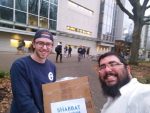
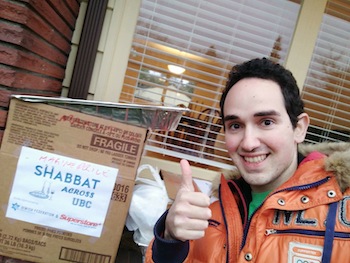
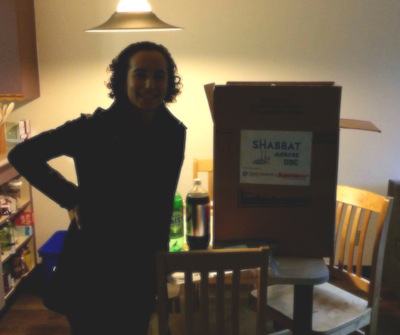
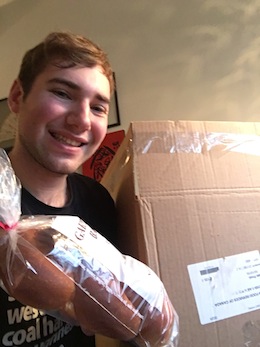
Chabad on Campus, student and other volunteers and Shabbat hosts made Shabbat Across UBC on Nov. 18 possible. (photos from Chabad at UBC)
On Nov. 18, more than 75 students celebrated Shabbat with Chabad on Campus at the University of British Columbia but, this time, they only arrived at Chabad after dinner. Instead of hosting the meal at the Chabad House as usual, there were six different dinners hosted by student volunteers in their residence buildings, after which the students met up at Chabad, where they shared dessert and got a chance to know one another.
Rabbi Chalom Loeub, who runs Chabad at UBC with his wife Esti, delivered food and supplies, and the hosts invited their friends and neighbors and ran the meal.
Cordelia Sank is a second-year UBC theatre production student, who volunteered to co-host a dinner in the Fairview Residence block. “Getting the chance to bring together all of the other Jewish students in my residence was very special and inspiring for me,” she said, “and I look forward to attending many more of these dinners in the future.”
The event was a big success, drawing in both seasoned Chabad members and new students, some of whom were experiencing Shabbat for the first time. UBC president Santa J. Ono wrote a letter of congratulation, praising the event as a “wonderful initiative … to build community at UBC.”
Hani Gorgy is a third-year exchange student visiting from Israel, who has attended many Shabbat meals, classes and programs at Chabad on Campus. “I’ve always felt that Shabbat dinner is a time of spiritual joy,” she said. “Being invited to Shabbat dinners here in Vancouver made me feel welcomed and safe. Meeting so many Jewish people here helped me feel like I’m part of the community.”
Weekly Shabbat dinners are only one of the programs that Chabad at UBC offers, including social programs, Torah classes, kosher meals on campus, support and holiday programming for the Jewish community at UBC and other colleges and universities across Vancouver.
The Shabbat Across UBC event was made possible by the sponsorship of the Jewish Federation of Greater Vancouver and the Marine Drive Superstore. Chef Menajem of Forty-One Catering created an impeccable spread, and the student volunteers and Shabbat hosts made this annual event a reality.
For more information about this or other events, contact the Chabad Jewish Student Centre at 778-712-7703, [email protected] or chabadubc.com.
Sydney Switzeris a fourth-year student at Emily Carr University and president of the Chabad Jewish Student Club.
May 24, 2017, marks the 50th anniversary of a united Jerusalem. In honor of this occasion, the Afikim Foundation, in cooperation with the Israel Ministry of Diaspora Affairs, is launching the Jerusalem50 Global Unity Torah, a global movement that celebrates a reunited Jerusalem with acts of kindness.
“The Global Unity Torah will provide Jews worldwide an unprecedented communal platform to do good and inspire goodness in others,” said Rabbi Raphael Butler, founder of the Afikim Foundation. To purchase a letter, the currency is not in dollars but in acts of kindness.
Individuals and families from all walks of Jewish life will unite with organizations, congregations, agencies, schools and Jewish groups from all corners of the globe to “purchase” their letter(s) in the Torah with acts of chesed (kindness).
With an interactive site in five languages, jerusalem50.org, a social media campaign, pamphlets designed and published in five languages, wall hangings of the sites of Jerusalem set to display in communities around the world, and a traveling exhibition on Jerusalem, the Jerusalem50 movement is set to launch.
“As an innovative incubator, Afikim is where profound Jewish ideas take flight, and we envision Jerusalem50 having a poignant and lasting impact on the Jewish people,” said Butler. “By using kindness as an impetus for change and Jerusalem as a uniting factor, we can transform our world.”
Rabbis dance with their colleagues at a banquet at the Brooklyn Marine Terminal Pier 8 on Nov. 27. They were among the 5,600 rabbis and guests from 90 countries who gathered in New York for the International Conference of Chabad-Lubavitch Emissaries, an annual event aimed at reviving Jewish awareness and practice around the world. This year’s conference carried added significance, as the North American Jewish community marked 75 years since the Lubavitcher Rebbe – Rabbi Menachem M. Schneerson, z”l – and his wife, Rebbetzin Chaya Mushka, z”l, arrived on U.S. shores from wartorn Europe in 1941. (Courtesy of Chabad.org)



 Rabbi Chalom Loeub, who runs Chabad at UBC with his wife Esti, delivered food and supplies, and the hosts invited their friends and neighbors and ran the meal.
 The event was a big success, drawing in both seasoned Chabad members and new students, some of whom were experiencing Shabbat for the first time. UBC president Santa J. Ono wrote a letter of congratulation, praising the event as a “wonderful initiative … to build community at UBC.”
 Weekly Shabbat dinners are only one of the programs that Chabad at UBC offers, including social programs, Torah classes, kosher meals on campus, support and holiday programming for the Jewish community at UBC and other colleges and universities across Vancouver.