Skip to content
  • Home
  • Subscribe / donate
  • Events calendar
  • News
    • Local
    • National
    • Israel
    • World
    • עניין בחדשות
      A roundup of news in Canada and further afield, in Hebrew.
  • Opinion
    • From the JI
    • Op-Ed
  • Arts & Culture
    • Performing Arts
    • Music
    • Books
    • Visual Arts
    • TV & Film
  • Life
    • Celebrating the Holidays
    • Travel
    • The Daily Snooze
      Cartoons by Jacob Samuel
    • Mystery Photo
      Help the JI and JMABC fill in the gaps in our archives.
  • Community Links
    • Organizations, Etc.
    • Other News Sources & Blogs
    • Business Directory
  • FAQ
  • JI Chai Celebration
  • JI@88! video

Recent Posts

  • Eby touts government record
  • Keep lighting candles
  • Facing a complex situation
  • Unique interview show a hit
  • See Annie at Gateway
  • Explorations of light
  • Help with the legal aspects
  • Stories create impact
  • Different faiths gather
  • Advocating for girls’ rights
  • An oral song tradition
  • Genealogy tools and tips
  • Jew-hatred is centuries old
  • Aiding medical research
  • Connecting Jews to Judaism
  • Beacon of light in heart of city
  • Drag & Dreidel: A Queer Jewish Hanukkah Celebration
  • An emotional reunion
  • Post-tumble, lights still shine
  • Visit to cradle of Ashkenaz
  • Unique, memorable travels
  • Family memoir a work of art
  • A little holiday romance
  • The Maccabees, old and new
  • My Hanukkah miracle
  • After the rededication … a Hanukkah cartoon
  • Improving the holiday table
  • Vive la différence!
  • Fresh, healthy comfort foods
  • From the archives … Hanukkah
  • תגובתי לכתבה על ישראלים שרצו להגר לקנדה ולא קיבלו אותם עם שטיח אדום
  • Lessons in Mamdani’s win
  • West Van Story at the York
  • Words hold much power
  • Plenty of hopefulness
  • Lessons from past for today

Archives

Follow @JewishIndie
image - The CJN - Visit Us Banner - 300x600 - 101625

Category: News

Dialogue heads east

Dialogue heads east

Belle Jarniewski (fifth from the left) is one of the co-founders, with Sumera Sahar (fourth from the left), Perry Kimelman and Dr. Rory Dickson of the Muslim-Jewish Dialogue Group of Winnipeg. (photo from Belle Jarniewski)

Started in Winnipeg last year after a visit from Rabbi Shaul Osadchey of Calgary’s Beth Tzedec, Belle Jarniewski and Perry Kimelman believe that a local dialogue group with Muslims and Jews will do a lot of good for both communities.

Jarniewski is chair of the Freeman Family Foundation Holocaust Education Centre, a position she has held since 2008. And, just recently, she began a two-year term as president of the Manitoba Multifaith Council, the first woman and the first Jewish person to hold that position.

“The Manitoba Multifaith Council had brought in Rabbi Shaul Osadchey of Calgary for its Multifaith Leadership Breakfast in 2015 and I was intrigued to hear how successful he had been in his own interfaith dialogue work and to hear how well he had reached out to the Muslim community there,” she told the Independent.

Jarniewski approached her synagogue with the idea of seeing if she could work with them to hold the kinds of events with which Osadchey had seen success, but received little interest. So, she decided to start a group independently of an institution.

photo - Belle Jarniewski
Belle Jarniewski (photo from Belle Jarniewski)

“Perry and I are also members of the Arab-Jewish Dialogue Group, which discusses (primarily) the Arab-Israeli conflict, but seems to eschew any real discussion of religion,” she explained. “Both of us have been active in interfaith work for quite some time and have many connections to wonderful people. We felt that was something that was missing. Once we realized that both of us had long been interested in starting just such a group, we put our heads together to see what would be the best way forward.”

Of course, to get the idea off the ground, they needed a Muslim partner or two. They found a perfect match in Sumera Sahar, a member of the Canadian Council of Muslim Women (CCMW). The second Muslim co-convener they found was Dr. Rory Dickson of the University of Winnipeg’s department of religion and culture. And, with that, the four set out to build membership, which is now a balanced mix of almost 40 Jews and Muslims (by invitation only). Members have been proposed by other members, as well as by the conveners.

“It is important that those who join are interested in dialogue with each other, are interested in religion and culture – our own and each other’s – and accept the very few rules we have imposed upon ourselves,” said Jarniewski.

These rules, she said, include “no discussion of politics – there is already another group established for that very reason – and, as well, both groups decided early on that we preferred not to involve clergy. If someone wishes to join, they must be referred through a member.

“We also have a closed group discussion through our private Facebook page, which seems to work very well. The ages of our members are from university through … well, I don’t ask … I would say in the 60s.

“The diversity of religion streams and origins of both Jewish and Muslim members contributes to some wonderfully rich discussions,” she continued. “The group is all about learning about each other’s religion and culture and each other, and getting to know one another. For far too long, Muslims and Jews have had, at best, a polite relationship with each other, but haven’t really gotten to know one another and learned just how much our two religions have in common.”

The group has held a number of evening get-togethers, learning about Sharia and halachah side by side. “The word Sharia evokes, for most Westerners, the most extreme form of Islamic law,” said Jarniewski, “but we learned that Sharia is far more complex than this simplistic interpretation.

“One night, we had Dr. Ruth Ashrafi talk about the role of women in Jewish law and Drs. Rory Dickson and Ahmet Seyhun lecturing on family law in Islam. On another night, we had a great discussion about halal and kashrut.

“At our very first meeting, one of our Jewish members, who hails from Iran, recited a Muslim prayer in flawless Arabic. What an icebreaker that was!”

Sahar told the Independent this group “is an important initiative and much needed, given the popular and often-unchallenged notion that somehow Jews and Muslims are historical and natural adversaries.”

Sahar is an executive member of CCMW’s Winnipeg chapter, the co-coordinator of a community food bank serving Arabic-speaking refugees and has recently been invited to sit on the board of the Manitoba Multifaith Council.

The core objective of the Muslim-Jewish dialogue group is that Muslims and Jews get to know one another directly without the filter of religious or political organizations. Sahar contends that most, if not all, group members believe that the group is a crucial step toward countering antisemitism and Islamophobia and, most importantly, to bridging communities.

Like Jarniewski, Sahar has made good friends and formed a much better understanding of the similarities both religions share, not just religiously, but also as minority religious communities.

“Being a minority community has its challenges, and both Jews and Muslims share similar anxieties and concerns,” said Sahar. “We share the struggle of gaining acceptance and inclusion without losing our religious values and identity. We are also subject to the question of representation – who speaks for us?

“Both communities are pluralistic and diverse but, as is the case with most minority groups, we are often represented in the media and popular discourse as a single voice. I was struck to learn that this issue is as much a source of frustration for the Jewish members of the group as it is for the Muslim members.”

The dialogue group has provided a platform to discuss such issues and suggest some strategies to overcome them. The convenors are pleased to see the sincerity with which group members have engaged with one another and are hopeful in their potential to build understanding.

“I feel that it is more important than ever to speak up when unfortunate statements are made in these rather difficult times that attack Muslims and Islam,” said Jarniewski. “These statements are generally mired in stereotypes and ignorance. It is important that our community realize they are received in the Muslim community in the very same way that the Jewish community is hurt by antisemitic comments.”

Jarniewski is well aware that, across Canada, there are Jewish-Muslim groups such as the one in Winnipeg who are coming together to engage in dialogue. “Little by little, groups such as ours will have a very positive effect,” she said.

Jarniewski quoted Catholic priest and Swiss theologian Hans Küng: “No peace among the nations without peace among the religions. No peace among the religions without dialogue between the religions. No dialogue between the religions without investigation of the foundation of the religions.”

Rebeca Kuropatwa is a Winnipeg freelance writer.

Format ImagePosted on September 23, 2016September 21, 2016Author Rebeca KuropatwaCategories NationalTags dialogue, interfaith, Islam, Judaism, peace
87 headstones added

87 headstones added

Shirley Barnett, chair of the Jewish cemetery restoration project, led the proceedings. (photo by Cynthia Ramsay)

photo - Headstones for the graves of 87 babies and children were unveiled at Mountain View Cemetery’s Jewish section on Sept. 11
Headstones for the graves of 87 babies and children were unveiled at Mountain View Cemetery’s Jewish section on Sept. 11. (photo by Cynthia Ramsay)

On Sept. 11, a small crowd gathered at the Jewish section of Mountain View Cemetery for the unveiling of 87 headstones for babies and children who had passed away between 1893 and 1996.

Shirley Barnett, chair of the Jewish cemetery restoration project, which began in 2012, welcomed attendees. She acknowledged several of the people who greatly contributed to the project, and noted there is still a need for financial support.

“There is work to be done yet,” she said. “There are at least 40 or 50 adult burials that do not have headstones.… We have about 10 or 11 baby and children’s headstones that we did not cover today; we’re still researching the data on those.”

Rabbi Andrew Rosenblatt of Congregation Schara Tzedeck said a few words about how the loss of children is treated in the Tanach, while Rev. Joseph Marciano chanted the prayers for the unveilings.

Before the service, however, Barnett paid tribute to Helen Aqua, who donated the funds for all of the 87 headstones unveiled that day.

“I am but a small piece of this project, and most proud to have been part of this restoration,” said Aqua.

The project also received $27,000 toward the restoration from the federal government’s Canada Western Economic Diversification Infrastructure Canada 150 Grant.

photo - Helen Aqua donated the funds for all of the headstones unveiled that day
Helen Aqua donated the funds for all of the headstones unveiled that day. (photo by Cynthia Ramsay)

Representing the Government of Canada, Dan Ruimy, member of Parliament for Pitt Meadows-Maple Ridge (Liberal), spoke.

“Just to be here today is very special to me,” said Ruimy, who is Jewish. He said the ceremony was “a solemn reminder of the early pioneers and their families who have helped shape and build this community.”

He said he was proud that the government was “able to help with this meaningful project.”

People were invited to walk through the cemetery, and Daniella Givon led a tour, using a guidebook created by the Jewish Museum and Archives of British Columbia.

Format ImagePosted on September 23, 2016September 21, 2016Author Cynthia RamsayCategories LocalTags Jewish cemetery, Mountain View, Schara Tzedeck
A physical, emotional hike

A physical, emotional hike

Arlene Doyle, right, was joined for part of her adventure by her friend, Jennifer Williamson. (photo from Arlene Doyle)

In early February, Arlene Doyle, a 53-year-old massage therapist and writer based in Ottawa and Perth, Ont., set off on the Israeli National Trail, the Shvil, as it is called in Hebrew. She shared some of the highlights of her at-times grueling 10-week hike at a Jewish National Fund of Ottawa-hosted event on July 14.

Beginning at the Gulf of Aqaba in Eilat, the Shvil runs northwardly through the length of Israel to Dan, near the Lebanese border. The trail, which is approximately 1,000 kilometres (620 miles), opened to hikers in 1995.

In the description of herself on her website, theflipsideoffifty.com, Arlene says she is someone who likes adventures. For those of us who have known her personally for nearly 30 years, that description is an enormous understatement. Arlene is an experienced hiker, with Kilimanjaro, Everest base camp, parts of the Peruvian Andes, several mountain ranges in Greece, Mount McKinley in Alaska and up and down the Grand Canyon to her credit. She has also biked from Vancouver to Mexico along the U.S. West Coast.

No stranger to challenges, the Shvil appealed to Arlene because it met four specific criteria: the trail was more than 500 miles, parts of it were remote, she could expect it to be warm most of the time, and Israel was a place to which she had not yet traveled.

It also obliged her one constraint. In addition to her work as a massage therapist, writer and mother of three young adults, Arlene is a fledgling blueberry farmer. She needed to be home by mid-April to nurture her hundreds of blueberry plants as they entered their second year of growth.

Arlene was joined for part of her adventure by a friend, Jennifer Williamson.

photo - Jennifer Williamson climbs up a ladder after she and hiking partner Arlene Doyle had to trek through a pool of water
Jennifer Williamson climbs up a ladder after she and hiking partner Arlene Doyle had to trek through a pool of water. (photo from Arlene Doyle)

The Shvil was designed to be walked from the northern part of the country towards the south. Walking from the north, hikers have the opportunity to acclimatize to the trail and be in their best physical shape as they approach its most challenging parts. Since Arlene and Jen started their hike in early February, when northern Israel can be chilly, they decided to walk from the south to the north, in order to enjoy warmer temperatures at the outset of the hike. They paid a price for that decision.

Carrying 45-pound backpacks with all of their camping and survival gear, they met windy, wet weather, cold evenings and mornings in the desert, difficulties caching water – which meant having to carry enough water and food for three days – steep ascents which, for hours, snaked up, down and around mountains, and difficulties even finding the trail markers – orange, blue and white stripes placed on rocks at varying frequencies. Their challenges also included literally having to swim across pools of water of unknown depth only to have a sheer vertical rock waiting on the other side. And then there was the isolation – they hiked for seven days from Eilat to beyond Timna Park and the Solomon Pillars without meeting another soul. In Arlene’s words, “it was strenuous, beautiful and sometimes treacherous, and the quiet solitude of the desert felt blissful.”

Once they reached Arad, a city located on the border of the Negev and Judean deserts, they were far enough north to start enjoying Israeli hospitality. There, Jen’s enflamed knees were diagnosed as acute tendinitis, no doubt brought on by the heft of her pack, and prescribed a 10-day rest, which she took at a guest house. Arlene continued north on her own and her blogs provide exquisite detail about her experiences in and around Arad, Masada, Meitar and Sansana.

photo - When Jennifer Williamson was diagnosed with acute tendinitis in her knees, she took her prescribed rest at a guest house in Arad
When Jennifer Williamson was diagnosed with acute tendinitis in her knees, she took her prescribed rest at a guest house in Arad. (photo from Arlene Doyle)

It was in Sansana where Arlene met her first “Trail Angel” – Israelis who feel passionately about their country and open their homes to hikers along the Shvil, providing beds, showers and other amenities out of pure generosity. After staying with several Trail Angel families, Arlene remarked, in her most diplomatic fashion, that she had gained an appreciation of the many complex issues around which Israelis have equally complex and diverse opinions.

After a few days of travel on her own, Arlene realized that she, too, had some bodily damage to repair. She had significantly strained both her Achilles tendons. Communicating via cellphones, she and Jen decided to nurse their mutual injuries with an unplanned three-day “spa retreat” at the Dead Sea, camping on an empty beach facing the Jordanian mountains. A lack of “sweet” water in which to bathe their salt-crusted bodies and clothing and the fact that their food supply had run out, put them back on the Shvil, hiking towards Jerusalem.

Their few days in Jerusalem proved to be one of the highlights of the trip. Arlene remarked on how deeply moved she was by all she experienced in the Old City. Having been raised in a religious milieu – her parents were Mormon missionaries – she had a deep appreciation for the various interpretations, traditions and teachings of the many unique stones, domes, walls and temples throughout Jerusalem.

The richness of this experience was much enhanced when she cashed in on a generous gift from one of her Ottawa clients – an overnight stay at the King David Hotel. She and Jen arrived looking like ragamuffins, and left feeling very pampered by the luxuries the gift afforded them and by how wonderfully they had been treated. When hotel staff heard that these women were walking the Shvil, Arlene feels that they were accorded an extra measure of respect and kindness.

After Jerusalem and before Jen returned to Canada, they rented a car to visit some of the key sites in Israel not on the Shvil. The added bonus was that being off their feet gave their knees and ankles more recovery time. They headed to the Golan Heights, passing the Mount of Beatitudes, Merlon Golan and, finally, the Nimrod fortresses, which date from 1270 CE.

With Jen in the air, Arlene returned to the Shvil. Her path took her through Caesarea, where she slept within the famous ruins. Workmen woke her with water and cookies and advice to be careful, as snakes would soon be coming out from under the rocks to sun themselves.

photo - One of the markers along the Israel National Trail
One of the markers along the Israel National Trail. (photo from Arlene Doyle)

In Zikhron Ya’acov, she enjoyed an impromptu concert in the park before heading to the home of another Trail Angel. After returning yet again to the Sea of Galilee, she made her way to the Nahal Me’arot Nature Reserve and to the one spot on earth where skeletons from both Neanderthal and Homo Sapiens have been found together.

It was during these solitary days on the trail that Arlene’s personal reflections on her experience came into focus. Her first reflection was around Trail Angels. “The degree of caring here for other people’s well-being feels unique,” she said. “The love of homeland feels unique. Hiking the trail is both praised and supported.”

A second reflection was around loss. One of the stopping points on the trail is a small house near Sansana, where a young Israeli died while hiking. The parents of the hiker created this house as a memorial to their son. Arlene talked about how significant a tribute that was and how it sharpened her own awareness of how, in life, “nothing stays the same; we all have to adapt to losses.”

At the end of her presentation, Arlene expressed very poignantly what many of us in the audience wanted to know.

“Solitary walking for days, you find out things about yourself,” she said. “We all have a load to carry. Walking alone, the weight and onus of your emotional cross rests squarely on your own shoulders. You come face-to-face with the sticks and bones of your personality and the measure of your mettle.”

Judging by the questions posed by her audience, Arlene’s experience whet the appetite of many to have the opportunity to measure their mettle.

Karen Ginsberg is an Ottawa-based travel writer who hopes to walk a flat part of the Shvil on an upcoming trip to Israel and meet a Trail Angel or two.

Format ImagePosted on September 23, 2016September 21, 2016Author Karen GinsbergCategories Israel, TravelTags Israel National Trail, Shvil, Trail Angel
Jewish tourists in Romania

Jewish tourists in Romania

The Choral Temple in Bucharest. (photo from Wikimedia Commons)

We spent two weeks in Romania in the late summer of 2015, also visiting Bulgaria. We took this trip partly because it was an area of vibrant Jewish life from Roman days until the late 1930s. Romania also served as a commercial link between Europe and Asia, and was known for its café life. Its capital, Bucharest, was called the “Paris of the East.” Then came the Nazis and, after them, the Soviets. We wanted to see what remains in these two countries, primarily for Jews but also for the rest of the population.

We arranged a private tour with a knowledgeable guide that generally followed an itinerary designed as a Jewish heritage tour, supplemented by Ruth Ellen Gruber’s Jewish Heritage Travel: A Guide to Eastern Europe (2007). Local information on Jewish sites is surprisingly scant, nothing like what one finds in Lithuania and Latvia. However, the tour company had prearranged talks with people in the larger synagogues, museums and cemeteries, which helped to augment our own observations. There is a monthly Jewish newspaper in Romania, Realistatea Evreiasca, with one page in English and one in Hebrew. As mentioned, our tour in Romania was followed by a visit to Bulgaria, but space limitations permit only scattered references to our time in that country.

Romania and Bulgaria form the southern and eastern parts of the Balkan peninsula in Europe. Romania lies immediately to the north of Bulgaria, with the Danube River forming much of the border between the two before flowing into the Black Sea. Northern and central Romania is dominated by the Carpathian chain of mountains, and southern Romania by the plain of the Danube. Further south lie Greece and Turkey; to the west, various countries that used to be Yugoslavia; and to the east, Ukraine and the always menacing Russia.

Romania was a monarchy until the end of the Second World War. Supported by local antisemites, it fit rather comfortably under Hitler’s leadership and, then, under Nicolae Ceausescu, became one of the most harsh of all Soviet satellites. Today, Romania is best described by a guide at one synagogue who cautiously called it a “developing democracy.” (More on politics later.)

In contrast to the rest of Eastern Europe, Romanians speak a Romance language, which helps make many signs understandable to Anglos. Despite some bumps along the way, the economy in this proto-capitalist country seems to be improving year by year and, in 2007, it became a member of the European Union.

Almost everywhere one looks in Romania, there is an Orthodox church at the street corner. There are some Roman Catholic churches and a few mosques. The Jewish population is now only a few percent and heavily concentrated in Bucharest. Before the Second World War, large numbers of Jews lived in the northern and western parts of the country.

Romanian synagogues tend to have the plain exteriors but elaborate interiors that are common elsewhere in Eastern Europe and in Muslim countries. Romania was more Sephardi than Ashkenazi, but most synagogues now have the bimah at the eastern end rather than in the middle. In some cases, markings on the floor indicate that the bimah had been moved forward in the recent past. With some exceptions, the old Jewish quarter has been destroyed to make way for large, monotonous apartment buildings that are dubbed “Soviet Gothic.”

Restaurant food and wine was great everywhere we went, and available at modest prices – in contrast to what one hears, the white wine is just as good as the red (well, almost as good). Pork is the main meat, but chicken and veal are widely available, as are dairy products. The country is slowly returning to the café culture that was once so famous. The spirit is enhanced by wide avenues for pedestrians complete with street performers.

Some synagogues and Jewish community centres serve kosher meals, but otherwise we saw no kosher restaurants. And then there is rakija, or plum brandy, typically 60% alcohol; our advice is to sip slowly. David was delighted to see a few moderate-sized wind farms and some large solar electric farms. Less happily, there is a lot of smoking by people of all ages and in almost all places.

Our time in Romania began with a couple of days in Bucharest and then went from city to city elsewhere in Romania. Bucharest has two active congregations, one Chabad and the other in a 160-year-old Orthodox synagogue known as the Choral Temple. The adjective “choral” means that there is, or was, a choir. As with other synagogues that we visited, services are generally limited to Shabbat and holidays, though Chabad meets daily. Because of the small Jewish populations and the effects of assimilation, services are typically held in prayer rooms rather than in the large sanctuary. Unhappily, from our perspective, they all retain traditional restrictions on participation by women who, if they appear at all, are kept behind nearly opaque curtains. Synagogues in many of the larger cities are today undergoing renovations, thanks to Romanian, Israeli and European Union money, plus contributions from the Romanian diaspora. In contrast, with scattered exceptions, smaller cities today show little more than deteriorating synagogue buildings and ill-kept cemeteries.

When we visited the Choral Temple, we found that the exterior renovations had been completed but the interior ones were ongoing. About half of the visitors were Romanian, and the rest mostly from the United States or from Israel. As we ended our visit, about six of us were making our way out of the gate, which faces onto a busy street, and saw two local men watching us. One greeted us in French. He wanted to know, in a friendly way, why tourists came to Bucharest. He and David spoke together for awhile in French. The other man was large, probably in his 50s, and stood stock still, forcing us to walk around him to exit the gate. Toby remembers that she had never seen such glaring eyes and such a set jaw. She was transfixed by the unrelenting contempt pouring from this man’s face. She had no language in which to greet or to question him. Was he contemptuous of tourists, of Western tourists, or of synagogues? Toby retains a memory of these two men as two faces of Romania: the one open and friendly; the other full of animosity that may have been antisemitic.

A high point in David’s trip was attending Shabbat services in the last wooden synagogue in Romania. It is located in Piatra Neamt in north-central Romania, and its sanctuary is built below street level to meet some old restriction about not being higher than any church. The building’s formerly wooden base has now been replaced by concrete to protect the wood from deterioration. Everything above the base is the original wood, as is most of the elaborately decorated interior, with many locally created crafts, carvings and paintings.

photo - The wooden synagogue in Piatra Neamt
The wooden synagogue in Piatra Neamt. (photo from romania-insights.com)

David entered the building on Shabbat when, clearly, tourists were not welcome. Even though wearing a kippah, he was eyed suspiciously. Was this just a Jewish tourist sneaking a look inside the building at a time when it was closed to tourism? The regulars relaxed a bit when he put on a tallit, and more when, out of a corner of their eyes, they saw him saying the brachah before putting it on. Later, the gabbai gave him an aliyah, and invited him to the kiddush, which was fun, not so much for the bun and wine as for the unlabeled bottle that emerged afterwards and, not surprisingly, turned out to be rakija.

Sighit is located in northwestern Romania, which is the part closest to Hungary, and perhaps for that reason has a long history of antisemitism. The large Jewish cemetery there is remarkable for the practice of adding the names of Jews who died in the Holocaust to the tombstones of family members who had died in the 1930s. The city is the birthplace of Elie Wiesel, and home to a museum dedicated to his works. This is also the area where the Ba’al Shem Tov, the founder of modern Chassidism, lived, and we heard half a dozen (conflicting) statements as to where he taught, studied or served as rabbi.

Tourists to rural Romania will also see a number of Orthodox churches that are densely painted on every surface, and also some monasteries built entirely of wood without the use of nails. And, of course, tourism entrepreneurs have built on the Dracula legend to encourage visits to castles within easy reach of Bucharest. They may be fun, and there is apparently a nugget of truth in the story of Vlad the Impaler. Instead, we wandered in the old city of Bucharest, which is just beyond the city’s modern centre, where one finds the presidential palace, the art museum and other sites of national importance. Within walking distance of the centre is the Peasant Museum, which not only has the usual displays of clothing and tools from different parts of the country, but also entire water mills (for grinding flour) and pressing mills (to make felt) with their roofs removed so they can be viewed from an elevated platform. The museum shop was the best place we found to purchase gifts.

According to the Anti-Defamation League, antisemitic acts are now at a low level in Romania, but the country has not yet emerged from quiet denial of what happened to Jews during first the Nazi era and then the communist era. (For more information, see the recently translated book entitled The Jews of Timisoara by Tibor Schatteles, which details Jewish life in one western Romanian city from Roman times through the present.) We found occasional plaques to commemorate the loss of Jews during the Holocaust, but they were erected by local Jewish groups, not by civil authorities.

Romania did send a lot of its Jewish citizens to their deaths in concentration camps. In some Romanian cities, pogroms were initiated by local antisemites. Statistics from Maramuresh province in the north, which at one time had 52 synagogues, are telling: 35,000 Jews in 1930, 3,100 in 1948 and 48 in 1992. On the other hand, during both Nazi and communist periods, the Romanian government allowed Jews to buy their freedom on ships that would dock at Black Sea ports and pass through the Bosporus en route to Israel or other safe havens.

During the communist era, Jewish communities and institutions suffered mainly from near-total neglect. A 7.2-level earthquake in March 1977 took a heavy toll on Jewish buildings, but only the most serious repairs were undertaken.

What about the future for Romanian Jewish communities? Almost everywhere we were told that most marriages today are mixed, and only a few involve conversion of the non-Jewish partner. The large and relatively active synagogue in Sibiu had only one bar mitzvah child that year. Adjacent to some synagogues are buildings that were formerly Jewish schools, but today most teaching takes place in extra rooms in the synagogue.

While the future for Romania – and for individual Jews who live there – seems distinctly positive, the future for Romania’s Jewish population as a viable minority seems much less assured.

David Brooks is environmental economist who works with a number of organizations in Canada and Toby Brooks works with organizations fighting abuse of women. They live in Ottawa.

Format ImagePosted on September 23, 2016September 21, 2016Author David and Toby BrooksCategories Travel, WorldTags antisemitism, Budapest, history, Holocaust, Romania
Consider an African safari

Consider an African safari

In Livingstone, Zambia, visitors on the Jewish tour will see a church that used to be a synagogue. The Jewish population peaked in the late 1950s, to some 1,000 community members. (photo by Rebecca Shapiro)

“This guy came to stay, and asked to see the Jewish parts of town,” recounted Peter Jones, owner of the luxury Zambian hotel, the River Club. “I asked him to wait until the next day, then spent all evening swotting up on the area’s Jewish history.”

photo - The Jewish cemetery is on the Livingstone tour
The Jewish cemetery is on the Livingstone tour. (photo by Rebecca Shapiro)

Thus began Jones’ first Jewish tour of Livingstone, an historic town close to the mighty Victoria Falls. He led the guest around the country’s first synagogue (now a church), a small museum and the Jewish cemetery.

“He really took his time walking round,” Jones recalled. “I later found out he was a Holocaust survivor.”

That was 13 years ago, and Jones reckons he’s led about 100 Jewish tours since.

On a recent trip to the region, I was lucky enough to experience a tour for myself. Knowledgeable about all manner of local signs and monuments, Jones pointed out evidence of the town’s rich Jewish heritage that you’d never notice yourself – the faint outline of a Magen David beneath the old synagogue’s paintwork, the marks on a doorway where a mezuzah used to hang.

It seems appropriate, therefore, that his stunning riverside lodge is home to the first custom-built kosher kitchen in Livingstone’s tourism industry. The newly built facilities offer separate dishes for meat and milk, kosher food and customized meals for Orthodox guests. Jones pointed to an upsurge of Jewish tourists, particularly from North America, to explain why he sought mashgiach-approved status.

He’s not alone in noting the increased Jewish interest in the region: companies such as Sikeleli Africa Safaris have responded to it by creating luxury and bespoke “Jewish-friendly” itineraries.

This move made sense for the West Vancouver-based, family-run safari company, thanks to their longstanding Jewish ties to Southern Africa. I had the pleasure of spending time with the daughter, Danni, a Zimbabwean local whose Jewish grandfather held the esteemed position of mayor of Harare, the capital. She now works with many properties that cater to kosher tourists, including Zambia’s River Club, South African beachside hotel Prana Lodge and safari camp Makweti. These properties not only offer authentic safari experiences, but truly showcase the luxury available in all parts of Southern Africa.

For those who don’t keep kosher, the company’s options are, as you’d expect, more varied. This is partly because the safaris are fully customizable, but also because locations on offer include so much more than just South Africa’s renowned Kruger National Park.

photo - The sun sets on a safari in Zimbabwe’s Hwange National Park
The sun sets on a safari in Zimbabwe’s Hwange National Park. (photo by Rebecca Shapiro)

Safaris in Namibia can be unique. Very much off the beaten track, the arid country is home to two great deserts, the world’s tallest sand dunes and a fascinating multicultural character. A whole host of luxe camps have popped up there in recent years, and they’re the perfect place to both spot the black rhino on foot, and explore a country to which very few people venture.

So, why the increased Jewish interest in Zambia and Zimbabwe? After all, it’s obviously easier to be a Jewish traveler in South Africa than in the surrounding countries. Johannesburg boasts the largest Jewish population in the country, while Cape Town has an impressive range of kosher facilities. There are also Jewish communities to be explored in Durban, East London, Plettenberg Bay and Port Elizabeth. The Chabad presence throughout the area is as useful as it is widespread, but the cultural sights themselves form a real highlight. Don’t visit the country without visiting the Jewish Museum in Cape Town (it’s close to South Africa’s oldest, grandest synagogue), and do leave time for visiting Kleine Draken, the only winery in South Africa dedicated exclusively to kosher and mevushal wines.

From a personal and Jewish perspective, however, I found traveling to lesser-known countries to be infinitely more satisfying. This was thanks to the Jewish scene’s intimate feel there. Jews originally settled in Zambia and Zimbabwe from the late 1800s, as a result of pogroms in Russia, and later to flee persecution in Nazi Germany and antisemitism in South Africa. Numbers peaked in the late 1950s in Zambia and Zimbabwe, at 1,000 and 7,000, respectively. Since then, despite mass immigration to Israel and the West, Jewish life hearteningly continues. In Zimbabwe, for instance, Harare contains both a Sephardi and an Ashkenazi synagogue, but because the city now has fewer than 100 congregants, the prayers alternate between the two.

But, traveling in countries such as these is also more feel-good because of tourism’s boost to the economy. Many Zimbabwean camps have fantastic initiatives. Staying at a Wilderness Safari camp, for example, helps support nutrition programs for primary school children. At Miombo, a personal favorite, you can visit the Iganyana Arts Centre, where local artisans create gorgeous crafts out of recycled materials. Likewise, a trip to the River Club provides opportunities to contribute to social development projects in the village, including renovating water supplies and building libraries, as well as to take stunning river cruises, with hippo or crocodile sightings likely.

I should stress, however, that visiting Zambia or Zimbabwe doesn’t just benefit others – it provides you with the most exclusive, unparalleled safari experience. The game is abundant – Cecil the Lion’s pride strolled past my tent in Davison’s Camp – the scenery is phenomenal and the drivers are incredibly knowledgeable. There’s also a wealth of interesting attractions nearby, such as Great Zimbabwe, a former city that houses the largest collection of ruins in Africa south of the Sahara. Oh, and according to Sikeleli, a safari in Zimbabwe costs just one-sixth of the price of one in neighboring Botswana.

photo - A lion relaxes in Zimbabwe’s Hwange National Park
A lion relaxes in Zimbabwe’s Hwange National Park. (photo by Rebecca Shapiro)

On top of that, the countries offer such sincere hospitality that you can’t fail to be impressed – luxurious Linkwasha Camp provides kosher food on request in the middle of the bush, while Vintage, a back-to-basics Zimbabwean camp with no running water, still manages to cater to everything from vegan to gluten-free.

And did I mention that Victoria Falls, the waterfall that separates the two countries, is a UNESCO World Heritage Site and natural wonder of the world? You have to see its beauty and hear its roar to really understand just how magical it is. But, until then, just trust me that, from any perspective, but particularly a Jewish one, venturing to Zimbabwe or Zambia on a safari is unforgettable.

Sikeleli Safaris runs Jewish safaris for families, couples and congregations alike. Though fully customizable, accommodation tends to be in luxury lodges and hotels in Zambia and South Africa. Prices start from approximately $6,000, excluding commercial flights and dependent on season and group size. The itinerary can be amended and can start in either Lusaka, Zambia or Cape Town, South Africa. Danni at Sikeleli Safaris can be contacted at [email protected] or by phone at 26-378-279-9697.

Rebecca Shapiro is associate editor of vivalifestyleandtravel.com, a travel blogger at thethoughtfultraveller.com and a freelance journalist published in Elle Canada, the Guardian, the Huffington Post and more. A Londoner by birth, she’s lived in Shanghai and Toronto, but is currently (and happily) settled in Vancouver.

Format ImagePosted on September 23, 2016September 21, 2016Author Rebecca ShapiroCategories Travel, WorldTags Africa, safari, Zambia, Zimbabwe
Tower of David a must-see

Tower of David a must-see

A scene from Migdal David’s The Night Spectacular: the Queen of Sheba with her entourage. (photo by Amit Geron)

While growing up in the United States, my friends and I never seemed to tire of asking each other, “Who is the Lincoln Memorial named after?” and “Who is buried in Grant’s Tomb?” The point of asking these silly questions seemed to be their obvious answers. When you grow up, however, you learn that the truth is not always so clear. Take, for example, Jerusalem’s Tower of David, also called David’s Citadel. King David, for whom it is apparently named, had nothing to do with the tower or any other part of this historic structure.

The tower is actually part of a medieval fortress that contains architectural additions from later periods. It is located near Jerusalem’s Jaffa Gate, which is the most trafficked entrance to the Old City. The tower is so well-recognized, it appears emblematically in countless Jerusalem paintings and photographs.

Early Byzantine Church fathers misinterpreted Josephus Flavius’ writings, ascribing the Tower of Phasael, from King Herod’s time, to King David. To further complicate the issue, Muslims also associated the Herodian tower with King David. They named their mihrab (prayer niche) Nabi Daud, David the Prophet. Later still, 19th-century Western Christians labeled the Turkish minaret added to the Mamluk mosque the Tower of David. This wrong name is what the tower is still called.

Tower of David Museum’s mission, in contrast, has evolved over time and various administrations. When the museum first opened in 1989, the aim was to present Jerusalem in all the years of its existence. Today, that is still a large part of the museum’s objective, but staff now creatively focus on familiarizing the public with the building complex’s amazing and lengthy physical presence. No easy job in an historic structure bound by preservation guidelines, in a city that has supreme importance to several of the world’s major religions and dates back to the second millennium BCE.

One of the new must-see additions is the Kishle. The discovery of the Kishle – when the Turkish Ottomans built a prison there in the mid-1800s, the Kishle referred to soldiers’ barracks – was accidental, but the follow-up to this archeological find has been careful and meticulous. What has recently been opened to the public is a continuous cut-away, or time line, of Jerusalem. The excavations reveal Jerusalem from as early as the sixth century BCE. It likewise shows walls from the time of King Herod – some of Herod’s huge building stones from the last quarter of the first century BCE are also still in place to the right of the museum’s main entrance by Omar Ibn El-Khattab Square – as well as evidence from the Middle Ages. Of particular importance is the discovery of a wall from the First Temple period, which adds to our knowledge about the city wall’s ancient route. Walking outdoors to the Kishle exhibit is an adventure in and of itself, as visitors traverse a dry moat that surrounds the Citadel. Also outdoors are finds going all the way back to the Second Temple period.

photo - Excavations of the Kishle
Excavations of the Kishle. (photo by Oded Antman)

The museum makes an effort to present Jerusalem from a variety of angles. Take, for example, the current temporary exhibit, Camera Man. In this wonderful photo display, we are able to see Jerusalem over 50 critical years of existence, a time in which its rulers switched hands three times, from Turkish rule to British rule to state of Israel rule. But the beauty of this show is that it zeroes in not on the wheeler-dealers of these various administrations, but rather on the daily life of the average Jerusalemite.

Relatedly, the museum seeks ongoing public involvement. Hence, it has taken two rather bold steps: it has taken part of the Camera Man exhibit out of the museum complex, mounting some of the photos in the centre of town, in close proximity to busy Machane Yehuda Market. A second significant step – that dynamically changes the exhibit, even as it is being shown – relates to the museum’s invitation to Jerusalem residents to send photos from their own family albums. Thus, with this participation, the exhibit is frequently being updated.

But the museum has not limited itself to just presenting Jerusalem’s history through photography. In the past year, it has gone digital in a big way. Families with elementary school-age children may now pay a small additional fee to tour the museum with enhanced iPad technology. In the Hebrew version of the award-winning Swipe the Citadel – an English version is in the pipeline – the family joins in the search for an archeologist’s young missing daughter. The virtual family and the real visiting family travel through the museum’s many old stone corridors looking for the girl. At the end of the adventure, virtual father and child are reunited, and visitors have been exposed to Jerusalem’s long and amazing history. There are currently six other apps for improving the on-the-grounds museum experience, including a digital detective game to discover who built the tower. A preview of what is available can be seen at tod.org.il/en/todigital.

The museum is always thinking of new ways to reach families. With this in mind, it has started hosting a new outreach program that allows families with children with special needs to participate as a family unit. The whole family attends and each member of the family engages to the extent to which he or she can. The museum already has a quiet room and a time-out room, and has been consulting with specialists to further develop meaningful family experiences.

While the Night Spectacular is an established program for Jerusalem tourists, readers might not know that there have been incredible outdoor evening concerts in the museum complex. These concerts have varied, from large events of hundreds of people listening to classical music, to smaller events of international liturgical music.

In the past, Tower of David Museum has hosted some incredible events for Jerusalem’s ethnically diverse population. For example, in 2000, Washington state artist and craftsman Dale Chihuly put this question to the people of Israel: “What’s incredibly hard to make, but all too easy to break?” Through his installation at the museum, Chihuly showed there is more than one way to solve this riddle, but his simple, yet thoughtful, answer was: “glass and peace.” The artist has donated some of his work to the museum.

While there may be a question about the museum’s name, there is no question you have to check it out the next time you are in Jerusalem.

Deborah Rubin Fields is an Israel-based features writer. She is also the author of Take a Peek Inside: A Child’s Guide to Radiology Exams, published in English, Hebrew and Arabic.

Format ImagePosted on September 23, 2016September 21, 2016Author Deborah Rubin FieldsCategories Israel, TravelTags Israel, museums, technology
Where David fought Goliath

Where David fought Goliath

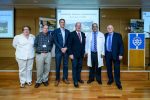
The author, Sybil Kaplan and Prof. Yosef Garfinkel at the opening of the exhibit In the Valley of David and Goliath, now at Bible Lands Museum in Jerusalem. (photo by Barry A. Kaplan)

“As the Philistine moved closer to attack him, David ran quickly toward the battle line to meet him. Reaching into his bag and taking out a stone, he slung it and struck the Philistine on the forehead; the stone sank into his forehead, and he fell face down on the ground. So, David triumphed over the Philistine with a sling and a stone; without a sword in his hand, he struck down the Philistine and killed him.” (1 Samuel 17:48-50)

Most of us have read or heard the story of David and Goliath, and some of us have even visited where the battle took place. But now we all have the chance to learn more. On Sept. 5, In the Valley of David and Goliath opened at Bible Lands Museum in Jerusalem. Presented to the public for the first time, the exhibit will be on display until September 2017.

Khirbet Qeiyafa (Fortress of Elah), 20 miles southwest of Jerusalem, on top of a hill overlooking the Valley Elah, was excavated by Prof. Yosef Garfinkel from 2007 to 2012. Garfinkel is the Yigael Yadin Chair in Archeology of Israel at Hebrew University and director of excavations at Khirbet Qeiyafa.

This fortified city was across from Gath, the Philistine city where Goliath lived when he came out to face the Israelites. The evidence indicates that the city was a military outpost for the House of David. In David’s day, the Valley of Elah served as a neutral zone between the Israelites and the Philistines. Excavators discovered a large cache of weapons in Qeiyafa, which Garfinkel identifies as “an area of conflict between two political units.”

photo - Cooking pots were among the many items on display
Cooking pots were among the many items on display. (photo by Barry A. Kaplan)

Based on carbon-14 dating performed on 28 olive pits, archeologists believe the city lasted from 1020 to 980 BCE. Items found at the site strengthen the connection to King David and religious practices described in the Bible. As well, according to Garfinkel, this Iron Age town was described in the Bible as the location of the battle between David and Goliath 3,000 years ago.

In an interview with Erin Zimmerman for CBS News in 2013, Garfinkel maintained that Khirbet Qeiyafa was a Jewish city for four reasons.

“It has a big casement city wall and houses abutting the city wall,” he said. “This is known from four other sites, so now we have five sites. All these five cities are in Judah, none of them is in Philistia. This is really typical Judean urban planning.”

Second, the bones found in the city all come from kosher animals.

“We have sheep, goat, cattle, but we have no pigs and no dogs,” he said. “On the Philistine side, they consume pigs and also dogs. Up to 20% of the animal bones at Philistine sites are pigs, but here, nothing.”

And, according to Garfinkel, a found pottery shard, also known as an ostracon, is the earliest example of Hebrew writing ever unearthed. On it are written commandments to worship the Lord and to help widows, orphans and slaves.

“It started with the word ‘al ta’as,’ which means ‘don’t do,’ and ‘ta’as,’ ‘to do,’ is only in Hebrew. It’s not Canaanite and not Philistine,” he explained.

Finally, Garfinkel said the absence of idols – which would have been in abundance in other places – points to a Jewish city.

“If you go to Canaanite temples of the Late Bronze [Age], you will find a lot of human and animal figures, but not in Khirbet Qeiyafa. So, the people here really obeyed the biblical taboo on graven images,” he said.

Garfinkel pointed out that, “in the absence of idols, there were religious shrines, and the models predate Solomon’s Temple by about 40 years, yet they match the Bible’s description of the Temple, down to the triple-framed doors. They’re the first physical evidence of Jewish worship in the time of King David.”

Part of the exhibit at the Bible Lands Museum are the two inscriptions that were found – one on a jar and one inscribed with ink on a pottery shard – which contain the distinctly identifiable Hebrew words for “king,” “don’t do” and “judge.”

Among the other objects on display are storage jars, water basins, a model of a house, hundreds of pottery vessels, jar handles with finger impressions, cooking pots and jugs, and the bowl that contained the olive pits.

Most amazing is a stone model shrine, which reflects a Mesopotamian architectural-style before the era of King David, but which probably inspired the look of the palace built by Solomon, David’s son. Features of the model are mentioned in biblical references to King Solomon’s Temple, built decades later.

For Hebrew-speakers traveling to Israel in the near future, exhibit curators will be giving behind-the-scenes tours in Hebrew on Oct. 7, Nov. 11 and Dec. 16.

Sybil Kaplan is a journalist, foreign correspondent, lecturer, food writer and book reviewer who lives in Jerusalem. She also does the restaurant features for janglo.net and leads walks in English in Jerusalem’s market.

Format ImagePosted on September 23, 2016September 21, 2016Author Sybil KaplanCategories Israel, TravelTags archeology, Jerusalem, Khirbet Qeiyafa, museums
Jerusalem’s French aspects

Jerusalem’s French aspects

Salt print of Adolphe Crémieux, December 1856, by Nadar (1820-1910), from the J. Paul Getty Museum. (photo from Wikimedia Commons)

While Jerusalem’s French connection thankfully lacks the violence and crime of the 1971 movie by the same name, both the film and real-life “French” Jerusalem have one thing in common: both expose us to off-the-beaten-track sites. Take a look at what you’ll find in Jerusalem.

The Israel Museum (11 Ruppin Blvd.) has amazingly reassembled an original 18th-century French salon called the Rothschild Room. (All that’s missing is the fancily dressed smart-set listening to a book or music recital.) It also has an impressive collection of French impressionist and post- impressionist painters, such as Pierre-Auguste Renoir, Camille Pissarro, Edgar Degas,

Alfred Sisley, Claude Monet, Paul Cézanne, Paul Gauguin and Henri de Toulouse-Lautrec, as well as works by earlier French artists such as François Boucher.

Speaking of paintings, 120 years ago, Count Marie Paul Amédée de Piellat painted Crusader-related images on the wall of what is today known as Jerusalem’s French Hospice, a non-denominational facility for the terminally ill. Painted in fresco-style, they were recently uncovered during a routine repair.

First built some 130 years ago as St. Louis Hospital – after the same King Louis IX who was responsible for broadening the Inquisition and burning Talmuds – it stands at 2 Shivtei Yisrael St. Around the corner from the hospice is the Romain Gary French Institute of Jerusalem, which promotes French culture by means of French-language courses, a French-language library and a media and entertainment space.

Romain Gary was a Second World War pilot, French diplomat and filmmaker, but was best known for his prolific writing. He won literary prizes using various pen names. Born to Jewish parents, his mother had him baptized a Catholic. Oddly, he had a large menorah at the foot of his bed when he shot himself dead.

Jerusalem’s Ratisbonne Monastery – built in the late 1880s, in Rehavia, 26 Shmuel HaNagid St. – is named after two French Jewish brothers who converted to Catholicism and made it their mission to have Jewish children follow in their “way.” Just before Israel declared statehood, 60 children from Kfar Etzion were safely evacuated to the monastery before the kibbutz fell. Most of the kibbutz defenders, however, were killed in the fighting. During the period in which the Jordanians blocked Hebrew University’s Mt. Scopus campus, the Ratisbonne Monastery served as the school’s law faculty.

Today, the monastery is an international theological school for those studying for the Catholic priesthood.

Several Jerusalem streets are named after French personalities who were either themselves Jewish or had connections to Jews. Centrally located Emile Botta Street is named after the French consul in Jerusalem during the Ottoman rule. The 90-year-old Pontifical Biblical Institute stands on this street. This facility has been in the news lately, as an Egyptian mummy belonging to the institute is currently on exhibit at the Israel Museum.

Emile Zola Street in the German Colony honors the outspoken journalist who defended Captain Alfred Dreyfus’ innocence. In a Jan. 13, 1898, letter (J’accuse!) to the French president, Zola publicly charged the French government and army with suppressing the true story behind Dreyfus’ arrest. Zola himself paid a high price for his bravery; he fled to Britain to avoid prison, only to die there suddenly and suspiciously from carbon monoxide poisoning.

Located near Emile Zola Street is Adolphe Crémieux Street. Crémieux was a Jewish lawyer, statesman, staunch defender of human rights (both of Jews and slaves) and the founder, in 1860, of the Alliance Israélite Universelle; four years later, he served as its president. Unfortunately, the Alliance vocational school no longer stands, but you can still see approximately where the gate was on Jaffa Road, in front of the site’s successor, the Clal Building.

Crémieux did much to better the conditions of the Jews in France. In 1827, he advocated the repeal of the Oath More Judaico, a piece of stigmatizing legislation left over from pre-revolutionary France. Crémieux apparently brought about the abolition of the oath when he defended Rabbi Lazard Isidor. The rabbi – who went on to become France’s chief rabbi – had refused to take the antisemitic oath and was charged with contempt of court. Crémieux got him acquitted. On March 3, 1846, the French Supreme Court finally declared the oath illegal.

Crémieux was likewise involved in defending Saratov (Russia) Jews facing charges of blood libel. For his instrumental assistance in bringing about the end to slavery in the French colonies, Crémieux was nicknamed the “French Abraham Lincoln.”

In recent years, Crémieux Street drew significant attention when police investigated former prime minister Ehud Olmert for the suggested favorable terms he received on the purchase of a home on this street, in exchange for help rendered to the contractor who sold it to him. The National Fraud Unit ultimately advised that there was not enough evidence to proceed with criminal charges against Olmert in the “Crémieux Street affair.”

Frederic Chopin Street is named for the well-known, Polish-born, French composer and pianist. Probably not coincidentally, this Talbiya street is the site of the Jerusalem Centre for the Performing Arts. Six halls serve as regular venues for music and dance concerts, dramatic performances and films.

Located in an ultra-Orthodox neighborhood, Estori Haparhi Street is named after the first topographer of the land of Israel. Haparhi’s family lived in Provence, but was expelled from France, along with the rest of the medieval Jewish population. Following this expulsion, he made aliyah and frequently preached the necessity of settling in the Holy Land. While making his living as a doctor, he wrote a book citing the biblical and halachic borders of Israel. He claimed that the Arabic names of numerous towns and villages reflected their Jewish textual names.

Speaking of medieval France, the Jerusalem municipality named three Mekor Baruch neighborhood streets after medieval Jewish scholars, Rashi and his two grandsons, the Rashbam and Rabenu Tam.

Neve Yaakov’s Gamzon Street recognizes the French resistance work of Robert Gamzon. In wartorn France, he set up an underground for issuing false identities to children and young adults. With these papers, they were able to escape France. Gamzon went on to fight in Israel’s War of Independence and to do research at the Weizmann Institute.

Talpiot’s Marie-Pierre Koenig Street commemorates the bravery and leadership of the French general who headed the Free France forces in the Second World War and took part in the D-Day landing. During the war, Koenig let members of the Jewish Brigade fly the blue and white flag, in defiance of British orders banning such action. Even after becoming the French minister of defence, Koenig remained an advocate of the new state of Israel.

For a general understanding of how the Holocaust affected French Jewry – including the critical assistance provided by French Jewish underground workers – plan a physical, or at least a virtual, visit to Yad Vashem (yadvashem.org). France’s recognition of Jewish defence was short-lived, however. Following the Six Day War, France embargoed its Mirage fighter jet. This forced Israel to develop the Kfir jet, and a street named HaKfir reflects Israel’s decision to go blue and white.

Deborah Rubin Fields is an Israel-based features writer. She is also the author of Take a Peek Inside: A Child’s Guide to Radiology Exams, published in English, Hebrew and Arabic.

Format ImagePosted on September 23, 2016September 21, 2016Author Deborah Rubin FieldsCategories Israel, TravelTags France, Israel, Jerusalem, tourism
Museums adapt using tech

Museums adapt using tech

Museloop’s app that it created for Israel Museum. (photo from Museloop via Times of Israel)

How do museums and other purveyors of history attract visitors and make the past relevant, especially as people come to expect more and more digital experiences?

Perhaps surprisingly, Werner W. Pommerehne and Bruno S. Frey recognized the problem more than 36 years ago. In their article “The museum from an economic perspective,” which was published in the International Social Science Journal in 1980, they stated:

“Museum exhibitions are generally poorly presented didactically. The history and nature of the artists’ work is rarely well explained, and little is offered to help the average, uninitiated viewer (i.e., the majority of actual and potential viewers) to understand and differentiate what is being presented, and why it has been singled out. Accompanying information sheets are often written in a language incomprehensible to those who are not already familiar with the subject. There is no clear guidance offered to the collections, and little or no effort is made to relate the exhibits to what the average viewer already knows about the history, political conditions, culture, famous people, etc., of the period in which the work of art was produced.”

Keren Berler, chief executive officer of Israeli start-up Museloop recently put the problem into current perspective. Younger visitors, she noted in an Israeli radio interview this past June, find museum visits passive and boring. She said, especially when seeing museum art exhibits, young people need something more to draw them into what they are seeing. So, her company has designed a museum-based application for iPhone and Android use. The application includes games, such as find-the-difference puzzles, plus information about the artist, all of which will hopefully make the visitor better remember the art and some facts about it.

Interestingly, in describing the games, two of the attributes she mentioned were competitiveness and the ability to take “selfies.” Children as young as 8 or 9 years old can use the app on their own, but younger children would need an adult to assist them.

Right now, the Museloop app focuses on Israel Museum’s under-appreciated (read: under-visited) permanent art collection. This exhibit includes the works of a number of “heavies,” such as Marc Chagall, Claude Monet, Pierre-Auguste Renoir, Paul Cézanne and Paul Gauguin. The goal is to make the experience so appealing that young visitors will then want to visit other museums. Since Israel Museum is paying the start-up for the development and use of the app, visitors benefit by having free use of it.

In contrast, Tower of David Museum has its own in-house digital department. This department has developed its own applications for heightened exhibit viewing.

photo - Virtual reality in the actual reality of Tower of David Museum
Virtual reality in the actual reality of Tower of David Museum. (photo from Tower of David Museum)

According to Eynat Sharon, the head of digital media, her department takes into consideration the visitor’s total museum experience. This experience consists of three overlapping circles: the pre-visit, in which a person visits either the museum’s website or mobile site; the actual physical visit; and the post-visit, in which the person digitally shares with friends and family on Facebook, Instagram and other social media what they encountered at the museum. The museum’s technical equipment and apps may be rented by museum visitors for a small fee.

Are these new applications then to be applauded? Some people still need convincing. Last year, art critic Ben Davis reflected on news.artnet.com, “For many, many viewers, interfacing with an artwork through their phone trumped reflecting on its themes. In effect, now every art show is by default a multimedia experience for a great portion of the audience, because interaction via phone is a default part of the way people look at the world.”

Dan Reich, who is the curator and director of education for the St. Louis Holocaust Museum and Learning Centre, said, “Personally, I am not big on technology. You end up with lots of button-pushing but not necessarily a lot of education. As a museum, we are pretty low-tech. We have an audio tour of the permanent exhibit, several stops in the museum where you can press buttons and hear testimony, an interactive map and – more recently – added an interactive screen entitled ‘Change Begins With Me,’ which deals with more recent or contemporary examples of hate crimes and genocide. We have been digitizing our collection of survivors’ testimonies. We have testimonies edited to different lengths. Generally, survivors like to be recorded, knowing their words are being preserved.”

And recent comments on TripAdvisor show that museums don’t necessarily have to be high-tech to succeed in their mission.

Visitors, for example, gave the St. Louis Holocaust Centre high marks.

Other Holocaust learning centres, however, have started taking current technology through uncharted waters. The USC Shoah Foundation now uses holographic oral history. According to Dr. Stephen Smith, the foundation’s executive director: “In the Dimensions in Testimony project, the content must be natural language video conversations rendered in true holographic display, without the 3-D glasses. What makes this so different is the nonlinear nature of the content. We have grown used to hearing life histories as a flow of consciousness in which the interviewee is in control of the narrative and the interviewer guides the interviewee through the stages of his or her story. [Now] with the … methodology, the interviewee is subject to a series of questions gleaned from students, teachers and public who have universal questions that could apply to any witness, or specific questions about the witness’ personal history. They are asked in sets around subject matter, each a slightly different spin on a related topic.” One educator confided that, while the technology is “creepy,” the public apparently likes it.

So, how do museums cope with the possibility that the medium in and of itself becomes the message? In other words, how do museums keep their audiences from being distracted by the technology? At the same time, how can museums survive financially if they follow goals that differ substantially from those of visitors, funders and other supporters?

A few months ago, Canadian entrepreneur Evan Carmichael offered guidelines at an Online Computer Library Centre conference. His suggestions seem applicable to museum administrators as well: express yourself, answer their questions, offer guidance, involve the crowd, “use your audience to create something amazing … create an emotional connection, get personal, and hold trending conversations, go to where things are happening, be there.

Time will tell whether the advent of museum-related high-tech will realize Don McLean’s 1971 tribute to Vincent Van Gogh’s art: “They would not listen, they did not know how. Perhaps they’ll listen now.”

Deborah Rubin Fields is an Israel-based features writer. She is also the author of Take a Peek Inside: A Child’s Guide to Radiology Exams, published in English, Hebrew and Arabic.

Format ImagePosted on September 23, 2016September 21, 2016Author Deborah Rubin FieldsCategories WorldTags art, history, Holocaust, museums, technology
Another planet earth?

Another planet earth?

An artist’s impression of the newly discovered planet, Proxima Centauri b. (photo from ESO/M. Kornmesser)

An international team announced recently that a planet with a mass similar to that of earth has been observed orbiting the star Proxima Centauri – the closest star to our sun, just over four light years (about 40 trillion kilometres) away.

The collaboration of scientists from nine countries, known as the “Pale Red Dot” and led by Dr. Guillem Anglada-Escudé of Queen Mary University of London, included Weizmann Institute of Science’s Dr. Aviv Ofir, who is in the group of Prof. Oded Aharonson of the earth and planetary sciences department.

Proxima Centauri is a red dwarf – a star with a diameter about one seventh that of our sun and far dimmer: it gives off only 1/600 the light of our sun. The team’s calculations show that the planet, known as Proxima Centauri b, has a mass of at least 1.3 times that of earth and its year – the time it takes to orbit its sun – is a little over 11 days. It orbits quite close to its sun – only five percent of the distance from earth to our sun; but, since its sun is so dim, the temperature on Proxima Centauri b may be relatively balmy and liquid water could theoretically exist on its surface.

The range of distances where the planet’s temperature permits liquid water is often referred to as “the habitable zone.” Although conditions on the planet’s surface are as yet unclear, the scientific team hopes to learn more about this planet in further research. Ofir said it is not at all clear whether life as we know it could have evolved on the planet, and the subject is already the focus of intense debate.

The planet was discovered through measurements of the radial velocity of the star. Such measurements rely on the Doppler effect, the shift in wavelength as an object moves closer to or away from the viewer. The star, according to the team’s highly accurate measurements, is moving at a speed of about a metre a second (or 3.6 kilometres an hour) towards and away from us.

Ofir explained that, when we speak of a planet orbiting a star, in reality they are both orbiting a shared centre of gravity. Since the mass of the star is naturally much greater than that of its planets, that centre of gravity is usually close to the centre of the star, and planets make the star’s motion appear as a “wobble.” And that wobble can be detected by today’s instruments: in the case of Proxima Centauri, the scientists observed periodic changes in the star’s velocity, the result of another body tugging at it. That body, according to the measurements, is a planet with a relatively small mass, just over that of earth.

Ofir pointed out that Proxima Centauri has been studied for the past century, but only now have observations – designed for this very purpose – become sensitive enough to decisively detect the presence of this small planet. He is continuing to work on this and other projects to identify and study planets around Proxima Centauri.

“We discovered the planet with an observatory in Chile. We can’t see Proxima Centauri from our observatories in Israel,” he explained. “It is well below the southern horizon, so it is unobservable from Israel all year round.”

For more information about Weizmann Institute research, visit wis-wander.weizmann.ac.il.

Format ImagePosted on September 23, 2016September 21, 2016Author Weizmann InstituteCategories WorldTags astronomy, earth-like planets, Proxima Centauri, science

Posts pagination

Previous page Page 1 … Page 234 Page 235 Page 236 … Page 314 Next page
Proudly powered by WordPress