Skip to content
  • Home
  • Subscribe / donate
  • Events calendar
  • News
    • Local
    • National
    • Israel
    • World
    • עניין בחדשות
      A roundup of news in Canada and further afield, in Hebrew.
  • Opinion
    • From the JI
    • Op-Ed
  • Arts & Culture
    • Performing Arts
    • Music
    • Books
    • Visual Arts
    • TV & Film
  • Life
    • Celebrating the Holidays
    • Travel
    • The Daily Snooze
      Cartoons by Jacob Samuel
    • Mystery Photo
      Help the JI and JMABC fill in the gaps in our archives.
  • Community Links
    • Organizations, Etc.
    • Other News Sources & Blogs
    • Business Directory
  • FAQ
  • JI Chai Celebration
  • JI@88! video

Recent Posts

  • BGU fosters startup culture
  • Photography and glass
  • Is it the end of an era?
  • Taking life a step at a time
  • Nakba exhibit biased
  • Film festival starts next week
  • Musical with heart and soul
  • Rabbi marks 13 years
  • Keeper of VTT’s history
  • Gala fêtes Infeld’s 20th
  • Building JWest together
  • Challah Mom comes to Vancouver
  • What to do about media bias
  • Education offers hope
  • Remembrance – a moral act
  • What makes us human
  • המלחמות של נתניהו וטראמפ
  • Zionism wins big in Vegas
  • Different but connected
  • Survival not passive
  • Musical celebration of Israel
  • Shoppe celebrates 25 years
  • Human “book” event
  • Reclaiming Jewish stories
  • Bema presents Perseverance
  • CSS honours Bellas z”l
  • Sheba Promise here May 7
  • Reflections from Be’eri
  • New law a desecration
  • Resilient joy in tough times
  • Rescue dog brings joy
  • Art chosen for new museum
  • Reminder of hope, resilience
  • The national food of Israel?
  • Story of Israel’s north
  • Sheltering in train stations

Archives

Follow @JewishIndie
image - The CJN - Visit Us Banner - 300x600 - 101625

Tag: Israel National Trail

Travel along Incense Route

Travel along Incense Route

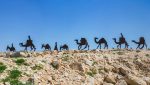
A sculpture of camels traversing the Incense Route in Avdat National Park. (photo by Kate Giryes/Shutterstock.com)

Close your eyes and travel back in time 2,000 years. You’re riding on the back of a camel laden with frankincense and myrrh from faraway Yemen, navigating 100 kilometres across the harsh, hilly Negev Desert to get your precious cargo to the Mediterranean ports.

For 700 years, from the third-century BCE until the second-century CE, this was the hazardous but hugely profitable task of the nomadic Nabatean people. Today, the small Israeli portion of the 2,000-kilometre Incense Route – a UNESCO World Heritage Site – is a fascinating trail filled with beautiful desert vistas and archeological discoveries.

The route includes the remains of the Nabatean towns of Halutza, Mamshit, Avdat, Shivta and Nitzana (another, Rehovot-Ruhaibe, is hidden by sand dunes), four fortresses (Katzra, Nekarot, Mahmal and Grafon) and two khans (Moa and Saharonim). You can see evidence of surprisingly sophisticated watering holes, agriculture and viniculture that the Nabateans innovated.

“The Roman and Greek empires controlled a lot of cities around the Mediterranean shores and, in all these cities, there were pagan shrines where they sacrificed animals. The smell was terrible, so the Nabateans brought incense for those shrines to cover the smell of the slaughter,” explained tour guide Atar Zehavi, whose Israeli Wild tours specialize in off-the-beaten-track jeeping, cycling, hiking and camel-back trips like the Incense Route.
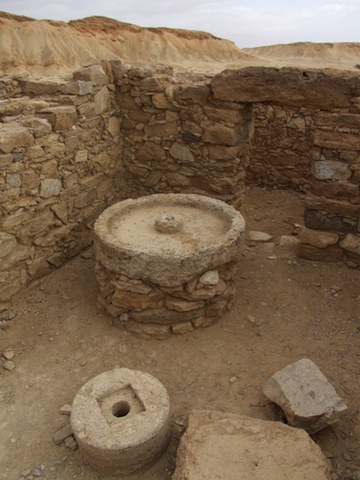
photo - At Moa, you can see an original pressing stone for olive oil
At Moa, you can see an original pressing stone for olive oil. (photo by Atar Zehavi)

“The route is surprisingly difficult because there were easier ways to go across the Negev. But the Nabateans wanted to stay hidden from other Arab tribes that might ambush the caravans, and they wanted to avoid being discovered by the Romans so they could keep their independence,” Zehavi said. “They knew how to harness the harsh desert conditions to their advantage, building water holes and strongholds others would not find. The Romans conquered Judea pretty easily but it took them another 150 years to conquer the Nabateans.”

Zehavi recommends a two-day “jeeping and sleeping” excursion along the Incense Route, also called the Spice Route. Start in the east, at Moa in the Arava Valley, site of an ancient khan (desert inn). From there, ascend the Katzra mountaintop, a stronghold overlooking the whole region. This will give you an appreciation for how hard it was to lead a caravan of camels up a steep slope.

“They’d travel 30 kilometres a day between khans. One camel carried 350 kilos of incense and only needed to drink once every 10 days or so,” said Zehavi, who has a master’s degree in environmental studies.

Even back then, camels wouldn’t have had much to drink at the third stop, the Nekarot River, a dry riverbed that once flowed through the Arif mountain range and northern Arava. The Nekarot is part of the Israel National Trail and boasts spectacular landscapes.

This leads you past Saharonim to the fourth stop, the town of Mitzpeh Ramon with its world-famous Ramon Crater (Makhtesh Ramon), which still has visible Nabatean milestones among its abundant flora and fauna, including the Nubian ibex. Ramon is the world’s largest erosion crater, stretching 40 kilometres and descending to a depth of 400 metres. It has unique geological structures, such as the Hamansera (Prism) of crystallized sandstones and the Ammonite rock wall embedded with fossils.

photo - An ibex at the Ramon Crater
An ibex at the Ramon Crater. (photo from PikiWiki Israel)

Camp out overnight in the crater, if weather and traveler preferences permit. A variety of hotels, from desert lodge to hostel to luxury, are also in the crater area. While in Mitzpeh Ramon, you may want to include the visitors centre and a nighttime stargazing tour.

The next morning, you’ll have a choice of trails for walking, jeeping or biking in the crater. A guided jeep tour is always a good option.

Getting back on the Incense Route, you go up Mahmal Ascent on the northern rim of the crater, a 250-to-300-metre climb to the Mahmal Fortress. Proceed northwest from there to Avdat National Park, site of a once-flourishing Nabatean city, where you can see shrines that were later turned into Byzantine churches.

Zehavi explained that, after the Roman Empire transitioned into Byzantine Christianity around 324 CE, incense was no longer needed, so the Nabateans started producing wine and desert agriculture, as well as raising Arabian horses.

“It’s amazing to see the way the harsh desert was colonized for agriculture through the use of highly sophisticated irrigation systems,” said Zehavi.

End your tour of the Incense Route at Avdat or go northwest to Shivta National Park and Halutza, or northeast to Mashit National Park near Dimona.

Israel21c is a nonprofit educational foundation with a mission to focus media and public attention on the 21st-century Israel that exists beyond the conflict. For more, or to donate, visit israel21c.org.
Format ImagePosted on April 21, 2017April 20, 2017Author Abigail Klein Leichman ISRAEL21C.ORGCategories TravelTags history, Incense Route, Israel, Israel National Trail, Nabateans
A physical, emotional hike

A physical, emotional hike

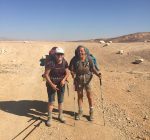
Arlene Doyle, right, was joined for part of her adventure by her friend, Jennifer Williamson. (photo from Arlene Doyle)

In early February, Arlene Doyle, a 53-year-old massage therapist and writer based in Ottawa and Perth, Ont., set off on the Israeli National Trail, the Shvil, as it is called in Hebrew. She shared some of the highlights of her at-times grueling 10-week hike at a Jewish National Fund of Ottawa-hosted event on July 14.

Beginning at the Gulf of Aqaba in Eilat, the Shvil runs northwardly through the length of Israel to Dan, near the Lebanese border. The trail, which is approximately 1,000 kilometres (620 miles), opened to hikers in 1995.

In the description of herself on her website, theflipsideoffifty.com, Arlene says she is someone who likes adventures. For those of us who have known her personally for nearly 30 years, that description is an enormous understatement. Arlene is an experienced hiker, with Kilimanjaro, Everest base camp, parts of the Peruvian Andes, several mountain ranges in Greece, Mount McKinley in Alaska and up and down the Grand Canyon to her credit. She has also biked from Vancouver to Mexico along the U.S. West Coast.

No stranger to challenges, the Shvil appealed to Arlene because it met four specific criteria: the trail was more than 500 miles, parts of it were remote, she could expect it to be warm most of the time, and Israel was a place to which she had not yet traveled.

It also obliged her one constraint. In addition to her work as a massage therapist, writer and mother of three young adults, Arlene is a fledgling blueberry farmer. She needed to be home by mid-April to nurture her hundreds of blueberry plants as they entered their second year of growth.

Arlene was joined for part of her adventure by a friend, Jennifer Williamson.

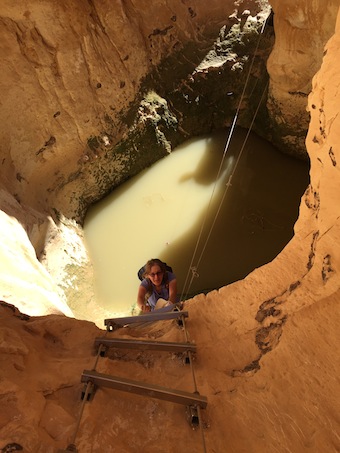
photo - Jennifer Williamson climbs up a ladder after she and hiking partner Arlene Doyle had to trek through a pool of water
Jennifer Williamson climbs up a ladder after she and hiking partner Arlene Doyle had to trek through a pool of water. (photo from Arlene Doyle)

The Shvil was designed to be walked from the northern part of the country towards the south. Walking from the north, hikers have the opportunity to acclimatize to the trail and be in their best physical shape as they approach its most challenging parts. Since Arlene and Jen started their hike in early February, when northern Israel can be chilly, they decided to walk from the south to the north, in order to enjoy warmer temperatures at the outset of the hike. They paid a price for that decision.

Carrying 45-pound backpacks with all of their camping and survival gear, they met windy, wet weather, cold evenings and mornings in the desert, difficulties caching water – which meant having to carry enough water and food for three days – steep ascents which, for hours, snaked up, down and around mountains, and difficulties even finding the trail markers – orange, blue and white stripes placed on rocks at varying frequencies. Their challenges also included literally having to swim across pools of water of unknown depth only to have a sheer vertical rock waiting on the other side. And then there was the isolation – they hiked for seven days from Eilat to beyond Timna Park and the Solomon Pillars without meeting another soul. In Arlene’s words, “it was strenuous, beautiful and sometimes treacherous, and the quiet solitude of the desert felt blissful.”

Once they reached Arad, a city located on the border of the Negev and Judean deserts, they were far enough north to start enjoying Israeli hospitality. There, Jen’s enflamed knees were diagnosed as acute tendinitis, no doubt brought on by the heft of her pack, and prescribed a 10-day rest, which she took at a guest house. Arlene continued north on her own and her blogs provide exquisite detail about her experiences in and around Arad, Masada, Meitar and Sansana.

photo - When Jennifer Williamson was diagnosed with acute tendinitis in her knees, she took her prescribed rest at a guest house in Arad
When Jennifer Williamson was diagnosed with acute tendinitis in her knees, she took her prescribed rest at a guest house in Arad. (photo from Arlene Doyle)

It was in Sansana where Arlene met her first “Trail Angel” – Israelis who feel passionately about their country and open their homes to hikers along the Shvil, providing beds, showers and other amenities out of pure generosity. After staying with several Trail Angel families, Arlene remarked, in her most diplomatic fashion, that she had gained an appreciation of the many complex issues around which Israelis have equally complex and diverse opinions.

After a few days of travel on her own, Arlene realized that she, too, had some bodily damage to repair. She had significantly strained both her Achilles tendons. Communicating via cellphones, she and Jen decided to nurse their mutual injuries with an unplanned three-day “spa retreat” at the Dead Sea, camping on an empty beach facing the Jordanian mountains. A lack of “sweet” water in which to bathe their salt-crusted bodies and clothing and the fact that their food supply had run out, put them back on the Shvil, hiking towards Jerusalem.

Their few days in Jerusalem proved to be one of the highlights of the trip. Arlene remarked on how deeply moved she was by all she experienced in the Old City. Having been raised in a religious milieu – her parents were Mormon missionaries – she had a deep appreciation for the various interpretations, traditions and teachings of the many unique stones, domes, walls and temples throughout Jerusalem.

The richness of this experience was much enhanced when she cashed in on a generous gift from one of her Ottawa clients – an overnight stay at the King David Hotel. She and Jen arrived looking like ragamuffins, and left feeling very pampered by the luxuries the gift afforded them and by how wonderfully they had been treated. When hotel staff heard that these women were walking the Shvil, Arlene feels that they were accorded an extra measure of respect and kindness.

After Jerusalem and before Jen returned to Canada, they rented a car to visit some of the key sites in Israel not on the Shvil. The added bonus was that being off their feet gave their knees and ankles more recovery time. They headed to the Golan Heights, passing the Mount of Beatitudes, Merlon Golan and, finally, the Nimrod fortresses, which date from 1270 CE.

With Jen in the air, Arlene returned to the Shvil. Her path took her through Caesarea, where she slept within the famous ruins. Workmen woke her with water and cookies and advice to be careful, as snakes would soon be coming out from under the rocks to sun themselves.

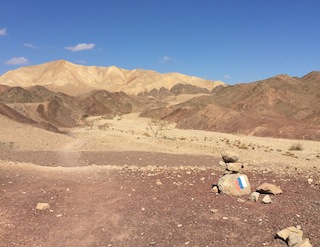
photo - One of the markers along the Israel National Trail
One of the markers along the Israel National Trail. (photo from Arlene Doyle)

In Zikhron Ya’acov, she enjoyed an impromptu concert in the park before heading to the home of another Trail Angel. After returning yet again to the Sea of Galilee, she made her way to the Nahal Me’arot Nature Reserve and to the one spot on earth where skeletons from both Neanderthal and Homo Sapiens have been found together.

It was during these solitary days on the trail that Arlene’s personal reflections on her experience came into focus. Her first reflection was around Trail Angels. “The degree of caring here for other people’s well-being feels unique,” she said. “The love of homeland feels unique. Hiking the trail is both praised and supported.”

A second reflection was around loss. One of the stopping points on the trail is a small house near Sansana, where a young Israeli died while hiking. The parents of the hiker created this house as a memorial to their son. Arlene talked about how significant a tribute that was and how it sharpened her own awareness of how, in life, “nothing stays the same; we all have to adapt to losses.”

At the end of her presentation, Arlene expressed very poignantly what many of us in the audience wanted to know.

“Solitary walking for days, you find out things about yourself,” she said. “We all have a load to carry. Walking alone, the weight and onus of your emotional cross rests squarely on your own shoulders. You come face-to-face with the sticks and bones of your personality and the measure of your mettle.”

Judging by the questions posed by her audience, Arlene’s experience whet the appetite of many to have the opportunity to measure their mettle.

Karen Ginsberg is an Ottawa-based travel writer who hopes to walk a flat part of the Shvil on an upcoming trip to Israel and meet a Trail Angel or two.

Format ImagePosted on September 23, 2016September 21, 2016Author Karen GinsbergCategories Israel, TravelTags Israel National Trail, Shvil, Trail Angel
Proudly powered by WordPress