Skip to content
  • Home
  • Subscribe / donate
  • Events calendar
  • News
    • Local
    • National
    • Israel
    • World
    • עניין בחדשות
      A roundup of news in Canada and further afield, in Hebrew.
  • Opinion
    • From the JI
    • Op-Ed
  • Arts & Culture
    • Performing Arts
    • Music
    • Books
    • Visual Arts
    • TV & Film
  • Life
    • Celebrating the Holidays
    • Travel
    • The Daily Snooze
      Cartoons by Jacob Samuel
    • Mystery Photo
      Help the JI and JMABC fill in the gaps in our archives.
  • Community Links
    • Organizations, Etc.
    • Other News Sources & Blogs
    • Business Directory
  • FAQ
  • JI Chai Celebration
  • JI@88! video

Recent Posts

  • Story of Israel’s north
  • Sheltering in train stations
  • Teach critical thinking
  • Learning to bridge divides
  • Supporting Iranian community
  • Art dismantles systems
  • Beth Tikvah celebrates 50th
  • What is Jewish music?
  • Celebrate joy of music
  • Women share experiences 
  • Raising funds for Survivors
  • Call for digital literacy
  • The hidden hand of hate
  • Tarot as spiritual ritual
  • Students create fancy meal
  • Encouraging young voices
  • Rose’s Angels delivers
  • Living life to its fullest
  • Drawing on his roots
  • Panama City welcoming
  • Pesach cleaning
  • On the wings of griffon vultures
  • Vast recipe & story collection
  • A word, please …
  • מארק קרני לא ממתין לטראמפ
  • On war and antisemitism
  • Jews shine in Canucks colours
  • Moment of opportunity
  • Shooting response
  • BC budget fails seniors
  • Ritual is what makes life holy
  • Dogs help war veterans live again
  • Remain vital and outspoken
  • An urgent play to see
  • Pop-up exhibit popular
  • An invite to join JWest

Archives

Follow @JewishIndie
image - The CJN - Visit Us Banner - 300x600 - 101625

Category: News

CHW marks 100 years

Canadian Hadassah-WIZO (CHW) has been a driving force in the Jewish community for 100 years. Known to many simply as Hadassah, CHW has rebranded in the last decade to be recognized for its full range of activities, using its acronym to also exemplify the work it does for children, healthcare and women in Israel.

Jewish Canadians can take great pride in the many initiatives that have come from the fundraising and determination of CHW women who have helped build the state of Israel.

One of the keystone projects CHW supports is the Hadassim Children and Youth Village, located east of Netanya. Founded in 1947 for European Jewish refugee children, it is one of the largest residential schools in Israel. The school has evolved over the years to house children as young as age 6 who could not safely remain in their homes. These children live in family units, cared for by foster parents who maintain contact with biological parents when appropriate.

With the world refugee crisis, there has been somewhat of a return for Hadassim to its original purpose. As an example, because of antisemitism, more than 60 teens from France have sought refuge at Hadassim through the Na’aleh program, according to CHW national executive director Alina Ianson.

The program, she said, “is an opportunity for Francophone youth to continue their education in their native language. The Na’aleh program has become increasingly important due to the rise of antisemitism, causing many European teenagers to seek out safety and security. CHW Hadassim gives teenagers freedom: freedom to learn, freedom to live, freedom to be Jewish. CHW Hadassim gives teenagers a home again.”

Over the past 100 years, Israel has grown from the dream of a homeland to a high-tech powerhouse. Nonetheless, pressing social issues, particularly for women and children, still exist. Healthcare has changed dramatically but the need for support is arguably more critical because, while there are more life-saving technologies, they can also be quite expensive. For this reason, CHW continues to be as relevant as ever, national president Debbie Eisenberg told the Independent.

Eisenberg highlighted the CHW Vancouver connection. “Four of CHW’s past national presidents have called Vancouver home,” she said. “These visionary past national leaders include Naomi Frankenberg, z”l, Judy Mandelman, Rochelle Levinson and Claudia Goldman. Throughout our 100 year history, CHW has certainly changed the very fabric of Israeli society by supporting essential programs and services for children, healthcare and women in Israel,” she added.

Current Vancouver centre president Stephanie Rusen is proud to head an organization that has made and continues to make such an impact on the lives of people in Israel. Rusen believes that the focus for Vancouver in CHW’s centennial year is the Hadassim Youth Village partly because it exemplifies everything that CHW does right. Those most vulnerable in Israeli society find a home at Hadassim and grow up to meet their potential as active, contributing members of Israeli society.

“CHW Hadassim has been improving the lives of children and families for the last 70 years,” said Rusen. “Many of the children who come to CHW Hadassim are escaping prejudice, persecution, and even violence. Thanks to our generous supporters, as well as the funds raised at last year’s tribute gala, the Claudia Goldman Dormitory Hey at CHW Hadassim was renovated and is now home to 60 students. These children now have a safe place to call home. CHW Vancouver proudly supports CHW Hadassim.”

Rusen has presided over many local changes in how CHW operates. The previous chapter-based format has given way to an organization that plans citywide programs for all ages and interests, while continuing its efforts to fund its projects in Israel. The local annual kick-off event was held on Sunday at the Shaughnessey Golf and Country Club. Entitled “Heroes Among Us,” the event honoured three local women, ranging in age from the mid-20s to mid-80s, who have made a difference in various aspects of the Metro Vancouver community: Courtney Cohen, Lori Yelizarov and Helen Coleman.

For more information on how to become involved with the activities of CHW, visit their website at chw.ca (look for Vancouver centre) or call the office at 604-257-5160.

Michelle Dodek is a freelance writer living in Vancouver.

Posted on September 22, 2017September 21, 2017Author Michelle DodekCategories WorldTags CHW, Hadassah, Hadassim, healthcare, women, youth

Marking memorial’s 30th year

On Sunday, Sept. 24, 11 a.m., at Schara Tzedeck Cemetery in New Westminster, the annual High Holidays Cemetery Service, presented by the Vancouver Holocaust Education Centre, Congregation Schara Tzedeck and the Jewish War Veterans, will mark the 30th anniversary of the Holocaust Memorial. On April 26, 1987, 1,300 numbers of the community, including Holocaust survivors and their families, attended the unveiling of the memorial, on which more than 900 names of family members who perished during the Holocaust were inscribed. Survivor Lillian Boraks-Nemetz wrote the following poem after that unveiling 30 years ago.

The Six Million
Written in dedication of the Holocaust Monument in Schara Tzedeck Cemetery

In this cemetery
far away from where They died
you stand dwarfed by this giant monument
your feet sinking lower and lower into the earth
your soul graining deeper and deeper
into the black granite.

You stand an alien to this earth
a born again human
sixty odd years away from the factories of death
of mercy – pleading voices scattered to deaf winds.

You stand in this cemetery
on the anniversary of the Holocaust
staring with hollow eyes
at simulated graves of strangers finally named
who once went to sleep in a common ditch
souls torn from peace like bones from flesh –

a child’s name upon your lips
a child’s fist pressing upon your breath
to break the granite silence
to speak to shout to scream the truth
to silence forever the mad dogs who
deny the happening of Shoah.

You remember as you stand here
waiting your turn to honour the Dead
how you stood with Them then
in line for death only you didn’t die
running away on all fours
through the contaminated sewers like a rat.

You say Kaddish and for a single moment
become one with the living and the dead.
Then you, the survivor, slip away into an alien world
where your soul must learn to sustain alone,
The Six Million.

Posted on September 22, 2017September 21, 2017Author Lillian Boraks-NemetzCategories LocalTags Holocaust, Jewish war veterans, memorial, Schara Tzedeck, Vancouver Holocaust Education Centre, VHEC
אוכל על חשבון המתים

אוכל על חשבון המתים

(צילום: Brandon Godfrey)

לדין שיינדלר תושב אזור ונקובר מסתבר שיש מנהג מוזר ביותר שאינו זוכה כלל להערכה. במשך עשר השנים האחרונות הוא נוהג להופיע בעשרות טקסי אשכבה שונים (בעיקר אלה שנערכים במועדוני גולף מהודרים), ולהינות בחינם מהאוכל והשתייה שמוגשים בהם – לקרובים של הנפטרים. שיינדלר שיהיה ברור לא מוזמן כלל לאירועים אלה והוא פשוט מופיע אליהם כאילו הוא אחד ממקורבי הנפטרים. הוא אינו מדבר עם אחד וללא בושה ניגש לאחד השולחנות העמוסים אוכל מתיישב ומתחיל לאכול. לאחר סיום הארוחה המכובדת כאשר מילא את כרסו, הוא מכבד את עצמו בשתיית מספר כוסות של בירה או יין ואז נעלם. מספר קרובים של נפטרים מציינים כי הם ראו את שיינדלר אף לוקח אוכל הבייתה. וחוזר חלילה. איך הוא לא מתבייש?

במשך השנים הצטברו עדויות רבות בגין התנהגותו השערוריית והביזארית של שיינדלר שהוא איש מבוגר המרכיב משקפיים עם שיער שיבה לראשו, שכנראה נחשב לאיש בודד מאד בעולמנו וחי לבד. לא מעט תושבים מקומיים ראו אותו שוב ושוב בטקסי האשכבה שונים. אז גם החלו להגיע תלונות כנגדו לתחנות הרדיו והטלוויזיה המקומיות שהולכות ונערמות.

במספר מקרים ניגשו לשיינדלר קרובי משפחה שלא הכירו אותו ושאלו אותו ישירות איך וכיצד הוא קשור לנפטר. לפי תשובתו המתחמקת הם הבינו מייד שהוא לא מכיר את הנפטר כלל. באחד המקרים אומרת אישה שאימא נפטרה, כי שיינדלר סיפר לה שכביכול שאימא ואימו היו חברות טובות. ואימא נהגה להסיע את אימו אף למקומות שונים כולל לקניות. נו באמת? “אך מה לעשות” אומרת האישה “לאמי לא היה רשיון נהיגה ואף לא רכב”. לאחר השיחות הלא נעימות הללו שיינדלר היה קם ומסתלק מהמקום בשקט ומהירות רבה.

לתשובת כתבת תחנת הטלוויזיה ‘גלובלניוז’ שתפסה אותו ליד ביתו, אמר שיינדלר שלא הרגיש בנוח עם הראיון (הוא לא הפסיק להתגרד, להוריד ולהרכיב את משקפיו), כי הוא אכן מבקר בטקסי ההשכבה, אך זה נובע לטענתו לאור כביכול תחקיר שהוא עושה במסגרת ספר שהוא כותב. הספר שהולך להיות פרוייקט מאוד ארוך יעסוק בסיפור מפחיד מאוד הוא מוסיף. הוא דחה את הטענה כי הוא מגיע לאירועים בגלל האוכל והשתייה בחינם. שיינדלר הודה כי הוא נהג לבקר בשלושה עד ארבעה טקסי הלוויות מדי חודש לאורך שנים רבות. את המידע בדבר האירועים לכיבוד המתים הוא פשוט מצא במודעות אבל בעיתונות של משפחות הנפטרים. להגנתו אמר עוד כי הוא כן נהג לשוחח מעת לעת עם האורחים באירועים, אך הוא לא יכול לספר להם מדוע הוא נוכח במקום. לאור התלונות הרבות נגדו הבטיח שיינדלר להפסיק ולבקר בטקסי הלוויות שאליהם לא הוזמן. הוא גם התנצל. לא ברור עדיין האם יש אמת בדבריו כי הוא אכן כותב ספר. שיספר זאת למתים.

אחד מהגושלים באינטרנט שקרא על מעלליו הרבים של שיינדלר הגיב באופן הבא: “כשיבוא היום ונקווה לא בזמן הקרוב כולנו נגיע להלוויתו שלו”. גולש אחר הגיב בחריפות גדולה יותר: “מדוע שלא נעמוד על הכבר שלו ובתור נשתין עליו?”. גם אחת הגולשות הגיבה בחריפות רבה על התנהגותו של שיינדלר: “אין שום תרוץ למעשיו. האיש הזה הוא כדור רפש שמנצל צער של אנשים אחרים כדי להשיג רווח פרטי. זה מעורר רחמים”. ולסיום גולשת אחרת ענתה בתחכום: “יש כאלה שהולכים לסרטים ויש אחרים שהולכים להלוויות”.

Format ImagePosted on September 20, 2017September 20, 2017Author Roni RachmaniCategories עניין בחדשותTags Dean, funeral crasher, Vancouver, דין, ונקובר, טקסי אשכבה
A healing partnership

A healing partnership

Left to right: Bernard Bressler, Bill Barrable, Prof. Yaakov Nahmias, the Hon. Jody Wilson-Raybould, Jonathan Miodowski, Dina Wachtel, the Hon. Bruce Ralston and Rick Glumac. (photo from Rick Hansen Institute)

On Aug. 25 in Vancouver, the Rick Hansen Institute (RHI) announced a new partnership with the Hebrew University’s Alexander Grass Centre for Bioengineering. The first of its kind in the world, this partnership will fast-track the development of products designed to improve the lives of people who have been devastated by spinal cord injuries (SCI).

Bioengineering uses scientific concepts and methods to find practical, cost-effective solutions to problems in the life sciences. Researchers investigate ways to regenerate damaged tissue, grow new organs or mimic the systems and processes of the human body with synthetic tools. In the case of individuals with SCI, this means combating the paralysis caused by a serious injury.

According to the RHI, in British Columbia alone, there are 12,000 people living with an SCI. “The economic burden is an estimated $372 million a year for new traumatic spinal cord injuries: this figure includes direct healthcare (59%) as well as indirect morbidity and mortality related (41%) costs,” says the RHI. “Secondary complications such as pressure ulcers, neuropathic pain, urinary tract infections and pneumonia cost an estimated $70 million in direct costs to B.C.’s healthcare system annually.”

The Grass Centre’s Biodesign program teaches researchers, business and bioengineering graduates how to make medical innovations commercially available. Recent innovations at the centre include a device that inserts chest tubes. The device prevents lung collapse in under a minute and saves lives in the battlefield and the emergency room. The centre also has developed pressure-sensing socks that can tell when patients with diabetes are in pain, prevent foot ulcers and communicate health data to smartphones. More than 130 million people suffer from diabetes-related pain worldwide.

Bill Barrable, chief executive officer of the RHI, described Rick Hansen’s long association and warm relationship with Israel. Hansen traveled there on his Man in Motion tour many years ago and he also received an honorary degree from the Hebrew University. Barrable accompanied Hansen on that latter visit.

Barrable spoke of the new partnership as being designed to “grow the next generation of medical research entrepreneurs.” These entrepreneurs will create intellectual property that can be sold commercially within one year, a goal he described as “extraordinary.” In addition to the profound impact it will have on patients, Barrable sees the project as a way to strengthen innovation in British Columbia.

Prof. Yaakov Nahmias is the director of the Grass Centre. After co-founding the Biodesign program at HU with Hadassah Medical Centre and Stanford University, four new medical devices were launched under his leadership – in the program’s first year. Referencing Israel’s reputation as a “start-up nation,” Nahmias touched on the 2009 book Start-up Nation by Dan Senor and Saul Singer, which explores how it is that a small, embattled country like Israel has more tech start-ups than any other. Speaking of the student body at the Grass Centre, Nahmias described a population that is mature, self-sufficient and has a rich life experience. Having completed school and their mandatory military service, Israeli grads also have traveled the world and worked while pursuing their undergraduate studies. He described a group that did not want to continue their research work as academics, but as entrepreneurs. The Biodesign program enabled them to do this. Its multi-disciplinary, team-based approach to medical innovation is also unique, according to Nahmias, “because it leverages the diversity we see in Israel.” The program is host to groups led by Palestinians from East Jerusalem and ultra-Orthodox rabbis alike, he said. The program’s success, he added, was owed to the creativity and talent of this diverse group.

In concert with the fiery, boundary-pushing Israelis, Nahmias said Canadian researchers would bring “people with vision, people who would set the course and know how to treat patients and solve problems in everyday life. But we also want to have agitators, people who would rock the bridge and say, ‘that’s not good enough!’ These are the people we have in Israel. And this is why this partnership is unique.”

B.C. Minister of Jobs, Trade and Technology Bruce Ralston spoke highly of Israel’s capacity for innovation. Looking forward to seeing stronger ties develop between the technology sectors of Israel and British Columbia, Ralston said he sees this partnership as a way to “restore and bolster our commitment to research in a way that attracts top-flight talent back to B.C.”

Also joining in the announcement, which was made at the Blusson Spinal Cord Centre, at Vancouver General Hospital was the Hon. Jody Wilson-Raybould. In her capacity as federal justice minister, she applauded the new initiative, describing SCI patient care as “a human rights issue.”

Also in attendance was Bernard Bressler, director of the board of Canada-Israel Industrial Research and Development Foundation. Bressler praised the partners for going beyond academic research to make life-altering technologies. “The partnership creates an environment where creative ideas, difficult problems and entrepreneurial mentorship can interact in a structured way,” he said.

Speaking after the event, John Chernesky, RHI’s consumer engagement lead, commented, “What excites me most is the prospect of new devices that allow people with paralysis to complete ordinary tasks, even something as simple as using an arm to manipulate their environment. Spinal cord injuries can affect every part of a person’s body. The implications [of a program like this] are tremendous.”

Dina Wachtel, executive director of Canadian Friends of Hebrew University, Western Region, said the program created “a living bridge upon which a scientist from Canada will spend time in Israel with the start-up nation and, once they trigger the process, as a team, and have the beginning of a device, they can bring it back to B.C. for further development.”

Shula Klinger is an author, illustrator and journalist living in North Vancouver. Find out more at niftyscissors.com.

Format ImagePosted on September 15, 2017September 14, 2017Author Shula KlingerCategories LocalTags British Columbia, CFHU, healthcare, Hebrew University, innovation, Israel, Rick Hansen, spinal research, technology
Israel has some allies

Israel has some allies

Left to right: Stephen J. Adler, Dr. Asher Susser, and Rabbi Shmulik Yeshayahu. (photo © 2017 Alan Katowitz)

In a wide-ranging lecture addressing Israel’s place in a rapidly changing Middle East, Prof. Asher Susser claimed that, without a continued focus on cutting-edge technology and modernization, Israel will not survive in the long run.

Susser, who is a professor emeritus at Tel Aviv University, spoke at the Ohel Ya’akov Community Kollel in Vancouver on Aug. 9. The event was presented by the Kollel, Canadian Friends of Tel Aviv University, Congregation Schara Tzedeck and Vancouver Hebrew Academy.

The professor believes that the key to Israel’s survival is its universities, which he described as the “powerhouses of Israel’s future.”

“Without that basic education, we will not have the wherewithal to withstand the absurdity of the neighbourhood,” he said.

In opening the evening, Kollel director Rabbi Shmulik Yeshayahu noted the “tough neighbourhood” in which Israel lived.

Stephen J. Adler, executive director of the Canadian Friends of Tel Aviv University’s Ontario and Western Canadian division, said that TAU is not only the largest educational institution in Israel, with more than 33,000 students, but that it also houses the largest research centre in the country. He highlighted the university’s affiliations with the Kellogg School of Management at Northwestern University in Evanston, Ill., and also with the Sackler School of Medicine in New York. Adler said TAU alumni have created, among other things, technological innovations like the Iron Dome and the navigation app Waze. Adler invited members of the Vancouver Jewish community to come visit the TAU campus, then introduced Susser, “one of our treasures.”

Susser has taught at TAU for more than 35 years and was director of the Moshe Dayan Centre for Middle Eastern and African Studies for 12 years. In addition to various visiting professorships in the United States over the years, he teaches an online course on the Middle East that has been taken by more than 85,000 students in more than 160 countries, including attendees of the Vancouver event. He is the author of several books, including Israel, Jordan and Palestine: The Two-State Imperative, On Both Banks of the Jordan: A Political Biography of Wasfi al-Tall and The Rise of Hamas in Palestine and the Crisis of Secularism in the Arab World.

Susser discussed the root causes of some of Israel’s past successes – including its ability to modernize and the Arabs’ failure to do so – and remaining challenges. One of those challenges, he noted, is the conflicting narrative regarding the establishment of the state of Israel.

“These narratives are not just slightly different between Israel and the Palestinians, but they are completely contradictory and have virtually nothing in common,” he said. “I would say that this is one of the major reasons why Israel and the Palestinians have such great difficulty coming to terms with each other and the difficulties remain.

“Our narrative,” he continued, “is a heroic story of the self-defence of the Jewish people,” which represents “literally rising from the ashes of Auschwitz to sovereignty and independence from 1945 to 1948, in three very short years.” This was viewed, he said, as “a miraculous redemption and justice for the Jewish people” but is viewed by Palestinians as “the epitome of injustice.”

Susser also noted that the establishment of Israel, wherein “the few against the many” prevailed, is, ultimately, “a monument to Arab failure.” He said, “For the Arabs, when they look at us every day for the last 70 years, it is to look at the monument [of] their failure to modernize successfully.”

He pointed to the Six Day War as a turning point that “proved that Arabism is an empty vessel.” And he listed three reasons why Arab states have failed to advance: a lack of political freedom, a lack of first world education systems and a lack of economic equality and inclusion of women in the workforce.

These weaknesses in Arab civil society, he said, have led to “a human disaster” that has “prevented Arab countries from advancing,” and is worsened by the sectarian divisions that exist in Arab countries. The one exception, he said, is Jordan, which is a stable state in large part due to the fact that its Jordanian and Palestinian citizens are Sunni Muslims.

“Israel’s major challenges now come not from the strength of the Arab states but the weakness of the Arab states,” said Susser. Unlike the period between 1948 and 1967, when Israel was threatened by Arab states like Egypt, Israel is now threatened by non-Arab states like Iran and non-state actors like Hezbollah, Hamas and ISIS. The problem, according to Susser, is that, “You can’t destroy Hamas or Hezbollah in six days.”

“Fighting the non-state actors is a much more difficult prospect,” he said. “These non-state actors are less of a threat to Israel but ending the conflict with them is a lot more difficult.”

The threat from Iran – which he considers to be one of the three principal non-Arab Middle Eastern powers (along with Turkey and Israel) – is “not necessarily that the Iranians will drop a bomb on Israel,” he said. The main problem is “the constraints that a nuclear Iran will pose to Israeli conventional use of military force.”

“If Israel is attacked by Hamas from Gaza or by Hezbollah from Lebanon, or by both of them together, and Israel wishes to retaliate by conventional means against these two Iranian proxies with a nuclear umbrella provided by Iran, will Israel have the freedom of operation to do it?” he asked.

One other challenge Israel faces, said Susser, is demography. He noted there are six million Israeli Jews and an equivalent number of Arabs residing in the area between the Mediterranean and the Jordan River, including the West Bank and the Palestinian citizens of Israel. “Can Israel remain a Jewish democracy with these demographic realities?” he wondered.

Susser concluded on a somewhat optimistic note. The conflict between the Shiites and Sunnis, he said, has allowed Israel to forge alliances with Sunni Arab nations like Egypt, Jordan, Saudi Arabia and other Gulf states, all of which, he said, “have common cause with Israel to block Iranian regional hegemonic design.” In addition, he noted, “We have cooperation with Jordan against ISIS and its allies, so the idea that Israel is against everyone in the Middle East is not the reality.”

David J. Litvak is a prairie refugee from the North End of Winnipeg who is a freelance writer, former Voice of Peace and Co-op Radio broadcaster and an “accidental publicist.” His articles have been published in the Forward, Globe and Mail and Seattle Post-Intelligencer. His website is cascadiapublicity.com.

Format ImagePosted on September 15, 2017September 14, 2017Author David J. LitvakCategories LocalTags Asher Susser, Israel, Kollel, Middle East, Schara Tzedeck, security, Tel Aviv University, Vancouver Hebrew Academy
Ottawa teen sentenced

Ottawa teen sentenced

The front doors to Ottawa’s Congregation Machzikei Hadas on Nov. 17. (photo from Machzikei Hadas via CJN)

An Ottawa teen who vandalized several Jewish buildings last autumn, and who professed pro-Nazi sympathies, was sentenced in August to a year in custody, including time served.

The teenage male, who cannot be named because he was arrested as a minor, has been in custody for nine months, meaning he will serve another three months at Ottawa’s William E. Hay Centre, a youth detention facility. At his sentencing on Aug. 31, he also received two years probation, with several restrictions.

As part of his probation, the youth was ordered to write three 500-word essays, one each on a notable Jewish Canadian, a Muslim Canadian and a black Canadian. He also faces a curfew, restrictions on internet use and was ordered to stay away from the buildings he vandalized.

The teen had pleaded guilty to five charges, including inciting hatred, mischief against religious buildings, threatening conduct, possession of weapons and breaching bail conditions from an assault conviction in 2015. The charges stemmed from a spate of incidents between Nov. 13 and 19, 2016, when spray-painted swastikas, white nationalist symbols and racial slurs were daubed on two area synagogues, a Jewish prayer house, a Jewish communal building, a mosque and a United Church that has a black minister. The Jewish targets were Congregation Machzikei Hadas, Kehillat Beth Israel synagogue, a Jewish prayer centre called the Glebe Minyan that is run out of a private residence and a building on Ottawa’s Jewish Community Campus.

The teen turned 18 soon after the offences occurred. After he pleaded guilty, the Crown prosecutor asked the judge to consider sentencing him as an adult, in order to treat his racist ideology, monitor his movements and designate him a long-term offender. But the judge, Peter Griffiths, denied that request, saying the accused has shown signs of progress that risk being undermined if he were sentenced as an adult.

“We hope the judge is correct in his assessment and that [the teen’s] progress continues, because the best outcome for our community is that he alters his worldview,” Andrea Freedman, president and chief executive officer of the Jewish Federation of Ottawa, told the CJN.

Freedman, who attended the court hearings, said she considered the sentence to be just. “I think the judge was fair and tried to balance the need to infer that public safety is protected and that the sentence acts as a deterrent for others, while balancing the need to rehabilitate this young man,” she said.

Freedman, along with Linda Kerzner, chair of the Jewish Federation of Ottawa, and Elly Bolleggraaf, a local Holocaust survivor, submitted victim impact statements to the court, saying the attacks shocked and hurt the city’s 14,000-strong Jewish community deeply.

Freedman told the CJN, during the teen’s sentencing hearing last May, that the accused “has an extended history of racist and antisemitic views and, by all accounts, is completely unrepentant for his deeply traumatizing actions,” and that he had refused treatment.

“Accordingly, we feel we have no choice but to ask the court to consider a lengthy sentence and an extended probationary period, as well as a restraining order barring him from proximity to Jewish institutions,” Freedman said at the time.

At his sentencing hearing, Dr. John Federoff, a forensic psychiatrist who examined the teen, testified that the young man likely had schizophrenia and blamed his crimes on Jews.

More recently, the teen apparently told youth workers that he’s interested in removing racist tattoos from his body, expressed an interest in mental health counseling and has shown progress in vocational training while in custody, CBC News reported.

Freedman said the teen apologized for his actions before receiving his sentence. “We’re appreciative that this individual has been held accountable for his actions,”she said. “Our primary concern is the safety of our community members.” She added she is hopeful that the progress in the offender’s behaviour noted by the judge “is genuine and continues.”

While previous attempts at outreach have not succeeded, she said, “we continue to remain willing to engage with him in a sincere manner to help him alter his worldview. And we’re hopeful that this is the type of engagement that will bring this individual to successfully change his ways.”

“One year in custody with a two-year probation is the longest sentence ever handed down a young offender for a hate crime,” said Bernie Farber, executive director of the Mosaic Institute, who testified as an expert witness at the teen’s trial. “It sends a strong message.”

– For more national Jewish news, visit cjnews.com

Format ImagePosted on September 15, 2017September 14, 2017Author Ron Csillag CJNCategories NationalTags antisemitism, Ottawa, vandalism
Feed the hungry

Feed the hungry

(photo from Jewish Family Service Agency)

Each year, Jewish Family Service Agency, in collaboration with Jewish Women International-B.C., operates Project Isaiah – a High Holy Days food drive that assists members of our community in need. A successful response to Project Isaiah is vital to provide 300 people in the community with four months’ worth of provisions from the Jewish Food Bank.

JFSA is grateful for the assistance of local synagogues in distributing bags and collecting items from congregants for this special project. The bags are distributed in September and JFSA asks that people pick one (or more) up, fill it with non-perishable food and return the full bag(s) to their synagogue or wherever they originally collected the bag(s). All donations go directly to the Jewish Food Bank to assist individuals and families.

For more information about Project Isaiah – “… share your bread with the hungry” (Isaiah 58:7) – contact Marnie Greenwald at 604-257-5151, ext. 1-230, or [email protected], or Sara Ciacci at 604-325-4810.

Visit jfsa.ca/donate or call 604-257-5151 to make a direct donation, or buy a Rosh Hashanah tribute card, to support JFSA’s food assistance programs or any of its other funds.

Format ImagePosted on September 15, 2017September 14, 2017Author Jewish Family Service AgencyCategories LocalTags High Holidays, Jewish Food Bank, JFSA, tikkun olam
A time to socialize and lunch

A time to socialize and lunch

Most of the volunteers have been with the JFSA Seniors Lunch program for up to 15 years. (photo from Jewish Family Service Agency)

The Jewish Family Service Agency Seniors Lunch program held its annual volunteer appreciation event on Aug. 8. The volunteers were treated to lunch catered by Omnitsky and had the chance to share why they are involved in the program.

Most of the volunteers have been with this weekly event for up to 15 years. A close bond has formed among the volunteers and the warmth and camaraderie is what contributes to the success all around. They spoke movingly about how important it is for them to be involved in it, to give their time to it, week in and week out. They said they believe so strongly in what JFSA does and, therefore, want to be involved in some way.

When asked why they are so committed to this program in particular, the volunteers said they loved the seniors, that it felt so good being with them and that their own week went better when they were giving to others. Their longtime involvement is a testament to the importance of the lunch program – they want to help make sure that it continues to flourish.

The JFSA Seniors Lunch is completely volunteer-driven. It is a full-course, sit-down kosher lunch held every Tuesday at noon. It is held twice a month at Temple Sholom, once a month at Beth Israel and, the last Tuesday of the month, a movie is shown in cooperation with the Vancouver Jewish Film Centre at the Peretz Centre.

Seniors enjoy being with old and new friends from the Jewish community. Socialization and good nutrition are two primary determinants in healthy aging and the lunch program addresses both of these issues. For more information and reservations, please call JFSA at 604-558- 5709.


Format ImagePosted on September 15, 2017September 14, 2017Author Jewish Family Service AgencyCategories LocalTags JFSA, seniors, volunteering
Implant first in world

Implant first in world

Cardiologist Gil Bolotin checks patient Robert MacLachlan, the first in the world to receive the CORolla implant, at Rambam hospital. (photo by Pioter Fliter/RHCC)

A 72-year-old Canadian man has become the world’s first recipient of an Israeli-developed implant to treat diastolic heart failure, a fairly common condition for which there is no effective long-term treatment.

The minimally invasive surgery was performed on July 26 at Rambam Health Care Campus, a medical centre in Haifa, by a multidisciplinary team led by cardiologists Gil Bolotin, director of cardiac surgery, and Arthur Kerner, senior physician in the interventional cardiology unit.

The implant, called CORolla, was developed by Israeli startup CorAssist Cardiovascular of Haifa. The elastic device is implanted inside the left ventricle of the heart and can improve cardiac diastolic function by applying direct expansion force on the ventricle wall to help the heart fill with blood. The CorAssist technology was invented by Dr. Yair Feld, a Rambam cardiologist, with doctors Yotam Reisner and Shay Dubi.

The patient, Robert MacLachlan, explained that he had run out of treatment options in Canada for his diastolic heart failure. His wife had read about the CORolla implant on the internet and contacted Dr. Karen Bitton Worms, head of research in the department of cardiac surgery at Rambam. MacLachlan’s cardiologist encouraged him to apply to have the experimental procedure in Israel.

Bolotin said that, while many potential applicants were interested in the procedure, no one wanted to be first until MacLachlan came along.

“I am proud that Rambam offers treatments to patients not available anywhere else in the world,” said Dr. Rafi Beyar, director and chief executive officer of Rambam.

The hospital did not comment on the condition of the patient, but, in a video released a month after the procedure, MacLachlan said he already feels better and has noticed that his skin colour looks healthy for the first time in a long time.

The Israel Ministry of Health has authorized up to 10 clinical trials at Rambam to test the efficacy of cardiac catheterization for placement of the CORolla implant. The potential market for the device is large. It is estimated that more than 23 million people worldwide suffer from heart failure, a condition in which the heart fails to pump sufficient oxygenated blood to meet the body’s needs. Approximately half of heart failure patients suffer from diastolic heart failure, in which the left ventricle fails to relax and adequately refill with blood, resulting in a high filling pressure, congestion and shortness of breath. This is the condition for which the CORolla device was invented.

To watch the video about the surgery, which includes an interview with MacLachlan, and how the medical procedure works, visit israel21c.org/haifa-hospital-tests-first-implant-for-heart-failure.

Israel21c is a nonprofit educational foundation with a mission to focus media and public attention on the 21st-century Israel that exists beyond the conflict. For more, or to donate, visit israel21c.org.

Format ImagePosted on September 15, 2017September 14, 2017Author ISRAEL21CCategories IsraelTags CORolla, healthcare, Rambam Health Care Campus, technology
Can you hear me now?

Can you hear me now?

The black dial phone in the Jerusalem residence of former prime minister Levi Eshkol. (photo by Sharon Altshul)

Around Rosh Hashanah, some of us do this back-and-forth dance, reflecting on things past while looking ahead. As I live in Israel, I am going “to dance” to what I believe is the most pervasive part of our daily existence – our (some would say obsessive) phone use.

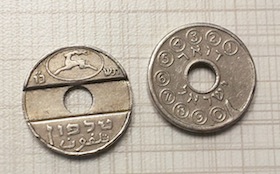
In the days prior to Israel’s becoming a “start-up nation,” telephone service was in pretty sad shape. For many years, most Israelis did not have phones in their homes. So, in the evening, you would wash up, dress up and go outside to use a public telephone. To make your call, you would load your pockets with asimonim, round, grooved, metal tokens. If you were calling someone outside your area code, you would hope that the weight of all the necessary asimonim would not tear your pockets.

photo - In the old days, Israelis would need to gather up their asimonim and head to the public payphone to make a call
In the old days, Israelis would need to gather up their asimonim and head to the public payphone to make a call. (photo by Hidro for Creative Commons)

Talking on payphones was fraught with problems. For starters, how would the person at the other end know you wanted to chat? Answer: the call had to be carefully arranged in advance, with both sides knowing the time, location and telephone numbers of the public telephones that were to be used.

It was an event requiring lots of patience. You had to stand in line with your neighbours, who also wanted to use the phone. You had to ignore the pressure from those behind you, telling you to hurry up and let someone else have a turn. Loud “discussions” occasionally broke out. People claimed they had a dahuf (urgent) call to make or receive. (In Israel, the term dahuf is thrown around a lot.) Thus, the beginning of the Israeli telecommunication era is essentially a study in how people function in groups.

Moreover, Israeli payphones seemed to have a mind of their own. You would be talking when, suddenly, in one big gulp, the telephone cruelly swallowed all your tokens. No amount of whacking the sides of the phone box or banging the receiver in its cradle would return the tokens. You were simply finished for the night. Talking on a payphone was such a tricky business, people would resort to sending postcards, as it was an easier way to relay a message.

By and large, Israeli households did not have telephones until the 1960s – as late as 1964, 55,800 Israeli homes were waiting for phones. If someone had acquired a telephone before the sixties, the person was either suspected of, or envied for, his or her protectzia, the fact that s/he “knew” somebody.

After a long wait – possibly for years – the phone company gave a household a black stationary phone with a short cord. Meaning that, to talk, you had to stay in one place. If you were lucky, nobody’s line would cross yours. If it did, you were stuck listening to their private affairs. People didn’t hang up right away because they didn’t know how long it would take to reconnect with friends. And, while on the subject of talking on the phone, to counter the high cost of doing so, employers with chatty employees or families with talkative children (or adult family members) went to the extreme of putting a lock on their dial phone.

After the implementation of the black telephones, changes came faster. Although the colour choice remained limited, Israelis could choose something other than a phone. They could also order a long phone cord or a press-button phone. Likewise, people could have phones in more than one room. Some advances have gone smoother than others. For example, fax installation and transmission continues to gravely challenge Bezek (the Israeli telephone company, established in 1984) and Bezek users.

In the international sphere, things also changed, albeit unevenly. In the late 1950s, Israel got hooked up to five continents. To place or receive an overseas call, you had to go to the central post office. You sat in a special glassed-in wooden booth while a special operator made the connection.

After a period of time, there were telecartim, or insertable phone cards for public phones. These cards became quite popular and many Israelis became phone card collectors and traders. I remember attending a telecart exhibit in Tel Aviv.

photo - There are a few remaining payphones in Israel
There are a few remaining payphones in Israel. (photo by Deborah Rubin Fields)

What feels like light years later, Israelis started equipping themselves with cellphones and, not long after that, with ear sets. Suddenly, it seemed that many people were experiencing severe mental health problems. In public, flaying arms and shouting at invisible people became rampant. I remember the first time I spotted a person exhibiting this behaviour. Only when he drew near did I see a thin black wire around his jaw and ear. I sighed, “another cellphone casualty.”

Israelis are apparently now making up for lost time by being glued to their mobile phones. They converse everywhere (on dates, in toilets, on trains and buses) about everything.

Some of the usage issues are (pretty close to being) unique to Israel. If you were under the impression that kashrut (kosher) is a food-related concept, think again. In Israel, as well as in a few Western countries, there are kosher cellphones. While they are not edible, they have been a boon to Israel’s ultra-Orthodox community. According to Cellular Israel, “a kosher phone is any phone that is approved and certified by vaad harabonim” (the rabbinic committee for matters of communications).

A kosher phone can only make and receive voice calls. Text messaging and emails will not work on a kosher phone. Moreover, for health, security, public services, water and electricity personnel, there is even a kosher phone designed to avoid breaking the laws of Shabbat. Technically, this mobile device may be dialed without connecting. There is even a kosher de-smarted (meaning that it has no web-browsing capability) smartphone.

Not all the changes appear to be positive. While more studies need to be done, Israeli researchers are beginning to think there is a real downside to cellphone use – it might even interfere with the biblical injunction to “be fruitful and multiply.”

As reported in Reproductive BioMedicine Online, there appears to be an association between higher rates of abnormal semen concentration and talking on cellphones for an hour or more a day, and talking on the devices as they are being charged. Among men who reported holding their phones within 50 centimetres of their groin, a higher rate of abnormal sperm concentration was found. Semen concentration was abnormal among 47% of those who stored their phone in their pants pockets, while it was abnormal in only 11% of the general male population. In brief, Israeli men might need to curb their cellphone use.

There might be another advantage to having an alternative to cellphones. Several years ago, when there was a wave of terrorism, having old-fashioned payphones around turned out to be beneficial. When an attack occurred, Jerusalemites whipped out their cellphones “to report in” with their families. With so many people simultaneously calling, the system crashed. It was the city’s remaining public phones that allowed people to reassure worried loved ones.

Admittedly, many of the above changes likewise happened elsewhere in the Western world; the telecommunication revolution has been a global revolution, after all. But, for many in Israel, each change or step of the way was met with a kind of curiosity or wonder that may have been singular to Israel. Today, that innocence has disappeared. For better or for worse, I’m not sure.

Deborah Rubin Fields is an Israel-based features writer. She is also the author of Take a Peek Inside: A Child’s Guide to Radiology Exams, published in English, Hebrew and Arabic.

Format ImagePosted on September 15, 2017September 14, 2017Author Deborah Rubin FieldsCategories IsraelTags communications, culture, Israel, technology

Posts pagination

Previous page Page 1 … Page 205 Page 206 Page 207 … Page 322 Next page
Proudly powered by WordPress