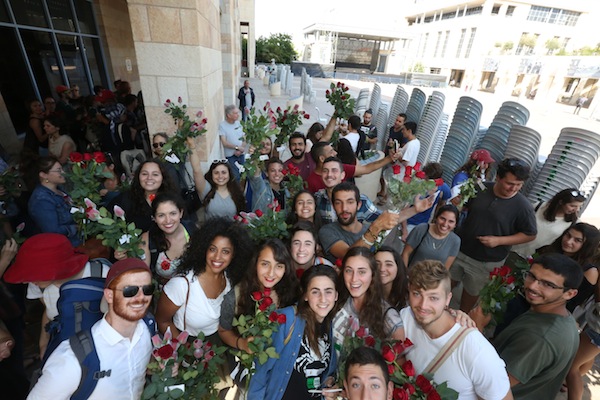
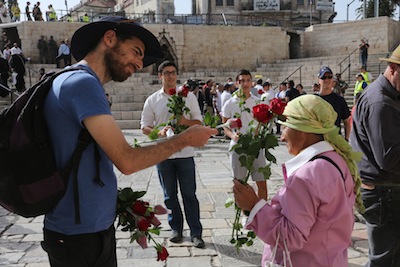
One of Tag Meir’s annual events is Flowers of Peace. Participants hand out roses on the streets of the Old City in Jerusalem on Jerusalem Day. This year, they gave out some 2,000 flowers as a message of peace to Muslims and Christians in the city. (photo from Tag Meir)
To counter what Tag Meir head Gadi Gvaryahu described as incitement by radical settlers through Tag Mechir (Price Tagging), Tag Meir (Light Tagging) was formed.
Tag Meir, which started in 2011, is operated by members of the same segment of religious Zionistic Judaism that started price tagging (attacking Palestinian property and people) in 2009. Members of Tag Meir started visiting victims on both sides of the conflict in an effort to show solidarity and repair physical and psychological damage.
Today, Tag Meir is supported by many organizations and institutions in Israel from all segments of Jewish society – secular, Reform, Conservative, Orthodox and ultra-Orthodox Jews – coming together to stand against hate and intolerance.
Though he now lives in Rehovot, Gvaryahu still considers Jerusalem home. He is the eighth generation of his family to live there.
Gvaryahu was deeply affected by the assassination of Yitzhak Rabin and the fact that the killer had come from his segment of religious Zionism, Kippot Srugot (Knitted Kippot). He decided he had to put his passion for helping animals aside – he is a farm animal behavioural researcher by training – to find ways to mend Israeli society.
“I decided it’s about time to be more involved in public business – not politics, but more education,” said Gvaryahu. “Me and a few other families initiated a synagogue, an Orthodox synagogue in Rehovot, named after Yitzhak Rabin.”
Gvaryahu realized there was something wrong with the education system when he received a call from the head of his son’s yeshivah, demanding his son apologize for an outburst.
“Six months after Yitzhak Rabin’s assassination, a famous rabbi came to my son’s school,” recalled Gvaryahu. “He said that now, with Rabin dead, all his bad things were forgiven. And he didn’t even mention that he was murdered. He just treated him like someone who’d sinned a lot, talking to the whole synagogue, like 400 students, including the head of the synagogue … and they were all silent, except one person – my son.
“My son said, ‘How dare you say that? He just passed away! And, how dare you say that he has sins? He was killed, murdered!’ Then, he left the room, crying.”
When the rosh yeshivah called, Gvaryahu commended his son’s actions and said, “This rabbi should apologize. I’m not going to ask my son to apologize.”
Eventually, they consulted a leading rabbi who declared that Gvaryahu’s son “did a wonderful job and there’s no reason for him to apologize.”
It was at that point that Gvaryahu decided they needed to start their own school.
The first time that Israelis heard the term “Price Tag” in the context of payback was in December 2009. It was dubbed so by a small group of extreme right-wing West Bank settlers who had begun indiscriminately attacking Palestinians.
Gvaryahu explained the psychology behind it: “Something happened to us by Palestinians, by the army, by politicians, whatever … someone will pay the price. The thinking is, we don’t care that you’re innocent, we don’t care that you are Christian, Muslim…. You’re not Jewish, you’ll pay the price. We’ll burn, damage your mosque, your house, your car, your olive trees, and that’s called, ‘Price Tag,’ happening almost daily in the West Bank. Most of them, we don’t hear about. But, after a terror attack by Muslims, unfortunately, we have a bunch of them in the last two months … there’s been attacks by extreme settlers.”
While Tag Mechir destroys, Tag Meir aims to rebuild and bring light. “So, we call the people, the victims, in hospitals, villages, wherever, mosques, monasteries or churches, and we create a solidarity visit,” said Gvaryahu.
Flowers of Peace volunteers on Jerusalem Day. (photo from Tag Meir)
“Over the years, we’ve gained many, many Jewish, Christian and Muslim friends, and that’s very important. It’s important, because it’s a correct response to that crime, because they want to create terror or fear, especially among Muslims and Christians. So, those visits strengthen the relationship between Jews and Muslims and Christians. We have three Facebook pages – one in Hebrew, one in Arabic and one in English – with 35,000 followers.”
People in Israel not connected to Tag Meir have started solidarity visits by themselves, aiming to mend fences with Palestinian neighbours. “First, you know, I’m happy about Tag Meir,” Gvaryahu said about this development. “Second, that they get that this is the right way to respond to a hate crime or a price tag attack – it’s wonderful. It’s what we want to happen.
“This isn’t something that can be solved quickly. It’s education. We try to educate society, especially the Zionist society, we hope.”
This year, due to the rise in Tag Mechir attacks, Tag Meir held an education symposium on Sept. 10 at the Van Leer Jerusalem Institute, near the home of the president of Israel, Reuven Rivlin. Among the speakers were the former head of the Israeli security agency, Shin Bet, Yaakov Peri, senior rabbis from different segments of society, and the mother of one of the Jewish victims of terror, Sarah Rosenfeld.
“Her son [Malachi Moshe] was murdered and she will give her strong condemning opinion about ‘price tag,’” said Gvaryahu prior to the symposium. “When we came to visit the Rosenfeld family, she said that, if Malachi would be with us, he would join Tag Meir.
“This is very unique about Tag Meir, that we visit both settlers and victims of Tag Mechir on the Palestinian side. It’s not that pleasant an activity sometimes, but we feel it’s very important.”
One of the yearly events Tag Meir hosts is a flower giveaway called Flowers of Peace. They go out into the streets of the Old City in Jerusalem on Jerusalem Day and hand out roses. “This year, we spread 2,000 flowers all over the Old City,” said Gvaryahu. “It’s a symbolic act, sending a message of peace to Muslims and Christians in Jerusalem.”
While Gvaryahu said 40% of the people in Jerusalem are Muslim, Jerusalem Day is only celebrated by the Jewish population. He said some of the songs that are traditionally sung must irritate the Muslim population. “Unfortunately, we don’t celebrate it, in our opinion, in the right way,” he said. “We just march with Israeli flags from West Jerusalem to the Western Wall through the market. Not all the songs are horrible, but a few of them are. So, this is our response. We march with Flowers of Peace.”
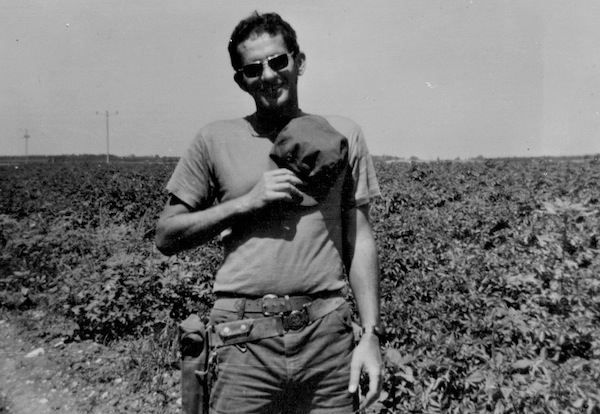
The author took refuge from the perils of the streets by joining a kibbutz as a volunteer. (photo from Victor Neuman)
In this eight-part series, the author recounts his life in Israel around the time of the 1973 Yom Kippur War. The events and people described are real but, for reasons of privacy, the names are fictitious.
Before the War: Part 1
“The bomb shelters can no longer be used as discotheques.”
It was Oct. 6, 1973. Gidon, our kibbutz commander, was announcing that we were under attack and giving us our preparation instructions, including the immediate clearing out of bomb shelters for use in the event of air attack.
Syria had overrun the Golan defences and Egypt was pouring into the Sinai. I was in disbelief over the whole thing. Last year, I was writing my master’s thesis, analyzing Hawthorne’s The Scarlet Letter. Now I could be writing something more like Warfare: A Tourist’s Guide. How had my life gone so abruptly from pondering literature to pondering existence?
There’s an expression Israelis use: “I could sell you.” In other words, you are ripe for the plucking and I could easily take advantage.
When I arrived in Israel on my first trip, in 1968, I was totally pluckable. No knowledge of Hebrew. No knowledge of the country. No tour group guide to protect me. All I had was my curiosity about this country that had recently achieved a stunning victory in the Six Day War. I think that event had caught the attention of many like myself, and there was a huge influx of tourists and volunteers to visit this remarkable place.
I was bought and sold in the streets of Tel Aviv. Simply buying a prickly pear fruit was fraught with fraud.
“One-and-a-half lira please,” the street vendor told me. I paid him and started walking away. Then an Israeli stepped up to the stand.
“One-and-a-half lira please.”
This time, the buyer was having none of it. “Yes, one-and-a-half lira, but you’ll take 75 grush.” Leaving no opportunity for a response, he paid what he wanted and took the fruit. I had just paid double for the same thing.
At another time, I tried to be smarter. I needed to change my German marks into Israeli money. I was aware there was a black market for foreign currency and the street usually offered better rates than the bank. It didn’t take long to find a dealer. They can smell a tourist a mile away. One came up to me asking if I had foreign currency to change. I asked him what rate he was offering for German marks. He gave me a number that sounded pretty good and we agreed on a transaction. I handed over the Deutschmarks – he could have bolted but he was an older guy and I figured I could outrun him if I had to.
He took my money and began counting out Israeli currency. I thought there was something odd about the way he wrapped the money around one finger as he flipped the bills and counted them out to me. Later, when he was long gone, I recounted what he gave me and found I was several bills short. He had flipped the bills so that he had ended up counting the same ones twice and giving me less than we had agreed upon. In the end, I was “sold” again and had even less than I would have gotten at the bank.
You never really lose at these things because they always come with lessons. In most cases, you win some and you learn some. The only time you really lose is when misfortune befalls you and you’re sleeping through class.
I took refuge from the perils of the streets by joining a kibbutz near Haifa as a volunteer. Kibbutzim are basically communal societies where all wealth, housing and equipment are owned by the collective. Material perks like TVs or stereos are doled out on a seniority basis. No one – even those running the place – has any real power over others or more wealth than others. The top jobs are considered something to be avoided. You have all the responsibility and headaches of administering the mess without any particular rewards. In my experience, a kibbutznik generally takes the top job when it is their turn in the rotation and they simply can’t get out of it. Socialism in its purest form and no commissar overlords.
Kibbutz life was good. Nobody tried to rob me and, in return for picking grapefruit and oranges, I got accommodation, food, Hebrew lessons and free tours of the countryside. Sometimes, on my days off, I went further afield.
One of those forays was particularly memorable. My girlfriend, Suzanne, was a kibbutz volunteer from Paris and together we decided to attend Independence Day celebrations in Jerusalem. We booked a hotel room in the Arab quarter of Jerusalem’s Old City and thought about our plans for the evening. The debated options were hanging out in the room or going to the cinema to take in a movie that was a modern American take on Romeo and Juliet. Romance won the day and we left for the movie. The movie was mediocre. Things back at the hotel were less so.
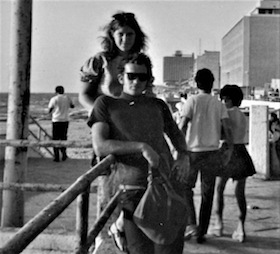
Victor Neuman and his then-girlfriend, Suzanne, in Tel Aviv. (photo from Victor Neuman)
When we got back, we were met by police and the hotel manager. The manager apologized for the inconvenience but we were being moved to another room and could we please collect our luggage from the original room. The sight of our old room was amazing. It was all sparkly. The windows were gone and every horizontal surface was covered with dust. Someone had set off a bomb in the alleyway outside our room.
You might think that a bomb blast would send great shards of glass flying across the room. A blast close by doesn’t. Instead, it pulverizes the glass into a fine dust and that’s what is blown across the room. Objectively speaking, the room looked beautiful – like a fantasy bed chamber decorated in fine diamonds. In reality, we were shaken, as we carefully swept the glass from our bags and began hauling them to our new room on the opposite side of the hotel. It was nice. It had windows.
And the movie? We upgraded its rating from mediocre to fantastic.
Suzanne and I had different travel plans and, after Jerusalem, she traveled to be with friends on a kibbutz north of Hadera. I was concerned that I didn’t have enough money to fly home if the need arose. I was also learning very little Hebrew from the kibbutz we had been on and it was getting annoying needing Suzanne to translate for me wherever we went. When we parted, I headed south to find work in Arad, hoping I could make some serious money and learn Hebrew by some kind of immersion method.
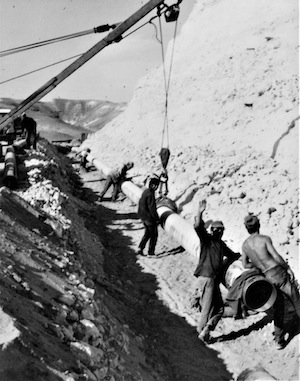
The immersion was profound. I was plunked down in an environment where nobody spoke English. The Arad employment office put me on a crew building a pipeline that would take Dead Sea chemicals to a refinery in Tishlovet. The crew consisted of central European Jews, Israeli Arabs, some local Bedouins and an assortment of thieves, bastards and criminals who were probably one step ahead of an Israeli SWAT team. One of them stole my camera (a beautiful Zeiss Ikon that my father had gifted me) and an assortment of items from all of the crew. We were put up in a motel and, the day the thief quit, he still had the key to the motel room. He made the most of it.
The crew on which the author worked, building a pipeline that would take Dead Sea chemicals to a refinery in Tishlovet. (photo from Victor Neuman)
On the job, I was low man in the pecking order. I had to fetch tools when yelled at and woe to me if I didn’t understand what was being asked for. With this bunch, everybody knew only enough English to swear, and little more. I was sworn at in English, Arabic, Romanian, Hungarian, Polish and Hebrew. It was somewhat typical of what I heard in other parts of the country. Israelis have a knack for adopting the choicest insults from all the languages they encounter. Understandable when you come down to it. Spoken Hebrew was basically invented by linguistic scholars around the time the state was created. They had the difficult task of updating ancient Hebrew to cover things like helicopters and toaster ovens. They didn’t spend a lot of time thinking up swear words. Israelis had to improvise and they did a fine job of it.
The upshot was that, in two months on the pipeline, I learned more Hebrew than in a year of kibbutz Hebrew school. I was getting pretty fluent and I had a good ear for the accent. I began to find that, when I spoke, I was often being mistaken for a Sabra. And, as a bonus, I could swear like a sailor.
* * *
Living in Arad, I now had a decent amount of money rolling in from my work. I decided to take an offer from a guy I’ll call Bad Lennie. Bad Lennie was a South African Jew who had immigrated to Israel with his brother, Good Lennie. Good Lennie lived in one part of Arad with his girlfriend; Bad Lennie had his own apartment. When the two of them were in the same room, I noticed Good Lennie seemed somewhat embarrassed around his brother and often cringed when his brother rambled on about his life in South Africa. In time, I found out that he had good reason to be embarrassed.
Bad Lennie was between jobs and needed money, so he offered me a chance to share his flat if I split the rent with him. I couldn’t pass up the chance to leave behind the den of thieves that were my pipeline crew, so I moved in with Bad Lennie.
Bad Lennie had some disturbing fantasies. He had undergone some military training in his home country. He had a lot of stories to tell me about his time in the military. According to him, he was a top-notch officer in command of hundreds of blacks. His favourite story was of the day one of his men questioned his authority in front of the others. Bad Lennie calmly walked up to the offending black soldier and put a bullet in his head. After that he never had trouble with the others. He told me many stories with pretty much the same theme. The den of thieves was starting to look better to me.
Bad Lennie had a revolver. I found out about it one day when he had this huge grin on his face and told me to feel under his arm. I wanted to pass but he grabbed my hand and stuck it in his armpit.
“What do you think? It’s a gun!” What did I really think? He was wearing a holstered gun under a turtleneck sweater! Not a bad James Bond look except that his turtleneck quick draw was going to need some work. I knew he was an idiot but now I was beginning to wonder how dangerous a one.
Bad Lennie pestered me to get him a job on the pipeline so I did. He lasted three days. On the third day, he came up to me and said, “Watch this.” Then he proceeded to go up to our Arab foreman and swear a blue streak at him in English. He turned back to me with that same stupid grin on his face. “It’s OK. The bugger hasn’t a clue what I’m saying.”
I had been on the pipeline long enough to know different. Everybody in this bunch was fluent in Swearese. Bad Lennie was fired. He still seemed confused about why but he was a goner nevertheless. And his problem became my problem. Bad Lennie was getting half the rent money from me but it was not enough and he started borrowing my money. I saw no chance of getting repaid because Bad Lennie now had no job. He spent most of his time hitting on his brother for money and going to the cinema in Beersheva to watch the latest Western. After coughing up a fair amount of cash, I cut him off. Then he offered to sell me some of his coffee table books on Israel. Truth be told, they were beautiful books but I was still living out of a backpack and couldn’t see myself schlepping all that weight.
I said, “No thanks.” He looked pissed but I didn’t care.
One day, I returned from work and walked through the door of our flat. There was Bad Lennie standing kitty-corner across the room with his gun pointed straight at my head. I just froze. I felt a powerful urge to say something but nothing came to mind. Then he pulled the trigger and there was this loud “snap.”
“It’s empty,” and he was grinning again. “I’m just kidding around. I wasn’t really going to shoot you.”
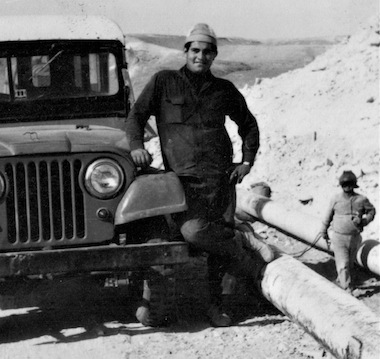
The Arab foreman of the pipeline who fired Bad Lennie after Bad Lennie swore at him. (photo from Victor Neuman)
I decided then and there that I had made enough money and my Hebrew would suffice. Bad Lennie’s gun was empty but I was sure he kept bullets somewhere. It was time to get out of Dodge. On the day I decided to leave, I left the job site early and headed for the apartment. I knew Lennie wasn’t around because they were playing a new Western at the cinema. I grabbed all my things and stuffed them in my bag. There was a little room left, so I grabbed Bad Lennie’s books and stuffed them in my bag as well.
Lastly, I wrote him a note: “Hi Lennie, I’m leaving town to go to a kibbutz in the north. Take care and best of luck. P.S. I’ve changed my mind about your books. I’ll buy them after all. Just deduct what they are worth from the money you owe me and we’ll call it even. Cheers.” Then I headed for the nearest road out of Arad and started hitchhiking north. It was a bit nerve-wracking. I wasn’t sure who would show up first – my ride or Bad Lennie. I was in luck. My ride came first and I was on my way to join Suzanne.
As I mentioned, Suzanne and I had met at our previous kibbutz, near Haifa. She was Jewish and, like me, had come to Israel to check it out and become a volunteer. She was a huge fan of Leonard Cohen and, as a consequence, had a real thing for dark, brooding, handsome Canadians. All I had going for me was the Canadian thing and, happily, she settled for that. For me, the trigger was her incredibly sexy French accent. It was like listening to music.
She also spoke her mind entirely with nothing held back. Tears or laughter came at the drop of a hat and you were never in doubt about what she thought or how she felt. It was a raw honesty of emotion that took some getting used to but, once you did, it was exciting in a scary kind of way. The ride was bumpy but never ever dull. And nothing frustrated her more than people suppressing their feelings. Once, when I was being particularly uncommunicative, she booted me in the rear to try to get me past it. I don’t recall if it worked but, after that, if I felt withdrawn, I made sure I was sitting down.
Suzanne worked in the children’s house and I had a steady job in the banana fields with a guy named Lev as my boss. Banana life was good but there came a time when I worried that I was spinning my wheels. I wasn’t sure I wanted kibbutz life forever and I thought I had the beginning of a career back in Canada. I had a BA in English literature, after all. It had to mean something. I felt I needed to return to Canada and see what I could make of my life there. I was in a dark, who-am-I kind of mood. When I told Suzanne I was going home, she was angry.
“I won’t be the one left behind,” she told me.
Before I knew it, she was on a plane bound for Paris and I was sitting in the middle of a very empty room. Worse than empty. The life had gone out of it. To my surprise, I actually wept. I never realized until then how much I would miss her. Typical of me. Why not save steps? Burn the bloody bridge while you’re still standing on it.
I couldn’t bear that empty room and so, in the time I had left before going home, I joined an archeological dig in the Negev near Beersheva. The work was hot, dirty and finicky. We had to move a lot of dirt to get down to the Iron Age town we were looking for and, at that point, the work had to be much more careful. Every find was scraped, brushed clean, surveyed for location, photographed and, finally, removed to our storage room at the base of the hill.
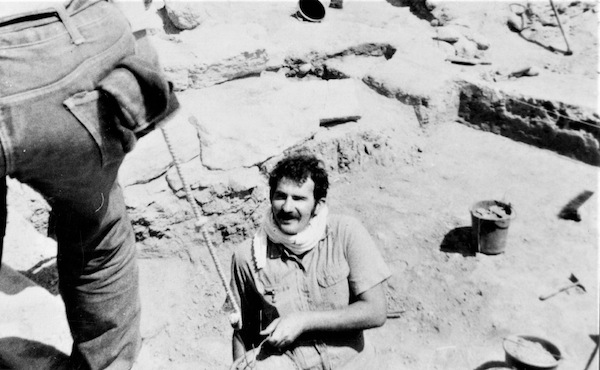
In the summer of 1969, the author worked on an archeological dig. Here, he passes up a bucket of dirt for disposal. In the background, partially covered with a rock slab, is a Bedouin grave dating to the Middle Ages. (photo from Victor Neuman)
I was particularly proud of finding an intact Iron Age kiln, circa 700-600 BCE – basically, a three-foot-wide, clay-walled cylinder standing on its end. I carefully brushed and excavated the kiln to its base, always careful to leave the dirt in the centre as support for the walls. After three days of clearing the outside of the kiln and the floor around it, I was told it was time to take it down and go deeper. It had been photographed, measured and catalogued and now it had to be removed. Strangely, my fellow volunteers had all dropped their tools to come and watch me take a pickaxe to the kiln. Not sure what was going on, I swung the pickaxe and buried it in the centre of the kiln. There was a horrible sound of glass breaking.
“Crap!” I thought. “I’ve just destroyed some 2,600-year-old glass artifact that was situated in the middle of my kiln.” Everybody who had gathered round gasped loudly in horror. Feeling disgraced, I dejectedly began pulling out bits of glass. But there was something peculiar. The glass had a colour that was unlike any ancient glass I had ever seen. In fact, it looked a lot like.… “Alright,” I said, “Who buried the frigging beer bottle in my kiln?”
Aside from the pranks, we did a lot of good work and, by the end of the season, I was standing on the streets of ancient Beersheva where Abraham once walked.
When the dig ended for the summer, it was time to go home. My first trip to Israel was over. I returned to Canada in 1970, got an MA in English literature by May 1972 and, damn me, I still didn’t want to teach. I was no further ahead in knowing what I wanted to do. Also, I missed the kibbutz. I decided to go back to Israel later that year. My thinking was that I’d spend some quiet time there deciding about my future. I didn’t realize that I’d have to do my contemplating in the middle of a war.
Victor Neumanwas born in the former Soviet Union, where his family sought refuge after fleeing Poland during the Second World War. The family immigrated to Canada in 1948 and Neuman grew up in the Greater Vancouver area. He attended the University of British Columbia and obtained a BA and MA with majors in English literature and creative writing. Between 1968 and 1974, he made two trips to Israel, one of which landed him on a kibbutz at the time of the 1973 Yom Kippur War. Upon his return to Canada, he studied survey technology at BCIT and went on to a career of designing highways for the Province of British Columbia. When he retired, he reconnected with his roots in creative writing and began writing scripts for Vancouver Jewish Folk Choir concerts and articles for the Jewish Independent. Neuman and his wife, Tammy, live in southeast Vancouver and enjoy the company of friends, their extensive extended family and their four sons.
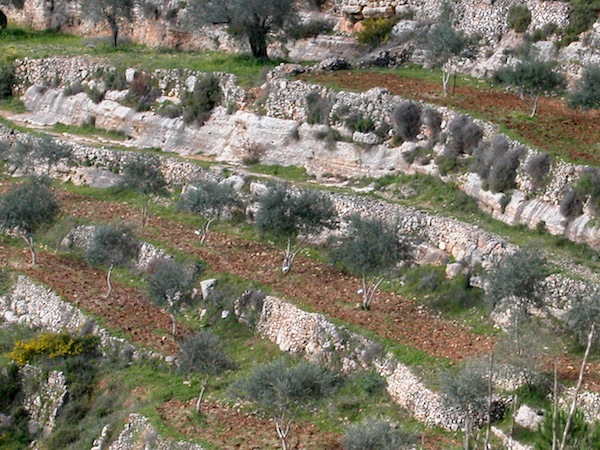
Patch cultivation, or box fields, in the Judean Lowlands. Image is from the 2017 article “The Origin of Terracing in the Southern Levant and Patch Cultivation/Box Fields” by Shimon Gibson and Rafael Lewis in the Journal of Landscape Ecology. (photo from Rafael Lewis)
Rosh Hashanah is upon us and that means time for a special seder with blessings over eight different fruits and vegetables. One of the chosen fruits is the pomegranate (rimon in Hebrew), most likely because the Israeli pomegranate ripens around the Jewish New Year. Over the pomegranate, we recite the following blessing: “May it be Your will, G-d and the G-d of our ancestors, that we be filled with mitzvot like a pomegranate [is filled with seeds].”
Interestingly, the pomegranate is one of the seven species mentioned in the Torah (Deuteronomy 7:12-11:25). Jerusalem has never been considered prime agricultural land, but farmers of old actually grew pomegranates and other fruits – once they had cleared the rocky hills for cultivation.
How challenging was ancient Jerusalem’s topography and climate? Jerusalem has no natural resources (including water) or fertile land. It is situated on a range of hills running north to south between the Mediterranean Sea to the west and the Jordan Rift Valley to the east. The Hills of Ephraim extend from the Jezreel Valley southward through Shechem (Nablus) and Ramallah. The Judean Hills run southward from Jerusalem through Bethlehem and Hebron down to Beersheva. The watershed runs through the heart of the range. Jerusalem is about 800 metres above sea level; the hills to the north, Shechem, 950 metres; and, to the south, Hebron, 1,000 metres.
Today, Jerusalem’s annual rainfall is about 553 millimetres, with rainfall limited to the months of November through March. Historically, however, while there were fluctuations – including two periods of severe drought – it still appears that, until the Middle Ages, Jerusalem was receiving more precipitation than it does today.
Given that less-than-compelling physical description, it is somewhat amazing that any early people stuck around to farm on Jerusalem’s hillsides. Those who stayed applied the ancient technique of terracing, which, as Haaretz’s Nir Hasson has stated, is simply “a series of steps, with the earth held back by a wall of stones to enable tilling the mountainside.”
Setting up and maintaining the terracing, however, is easier said than done. After you manually clear the rocks (a process called izuq in Hebrew), you have to haul over a layer of fertile soil. But your preparations still aren’t complete. You then have to lug back the cleared rocks to create retaining walls. The retaining walls keep the terraces from collapsing during Israel’s rainy season. Only then could you get down to planting.
Most of the farming on the terraced areas of the Judean Mountains was done without artificial irrigation. Farmers harvested pomegranates, grapes, olives and figs watered solely by rainfall.
How do we know people used terraces so long ago? Jon Seligman, an archeologist and the Israel Antiquities Authority’s director of external relations and archeological licensing, wrote his doctorate on the “rural hinterland” of Jerusalem during the Byzantine period. He concluded that, given Jerusalem’s hilly and rocky topography, there must have been terraces. In fact, in Hebrew, the word step also refers to terrace.
Other scholars have noted that, at some Judean Mountain sites, such as Mevasseret Yerushalayim, the terraces were natural features of the landscape. That the terraces were already there did not rule out all the problems, though. For instance, archeologists discovered that the soil in this area was a different colour, implying farmers had dragged in earth from other locations. When the terrace was wide enough, the farmer worked with a plow. When it was very narrow, the farmer was forced to use a hoe or mattock.
Overall, the size of the irrigated areas in the Judean Mountains was quite small. In these irrigated terraces, farmers chose to grow vegetables, rather than to cultivate orchards. The irrigated areas consisted of three parts: construction of a storage system to hold spring water, slightly raised channels to convey the spring water and level terraces.
In the valleys of the mountains, farmers occasionally had to deal with draining off excess water caused by floods or heavy rains. They did this by extending the terracing deep into the valley. Where necessary, they built drain lines. The drain lines were built at levels lower than the channels. On a needs basis, farmers constructed stone walls to divert excess water.
There is evidence that early terracing took place initially in the lower parts of hill slopes, closer to the wadi (valley or ravine which is dry except in the rainy season) beds, which were also terraced, with newer terraces later being built further up the slopes following woodland removal.
Apparently, the chief consideration in ancient and Arab settlements in the Judean Mountains was on preserving cultivatable areas. Hence, most of these settlements ended up on mountain plateaus and adjoining ridge crests.
But how did early people come to consider terracing? For more than 100 years now, some archeologists have been suggesting box fields or patch cultivation may have sparked early attempts at terracing. Box fields or patch cultivation denote the natural step-like appearance of the rocky slopes of hills, with thin layers of chalky marl interposed between limestone or dolomite strata.
Some researchers contend that these box fields were used on deforested slopes. Shimon Gibson and Rafael Lewis write in a 2017 article in the Journal of Landscape Ecology that their appearance on Jerusalem’s hilly slopes (and in other parts of ancient Israel and Jordan) were “sufficiently broad and deep enough to accommodate the root systems of one or sometimes two trees, usually olive trees. While limited in size, they constitute leveled cultivable soils on sloping rocky ground.”
Moreover, “box fields were also recorded as a phenomenon on the hill slope of Sataf, west of Jerusalem. During excavations at this site, the remains of houses and installations dating from the Chalcolithic period (4800-3500 BCE) were found adjacent to two springs of water. Due to the very steep angle of the Sataf hill slope, there can be no doubt some form of retained fields must have existed there during that period…. Indeed, an agricultural terrace from the Early Bronze I (3330-3050 BCE) was excavated at the site, and it too may have been a development of a box field.”
Terraces at Sataf in the Jerusalem Corridor. (photo from Photo Archive of JNF)
About 35 years ago, at the Sataf Spring, the Jewish National Fund began to reestablish the ancient terraced fields. The organization’s purpose was to preserve the cultural heritage of terracing and to preserve the landscape. The terraces are more or less the same size as the ancient steps. The trees found at the terraces are from the original species – basically, the biblical seven species, which includes olives, pomegranates, dates, grapes and figs.
Part of the terraces have trees, which grow from rainfall only, and part of the terraces contain organic vegetables and herbs irrigated by Sataf’s springs. Spring water travels to the vegetable plots via channels. These channels are simply opened and closed by earth and stone banking. When Jerusalem has a “wet winter,” i.e. with plenty of rain, the fields are watered solely by rain.
The terraces are maintained by a small staff headed by Gidi Bashan and a large number of volunteers. The work is all done by hand. There is no mortar used in the stone walls. Consequently, heavy rains occasionally seep in between the stones, eventually pushing out the stones. The collapsed walls must then be rebuilt, one stone at a time. In addition, there are some 55 small allotments, which allow Jerusalem residents – for a token fee – to farm in their spare time.
Terracing in the Judean Mountains has altered the flow of both the spring water and the run-off water. It has largely halted the growth of the area’s natural vegetation. It has changed the course of paths and roads.
South and west of Jerusalem, Arab villages have continued to employ terracing. Thus, according to EcoPeace Middle East (formerly known as Friends of the Earth Middle East), Battir, a village south of Jerusalem, still uses irrigated terraces, which date back 4,000 years. The terraces are the product of centuries of work. With the billion collected stones “piled one on top of another, generations have engaged in traditional farming. Spring water – stored in small pools – is channeled to the terraced fields by open canals. Today, Battir families grow olives, cabbage and eggplant just as was done in antiquity.
Terraces in any given area will look different, as it depends on what on-site raw materials are available.
From the First Temple period onward, thousands of agricultural terraces were in use around the Judean Mountains. They were destroyed and rebuilt during the Hellenistic, Roman and Byzantine periods. Farmers – including Arab families, until Israel’s War of Independence – and Jerusalem residents were able to make a living from a small number of repaired ancient Jerusalem-area terraces. While terraced farming will no longer provide enough produce to feed a large and expanding population, it is hoped that some terraces will continue to be part of Israel’s cultural heritage.
Deborah Rubin Fields is an Israel-based features writer. She is also the author of Take a Peek Inside: A Child’s Guide to Radiology Exams, published in English, Hebrew and Arabic.
ראש ממשלת קנדה לשעבר מנסה לעשות עסקים בישראל – חלק א’
יש לנו סינון די פשוט. כל מי שעובד איתי, עבד איתי שנים ארוכות בממשלה בצורה כזו או אחרת. אני חושב שהייתי ידוע גם בקרב תומכיי וגם בקרב מתנגדיי, בתור מי שהייתה לו אג’נדה ברורה וסט מוגדר של ערכים פוליטיים, לטוב ולרע. המבחן הפשוט שבו אנו משתמשים בכל מה שאנו עושים הוא האם זהו סוג העסקים שאני בתור ראש ממשלה הייתי רוצה להיות קשור אליהם ושהייתי מוכן להתייצב ולצאת בהצהרה רשמית לגביו, שהייתי רוצה להיות מקושר אליו ושהייתי רוצה לראות שהוא קורה. אם הוא לא כזה – בלי קשר אם הוא רע או לא חוקי או וואטאבר – אז זה לא סוג העסקים שנחפש.
כך הגדיר ראש ממשלת קנדה לשעבר סטיבן הרפר (בן השישים) את גבולות הגזרה המוסריים שלו בעשיית עסקים, בין היתר עם גופים סיניים, בראיון לעיתון “גלובס” שנערך בעת ביקורו האחרון בישראל.
הרפר כיהן שלוש קדנציות רצופות כראש ממשלה ימני שמרני, מאלפיים ושש ועד שהודח בבחירות האחרונות על ידי ראש הממשלה הליברלי הנוכחי, ג’סטין טרודו. הרפר הוא נוצרי אוונגליסט שנחשב תומך נלהב של ישראל וביקר בה כמה וכמה פעמים. בביקור האחרון כרה”מ נשא נאום במליאת הכנסת שבו אמר בין השאר את המילים הנחרצות: זו מסורת קנדית לעמוד לצד מה שעקרוני וצודק ללא קשר למה נוח או פופולרי. עמידה לצד ישראל היא למעלה מצו המוסר, היא גם בעלת חשיבות אסטרטגית וגם עניין של האינטרסים ארוכי-הטווח שלנו. עבור אומות רבות עדיין קל יותר לראות בישראל שעיר לעזאזל מאשר לחקות את הצלחתה.
לאחר התבוסה בבחירות הקים הרפר את את הרפר ושות’ – חברת ייעוץ שמעמידה לרשות לקוחותיה את רשת הקשרים שלו.
החברה מסייעת לתאגידים שפועלים בסביבה בעלת סיכון פוליטי או גיאו־פוליטי, בנגישות לשווקים ופיתוח קשרי ממשל. עם זאת, כמו ראשי ממשלה ונשיאים אחרים הוא מוסיף להיות מעורב בפוליטקה הבינ”ל. הרפר עומד בראש ארגון “האיחוד הדמוקרטי הבינלאומי” – ארגון גג של מפלגות מרכז-ימין, המקביל לאינטרנציונל הסוציאליסטי, מהצד הימני-שמרני, ומסייע למפלגות שמרניות אחיות להיבחר בארצותיהן. מזה כשנה כולל הארגון גם את מפלגת הליכוד מישראל.
בראיון דיבר על הצורך של יזמים צעירים ביד מכוונת. זה לא הדבר היחיד שאנו בהרפר ושות’ עושים אבל רבים מלקוחותינו הן קרנות השקעה, חלקן בתחום הטכנולוגיה, והסיפור פה בישראל שונה. מבלי להעליב, רוב הזמן אתה פוגש בניעשרים ושלושים חכמים וכו’, אבל אתה יודע – יש להם עוד הרבה מה ללמוד בחיים. זו חלק מהסיבה שהם מעסיקים אותנו. הם זקוקים לפרספקטיבה הרחבה. אך לעומת זאת, במקרה שלנו, כשאנו מתעסקים עם ישראלים מנוסים יוצאי מערכת הביטחון הם בשלים ומקצועיים, ואנחנו עובדים איתם כדי להפיק הזדמנויות עסקיות, אז זה בהחלט תחום מרתק.
עניין שמוסיף הרפר לגלות בפוליטיקה העולמית לאחר פרישתו קיבל ביטוי משמעותי גם עם פרסומו של הספר שכתב בשם “כאן ועכשיו: פוליטיקה ומנהיגות בעידן השיבוש” – משחק מילים באנגלית אותו ניתן לקרוא גם כ”ימין כאן וימין עכשיו”. הספר מנתח את הסיבות לעליית הפופוליזם ובראשן בחירותו של נשיא ארה”ב, דונלד טראמפ והברקזיט בבריטניה. את הספר, שאותו הרפר עצמו מתאר כמדריך למדינאות שמרנית בעידן הפופוליסטי, תיאר השבועון הקנדי “מקלינז” כמעין מתכון לשיפוץ המצע הרפובליקני בארה”ב, שבו הוא מתרה בהנהגה הרפובליקנית למצוא דרכים לשמור את הקולות המתנדנדים שהעלו את טראמפ.
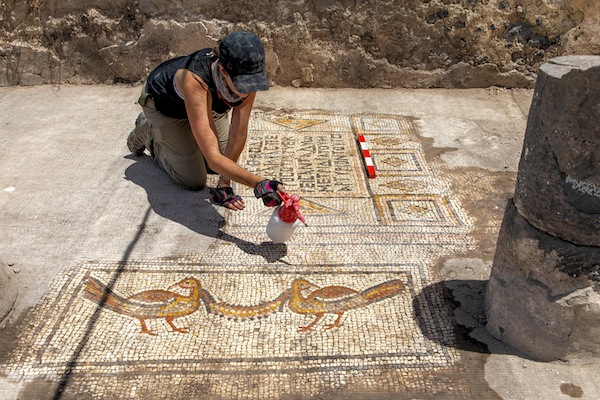
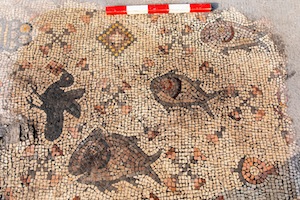
A mosaic revealed during the excavation of the “Burnt Church” in Hippos. (photos by Michael Eisenberg via Ashernet)
A mosaic was revealed during the excavation of the “Burnt Church” in Hippos, which was built in the second half of the fifth or in the early sixth century CE and was probably burnt down during the Sasanian conquest in the beginning of the seventh century. According to the researchers, the descriptions in the mosaic, along with the location of the church, overlooking the Sea of Galilee, raise the connection to the “Feeding the Multitude,” the miracle performed by Jesus in the area, according to the New Testament. “There can certainly be different explanations to the descriptions of loaves and fish in the mosaic, but you cannot ignore the similarity to the description in the New Testament: for example, from the fact that the New Testament has a description of five loaves in a basket, or the two fish depicted in the apse, as we find in the mosaic,” said Dr. Michael Eisenberg, head of the excavation team in Hippos on behalf of the Institute of Archeology at the University of Haifa, along with colleague Arleta Kowalewska. The excavation of the church specifically was placed in the hands of Jessica Rentz from the United States, who has exposed its entire internal area.
During the preservation process, headed by Yana Vitkalov from the Israel Antiquities Authority, most of the mosaic area was cleaned and preserved, and most of its decorations and two inscriptions in Greek were exposed. The first one tells about the two fathers of the church, Theodoros and Petros, constructing a sanctuary for a martyr, while the second one, which is located inside a medallion at the centre of the mosaic, exposes the name of the martyr, Theodoros. An initial reading of the inscriptions was done by Dr. Gregor Staab from the University of Cologne in Germany, expedition epigraphist.
Eisenberg continues to be cautious about the interpretation of the new mosaic. “Nowadays, we tend to regard the Church of the Multiplication in Tabgha, on the northwest of the Sea of Galilee, as the location of the miracle, but with careful reading of the New Testament, it is evident that it might have taken place north of Hippos within the city’s region.”
לדף בפייסבוק של הליכוד בקנדה יש מעט מאוד תומכים. כך עולה ערב הבחירות הכלליות בישראל שיערכו ביום שלישי הקרוב (השבעה עשר בספטמבר).
דף הליכוד קנדה שהפרסום בו נכתב בעברית ואנגלית כאחד מיועד בעיקר לתמוך בראש הממשלה וראש הליכוד, בנימין נתניהו. מספר העוקבים אחרי פרסומי הליכוד בקנדה עומד על שלושים ותשעה בסך הכל, ומספר “הלייקס” עומד על ארבעים בסך הכל. התמונות האחרונות שפורסמו בדף של הארגון הן מלפני יותר מארבע החודשים (מהעשרים ותשע באפריל).
גם האתר של הליכוד קנדה שמקושר ישירות לאתר של הליכוד בישראל, לא פעיל במיוחד. החלק של “מי אנחנו” ריק לחלוטין, בחלק של “תוכנית ואירועים” – האירוע האחרון הוא משנת אלפיים ושלוש, ואילו חלק של “הודעות לעיתונות” – המידע האחרון משנת אלפיים ושבע.
בדברי ההסבר לפעילות הליכוד בקנדה נאמר בין היתר כי: הליכוד קנדה מחוייב לתמוך בישראל חזקה ובמאמצים החלוציים של המתנחלים ביהודה ושומרון. הליכוד קנדה יפעל בצורה אגרסיבית נגד האנטישמיות, כולל בארגונים ניאו-נאצים, אסלמיסטים קיצונים וגורמים בקהילה היהודית “הסובלים” משנאה עצמית. הארגון יעזור לסטודנטים היהודים בקאמפוסים השונים להתמודד מול אנשי השמאל המתנגדים לישראל ותומכים בתנועת הבי.די.אס.
הליכוד בקנדה מתגאה בפעילותו ובארגונים השונים הקשורים בו ובהם: הארגון הרוויזיוניסטי הציוני, נשות חרות, חרות הצעירה, בית”ר ותגר. הארגון תומך ותמך בקרן תל חי, כפר הנוער על שם יוהנה ז’בוטינסקי, המערכה הארוכה לשחרור היהודים מברית המועצות לשעבר, קרן קיימת לישראל וההסתדרות הציונית העולמית.
רשימת נשיאי העבר של הליכוד קנדה כוללת בין היתר את השמות הבאים: נתן סילבר, סם שיינהואס, סם סוקולוב, בן מילנר והארי וול. רשימת המנהיגים של הליכוד בקנדה כוללת בין היתר את השמות הבאים: מוריס פיינשטיין, אייב מונק, נתן בלנקרוט, מוריס דיאמנט, ג’ק רפופורט, יחיאל הברמן, מוריס מלוטק, לואיס מוזס, שלדון לרמן, טוביה שוורץ ומוריס לקס.
הליכוד קנדה מפרסם בימים אלה בנארים במספר אתרים הקשורים לישראל והקהילה היהודית כאן, לקראת הבחירות בישראל. במודעות נכתב בין היתר כי התומכים בליכוד קנדה הם חלק מארגון קהילתי המייצג את האידאליזם של הציונית המרכז-ימנית. המצטרפים יודעים שמדובר בארגון יהודי פעיל אחראי, המתחייב לתת מענה נמרץ לאנטי-ציונות בזירה הציבורית, באוניברסיטאות ובחוגים היהודים המתקדמים. המצטרפים תומכים בתוכנית של ההסתדרות הציונית העולמית.
במודעות יש מידע בדבר תוכנית ירושלים: אחדות העם היהודי, הקשר של העם היהודי למולדתו ההיסטורית היא ארץ ישראל. וכן מרכזיותיה של מדינת ישראל ובירתה ירושלים המאוחדת בחיי האומה. ובנוסף: תמיכה בעלייה לישראל מכל מדינות העולם, חיזוקה של ישראל כמדינה ציונית ודמוקרטית ועצוב המדינה כחברה מופתית בעלת אופי מוסרי ורוחני יחודי, המאופיין בכבוד הדדי לעם היהודי, תוך חתירה לשלום ותרומה לשיפור העולם. יש להבטיח את עתידו והייחוד של עם ישראל על ידי קידום החינוך היהודי, העברי והציוני, טיפוח ערכים רוחניים ותרבותיים, והוראת השפה העברית כשפה לאומית. עוד נאמר כי יש ליישב את המדינה כביטוי לציונות המעשית, יש לטפח אחריות יהודית הדדית, להגן על זכויות היהודים כיחידים וכאומה, וכן לייצג את האינטרסים הציוניים-לאומיים של העם היהודי ולהיאבק בכל גילויי האנטישמיות.
עלות הצטרפות לליכוד קנדה עולה חמישה דולרים, היא מיועדת רק לבני שמונה עשרה פלוס, ומותנית בקבלת תוכנית ירושלים ותמיכה באג’נדה של הליכוד שהיא מדינה יהודית חזקה ובטוחה. מספר הטלפון מטורונטו המצורף למודעה שייך לפרנק דיאמנט, לשעבר מנכ”ל בני ברית קנדה (שפעל בארגון במשך כשלושים שש שנים).
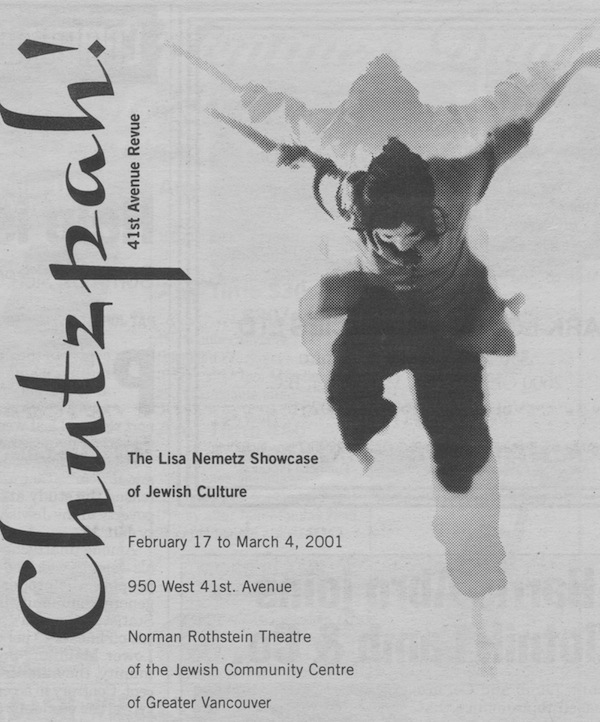
Mary-Louise Albert was not only a dancer in the first-ever Chutzpah! Festival, but its poster model (see image below).
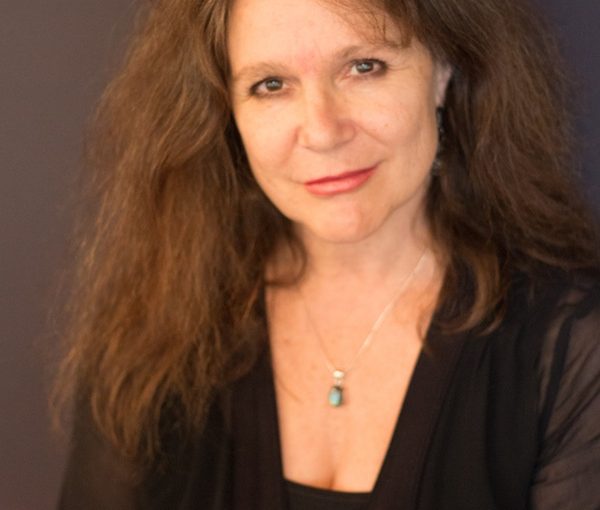
As the 19th annual Chutzpah! Festival approaches, ready to embrace its new season – no longer a spring festival but a fall one – it will have to loosen its embrace on its artistic managing director, Mary-Louise Albert. After 15 years heading Chutzpah!, this is her last. Albert is moving on to the next part of her creative and personal journey, and the Jewish Independent spoke to her about the festival, its legacy and what might lie ahead for her.
JI: What do you think the main impact of the Chutzpah! Festival has been for the Jewish and general communities and the relationship between the two?
MA: Presenting and facilitating the growth of professional performing arts is an exciting and multi-layered approach to uniting communities. I am very proud that we have brought the festival to a point of national and international recognition, as well as being one of the flagship Jewish festivals in North America.
Through the insistence of high standards and by supporting new work, the festival has increased an understanding and appreciation of programming that embraces an eclectic range that is Jewish arts and culture, in particular from a Canadian perspective. Expanding on this programming, Jewish and non-Jewish artists share our stages, increasing our ability to bring many Canadian and North American premières to Lower Mainland audiences. Seeing, over the past 15 years, audiences from all walks of life and backgrounds embracing the festival is particularly rewarding.
JI: Have you accomplished what you set out to do when you took over the festival 15 years ago?
MA: Yes, which feels very satisfying to be able to say. I wanted the festival to not only survive but thrive in a very competitive local and national performing arts scene, which is tricky given a cultural umbrella. This meant attaining an international standard – not just a couple of high-profile shows, but across the board. It also meant the dance and music programming had to expand, which has in particular allowed for funding opportunities and artist growth.
An area I’m very proud of is connecting urban and rural communities through creation residencies. Many B.C.-based Chutzpah! artists have had creation residencies in both the North Island region and in the Norman and Annette Rothstein Theatre, resulting in world premières, with these productions going on to tour nationally and internationally. For example, this year, Geoff Berner, T.J. Dawe, Toby Berner, Tallulah Winkelman and Jack Garten will be Chutzpah! artists-in-residence for a week in Sointula, Malcolm Island, where they will perform as well. Chutzpah! will be sending UNA dance company from New York City to perform in Sointula, Port McNeil and in Alert Bay with the N’amgis nation directly before their Vancouver performances, which is a rare and meaningful opportunity for all involved. Sharing artistic wealth with underserved regions of B.C. is and has been an important aspect of the festival for the past few years. It is also in keeping with the times.
JI: In a couple of interviews I’ve read, you speak about how your training and working as a dancer was helpful to you in running Chutzpah! Could you speak a bit to that?
MA: I was trained in ballet and contemporary, danced professionally for 20 years and, within this time period, became a mother of two children. I was 45 when I stopped performing and, through support from the Dancers Transition Resource Centre, embarked on a new adventure of being the oldest “kid” in the class for a few years at Capilano U and BCIT’s Business School.
I was then hired by Gerry Zipursky [then-executive director of the Jewish Community Centre of Greater Vancouver, which is home to the Rothstein Theatre] and an inquisitive hiring committee (who I will always be grateful to) … and embarked on this job where I needed to come in running and move things forward. All this took stamina, tunnel vision, a somewhat sharp brain (and elbows), nerviness, flexibility and passion – things that a combination of dance training and a professional dance career prepares you for.
JI: In relation to Chutzpah!, what are one or two of your “I’m most proud of” moments?
MA: There are so many that I am proud of, but I would have to say the festival has been a trailblazer in presenting Israeli artists – and often in their first Canadian or North American appearances. Artists such as the Idan Raichel Project, Kibbutz Contemporary Dance Company, Batsheva Dance Company, Balkan Beat Box, Yemen Blues, Idan Sharabi, Roy Assaf, Avishai Cohen Quartet, Itamar Borochov Quartet, Dudu Tassa, Diwan Saz, Maria Kong, Baladino, Victoria Hana, David Broza and Mira Awad, A-WA and many more. And continuing this year with AvevA, Yemen Blues, Guy Mintus Trio, and Rami Kleinstein.
As well, I’m very proud of the growth of the dance and music programming and how this growth has affected positively and in a multi-faceted way the artistic development of many artists.
JI: What’s next for you?
MA: I live in both Burnaby and in Sointula on Malcolm Island. Development of contemporary dance, rural B.C. and social causes are beckoning. At 64, I still have a bit of “oomph” left to pursue.
JI: If there is anything else you’d like to add, please do.
MA: I’m honoured and thankful to have worked with so many excellent professional colleagues in the arts world and at the JCC in accomplishing the festival’s achievements, as well as working with some wonderful volunteers. However, there are two volunteers in particular who I want to give a special thank you to. People with integrity and grace who have stuck by me and the festival from the very beginning – Harriet Wolfe and Lloyd Baron.”
Rabbi Lynn Greenhough represents a series of firsts for the Victoria Jewish community. (photo from Kolot Mayim)
When Lynn Greenhough is officially installed as rabbi of Kolot Mayim Reform Temple in Victoria tonight, Sept. 6, she will bring with her a series of firsts to the city’s Jewish community: its first rabbi born on Vancouver Island, its first Canadian-born rabbi, its first full-time female rabbi with her own congregation and its first rabbi who was not born into Judaism.
A stalwart in Victoria’s Jewish life for nearly 30 years, Greenhough has been Kolot Mayim’s spiritual leader since 2017, while simultaneously completing her rabbinical studies at the program offered by the Jewish Spiritual Leaders Institute (JSLI) in New York.
For someone born and raised in Happy Valley – 15 kilometres west of Victoria – at a time when the area was still a farming community, the rabbinate was not a calling many in the community, or indeed on the Island, might have considered.
Her first taste of Judaism, and some of the recent history of the Jewish people, came in Grade 5, when she found a copy of William L. Shirer’s The Rise and Fall of the Third Reich in her schoolroom library, and her curiosity and sense of connection to Judaism ensued. She recognized that justice had tragically failed Jews during the Holocaust and she felt a need to be part of rebuilding a world where such a failure could never happen again.
“I consciously gravitated towards Judaism because of its inherent sense of justice,” Greenhough told the Independent. “At that early point, I realized, I would be a Jew.”
Life, jobs and family followed. She finished school, married and had a son, helped open Everywoman’s Books in Victoria and then worked for Canada Post as a truck driver for 20 years.
In the 1980s, Greenhough attended a few Jewish events at Victoria’s Congregation Emanu-El. She began to light candles and tried to build a sense of Shabbat into her week. She also looked for a Jewish partner who could help her build a Jewish home. Yet, it wasn’t until she was in her late 30s that she was determined – accompanied by now-husband Aaron Devor – to convert. Devor grew up in a Jewish neighbourhood on Long Island, but was not a regular synagogue attendee. Along the way, the couple became deeply engaged in Jewish life.
By 1992, Greenhough’s conversion was complete and, from then, it was full-on immersion to the point where she became a leader and educator. At Emanu-El, she guided historical tours, joined the board of directors, led services, including chanting Haftarot and Torah, joined the Chevra Kadisha (Burial Society) and served as a funeral officiant.
In 1996, she served as an instructor at the synagogue’s Hebrew school and then began teaching and coordinating b’nai mitzvah classes. In 1998, she began to teach Torah and Haftorah studies for adults and, in 1999, taught an introduction to Judaism course for those interested in conversion.
However, it was the Chevra Kadisha that became her passion. In 2000, Greenhough completed her master’s degree at Royal Roads University under the supervision of Dr. Rabbi Neil Gillman, z”l, from the Jewish Theological Seminary in New York. Her thesis – We Do the Best We Can: Chevra Kadisha in Small Jewish Communities in North America – looked at both the history of Jewish models for care of the dead, and present-day practices and training models from 16 different small Jewish communities.
This work led to further connections. Greenhough, along with Rena Boroditsky of Winnipeg, Man., and David Zinner of Maryland, worked together to organize the first of now 16 international conferences dedicated to learning about these burial practices.
Greenhough has also taught Judaism in the University of Victoria’s religious studies program (2007-09), was scholar-in-residence at Temple Beth Shalom in Phoenix, Ariz. (2009) and taught courses in academic writing at Royal Roads (2012-16).
In 2014, she joined Kolot Mayim as a member and led Torah studies and Shabbat and holiday services as needed, before becoming its spiritual leader in September 2017. Synagogue members are glowing in their praise of Greenhough as their choice.
“She brings a richness of experience as a born and raised ‘Island Girl.’ Indeed, she has attracted, and continues to attract, new members through her wisdom, spirituality, empathy, knowledge and quirky sense of humour,” said Sharon Shalinsky, president of Kolot Mayim.
Kolot Mayim was founded in 1998 by a small group of individuals and families, initially meeting monthly at the Victoria Jewish Community Centre. As the congregation grew, the frequency of services increased, ultimately to a weekly schedule. The synagogue has struggled to find a permanent rabbi and has, at times, been challenged in terms of membership recruitment and retention. The past year, though, it has seen a 70% increase in membership.
To mark the installation of a new rabbi at its westernmost location, Dr. Pekka Sinervo, the head of the Canadian Council of Reform Judaism, will be on hand at the ceremony, as will Rabbi Allan Finkel, who, along with Greenhough, is a 2019 graduate of the JSLI program and now leads services at Temple Shalom in Winnipeg.
Ahead of the occasion, Greenhough reflected, “This was not a career move, but the fulfilment of a dream.”
Sam Margolishas written for the Globe and Mail, the National Post, UPI and MSNBC.
Left to right, Sasha Gerson, Joanna Wasel and Frances Belzberg will be honoured by CHW on Sept. 22. (photos from CHW Vancouver)
Welcome to September! A few signals that summertime is ending are the kids going back to school, the Jewish holidays quickly approaching and the return of Jewish community gatherings like the upcoming Canadian Hadassah-WIZO (CHW) Vancouver luncheon.
On Sept. 22 at the Richmond Country Club, CHW is holding an event to honour exceptional volunteers. As a volunteer organization driven by women, which focuses on the welfare of children and women in Israel but is also concerned with the health care of all Israelis, CHW often chooses to recognize the contributions of local women who make a difference to the lives of those in our local community.
This year, the organizing committee of the luncheon, headed by CHW volunteer Toby Rubin, selected three visionaries who have put their considerable talents as organizers, motivators and mentors to work to improve various areas of Jewish life in Vancouver. Sasha Gerson, Joanna Wasel and Frances Belzberg represent three different generations of volunteers and all contribute in diverse ways to the community.
Gerson is well known in the Russian-Jewish community. For years, she helped immigrants settle in Vancouver through her work at Jewish Family Services. Her most public role is as an award-winning radio host. Twelve years ago, she and her partner, Dmitry Shiglik, launched Radio VERA, a weekly Russian-English talk show. Her motivation is to bring Jews together, and her volunteer activities through the radio have included organizing trips to Israel, festivals for children and music events. She interviews people primarily in Vancouver but has guests from Russia and Israel on her show. She is also a CHW volunteer, currently serving as treasurer of CHW Vancouver.
Familiar to those who are connected in any way to Camp Hatikvah, Wasel is known as a volunteer extraordinaire. She is currently serving her fifth year as president of the Camp Hatikvah board and, during her presidency, she has expanded participation in the camp’s programming. One of her most important legacies is the introduction of Family Camp, which was first held eight years ago. This program has brought a camp experience to more than 220 people every year since its inception.
“You’re never too old or too young to be a camper!” said Wasel of Family Camp. She sees the weekend-long experience as a chance for adults to make new friends. “People bond and it establishes a foundation for the Camp Hatikvah community. In addition to being good, quality family time, we see it as a community-building experience,” she said.
Camp Hatikvah is associated with the Young Judaea movement, a Zionist organization that dates back to 1917. Historically, CHW has been associated with Young Judaea, as well, providing funding for national programs including Biluim Canada and Israel.
The third honouree, Belzberg, has had a life-long commitment to philanthropy and Jewish community building. She has been involved with CHW for 67 years, most of those in Vancouver. Having contributed in the early years of her marriage to Hadassah in Edmonton, Belzberg knew that joining a Hadassah chapter when she moved to Vancouver would help establish close friendships in a new city. She continued as a volunteer in many leadership roles, including chair of the Hadassah Bazaar, and on the national board as well.
Belzberg’s dedication to community extends beyond CHW. She also has served as Jewish Federation of Greater Vancouver’s first women’s division chair and has held many other leading fundraising roles, including with St. Paul’s, B.C. Children’s and Vancouver General hospitals. She was a founder of the Dystonian Medical Research Foundation and was recognized for her diverse and numerous efforts with the Order of Canada in 1995. Belzberg has given countless hours as a volunteer, driven by a belief she explained this way: “Without community involvement,” she said, “there will be no future for the Jewish people. It is up to us to combat antisemitism and make sure our communal organizations remain strong.”
Those who attend the Sept. 22 luncheon, 11 a.m. to 2 p.m., will have the opportunity to hear a short address by each of the honourees. Proceeds from the event will benefit one of the many educational projects CHW supports in Israel – the CHW Centre for Clinical Training and Community Care, Hadassah Academic College in Jerusalem, is one of the fastest-growing institutions of higher learning in Israel. It is a pluralistic college with a range of undergraduate and graduate degrees, from health and life sciences to information and computer technology.
Luncheon tickets are selling fast, said Rubin. With more than 100 already sold and capacity at 150, those interested should purchase tickets soon. For more information or to register, call the CHW office at 604-257-5160.
Michelle Dodekis a freelance writer living in Vancouver.
פארק פופולרי נוסף, הנמצא בעיר הסמוכה צפון ונקובר – הוא פארק קפילנו שמראה את הצד הפראי של האזור. האטרקציה המרכזית בו היא גשר תלוי שמורכב משבעה קטעים שונים (בגובה של כשבעים וחמישה מטר מעל פני האדמה). הגשר שכמאה וחמישים מטרים אורכו, נחשב לאחד הארוכים בעולם והוא מואר בלילה כך שניתן לטייל בו גם בחשכה. בפארק יש פעילויות למשפחה, מסעדה ושבילי יער יפים, כולל אחד שמדמה הליכה על צוק וכולל רצפת זכוכית שתגרום להולכים להרגיש באוויר כשמתחת זורם נהר קפילנו.
אם רוצים לראות את אזור ונקובר והאיים באוקיאנוס שלחופו היא שוכנת, יש להמשיך אל הר הגראוס שגם הוא ממוקם בעיר צפון ונקובר. בעזרת קרוניות גדולות של הרכבל שיכולות להכיל עשרות אנשים, עולים כאלף ומאתיים מטרים אל הפסגה ורואים נוף עוצר נשימה. חובבי הספורט והאקסטרים יוכלו לשלב בביקור מסלולי ריצה הרריים, שבילי אופניים מאתגרים וריחוף באומגה. במקום גם יש שגם מופעי חיטוב עצים, סיור לימודי על דובים ודורסי לילה וטיסת מסוק. ביקור בהר הוא מבחינת חובה ומומלץ להקדיש לו יום שלם. מי שרוצה לראות את האזור מלמעלה ללא טיפוס להר, יכול לטוס במעלית במסע של מאה ושבעים מטר אל מגדל התצפית שנמשך כארבעים שניות בלבד.
אם ניתן להשיג מכונית שכורה, מומלץ מאוד להמשיך ולגלות את סביבת האזור ונקובר ולנסוע בכביש “סי טו סקאי”. מדובר באחד הכבישים היפים בעולם, שמתפתל לאורך החופים ומספק מראות יפים בכל עיקול, כולל אתרים היסטוריים ונקודות עצירה מיוחדות לתצפית.
אחד המבנים המעניינים בוונקובר הוא “קנדה פלייס”, שממקום במפרץ בורארד הצר באזור קול הרבור. ומה יש בו: מרכז כנסים גדול, מלון, מסעדות, ברים, מועדוני לילה, גלריות, הופעות, פעילויות למשפחה, ספא, ומרכז סחר. וכן מזח לספינות שממנו יוצאים הקרוזים להפלגות באיים שלחופי האוקיאנוס. הקנדים אוהבים לבלות בו בחורפים הקרים יחסית. בקיץ האזור שוקק ומלא אנרגיות. אחת האטרקציות המהנות ביותר היא “פלי אובר קנדה” שבו יוצאים למסע קולנועי אינטרקטיבי מעל נופיה המרהיבים של קנדה.
ונקובר היא ביתם של מהגרים רבים ממזרח אסיה ונהנית מסצנה תרבותית וקולינרית מפותחת בהשראתם. מרכז העיר מספק שפע של מסעדות אסיאתיות. באזור צ’יינה טאון האטרקציה היפה בו היא הגן הסיני של ד”ר סאן יט-סן. זהו הגן הסיני הראשון בקנדה שלא כל כך מטופח. יש בו שילוב בן אסתטיקה לטבע. יש בגן בריכת דגים ועצים מיניאטורים. הגן הוקם בשנת אלף תשע מאות שמונים ושש מחומרים טבעיים בלבד. הביתנים מעוצבים לפי מיטב הארכיטקטורה הסינית, והרמוניה נושבת בין שבילי הגן הודות לשילוב בין הצמחייה, מספר סלעים ואדריכלות שבמקום.
גאסטון, השכונה הוותיקה ביותר בוונקובר, היא אזור מתאים לכניסה אטית אל הערב באחת מעשרות המסעדות, המועדונים ובתי הקפה שבה. השכונה מפורסמת לא רק בזכות מקומות הבילוי, אלא גם הודות לשעון הקיטור קטן והצנוע שהוצב ברחוב, כאנדרטה לימים שבהם עברו מתחת לעיר צינורות קיטור לחימום הבתים. מנגנון השעון נחשב למודרני והוא מוציא אדים ומדי שעה, תוך השמעת נעימת הווסטמיניסטר.
ונקובר היא עיר של טבע. העיר מוקפת אטרקציות פראיות בשילוב של הרים גבוהים ומי האוקיאנוס. האנשים בה נחשבים אולי? ידידותיים ומנומסים. יש בעיר מוזיאון וגלריה, פארקים גדולים, מסעדות ופינות שקטות. זאת לצד ספורט אקסטרים ופעילות ימית. ונקובר היא בסיס יציאה לטיולי טבע והפלגות במערב קנדה, ומהווה מארחת נחמדה לבילוי של מספר ימים.