Capturing nature in photos

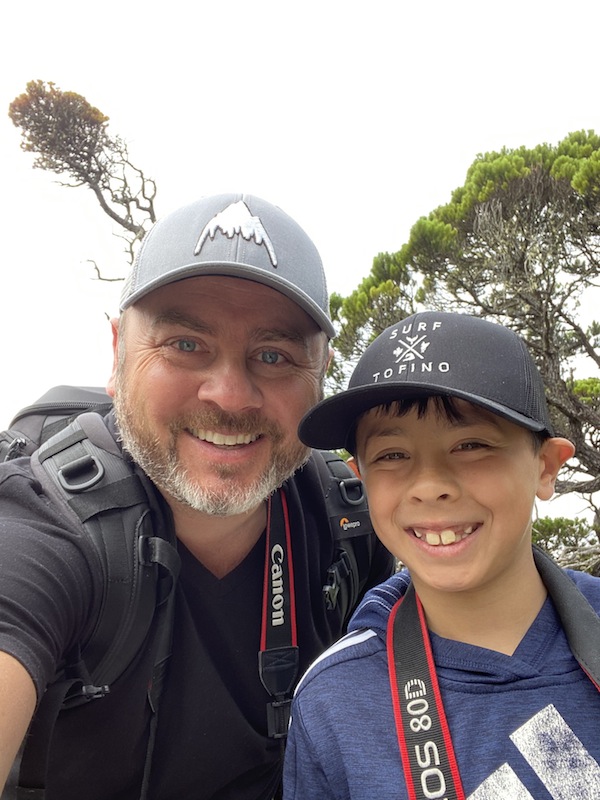
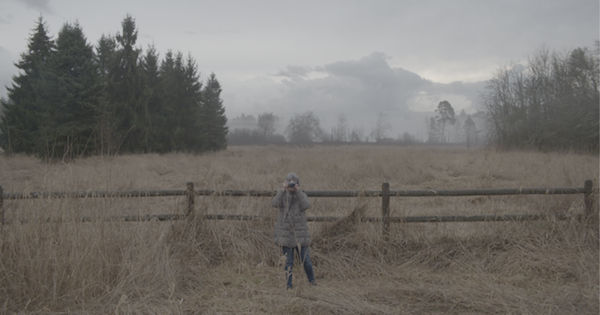
Micah Groberman with his son, Evan. (photo by Micah Groberman)

The current photography exhibit at the Zack Gallery, Discoveries: A New Way Forward, allows visitors a peek into the wilderness of British Columbia. A bird serenades the sunset. A bear crosses a road. A coyote glares into the camera. Even a Whistler bridge seems to lead to an adventure in the forests and mountains of our province. The photographer, Micah Groberman, talked to the Independent about his art and how the pandemic set him on his new creative course.

“Before the pandemic, I had a business with a partner, Ivan Solomon. We did many different things, but mostly we designed wall murals for children’s stores, hospitals and private clinics,” said Groberman. “After the pandemic hit, we couldn’t do it anymore, couldn’t stay inside the enclosed spaces for the long time it takes to create a large mural. Many places closed. School was canceled. I had to stay at home and take care of my sons.”

photo - Micah Groberman’s photo of a hummingbird feeding her babies was featured on CBC
Micah Groberman’s photo of a hummingbird feeding her babies was featured on CBC.

For Groberman, instructing his elementary school sons from a set curriculum was frustrating. “I’m not good at math,” he joked. So he found something else to do with his boys. He shared his passion for nature with them. They went for walks in local parks. And they took photographs.

“I started taking photos when I was about 9,” Groberman recalled. “It was with a simple camera, the point-and-shoot kind. I enjoyed it and did it for a long time, simply for myself and my family. During COVID, my photography took a more serious turn. I wanted to do it well. I wanted to learn. I watched videos on YouTube. You can find all sorts of useful tips online. I got myself some professional gear, a large camera. And I took photos. Many, many photos. I learned by doing.”

Groberman classifies his images into three categories: landscape, wildlife (which includes all his animal and bird shots) and fine art. The last category is the most inclusive. It overlaps with landscape and boasts some unusual shots, like a PNE ride from a rare angle or an old pickup surrounded by flowers that displays an uplifting message in its cargo bed.

photo - Micah Groberman took this photograph last year at the Richmond Sunflower Festival
Micah Groberman took this photograph last year at the Richmond Sunflower Festival.

“I took it last year at the Richmond Sunflower Festival,” Groberman explained. “The organizers put the old truck among the flowers, and I thought it looked interesting.”

Many of his images, especially of wildlife, are fascinating because he has sought them out. In addition to artistic skill and adequate hardware, nature photography requires a great deal of perseverance and patience. Groberman has both.

“The bear that crosses the road – I took this picture from my car,” he said. “We were in Whistler, driving around, looking for bears. It took us three hours, until one walked out of the woods.”

Another of his amazing wildlife shots is a coyote on a piece of driftwood. “I noticed him hiding in the bushes on the other side of a stream in Richmond. I followed him for about five minutes, with only glimpses, until he came out and stared at me. I took the shot, but I was glad there was water between us.”

While taking his own photos, Groberman tried to share his knowledge with his sons. “My younger son wasn’t that interested,” he said, “but my older son, Evan, took to photography. I taught him, and he inspired me. Many of my photos in this show I took when I was with him. I think teaching him made me a better photographer.”

Groberman hadn’t ever exhibited his photos prior to the pandemic. He had never even thought about doing so. “It was just a hobby,” he said. “But, in 2020, I participated in a group show at the Zack. A couple of my son Evan’s photos were also on display. That’s how I first met Hope [Forstenzer], the gallery director.”

photo - It took a few hours of searching before Micah Groberman came across this bear and took its picture
It took a few hours of searching before Micah Groberman came across this bear and took its picture.

According to Groberman, the current show was supposed to be a double feature, including a sculptor as well. “But the sculptor didn’t happen,” he said, “so it became my solo photography show. There are 37 images in the show: 30 are mine, seven are Evan’s. We have a show together.”

The name of the show – Discovery – came from the experiences shared between father and son. “Our walks together were bonding,” said Groberman. “We discovered things together. Evan discovered new skills. I discovered a new way to move forward and I discovered teaching. That’s where the name of the show came from.”

Groberman hopes that his wall mural business will recover once the pandemic ends, but he also sees several new avenues for his creativity.

“I want to do more with my photography,” he said. “I’m exploring different options, trying to establish myself locally. I went to stores to offer them prints of my photos and postcards. I rented a bunch of my prints to a movie set. I entered local contests. One of my photos – a mama hummingbird feeding her babies – was featured on CBC. Another – a photo of a heron – won the Richmond banner contest last year in the nature category. You will see my heron on the streetlights in Richmond. I have an Instagram account. I’m just starting with photography, but I want to see where I can end up.”

Discover opened on Oct 4 and runs until Nov. 7. Learn more about Groberman’s work at micahgphotography.com.

Olga Livshin is a Vancouver freelance writer. She can be reached at olgagodim@gmail.com.

Nature-inspired artist

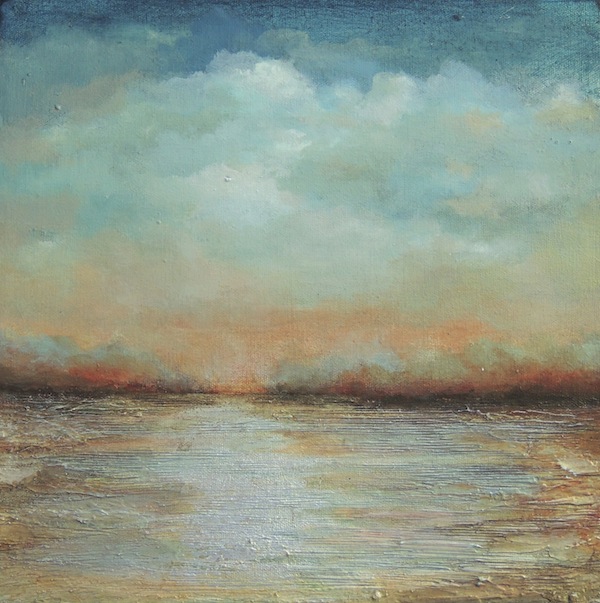
Two of artist Monica Gewurz’s paintings – “Silver Marsh” (above) and “Dawn II” – are featured in the exhibition of the Nature Trust of British Columbia’s Artist of the Year Award. “Silver Marsh” was inspired by a sunset at Addington Point Marsh, one of NTBC’s properties, which aims to conserve waterfowl and fish habitat, and “Dawn II” by a visit to Vaseux Lake in the Okanagan, an NTBC property that protects habitat for bighorn sheep and other threatened species.

Two of artist Monica Gewurz’s paintings have been selected by a jury to be included in the exhibition of the Nature Trust of British Columbia’s Artist of the Year Award. The joint show of the Federation of Canadian Artists and the Nature Trust opens on Oct. 18 at the Federation Gallery on Granville Island.

Before turning her focus to art in the past several years, Gewurz had worked in both the public and private sectors, in areas from commercial real estate to tourism to aboriginal issues. However, art was an integral part of her upbringing in Peru.

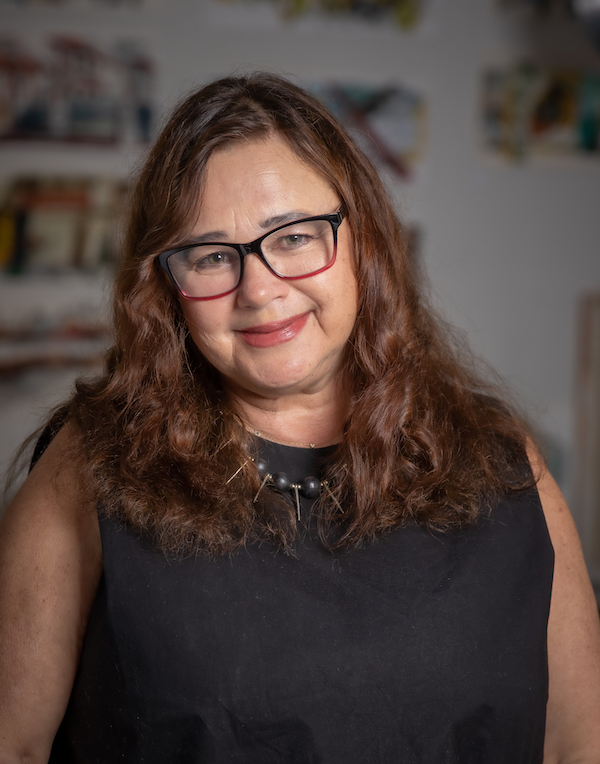
photo - Monica Gewurz
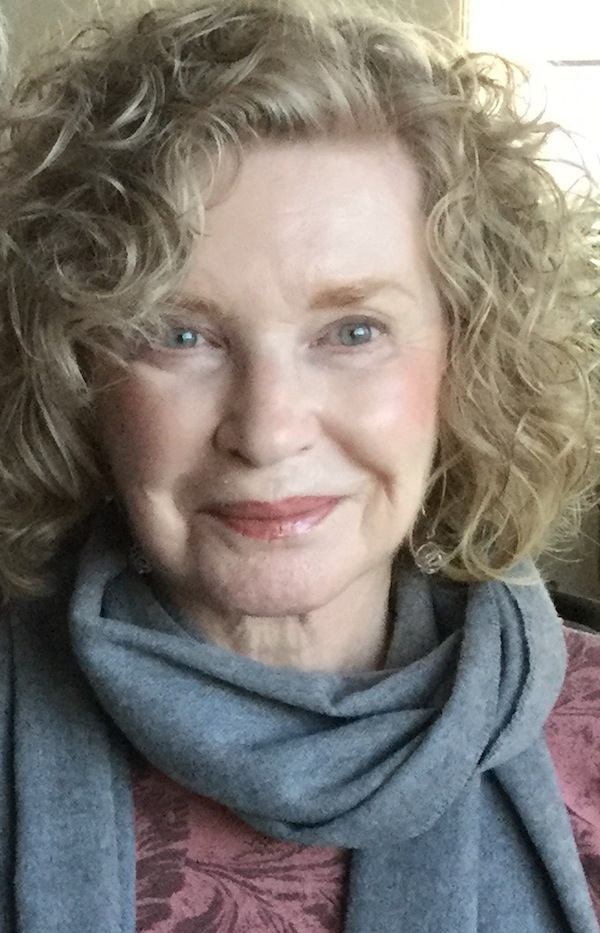
Monica Gewurz (photo from Monica Gewurz)

“For my parents, art was as important as science,” Gewurz told the Independent. “My mother was also an artist, and she exposed me to art at an early age – not just Judaica and Peruvian art but also art from different cultures. We traveled a lot. I always enjoyed visiting museums and art galleries. And I always had my camera with me, always took pictures. Landscapes and close-ups, textures and patterns always fascinated me.”

Upon graduating high school, however, she chose a different path.

“In the early 1970s, I was studying to become a veterinarian in Peru. At that time, South America went through some economic and political unrest,” she said. “Peru had a military government, and antisemitism was on the rise. My university was hit repeatedly with strikes and class closures. Getting an education was becoming difficult and dangerous. That was when I decided to move to Canada. With my parents’ financial support, I came alone to continue my studies at the University of Guelph. My parents immigrated later, in 1985.”

After university, Gewurz worked for the Canadian government, but she couldn’t abandon her art. “My photography, jewelry and painting all started as hobbies. I needed an outlet to balance my hectic and stressful full-time job…. In 2000, I started making tribal and sculptural jewelry. I was successful enough to showcase my pieces in national craft shows and then commercially in some galleries, here in Vancouver and in the U.S.”

She knew that most professional artists had formal art education, so she enrolled at Emily Carr University of Art + Design in 2011. “I could study there part-time while working,” she said. “It would also allow me the opportunity to meet other artists.”

She finished her studies at Emily Carr in 2016. Coincidentally, she couldn’t continue at her government job for much longer. “Due to a life-threatening autoimmune illness, in 2017, I had to retire,” she explained. “That gave me the opportunity to embark on a new career as a professional artist.”

Gewurz’s paintings are mostly abstracts, reflecting the landscapes of the West Coast. “The force and energy of water and its associated reflective light, the interplay of shadows and colours in a landscape, have always drawn me in as a scientist and an artist,” she said. “The endlessly changing skies and the patinas of precious minerals mesmerize me. I am fascinated with the contrasting nature of life. I paint it all to provide an escape to a dream-like place.”

Fractals in nature and stylized figures frequently populate her paintings. She doesn’t strive for photographic correctness. “Painting in abstract challenges me to represent reality in a veiled, mysterious and intriguing way,” she said. “Abstraction and the use of texture allow me the freedom to change what I see and feel into my own expression. The artistic process is, for me, one of constant discovery and conversation. The painting speaks to me, tells me what it needs, and I respond.”

Although initially she used brushes, she said, “Lately, I transitioned to using mainly a palette knife and other unconventional tools. As a result, my art became more abstracted and complex.”

She bases her paintings on her own photographs and on her memory; she never paints on location. “I paint from the heart and intuitively,” she said. “I don’t paint anything specific in a landscape and that’s what I love about it – the process of being able to use the paint any way I want. I leave out a lot of visual information. That allows the viewers to use their imagination, to see and describe every painting in their own way.”

Gewurz gifts much of her art to charities and friends. “It is exciting for me to witness the connection some of my ethereal-looking paintings elicit in viewers,” she said. “It humbles me, when people I’ve never met immerse themselves in the layers, shades and textures of my paintings and then share with me how they are seduced into a visual, tactile and emotional response. When such a connection is made, I feel that I accomplished my mission. Of course, the cherry on the cake is when somebody buys a painting and becomes a collector and, many times, a friend.”

She shared one such a case. In 2014, an interior designer from Singapore saw one of her mixed media paintings at an exhibit and contacted her for a commission. The painting was two by two feet, said Gewurz, “but she wanted a much larger one, measuring seven by four feet, for her client, a new five-star hotel in Hong Kong. That was a turning point in my career and a huge jump in scale for me. That painting still hangs in their lobby.”

Mixed media seems to be Gewurz’s preferred style. She incorporates in her pieces ancient and modern materials, such as textiles, sand, rust, aluminum foil, copper and silver. She paints in multiple layers to seduce viewers in visual and visceral encounters. But, whatever the materials, her theme remains predominantly nature.

image - “Dawn II” by Monica Gewurz
“Dawn II” by Monica Gewurz

Gewurz’s love of nature led to her involvement with the Nature Trust of British Columbia (NTBC). “I am a donor and volunteer,” she said.

She is also an active member of the Federation of Canadian Artists (FCA).

“One of the main FCA missions is to outreach and raise awareness about conserving the environment and natural spaces,” she said. “Every year, FCA asks their membership to submit a proposal for a show that deals with social and environmental issues. I submitted the idea to have a joint show with NTBC, as they had a common vision, and also to take the opportunity to celebrate their respective anniversaries. Both director boards reviewed and accepted my proposal.”

Of course, she longed to participate in the show as well, since its underlying purpose – the conservation of British Columbia’s endangered habitats – is close to her heart.

“FCA holds several juried shows every year,” said Gewurz. “I regularly submit and often get juried in to showcase in them. This time, I applied as well. I was thrilled and honoured that two of my paintings were admitted. There was a lot of competition.”

Gewurz’s commitment to environmental issues extends beyond her participation in such shows and groups.

“I use upcycled materials in some of my mixed media art,” she explained. “There is beauty in repurposing materials because of their distinctive uniqueness and imperfect textures. Also, the fact of my using them conveys the message to the viewer about the importance of decreasing waste and minimizing our carbon footprint.”

She added, “Art can certainly open people’s eyes to how much our lifestyles imperil the planet. Art could encourage all of us to make positive changes.”

See more on Gewurz’s website, mgdesigns.org.

Olga Livshin is a Vancouver freelance writer. She can be reached at olgagodim@gmail.com.

Chosen Family now at Zack

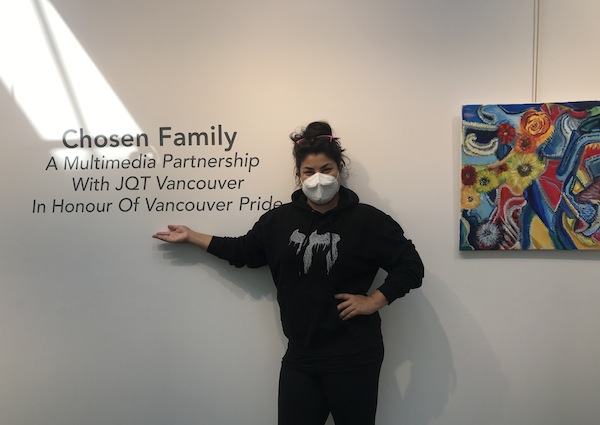
JQT Vancouver executive director Carmel Tanaka at the Zack Gallery, where the Chosen Family exhibit is on display until Sept. 30. (photo from Carmel Tanaka)

In a Simon Fraser University survey of more than 4,000 elderly Canadians (55+), conducted from August to October 2020, to see how people were coping with the pandemic, about 10% of respondents identified themselves as part of the LGBTQ+ community. These respondents were more likely to follow COVID protocols and to have said they “feel they have been here before” – they were 10 times more likely to report experience with HIV/AIDS than heterosexual persons. Among the many other findings, LGBTQ+ respondents were less likely to ask relatives for help, but more likely to call upon close friends.

In the context of the pandemic, then, the focus of the new exhibit at the Zack Gallery has added significance. The show, called Chosen Family, is a multimedia partnership between the gallery and JQT Vancouver in honour of Vancouver Pride. It opened officially on Aug. 26, with the artists in attendance.

JQT (Jewish, Queer and Trans) is an arts, culture and education nonprofit organization. It is dedicated to creating connections and seeking space to celebrate the intersectional identities of Jews of diverse sexual orientations and genders. The organization’s executive director, Carmel Tanaka, said JQT’s members are accomplishing their goals “by queering Jewish space and ‘Jewifying’ queer space in Vancouver.”

“We started JQT in Vancouver four years ago, as a grassroots movement, everyone was a volunteer,” Tanaka told the Independent. “We incorporated as a nonprofit in 2020. This show feels like a milestone. It is probably the first exhibition here, at the Zack Gallery, that features exclusively queer Jewish artists.”

The theme of the show, Chosen Family, reflects that some LGBTQ+ individuals face rejection by their immediate family and must look elsewhere for understanding and acceptance. “I’m lucky,” said Tanaka. “I didn’t have to look for another family; my family was supportive. Unfortunately, that’s not true for everyone.”

image - One of the images in a series of six by Ari Fremder
One of the images in a series of six by Ari Fremder.

Only a few artists are featured in the exhibit. “We invited more artists from the JQT community, plus their families, to submit art for the show, but not everyone was easy with the invitation,” Tanaka said. “Some didn’t feel ‘artistic’ enough. Others didn’t feel Jewish enough. Still others – the older people mostly – didn’t feel entirely safe to identify themselves as queer to the wider community. It is an ongoing vulnerability issue with many of us.”

Another reason might lie in the location of the gallery. “The Zack Gallery is inside the Jewish Community Centre, so the art must be family friendly. That might be a limiting factor for some artists,” Tanaka mused. “We might look at another venue next time.”

The show includes art in a variety of media: paintings, prints, textiles, cinematography, sculpture. A series of six pictures by Ari Fremder all have the same size and structure – a human face surrounded by flowers – but they centre on different faces, representing different friends or family members, and have varied arrangements of flowers. Nonetheless, they all have one thing in common – they are all beautiful and upbeat.

Two of Fremder’s paintings are self-portraits. One looks like a face in repose; the other an angel with black wings. The angel soars in the dark sky and, unlike the six-photo series, this image is moody and contemplative.

image - A collage by artist Holly Steele
A collage by artist Holly Steele.

On another wall, there are several paintings by Holly Steele. In one, a multimedia print, hands clasp together in various combinations: hands of friends and hands of family, interspaced with positive, trust-affirming words. The image, done in a muted greenish-yellow palette, screams of the yearning for acceptance.

In the centre of the gallery resides a sculptural composition by Morgan Strug. A dinner table with chairs around it shows us what a family meal means to the artist. There is understanding and affection there, benign teasing and fierce joy in the others’ fulfilments. Is it wishful thinking? Is it the artist’s reality? Everyone can decide for themselves.

Strug is the director of the short movie Enby, which screened at the Vancouver Queer Film Festival earlier this month, and the film is part of the Zack exhibit. The gallery planned three screening dates, the first being for the exhibit opening Aug. 26, as well as Sept. 9 and Sept. 30. Those who want to see it should contact the gallery first.

“This is a very eclectic show,” Tanaka said. “It is the first art show for several of the participating artists. Some of them celebrate both their identities: as a queer and as a Jew. We would love this show to become an annual tradition.”

Chosen Family continues until Sept. 30. To learn more, visit jqtvancouver.ca.

Olga Livshin is a Vancouver freelance writer. She can be reached at olgagodim@gmail.com.

Communicating with visuals

“Hanging Out” by Derry Lubell.

Derry Lubell’s photography captures the motion of dance, the ephemeral magic of the art form that generally only exists at the moment of performance. Unless, of course, it is recorded by a talented photographer.

Lubell’s solo exhibition The Body Speaks: Dance • Movement • Emotion opened on July 2 at the Zack Gallery. The official opening on July 8 was in person, as the long months of COVID restrictions started to ease. The gallery’s latest email to its patrons joyously states: “Appointments are no longer needed to see the show in person. Come on in!”

photo - “The Dichotomy” by Derry Lubell
“The Dichotomy” by Derry Lubell.

When you do go in, you’re surrounded by dance and dancers, their beautiful faces, and their astounding bodies. The gallery is a quiet place, but you can almost hear the music floating in the air, while the graceful ballerinas leap and pirouette around you. Most images are black and white or rendered in muted colours. “I think you can see the lines better in black and white,” said Lubell in an interview with the Independent. “The colour is often distracting, and I don’t want that. I don’t like fussy. I want clean shots.”

Lubell has been an artistic photographer for about five years. “Before that, I had a career as a psychotherapist. I had a family to raise,” she mused. “I always had a small camera with me, since I was young, to photograph my family or places I visited, but it was casual, like memory shots. After I retired, I started thinking: what else do I want to do? I always enjoyed talking to people, understanding their emotions. I wanted to do something similar but without the responsibility. Photography allows that. Using photography, I can still communicate with people, discern their emotions, reach their hearts, but on a visual level, without words.”

photo - Derry Lubell
Derry Lubell (photo from Derry Lubell)

The former psychotherapist reinvented herself as a photographer, and it led her on a long road of self-exploration, especially because the technology had progressed so much. “I had to learn computers,” she said. “I work harder now than before I retired. Shooting. Editing my pictures. Studying. Taking classes. Looking at other photographers’ images to see what works and what doesn’t. I put up my pictures on my website and Instagram, so others can see me, too.”

The dancing series is her latest, and it came about almost by accident. “I always enjoyed working with people who are comfortable with their bodies,” she said. “Even as a psychotherapist, I paid attention not only to words but to body language. Many people speak with their bodies. Dancers are the best at that.”

Her admiration of dancers prompted her a few years ago to enrol in dance lessons. “It was incredible,” she remembered. “The instructor was wonderful. I asked her: could I take your photograph? She agreed. After that, I photographed her and some of her students, and some other dancers.”

Lubell prefers taking pictures in people’s natural milieu. Some of the photos in the exhibit she took during rehearsals in the dancers’ studio spaces around the city. For others, she arranged meetings with the dancers outside, in urban surroundings, parks or the beach.

“Each session is an hour or two hours long. Each one is a collaboration between a photographer and a dancer,” she explained. “Together, we choose a location. I would ask her to bring half of her dancing wardrobe, and we try different costumes to see what works for the camera. I often select the background, and then the dancer would start dancing, and I would walk around and take shots. I might suggest a position or a prop, like ‘play against that log’ or ‘turn this way,’ but they are the performers. They like to perform. It is up to me to capture the perfect moment.”

One of those moments resulted in a unique picture. Only the legs of the dancer are showing. One wears a point shoe, posing like a coquette on a staircase. The other is still wearing a stiletto. The photo, titled “The Dichotomy,” emphasizes the dual nature of the subject: a woman and a dancer.

“It was sold before the show started,” Lubell said. “I brought pictures to the gallery to hang on the walls. Everything was still on the floor, in boxes. I left the gallery for a few minutes. When I came back, Hope [Forstenzer, the gallery director] said: ‘You know, this one just sold.’ Before it was even displayed.”

photo - “Form in Flight” by Derry Lubell
“Form in Flight” by Derry Lubell.

Another interesting image, “Form in Flight,” is of a young dancer in street clothing jumping in front of a brick wall. Lubell took the photo in Chinatown. “It is one of the oldest walls in the city,” she said. “I walked around Chinatown with that dancer. She is a student, but she loves dancing. When I saw that wall bordering a parking lot, I asked her to dance against it.” The dancer’s flight in the image is airy and joyful.

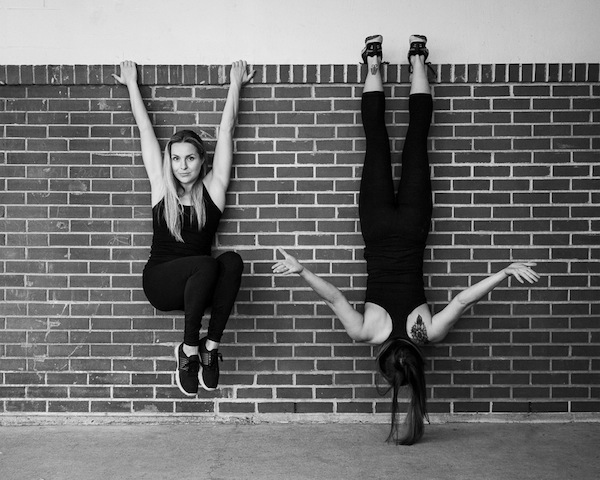
Several pictures display more than one dancer. One of those photos, called “Hanging Out,” is imbued with humour: one dancer is hanging from a wall with her hands, while the other is hanging upside down by her feet. “They are best friends,” Lubell said. “They met years ago as gymnasts. One does stunts for the movies now – she is the one who is upside down. I asked them to dance against the wall, and they started playing together, having fun. That mutual pose was a surprise to me.”

Lubell considers her dancers as partners in her art. “They have the right of veto. It doesn’t happen often, but sometimes they would say: ‘Don’t use this picture, my leg is in the wrong position.’ And I won’t. I honour their requests. After all, they honour me by allowing me to shoot their photos.”

The Body Speaks is on display until Aug. 16. For more information, visit the photographer’s website, derrylubell.com.

Olga Livshin is a Vancouver freelance writer. She can be reached at olgagodim@gmail.com.

Honouring women’s courage

Anne Petrie (photo from Maurice Yacowar)

The University of Calgary has organized a virtual exhibition to honour the efforts of Jewish women in the Canadian Armed Forces during the Second World War. Called She Also Served, it comprises a series of nine banners by various artists.

Originally scheduled to be displayed at the Military Museums in Calgary during Jewish Heritage Month in May, it has been made available online throughout 2021 and will be physically hung in May 2022. Of the 17,000 Jews who served in the Canadian armed services, more than 275 were women.

Among those selected to display their work is Anne Petrie of Victoria. For her banner, a digital print called “In the Tradition of Service,” Petrie chose to list all the known names of the Jewish Canadian servicewomen. She used a font that is reminiscent of the typewriters of the 1940s. Another layer of the banner has the names of 12 biblical heroines, confirming the tradition of Jewish women’s courage and dedication to serving their communities.

“I was immediately struck by knowing that, although they would not have had to hide their Jewish identity, it was still in those days not something that you would be comfortable being completely open about,” Petrie told the Independent. “Even if it was, at best, very casual antisemitism, it was a reality when they would have signed up. So, there you are fighting (even if it’s only at a desk) for something – a religion, a people, a culture – that you can’t really be openly passionate about.”

image - Anne Petrie’s “In the Tradition of Service,” 2021. Part of the She Also Served exhibit, now online
Anne Petrie’s “In the Tradition of Service,” 2021. Part of the She Also Served exhibit, now online.

For Petrie, She Also Served is an opportunity to reveal and contextualize the “Jewishness” of that other “them, the unsung and – worse – unidentified Jewish-Canadian women soldiers.” She said she is honouring them by naming them in “their doubly suppressed identities, as women and Jews.”

Petrie’s intention was to present the full names and rank (where available) of all the Jewish women known to have served. The collection of names fills the background layer of the 75-by-165-centimetre banner. Each name is in the colour of their respective services: olive green for army, dark navy for the navy and a lighter “air force blue” for the Women’s Army Corps. Emerging from the background in a larger, translucent Hebrew script, and in a camouflage pattern, are the names of Judaism’s biblical heroines, “themselves often subordinated by patriarchal tradition to the male heroes,” said Petrie.

“In making the banner itself, I was struck by how powerful it was to actually write out all the 279 names of the Jewish servicewomen that have so far been identified. I knew none of them personally, of course, but I felt that typing each name was a kind of acknowledgement and, strange as it sounds, I did feel a kind spirit or presence as I typed each of the names. I only wish we did know more about them, but I understand that research is continuing and, hopefully, there will eventually be stories attached to each of these women’s names,” she said.

Petrie thanked Janice Shulman and Rabbi Lynn Greenhough for their assistance with the project.

Prior to beginning her work as an artist, Petrie’s career spanned more than 30 years in radio and television, where she worked as a researcher, producer, documentary-maker, columnist and commentator in news and current affairs. She is also the author of several non-fiction books: Ethnic Vancouver, Vancouver Secrets and Gone to an Aunt’s: Remembering Canada’s Homes for Unwed Mothers.

After retiring from the CBC, she returned to school and obtained a bachelor of fine arts from the Alberta College of Art and Design in 2008. Since then, she has had a number of exhibitions. Her next exhibit, said/unsaid, is a two-person show with Jane Coomb – it opens at the errant artSpace gallery in Victoria (975 Alston St.) on July 9.

The other artists whose work is featured in She Also Served are Razieh Alba, Sophia Borowska, Alysa-Beth Engel, Lily Rosenberg, Talie Shalmon, Jules Schacter, Bev Tosh and Susan Turner. The representations exploring the servicewomen’s experiences range from naturalistic to abstract. Some works use archival photographs, while others use media include oil painting and paper-cutting.

The stories of 41 Jewish servicewomen are also featured on the website. These accounts were an impetus for the call for submissions for the exhibition, which was curated by the University of Calgary’s Prof. Jennifer Eiserman and librarian emerita Saundra Lipton. They ask for help in “completing the story” from anyone who has more information about the featured servicewomen and any of those identified in the list of names collected.

To view the exhibition, visit live-ucalgary.ucalgary.ca/she-also-serves/exhibition.

Sam Margolis has written for the Globe and Mail, the National Post, UPI and MSNBC.

Artwork flies, returns home

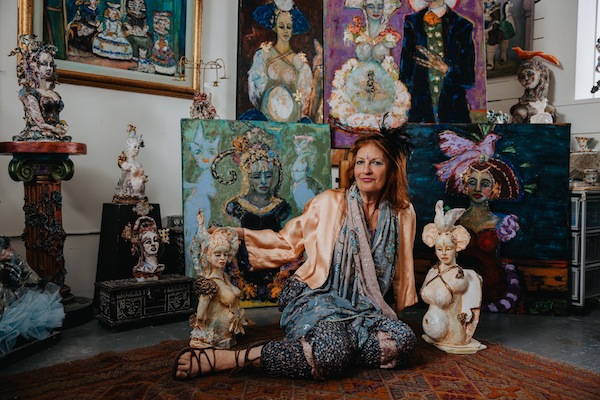
Suzy Birstein in her studio, with works featured in her solo exhibit Tsipora, now at the Zack Gallery. (photo from Suzy Birstein)

Suzy Birstein’s Hebrew name – Tsipora – means bird. The artist’s new show, Tsipora: A Place to Land, which opened at the Zack Gallery on May 20, expatiates on her name’s meaning and its connection to the winged creatures of the sky.

“I love feeling like an exotic bird,” Birstein told the Independent. “I like bringing colour and joy to the people who visit my shows.”

Birstein’s art is bursting with bright hues and glitter. Both her sculptures and her paintings seem to aspire to one purpose only: to instil gladness in people’s hearts, which feels especially important during COVID and all its associated hardships and anxieties.

“The show’s idea was born out of a personal tragedy,” said Birstein. “A few years ago, one of my close friends passed away. I grieved but I knew I didn’t really lose her. She stayed right there, always with me, like a bird on my shoulder, and I thought: what a wonderful concept. I decided to create a series of sculptures of women, with birds incorporated into the whole in different ways.”

Almost every sculpture in the show has a bird. Sometimes, it is a tiny golden bird peeking from behind a woman’s shoulder or hiding in her skirt. Sometimes, it is an elaborate hair ornament. And, sometimes, it is implied rather than shown. But the idea of a bird is always there.

“When I started this series in 2017, my thoughts were all about freedom and travels – flying like a bird,” Birstein said. “I’ve always liked to travel and visited many countries: Europe, Asia, Mexico. I like seeing something new every day.”

Accordingly, the first few sculptures of her new series were reminiscent of her travels, their dark texture a reference to the ancient sacred sites she had visited. Their diaphanous tutus a playful metaphor of dance and flight, a symbol of the weightless grace of a ballerina.

“In 2020, I was planning to travel to the south of France, with a show scheduled in Cannes, when the pandemic hit, and all travel stopped,” Birstein said. After that, the focus of her art changed, becoming more home-oriented.

“Instead of flight, my sculptures became about nesting,” she said. “I couldn’t teach anymore because of the pandemic, didn’t teach for a year due to the school closures, so I took the opportunity and the time to indulge in self-exploration. I asked myself: what is beautiful? And my answer was: birth. And rebirth. Each sculpture I made during that time was of a pregnant woman. Not flights anymore but home and harmony.”

Many sculptures also have mirror fragments embedded in them, making them festive, shining. “The mirror shards help me bridge the inner world of a woman, her home and soul, with the outer world of traveling and flying,” Birstein said.

The show includes not only sculptures but several paintings as well. “The sculptures always come first,” she explained. “They are inspirations for my paintings. After a sculpture is ready, I sometimes paint it: like another version of the sculpture, an exploration of a unique perspective. It is a different experience – working on a flat surface with no fear of breaking the fragile pottery. I don’t use a brush. I paint with a tiny palette and my fingers. It feels almost like working with liquid clay.”

Clay was the medium that catapulted her into the art world, and she feels a deep affinity for it.

“When I was a child,” she recalled, “I couldn’t draw realistically. I thought I couldn’t be an artist. I danced and I modeled for artists. I was about 22 when I started working as an artist model full-time for an art school in Toronto. The administration of the school offered me any art classes I wanted for free, and I decided to try pottery. Clay spoke to me. I also took up weaving and fibre art and liked it. Later, when we moved to Vancouver because of my husband’s work, I wanted to take more art classes. There was no fibre art school at the time, but I enrolled in Emily Carr as a sculptor. They accepted me on the basis of my portfolio – the pieces I created in Toronto.”

Birstein uses white clay for her pieces and paints them before she fires them. “Sometimes, this process has several iterations,” she mused. “I paint the sculpture. Then I fire it, but firing is unpredictable. Colours might burn out or melt into each other in unexpected ways. Then I paint the piece again, maybe add some elements. Fire again. Some pieces take five or six times in the kiln before I know they are ready, but I don’t do perfect. I make mistakes sometimes and then play with my mistakes. I love quirkiness and imperfections.”

It helps that she owns her own kiln. “My kiln is in my basement,” she said. “It was a wedding present from my parents. They knew pottery made me happy.”

It is significant that the most important tool of her art was a gift to celebrate her family.

“I feel free like a bird in my art, but only because I have such strong support from my husband,” said Birstein. “I have stability in my life, a safe place to return, a secure home, and that allows me my freedom of artistic flight.”

That’s why the only image in the show with a man in it is her husband’s portrait.

“I was looking at all those sculptures and paintings of pregnant women in this series and thought: who made them pregnant? There must have been a man,” she said.

“It depicts my husband and my art,” said Birstein of the portrait painting, which features a man standing beside a sculpture of a pregnant woman.

The show Tsipora runs until June 27. In addition to being able to book a walk-through of the exhibit with the gallery, people can arrange a personalized tour with the artist via her website, suzybirstein.com, or by calling her at 778-877-7943.

Olga Livshin is a Vancouver freelance writer. She can be reached at olgagodim@gmail.com.

Crackin’ Out online exhibit

A still from the documentary Crackin’ Out: The Ronnie Tessler Rodeo Collection, showing photographer Ronnie Tessler. The documentary was directed by Sarah Genge and produced by the Jewish Museum and Archives of British Columbia.

The Jewish Museum and Archives of British Columbia is currently hosting Crackin’ Out, an online exhibit of photographs of rural Western Canadian rodeo from 1976 to 1980 by Ronnie Tessler, along with a short documentary by director Sarah Genge. In rodeo, the term “crackin’ out” means “the beginning of the new season, breaking out of the chute, or even breaking out new chaps.”

“These explosive words epitomize for me the spirit of rodeo and the cowboy way of life,” Tessler explained.

The idea to shoot the images began as a “fun photo expedition” to Williams Lake Rodeo in 1976 by four friends who were members of a photography group, the Vancouver Image Exhibition Workshop, which is known for bringing in acclaimed guest artists.

The group worked together for a year and, with the permission of the Canadian Cowboys Association, produced an exhibit at the Finals Rodeo in Edmonton in 1977. Tessler worked independently for the next two years, documenting life at rodeos throughout the west, from British Columbia to Manitoba and into the northwest corner of the United States. Aspiring for objectivity, she realized it was not attainable.

“I wanted to know more about the cowboys, what went on behind the chutes and on the road and what motivated them to take on the challenges they did unsupported by a team or steady income,” Tessler said.

The exhibit takes the viewer not only to the action, the cowboys riding – and falling – but also to the personal and the life surrounding the event: the preparations, the traditions, the camaraderie and the love. The photos evoke an emblematic sense of a particular era in Western Canadian life.

Grouped into three chapters – “Before the Rodeo,” “The Rodeo” and “After the Rodeo” – each photograph is accompanied by stories, observations and explanations from Tessler that encapsulate the feeling that existed the moment each image was taken.

photo - A novice rider at the John Quintana Bull-riding School in Oregon, 1978. Photo taken by Ronnie Tessler. Part of the Crackin’ Out online exhibit
A novice rider at the John Quintana Bull-riding School in Oregon, 1978. Photo taken by Ronnie Tessler. Part of the Crackin’ Out online exhibit.

These images are what photographer Henri Cartier-Bresson, who is referred to in the exhibit, called “the decisive moment.” Or, as scholar John Suler, also quoted in the exhibit, described as “the moment when the visual and psychological elements of people in a real-life scene spontaneously and briefly come together in perfect resonance to express the essence of that situation.”

Rodeo was the first large, thematic body of work that Tessler did. Every project she undertook, she said, began when she “noticed themes coming out on my contact sheets and felt there was something I wanted to pursue. Each took about three years.”

Tessler’s Crackin’ Out was followed by her next major work, Israeli Suite, which was photographed over several visits to Israel. There was no similarity between these bodies of work and her last large project was different still – Jewish life in the West Kootenays.

As for the Jewish connections to the rodeo exhibit, Tessler observed, “I didn’t meet another Jew the entire time and did not encounter or make use of any specific Jewish values while doing the work. Many cowboys knew I was Jewish, and one asked what I was doing photographing a bull-riding school instead of watching Shoah on TV every night. I did enjoy the uniqueness of being an urban, Jewish woman with a family ‘goin’ down the road,’ putting myself on the line to record another way of life.”

Genge’s documentary Crackin’ Out: The Ronnie Tessler Rodeo Collection is part of the exhibit. It expands on the legacy of Tessler’s photography by exploring a multitude of perspectives on rodeo from such people as a stock contractor, a curator, a child of rodeo, a cowboy, an artist and a professor, as well as the archives intern who processed the collection.

“One photograph does not illustrate one idea. By speaking with eight different people, my aim was to bring their collection of voices together to elucidate an ever-shifting narrative of an image,” Genge said. “This film offers a brief glance at some of the distinct and disparate angles that create a multifaceted and, at times, conflicted understanding of Western Canadian rodeo.

“I endeavoured with this film to present aspects of rodeo frequently left untold, specifically its importance to Indigenous people, women and LGBTQ+ communities. It should be noted that, much like Tessler’s inherent presence in capturing these photographs, my subjectivity in curating them is unavoidable,” she added. “I am an unreliable witness who, six months ago, had never set foot at a rodeo, so my bias as an outsider is present throughout.”

The exhibit, which can be found at jewishmuseum.ca/exhibit/crackin-out, also features an hour-long video of its April 21 launch, which includes discussions with Tessler and Genge.

Sam Margolis has written for the Globe and Mail, the National Post, UPI and MSNBC.

From a singular perspective

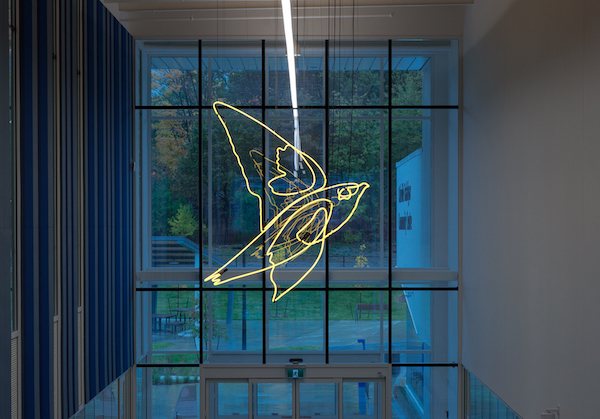
Barb Choit’s “Ravenous Appetite and Boundless Energy” features a chimney swift that can only be recognized as such from one vantage point. (photo from Barb Choit)

Last October, in a year that could be considered one of the worst in history for artists overall, Vancouver artist Barb Choit completed a large public art project in Oakville, Ont. “Ravenous Appetite and Boundless Energy” is the image of a bird, a chimney swift, created from hand-drawn, coloured, lead-glass tubing filled with neon. It is installed in the Oakville Trafalgar Community Centre.

“Most public art projects are by invitation only. However, for this one, I responded to an open call put out by the Town of Oakville,” Choit told the Independent in an email interview. “With this process, the first step is to send a letter of interest describing your qualifications and approach. From that, a public art jury selects a smaller group of artists to create a design for an artwork, which is called a ‘concept proposal.’ Each artist makes a presentation of their proposal and one is selected to create their proposed project.”

Winning the competition, it took her one-and-a-half years to convert her original idea into the final installation, a bird in flight, soaring just under the ceiling of the community centre.

The chimney swift has special significance for the Oakville community, said Choit. “The work responds to the transformation of the adjacent, abandoned Oakville High School into a habitat for a colony of chimney swifts, a threatened migratory bird. Every year, residents of all backgrounds come to watch birds roost in the chimneys of the former school. The community’s galvanization around birdwatching inspired me to represent the chimney swift as an ‘artifact’ of the culture and spirit of Oakville.”

In Choit’s installation, visitors to the centre can only see a bird in the design from a certain perspective. If they look at it from other positions, all they see is a wriggle, written in shining neon.

photo - The sculpture appears abstract to viewers moving through the space. Yet, from a specific vantage point, a representation of a bird appears
The sculpture appears abstract to viewers moving through the space. Yet, from a specific vantage point, a representation of a bird appears. (photo from Barb Choit)

“For ‘Ravenous,’” she explained, “I used a display strategy employed by science and nature museums to spark the viewers’ interest in the natural world – an optical illusion, anamorphosis. It is a visual illusion in which an object is distorted so that it can only be recognized from a specific vantage point. The sculpture appears abstract to viewers moving through the space. Yet, from a specific vantage point, a representation of a bird appears. Many people find optical illusions particularly engaging. Creating a visually striking piece was crucial to engaging a multi-generational community. And the glowing yellow form complemented the space for which I was designing the work.”

The word “illusion” suits the chimney swift as a species. According to Wikipedia, during flight, the birds often appear to beat their wings asynchronously, but photographic and stroboscopic studies have shown that they beat them in unison. The illusion that they do otherwise is heightened by their speedy and erratic flying, with many rapid changes of direction.

Choit’s choice of medium for this work necessitated collaboration with the manufacturers of the neon-filled tube.

“Different projects require a different balance between collaboration and delegation,” she said. “My recent project uses neon, which requires a type of industrial fabrication that includes hazardous materials and live electricity. It wouldn’t be practical or advisable for me to carry out this part of the fabrication myself. However, one needs a grasp of how materials work in order to create a feasible design and communicate with fabricators.”

She compared it to the architectural process. “In order to design and build a successful building, an architect does not show up at the building site with a hammer and nails,” she noted. “However, she must know how a building is constructed, as well as the properties and possibilities of the materials used.”

As she has done for other works, Choit did extensive research for this installation.

“People know me for my photographic work, but I have worked in most mediums at one point or another,” she said. “Within my work, I look at how communities and individuals imbue objects with meaning. Most of my major projects involve cultivating collections and working with archives. I explore this theme in a variety of media, such as photography, installation, performance and sculpture. Recently, I have had commissions for 2-D and 3-D public artworks.”

photo - Artist Barb Choit
Artist Barb Choit (photo from Barb Choit)

Choit’s interest in collections is longstanding. She has a master of arts in critical and curatorial studies from Columbia University in New York. “At Columbia, I researched institutional frameworks for art,” she said. “I wrote my thesis on the history of collecting. This area of academic research still drives my work as an artist.”

Public art is a relatively new area for Choit and she is exploring the possibilities. “I primarily make works to be shown in galleries; it is only recently that I have moved into public art. I like public art because the projects can be much more ambitious than something that would be purchased by an individual. However, I still enjoy making smaller works that can be appreciated privately and I am open to larger site-specific commissions to be installed in privately owned buildings and outdoor spaces.”

She is planning to do more work in the public sector, despite the challenges. “Usually, public art projects are by invitation. There are also a few websites that list opportunities for artists to submit their qualifications, with the intention of being shortlisted to create a proposal for a specific project,” she said, noting the need to be wary of fraud.

“Artists need to be careful of websites that list art opportunities because there are dubious organizations out there to exploit them,” she said. “For example, some art ‘opportunities’ ask artists to pay a fee to be considered for a project. Artists should never pay a fee to have someone look at their work.

“Also, some organizations solicit full proposals from artists. Creating a proposal is an immense amount of work and a highly specialized skill. For legitimate public art calls, artists who are shortlisted to create a proposal are paid a fee for this work. I discourage any artist (or anyone, for that matter) from engaging professionally with an organization that expects unpaid work.”

Among Choit’s previous public works is the photographic project “Campaign,” a billboard series commissioned by the Capture Photography Festival in Vancouver in 2017. “It was a series of outdoor billboards based on my 2015 photography project where I remade Andy Warhol’s shoe Polaroids from the 1980s. I documented a collection of vintage women’s shoes using discontinued instant film and a vintage Polaroid camera from the era.”

Despite her extensive education, experience and obvious talent, Choit considers luck as one of the best ingredients for artistic success.

“Luck is crucial,” she said. “It is not necessarily about chance but infrastructure – family and community support, education, healthcare, even freedom of expression, can be just as crucial as talent and skill.”

Learn more at Choit’s website, barbchoit.com.

Olga Livshin is a Vancouver freelance writer. She can be reached at olgagodim@gmail.com.

Chai Quilt grows and changes

When I first entered the Zack Gallery to view its new show, the Chai Quilt, my first impression was that it was an amateur show. Only one wall of the gallery featured art, and it looked like the work of a kindergarten class, with several exceptions. I soon found out that that is indeed what it is!

In talking to gallery director Hope Forstenzer, I learned that this exhibit is different from most of the shows the gallery has produced. Many of the amateur artists are actually 3 to 5 years old and attend the JCC’s preschool.

“We sent out a call for participation in this show to everyone on the mailing lists of the JCC and the gallery,” said Forstenzer. “I wanted this show to connect the gallery to the community, to make it a mixed show. Whenever someone expressed an interest, we gave them the fabric squares and the craft kits. Some families received four or five squares for every family member. Our preschool at the centre had several, too. A few professional artists also responded to the call, as did some of the JCC staff.”

photo - A portion of the Chai Quilt at Zack Gallery
A portion of the Chai Quilt at Zack Gallery (photo by Hope Forstenzer)

The show takes place in conjunction with the JCC’s Festival of Israeli Culture and, therefore, shares the festival’s theme, which is celebrating life – chai, in Hebrew.

“We asked everyone to create their own celebration of life and spring,” explained Forstenzer. “No matter how hard the pandemic hit us all, there is still life worth celebrating.”

When the squares came back from the artists, Forstenzer created a quilt of them on one long wall of the gallery, a continuous artistic surface reflecting community members’ united vision of life. “The squares touch sides,” she said. “Even if we can’t meet because of the pandemic, we’re still in this together. Our art brings us together.”

The show’s unique blend of professional and amateur artists means there are several profound differences from previous Zack shows. One of those differences is that there are no name cards. If a participant signed their square, everyone can see their name; if not, the square’s creator is anonymous.

Another difference is that the show started a week later than planned.

“Many of the participants are families with children,” said Forstenzer. “They kept calling me and asking for more time. Even now, when the show is open, the squares are still trickling in. There are already over 70 on the wall. I had three new ones today, waiting on my desk, and more are coming, I’m sure. I’m going to add them on to the end of the quilt as they come.”

photo - Another part of the Chai Quilt at Zack Gallery
Another part of the Chai Quilt at Zack Gallery (photo by Hope Forstenzer)

The show, or rather the quilt, grows daily; resembling a living organism. And, it also changes. As I was speaking to Forstenzer, one of the participants, Jessica Gutteridge, artistic director of the Rothstein Theatre, came into the gallery. She wanted to rotate her square, which was already on the gallery wall. “It would look better the other way,” she offered, and Forstenzer agreed.

“I was excited to have an opportunity to participate in this community art project,” Gutteridge said. “Although my professional artistic practice is in the theatre, I have been involved as a hobbyist and student in visual arts and crafts, particularly needlework, for most of my life. During the early part of the pandemic, Hope and I created a virtual drop-in community art program called the Creative Kibbitz. It was based on a project I had started – to invite people to my home to socialize and make creative work. This show was a nice way to extend that work, and a theme based on celebrating life and renewal seemed very appropriate and inspiring in this moment.”

Although Gutteridge has never participated in a Zack show before, her pink square with its jolly cherry blossoms looks like it belongs on the gallery’s wall. “Cherry blossom time is one of my favourite moments of the year,” she said. “It is so ethereally beautiful for the short time it lasts. To me, it captures the rebirth of spring perfectly and the stirring of new life. I decided to make a spray of cherry blossoms using two of my favourite media, yarn and rhinestones, in an effort to make something that captures the shimmer and sparkle of spring.”

In addition to needlework, the quilt pieces have been made using an astounding variety of media. Photo collages and paintings. Feathers and beads and felt flowers. Dried leaves and confetti paper ribbons. Letters and abstract glitter splashes. Buttons and lace.

The creator of one square, which has dancers in lacy costumes, is Beryl Israel, a retired teacher. “I am a member of the fantastic JCC Circle of Friends program,” she said in an email interview. “Up to the start of COVID, I taught tap dancing at one of the local community centres.” Her love of dancing poured into her contribution to this show.

“My motivation for this work was to concentrate on the happiness and positivity around us in a gentle, hopeful way, with the inspiration from the dancing figures of Matisse,” she explained. “I wanted to record some of my old dress fabrics, laces from my mother, favourite photos, handmade paper, flowers, etc., plus the use of acrylic paints and stitching, which resulted in my composition.”

The imagination all the artists infused into their squares seems to know no bounds, as if they wanted to say, the ways in which we each see life is different, but, together, we can create a life as diverse and colourful as the Chai Quilt on the wall of the Zack Gallery.

The quilt is on exhibit until May 14.

Olga Livshin is a Vancouver freelance writer. She can be reached at olgagodim@gmail.com.

Artists rise to challenge

“Sometimes Being Human … Can Be Hard” by August Bramhoff.

The Jewish Community Centre of Greater Vancouver’s inclusion services’ third annual art exhibit at the Zack Gallery is on display this month. And people can meet the artists at a March 23 virtual reception.

“For the last two years, the JCC has celebrated Jewish Disability Awareness and Inclusion Month through an art exhibit that interrogated and explored themes of community longing and belonging,” Leamore Cohen, inclusion services coordinator, told the Independent. “We asked artists of mixed ability: How do we make meaning of the concept of community, the real and the imagined spaces we inhabit? What does community longing look like and what are the possibilities for belonging in an ever-changing world?”

This past year, the world has changed almost beyond recognition. “In Vancouver, we are nearing a year since the COVID pandemic shut down our city and transformed all aspects of our social world,” acknowledged Cohen. “However, while we were isolated, we also saw our creativity flourish.”

In the two previous exhibits, artists responded enthusiastically to inclusion services’ challenge, unfolding a fascinating slice of society through their art, and both shows were successful, well-attended cultural events. Unfortunately, the pandemic has moved most of our interactions online, and so it is with this new show, though it is also available to view in-person by appointment.

The participating artists are of differing abilities and artistic levels, so the artforms vary. There are paintings and multimedia collages, figurative and abstract imagery, landscapes and still life. Some pictures are disturbing in their naked emotional pain. Others are quietly sad, or funny, or absurd. One thing is universal: the artists’ willingness to express their feelings, both in their art and in words, as each piece is accompanied by its creator’s short writeup.

It is impossible to mention all 57 pieces on display, but here are a select few to represent this multifaceted show.

August Bramhoff’s painting “Sometimes Being Human … Can Be Hard” depicts a woman sitting, alone. She is sewing or knitting. The painting’s muted colours permit no joy. There is obviously no one there with her, even beyond the edges of the painting. The woman’s isolation and loneliness are palpable despite the spare simplicity of the image.

The artist wrote about his painting: “My main practice is analogue photography, with a focus on street photography…. This is the first painting I’ve created in over 10 years. The inspiration for this work is from a feature film. It captures the sense of longing and displacement we all seem to be juggling during the COVID shutdown.”

In contrast, Tracy-Lynn Chernaske’s “Whispers” is a dreamy landscape. The moon shines over the night forest and a trail of shiny fog weaves its way between earth and sky. Maybe it is just the weather. Or maybe the fog illustrates our mutual desire to connect with one another. Maybe it is a whisper of our souls.

The artist explained: “Community is … a place and a way to tell stories and journeys so they can be witnessed, heard and held. They are a way of bonding together … and the need to push away and seek out new and more fitting spaces.” According to Chernaske, we all nourish “the invisible threads of relationships that cross borders, land, sea and time.”

In Evelyn Finchman’s “Roots” – an abstract composition in the earthy colours of brown and beige – interconnected spirals, lines and shapes allow the viewer’s imagination to stir. Is it food? Is it a surreal terrain? A carpenter’s schematics?

“Belonging to a community is much more than interacting with our societies and being accepted by our peers,” mused Finchman. “This year, I realized how important it is to coexist within the nature that surrounds us…. There is no human life if we don’t respect all living beings on our planet and understand that we are part of the whole environment.”

image - “Roots” by Evelyn Finchmann
“Roots” by Evelyn Finchmann.

Another artist who touched on the theme of nature and its connection with humanity is Peggy Logan. Her painting “Flowers Adrift” shows single blooms, all different – a tulip, an orchid, a daffodil, a daisy – but all similarly pale and faded, bobbing on the blue background. The image seems dejected and symbolic.

“The piece of work I have created,” said Logan, “is about that sense of disconnection that exists now with friends and family with restrictions on travel, social distancing, and isolating inside. This image is about the lack of roots the flowers have as they float over the water via the internet.”

Symbolism is also the main approach of Theresa Moleski in her painting “Life In and Beyond our Bubble.” The painting is dark, almost black and white. A tree is imprisoned inside a sharply delineated bubble, striving to get free. But there is something vaguely optimistic outside the bubble, too. And the artist expressed herself in no uncertain terms in her writeup: “COVID or not, I will continue my journey as an artist!”

While most of the images in this show are serious in tone, a few offer a humorous slant on our very human follies. Danielle Haslip’s painting “First Date Red Flags” is a tongue-in-cheek exploration of dating. Its style – childlike and undeniably funny – includes a figure with lots of teeth. You see it and you know: something is gonna bite.

“Reflecting on my own personal growth, as I wait for conditions to be safer for meeting people, I thought I’d be cheeky and depict an exaggerated vision of dating, in which we can either fall prey to manipulative people, who mean us harm, or attempt to force a connection with someone who is not a good fit for us,” wrote Haslip.

Another smile-inspiring work is Paul Leighton’s “Not Over the Moon Yet.” On the painting, a sad cow is floating on a cloud. Or is it an island? The style is two-dimensional, but the meaning is much deeper. Is the poor cow attempting to fly away from stupid humans? The artist thinks so: “My approach to the theme of longing and belonging is to use oblique humour to ponder unfathomable human global problems through the lens of the preposterous…. An individual, no matter how earnest, can’t solve all the interrelated problems of the Anthropocene or rescue a cow fleeing into the clouds,” said Leighton. “However, social pressure and citizens’ assembly can help.”

image - “Not Over the Moon Yet” by Paul Leighton
“Not Over the Moon Yet” by Paul Leighton.

And then there are paintings like Gail Rudin’s “Home is Where the Heart Is.” Folk art in style, it is heart-warming in its essence. It reminds all of us of the importance of home.

The show is on display at the gallery until April 2. To view the exhibit anytime or attend the March 23, 5 p.m., reception, visit jccgv.com/community-longing-and-belonging.

Olga Livshin is a Vancouver freelance writer. She can be reached at olgagodim@gmail.com.