Skip to content
  • Home
  • Subscribe / donate
  • Events calendar
  • News
    • Local
    • National
    • Israel
    • World
    • עניין בחדשות
      A roundup of news in Canada and further afield, in Hebrew.
  • Opinion
    • From the JI
    • Op-Ed
  • Arts & Culture
    • Performing Arts
    • Music
    • Books
    • Visual Arts
    • TV & Film
  • Life
    • Celebrating the Holidays
    • Travel
    • The Daily Snooze
      Cartoons by Jacob Samuel
    • Mystery Photo
      Help the JI and JMABC fill in the gaps in our archives.
  • Community Links
    • Organizations, Etc.
    • Other News Sources & Blogs
    • Business Directory
  • FAQ
  • JI Chai Celebration
  • JI@88! video

Recent Posts

  • BGU fosters startup culture
  • Photography and glass
  • Is it the end of an era?
  • Taking life a step at a time
  • Nakba exhibit biased
  • Fight for Jewish rights
  • Film festival starts next week
  • Musical with heart and soul
  • Rabbi marks 13 years
  • Keeper of VTT’s history
  • Gala fêtes Infeld’s 20th
  • Building JWest together
  • Challah Mom comes to Vancouver
  • What to do about media bias
  • Education offers hope
  • Remembrance – a moral act
  • What makes us human
  • המלחמות של נתניהו וטראמפ
  • Zionism wins big in Vegas
  • Different but connected
  • Survival not passive
  • Musical celebration of Israel
  • Shoppe celebrates 25 years
  • Human “book” event
  • Reclaiming Jewish stories
  • Bema presents Perseverance
  • CSS honours Bellas z”l
  • Sheba Promise here May 7
  • Reflections from Be’eri
  • New law a desecration
  • Resilient joy in tough times
  • Rescue dog brings joy
  • Art chosen for new museum
  • Reminder of hope, resilience
  • The national food of Israel?
  • Story of Israel’s north

Archives

Follow @JewishIndie
image - The CJN - Visit Us Banner - 300x600 - 101625

Category: Arts & Culture

Ventanas come to B.C.

Ventanas come to B.C.

Tamar Ilana leads a Sephardi singing workshop Feb. 20 and she and her ensemble, Ventanas, have five shows in British Columbia. (photo by Zahra Saleki)

Tamar Ilana and Ventanas wind up their Arrelumbre tour with six engagements in British Columbia, starting off Feb. 20 with Tamar leading a Sephardi singing workshop at Net Loft on Granville Island.

The group will perform at Russian Hall in Vancouver (Feb. 24), as well as in Duncan (Feb. 21), in Victoria (Feb. 22), on Quadra Island (Feb. 23) and on Bowen Island (Feb. 25). When they return to Toronto, they will record their third album.

Ventanas’ first album, which was self-titled, was released in 2013. Arrelumbre was recorded in November 2014 and released in June 2015 at the Aga Khan Museum in Toronto. Both recordings were nominated for two Canadian Folk Music Awards each: Ventanas for best traditional singer and best ensemble in 2014 and Arrelumbre for best traditional singer and best world group in 2015.

“On Arrelumbre, we recorded four original compositions – our first compositions!” Tamar told the Independent. “Up until then, we had focused on rearranging traditional works, but Arrelumbre launched us on the path of creativity. These four originals, each in a different rhythm, are ‘Elianto’ (slow 9/8), ‘Primavera’ (7/8 with a bulerías flamenco insert), ‘Libertad’ (6/8) and ‘Si Te Quiero’ (10/8). These pieces were composed by our oud player, Demetri Petsalakis, who is not joining us on this tour because he is touring with the New Canadian Global Music Orchestra. I then wrote lyrics in Spanish and we arranged them as a band.

“We also incorporated bass for the first time (on ‘Libertad’), invited guest Ukrainian folk singers Mark and Marichka Marczyk, and guest Iranian daf virtuoso Naghmeh Farahmand,” she added. “We loved having bass so much that we invited the guest bass player, Justin Gray, to become a member of the band. He has been with us ever since and he will be on tour with us this month. He is also the brother of our percussionist, Derek Gray, which makes them a great team for our rhythm section.”

When the Independent interviewed Tamar, she was in California – since the beginning of 2015, she has been touring with Lemon Bucket Orkestra’s Counting Sheep, a multimedia play inspired by the 2014 Maidan revolution in Ukraine. Tamar said the show has had three soldout runs in Toronto, won various awards at the Edinburgh Fringe Festival and has also traveled to Germany, Ireland, England and New York.

Since the Independent last interviewed Tamar four years ago – when she and Ventanas were in Vancouver for the folk festival – Tamar has also been doing other creative endeavours. In fall 2015, she performed in Yaël Farber’s Salomé at the Shakespeare Theatre Company in Washington, D.C., for three months. And, in 2016, with some funding from the Ontario Arts Council, she studied at Les Glotte-Trotters, a private vocal academy in Paris, France. Last year, she sang as an invited guest on various albums by other artists.

Among Ventanas’ highlights since the Vancouver folk fest, the group performed in 2016 at APAP|NYC (Association of Performing Arts Professionals | New York City), which, according to the organization’s website, is “the world’s leading gathering of performing arts professionals.” Ventanas also came out to Burnaby that year, to perform at Pacific Contact, B.C. Touring Council’s annual showcase. In 2017, they toured the United States for the first time, hitting New York City, Washington, D.C., Boston, Chicago and Minneapolis.

“We are absolutely thrilled to be returning to B.C., where we find the people to be warm and hospitable, and to greatly appreciate our art,” said Tamar.

Once they return home, however, Ventanas won’t be wasting any time – they are set to record their new album in March.

“This recording,” said Tamar, “will be at least 50% original material, this time from various members of the band, including Jessica Hana Deutsch, our violinist; Benjamin Barrile, our flamenco guitarist; Demetri Petsalakis. I have written some lyrics; however, I have also taken poetry in French by the poet Omar Khayyam for one piece, inspiration from Martin Luther King’s ‘I Have a Dream’ for another, and Hebrew teachings for another. This album brings us closer to our long-term goal of composing the majority of our music, based on the fusing of our cultures and traditions, resulting in our own sound and feel.”

The group that is in British Columbia this month is a little different than the one that came to Vancouver in 2014.

“Dennis Duffin, who was here with us in 2014, has since moved to Seville, Spain, to pursue his studies in flamenco guitar … and Alejandra Talbot, a flamenco dancer with us in 2014, has since moved to Mexico to delve into her roots,” said Tamar. “Benjamin Barrile, who I have collaborated with over the years … and who was a member with myself, Dennis and Lia [Grainger] in Flamenguitos del Norte, has been playing with Ventanas now since 2015, and we are excited to have him record with us on our upcoming album for the first time. Justin Gray, also with us since 2015, co-produces our albums, along with myself.”

Tamar said, while members have come and gone over the years – every musician bringing “their expertise and individual sound to the group” – “the core feeling of the band remains, and gets passed down through the generations, so to speak.”

“Overall,” she said, “the sound has matured, the sound grows richer and our musicianship increases, as we continue to become more and more ourselves. We are all working on various projects and what we learn, we pour into Ventanas, resulting in a depth and richness that we only hinted at in the beginning.”

For the full schedule and tickets to Ventanas’ B.C. performances, including Tamar’s singing workshop, visit ventanasmusic.com.

Format ImagePosted on February 16, 2018February 14, 2018Author Cynthia RamsayCategories MusicTags Arrelumbre, Sephardi, Tamar Ilana, Ventanas
Musical tribute to dear friend

Musical tribute to dear friend

Perla Batalla brings the music of Leonard Cohen to the Rothstein Theatre March 11. (photo from Chutzpah!)

I didn’t choose singing. It chose me,” Perla Batalla told the Independent in an email interview. Batalla brings her personal and moving tribute to her good friend, Leonard Cohen, to the Chutzpah! Festival March 11.

“He was not only a mentor and a friend, but also a very great inspiration. Being as I was young when I worked with Leonard – I was in my 20s – I watched him like I was watching a master and learning as much as I possibly could,” she said. “His need to always seek the comfort of his audience was truly generous – and all too rare. We began working together in the 1980s and we never lost touch, even after I was touring on my own.

“In Leonard’s earlier tours,” she said, “he would tell stories before every song – very funny, honest stories about his life. Each night he’d tell similar stories, but they always seemed fresh – like I’d never heard them before – I think that was because of his honesty, and his ability to show up and always be authentic, be authentically Leonard Cohen.

“He had a huge impact on what I do and how I perform. If I approach a song with unconditional honesty, the meaning is not static – it can ebb and flow as I relate the words to my own life and experiences.”

In Vancouver, Batalla – who lives in Ojai, Calif. – will be joined by pianist Michael Sobie.

“He recently returned after touring as assistant conductor and pianist with the Game of Thrones Concert Stadium Tour,” Batalla said. “Michael also performs as the principal pops pianist with the Grand Rapids Symphony and has toured internationally as pianist/conductor with Broadway musicals like Les Misérables, Wicked, Aïda and tons more. He is a dream to work with.”

Perla Batalla in the House of Cohen features songs and personal stories that “reveal Cohen’s lighter side,” notes Batalla’s website. It also shows “her sincere respect and deep love for the music, the poetry and, most of all, for her dear friend, Leonard Cohen.” Cohen passed away Nov. 7, 2016.

Batalla released her first recording in 1994, an eponymous CD on the Warner/Discovery label, and has since produced six CDs on her own label, Mechuda Music, one of which, Bird on the Wire, was a tribute to Cohen. Internationally known, Batalla composes and performs in both English and Spanish. The names of two of her CDs, Discoteca Batalla and Mestiza, more than hint at how important her heritage is to her.

“I grew up in Venice, Calif.,” she said. “Our family owned a Mexican record shop called Discoteca Batalla, which served as an important hub for Latino culture in West L.A. I constantly feel the push and pull of the Afro-Mexican influence from my father and the Euro-Argentine-Jewish elements from my mom. This is my own mestiza, mix – I wouldn’t trade it for the world. From all sides, theatricality is in my bones, my roots. I don’t only use my voice to sing a song. To completely engage, I have to use my entire body. And it has to be sincere. It has to come from within.”

She said she comes from a long line of musicians on her father’s side in Mexico and theatre people on her mother’s side in Argentina. “My father was a singer and my uncle, Cipriano Silva, was a trumpet player with the world-famous Mariachi Vargas de Tecalitlán,” she added. “My desire to sing came early – when my family took a camping trip, I can remember sitting by myself among the redwoods singing to them. I made up a song and it felt strange, but good. Trees are a very attentive audience.

“When I was a little older,” she continued, “I remember watching my uncles and my father (who were usually pretty scary) singing traditional songs after dinner and openly weeping as they sang – and it occurred to me at the time that music seemed to have a unique power. By the time I was in my teens, I was studying opera privately and singing in clubs at night; I have never wanted to do anything else.”

When asked about her creative process, how a song comes to her, she said, “Research and serendipity. My current Frida Kahlo project, Blue House, is an example. I wanted this song cycle to be a love letter to the creative spirit. My songwriting partner, David Batteau, and I began by reading everything we could get our hands on; we spent a lot of time in museums; I even started to paint and do art pieces. Through research and discussion, ideas begin to appear like ghosts. It starts as a thread, and then we follow the thread to wherever it leads; destinations we had no idea were even there when we embarked.

“I am also inspired by stories. When I keep my ears open, I can hear stories everywhere. Sometimes there can be a great story hidden within a painting, a black-and-white photograph, or a symphony.”

Not only has Batalla been recognized for her work in music, but she also has been awarded for trying to heal the world in other ways, as well.

“I am most grateful for having the opportunity to do educational outreach with at-risk youth in underserved communities around the U.S.,” she said. “I take a lot of time to talk with the students about how being creative can give you power. Sometimes young people just need to be given permission to explore the artistic horizon.

“Passing on love and appreciation for music, poetry and the beauty of the Spanish language to the next generation of artists is paramount. I want young people to discover the magic of song. When words and music collide with honesty and humanity, the result is the foundation on which everything of life is built. At a time when art and music are marginalized in the education of youth, I am now more than ever committed to educational outreach as I travel throughout the world. Exposing young audiences to the beauty of art, music and poetry through music and live theatre may be our best defence against the current onslaught of cynicism.”

As for her love of Cohen’s music?

“For me, it is his imagery, use of metaphor and painful honesty, which gives Leonard’s lyrics such depth of meaning,” she said. “His poems and songs are also intrinsically personal. When I sing his songs, Leonard’s lyrics help sustain me – I reinterpret them with each performance. Plus, his lifetime dedication to his craft at the expense of all else is the epitome of devotion to beauty.”

She added, “For an artist, reading reviews or caring what everyone thinks is the kiss of death. Since I’m human, I do care what some people think, but, in the end, I do what will satisfy my creative goals and desires. I am grateful every day that I have the freedom to take chances and continue my own journey.”

Perla Batalla in the House of Cohen is at the Rothstein Theatre for one performance only, on March 11, 7:30 p.m.

For all of the Chutzpah! music offerings and the full festival schedule, visit chutzpahfestival.com.

Format ImagePosted on February 9, 2018February 7, 2018Author Cynthia RamsayCategories Performing ArtsTags Chutzpah! Festival, Leonard Cohen, music, Perla Batalla, storytelling
Bursting with colours and joy

Bursting with colours and joy

Artist Lauren Morris at the opening of her solo show, Dressed in Colour, at the Zack Gallery Jan. 25. (photo from Lauren Morris)

Dressed in Colour, Lauren Morris’s new solo exhibition at the Zack Gallery, perfectly reflects the artist’s relationship with the world. “Everything about me is colour,” she said in an interview with the Independent. “Colours bring this show together.”

This is Morris’s second solo show at the gallery, the first having been in 2015. She is known for her vivid flowers and colour-infused compositions.

“I always explore new colours, always learn, always take new photos. Living in Vancouver makes me want to paint even more colours,” she said.

Inspiration has not always come easily, though.

“About five years ago, I took a sabbatical. I didn’t paint for more than a year, didn’t know what to paint. I was stuck,” she said. “Before that period, I always used someone else’s vision as a starting point: photographs I found online, other artists’ pieces. But it stopped working for me. Then, I realized that it doesn’t matter what I paint. I began taking my own photographs. Now, I base everything I paint on my own experiences. I love nature, I enjoy flowers, and it all comes out in my art.”

Influenced by nature, Morris creates large canvases where colours, shapes and light intertwine into unique flowery abstractions, beautiful but never photographic or even realistic. Her flowers come from her imagination, with depth and texture adding meaning. “There is always something mystical in my paintings, something unknown,” she said. “A lot is going on in every picture, and the multiple layers create reflections.”

Morris paints with acrylics, but this medium, despite its growing popularity, has its quirks. “Acrylics dry fast, and they often become dull when dry,” she explained. “To brighten the images, I use varnish on top of acrylics. Varnish makes the magic come out. People even ask me if I paint in oils.”

photo - “Water Lilies” by Lauren Morris
“Water Lilies” by Lauren Morris.

Her flowers are larger than life. One can’t even see the overall image until one is at a distance from the work. “When I paint, I often stand back a lot,” Morris said of her creative process.

For her, a painting is never finished until it is no longer in her possession. “Yesterday, I saw something wrong in one painting in this show,” she said the day before the exhibit’s opening night. “Something bothered me, so I brought my paints and touched it up.”

Sometimes, she starts a painting with a preconceived image, but, like living things, her pieces frequently have a mind of their own. “My paintings often surprise me, and I always allow them to happen,” she said. “If I planned something else, but the image evolved somehow, I find it fascinating. If something doesn’t work, I fix it. I don’t have an anxiety. I don’t fear the canvas.”

Morris trusts her intuition, and it makes her paintings vibrant. It also makes her an excellent teacher. Lately, she has been teaching adult art workshops at the Designers Collective. “Most of my students are beginners,” she said. “They come to the workshop and they’re unsure. They think they can’t paint. I teach them not to be afraid. I bring art to people. I tell them: there are no mistakes in art. It’s not about technique. Art is a self-exploration. If you don’t like something you already painted, we’ll cover it up with something new. Maybe the old image will peek through, like a reflection of something different…. I try to make people believe in themselves. It’s almost a therapy class.”

She applies the same approach of playful exploration to her own work, fearlessly searching for beauty in her art. “I’m never bored when I paint. My art excites me. I get absorbed by my paintings,” she said happily.

Morris’s canvases seem to thrum with the strands of silent music, a quiet serenade of water lilies in a deep-green pond or a loud trumpeting from the white, extravagant bouquet exploding with elation.

“Before, I always listened to classical music when I painted, but, a few years ago, I stopped,” she said. “Now, I paint in silence. I still love music, but not when I paint. Maybe, it happened because there is so much noise around us, with the internet and the city life.” She doesn’t want the ambient noise of the urban sprawl to interfere with her paintings. “I want to create a mood,” she said. “I want to make people happy.”

Not surprisingly, people find delight in her paintings. In the past five years, she has been participating in the Eastside Culture Crawl, and sales – a challenge for any artist – have been encouraging. She has donated several of her paintings to various medical establishments around Vancouver, and her website also gets lots of traffic.

Her commissions have become almost a business, and she treats them as such. She starts practically every day with a few hours in her studio. “Each painting becomes a project to complete,” she said. “When clients come to me with a commission, my interior designer’s background kicks in. They have a vision of what they want: a size, a shape, a place on a wall in their home. I understand someone’s vision. It doesn’t make me feel constricted. If I’m able to get their vision right – the size, the colour scheme, the overall impression – I’m glad.”

Dressed in Colour is on display until Feb. 24. For more information about Morris and her work, visit lmdesignsstudio.com.

Olga Livshin is a Vancouver freelance writer. She can be reached at [email protected].

Format ImagePosted on February 9, 2018February 7, 2018Author Olga LivshinCategories Visual ArtsTags Lauren Morris, nature, painting, Zack Gallery
Peek behind the stage

Peek behind the stage

Left to right: Ryan Beil, Megan Leitch and James Fagan Tait in Jitters. (photo by David Cooper)

Let’s hear it for the play-within-a-play, the vehicle that takes the audience from front-of-house to backstage dressing room, into the psyche of live theatre, chock-full of clever lines, employing slapstick that isn’t overdone and providing first-rate acting and laughs from beginning to end. Jitters is simply a great way to spend an evening.

Similar to Michael Frayn’s Noises Off, which ran at the Playhouse in 2004, Jitters – presented by Arts Club Theatre – follows the launch of a new performance (The Care and Treatment of Roses) from chaotic on-stage rehearsals to backstage conflict and confusion. But, whereas Noises relies on physical comedy, Jitters is more about the frailness and insecurities of actors, particularly Canadian actors who see the United States as a means to success.

In Jitters, the playwright, director and (almost) entire cast are hoping their play will be brought to Broadway by an American producer who may or may not be in the audience.

The play gets its name from opening-night jitters, as director George is doing his best to open Roses on time with the whole cast in attendance – not an easy thing to do when one actor ends up in hospital, another shows up drunk and a third simply walks out. Like a coach in the dressing room at half-time, George’s tactics include mollycoddling, pleading, motivating, scolding, ego-stroking, pacifying and all-around sucking up to get his actors in line. And each one needs a different kind of hand-holding.

Though she is fawned over as the star of Roses, diva Jessica (Megan Leitch) still has self-doubt, but George’s attempt to boost her confidence falls on deaf ears. “You look gorgeous,” he tells her in dress rehearsal.

“Liar! I look like a Barbie doll for octogenarians,” she hisses.

And, in a hilarious moment, George asks, “Can we discuss this like adults?” she answers, “We aren’t adults; we’re actors.”

Then there’s Phil (James Fagan Tait), the neurotic shlemazl who starts every sentence with, “I don’t want to burden you,” before complaining about his wardrobe, his hairpiece, his life and the fact that there is no prompter (as he tends to get ulcers at the thought of forgetting his lines); Patrick (Robert Moloney), the acrimonious, jealous co-star who would rather be a big fish in Canadian theatre than risk failure on Broadway; and Tom (Kamyar Pazendeh), whose novice uncertainty is a refreshing contrast to the other actors’ cynicism. Tom is going to be a great actor because “he’s got the right combination of empathy and self-absorption.”

Meanwhile, the playwright Robert (played by Jewish community member Ryan Beil – a dead ringer for Eric Idle in this role) is a nervous wreck, wincing and arguing every time his script is changed to indulge the actors.

While Jitters doesn’t highlight physical comedy, as seen in Noises Off, the verbal jousting is far better. The script pillories the treatment of Canadian actors (“Where else can you be a top-notch actor all your life and still die broke and anonymous?”) but it also examines the complexity of the characters who one moment are insulting and backstabbing each other and the next moment hugging in understanding.

The neuroses, capriciousness and insecurities of the actors allow for wonderfully fun performances, but I didn’t find the quality equal across the board. I thought Tait’s hapless encounters and expressive reactions stole the show, while Leitch seemed to be overplaying the part she’s supposed to be overplaying.

Final kudos must go to the set design. The stunning detail of the dressing room after the 360-degree turn of the stage before the second act was so unexpected, it actually drew applause from the audience, which I have rarely seen.

Two jittery thumbs up.

Jitters runs at Stanley Industrial Alliance Stage under the direction of David Mackay (who, by the way, also starred in Noises Off) until Feb. 25. For tickets, visit artsclub.com.


Baila Lazarus is a Vancouver-based writer and principal media strategist at bailalazarus.com.

Format ImagePosted on February 9, 2018February 7, 2018Author Baila LazarusCategories Performing ArtsTags Arts Club
Chutzpah! opens with Open

Chutzpah! opens with Open

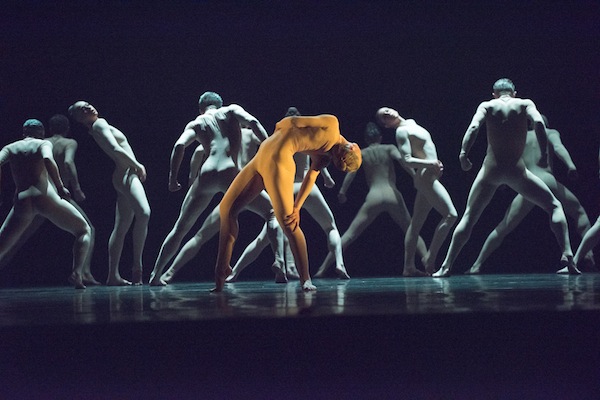
Ezralow Dance’s Open comprises many themes. (photo by Angelo Redaelli)

Los Angeles-based Ezralow Dance kicks off this year’s Chutzpah! Festival at the Rothstein Theatre Feb. 15 with, appropriately enough, a work called Open, for its embodiment of myriad ideas and ways in which to express them.

Chutzpah! also features a range of creative expression every year, with performers from around the world in dance, comedy and theatre. As has become tradition, the Jewish Independent will highlight several of the performances prior to the month-long festival. This week, we focus on dance, speaking with Daniel Ezralow, as well as Israel’s Roy Assaf.

* * *

“Open is a testament to what I believe,” Daniel Ezralow told the Independent in an email interview. “When my wife (who collaborated with me) and I were thinking of a title for the show, we played around with a lot of options, but when we came up with the one word Open, it expressed everything that I wanted to say. Be open, open yourself, open to others, open your eyes, open your mind, open your heart and stay open to the world in many senses.

“It was a way of saying, leave your judgments at the door and try, just try, to be open-minded. I find that we are so full of judgment, many times we fail to see the beauty of what is so simple and directly in front of us. I am constantly attempting to open my mind and receive what comes to me. There is a wonderful concept, ‘to want what you get, not get what you want.’ I think Open has something to do with this.”

In his work, Ezralow is certainly open to new ideas and a wide variety of media. In his 40-some years in dance, he has performed with several companies, co-founded others and choreographed for numerous groups around the world, including Batsheva Dance Company, Paris Opera Ballet, Maggio Musicale Fiorentino and the Atlanta Ballet. He choreographed the opening ceremony of the 2014 Winter Olympics and Cirque du Soleil’s Love. He has created for dance festivals, Broadway shows, gymnastics competitions, television, film, commercials and other corporate projects, awards programs, pop star performances and music videos. The award-winning choreographer, director and multimedia artist has a vast and eclectic resumé, to say the least.

“I remember as a child always asking my father ‘why?’ I asked him why about just about everything. There is no question I am naturally curious,” said Ezralow. “I was once working with Chaim Topol on a project in New York City and we were in a taxi together. I asked him why – why does he work, why does he do the things he does? I’ll never forget the response he gave me. He said, ‘Curiosity.’ At that point, I understood that was the same thing that made me do the things I do. My mother always encouraged me to ask questions and to do what I believed in. I do lose myself in creations, but usually it is not an escape. In my best moments, I also try to live life like a creation and lose myself in it.”

In looking at his body of work, it’s hard to believe that Ezralow didn’t take a formal dance lesson until he was in his late teens, when he was a biology student at University of California, Berkeley.

“Dancing chose me so strong, I had little choice to shy away from it,” he said of his change in career direction.

“At the time, I was deeply disappointed with the American medical system. I felt it had nothing to do with helping people and was mostly about a hierarchy to achieve a status of life. The system was very closed to acupuncture, Eastern ideas and anything alternative. At the time, this made me feel that it was really askew and not for healing and helping people but rather for diagnosing, medicating with pills and cutting in surgery.

“Hopefully, this has changed and we are now entering a period of truer possibilities,” he said. “I just saw a wonderful documentary titled Heal, which delves into the human possibilities to heal ourselves. This is the kind of medicine I would like to get involved with. I also feel that the work I do is healing – dance is healing!”

About his goal as an artist, he said, “As I have grown, I have shed some of my desire to be a performer/exhibitionist and have been humbled with age, which has allowed me to dig deeper to understand that all I ever really wanted was to make people happy. Happy can mean crying, happy can mean laughing, happy can mean many things to me. I really just want to help people to be inspired to live another day of their lives on this planet.”

Ezralow’s father’s family came to Los Angeles via Winnipeg, of all places.

“My grandfather ran from the Russian revolution to Canada and settled in Winnipeg, where my father was born, who was one of a family of five. My grandfather was a carpenter,” he explained. The family moved to Los Angeles, he said, “probably because my grandfather saw there was opportunity. They settled in Boyle Heights, the poor Jewish area of L.A., and he began building houses. One by one, he would build a house, sell the one they lived in and move to the new house. I took a tour of Boyle Heights with my father before he passed away and he pointed out all of the homes my grandfather built and the family had lived in.”

According to the Jewish Journal, Ezralow’s parents met in Los Angeles; his mother was born in Poland, but the family emigrated when she was quite young.

“My mother grew up a Sabra in Palestine, before the declaration of the state of Israel,” he said. “All of my family on her side are still in Israel and I would travel every other summer with my family to Israel, so I am connected by heritage to a people I know intimately from my entire childhood. This has given me a sense of Jewishness as natural and surrounding me.

“In Los Angeles, as well,” he continued, “there is a very strong and permeated Jewish community, which I grew up in and was a bar mitzvah. But, after that, I felt that there was too much dogma in religion. I have worked many times with Batsheva in Israel and still have a deep connection to everyone. I am sometimes sad to see what is happening with the conflict there. But I feel a strong sense of Jewish humanity in my soul. It is something that is universal and not selective to one religion.”

* * *

photo - Roy Assaf Dance’s Six Years Later
Roy Assaf Dance’s Six Years Later. (photo by Costin Radu)

Roy Assaf is both creator of and a performer in the two award-winning pieces he is bringing to the Chutzpah! Festival, starting Feb. 22.

“I dance in both works, the duet Six Years Later and the trio The Hill,” he said in an email. “Back in 2011 and 2012, when these works were created, it felt perfectly natural for me to choreograph and to dance the work at the same time. Nowadays when I create, it is not at all the obvious choice.”

Assaf was born in Israel, and dance has been a part of his life for as long as he can remember. About 15 years ago, he started working with Emanuel Gat, initially as a dancer, then as an assistant choreographer. Assaf’s first choreographed work, in 2005, won two awards at the Shades in Dance competition in Tel Aviv. In 2010, he worked with the Noord Nederlandse Dans company in Groningen, Holland, creating for them a work called Rock.

“I was invited by their artistic director, Stephen Shropshire,” said Assaf about that commission. “The amount of trust that Stephen gave me while working with his company strengthened my belief in myself that I could and should keep making pieces.”

Since then, Assaf has created or co-created works for many other companies, including two full-length pieces supported by the Intima Dance Festival, a work for L.A. Dance Project for the Biennale de Lyon, a collaborative piece for the Royal Swedish Ballet, and a piece for the Gothenburg Ballet. This past fall, he began creating 25 People, working with third-year Juilliard students in New York City, where he was on faculty for a semester, which he is resetting with dancers in Israel.

For Assaf, dance is not simply art for art’s sake.

“I would like to give people room to imagine,” he said. “It’s certainly not about distracting people – I really hope we are in the business of encouraging or facilitating engagement in one’s own life. What a pity it would be if dance principally served to distract or disconnect someone from his or her experience. Please do come to a performance and be fully yourself there – see what you see, recognize what you recognize, run with your fantasies, meet your uncomfortable places.”

The duet Six Years Later explores the relationship between two people who have come together after having been separated for a long time, while The Hill is a commentary on war, based on the Hebrew song “Givat Hatachmoshet,” about a particularly devastating battle that took place during the Six Day War in 1967, a battle that Israel won but with great losses.

Despite the different subject matter, Assaf has described both pieces as having a lot in common.

“They share a spine, in terms of physical material,” he explained. “If you look closely, you may discover that they are both dealing with much of the same movement – but that the same movement has undergone a very different treatment in each work. You might say they share a point of origin, but parted ways in their process. Each work followed a path to its logical conclusion. Both, however, deal with the story of human touch: its effect, its consequence.”

For all of the Chutzpah! dance offerings and the full festival schedule, visit chutzpahfestival.com.

Format ImagePosted on February 2, 2018February 1, 2018Author Cynthia RamsayCategories Performing ArtsTags Chutzpah! Festival, dance, Daniel Ezralow, Israel, Rothstein Theatre, Roy Assaf
The greatest Jewish novel?

The greatest Jewish novel?

What strange quirk brought it about that what may be one of the greatest and most Jewish of Jewish novels should be written not by a Diaspora Jew, nor an Israeli Jew, nor a Diaspora Jew who had made aliyah, but rather an Israeli who relocated to New York?

Further stymying expectations, Ruby Namdar did not write this novel in English, but in Hebrew (it was recently translated by Hillel Halkin). “For who?” asked an audience member at the Cherie Smith JCC Jewish Book Festival event on Nov. 26, when I had the pleasure of interviewing Namdar in front of a small gathering. If Namdar wanted his novel, which he acknowledged to be soundly in the lineage of Bernard Malamud, Saul Bellow and Philip Roth, to be read by New Yorkers, why write it in Hebrew? If he wanted the novel to make sense to Israelis, why write it about a rootless Diaspora Jew with no connection to Israel?

“I don’t know what I was thinking,” said Namdar, “I don’t know who I was writing for, I just wrote.”

The Ruined House is not just a great Jewish novel or a great novel in modern Hebrew. It possesses a structure that is at once talmudic and kabbalistic, a structure that is deep and intricate yet carried off with such a sense of understatement and naturalness, effortlessly unfolding within Namdar’s lucid, lyrical and vivid prose, that most English-language reviewers thus far have not fully noticed it. This structure is what gives the novel its profoundly Jewish resonance, which is at once modern and ancient, rootless and anchored in the archetypal depths of Jewish experience and textuality.

Talmudic structure

The Ruined House is divided into seven books, with its seventh book being the culmination of an obviously Jewish numerical pattern. Each book follows the anti-hero, Andrew P. Cohen, over the course of one year of his life, as he enters what seems to be a midlife crisis from hell (or perhaps from heaven).

Cohen is a successful and wealthy professor of comparative culture, who lives in an idyllic Manhattan high-rise with a view of the river, a pristine Apollonian realm in the skies. He has a beautiful young lover, Ann Lee, and an adoring group of followers and acolytes. He cherishes his controlled, harmonious and detached existence, which he has gained through leaving his wife and two daughters years before.

At the end of the first six sections of the novel are a few pages of text designed to look like a blat Gemara, a page of Talmud. The central text in these inserts tells the story of a high priest preparing and executing the Yom Kippur sacrifices. While he does so, he is watched by Obadiah, a humble Levite who wonders whether the priest is truly pious or just a functionary in league with the elite. Encircling the narrative are passages from the Talmud, Mishnah and Tanakh, which describe the laws, folklore and spiritual significance of the high priest’s duty. They also feature key excerpts from Shaarei Gilgulim (The Gate of Reincarnation), a kabbalist text written by Chaim Vital (1542-1620) to expound the cosmology of his master, the Ari HaKodesh, Isaac Luria (1534-1572).

The insertion of these texts is deliberate and precise. Just as the narrative in the inserts is flanked by canonical Jewish sources, the narrative of the novel is surrounded by ancient Jewish forces. As the hidden, broken nature of Cohen’s life begins to surface, he begins to have intense, waking visions of the ancient Temple in Jerusalem. His dreams turn nightmarish, alternating between repressed guilt at his betrayal of his family and dreadful tableaus of the rape of Jerusalem by the Romans and the murder of Jews by the Nazis.

The structure of the story and the inserts are not the only mirrors in the book: Cohen’s life is cast as priest-like. His elite status; the pure harmonious realm in which he lives; his having separated from his wife like Moses to live in the skies; even the elaborate meat dinners he cooks up for his dinner guests alone in his perfect kitchen all point to it. His name, of course, highlights both the substance and the irony of his life as priestly metaphor. At one point, his daughter, Rachel, disgustedly mocks people who think that Jews named Cohen are descended from the priestly lineage: “Everyone knows they just gave out those names randomly at Ellis Island.”

As Cohen descends into apparent madness, a grotesque version of the priestly sensibility gets stronger in him. He becomes morbidly obsessed with the impure and averse to the physical, the decaying and the dead. He finds himself horrified by menstrual blood and semen. The explanation of this growing claustrophobic sensibility lies in the paragraphs of Shaarei Gilgulim, which are included in Namdar’s inserts.

Kabbalist elements

Shaarei Gilgulim describes the way that some souls, during the process of reincarnation, unite with other souls in order to complete their own tikkun (repair). In the first pages of The Ruined House, “one shining soul, the figure of a high priest” is suddenly visible above New York among the celestial machinations momentarily revealed as the veil is briefly sundered. The key to the priest’s identity lies in the kabbalist doctrine of ibbur, or impregnation, where a soul from beyond enters into an earthly person in order to help them, to complete their own mission, or some combination of the two. In Cohen’s case, as suggested in a last talmudic insert, he has been “impregnated” by the soul of the high priest in need of tikkun for feeling himself superior to Obadiah, the humble Levite. The high priest and Cohen share a sin in common: arrogance. Their collective confrontation and reckoning with it will be psychically violent and cathartic and come close to doing Cohen in.

Critique of Diaspora?

Some reviewers have read The Ruined House as a critique of the Diaspora Jew, viewing the narrative as a kind of punishment of Cohen, enacted on him by the rising tide of archaic Jewish intrusions into his life. Namdar said this is a moralistic distortion of his ambivalent, questioning text. Instead, Namdar pointed to the shatterings of the illusion of wholeness and perfection that happen in the book. “Where things are broken, there, seeds can take root and grow,” he said.

For example, Cohen’s harmonious life is an illusion that is shattered in the course of the book, leaving a “ruined house.” Yet the figure of the ruined house (bayit asher necharev in the original Hebrew, a phrase that comes from a poem by Yehuda Amichai) is also an allusion to another ruined house, that of the Beit Hamikdash, the Jerusalem Temple, whose pristine world of order and control, Namdar suggests, also was illusory.

The third ruined house is suggested by the timing of the events in the novel. The story begins in the Hebrew month of Elul (signifying its theme of repentance), on Sept. 6, 2000. After the narrative comes to a head on Tisha b’Av, the date of the destruction of the Temple, it jumps from Aug. 1, 2001, to Sept. 18, 2001, leaving a lacuna where Sept. 11, 2001, and the destruction of the Twin Towers, resides.

“I did not want Sept. 11 to appear in the narrative, thus making the novel reducible to being about that event,” said Namdar when I asked him about this. “Rather, I wanted the trajectory to point to its occurrence outside the frame.”

There is much more to talk about in this remarkable novel, which manages at once to be so Jewish, so Israeli, so American and so human. I did not touch here on the attention Namdar lavishes on the details of Cohen’s daily life or Namdar’s subversion of the lineage of Malamud, Bellow and Roth in his intense empathy with the female characters of the novel, and his unsparing deconstruction of Cohen’s narcissistic masculinity. I did not examine his vivid and hilarious slow-motion evocation of a grossly excessive bar mitzvah, or his brilliant parody of the Zionist clichés of a Birthright-like propaganda tour of Israel, and many other delights. I hope this introduction is enough to invite you to step into Namdar’s mesmerizing fusion of a talmudic-esoteric structure with an incandescent evocation of life in Manhattan, and discover what else he has hidden there, of which, I promise you on good authority, there is much.

Matthew Gindin is a freelance journalist, writer and lecturer. He writes regularly for the Forward and All That Is Interesting, and has been published in Religion Dispatches, Situate Magazine, Tikkun and elsewhere. He can be found on Medium and Twitter.

Format ImagePosted on February 2, 2018February 1, 2018Author Matthew GindinCategories BooksTags Cherie Smith JCC Jewish Book Festival, Jewish life, Judaism, kabbalah, literature, Ruby Namdar, Talmud, Torah, translation
Celebrating many milestones

Celebrating many milestones

Alexandra Gerson, centre, says a few words at a Jewish talent show put on by Radio VERA last year. (photo from Radio VERA)

“I have a dream: I want to bring together Russian-speaking and English-speaking Jews in Canada, to unite them into one seamless whole. All I do, my Radio VERA included, is serving that goal,” said Alexandra Gerson, a co-owner of VERA.

This year, VERA celebrates its 10th anniversary. Timed to coincide with that milestone, the radio station is helping bring the concert Le Chaim to Richmond’s Gateway Theatre on Feb. 3.

“VERA is an acronym of the words Vancouver Jewish Russian Association, in Russian,” Gerson explained. She said VERA’s roots lie in her previous radio program, Russian Voice, a pre-taped one-hour weekly show in Russian, which launched in 2001 with the financial support of David Stevens. The program had mostly Jewish content, but it didn’t last long. From its inception, Gerson said she received multiple antisemitic threats and her car was vandalized. Home-grown Russian extremists were not happy with a Jewish program called Russian Voice, she said, and they kept harassing her. Concerned for her young daughter’s safety, with the police urging caution, Gerson eventually closed the program, but she didn’t give up her love for radio. “You can listen to the radio anywhere, in your car, in your home or office, working or resting,” she mused.

Her radio work brought her into the midst of the Zionist movement in Canada. “I’ve lived in Canada for 24 years,” she said. “My father was a Zionist, and Jewish ideas are dear to me. I’ve always liked being a Jew. I work for the Jews of Canada. I’m an official representative of the World Zionist Organization in Canada, and my Radio VERA is an integral part of my work. It promotes Jewish ideas and is a pro-Israel station. I come to the studio every morning, turn on the microphone, and say, ‘Hello, Jews!’ And feel proud.”

photo - Alexandra Gerson, co-owner of Radio VERA
Alexandra Gerson, co-owner of Radio VERA. (photo from Radio VERA)

Gerson’s pride in her Jewishness pushed her towards attending seminars and workshops on Jewish leadership. During one of them, in 2003, she met Dmitry Shiglik, an American businessman and a dynamic figure in the Russian-Jewish world. He became a steady backer of her then-new endeavor, Radio VERA, which broadcasted its first show in 2008.

“VERA broadcasts live five days a week, Monday to Friday, 8 a.m. to 10 a.m.,” Gerson said. “It’s the most expensive time, when everyone is in their cars, heading for work. We exist because of our generous donors: Yosef Wosk, Alex Kivritsky of the HiFi Centre and, of course, Dmitry Shiglik, my co-owner.”

She stressed that VERA is not, and hasn’t been for a long time, a Russian radio broadcast. “It stopped being ethnic years ago. We do interviews about what is of interest to everyone. For example, North Korea is on people’s mind these days, so we did an interview with the editor of the Russian newspaper in Seoul.”

Every morning, listeners of VERA can expect relevant and time-sensitive interviews in two languages: Russian and English. “We do interviews in whatever language our guest prefers,” said Gerson. “Our hosts switch languages fluidly, as the situation demands. We’re the only radio station in Canada, maybe in the world, with such an approach. It’s not as easy as it sounds. Russian- and English-speaking people often have different mentalities, born in different cultures, so we have to use different techniques of conducting interviews.”

VERA, which is part of Fairchild Radio 96.1 FM, has interviewed most Canadian politicians, top people from the Russian and Israeli governments, international performing artists and athletes, writers and musicians. They usually conduct two interviews each show.

“At first, our listeners were almost exclusively local Russian pensioners, listening for the language,” said Gerson. “As we continued our bilingual policy, a middle-aged group joined in for content in both languages. Then we added overseas and non-Russian speakers, who regularly tune in to our programs. In a way, they know us better in the U.S.A. than in Canada. We have listeners in Israel, Russia and Europe. There are two ways to access our programs: live on the radio during the broadcast or online through our website, where we keep the archives of all the programs we’ve done in 10 years. Our site has up to 15,000 visitors a day.”

Despite the large amount of traffic and the work needed to produce a two-hour program five days a week, VERA has only three employees. “Pavel Manugevich and Denis Manzar are both my co-hosts, and Alex Kivritsky is our CEO,” Gerson said. Manugevich “has been with VERA since the beginning; he is a professional journalist. Denis Manzar has been co-hosting VERA programs for two years; outside the studio, he is a lawyer and a documentary filmmaker.”

Through her work on VERA, Gerson personifies a cosmopolitan blend of Jewish, Russian and Canadian. In 2014, she was named Russian-American Person of the Year in the media category. According to its website, the honour is presented by Universal Awards Management and the World Forum of Russian-Speaking Jewry, with support from the American Council for World Jewry. Gerson – the only Canadian to have received the honour – shared her award with American-Russian journalist Victor Topaller, who is also Jewish.

But Gerson isn’t resting on her accomplishments. She is always looking for ways to bring the Jews of Canada together, no matter their points of origin. As an example, three years ago, VERA started a new multi-faceted platform that goes beyond the radio.

“We have our annual sports day,” Gerson explained. “We organize the annual festival of Jewish children’s art and various Jewish holidays. Every year, we take 40 of our listeners on a trip to Israel, and we frequently promote concerts of Jewish performers.” It is in the latter regard that VERA is sponsoring the upcoming gala concert Le Chaim, which is the brainchild of Mikhail Gluz, artistic director of the Solomon Mikhoels Cultural Centre in Moscow.

“I’ve known Mikhail Gluz for several years,” said Gerson. “We first met in Moscow and, afterwards, regularly exchanged emails and swapped ideas. He told me about his new project, Le Chaim, a traveling show of Russian-Jewish performers from Russia, Israel and North America. He wanted to tour Le Chaim across Canada and the U.S., performing in any major city that would offer a venue, to celebrate the 70th anniversary of the state of Israel. It is the first such project in Canada organized by Russian Jews in celebration of Yom Ha’atzmaut.”

In addition to celebrating Israel’s Independence Day, the concert, which will also feature a documentary and historical footage, commemorates the 20th anniversary of the International Solomon Mikhoels Festival of Arts and is dedicated to International Holocaust Remembrance Day.

“When I heard about Le Chaim, I wanted to bring it to Vancouver, to coincide with the 10th birthday of Radio VERA,” said Gerson. “Mikhail was not eager at first. He said it wasn’t a commercially viable suggestion, the Vancouver Jewish community being much smaller than the other cities on their itinerary. But Yosef Wosk supported the idea and donated the money to make it possible.”

One of the performers in Le Chaim, Jewish jazz singer Alla Reed, has visited Vancouver before. “I loved it,” she said on the telephone from Russia. “Other cities have clean air or beautiful nature or thriving culture or receptive audience, but Vancouver has it all together. And it also has wonderful people, like Sasha [Gerson] and her Radio VERA. I look forward to meeting my friends and singing in Vancouver again.”

For more information on VERA, visit veracanada.fm. Tickets for Le Chaim on Feb. 3, 7 p.m., can be purchased via VERA or from Gateway Theatre at 604-270-1812 or gatewaytheatre.com.

Olga Livshin is a Vancouver freelance writer. She can be reached at [email protected].

Format ImagePosted on January 26, 2018January 24, 2018Author Olga LivshinCategories Performing ArtsTags Alexandra Gerson, culture, Le Chaim, Mikhail Gluz, Radio VERA, Russia
Singing adds to health

Singing adds to health

Choir director and singer Earle Peach, seated at centre, with members of Highs and Lows Choir. (photo by Kathleen Yang)

For more than 20 years, Highs and Lows Choir has brought music back into the lives of its members. Established as a four-part choral group in the mid-1990s, its mission is the mutual support of singers, in a way that nurtures mental health and wellness. Auditions are not required for new members; musical activities and instruction are built into their weekly rehearsals. The main thing, according to choir director and singer Earle Peach, is “the desire to participate and the willingness to learn.”

Accompanied by pianist Elaine Joe, the choir of about 20 voices practises a wide repertoire of songs, which it performs at numerous venues around Vancouver. In December, the songs were festive and drew on a range of traditions – songs from Christmas in Victorian England, and a Chanukah song from Spain called “Ocho Kandelikas.” Between the seasonal items, the choir performed the satirical “Parking Lots and Strip Malls,” “Blue Moon” and, a favourite with swing bands, “Jump, Jive and Wail.”

“We’ll sing music from any place or time period, as long as it has beautiful harmony and isn’t too difficult,” said Peach of the set list.

The atmosphere at rehearsals is buoyant, even amid the hard work of managing tricky intervals and rhythms, as in, for example “A La Ru,” a Spanish lullaby. The choir sings in a range of languages, performing works in English, Latin, French, Swahili, Ladino and Haitian Creole. The music is “challenging but manageable,” according to Jewish community member Rachel Mayer, an alto singer who is also a member of the choir’s board.

In the break, members talk about upcoming events in the community. In December, the calendar was full of choral visits around town, including two events at Douglas Park Community Centre and a lunch at Carnegie Community Centre. At the end of January, the choir will be singing for the Suzuki Elders and, in February, they will join other choirs at the Home Ground Festival in Oppenheimer Park in the Downtown Eastside.

Bass singer Kevin Elwell has managed or co-managed Highs and Lows Choir since 2003, and has been a peer support worker and English-as-a-second-language instructor with Vancouver Coastal Health since 2006. He has seen firsthand the tremendous difference the choir has made in the lives of its members: a difference recognized by the Mayor’s Arts Award, which was given to Peach in the fall of 2017, for community-engaged art. A conductor for three other choirs in the area, Peach is also a performer, teacher, producer and recording artist.

Alaric Posey (bass) described the choir as “the highlight of my week.” Having sung in children’s choirs, he had been away from music for many years before joining Highs and Lows in 2003. This opened the door to a life full of music, as he is now the choir’s assistant conductor and co-manager. He also teaches music and performs with a number of other groups around Vancouver.

The singers explain that, while singing is good for you, the social element is equally important. “There’s more of an effect the more people you sing with. You’re a community with a common purpose,” said Posey.

Academic research confirms the views of the singers. A 2016 article on the neuroscience of singing reports that social singing evolved to serve the needs of early humans. By singing and dancing together, groups shared important information, forged strong social bonds and fended off enemies. While we may not need to scare away predators, our modern brains still benefit from the endorphins released into our bodies as we sing. These endorphins make us happier, healthier and more able to think creatively. Choir librarian Dale Sweet (tenor) sets a good example with his commitment to singing in seven different choirs around town.

While the choir was founded to nurture the mental health of its members, the lows are left at home during rehearsal. The choir is a place to be task-oriented while making music and laughing at the endless stream of bad puns emanating from the conductors. Still, the members always know that others have their backs. True to the choir’s name, soprano, chair of the choir board and Jewish community member Penny Goldsmith observed, “People look out for each other. If someone doesn’t show up, we call them.” Aptly named, the choir helps the spirits of its singers take flight.

The choir sings weekly every Tuesday from noon to 1:45 p.m. at the Unitarian Church at Oak and 49th in Vancouver. New members are always welcome. More information about the choir can be found at highsandlowschoir.ca.

Shula Klinger is an author and journalist living in North Vancouver. Find out more at shulaklinger.com.

Format ImagePosted on January 26, 2018January 24, 2018Author Shula KlingerCategories MusicTags choir, Earle Peach, health, Highs and Lows
Ever-changing job landscape

Ever-changing job landscape

Prof. Ilana Gershon’s latest book is Down and Out in the New Economy. (photo from Ilana Gershon)

An increasing number of people in their 50s and 60s are needing or wanting to find work – and are finding that next job elusive.

Indiana University anthropology professor Ilana Gershon has been researching the (often unsuccessful) ways in which job seekers look for work. One result of this research is her latest book: Down and Out in the New Economy: How People Find (or Don’t Find) Work Today (University of Chicago Press, 2017).

Long gone are the days that employers just want an extra pair of hands to do a job, said Gershon.

“We used to have an idea of ourselves as workers, in which we imagined we owned ourselves, as if we were property,” she explained. “This was the metaphor – that we were renting ourselves to an employer for a certain period of time and, when the time was over, we’d get ourselves back. The idea of renting ourselves as though we were property really affected the ways you could have particular ideas, of what was a just work relationship.

“So, you thought you could have arguments about whether you should have a 40-hour work week or not, about how much time you should be able to rent yourself to an employer … and people would have legal cases and legislation around the boundaries of work. Should people be paid for putting on a uniform that would make them be work ready or should they put on a uniform in their own time, and should employers only pay for them once they put on the uniform?”

Gershon said this metaphor very much shaped how people thought about what was appropriate and what was not.

“One of the other consequences of that is that unions were able to argue that, in fact, people were not just renting a portion of their day,” she said. “Unions argued that they were renting a portion of their lives and, as a result, the companies owed them health insurance or a pension … that they should be reimbursed for giving over a portion of their lives to the company.”

On the other side of the equation were the companies, which were very interested in ensuring there was some form of company loyalty.

According to Gershon, in the United States and the United Kingdom, after Ronald Reagan and Margaret Thatcher took power, respectively, things began to change. People began to imagine themselves as though they were a business – as a bundle of skills, assets, qualities, experiences and relationships that had to be consciously managed like a business. And, as a business, continual enhancement was required.

“When people are entering into an employment contract, that now means they are entering into a business-to-business contract, in which they are offering temporary solutions for market-specific problems a company experiences,” explained Gershon. “So, now you have all these self-help articles that talk about being the CEO of Me Incorporated.

“One of the other consequences of this is people now talk a lot about having a personal brand. Because, if you imagine yourself as a business, then you should have a personal brand, as businesses have brands. So, a lot of the ways in which people understand what the employment contract can now offer them is being shaped by this change in metaphor.”

book cover - Down and Out in the New EconomyGershon’s research on the topic began in 2012, with the interviewing of people around Indiana University and her attending one or two job search workshops available to undergrad students. In 2013/2014, while being a fellow at Stanford’s Centre for Advanced Study in the Behavioural Sciences, she did field work in the Bay Area in California.

Not everything regarding the job market is new, she said. “People already know a lot about hiring, because they participated in hiring in their previous workplaces … and they shouldn’t ignore everything that they already know.

“I was trying very hard not to make it a Silicon Valley project,” she said of her research. “I was very concerned about that, because, what I wanted to do was think about the hiring ritual in general. I interviewed people in the Midwest and East Coast about this – not as many people as I interviewed in the Bay Area, but I wanted to check if I saw any difference.

“The major difference I saw was that the people had a very different idea of how much time you should spend at a job. People in the Bay Area thought the ideal time you spend at a job was two to three years. And, in the Midwest, it was something more like seven to 10. On the East Coast, it was more like five to eight.”

According to Gershon, she worked hard to produce an “anti-advice book.” Her aim was to focus the book on the implications of thinking of yourself as a business and how that has changed hiring and affected what employment contracts have become. Further, she wanted to explore how one should present themselves as an employee, and what employers feel are desirable traits in candidates.

One of Gershon’s findings is that the new concepts are now standard fare in all job search workshops.

“People are being told to do this, but people in the trades and blue collar workers don’t seem to find this way of thinking terribly useful yet,” she said. “So, the people for whom it fits their situation best are going to be white collar workers for the most part.”

But, whether or not everyone finds the ideas useful, they are being encouraged.

“People working retail are constantly being told they have to brand themselves,” said Gershon by way of example. “I don’t think this particular way of trying to brand yourself constantly or imagine yourself as a business is making all that many people happy.

“If you haven’t been in the workforce for 15 to 20 years and you’re suddenly going to these job search places where they’re telling you everything is new and the ways you used to look for jobs no longer make sense … it’s all very confusing. I’m offering the context for that, explaining why things might seem new, and what’s genuinely new and what isn’t.

“I think figuring out how to get a job is actually something you have to do specifically for your particular industry,” she added. “People offer a lot of standardized advice, as though there’s a magic bullet that works in every context. What I’m talking about is how not to engage with that kind of standardized advice. Instead, figure out how to do the research so that you can understand those communities on your own.”

Rebeca Kuropatwa is a Winnipeg freelance writer.

Format ImagePosted on January 19, 2018January 17, 2018Author Rebeca KuropatwaCategories BooksTags economics, employment, Ilana Gershon
Life-giving practice

Life-giving practice

On Feb. 1, Sarah Peyton speaks at Or Shalom on the topic Why Love is Not Enough: Family Heartache and the Path of Repair. (photo from Or Shalom)

Have you ever longed for someone who would be able to listen to you without judgment, to every concern, fear, yearning or hurt you might have? Someone able to hold you in gentle understanding and with deep compassion all the time? Such a person does exist – within yourself. And you can find out how to meet them through the work of Sarah Peyton.

Peyton is a neuroscience educator and certified trainer of nonviolent communication, which was pioneered by American psychologist Marshall B. Rosenberg. She will introduce the latest understanding of neuroscience and the part it plays in building social and family relationships in her talk at Or Shalom on Feb. 1, called Why Love is Not Enough: Family Heartache and the Path of Repair. Peyton will show how deep, resonant empathy for oneself and the other can connect conflicting parties, even as the conflict resides within one’s own inner voice of criticism.

I met Peyton in the summer of 2015. My husband was assisting in a nonviolent communication retreat, and I had been asked to facilitate a writing session as a part of it. At the last minute, I painfully withdrew. My mother’s death, less than two years before, had left me paralyzed and in deep grief and mourning. I was not up to the task of supporting anyone, not even myself. Tearfully, I watched as my husband left for the weekend. Miraculously, my husband forgot something he needed and returned home to retrieve it. “Come back with me,” he urged. “Don’t facilitate. Just sit outside, swim, write under the trees. Get well.” I said, “Yes.”

That weekend changed my life. Peyton warmly guided a group of participants in her process of resonant language and connection. Peyton, I would come to learn, had lost her beloved son just the year before. Given that, how was it possible that she could contribute with such presence?

Over the next two years, I worked privately with her, learning about resonant language and how to live it. Last year, Norton Press published Peyton’s first book, Your Resonant Self: Guided Meditations and Exercises to Engage Your Brain’s Capacity for Healing. I interviewed her recently, in anticipation of her Vancouver talk.

DAS: What began your work with resonant language?

SP: I began this work when my 33-year-old adopted son was dying. His death took a long time, eight years. His dying began when he had a reawakening of the trauma in his family. I was desperate to save him. I began to learn and practise a way to share life and our experiences, a way to enhance life. We were all sustained by this practice, through his dying and afterwards, through our mourning. Relational language allowed us to find each other through the dark cloud of loss and death. It took me five years to write the book. I began writing it in the last year of my son’s life.

DAS: What is resonant language?

SP: Our brain has two hemispheres, and the structures of each side are different. The language centres of the left brain are instructional-based. They help us to take action, plan and strategize…. Our right brain creates a relational language where you and I are experienced together. Relational language is resonant and is the language of poetry, metaphor, visual imagery, longing, dreaming. Warmth is a way to navigate to this resonant relational right brain and create connection to ourselves and others.

A lot happens in family when we live in a world of doing in our caring for each other. A different way of being together happens in a world of relational language and resonance. This work is the work of awakening remembrance of what it’s like to reclaim our birthright, the birthright of being relational beings in a world of warmth.

What stops us from engaging in this relational right-brain language is fear. We have made, early on in our lives, promises in our hearts to prevent pain or disappointment in and for ourselves. When we recognize our own fear and the ways that we closed our hearts, we’ve taken the first steps to remember what we have forgotten. We will be reminded of what we know and have lost. We’re learning what the “garden” in our brains needs. It needs warmth.

DAS: What is your hope for your work and our world?

SP: We’re looking at a world that is split between doing and being. Brain by brain, we can change our world and change our planet. We will look at a world that is not split.

I hope that those who come to our evening will be able to discover a way to listen and know themselves differently, and to discover the pathway to their own warm, beating hearts.

* * *

Though I will always miss my mother, the terrible grey numbing grief has lifted. My heartache has become touchable, a renewal in the richness of my life lived with her. I have learned that being able to touch heartache in its many guises provides us with life-giving renewal in our relationships. Peyton’s relational emotional language is one that continually restores me to compassion and connection, with myself and others.

Dael Adams Segal is a writer and a mentor of writers. She writes midrash and prayer and facilitates women’s-centred Torah study at Or Shalom Synagogue, where she is a member.

Format ImagePosted on January 19, 2018January 17, 2018Author Dael Adams SegalCategories BooksTags communication, health, Or Shalom, Sarah Peyton

Posts pagination

Previous page Page 1 … Page 101 Page 102 Page 103 … Page 163 Next page
Proudly powered by WordPress