Skip to content
  • Home
  • Subscribe / donate
  • Events calendar
  • Business Directory
  • FAQ
  • News
    • Local
    • National
    • Israel
    • World
    • עניין בחדשות
      A roundup of news in Canada and further afield, in Hebrew.
  • Opinion
    • From the JI
    • Op-Ed
  • Arts & Culture
    • Performing Arts
    • Music
    • Books
    • Visual Arts
    • TV & Film
  • Life
    • Celebrating the Holidays
    • Travel
    • The Daily Snooze
      Cartoons by Jacob Samuel
    • Mystery Photo
      Help the JI and JMABC fill in the gaps in our archives.
  • Community Links
    • Organizations, Etc.
    • Other News Sources & Blogs
  • JI Chai Celebration
  • JI@88! video

Recent Posts

  • SFU honours Gloria Gutman
  • Lifting people’s spirits
  • Wedding a ray of light
  • Indigeneity and Zionism
  • Rule of law broken: councilor
  • Football and its roles
  • The burden of defence
  • Fish Café returns after fire
  • All right in what goes wrong
  • Nuns & mermaids at TUTS
  • Camp offers holiday retreat
  • Students and mentors inspire
  • Once-in-a-lifetime trip
  • 100 dancers, one heart
  • Money for the sciences
  • What “Jewish food” means
  • Have a cookie, schnitzel too
  • Federation now across BC
  • Israel fighting for its existence
  • Deal strengthens Iran
  • Patriotic belonging diminishes
  • A campaign to engage
  • Upstanders’ first live event
  • Responding to Carney
  • Having your own home
  • Music a family tradition
  • Musical to warm heart
  • Community milestones … June 2026
  • Sharing her passion for Israel
  • Or Shalom reopens its doors
  • JFS from past to future
  • Need holistic approach
  • Sharing stories, advice
  • Journalist shares fears
  • Skills to live together
  • Road to independence

Archives

Follow @JewishIndie
image - CJN box ad Rockowers 2026

Byline: Rebeca Kuropatwa

Envisioning a peaceful future

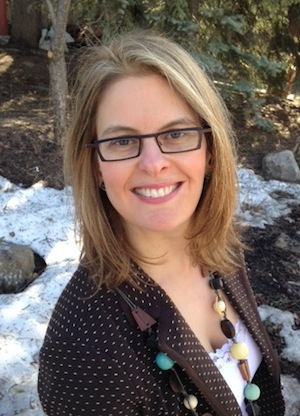
photo - Mira Sucharov spoke on March 2 as part of the University of Winnipeg’s Middle East Week
Mira Sucharov spoke on March 2 as part of the University of Winnipeg’s Middle East Week. (photo from Mira Sucharov)

As part of Middle East Week at the University of Winnipeg, Mira Sucharov, associate professor of political science at Carleton University in Ottawa, spoke on the topic of Power and Identity Across the Israeli-Palestinian Divide.

About 60 people came out March 2 to the university’s Convocation Hall to hear Sucharov, who is currently the country analyst for Israel and the Palestinian territories for Freedom House, as well as a blogger and writer whose work appears regularly in several publications around the world, including the Jewish Independent.

Sucharov sees relations between Palestinians and Israelis as more polarized now than at any other time since the peace process that began two decades ago. She said she was pleased to be part of U of W’s Middle East Week, as it promotes dialogue, in contrast to the situation on many North American campuses, where hardened opposing camps are choosing shouting over listening.

Describing herself as a liberal Zionist, Sucharov explained the term as referring to someone who “believes that there is legitimacy to Israel’s existence, and that nations deserve a state.” However, “liberal Zionists not only acknowledge the existence of Israel and support its existence, they are deeply troubled by its occupation.”

Sucharov said that, while some Israelis and Israel supporters prefer the term “disputed land” to the term “occupation,” Sucharov views “occupation” as “an important word.” She explained, “We’re not just talking about a geographic swap of land. We’re talking about a population of Palestinians who are not citizens of any country.

“The IDF, on a macro level and often on a micro level, is in charge of the area and the daily lives of Palestinians who have to pass through checkpoints to get to work, to farm their land…. We know about the Israeli security barrier or separation wall that has served to disrupt daily lives in many ways in the West Bank.

“So, liberal Zionists are troubled by this idea of occupation and seek to do what they can to end it. As a Canadian from Winnipeg, I feel that by engaging in constructive discussion, constantly being educated, I can help people at a global level think more deeply, critically, and in a more engaged way about issues of global concern.”

Sucharov said that there are financial incentives, as well as ideological motivations, for living in the West Bank. “There are many who’ve moved to the West Bank because it’s cheaper,” she noted. “Part of it, no doubt, was wanting to return to biblical Israel, a sense of having a greater Israel, of being/having religious/national identity fulfilled. There’s another important motivating factor, and that was the idea of Israel having a wider girth, more strategic depth.”

In Sucharov’s view, “the occupation” should not be permanent, and dialogue is needed to get governments together for peace talks. “The only way to end the occupation is if Israelis and Palestinians come together to discuss and negotiate an agreement,” she said.

As for what such an agreement may look like, Sucharov imagines “a city with two capitals: Jerusalem, a holy place for all religions to pray at their own places of worship. Refugees will probably be returned, free return to a Palestinian state. There will probably be some compensation package, [on a] humanitarian basis for some refugees … based on historical agreements.”

If the Geneva initiative does take place, said Sucharov, “Can Israel feel safe with such an agreement?

“It used to be called, ‘give an inch, they’ll take a mile,’” she continued. “Now, there is a concern about the fact that Palestinians in a recent poll have indicated that they would want to use a two-state agreement as the beginnings of full takeover.

“Palestinians, no doubt, would want all of Israel … many of them … and Israelis, no doubt, would want all of Palestine … many of them. The question is, even if some Palestinians were desirous of acquiring or launching terrorist missions with or without the consent of its governing authority, could Israel defend itself?”

If/when Israelis and Palestinians reach an agreement, she said, they would have to make sure that there were “security guarantees from the United States … [that] the U.S. will guarantee the security of Israel.

“Palestine would have to agree to be a de-militarized state. So, both sides will not have to necessarily trust each other … [they] would have to understand that there is a security guarantee in the form of a major global superpower.

“That’s the two-state solution. But, there certainly are those in the military establishment of any state who could stand to gain from an ongoing conflict…. We have to … make peace seem more attractive.”

As things stand, Sucharov said, “Palestinians and Israelis are almost mutually fearful of one another.… I think the biggest obstacle is the culture of mutual fear.”

And then there is the question of whether or not Iran, if there is the possibility of peace between Israelis and Palestinians, will “behave in a suicidal fashion,” said Sucharov. “That’s what, in international relations, [they] call the … idea of nuclear deterrence – the idea that more nukes make the world safer. I’d prefer less nukes, less proliferation, but there is a logic to the idea of stability of nuclear weapons.

“Once peace is achieved by the government, ideally, the next generation grows up in a culture in which the status quo exists.

“Regional threats would be diffused to make peace,” she continued. However, “the Israeli-Palestinian conflict is not the only conflict in the region and we’re not going to see peace on earth, but Iran and other enemies of Israel … Hamas … would have less wind in their sails. The status quo would be peace, so there would hopefully be less local support for their belligerent postures.”

Rebeca Kuropatwa is a Winnipeg freelance writer.
Posted on April 17, 2015April 16, 2015Author Rebeca KuropatwaCategories NationalTags Israeli-Palestinian conflict, Israelis, Mira Sucharov, Palestinians, peace, two-state solution
Sephardi group in Ottawa

Sephardi group in Ottawa

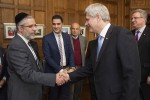
Rabbi Ilan Acoca, left, shakes hands with Prime Minister Stephen Harper on Parliament Hill. (courtesy of Prime Minister’s Office)

Last month, a Jewish delegation paid a visit to Parliament Hill with two main items on the agenda – educating the Canadian government about Sephardi Jewry in Canada and discussing Iran’s aim to obtain nuclear weapons.

The delegation included Sephardi community leaders, activists, philanthropists and spiritual leaders from across Canada. They met with the prime minister, various ambassadors and other dignitaries. The delegation was led by Yehuda Azoulay and Vancouver’s Rabbi Ilan Acoca of Congregation Beth Hamidrash, the only Sephardi synagogue west of Toronto.

A scholar, educator, author, activist and entrepreneur, Azoulay established the Sephardic Legacy Series: Institute for Preserving Sephardic Heritage. He envisioned the series as helping ensure future Sephardi publications, articles, lecture series, documentary films and research on Sephardi topics, and other works geared toward the benefit of Sephardi communities worldwide. It was the lack of general knowledge concerning Sephardi history, culture, Jewish law and other facets of Sephardi Judaism that prompted him to establish the organization. To date, Azoulay has authored five books and published more than 30 articles on various topics. In November 2013, he initiated a tribute luncheon to honor the contributions of Sephardi Jewry in America for members of the U.S. Congress.

The recent Parliament Hill delegation had as its primary goal to “create more awareness about Sephardic Jews in Canada by educating them about our history and our contributions to Canadian society,” Acoca told the Independent. “There are currently 55,000 Sephardic Jews in Canada and the number is growing. This is something that we related to the government.”

Acoca was born in Israel to parents of Moroccan descent. “I grew up in a typical, traditional Sephardic home,” he said. “Sephardic Judaism was an integral part of my upbringing.”

When Acoca was 13 years old, his family moved to Montreal, where he attended a Jewish high school. Growing up in Montreal’s Sephardi community, Acoca said, “helped me deepen my appreciation for my rich Sephardic ancestry.” Acoca eventually become a rabbi, fulfilling his grandfather’s wish that one of his descendants follow in his footsteps to the rabbinate, he said. In November 1999, Acoca and his wife Dina took on the roles of rabbi and rabbanit at Beth Hamidrash.

“Getting this responsibility made me more aware and passionate about my ancestry,” said Acoca. “My job enabled me to learn more about various Sephardic traditions and communities.”

Over the years, Acoca has added other aspects to his rabbinical role, teaching online, writing a monthly column in the Canadian Jewish News, heading the Rabbinical Council Sephardic Affinity Group, being an official Sephardi representative in Western Canada, and being the region’s Sephardi halachic authority.

Canadian human rights lawyer David Matas joined the group in Ottawa. Acoca described the importance of having Matas present in front of the House of Commons SubCommittee on International Human Rights about Iran’s intent to develop nuclear capability. During the presentation, Matas and Azoulay also conveyed some of the hardships that Iranian Jews “have faced and continue to endure.” (The full hearing is available at cpac.ca/en/programs/in-committee-house-of-commons/episodes/37646919.)

Matas gave six recommendations to the committee, which he shared with the Jewish Independent:

1. Expand the exceptions to sovereign immunity to catch Iranian human rights violations in a larger net. It should be possible for victims of the Iranian regime to sue in Canadian courts for the harm that the regime has done to them.

2. Ask for the extradition of Hassan el-Hajj Hassan, a Canadian citizen implicated in a Bulgarian bombing, from Lebanon to Canada. Under the Criminal Code, Canada has jurisdiction to prosecute him because he is a Canadian citizen, explained Matas. Canada does not have an extradition treaty with Lebanon, but the Extradition Act allows for extradition, even without a treaty, on a case-by-case basis by agreement with the state where the accused is found.

3. Support the suggestion that any arms agreement between Iran and foreign states include a human rights component parallel to that of the Helsinki Accord. “A regime hell bent on the destruction of Israel and the Jews should be kept as far away from weapons of mass destruction as possible,” said Matas. “A nuclear weapons agreement with Iran, if one can be reached, should not just prevent nuclear weapons capability. It should have a place for human rights.”

4. The European Union in July 2013 added the military wing of Hezbollah to its list of terrorist entities. Canada should urge the EU to list Hezbollah in its entirety, not just the military wing, as a terrorist entity.

5. As the lead sponsor to the United Nations General Assembly, Canada should strengthen the language of the resolution, even if it that means fewer votes. “While we would not suggest language so strong that the resolution would be lost, Canada today has some room for manoeuvre,” said Matas.

6. Encourage the Government of Canada to take into account all refugee populations as part of any just and comprehensive resolution to the Israeli-Palestinian and Arab-Israeli conflicts. “That, of course, includes 55,000 Jewish refugees from Iran, driven out of Iran by the regime of the mullahs,” said Matas.

It is also important to confront the myth that Israel is a Western, imperial, colonial enterprise – a myth that holds particular sway with the mullahs of Iran, Matas said. The reality is that Israel is in large measure composed of Jews from the Middle East, including Iran. “Unless the Palestinians themselves accept the reality of dual victimization, a meaningful peace becomes impossible,” he said.

The delegation met with MPs Tim Uppal, Denis Lebel, Jason Kenney, Peter Kent, John Carmichael, Mark Adler, Joyce Bateman and Irwin Cotler. Other members of the delegation, including Acoca, met privately with Prime Minister Stephen Harper.

“The government officials were extremely supportive and promised they will assist,” said Acoca. “We were ecstatic, definitely.”

Acoca is eager to create more awareness of Sephardi Jewry, the community’s needs and cultural differences, and to promote understanding. He is also looking forward to following up on the event and meetings, and hopes this delegation will become an annual occurrence. “I would like the Sephardic way and philosophy to be preserved and am working hard, together with my colleagues, to ensure a thriving future,” said Acoca.

For a short video clip from the group’s Parliament Hill visit, see this link (at 0:26): youtube.com/watch?v=AiZ9_4O936Q.

Rebeca Kuropatwa is a Winnipeg freelance writer.

Format ImagePosted on March 27, 2015March 26, 2015Author Rebeca KuropatwaCategories NationalTags Beth Hamidrash, David Matas, Ilan Acoca, Iran, Sephardi, terrorism
IBD effects and treatments

IBD effects and treatments

(photo from trustedtherapies.com)

Every year, 15 out of every 100,000 Canadians is diagnosed with inflammatory bowel disease (IBD). More concerning are the statistics for Ashkenazi Jews, one of the more at-risk populations for the disease.

IBD is a group of inflammatory conditions that affect the gastrointestinal tract, or the gut, explained Dr. Charles Bernstein, a gastroenterologist working at Winnipeg’s Health Science Centre (HSC) and the University of Manitoba (U of M).

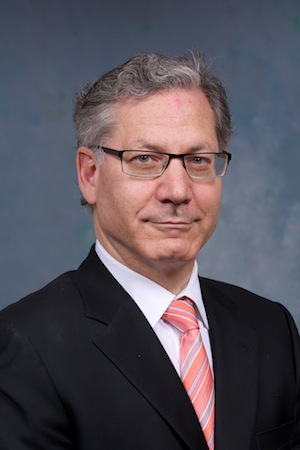
photo - Dr. Charles Bernstein
Dr. Charles Bernstein (photo from Charles Bernstein)

Speaking at the Victoria Inn in Winnipeg at a gala to raise funds for Crohn’s and colitis research, he said, “They’re associated with symptoms of abdominal pain, diarrhea, sometimes weight loss, rectal bleeding … and they’re quite common in young people. The peak age of incidents is in the 20s for Crohn’s, although it can actually present at any age.”

According to Bernstein, these diseases often mean a high burden, especially when they present in teens or young adults. “With ulcerative colitis, there is a rise in the 20s, but [the rate] plateaus. And the incidences are quite similar with every decade of life. And, since there isn’t a high mortality rate associated with the diseases, people carry these diseases throughout their life.”

Although the cause for the conditions remain mostly unknown, the doctor said research has moved forward considerably in the last decade and a half, at least in so far as understanding some of the contributing factors. Research has primarily focused on developing better “Band-Aid” solutions, such as ways to control the body’s response with anti-inflammatory and immunosuppressant drugs. “This, in a sense, allows us to put the genie back in the bottle,” said Bernstein. “In Crohn’s disease, we don’t know what’s causing the act of inflammation, so we don’t have a specific treatment. So, it’s different than taking penicillin for infectious [bacterial] pneumonia. We know we are taking the antibiotic to treat a specific thing and the pneumonia goes away.”

These diseases are more prevalent in Ashkenazi Jews, though they are by no means the only ethnic group affected. For several years, the focus has been on the genetic components to these diseases. Today, however, there is a more research into possible environmental factors, Bernstein said, and these deserve more attention.

“Indians from India are quite unlikely to get these diseases,” he said, by way of example. “Although these diseases are [now] emerging in India, the rates are substantially lower than in a country like Canada. But, when Indians move to Canada, like they do in B.C. in large numbers, they may not, as adults, get IBD while living in B.C., but their children seem to be at a comparable risk as white kids growing up in B.C. It’s an important area of investigation right now, trying to understand what these environmental factors are that drive these diseases to emerge.”

Diet is one area for research. “There’s a great interest in diet and what it is about the diet in the Western world, in particular in Canada, that may impact bugs present in our bowel and the response to them. Also, smokers are more likely to get Crohn’s than non-smokers, but we don’t understand what it is about smoking that impacts the development of the disease.”

The genetic “cure” has proved elusive as yet, even with a great deal of research in that area. “Because of all the work that’s gone into genetic work, we understand that probably most of the genes are associated with Crohn’s. But, we’ve not been able to find some gene switch to treat and, therefore, turn off the disease.”

According to Bernstein, the rate of IBD among Ashkenazi Jews is higher in Canada than Ashkenazi Jews in Israel, which, he posits may be due to the very different environment and, to some extent, different dietary patterns of Ashkenazi Jews living in Israel versus those living in Canada.

“Ashkenazi Jews have the machinery to … develop IBD when confronted with whatever the environmental triggers are, but my suspicion is that the environmental triggers are higher in North America than they are elsewhere.”

“With a rate of approximately 250 cases per 100,000 in the population at any one time, and while the rates in B.C. are slightly lower than elsewhere in Canada, the rates are as high in Canada as anywhere in the world. And the prevalence rates of these diseases amount to about 240,000 Canadians with Crohn’s disease or ulcerative colitis – probably 140,000 have Crohn’s disease and 100,000 have ulcerative colitis.”

The burden to sufferers of IBD is when they are experiencing symptoms that interfere with their work, sports or social life, their quality of life.

“We can get 95 percent of people’s symptoms controlled, so it doesn’t have to have a big impact on their life,” said Bernstein. “There are a small percentage of people with chronic, grumbling symptoms that we can’t control.”

These conditions contribute a significant cost to society, as well, when IBD sufferers are either missing work or are going to work but are not able to function to their full potential. There are also direct costs for managing these diseases via providing doctors, nursing services, medication, hospital coverage, etc.

“For some of the drugs, we use a category called ‘biologicals’ or the antibodies of TNF [tumor necrosis factors],” said Bernstein. “They can cost 30- to 35,000 dollars per year.

“Our centre in Winnipeg has been among the leaders in exploring not just the burden of the disease, but also the psychosocial factors that impact the disease – understanding how stress, anxiety and depression impact the disease and vice versa.”

Dr. Brian Bressler a gastroenterologist at St. Paul’s Hospital in Vancouver, echoes Bernstein’s concern about being too focused on the genetic component of the disease.

IBD issues become problematic when one’s immune system is inappropriately activated and causing damage and inflammation in the bowels, Bressler explained in an interview. “Many genes have been identified as putting people at an increased risk of having these problems and there are environmental influences in the world that, when exposed, can increase one’s risk of their immune system not working properly,” he said. “This doesn’t mean that if you have the gene defects you’re going to get it. It’s more likely than not that you won’t get IBD, which is why we don’t tell people routinely to get checked just because they have the genes.

“The highest risk is having a sibling who has Crohn’s or ulcerative colitis, but even if you have a sibling it’s still likely you’re not going to get it.”

When it comes to getting IBD under control, Bressler said that controlling inappropriate immune system response is key, as this leads to inflammation and to potentially serious bowel damage.

To date, there is no cure, but the focus is on ensuring that the disease is as controlled as possible. “In general, patients present with symptoms and not feeling well because of a multitude of problems,” said the doctor. “While some are able to control symptoms by changing their diet, there’s no diet that has been proven to be effective in managing IBD.”

It is important to try to make adjustments to diet and lifestyle, however. “Sometimes, patients don’t have any symptoms, but they are still having their immune system causing damage. This can lead to permanent problems in the bowel.”

Another option for some cases is surgery. There are four types of surgical procedures used to treat the symptoms of Crohn’s, for example, depending on the specific complication, the location in the GI tract and the severity of the symptoms. Surgical approaches include re-section, colectomy, proctocolectomy and strictureplasty. There is a light on the horizon for future IBD treatment, however. “Newer medical therapies are a little more sophisticated,” Bressler said. “They are a little more specific in targeting certain problems driving the inappropriate immune response. An older therapy, like prednisone [a steroid], is more [about] global control of the immune system. This is sometimes necessary and many times works, but does have a lot of side effects and long-term complications. There are newer therapies that can treat the inappropriate immune response, without leading to so many side effects.”

Rebeca Kuropatwa is a Winnipeg freelance writer.
Format ImagePosted on March 20, 2015April 27, 2020Author Rebeca KuropatwaCategories LifeTags Charles Bernstein, colitis, Crohn’s, IBD, inflammatory bowel
AJD on Road to Peace

AJD on Road to Peace

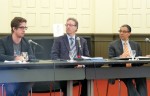
Road to Peace: left to right, Josh Morry of the Arab Jewish Dialogue on Campus, and AJD’s Howard Morry and Ab Freig. (photo by Rebeca Kuropatwa)

Founded in 2006, the Arab Jewish Dialogue (AJD) is a national organization based in Winnipeg with the goal of improving relations and respect between Arabs and Jews through dialogue and education. On Feb. 23, AJD co-founder and co-chair Ab Freig, co-chair Howard Morry and AJD on Campus founder Josh Morry spoke at the University of Manitoba on The Road to Peace in the Arab Israeli Conflict – A Conversation with the Arab Jewish Dialogue.

Of AJD on Campus compared to AJD, Josh Morry said, “We, too, discuss issues that are difficult and that often make us feel uncomfortable. The only difference is some policy statements that make our group more conducive to operating on campus.

“One of the things we added to our constitution, and I believe you can find it on the website, is that we abhor the use of name calling. Not only does this undermine policies, but it stops people from being able to engage in positive dialogue.”

The core campus group consists of six Arab members and six Jewish members. Plans are in the works for the organization to host a Middle East feast at the U of M.

Since AJD on Campus formed, Morry said, “I’ve seen firsthand a reduction in the hateful speech that undermines the policies. Jewish students feel much safer on campus now.”

About Arab and Jewish relations, Freig said, “We talk about what is the best case scenario: living in peace and harmony, prosperity, cooperation. We talk about that and understand it. Then we talk about the obstacles and how we can overcome them. We both need to identify what’s best for us.

“That’s the basics of what we do. In order for us to do that, we needed to dig deeper. No one seems to dig deeper to understand. So, I’ll meet with people and start with a discussion on how to take it from here.”

Freig has witnessed how what starts in the dialogue group passes onto children, cousins, and further.

Howard Morry provided an example of how, simply by acting from a humanistic level, he was able to restore trust within the group after one of the times Israel sent its military into Gaza. He told those gathered that the Jewish members were sorry for any loss of life during the operation. “Once I said that, it was as if the oxygen was put back in the room,” he explained. “The people that were sitting cross-armed changed their posture to a more open one. And then, continuing with this … we actually had a very productive talk – politically, strategically, and at every level. But, until that moment, we had lost all the trust in that room and we couldn’t move any further.”

Recently, AJD has been talking a lot about ISIS, working to understand who is supporting them, how they are getting the money and what is driving them. And, because of the violence that happened in France with Charlie Hebdo, they also took some time to discuss the Prophet Mohammed.

“There was a Muslim Arab in the group who explained [the concerns] to the other members,” said Freig. “We issued a statement. We condemn violence and we support freedom of expression and [the] press. We put together a press release, signed by the Jewish and Arab members.”

While AJD has been going strong for nine years, creating the same kind of openness and trust within a university setting will be a challenge. “Unless you’re a really bad student, you’re not going to be part of this group for nine years, because you graduate,” said Josh Morry. “I think before we expand across Canada, we have to expand across Winnipeg. So, it would be nice to a get a student here to set up a group at the University of Winnipeg (U of W).”

He noted that it may be easier for AJD on Campus to expand to schools on the East Coast. “People are much more eager to join student groups and get involved there,” he said. “Our model is easy to replicate. The constitution is easy to duplicate, using very general terms.”

Freig stressed that, within both groups, members do not “agree on everything, [but] we don’t really need to, to have a dialogue. We discuss difficult topics and keep talking about it, and hash over the issues until we get to an understanding. That’s what we try to achieve.

“It’s not necessarily an agreement, but an understanding – understanding each other’s narratives. There are some issues we are in too deep with, so we have one meeting after another, trying to get the other person to understand. If you don’t understand where the other person’s coming from, you won’t ever get over being at odds with one another. We still have work to do.”

Howard Morry added, “One of the great gifts of this group is that it gives you a chance to explain things more than once. In this group, we approach issues in different ways. Over time, listening to each other, there’s an understanding with some members, but not with others.

“I’ll tell you that the happiest moment I think I’ve had is when I’ve said something the 16th time over a two-year period, and I had one of the members come up to me and say, ‘Howard, you just changed my life.’”

Both groups hope to inspire the broader Canadian population with how well people – not only Arabs and Jews – can get along by speaking to each other respectfully, not jumping the gun, and not just trying to be right. They see their groups as a learning tool for life, teaching how to get along with others and to build trust.

“Our intention is to extend throughout Canada and then maybe we will inspire people in the Middle East,” said Freig.

Co-chair Morry added, “While we want there to be peace, our group is focused on Canadian Jews and Arabs.… We were concerned when we first started, not wanting to become like Europe. There was a lot more violence and disagreement and no dialogue at all.

“The idea is that when you get dialogue amongst the people who’ve chosen to live in Canada, over time, it will hopefully influence the rest [of the world].”

Rebeca Kuropatwa is a Winnipeg freelance writer.
Format ImagePosted on March 13, 2015March 11, 2015Author Rebeca KuropatwaCategories NationalTags Ab Freig, Arab, Arab-Israeli conflct, dialogue, Howard Morry, Jewish, Josh Morry, peace
Using art to bridge peoples

Using art to bridge peoples

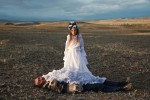
The gallery includes work by Almagul Menlibayeva of Kazakhstan. (photo from AMOCAH)

When people in Israel saw that Belu-Simion Fainaru and his partner Avital Bar-Shay were considering opening yet another art museum/gallery, some eyebrows were raised. But what this dynamic duo in life and in art had in mind was much more than another one-dimensional art space. Their far-reaching ideas will likely quiet the doubts of any naysayers.

Fainaru and Bar-Shay, both Jewish artists living in Haifa, decided to create an art meeting space for Jewish, Christian, Muslim, Bedouin and Druze artists – a place where they could display their art alongside one another. They created the Arab Museum of Contemporary Art and Heritage (AMOCAH) in Sakhnin in the Lower Galilee, which was declared a city in 1995 and has a population of 25,000 of mostly Muslims and a minority of Christians. It also is home to a significant population of Sufis, Muslims who adhere to a mystical stream of Islam.

Bar-Shay and Fainaru originally met in Israel. Fainaru made aliyah from Romania in 1973. A successful visual artist, he has curated exhibits around the world, making international connections along the way. Bar-Shay is an Israeli-born artist, designer and architect. She has exhibited in Israel and abroad and has vast experience in public art, working as a cultural entrepreneur. She specializes in artistic activity in the periphery.

The idea for AMOCAH started with Fainaru and Bar-Shay initiating and curating the Haifa Mediterranean Biennale four years ago. This led to a second biennale in 2013, which took place in Sakhnin. At the Haifa biennale, they used shipping containers to exhibit the artwork. In Sakhnin, the biennale was held in a building that the town’s mayor offered for the occasion.

“Right now in Israel, a lot of … Jewish people feel a special energy when it comes to Sakhnin,” said Fainaru. “So, we did this big project in the Sakhnin area, where a lot of Jewish people are already using various art mediums to bring communities together.”

Fainaru said that the various communities do not usually do things together and, even within the Arab community, Muslims and Christians generally keep to themselves.

“The art will have an urban dimension and we can approach art for a population that’s not very familiar with contemporary art,” said Fainaru. “We think it’s important to decentralize the art scene in Israel.”

Going with the biennale (Italian for every two years) concept seemed the most feasible, with politics and budgets in Israel regularly being in flux. “We had a big project with the Ministry of Education, but a few months after we decided to move ahead with [the minister], he [had] just resigned,” noted Fainaru, as an example.

While the idea of a biennale was born 100 years ago in Venice, Fainaru and Bar-Shay wanted to go with that premise and added a new twist – creating a biennale melting pot of cultures, and eventually transform that into a permanent museum in Sakhnin.

“We think countries around Israel and the Mediterranean should cooperate and exchange ideas in the area of contemporary art,” said Fainaru. “We put a lot of emphasis on education and doing workshops with artists from abroad.

photo - Afghani-German artist Jeanno Gaussi’s work is at AMOCAH
Afghani-German artist Jeanno Gaussi’s work is at AMOCAH. (photo from mfa.gov.il)

“We want to develop projects under the umbrella of the biennale and museum, also with Jewish and Arab children – the next generation – to communicate and get to know each other, have fewer misconceptions, and make a better living here not based on violence.”

It took some time and meetings with the right people to get the Sakhnin museum off the ground. Fainaru and Bar-Shay met with the mayor of Sakhnin, Mazin G’Nayem, who was open to the idea. The mayor spoke with his culture deputy and the pieces began to fall into place.

“He [the mayor] thinks it’s important to have contact between Jews and Arabs, as we have to live together,” said Fainaru. “He understands that art will help the people of Sakhnin and promote coexistence between Jews and Arabs. He saw that with the football team he put together that has Jews and Arabs playing together.”

During the first biennale in Sakhnin in 2013, Sakhnin was flooded with people coming to participate in the festivities. AMOCAH is open to the public and, so far, the majority of the visitors have been students of contemporary art. The educational component of the museum is still being developed. “We hope, with these educational activities with the biennale, Israel’s sense of art will become known to people all around,” Fainaru said.

AMOCAH carries art from the various cultures in the region and from different religions, but Fainaru is especially proud of the art coming from countries without political ties to Israel, like Syria, Iraq, Iran, Afghanistan and Turkey.

“Normally, relations between Israel and Turkey are very bad,” he said. “Even I was dismissed from a biennale exhibition in Turkey, because of war between Israel and Gaza [last] summer.”

To facilitate cooperation between the Jews and Arab artists involved, the biennale and the museum are being organized by both communities.

“Tel Aviv-area people are self-sufficient in art, culture, cinema, food … in life,” said Fainaru. “They don’t feel they have to go to another place inside Israel. But, in the periphery, what we’re doing is creating an alternative activity in art in Israel and having an influence on life here – making a change and bringing art to people while incorporating cooperation between Jews and Arabs and neighbors around. This is just a beginning.”

The next Sakhnin biennale is scheduled for the end of 2015, with Fainaru and Bar-Shay already working to bring in the works of many new artists from Israel and abroad.

Rebeca Kuropatwa is a Winnipeg freelance writer.
Format ImagePosted on February 27, 2015February 26, 2015Author Rebeca KuropatwaCategories IsraelTags AMOCAH, art, Avital Bar-Shay, Belu-Simion Fainaru, Israel, Sakhnin biennale
Halper talks across Canada

Halper talks across Canada

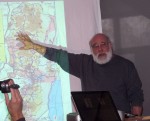
Dr. Jeff Halper speaks at the University of Manitoba on Feb. 9. (photo by Rebeca Kuropatwa)

Dr. Jeff Halper, an Israeli anthropologist and Nobel Peace Prize nominee, spoke on four different occasions in Winnipeg over two days, Feb. 8 and 9, as part of a cross-Canada speaking tour, which also brought him to Vancouver Feb. 10-12. He is the head of the Israeli Committee Against House Demolitions (ICAHD), an organization self-described as “dedicated to ending the Israeli occupation and [that] advocates for a just peace between Israel and the Palestinian people.”

The first of Halper’s Winnipeg talks was An Israeli in Palestine, and it was held at Crescent Fort Rouge United Church. He then spoke at the University of Manitoba on Academic Freedom and the Israeli-Palestinian Conflict, reprised An Israeli in Palestine at the University of Winnipeg and, finally, did an interview with Jewish Post & News editor Bernie Bellan at the Free Press News Café (which can be found at icahd.org/node/568).

The U of M lecture on Feb. 9 was sponsored by the department of history, the Centre for Professional and Applied Ethics, and the Global Political Economy program. Halper began this talk by saying that “the side” most people are aware of is the one that “only demolishes houses of terrorists and that is trying really hard to make a fair peace with the Palestinians.” But, he said, people are not very aware of the side that is “building settlements in the West Bank and refusing to issue building permits to Palestinians in the West Bank.”

According to Halper, Israel has been working for years to physically eliminate the proposition of a two-state solution by creating in the West Bank a Palestinian territory that is so fragmented with Israeli settlements that such an option is no longer viable. “A solution that the Israeli peace camp, including myself, supported for many years … the solution accepted by the international community … U.S., Canada, the UN, the Palestinians and every Arab country, is gone,” he said.

Halper believes that the two-state solution is “tremendously pro-Israeli.” He said, “If Israel in fact wants peace and security, it could have had that 27 years ago. And, it could have kept 78 percent of the country. This two-state solution was adopted unanimously by the Arab League. Every Arab country said that if Israel relinquishes the occupation, we will not only make peace with Israel, we’ll integrate Israel into the region. There was even talk of Israel joining the Arab League.”

In Halper’s view, “Israel has always said no and never seriously considered a two-state solution…. In 1993, there were 200,000 settlers. By the year 2000, after seven years of negotiation, there were 400,000 settlers. Today, there are 600,000 settlers. In four years from now, there will be a million Israelis living in the occupied territory.

“What Israel has done to ensure its permanent control, to ensure that the Palestinians are imprisoned in areas, is not a bi-national state … heaven forbid, because it has to be a Jewish state…. There’s no chance Israel will be forced out of the occupied territory. Israel has laid over the West Bank what I call ‘a matrix of control.’”

Halper argued, “There is no more West Bank: it’s gone. There are today more Israelis living in east Jerusalem than there are Palestinians. And whether it’s east Jerusalem or the West Bank, Palestinian territory is completely fragmented.

“Also, out of the 600 checkpoints in the West Bank, only 17 are actually between the West Bank and Israel. All the others are inside the West Bank, preventing Palestinian movement, confining them to these islands.

“How will a Palestinian state emerge from this?” he asked. “The whole idea of the two-state solution was based on a north/south axis, here’s Israel and, alongside, it’s a Palestinian state.”

Halper sees Israel as “working to force Palestinians out of homes located in the ‘wrong’ place, largely through house demolition. None of those homes had anything to do with security.”

As an example, Halper used the house of ICAHD member Salim Shawamreh. To date, said Halper, that home has been demolished and rebuilt by the ICAHD six times. “They bought a small plot of land in the town of Anata, which is right next to Jerusalem,” said Halper. “The land is registered. When they went to apply for a building permit, the answer was ‘no.’ Israel has zoned the entire West Bank as agricultural land so, when a Palestinian comes to build a home on land he owns, the answer is ‘Sorry, but this is agricultural land.’ It applies to Jews and Arabs.”

Beside Anata is the Israeli town of Ma’ale Adumim, which, Halper said, is built on the same agricultural land with a permit. “You have 50,000 Israelis living in government-built cities on the same land,” said Halper. “If you want to rezone from agricultural to residential, it takes a second.”

Many families build without a permit, said Halper, and Shawamreh “decided to build his house without a permit and the Israeli authority sent a demolition order with a dozen solders. They aren’t coming to arrest him. They’re coming to demolish his home…. Salim resisted and was taken out by force. His wife, Arabiya, managed to lock the door and stayed inside with the children. So, the soldiers broke the windows and threw in tear gas to flush the family out. Arabiya was taken out unconscious, the kids running and screaming in every direction. We get into the act if we can. She managed to call us … [and] we resist the demolition of homes.

“We rebuild homes as political acts of resistance,” he continued. “We’ve rebuilt 587 homes over the last 14 years or so … 587 joint acts of resistance. We refuse to be enemies. That’s one of our slogans.”

Halper’s tour, organized by United Network for Justice and Peace in Palestine/Israel and Independent Jewish Voices-Canada, as well as various local groups, fundraised for ICAHD’s building of a house for a Palestinian family whose home was demolished. Admission to events was free, though donations were welcomed.

Rebeca Kuropatwa is a Winnipeg freelance writer.

Format ImagePosted on February 27, 2015February 26, 2015Author Rebeca KuropatwaCategories NationalTags ICAHD, Israel, Israeli-Palestinian conflict, Jeff Halper, Palestinians, Salim Shawamreh

Taking care of elders

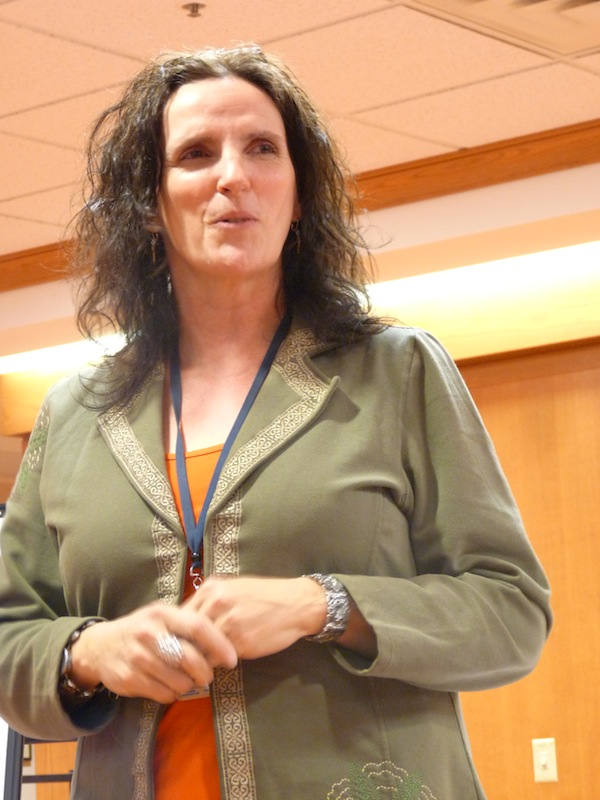
Cindy Greenlay, therapeutic recreation manager at Winnipeg’s Simkin Centre, is one of the first to admit that no one plans to retire and move into a care home. But, she explained, “Circumstances happen and the support we’re able to provide here is something needed in the community.”

On Feb. 18, the women’s philanthropy of Combined Jewish Appeal (CJA) in Winnipeg hosted an educational evening at the Simkin Centre on the centre’s programming. Daniela Jacobson, co-chair of women’s philanthropy, began the event, noting that the Simkin Centre “is our newest agency to the Jewish Federation of Winnipeg.” She then gave the floor to Greenlay.

photo - Simkin Center’s therapeutic recreation manager, Cindy Greenlay
Simkin Center’s therapeutic recreation manager, Cindy Greenlay. (photo by Rebeca Kuropatwa)

According to Greenlay, people don’t come to the Simkin Centre at the end of their lives to die – they come to continue living. Something about which the centre staff feel strongly is the importance of getting to know each of the residents individually. “We don’t assume that everyone who is 75 likes to play Bingo,” said Greenlay by way of example.

The staff meet with each resident several times and gather as much information about what he/she likes to do, so they can build activities to match. One of the most important things to understand, said Greenlay, is that residents have a lot of free time on their hands and the centre needs to fill that time with relevant programming.

“We need to do that every single day – 13 hours a day,” she said. “As 80 percent of our population is cognitively impaired, so we have some people here who make those choices…. We’re all trained in specific areas to adapt to different disabilities…. We have one recreation staff for every 40 residents. That person works five days a week to fill up this big piece of the pie.”

The centre’s programming is funded by the local Jewish federation and private donors.

“To brag a little bit, our facility is chosen every year by Red River College to bring the recreation students to,” said Greenlay. “The students come here every fall to see what they want to be when they ‘grow up.’ They shadow our staff every fall to see what the programs are supposed to look like.”

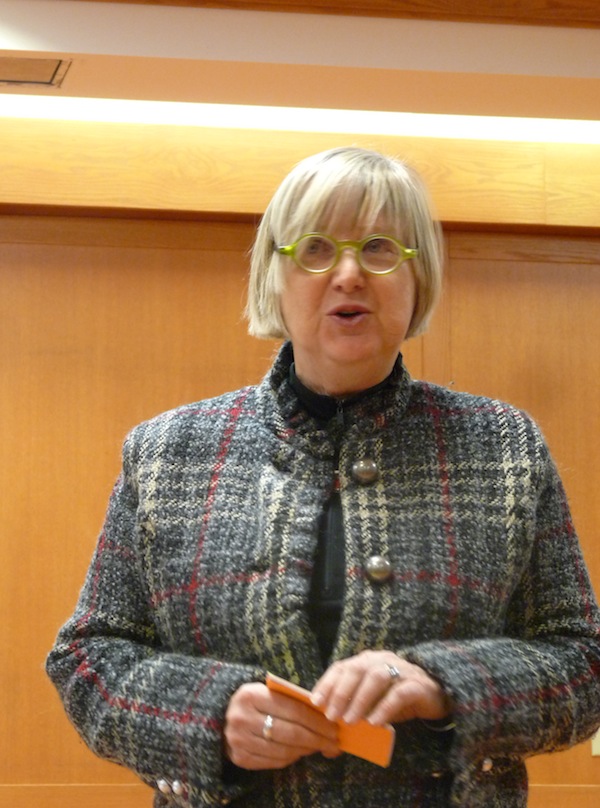
Until a year ago, Simkin’s spiritual health care was led by Rabbi Neal Rose, and it was based on a chaplaincy model. “Once Rabbi Rose retired, the board met and did some rethinking,” said Barb Findlay, the centre’s spiritual health care practitioner. “They researched what spiritual health could look like going forward. I think that in the whole world – and the Jewish world is not different – generally, people today are less religious and more spiritual. People use yoga and meditation and different ways to access the Divine. It’s interesting, as I go around and meet new residents and introduce myself, I get one refrain that I hear all the time, ‘Wait a minute. I’m not too Jewish.’ And, you know, actually, they are very Jewish.”

photo - Barb Findlay, Simkin Centre’s spiritual health care practitioner
Barb Findlay, Simkin Centre’s spiritual health care practitioner. (photo by Rebeca Kuropatwa)

Spiritual health has been recognized by the Canadian Medical Association and the Winnipeg Regional Health Authority (WRHA) as an integral part of the health profile, which includes physical and emotional health.

“Spirituality is defined as that which gives meaning and purpose to life, besides the physical,” explained Findlay. “The purpose of spiritual health is to symbolically walk beside people and to occupy that liminal space between what’s known and what’s not known in life.”

Although the overwhelming majority of people at the Simkin Centre are Jewish, the centre operates as the Victoria Hospital emergency placement location. As such, the spiritual health personnel have to provide support for people from all religions, including Buddhists, Catholics, Evangelical Christians and First Nations.

“What is important is their belief system and helping them to boost that and work with that for whatever needs they have,” said Findlay. “Israel has embraced this new profession. They named it the ‘livui ruchani,’ which is Hebrew for ‘spiritual accompaniment.’

“The Simkin population is roughly 200, and about 15 percent aren’t Jewish,” she continued. “The average age is 90, and about 85 percent of our people have some element of dementia. Ninety-six percent of elders live out their lives in the community with or without some supports, so, what we have here is a very small percentage of our elderly population – about four or five percent.”

Dr. Harvey Chochinov, a geriatric psychiatrist in Winnipeg, has dedicated much of his work focus to end-of-life care, and has found that distress at the end of life is usually connected with people feeling as though they are a burden.

“He’s developed a whole process which involves questioning and reflection, so we can help people review and rebuild, and hopefully move away from feeling they’re a burden for their loved ones,” said Findlay.

The evening’s talk ended off on a lively and light note, with Cindy Bass, the centre’s music therapist demonstrating how she engages residents. “Music memory is one of the last remaining faculties for the elderly population with Alzheimer’s disease,” said Bass. “For example, if you take a song like ‘My Bonnie Lies Over the Ocean,’ everybody knows it. And it’s been shown that some people who can’t speak anymore can still sing, which is also why it works well as therapy for stroke victims, helping them relearn to speak.”

Music can increase attention span and be very useful for the cognitively impaired, she added, as it opens new brain pathways, evidence of which has been seen using MRIs.

Bass led the crowd in a few songs to illustrate the power of music and she explained the many benefits gained through music, including the building of community ties and increased socialization, as well as its use in prayer and to enhance self-expression.

“Music,” she said, “provides people of all ages, regardless of disability, with ample opportunity for meaningful responses to all aspects of our environment.”

Rebeca Kuropatwa is a Winnipeg freelance writer.
Posted on February 27, 2015February 26, 2015Author Rebeca KuropatwaCategories NationalTags Barb Findlay, Cindy Greenlay, Daniela Jacobson, elderly, health care, Jewish Federation of Winnipeg, Simkin Centre
Great in Uniform sees potential

Great in Uniform sees potential

Cpl. Ben Levi is a participant in the Great in Uniform program. (photo from Israel Defence Forces)

The program Great in Uniform aims to integrate young Israelis with special needs into the Israel Defence Forces. To date, some 200 youths have been successfully integrated through the program into administrative and logistical positions in the IDF’s air force and home-front command.

The program was founded by Lt. Col. (Res.) Ariel Almog, who became disabled while serving in the IDF when responding to a terror attack. Eventually, he began looking for a way he could return to the army. He then realized that he would like to help make this a reality for others with disabilities, too.

Typically, Israeli teens with special needs are granted an exemption from obligatory military service. By opening a window and creating a support system for those wanting to volunteer to join the army, the IDF is making it possible for these young Israelis to be integrated into the army with their peers. The teens begin as volunteers, serving in various roles. In some cases, they can get advanced training and even become officers.

This has been the case with Ben Levi. Levi was diagnosed with cerebral palsy (CP) when he was born. He has learned to live with his disability and the 21-year-old longed to join the army and follow in the path that many in his family have taken: he wanted to serve in a fighting unit.

Levi said he currently works “in the storage room, which is part of the logistics force in the home command. When I have trouble, people help me, but I don’t feel I’m a volunteer. I feel I am a solider for all intents and purposes. I try to do what I can. I am disabled and it’s not obvious at all that I would have gotten as far in the army as I have.

“I can tell you a secret,” he added. “I’m actually interested in going for the officer’s course.

“I’m really happy I got to draft and that I get to serve the country,” he said.

Levi said he feels like a soldier just like any other, and has many friends on the base. When he runs into difficulty, he knows he has his family’s support. In fact, Levi’s family has gotten involved in the IDF program.

“It’s fantastic to wake up every morning and know that I am serving my country, have a job and a way to contribute – it proves to me that CP can’t limit me,” said Levi. “You come into the army as a child and you come out as a full grown person.”

Levi’s commander, Ariana Goldsmith, 18, is originally from Long Island, N.Y. She has been living in Ra’anana for the past seven years after making aliyah with her family.

Goldsmith’s becoming a commander of special soldiers was her own “dream come true,” she said.

“I’ve been volunteering for many years with people with special needs [with] Yachad. My cousin is special needs, I grew up with him, and I’ve been volunteering since I was younger for different organizations.”

Although Goldsmith only joined the IDF four months ago, she was given the title of commander to allow her to do her job – escorting special needs soldiers on base.

“Since I heard about this program, this job has been my dream,” said Goldsmith. “There’s no other job I want to do. So, I ended up getting in contact with the head of the program … it took a long time, about a year and a half, and a lot of working it out with the army, but it ended up working out.

“This is an unbelievable program – to see these kids … they just want to do it so bad. There are so many soldiers in the army who aren’t that into [serving]. You know, everyone has to [serve].” Those with disabilities, however, “don’t have to do the army,” she continued. “They want to, to give back, and they are unbelievable.”

Goldsmith is the only escort in the program at the moment, but that is not stopping her from blazing a trail for future escorts. “With my experience, I can give back to the program and make it more of an official job … so that, after me, more people can go into the army and become a commander for this program.”

Goldsmith feels most units in the army would benefit tremendously from incorporating special needs soldiers, and that the benefits of the program are greater for able-bodied soldiers than they are for special needs soldiers. “I think the base and soldiers get so much out of seeing these [special needs] soldiers being volunteers, and that all they want to do is work. They gain so much from seeing them, they learn a life lesson. Some of these soldiers have never seen special needs people before…. By seeing them and working with them, they gain so much patience and they make connections with them…. This really raises the morale on base in general.”

Rebeca Kuropatwa is a Winnipeg freelance writer.
Format ImagePosted on February 20, 2015February 19, 2015Author Rebeca KuropatwaCategories IsraelTags Ariana Goldsmith, Ben Levi, Great in Uniform, IDF, inclusion, Israel Defence Forces
Cleaning up oil in Arava

Cleaning up oil in Arava

The Tran-Israel oil pipeline spill near the Evrona Nature Reserve in the Arava Desert has harmed flora and fauna. (photo by Menachem Zalutzki via Israel Ministry of Environmental Protection)

On Dec. 3, 2014, a fractured pipe created the biggest oil spill in Israel’s history, releasing some five million litres of crude oil far into the Arava Desert. In the days that followed, experts from around the world were contacted to clean it up, including from the Hebrew University of Jerusalem.
photo - Hebrew University’s Dr. Yoel Sasson (pictured here) and his colleague Dr. Uri Stoin have developed a technology that can treat waste caused by any organic compound, including oil
Hebrew University’s Dr. Yoel Sasson (pictured here) and his colleague Dr. Uri Stoin have developed a technology that can treat waste caused by any organic compound, including oil. (photo from Yoel Sasson)

Dr. Yoel Sasson, a professor at Hebrew University’s Casali Institute of Applied Chemistry, specializes in environmental catalysis, and he and student Dr. Uri Stoin have developed a soil decontamination process that can treat waste caused by any organic compound, including oil.

According to Sasson, spills are common in countries where oil is being moved by pipes and, considering how old the pipe is in Israel, it was just a matter of time that such a leak would occur, he said.

Exacerbating the situation was that it took hours for the break to even be detected. “It’s horrible, because the oil is simply killing everything,” said Sasson. “All the farmland, the flora and fauna … nothing is left alive once the oil is there.”

The Ministry of the Environment is now in charge of cleaning up the spill and they will have to select the contractor to do the job. According to Sasson, there are several companies that have placed bids, one of which is Man Oil Group, the Swiss company licensed to commercialize this technology developed at HU.

A superoxide, the technology is a variation of an oxygen molecule. “Unlike the oxygen molecule, which is relatively inert, superoxide is a very aggressive, free agent,” explained Sasson. “And it actually oxidizes every organic material.”

It works by breaking down the organic (carbon-based) matter into water and CO2, and the organic material very rapidly oxidizes, he explained. “Normally, within 10 minutes, oil simply disappears … the soil re-mineralizes,” he said.

“As the oil is killing everything, when you apply the agent, you do not revive the plants, but you take the soil back to its virgin condition. And then, with time, nature will come back. We estimate six to 12 months, [then] it comes 100 percent back to life.”

The CO2 released in the process can also be neutralized and turned into sodium carbonate, which is soluble with water. With rain, it will be washed away.

Typically, technologies of this kind are termed as either “biological” or “chemical.”

Biological means bacteria is applied (i.e. eating or digesting the oil), a technique that has been used for many years. While this does work, it has some drawbacks. “It’s very slow,” said Sasson. “It would take a half a year to a year to start to see something developing. And it requires excavating the soil, digging it out, so the bacteria will have some air. They are aerobic material.

“Our method is chemical,” he continued, “which means it’s fast, a matter of minutes, actually.”

Sasson estimated that the oil did not seep deeply into the Arava soil, approximately 10 or 20 centimetres maximum. Regardless, he said, the agent is not limited to any particular depth. It can be drilled into the soil and the whole treatment can take place underground.

photo - A cormorant that fell victim to the oil spill
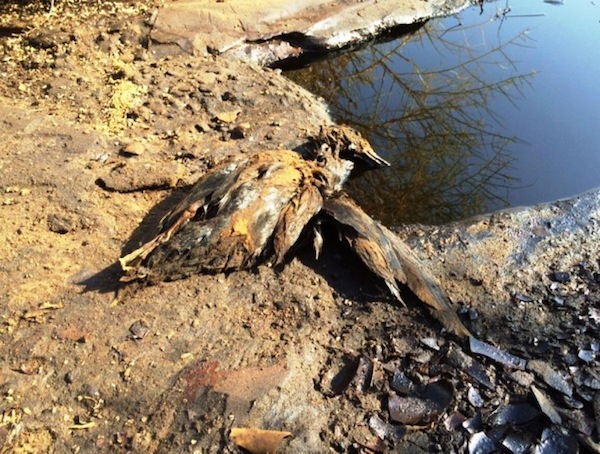
A cormorant that fell victim to the oil spill. (photo by Menachem Zalutzki via Israel Ministry of Environmental Protection)

Man Oil Group has been cleaning up oil spills with superoxide in Siberia, Africa and in the Gulf States, and is now looking at the soil in the Arava. The areas that it cleaned in Siberia were larger than that of the Arava spill, and the company has also conducted a successful test cleaning a stretch of a Swiss railway track. The track base, which is comprised of limestone, was restored to its white state, eliminating years of oil drips that were becoming an environmental problem, killing everything around it. Man Oil also conducted a test on the Arava spill site, with positive results.

According to Sasson, oil-caused damage is a worldwide problem that is very serious. But he is focused on cleaning up other contaminated areas as well, one of which is the result of military industries that have left organic pollution underground in Jerusalem.

“This particular case involves mainly those from a group of materials called ‘organic chlorine compounds,’” said Sasson. “These types of compounds, nature doesn’t recognize, and they are polluting underground water. It’s really a disaster.

“When we started, we worked on the destruction of these materials. This was very successful. But, we noticed it takes a lot of time with the authorities to get permission. It takes many years to start such a cleanup. Meanwhile, the oil cleanup is faster and is needed in many more places.”

Another application focus for Sasson is sewage sludge, a by-product of bacteria used to digest sewage waste being disposed of into the environment, causing contamination.

“You feed bacteria your waste,” said Sasson. “They convert the waste into CO2 and water again but, at the same time, they are growing. And, normally, for one kilogram of waste, you will build up a weight of about 450 grams of bacteria (about 50 percent) and then you create a new waste. So, instead of having one kilogram of waste, now you have half a kilogram. But you’re still stuck with it, because there’s nothing to do with the bacteria. So, what we are trying to do is really decompose this waste using our agent. So far, initial experiments show it is working but, of course, we have to substantiate it and develop it into larger scale.”

At press time, Sasson was still waiting to hear from the Ministry of the Environment if the process they developed will be chosen to clean up the Arava spill.

 ***

The Evrona Nature Reserve rehabilitation team began its work on Jan. 12, 2015, with a meeting headed by Deputy Environmental Protection Minister Ofir Akunis. Air quality tests found that there has been a 90 percent reduction of pollution in Evrona, one of the sites most harmed by the December 2014 oil spill in Israel’s southern Arava region. Some 30 companies are now vying to be selected to decontaminate the soil that was contaminated by the oil spill. The reserve, noted Akunis, will open once there is no fear that the health of visitors could be affected. The hope is that this will be in the near future.

– Israel Ministry of Environmental Protection (sviva.gov.il)

Format ImagePosted on February 13, 2015February 12, 2015Author Rebeca KuropatwaCategories IsraelTags Arava, Casali Institute, Evrona, Hebrew University, oil spill, superoxide, Yoel Sasson
Writing key to kids’ literacy

Writing key to kids’ literacy

Prof. Dorit Aram noticed that young children, prior to going to school, long to write. (photo from Dorit Aram)

According to a recent research from Israel, learning to recite the alef bet alone does little to help children advance their literacy – children should be learning to write, and before they even enter the school system.

The team’s lead researcher, Prof. Dorit Aram, maintains that longstanding misconceptions are getting in the way of children’s abilities.

Aram teaches at Tel Aviv University’s Jaime and Joan Constantiner School of Education specializing in adult/child early interactions and their relationship to children’s early literacy and social-emotional adjustment. The research was conducted in collaboration with colleagues at American universities and was published last year in Early Childhood Research Quarterly.

“My research started with children that come from lower socio-economic backgrounds,” said Aram. “What we see is that there are gaps between children in terms of their reading and writing achievements.”

As reading and writing are key to children’s academic success, Aram “was interested in how parents could promote their children’s literacy, in particular those from lower socio-economic backgrounds.” This particular study, however, looked at a group of ethnically diverse, middle-income preschoolers.

Aram began studying literacy with one of the leading early literacy researchers in the world, the late Dr. Iris Levin, working with her, examining children’s early writing development. Levin was a developmental psychologist at the School of Education at Tel Aviv University. She passed away in 2013.

“People are so busy with reading,” said Aram, “but considering young children, in particular, I felt writing was even more fascinating than reading, because it’s more active in its communication.”

Aram noticed that young children, prior to going to school, long to write. She recalled a child asking his father how to write a word, in one case. The child’s father gave him the letters, and Aram was left to wonder, “Did the father know he was really mediating, ‘scaffolding,’ his child’s early literacy?”

Aram began studying such interactions to determine ways in which a parent can “scaffold” his/her child’s understanding of the writing system, help them segment a word into its sounds, connect the sounds with the letters, and understand how to build words.

“I saw in my research that the more the parents help the child understand that written language is really symbolizing the spoken words, and that … when the parents really encourage the children to segment the word into its sounds and then retrieve the letters, the more the parents did it (this is what we call the graphophonemic mediation) … the children were doing better,” said Aram.

Working with children in preschools, Aram discovered that teachers were reluctant to work with kids on their writing literacy. “In the beginning, it was difficult for them because they connect writing to school and felt like they were taking away from the kids’ childhood,” she explained. “They’d say, ‘Well, these kids will have so much writing in school. Why do we have to bother them with writing now?’”

According to Aram, the teachers were not considering the possibility that the kids might want to be able to write out the names of their friends, their telephone number, or how they feel.

“Then they saw it’s not against the preschool spirit, that it can fit very well with it,” she said. “And because they were practising letters and phonological awareness, these things were part of their early literacy curriculum anyway.

“The teachers were unaware that you can combine it and have kids write. And, the writing makes the children happy, because they’re doing something meaningful – allowing them to do more than just practise letters, allowing them to really communicate.”

Aram and her team worked with children as young as 3.5-years-old on writing and letter knowledge, graphophonemic understanding, and early writing – not with a pencil, but with magnetic letters or stickers, for example.

“We saw that it worked beautifully,” said Aram. “These children did very well at the end of our intervention year, and it even predicted their achievements and the pace of their development the year after.”

According to Aram, the key is helping the child segment the different letters and the sounds they make. In her research, Aram has found that kids who were taught to connect a letter with the sound the letter makes progressed more than the other groups.

“What amazed us was that the children who received feedback – like so many children of American parents do – by just giving the children the names of the letters, it didn’t help the kids. It was just as good as saying to the kids, ‘Write this word again,’ without any feedback.”

The technique is more challenging to teach in English than in Hebrew, said Aram. However, she added, “From the studies done in English, we found it is still very useful to segment the word into sounds and connect sounds with their letters. Also, to motivate children to write and to respect their writing, even if it’s not 100 percent.”

About English, she explained, “If you think about Italian or other Romance languages, English took all the ‘difficulties,’ and it’s so difficult to see the connection between sounds and letters.”

But that shouldn’t stop parents and teachers from introducing writing into the kids’ daily lives. “For example, if you want, you can send emails, you can [help them] send a ‘Hi Daddy, I love you’ note … or you can write what you want to eat tomorrow, just little things – a word here, a word there.”

Aram noticed, on her visits to North America, that many homes in the United States and Canada have magnetic letters on their fridges. She suggested, “Instead of just naming the letters, write [a] word and do things that are meaningful. Letters, by themselves, are less meaningful. But writing is for communication and writing is meaningful…. It doesn’t have to mean you do a lot of writing, just two words here or there, a sentence here or there – that makes a huge difference, and children love it.”

Rebeca Kuropatwa is a Winnipeg freelance writer.
Format ImagePosted on February 6, 2015February 5, 2015Author Rebeca KuropatwaCategories LifeTags Dorit Aram, education, literacy, Tel Aviv University

Posts pagination

Previous page Page 1 … Page 26 Page 27 Page 28 … Page 31 Next page
Proudly powered by WordPress