Skip to content
  • Home
  • Subscribe / donate
  • Events calendar
  • News
    • Local
    • National
    • Israel
    • World
    • עניין בחדשות
      A roundup of news in Canada and further afield, in Hebrew.
  • Opinion
    • From the JI
    • Op-Ed
  • Arts & Culture
    • Performing Arts
    • Music
    • Books
    • Visual Arts
    • TV & Film
  • Life
    • Celebrating the Holidays
    • Travel
    • The Daily Snooze
      Cartoons by Jacob Samuel
    • Mystery Photo
      Help the JI and JMABC fill in the gaps in our archives.
  • Community Links
    • Organizations, Etc.
    • Other News Sources & Blogs
    • Business Directory
  • FAQ
  • JI Chai Celebration
  • JI@88! video

Recent Posts

  • Sharing her testimony
  • Fall fight takes leap forward
  • The balancing of rights
  • Multiple Tony n’ Tina roles
  • Stories of trauma, resilience
  • Celebrate our culture
  • A responsibility to help
  • What wellness means at JCC
  • Together in mourning
  • Downhill after Trump?
  • Birth control even easier now
  • Eco-Sisters mentorship
  • Unexpected discoveries
  • Study’s results hopeful
  • Bad behaviour affects us all
  • Thankful for the police
  • UBC needs a wake-up call
  • Recalling a shining star
  • Sleep well …
  • BGU fosters startup culture
  • Photography and glass
  • Is it the end of an era?
  • Taking life a step at a time
  • Nakba exhibit biased
  • Film festival starts next week
  • Musical with heart and soul
  • Rabbi marks 13 years
  • Keeper of VTT’s history
  • Gala fêtes Infeld’s 20th
  • Building JWest together
  • Challah Mom comes to Vancouver
  • What to do about media bias
  • Education offers hope
  • Remembrance – a moral act
  • What makes us human
  • המלחמות של נתניהו וטראמפ

Archives

Follow @JewishIndie
image - The CJN - Visit Us Banner - 300x600 - 101625

Byline: Lauren Kramer

Our national movie history

Our national movie history

Making Movie History panelists during DOXA Industry Day at the SFU Goldcorp Centre for the Arts on May 7, left to right: Michelle van Beusekom, head of the National Film Board of Canada’s English-language production branch, and filmmakers Mort Ransen, Bonnie Sherr Klein and Anne Wheeler. Panel moderator was Marsha Lederman of the Globe and Mail. (photo by Fortune Hill Photography courtesy of NFB)

When it comes to their own history, Canadians haven’t had a great track record for recording their success stories. So, when Michelle van Beusekom had an opportunity to produce Making Movie History: A Portrait in 61 Parts, an anecdotal history of the National Film Board of Canada, she was thrilled to jump on board. Told through portraits of legendary artists and filmmakers who have worked at the NFB since its establishment in 1939, the free iPad app was released last month at the DOXA Film Festival in Vancouver.

Present at the launch were B.C.-based filmmakers Mort Ransen, Bonnie Sherr Klein and Anne Wheeler, who participated on a May 7 panel with van Beusekom, who is head of the NFB’s English-language production branch. The panel was moderated by Marsha Lederman of the Globe and Mail.

It took five years to make Making Movie History, which consists of 30 profiles in French and 30 in English, and van Beusekom is hoping movie lovers will watch it.

“It delivers a fascinating look at the origins of cinema in Canada and insight into the stories of early founders of cinema craft in this country,” she told the Independent.

The portraits are of individuals who participated in the NFB from the 1940s through the 1980s, with a special focus on the earlier years, when the NFB was founded as a government-funded but independent organization with a vision to primarily create documentaries in the public interest. “It created this space where talented people could practise their art, develop a filmmaking tradition in this country and use this art form in the public interest,” she explained.

Over the course of working on the app, van Beusekom gained a keen appreciation of the role of women at the NFB from early on.

“As young men went overseas to fight in World War Two, it created opportunities for women in secretarial roles, cinematography, camera, editing and directing, and many were recruited to the NFB,” she said. “When people talk about women’s cinema in Canada, they talk about Studio D, which started in 1974. Until now, the 1940s generation of pioneers of women in Canadian cinema has almost been forgotten. I learned about Gudrun Parker, Evelyn Spice Cherry, Jane Marsh Beveridge and Laura Boulton, which was huge for me. These were names we didn’t know much about and it changed our perception of women’s roles in Canadian cinema.”

The intention of the app is not to be a comprehensive overview, but to provide a portrait that ideally captures the spirit of the individuals profiled and the spirit they brought to the organization. One of those individuals is Klein, who came to Canada with her spouse as a conscientious objector and worked at the NFB. One of her projects was Challenge for Change, where she used film to address social problems such as chronic poverty. Klein was also a foundational figure at Studio D, which operated from 1974 through 1996.

She recalls the NFB as “a Mecca for documentary films, the only place in the world with a government-funded but independent filmmaking agency” in 1975, when she became involved. “We were using films to give people a voice, people who hadn’t spoken for themselves before on screen,” she told the Independent.

Newly graduated from Stanford University at the time, Klein remembers that, back then, the only documentaries around were those made by National Geographic. At Studio D, Klein helped make films by, about and for women, training and nurturing filmmakers, including camera and sound women in this country for the first time.

Things have changed since then for women in the industry, but not that much, she said. “Now, it’s superficially better. There are a lot more women in the film world and graduating from film schools and a lot more diversity among those women. But, are women really getting a chance to tell their own stories, as opposed to just being in the workforce and working on the same old stories?”

Klein noted that nine out of 10 of the last Telefilm Canada (government-funded) films were directed by men. “Women will tell you there’s still a glass ceiling,” she said. “They can only make films up to a certain budget, and they’re not making series, so it’s not great. But the NFB just made a historic commitment for gender equity across the board in all its projects. That commitment sets the bar and challenges other agencies who have lots of money, to do the same.”

According to the Women in View On Screen Report (October 2015), of the 2013-14 fiscal year’s feature-length films by Telefilm Canada, women represented 17% of directors, 22% of writers and 12% of cinematographers credited; in the under $1 million category of film investment, women directors constituted 21%; in the over $1 million category of film investment, women directors constituted four percent. Of the English-language drama TV series between 2012 and 2013, 17 of the 29 series did not have a single woman director on any of their 151 episodes, and not one of the 293 episodes employed a female cinematographer.

The Making Movie History app is available from the iTunes Canada app store, as well as at nfb.ca/makingmoviehistory.

Lauren Kramer, an award-winning writer and editor, lives in Richmond. To read her work online, visit laurenkramer.net.


Format ImagePosted on June 10, 2016June 8, 2016Author Lauren KramerCategories TV & FilmTags DOXA, NFB, women in film
Help for substance abusers

Help for substance abusers

Rebecca Denham, director of services for Jewish Addiction Community Service of Vancouver. (photo by Wendy Oberlander)

The first comprehensive effort to reach Jewish individuals suffering from addictions launched this month in Vancouver when the Jewish Addiction Community Service of Vancouver came into being. Its goal is to approach substance abuse issues – specifically alcohol and drugs – within a Jewish context.

The first two services being offered by JACS Vancouver are a support group for families living with substance abuse and navigational support, to help direct individuals and families to the right channels in the support system, whether they want access to recovery programs, counseling or other resources. But those services will expand rapidly to include community education and awareness building.

“We want to teach people how to identify when someone is in trouble with substance abuse, and to get them to the right services,” said Rebecca Denham, director of services for JACS, who will be providing assistance from an office at JHub in Richmond (8171 Cook Rd., Suite 212).

Denham is planning to do this outreach at schools, synagogues and camps by hosting events that promote awareness. “We want to start conversations” she said, “because that’s where it has to begin: people talking about addiction, where they’re seeing it and how substances are being used and abused.”

Calls for assistance are beginning to come in as Denham reaches out to Lower Mainland addiction service providers, psychologists and counselors to inform them that JACS exists and the kind of support it offers.

“We want to let people in the Jewish community know that there will be services that incorporate their traditions and values, and acknowledge that some of their circumstances may be unique,” she explained. If someone needs to enter a treatment facility, JACS would like to ensure they have access to kosher food and rabbinical support, if they want it. When they’re exiting such facilities, JACS can offer help on moving back to the community safely, and on how to attend Jewish events that may incorporate alcohol, for example.

Denham, an Ottawa native with 15 years’ experience in mental health, addiction and youth at risk, moved to Vancouver in 2010 and worked with Jewish Family Service Agency in its mental health outreach program. She is available to take calls for appointments Monday through Thursday, 9 a.m.-1 p.m.

JACS Vancouver will offer some of the programs provided by JACS Toronto, founded some 15 years ago. There are other JACS programs in cities including Winnipeg, Seattle and Chicago, and Denham is looking forward to partnering with Jewish services across North America and emulating some of their successful programs.

JACS Vancouver’s funders include the Jewish Community Foundation, the Betty Averbach Foundation, the Diamond Foundation, the Kahn Foundation, the Al Roadburg Foundation and the Snider Foundation, as well as private donors. For more information, call 778-882-2994 or email [email protected].

Lauren Kramer, an award-winning writer and editor, lives in Richmond. To read her work online, visit laurenkramer.net.

Alcohol use in Canada – data from Health Canada

The following are excerpts on alcohol use from the Canadian Alcohol and Drug Use Monitoring Survey, which was an annual general population survey of alcohol and illicit drug use among Canadians aged 15 years and older that ran from 2008 through 2012. There is much more information contained in this survey, which can be accessed at hc-sc.gc.ca/hc-ps/drugs-drogues/stat/_2012/summary-sommaire-eng.php. The Independent was referred to it by Rebecca Denham, director of services for Jewish Addiction Community Service of Vancouver.

In 2012, 78.4% of Canadians reported drinking alcohol in the past year. Similar to previous years, in 2012, a higher percentage of males than females reported past-year alcohol use (82.7% versus 74.4%, respectively) while the prevalence of past-year drinking among adults aged 25 years and older (80%) was higher than among youth (70%).

In November 2011, the Canadian federal, provincial and territorial health ministers received Canada’s Low-Risk Alcohol Drinking Guidelines, which consist of five guidelines and a series of tips. Low-risk drinking guideline 1 (chronic) is defined as people who drink “no more than 10 drinks a week for women, with no more than two drinks a day most days and 15 drinks a week for men, with no more than three drinks a day most days. Plan non-drinking days every week to avoid developing a habit.” Low-risk drinking guideline 2 (acute) is defined as those who drink “no more than three drinks (for women) or four drinks (for men) on any single occasion. Plan to drink in a safe environment. Stay within the weekly limits outlined [in guideline 1].”

In 2012, among people who consumed alcohol in the past 12 months, 18.6% (representing 14.4% of the total population) exceeded guideline 1 for chronic effects and 12.8% (9.9% of the total population) exceeded guideline 2 for acute effects. A higher percentage of males than females drank in patterns that exceeded both guidelines.

The guidelines were exceeded by youth aged 15 to 24 years at higher rates than among adults aged 25 years and older. One in four (24.4%) youth drinkers versus 17.6% of adult drinkers exceeded the guideline for chronic risk, while the acute-risk guideline was exceeded by 17.9% of youth drinkers and 11.9% of adult drinkers.

In 2012, for the first time, CADUMS asked about four harms people may have experienced in the past 12 months due to someone else’s alcohol use. Types of harm include being verbally abused, feeling threatened, being emotionally hurt or neglected and being physically hurt. One in seven (14.2%) Canadians aged 15 years and older experienced at least one of these harms as a result of another person’s drinking. Verbal abuse was the harm reported by the largest percentage of Canadians (8.9%), followed by being emotionally hurt or neglected (7.1%) and feeling threatened (6.3%), while being physically hurt was experienced by 2.2%.

Format ImagePosted on May 27, 2016May 27, 2016Author Lauren KramerCategories LocalTags addiction, alcoholism, Denham, drugs, JACS
Seek Peace initiative

Seek Peace initiative

Steve McDonald, deputy director of communications and public affairs for the Centre for Israel and Jewish Affairs. (photo from of Steve McDonald)

Every day, a handful of the approximately 500 volunteers at Road to Recovery head to one of the crossing points in Israel, pick up Palestinians who have medical permits for appointments or treatments in Israeli hospitals, and escort them there and back. Entirely volunteer-driven, this is the kind of peaceful bridge-building that rarely makes the media headlines, but that the Centre for Israel and Jewish Affairs is hoping to highlight through its recently relaunched program, Seek Peace and Pursue It.

“This program is designed to encourage Canadian individuals and organizations who are concerned about the absence of peace in the Holy Land to rethink the issue by engaging in practical, positive initiatives that help build peace from the ground up,” said Steve McDonald, deputy director of communications and public affairs for CIJA. “Rather than getting distracted by destructive initiatives like the boycott, divestment and sanctions movement, Road to Recovery is exactly the sort of thing that will bolster Israeli initiatives to bring the two sides together and keep activists focused on positive engagement.”

The idea for Seek Peace was hatched by former CIJA executive Len Rudner in 2012, after the United Church of Canada declared it would boycott Israeli settlements. At that time, CIJA reached out to UCC leaders.

“We told them BDS does nothing to advance peace or improve life for average Palestinians, we don’t think it fulfils your own interest in helping Palestinians,” said McDonald.

The efforts were in vain and the UCC continued to advocate a boycott, something McDonald says was a betrayal of average UCC members in Canada, as well as an undermining of longstanding Jewish-Christian ties in this country.

One of McDonald’s tasks is to develop CIJA’s relationship with Christian churches and leaders in Canada, many of whom are interested in Israel and want to get engaged in peace-building activities. At the end of May, he will deliver a presentation at the Toronto School of Theology to Baptist, Anglican and Catholic representatives. His focus will be on one organization: Hand in Hand, a network of Jewish-Arab integrated bilingual schools focused on mutual recognition, inclusion and equality.

“There’s tremendous interest among some of our Christian partners for this sort of work,” explained McDonald. “When they see we’re pro-Israel but not anti-Palestinian, they are somewhat surprised that the organized Jewish community is so interested in peace. We want to show them there are constructive alternatives to BDS, positive ways we can be helping build peace.”

Seek Peace is not directly about fundraising, but rather about providing a catalogue of positive initiatives. The organizations featured include Heart to Heart, where Jewish and Palestinian Israeli youth live together in a camping environment for three weeks and tackle politics, culture and identity through dialogue. There is Project Rozana, which is about delivering medical access for Palestinian-Israeli children who need pediatric intensive care, and there is Tsofen, which promotes the integration of Israel’s Arab citizens into the high-tech industry. These are just a handful of the many constructive, peace-building programs that Seek Peace is trying to bring to the forefront, organizations doing impressive work that often goes unreported.

Within a few years from now, McDonald said he’d love to see churches and synagogues partner to host events that highlight one of these particular or similar causes.

“My goal would be for this to be taken on at a local and national level by our Christian friends,” he said, “but it’s not specifically for Christians – any community can get involved.”

In Vancouver, the CIJA team already has strong interfaith relationships and is well-positioned to pitch this project to its existing contacts, he added. “I think Vancouver is a place where there could be a lot of appetite for this kind of thing,” he said.

For more information on Seek Peace, visit cija.ca/resource/seek-peace-and-pursue-it.

Lauren Kramer, an award-winning writer and editor, lives in Richmond. To read her work online, visit laurenkramer.net.

Format ImagePosted on May 27, 2016May 25, 2016Author Lauren KramerCategories NationalTags CIJA, Israeli-Palestinian conflict, peace, tikkun olam
Noa concert sells out

Noa concert sells out

Achinoam Nini performs for a full house at the Chan Centre on Yom Ha’atzmaut, May 11. (photo from cjnews.com)

Despite the controversy in the months leading up to her Yom Ha’atzmaut performance at the Chan Centre for the Performing Arts on May 11, Noa’s concert attracted a full house and every one of the 1,185 seats was sold.

“After all the harrowing events leading up to this concert, I am so thrilled to be here and truly grateful to the Jewish Federation [of Greater Vancouver] for not folding and the Israeli ambassador for supporting!” the Israeli singer, whose full name is Achinoam Nini, posted on her Facebook page soon after she touched down in the city.

Performing barefoot throughout, the singer thanked the audience, Federation staff and the Vancouver Jewish community repeatedly during her show “for sticking up for me.”

In February, the Jewish National Fund of Canada, an annual sponsor of Vancouver’s community Yom Ha’atzmaut concerts, withdrew its support, saying it would take a one-year hiatus “due to the views of the entertainment booked for this year’s celebration.”

The organization’s chief executive officer, Josh Cooper, said “the entertainer that has been hired does not reflect nor correspond to the mandate and values of JNF of Canada.” Its decision followed an article in the Jerusalem Post, later retracted, that claimed Vancouver Jews were “outraged” over Nini’s performance and alleged that she supports the boycott, divest and sanctions (BDS) movement against Israel. She has repeatedly denied the allegation.

After JNF Canada withdrew, the Israeli embassy and the Consulate General of Israel in Toronto stepped in as sponsors. Irit Stopper, deputy consul general in Toronto, represented the state of Israel at the event. It was also attended by Linda Kislowicz, president and CEO of Jewish Federations of Canada-UIA, Vancouver City Councilor Geoff Meggs and Burnaby-Lougheed NDP MLA Jane Shin.

Outside the Chan Centre, Michael Brosgart, president of the Jewish Defence League in British Columbia, stood with a handful of supporters and a few placards declaring “Terrorists are obstacles to peace; Biblical Zionists are not.”

A folding table held pictures of an Israeli couple murdered by Palestinian terrorists, and Brosgart distributed material to bystanders. The pages contained excerpts from letters expressing objections to Nini’s performance from community member Frances Belzberg and Israel Defence Forces Lt.-Col. Eyal Platek, as well as links to articles about the singer.

“Noa is supporting the most divisive groups in Israel – B’tselem, Breaking the Silence, BDS and JStreet,” Brosgart said. “Unfortunately, Jewish Federation and the Israeli embassy, because they’re funding this, are supporting her. We think this is rotting the Jewish community.”

On JDL’s Facebook page Brosgart elaborated. “This performance will be extremely divisive, distasteful, disrespectful and does not represent the views and interests of the community. Especially at the time we need unity the most. This is not about free speech. Nini can sing her sh—y songs anywhere she wants. However, this is Israel’s Independence Day. To bring an anti-Israel, terror-sympathizing, enemy-strengthening performer on this day is to spit in the face of all who have lost loved ones defending the nation of Israel.”

One Israeli who attended the concert but asked not to be named said she disliked that Nini “does not separate her political views from her artistry. I’m sorry the selection committee didn’t do more research before they chose her, but I think they learned a lesson,” the woman said.

After seeing the Facebook responses of Israelis in Vancouver opposed to the performance, she decided to attend nevertheless. She added that, once Nini was invited to Vancouver, “I think it was the best thing to keep her here instead of canceling the performance.”

The kosher restaurant Shuk Eat & Play hosted an alternative Yom Ha’atzmaut celebration dinner for 110 attendees the same night.

“I heard Noa’s political sayings and I didn’t appreciate it,” said Shuk owner Alon Volodarsky. “So, some people who didn’t like her suggested we hold this dinner for those community members who still wanted to celebrate Yom Ha’atzmaut but didn’t want to attend the concert.”

Lauren Kramer, an award-winning writer and editor, lives in Richmond. To read her work online, visit laurenkramer.net. This article was originally published in the Canadian Jewish News.

Format ImagePosted on May 20, 2016May 18, 2016Author Lauren KramerCategories LocalTags Brosgart, Federation, Israel, JDL, Jewish Defence League, Nini, Noa, Shuk, Yom Ha'atzmaut
Saying what he wants

Saying what he wants

Ari Shaffir was in Vancouver Feb. 18-20 as part of Just for Laughs NorthWest. (photo from Ari Shaffir)

Ari Shaffir is a long, long way from his yeshivah. The 42-year-old stand-up comedian and actor who lives in New York and Los Angeles appeared in Vancouver Feb. 18-20 as part of Just for Laughs NorthWest and entertained packed audiences with his deep baritone and casual conversation, drawing plenty of laughter.

Shaffir grew up Orthodox and shomer Shabbat in Kemp Mill, Md., attending Hebrew academy and the Jewish day school before spending two years at Beth Midrash HaTorah, a now defunct yeshivah in Jerusalem. When he returned, he enrolled at Yeshiva University in New York. That was the year he lost his religion.

“Mostly it was inward reflection that caused me to turn away,” he said. “I was doing these religious things because I was expected to, and I was succeeding, but I’d never stopped to think why I was doing them. When I really thought about it, I didn’t see a belief inside me. It just wasn’t there.”

At 20, he left Yeshiva University for the University of Maryland, taking arts courses like English and screenwriting. His parents and friends were dismayed by his change in lifestyle. “My friends tried to talk me out of it,” he said. “They would be happier if I were dating a Jewish girl who was a completely worthless human being as opposed to Mother Teresa. When I thought about it, I started feeling mad and decided this is not the way I should live my life.”

When a friend moved to California, Shaffir decided to join him. “I’d done stand-up once in college and had always thought about it, because I was one of the funnier guys at school, but it didn’t seem like a legitimate career,” he said. “Initially, I tried to find a fun regular job, but couldn’t, so I did an open mic one time in California and that was it. I was totally focused.”

Shaffir’s career has been on an upward swing in recent years. His stand-up album Revenge for the Holocaust was released in 2012 and went to No. 1 on iTunes and amazon.com the week of its première. His show Passive Aggressive premièred on chill.com in 2013 and on Comedy Central in 2015, while his weekly storytelling series This is Not Happening premièred on Comedy Central in 2015. Season 2 of This is Not Happening will air this year, and it was recently picked up for a third season on Comedy Central. He hosts the podcast The Skeptic Tank, a weekly interview show that averages more than 100,000 downloads per week, and he just shot a feature film, Keeping Up with the Joneses, slated for release this spring.

He didn’t completely lose his cultural identity, if his performance on Feb. 18 was anything to go by. In one part of his show, he joked about visiting Germany and urinating outdoors anywhere he could, hoping to pee on Hitler’s grave. “If anyone tried to stop me, I’d play the Jew card,” he said. (The part about urinating outdoors was no joke, he admitted in a telephone interview. “I did that.”)

Shaffir says the Bible is now his least favorite book: “There’s a lot of holes in the story.”

He enjoys using material he learned in his religious life in a completely opposite way than how it was intended. “I get joy out of that,” he said. “For example, the Torah says if someone is coming to kill or rob you, you’re allowed to defend yourself up to the point of killing them. A child cost $500,000 to raise and they’re going to take that from you, so the Torah would tell you to kill them to protect your income.”

Defying his parents’ expectations and leaving the community of Kemp Mill wasn’t easy, and there are still things Shaffir misses from that life. “It took my parents years to get over it. My mother was more concerned with me losing the culture of Judaism, the songs on Pesach, the camaraderie. My dad was angry. He had swayed from religion for a little while, but I swayed way further. Years later, he realized he didn’t want to lose me as a son and we were able to move on.”

Shaffir’s casual, unassuming storytelling style accounts for his popularity. His stand-up routine is peppered with sex and toilet jokes, rants on why he hates kids and anecdotes from his travels. Throughout his routine, he appeared relaxed and at ease, and his hour-long performance went by quickly.

If he has any remaining link to his Jewish life, it’s cultural, Shaffir said. “When I hear a news story come on about Israel, my ears perk up a little more than they would about another country. Otherwise, I have nothing left to do with the religion. But I miss the community I had in Kemp Mill, where everyone knew me. You had this gigantic family that you’d see in synagogue every weekend. To lose all that – now I’m on my own and I’m just floating. You lose those friends. You can’t go to restaurants with them because we’re into different things. They’re into family and religion, I’m not into either.”

A page on his website is called Shroomfest and, on it, Shaffir has taken time to write everything he feels others should know about mushrooms. “That’s not a joke, it’s real, and I do it a few times a year,” he said. “I took a lot of time to write that and it helps a lot of people take mushrooms the right way.”

Shaffir described feeling free on stage to say what he wants, but when it catches up with him in a private setting, he feels some guilt and embarrassment. “I feel guilty about all sorts of stuff, not committing to women, not being monogamous. If I’m at a dinner party and it comes up that I had a threesome last week, then, yes, I’m embarrassed.

“I’m proud that I’m a free comedian,” he reflected. “I say and do what I want, what I feel is correct creatively, and both criticism and praise are irrelevant to me. I’m living as a stand-up comedian! It’s one of the coolest jobs in the world and I have an apartment I pay for, just by doing that!”

For a link to his podcast visit arishaffir.com/category/podcast.

Lauren Kramer, an award-winning writer and editor, lives in Richmond. To read her work online, visit laurenkramer.net.

Format ImagePosted on March 11, 2016March 10, 2016Author Lauren KramerCategories Performing ArtsTags comedy, Just for Laughs, Shaffir
Mixed reaction to Nini

Mixed reaction to Nini

Achinoam Nini at the 21st UNESCO Charity Gala 2012 in Dusseldorf, Germany. (photo by Michael Schilling via commons.wikimedia.org)

The Jewish Federation of Greater Vancouver’s invitation to Israeli singer Achinoam Nini (Noa) to perform at the community’s Yom Ha’atzmaut celebrations has received mixed reactions, including a withdrawal of support for the event by Jewish National Fund of Canada, Pacific Region.

In a Feb. 18 statement, JNF Canada chief executive officer Josh Cooper said the organization would be taking a one-year hiatus from its tradition of sponsoring the Yom Ha’atzmaut event “due to the views of the entertainment booked for this year’s celebration. The entertainer that has been hired does not reflect nor correspond to the mandate and values of the Jewish National Fund of Canada.” When pressed to answer where, specifically, Nini diverged from JNFs mandate, Cooper said he had “nothing further to add.”

Among the many Jewish community partners in a Jewish Federation of Cincinnati-sponsored performance by Nini and Mira Awad in June 2015 was JNF, and JNF was one of the sponsors of a Nini and Gil Dor concert in Atlanta less than two weeks ago. About the different mandates and values of JNF Canada and JNF USA, Cooper said “JNF/KKL has offices in 48 countries. While we all work together in Israel, we operate independent of each other in our respective countries.”

Jewish Federation of Greater Vancouver issued a statement saying the organization was “disappointed” by JNF’s decision to withdraw support: “JNF has been a valued sponsor of our Yom Ha’atzmaut celebration for many years, and we look forward to welcoming them back next year.”

In a Feb. 20 article, the world chair of Keren Kayemeth LeIsrael (KKL)-JNF, Danny Atar, told Haaretz that he was against JNF Canada’s withdrawal of support over Nini’s views, saying, “I intend to express my opinion on the decision directly to the leadership of JNF Canada at a meeting we will be having shortly in Israel.”

Locally, Nini’s scheduled appearance is drawing strong reactions from some community members.

Richmond resident Arnold Shuchat expressed his “complete opposition to the decision to engage the controversial artist” in a Feb. 18 letter to Ezra Shanken, chief executive officer of the Jewish Federation of Greater Vancouver, and to its board of directors. “The purpose of a Jewish community event should be to marshal and unify our community as opposed to fragment it,” he wrote. “It had to be obvious to any reasonable person who might have investigated her political positions that she would be a polarizing figure to many in the community. This decision is a regressive and irresponsible one and should be reversed as quickly as possible to prevent damage to both the reputation and fundraising ability of our Federation.”

René Ragetli, also from Richmond, agreed. “I think she’s a divisive figure and it’s a big mistake to have her here, especially for Yom Ha’atzmaut. She’s said some outrageous things – called our leaders fascist thugs and expressed admiration of Mahmoud Abbas. The woman is not balanced,” he said. “Her bringing comfort to the widow of a terrorist at an event to honor the Israeli fallen – it’s insulting. Sure, people are entitled to their own opinions, but having her on the stage for Yom Ha’atzmaut degrades the event. This is a storm that’s not going away, and a mistake that needs to be corrected.”

An online petition titled “Stop Achinoam Nini from performing at our Yom Ha’atzmaut celebration” had almost 400 signatures at the time of publication. Cynthia Ramsay, publisher of the Jewish Independent, said she has received several letters and emails about Nini.

“Every person who’s tried to get me to run a letter or has cc’d me on an email to Federation has the exact – and I mean exact – same two points: she supports B’Tselem and Breaking the Silence, and she’s anti-Israel or pro-BDS,” Ramsay said. (See “Let’s talk about Nini…” by the JI editorial board.) “No one has provided any evidence, not even a Jerusalem Post quote, to support their allegations, some of which are even nastier and also with zero proof. Because of the wording of most people’s emails/letters, I think it’s a chain reaction, everyone’s just repeating what they’ve heard from someone else without doing any research of their own. The main concern seems to be about BDS and she is against BDS from what I’ve read.”

Shuchat said the issue with Nini was not about BDS. “This has been very divisive because she’s very controversial, she’ll offend a lot of people and it was very foreseeable that this would happen. She’s polarizing so it was a dumb decision to invite her. Mainstream media are going to see this and say, ‘Look at all these heebs fighting with each other!’ Federation should cancel the engagement and focus on building a cohesive community.”

Ramsay disagreed. “I think it would be very sad if Federation withdrew its invitation or if Nini declined it because of the controversy it’s causing, which, I think, is unmerited.”

A Feb. 22 letter to Federation board chair Stephen Gaerber signed by more than 30 Israeli Canadians also urged “Federation to stick to the invitation.” It notes that “the current political climate in Israel condemns every person who advocates for peace and human rights, and campaigns, such as the recent one by Im Tirzu and other similar extremist groups, single out progressive artists, including Amos Oz and David Grossman to name a few.

“By canceling the invitation of Achinoam Nini to perform in Vancouver,” the letter continues, “we will not only be missing the opportunity to experience a great musician, it will also mean taking a stand against everything Vancouver and Canada is proudly known for, our belief in tolerance, pluralism, human rights, these same core values as they are reflected in our Jewish heritage. Here in Vancouver we must not get entangled in the type of intimidation that is going on in Israel. If the opportunity to bring her is missed due to politics, it sends a terrible message and may create rupture in the local Jewish community and will distance plural and liberal people like us from it.”

Lauren Kramer, an award-winning writer and editor, lives in Richmond. To read her work online, visit laurenkramer.net. A version of this article was published by Canadian Jewish News.
 

Format ImagePosted on February 26, 2016February 25, 2016Author Lauren KramerCategories LocalTags Achinoam Nini, Arnold Shuchat, Cynthia Ramsay, Danny Atar, Jewish National Fund, JNF, Josh Cooper, Noa, René Ragetli, Yom Ha'atzmaut
Community expanding

Community expanding

As the Jewish community expands into Coquitlam and other cities in the Lower Mainland, there must be an adjustment in the allocation of community resources. (photo by Greg Salter via Wikimedia Commons)

The face of Vancouver’s Jewish community is changing, with 36% born outside of Canada – the largest percentage in any Jewish population in the country.

In the Grade 1 classroom at Richmond Jewish Day School, half of the class is learning English as a second language, its students hailing from Israel and Argentina and speaking a mixture of Hebrew, Russian and Spanish.

photo - Abba Brodt
Abba Brodt (photo from Abba Brodt)

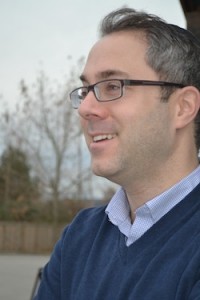
“There’s definitely a growing number of Israeli families in all our Jewish day schools,” said Abba Brodt, principal at RJDS. Among them is the second wave of Russian Jews, comprised of Russian emigrés who made aliyah as children and moved to Vancouver after doing army service in Israel and starting their families. “They maintain strong Russian ties but have an incredibly strong connection to Judaism and Israel,” he said.

The new arrivals place extra demands on Jewish day schools in terms of meeting their children’s language needs, and RJDS has had to shift resources internally so the children of new immigrants can learn successfully in class.

“When people come, what’s our obligation to them?” Brodt pondered. “They want their kids to get a Jewish education as they get established. Many of these parents come without jobs, are not established financially and are trying to adjust, but it takes many, many years. The only menschlik thing to do is to open our doors, figure it out and let them know they’re not a burden at all. I think that’s the right approach for any Jewish organization in town. The faster we help them get on their feet, the better for the community.”

Adjustment is easiest for the youngest children. Brodt recalled a Russian-Israeli family that arrived in June 2014 with a child who couldn’t speak a word of English. “He entered kindergarten and by December that year he was speaking to his parents outside of school hours in English!”

photo - Cathy Lowenstein
Cathy Lowenstein (photo from Cathy Lowenstein)

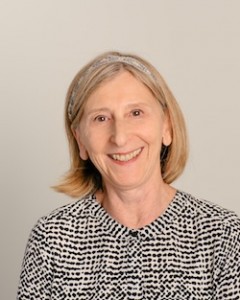
At Vancouver Talmud Torah, head of school Cathy Lowenstein has also witnessed an influx of new immigrants from Israel, as well as from Brazil, Estonia and Hungary. “For students in the younger grades, ESL support isn’t as much of an issue, as they can really immerse themselves in language much faster than students in intermediate grades. But, over the past few years, we’ve increasingly had to allocate budget to students who require ESL support,” she said.

That can be difficult because the ESL needs vary year by year. “Often, these students don’t present until late summer, so we’re left trying to reallocate dollars in August so that we can properly help them transition into the school,” she explained.

Tuition assistance is provided on a case-by-case basis, Lowenstein said. “Even though we may have allocated our cap, we do our very best not to turn away a family wanting a Jewish education,” she said.

The high cost of living in the Lower Mainland is having far-reaching effects on the 26,250 Jews who call this corner of the West Coast home. Approximately 14,000 of them live in Vancouver, close to 6,000 in Richmond and the remainder in outlying cities including Burnaby, New Westminster, Port Coquitlam, Coquitlam, Port Moody, Maple Ridge and Langley, where Jewish resources are few and far between. That’s because the high price of housing forces many new arrivals into these outlying areas, where accommodation is a little more affordable.

While RJDS has space available for more students, the challenge lies in reaching those Jewish families who live in the suburbs.

“We know there are 700 Jewish school-age kids in the Tri-Cities of Coquitlam, Port Coquitlam and Port Moody and, as much as the schools may want them, how many families are going to have their kids get on a bus for an hour’s commute each way?” Brodt said. “You have to be super-committed to do that when there are good public schools around. If I could create a pipeline to Burnaby, I’d do it, but the possible customer base there is not ready to make that sort of commitment. They’re managing their Jewish lives out there, as is their right.”

photo - Shelley Rivkin
Shelley Rivkin (photo from Shelley Rivkin)

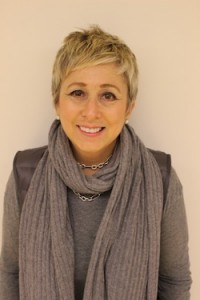
At the Jewish Federation of Greater Vancouver, vice-president of community affairs Shelley Rivkin noted that more than 850 children now live in underserved areas beyond the borders of Vancouver and few are receiving any Jewish education. “With community support, Jewish educators can develop innovative programs via which these kids can access that education, sharing fully the richness of our traditions and strengthening their Jewish identities,” she said.

In one such program, Federation collaborated with the Jewish Community Centre of Greater Vancouver and funded a pilot project to enable Jewish children living in Coquitlam, Port Coquitlam and Port Moody to attend Jewish summer day camp. The project made transportation and fee subsidies available to 22 kids.

Federation has established a regional communities task force that began work last month. In the meantime, the organization contributes to a shuttle bus in Richmond that helps seniors attend various community activities, and Burquest seniors can enjoy another day of programming thanks to additional funding provided to Jewish Family Service Agency. For young families, PJ Library is an important outreach program, Rivkin said. “For many young families who are raising children in interfaith households and/or who live in the suburbs, PJ Library is a primary Jewish connection. Recently, 100 people attended a PJ Library Chanukah event in Coquitlam.”

Federation is seriously focused on the future of the Lower Mainland’s Jewish community and anticipating programming to reach its needs over the next 15 years.

“Our population of seniors is expected to double by 2030 and an increased number of them will be 85 or older, so programs and services for this group will need to be expanded,” said Rivkin. “As issues of affordability persist, we expect there to be more Jews moving to more affordable suburbs that have little or no Jewish infrastructure. We expect these regional communities to play a larger role, and Jewish Federation will increase its focus on programs and services to reach them.”

The cost of living in Vancouver will likely continue to impact those who pay a premium to live near Jewish services and institutions, but find that the cost of Jewish life prevents them from participating. “We expect that increased subsidies for program participation will be needed,” she added.

According to the National Housing Survey in 2011, 16% of the Lower Mainland’s Jewish community lives below the living wage of $36,504. Among Jewish immigrants to the Lower Mainland who arrived between 2005 and 2011, that low-income rate is 25%. As one communal effort in dealing with this issue, Tikva Housing Society will expand the affordable housing stock for the Jewish community by 42 additional units in Vancouver and Richmond by 2017.

Lauren Kramer, an award-winning writer and editor, lives in Richmond. To read her work online, visit laurenkramer.net. A longer version of this article was published in the Canadian Jewish News.
Format ImagePosted on February 12, 2016February 11, 2016Author Lauren KramerCategories LocalTags Abba Brodt, affordability, Cathy Lowenstein, education, immigration, Jewish Federation, RJDS, Shelley Rivkin, VTT
Eat and play at Shuk

Eat and play at Shuk

Shuk owner Alon Volodarsky, left, and chef Evy Swissa. (photo by Lauren Kramer)

Shakshuka is not a dish that’s easy to come by in Vancouver. Until recently, that is. When Shuk opened its doors on Oak and 41st in early December, this favorite Israeli breakfast item made it to the menu, among a host of other Mediterranean foods, including house-made hummus, Moroccan fish, falafel, borekas, labneh and hatzilim.

Shuk’s owner is the multi-talented Alon Volodarsky, 35, an Israeli from Haifa who moved to Vancouver eight years ago and has had careers in professional dance choreography, carpentry and home renovation. He also has owned a store selling remote-controlled toys.

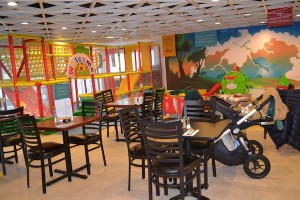
photo - In addition to great food, Shuk has space in the large dining room to keep the 2- to 6-year-old crowd entertained.
In addition to great food, Shuk has space in the large dining room to keep the 2- to 6-year-old crowd entertained. (photo by Lauren Kramer)

Soon after he arrived here, he tasted the food of chef Evy Swissa, who worked at Café 41, and quickly recognized his expertise. Volodarsky also noticed a dearth of establishments where parents could shmooze, enjoy good food and know that their kids were playing safely within eye- and earshot. So, when the opportunity arose to take over Café 41, he jumped at it. He invested $100,000 in a complete remodel and added a space for kids, with climbing structures in the large dining room to keep the 2- to 6-year-old crowd entertained. Then, he found a slab of cedar, cut and varnished it and made it a centrepiece bar in his new restaurant, Shuk. It’s a fabulous piece of carpentry.

Volodarsky hasn’t spared any expense transforming Shuk into a more sophisticated space, adding a state-of-the-art coffee machine, excellent lighting, a beautiful color scheme and quartz countertops. Dairy products are all chalav Yisrael and many of the ingredients he uses come from Israel, including

Israeli rosewater, tehina, za’atar, Moroccan spices and Turkish coffee by Elite. The kitchen is under Chabad supervision.

photo - My shakshuka ($14.50) arrived on a skillet, presented on a wooden board accompanied by French fries in a neat stainless steel basket.
My shakshuka ($14.50) arrived on a skillet, presented on a wooden board accompanied by French fries in a neat stainless steel basket. (photo by Lauren Kramer)

My shakshuka ($14.50) arrived on a skillet, presented on a wooden board accompanied by French fries in a neat stainless steel basket. It was also served with pita that Volodarsky was quick to point out is deliberately Israeli-style, sourced from Toronto, and hummus, which Swissa makes in five-litre quantities daily and was so good I had to bring a container of it home. Other items on the menu included the $7 boreka plate (three borekas served with boiled egg, tahini and pickled cukes), the $14.95 falafel plate (seven balls with a side of hummus, fries, Israeli salad and pita), hatzilim ($14.50, served on top of tahini with tomato salsa and pita) and za’atar focaccia ($14.50). There’s also poutine ($7.50), French toast ($8.95), eggs benedict with salmon and avocado ($14.50), pasta and wraps containing fish or falafel.

The food is a mix of Mediterranean, Russian and Yemeni influences, Swissa said. “It’s comfort food that brings you back to Israel,” he confided, adding that the menu is fairly simple with daily specials bringing new items to the mix. The two specials the day I came in were Persian fish balls with couscous, spinach and carrots ($17.30) and flatbread with caramelized onion, goat cheese and pesto ($14).

Volodarsky looked pensively towards the children’s area, where his 3-year-old often releases energy on rainy Vancouver days. “The idea is to attract families with kids,” he said quietly. “Out front we have a quiet area for coffee and meetings, but in the back are most of our 76 seats, and Sundays it’s packed in there.”

The fact that the restaurant is kosher is a big drawcard for Vancouver’s Jewish community and Volodarsky and his team of nine are fighting the perception that kosher means “super expensive.”

“We’re really trying to keep our costs reasonable,” he said. Still, some 55% of diners are not Jewish, Swissa noted. “And they love hummus!”

Don’t miss the desserts – there’s a fabulous selection of delicacies including tahini ice cream, chocolate-banana mousse cups and butter popcorn mousse.

And, if you don’t have the time or energy for a Friday night meal, Swissa can handle that in a heartbeat, complete with the challah, for any orders, even as small as a family of one or two. “I need just 20 minutes forewarning,” he said. He makes 12 challot each Friday in three different flavors, and they disappear fast, so pre-orders are crucial.

Shuk is open Mondays through Thursdays, 8 a.m.-8 p.m.; Fridays, 8 a.m.-3 p.m.; and Sundays, 9 a.m.-8 p.m. There is free underground parking and free wifi. Before Feb. 10, Shuk’s grand opening, access to the kids play area is free. After that date it’s $5 per child, $2.50 per sibling or $30 for a month-long unlimited membership. For more information or reservations, 604 563-4141.

Lauren Kramer, an award-winning writer and editor, lives in Richmond. To read her work online, visit laurenkramer.net.
Format ImagePosted on January 29, 2016January 26, 2016Author Lauren KramerCategories LocalTags Alon Volodarsky, Café 41, Chabad, Evy Swissa, kosher, Shuk
The beauty of France here

The beauty of France here

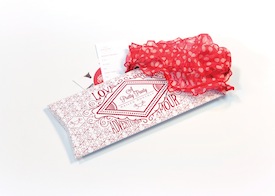
“Panty By Post is about shipping a piece of self-love in a little package,” says Natalie Grunberg. (photo from Natalie Grunberg)

Underwear. We all wear it and it’s not something most of us think too deeply about – until our own pairs look too disheveled, torn or worn out to warrant further use. But Vancouverite Natalie Grunberg thinks a lot about underwear – panties, specifically.

She started considering these hidden pieces of apparel on a trip to France in 2009. “I was inspired by the lifestyle I saw,” she told the Independent. “I loved the way the women dressed, the kind of confidence they have when they’re walking down the street and looking so lovely, even if it’s just to get a baguette.” As she spent time in French stores, she noticed the beauty of French underwear and lingerie and, not long after she landed at YVR, she started her own company, Panty By Post (pantybypost.com).

“I feel like there is value in putting yourself together well, and it starts with your underwear,” she said. “Panty By Post is about shipping a piece of self-love in a little package – the sexiness, self-respect and confidence of the French comes to your doorstep like self-esteem in a box.”

Grunberg, 39, is a native Vancouverite and member of Congregation Or Shalom who has been vacationing in France since the age of 14. That French influence had a profound impact on the Grunberg kids. Paul, Natalie’s brother, owns the French restaurant L’Abattoir in Gastown, while Natalie, formerly a high school teacher, gave up her day job two years ago to focus on her business. The learning curve was steep and those first five years, she said, were “like a mini MBA where I taught myself the skills I needed.”

At first, she imported sexy, lacy panties. Then she surveyed her customers to find out what they were looking for in terms of panties and bras. She learned that her mostly North American customers wanted beautiful underwear that was comfortable and durable, “nothing poofy or scratchy. They need to be able to wear them under their business suits or under their jeans,” she explained. So, she created her own label and forged a manufacturing relationship with a Colombian company. “I prefer working with Colombia over China because they offer really great working conditions and give their workers health care and support for single moms,” she said.

photo - Monthly subscriptions start at $15 and increase depending on the style and type of panty
Monthly subscriptions start at $15 and increase depending on the style and type of panty. (photo from Natalie Grunberg)

Who buys panties by post? It’s an admittedly unusual way to source your underwear but Grunberg’s demographic ranges from 25 through 65. “Sometimes, it’s a mom buying for their daughter or themselves, other times a husband or boyfriend is purchasing for their partner, but this is not for the bargain shopper,” she insisted. “Our customer is not the Costco shopper who buys a Haines pack of 10 underwear. Rather, these are women and men who understand the quality and value of a good panty.”

The Panty By Post transaction starts on the internet with monthly panty subscriptions starting at $15 and increasing depending on the style and type of panty. Grunberg includes a handwritten note in each box of panties she ships and can personalize the notes if her customers have a specific message they want to relay. Some have been monthly subscribers for the seven years she’s been in business. Others prefer to use Panty By Post for special occasions like a bridal shower gift or Valentine’s Day treat.

There’s a massive difference in the mindset of French versus American women, Grunberg noted, and it goes well beyond the panties they choose. “French women focus on buying good quality instead of volume. They 100% understand the value of wearing beautiful underwear, not just for your partner, but for yourself. North American women are more focused on comfort and don’t see the value of those little details. We don’t care as much about quality because we’re more focused on buying a lot.”

Grunberg is determined to change that mindset. “It’s not OK to sacrifice beauty for practicality because we can have it all,” she said. “It’s not about impressing a man, it’s about taking pride in your appearance. I’m on a mission to change the panty drawers of North American women. I want to bring the experience of France directly to your door.”

Lauren Kramer, an award-winning writer and editor, lives in Richmond. To read her work online, visit laurenkramer.net.

Format ImagePosted on January 29, 2016January 26, 2016Author Lauren KramerCategories LocalTags Natalie Grunberg, Panty By Post, underwear
Ruimy in Maple Ridge

Ruimy in Maple Ridge

Dan Ruimy (photo from Dan Ruimy via cjnews.com)

If there’s one thing Dan Ruimy is good at, it’s getting people together and promoting dialogue.

Ruimy is the new Liberal member of Parliament for the Pitt Meadows-Maple Ridge riding. A 53-year-old son of Jewish Moroccan immigrants to Canada, Ruimy’s parents, Andre and Jacqueline, moved to Montreal’s Cote-des-Neiges in the mid-1950s. There, they raised their five sons and ran Cantor’s Bakery in Cote-des-Neiges and a grocery store in Habitat 67. Ruimy attended synagogue with his family on the High Holy Days. Later, a career in food and beverage led him all over the country for 27 years, as he filled positions at McDonald’s, A&W and Quiznos.

All that traveling took its toll and by 2011 he was ready to settle down, get grounded in one community and find a place to call home. He chose Maple Ridge and purchased a secondhand bookstore that sold loose-leaf tea. Today, he is still the owner of Bean Around Books & Tea, and credits the tea and coffee shop as having played a pivotal role in his decision to enter politics.

“At Bean Around, I saw what happens when you include people in your community,” he reflected. “Having spent my life in the hospitality industry, my personality is all about social contact. At the tea shop, I saw there was a craving for that, so I’d introduce people to each other and help make connections. It’s quite an amazing thing to watch a 15-year-old engaging an 86-year-old in dialogue. When I started thinking about running for public office, I realized that this is what I could do for my community: create dialogue, bring people together and help people find solutions for the challenges they encounter every day.”

Ruimy feels strongly about community and what comprises it. “The Syrian refugees are a perfect example,” he said. “By including them, we become a stronger community. Isn’t that what Canada is all about? We’re a nation built on immigration. We shouldn’t shun people, we should welcome them with open arms, because that’s our future as well.”

Since being sworn in as a member of Parliament in November, Ruimy has hired extra staff for his shop to accommodate a busy schedule commuting to and from Ottawa. While he’s no stranger to traveling for work, it’s different this time, he said. “This is my home base now, I have a community to come back to. In the past, I’d come back to an empty place where I didn’t know my neighbors and wasn’t involved but, for the first time in my life, I can actually say I’m coming home.”

He plans to open his constituency office in Maple Ridge soon. It’s “tough” to be Jewishly affiliated in Maple Ridge, he said, given that there are few Jews living there. But, in Ottawa, he’s joined the Canada-Israel Inter-Parliamentary Group. “Having those roots is important to me, and I think we lose sight when we’re not involved in that part of our community,” he said.

Ruimy said the key issues he’ll be working on are homelessness, affordable housing, helping struggling seniors, and providing assistance to youth trying to find jobs. “There’s lots of opportunity in Canada but, for some reason, people have difficulty finding the programs,” he said. “I hope to be an agent of change and help bring those opportunities to young people.”

The most exciting moment of his parliamentary career to date was attending the first session in the House of Commons, he added. “For the first time, you’re seeing the 338 people who got elected and, at that moment, it sunk in how lucky I am to have been given this opportunity. It’s a privilege really and I feel proud that people sent me here to represent them, that they put their trust and confidence in me.”

Lauren Kramer, an award-winning writer and editor, lives in Richmond. To read her work online, visit laurenkramer.net. This article was originally published in the Canadian Jewish News.
Format ImagePosted on January 15, 2016January 15, 2016Author Lauren KramerCategories LocalTags Dan Ruimy, Liberals, Maple Ridge, Pitt Meadows

Posts pagination

Previous page Page 1 … Page 9 Page 10 Page 11 … Page 15 Next page
Proudly powered by WordPress