Skip to content
  • Home
  • Subscribe / donate
  • Events calendar
  • News
    • Local
    • National
    • Israel
    • World
    • עניין בחדשות
      A roundup of news in Canada and further afield, in Hebrew.
  • Opinion
    • From the JI
    • Op-Ed
  • Arts & Culture
    • Performing Arts
    • Music
    • Books
    • Visual Arts
    • TV & Film
  • Life
    • Celebrating the Holidays
    • Travel
    • The Daily Snooze
      Cartoons by Jacob Samuel
    • Mystery Photo
      Help the JI and JMABC fill in the gaps in our archives.
  • Community Links
    • Organizations, Etc.
    • Other News Sources & Blogs
    • Business Directory
  • FAQ
  • JI Chai Celebration
  • JI@88! video

Recent Posts

  • Story of Israel’s north
  • Sheltering in train stations
  • Teach critical thinking
  • Learning to bridge divides
  • Supporting Iranian community
  • Art dismantles systems
  • Beth Tikvah celebrates 50th
  • What is Jewish music?
  • Celebrate joy of music
  • Women share experiences 
  • Raising funds for Survivors
  • Call for digital literacy
  • The hidden hand of hate
  • Tarot as spiritual ritual
  • Students create fancy meal
  • Encouraging young voices
  • Rose’s Angels delivers
  • Living life to its fullest
  • Drawing on his roots
  • Panama City welcoming
  • Pesach cleaning
  • On the wings of griffon vultures
  • Vast recipe & story collection
  • A word, please …
  • מארק קרני לא ממתין לטראמפ
  • On war and antisemitism
  • Jews shine in Canucks colours
  • Moment of opportunity
  • Shooting response
  • BC budget fails seniors
  • Ritual is what makes life holy
  • Dogs help war veterans live again
  • Remain vital and outspoken
  • An urgent play to see
  • Pop-up exhibit popular
  • An invite to join JWest

Archives

Follow @JewishIndie
image - The CJN - Visit Us Banner - 300x600 - 101625

Byline: Cynthia Ramsay

Stop zombie-vampires

Stop zombie-vampires

Rowan Jang provides an example of the zombie-vampires audiences can expect to encounter in The Zombie Syndrome: Dead in the Water. (photo by Emily Cooper Photography)

Last year, I was one of a group of “specialists” who gathered outside Trout Lake Community Centre to embark on our mission, which related to a downed alien spaceship. While the details of that mission must remain confidential, one aspect can be revealed – it was loads of fun. It was also a great cardio workout, not just because of the running from zombies, but the screaming, both from fear and excitement.

This year, the Virtual Stage is gathering teams (audiences) of 18 on Granville Island every 30 minutes from 6:30 to 8:30 p.m. nightly until Oct. 31 to help find Special Forces operative Frank Johnson. As per the mission description, Johnson “was hunting down former government geneticist Mattias Van Cleave when he fell off the radar. Van Cleave, a suspected vampiric psychopath, is believed to be responsible for a string of recent murders, and the sudden appearance of zombie-vampire mutants across the Lower Mainland. The audience must determine Johnson’s whereabouts and ensure his mission to stop Van Cleave is completed at any cost.”

As with the four previous Zombie productions, The Zombie Syndrome: Dead in the Water makes use of the latest technology – this year, it’s Apple’s new location-based iBeacon.

“I am very interested in how emerging technologies can excite live audiences and breathe new life into theatre as an art form,” Virtual Stage artistic director, Zombies series creator and Jewish community member Andy Thompson told the Independent. “I am very narrative-driven as an artist, and the iBeacons have been a delightful tool in the creation of The Zombie Syndrome: Dead in the Water.”

The decision about what technology to use, Thompson said, “involves a process of questioning what is readily accessible and available, not only for myself as a producer, but also for today’s audiences. What is free within smartphones today? What is new and exciting? How can these gadgets drive a story forward? What can people afford? What can our company afford?

“I am also constantly imagining what the next big thing in technology might be, as well as its potential future societal impact,” he added. “My vision of concern for the future with ‘social media on steroids’ in my musical Broken Sex Doll is one example of this. I am also assessing what exciting new technologies are present today and how they may aid in live storytelling. In the particular instance of this show, the iBeacons roll out narrative content in a very interactive and engaging way as the audience moves from site to site.”

As the audience moves quickly along – both because they are “racing against the clock” and because there are scary things lurking in the dark – the possibility of an accident, miscue or technical glitch is much higher than for a standard production.

“We rehearse as many possibilities as we can,” said Thompson, “but the most important preparation we have is to be ready for anything: the ‘known unknowns,’ as Donald Rumsfeld might say. So far, the audiences have been completely surprising to us in how they navigate the problems we present to them. So, it is fresh and exciting every performance. The personalities of the individual audience members also greatly affect the flow and feel of each show. We did a lot of improvising in the rehearsal process so the actors are very prepared and on their toes.”

One unexpected moment – of which Thompson said “there have been many” – took place during last year’s mission, “when the entire site flooded on our closing performance at Trout Lake. We had about one hour to physically relocate most sites to higher ground, rehearse it in the new areas, and get as many technical elements in place as we could. We managed to pull off a derivative of the show, which was a miracle and a testament to our amazing crew and performers.”

As to what participants can expect this year, Thompson said, “Audiences will be traveling by sea at one point, which we are thrilled about. They will be confronted with a new breed of mutant zombie-vampires that cannot be killed. The iBeacon technical aspect to the show is also a Canadian theatre première, so people will be testing that tech out with their smartphones in a live entertainment environment like they have never done before. And yes, there might be running….”

For mission tickets, visit thevirtualstage.org/zombies. Participants should dress for the weather and moving quickly; the show is rated PG-13.

Format ImagePosted on October 14, 2016October 13, 2016Author Cynthia RamsayCategories Performing ArtsTags interactive theatre, technology, vampires, Virtual Stage, zombies
87 headstones added

87 headstones added

Shirley Barnett, chair of the Jewish cemetery restoration project, led the proceedings. (photo by Cynthia Ramsay)

photo - Headstones for the graves of 87 babies and children were unveiled at Mountain View Cemetery’s Jewish section on Sept. 11
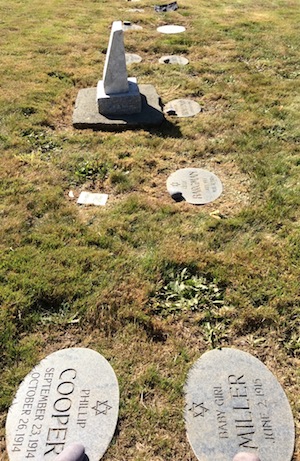
Headstones for the graves of 87 babies and children were unveiled at Mountain View Cemetery’s Jewish section on Sept. 11. (photo by Cynthia Ramsay)

On Sept. 11, a small crowd gathered at the Jewish section of Mountain View Cemetery for the unveiling of 87 headstones for babies and children who had passed away between 1893 and 1996.

Shirley Barnett, chair of the Jewish cemetery restoration project, which began in 2012, welcomed attendees. She acknowledged several of the people who greatly contributed to the project, and noted there is still a need for financial support.

“There is work to be done yet,” she said. “There are at least 40 or 50 adult burials that do not have headstones.… We have about 10 or 11 baby and children’s headstones that we did not cover today; we’re still researching the data on those.”

Rabbi Andrew Rosenblatt of Congregation Schara Tzedeck said a few words about how the loss of children is treated in the Tanach, while Rev. Joseph Marciano chanted the prayers for the unveilings.

Before the service, however, Barnett paid tribute to Helen Aqua, who donated the funds for all of the 87 headstones unveiled that day.

“I am but a small piece of this project, and most proud to have been part of this restoration,” said Aqua.

The project also received $27,000 toward the restoration from the federal government’s Canada Western Economic Diversification Infrastructure Canada 150 Grant.

photo - Helen Aqua donated the funds for all of the headstones unveiled that day
Helen Aqua donated the funds for all of the headstones unveiled that day. (photo by Cynthia Ramsay)

Representing the Government of Canada, Dan Ruimy, member of Parliament for Pitt Meadows-Maple Ridge (Liberal), spoke.

“Just to be here today is very special to me,” said Ruimy, who is Jewish. He said the ceremony was “a solemn reminder of the early pioneers and their families who have helped shape and build this community.”

He said he was proud that the government was “able to help with this meaningful project.”

People were invited to walk through the cemetery, and Daniella Givon led a tour, using a guidebook created by the Jewish Museum and Archives of British Columbia.

Format ImagePosted on September 23, 2016September 21, 2016Author Cynthia RamsayCategories LocalTags Jewish cemetery, Mountain View, Schara Tzedeck
From cardboard to folktales

From cardboard to folktales

Books can take you to the most captivating places. Not always happy places, but places worth exploring, places where the people, environment, challenges and culture are different. A place you can have adventures, learn from what has happened to others or just escape from your daily routine, all for the relatively low price of a book. Oh, and maybe a cardboard box.

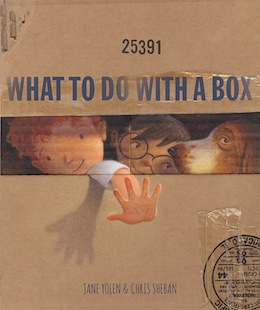
book cover - What to do with a BoxThe beautifully and creatively illustrated What to do with a Box (Creative Editions, 2016) features the rhythmic writing of Jane Yolen and the inspired art of Chris Sheban. The book is a tribute to the power of the imagination – a way to impart to the younger set that fun doesn’t necessarily need batteries. It’s also a reminder to parents that expensive toys aren’t at the root of what makes playtime enjoyable, and they may even be enticed to join their kids in a cardboard box adventure – if they’re invited to come along, that is.
The writing is simple, as it is for most picture books. That box, “can be a library, palace, or nook,” or a place you can “invite your dolls to come in for tea”; it can be a racecar, a ship, and so much more. And the art by Sheban looks as if he took Yolen’s advice: “You can paint a landscape with sun, sand and sky or crayon an egret that’s flying right by.” It is described as cardboardesque and, indeed, it looks as if he drew the illustrations on different types of boxes.

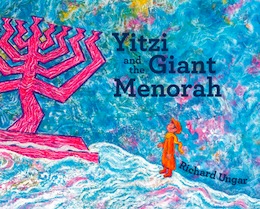
book cover - Yitzi and the Giant Menorah For slightly older readers (or listeners), Richard Unger has written and illustrated a more traditional story with Chagallesque art, Yitzi and the Giant Menorah (Penguin Random House, 2016). It is a picture book, but with a substantive amount of text on each page. It, too, is beautifully and creatively put together, with most of the text printed on a plain page that includes a black-and-white sketch that doesn’t overlap it in any way, making the reading easier. More importantly, it leaves most of the colorful, vibrant and expressive artwork on the opposite page free from writing. At the end of the book is the brief story of Chanukah.
While set on the eve of Chanukah in the shtetl of Chelm, this tale bears a similar message to What to do with a Box: money isn’t everything. It adds to that the lesson of gratitude.

In the story, the mayor of Lublin gives the people of the Chelm “the biggest menorah” Yitzi has ever seen and the villagers are so grateful, they want to thank the mayor in a way that matches the grandeur of his gift. This being Chelm, the solution doesn’t come easily but, after a few failed efforts, they succeed in a heartwarming way.

* * *

For young adult readers, the stories are much more serious in both subject matter and tone.

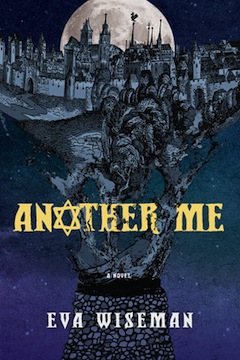
book cover - Another MeEva Wiseman’s Another Me (Tundra Books, 2016) is set in the mid-1300s in Strasbourg, France. It starts with the main character’s death at the hands of the men poisoning the town’s water – an act the Jews were accused of committing not only in Strasbourg, but other cities in Europe, as well. It was thought that poisoned water was causing the plague and, since fewer Jews were dying, the rumors began that they were causing the illness. In reality, Jews were also dying, but in fewer numbers because Jewish law required much more handwashing than was customary in medieval times.
Wiseman also elaborates upon less tangible Jewish beliefs in Another Me. When Natan, 17, dies, his story doesn’t end. He becomes an ibbur – his soul enters the body of another man; in this instance, that of Hans the draper.

Hans works for Wilhelm, with whose daughter, Elena, Natan has fallen in love. Natan has come to know all of these non-Jews from helping his father in the shmatte business. Wilhelm is one of the very few Strasbourgians who is not antisemitic. Hans is also a good person, though he is jealous of Elena’s affection for Natan. When Natan – to whom she’s attracted – becomes Hans – who she finds ugly – Elena struggles to see beyond the exterior.

While mostly told from Natan’s perspective, Wiseman also allows Elena to tell a substantial part of the story. It is sometimes hard as a reader to change gears, but the dual voices offer a deeper understanding of the situation of the Jews in the city (and beyond), and those who would help them. Being historical fiction, while Wiseman can play with magic, there is, sadly, no chance for a happy ending.

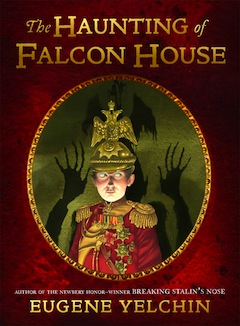
book cover - The Haunting of Falcon HouseMagic – or, at least, ghosts – also informs the storytelling in Eugene Yelchin’s The Haunting of Falcon House (Henry Holt and Co., 2016).

Ostensibly, this book is a translation Yelchin has made from a bundle of decaying pages bound with twine that he came across as a schoolboy in Russia. He brought them with him when he immigrated to the United States, but let them sit for years. Apparently written and illustrated by “a young Russian nobleman, Prince Lev Lvov,” who was born in 1879, there were many pages missing or unreadable.

“I managed to establish a chronological order of the events and then divided them into chapters, matched the drawings to the chapters, and discarded those I could not match,” writes Yelchin in the translator’s note that begins the book. So “inwardly connected to the young prince” did Yelchin become, he writes, “I can’t be certain, but as I typed Prince Lev’s inner thoughts, I felt cool fingers firmly guiding mine across the keys.”

In the story, 12-year-old Lev’s hands are similarly guided by a mysterious force when he is drawing. Arriving at Falcon House from St. Petersburg to take his place as heir to his family’s estate, Lev – who bears a striking resemblance to his grandfather – dreams of being a hero and nobleman like his grandfather and preceding ancestors. But, with some mystical guidance from Falcon House’s resident ghost, Lev begins to understand that being nobility doesn’t necessarily mean being noble, and his family’s secrets, which are slowly revealed, make him rethink his aspirations.

The ghost, a scary aunt and the disturbing illustrations combine to good effect in The Haunting of Falcon House, even though the story takes a little too long to unfold. The detailed notes at the book’s end provide valuable historical context and add greatly to the reading experience.

book cover - Briar Rose: A Novel of the Holocaust Jane Yolen’s Briar Rose: A Novel of the Holocaust (Tor Teen, 2016) is also a retelling – an adaptation of Sleeping Beauty. And, it is a reissue, having originally been published almost 15 years ago in a series created by Terri Windling, which comprised novels by various authors that reinterpreted classic fairy tales.

In Yolen’s reimagining, Briar Rose (aka Sleeping Beauty) is Gemma, Rebecca’s grandmother. Unlike her cynical and competitive older sisters, Rebecca never tires of listening to Gemma’s version of the tale, which doesn’t quite match up with the traditional folktale. When Gemma dies, leaving behind a box containing a few documents and photos that don’t quite match up with what she has told her family about her history, Becca sets off to find the truth.

Her search – done in the days before Google – starts slowly, with the help of her editor, Stan, on whom she has a crush. It takes them from their hometown of Holyoke, Mass., to Oswego, N.Y., where refugees were sheltered at Fort Oswego: “Roosevelt made it a camp and, in August 1944, some 1,000 people were brought over and interned [there]. From Naples, Italy. Mostly Jews and about 100 Christians,” explains the reporter at the Palladium Times to Becca.

What she learns at Oswego leads her on a journey to Poland and to Chelmno. Of the more than 152,000 killed by gas (or shooting) at the Nazi extermination camp that was there, only seven Jewish men are known to have escaped. This allows Yolen to imagine that one woman survived the killing centre, which was established on an old estate in a forest clearing that had a schloss (castle, or manor house).

In Gemma’s cryptic telling of her survival, she is saved from the castle by a “prince,” who we find out was himself saved by partisans after his escape from Sachsenhausen concentration camp and then joined the resistance; in her story, briars take the place of barbed wire, the wicked fairy the Nazis. As Becca discovers the reality of her grandmother’s past and finds her own voice and identity through the journey, we also witness Poles’ difficulties in dealing with what took place during the Holocaust and we meet others – including Gemma’s prince – who are still trying to heal from the destruction the Nazis’ wrought.

Interweaving the “real” story with Gemma’s fairy tale is very effective at building the anticipation and, once Becca arrives in Poland, Briar Rose is a page-turner. One almost doesn’t realize how much they’re learning while they’re reading. Almost.

Format ImagePosted on September 23, 2016September 21, 2016Author Cynthia RamsayCategories BooksTags Chanukah, children's books, fairy tales, fantasy, ghosts, Holocaust, picture books, plague, playtime, science fiction, Sleeping Beauty, young adults
Quirky fiction meets history

Quirky fiction meets history

Two quirky books. Both historically based, both written with humor, both dark and light. But there the similarities end.

The quiet and quirky Fever at Dawn by Péter Gárdos is based on letters his parents sent to each other immediately following the Holocaust, as they recovered from their physical ailments in Sweden. The raucous and quirky Two-Gun & Sun by June Hutton takes its inspiration from Morris “Two-Gun” Cohen and Dr. Sun Yat-sen, who actually did know each other, and Puccini’s La Fanciulla del West, to tell the story of a young woman who heads to a northern B.C. mining town in 1922 to revitalize her uncle’s newspaper, which he left her in his will.

book cover - Fever at Dawn

Fever at Dawn (House of Anansi Press, 2016) begins with a note from Gárdos about the letters his parents – Miklós and Lili – sent to each other from September 1945 to February 1946. Until his father died, Gárdos had no idea of their existence, though his mother had told him, “Your father swept me off my feet with his letters.”

The main quirky thing about this story (there are others) is that Miklós tried to sweep no fewer than 117 women off their feet with his letters. Told by his doctor that he would not survive his tuberculosis, Miklós defiantly decides he wants to get married. He inquires for the names and addresses of all the women survivors being treated in Sweden, and sends all of them the exact same letter. He determines pretty quickly that Lili is “the one,” though 18 women respond.

The secondary characters are well-conceived and play important parts in Miklós and Lili’s developing relationship. It is a beautiful and uplifting story – love and hope from hatred and tragedy. It brings up many issues, in Lili’s wanting to renounce her faith and in how the survivors are treated, for example. The translation into English from Hungarian by Elizabeth Szász is a bit awkward in parts, but otherwise does justice to the work. And some of the awkwardness might be due to the fact that Gárdos, who is a filmmaker and theatre director, originally envisioned the story as a film – which was released last year – but also wrote it as a novel.

book cover - Two-Gun & SunTwo-Gun & Sun (Caitlin Press Inc., 2015) might also make a good film. It brings to mind Joss Whedon’s Firefly, mixing science fiction (specifically steampunk) with opera’s larger-than-life and often unbelievable drama with history. It’s a very stylized novel, which, more than other books, means that it will be loved by some readers, and not so much by others.

While loosely historical, it does strongly evoke the era and how hard it must have been to survive back then, especially in a remote town, especially if you were a minority, and very especially if you were a woman. The central character, Lila Sinclair, arrives in Black Mountain from Nelson, given by her uncle’s death a more adventuresome, “manly” economic opportunity than marriage, teaching or prostitution, which seem to have been women’s main choices at the time.

Some of the more fascinating aspects of this novel are the daily-life moments, what people ate, how they earned a living, the excitement a traveling troupe generated, the dangers posed by a lack of law. Anyone in the publishing industry will also appreciate Lila’s struggle to get the printing press up and running, and how newspapers once operated. As well, while her relationship with Vincent, a Chinese printer, runs a predictable course, it offers a chance for Hutton to address the racism of the day.

Two-Gun & Sun is a unique twist on the traditional western and, while the ending wasn’t quite satisfactory for this reader, its originality and oddness were entertaining and energizing.

Format ImagePosted on September 23, 2016September 21, 2016Author Cynthia RamsayCategories BooksTags fiction, Holocaust, science fiction, steampunk, Two-Gun Cohen
Challenging films at VIFF

Challenging films at VIFF

Soon after he discovered he was Jewish, Csánad Szegedi reached out to Rabbi Boruch Oberlander. Szegedi’s transformation from virulent antisemite to Orthodox Jew is the topic of the documentary Keep Quiet. (photo from Gábor Máté/AJH Films & Passion Pictures)

While this year’s Vancouver International Film Festival holds much that will be of interest to Jewish Independent readers, the list is short when it comes to specifically Israeli or Jewish-related films that will appeal.

Perhaps surprisingly, the Israeli films are harsh critiques of Israel. Beyond the Mountains and Hills (Israel/Germany) is about a dysfunctional family (a metaphor for the country), Junction 48 (Israel/Germany/United States) is about an Arab-Israeli rapper who faces racism, among other Israeli-inflicted ills; Between Fences (Israel/France) is a documentary about Israel’s internment of African refugees at the Holot Detention Centre and Vita Activa: The Spirit of Hannah Arendt (Israel/Canada) is about Hannah Arendt, who, among other things, was critical of Jewish leadership during the Holocaust and did not approve of the state of Israel as it was founded.

Among the other film offerings is Keep Quiet (United Kingdom/Hungary), a documentary about Csánad Szegedi, the staunch antisemite who helped found Hungary’s far-right party Jobbik and its Hungarian Guard, which has since been banned. As a member of the European Parliament, he continued to foment hatred until a fellow nationalist and racist outed him as being Jewish – his grandmother had not been the adopted daughter of the Klein family, as she told him, but their daughter. The documentary includes interviews Szegedi did with his grandmother (about her imprisonment in Auschwitz, and other matters) and a conversation with his mother, who also found out later in life that she was Jewish. He asks both women about his increasing embrace of antisemitism over the years, why didn’t you stop me? Their responses are thought-provoking and sad.

Keep Quiet does not accept Szegedi’s transformation unquestioningly and gives speaking time to the doubters, as well as the cautious believers, such as Rabbi Boruch Oberlander, head of the Orthodox Rabbinical Council in Budapest. Oberlander has supported and taught Szegedi since the former antisemite contacted the rabbi for help. The event that ends the film is Szegedi’s attempt in 2013 to speak in Montreal about his Jewish journey – he wasn’t allowed to stay in the country. Before being put on the next plane home, however, Szegedi recorded a lecture, which was played at the event, with Oberlander fielding the hostility it wrought in some attendees. In Oberlander’s view, we must love every Jew, no matter how wicked. Of his choice to help Szegedi, he says, “I pray that I shouldn’t be disappointed.” Even Szegedi is unsure as to whether he would ever turn his back on Judaism – maybe, he admits, but not likely.

The way in which the filmmakers present Szegedi’s story is informative and balanced, and viewers get a sense of the man and his deeds, as well as about Hungary and how a political party as racist as Jobbik can find success there.

photo - Hannah Arendt
Hannah Arendt (photo from the Hannah Arendt private archive via Zeitgeist Films)

Vita Activa also does a good job of including both fans and critics of Arendt’s work, but mainly uses Arendt’s own words to explain her thoughts and analyses. The film uses as its foundation the Adolph Eichmann trial, about which Arendt wrote Eichmann in Jerusalem: A Report on the Banality of Evil (1963), describing Eichmann as “a typical functionary,” and thus an example of the “banality of evil.” (Viewers should be warned that there are many disturbing Holocaust-related images in this film.)

“Eichmann was quite intelligent but he had that dumbness,” she tells an interviewer in one of the clips included in the documentary. “It was that dumbness that was so infuriating, and that was what I meant by ‘banality.’ It has no depth; it isn’t demonic. It’s simply the unwillingness to ever imagine what others are going through.”

Another of Arendt’s theories – about refugees – remains relevant. With no rights, refugees are considered “superfluous” by a regime, she argued, and denationalization and xenophobia become a powerful weapon of totalitarian politics.

In Keep Quiet, a political journalist describes Hungary as a “part of the world where history has been manipulated” and the effects that such manipulation has upon generations. Arendt broadens that view beyond Europe, saying, “It has been characteristic of our history of consciousness that its worst crimes have been committed in the name of some kind of necessity or in the name of a mythological future.”

In addition to her early work, Vita Activa touches upon Arendt’s personal life, which offers some further understanding of the philosopher, who was seen by many to lack empathy. In one interview, she talks about how Auschwitz shouldn’t have happened, how she could handle everything else but that. Yet, she criticized the Jewish leadership who cooperated with the Nazis – the councils and kapos – and hypothesized that, if there had been no such leadership, there would have been chaos and suffering and deaths but not six million. One professor interviewed for the documentary calls Arendt’s comments “irresponsible,” another says they showed her complete ignorance of history, yet another says she regretted her remarks later in life.

The film also notes Arendt’s change from supporting Zionism to condemning elements within it. Among other things, she said, “A home that my neighbor does not recognize is not a home. A Jewish national home that is not recognized by and not respected by its neighboring people is not a home, but an illusion, until it becomes a battlefield.” And she pointed to tendencies within Zionism that she considered “plain racist chauvinism” that do “not differ from other master race theories.”

The documentary also covers Arendt’s 1951 Book of Thoughts, in which she contemplates the nature of forgiveness, revenge, reconciliation. For her, the latter doesn’t forgive or accept, but judges. When you take on the burden of what someone else did, she believed, you don’t accept the blame or absolve the other of the blame, but take upon yourself the injustice that occurred in reality. “It’s a decision,” she said, “to be a partner in the accountability, not at all a partner to the guilt.”

photo - A “theatre of the oppressed” workshop at the Holot Detention Centre in Israel
A “theatre of the oppressed” workshop at the Holot Detention Centre in Israel. (photo from Vancouver International Film Festival)

Reconciliation and forgiveness don’t enter the picture in either the documentary Between Fences or the fictional (but based on a real person) Junction 48. They each highlight important, even vital, issues in Israeli society, but do so in such a condemnatory, predictable way that anyone but the choir won’t be able to sit through these films.

Without much context, Between Fences looks at the poor situation in which asylum seekers from Eritrea and Sudan find themselves when they reach the safety of Israel. In many countries, these asylum seekers face problems, but viewers wouldn’t know that from this documentary, nor would they begin to understand the atrocities being committed in their homelands. However, they will learn how Israel doesn’t recognize their refugee status and makes every effort to send them back, how racist Israelis are towards these newcomers and a host of other problems with Israel and its people. Not one government official or Israeli is interviewed, although some Israelis participate in the “theatre of the oppressed” workshops in Holot on which the film focuses. In addition to leaving many questions unanswered, the film also begins and ends confusingly and is slow-paced.

Bias also makes Junction 48 almost unwatchable for anyone who would like to see the Israeli-Palestinian conflict resolved, so that both peoples’ rights and safety are ensured. From the second sentence of the opening, the perspective is made clear: “The Israeli city of Lod is the Palestinian city of Lyd, which once sat on the main railway junction. In 1948, tens of thousands of Palestinians were exiled from Lyd in order to resettle the town with Jews….”

photo - Samar Qupty and Tamer Nafar in Junction 48
Samar Qupty and Tamer Nafar in Junction 48. (photo from VIFF)

We then meet Kareem, an aspiring young rapper, whose parents are worried about his involvement with drug dealers and his future in general. His friends not only deal and take drugs, but visit prostitutes and dabble in other criminal activity. Nonetheless, every Israeli they encounter is the real bad guy, from the police to other rappers to the government, which is knocking down one of their homes to build a coexistence museum. Oh, the irony.

The only entertaining and thought-provoking aspect of this film is the music by lead actor and film co-writer Tamer Nafar, which is available online.

In the end, the Jewish Independent chose to sponsor what a VIFF programmer called a “classic Jewish comedy,” though, having seen a screener of the film, the Jewish aspect is hard to discern. While much lighter (and non-political) fare than the other offerings, it has much to say – or show, really, as the dialogue is minimal – about social awkwardness and a lack of direction in life. The protagonist, Mike, works at a pizza place in New Jersey and has the energy level of a slug and the magnetism of zinc. Yet, somehow, he has friends, albeit not great ones.

Short Stay is one of those films that moves apace with its main character, so slowly and in all different directions, as Mike both physically wanders the streets and mentally wanders to destinations unknown. Viewers don’t gain insight into what motivates Mike, who seems unperturbed by his lack of career, social skills, direction and future, but they root for him, empathize with what must be his loneliness.

photo - The social awkwardness of the protagonist of Short Stay, Mike, is obvious in his exchanges with others
The social awkwardness of the protagonist of Short Stay, Mike, is obvious in his exchanges with others. (photo from VIFF)

Short Stay director Ted Fendt best describes the acting of the nonprofessional cast, many (all?) of whom are his friends. “The film contains a range of performance styles from the fairly natural (Marta and Meg), to Mark and Dan’s B movie ‘villains,’ who might have stepped out of an Ulmer or Moullet film, to the quasi-Bressonian, unaffected manner Mike delivers his lines.” And therein is a Jewish link, Edgar G. Ulmer.

Another Jewish filmmaker – Vancouver’s Ben Ratner – will be premièring his short film, Ganjy, at this year’s festival. About a former boxer suffering from dementia pugilistica, who is in desperate need of help when three friends visit, Ganjy was inspired in part by Muhammad Ali. Its creators are looking to fundraise enough to take the film to other festivals, as well as contribute to the Muhammad Ali Parkinson Centre. For more information, visit indiegogo.com/projects/ganjy-film#.

For more information about and the full schedule of films playing at VIFF, visit viff.org.

Note: This article has been edited so that it is clear Hannah Arendt was speaking of tendencies within Zionism that she considered “plain racist chauvinism” that do “not differ from other master race theories,” and not condemning Zionism as a whole.

Format ImagePosted on September 16, 2016September 18, 2016Author Cynthia RamsayCategories TV & FilmTags anti-Israel, anti-Zionism, antisemitism, Arab Palestinians, Arendt, asylum seekers, hip-hop, Holot, Israel, Judaism, Szegedi, Vancouver International Film Festival, VIFF, Zionism
Living with prostate cancer

Living with prostate cancer

Sima Elizabeth Shefrin’s new book, Embroidered Cancer Comic, will be launched on Sept. 15 at the Roundhouse.

Cancer is a word often whispered. Sex is certainly not spoken of in polite company. Yet Sima Elizabeth Shefrin tackles both topics in her new book, Embroidered Cancer Comic (Singing Dragon, 2016), which receives its Vancouver launch on Sept. 15 at Roundhouse Community Centre.

The comic begins with Shefrin’s husband, Bob Bossin, coming home from the doctor with a diagnosis of high cholesterol. “Oh, he also said my PSA was up,” Bossin tells Shefrin. After some understandable delays, Bossin gets the needed biopsy. While the couple are enjoying a funny movie together, the call from the doctor comes: prostate cancer.

book cover - Sima Elizabeth Shefrin’s new book, Embroidered Cancer ComicIn a mere 30 pages, with text and illustrations by Shefrin, Embroidered Cancer Comic shows Bossin’s uncertainty over treatment options, his efforts to learn more about the cancer, the emotional stress on him and Shefrin, as well as the effects of the cancer and its treatments on the couple’s sex life.

“The strain of the prostate cancer journey on relationships cannot be overstated, yet patients and their partners are left to figure this out for themselves,” writes Dr. Peter Black of Vancouver Prostate Centre – Bossin’s surgeon – in a brief commentary at the end of the comic, where both Shefrin and Bossin also share more of their story.

Helping others was one of Shefrin’s goals.

“I’m hoping the book will help couples in this situation be able to communicate,” she told the Independent.

Already, it’s had an impact.

“I thought it had potential for being a major project, especially after I got the publishing contract,” said Shefrin. “But then, of course, you don’t leave that in the hands of the gods. Singing Dragon has been very good for getting publicity in Britain, in both the comic and the medical worlds. In Canada, I’ve done most of it myself.

“I believe that this book can do real good in the world,” she said, sharing that a man in Quebec had written her “about what a difference it had made to both him and his wife.”

She said, “That’s what I’m hoping to do. I believe in the comic, so I’m willing to do whatever pushing I need to, to get it out into the world.”

Shefrin is a noted fabric artist, her website name – stitchingforsocialchange.ca – perfectly describing the nature of her work.

“I have often used my art to work through life events and to create awareness and conversation about taboo or contentious subjects,” she writes at the end of the comic book. “But nothing has made me feel as vulnerable as the creation of this comic. At the same time, it has helped me realize that, when you’re there, cancer becomes a part of daily life, like buying groceries or washing dishes.”

It took Shefrin three years to sew the embroidered line drawings, which were then photographed for the book. When asked if she ever thought of creating the images in a more expedient way, Shefrin said, “Fabric is my medium. The books I illustrated are mostly paper collage, but even when I work in paper, I think like a fabric artist. I did drawings first and then embroidered them, and I always liked the embroidered result better than the original drawing.”

The book “started out as a piece of art,” she said. “I thought I might self-publish or maybe simply photocopy a kind of catalogue for a show. But, one day, I came across the Graphic Medicine site and realized that there was a whole world out there of people making comics about medical issues. I’d had no idea.

“So, I started looking at the site regularly as well as at their Facebook page. Occasionally, there would be postings for people looking for comic strips on this and that and, if it was vaguely relevant, I’d send out my work. I do this a lot and often it comes to nothing. But, a couple of months later, I got an email from Jessica Kingsley saying they might be interested in publishing my work. It took me about an hour to figure out who they were and how they found me. They published it through their imprint, Singing Dragon. After that, the focus shifted and became about creating the comic, a story with a beginning, middle and end, instead of an art series. Now that it’s in print, I’m back to creating the quilts for the art series.”

The book has received many very positive reviews, including one in the U.K. medical journal The Lancet – and, according to the book’s Facebook page, it earned “a lovely personal note from Judi Dench,” who is mentioned in the comic. Specifically, when Shefrin asks her husband, “Who really excites you?” his answer is Dench.

The most touching review of the book comes from Bossin. “And because you live with cancer, whoever you live with lives with it, too, as Elizabeth’s comic shows so tenderly,” he writes. “For me, there is no one I would rather live with cancer with. No one.”

Those curious about what Dame Judi said and other stories behind the comic’s creation can ask Shefrin and Bossin at the Sept. 15 launch, which starts at 7 p.m. The quilted original illustrations are on display at the Roundhouse’s Window Gallery until Oct. 30.

Format ImagePosted on September 9, 2016September 7, 2016Author Cynthia RamsayCategories BooksTags Bossin, comics, health, prostate cancer, relationships, Shefrin
Dance links cultures

Dance links cultures

Sula Boxall will perform with Flamenco Rosario in Flamenqueando on Sept. 17 at Vancouver Playhouse. (photo by Tim Matheson)

The Vancouver International Flamenco Festival Sept. 10-20 features a lineup of local and international flamenco artists – including local Jewish community member Sula Boxall.

Founded by Flamenco Rosario in 1990, the festival is apparently one the few devoted to flamenco outside of Spain. It features both free workshops and ticketed performances by several different groups and, this year, “celebrates flamenco’s Spanish Gypsy origins with the Vancouver première of Mercedes Amaya Company (Mexico/ Spain).”

Boxall will perform with Flamenco Rosario in Flamenqueando on Sept. 17, 8 p.m., at Vancouver Playhouse. They will open for Mercedes Amaya Company.

“I am honored that Rosario [Ancer] asked me to be a part of Flamenco Rosario’s performance on Sept. 17. These types of opportunities do not come along very often in Vancouver,” Boxall told the Independent. “It is an amazing opportunity to grow as a dancer and be a part of her creative process and experimentation. To be dancing in the same performance as the renowned Mercedes Amaya is humbling and intimidating. Being able to watch other performers and learn from them is a chance for professional development; I’m looking forward to the other performances and workshops that the festival has to offer.”

Boxall was born in Vancouver. “My parents had moved to Canada three years previously from South Africa,” she said. “I grew up in the Kitsilano area, attending Trafalgar Elementary and the Prince of Wales mini school. I moved to Victoria to study at UVic before continuing my studies at UBC. Currently, I am an elementary school teacher in Vancouver and teach children’s flamenco classes at Centro Flamenco.”

She has always wanted to dance.

“Since I was able to walk, I’ve been dancing,” she said. “When I was in preschool, I would create performances in my living room for my parents. I begged for dancing lessons until my parents agreed to start me in ballet at age 5. I continued to dance for the next 11 years. After a nine-year break from dancing, I was drawn back into it with flamenco. For the last eight years, it has grown into another important part of my identity. Dancing is something that is a part of me and I am a better person because of it.”

According to her bio, Boxall studied ballet, modern, jazz and character dance at Arts Umbrella. When she returned to dancing in 2008, “she found a way to renew her love of dance with flamenco at Centro Flamenco” and Ancer’s mentorship was “an integral part of her development as a dancer.”

Boxall started Flamenco Rosario’s three-year professional training program in 2010, she traveled to Spain in 2012 and studied there, she regularly attends workshops in Vancouver and, in 2013, she had her first solo performance. She regularly performs around Metro Vancouver, and also participated in the Vancouver International Flamenco Festival in 2014.

“Flamenco is an art form that has connections to many cultures, including the Jewish culture. I feel that my love of the traditional Jewish melodies is closely tied to my love of flamenco music,” said Boxall about why she is particularly drawn to this dance form.

“Having the opportunity to move and feel through flamenco dance allows me to express myself,” she added. “Flamenco is incredibly complex and diverse and demands lifelong learning. It takes years of study to understand flamenco and, even then, there is always more to learn. The challenge is what draws me to continue and work on improving my skills and understanding.”

As for other aspects of Judaism or Jewish culture that play a role in her life, Boxall said, “When I was growing up, I regularly attended the Peretz Centre in Vancouver. Through the Peretz, I was allowed to explore different parts of Judaism and gain a greater understanding of my cultural background. The culture, traditions and history continue to be very important to me and my identity, in particular the elements of family and community. With my family and friends, I continue to celebrate the holidays and enhance friendships in the Jewish community.

“I’ve especially been drawn to the music and the way it moves my soul. My mother gave me a large book of Jewish music for Chanukah years ago and I continue to find joy in learning new songs.”

It is interesting to connect the secular humanist philosophy of the Peretz Centre with the way in which the weeklong flamenco festival is described on its website. Since it began, the festival has “grown to a mature understanding of Vancouver’s multicultural audiences by nurturing the form’s hybridized roots in Sephardic, Persian, Gypsy and Indian cultures, and by striving to reflect and connect its diverse sociocultural identity through work narratives underlining flamenco’s universal message of humanistic tolerance.”

For tickets and information about the Vancouver International Flamenco Festival, visit vancouverflamencofestival.org or call 604-568-1273.

Format ImagePosted on September 9, 2016September 7, 2016Author Cynthia RamsayCategories Performing ArtsTags Boxall, dance, flamenco, humanism, Peretz Centre, Rosario Ancer
Mazal tov, Golde

Mazal tov, Golde

August’s Gotta Sing! Gotta Dance! crew. (photos by Hannes Photography)

photo - This August’s Gotta Sing! Gotta Dance! crew 1This August’s Gotta Sing! Gotta Dance! crew did a wonderful job of bringing Perry Ehrlich’s Break a Leg! to the Rothstein stage, as did the July graduates, no doubt. Ehrlich outdid himself on the script, which had more witty lines than groaners, with humor on so many items currently in the news; notably, the presidential race. In Ehrlich’s musical, Fiddler on the Roof’s Tevye actually does break a leg and Golde, who knows all his lines, steps in to take the lead role. She becomes the star, flipping traditions on their head as she rises beyond the theatre and into the political spotlight. Every one of the 76 young performers seemed to have a blast performing the show, and there were many, many talented singers, dancers and actors. The full-house audience certainly enjoyed themselves. The entire Gotta Sing! Gotta Dance! faculty is to be commended.

photo - This August’s Gotta Sing! Gotta Dance! crew 2


Format ImagePosted on September 9, 2016September 7, 2016Author Cynthia RamsayCategories Performing ArtsTags Gotta Sing! Gotta Dance!, JCC, musical theatre, Perry Ehrlich
An open door to dance

An open door to dance

Ziyian Kwan and Vanessa Goodman perform together in Simile, which concludes the Scotiabank Dance Centre’s open house on Sept. 10. (photo by David Cooper)

The Scotiabank Dance Centre’s open house on Sept. 10 culminates with Simile, featuring new work and performances by Vanessa Goodman of Action at a Distance and Ziyian Kwan of dumb instrument Dance.

All three pieces in the show – Kwan’s Still Rhyming, Goodman’s Floating Upstream and the collaboration In Vertebrate Dreams – are connected yet unique, Goodman told the Independent.

“Ziyian’s piece, Still Rhyming, is a beautiful work that responds to Patti Smith’s book M Train, and the piece has an incredible live sound score by Jo Passed,” she said. “It is a whimsical journey for the audience and Ziyian captures and transports my imagination while I am watching the piece. For me, Floating Upstream explores the notion of having one’s head in the clouds in a very simple sense: it is the idea

of being a dreamer, where anything is both possible and impossible. And, in In Vertebrate Dreams, we are creating a surreal world where human and animal instincts are being explored and subverted.

“In many ways, I think all three works are playing with a skewed perception of reality. However, I also believe that all three works are entirely different in their tone and expression. I think this has created a very diverse and engaging program.”

According to its description, Floating Upstream “plays with the fantastic being mundane and the mundane being fantastical.” Goodman explores these elements “through simple actions and coordinations that I employ daily, like walking or speaking,” she said. “In the opening of the work, I deconstruct the act of walking and try to transform it to feel as if I am floating through the space. Or simple gestures that I do while I am talking – with these gestures, I have experimented and distorted how I can embody them until they are unrecognizable.

“Floating Upstream has an original sound composition by Vancouver-based artist Loscil,” she added. “Loscil and I have been collaborating on several works over the last year, including my solo Container that just toured to Seattle’s On the Boards’ Northwest New Works Festival and Portland’s Risk/Reward Festival. It is so great to be continuing our creative process together, as I find creating with his soundscapes so rich and driving.”

Goodman has also been working with Kwan for some time, “supporting one another and collaborating in a number of ways since 2013,” she said. “Simile is, in many ways, a culmination of our interest in each other’s work and friendship. It is always such a pleasure and honor to collaborate with colleagues in new ways, to see where you can grow and be challenged inside your artistic practice.

“The idea for the duet seeded for us when we were doing a photo shoot for the production and we got several props to work with to create some imagery to publicize the show,” she explained. “We started exploring these masks and all of sudden we decided that we were compelled to make this work. What has become clearer for me as this process has gone on is that the work is about how we both are different animals when it comes to creation but, in a strange and wonderful way, we also complement each other and have created something that is unique to us working with one another.”

The evening also features lighting design by James Proudfoot.

Goodman expressed gratitude to the Dance Centre for Simile’s inclusion in the open house, saying that she and Kwan “are very excited to be sharing this program that we have been dreaming up for the last two years.”

The Sept. 10 open house starts at 11 a.m. with an hour class on pow wow, followed by a class on tap and then many other dance styles – including swing, Brazilian, Scottish, hip-hop, ballet – throughout the afternoon to 5 p.m., as well as a workshop on injury prevention. All classes are free and suitable for beginners.

Simile starts at 8 p.m. at the centre, which is at 677 Davie St. Tickets are $25/$20 from Tickets Tonight, 604-684-2787 or ticketstonight.ca. For more information, visit thedancecentre.ca.

Format ImagePosted on September 2, 2016August 31, 2016Author Cynthia RamsayCategories Performing ArtsTags dance, In Vertebrate, Vanessa Goodman
Up close, personal at Fringe

Up close, personal at Fringe

Jewish community member Erika Babins co-stars in How to Adult: The Musical. (photo from Coffee & Screaming)

As with the Jewish community Fringers profiled in the last issue of the Jewish Independent, the performers interviewed this week seek not only to entertain audiences but to spur self-reflection and even societal change. And they do so in a range of styles – musical, vaudeville and drama.

How to Adult: The Musical opens Sept. 8 at the Cultch Historic Theatre. It features three 20-something roommates who are trying to get their lives in order.

It is Amy Dauer’s writing debut and it is directed by Eleanor Felton, whose Eurydice received critical acclaim at last year’s festival. Dauer and Felton know each other from university.

“Last year, during the Fringe Festival, I told her she should write me a show to direct. And so she did,” Felton told the Independent. “It’s fantastic because Amy and I are also roommates, so a lot of what is in the script are things I recognize from our lives. I love the mixture of hilarity and disaster that feels very close to my life. And I love that, above all, this show is about the relationships between the characters rather than the events that are going on in their lives.”

Being a new musical, however, posed some challenges, the biggest of which, said Felton, “has been working with an evolving script and score. Peter [Abando] and Amy have worked really hard and the actors have been incredibly flexible, which was a huge blessing in the process.”

Jewish community member Erika Babins plays Imogen.

“Imogen is your textbook introvert,” explained Babins about the character. “She works from home on her computer all day as a graphic designer and, when she’s done, all she wants to do is curl up on the couch and watch Doctor Who on TV. When her friends suggest they go clubbing for her 25th birthday, it’s the worst thing imaginable. She finds it hard to stand up for herself and voice her opinions and usually defers to the judgment of her outspoken and confident best friend and roommate Holly. Throughout the course of the play, you see her getting frustrated with constantly being talked over and her ideas being vetoed, especially with Holly, who’s always been the alpha in their relationship, but with their other roommate Rosie and her brother, Graham, who suddenly reappears in her life.”

Babins can relate to her part.

“When I first read the character description, I joked that I was being type cast in this role. I even wore my Doctor Who shirt to the audition,” she said. “Like Imogen, I would rather stay home and read than go to a club or a party. I’ve also been able to bring my experiences with anxiety and panic attacks to the role, which has been both enlightening and really hard to explore. I’ve definitely had many moments in the five years since I graduated university where I’ve seriously sat down with myself and thought, ‘What is the point here? What am I actually doing?’ The big difference between Imogen and myself is that, unlike her, I have an amazingly strong support system of family and friends who I know I can talk to and who will either give me great advice or complain and berate the universe right along with me.”

photo - Bella Culpa opens Sept. 9 at Waterfront Theatre
Bella Culpa opens Sept. 9 at Waterfront Theatre. (photo from A Little Bit Off)

A strong support system is also at the heart of Bella Culpa, where Portland-based circus theatre duo A Little Bit Off – Amica Hunter and David Cantor – must rely on each other, as their comedy shows are not just vaudevillian and slapstick but acrobatic, as well.

Bella Culpa, which opens Sept. 9 at Waterfront Theatre, is set in an Edwardian-era manor house, and Hunter and Cantor play two servants who are trying to finish (unsuccessfully) all of their chores before a big dinner party.

“We tend to approach our work from many angles at once,” Cantor told the Independent about their creative approach. “Once we have an idea for a show, we think of the overarching theme, the props we want to use, the characters, and we tend to approach all of those areas by playing games, or doing exercises. Through the games, we find things we like, which we take and apply some structure to. Once we have a few well-crafted bits, then we start weaving them together and making things flow together, to grow and expand out into a full show.”

Cantor – who is first cousin, twice removed of famed vaudeville and film actor Eddie Cantor – met Hunter at the Circus Centre in San Francisco in 2013.

“We were inspired by many of the same artists, so we started working together,” he said. “When the opportunity arose to travel to Europe and perform in some festivals, we jumped at the chance, and A Little Bit Off was born.”

About the enduring popularity of vaudeville and slapstick, Cantor said, “Language can be a very useful tool when it comes to conveying ideas to other people, but it can also be a mask. While it lets us connect on an intellectual level, it also distances us. Having our work centre around the body, it gets closer to what makes us all human. It’s a way to speak across any language barrier, any generational gap, any cultural differences. Our work is very much about tying people to their humanity and giving them a shared experience with the temporary community that forms any time you see a show in a theatre.”

As to the physicality involved in their performance, Cantor said, “All art takes risks. Our risks are sometimes with our bodies. We take care to use good technique, which mostly protects us, but there is an element of chaos that we choose to include, that makes the slapstick a bit more real, and the audience can see that, and we hear it in their reactions. They gasp at the falls, and then there is a laughter that comes with the relief of tension, as they realize that it was part of the shtick.

“We, luckily, to this point have avoided any serious injuries from our slapstick. We have had other show mishaps. In our last show, Beau & Aero, we use a tambourine as a prop. We were nearing the finale of the show and Amica stepped on one of the tambours, the little metal cymbals, that had fallen off, due to the abuse we put the prop through in the show. It was razor sharp and sliced Amica’s foot open quite badly. She left bloody footprints all over the stage and on my costume as we finished the show with an acrobatic number. Luckily, the footprints were up my back and, hence, not visible to the audience. We left immediately after the show to a pharmacy to get superglue and glue her foot shut. Had we been in Canada, with proper health care, we could have gone to the ER, but we do what we have to.”

photo - Ariel Martz-Oberlander’s The Lilacs that Come a Month Early are Still so Beautiful is part of the Fringe's Generation Hot program
Ariel Martz-Oberlander’s The Lilacs that Come a Month Early are Still so Beautiful is part of the Fringe’s Generation Hot program. (photo from Ariel Martz-Oberlander)

Moving from health policy to the environment, climate change is front and centre of the program Generation Hot, which features nine “young artists responding to the climate crisis through new performances.” Guided by The Only Animal co-founder Eric Rhys Miller and mia susan amir of The Story We Be, the mentees have created various works. Divided into three programs, local Jewish community member Ariel Martz-Oberlander’s The Lilacs that Come a Month Early are Still so Beautiful shares Program C with Cosmic Justice by Nelson Ellis and Howard Dai. Program C opens Sept. 10 in the Anderson Street parking lot.

“This piece is vitally personal, there are parts that are deeply vulnerable and, therefore, risky to present publicly,” Martz-Oberlander told the Independent about her play. “I believe strongly that the personal is political, and that we can only talk successfully about large-scale issues by addressing the specific ways these issues are experienced in the small details of the day to day. For this piece, I am working with a cast of six enthusiastic, intelligent actors who fully bring their own worlds to this piece in such a rich way.”

The play’s description reads, “A grandmother, millennials, a woman coming to terms with abuse and ‘The Last of His Kind’ all share the stage. What is the everyday normalcy of climate change, or the deep abnormality of ignoring a crisis so large it already affects everyone? The characters struggle to hold on to the answers even as a world that ended five minutes ago slips away.”

“In the play,” said Martz-Oberlander, “the last of an unidentified species struggles to curate a message that will illustrate the urgency of the situation; however, the vignettes presented always get away from him, and the result is bittersweet.”

She added, “Jewish viewers will recognize a twist on the traditional Passover seder scene halfway through the play, as a young girl struggles to bring social justice to her family table.”

For tickets and information on all the Fringe shows, visit vancouverfringe.com.

Format ImagePosted on September 2, 2016August 31, 2016Author Cynthia RamsayCategories Performing ArtsTags adulthood, Babins, Bella Culpa, climate change, David Cantor, Fringe Festival, Martz-Oberlander, slapstick, theatre, vaudeville

Posts pagination

Previous page Page 1 … Page 66 Page 67 Page 68 … Page 84 Next page
Proudly powered by WordPress