Skip to content
  • Home
  • Subscribe / donate
  • Events calendar
  • News
    • Local
    • National
    • Israel
    • World
    • עניין בחדשות
      A roundup of news in Canada and further afield, in Hebrew.
  • Opinion
    • From the JI
    • Op-Ed
  • Arts & Culture
    • Performing Arts
    • Music
    • Books
    • Visual Arts
    • TV & Film
  • Life
    • Celebrating the Holidays
    • Travel
    • The Daily Snooze
      Cartoons by Jacob Samuel
    • Mystery Photo
      Help the JI and JMABC fill in the gaps in our archives.
  • Community Links
    • Organizations, Etc.
    • Other News Sources & Blogs
    • Business Directory
  • FAQ
  • JI Chai Celebration
  • JI@88! video

Recent Posts

  • Eby touts government record
  • Keep lighting candles
  • Facing a complex situation
  • Unique interview show a hit
  • See Annie at Gateway
  • Explorations of light
  • Help with the legal aspects
  • Stories create impact
  • Different faiths gather
  • Advocating for girls’ rights
  • An oral song tradition
  • Genealogy tools and tips
  • Jew-hatred is centuries old
  • Aiding medical research
  • Connecting Jews to Judaism
  • Beacon of light in heart of city
  • Drag & Dreidel: A Queer Jewish Hanukkah Celebration
  • An emotional reunion
  • Post-tumble, lights still shine
  • Visit to cradle of Ashkenaz
  • Unique, memorable travels
  • Family memoir a work of art
  • A little holiday romance
  • The Maccabees, old and new
  • My Hanukkah miracle
  • After the rededication … a Hanukkah cartoon
  • Improving the holiday table
  • Vive la différence!
  • Fresh, healthy comfort foods
  • From the archives … Hanukkah
  • תגובתי לכתבה על ישראלים שרצו להגר לקנדה ולא קיבלו אותם עם שטיח אדום
  • Lessons in Mamdani’s win
  • West Van Story at the York
  • Words hold much power
  • Plenty of hopefulness
  • Lessons from past for today

Archives

Follow @JewishIndie
image - The CJN - Visit Us Banner - 300x600 - 101625

Author: Rachel Solomon ISRAEL21C

Israelis flipping for acro-yoga

Israelis flipping for acro-yoga

Jerusalem-based instructor Ayo Oppenheimer bases student Rabbi Rachel Kobrin in her first acro-yoga flight. (photo by Daniel Cuevas)

As I walk through Tel Aviv’s HaYarkon Park on a gorgeous day, I watch people enjoy nice, normal activities like soccer, running, rowing and yoga. But that’s not what I’m here for. No, I’m at the park to join a weekly meetup of people who balance, flip and manoeuvre each other in a series of gravity-defying poses called “acro-yoga.”

Even though I don’t know a soul, I instantly recognize the acro-yoga group. They are all partnered up, the “bases” lying on their backs with the “flyers” balancing on top of them.

Within minutes of joining them, I meet Yair Chuchem, a computer programmer who’s practised these strange yet fun-looking moves for more than three years. When I tell him that I’m writing an article about Israel’s growing acro-yoga craze and ask for an interview, he responds, “The best way to understand acro-yoga is to do it.”

Anything for my craft….

The next thing I know, I’m trusting Chuchem – a complete stranger – to balance me upside-down with my shoulders planted on the soles of his feet. Surprisingly, Chuchem doesn’t feel like a stranger for long. After all, we are literally in a position that requires us to communicate and cooperate clearly and patiently with each other.

“This is what acro-yoga is all about,” he said after carefully lowering me back on my feet. “It’s trust and teamwork, and it bonds people.”

Once the blood rushes out of my head, I realize he’s right. Chuchem already feels like a friend (although, had he dropped me, I might feel differently).

In terms of the physical dynamics, acro-yoga is a practice that combines acrobatics and yoga moves between the base and the flyer. But, as I learned from my first experience, it also involves cooperation and some fearlessness, which perhaps is why Israelis are going absolutely crazy for it.

“Acro-yoga is a really fun practice with lots of social components to it,” explained Ofir Gothilf, an established acro-yoga instructor based in Tel Aviv. “It’s a warm community that uses touch in a safe, secure way; and everyone is looking for that human experience – maybe Israelis more than others.”

While acro-yoga (or acro-balance) is an international practice – with the trademarked AcroYoga school founded by two Americans in 2003 – it has grown leaps and bounds in Israel, which is recognized as one of the strongest, if youngest, acro-yoga communities worldwide.

“[The community] started out as just 10 friends wanting to jam and get together in the park,” explained Eitan Padan, an Israeli acro-yoga instructor with six years of experience. “And now, in just two years, it’s grown to over 4,000 members.”

That figure is based on current members of Israel’s acro-yoga Facebook group called LaOof Nifgashim or Fly Together. Padan estimates that among the 4,500 members, several hundred of them actively practise. The interest is also evident by the sheer number of acro-yoga opportunities throughout the country. According to Fly Together, Israel boasts nearly 30 instructors, classes and self-organized meetups spanning from Eilat to Haifa.

From May 21 to 24, a few hundred Israeli acro-yoga enthusiasts of varying levels were in the Negev for the fifth Israeli Acrobatic Convention, featuring workshops led by world-class teachers hailing from cities including Berlin, Paris and Moscow.

Among the headlining instructors was Lux Sternstein, who, for his third year in a row, traveled all the way from Seattle to lead several advanced workshops throughout the convention’s four-day program. Upon each visit, Sternstein grows more impressed with the growth and diversity of Israel’s acro-yoga community.

“Most remarkable to me is the age range [in Israel],” Sternstein said. “It’s the model that I wish the entire world would practise – to have teenagers and senior citizens working together. We don’t have that in North America, where it’s typically people in their early 20s to mid-40s.”

While it might seem shocking to imagine senior citizens doing acro-yoga, it speaks to the inclusive, welcoming nature of the practice, said Padan, who is in his 50s.

“Everyone can come join,” he said. “No matter your sex, race, religion, size, age. There is no sense of competition in ‘acro’ like there is in other sports. It’s about working together.”

Beyond recreation and fitness, acro-yoga also has therapeutic applications, said Jerusalem-based instructor Ayo Oppenheimer, who taught in the United States before immigrating to Israel.

“Acro-yoga is a tool for happiness, self-awareness and empowerment,” she said. “In addition to teaching my regular practice, I’ve taught here [in Israel] at a women’s shelter for victims of domestic violence and at a hospital for teenage girls at risk. I don’t see myself as a fitness instructor. For me, I really believe that acro-yoga can improve people’s lives.”

Back at the HaYarkon acro meetup, I hear a similar sentiment. People aren’t here for exercise, per se, but for a challenge that thrives on personal connection.

“It’s nice that people are cooperating together for one goal,” said Shira Rosenzweig, who is one of the best flyers at the meetup.

Next comes a real visual treat: Rosenzweig and Chuchem pair up. From handstands to turns to straddles, Rosenzweig gracefully flows from pose to pose with Chuchem expertly guiding and supporting her. They look like an ice-dancing couple who has practised together for years. But, then I remind myself that this is acro-yoga. It’s quite possible that they only just met.

Israel21C is a nonprofit educational foundation with a mission to focus media and public attention on the 21st-century Israel that exists beyond the conflict. For more, or to donate, visit israel21c.org.

Format ImagePosted on May 29, 2015May 27, 2015Author Rachel Solomon ISRAEL21CCategories IsraelTags acro-yoga, acrobatics, Eitan Padan, health, LaOof Nifgashim, Lux Sternstein, Ofir Gothilf, Shira Rosenzweig, Yair Chuchem, yoga

Fueling your workout

With the arrival of warm weather, many Canadians take their workout outside. Whether you’re a recreational runner or an Ironman competitor, nutrition plays a vital role in your performance. Five-time Olympian Hayley Wickenheiser has said, “Good nutrition accounts for 50% of my performance, with 40% being mental and 10% being physical.”

For improving either endurance or strength training, carbohydrate is the key nutrient. Our bodies rely primarily on carbs to provide the fuel needed during aerobic, power and strength-based activities. If you are gluten-intolerant, like 12% of Canadians, it is important to find gluten-free carb sources.

Pre-workout: Eating prior to physical activity allows us to exercise harder and longer, and recover more quickly. Include a small low-fat, moderate-protein, high-carbohydrate meal or snack 30-60 minutes prior to activity, such as a fruit smoothie, toast (gluten-free breads are readily available) and nut butter, or cereal and yogurt. Wickenheiser’s favorite pre-game meal is chicken, quinoa and steamed vegetables.

During: If you’re working out for less than 60 minutes, there is no need to have anything but water during your workout. For longer workouts, choose an electrolyte-based beverage containing carbohydrates. Small portions of gluten-free bagels or cereal bars can also be quick and effective. Dehydration causes fatigue and cramping, and impairs performance, so drinking adequate fluid before, during and after exercise is important. While hydration needs vary from one person to the next, a good starting point is having one to two cups of fluid before, during and after activity.

Post-Workout: Within 30-60 minutes after physical activity, the goal is to replace the water lost in sweat, restore the muscle fuel (carbs) and promote muscle repair with protein. Great post-exercise meals and snacks include flavored dairy, soy or almond milk, stir fry with lean meat, rice and vegetables, a wrap with hummus and vegetables or trail mix.

Tristaca Curley is a registered dietitian in Kelowna. She is a member of the Sport Nutrition Advisory Committee of Canada and can be found at fuelingwithfood.com.

Posted on May 29, 2015September 2, 2016Author Tristaca CurleyCategories LifeTags fitness, Hayley Wickenheiser, health, nutrition

Rights and security

When we see online memes saying that a Canadian is more likely to die from an interaction with a moose than a terrorist, we can justifiably relax and even admire the characteristics of a country where a gangly antlered mammal is more to be feared than the kind of ideological threats rampant around the world.

The moose meme is part of a campaign that views the federal government of Prime Minister Stephen Harper as fear-mongering, trying to drive voters back to the Conservative party lest more “soft on terrorism” parties come to power in this fall’s election. The Conservatives’ weapon at hand is Bill C-51, which is seen by critics as a bludgeon against a mosquito.

It may be true that in the history of our country moose have been more deadly than terrorists, but times change. Moose are not mobilizing globally to attack civilians across the West. Vigilance tempered by pragmatism would seem to be in the Canadian tradition.

The difficulty of balancing overreaction with being prepared has been most evident in the mixed reaction to Bill C-51 from Canada’s opposition parties. Thomas Mulcair’s New Democrats voted against the bill; Justin Trudeau’s Liberals voted for it but Trudeau said he would make changes to the law if he forms government.

Canada has blessedly not suffered the magnitude of terrorist or hate-motivated violence seen in Europe recently, including the brutal Charlie Hebdo and Hyper Cache attacks. But we have seen so-called “lone wolf” violence in Saint-Jean-sur-Richelieu, where warrant officer Patrice Vincent was killed and another Canadian Forces personnel was injured, and in Ottawa, where Cpl. Nathan Cirillo was killed while standing guard at the War Memorial.

Barring a stunning reversal in a Conservative-dominated Senate, Bill C-51 will become law in the coming weeks. The legislation will make it easier for government departments to share information about Canadians across jurisdictional silos. It will also give police new powers to “preventatively” detain or restrict individuals who are suspected of plotting a terrorist act. It bans the “promotion of terrorism,” gives the public safety minister the right to add people to the country’s “no-fly list” and increases the powers of the Canadian Security Intelligence Service (CSIS).

CSIS is Canada’s spy agency and until now has had a role limited to observation. C-51 would expand that role to something called “disruptive” powers, allowing agents to act more directly in ways that are not fully spelled out.

Critics also fear a loss of individual privacy as, for example, tax information that is now secluded in the Canada Revenue Agency could be shared with other government departments.

These concerns are justified, particularly those that increase the powers of CSIS, which has been criticized for lacking adequate civilian oversight.

Some Canadian Jews, including the recently deceased Alan Borovoy, have been among Canada’s greatest civil libertarians and bulwarks against government overreach in individual lives. With a history deeply affected by totalitarian governments, some in our community may have a special sensitivity to legislation that threatens to impinge on individual rights. Because this is not an exact science, it will always be a matter for disagreement, with some arguing that security legislation goes too far and others declaring it absolutely necessary.

At the same time, though, terrorist attacks and hate crimes in Europe have been disproportionately directed toward Jewish people and institutions. Statistics on hate crime incidents in Canada also indicate that Jewish people and institutions are vulnerable to acts of hate in numbers disproportionate to population.

Most Canadians may be more vulnerable to a moose than a terrorist, but Jewish Canadians understand that terrorism needs to be taken seriously. Of course, so do civil liberties.

Canadians across the country will rally against Bill C-51 Saturday. Even so, it will almost certainly become law. When it does, concerned Canadians should pressure the government to improve civilian oversight of our spy agency, which is perhaps the most crucial measure needed to ensure the law does not lead to lawlessness by government officials.

We should also strengthen public vigilance by supporting organizations that monitor and measure government intrusions into private spheres, such as the Canadian Civil Liberties Association.

And we should do all we can to ensure that Canada remains a place that is both safe from a collective standpoint – and secure in terms of our individual liberties.

Posted on May 29, 2015May 27, 2015Author The Editorial BoardCategories From the JITags Bill C-51, civil rights, Justin Trudeau, security, Stephen Harper, Thomas Mulcair

Committed to translating Israel

What someone writes clearly says a lot about a person. And so do the books one chooses to translate. For Israeli books that make it abroad to an English-speaking audience, an important and sometimes overlooked subset of Israeli literary society is the translators themselves.

Himself an accomplished author based in Chicago (his newest book is a young adult novel called Me Being Me is Exactly as Insane as You Being You), as a translator, Todd Hasak-Lowy sees it as his mission to bring excellent and innovative literature to English speakers. Motti by Asaf Schurr (which also includes an afterword by Hasak-Lowy) is a good example. “You could change 30 words of it and you wouldn’t know it’s an Israeli book. It challenges what people think of about Israeliness. That’s a book I want Americans to read because it’s great Hebrew literature, someone who’s a product of that society, but it’s not Amos Oz.”

As an American who never made Israel his permanent home, Hasak-Lowy spent a year in Israel after high school, took some Hebrew in college, and then pinned himself to a seat in the library in graduate school deepening his Hebrew knowledge, before spending some additional time in the country. “When I graduated high school, I knew around 300 Hebrew words from summer camp; when I got to grad school, I was able to crawl through an early [A.B.] Yehoshua novel over 30 months,” and now he’s a sought-after translator who thinks carefully about which projects he seeks to take on.

Haim Watzman is a translator’s name I had long known, staring at me from the inside front page of some of the most formative books I read about Israel when I was younger, including David Grossman’s first two non-fiction books, The Yellow Wind and Sleeping on a Wire. The first in-depth look at the Palestinian experience of being under Israeli military occupation, The Yellow Wind brought the Palestinian narrative to an Israeli – and then to a worldwide – audience; Grossman’s follow-on treatment of Palestinian citizens of Israel was similarly path-breaking.

Watzman and I spoke by Skype, as he and his wife, Ilana, prepared to celebrate their 30th wedding anniversary with a trip to the Netherlands. In talking to Watzman about politics, style, culture and translation, there are some technical points I was reminded of. First, English translations of Hebrew books tend to run about 30% longer. The economics of this for publishers can be daunting, so sometimes translators suggest editorial cuts. Second, because of the gendered nature of the language, Hebrew can afford both more passive tense and longer, meandering sentences. As Hebrew writers have become accustomed to using the passive voice that English writers now eschew as being a bad habit, translators have to take on an editing role: fact-checking and at times asking the writer “who” did what, exactly? And as for long, drawn-out sentences, English readers prefer theirs short and breezy.

About The Yellow Wind, Watzman describes it as his “rookie” assignment, which he was fortunate to land. As an undergraduate at Duke University, Watzman had written a thesis on Palestinian citizens of Israel, and as a correspondent for the Chronicle of Higher Education covering Palestinian colleges in the West Bank, he felt it important to bring the Palestinian story abroad. And while he’s careful to insist that these are the author’s works, not his own, today he says he’d do some things differently in the translation. Though he thinks “the translation came out fine – the public loved it; the editors loved it,” he says he “was more deferential then. I’d probably be more demanding of the author today, in terms of needling him for clarifications and suggestions.” Stylistically, he pushed to change Grossman’s present tense to the past, and he chose to keep some Arabic terms in the English translation.

It wasn’t until years later and subsequent translation gigs – including Grossman’s (and other authors’) political petitions published in newspapers – that Grossman finally asked him whether he agrees with the thrust of his political messages. For the most part, Watzman does.

I couldn’t help but be intrigued by the fact that Watzman leans left-liberal while being Orthodox in his religious outlook. (His Twitter profile photo, for example, is a sketch of Grossman working with Watzman, the latter’s kippa dominating the foreground.) Watzman explains that he came to religious observance “gradually,” having been “very taken by Shabbat and the intellectual component, including the debate over texts.” Two things “didn’t work for him,” however: orthodoxy’s attitude towards women, and the tendency within the Orthodox community towards right-wing politics. “I wasn’t going to give up my political principles for religion.” In Jerusalem’s Baka neighborhood, Watzman eventually found a like-minded community called Kehilat Yedidya.

And, while Watzman is committed to liberal democracy and human rights, he is no pacifist. Having tragically lost his son Niot in a military accident four years ago, Watzman tells me how he understands the military to be a necessity. Yet, while “Israel has to be vigilant and defend itself,” the country should be searching for peace through “accommodation and understanding.” He believes that “you can be both a Jewish nationalist and a liberal humanist. Not only is it possible, it is essential.” One could say that reading Israeli books, including new literature as well as the kind of searing non-fiction works that Grossman, Tom Segev and others have produced, captures this dualism perfectly: a nation committed to writing in its own land in its own language, while keeping tough questions in the foreground.

Mira Sucharov is an associate professor of political science at Carleton University. She blogs at Haaretz and the Jewish Daily Forward. A version of this article was originally published on haartez.com.

Posted on May 29, 2015May 27, 2015Author Mira SucharovCategories Op-EdTags Asaf Schurr, David Grossman, Haim Watzman, Israel, Todd Hasak-Lowy, Tom Segev, translation
Mystery photo … May 29/15

Mystery photo … May 29/15

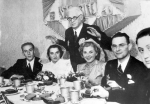
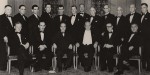
Group of B’nai B’rith men, circa 1950. (photo from JWB fonds, JMABC L.12152)

If you know someone in this photo, please help the JI fill the gaps of its predecessor’s (the Jewish Western Bulletin’s) collection at the Jewish Museum and Archives of B.C. by contacting [email protected].

Format ImagePosted on May 29, 2015May 27, 2015Author JI and JMABCCategories Mystery PhotoTags B'nai B'rith, JMABC

Good for Jews not good read

Washington Post columnist Richard Cohen came under a barrage of criticism in 2006 for writing that Israel was a mistake. Almost a decade after the controversy, he has come back with Israel: Is It Good for the Jews? (Simon & Schuster, 2014), in which he acknowledges that “mistake” may have been the wrong word and explains what he intended to say.

book cover - Israel: Is It Good for the Jews?Cohen admits that he could not think of another word to reflect the missteps in Israel’s history. He believes that early Zionists were mistaken to think the creation of a Jewish homeland in Palestine was the answer to antisemitism. Also, Israel in its 67 years has made mistakes; for example, he believes it was a blunder not to banish all Palestinians in 1948, and that it was a huge error to become an occupying power after 1967.

Those are hot topics to debate, especially after the recent election in Israel. But how are they related to the provocative question posed by the title? Cohen never makes a connection. He pays little attention to contemporary Israel and its relationship to Jews around the world. The title does not reflect the book that he wrote.

A provocative book title may be good for promotion and sales. It’s disappointing for readers who are familiar with his reputation and expect more from his book. Cohen is a syndicated columnist who has received awards for his investigative reporting. Israel: Is It Good for the Jews? was nominated for a Jewish Book Council award.

So, let’s ignore the title and look at the book for what it is. Cohen has written a brief history of antisemitism leading up to the creation of the state, an account of the early days of Israel and a quixotic account of some current events. He includes an 11-page index of books about Israel and the Jewish world that provide the anecdotes and profiles for his work.

However, even here, Cohen stumbles. With a deft pen, he fills the page with clever turns of phrases but, at times, his comments seem simply glib. His sweeping statements do not always make sense. He occasionally drifts sideways, making it difficult to follow what he is saying as he weaves his way through history.

At the outset, he makes it clear that he is not questioning Israel’s right to exist when he voices criticism of the country. He offers his credentials as a staunch supporter of Israel who loves and admires the country. He then begins his journey through the vitriolic world of antisemitism, paying special attention to leading figures who are not normally considered to be antisemites, and to the diabolical attacks against Jews in Europe that stretched far beyond Nazi Germany.

No one will challenge Cohen when he says that those who thought a Jewish homeland would end antisemitism were wrong. Creating a nation of Jews in the midst of Arab Muslim countries has produced a century of warfare and terrorism. Hatred of the Jews persists. He provides ample evidence that shows how the antisemitism of medieval and 20th-century Europe, with its pogroms and death camps, has morphed into aggressive anti-Zionism, spreading like an unruly virus throughout the Arab Muslim countries.

Cohen also shows how mistaken early Zionists were when they assumed that the Arab Middle East would politely make way for European Jews.

He writes that the Zionist dreamers meant no harm to the Arab residents. They intended to bring a European way of life to their new homeland. They sometimes thought, innocently, that the new country would benefit the Arabs as well as the Jews. Cohen says they were mistaken. But, as he notes, Palestinian resentment of Jewish immigration has been vocal and often violent since the 1930s.

Despite the harsh reception, the early immigrants came with their European morals. Ethnic cleansing and massive population shifts were common in other countries at that time, but founding father David Ben-Gurion and others refused to accept the expulsion of all Palestinians. The Palestinians became “collateral damage” to the fight for a new country. Cohen contends that the harm done to Palestinians was necessary, if the state was to be built, and could have been far worse.

He refers to the expulsion of 14 million ethnic Germans from their homes in countries outside Germany. The world shrugged as they were sent back to their ancestral homeland. The transfers were uncontroversial government policy in several European countries at that time. Similarly, in India and in Russia. He maintains that Israel could have done something similar.

Cohen links the decision to leave most Palestinians in their homes inside the country to the current situation, where Israel is now “two nations in one land.” He says that the occupation of the West Bank territories has further weakened the country. The occupation is “lighting the slow-burning demographic fuse that ensures that Jews will not be the majority in the Jewish homeland.”

He is extremely pessimistic about the country’s future. “To say Israel should survive is to accept ethnic cleansing,” he writes with a tone of despair.

Viewing the country from a left-wing perspective, Cohen contends that Israel has lost its purpose. The withering Jewish populations in Europe and the Islamic world have diminished the necessity of a safe haven for Jews. Meanwhile, Jews in North America are increasingly assimilated or indifferent to the country.

Israel has also lost its moral compass and “cannot distinguish the bell of reasonable criticism from the bell of hateful antisemitism,” he writes.

Cohen predicts things will only get “worse” for Israel. War or the constant threat of war will degrade Jewish Israel; secular Jews will leave Israel. The country – a land for a hated people and a despised religion – will become a gated community in the Arabian Desert. Time is not Israel’s ally. Echoing Israeli journalist Ari Shavit, Cohen believes that, sooner or later, the Jews will run out of miracles.

Robert Matas, a Vancouver-based writer, is a former journalist with the Globe and Mail. This review was originally published on the Isaac Waldman Jewish Public Library website and is reprinted here with permission. To reserve this book or any other, call 604-257-5181 or email [email protected]. To view the catalogue, visit jccgv.com and click on Isaac Waldman library.

Posted on May 29, 2015May 27, 2015Author Robert MatasCategories BooksTags antisemitism, Israel, Richard Cohen
Soft side of the law

Soft side of the law

If you’re a member of any law enforcement effort in North America these days you’re not exactly living the dream when it comes to respect.

Stories of corruption and abuse have littered the news the past couple of years with well-known cities like Ferguson and Baltimore fighting off large-scale riots as a result.

On social media it has become the norm to talk about police officers like they are ALL abusive, power-hungry brutes – a label that is a sad contrast to the post 9/11 world.

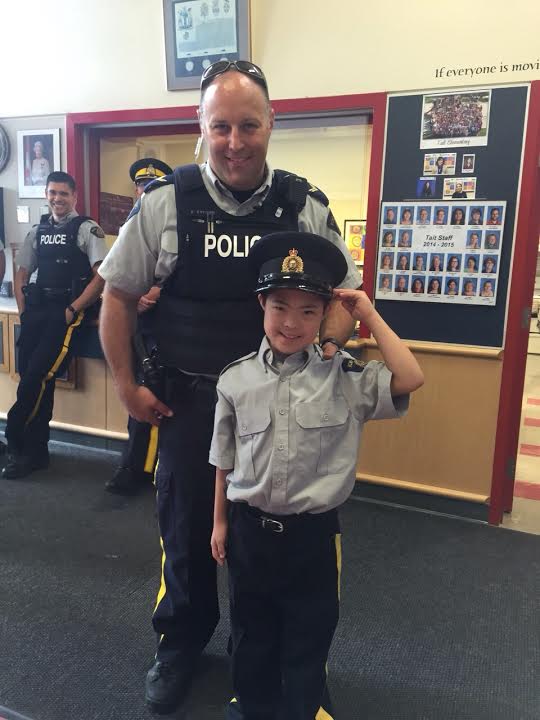
In Richmond last week, RCMP Corporal Kevin Krygier and his team put on a display that reminded many that the vast majority of our nation’s force are here for much more than crime and punishment. They are here for us.

This particular story started at Tait Elementary School, where Mike Ciu is a fourth-grade student with Down Syndrome. When Krygier visited the school this winter he met Mike, who helped give the corporal a tour of his school.

Soon after, Mike’s educational assistant, Marci Hammer, sent Krygier a video of Mike explaining that when he grew up he dreamed of being a police officer.

“I was so touched, I decided to make his dream a reality,” Krygier explained of what came next.

Krygier rallied his troops, connected with Hammer, started making some plans and put together an assembly presentation for Mike that blew his whole school away.

That day Mike Ciu was named an honorary Police Chief, given a uniform and marched into the gym with his new peers to roaring cheers from his younger peers. It was a day he and his family won’t soon forget.

Corporal Kevin Krygier and Mike Ciu

While the gesture turned into a nice community story, it was also a reminder that many of our uniformed defenders of the law are genuinely here to keep us safe AND make our lives better. So next time you hear a story of an officer abusing his power, share this one of our officers spreading the glory instead.

“I joined the RCMP to make a difference in people’s lives,” Krygier said. “I have done many things as part of the RCMP – some I have had to do and they have been sad and difficult. But this was so enjoyable for me and my colleagues. It took a lot of collaboration to make it happen, but comparably, it was easy and very meaningful for all of us who were involved.”

The event was captured on CTV News HERE.


Format ImagePosted on May 27, 2015May 27, 2015Author Kyle BergerCategories It's Berger Time!Tags Baltimore, Ferguson, Kevin Krygier, Mike Ciu, RCMP, Riots, Tait
אפליקציה סלולרית ברכבים

אפליקציה סלולרית ברכבים

אפליקציה סלולרית ברכבים: חברת הביטוח דז’רדינס מציעה לעקוב אחרי הנהגים תמורת עשרים וחמישה אחוז הנחה בפוליסה

לקוחות של חברת הביטוח המקומית דז’רדינס שיסכימו לתת לה אור ירוק לעקוב אחר נהיגתם, יקבלו בתמורה הנחה משמעותית בפוליסת הביטוח, בשיעור של עד עשרים וחמישה אחוז. כך החליטה חברת הביטוח לאחרונה, במסגרת קמפיין חדש כדי לעודד נהגים לנהוג בזהירות, כך שהדבר יגרום להקטנה משמעותית של מספר התאונות והנזקים בנפש וברכוש.

ד’זרנדיס היא בעצם חברה הראשונה בקנדה שמציעה ללקוחותיה ממש בימים אלה להתקין אפליקציה במכשיר הסלולר שלהם, שתאפשר לה לעקוב מקרוב אחר התנהגותם בכביש, כאמור תמורת הנחה בביטוח. האפליקציה תספק לדז’רנדיס מספר נתונים משמעותיים. ובהם: מהירות הנהיגה של הרכב, מרחק השמירה מהרכב שנמצא מקדימה, כמה פעמים לחץ הנהג על דוושת המעצור, באיזה יום הוא נהג ובאיזה שעה הוא נמצא על הכביש. עם סיום הנהיגה האפליקציה מסכמת את הנתונים ומעניקה לנהג ניקוד על צורת התנהגותו והתנהלותו בכביש, שמועברים למאגרי המידע של חברת הביטוח.

אחת מעובדות של חברת דז’רדינס שמפעילה את האפליקציה במסגרת ניסוי שמתקיים מאז חודש ספטמבר, מציינת כי רק מעצם השימוש בה היא כבר הפכה לנהגת יותר זהירה ומבוקרת שמקפידה על חוקי התנועה.

אך יש גם לא מעט שמבקרים את הפרוייקט החדש וטוענים שהאפליקציה תאפשר בעצם לדז’רדינס להשיג מידע אישי על לקוחותיה, ומי יודע לאיזה ידים הוא אף יכול להתגלגל. בדז’דינס שוללים את הטענות האלה ואומרים בתגובה, כי הם יאספו רק מידע על התנהגות הנהגים בכביש, והוא לא יועבר לשום צד שלישי. אגב גורמי אכיפת החוק יוכלו לקבל את המידע מחברת הביטוח רק אם יציגו צו בפניה מבית המשפט.

אפליקציה סלולרית במסעדות: מסעדות מוכרות מראש כרטיסים לשולחנות למנוע הפסדים מהזמנות

כמה פעמים הגענו למסעדה ונאלצנו להמתין בכניסה בתור ארוך ובלתי נגמר עד שפקעה סבלנותנו. ומה שעוד יותר מרגיז שראינו לא מעט שולחנות שפשוט עומדים להם ריקים וגלמודים עם השלטים מאירי העיניים “שמור”, ואף אחד לא יושב סביבם.

מתברר שהשולחנות “השמורים” האלה מעצבנים לא פחות גם את בעלי המסעדות, שמפסידים כסף רב מהתופעה הנפוצה הזו. הרבה לקוחות שמזמינים שולחנות מראש מאחרים מאוד להגיע, וחלק מהם אף לא טורח בכלל לבוא ולהודיע על כך למסעדות.

בעלי מסעדות בקנדה החליטו שהגיע הזמן לעשות מעשה ולשנות את רוע הגזרה, של מכת השולחנות הריקים. חלקם בחרו בפתרון קל ביותר והם ולא מקבלים עוד הזמנות מראש. התוצאות מורגשות היטב בשטח. אחוז תפוסת השולחנות גדל בשיעור משמעותי של למעלה מעשרים וחמישה אחוז, ובהתאם לכך ההכנסות הולכות וטופחות. ישנם בעלי מסעדות שמנסים אף “לחנך” את הלקוחות, וגובים פקדון מכובד עבור הזמנת שולחנות מראש, שלא יוחזר אם לא יופיעו.

ואילו ישנם בעלי מסעדות אחרים, בעיקר אלה שנמנים על הדור הצעיר יותר, שהחליטו לחפש פתרונות יצירתיים מבוססים על טכנולוגיה, כדי לאפשר ללקוחות להזמין מקומות מראש, אך במקביל גם לא להפסיד גם כסף. הם החלו לאחרונה להפעיל אפליקציה במכשיר הסלולר למכירת כרטיסים מראש עבור השולחנות, בדומה למה שקורה בענף האירועים. מחירי הכרטיסים משתנים בהתאם לרמת התפוסה המסעדה, מועד ההזמנה (למשל: באיזה שבוע מדובר, באיזה יום מדובר ואפילו באיזה שעה מדובר), מיקום השולחן וסוג התפריט. האפליקציה מדווחת גם בזמן אמת ללקוחות פוטנציאליים, מהו זמן ההמתנה לשולחנות באותו יום ואם יש בכלל שולחנות פנויים. כך שכולם יוצאים מורווחים מהאפלקציה הזו.

Format ImagePosted on May 26, 2015May 24, 2015Author Roni RachmaniCategories עניין בחדשותTags Ajusto, app, Desjardins, insurance, restaurant, telematics, אפליקציה סלולרית, ביטוח, דז'רדינס, מסעדה

Canada is not referee: Baird

Canada is not a referee in the game of geopolitics, said John Baird, Canada’s former foreign minister, it’s a player.

photo - John Baird
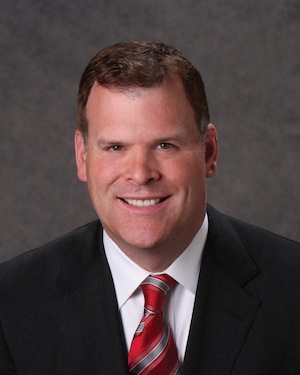
John Baird (photo from Jewish National Fund)

Baird, who will be honored at the Jewish National Fund’s Negev Dinner in Vancouver on June 7, spoke of his admiration for Israel and Canada’s close connections with that country in an interview with the Independent Sunday.

Responding to criticism that Canada has lost its place as a middle power or neutral broker, Baird insisted that is not Canada’s role in the world.

“We are a player,” he said. “We are on the liberal democratic team. We make no apologies for that.”

He cited the Conservative government’s role opposing Iran’s drive for nuclear weapons and regional dominance. The impact this has had in the Arab world is misunderstood by many Canadians, he said.

“Our standing in the Arab world today is stronger than it has ever been,” said Baird, speaking from Ottawa. “When I was foreign minister, we built good relations with the new government of Egypt, with the government in Iraq, with the UAE, the Saudis, the Bahrainis. We are widely respected among the political leadership. Yes, we have an honest difference of opinion with respect to our position on Israel. But when it comes to the Muslim Brotherhood, when it comes to Hamas, when it comes to Hezbollah, when it comes to Iran’s nuclear program, Iran’s material support for terrorism, when it comes to the Iranian-backed advance in Yemen … Saudi Arabia, Israel, Canada: we all share the same view. That’s not understood very well in this country.”

Baird said Canada is a world leader on child and maternal health, opposing forced marriages of girls, and supporting the rights of sexual minorities. Opponents of the government may have difficulty squaring their ideas of how a Conservative administration should behave with the record of the current Canadian government on issues of gender and sexual equality, but Baird says, “Look at the facts.”

“Prime Minister [Stephen] Harper personally has championed child and maternal health,” he said. “We’ve seen record investments not just in Canada but around the world because of his leadership. If you look at the leadership that I undertook with respect to young girls being forced into marriage, we became a leader in that. Canada followed the United Kingdom’s lead on sexual violence in conflict, not just on policy but on programming. When you look at [United Nations’ projects supporting] women, peace and security, we’ve taken a big role in North Africa. So, if you look at the facts, it’s undeniable, particularly on the issue of women and girls. The Day of the Girl resolution was championed by Canada at the UN.”

Advancing the rights of women worldwide is both a human rights matter and a determinant of societal health, Baird said.

“It’s in our own interest to do so,” he said. “It’s not just about human rights. The stronger role that women can play in government, in parliament, in civil society, the more we can combat extremism and promote pluralism.”

Reminded of a comment he made several years ago that, were he to leave politics he would probably go work on a kibbutz in Israel, Baird explained his respect for the Jewish state.

“I just have a passion for Israel, for its people, its culture, its history,” Baird said. “For everything the Jewish people have accomplished in the last 67 years. It’s really remarkable.”

What the Jewish people have built from the ashes of the Holocaust, he said, is admirable.

“The strength and ingenuity of the Jewish people, what they’ve accomplished in science, technology, agriculture, the huge history, it’s a remarkable accomplishment. What they’ve accomplished politically – a liberal democratic state in a pretty dangerous part of the world. The values that underpin the state of Israel, it’s just a remarkable, remarkable achievement.”

While Canada’s foreign policy, particularly under Baird, has turned Canada into what is frequently called Israel’s best friend in the world, the global attitude toward Israel remains highly negative, Baird acknowledged.

“We see far too much moral relativism,” he said. “It has stunned me the amount of criticism that Israel gets in so many international arenas, whether it’s the UN in New York or in Geneva … the UN Human Rights Council … others. On occasion it can be disappointing. It can be difficult to stand up against the rest of the crowd but it’s important to do what’s right. Canadians can be very proud that their government’s taken the path less traveled. We’ve never been afraid to stand up and support our liberal democratic friends.”

The former minister, who left politics earlier this year, speculated on where the animosity toward Israel comes from.

“I don’t think everyone who is against Israel is an antisemite,” he said. “But all antisemites are against Israel. I have great concern that we’ve seen, instead of people targeting the individual Jew, they’re targeting the collective Jew, the Jewish state. These things cause us great concern.”

Although he is moving into the private sector – he is working as a member of Barrick Gold’s advisory board and last week was elected to the board of Canadian Pacific – Baird promises to continue to be an outspoken supporter of Israel and a critic of Iran’s nuclear program and its support for terrorism.

Asked if he might return to public life as a candidate for the Conservative leadership when Harper retires, Baird deflected the idea with a flat “no” and refused, with a laugh, to elaborate.

Ilan Pilo, shaliach and executive director of Jewish National Fund, Pacific region, called Baird “a man of integrity and a true friend to Israel.”

“JNF is grateful to honor him for his leadership on the world stage, for years of devoted service to the citizens of Canada, his dedication to the Jews of Canada and to the state of Israel,” said Pilo. “Thanks to Baird’s outstanding leadership, Canada has become Israel’s most unwavering ally.”

Baird returned the compliment.

“Canadian supporters of JNF can be very proud of the work they’ve done over the years,” said Baird.

This year’s Negev Dinner, which takes place at the Four Seasons Hotel, supports a project in the city of Sderot, adjacent the Gaza Strip. The city has been under bombardment by Hamas missiles for the last several years. The park and fitness facility will enhance life for the citizens and provide a “green lung” for the city.

Pat Johnson is a Vancouver writer and principal in PRsuasiveMedia.com.

Posted on May 22, 2015May 21, 2015Author Pat JohnsonCategories LocalTags Ilan Pilo, Israel, Jewish National Fund, JNF, John Baird, Negev Dinner
Exhibit’s familiar face

Exhibit’s familiar face

This photo is among the images in The Face of the Ghetto: Pictures Taken by Jewish Photographers in the Litzmannstadt Ghetto, 1940-1944, produced by the Topography of Terror Foundation, Berlin. The bride on the right is Bronia Sonnenschein; beside her is her groom Erich Strauss. The second bride is Mary Schifflinger with husband Ignatz Yelin. Blessing the couples is Chaim Rumkowski, head of Lodz Ghetto’s Jewish council. Only Sonnenschein survived the Holocaust. She passed away in Vancouver in 2011. (photo from Yad Vashem Photo Archive)

The Face of the Ghetto: Pictures Taken by Jewish Photographers in the Litzmannstadt Ghetto, 1940-1944, opened last week at the Vancouver Holocaust Education Centre. Produced by the Topography of Terror Foundation in Berlin, among the traveling exhibit’s photographs was a surprise – a photo with a local connection.

“Unidentified in the photo caption but recognized by our education director [Adara Goldberg] during her research about this exhibit, Bronia Sonnenschein is depicted in the photo to my left,” said VHEC executive director Nina Krieger in her remarks at the opening on May 14, directing attendees’ attention to an image “showing a double wedding ceremony presided over by Chaim Rumkowski, the head of the Council of Elders in the Lodz Ghetto. Bronia was the sole survivor of those shown in this photograph. A multilingual secretary in Rumkowski’s office and a survivor of Auschwitz, Bronia passed away in 2011 but is fondly remembered by so many of us.

“Bronia, who stood maybe ‘this’ tall,” continued Krieger, indicating a measure of about shoulder height, “was a giant in terms of her dignity, her resilience, and her dedication to sharing her eyewitness testimony with tens of thousands students as a VHEC outreach speaker.”

About the Topography of Terror Foundation, Krieger explained that it “is mandated to transmit the history of National Socialism and its crimes, and to encourage people to actively confront this history and its aftermath. A distinctive indoor and outdoor museum, the Topography of Terror is located on the very grounds previously occupied by the primary institutions of Nazi persecution and terror: the SS, the Gestapo secret police and the Reich Main Security Office ran their central operations from the site.”

Krieger provided context for the exhibit. “Following the German invasion of Poland in 1939, the Nazis imposed a ghetto in the city of Lodz, which they renamed Litzmannstadt. From 1940 to 1944, more than 180,000 Jews and 5,000 Roma and Sinti lived in the ghetto’s cramped quarters, with many working in factories that supported the war effort.

“Ghetto residents were not allowed to own cameras, yet Lodz is the most documented of all the ghettos in Nazi-occupied Europe. Some of these images were taken by perpetrators, often trivializing the terrible conditions in the ghetto and attempting to justify the exploitation of Jewish forced laborers. Others – and the focus of this exhibit – were taken by a handful of Jewish photographers, commissioned by the local Jewish council. While instructed to document the productivity of the war industry for the Nazis, the photographers also captured – at great personal risk – intimate moments of family, childhood and community.”

The Face of the Ghetto exhibit is here as a result of VHEC’s partnership with the German Consulate General in Vancouver and the sponsorship of the German government. Consul General Herman Sitz was at the opening and said a few words, as did Sonnenschein’s son, Dan. Drawn from a collection of 12,000 images held by the Lodz State Archives, one of the intimate moments captured is the one in which his mother appears.

“Last Friday was the historic 70th anniversary of Victory in Europe Day,” said Sonnenschein, addressing those assembled. “May 8th was personally very meaningful for my mother, as it was the date in 1945 on which she was liberated from the Nazi horror. For her, the bitterly harsh years had begun on March 13, 1938, when Germany annexed a largely welcoming Austria, immediately setting off intense persecution of the Jewish population.

“My mother, with her sister and parents, were among the longest-held prisoners in the Lodz Ghetto, from its formation in spring 1940 until its so-called liquidation in August 1944. Unlike many deported there from other places, they had fled Vienna after the notorious Kristallnacht, and were living under great stress in Lodz when the family was forced from their new home into the ghetto. They were later joined by a beloved aunt of my mother who was deported from Vienna. Her cherished elderly grandmother was deported elsewhere and murdered soon after.

“My mother, with her German-language and office skills, worked as a secretary in the ghetto’s Jewish administration,” he explained. “The photo in this exhibit shows her being married to Erich Strauss, who had been deported from Prague with his mother. The other bride in this double ceremony was Mary Schifflinger, my mother’s fellow office worker and good friend, whose groom’s name was Ignatz Yelin. Shown in the photo blessing the couples is Chaim Rumkowski, appointed head of the Jewish council by the ghetto’s masters in the German administration.

“These five people were all transported, in the usual dreadful way, to Auschwitz, where Rumkowski was killed. Soon after, the others were sent to a less well known but no less brutal concentration camp called Stutthof. There, Mary and her husband were killed, Erich Strauss and his mother were killed, my mother’s father and aunt were killed. As my mother once said, it was a killing field.

“Other photos of my mother in the ghetto may be seen on the internet, along with such photos of my Aunt Paula, who also married in the ghetto, to Stan Lenga,” continued Sonnenschein. “Unlike my mother’s first husband, my Uncle Stan survived and the couple was reunited after the war, being a part of my close family in Vancouver along with my maternal grandmother, Emily Schwebel. The local Jewish Family Service Agency gives an annual Paula Lenga Award in my aunt’s memory for exemplary volunteer service.

“My mother was also an exemplary volunteer, in her case, in Holocaust education. She began this late-life career, first under the auspices of the Canadian Jewish Congress and then with this centre, for over two decades compellingly conveying the suffering imposed on her and so many others for, as she put it, the crime of being Jewish. She often quoted Elie Wiesel’s saying: ‘Not every German was a Nazi but every Jew was a victim.’

“Although we no longer can experience her vibrant presence,” concluded Sonnenschein, “we are fortunate to have many recordings of my mother, as well as a book, to help her testimony live on.” Included in those recordings, he said, is one of her talking about the photo in The Face of the Ghetto exhibit, and related matters. The photos he mentioned of his mother and aunt can be found at google.com/culturalinstitute, searching for “Bronia Sonnenschein” and “Paula Lenga.”

In conjunction with the exhibit, the VHEC has developed a school program and teaching resource to engage students. “Visiting school groups will explore topics such as resistance to dehumanization; the unique experiences of children; and the complex role of Jewish leadership under Nazi occupation,” said Krieger, noting that several of the volunteer docents were at the opening. “Volunteers are central to our work,” she said, “and it’s my honor to acknowledge and to thank our docents for everything that they do.”

Krieger also thanked the VHEC staff – present were Goldberg, designer Illene Yu, archivist Elizabeth Shaffer, collections assistant Katie Powell and administrator Lauren Vukobrat – and the installation crew, Wayne Gilmartin and Adam Stenhouse, as well as the consul general.

The Face of the Ghetto is on display at the VHEC until Oct. 16.

– With thanks to Nina Krieger and Dan Sonnenschein for providing electronic copies of their remarks.

Format ImagePosted on May 22, 2015May 21, 2015Author Cynthia RamsayCategories LocalTags Bronia Sonnenschein, Dan Sonnenschein, Lodz, Nina Krieger, Topography of Terror Foundation, Vancouver Holocaust Education Centre, VHEC, Yad Vashem

Posts pagination

Previous page Page 1 … Page 560 Page 561 Page 562 … Page 649 Next page
Proudly powered by WordPress