Skip to content
  • Home
  • Subscribe / donate
  • Events calendar
  • News
    • Local
    • National
    • Israel
    • World
    • עניין בחדשות
      A roundup of news in Canada and further afield, in Hebrew.
  • Opinion
    • From the JI
    • Op-Ed
  • Arts & Culture
    • Performing Arts
    • Music
    • Books
    • Visual Arts
    • TV & Film
  • Life
    • Celebrating the Holidays
    • Travel
    • The Daily Snooze
      Cartoons by Jacob Samuel
    • Mystery Photo
      Help the JI and JMABC fill in the gaps in our archives.
  • Community Links
    • Organizations, Etc.
    • Other News Sources & Blogs
    • Business Directory
  • FAQ
  • JI Chai Celebration
  • JI@88! video

Recent Posts

  • Story of Israel’s north
  • Sheltering in train stations
  • Teach critical thinking
  • Learning to bridge divides
  • Supporting Iranian community
  • Art dismantles systems
  • Beth Tikvah celebrates 50th
  • What is Jewish music?
  • Celebrate joy of music
  • Women share experiences 
  • Raising funds for Survivors
  • Call for digital literacy
  • The hidden hand of hate
  • Tarot as spiritual ritual
  • Students create fancy meal
  • Encouraging young voices
  • Rose’s Angels delivers
  • Living life to its fullest
  • Drawing on his roots
  • Panama City welcoming
  • Pesach cleaning
  • On the wings of griffon vultures
  • Vast recipe & story collection
  • A word, please …
  • מארק קרני לא ממתין לטראמפ
  • On war and antisemitism
  • Jews shine in Canucks colours
  • Moment of opportunity
  • Shooting response
  • BC budget fails seniors
  • Ritual is what makes life holy
  • Dogs help war veterans live again
  • Remain vital and outspoken
  • An urgent play to see
  • Pop-up exhibit popular
  • An invite to join JWest

Archives

Follow @JewishIndie
image - The CJN - Visit Us Banner - 300x600 - 101625

Author: Robert Matas

Storytelling overtaken by facts

Isaac Bashevis Singer and Sholem Aleichem gave us delightful fables about the shtetl, the overcrowded villages of Eastern Europe, with endearing characters that contended with abysmal poverty, deadly pogroms and false messiahs. However, life in the shtetl was not always so dreary.

In a new book that effectively undermines the archetypical shtetls of our imagination, Yohanan Petrovsky-Shtern in The Golden Age Shtetl: A New History of Jewish Life in East Europe (Princeton University Press) redraws the image of the shtetl. A professor of Jewish studies at Northwestern University and author of several books, Petrovsky-Shtern documents a brief period in history, from the late 17th century to the mid-18th century, when life was not so bad in those towns of our ancestors in eastern Poland and Ukraine.

book cover - The Golden Age Shtetl: A New History of Jewish Life in East EuropePetrovsky-Shtern looks closely at three provinces with 44 shtetls in Eastern Europe. Relying mostly on documents that were previously overlooked, he discovers that many of the shtetls at that time were neither poor nor especially pious. On the contrary, they were thriving communities with stable economies built around popular market fairs. Some shtetls had trading firms that rivaled those found in large cities. Some had fancy restaurants and a rich cultural life.

Although Jewish businessmen were prominent, the Jews were a minority in many of the towns. Jews and Christians lived and worked together.

As might be expected in any neighborhood, the Jewish community also had its share of characters of questionable integrity. Petrovsky-Shtern goes through historic court records that reveal stories of bribes, counterfeiting, smuggling, informants and collusion of Jewish businessmen with crooked clerks. Even the rabbinical leadership comes under his microscope.

Jews came to Eastern Europe with the Greek colonizers more than 2,000 years ago but the Jewish presence in the region was minimal until Polish nobility encouraged Jewish migration from Western Europe.

The Jews were invited to run country fairs and sell liquor, two activities that provided significant tax revenues to the Polish authorities. The Jewish businessmen brought new “Western” approaches to trade. They put stores and stalls under one roof, and sold exotic merchandise from distant lands. They opened inns offering a place to drink and a bed. They injected a cosmopolitan slice of urban life into rural agricultural areas. They expanded trade, bringing prosperity to the region.

By 1840, however, the golden era had started to fade. The Russian monarchy, which had ruled the region with benign neglect since the partition of Poland in the late 1700s, began asserting its authority. Discriminatory laws against Jews contributed to the decline of the shtetl, as authorities shifted economic and political power to larger urban centres. Once-vibrant communities turned into depressed outposts of the Russian Empire, the shtetl of popular Yiddish literature. They struggled to survive in their diminished state, until the Nazi regime wiped them out.

A fascinating and often ignored aspect of the shtetl described by Petrovsky-Shtern is the relationship of the shtetl Jews with the Holy Land.

In the late 18th century, about 500 Jews from the Polish-Lithuanian Commonwealth went to Palestine to build a religious utopian community. Followers of Rabbi Eliyahu ben Zalman, the Mitnagdim idealists, were convinced that resettlement would pave the way for the Messiah. The rabbi, also known as the Vilna Gaon, had predicted the Messiah would arrive in 1840, coinciding with the year 5600 in the Jewish calendar.

Not to be undone, followers of the Ba’al Shem Tov, the rival Chassidic sect, made aliyah in even greater numbers, settling in Safed, Tiberias, Hebron and Jerusalem. By 1800, the Jewish population of Palestine had expanded to 6,000, accounting for roughly two percent of the population.

Petrovsky-Shtern recounts the impact of this aliyah on those who remained behind in the shtetl. In some respects, reverberations of the migration continue to be felt almost 200 years later.

The pioneers in Palestine faced unimaginable challenges: poverty, illnesses, natural disasters, famine and discriminatory Ottoman Empire laws. In order to survive, the Jews of Palestine developed a sophisticated network of rabbinic fundraisers who went from shtetl to shtetl, giving sermons, selling books and sparking the imagination with stories about the Holy Land, including tales about inscriptions on the tombs of the prophets.

The rabbinic messengers assured shtetl Jews that supporting Jews in the Holy Land was comparable to fulfilling the commandment of settling in the Holy Land themselves. The rabbis, who kept meticulous records, told donors that prayers were chanted on their behalf at the Cave of Machpelah, the gravesite of Abraham, Isaac,

Jacob, Sarah, Rebecca and Leah.

The authorities tried to stop the flow of funds to Palestine. They suspected that the Jews, who they blamed for the death of Jesus, were sending money to rebuild the Temple in Jerusalem. They believed that the fundraising was reinforcing Jewish separateness, undermining assimilation, increasing fanaticism and possibly hindering Jews’ ability to pay local taxes.

Also, as the years passed, raising funds for the Jews in Palestine was viewed as aiding an enemy of the state. By the 1800s, the Polish-Lithuanian Commonwealth had been partitioned and territory that included many of the shtetls became part of the Russian Empire, which had hostile relations with the Ottoman rulers.

Yet, Jewish communities still managed to raise money, especially in the years from 1810 to 1830. Aiding the Jews of Palestine became one of the highest priorities for Eastern Europe’s Jews, comparable only to the commandment of ransoming prisoners, Petrovsky-Shtern says.

The communal leadership of dozens of shtetls in the provinces of Volhynia and Podolia imposed a tax to help establish a synagogue in Jerusalem and maintain Chassidic groups. Charity boxes were on many dining tables and store counters. As well, sacks of earth from the Holy Land and ritual objects produced by the Jews of Palestine found their way into everyday life of the shtetl. Unpublished manuscripts by Holy Land rabbis and mystics were much sought-after reading, passing from hand-to-hand in the shtetl.

In a tale that echoes across two centuries, Petrovsky-Shtern recounts the role of the legendary charity boxes that are now found in many Jewish homes in North America. He writes that Jewish women in the shtetl of Kremenets, and possibly surrounding towns, turned the “commandment” to help the Jews of Palestine into an intrinsic part of the blessings over candles before Shabbat: right before the blessing, they put some money aside in a wooden charity box or tin mug to support the Holy Land communities.

By the time of the devastating earthquake in Safed in 1837, whatever hurt Palestine was felt just as strongly in the shtetls of Eastern Europe. The relationship between the shtetl and the Jews of Palestine appears to have many similarities with contemporary links between Israel and the Diaspora.

Petrovsky-Shtern provides a wealth of information about many different aspects of daily life, woven between lively vignettes to illustrate the comfortable standard of living enjoyed by many shtetls before their precipitous disintegration.

Unfortunately, the book is too easy to put down. Petrovsky-Shtern’s encyclopedic descriptions of the shtetl provide solid background for an academic understanding of the shtetl, but the pace is uneven. Interesting stories, such as the account of the relationship to the Holy Land, are interspersed with lengthy reports of dry historical records.

As Petrovsky-Shtern wanders back and forth across the years and jumps from shtetl to shtetl, the locations and dates turn into boring lengthy lists of trivia. Despite the endless string of names of real people, the reader does not come to know anyone in the shtetl. The facts may be on Petrovsky-Shtern’s side, but Isaac Bashevis Singer and Sholem Aleichem tell much more memorable stories.

Robert Matas, a Vancouver-based writer, is a former journalist with the Globe and Mail. This review was originally published on the Isaac Waldman Jewish Public Library website and is reprinted here with permission. To reserve this book or any other, call 604-257-5181 or email [email protected]. To view the catalogue, visit jccgv.com and click on Isaac Waldman library.

 

Posted on July 1, 2016June 29, 2016Author Robert MatasCategories BooksTags history, Petrovsky-Shtern, shtetl
Perlman wins Genesis Prize

Perlman wins Genesis Prize

(photo from Ashernet)

Prime Minister Binyamin Netanyahu awards this year’s Genesis Prize to violinist Itzhak Perlman at a June 23 ceremony in Jerusalem. The annual prize of $1 million is given to “an exceptional human being who has attained outstanding excellence and international renown in his or her chosen field, is a role model in the community and who can inspire the next generation of Jews worldwide.” Perlman said he plans to direct his prize money to philanthropic projects in the fields of music and support for individuals with disabilities.


Format ImagePosted on July 1, 2016June 29, 2016Author Edgar AsherCategories IsraelTags Genesis Prize, Israel, Netanyahu, Perlman, tikkun olam
סטארט תל אביב

סטארט תל אביב

סטארט אפ קנדה עומדת לסיים את הליך ההתמודדות לבחירת אישה יזמית של סטארט אפ לתחרות הבינלאומית ‘סטארט תל אביב’, שתערך בחודש ספטמבר הקרוב.

אישה ממציאה: מסתיים הליך ההתמודדות לבחירת אישה יזמית של סטארט אפ לתחרות בינלאומית בתל אביב

סטארט אפ קנדה עומדת לסיים את הליך ההתמודדות לבחירת אישה יזמית של סטארט אפ לתחרות הבינלאומית ‘סטארט תל אביב’, שתערך בחודש ספטמבר הקרוב. התחרות תתקיים במשך חמישה ימים (25-29) וישתתפו בה נציגות משלושים מדינות שונות. הפרוייקט של סטארט אפ קנדה לבחירת הנציגה שתגיע לתל אביב מתקיים בחסות שגרירות ישראל בקנדה וחברת יו.פי.אס. הזוכה תזכה בכרטיס זוגי ואירוח מלא בתל אביב.

התנאים להצגת מועמדות להשתתפות באירוע בתל אביב: אישה עד גיל ארבעים, ממציאה של סטארט אפ, הסטארט אפ נמצא ופועל מחוץ לקנדה, הסטארט אפ מבוסס על טכנולוגיה או עושה שימוש בטכנולוגיה בדרך חדשנית וקריאטיבית. יצוין כי רק נציגה אחת מכל חברת סטארט אפ יכולה להציג מועמדותה לאירוע. המועד האחרון להגשת מועמדות נקבע לארבעה ביולי.

במסגרת הביקור בתל אביב הנציגה הקנדית ביחד עם הנציגות מהמדינות הנוספות תפגשנה יזמים ישראלים בולטים, משקיעים, אמנים, יוצרים ומדענים. בהם: ראש עיריית תל אביב רון חולדאי, יוסי ורדי, אורלי שני ורותי קורן. האורחות מחו”ל ישתתפו בפסטיבל החדשות של עיריית תל אביב הנקרא ‘אולד’ וכן במספר בהרצאות וסדנאות בינלאומיות. הפסטיבל משמש זירת מפגש בין עולם ההיי-טק והחדשנות בישראל, לבין הזירה הבינלאומית והציבור הרחב. הפסטיבל כולל אירועים, סיורים, מפגשים, ביקורים בחברות סטארט אפ ועוד. יצויין כי ‘סטארט תל אביב’ מנוהל על ידי משרד החוץ של ישראל ומתקיים מזה חמש שנים.

סטארט אפ קנדה יצא לדרך בשנת 2012 על ידי היזמית ויקטוריה לינוקס. הארגון משתף פעולה עם שלוש מאות גופים ברחבי קנדה, בניהול מאתיים אירועים בארבעים קהילות שונות. עד היום כעשרים אלף איש השתתפו באירועים של סטארט אפ קנדה. הארגון הצליח כבר ליצור קשר בין שלושת אלפים יזמים עם סטארטאפיסטים. על השותפים של המסחרים של סטארט אפ קנדה נמנים: סקוטיה בנק, מיקרוסופט, יו.פי.אס והפיינשל פוסט.

לפי נתונים של בנק אוף מונטריאול מיליון וחצי קנדיים מועסקים על ידי חברות בבעלות נשים. ואילו על פי נתוני בנק אר.בי.סי עסקים בבעלות נשים בקנדה תורמים מאה ארבעים ושמונה מיליארד דולר לכלכלה הקנדית מדי שנה.

אישה מתחזה: אישה מחופשת עם פאה ומשקפיים התייצבה למבחן נהיגה ברכב במקום אמה

בוחן נהיגה וותיק במחוז אונטריו הופתע מאוד לראות שלמבחן נהיגה ברכב (טסט) שהייה אמור להתקיים עם נבחנת מבוגרת בת 73, התייצבה אישה חבושה בפאה ועם משקפיים כהים. הבוחן לא היה צריך להתאמץ במיוחד לראות שהנבחנת לידו (במושב הנהג), נראית הרבה יותר צעירה מאישה בת 73. לאחר שהתעשת הבוחן החליט כן לאפשר לצעירה המחופשת לבצע את הטסט במקום אמה. בו בזמן הוא הודיע למנהליו במשרד על האירוע החמור, ואלו הזעיקו מייד את השוטרים שעצרו אותה.

האישה בת ה-39 הודתה בחקירתה בתחנת המשטרה כי היא בתה של הנבחנת המבוגרת שלנחצה מאוד מהטסט ופחדה להיכשל. הבת (ששמה לא פורסם בשלב זה על ידי המשטרה) הוסיפה עוד, כי היא חשבה שהיא דווקא כן פעלה נכון כיוון “כשעזרה” לאמה, והתייצבה למבחן הנהיגה במקומה. במשטרה כמובן לא קיבלו את הסבריה אלה של המתחזה והיא תעמוד למשפט במהלך חודש יולי הקרוב. שני סעיפי האישום נגד האישה: התחזות ועבירה פלילית. אם תורשע העונש המקסימלי על שתי עברות אלה הוא חצי שנה בכלא וקנס בגובה חמשת אלפים דולר. סביר להניח שהנאשמת תתרחק מתחפושות לפחות בתקופה הקרובה.

Format ImagePosted on June 29, 2016June 29, 2016Author Roni RachmaniCategories עניין בחדשותTags driving exam, entrepreneur, Ontario, startup, Tel Aviv, Victoria Lennox, wig, women, אונטריו, ויקטוריה לינוקס, יזמית, מבחן נהיגה ברכב, סטארט אפ, פאה, תל אביב
Share in collectors’ passions

Share in collectors’ passions

Yosef Wosk with his collection of circus memorabilia, some of which can be seen in the Museum of Vancouver exhibit All Together Now: Vancouver Collectors and Their Worlds. (photo by Rebecca Blissett)

Prosthetics. Menus. Corsets. Artificial eyes. Seeds. Public transit documents. One wouldn’t necessarily think of these items as “collectibles,” yet they form part of a new exhibition that opened on June 23 at the Museum of Vancouver (MOV).

All Together Now: Vancouver Collectors and Their Worlds presents wall-to-wall displays of rare and unconventional items from 20 local collectors. Rounding out each exhibit is an opportunity for a fun, hands-on experience and a profile of the collector, including his or her motivations for collecting.

The exhibition explores the questions: Why do people collect and how do private collections touch public consciousness?

“The act of collecting is a fascinating way to engage with one’s identity, history and community,” Viviane Gosselin, curator of contemporary culture at the MOV, said in a release. “This exhibition enables visitors to enter into the rich, often unknown worlds of collectors and to think about how private collections can affect our understanding of the past. In this way, it reminds us of the importance of collectors as memory-keepers.”

Some of the exhibition’s “memory-keepers” include Imogene Lim, an anthropologist who collects Chinese-Canadian restaurant menus. She does so because they connect to her family story and her interest in intercultural history. David Moe collects vintage artificial limbs because they connect to his father’s profession and provide insight into the development of medical technology.

Gosselin noted that many of the collections form the basis for larger conversations about important societal issues. For example, Harold Steves’ collection of heirloom seeds ties to environmental history and issues of sustainability and food security. Prosthetics stimulate discussions about visibility, accessibility, social stigmas associated with disability and prosthetic design developments.

photo - Harold Steves’ collection of heirloom seeds ties to environmental history and issues of sustainability and food security
Harold Steves’ collection of heirloom seeds ties to environmental history and issues of sustainability and food security. (photo by Rebecca Blissett)

For Yosef Wosk, whose circus memorabilia was chosen by MOV curators to feature in the exhibition, collecting represents “an assembly of ideas, feelings, interesting people, travels and experiences so that the whole world, in a way, is a great museum.” He believes that the selection of his circus memorabilia for exhibition was “serendipitous,” as he considers the circus a “metaphor for life … usually a joyous place and sometimes an adventure.”

Wosk has been an avid collector of art and other diverse objects for many years. His 20 different collections encompass paintings, sculptures, photographs, furniture, carpets, lamps, textiles, glass, books (subdivided into 15 to 20 categories), toys and religious articles, including Judaica. He cherishes his collection of Torah scrolls from around the world, including Syria, Yemen, Iraq, Iran, Morocco and Tunisia.

As a child, Wosk collected coins, stamps, marbles and comics, but he is nostalgic in remembering the purchase of his first piece of “real art” at the age of 16. It was a Japanese scroll that he decided was worthy of his entire summer salary as a junior counsellor at Camp Hatikvah.

Over the years, Wosk built up his collection while studying and working in different cities around the world, such as Jerusalem, New York, Toronto, Philadelphia and Boston. As a student in Toronto, he acquired (with the help of his father) an Andy Warhol screenprint, “Ten Portraits of Jews of the Twentieth Century,” which he kept in a cardboard case under his bed.

Perhaps naturally, it was in Jerusalem that Wosk started to collect Judaica. Noting that, “collecting is an external manifestation of inner thoughts, feelings and spirituality,” he regards his Jewish collections, in particular, as an appreciation of Creation. He points out that the first description of G-d in the Torah is as an artist, as Creator. Moreover, the earth, and everything that fills it, is G-d’s collection. As such, Wosk has a profound appreciation for human creativity as an extension of the individual but, ultimately, of G-d. “That is how I feel about the collection, which is part of the world and the universe, which emanates from the Creator,” he said.

Wosk also believes that, as a collector, he has a responsibility to share his prized possessions with others.

“Sharing is as important as the collecting,” he said. “I find that collecting is not just owning, but along with ownership comes responsibility … to the object, the artist and the community.”

Wosk also emphasized, “People shouldn’t be afraid to collect and give it away.” He is a proud patron of the arts, serving on local and national boards of directors for various museums and art organizations (he was a founder of the Jewish Museum and Archives of British Columbia), donating art to hospitals and institutions of higher learning, and lending his collections to different exhibitions. His collection of Judaica has been displayed in Philadelphia and Boston, as well as in Vancouver, including at the Jewish Community Centre of Greater Vancouver’s Sidney and Gertrude Zack Gallery. He hopes to coordinate an exhibition in Israel in the future.

Wosk’s remarkable collections, and his enthusiasm to share his “wealth” with diverse communities, warrants his honorific as a “memory-keeper.” For a man who once worked as a teaching assistant for one of the greatest memory-keepers in history, the esteemed Elie Wiesel, this is perhaps not so serendipitous.

All Together Now: Vancouver Collectors and Their Worlds is at the Museum of Vancouver until Jan. 8, 2017. If you fancy yourself a collector and would like to participate in this exhibition, the MOV invites the public to post pictures of themselves with their collections on social media using the hashtag #mycollectionatMOV. Images will be projected onto a wall of photos. For more information, visit museumofvancouver.ca.

Alexis Pavlich is a Vancouver-based freelance writer.

Format ImagePosted on June 24, 2016June 22, 2016Author Alexis PavlichCategories Visual ArtsTags collectibles, Museum of Vancouver, Wosk
Networking over breakfast

Networking over breakfast

Jonathan Kallner, event speaker and managing partner, KPMG, talks with Eli Joseph, senior account manager, business and personal, RBC Royal Bank, at Schara Tzedeck’s LinkYid networking event June 3. (photo by Baila Lazarus)

There is a theory that you are the average of the five people you hang around with the most. Thus, creating and interacting with a successful network of businesspeople should, over time, increase your own level of success.

With this in mind, Jonathan Kallner, managing partner, KPMG Vancouver, opened LinkYid’s first complimentary career networking breakfast with the topic, How to Unleash the Power of Your Network.

LinkYid is a Congregation Schara Tzedeck program that connects immigrants, professionals and entrepreneurs with mentors, employment and business opportunities that match their potential. They held their first event at KPMG on June 3.

“This topic ties into a core pillar in our strategy [at KPMG], which is community,” said Kallner. “We believe in building networks and helping networks succeed.”

Talking about his own experiences in school, in his job and the industry, Kallner admitted that, when he needed to make major decisions, he turned to his contacts.

“If you nurture the networks, they become your supporters,” he said. But, he added, “I didn’t appreciate how important that was until later in my career. I never realized what a difference there could have been in my life.”

Using Blockbuster as an example of failed relationship-building, Kallner pointed out how successful the video rental company had been, with an outlet in every neighborhood and relationships with everyone in the local community.

“If you wanted to watch a movie, you went to Blockbuster and, in four years, they destroyed it,” said Kallner. “Because they did not maintain the relationships with their customers, they allowed someone else to come in and own that relationship.

“It’s no different in our everyday lives,” he said. “The world can change around you but your relationships can stay constant.”

Kallner outlined four key points in building networks and relationships:

1. Know your goals. Each person needs to establish their own personal plan for their business, looking forward one, two and five years. Focus on the skills you have that you can capitalize on and what you need to develop. Use your networking connections to seek advice and consider it.

“When you’re looking at strengths and weaknesses, be very honest,” said Kallner. People looking to hire want to know that candidates have a good understanding of this, he said.

2. Consider getting a coach or mentor. Many of those who have gone before you in the industry will be willing to share their experiences with you, said Kallner. “They can challenge you to think differently and push your boundaries. They can act as a connector, help you develop your personal goals and work with you to define the next steps in your career.” Mentors will also be candid with you to encourage your business and personal growth.

“I still seek the guidance of mentors,” said Kallner, adding that the mentor or coach will also get value out of the relationship.

3. Build and work your network. Any search for business groups on Meetup will yield dozens of groups you can connect with in the Lower Mainland in any given week, but there are more and less effective ways of working your networks. Talk to new people at each event, said Kallner.

Respect their time and don’t be a salesperson, he added, as the key to networking is building relationships. “Don’t overlook how networks build naturally and don’t rush it,” he advised.

4. Take advantage of social media. While online presence is essential, especially when building your digital networks, there are things to look out for, said Kallner. Select the right platform. LinkedIn is considered the best platform for business operators. Others can be beneficial but you have to manage your brand closely, keep active on the site on a regular basis and make sure your profile is professional.

“Facebook can kill a brand if you’re not careful to be professional with your posts,” he said.

The LinkYid networking session drew students, entrepreneurs and professionals seeking work, looking for new hires or simply to start their relationship-building.

Erez Iancu Ben Haim, an MBA student at Sauder School of Business, was there to start building his connections and discuss his goals with people in the room. Eli Joseph, a senior account manager with RBC Royal Bank, wanted to meet some new people and find new businesses that might be looking for government loans.

“Being in the business world, people come to me if they’re looking for connections, as well,” said Joseph.

In closing his talk, Kallner reminded people of two key takeaways:

  • Follow up after meeting with someone at an event with a personalized invitation to connect.
  • Networking doesn’t only happen at events. It can happen anywhere.

To find out more about LinkYid, visit linkyid.net, email Rachael Lewinski at [email protected] or call 604-736-7607.

Baila Lazarus is a freelance writer and media trainer in Vancouver. Her consulting work can be seen at phase2coaching.com.

Format ImagePosted on June 24, 2016June 22, 2016Author Baila LazarusCategories LocalTags Kallner, KPMG, LinkYid, networking, Schara Tzedeck
Outlook’s final edition

Outlook’s final edition

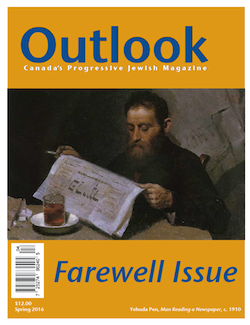
The cover of Outlook magazine’s final issue features a painting by Lithuanian artist Yehuda Pen (1854-1937). The newspaper in the image, explains the caption, is Der fraynd (The Friend), which, “founded in 1903, was one of the major Yiddish newspapers of its day before it was closed down in 1913 by czarist censors.” For Outlook – “Canada’s only progressive Jewish periodical” – it wasn’t censors that caused its demise, but the economy, one that has seen many print publications close their doors.

“We have struggled uphill for quite awhile with the difficulties and expenses of sustaining a print publication with a small and specialized – although devoted – readership, and we must finally let go,” writes editor Carl Rosenberg in the magazine’s final issue, the Spring 2016 edition.

image - cover of Outlook magazine’s final issue“Looking back, we are proud of having given a home to diverse voices in the left and Jewish communities: liberal Zionist, non- and anti-Zionist, Yiddishist, Marxist, feminist, anarchist, environmentalist, social democratic,” he continues. “We have covered and reflected the Canadian and international scene, including labor struggles, environmental issues, women’s issues, issues of sexuality, gender, human rights and civil liberties. We have hosted lively, often impassioned, debates on many issues, and we hope they have usually been respectful as well.



“We have upheld a cultural heritage dear to most secular Jews – that of Yiddish language and literature. We have published works by and about a wide variety of Yiddish writers, men and women, and recounted the rich and dynamic history of the secular Yiddish culture that emerged in Eastern Europe a century and a half ago and has played such a large part in modern Jewish history and culture.

“We have remembered one of the greatest crimes in recorded history – the Nazi Holocaust or Shoah against the Jews of Europe, paying tribute to those who resisted against impossible odds. We have tried to draw universal lessons from this monstrosity, speaking out against racism, chauvinism and fanaticism of all kinds. On the Israeli-Palestinian conflict, we have supported the rights of both peoples to exist in peace and equality, while opposing violence on all sides, and we have opposed the decades-long Israeli occupation of the West Bank and Gaza and the systematic Israeli violation of Palestinian human and national rights.”

In an article by Leslie Dyson, managing editor Sylvia Friedman – whose involvement with Outlook goes back 43 years – explains a bit of the publication’s history. While she connected with the magazine in Toronto in 1973, it started in 1963, evolving, writes Dyson, “from an English-language insert in the Vochenblatt (Weekly Paper),” which closed its doors in 1978, “due to the ill-health of its editor, Joshua Gershman, who was also for a time the de facto editor of Outlook, where [Friedman] worked with him.

“In 1979, Friedman announced that she was moving with her family to Vancouver. It seemed that Outlook (known then as Canadian Jewish Outlook) would have to fold. Ben Chud and Hank Rosenthal, progressive Jewish activists in Vancouver, asked if they could jointly take over the role of editor and have Friedman manage the magazine in Vancouver – an arrangement that was accepted.”

The magazine describes itself as “an independent, secular Jewish publication with a socialist-humanist perspective.” Published six times a year, it had collectives in Ottawa, Toronto, Winnipeg and Vancouver. It has had an office in the Peretz Centre for Secular Culture (which used to be called the Vancouver Peretz Institute) since the late 1980s. Rosenberg became assistant editor in 1993 and editor in 1998.

“We didn’t follow a particular policy,” Friedman told Dyson, “but we have been critical of what’s happening in Israel, the States, Canada and B.C. I guess the focus has been on equality and principles of socialism. But even left-leaning governments never received blind support.”

Financed by fundraisers held in Vancouver, Winnipeg and Toronto; subscriptions; and funds bequeathed by “Joseph Zuken (a long-time openly communist city council member in Winnipeg) and Ben Shek (a professor, social justice activist, active member of the Toronto Jewish Folk Choir and regular contributor to Outlook),” making ends meet has always been challenging for Outlook. At its highest, circulation was 3,000 copies in the 1990s.

With older readers literally dying off and younger readers getting their information from the internet, plus constantly increasing printing and mailing costs, publishing the magazine just became too expensive.

The final issue features many comments from readers about what Outlook has meant to them, essays on such topics as the future of the NDP and the state of public broadcasting, and several book reviews.

Format ImagePosted on June 24, 2016June 22, 2016Author Cynthia RamsayCategories NationalTags Friedman, magazine, Outlook, progressive, Rosenberg
Concern over incarceration

Concern over incarceration

A new handbook published by T’ruah: The Rabbinic Call for Human Rights provides a resource for the Jewish community to press for change around the problem of mass incarceration in the United States.

“We are here to uphold ideas of redemption and mercy,” said T’ruah director of programs Rabbi Rachel Kahn-Troster, citing a colleague who described America’s prisons as having a “mercy deficit.”

The handbook is available for free download at truah.org/incarceration. It provides background and resources – steeped in Jewish texts and teachings – for Jewish communities to take action around these issues. Leading a network of 1,800 rabbis across North America, T’ruah aims to bring attention to an array of domestic social justice issues, as well as human rights for Israelis and Palestinians.

When it comes to mass incarceration, Canada doesn’t have the same problem, but we have similar societal ills when it comes to race, ethnicity and imprisonment – as well as problematic prison conditions themselves – that call out for redress.

The handbook initiative came out of T’ruah’s earlier work on ending solitary confinement. Over the last couple of years, Kahn-Troster has found the Jewish community to be increasingly receptive to grappling with issues around incarceration. Michelle Alexander’s book The New Jim Crow: Mass Incarceration in the Age of Colorblindness, which details the effect that mass incarceration – and the subsequent denial of civil rights for convicted felons – has had on the African American community, really opened people’s eyes, she told the Independent.

Why the term mass incarceration? Compared to other countries, the United States imprisons its population at alarmingly high rates: 698 out of every 100,000 citizens are behind bars. For comparative purposes, Canada’s per capita rate is 141 out of 100,000, according to Statistics Canada.

And then there is the problem of race. African Americans are six times more likely to be jailed than their white counterparts, yet crime rates are not necessarily different. According to American Civil Liberties Union data cited in the T’ruah report, despite equal rates of actual usage, a black person in America is 3.73 times more likely as a white person to be arrested for drug use.

In Canada, blacks are incarcerated at three times their rate in society, according to the Office of Correctional the Investigator of Canada (OCIC). And, while only four percent of the population of Canada is aboriginal, 25% of the prison population is aboriginal. Among the female prison population, fully 36% are aboriginal, and these percentages are only increasing, according to CBC News reporting from January of this year. For aboriginal adults in Canada, the incarceration rate is 10 times higher than for non-aboriginal adults, says OCIC. Maclean’s, in February, quoted criminologists describing Canadian prisons as the country’s new “residential schools.”

In addition, a report from Saskatoon and Regina, cited in the Saskatoon StarPhoenix, revealed that indigenous students are 1.6 times more likely to be stopped on the street than non-indigenous students. A Toronto Star analysis revealed that, in Toronto, blacks are three times more likely to be stopped by police than non-blacks.

As the Supreme Court of Canada has noted, “courts must take judicial notice of such matters as the history of colonialism, displacement and residential schools and how that history continues to translate into lower educational attainment, lower incomes, higher unemployment, higher rates of substance abuse and suicide and, of course, higher levels of incarceration for aboriginal peoples.”

The legacy of slavery in America looms large, and racial bias in the criminal justice system continues to haunt society. “People of color are more likely to be pulled over,” Kahn-Troster said. “The War on Drugs enables cops to search them. There’s a higher level of policing in black areas; there’s racial bias in jury selection; it’s easier to strike black people from juries; the sentencing is harsher if there’s a black perpetrator and a white victim than the other way around.”

In Canada, solitary confinement is an ongoing issue, as is overcrowding, concern over mental and physical health and rehabilitation, and an overall troubling rise in incarceration rates just as the crime rate lessens. Reporting in the Toronto Star puts the figure at a 17% increase in the federal prison population over the last decade.

With t’shuvah (repentance), cheshbon hanefesh (personal accounting), a questioning spirit and the search for social justice all core Jewish values, T’ruah’s initiative is laudable. It’s easy to look away – and harder to do the tough work of asking how we can both prevent harm to victims while improving our nation’s justice system to avoid discrimination and to shelter the most vulnerable.

Mira Sucharov is an associate professor of political science at Carleton University. She is a columnist for Canadian Jewish News and contributes to Haaretz and the Jewish Daily Forward, among other publications.

Format ImagePosted on June 24, 2016June 22, 2016Author Mira SucharovCategories NationalTags discrimination, incarceration, justice, prison, racism, T'ruah

It’s OK to boycott BDS

The Anti-Defamation League, one of North America’s most prominent Jewish advocacy agencies, has taken a stand that is at odds with the consensus position of almost all other local, national and international Jewish and Zionist organizations.

Responding to the BDS movement, which strives to boycott, divest from and sanction Israel, and which is condemned by some as being founded on antisemitic premises, most Jewish organizations have stood emphatically in opposition to the movement.

Governments have also come out against BDS. The government of Canada passed a motion in Parliament in February, condemning “any and all attempts by Canadian organizations, groups or individuals to promote the BDS movement, both here at home and abroad.” Just in the last year, nine U.S. states have enacted anti-BDS laws, which generally prevent state government departments and agencies from doing business with organizations that support BDS. Similar legislation may come to the U.S. Congress.

The ADL’s position, which has been slammed by the Zionist Organization of America, is that the issue comes down to free speech.

“A decision by a private body to boycott Israel, as despicable as it may be, is protected by our Constitution,” wrote Abraham Foxman last year, when he was the national director of the ADL. “Perhaps in Europe, where hate speech laws exist and are acceptable within their own legal frameworks, such bills could be sustained. But not here in America.”

There is no question that the American political tradition falls very heavily on individual rights and free expression. Canadian and European approaches tend to balance individual and group rights. Free speech, sacrosanct in American constitutionalism, is limited by law in some cases in Canada and other democracies if it is seen to possibly incite hatred against individuals or groups.

The United States has its unique constitutional history and relationship with free expression and the Jewish organizations in that country can be left to argue these issues among themselves. As Canadians, we would contend that, in fact, countering the BDS boycotters by boycotting them is not an infringement on free expression, but rather an entirely logical extension of it.

When the House of Commons passed the anti-BDS motion last winter, it was an expression by members of the House that the movement was founded on ideas that are selective, misguided and potentially discriminatory. The motion did nothing whatsoever to legally forbid those ideas and their promulgation. They merely condemned them.

The idea that state or other governments would forbid their departments and agencies from investing in or doing business with organizations that promote BDS may seem heavy-handed. A government is not the same thing as a business or a church. People can quit a church or disagree with the policies of the business by voting with their dollars. A government represents all of its people. But governments also, by definition, must take stands on the issues of the day. By rejecting the BDS movement, governments are doing precisely that. Voters will have the opportunity to endorse or repudiate those positions at the time of the next election.

Boycotting the boycotters, which is effectively what nine U.S. states have chosen to do, is fair game. We have made the case before in this space that one person’s free speech does not erase that of another person. When an individual or group expresses an ugly idea, in a democracy, it does not abrogate their rights if another individual or group speaks up to condemn the ugly idea.

Whether legislation against BDS is the most effective means of combating BDS is open to debate.

Foxman argued that education, lobbying or persuasion may be the more effective long-term strategy. In our view, legislation and education need not be mutually exclusive.

Posted on June 24, 2016June 22, 2016Author The Editorial BoardCategories From the JITags ADL, BDS, boycott, Foxman, Zionist, ZOA

B’nai Brith and IJV face off

The Jewish community is seeing mud being slung again. B’nai Brith Canada has come down hard on Independent Jewish Voices (IJV). The latest salvo, which came via email blast as the Jewish Independent was going to press, contended that IJV has taken part in Al-Quds Day events in Toronto. Before that, B’nai Brith claimed that IJV “promotes Holocaust denial.”

With regard to the latter accusation, B’nai Brith, also via email blast, called attention to IJV having posted an article by blogger Alan Hart about antisemitism and anti-Zionism, which had been republished on a website called Veterans Today. That website – Veterans Today – evidently engages in Holocaust denial.

A statement by IJV issued on June 8 takes responsibility for the error. “We thoughtlessly linked to Hart’s article on the Veterans Today site. We acknowledge that our oversight in this respect was lax: we didn’t verify the nature of the Veterans Today website.… For that, we apologize to our members and supporters for our carelessness. IJV has now removed that link.”

IJV campaigns coordinator Tyler Levitan told me by email that, “while we are guilty of a very small number of regrettable social media posts over the years – out of thousands of articles we’ve posted – that linked to decent articles reposted to indecent websites, this by no means makes us in B’nai Brith’s words, a ‘fig leaf for neo-Nazis and antisemitism’ [a quote which appeared in the Canadian Jewish News]. That’s pure slander. We are in no way connected to anything on the right, let alone the far-right.”

Levitan then came out swinging. “B’nai Brith, on the other hand, has had very close relations with far-right Christian fundamentalist groups and individuals, such as John Hagee, who promote homophobia and bigotry. Their CEO Michael Mostyn used to be the director of the neoconservative advocacy group Canadian Coalition for Democracies. Their connections to the far-right of the Canadian political scene are literal, not imaginary.”

In response, Mostyn told me by email, “I am proud of my prior work with the Canadian Coalition for Democracies, especially its advocacy on behalf of persecuted groups such as North Koreans, Middle East Christians and Baha’is in Iran.” Mostyn added that B’nai Brith Canada “does not have any current affiliation with John Hagee.”

Following IJV’s apology, B’nai Brith issued another community-wide communications statement attempting to further impugn IJV’s reputation. It didn’t help that elsewhere Hart has apparently issued conspiracy theories. This, too, Levitan responded to, saying in the email interview, “we certainly do not subscribe to his political views regarding 9/11.”

What seems to be going on here is a regrettable discursive war over Israel fought by other means. Dov Waxman’s recent book Trouble in the Tribe: The American Jewish Conflict Over Israel details the acrimony taking place on the topic of Israel across the American Jewish community. On this score, the Canadian Jewish landscape is little different.

Better than issue smear campaigns against those who don’t hew to the mainstream Jewish community perspective, the Jewish community should be debating the issues at stake. How to end Israel’s 49-year long occupation of another people? What kinds of security assurances does Israel need in order to bring that era to an end? What are Israel’s obligations under international law? How can the refugee issues be resolved in a just way? How can Israel institute full equality between its Jewish and non-Jewish citizens?

These are issues that would be very worthy of more discussion. That said, two lessons can be learned here. First, organizations should be careful about with whom they associate. If conspiracy theorists are going to undermine the message – and, to most ears, they will – organizations should find other ways to raise issues than relying on questionable sources. And, if cozying up to the far-right is going to help portray an organization as being out of touch with its constituency, then it, too, should be careful about with whom it rubs shoulders. If, on the other hand, these allies are understood by the organization to be representative of their values, then that is also an important opening for discussion so community audiences can decide with whom to cast their lot.

To this end, I would like to encourage IJV and B’nai Brith Canada to take their feud out of the realm of email blasts and counterpunches and into the realm of policy questions. Perhaps a public debate hosted by the two organizations over mutually-agreed-upon questions with regard to Israel and the Palestinians would be apt. I know that I, for one, would tune in.

Mira Sucharov is an associate professor of political science at Carleton University. She is a columnist for Canadian Jewish News and contributes to Haaretz and the Jewish Daily Forward, among other publications.

Posted on June 24, 2016June 22, 2016Author Mira SucharovCategories Op-EdTags B'nai B'rith, BBC, IJV, Independent Jewish Voices
The future of tech, media

The future of tech, media

A concert at Deer Lake Park gets Matty Flader thinking about social media. (photo from deerlakepark.org)

King David High School’s creative writing course, taught by Aron Rosenberg, partnered with the Jewish Independent for their final unit of the school year. Students were challenged to write articles reflecting on their identity as young Vancouverites in the Jewish community. After brainstorming topics, the students agreed to focus an article on technology or print media, and how these things are changing and will continue to transform in the future. Here are some of their thoughts.

Phone-y confidence
by Matty Flader

Last night, I went to a concert in Deer Lake Park, an outdoor venue, with my sister. We went to see the Lumineers, a folk band that has become fairly popular since their debut album in 2013. I was rather excited to see the show, as I am a big fan of the band’s music and unique style.

It rained throughout the concert, which was a major annoyance. Getting soaked and standing in the mud for a few hours is not everyone’s ideal evening, but it was worth it for the music. The band was excellent at performing live and it was an amazing show. One thing that almost did ruin my experience, however, was the sea of cellphones raised above people’s heads filming the concert. Almost everyone at some point had their phones out to film the concert to share with their friends over social media.

One thing I think our parents do not understand about our generation is that social media is a competition. We constantly compete by sharing statuses, photos and videos of anything significant we do. The goal is simple acknowledgement or validation from our peers; we want them to be jealous of how amazing our lives are. The most famous of our friends – the one with the most likes and shares – is the most successful among us, though we wouldn’t admit that aloud. Our generation lives in constant fear of being forgotten or ignored, and we use social media as a way to remind our friends of how exciting we are.

It is no longer innate to live in the moment. Now that everything is expected to be documented, we live our best moments through the small screens of our phones. Concerts are just the tip of the iceberg. I have encountered this issue at graduations, parties, hanging out with friends, and even spending time with one’s parents. Although I love modern technology, sometimes I wish I could exist without the ominous anxiety of social media.

Technology today
by Eli Friedland

We live in a world where technology is the new alcohol. Rather than face reality, people stare at their screens, lost in the lives of others. Picture perfect images captured for eternity. Model-worthy smiles lighting up the screen. Are they real? That is the question most people fail to ask themselves when they zealously peruse the photos that flood their news feeds.

photo - Eli Friedland is happy to have one day a week to power off
Eli Friedland is happy to have one day a week to power off. (photo from pexels.com)

We live in a world where, rather than make conversation with those in front of us, we choose to talk to an online persona. We have closed the gap from those distant to us, yet we have distanced the gap from those closest to us. We ride the bus in silence, the only sound, fingers tapping away at screens. We receive validation from ambiguous “likes” and take pride in meaningless comments. We allow the world to pass us by as we scroll through the news in far off lands. We only see the perfect that happens to others, that which is posted online. Tired eyes scroll through vast oceans of pictures that have no end.

Constant alertness and comparisons are our 10 plagues. We need redemption from technology. I cannot bear to imagine a world in which people cannot talk, for technology has robbed us of our voices. I fear this more than anything and I know that G-d gave us a day of rest to prevent this plague from growing too large.

Every Friday at sundown, I power down. I turn my phone off, I put my laptop away and I put all electronics out of sight and out of mind. All week, I long for Friday, when I have a valid excuse to disconnect from technology. Rather than staring anxiously at my smartphone, I make myself smart. I read books, I learn from my family, friends and the rabbi’s lectures. I spend all week learning hacks for my phone but, come the weekend, I learn about people. Instead of awaiting a text or phone call that might never come, I knock on my friends’ doors and we go to the park, we walk, we talk. I play Bananagrams with my parents, I soak up the sun with my brother, I interact with humanity in a way unparalleled when phones are out. On the Jewish day of rest, I receive people’s undivided attention and they receive mine.

Death of print media
by Noah Hayes

In Canada, print media’s roots go back to the Halifax Gazette, started in 1752. Since then, print media has reigned as the dominant form of news media all over the world. But it’s no secret that digital streams of information are pushing aside the morning paper. The reality is that your kids will likely wake up in the morning and go on their electronic devices to see the latest happenings, rather than wake up to a freshly printed newspaper, waiting to be read and, eventually, discarded.

As a high school student who values media but rarely in print, I am often confronted with the question of why we don’t really need print media anymore. If you need a plumber, a painter, a lawyer or a car, you’re likely not looking in your newspaper these days. It’s not like word of mouth is a modern concept but, with the internet as a platform to share recommendations and spread ideas, newspaper advertisements are less relevant.

screenshot - Noah Hayes predicts the demise of print media, as younger people get all their information electronically
Noah Hayes predicts the demise of print media, as younger people get all their information electronically.

Some may suggest that print ads – and not just in newspapers – can be more effective because they target specific geographic regions or interest groups. For instance, if I know of a wealthier area in the city that has lots of nice cars and is mostly made up of younger people, I can advertise a more expensive car that younger people would be more interested in on a bus stop, or even on the side of a bus that goes through there. In a rougher area of the city, I can advertise an entry-level car because more people might be willing to buy it.

What’s becoming more and more the reality, however, is that the internet can do the same thing, with even greater accuracy and efficiency; data tracking in this day and age is limitless. If you’ve been searching for a new pair of shoes on a website, ads for that website can appear on the next site you’re on, even if it’s totally unrelated to shoes. You’re being tracked on most sites that you go on. It’s 2016 and, even with Edward Snowden’s notoriety, people are still unaware of the trail they create just by going on their computer. And this trail is analyzed for more than just advertising.

What about entertainment? Many read print media to stay up to date or see an interesting piece from their favorite columnist in the morning. These newspapers or magazines now almost always have websites where you can also read your favorite columnists. If you go on Twitter, you can get live updates from your favorite journalist or news source, along with a link to articles they publish. Your dearest sports team probably has a website, along with sites dedicated to covering it, and their beat writer likely has a sturdy online presence, too. If you just want a gob of information to delve into, try going on Reddit or Buzzfeed. Some sites go well beyond the impersonal newspaper and literally let you customize your own homepage to only get info on the things you’re interested in. Want pictures? Check. Want funny pictures? Check. Want funny pictures of cats doing awkward, cute poses? Check.

The biggest reason why people seem to be migrating away from print media towards the internet is cost. Though newspaper and magazine companies can still charge you for reading their websites, most digital media is free. For these companies, why produce a print version if they’re also going to put their content online? Perhaps the sense of familiarity and comfort that comes with print media is its most effective selling point. The digital world hasn’t hit its peak yet because the older generation still values the routine and ritual of the morning paper or magazines.

As morbid as it sounds, the only part of print media that doesn’t seem easily replaceable is the “In Memoriam” section of the newspaper. There are few ways to find out about lost loved ones in the community, or the anniversaries of their passing. However, the community of the internet is much larger than the local communities that find solace in the local newspaper’s “In Memoriam” section and, one day, the internet will provide this service, too.

Digital media is simply too powerful. It’s a tool that can be used in dozens of different ways, an unstoppable machine that will eventually show print media the door, and make sure that door hits its tuchus on the way out.

Print’s ironic future
by Leora Schertzer

Every day, more than two million news articles are published online. Millennials subscribe to a fast-paced lifestyle, making the internet a popular platform to read the news mere minutes after the fact. People share news and magazine articles with their friends and followers over Facebook, Snapchat, Twitter and beyond. If you were to ask the average young adult where she or he reads about the latest happenings, the answer would most likely be through the shared articles of her or his online peers. Perhaps a more cultured individual would name a specific news source that she or he frequents to maintain a sharp awareness of the world, which would also be online.

photo - Leora Schertzer thinks that print media might become cool again ... 40 years from now
Leora Schertzer thinks that print media might become cool again … 40 years from now.

Though the future of print media seems dire, I would argue that not all hope is lost. Many people still prefer paper copies of newspapers, magazines and books. Some claim that a good old physical copy feels more personal and less distracting. With access to literally millions of other articles online, users could feel rushed or anxious, knowing that there are so many more articles to be read. A real newspaper feels like your own and, with one’s options limited to one paper, consumers could feel satisfied with the articles they have read, rather than feeling they have merely grazed the tip of the iceberg of daily news.

Another reason print media may live on is for the sake of esthetic and irony, similarly to vinyl records. People still love their vinyl record collections, even though far more practical and efficient ways of listening to music are out there. Some may hang on to print newspapers and magazines for the novelty, or because they believe the “original way” is the “best way.” For this reason, print media may make a comeback within the next 40 years. Though print media will become more of a niche market in the near future, as it becomes less common or mainstream, it may ironically become more highly regarded – what becomes less viable, becomes more valuable.

Format ImagePosted on June 24, 2016June 22, 2016Author KDHS creative writing studentsCategories LocalTags KDHS, newspapers, social media, technology

Posts pagination

Previous page Page 1 … Page 500 Page 501 Page 502 … Page 661 Next page
Proudly powered by WordPress