Skip to content
  • Home
  • Subscribe / donate
  • Events calendar
  • News
    • Local
    • National
    • Israel
    • World
    • עניין בחדשות
      A roundup of news in Canada and further afield, in Hebrew.
  • Opinion
    • From the JI
    • Op-Ed
  • Arts & Culture
    • Performing Arts
    • Music
    • Books
    • Visual Arts
    • TV & Film
  • Life
    • Celebrating the Holidays
    • Travel
    • The Daily Snooze
      Cartoons by Jacob Samuel
    • Mystery Photo
      Help the JI and JMABC fill in the gaps in our archives.
  • Community Links
    • Organizations, Etc.
    • Other News Sources & Blogs
    • Business Directory
  • FAQ
  • JI Chai Celebration
  • JI@88! video

Recent Posts

  • Zionism wins big in Vegas
  • Different but connected
  • Survival not passive
  • Musical celebration of Israel
  • Shoppe celebrates 25 years
  • Human “book” event
  • Reclaiming Jewish stories
  • Bema presents Perseverance
  • CSS honours Bellas z”l
  • Sheba Promise here May 7
  • Reflections from Be’eri
  • New law a desecration
  • Resilient joy in tough times
  • Rescue dog brings joy
  • Art chosen for new museum
  • Reminder of hope, resilience
  • The national food of Israel?
  • Story of Israel’s north
  • Sheltering in train stations
  • Teach critical thinking
  • Learning to bridge divides
  • Supporting Iranian community
  • Art dismantles systems
  • Beth Tikvah celebrates 50th
  • What is Jewish music?
  • Celebrate joy of music
  • Women share experiences 
  • Raising funds for Survivors
  • Call for digital literacy
  • The hidden hand of hate
  • Tarot as spiritual ritual
  • Students create fancy meal
  • Encouraging young voices
  • Rose’s Angels delivers
  • Living life to its fullest
  • Drawing on his roots

Archives

Follow @JewishIndie
image - The CJN - Visit Us Banner - 300x600 - 101625

Author: Roni Rachmani

מונטריאול לתל אביב

מונטריאול לתל אביב

אייר–טראנסאט תפעיל לראשונה טיסה ישירה ממונטריאול לתל אביב בחודשי הקיץ. (צילום: Patrick Cardinal via Wikimedia Commons)

לראשונה תופעל טיסה ישירה ממונטריאול לתל אביב, באמצעות חברת הצ’רטרים הקנדית אייר-טראנסאט. זאת במלאת 150 שנה להיווסדותה של קנדה ו-375 שנה להיווסדותה של מונטריאול.

עד היום הופעלו טיסות ישירות בין קנדה לישראל רק מטורנטו, באמצעות חברת התעופה הקנדית אייר קנדה וחברת התעופה הישראלית אל על. זו הפעם הראשונה שאייר-טראנסאט (שהיא חברת התעופה השלישית בגדולה בקנדה) טסה ליעד במזרח התיכון.

אייר-טראנסאט נותנת אפוא מענה לביקוש הגדל לטיסות בין שתי המדינות. היא תפעיל את הקו החדש משדה התעופה טרודו במונטריאול לשדה התעופה נתב”ג בתל אביב, בחודשי הקיץ, בין ה-18 ביוני ועד סוף אוקטובר. הטיסות יבוצעו באמצעות מטוס איירבוס (מסוג אי330-300) שמכיל 345 מקומות ישיבה.

יש אפשרות לטוס עם אייר-טראנסאט מטורונטו למונטריאול ומשם לטוס ישירות לישראל. בסך הכל יתקיימו שתי טיסות שבועיות בין מונטריאול לתל אביב, בימים רביעי וראשון (הטיסה צפויה להימשך כתשע וחצי שעות), וכן שתי טיסות מתל אביב למונטריאול בימים שני וחמישי (הטיסה צפויה להימשך כעשר וחצי שעות). לפי ימי הטיסה שאינם כוללים את שבת, ניתן להבין שהחברה מאותתת שהיא תפנה בין היתר לקהל היעד בקרב יהודים דתיים והחרדים, שגרים במונטריאול ויש להם בני משפחה בישראל והפוך.

בחודשי הקיץ אייר-טראנסאט טסה בעיקר לעשרים ושמונה יעדים טרנסאטלנטים מרכזיים באירופה (בהם: צרפת, אנגליה, סקוטלנד, איטליה, יוון, ספרד, פורטוגל, הולנד, שוויצריה בלגיה, צ’כיה, אירלנד וקרואטיה). ואילו בחודשי החורף החברה טסה בעיקר ליעדים חמים במדינות הלטיניות ודרום אמריקה (בהם: מקסיקו, קולומביה, קוסטה ריקה, הרפובליקה הדומניקנית, אל סלוודור, האיטי, הונדורס, ג’מייקה, ניקרגואה, מרטיניק, פנמה, גוואדלופ, סנט לושה וסנט מרטין).

אייר-טראנסאט שמשווקת בתוספת לכרטיסי טיסה גם חבילות נופש ותיור רבות, תציע שירותים אלה גם לאלה שטסים לישראל. חבילות הנופש יכללו בתי מלון בתל אביב וכן בירושלים, ובנוסף סיורים מודרכים לאתרים תירותיים רבים באזור.

בסיסה של אייר-טראנסאט נמצא במונטריאול והחברה מפעילה שישים ושלושה קווים (מהם כארבעים ברחבי הקיץ) לעשרים ושש מדינות במהלך כל השנה, ממונטריאול וכן משדה התעופה פירסון בטורונטו. כמות הנוסעים של חברת התעופה עומדת על כשלושה מיליון איש בשנה. בהנהלת אייר-טראנסאט מאמינים כי השנה תפוסת המטוסים שלה תגדל בכעשרים אחוז לעומת אשתקד. החברה שמעסיקה כאלפיים וחמש מאות עובדים תחגוג השנה שלושים שנה להיווסדה.

השם טראמפ יוסר ממלון הדירות טראמפ אינטרנשיונל בטורונטו

מלון הדירות טראמפ אינטרנשיונל בטורונטו הוצע למכירה תמורת 298 מיליון דולר. הבניין בגובה 65 קומות שנפתח ב-2012 כולל 211 חדרי מלון, 74 דירות ושטחים מסחריים (כולל מסעדה בקומה ה-31). הליך המכירה מתנהל בפיקוח בית המשפט ויש כבר מתעניינים ברכישת הבניין, שנמצא ברחוב ביי בדאון טאון. הפרוייקט נושא את שם הנשיא החדש של ארה”ב דונלד טראמפ, ועם המכירה השם טראמפ יוסר ממנו לרווחת רבים מהתושבים. הבניין נפתח באיחור לאור בעיות שנתגלו בבנייתו. בנוסף זכוכית נפלה מהקומה ה-34, לאחר מכן התברר שהאנטנה שעל הגג אינה יציבה, ונתגלע סדק באחד החלונות.

בעלת הבניין חברת טאלון אינטרנשיונל בשליטת המיליארדר היהודי-רוסי, אלכס שניידר, צברה חוב של כ-300 מיליון דולר. טאלון וחברת הניהול של המלון בבעלות טראמפ, הגישו תביעות הדדיות על הפרת הסכמים. ואילו 23 תביעות הוגשו לבית המשפט על ידי בעלי דירות נגד החברות טאלון וטראמפ בטענות לניהול כושל, ואי עמידה בהבטחות להשכרת נכסיהם. עד היום מרבית הסוויטות לא נמכרו ותפוסת המלון עומדת על 55%-75% בלבד.

Format ImagePosted on January 18, 2017January 17, 2017Author Roni RachmaniCategories עניין בחדשותTags Air Transat, Montreal, real estate, Tel Aviv, Toronto, Trump, אייר-טראנסאט, טורונטו, טראמפ, ממונטריאול, נדל"ן, תל אביב
New start for Café Forty One

New start for Café Forty One

Chef Menajem Peretz (above) has partnered with Yamila Chikiar and chocolatier Daniel Presman. Peretz and the couple met through a mutual friend, and the three now co-own FortyOne Catering, Neshama and Café Forty One. (photo by Lauren Kramer)

It’s a new year and a new beginning for the restaurant at Oak and 41st. Café Forty One is under new ownership and has reopened at its former location, following the closing of Shuk Eat + Play several months ago. The three entrepreneurs at its helm are energized, excited and ready to feed Jewish Vancouver with soul food that’s kosher, delicious and caters to both the sweet-toothed and those who prefer savoury.

About 50 people showed up for the grand opening of Café Forty One last Thursday. Menajem Peretz, by now a well-known face in Vancouver’s kosher catering scene with a well-deserved reputation for culinary excellence, was in the kitchen. The trays that emerged carried crispy avocado spring rolls, bruschetta, and latke sandwiches filled with smoked salmon and sour cream.

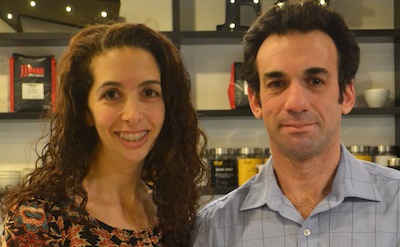
photo - Yamila Chikiar and Daniel Presman
Yamila Chikiar and Daniel Presman (photo by Lauren Kramer)

Peretz’s co-partners, Daniel Presman and Yamila Chikiar, managed the reception, displaying their talent behind the glass display case, which featured an assortment of pastries, mini-cakes, bonbons (Presman’s exquisitely decorated chocolate squares with liquid fillings), cupcakes, strudel, muffins, cake pops and blintzes.

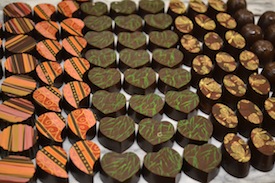
“In the two months before we opened, we put up new lighting, re-did the décor and renovated the tables,” said Chikiar, who moved to Vancouver from Buenos Aires 16 months ago with her spouse, Presman, mother-in-law and two children. Presman, a chocolatier who sold his bonbons to five-star hotels in Argentina, went back to work making kosher chocolates under the brand name Neshama, and the artistic, rich treats were quickly picked up by Superstore.

photo - Neshama chocolates
Neshama chocolates (photo by Lauren Kramer)

The couple met Peretz, who is also from Buenos Aires, through a mutual friend and hit it off immediately. Peretz was impressed with the bonbons and asked Presman to supply Neshama chocolates to his catering company. The relationship evolved and Group 41 was the result, a parent company that encompasses FortyOne Catering, Neshama and Café Forty One, and is owned and operated by all three partners.

“It was like a blessing when we met Menajem,” Chikiar said. “It’s difficult immigrating to another country and we had a hard year at first. But then opportunities started presenting themselves and it was like G-d was guiding us on a path.”

Café Forty One is a dairy establishment following Chalav Yisrael protocols, while FortyOne Catering offers meat, dairy and pareve meals. Chikiar is heading up marketing and communications and managing the front of house for the restaurant, while Presman heads up the sweet department and Peretz masterminds the savoury.

“The idea is to offer big portions and to give Café Forty One diners something extra,” Presman explained. “For example, all our sandwiches come with a shot of the hot soup of the day and, with any hot drink, we’re giving diners two free bonbons.”

The menu includes soups, salads, falafel and hummus plates, shakshuka, blintzes, omelettes, pizzas and sandwiches, as well as a wide assortment of sweet treats. The restaurant is open 10 a.m.-5 p.m. Sunday through Friday and underground parking is free for diners.

Lauren Kramer, an award-winning writer and editor, lives in Richmond. To read her work online, visit laurenkramer.net.

Format ImagePosted on January 13, 2017January 11, 2017Author Lauren KramerCategories LocalTags chocolates, Israeli food, kosher, restaurants
BBC’s advocate in the West

BBC’s advocate in the West

Ryan Bellerose, left, in Jerusalem with Michael Dickson of Stand With Us. (photo from Ryan Bellerose)

Ryan Bellerose is not the first Métis to stand with Israel, though he might end being one of the most influential, as he works to increase B’nai Brith Canada’s presence and advocacy voice in Alberta and British Columbia.

Based in Calgary, Bellerose became BBC’s advocacy coordinator for Western Canada just over four months ago. Like many Métis of his generation, he was raised Roman Catholic but, later in life, found his way back to indigenous spirituality and decided that Catholicism was not for him.

“I try to worship the creator the way Cree people do, rather than the way white people do,” he told the Independent.

Growing up, Bellerose read about Israel and felt a kinship with Israelis insofar as the struggles they have endured concerning their ancestral land and rights. The Métis here in Canada have had less success with similar struggles, he said.

That’s how his connection to Israel started, said Bellerose. “On top of that, on my mother’s side, my great-grandmother was really pro-Israel. She grew up in Norway during WWII. She was very pro-Israel, because she was very anti-Nazi Germany.

“She would drink Manischewitz wine everyday at 4 p.m. As a kid, I asked her one time why she drinks it, because she’d always make a face when drinking it. She told me, ‘I drink this because it shows the world that the Jews didn’t die and that the Nazis lost.’”

It would not be until Bellerose was in university that it became clear in his mind why he, himself, was pro-Israel. A Jewish friend at the University of Alberta helped him see just how similar the Métis and Jewish narratives are.

“I didn’t realize she was Jewish and I used to hang out with her a lot,” recalled Bellerose. “She’d always invite me over for dinner at her house on Friday. They weren’t super-observant Jews, but they still lit candles and had Shabbat dinner. They didn’t eat meat on Friday … all things that my family did, too. So, I just thought that they were super-Catholics, and I told my grandma that my friend is totally super-Catholic and that she’d love this girl.”

What Bellerose did not yet realize at the time was that his friend was being bullied at the U of A to a degree he had never seen before. Growing up in northern Alberta, Bellerose had experienced a lot of racism and prejudice, but nothing, he said, like these verbal attacks on his friend.

“What was a shock to me was this girl – blond-haired, blue-eyed, who played on sports teams and was super-smart academically – was being bullied to the point that she was considering suicide,” said Bellerose. “We’d be walking across the quad at the U of A and someone would yell, ‘Baby killer!’ I just always assumed they must be yelling at someone else or maybe even yelling at me, because there’s no way they would be yelling at her.”

This occurred a few times before Bellerose learned that his friend had participated in several pro-Israel events and that it was some very anti-Israel U of A students who were shouting such slurs at her.

“It’s one of those things that … it’s very difficult for a rational, moral human being to even wrap their heads around…. I think that’s why a lot of Canadians don’t understand the depth of this,” said Bellerose.

“It’s simply because she used to wear an IDF T-shirt and she was Jewish. So, I mean, the excuse would be anti-Zionism, but the truth is that it is antisemitism.

“I’m supposed to be one of her close friends and, yet, I had absolutely no idea what she was going through. I should be more sensitive than that as a Métis person who has experienced that kind of thing. It really bothered me that I didn’t see it. That was when I decided that I’m not going to stand there and be quiet when this kind of stuff happens.”

Soon after, in 2002, Bellerose was on his way to his football locker when he encountered an “apartheid wall” in his way. It was made out of papier-mâché and cardboard, and had bloody handprints on it. As the wall was blocking his way, Bellerose asked politely if they could move it. A female student responded to him, “Now, you understand the persecution the Palestinians deal with on a daily basis.”

Bellerose said, “I looked at her and said that my [Métis] people were still allowed to be killed in 1939 in Canada … that nobody will do anything about that … so don’t lecture me about oppression. I lost my cool with her and said that they should either move the wall or I would. They didn’t, so I walked over and ripped it down. I was angry, so I flipped their table over. They had a bucket of propaganda and I kicked that over.”

Fast-forward about 10 years, and Bellerose has joined Calgary United with Israel. He began his involvement helping organize events on a volunteer basis, while working full-time. During his spare time, he would argue with antisemites in comment sections of published articles, but eventually realized that he would be able to get his message out a lot more quickly if he educated influential people instead, on both sides of the conflict.

Bellerose said many people in the world, out of ignorance, believe that the Palestinians are on the side of complete right in the conflict, painting Jews as occupiers as opposed to people returning to their homeland.

“That’s literally how this whole idea that the Palestinians are the native people and the Jews are the white European colonizers came about…. That’s how it was spread so easily,” said Bellerose. “Arabs flipped that narrative…. If I allowed the argument that the Arabs are indigenous to the land of Israel, then I might as well turn around and say that white people are now indigenous to Canada. A lot of native people don’t understand that until you literally put it into those terms.”

Bellerose has a fairly significant following on social media, partly because he used to play football and partly because he is a sometimes controversial personality who makes people uncomfortable. B’nai Brith Canada began following Bellerose, too, and was especially impressed with his imploring Jews to be proactive in their advocacy and unapologetic.

“I firmly believe that the biggest part of this problem is that, a lot of times, until recently, Jewish advocates were kind of taught not to talk about the settlements,” said Bellerose. “I’m here to talk about the good things about Israel. Of course, the truth is there’s a lot to criticize – but there’s so much more to be proud of.”

When BBC hired Bellerose, he could hardly believe he would be paid to do what he loves doing and would do anyway.

“I tell people that I’m going to be more professional, swear a little less,” he quipped regarding his role with BBC. But, he added, B’nai Brith itself has become “less apologetic, more proactive … a little more in your face.”

Bellerose especially likes working with young adults, as he strongly believes there are many young people who are not connected with their identity because they don’t really understand it.

Bellerose is also working hard to build bridges between aboriginals and Jews. “I think that, by building these bridges, eventually we can help you and you can help us, and it will make the world a better place,” he said. “This is best done through what I call ‘relationship advocacy.’ Instead of going out and telling everyone how wonderful Israel is and how wonderful Jews are, I think it works much better when Jewish people invite somebody for Shabbat. The moment they see you as a human being and not an abstract concept, you build a relationship with that person. And, when that person has a relationship with you, they are way more likely to stand up for you, way more likely to actually get involved.”

Rebeca Kuropatwa is a Winnipeg freelance writer.

Format ImagePosted on January 13, 2017January 11, 2017Author Rebeca KuropatwaCategories NationalTags advocacy, B'nai B'rith, First Nations, Israel, Western Canada

A new youth award

Temple Sholom is inviting applications for the inaugural Tikkun Olam Youth Award. The award will be presented at the Dreamers & Builders Gala on March 5 to a deserving Jewish teen in the community who has demonstrated a vision to heal the world through an act of tikkun olam.

A prize of $1,800 will be awarded, of which $600 must be used toward the recipient’s tikkun olam project and $1,200 goes directly to the recipient as an award for being an example to the community.

The submission deadline for applications is, Friday, Jan. 13, 4 p.m. The winner will be notified on Jan. 31.

To qualify, an applicant must be a Jewish teen between the ages of 13 and 19; have identified something in the community, in the country or globally, that is in need of repair; and must have commenced the project.

Potential areas of award might include, but are in no way limited to animals in need of rescue and special treatment; antisemitism; art and/or music therapy; discrimination; global warming; Holocaust remembrance; LGBTQ; poverty; seniors; sustainable living; Syrian refugees; world peace and anything in between.

Applications may be submitted via online form or a video or multi-media presentation no longer than five minutes. Applicants should answer the following questions:

  1. What problem did you observe that needed fixing or healing?
  2. What steps have you taken toward your goal?
  3. What is your vision for the next steps to be taken?
  4. How will the community it is intended for benefit?
  5. Why are you passionate about this?
  6. How does the initiative connect to Jewish values?
  7. Who might the applicant try to involve to see the dream to fruition?

To apply, visit templesholom.ca/tikkun-olam-youth-award.

Posted on January 13, 2017January 11, 2017Author Temple SholomCategories LocalTags tikkun olam, youth

Share light of Shabbat

“We want to share Shabbat with those who are alone, or those who might have difficulty cooking for themselves. Plus, we want to help every Jew feel connected and part of the community,” said Rabbi Yechiel Baitelman of Chabad of Richmond, who started the Light of Shabbat program in 2011. “This is not tzedakah; it’s about making a connection with other Jews and helping them celebrate the mitzvah of Shabbos.”

With help from devoted community volunteers, full kosher Shabbat meals are cooked and delivered to those who are elderly, alone, recovering from illness, or homebound. Currently, deliveries are done every other week to about 10 people in Richmond. Each Shabbat box contains challah, grape juice and Shabbat candles, plus a meal of soup, salad, chicken, vegetables and dessert – all homemade. They even include a little card with the blessing for lighting candles, the Torah portion for the week and information about why Jews celebrate Shabbat.

“The boxes are personalized, depending on the needs of the recipient, so some boxes contain more than one meal,” said Grace Jampolsky, coordinator of the Light of Shabbat program. Chabad of Richmond has delivered 495 boxes to date.

“I like to bake the challah myself, but other volunteers make the soup, cook the chicken and vegetables, and bake the desserts,” added Jampolsky.

Richmond resident Courtenay Cohen and her friends, some of whom aren’t even Jewish, bake cookies, cakes and brownies for the Shabbat boxes. Cohen started volunteering a year or two ago. Asked why she recruited non-Jewish friends to help bake, Cohen said: “They’re very involved in their own religious community, but when I told them what I was doing, they wanted to help. It’s a great way to teach them about Judaism.”

Taking on a bigger role this year, Cohen now oversees the baking part of the Shabbat boxes. Not only does she bake, but she also helps pack the boxes and deliver some of them. “Delivering the boxes gives me a chance to visit elderly Jews and others in our community and make a person-to-person connection with them. It’s also a way to check in on them and make sure they’re living in safe and suitable conditions,” added Cohen. “Plus, they really love talking to young people.”

Pam, one of the Shabbat box recipients, said: “It’s fantastic! It’s very generous of Chabad to do this.” Pam said she especially likes when the kids decorate the boxes, and she enjoys the short visit with them. She said that, with the recent snow and an elevator that wasn’t working, she couldn’t leave her apartment for a week, so the Shabbat box was very helpful to have.

Rabbi Yeshurun Blumenfeld, along with his 6-year-old son and 4-year-old daughter, make volunteer deliveries of a Shabbat box to a couple in their 90s every other week. “Not only do I create an ongoing relationship with this couple, but it’s a way to teach my kids about the importance of doing mitzvahs,” said Blumenfeld, who added that promoting a mitzvah is a sanctification of G-d’s name.

Blumenfeld also shared a story of how, one day, when he was at a Richmond bakery buying challah for his family, he happened to bump into the wife of this elderly couple to whom he delivers a Shabbat box. She was shlepping a bunch of groceries, and he asked her how she was getting home. She told him she had called a taxi. He immediately said they should cancel the taxi, and he would drive her home himself. He said it was a very special moment for him, to make that connection with another Jew.

The Light of Shabbat program began in memory of Gavriel and Rivka Holtzberg, shluchim who started the Chabad House in Mumbai, India – the couple was murdered by terrorists in 2008.

Supporting the Light of Shabbat program is a huge mitzvah on many levels. And, as there are a lot of seniors and others in Richmond who would appreciate a good Shabbat meal, Chabad of Richmond desperately wants to expand the program, but needs more donors, sponsors and volunteers to sustain it. Their goal is to substantially increase the number of meals they deliver every week. Each filled Shabbat box costs approximately $25 to $28. To donate to the program on an ongoing or one-time basis, contact Baitelman at 604-277-6427 or [email protected].


Posted on January 13, 2017January 11, 2017Author Chabad of RichmondCategories LocalTags Chabad, Judaism, Shabbat, tikkun olam
Do we seek solace or action?

Do we seek solace or action?

Armon Hanatziv Promenade in Jerusalem on Jan. 8 following a terror attack. Four Israel Defence Forces soldiers were murdered – Yael Yekutiel, 20, Shir Hajaj, 22, Shira Tzur, 20, and Erez Orbach, 20 – and at least a dozen other people were injured when a truck driver, from the East Jerusalem neighbourhood of Jabel Mukaber, drove at speed at a group waiting at a bus stop. The terrorist was shot dead. (photo from Ashernet)

Israel is threatened by enemies who respect no rules of engagement, as we saw in the brutal vehicular attack that killed four and injured many others in Jerusalem Sunday.

Israel has faced the challenge of maintaining the moral code of a democratic, humanitarian society under the cloud of threatened annihilation and incessant terror. At the age of 18, young Israelis are often faced with the most impossible dilemmas as citizen-soldiers sworn to uphold national security while conducting themselves in a manner as ethical as the national ideals they are defending.

When Israeli soldiers go rogue, as they occasionally do, and contravene the moral code of the country and the Israel Defence Forces, the response is often polarizing. Worldwide, critics depict individual crimes as symptomatic of the culture of an illegal, apartheid state that is rotten at the core, while defenders cite the judicial processes that follow as evidence that Israel does indeed live up to its values. Sometimes, these cases open deep schisms, as we have seen recently in the case of Sgt. Elor Azaria.

Last year, Azaria, an IDF medic, shot dead a Palestinian terrorist in Hebron who had been disarmed and incapacitated. Azaria told a fellow soldier: “He stabbed my friend and he deserves to die.”

A panel of three Israeli judges unanimously convicted him of manslaughter with a possible sentence of 20 years.

“The fact that the man sprawled on the ground was a terrorist, who had just sought to take the lives of IDF soldiers at the scene, does not in itself justify disproportionate action,” the judges determined.

The trial and its aftermath have opened a debate – or reopened an endless one – about what is moral and immoral as Israel, depending on your perspective, struggles for its existential survival or perpetuates the occupation of Palestinian lands.

The case is being depicted as a fight for the moral soul of the country, although many issues have been portrayed in this dramatic fashion over the decades.

For other countries, addressing essential questions of national morality, of right and wrong, is not necessarily second nature. Yet much of the world is facing choices as stark or starker than Israel’s.

Donald Trump is about to be sworn in as president of the United States. While governments in European and other democracies have, at times, been led by unpredictable individuals, Trump’s ascension is unprecedented for a plethora of reasons that do not need itemizing.

In responding to Trump, and to myriad other current events, we have few precedents to guide us, yet how we respond will determine what our world will become.

Do we quietly accept the presidency of the bigoted, petulant, potentially dangerous Trump, recognizing that, for better or worse, he is the leader of the world’s ostensibly greatest democracy? Or do we stand as steadfast in every way possible against the regressive parts of his agenda (as scattershot and incoherent as that agenda may be)?

Do we try to empathize with, understand and transform the economic, social and racial outlooks that led 63 million Americans to vote for him, or do we dig in our heels and declare them, if not outright racists and women-haters, at least voters for whom xenophobia, race-baiting and misogyny were not deal-breakers, and seek to isolate them from mainstream discourse?

Further afield, do we oppose with every fibre the far-right movements that are growing in France, Hungary, Poland, Italy, the United Kingdom and elsewhere in Europe, or do we seek to ameliorate the conditions that are leading increasing numbers of Europeans to support these sorts of ideologies?

Do we choose to view Syrian refugees as potential terrorists or, at least, as products of a society where antisemitism is deliberately inculcated? Or do we see in them the same desperate humanity of our recent and long-past ancestors?

There are situations in the world that can reasonably cause us to seek solace in isolation, to retreat to the literal or figurative woods and cut ourselves off from the daily news that is so unsettling. However, we have a tradition that encourages discourse and action, one that tells us to repair the broken world, even if we are unable to complete the task.

Format ImagePosted on January 13, 2017January 11, 2017Author The Editorial BoardCategories From the JITags antisemitism, Israel, Israeli-Palestinian conflict, racism, terrorism, tikkun olam, Trump
Film seeking funders

Film seeking funders

A scene from the trailer for Note in the Oak.

During the summer of 2014, Vancouver-based Cornfield Media produced a short film titled Note in the Oak, starring Carmel Amit and Moshe Mastai. Now feature-length, the production is seeking funds to complete some of the Jewish heritage and culture aspects of the film.

The short Note in the Oak was the official selection at several festivals: at the Vancouver Jewish Film Festival in 2014 and, in 2016, at Roma Cinema DOC in Rome, Italy; Move Me Productions short film festival in Antwerp, Belgium; London Monthly Film Festival in England; Best International Independent Film Festival in Karlsruhe, Germany; and Reflections of Spirit International Film Festival in Erlangen, Germany.

The film’s plot was inspired by true events that took place in New Jersey in 2012. The hero is Joyce, a home-care provider. Following the death of a longtime patient, she goes on a quest to find his estranged son, Corry, to bring him to his father’s grave. The story mixes suspense, laughter, hope, heart and conflict. It also includes a slice of a Jewish culture.

During the past two years, the short has been developed into a feature film (100 minutes) and Cornfield Media is now ready to produce it this year. However, the feature script is not yet fully complete and some vital elements are still missing. This is where the producers are seeking community participation.

Cornfield Media needs help to secure some licensed Jewish artistic material – these poems and pieces of music are essential to the plot and without it, the story will be good, but missing some of the key Jewish elements it requires. Any assistance would be greatly appreciated. For more information and to contribute, visit jewcer.org/project/nito343334.

Format ImagePosted on January 13, 2017January 11, 2017Author Cornfield MediaCategories TV & FilmTags fundraising, Jewish culture, Judaism
Chimp facilitates charitable giving

Chimp facilitates charitable giving

Left to right: Ariel Lewinski, Judy Boxer and John Bromley. (photo from Chimp)

When it comes to charitable giving, there’s a widespread feeling of donor fatigue, says Judy Boxer, community engagement manager with Chimp Technology in Vancouver. Chimp is an online giving platform that helps people give to and fundraise for charities that match their values and interest. Focused on charitable impact, the company is determined to counter donor fatigue by making philanthropy a positive, rewarding experience. And it’s set its sights on the Jewish community of Vancouver with a Tzedakah Project targeting Jewish giving.

A Vancouver donor who prefers to remain anonymous gave Chimp $270,000 to jumpstart the Tzedakah Project in mid-November. Boxer and her colleague Ariel Lewinski are tasked with creating the community, helping select a board to run it and then handing it over to the board.

“Ultimately, this initiative is something the Jewish community will take on and run on their own terms,” she said. To add incentive to membership, the Tzedakah Project is starting out by offering an $18 charitable gift to new members “so they can experience the gift of giving to a Jewish charity of their choice,” Boxer explained.

The core of Chimp is the Chimp account, which gives a donor the same benefits as having their own private foundation, but free of charge, said Lewinski, Chimp’s vice-president of partnerships and growth. “It’s like an online bank account for charitable giving. You put any amount of money into the Chimp account and you get your tax receipt at the moment you want it. You can allocate the charitable giving at a later date.”

Chimp membership encourages donors to rethink how they give charitably. Boxer and her team have found that people’s donations are more reactive when they receive calls requesting donations. They don’t necessarily plan their giving to make the biggest impact.

“We’ve found people connect really well to causes,” she reflected. “At Chimp, we’ll help them figure out what causes are important to them and then offer a matching charitable organization so they can allocate their charitable giving. With a Chimp account, you have an opportunity to engage in a conversation about what you care about, what you want to achieve and where you want to make an impact, as opposed to reacting towards people asking for money.”

Chimp Technology is the brainchild of John Bromley, a 38-year-old Vancouverite who started out in corporate finance and then co-founded a law consulting company focused on charity. His clients were high-net-worth donors who needed help structuring their giving and, in the process of working with them, Bromley felt he could help ordinary people structure their charitable giving, too.

“I saw that the only people getting their giving problems resolved were people who had so much money they could create their own private foundation,” he said. “I started Chimp Technology in 2012 to focus on a donor-centred giving experience for everyone else.”

Bromley observed that the main place people learned to give was in religiously oriented families or theologically tied communities. “As there’s been more secularization in North America, we’ve seen a reduction in the number of people that learn how to give,” he noted. “Chimp isn’t religiously motivated, but we understand the theological backgrounds and the very important role those theologies and communities play in the giving economy in Canada.”

While Chimp is theologically neutral, it aims to represent donors and effectively facilitate their philanthropy. “That’s important, because, when you take away all the noise that exists around how to give to charity, you create more time for people to think about how they’ll spend their charitable dollars,” Bromley said. “Chimp is about enabling or empowering donors large and small to give on their own terms to the things that matter to them.”

Boxer said the Tzedakah Project is also trying to empower the younger generation and has partnered with Vancouver Hebrew Academy, Vancouver Talmud Torah, King David High School and Torah High in Vancouver. “We want to start a philanthropic conversation with kids of a certain age about the kind of impact they want to have, to have them think about charity in a new way, and possibly start conversations between them and their families,” she said.

“We’re trying to enable and empower people from different communities by giving them the tools they need to create a giving program around a cause or community,” Bromley added. “We’re not the founders of the idea for the Tzedakah Project – that’s coming out of the Jewish community. But it’s a real pleasure to be doing this with the Jewish community. I’ve learned a heck of a lot about the wealth of engagement with tzedakah and how serious giving values are in the community, and it’s quite inspiring.”

To join, visit go.chimp.net/tzedakahproject.

Lauren Kramer, an award-winning writer and editor, lives in Richmond. To read her work online, visit laurenkramer.net. This article was originally published in the CJN.

Format ImagePosted on January 13, 2017January 11, 2017Author Lauren KramerCategories LocalTags charity, fundraising, tikkun olam
Hoping to revive Dead Sea

Hoping to revive Dead Sea

Twenty-five swimmers from around the world crossed the Dead Sea on Nov. 15. (photo from EcoPeace)

On Nov. 15, some two dozen swimmers made the seven-hour trek across the Dead Sea, starting from the Jordanian side and swimming to the Israeli.

The demise of the Dead Sea is not news. According to the group EcoPeace Middle East – a Jordanian, Palestinian, Israeli environmental peace-building organization – the sea has receded by 25 metres in the last three decades and has lost a third of its surface area. Yet, hope remains.

The recent event’s initiator and a participant swimmer, Oded Rahav, stated in an EcoPeace press release, “If it’s possible to do the impossible, like swimming across the Dead Sea, then it’s possible to save the Dead Sea. We are not just interested in raising awareness, but creating real action to benefit the Dead Sea.”

Co-sponsoring the event with EcoPeace was Tamar Regional Council in Israel.

“A group of Israeli swimmers approached EcoPeace last spring with an idea to do a first-ever event – to swim across it [the Dead Sea]!” said Mira Edelstein, project coordinator of EcoPeace’s Jordan River Rehabilitation and Save the Dead Sea projects. “Not only were they looking for an idea to follow their previous success in topping a Guinness record – swimming from Cyprus to Israel – they also sought a way to raise awareness about the need to save the Dead Sea.

“They, naturally, turned to EcoPeace, as we’re the only regional environmental organization in the Middle East working on the issue of the rehabilitation of the River Jordan, which is in direct correlation with saving the Dead Sea. We gladly took on co-organizing the event and worked hard to make it happen, especially in getting permission from the Jordanian army to ‘sail’ across the border in the middle of the sea, starting from the Jordanian side.”

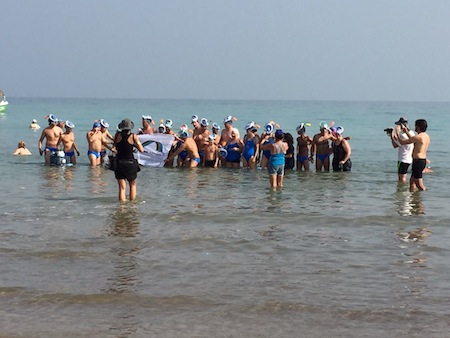
photo - The Dead Sea swim team
The Dead Sea swim team. (photo from EcoPeace)

There were 25 swimmers from all over the world who participated, including from Israel, Palestine, South Africa, New Zealand, Greece, Spain and Denmark. They had to swim with a full-face snorkeling mask because of the water’s extreme salinity and they also had to adapt their swimming style because of the water’s high density. It was a life-risking venture and the swimmers were accompanied by a medical team, as EcoPeace notes in the press release: “A drop in the eye causes severe irritation, and chance swallowing of its water can be fatal if not treated immediately.”

The event generated an unprecedented amount of media attention and EcoPeace hopes this will help its ongoing efforts to get local decision-makers to take action on the issue.

“We’re also being approached by several other organizations to do other cross-border events – bicycle event, music event, art event, etc. – and we’ll review all of them to see which is more feasible and which will give us the best results,” said Edelstein, who was born and raised in New York and made aliyah in 1993. She now lives in Gan Yavne, which is near Ashdod. She joined EcoPeace in 2004.

“Personally, as an environmentalist but also a general nature lover, the Dead Sea is such a pearl of nature with so many unique qualities found nowhere else on this earth, that it would be a tragedy to lose it,” she told the Independent. “This is a man-made catastrophe and we must work as hard as possible to reverse it.”

Edelstein explained that the threats to the Dead Sea are coming from two directions.

“First is from the north,” she said. “Historically, the main inflow to the Dead Sea has been the Lower Jordan River. And, with the diversion of more than 95% of the Jordan River’s water by Israel, Jordan and Syria, leaving a meagre five percent to reach the Dead Sea … no wonder the Dead Sea is shrinking – by more than a metre a year.

“EcoPeace is working extremely hard to rehabilitate the Lower Jordan River back to at least a third of its historic flow, not only for the river’s own integrity – this is the holy Jordan River! – but we’re doing this for the Dead Sea as well.

“Second is from the south – from both Israeli and Jordanian mineral industries. These industries are using the most simple, antiquated, water-intensive technology to harvest minerals from the Dead Sea: evaporation. Unfortunately, both industries have no incentive to change their extraction technology, because they do not pay a penny for the amount of water they use.”

EcoPeace is working to change this; however, discussions about extracting minerals using systems based on desalination technologies (reverse osmosis) have come to a standstill, as they cost money, while evaporation is free.

“They claim they are studying them (these technologies), but have concluded that they’re very expensive,” said Edelstein. “Our point is exactly that – that until they will be forced to pay for the amount of water they use, any kind of change will be expensive.”

With the Israeli mineral industry’s contract with the state on its last leg, Edelstein is hopeful that a new contract will include putting a price on the Dead Sea’s water.

“EcoPeace is working very hard to get a bill passed through the Israeli parliament wherein the Dead Sea Works [part of the company ICL Fertilizers] will need to pay for the amount of water they use,” she added.

“Both of these actions together, that EcoPeace is working on, will help stabilize the Dead Sea. The Dead Sea will not yet be completely saved or restored, but we understand we first need to halt its destruction and [then] to work on stabilizing it.”

While there was a plan to draw water from the Red Sea to the Dead Sea, the original mega-project, which the World Bank was studying for more than a decade, has been deemed unfeasible. The present-day Red Sea-Dead Sea canal project “is different than the original one,” said Edelstein. “This project is based on a water swap between Israel and Jordan, which also includes a component for Palestinians to get more water from Israel.”

With both the Jordanian and Israeli governments working closely, mainly on furthering the canal project, EcoPeace applauds the joint efforts, but does not see the project as the solution.

“I do believe that the Dead Sea is high on the public agenda,” said Edelstein. “It’s not difficult to find information on the issue. Our website is being upgraded and we’ll soon have updated information to share, but recent news articles are a good place to begin.”

For more information about EcoPeace, which was formerly called Friends of the Earth Middle East, its Dead Sea and other projects, visit foeme.org.

Rebeca Kuropatwa is a Winnipeg freelance writer.

Format ImagePosted on January 13, 2017January 11, 2017Author Rebeca KuropatwaCategories IsraelTags Dead Sea, environment, Israel
Importance of listening

Importance of listening

Dr. Izzeldin Abuelaish (photo by Bob Talbot)

I was born in Soroka Hospital in Be’er Sheva, southern Israel. My father, an Israeli-born Jew of Tunisian descent, began his residency in obstetrics and gynecology the following year. Joining him in the program was a Muslim-Palestinian doctor from Gaza, the first to do so in an Israeli hospital. Through their respective residencies, they grew to become close friends and remain so to this day. This is the story of how that doctor from Gaza taught me the advantages of remaining level-headed during disputes, by his mere demeanour and the way in which he converts misfortunes into valuable life lessons. This is the story of how Dr. Izzeldin Abuelaish changed the way I appreciate my parents, invest in my future and, most importantly, how I listen.

Dr. Izzeldin Abuelaish was born in 1955 in Jabalia refugee camp in Gaza, in conditions most of us can’t even comprehend. His school bag was an old, fibre bag, he owned a single pair of pants sewed from scrap materials and his school eraser was so valuable he had to wear it on a string around his neck. His mother, the “Lioness,” as he often refers to her, knew education to be the most powerful weapon of choice in their limited arsenal. Consequently, she pushed him to his limits, having him work in the mornings before school and in the afternoons. His teachers saw in him a passion and competence that could elevate him and his family out of their current conditions and, like his mother, pushed him to pursue his studies. He went on to receive a scholarship to study medicine in Cairo, he then went on to receive a diploma in OB/GYN from the University of London, accompanied by a subspecialty in fetal medicine in Belgium and Italy; and onwards to completing a master’s of science in health policy and management at Harvard University.

His road out of poverty was not smooth, but 2009 brought the worst wave of hurt to his life. Only a few months after losing his wife to cancer, Abuelaish’s apartment was shelled by an Israel Defence Forces tank during the Gaza War. His three daughters – 20-year-old Bessan, 15-year-old Mayar and 13-year-old Aya – and 17-year-old niece Noor were all killed. The entire tragedy was caught on live television, as Abuelaish had been communicating with Israeli media on the effects of war on Palestinian civilians. Destroyed and devastated, his wails were heard all over the world and, for the first time during the war, the Palestinian people had a human face, and a haunting shriek.

Despite this unimaginable heartbreak, Abuelaish refused to let hatred coerce him into visceral action. “Hatred,” the doctor said, “is destructive to the hater, not the hated.” In the face of such trauma and injustice, he remained calm and rational and channeled his anger into a fight for justice, not revenge. He knew that hatred would only hurt his interests and sway him off course.

Abuelaish had friends in the hospitals he worked at, colleagues, patients and others who cared for him deeply, my father being one of the many among them. Abuelaish knew not to let the loudest of political actions silence the intentions of citizens on either side of the border. He knew to listen, to speak out with kindness and courage and through action.

I was formally introduced to Abuelaish for the first time when he came to speak at my university. “You’re the son of Bentov?” he said to me. I replied with a smile and a nod. He was ecstatic to meet me, and I could barely believe I was in his presence. We were both baffled by the coincidence, and rejoiced in the opportunity. After the lecture, the professor and several students went to a nearby café to further discuss the tenets of his talk. He inquired on the well-being of my parents and I shared my vague childhood memories of him. Upon his departure, he left his card with me and asked me to contact him again. I have remained in close touch with him since.

In the summer of 2015, Abuelaish offered to let me work in his office, hoping I could write a research paper under his guidance. Sitting in his office at Dalla Lana School of Public Health at the University of Toronto, I gazed around the room, awestruck by the number of awards, photographs with world leaders, diplomas and gifts from supporters and friends that were on display. I remember most my reaction when I saw his bookshelf: the goliath volumes of medicine and politics were overshadowed by the collection of self-help books on overcoming trauma.

One morning, Abuelaish asked me to come with him to see the office of his philanthropic organization, Daughters for Life Foundation. After asking me whether Upper Canada College or University of Toronto Schools, both of which command some $20,000 in annual tuition, are better high school choices for his son’s education, he threw on the same black leather jacket he’s owned for at least a decade and a half, and we made our way to his 1998 Saturn SUV. The priorities he made clear that day and his mere demeanour ingrained in me a sense of proportion that drastically altered the things I hold dear in life. I am unable to articulate exactly how I felt driving in his car that day. I wanted to go home and burst into tears. His humility, his unending devotion to his children, his disregard for material goods. For the life of me, it took everything in my power not to shed a single tear during that car ride.

Before I met Abuelaish, I was an angry young man, easily swayed by inflammatory rhetoric and propaganda. I was arrogant, rigidly opinionated and impatient. When I met the doctor, my father’s friend, I saw a sobering display of the prowess of human endurance – an absolute refusal to remain defeated, even after many severe blows. I coined his philosophy “proactive pacifism,” as I could see no other way to describe it.

I began to realize the many unacknowledged fortunes in my life and the immense efforts my parents made. I also learned the value of listening and the importance of letting others voice their opinions unscathed by my bias. Most of us are quick to see differences, carelessly and lazily dividing people by economic, political and religious beliefs and doctrines. Instead of investing our energies into improving our lives, we spend it on putting or shutting down others, lest they make us work harder to maintain our place in the world or our opinions. Following the change of atmosphere in Europe and the United States, I think Canadians can learn from the valuable lessons of Abuelaish’s actions.

Instead of seeking revenge against those who have harmed him, he has chosen to empower those who have been harmed. In all of the self-help books and all of the various philosophies I have come across, I have never met anyone who embodies the “golden rule” as much as Abuelaish. I’m 20 years old and have had a life virtually devoid of struggle, in large part because my parents worked incredibly hard to provide me with all that I have. I did not fully appreciate this until I got to know Abuelaish.

After meeting him, I also saw the real benefits of allowing speech to flow freely and, when someone speaks, I now listen. As aggravating as that feels sometimes, I know that preserving this right, this freedom, is more important than my reaction to the words being spoken. I am now confident that proving a point means more than shouting out an opinion; it means putting my beliefs into action. After every conceivable reason to give in to hate, Abuelaish not only rose above his many adversities, he used them to fuel his goal of greater peace and cohesiveness between Israelis and Palestinians.

Abuelaish does not stand on the shoulders of giants; he guides them onwards. In 2011, he created Daughters for Life Foundation, which raises funds for academic scholarships for aspiring female students of Jewish, Christian, Muslim and other backgrounds from the Middle East. Abuelaish believes that, through the success of other young female students, he can bring to life the ambitions of the daughters he lost.

Abuelaish has accomplished more through dialogue than through dispute. As well, there are hundreds of Israeli and Palestinian children enjoying their lives due to his work as an obstetrician. Because of him, and the few others like him, I firmly believe in the prospect of peace in the region.

Abuelaish is far more than a mentor to me – he is my friend, he is family. The way he endures the many misfortunes in his life, the way he looks after his children, the way he helped me and the way he spoke of my parents are only examples. His many lessons transcend and translate into all aspects of life.

Following the recent election in the United States and a return of nationalist support across Europe, politics divide us now more than they have in a very long time. In an era of sound bites, protests and identity politics, it seems that most individuals have very little interest in listening to opposing viewpoints, lest these views betray their crafted narratives. We are eager to impose our opinions on others, convinced that mere criticism means that someone is an enemy of our noble cause or wants to harm us. This phenomenon is causing divides in parts of the world where diversity has been flourishing for decades. In these times, it would be wise for us to take a breath, to put things into perspective and remain coolheaded, regardless of our differences – or even our similarities, for that matter. If we invest our energies on improving ourselves, and encourage others to do the same, we should be able to get along, even if we disagree. These are just a few of the things I learned from my good friend, Dr. Izzeldin Abuelaish. As he has said, “The energy you want to waste on anger. Convert it to strength and determination.”

To learn more about Abuelaish, his book I Shall Not Hate: A Gaza Doctor’s Journey is available at various booksellers, including online, and the link to his foundation is daughtersforlife.com.

Gilad Kenigsberg-Bentov is a student at University of Western Ontario, where he is majoring in economics.

Format ImagePosted on January 13, 2017January 11, 2017Author Gilad Kenigsberg-BentovCategories Op-EdTags Israeli-Palestinian conflict, peace, tikkun olam

Posts pagination

Previous page Page 1 … Page 466 Page 467 Page 468 … Page 663 Next page
Proudly powered by WordPress