Skip to content
  • Home
  • Subscribe / donate
  • Events calendar
  • Business Directory
  • FAQ
  • News
    • Local
    • National
    • Israel
    • World
    • עניין בחדשות
      A roundup of news in Canada and further afield, in Hebrew.
  • Opinion
    • From the JI
    • Op-Ed
  • Arts & Culture
    • Performing Arts
    • Music
    • Books
    • Visual Arts
    • TV & Film
  • Life
    • Celebrating the Holidays
    • Travel
    • The Daily Snooze
      Cartoons by Jacob Samuel
    • Mystery Photo
      Help the JI and JMABC fill in the gaps in our archives.
  • Community Links
    • Organizations, Etc.
    • Other News Sources & Blogs
  • JI Chai Celebration
  • JI@88! video

Recent Posts

  • Or Shalom reopens its doors
  • JFS from past to future
  • Need holistic approach
  • Sharing stories, advice
  • Journalist shares fears
  • Skills to live together
  • Road to independence
  • Cutting grass with scissors
  • Zionism as a solution
  • Deceit, desire & the divine
  • Reclaiming sacredness
  • Creative project ideas
  • Summer squares and cobbler
  • Thou shalt … summer commandments
  • Legal help for students
  • Revisiting myth of Lilith
  • Wrong person rebuked
  • Canada’s mixed messages
  • Questions for museum
  • Symposium on antizionism
  • Making soccer political
  • CJPAC lauds Pulver’s impact
  • City recognizes Vrba’s legacy  
  • Organ donation saves lives
  • Theodore’s March premiere
  • A healing Shabbaton
  • Supplying healthy food
  • A chime of metal tags
  • Yellowknife seder a first
  • Ishai energizes, unifies
  • A Lag b’Omer to remember
  • Expanding the healing
  • Hannah Senesh – a unique hero
  • Community milestones … May 2026
  • Sharing her testimony
  • Fall fight takes leap forward

Archives

Follow @JewishIndie
image - The CJN - Visit Us Banner - 300x600 - 101625

Author: Pat Johnson

Reflecting on New York

Reflecting on New York

Raised by American parents in Montreal, Adam Gopnik moved, with his Canadian wife Martha, to New York City in the 1980s. There, he began a career as an art critic, editor and writer for such publications as GQ and The New Yorker, and with Knopf publishers. At the Stranger’s Gate: Arrivals in New York (Knopf, 2017) is his chatty memoir of those years.

There are many figures from the art and publishing worlds in this book, appearing in harmlessly gossipy anecdote after name-dropping anecdote. Gopnik is an amusing artist of the character sketch, as shown in his depiction of his wife.

“Someone once called her in print the most innately polite person she had ever met, and the truth is that in each of us natural sociability had been overlaid with Canadian politeness, and hers with a further code of Icelandic courtesy, producing a veneer of politeness so extreme that many took it for disingenuousness – which of course, in another way, it was.”

He can also neatly capture entire generations through their relationships to something inanimate.

“My grandparents had belonged to a check-cashing generation, proud to be engaged in it,” he writes. “To have an institution as large as an American bank in effect endorse their signature on a little bit of paper as equivalent to money meant to be taken seriously as a citizen. My parents, in turn, were credit card cultists – they loved having them, signing them, showing them, using them. For those who came of age in the boom times after the Second World War, the whole notion of credit, of sharing in a limitless improving future – of being trusted to buy now and pay later, since later would be so much richer than now – had some of the same significance that the notion of being trusted with checks had for my grandparents.

“We, in turn, generationally, had regressed, I realized,” he continues, “back into a cash economy – we used checks just to pay the utilities. The [bank] machines were one more instrument of that infantilization; we went to the machines for something that felt, at least, like our allowance.”
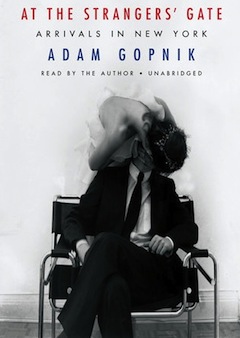
book cover - At the Stranger’s GateAs much as the individual characters who inhabit the pages, the protagonists are often the miniscule homes the Gopniks inhabited – and the insects and rodents with whom they cohabited. He credits their first tiny apartment, at least in part, for their marital contentment.

“One reason we didn’t fight was that the studio was so small, so small that you could never get sufficient perspective for the fighting to happen. In order to really have a quarrel, you have to sort of step back three steps and eye the other person darkly. There was just no room for that. We were on top of each other, not in that that sense – well, in that sense, too, at times – but we were also colliding with each other all the time. I don’t have any mental image of Martha from those years, except as a kind of Cubist painting, noses and eyes and ears.”

A later loft apartment seemed too sweet to be true in a New York of radically rising rents, a suspicion that appeared fulfilled when thick, dark liquid began dripping from the ceiling.

“For the next two weeks, the ceiling kept hemorrhaging,” Gopnik writes. “Sometimes, we would wake up and find it dripping slowly, slowly. At other times, it would really be coming down, as though a whole new vein had been opened, or else as though – and this thought struck us both about the same time – a new corpse had just been stowed away under the floorboards upstairs.”

“That’s not blood,” a neighbour told them, “it’s just molasses.”

The building had been a candy factory at the turn-of-the-century and for inexplicable reasons it would sometimes ooze ingredients. Gopnik decided to find this charming: “It was thrilling, like the moment when they opened up the Dead Sea Scrolls and found them pristine. Sugar syrup from a century ago, bubbling out of the walls, and still so sweet.… I felt happy; I was living on the big Rock Candy Mountain.”

The couple were less charmed by another discovery. A pest control officer announces: “You got them, all right. You got the big boys. You got the super-rats.”

“What do you mean, the super-rats?” Gopnik asks.

“‘Well, let’s put it like this,’ He thought for a moment. ‘These rats, if you see one, they look at you like you the problem.”

Leaving the apartment, Gopnik homes in on two of the phenomena of the 1980s that impacted his life in the Big Apple.

“The two great technological gifts of the ’80s were the Walkman and the hyper-developed sneaker, which, together, turned walking into an all-encompassing emotional activity,” he writes. “For a long time in the 1980s, I seemed to do nothing but walk around Manhattan. The modern sneaker, rising from Nike and Adidas, constructed with more architecture inside than most apartments, now allowed even the flat-footed to stride, Hermes-like, on what felt like cushioned air.… And then the Walkman made every block your own movie.”

Eventually, like rats in a too-small apartment, the couple became overwhelmed by the city and they left to raise a family where there are lawns and gardens.

This is a highly sentimental book, which is not a bad thing, especially for a New York-o-phile. Some shortcomings are too-frequent hackneyed phrases (“dense as a hockey puck,” “impossibly beautiful women”), the oddly repetitive use of some esoteric words and a style that sometimes evokes Lake Wobegon, Minn., more than New York, N.Y. In other words, it’s a cute book, which may sound like faint praise, but, given current events, that can be a refreshing break.

Format ImagePosted on December 1, 2017November 29, 2017Author Pat JohnsonCategories BooksTags Adam Gopnik, memoir, New York
Isaac shaped Vatican II

Isaac shaped Vatican II

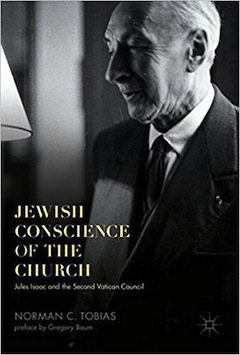
Jewish Conscience of the Church: Jules Isaac and the Second Vatican Council by Norman C. Tobias (Palgrave Macmillan, 2017) is an extraordinary book about the volte face that the Catholic Church executed at Vatican II in 1963 when, as a result principally of the intellectual exertions of Jules Isaac, former inspector general of education in France, the Church radically altered its negative teachings about Jews and Judaism and repudiated its malignant doctrine of Jewish responsibility for deicide.

There are many anomalies highlighted in this meticulously researched and comprehensive survey of one of the most important developments in the 20th century. Tobias is, by profession, a skilled tax lawyer, who taught at Queen’s University in Kingston, Ont., and who latterly earned a PhD in religious studies at the University of Toronto.

The focus of his doctoral dissertation, Isaac, was a man of many talents. Isaac’s textbooks on French and general history were staples of the high school curriculum in France, and regarded as authoritative sources for those subjects. That he would become the driving force after the Second World War towards the re-direction of Catholic doctrines vis-à-vis Jews is not something one would have expected from the high position he had occupied, quite comfortably, in France.

That comfort disappeared during the Nazi invasion of the country, and the occupation that followed. Almost 70,000 Jews were deported by the Nazis, most of whom perished in the concentration camps. Isaac himself narrowly escaped capture and survived only through the goodwill of friends, who hid him from both French collaborators and German troops. His wife and daughter, however, succumbed to the Nazi dragnet and he never saw them again.

book cover - Jewish Conscience of the ChurchAnother element that makes it even more startling that Isaac authored a number of treatises on the image of Jews in official Catholic doctrine is that Isaac had really little sympathy for Judaism. In fact, as Tobias reveals, Isaac once indicated that he much preferred paganism as a religious code. His indifference to the sancta of Judaism, a secularism that was quite common among many French Jews in the 1920s and 1930s, may explain why his son converted to Christianity.

It was during the Nazi occupation of France that Isaac, who had been a close associate of Charles Peguy, an early 20th-century sensitive Catholic poet, essayist and editor, began to analyze the sources that had contributed to the hatred that targeted his wife and daughter. He came to the not illogical conclusion that certain theological constructions in Catholicism were responsible for the teaching of contempt for Jews and Judaism.

Isaac, of course, as a gifted historian, knew that antisemitism existed before Christianity (as his Catholic interlocutors pointed out to him in later years) but he instinctively knew that pagan distaste for Jews was incidental, and recorded in minor chords, compared to the 2,000-year-old assault on Jews and Judaism first enshrined in Christian scripture and repeated century after century by the fathers of the Church and thereafter from Church pulpits especially in Europe. Isaac also knew that economic, political and social prejudices were sometimes hidden in the religious vernacular but his purpose was to show that it might be possible to alter the religious narrative through patient argument and persuasion.

The late Gregory Baum, a Catholic theologian of high repute, who wrote a warm introduction to the Tobias volume, originally responded to Isaac’s powerful Jesus and Israel (1948) by saying, in the early 1960s, that the New Testament was not antisemitic; it was an interpretation problem. Later, in the 1970s, Baum re-read Isaac’s work and reported that racial antisemitism was indeed present in parts of the New Testament.

For his carefully calibrated work, Isaac consulted with knowledgeable people and, during the decade from the end of the war, he organized his thinking in order to hone his criticism of the Christian texts with antisemitic tonalities and to suggest changes that would improve the image of Jews and Judaism. Isaac, in typical French style, created formats listing points to be analyzed like an explication de texte, that wonderful exegetical instrument.

It is not possible in a review to go through all of the points that Isaac deployed in his polemic but the major ones deal with the New Testament’s cruel caricature of Judaism as a corrupt and decadent civilization, its cavalier indictment of all Jews as being responsible for the crucifixion when most Jews actually lived in the Diaspora, and its horrendous “blood libel,” in which Jewish participants in the deicide legitimize their own punishment in perpetuity.

In the various encounters he had in print with respondents and in conversations with Catholic representatives in the 1940s and 1950s at various conferences in Europe – the descriptions of which Tobias offers with generous details, including a footnote apparatus I think should in some places have been inserted into the text – Isaac was always firm in his advocacy. His reputation as a sober, informed and flexible partisan of change in Church doctrines preceded him.

One of the most intriguing parts of the Tobias chronicle pivots on the road to Vatican II and the response to Isaac’s Jesus and Israel, just one of several of Isaac’s impressive works. Tobias has ferreted out the major reviews of the book that appeared in prestigious French journals. Not all were favourable, as might have been expected. One of the most acerbic criticisms focused on Isaac’s alleged memory lapse in not questioning Jewish unbelief after the crucifixion – as if this had anything to do with Isaac’s indictment of the New Testament’s “pogromist” attitude to Jews.

The Vatican II deliberations on Jews and other religions in 1963 incorporated, as far as Jews and Judaism were concerned, Isaac’s plangent plea for changes in statements about both. Isaac unfortunately passed away before it became official Church teaching but it was a wonderful posthumous reward.

On a personal note, in 1964, this reviewer heard Father Gregory Baum deliver a lecture at the University of Waterloo, in Ontario. I asked Father Baum how long it would take for Vatican II’s message to seep down to the parish level. He replied, “300 years.”

Arnold Ages is Distinguished Professor Emeritus, University of Waterloo.

Format ImagePosted on December 1, 2017November 30, 2017Author Arnold AgesCategories BooksTags antisemitism, Christianity, Judaism, Jules Isaac, Vatican II
Why we head home

Why we head home

(photo from oliveandwild.com/collections/judaic)

It is the season for gatherings and celebrations, and many travelers are urgently trying to make their way home for the holidays. An innate urge seems to drive them back to their roots. And, I wonder, What is it that draws people home for the holidays?

This existential question arose one year as I was lighting the menorah on the first night of Chanukah. Friends and family were gathered at our home to celebrate the holiday season once again. The loving faces, which crossed generations, reminded me that, for some, it is Christmas, a time to spread peace and joy throughout the world. For others, it is Chanukah, with its message of rebuilding, rededication and freedom from oppression.

Suddenly, I had a surreal experience in which the immediate sounds, sights and smells faded into the background. I am both participant and observer in this scenario and am filled with an overwhelming realization that I am looking at the history of the years, the culture and religion of past centuries, sitting at my table eating symbolic foods like potato latkes, gefilte fish and sufganiyot. It gave me pause to reflect on one of our most basic human needs – a sense of belonging.

The rituals that accompany such special occasions, regardless of whether it is Christmas, Chanukah or a powwow, serve to strengthen communal and family ties. There may or may not even be a religious focus but their significance should not be underestimated, as they have a deep and long-lasting impact. It is our cultural and social heritage that carries us from the cradle to the grave, and we learn these social ceremonies within the safety and security of the family.

The emotional attachments that are developed in the course of such activities are powerful, especially for a developing child. If you ask many adults who celebrate Christmas, for example, they will recall the occasion with fond memories. The nostalgia of the colourful lights, the smell of turkey roasting, the sounds of fun and laughter with family and friends and the excitement of exchanging gifts are hard to erase from one’s psyche. Special foods like Christmas cake, latkes or bannock, which are interwoven with the particular celebration, help form a powerful emotional bond that ties us to one another, its strength consolidated with annual repetition.

And, when we are adults, we are bound to repeat them, not only for ourselves, but to give to our children and grandchildren. We want to provide them with the beautiful memories of childhood we enjoyed. Rituals link the past with the future. Those who have never had these experiences, or have lost them, suffer a sense of painful loneliness at these times, leading to a widespread myth that suicide rates increase over the winter holiday season.

Numerous studies indicate the opposite. For example, an analysis by the Annenberg Public Policy Centre, which has been tracking media reports since 2000 in the United States, found that half of the articles written during 2009-2010 perpetuated this myth. However, reported incidents of suicide are the lowest in December and this has not changed in recent years, according to the U.S. Centres for Disease Control and Prevention. A Canadian article, Holiday Depression by Michael Kerr, which can be found at healthline.com, also dispels the myth of higher suicide rates during the holiday season. However, it may trigger other issues, such as substance abuse or depression, which do increase.

Sadly, people may become aware that, with the passing years, family and friends are no longer always available. Children move away, people pass away and these celebrations can emphasize solitary feelings that are glaring in their stark contrast to the happy family images portrayed all around. But there are remedies for loneliness. Volunteer at a homeless shelter or see what your local synagogue has on offer. Create a new tradition and invite over new friends and neighbours. Stay active. It can offer much to alleviate feelings of isolation.

While these philosophical meanderings ramble through my mind, an explosion of laughter jolts me back from my reverie. I contemplate the people around me with warmth and appreciation. The people sitting at my table are not so different from those sitting at yours. Social formalities are found in all societies, religions and cultures, and are strikingly similar. Though the focus of holidays varies, they cement communities and families together. As Barbra Streisand sings, “People who need people are the luckiest people in the world.”

Libby Simon, MSW, worked in child welfare services prior to joining the Child Guidance Clinic in Winnipeg as a school social worker and parent educator for 20 years. Also a freelance writer, her writing has appeared in Canada, the United States and internationally, in such outlets as Canadian Living, CBC, Winnipeg Free Press, PsychCentral, and for Cardus, a Canadian research and educational public policy think tank.

Format ImagePosted on December 1, 2017November 29, 2017Author Libby SimonCategories Celebrating the Holidays, Op-EdTags Chanukah, Christmas, powwow
The beauty of the light

The beauty of the light

(photo from flickr.com/photos/scazon)

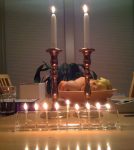
The sky turns shades of orange and mauve as I glance outside my dining room window and notice the sun slipping behind the trees. The havoc and chatter in the house has peaked. I call my daughter to come and light the Shabbat candles with me. It’s time. Eighteen minutes before sunset.

We light the candles, nine for me, representing each of our family members, and one for her. We cover our eyes and circle the flames three times with our hands as we say the blessing that ushers in the holy Shabbat. “Baruch ata Adonai Eloheinu Melech HaOlam, asher kidshanu b’mitzvotav, v’tzeevanu l’hadlik ner shel Shabbat kodesh.” (“Blessed are you, G-d, our Master of the Universe, who has sanctified us with His mitzvah, and commanded us to light the candle of the holy Shabbat.”) Instantly, the chaos subsides and peace and serenity reign. It’s visceral, and a mystery to me how it occurs every Friday evening.

The Shabbat candles warm the atmosphere of the Shabbat table. Their soft glow draws us in. All week, we run from home to work and school, activities and errands that fill our days. Many of us do not share meals or spend time together at all!

Only on Shabbat do we have the opportunity to have precious moments with family and share meals, discuss our week’s events, share Torah thoughts and stories of the parashah, to enjoy each other’s presence as well as that of our Shabbat guests.

Shabbat, the seventh day of the week, is the gift that G-d has given us in order to reconnect with family and friends, and teach us, by His example, to rest as He did after creating our beautiful world for us in only six days. We reconnect with our G-dly souls and recharge our batteries for the busy week ahead. We pray at home and in a synagogue and get a special spiritual feeling as we connect to G-d and our community.

We also have Chanukah, an eight-day festival of lights, falling yearly on the 25th day in the winter month of Kislev. Chanukah recalls the Jews’ victory, with a small army, over the huge Greek army in the second century BCE. It also commemorates the miracle of the tiny bit of light, enough to burn for one day, which lasted for eight days, until the rededication of the Temple was possible after the struggle.

The Shabbat candles are placed inside our homes, while the Chanukah candles are placed so they can be seen from outside our homes. Why the difference?

On Shabbat, we are supposed to enjoy and benefit from the holy glow of the Shabbat candles as they shine over the beautifully set Shabbat table, with its white tablecloth and lavish settings. It is the main attraction for those fortunate to have a place around the table.

On Chanukah, we are forbidden to use the light of the menorah for any practical purpose. As the Chanukah candles melt, we are not supposed to do any housework at all. Only after they’ve melted, can we celebrate the miracle of the oil with food and games.

From this, we can extrapolate an essential difference between Shabbat and Chanukah. Shabbat is for us, the Jewish people; it nourishes and reinforces us weekly. Chanukah reaches beyond the warmth of the home to light up the darkness of the outside world. It reminds us not to be afraid, even in the harshest times. And Chanukah candles teach us to stand up and speak out for those who do not possess this strength. This feeds a pride that transcends ego. This is our proud Jewish heritage and our gift to the world.

As I polish my Shabbat candelabra, candlesticks and our family’s chanukiyah, I smile as memories of past Shabbatot and Chanukah celebrations mingle with anticipation. This year, Chanukah begins on the evening of Dec. 12 and continues until the 20th. Wishing you a very happy and festive Chanukah.

Esther Tauby is a local educator, writer and counselor.

Format ImagePosted on December 1, 2017November 29, 2017Author Esther TaubyCategories Celebrating the Holidays, Op-EdTags Chanukah, Jewish life, Judaism, Shabbat
Some holiday songs’ origins

Some holiday songs’ origins

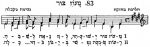
“Maoz Tzur,” recording by Abraham Tzevi Idelsohn. (photo from Music in the Jewish Community of Palestine 1880-1948 by Yehoash Hirschberg)

What do we have every year at Chanukah but rarely think about in terms of their origins? The songs. In a Hadassah Magazine article of some years ago, Melanie Mitzman quotes Velvel Pasternak on this subject. He said Chanukah songs are no more than a century old because Chanukah is a post-biblical holiday.

Pasternak is a musicologist, conductor, arranger, producer and publisher specializing in Jewish music. He has been described as “an expert on the music of the Chassidic sect and probably the largest publisher of Jewish music anywhere, although he is quick to note that publishing Jewish music is a business that attracts few rivals.”

The founder of Tara Publications, Pasternak has been responsible for the publication of 26 recordings and more than 150 books of Jewish music since 1971, spanning the gamut of Israeli, Yiddish, Ladino, cantorial, Chassidic and Holocaust music.

Most Chanukah songs, he told Mitzman, have been adapted from old folk melodies, have more than one set of lyrics and/or have been translated from language to language.

“Maoz Tzur,” for example, is called “Rock of Ages” in English. As Ariela Pelaia explains on thoughtco.com, it was written sometime in the 13th century by someone named Mordechai, and is a Jewish liturgical poem or piyyut, written in Hebrew originally, about “Jewish deliverance from four ancient enemies, Pharaoh, Nebuchadnezzar, Haman and Antiochus.” It is usually sung after lighting the chanukiyah. Its six stanzas correspond to five events of Jewish history and a hope for the future. Of its six stanzas, often only the first stanza is sung (or the first and fifth), as this is what directly pertains to Chanukah.

The authorship of the Yiddish song “Oy Chanukah,” or “Chanukah, Oh Chanukah,” in English, is unknown. According to the Freedman Jewish Music Archive at the University of Pennsylvania Library, alternate names of the Yiddish version of song have been recorded as “Khanike Days,” “Khanike Khag Yafe,” “Khanike Li Yesh,” “Latke Song (Khanike, Oy Khanike),” “Yemi Khanike” and “Chanike, Oy Chanike.” The standard transliteration of Chanukah in Yiddish, according to the YIVO system, is Khanike.

The Society for Jewish Folk Music in St. Petersburg published two classical compositions that make extensive use of this tune: “Freylekhs” for solo piano by Hirsch Kopyt, published in 1912 but performed as early as 1909; and “Dance Improvisation” for violin and piano by Joseph Achron, published in 1914 (composed in December 1914 in Kharkov, Ukraine).

The lyrics of the Hebrew version, which has the same melody, were penned by Avraham Avronin. The words correspond roughly to the original (more so than the English version), with slight variations for rhyme and rhythm’s sake. Thus, the first line names the holiday; the second calls for joy and happiness (using two synonyms); in the third, the speakers say they’ll spin dreidels all night; in the fourth, they will eat latkes; in the fifth, the speaker calls everyone to light the Chanukah candles; the sixth mentions the prayer Al Hanissim (On the Miracles).

The only big change is in the last line. Whereas the original calls us to praise God for the miracles He performed, the Hebrew one praises the miracles and wonders performed by the Maccabees. This reflects the anti-religious attitude of early Zionism, evident in many other Israeli Chanukah songs. In Israel, it’s still a very popular song, but, since the country has a rich inventory of Chanukah repertoire, it is not as popular as the English or Yiddish versions in North America.

“I Have a Little Dreydl,” also known as the “Dreidel Song,” is very famous in the English-speaking world. It also has a Yiddish version. The Yiddish version is “Ich Bin a Kleyner Dreydl,” “I Am a Little Dreidel.” The lyrics are simple and are, not surprisingly, given its title, about making a dreidel and playing with it.

The writer of the English lyrics is Samuel S. Grossman and the composer is listed as Samuel E. Goldfarb. The Yiddish version apparently was both written and composed by Mikhl Gelbart, known as Ben Arn, the Son of Aaron. Therefore, there is a question about who composed this music, as the melody for both the Yiddish and the English versions are precisely the same and the meaning of the lyrics in both versions is largely the same. However, in English, the song is about a dreidel made out of clay, which would be hard to spin, whereas in the Yiddish, the four-sided spinning top is made out of blay, which is lead.

Another popular dreidel song is “Sevivon,” with sevivon, sivivon or s’vivon being Hebrew for dreidel, which is the Yiddish word for a spinning top. “Sevivon” is very popular in Israel and with others familiar with Hebrew.

“Al Hanasim” is another popular Hebrew song for Chanukah. It is taken from the liturgy, but it is also an Israeli folk dance. The song is about thanking God for saving the Jewish people. The most popular tune, however, is relatively recent, having been composed by Dov Frimer in 1975.

The Chanukah song “Mi Y’malel” opens with the line, “Who can retell the mighty feats of Israel,” which is a secular rewording of Psalms 106:2, which reads “Who can retell the mighty feats of God.”

“Ner Li” translates as “I Have a Candle.” This is a simple Hebrew Chanukah song that is more popular in Israel than in the Diaspora. The words are by Levin Kipnis and the music is by Daniel Samburski.

Kipnis also wrote the words for “Chanukah, Chanukah,” which is a traditional folk song originating in Israel. In a completely different vein, “Judas Maccabaeus” is an oratorio by George Frideric Handel. During Chanukah, the melody for the oratorio’s “See, the Conqu’ring Hero Comes” is used by Spanish and Portuguese Jewish communities for the hymn Ein Keloheinu.

Last for this article, but certainly not the only remaining Chanukah song, is “Ocho Kandelikas.” This Ladino (Judeo-Spanish) song was written by Jewish-American composer Flory Jagodain in 1983, explains Pelaia. She adds that its lyrics describe “a child joyfully lighting the menorah candles,” saying that “beautiful Chanukah is here,” and describing all the wonderful things that will happen this time of year. The song counts out the eight candles for the eight days of Chanukah.

Sybil Kaplan is a journalist, lecturer, book reviewer and food writer in Jerusalem. She created and leads the weekly English-language Shuk Walks in Machane Yehuda, she has compiled and edited nine kosher cookbooks, and is the author of Witness to History: Ten Years as a Woman Journalist in Israel.

Format ImagePosted on December 1, 2017November 30, 2017Author Sybil KaplanCategories Celebrating the Holidays, MusicTags Chanukah, history, Judaism, music
Recipes from the world over

Recipes from the world over

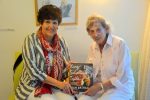
Cookbook author Joan Nathan, left, with journalist Sybil Kaplan. (photo from Barry A. Kaplan)

Before I review King Solomon’s Table: A Culinary Exploration of Jewish Cooking around the World by Joan Nathan (Knopf, 2017), I have to admit, I am prejudiced. I have known Joan for around 40 years, and every cookbook she writes is great. When she was in Israel recently, she agreed to appear at my English-speaking chapter of Hadassah Israel for a fundraiser. The program included my interviewing her, and her remarks are at the end of this article, after the recipes.

In King Solomon’s Table, Joan traces, through recipes and stories, the journey of many of the dishes that Jews eat, the people she has met over the years and the places she has visited. Alice Waters, well-known chef, food activist, owner and founder of Chez Panisse Restaurant in Berkeley and cookbook author, writes in the foreword: “Joan has become the most important preservationist of Jewish food traditions, researching and honouring the rich heritage that has connected people for millennia.”

photo - Sri Lankan Breakfast Buns are among the global fare in King Solomon’s Table. For the recipe, visit joannathan.com
Sri Lankan Breakfast Buns are among the global fare in King Solomon’s Table.  (photo from joannathan.com)

Joan’s introduction is an amazing history of the roots of Jewish food. This is followed by “The Pantry,” a discussion of spices and other items. Then there are the chapters and recipes. Every recipe has a story, and there are 171 recipes in 12 chapters. One can find recipes from Azerbaijan, Brazil, Bulgaria, Denmark, Ethiopia, France, Georgia, Germany, Hungary, India, Iraq, Israel, Italy, Kurdistan, Libya, Lithuania, Mexico, North Africa, Persia, Poland, Rhodes, Romania, Russia, Siberia, Sicily, Sri Lanka, Syria, Turkey, the United States, Uzbekistan and Yemen.

The variety is vast, from Hungarian Apple Pancakes to Sri Lankan Breakfast Buns, from French Buttery Olive Biscuits to Greek Eggplant Salad to Uzbek Noodle Soup. There are all sorts of breads, and recipes using couscous and different types of pasta. There are 15 vegetable recipes, 15 fish recipes, 10 recipes for poultry and 14 meat recipes. And, of course, there are recipes for sweets – 23 of them, including Sephardic Almond Brittle, Israeli Quince Babka and Brazilian Cashew Nut Strudel.

Scattered throughout the book are essays and, after the acknowledgments is a bibliography and index.

When Joan guest blogged for the Jewish Book Council, soon after the publication of the cookbook, she wrote: “One of the ideas that I have wrestled with throughout my career is the question of what is ‘Jewish food.’ Working on my latest cookbook, King Solomon’s Table: A Culinary Exploration of Jewish Cooking around the World, has at last answered that question for me.”

Here are a few of the recipes from this book.

SMOKY SHAKSHUKA
The name shakshuka comes from an Arabic and Hebrew word meaning “all mixed up.” It is said the dish was made in North Africa, when the women were busy with a lover and then made a quick meal for their husbands; it was born in the mid-16th century. This recipe makes eight servings.

4 red bell peppers
1 (1 pound) eggplant
2 tbsp olive oil
3 lamb, beef or chicken chorizo, sliced in rounds (optional)
5 chopped garlic cloves
12 chopped tomatoes or 28-ounce can chopped tomatoes
1 tbsp smoked Spanish paprika
2 tsp salt or to taste
1/4 tsp black pepper or to taste
1 tbsp sugar or to taste
1 bunch chopped cilantro
8 large eggs
crumbled Bulgarian feta cheese

1. Preheat the oven to 450°F and line a jelly roll pan with parchment paper. Cook the peppers and eggplant, pricking them first with a fork, turning occasionally with tongs until slightly soft and blackened, about 20 minutes.

2. Heat the oil in a pot over medium heat. Add peppers and fry about three minutes then add chorizo, if using, and garlic and cook six to seven minutes, stirring occasionally. Add tomatoes and simmer, uncovered, over medium-low heat for 30 minutes, stirring occasionally.

3. When the mixture is thickened, add the smoked paprika, salt, pepper, sugar, eggplant and all but three tablespoons of the cilantro. Stir to combine, Add seasonings to taste and add a little water if the mixture is too thick.

4. With the back of a spoon, make eight shallow wells in the shakshuka. Gently crack the eggs into the wells, cover the pot and poach over medium-low heat for five to 10 minutes until egg whites are set. Serve sprinkled with remaining cilantro and, if you like, Bulgarian feta cheese.

PICKLED HERRING SPREAD
(6-8 servings)

2 tbsp chopped red onion
1 tbsp almonds
1/2 Granny Smith or other tart apple, peeled and cored
1 large peeled hard-boiled egg
1 12-ounce jar marinated herring tidbits
1 tbsp fresh chopped dill

1. Pulse onion and almonds in food processor. Then add apple and egg to combine.

2. Pour off sauce and onions from marinated herring and add to food processor to chop. Place mixture in serving dish and sprinkle with dill to garnish.

LEEK AND MEAT PATTIES
The original 100-year-old recipe from Macedonia was a holiday staple for Balkan Jews, which Joan tampered with a bit. This recipe makes 12 patties.

1 1/4 cup olive oil
6-8 chopped leeks
2 1/4 tsp kosher salt
1/2 tsp black pepper
2 pounds chopped lamb, beef or boiled potatoes
3 large eggs
1 tsp cinnamon
1/2 tsp allspice
1/2 cup chopped parsley
1/2 cup matzah meal

1. Preheat oven to 425°F and rub a rimmed baking sheet with oil. Toss leeks with more oil, one teaspoon salt and pepper. Spread leeks in single layer and roast, tossing frequently until golden brown and crisp at edges, about 20 minutes. Cool.

2. Chop leeks and mix with meat or boiled potatoes, eggs, cinnamon, allspice, parsley, matzah meal and salt. Form into 12 patties. Heat a frying pan with a thin film of oil. Fry the patties until golden brown on each side, making sure they cook through. If using potatoes instead of meat, add a little Parmesan cheese for extra flavour.

***

An Interview with Joan Nathan in Jerusalem, June 15, 2017

SK: How did you decide to continue in food writing after you left Israel in the 1970s?

JN: We moved to the Boston area and I met with an editor at the Boston Globe. He asked me to write about food. I also had a scholarship to the Kennedy School at Harvard to do a master’s in public administration. I also met Dov Noy, z”l, the world’s renowned Jewish folklorist, who said, I’ll help you if you decide to write a cookbook, because he knew a lot about ethnic groups.

[At some point,] I told Julia Child’s editor I wanted to write a cookbook, but my father wanted me to go to Schocken Publishers.

[Schocken published The Jewish Holiday Kitchen in 1979, An American Folklife Cookbook in 1985, The Children’s Jewish Holiday Kitchen in 1988, The Jewish Holiday Baker in 1997 and Joan Nathan’s Jewish Holiday Cookbook in 2004. Knopf published Jewish Cooking in America in 1994, The Foods of Israel Today in 2001, The New American Cooking in 2005, and Quiches, Kugels and Couscous: My Search for Jewish Cooking in France in 2010.]

SK: How long does it take you to write a cookbook?

JN: King Solomon’s Table took six years. On a trip to India, I saw a sign, “Since the time of Solomon,” and got the idea, although the [part of the title] … about my journeys everywhere was my editor’s idea.

SK: How did you acquire the recipes?

JN: I sent out to all the “tribes.”

[Joan digressed here to say that the three essentials for Jewish food are the dietary laws; that Jews went out to look, for example, for spices; and how Jews’ food is influenced by the food of the country in which they’re living.]

SK: Who does the various elements of a cookbook?

JN: I have people help me in testing and I do my research. In the process of putting together a book, professional photographs are essential today. For King Solomon’s Table, I knew where I would go in the world…. I would plan trips for 10 days and, when I returned, I got the material typed quickly. The whole book comes together with the introduction. Each of my books is like a big term paper.

Sybil Kaplan is a journalist, lecturer, book reviewer and food writer in Jerusalem. She created and leads the weekly English-language Shuk Walks in Machane Yehuda, she has compiled and edited nine kosher cookbooks, and is the author of Witness to History: Ten Years as a Woman Journalist in Israel.

Format ImagePosted on December 1, 2017November 30, 2017Author Sybil KaplanCategories Books, LifeTags cookbooks, Joan Nathan, recipes
A homemade taste of Israel

A homemade taste of Israel

You don’t have to go to Israel to savour the perfect Israeli sufganiyot. (photo from IMP)

Here is a favourite Israeli Chanukah recipe courtesy of Tnuva, an Israeli company that makes kosher cheese and dairy products.

ISRAELI MINI SUFGANIYOT
(12 servings)

3 1/2 cups flour
1/4 cup sugar
1/2 tsp dry yeast
1 1/4 cup of 1% milk, lukewarm
2 tbsp butter
1 egg, at room temperature
oil for frying
8 tbsp sugar
1 tbsp cinnamon

In a small bowl, mix together yeast, milk and eggs.

In a separate bowl, mix half a cup of flour with the sugar. Then add in the yeast mixture and blend together. Add in the remaining flour and continue stirring until the dough is elastic.

Cover the bowl with a towel and let the dough rise for about an hour or until the dough has doubled in volume.

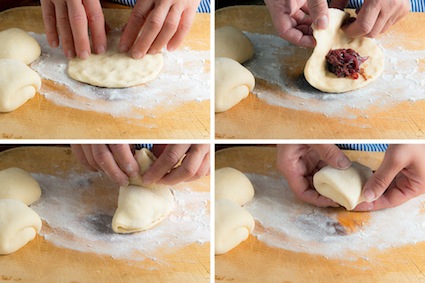
On a floured surface, roll out the dough to about half an inch thick. Make circles using a medium-sized cookie cutter.

Place the dough patties onto a well-floured baking tray and let them rise again until they have doubled in volume (about an hour).

Heat oil in a medium saucepan and fry the dough patties until they are golden on both sides.

Mix remaining sugar and cinnamon and coat the sufganiyot with the mixture.

Format ImagePosted on December 1, 2017November 30, 2017Author IMP Media Ltd.Categories Celebrating the HolidaysTags baking, Chanukah, Israel, sufganiyot

Cooking with bananas

Look up bananas and you’ll learn a lot, like I did. Botanically, bananas are, believe it or not, a berry, grown as a plant. They were first domesticated in Papua, New Guinea, about 5000 BCE and were known in the land of Israel in the 10th century. They are native to Indomalaya and Australia. High in potassium and pectin, magnesium and Vitamin C, they are a great weight loss food. However, diabetics should eat them with a meal and be aware that the fruit can raise blood sugar levels and they account for a high carbohydrate count. Here are some different ways to use them.

BANANA NUT PANCAKES
(12 pancakes)

1 cup flour
2 tsp baking powder
2 tbsp sugar
1 egg
1 cup milk
2 tbsp vegetable oil
1 medium cut banana
1/4 cup chopped nuts
oil for frying

1. In a bowl, combine flour, baking powder and sugar. Stir in egg, milk and oil and blend.

2. Add banana and nuts.

3. Heat oil in a frying pan. Drop batter by tablespoon into hot pan. Fry, then turn once and continue frying until golden brown.

MY BANANA SABRA DESSERT
(four servings)

2 mashed bananas
1/2 cup whipped cream
2 tbsp sabra
1 tsp semi-sweet grated chocolate
1 tbsp slivered almonds
1 tsp grated orange rind (optional)

1. Mash bananas in a bowl. Add whipped cream and sabra.

2. Spoon into serving glasses or dishes and freeze.

3. When ready to serve, sprinkle almonds, chocolate and orange rind on each glass or dish.

CHOCOLATE BANANA BREAD PUDDING
(six servings)

1/2 loaf challah bread
2 bananas
2 eggs
1 cup non-dairy creamer
1/3 cup sugar
1/3 cup chocolate chips

1. Preheat oven to 350°F. Grease a nine-inch round springform or cake pan.

2. Cut bread into one-inch pieces. Slice bananas.

3. In a bowl, beat eggs, non-dairy creamer and sugar. Stir in bread pieces and chocolate chips. Cover and refrigerate for one hour, pressing down bread to absorb cream mixture.

4. Spoon mixture into baking pan. Cover and bake 35 minutes. Uncover and bake 45 minutes longer or until a knife inserted into the middle comes out clean. 

CHOCOLATE CHIP BANANA MUFFINS
(36 mini muffins)

3/4 cups sugar
1/4 cup + 1 1/2 tsp oil
1 cup mashed bananas
2 eggs
1 3/8 cups flour
1 1/4 tsp baking soda
1/2 cup chocolate chips

1. Preheat oven to 350°F. Line mini muffin pans with paper or other liners.

2. In a bowl, combine sugar, oil, bananas and eggs and mix thoroughly.

3. Add flour and baking soda and whisk until batter is moist. Stir in chocolate chips.

4. Spoon batter into muffin cups. Bake for 25 minutes or until a toothpick inserted in the centre comes out clean.

Sybil Kaplan is a journalist, lecturer, book reviewer and food writer in Jerusalem. She created and leads the weekly English-language Shuk Walks in Machane Yehuda, she has compiled and edited nine kosher cookbooks, and is the author of Witness to History: Ten Years as a Woman Journalist in Israel.

Posted on December 1, 2017November 30, 2017Author Sybil KaplanCategories LifeTags baking, bananas
Time to light the lights

Time to light the lights

Chanukah lights (photo from pxhere.com/en/photo/285940)

Rabbi Kibbitz! Rabbi Kibbitz!” Young Doodle ran into the rabbi’s study, breathless and excited. “Rabbi Kibbitz! It’s time to light the Chanukah candles!”

Doodle stopped cold. The senior rabbi of the village of Chelm sat behind his desk, with his head drooping in his hands, staring blankly into nothing.

“Rabbi Kibbitz, are you all right?”

The wise old man shook his head.

“Are you having a heart attack? A stroke? Indigestion?!”

Again the rabbi shook his head.

“You’re not getting a divorce are you?”

The rabbi’s head shot up. He stared at Doodle, and firmly shook his head, no.

“Then, Rabbi, what is it?”

“The world, Doodle,” the rabbi said. “It’s falling apart. The czar is going crazy and so is the king of Poland. It looks like war may happen at any time, and Chelm is right in the middle.”

“That’s not new,” said Doodle. “The czar is always crazy. I hear last week he commissioned a jeweler to make a dozen eggs out of gold!”

“What’s crazy about that?” asked Rabbi Kibbitz.

“Eggs come out of chickens for free,” Doodle said. “With real eggs, you can eat ‘the gold.’ But golden eggs, it seems like you’re paying a lot for nothing.”

The rabbi nodded. He’d never been able to understand how Doodle thought.

“Come, Rabbi,” Doodle said. “It’s time to light the Chanukah candles. Everybody is waiting.”

“The harvest was poor this year,” the rabbi said. “It’s been poor the last four years. I don’t know how we are going to feed ourselves this winter. And, if next harvest is bad, then I’m sure we will all starve.”

“Actually, rabbi, it’s been six bad years,” Doodle corrected. “And you know what they say in the Torah? After seven years of famine, there will be seven years of feast!”

“I’m not sure it says that.”

“Perhaps not,” Doodle said. “But we will figure it out. We always do. If nothing else, we can always move somewhere.”

“Borders are closing, Doodle. Nobody wants to have poor refugees.”

“In America, there is plenty of opportunity!”

The rabbi shook his head. “I don’t know.”

“Come, let’s light the candles,” Doodle said.

“People are becoming so hateful.” The rabbi’s head slumped back into his hands. “Neighbours fight each other. Everyone looks out only for himself or his tribe. I always thought that, over time, the world would become a better place, but I hear the news about this revolution or that uprising or this massacre and that famine and all I see is darkness.”

“Let’s light the candles,” Doodle insisted.

“Enough with the candles!” The rabbi burst with frustration. “Chanukah is not even a major holiday. With all the problems of the world, it just doesn’t matter.”

Doodle stood still and stared at the rabbi. “It does matter. Every year, on the last night of Chanukah, our whole community gathers in the synagogue to light the candles. We kindle a shammos from the eternal lamp, and then that flame is passed to every shammos. We sing the blessings, and then one light becomes eight lights, multiplied by every single family in the village. It doesn’t matter how cold it is outside. We are warm and together in celebration. Even in the darkness the menorahs glow as bright as day.

“Come, Rabbi. Let’s light the candles.”

Rabbi Kibbitz looked up at the young boy. The wise old man had tears in his eyes. He nodded and stood.

Just then, Reb Cantor the merchant burst into the rabbi’s study.

“Rabbi Kibbitz! Have you heard? They’re devaluing the currency. The money – all the money – is going to be worthless!”

“Reb Cantor,” said Rabbi Kibbitz. “It seems very dark and bleak sometimes, doesn’t it?”

Reb Cantor nodded in agreement.

“Isn’t it wonderful,” the rabbi said, “that it is time for us to gather in the synagogue and light the Chanukah candles?”

Reb Cantor took a deep breath and nodded. “You are a very wise man, Rabbi Kibbitz.”

Together, the rabbi and the merchant left the study and their troubles behind.

Doodle rolled his eyes. Then, he grinned and ran to catch up. “Rabbi Kibbitz, Reb Cantor! Wait for me!”

Mark Binder is a Jewish storyteller and the author of A Hanukkah Present! Twelve Tales to Give and Share and Matzah Mishugas. These and other books are available in print and ebook on Amazon, iBooks, Google Play Books and other booksellers. To learn more about Binder, visit markbinder.com.

Format ImagePosted on December 1, 2017November 30, 2017Author Mark BinderCategories Celebrating the HolidaysTags Chanukah, Chelm, storytelling
House no longer home

House no longer home

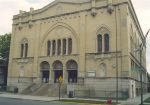
South Side Hebrew Congregation.  (photo by Deborah Rubin Fields)

“It has seemed to me sometimes as though the L-d breathes on this poor grey ember of Creation and it turns to radiance – for a moment or a year or the span of a life. And then it sinks back into itself again, and to look at it no one would know it had anything to do with fire, or light.” (Gilead by Marilynne Robinson, 2004)

Once I had turned onto Chicago’s Congress Parkway, I shut off Waze. I told myself that, from here on, I could navigate from long-stored memory. My destination: my old South Shore neighbourhood. My objective: by means of an on-site visit, to share recollections of my Chicago-based formative years with our four Israeli-bred children, so they could have a real sense of where I came from and why I am the way I am.

I expected the community I’d lived in from birth until halfway through my adolescence to be much changed. It’s a fact of life, people change, places change. Certain relatives and friends, however, discouraged my visiting where I’d grown up; some even informed me the local press had renamed the area Terror Town.

Consequently, with a bit of trepidation, we drove into South Shore to begin my guiding and reminiscing. South Shore (named for its proximity to the southern shore of Lake Michigan) had been a middle-class neighbourhood. Some upper-middle-class (probably closer to the lake), some lower-middle-class, lots of solid middle-class.

As I explained to my children, when I was growing up, my area was a religiously mixed Caucasian neighborhood, but we got along with our non-Jewish neighbours. I played with the Christian kids on our block.

Moreover, when it came to schooling, my parents likewise wanted my brothers and me to be broadly exposed, meaning we attended both Chicago Board of Education public schools (not Jewish day schools) and a five-day-a-week afternoon Hebrew school and Hebrew high school. But, even though we attended a public school, there were different rules for different people. For instance, a special bell rang in our elementary school one day a week at 2 p.m., signifying that practising Catholic kids were free to leave for catechism lessons. When we missed school for a Jewish holiday, we had to return to school with a note from our parents explaining why we had been absent. Needless to say, we had to make up whatever work or tests we missed.

Significantly, in those days, Chicago had other forms of “acceptable” discrimination. Jews and other minorities were not allowed to live in certain areas and were not given membership in certain clubs. The nearby South Shore Country Club was one such restricted place. In the late 1960s, when the rules changed (because of hard-fought anti-discrimination legislation), one of my parents’ closest friends, a history professor, was belatedly invited to join. He relished responding, “I don’t want to belong to any club which hadn’t wanted me.”

Now that I had the chance, I wanted to see the inside of the club. It had been converted into a municipal public park, golf course and cultural centre, close to where former President Barack Obama’s library will be constructed. Either the grounds had not been maintained at their previous level or the previous standard had been over-imagined, but I was underwhelmed by what I saw. Spontaneously, my children – who have all visited the remains of Nazi concentration and death camps – commented the club’s gatehouse reminded them of the entrance to Auschwitz.

Though we had lived in a mixed neighbourhood, there was a Jewish community centre, plus seven synagogues (representing various streams of Judaism) within walking distance of our apartment – more than in my current Jerusalem neighbourhood! Because my parents had “shopped around” until I was about 6 years old for the synagogue that best met our family’s needs, I was acquainted with just about all of them.

photo - Deborah Rubin Fields went to Hebrew school five days a week in this building owned by South Side Hebrew Congregation. The Men’s Club also met there. For awhile her grandfather was the president
Deborah Rubin Fields went to Hebrew school five days a week in this building owned by South Side Hebrew Congregation. The Men’s Club also met there. For awhile her grandfather was the president. (photo by Deborah Rubin Fields)

Now, as I drove my children through South Shore, I saw that South Side Hebrew Congregation, Congregation Habonim, Congregation Bnai Bezalel, Congregation Agudat Achim and South Shore Temple had become churches. Beth Am Congregation was now a school. The buildings by and large looked the same, except for the signs identifying the churches that now occupied the premises, and the occasional cross on the windows. The brick menorot were still on the façade of Torah Synagogue and the mikvah, but at least part of the complex had become a beauty supply shop.

I recalled one story from my club at the Jewish Youth Centre. My group went for a picnic supper at Rainbow Beach. My neighbour and friend, D., disregarded our warnings, returning home with what she called a gift for her mother, a long-dead alewife. When D. entered her apartment complex, the rest of us raced to the back of the building to snicker at D.’s mother screaming about the smelly fish.

And, speaking of social functions, my old synagogue, South Side Hebrew Congregation, played a social role, as much as it did a religious role. It wasn’t just a place for praying, as are many Israeli synagogues, it was a place to meet up with people with whom we shared a common core. For synagogue members like us who felt like part of a minority group, SSHC offered a sense of belonging, of comfort and of security.

Hence, every Shabbat morning, I went to the junior congregation. One our Hebrew teachers, Mr. Wolfson, with his heavy eastern European accent, directed our tefillot. My parents often went to the adult service. I have lots of good memories about SSHC, especially listening to Sparky Rosenstein, the president of the shul trying, but never really succeeding in blowing the shofar; stringing fresh cranberries and popcorn to hang in the giant communal sukkah (though we traditionally ate dinner in the sukkah of family friends, wrapped up in our coats, as Chicago was so cold already); walking around with a flag, apple and chocolate Kisses on Simchat Torah; and going up on the bimah to get the cantor wet when we started reciting the prayer for rain.

Years ago, I had gone on tours of old Jewish neighbourhoods with Prof. Irving Cutler. Back then, I had marveled at how Jews had established themselves in so many of Chicago’s districts. Yet now, seeing what had become of the Jewish institutions of my childhood, I was saddened no one had stayed around to keep them going. I whimsically thought it was too bad the Jews of South Shore hadn’t called on the Golem to protect these synagogues. Of consolation was the fact that people have continued to use most of the buildings as houses of worship.

During the entire trip, way-back-when scenes flooded my mind. Many I shared with my family. If the content wasn’t always complete, the emotion was. And this feeling my children will always have and it will be enough.

“… the end of all our exploring / Will be to arrive where we started / And know the place for the first time.” (T.S. Eliot, Four Quartets).

Deborah Rubin Fields is an Israel-based features writer. She is also the author of Take a Peek Inside: A Child’s Guide to Radiology Exams, published in English, Hebrew and Arabic.

Format ImagePosted on December 1, 2017November 30, 2017Author Deborah Rubin FieldsCategories TravelTags Chicago, family, Jewish life, memoir

Posts pagination

Previous page Page 1 … Page 412 Page 413 Page 414 … Page 670 Next page
Proudly powered by WordPress