


South Side Hebrew Congregation. (photo by Deborah Rubin Fields)
“It has seemed to me sometimes as though the L-d breathes on this poor grey ember of Creation and it turns to radiance – for a moment or a year or the span of a life. And then it sinks back into itself again, and to look at it no one would know it had anything to do with fire, or light.” (Gilead by Marilynne Robinson, 2004)
Once I had turned onto Chicago’s Congress Parkway, I shut off Waze. I told myself that, from here on, I could navigate from long-stored memory. My destination: my old South Shore neighbourhood. My objective: by means of an on-site visit, to share recollections of my Chicago-based formative years with our four Israeli-bred children, so they could have a real sense of where I came from and why I am the way I am.
I expected the community I’d lived in from birth until halfway through my adolescence to be much changed. It’s a fact of life, people change, places change. Certain relatives and friends, however, discouraged my visiting where I’d grown up; some even informed me the local press had renamed the area Terror Town.
Consequently, with a bit of trepidation, we drove into South Shore to begin my guiding and reminiscing. South Shore (named for its proximity to the southern shore of Lake Michigan) had been a middle-class neighbourhood. Some upper-middle-class (probably closer to the lake), some lower-middle-class, lots of solid middle-class.
As I explained to my children, when I was growing up, my area was a religiously mixed Caucasian neighborhood, but we got along with our non-Jewish neighbours. I played with the Christian kids on our block.
Moreover, when it came to schooling, my parents likewise wanted my brothers and me to be broadly exposed, meaning we attended both Chicago Board of Education public schools (not Jewish day schools) and a five-day-a-week afternoon Hebrew school and Hebrew high school. But, even though we attended a public school, there were different rules for different people. For instance, a special bell rang in our elementary school one day a week at 2 p.m., signifying that practising Catholic kids were free to leave for catechism lessons. When we missed school for a Jewish holiday, we had to return to school with a note from our parents explaining why we had been absent. Needless to say, we had to make up whatever work or tests we missed.
Significantly, in those days, Chicago had other forms of “acceptable” discrimination. Jews and other minorities were not allowed to live in certain areas and were not given membership in certain clubs. The nearby South Shore Country Club was one such restricted place. In the late 1960s, when the rules changed (because of hard-fought anti-discrimination legislation), one of my parents’ closest friends, a history professor, was belatedly invited to join. He relished responding, “I don’t want to belong to any club which hadn’t wanted me.”
Now that I had the chance, I wanted to see the inside of the club. It had been converted into a municipal public park, golf course and cultural centre, close to where former President Barack Obama’s library will be constructed. Either the grounds had not been maintained at their previous level or the previous standard had been over-imagined, but I was underwhelmed by what I saw. Spontaneously, my children – who have all visited the remains of Nazi concentration and death camps – commented the club’s gatehouse reminded them of the entrance to Auschwitz.
Though we had lived in a mixed neighbourhood, there was a Jewish community centre, plus seven synagogues (representing various streams of Judaism) within walking distance of our apartment – more than in my current Jerusalem neighbourhood! Because my parents had “shopped around” until I was about 6 years old for the synagogue that best met our family’s needs, I was acquainted with just about all of them.
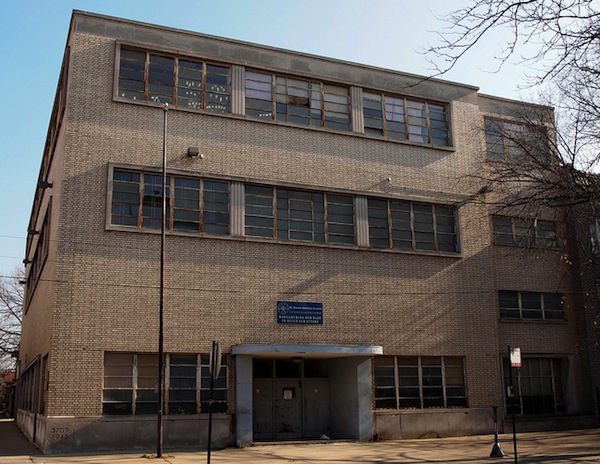
Now, as I drove my children through South Shore, I saw that South Side Hebrew Congregation, Congregation Habonim, Congregation Bnai Bezalel, Congregation Agudat Achim and South Shore Temple had become churches. Beth Am Congregation was now a school. The buildings by and large looked the same, except for the signs identifying the churches that now occupied the premises, and the occasional cross on the windows. The brick menorot were still on the façade of Torah Synagogue and the mikvah, but at least part of the complex had become a beauty supply shop.
I recalled one story from my club at the Jewish Youth Centre. My group went for a picnic supper at Rainbow Beach. My neighbour and friend, D., disregarded our warnings, returning home with what she called a gift for her mother, a long-dead alewife. When D. entered her apartment complex, the rest of us raced to the back of the building to snicker at D.’s mother screaming about the smelly fish.
And, speaking of social functions, my old synagogue, South Side Hebrew Congregation, played a social role, as much as it did a religious role. It wasn’t just a place for praying, as are many Israeli synagogues, it was a place to meet up with people with whom we shared a common core. For synagogue members like us who felt like part of a minority group, SSHC offered a sense of belonging, of comfort and of security.
Hence, every Shabbat morning, I went to the junior congregation. One our Hebrew teachers, Mr. Wolfson, with his heavy eastern European accent, directed our tefillot. My parents often went to the adult service. I have lots of good memories about SSHC, especially listening to Sparky Rosenstein, the president of the shul trying, but never really succeeding in blowing the shofar; stringing fresh cranberries and popcorn to hang in the giant communal sukkah (though we traditionally ate dinner in the sukkah of family friends, wrapped up in our coats, as Chicago was so cold already); walking around with a flag, apple and chocolate Kisses on Simchat Torah; and going up on the bimah to get the cantor wet when we started reciting the prayer for rain.
Years ago, I had gone on tours of old Jewish neighbourhoods with Prof. Irving Cutler. Back then, I had marveled at how Jews had established themselves in so many of Chicago’s districts. Yet now, seeing what had become of the Jewish institutions of my childhood, I was saddened no one had stayed around to keep them going. I whimsically thought it was too bad the Jews of South Shore hadn’t called on the Golem to protect these synagogues. Of consolation was the fact that people have continued to use most of the buildings as houses of worship.
During the entire trip, way-back-when scenes flooded my mind. Many I shared with my family. If the content wasn’t always complete, the emotion was. And this feeling my children will always have and it will be enough.
“… the end of all our exploring / Will be to arrive where we started / And know the place for the first time.” (T.S. Eliot, Four Quartets).
Deborah Rubin Fields is an Israel-based features writer. She is also the author of Take a Peek Inside: A Child’s Guide to Radiology Exams, published in English, Hebrew and Arabic.



