Can Syn save garden?

After a three-year wait, local writer Michael Seidelman’s Garden of Syn trilogy comes to a fast-paced, satisfying conclusion.

We first met our protagonist, Synthia Wade, in No One Dies in the Garden of Syn, which was released in 2016. (All of the books are published by Chewed Pencil Press.) A teenager when we encounter her, she is being parented by her aunt, as her parents went missing when she was 5 years old. In Book 1, due to circumstances beyond her control, Syn falls into another universe – one in which she can breathe easily, her cystic fibrosis nonexistent. But all is not healthy in the garden, as this other place is called, and Syn must rise to many challenges and challengers to set things right.

There are multiple universes in this trilogy, each with their own Syn, and, in at least one of them, Syn has a sister, Beth. The second book, Everyone Dies in the Garden of Syn, which came out in 2018, focuses on Syn’s efforts to rescue Beth, who has been kidnapped. Unfortunately, because of Syn’s actions, the healing powers of the garden disappear, hence, the name of this part of the story. Syn must take particular care, given her CF.

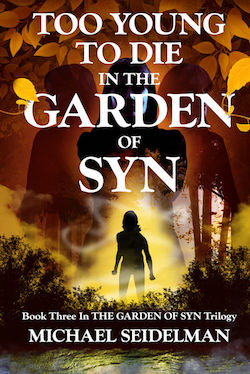
image - Too Young to Die in the Garden of Syn book coverMany people die in the second book. So, at the beginning of the third book, feeling responsible and guilty for the tragedies, Syn doesn’t want to return to the garden. However, a determined friend-turned-enemy forces Syn to finish what she started. In the conclusion to the series, Too Young to Die in the Garden of Syn, Syn must fight to save the garden and its inhabitants, at the risk of her own life.

The plot that runs through the trilogy is complex. Characters thought dead turn out not to be, characters that seem like allies turn out not to be and vice versa, and, given the multiverses, there are numerous versions of key personnel. As well, the story tackles many ethical issues, mainly involving medical research and experimentation. The novels also illustrate that who the hero of a story is depends on who’s telling the story – the bad guys in Seidelman’s fictional worlds don’t think they’re in the wrong; in fact, they have good reason to feel aggrieved and betrayed.

The action doesn’t lose momentum in this third book and Syn and her allies must race and jump around universes, fight and think for their lives – and the lives of many others. Though I was both hoping and fearing Seidelman would wrap things up more darkly, I think he made the right choice for his young adult audience.

Too Young to Die in the Garden of Syn was worth the wait.

For articles on the previous books in the series, including an interview with Michael Seidelman, visit jewishindependent.ca/first-book-of-trilogy-now-out and jewishindependent.ca/persistence-a-common-theme

Poems and photos meld

For anyone who has thought about publishing their own story, poems, photos, artwork – really, anything they have created – The Gate and Other Poems on a Life’s Journey (FriesenPress) should be an inspiration to just do it already.

This book of poetry by Winnipeggers Doug Jordan, with editing and photography by my cousin Sidney Shapira, is a wonderful example of what we are capable of creating when we stop thinking about maybe doing something and act. It also affirms the benefits that can be reaped by working with someone on an endeavour, not only for encouragement but for holding ourselves accountable to whatever vision we may have, and bringing it out of our heads and into being.

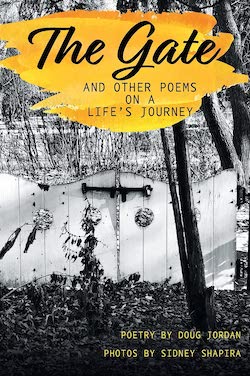
image - The Gate and Other Poems on a Life’s Journey book coverIn Shapira’s introduction, he acknowledges that Jordan’s target audience for this collection is his family, friends – in particular, friends who had also lived on the Shilo army base, near Brandon, Man., as kids – and former students. While this is probably the audience who will most revel in this publication, there are poems that will speak to everyone, about love, work, grief and other universal themes. They date from 1965 through to 2021.

Shapira has thoughtfully chosen photos of his that would complement various poems – all in black-and-white, to match the sombre mood of Jordan’s writings. The collection doesn’t leave readers in a sombre mood, however, perhaps because of the rhyming, which may not suit everyone’s tastes. Jordan explains his choice in a note at the end of the book:

“I enjoy poetry that rhymes and has rhythm,” he writes. “It is easier to read. Most poets prefer a form of free verse and their message is completely lost to many of their readers as they try to uncomplicate the poet’s words. This is when, as a teacher, we often hear ‘I hate poetry.’ No wonder. They can’t understand it, and don’t get me going on Shakespeare and others of that ilk.

“I say, if you are a poet and have a message or a story to tell, try do so in its most understandable terms.”

But don’t confuse rhythmic with simplistic. As Shapira notes, “Doug’s poems never meet his own standards after one draft; for example, ‘The Streets of Copenhagen’ took 10 years to achieve ‘finished’ status.”

The Gate truly represents a journey – one to which all of us can relate.

Reflections of her childhood – an excerpt from The Singing Forest

image - The Singing Forest book coverSay hello to Leah, the daughter of a man who disappears when she is a baby and a mother who dies in a car crash when she is 6 years old. She is placed in the care of her Jewish aunt during the week, and her three eccentric Jarvis uncles on the weekends – Rudy, Gus and Malcolm. This excerpt is a flashback – she is now a junior lawyer, working on the deportation of a war criminal, and Nate is a fellow junior in the firm.

***

You have no idea where he is? said the social worker. I don’t believe it for a minute, said her tone.

No idea, said Rudy. I’m sure he would be here if he knew.

In fact, he was not at all sure of this. The youngest brother, the father – witty and weak and self-absorbed. And a man who was afraid, desperately afraid of – what? Of being ordinary. Of leading a rye-and-ginger life. Chasing anything that might save him from this, like a distracted dog. A fugitive from the everyday, the commonplace, always searching for a way out.

He’ll turn up soon, said Rudy.

He is far from sure of this either.

The aunt was the formal placement – the mother’s half-sister, 19 years older than her, almost another generation. But a woman whose kidneys were starting to fail, scarred organs slowly breaking down.

I can’t handle her full-time, she said miserably, exhausted by the disease.

The social worker knew enough – too much – about the foster home system to send the child into its labyrinths. So this arrangement would have to work – the aunt during the week, the uncles on the weekend. She did what could be done, the things that were possible. A session on child-rearing, simple advice, checklists on clothing, food, sleeping. The child was the only one who read the lists, though, or tried to – her small finger tracing out the letters she knew until the papers were stained and dog-eared. Hoping that somewhere in there were the clues she needed, the answers to what had happened, how her life had jackknifed so wildly. But she also passed along anything she understood to Gus.

A taciturn man, something that suited them both. He used words sparingly, as if he had only a limited supply, and was storing them for some future use. Instead, he preferred silence, or a range of silences: dusty silences, steep silences, warm silences.

A clam, said the social worker to her supervisor. But soon he became used to the child winding around his legs, and developed a clumsy affection for her. Not a man who was a good bet in other ways, though – someone with serial bankruptcies, an instinct for failure.

Raised by your uncles? Nate says in the same tone someone might say: raised by wolves? His voice is dark, slightly hoarse. He is intrigued by this odd household, intrigued as only someone with two card-carrying parents can be.

I raised her, says her aunt. They looked after her.

Anna Rubin. Puffy-faced, her skin floury, her dark eyes circled with shadows. Persistent in her own way, determined that the girl would know something of this other life, that she would have some sense of its latitudes and longitudes.

No such thing as half-Jewish. Don’t let me hear you say that. If your mother is Jewish, you’re Jewish. Halachah. Those are the rules.

Those are the rules, echoed the girl, curled under the woman’s arm.

But her aunt had more to say, much more. A personal mission, built around tzimmes and the ten plagues.

The plague of locusts. The plague of frogs. The plague of water turning into blood.

The girl held up a hand, raising her small fingers.

Only three, she said.

She was a literal child.

A selection of the best, said her aunt.

Behind the scenes, though, her kidneys were silently abandoning their functions, the toxins in her system slowly building. Soon – too soon – it was the uncles during the week, the aunt on the weekend.

Not even a Jewish disease, said her aunt disgustedly, her skin yellow.

No need to tell that social worker, she added.

What do you do when you’re there? Malcolm said once, not so much interested in the girl as the aunt, any possibilities for money.

The child hesitated.

We eat brisket, she said after a minute, the only thing that came into her mind. She had no words for this briny, tender woman, for her kitchen, her houseplants, vines running along mantels, trailing down shelves. For the moth orchids everywhere – windowsills, bookcases – leaning over pots, their grey air roots twisting around them.

Malcolm looked at her uncomprehendingly. The idea that the girl was half-Jewish, the idea of Jewishness itself was so foreign, so baffling to him – to all three of them – that they ignored it. They had an unspoken agreement to treat it as if it were an awkward genetic problem, something that was better left unmentioned. And after awhile, she understood that she was not to talk to them about it, that this was something she had – she was – with her aunt.

Is it only for girls? she said to her, early on. Being Jewish?

Who told you that? Full of men. Look at Moses. Look at Einstein. Look at Marvin next door.

Marvin – thinning hair, mild, someone who yawns a lot. Ida’s husband, content to drift in her slipstream. Neighbours.

She’s not the brightest, but she has a good heart. And he shovels my walk in the winter.

And Moses? Einstein? Other neighbours?

Big shots, said her aunt.

That night: Men can be Jewish, too, she said to Gus, putting her to bed.

He said nothing in an agreeable way.

Look at Moses. Look at Marvin.

More nothing.

She sighed, the world-weary sigh of a six-year-old.

Those are the rules.

* * *

Half-Jewish. This is unsound genetically as well, she discovers later in biology classes, not a matter of chromosomal halves. Instead, she has a mix of genetic variations, extending in all directions. If some of them mark her as a carrier of Tay-Sachs disease, Bloom syndrome and an inability to drink milk, one non-Jewish parent will make no difference. This is a mess of a genome.

* * *

A week after the motion. Nate is sitting on the arm of one of her office chairs, cracking pumpkin seeds in his teeth. Lime, chili, salt – I roasted them myself.

You’re distracting me, she says, although the truth is that she was already distracted. The stay motion has been stalking her thoughts, intruding everywhere. She is waiting for the decision, although this is a wholly pointless exercise – it could be issued tomorrow, next week, or even next month, especially if the judge decides to write extensive reasons, not at all improbable. Still, she feels suspended in the web of this case, in part because she is still possessed by the idea that if they lose, it will be her fault.

Unlikely, says Nate. Although not impossible.

Or that she will be blamed anyway, whether it is her fault or not.

Not quite so unlikely, Nate admits. Give me your hand.

She stretches out her palm, and he leans over and shakes some pumpkin seeds into it.

She studies them absently, and then puts them in her mouth.

For more information, visit judithmccormack.com.

A death well-planned – an excerpt from Anne of Oasis

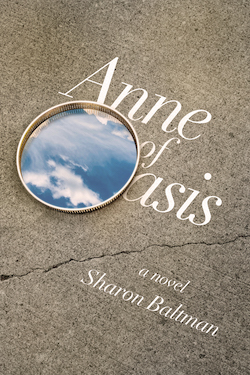
image - Anne of Oasis book coverIn Anne of Oasis, drawing on my many years as a physician psychotherapist, I tell the detailed, fictional story of what goes on in the therapy room when an eccentric, 70-year-old is obsessed with changing her life – or ending it. Anne bumbles through what she views as mysterious rituals with the therapist, explores secrets, re-jigs behaviours and, five years later, finds bliss. Here is the final chapter.

***

Chapter 26: June 2008

For two years, Doug heard sporadically from his mother and continued his requests for pearls. She made it clear to him and his brother she wasn’t coming out to Kelowna anymore. They occasionally visited her in Toronto, or in Golden, where she was staying with Eleanor for longer and longer periods of time.

When he received the phone call from a Toronto hospital, Doug asked if she’d fallen and busted her hip. They said it was more than that. They had found her unconscious on the street in Toronto with no ID, except for a piece of paper with Doug’s number on it as her next of kin. They admitted her as an Unknown Person and she was failing fast. If he wanted to see her alive, he had better come quickly.

He didn’t know what to do. He had promised to be there if she needed him for assistance in dying peacefully, but this was different. Yet how could he leave her to die on her own?

“She’s still your mother,” his wife offered.

He flew out as soon as he could. He arrived at the Toronto General Hospital, where Admitting confirmed there was no patient by the name of Anne Bishop. But a woman had been admitted as an Unknown Person. Doug wandered the halls searching for his mother.

“She was moved to a different floor.”

“She’s in ICU.”

“She’s not in ICU.”

Finally, he stepped into the Cardiac ICU and in the corner he saw a pile of breathing bones. Tube in mouth, IV in arm, sas-sas-sas of a respirator. Unknown Person at the foot of the bed.

“Is this her?” he asked the nurse at the desk.

“She was found with only this slip of paper on her.”

“That’s my name and number.”

“She apparently suffered a sudden, massive heart attack on the street.”

As Doug approached the bed, he recognized the bony lumps on her hands, the chewed-up fingernails, the crepe skin. It was definitely Mum. He gasped. His eyes filled, the lump in his throat tightened. He turned and rushed to the nursing station.

“Please, can the tubes be removed? She didn’t want heroics.”

“We barely know her name. We can’t follow any directives without proper ID and signed papers detailing her wishes.”

He took off uptown to retrieve the Dying With Dignity papers his mother had been talking about for years.

Stepping into his mother’s house, it felt haunted, full of yesterday’s glory. Dust everywhere. Her clothes neatly stashed, but neglect inhabited the place. He walked from room to room, observing photos everywhere – on window ledges, on kitchen counters, on the bedside table. Pictures of Jesse and Catherine and Doug and Bruce and Pam and Sue in every combination. Sitting next to each image was a shiny rock or pebble. He picked up each clear Plexiglass frame and stared. He was shocked to see how she surrounded herself with family. He began to sob.

He found the papers in the second drawer of his grandmother’s mahogany desk, exactly where his mother had said they’d be. Everything was perfectly organized and signed. He grabbed the requisite forms, glanced around at the family photos and returned to the hospital. They removed the tubes.

He returned to the house for a few hours’ sleep and arrived back at the hospital next morning, to find she had again sprouted pipes. The staff explained that overnight she had taken a turn for the worse and they tried to save her.

Angrily showing them the papers again, he repeated her wish to die quietly, and they removed the tubes a second time. He wrapped Mum in her favourite turquoise velour blanket he had brought from her home, took her in his arms and held her exactly as she held him as a sick boy on the farm. He noticed a flicker of a smile cross her face, then she took her last breath.

Just then, Eleanor appeared.

Through their tears, Doug and Eleanor awkwardly made their way to her house together. They expected to start planning how to say goodbye to Anne. But she beat them to it. She had detailed her every wish. They simply had to fulfil them.

“You know what?” Doug asked. “She knew what she was doing all those years ago around Dying With Dignity. We thought she was nuts, but it’s sure helping us now.”

“She was utterly determined in every aspect of her life,” Eleanor replied.

“What do you think we should do with the rocks? My brother thinks we should pitch them.”

“She schlepped them home from every spot she ever visited. Each and every one was special to her,” Eleanor sighed.

“I think we should leave some at the cemetery.”

Because Doug knew Mum hated missing appointments, he searched in her handwritten, dog-eared address book for Dr. C’s number.

“I’m so sorry,” Dr. C responded when he told her the news.

“It’s odd speaking to you in person after hearing about you for so long,” Doug said. “I’m happy to hear your voice. I need to tell you how important you were to my mother. Thank you for helping her.

“She was still difficult to deal with, but she seemed a lot happier. I also want to thank you for all the pearls of wisdom I received second-hand. Mum loved sharing them and they have been extremely helpful in my life.”

“We will all miss her.”

“As per her wishes, we are having a funeral service tomorrow afternoon at 2 p.m. at the Mount Pleasant Cemetery. We would be honoured if you would come.”

“Thank you. It would be a privilege. I’ll see you there.”

Tuesday afternoon, at 2 p.m., under a blistering sun, Doug, Eleanor and Dr. C, along with a handful of grey-haired men and women, gathered as they lowered the casket into the ground. Doug pulled out a heavy purple velvet Crown Royal bag and spoke.

“When I called Dr. C to notify her of Mum’s death, I asked what we could do with the stones Mum collected on her travels. She informed me that according to Jewish tradition, leaving a stone on a loved one’s grave signifies you have been to visit. Because of Mum’s lifelong appreciation of all things Jewish, placing stones on her grave would be a mitzvah, or a blessed act of kindness.

“I am honoured to ask each of you to dig into this bag, which held my marbles as a kid, to take out a pebble and place it on Mum’s final resting place.”

Tears rolled down his face. Doug held the bag open. Eleanor, Dr. C and the others lined up. One by one they removed a rock and placed it on the earth as it was shovelled onto the casket.

For more information, visit sharonbaltman.com.

A story of Hava Nagila

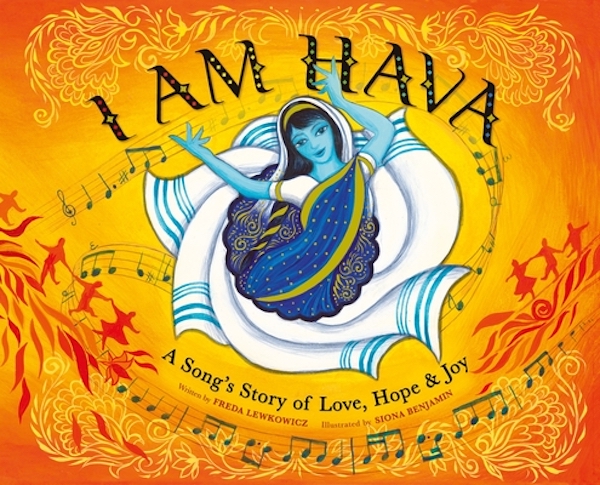
Among Intergalactic Afikoman’s newest picture books is I Am Hava: A Song’s Story of Love, Hope & Joy, written by Freda Lekowicz and illustrated by Siona Benjamin. It tells the story of the song “Hava Nagila,” from its birth as a niggun (melody without words) in Ukraine, to Jerusalem, to when it received its name and lyrics (though exactly from whom is still a mystery), and its journey around the world to popularity well beyond the Jewish community.

Hava Nagila means “Come and Rejoice,” explains the book, and this story – told by the song herself, personified as a blue-skinned Indian-Jewish girl in a sari – is full of movement and colour. It boldly celebrates the diversity of the Jewish people and our culture.

“For me, Hava’s story is a story of universality and multiculturalism,” Benjamin, who grew up as a Bene Israel Jew in India, writes at the end of the book. “Universality is always born from the specifics. The specifics for me are my Jewishness, my Indianness and my Americanness.

“Many blue-skinned characters populate my paintings,” she continues. “Hava is blue because blue is the colour of the sky and the ocean. Blue is the colour of the globe. Blue is also such a Jewish colour. It’s in the tallit. It’s in the tzitzit. It’s in the Israeli flag.”

Montreal-born Lekowicz also connects personally with the story. She shares that her parents, after the Holocaust, were in a displaced persons camp in Germany. “Like other Holocaust survivors,” she writes, “they were broken and in mourning. Yet the joyful sounds of Hava Nagila sometimes echoed in the camp. ‘Let us celebrate,’ it urged. The song symbolized hope and resilience.”

This lovely and imaginative book does joyous justice to this well-known song.

Beautiful Persian cookbook

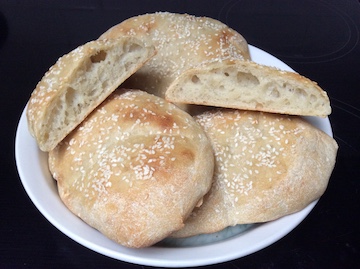
While my Barbari bread (above) looked nothing like the photo from the book (below), as my dough was too wet to allow for the requisite creation of vertical ridges, it tasted really good nonetheless. (photo by Cynthia Ramsay)

I was very excited to try out Persian Delicacies: Jewish Foods for Special Occasions by Angela Cohan. Living on the North Shore, I have met several people whose heritage is Iranian, though not Jewish, and I’ve eaten Persian food, but never made it. The idea that I could make my own “delicacies” was enticing.

Cohan is a Los Angeles-based writer and editor, so it’s no wonder that her cookbook reads well and looks fabulous. The layout is pretty and logical. The colour photos are beautiful. This is a great gift for a seasoned cook, or a cook that’s willing to have a few misadventures and so-so meals before they get the hang of things.

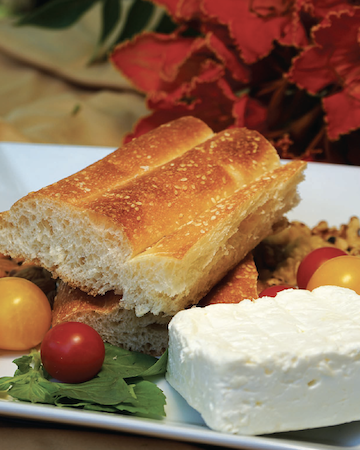
photo - Barbara bread as it’s supposed to look
Barbara bread as it’s supposed to look. (photo from Persian Delicacies)

In the preface, Cohan, who moved to the United States with her family in 1979, writes, “I was inspired to compile the specialty recipes of my mother, my late grandmothers, and other family members and friends in this cookbook. This book is as much theirs as it is mine. It is a tribute to my heritage as a Persian woman as well as an evolution of recipes since living and cooking in the United States for the past three decades.”

I remember watching my grandmother cooking. She seemed to randomly toss in this, shake in that. It appeared to the uneducated eye that measurements were not measured at all. I get the feeling that this is somewhat the case with this cookbook. Guesstimates in many cases rather than meticulously precise cups, teaspoons, etc. And the assumption that one knows how long to knead dough, for example.

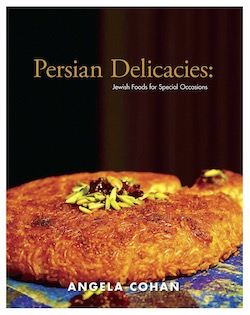
image - Persian Delicacies book coverThe recipes I tried – dolmeh (stuffed peppers), Barbari bread and sesame brittle – seemed easy enough. I chose them because I was on a deadline and had all the ingredients at hand. I will continue to explore this cookbook, as my first foray was promising but not that successful, in part because, instead of adapting the measures, I decided to follow the instructions come what may. So, even though I knew that my pepper stuffing was too bland, my dough was too sticky and my brittle too bendy, I made them as per the recipes. Everything was edible but nothing was delicious. Next time, I will use, respectively, another pinch of salt or another clove of garlic, more flour (or less water) and less honey. I can’t wait to try my hand at making kuku seeb zamini(potato frittata), tahdig (crispy rice), turmeric chicken, lavash bread and more.

Each recipe in Persian Delicacies comes with a brief description, either of what it is, from where or whom it came, and other useful tidbits. At the end of the book, there is some information on special occasions, with the examples of Norouz, the start of the Persian New Year, and Shabbat, and traditions associated with them, in particular as they relate to foods. A glossary of many of the ingredients and their health benefits is an interesting component.

DOLMEH
(serves 3)

3 or 4 bell peppers
1/4 cup olive oil
1 cup diced yellow onion
1/2 cup scallions, chopped
2 cloves garlic, peeled and finely chopped or minced
1 cup quinoa, cooked
1/2 cup fresh dill, finely chopped
1/2 cup fresh tarragon or parsley, finely chopped
1 tsp ground cinnamon (optional)
salt and pepper to taste

  1. Preheat the oven to 350°F.
  2. Cut the top of the bell peppers and remove the seeds and veins.
  3. Heat the oil in a skillet or a saucepan. Add the onions, scallions, and garlic and cook until soft, about four minutes.
  4. Add the quinoa, dill and tarragon and season with salt and pepper. Remove from heat.
  5. Spoon the quinoa mixture into the peppers. Place the stuffed peppers on a baking tray or baking dish and bake for 45 minutes. Add salt and pepper to taste. Top with chopped parsley and cinnamon (optional).

BARBARI BREAD
(serves 4)

1 1/2 cups warm water
1/2 tsp active dry yeast
3 cups all-purpose flour plus 1 tbsp additional flour
1 tsp salt
3 tbsp water
1/4 cup sesame seeds

  1. Add the yeast to the warm water, stir, and set aside.
  2. In a large bowl, combine the flour and salt. Add the yeast mixture. Knead the dough on a flat surface.
  3. Place the dough in a bowl and cover with plastic wrap. Let it rise for an hour.
  4. Preheat the oven to 325°F.
  5. In a small saucepan, stir one tablespoon flour and three tablespoons water over a medium-low heat.
  6. Uncover the risen dough, cut into four pieces, and roll out in an oval shape using a rolling pin.
  7. Place the dough on a cookie sheet. Using your finger or a small knife, create vertical ridges on the dough. Brush with the flour and water mixture. Sprinkle with sesame seeds.
  8. Bake for 25 to 30 minutes.

Savoury, sweet and simple

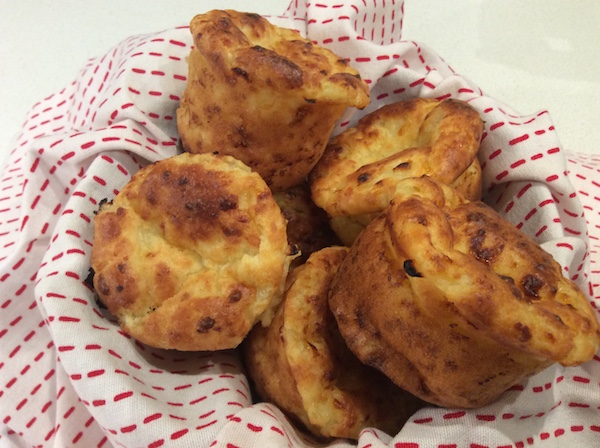
Cottage cheese muffins à la Accidental Balabusta, but double the size. (photo by Cynthia Ramsay)

Looking for a couple of easy recipes to add to your repertoire? But you’re not quite sure what to try? Because sometimes you want savoury. Sometimes you want sweet. But what if you want both? I’ve got just the answer – but it doesn’t come in the form of one recipe. It comes in two. One’s a side dish and one’s a snack or breakfast food. Both punch above their weight, that’s for sure.

With very few exceptions I have neither the focus nor the patience to embark on complicated recipes that call for exotic ingredients and specialty cookware. If I can’t pronounce it and it’s not available at my local Safeway or Superstore, it ain’t happening. (Except for those lamb shanks that I made for Rosh Hashanah, which did call for loads of ingredients and which were, to use my hubby’s words: “The best lamb I’ve ever eaten!” Sorry … I just had a modesty bypass.)

Maybe I’m not the most adventurous eater/cook in the world but I never go hungry. My father, alav hashalom, used to say that I’d eat out of a puddle if push came to shove. I prefer to describe it as having simple tastes.

Good thing my husband didn’t marry me for my cooking. Although it has improved significantly since we got married 12 years ago. When we first met, my idea of dinner was a California roll and Agedashi tofu takeout. We used to eat out at restaurants maybe three or four times a week during the honeymoon phase, i.e. the first four years of our marriage. I kept telling him I knew how to cook; I just chose not to activate that skill. And what do you know. He believed me.

But I digress. Back to the savoury recipe I was going to tell you about. It’s an eggplant side dish or chunky dip and is a perfect accompaniment to just about any meal, be it meat, chicken, vegetarian or fish. It’s a bit time-consuming, but what eggplant recipe isn’t, with all that peeling, slicing and dicing? I’m not a big fan of spicy food so you can up the garlic content as you see fit. I find it’s got just that right combination of salty, spicy, sweet and tart, without being heavy or overpowering. I call it Merle’s Eggplant, after my sister’s friend who gave us the recipe decades ago. Thank you, Merle.

MERLE’S EGGPLANT

1 diced onion
1 large or 2 medium-size eggplants, peeled and cubed
2-3 cloves garlic, minced
14 oz (398 ml) can tomato sauce
a squeeze or two of lemon juice
1-2 tbsp brown sugar

  1. Peel and cube eggplant and set aside.
  2. Fry diced onion in olive oil until lightly browned.
  3. Add eggplant to onions and fry, alternating covered and uncovered, until eggplant is opaque.
  4. Add minced garlic, tomato sauce, lemon juice and brown sugar. Cook on low heat for about one hour, covered.
  5. Refrigerate then serve. Some people like to serve it hot, but I prefer it cold, because I find that the flavours meld even more when it’s been refrigerated. But that’s your call. Try it both ways.

* * *

As for the sweet recipe – cottage cheese muffins – well, it’s a favourite in our home. It’s one of those comfort foods that soothe just about any ailment, from fatigue to sore feet. Aside from being healthy (think protein), they’re filling and super-fast to make, plus it’s one of those recipes that you can make blindfolded with both hands tied behind your back. Eat them hot, eat them cold, eat them with jam, eat them plain.

The only people that won’t like these muffins are the lactose-intolerant. And that can be remedied. I recently found lactose-free cottage cheese at the local supermarket. It’s slightly more expensive, but worth it if you like dairy but not the side effects that can go with it. Knock yourself out with these fluffy, light, healthy muffins. I’ve seen all sorts of variations on this recipe, using cheddar cheese, whole wheat flour, sour cream, etc., but none of them quite matches the simplicity and yumminess of this one.

I would strongly suggest doubling the recipe, since this recipe only makes 12 small muffins. Or just eat several at one go, and explain to shocked onlookers that they’re mini-muffins. Which they’re not, but, never mind. Just look at it as muffin-envy.

COTTAGE CHEESE MUFFINS

1 1/2 cups cottage cheese
2 tbsp sugar
1/2 cup melted butter or margarine
2 tsp baking powder
2 eggs
a pinch of salt
1 cup flour

  1. Preheat oven to 400°F.
  2. Mix all ingredients by hand. Don’t be surprised if the batter is quite thick.
  3. Grease muffin tins or use paper muffin liners. Distribute batter evenly between the 12 muffin cups.
  4. Bake for about 20 minutes or until golden brown on top. They’re ready when a toothpick inserted in the centre comes out clean.
  5. Eat plain or topped with yogurt, sour cream, berries, jam or whatever. They reheat well in the microwave. But, if there are more than two people living in your home, the muffins probably won’t make it till the next day. They may sound too good and too easy to be true, but I’m here to tell you, they’re the real deal. Sometimes, the most basic recipes are the star of the show. Or at least the crowd-pleasers.

* * *

It’s not the number of ingredients or the sophistication of technique that make a recipe sing. It’s the flavour, plain and simple. So, do yourself a favour and try out these two recipes. Tell them the Accidental Balabusta sent you.

Shelley Civkin aka the Accidental Balabusta is a happily retired librarian and communications officer. For 17 years, she wrote a weekly book review column for the Richmond Review. She’s currently a freelance writer and volunteer.

Brisket – a Jewish  tradition!

Brisket is the boneless meat on the lower chest of beef or veal. In traditional Jewish cooking, it is most often braised as a pot roast, especially as a holiday main course. For reasons of economics and kashrut, it was historically one of the more popular cuts of beef among Ashkenazi Jews.

Brisket is also the most popular cut for corned beef, which can be further spiced and smoked to make pastrami. In the 1900s, it appeared on Jewish deli menus, particularly in Texas, where the butchers, who emigrated from Germany and Czechoslovakia, had trouble selling the slow-cooking cut and created a way to dry smoke it and preserve it.

Brisket is one of the primal cuts of beef, though the precise definition of the cut differs internationally. The brisket muscles include the superficial and deep pectorals. As cattle do not have collarbones, these muscles support about 60% of the body weight of standing or moving cattle. This requires a significant amount of connective tissue, so the resulting meat must be cooked correctly to tenderize it.

The term brisket is derived from the Middle English brusket, which comes from the earlier Old Norse brjósk, meaning cartilage. The cut overlies the sternum, ribs and connecting cartilages.

Author and food writer Stephanie Pierson wrote an homage to this cut of beef: The Brisket Book:  Love Story with Recipes was published in 2011.

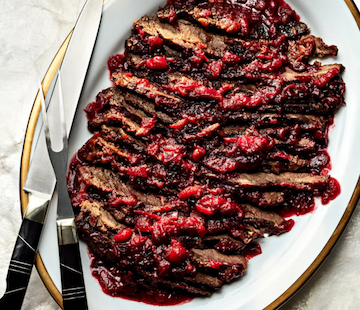
CRANBERRY-ONION CHANUKAH BRISKET
(This is Justin Chapple’s recipe from Food & Wine. It makes 8-10 servings.)

photo - Justin Chapple’s Cranberry-Onion Chanukah Brisket
Justin Chapple’s Cranberry-Onion Chanukah Brisket. (photo by Justin Walker)

8 cups fresh or thawed frozen cranberries
1 1/2 cups sugar
1 1/2-inch lemon peel strip
3 tbsp fresh lemon juice
salt and pepper to taste
2 1-ounce envelopes kosher pareve onion soup mix
1 7-pound trimmed beef brisket

The day before serving:

  1. Preheat oven to 325°F. Layer two sheets foil in a large roasting pan, letting foil hang over eight inches past each end. Repeat with two additional sheets of foil to form an X. Top with a sheet of parchment paper.
  2. In a saucepan, combine cranberries, sugar, lemon peel strip and lemon juice. Cook, crushing cranberries with a wooden spoon until mixture thickens, 10-14 minutes.
  3. Remove from heat and stir in onion soup mix. Let cool for 15 minutes.
  4. Spread a quarter of cranberry sauce on parchment. Place brisket fat side up. Spread remaining cranberry sauce over it, top with parchment and wrap foil around brisket. Place in oven for three to three-and-a-half hours. Uncover. Let cool one-and-a-half hours, then cover and refrigerate for at least eight hours.

The day of serving:

  1. Preheat oven to 325°F. Uncover brisket. Discard any fat. Scrape off cranberry sauce and place in a bowl.
  2. Slice brisket on carving board. Arrange in ovenproof dish. Spoon cranberry sauce over top, cover and bake 45 minutes to one hour.

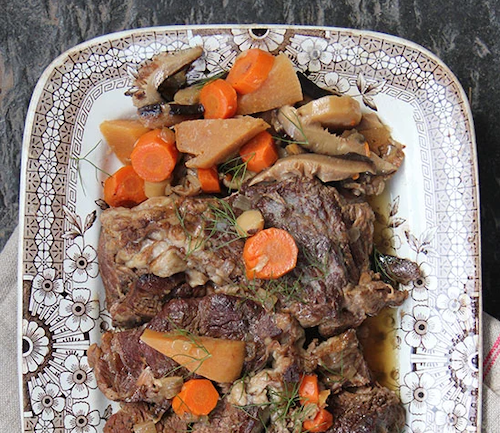
BEER-BRAISED BRISKET WITH ROOT VEGETABLES
(This recipe comes from Ian Knauer, former Gourmet Magazine editor, chef, food writer and owner of the Farm Cooking School. It makes 4-6 servings.)

photo - Ian Knauer’s Beer-Braised Brisket with Root Vegetables
Ian Knauer’s Beer-Braised Brisket with Root Vegetables. (photo by Ian Knauer)

1 2.5-to-3-pound brisket
2 tbsp olive oil
1 chopped medium onion
5 ounces sliced shiitake mushroom tops
3 finely chopped garlic cloves
3 large sliced carrots
3 sliced parsnips
1 rutabaga, peeled and cut into wedges
12 ounces beer of your choice
2 tbsp Worcestershire sauce
2 cups chicken stock
2 tbsp flour
1 tbsp dill

  1. Heat oil in a pot. Sear the brisket three to four minutes, turn, and continue searing another three to four minutes. Transfer to a plate.
  2. Stir onion, mushrooms and garlic into pot. Cook, stirring occasionally, for six minutes. Place brisket and juices back in pot.
  3. Stir in carrots, parsnips, rutabaga, beer, Worcestershire sauce and stock. Cover and simmer six hours, until meat is tender.
  4. In the meantime, stir flour and two tablespoons cold water in a bowl then whisk into the pot. Simmer until sauce thickens, about 10 minutes. Place on plate, sprinkle with dill and slice.

Sybil Kaplan is a journalist, editor of nine kosher cookbooks (working on a 10th) and a food writer living in Jerusalem. She leads English-language Shuk Walks in Machane Yehuda.

Minestrone warms the soul

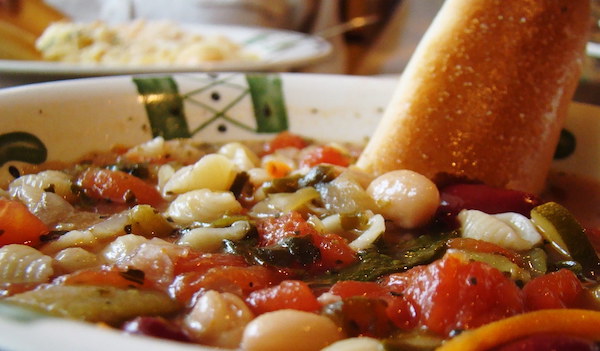
(photo from flickr.com/photos/veganfeast)

Minestrone came about as early as the second century BCE, when Rome conquered Italy and new vegetables flooded the market. It was known as an Italian peasant’s dish or poor man’s soup. Originally, it contained onion, garlic, celery, tomatoes and carrots – pasta seems to have been a later addition.

MY MINESTRONE
(6-8 servings)

2 tbsp margarine
3/4 cup chopped onions
2 minced garlic cloves
1 chopped leek
1/4 cup chopped celery
1/2 cup chopped carrots
2 chopped turnips
1 1/2 cups chopped zucchini
1 1/2 cups chopped cabbage
1 cup chopped potatoes
2 tbsp beef soup bouillon
1 cup chickpeas
1 cup chopped tomatoes
8 cups water
2 tbsp tomato paste
salt and pepper to taste
2 tbsp chopped parsley
1/2 tsp basil
1/2 tsp oregano
1 chopped bay leaf
1/4 tsp marjoram
1/2 cup small pasta
Parmesan cheese (optional)

  1. In a large soup pot, heat margarine. Sauté onions, garlic and leek.
  2. Add vegetables, water and spices but not pasta. Bring to a boil, reduce heat and simmer one hour.
  3. Add pasta and cook 15 minutes. Ladle into soup bowls and add the cheese.

ROOT VEGETABLE MINESTRONE
(Adapted from a Food & Wine recipe, it makes 6 servings.)

1/4 cup olive oil
1 finely chopped onion
1 minced garlic clove
1 sprig rosemary
2 sliced carrots
2 sliced parsnips
3 broccoli stems or chopped kohlrabi
3 cups cubed peeled, cut butternut squash
6 cups pareve chicken bouillon
salt and pepper to taste
1/2 cup angel hair pasta broken into 1-inch pieces
1/2 cup grated cheese

  1. In a soup pot, heat two tablespoons olive oil. Add onion, garlic and rosemary and cook until onion is soft.
  2. Add carrots, parsnips, broccoli or kohlrabi and squash and cook for one minute. Add bouillon, salt and pepper and cook about 15 minutes.
  3. In a frying pan, heat the remaining two tablespoons olive oil. Add pasta and cook, stirring frequently, about four minutes.
  4. Add pasta to soup. Cook until tender, five to six minutes. Discard rosemary. Stir cheese into soup and serve.

Sybil Kaplan is a journalist, editor of nine kosher cookbooks (working on a 10th) and a food writer living in Jerusalem. She leads English-language Shuk Walks in Machane Yehuda.

Pumpkin, but not pies

Pumpkin spice snickerdoodles (photo by Greg Dupree, food styling Torie Cox, prop styling Christine Keel / Food & Wine)

November arrives and I think pumpkin. Here in Israel, the d’la’at is amazing. Whole, they are huge in size and weight, cream in colour, with stripes all around.

Pumpkins are a variety of winter squash that belongs to the Cucurbitaceae (or cucurbits) family. Melon, watermelon and cucumber also fall into this category. Technically, pumpkins are fruit but, since they are often eaten in savoury dishes, many people refer to them as vegetables. Just about every part of the pumpkin is edible, including the seeds, their shell, leaves and flowers. Pumpkins are a superfood and are high in iron, packed with vitamins and minerals, and considered natural antioxidants.

But, enough about that and on to some recipes. Forget pie, though, and try these treats for your holiday guests.

The first dessert is pumpkin spice snickerdoodles. I was unfamiliar with snickerdoodles until coming across this recipe by Kelly Fields. Probably German in origin, the name of these sugar cookies could be a corruption of the German word schneckennudel, but notice the word schnecken, popular in Jewish cooking. American cookbook author Joan Nathan tells us: “Schnecken – the word means snail in German – are made of a rich and sweet yeast dough enriched with egg, sour cream and butter. The dough is pressed out in a large rectangle shape, sprinkled with sugar, cinnamon, raisins and ground nuts, and rolled up like a jelly roll. Cut on the cross section, the roll is sliced, baked and served open-side up in small coiled rounds.” Here is my version made pareve with slight changes.

PUMPKIN SPICE SNICKERDOODLES
(Adapted from Food & Wine. Makes 20 cookies.)

1 3/4 cups sugar
2 tbsp cinnamon
1 1/2 tsp cardamom
1/2 tsp nutmeg
1/2 tsp cloves
2 3/4 cups flour
2 tsp cream of tartar
1 tsp baking soda
1 cup unsalted butter or pareve margarine
2 large eggs
1 1/2 tsp orange blossom water or 3/4 tsp orange extract
1 tsp vanilla

  1. Preheat oven to 350°F and line three baking sheets with parchment paper.
  2. In a bowl, stir together 1/4 cup sugar, cinnamon, cardamom, nutmeg and cloves.
  3. In another bowl, stir together flour, cream of tartar and baking soda.
  4. Beat margarine and 1 1/2 cups sugar until light and fluffy (four minutes). Add eggs one at a time, then orange extract and vanilla. Add flour in two additions.
  5. Shape dough into 20 balls. Roll balls in spice mixture until coated. Arrange on baking sheets. Bake for six to seven minutes, then switch pans onto different racks, and continue baking 10 minutes. Let cool.

BAKED PUMPKIN WEDGES

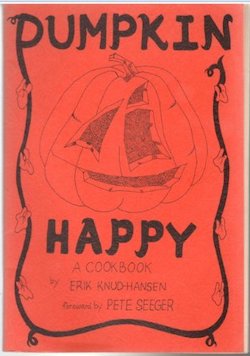
image - Pumpkin Happy book cover
Published in 1976, Pumpkin Happy recipes are still happy-making.

(While I found this recipe in a newspaper some 40 years ago, it comes from the 1976 cookbook Pumpkin Happy, written by Erik Knud-Hansen and illustrated by Andrea Grumbine. It makes 6 servings.)

1 4-pound pumpkin, cut into wedges, strings and seeds scraped out
1/2 to 3/4 cup pareve margarine
1/4 cup brown sugar or honey
1 tsp cinnamon

  1. Preheat oven to 350°F. Oil a glass baking dish.
  2. Make shallow cuts in each wedge.
  3. Melt margarine in a saucepan. Add sugar and cinnamon. Brush over wedges.
  4. Bake for 35 to 45 minutes, until tender.

PUMPKIN BUTTER

(This butter is great on toast with cream cheese, according to Kelsey Youngman, writing on Food & Wine’s website. This recipe makes 2 1/2 cups.)

1 3-pound pumpkin, stemmed, halved lengthwise and seeded
1 tbsp vegetable oil
1/4 cup apple cider
1/2 cup brown sugar
3 tbsp honey
1 tsp apple cider vinegar
3/4 tsp cinnamon
1/2 tsp ginger
1/4 tsp nutmeg
a pinch of cloves

  1. Preheat oven to 350°F and line a baking sheet with parchment paper.
  2. Brush cut sides of pumpkin halves with oil. Arrange cut side down and bake 50 minutes, or until tender.
  3. Scoop flesh into food processor. Discard shell. Add apple cider, process one minute. Add brown sugar, honey, apple cider vinegar, cinnamon, ginger, nutmeg and cloves. Process 20 seconds. Transfer to a saucepan.
  4. Bring to a simmer, stirring occasionally. Reduce heat and cook until mixture is reduced by one-third and turns slightly darker in colour, about 25 minutes.
  5. Remove from heat, cool and spoon into jars with lids. Store in refrigerator.

Sybil Kaplan is a journalist, editor of nine kosher cookbooks (working on a 10th) and a food writer living in Jerusalem. She leads English-language Shuk Walks in Machane Yehuda.