Food in story and song

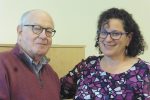
Ken Levitt, JSA president, with Debby Fenson, who was one of the singers at the event. (photo by Binny Goldman)

On Nov. 25, Jewish Seniors Alliance’s first Empowerment Series in partnership with the Jewish Museum and Archives of British Columbia was held at the Peretz Centre for Secular Jewish Culture.

Gyda Chud, JSA vice-president and Peretz president, and Ken Levitt, president of JSA, welcomed the 65 people gathered, with Levitt thanking Chud and citing her as an example of koach, strength, in all she did.

The theme of this year’s series is Food: The Doorway to Our Culture, so the partnership with the JMABC was a natural fit, as its theme for the year is “Feeding the Community,” said Michael Schwartz, coordinator of programs and development of the JMABC, who briefly described how the museum functions and the extent of its collection.

As for its theme, Schwartz said the JMABC has created a new podcast, called Kitchen Stories. Episodes include stories about Sephardi Jews adapting to the culture of a different land, and that of a blended family from Ukraine and Rhodes. Schwartz highlighted the story of a family in Haida Gwaii, where, he explained, contact is usually made through an event; a shared feast celebrating the catching of fish, for example, the preparing of the meal and then the partaking of it, all instrumental to the success of the project itself.

Often a dilemma is faced when adapting to a new food culture and discarding the former, said Schwartz. Questions often arise, Which self am I? Does this diminish my former self? Food represents identity, acceptability and relationships, he explained, adding that a new JMABC venture planned for the coming year is a supper club at the Peretz Centre, where each get-together will focus on a different cultural theme: Persian, Israeli and Mexican.

Shanie Levin, a vice-president of JSA, then shared stories of food with those gathered. Formerly involved in amateur theatre and more recently in Yiddish reading groups at the Isaac Waldman Jewish Public Library, Levin said she collected stories from several different perspectives. The first she read was an excerpt from Rhapsody in Schmaltz by Michael Wex, in which he lists the various blessings to be said before and after consuming foods. In the passage, Wex also notes the problem of dealing with a spoonful of milk that falls into the chicken soup. Does it render the whole soup non-kosher? Or just the pot? What if the family is poor and there is nothing else to eat? Referring to Wex’s book, Levin discussed how Ashkenazi Jews have remained close to their customs of origin while Sephardi Jews more often have adapted their food preparation according to the country in which they found themselves.

A crowd favorite was The Chicken Tale by Rabbi Daniel T. Grossman, which had everyone laughing, hearing about the rabbi who, traveling with a group of Jewish choir singers, finds himself in a town that knows nothing about the customs of Jews. Hoping to impress him, his hostess does some research at the local library. When she meets the rabbi, she informs him that she knows rabbis kill chickens, therefore, there is a chicken in the yard and the townspeople are waiting to witness the kill. However, the horrified rabbi says that he is not that kind of rabbi, but a praying and teaching rabbi. So, that night, they all eat fish.

Another story, A Town Called Roosevelt by Moishe Nadir, illustrated that a preconceived notion can be changed gradually with each course of a delicious meal.

A personal favorite was Challahs in the Ark by Rabbi Zalman Schachter-Shalomi, written about the time the Jews were expelled from Spain, eventually to relocate to Tzfat. The shul caretaker was desperate to know if he had found favor in God’s eyes. Knowing his wife was an expert challah baker, he asked her to bake 12 loaves, which he then placed in the Torah ark, thinking that, if they were gone in the morning, then he would know God had accepted his offering. In the meantime, the shamash, who had not been paid for many weeks and had a hungry family, was pleading with God to show him a sign that his prayers were being heard. Imagine his joy upon discovering the loaves of bread at the ark, which he thought to be a definite sign. This joy was echoed by the caretaker the next morning. Seeing the challahs were gone, he felt God had accepted them.
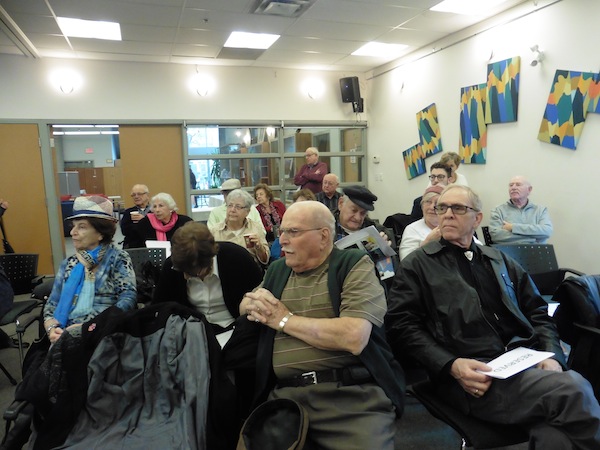
photo - Serge Haber, Jewish Seniors Alliance emeritus president and JSA founder, left, and Larry Shapiro, second vice-president and executive board member of JSA, sit in the front row of JSA’s first Empowerment session of the year’s series
Serge Haber, Jewish Seniors Alliance emeritus president and JSA founder, left, and Larry Shapiro, second vice-president and executive board member of JSA, sit in the front row of JSA’s first Empowerment session of the year’s series. (photo by Binny Goldman)

The audience was reluctant to let Levin stop, so she read one more story, a short version of Sholem Aleichem’s Chanukah Gelt. Her delivery held listeners’ rapt; they could envision the action, as each story enfolded.

A musical program followed, featuring Debby Fenson, Deborah Stern Silver and accompanist Elliot Dainow. Fenson is ba’alat tefilah (Torah reader) at Congregation Beth Israel, where she teaches b’nai mitzvah students; Stern Silver is a trained soprano who sings with Fenson at Beth Israel; and Dainow is musical director of the Unitarian Church, as well as being an accompanist for soloists and various ensembles, including the Vancouver Jewish Folk Choir, which calls the Peretz Centre home.

Introducing their program, Stern Silver said the songs being presented were of Ashkenazi sources. They included “Tayere Malkeh,” a Yiddish drinking song, performed with a drinking cup and an empty bottle of wine, and a song about having to eat potatoes every day, which had the audience eagerly joining in with the chorus of bulbes (potatoes). The third song transported everyone to the Israeli marketplace, “Shuk HaCarmel,” and “Rozhinkes mit Mandlen” (“Raisins and Almonds”), a lullaby sung to children, brought tears of recognition and nostalgia.

Several instruments were handed out and those in the audience became participants in the performance of “The Latke Song” by Debbie Friedman. For the final song, “Finjan,” the audience enthusiastically clapped along.

It is impossible to capture the warm feeling of shared chavershaft (camaraderie) prevailing in the room; a fargenign, a pleasure.

In addition to Chud, who was the convenor, the event was made possible with the help of JSA staff, and Karon and Stan Shear filmed it for JSA’s website. Here’s to continuing the singing of our songs and sharing our stories m’dor l’dor, from generation to generation, af eybik, forever.

Binny Goldman is a member of the Jewish Seniors Alliance of Greater Vancouver board.
Biofeedback can help

Janette Sperber (photo by Olga Livshin)

Three decades ago, Janette Sperber experienced the benefits of biofeedback personally. “At the time, I lived in San Francisco and worked in social services with abused children,” she recalled in an interview with the Independent. “I had severe asthma, went to the emergency in a hospital at least twice a year with my asthma attacks. In 1987, I became a research subject. One of the pioneers in biofeedback in America conducted a study in the new protocols for treating asthma, and I jumped at the opportunity. The program lasted for 13 weeks and it revolutionized my life.”

Since then, Sperber has never gone to emergency again. Although her asthma didn’t disappear, the program helped her manage her condition. It taught her the right breathing regimen, stress management and relaxation techniques. “Even my personality improved,” she said with a smile, “at least according to my friends. Maybe because the fear of asthma, of struggling for breath, was gone. My general way of relating to life changed. I felt more secure, more confident. Biofeedback led me from being a victim of asthma to being in control of my life. It empowered me.”

She became a huge proponent of biofeedback techniques. Whenever her coworkers complained of headaches or chronic pains, she taught them what she had learned in the program, and it helped them, too. After awhile, she started thinking of doing it professionally.

“I went for special training, took some additional classes and passed the licence exam in 1989,” she said. After a few years of working in physiotherapy clinics, she started her own biofeedback practice in San Francisco. Four years ago, she moved to Vancouver.

According to Sperber, biofeedback is a learning process, not a treatment. She teaches her clients how to manage certain physical and psychological conditions, including panic and anxiety disorders, recurring headaches, asthma, muscle-based dysfunctions and many others.

“It’s very gratifying to a counselor,” she said, “because biofeedback is a short-term process. People come to me with a complaint. I identify the problem and teach them how to deal with it, how they could help themselves. If they do their homework and practise, we both see positive results in a short time.”

One of the common problems with which she has helped her patients is chronic pain, including headaches and even cancer-related pains. “I don’t treat cancer,” she stressed, “but I can help people with the pain. When something hurts, we always want the pain to go away. We tighten our muscles to fight the pain, to resist it, but the tension often leads to the opposite results: the pain worsens. It triggers the alarm bells in our brains, and the stress level goes up, exacerbating the pain further. We need to relax instead.”

In addition to relaxation techniques, Sperber teaches her clients the right approach to breathing, which could also reduce anxiety and even prevent panic attacks. “With the optimal respiration patterns, my clients can catch a panic attack before it is fully developed, ‘nip it in the bud,’” she said.

The first stage of any treatment is to identify the source. For that, Sperber uses special sensors similar to the ones used in electrocardiogram testing. The test is painless. She applies electrodes to different parts of a client’s body to find the problem area and then teaches the client how to reduce the tension in that group of muscles. She also tests breathing and heartbeats before recommending certain techniques.

“Not everything works for everyone,” she warned, “but I try different techniques with each client to find what works best for them. The more open-minded my clients are, the better I can help them. They need to practise what I teach to get the best outcome. Those who don’t want to practise are unwilling to help themselves.”

Some of her more difficult patients include a perhaps unexpected group. “Women who are too nice are sometimes the hardest to help,” she said. “They go to their doctors with pain complaints, and the doctors recommend medications and suggest restrictions of what they should and shouldn’t do. Some doctors also recommend them to me or other biofeedback specialists. But, because these women – and it is usually women, not men – are too nice, they can’t say no. Someone asks them to do something extra at work or at home and they do it, even though it aggravates their conditions. They should learn to say no, to take better care of themselves.”

Another problem Sperber encountered recently is the gradual proliferation of fake biofeedback providers. “Biofeedback is growing in popularity,” she said. “More and more doctors recommend their patients to find a biofeedback specialist, but I’m only aware of a few other licensed biofeedback professionals besides myself in Vancouver. Lots of scams though. If you want to consult a biofeedback counselor, check the website of Biofeedback Certification International Alliance – bcia.org – for the certified practitioners in your area.”

Sperber loves what she does. “It’s wonderful to be able to help people improve the quality of their lives,” she said.

Sperber’s website is theempoweredlife.ca.

Olga Livshin is a Vancouver freelance writer. She can be reached at olgagodim@gmail.com.

A celebration needs dessert

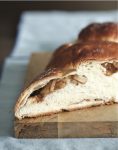
Rosie Daykin’s apple-stuffed challah.

Ten years ago, Rosie Daykin opened Butter Bakery and Café in Vancouver. Five years ago, it moved to its current location on Mackenzie Street and began offering breakfast and lunch, in addition to baked goods. The bakery has grown to have its products distributed and sold in more than 300 grocery stores and high-end retailers, including Whole Foods, Dean and Deluca and Crate and Barrel.

book cover - Butter Celebrates!Daykin published her first cookbook in 2013, Butter Baked Goods: Nostalgic Recipes from a Little Neighborhood Bakery, and her second in 2015, Butter Celebrates! A Year of Sweet Recipes to Share with Family and Friends, both via Appetite by Random House. Just last month, the U.S. edition came out from Knopf, with the subtitle “Delicious Recipes for Special Occasions,” and this reviewer received a copy.
After the essays “Essential Elements and Entertaining,” “Buts and Bobs for Successful Baking” and “Some Gentle Reminders,” the book jumps into the holidays – there are 117 recipes and 185 photographs.

There are recipes for almost every occasion. The book is divided into Valentine’s Day, St. Patrick’s Day, Easter, Mother’s Day, Butter Babies, Welcome Wagon, Butter Creams and Frostings, Summer Celebrations, Zelda’s Birthday Party, Halloween, Thanksgiving, Chanukah, Christmas and Happy New Year. A final essay is on packaging your goodies.

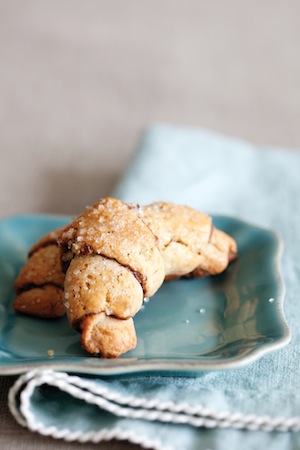
This is not a Jewish cookbook, however, there are new and creative holiday recipes and the offerings for Chanukah are sufganiyot, apple-stuffed challah and chocolate hazelnut rugelach.

As Daykin writes, “What kind of celebration could it be without baked goods?” With that said, here are two of her three Chanukah recipes. If you’re not feeling up to baking, you can always pick up something at the bakery, of course – and they also sell a variety of gift boxes that would bring a smile to many a face. Butter Bakery and Café is located at 4907 Mackenzie St., and is open Monday through Saturday, 8 a.m. to 5:30 p.m., and Sunday, 9 a.m. to 5 p.m.

photo - Rosie Daykin’s chocolate hazelnut rugelach
Rosie Daykin’s chocolate hazelnut rugelach.

CHOCOLATE HAZELNUT RUGELACH

“Traditional rugelach is filled with jam, fruit and nuts, but chocolate and hazelnut seemed just a smidge more celebratory to me,” writes Daykin. “It also provided me with another excuse to spread Nutella on something. These little crescent-shaped cookies fall under the more-ish category of baking. You eat one and you have to have more.”

1 1/2 cups pastry flour
1⁄2 tsp baking soda
1⁄2 tsp salt
1⁄2 cup cream cheese, full fat
1⁄2 cup butter, room temperature
1⁄2 cup granulated sugar
1 cup Nutella
1⁄2 cup hazelnuts

Finishing touches:
1 large egg
1 tbsp water
Course sanding sugar

Makes: two dozen cookies.

You will need: two (11-by-17-inch) rimmed cookie sheets lined with parchment paper.

Storage: these cookies will keep in an airtight container for up to one week or in the freezer for up to three months.

  1. On a large piece of parchment paper, sift the flour, baking soda and salt. Set aside.
  2. In a stand mixer fitted with a paddle attachment, cream the cream cheese and butter on high speed until well blended. Scrape down the sides of the bowl. Add the sugar and continue to beat until light and fluffy. Scrape down the sides of the bowl.
  3. Turn the mixer speed to low and slowly add the dry ingredients. Continue to beat until well combined.
  4. Divide the dough in two. Wrap each piece in plastic wrap and chill in the refrigerator for at least two hours.
  5. Preheat the oven to 350°F.
  6. Place the Nutella in a small bowl and use a spoon to give it a good stir to help loosen it up. This will make it easier to spread across the tender dough.
  7. Use a large chef’s knife to chop the hazelnuts. Set aside.
  8. Place a chilled piece of dough on a lightly floured work surface and use a rolling pin to roll it into a circle about nine inches in diameter.
  9. Use a small offset spatula to carefully spread the Nutella across the dough. The dough is very tender, so work carefully to avoid it tearing it. If it does tear, not to worry, just press it back together.
  10. Sprinkle half of the chopped hazelnuts over the top of the Nutella.
  11. Use the large chef’s knife to cut the dough into quarters and then each quarter into thirds, just like if you were cutting a pie.
  12. Start at the wide end of a piece of dough and roll it toward the point. Bend the two ends in slightly to create a crescent shape and then place it on a prepared tray.
  13. Repeat with the balance of the dough.
  14. Combine the egg and water in a small bowl and whisk them together. Use your pastry brush to lightly coat the top and sides of each cookie. Sprinkle generously with the sanding sugar.
  15. Bake for approximately 15 minutes, or until the cookies have puffed up and are a lovely golden brown. Remove the cookies from the oven and transfer them to wire racks to cool.

APPLE-STUFFED CHALLAH

“I wondered what would happen if I melded the idea of a butter cinnamon bun and challah loaf. Oh, believe me, people … good things happened. This bread is wonderful warm from the oven or lightly toasted with butter, but in French toast it has found its true calling. So, you might want to say ‘hola’ to this challah all the time.”

1 package instant yeast
1⁄4 cup warm water
4 cups all-purpose flour
1⁄4 cup granulated sugar
2 tbsp butter
1 tsp salt
2 tbsp liquid honey
2 large eggs
2 egg yolks
2 tbsp vegetable oil
3⁄4 cup water

Apple stuffing:
2 apples, peeled, cored and cut into 1⁄2-inch cubes (something tart, like a Granny Smith, works well)
2 tbsp dark brown sugar
1 tbsp liquid honey
1 tsp ground cinnamon

Finishing touches:
1 large egg
2 tbsp water
Coarse sanding sugar

Makes: one loaf, eight to 10 slices.

You will need: one (11-by-17-inch) rimmed cookie sheet lined with parchment paper.

Storage: this challah can be kept well wrapped or in an airtight container for several days, especially because you can toast it.

  1. For the challah, in a small bowl, sprinkle the yeast into the warm water. Set aside to bloom.
  2. In a stand mixer fitted with a paddle attachment, combine the flour, sugar, butter and salt on medium speed. Continue to beat until the butter has been distributed throughout the flour.
  3. In a liquid measuring cup, whisk together the honey, eggs, egg yolks, oil and water. Turn the mixer speed to low and add the liquid ingredients to the dry ingredients. Add the yeast with its water and continue beating until well combined.
  4. Stop the mixer and change the paddle attachment to a dough hook.
  5. Turn the mixer speed to high and let the dough hook knead the dough for at least five minutes, until it is shiny, smooth and elastic.
  6. Place the dough in a lightly oiled bowl and cover loosely with plastic wrap. Place the bowl in a warm, draft-free spot and allow the dough to rise until it has doubled in size, about 90 minutes.
  7. Meanwhile, prepare the apple stuffing. In a medium bowl, combine the chopped apple, brown sugar, honey and cinnamon. Use a wooden spoon to stir and coat all the apples. Set aside.
  8. Once the dough has fully risen, remove the plastic wrap and punch down the dough to release the air produced by the yeast. Turn the dough out onto a lightly floured work surface and allow it to rest for about 10 minutes.
  9. Use a knife to divide the dough into three equal pieces. Use your rolling pin to roll each piece into a rectangle approximately 14 inches long and six inches wide. Place one-third of the apple filling down the centre of a piece of dough. Pull one side of the dough over the filling and pinch to seal it closed on the other side and at the top and bottom. This will create a filled log of dough. Repeat with the other two pieces of dough.
  10. Lay one of the logs vertically along the centre of the prepared cookie sheet. Lay a second log across the middle of it, with the ends of the log pointing at 10 o’clock and four o’clock. Then lay the third log across the middle on top, with the ends pointing at two o’clock and eight o’clock. Braid one side of the loaf from the middle down and then tuck the ends under. Turn the cookie sheet and repeat with the other side.
  11. In a small bowl, combine the egg and water and use your pastry brush to generously coat the top and sides of the loaf with the egg wash. Sprinkle with the sanding sugar.
  12. Cover the loaf loosely with a sheet of plastic wrap and set in a warm, draft-free place to rise again until it has nearly doubled in size, about 90 minutes.
  13. Preheat the oven to 350°F.
  14. Bake the loaf for 30 to 40 minutes, or until it is a lovely golden brown and a wooden skewer inserted in the centre comes out clean.
  15. Remove from the oven and allow the loaf to cool for at least 20 minutes on the cookie sheet before transferring to a cutting board and slicing.

Sybil Kaplan is a journalist, foreign correspondent, lecturer, food writer and book reviewer who lives in Jerusalem. She also does the restaurant features for janglo.net and leads walks in English in Jerusalem’s market.

Exploring power of women

Expectations – our own and others’ – can motivate us or constrain us. Two recently published novels feature strong (Jewish) women who must fight for their independence, battling not only parental, societal and other judgments, but their own self-conceptions. One book takes readers to the wilds of Arizona more than a century ago, the other takes us to a contemporary world of privilege in Boston. Both are internal, as much as they are external, journeys, and both are journeys worth taking.

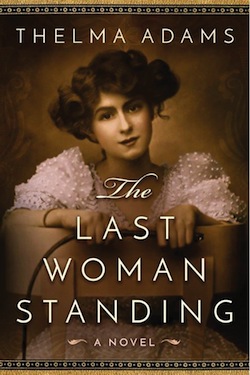
The Last Woman Standing: A Novel by Thelma Adams (Lake Union Publishing, 2016) is a fictional account of how Josephine Marcus met and fell in love with Wyatt Earp (and he with her). While the real-life Josephine apparently tried very hard to keep her and Wyatt’s private life private, Adams has mined what information exists and creatively filled in the blanks for the beginning, in 1880-1881, of their infamous romance.

Josephine defied all expectations when she ran away from home as a young teen in the 1870s and, though she returned, she didn’t do so for long. She left home again in 1880, at age 19, with a promise of marriage from Johnny Behan, a man she met on her first foray into the Wild West from the relative safety and security of San Francisco.

book cover - The Last Woman StandingThe daughter of Prussian Jewish immigrants who eked out a living on her father’s income as a baker, Josephine cannot bear to be contained by the strictures of society, her religion and her mother, whose story of coming to America is truly tragic. “I loved my mother but wouldn’t follow her down her path of righteousness and sorrow,” says Josephine in The Last Woman Standing. “We lived in a new world. She dwelled among old dybbuks.”


While the spirits of the dead might have haunted her mother, Josephine learned how brutal the living world could be when she arrived in Tombstone, Ariz. A shonda (shame) to her family – though her father and three siblings are portrayed as more understanding than her mother – Josephine becomes a shame to herself.

Johnny doesn’t follow through on his promises; in fact, he’s a cad who cheats and lies to get his way, including betraying Wyatt in order to become sheriff of the county. The position came with power, and money, but Johnny also knew of Josephine and Wyatt’s attraction to each other, so revenge was also a motivation. As well, Wyatt was a marshal – a position that deals with federal issues – and there was still unrest stemming from the Civil War. Johnny was friendly with the cowboy crowd, which generally voted Democrat and were sympathetic to the Confederates, if not Confederate veterans themselves, while Wyatt and his brothers were Republicans. These political differences no doubt played a part in the men’s animosity for each other.

Josephine eventually leaves Johnny, after one particularly harrowing experience in which he places her as a bet in cards and loses, and another in which she catches him mid-dalliance. On her own, she finally starts to understand a woman’s terrifyingly narrow set of survival choices – not that men were much more secure at that time and in that place. Wyatt must also fend for his life, and not just at the shoot-out at OK Corral.

All told, The Last Woman Standing is a fascinating tale, a western from a woman’s perspective, though it does drag a bit in places. It takes a long time in the narrative for Josephine and Wyatt to finally get together and they aren’t together for that long before Wyatt is a wanted man and must fight for his life. There’s a little too much of Josephine’s pining in the sections in which the lovers are separated, but, otherwise, this is a great read.

* * *

Good Girls by Shalta Dicaire Fardin and Sarah Sahagian (Inanna Publications and Education, 2016) is a young adult novel that not-so-young adults – women mainly – will also enjoy very much.

When we meet Octavia Irving, 15, she’s in the middle of hosting the party of her life at her family’s summer home. And she’s loving it, until her 19-year-old boyfriend leaves early with a bunch of his friends. Fortunately for her, as it turns out, one of those friends vandalizes a neighboring home.

book cover - Good Girls
Good Girls book cover

Octavia’s father gets the news during the bar mitzvah of his wife’s nephew. We find out that this is his second marriage and that he had walked out on Octavia’s mother during her pregnancy, “because his parents found her bohemian nature objectionable.” We also find out that he has issues with “her lax parenting style.”

So, while Octavia may come from a family with money to spare, the family dynamic is complex. As well, the expectations her parents have of her, and that she has of herself, are low. However, when Octavia tells her father the name of the culprit, and he calls her mother, she knows things are about to seriously change – “No matter how badly she misbehaved, her parents had never teamed up against her before.”

Allie Denning, on the other hand, is one of the “good girls.” She loves being a student at Anne Bradstreet College, an all-girls prep school in Boston. She follows the rules to the letter and is totally focused on doing the best she can. But, no matter what she does, because it comes from a place of privilege, it doesn’t seem good enough for her mother, the daughter of immigrants, who grew up in poverty but managed to get a scholarship to Columbia then go on to graduate with a PhD from Harvard. Allie’s father also went to Harvard and her great-grandfather was a president of the university, so expectations all round are that Allie will continue the legacy.

Again, a complex family dynamic. But one with which Allie more or less knows how to deal. As long as school is good, life is good. And that’s how Octavia throws a wrench into Allie’s world; she’s the bad girl who has been banished to the all-girls school, and she has the attitude to prove it.

One of Allie’s main sources of pride is being “the first 10th grader in ABC history to make captain of the debate team.” When Octavia tries out for the team at the behest of the school’s new guidance counselor, and makes it – showing a natural talent for debating – both Allie and Octavia must adjust. And, as the team gears up for a big competition, the girls must decide the person they want to be, whether or not that person meets their, or anyone else’s, expectations. The tension leading up to the debate is palpable and the reading compelling.

The cast of characters in Good Girls is diverse, and Allie and Octavia are not the only ones facing challenges and trying to figure out who they are. We meet fellow students and get to know the guidance counselor and other teachers, as well. The storyline doesn’t always go in the direction one expects, which is a great attribute for a novel. And, since it is a novel that is intended to be part of a series that will follow Allie, Octavia et al through their time at ABC, not everything gets resolved in this first instalment.

One of Inanna Publications’ priorities is “to publish literary books, in particular by fresh, new Canadian voices, that are intellectually rigorous, speak to women’s hearts, and tell truths about the lives of the broad diversity of women – smart books for people who want to read and think about real women’s lives.” With Good Girls, they have done just that.

Join real-time app pilot

The Go Downtown app helps users find out what is happening in town right now.

Go Downtown has launched a public pilot of its real-time urban mapping mobile application in the Metro Vancouver area. The app is now free to download at the Canadian App Store and Google Play.

The new app helps users in large cities find out what is happening around town right now, and where to go to participate. The app indicates the location of live events and highlights crowd hot spots using a live foot-traffic heatmap.

The main mapping platforms like Google, Apple or Bing present mostly static data, while the information about live urban events – such as bands, parties, shows, etc. – is fragmented across the net and hard to find. Go Downtown changes the way we plan our hangouts and find out where the action is, by visualizing the live city. The social app aggregates information about events – such as festivals, shows, live music, food truck locations, happy hours and more – from user reports and other sources and displays them on the map. Users can share the details of an event they like and the app produces a walking route to take them there.

image - Go Downtown appGo Downtown also features a live foot-traffic heatmap. The app aggregates the location and speed of its users to generate a real-time foot-traffic “synoptic map.” The heatmap highlights pedestrian hot spots and helps users find where the action is and where people are going. Users can even filter the map to find hot spots of specific groups of people based on their demographic and common interests.

In addition, the app offers themed walking routes – like “tourist attractions,” “shopping spree,” “pub crawl” and other things near the user – that enable the user to explore the city by walking.

“The concept of real-time urban mapping is powerful,” said Yaron Bazaz, co-founder and chief executive officer of Go Downtown. “Waze revolutionized mapping by using real-time user reports to map current traffic congestions and help drivers. Go Downtown takes real-time mapping further by utilizing user inputs to depict urban life. Where are people hanging out right now, what cultural events are taking place today? The ability to digest all this information, visualize it and analyze patterns will have enormous impact on users, businesses and local authorities.”

In addition, the real-time foot-traffic data and live urban events information generated serves a wide range of markets: from leading retail chains and car-sharing ventures that would like to understand foot-traffic patterns, to universities and cities that can use it for better planning. Go Downtown predicts that live foot-traffic data pattern analysis and forecast will play a key role in many Smart City initiatives and will be widely used by urban planners to plan more pedestrian-friendly cities.

Earlier this year, the startup ran a successful pilot at the University of British Columbia with the support of the faculty and the student organization. During the pilot, the app aggregated the foot traffic of hundreds of participants and mapped the main walking routes students were using throughout the campus.

Following the public pilot in Vancouver, the company plans to expand the service to more cities in Canada and the United States. To participate in the Vancouver pilot, visit godowntown.mobi to download the iOS version from the App Store or the Android version from Google Play.

Leaders meet with Horgan

From left to right: Ezra Shanken, chief executive officer, Jewish Federation of Greater Vancouver; Jason Z. Murray, chair, Local Partner Council, Centre for Israel and Jewish Affairs; Penny Gurstein, volunteer leader, JFGV; Candace Kwinter, member of the CIJA LPC; Stephen Gaerber, chair of the board, JFGV; John Horgan, MLA, leader of the Official Opposition; Yael Levin, manager of partnerships, CIJA Pacific Region; David Berson, member of the CIJA LPC; Shelley Rivkin, vice-president, allocations and community relations, JFGV; and Nico Slobinsky, director. (photo CIJA Pacific Region)

On Nov. 28, the Centre for Israel and Jewish Affairs (CIJA) and the Jewish Federation of Greater Vancouver (JFGV) hosted discussions with Jewish community leaders and British Columbia Leader of the Official Opposition John Horgan and Selina Robinson, member of the Legislative Assembly for Coquitlam-Maillardville.

The discussion underscored the Jewish community’s relationship with the provincial New Democratic Party (NDP) and provided Horgan with details regarding issues faced by the approximately 30,000 members of British Columbia’s Jewish community.

Lay leaders and professional staff representing a wide range of perspectives discussed such priorities as antisemitism, community security, affordable housing, elder care, Jewish education, ethno-cultural cooperation and the centrality of the state of Israel to the Jewish community.

Horgan expressed his appreciation for the Jewish community and recognized the importance of working with them to confront hatred and intolerance wherever it exists.

“British Columbia’s Jewish community cherishes the historic, enduring and constructive relationships existing with both the B.C. NDP and B.C. Liberal parties,” said Nico Slobinsky, CIJA’s Pacific Region director. “CIJA is committed to strengthening our relationship with all provincial parties to affirm our shared values and work together on the challenges facing B.C.’s Jewish community and other ethnic and religious minorities.”

Focusing on the miracle of the oil

For us to become a glowing menorah, casting light in and around us, and lighting up the world, we must be oil-like. (photo from Cinco Resources, Inc.)

The story of Chanukah takes us back to the year 164 BCE, two centuries before the destruction of the Second Holy Temple in Jerusalem by the Romans. Then, Israel was under the rule of the empire of Alexander the Great.

The Greeks, in the year 200 BCE, had a great impact on the civilization of the whole world and the Jewish people. Although the Jewish people were very strong spiritually, they were very weak politically and militarily. The spiritual strength was attributed to the men of the Great Assembly; great sages and their successors, the Tannaim (codifiers of the Mishnah). When Alexander the Great of Macedonia conquered the civilized world, he brought the Greek culture, language, thoughts, beliefs, philosophy, customs and modernization to the masses and these beliefs rapidly spread.

When Alexander conquered Palestine, he gave complete freedom of religion to the Jews. He abolished taxes on the Sabbatical year, when the Jews didn’t work the land. As well, he freed Jewish soldiers from duty on the holy Sabbath. Alexander the Great died at the young age of 33. After his death, Jewish nobility and upper classes began taking on Greek ideas and customs. Would you even guess that the words synagogue and sanhedrin (supreme Jewish court) are Greek words?

Greek culture, aka Hellenism, began to make a serious impact on Jewish life in the Holy Land. The great rabbis of the generation saw the dangers of the Hellenists, threatening the traditions and faith of the Jewish people and the Torah. Hellenists were springing up everywhere.

Eventually, King Antiochus Epiphanes set out to destroy the last remnants of the Jewish people. He decreed the death penalty for any Jew found abiding by the laws of Torah, for observing the Sabbath and holy days, for the reading and teaching of Torah or gathering in houses of prayer. The building of the Beit HaMikdash, the Jewish Holy Temple in Jerusalem, was changed officially into a temple for the highest Greek god, Zeus, and an idol was set up before the holy altar. Altars were also erected for the Olympian gods, and there were heathen altars. The king’s soldiers forced Jews to bring offerings to these idols and bow down to them in the cities.

The study of Torah was not only forbidden, but the Torah scrolls were destroyed and their owners burned at the stake. Parents who circumcised their children were killed and teachers of Torah were tortured for trying to perpetuate the forbidden Jewish religion.

King Antiochus had no idea that his attempt to eradicate the Jewish religion would have just the opposite result. Many Jews became strengthened in their faith. When they came to the city of Modiin, Mattityahu, the father of the Maccabees – named for the verse in Exodus (15:11), “Who is like you of the lords of Israel” – came out and killed a traitor who was offering sacrifices to a Greek god.

His experience inspired many miraculous victories, including the large military victory over the Greeks in the year 3622 (139 BCE). Thereafter, the enemy was cleared out of the land, and Jerusalem and the Holy Temple were liberated. The victorious Jews set out to destroy the idols and altars in the Holy Temple and the golden menorah was replaced with an iron-wrought one. This took place on the 25th of the month of Kislev and the rededication of the Holy Temple lasted for eight days, until more oil could be made and brought to Jerusalem.

One small bottle of olive oil with the high priest’s kosher stamp on it was found, which was just enough to last for one day and yet, miraculously, it lasted for eight days and the entire dedication ceremony, being used to light the menorah again in the Holy Temple daily. The prayer “Al HaNissim” – about the miracles – is recited in the Grace After Meals and also the Amidah prayer during Chanukah and recalls the many miracles that took place.

Judaism and Jewry were undoubtedly saved from one of the greatest dangers that ever threatened the existence of our people. It was a struggle not only of the few over the many, but of the holy versus the unholy and of Judaism and Torah over Hellenism. The forces of the Torah prevailed.

Why do we celebrate so much about the oil? The miracle of the oil would seem of minor significance relative to the military victory of the Jews. Had the Jews been defeated by the Greeks, there would be no Jews today, G-d forbid. If the oil wouldn’t have burned for eight days, the menorah wouldn’t have been kindled. Why then, is the main focus of Chanukah on the oil?

Many insights have been offered. A symbolic explanation follows that shows how oil has the same characteristics as a person. This is based on a letter written by the Lubavitcher Rebbe, of blessed memory, before Chanukah 1947.

In writings of Jewish mysticism, all physical properties of an object are seen as continuations of their metaphysical properties. Every object originates in the realm of the spirit, embodied by a particular sublime energy. The energy evolves to assume a physical reincarnation, giving rise to particular physical characteristics that mirror their spiritual source. This is how a person ought to behave in their life. This, parenthetically, constitutes an extremely rich component of Judaism.

From the vantage point of Torah, the truths of science, physics, chemistry, biology, etc., and the truths of philosophy, spirituality and psychology, are merged together in a perfect mosaic, since all that is physical has a realm in the spiritual.

Olive oil contains four interesting qualities:

1. It is produced by crushing and beating ripe olives. The olive must be severely “humbled” and pressed to emit its oil.

2. Olive oil penetrates solid substances deeply – as do many other oils extracted from minerals, plants and animals. We know how difficult it can be to remove oily grease from our fingers and clothes. Oils have been used throughout history as remedies for bodily wounds, since oil penetrates the body far beyond its external tissue.

3. Oil does not mix with other liquids. When you try to mix oil with water, the oil remains distinct and will not dissolve in or combine with the water.

4. Not only will oil not dissolve in water, it rises and floats on top of other liquids. On a symbolic level, this appears paradoxical. Is oil humble or arrogant? It gets beaten badly, yet rises to the top.

These four qualities displayed by oil are essentially a physical manifestation of four spiritual and psychological attributes from where oil originates.

In our lives, we may attempt to become “oil-like.” How? By learning how to cultivate the four properties that characterize oil.

1. The crushing and pressing of the olives into oil represents the notion of humility. Seeing ourselves for who we really are, being open to discovering our biases, blind spots and errors, allows us to genuinely grow.

2. The direct result of this “pressing” is our ability to become oil-like, and affect others deeply. We can share ourselves with others and be in a real relationship. It takes courage to show up in the world with the “real you” and to then connect with other hearts profoundly.

3. Humility and genuine relationships must never allow one to be pulled down completely and dragged down emotionally. One must not forfeit their individual identity. The beauty of a relationship is the fact that two distinct individuals choose to share themselves with each other. Just like oil, you know how to feel and experience another human being meaningfully, while not becoming consumed by the other’s identity.

4. This threefold process of crushing yourself, bonding with others and at the same time retaining your distinctiveness, should ultimately cause you to rise, just like oil, to the top, and “float” above all that is around you. Realizing that you are a “piece of the Divine” (Tanya, Chapter 2) and that every moment you are a representative of G-d to our world, allows a person to experience themselves as indestructible, and wholesome. This comes not from arrogance, but from realizing that one’s soul is part of the infinite.

This is the deeper mystical significance of the miracle that caused the oil to last beyond its one day. It is also why we celebrate with a focus on oil, as this story captures the rhythm of our lives. For us to become a glowing menorah, casting light in and around us, and lighting up the world, we must be oil-like.

First, we must discover the art of humility and integrity; second, we must allow ourselves to show up genuinely in our relationships; third, we must retain our distinctiveness and individuality; and fourth, we must always recognize that part in us which is always “on the top.”

Judaism, particularly its festival of Chanukah, comes to teach ordinary human beings how to become oil-like. If we wish to ignite a heavenly radiance in our lives, we ought to take a good and deep look at the olive oil in our menorahs.

In that sense, oil embodies the essence of Chanukah, the Festival of Lights. Indeed, in many a Jewish household, the Chanukah lamps consist of wicks dipped in olive oil, replicating the Temple menorah lamps. Throughout the holiday, to commemorate the miracle of the oil, we eat various foods cooked in oil, including such delicacies as latkes and sufganiyot.

The following is a story I read recently.

In Brooklyn, N.Y., there was a Jew named Yankel, who owned a bakery. He told the story of how he survived the Holocaust. He said, “You know why it is that I’m alive today? I was just a teenager at the time. We were on a train, in a cattle car, being taken to Auschwitz. Night came and it was freezing, so deathly cold in that cattle car. The Germans would leave the cars on the side of the tracks overnight, sometimes for days on end without any food, and, of course, no blankets to keep us warm.”

Yankel continued, “Sitting next to me was an older Jew – this beloved elderly Jew – from my hometown. I recognized him but had never seen him like this. He was shivering from head to toe and looked terrible. I wrapped my arms around him and began rubbing him to warm him up. I rubbed his arms, legs, face and neck. I begged him to hang on. All night long, I kept the man warm this way. I was tired, freezing cold, my fingers were numb, but I didn’t stop rubbing the heat onto this man’s body. Hours and hours passed this way. Finally, night passed, morning came and the sun began to shine. There was some warmth in the cabin, and then I looked around the car to see some of the other Jews in the car. To my horror, all I could see were frozen bodies, all I could hear was deathly silence.

“Nobody else in the cabin made it through the night – everyone had died from the frost. Only two people survived: the old man and me. The old man survived because somebody kept him warm; I survived because I was warming somebody else.”

Yankel’s life was saved by and for assisting another human being.

When you warm other people’s hearts, you automatically warm yourself. Humans need each other and get elevated by helping and supporting others. When you seek to support, motivate, encourage and inspire others, then you discover support, encouragement and inspiration in your own life as well.

This is the lesson of the olive oil: to penetrate and make a difference in humanity and, in turn, this will empower us to do more, like the light of Chanukah, which increases every night of the festival. Beginning with one candle with its small flicker and increasing every night by adding one more candle, until the menorah shines its eight lights in total splendor and beauty.

May G-d help us celebrate this Chanukah with real peace in Israel and around the globe, and bring us the ultimate refinement of the world with the imminent coming of Mashiach. Then, we will all merit to light our Chanukah lights in the third Holy Temple in Jerusalem, the most beautiful and everlasting one.

Wishing everyone a joyous festival of Chanukah and a fabulous time with family and friends eating delicious latkes and doughnuts, playing dreidel and singing Chanukah songs. Chag sameach!

Esther Tauby is a local educator, writer and counselor. She offers many thanks to her husband, Rabbi Avraham Tauby, for his help with research for this article.

Spinal cord registry expands

Left to right: In Jerusalem, during British Columbia’s trade mission to Israel, are B.C. MLA Dr. Moira Stillwell, Hadassah Medical Centre’s Dr. Guy Rosenthal, Rick Hansen Institute chief executive officer Bill Barrable, B.C. Finance Minister Michael de Jong; and Hadassah Medical Centre’s Prof. Eyal Itshayek and Prof. Yoram Weiss. (photo from RHI)

The medical interventions and outcomes of Israelis with spinal cord injury (SCI) can now be captured in the Rick Hansen SCI Registry (RHSCIR), a prospective observational study of individuals sustaining a traumatic SCI, thanks to the teams at the Rick Hansen Institute (RHI) and Hadassah Medical Centre.

Spinal cord injuries have a devastating impact on the health and well-being of the individuals affected. SCI health-care services are highly specialized and complex and place a significant burden on health-care systems. By connecting clinicians, researchers and health-care administrators, the goal of the registry is to advance research, improve clinical practice and reduce health-care costs.

The registry has sites at 31 major acute care and rehabilitation hospitals across Canada. In the last year, registry sites have been established in China, New Zealand and, now, Israel, marking its turn as a truly global study that connects the international SCI research and clinical care communities. There are currently more than 6,000 individuals with SCI enrolled in the registry.

At Hadassah Medical Centre, the registry pilot study is led by Dr. Eyal Itshayek and a team of researchers who will collect details about study participants’ SCI, including the extent of their injury, level of paralysis, recovery, success of various treatments and impact on quality of life and physical function.

RHI and Hadassah celebrated their established partnership with an official launch of the RHSCIR pilot study on Nov. 16. RHI’s chief executive officer, Bill Barrable, and manager of commercialization and industry relations, Jonathan Miodowski, visited the hospital as part of British Columbia’s trade mission to Israel, led by B.C. Minister of Finance Michael de Jong.

The delegation and invited guests attended a presentation from Hadasit Technology and took a tour of the trauma unit of the medical centre, which was followed by the RHSCIR pilot launch event. Elad Strohmayer from the Israel Ministry of Foreign Affairs, and Ralph Jansen, deputy head of mission from the Canadian Trade Commissioner Service, had the opportunity to say a few congratulatory words, along with de Jong, hospital representatives and Barrable. De Jong spoke highly of the partnership between Hadassah Medical Centre and RHI, and of how the launch of RHSCIR “forges another link in the chain of research that will make life better for so many people.”


A leader by example

Janice Middleman, left, Rabbi Shaul Osadchey and Bobbie Osadchey, with Florence Middleman in the foreground. (photo from Rabbi Shaul Osadchey)

While it is becoming more commonplace to see people reach the age of 100 in fair health, it remains rare that an individual reaches the age of 110. So, Florence Middleman has beat the odds. And one person in particular has helped her achieve this milestone – her daughter, Janice Middleman.

Florence’s parents moved to eastern Canada at the turn of the last century. At the time, Alberta was vying to become a province. “They went east and recruited, and asked my grandparents and many others to be homesteaders,” said Janice. “As they stayed on the land a certain length of time and worked the land and raised animals, the land would become theirs.

“So, my grandparents came to Alberta and were homesteaders for quite awhile. It was during the dry-land period. There were many dust storms. At some point, they had to put the animals in the house and had to stay in the shelter on the hill they’d built for the animals – to protect themselves and the children from the dust storms.

“After a period of time, they moved to a small town near Edmonton, called Daysland. My grandfather, Max Goldberg, was a tailor. He made the red jackets for the Mounties, as well as everybody else’s clothes.

“My grandmother, Molly, was a midwife and spoke many languages. She delivered all the babies in the town and also accompanied the doctor on his rounds, as many people were immigrants who couldn’t speak English. She translated, so he could treat them.”

Florence was about 19 when the family moved to Edmonton and opened a store. She married Harry Middleman, who had moved from Montreal to Edmonton during the First World War. Janice was their only child.

The family moved to Calgary. While she lived in Toronto during her university years, Janice returned to Calgary afterward to be close to her parents. She took more university courses in Calgary.

When Harry passed away in 1985, Janice moved in with Florence. She found a flexible job she could do from home, while also caring for her mom, as there was no other family in the city.

Florence had four brothers who all passed away many years ago. Janice likes to describe her mom as having won the gene pool by living so long. “She’s got a tremendous spirit, plus the marvels of medicine as well,” said Janice.

Florence worked until the age of 68 as a librarian at an elementary school. She would have continued working and the library tried hard to keep her on, but, at the time, there was a law in place that you had to retire at the age of 65.

“When she did retire, she took a nap every day,” said Janice. “She has just a very, very good attitude. Besides working and helping to support our family, she volunteered at shul, Hadassah, the Red Cross and the Cancer Society – just to name a few.

“She had an interest in everybody, in Judaism, a belief in God, and kept a kosher home. She had an interest in the world. She appreciated everything and the beauty of nature, and appreciated children, animals and people in general. She still does.

“She always had a lot of friends. Regrettably, most of them are gone now, but she always had a lot of friends. She realized how important it was to give to the world. That’s also part of Judaism, to make the world a better place.”

When asked about her keen interest in child welfare and education, Florence said, “I worked at Glamorgan elementary school, including their library and the rest of the school, and bonded with the students. I was well liked by the children and got to know their likes and dislikes, their needs for education and their quality of life.

“One boy was Jewish and asked me if the library had any Jewish books. There were none in the library, so I brought some from home for him to read. He was very happy to have them.”

Janice added, “After that, my mother was very instrumental in inspiring the school to have multicultural books in their library. It spread to all the schools after that, a great deal due to her influence.”

Florence shared that some of her most-loved reading includes many “biographies, books on Judaism and prayer … biographies on artists, politicians like Abe Lincoln, history, art books, history of art, Canadian history, and all different countries.”

Janice noted, “She was and still is interested in countries and how they got where they are. She has a great love for literature, like Shakespeare, Dickens and William Blake. Also, my mother has written and continues to write our family history, as well as short stories and poetry.”

Florence had this to say about the most-treasured people in her life, such as her daughter, Janice: “I keep good people around me who care about other people, care about doing good works and doing good things in the world. My parents contributed greatly to the town of Daysland.”

As to whether she has any words of wisdom she would like to impart to readers, Florence said, “Keep on going. Surround yourself with good people who have good thoughts and care about their families, friends, the world, who care about contributing to the world and making it a better place and doing good work.

“Volunteer,” she added. “Give to charity when you can. Enjoy Judaism in any manner you are able. Give your time to your friends. Listen to them when they need you. Have a positive attitude. Be optimistic. Be grateful for what you have – your health, family, friends, home, food on the table and clothes on your back.

“Don’t think of the past or what you don’t have. Enjoy every moment, the moments you are in. Keep liking everyone. Don’t forget to thank people in your lives, in your family, and to appreciate everything you have.

“And take time to be good to yourself,” she concluded. “Take a nap every afternoon to refresh yourself. Be good to everyone. Be good to your family and friends. Don’t forget to thank God everyday for everything you have. Before Friday, during the week, don’t forget to be grateful to God and to everyone for everything in your life.”

Rebeca Kuropatwa is a Winnipeg freelance writer.

A Yiddish writer resurrected

Tekhiyas ha-meysim, resurrection of the dead, is not an everyday occurrence. But it happens in literature when attention is once again focused on long-neglected authors. Scott Davis, editor and publisher of Storyteller Press, is one of those resurrectors. He has rediscovered the prolific and bestselling 19th-century Yiddish writer, Jacob Dinezon, who was friendly with “the Big Three,” the founding fathers of modern Yiddish literature – Mendele Mocher Seforim, Sholem Aleichem and Y.L. Peretz – and has brought him back.

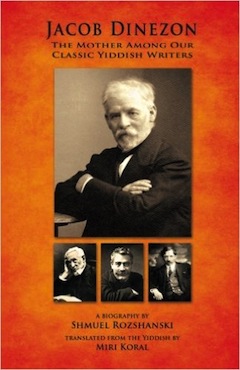
So far, four works by or pertaining to Dinezon have been published by Storyteller Press: Memories and Scenes, a collection of stories and reminiscences (2014); two novels, Yosele (2015) and Hershele (2016); and, now, the 1956 biography Jacob Dinezon: The Mother Among Our Classical Yiddish Writers by Argentine Yiddish writer Shmuel Rozhanski, translated by Miri Koral.

I must confess that, even though I took an advanced degree in Yiddish literature at Columbia University, I had never once heard mention of Dinezon – until Davis came along a couple of years ago and resurrected him. But now, when one scrolls through an internet site for Peretz, one sees not one but two photos of Dinezon; one with Aleichem and Peretz, the other, with Peretz alone.

Dinezon was friendly with Peretz for a quarter of century. In 1890, he published, at his own expense, Peretz’s first book, Bekante Bilder (Familiar Pictures), when it was rejected by all other publishers, and he presented the entire printing to his friend.

Rozhanski’s book is not exactly a biography in the classical sense. In fact, he doesn’t even tell us in what year Dinezon was born. Rather, the author focuses on Dinezon’s books and the interaction between them and the author’s life. It may more properly be called a literary biography, with a summary and gentle analysis and evaluation of Dinezon’s works.

Dinezon, who was born near Kovno, Lithuania, and died in Warsaw in 1919, was one of the most popular Yiddish writers during the 19th century, when Yiddish literature flourished in Eastern Europe. His novel The Dark Young Man sold more than 200,000 copies. Every Jewish household had his books but, because of the sentimental nature of his work, his reputation has fallen into neglect. He was considered passé because critics felt he pandered too much to women readers and other lovers of romances. Today, he might be considered the author of soap operas or pulp fiction. And yet, a respected Yiddish writer placed Dinezon and Aleichem on the same plane, calling the former lachrymose and the latter funny – and both writers of the folk.

In Rozhanski’s book, we learn of the spiritual and linguistic struggle that Yiddish works had to undergo from the middle through late 19th century, when proponents of the Jewish Enlightenment, the Haskalah, sought to highlight Hebrew belles lettres and diminish Yiddish. Among these maskilim were Mendele, who wrote in Hebrew and Yiddish, and Aleichem, who began in Hebrew but then switched to Yiddish.

Dinezon, too, was torn between the two languages, and this inner battle is aptly depicted in one of his letters. There, he states that when he writes in Hebrew and uses phrases from Isaiah or Ezekiel, he feels that the prophets are speaking for him. But, when he writes in Yiddish, he feels that he is speaking for himself and that his protagonists are speaking in their own authentic voices.

This is perhaps the best description of the inner conflict that 19th-century writers who knew both Hebrew and Yiddish had to face. The usual explanation for dropping Hebrew and returning to Yiddish – this was Aleichem’s position, for instance – was the more practical one that the Jewish masses in Eastern Europe knew Yiddish far better than Hebrew and, hence, the readership was very limited. But Dinezon’s literary explanation penetrates the heart of the artistic problem of choosing one or the other of two Jewish languages.

book cover - Jacob DinezonRozhanski calls Dinezon “mother” for his gentle nature. Once, when Peretz devastated a young writer whose short story he had read by telling him, “Enough! You have no talent,” Dinezon, who was present, called the young man aside and told him to try again; perhaps his next effort would be better.

But Dinezon had the courage to criticize Mendele, whom Aleichem called the “zayde,” the grandfather, of Yiddish literature. Dinezon called Mendele too much of a purist regarding use of the Yiddish lanuage. He felt the language of the plain folk should be used. And Rozhanski claims that Dinezon’s goals were more moralistic than artistic; hence, Dinezon criticized Mendele’s satires, regarding them as humor without any moral lesson.

Indeed, it was the moral lesson and a practical uplift of society that Dinezon had in mind when he published Yosele. In this short novel, he criticized the cruel educational methods used by teachers in the small-town cheders. This novel prompted calls for reform, helped modernize pedagogy and led to the inception of more secularly minded schools for youngsters.

The biographer contends that Dinezon’s creativity shouldn’t be measured by his books alone. His work for orphans, his translation of Heinrich Graetz’s History of the Jews from German into Yiddish, even though Graetz didn’t want his work “desecrated” by having it in jargon, and his thousands of letters to writers and social activists – all of these Rozhanski considers part of Dinezon’s creative accomplishments.

So modest a man was Dinezon that, once, at a literary event in honor of Peretz, Peretz pointed to Dinezon in the audience and said, ”My holy soul is this man … this man.” At this, Dinezon rose and denied Peretz’s kind remark by saying that the inspiration comes from within Peretz himself.

Dinezon was a lifelong bachelor. At one point in his life, he was, like Aleichem, a tutor to the daughter of a wealthy man.

Like Aleichem, he fell in love with the girl and the girl’s love was reciprocated. But, whereas Aleichem ended up marrying his pupil, Dinezon was denied his love.

Nevertheless, despite this setback, he continued to serve the wealthy man in other trusted capacities.

In 1913, when Aleichem was ill in Europe – he would immigrate to the United States in 1914 – Dinezon wrote him a letter revealing a plan. When Aleichem would feel better, he would join Peretz and Dinezon and all three writers would go to Palestine and walk the land and write a book about their adventures. “So get well soon,” Dinezon concludes.

This dream was never realized.

For this slim in-depth literary biography, Rozhanski assiduously mined letters, newspapers, magazines, Yiddish writers’ memoirs, critical evaluations, as well as all of Dinezon’s published works, to draw information about the writer, in his own words and in the estimation of others.

Curt Leviant’s most recent books are the novels King of Yiddish and Kafka’s Son.