הורהליצרניותהסיגרותלשלםלמעלהמ-15 מיליארדדולר. (צילום: Andrew Magill via commons.wikimedia.org)
התביעה הגדולה בתולדות קנדה: בית המשפט העליון בקוויבק הורה ליצרניות הסיגרות לשלם למעלה מ-15 מיליארד דולר למעשנים
בית המשפט העליון של מחוז קוויבק הורה לשלוש יצרניות סיגריות הגדולות ביותר קנדה, לשלם 15.6 מיליארד דולר למעשנים. זאת לאור הנזקים הכבדים שנגרמו להם מעישון. מדובר בתביעה יצוגית בהיקף הכספי הגדול ביותר בהיסטוריה של קנדה עד היום. כצפוי שלוש יצרניות הסיגריות אימפריאל טובקו קנדה, ג’י.טי.איי מקדונלד קורופרשיין ורוטמנס-בנסון אנד הדג’יס אינק, הזדרזו כבר והודיעו כי יערערו על פסק הדין שפורסם לפני מספר ימים.
ההליך המשפטי המורכב נגד חברות הסיגריות החל לפני כשלוש שנים. התביעה מתייחסת לנזקי העישון שנגרמו למעשנים בחמישים השנים האחרונות. בפועל מדובר בשתי תביעות שאוחדו: הראשונה של כמאה אלף מתושבי קוויבק שחלו בסרטן עקב העישון וחלקם כבר נפטרו, והשנייה של כתשעה מאות אלף מתושבי קוויבק שמכורים לעישון סיגריות.
בפסק הדין ציין בית המשפט העליון כי ליצרניות הסיגריות אחריות ישירה לנזקים שנגרמו למעשנים, בזמן שהן בחרו שלא לעדכנם בדבר נזקי העישון הכבדים הצפויים להם. הנתבעות טענו מצידן כי המעשנים היו מודעים לנזקי העישון שצפויים להם, וכן כי הסיגריות נמכרות בקנדה באופן חוקי ובאישור הממשלה הפדרלית.
יצויין כי בית המשפט לערעורים של מחוז אונטריו דחה לפני מספר ימים, בקשה של יצרניות הסיגריות לבטל תביעה נגדן. ובכך ניתן אור ירוק להמשיך בתביעה מצד ממשלת אונטריו נגד חברות הסיגריות שהיקפה לא פחות מחמישים מיליארד דולר. גם במחוזות של בריטיש קולומביה וניו ברנזוויק הגשו תביעות דומות לבתי המשפט המקומיים, נגד יצרניות הסיגריות. ואילו בשאר המחוזות בקנדה גם נפתחו הליכי תביעה שעדיין לא הגיעו לבתי המשפט.
ועוד בנושא המלחמה ביצרניות הסיגריות: בחודש מאי הוקמה קרן צדקה של המיליארדר היהודי-אמריקני, מייקל בלומברג, לשעבר ראש עיריית ניו יורק, כדי לסייע לממשלות ברחבי העולם להילחם בתעשיית הסיגריות. הקרן אמורה לסייע למדינות שמתקשות לצמצם את העישון, באמצעות אספקת יועצים משפטיים לתמיכה בחקיקה נגד יצרניות הסיגריות. תקציב הקרן של בלומברג ארבעה מיליון דולר בשלב זה, ומובטחות לה תרומות מהקרן של ביל ומלינדה גייטס.
לפי הערכות בארגוני הבריאות העישון גרם למותם של עשרה מיליון איש במאה העשרים, והוא ויגרום למותם של מיליארד איש במאה הנוכחית.
הכלב הוא חברו הטוב ביותר של האדם: כלבת לברדור עזרה לילדה להעיד בבית המשפט
לראשונה בקנדה נעשה שימוש בכלב כדי לעזור לעדים במצוקה להעיד בבתי המשפט הפליליים. כל גורמי האכיפה, השפיטה והעובדים הסוציאליים מציינים בחיוב רב את השימוש בכלבים לראשונה לצרכים יחודיים אלה.
ילדה שחוותה תקיפה מינית ונמצאת בטרומה קשה מאוד נעזרה בעדותה לפני מספר ימים בבית המשפט המחוזי בעיר סרי, בכלבה בת שבע מסוג לברדור צהוב העונה לשם קאבר. הכלבה ממשרתת במשטרת העיר דלתא מאז 2010. השימוש בכלבה בעת הדיונים בבית המשפט התאפשר, לאחר שהשופט בתיק אישר את בקשת פרקליטות המדינה להיעזר בה.
ברגעים הקשים במשפט כאשר קורבן התקיפה המינית התקשתה לתאר מה עבר עליה עת הותקפה, היא חיבקה וליטפה את קאבר שהייתה צמודה לרגליה, ופשוט הרגיעה וניחמה אותה כל הזמן.
במסגרת ניסוי במשטרת דלתא בשלוש השנים האחרונות, קאבר הובאה לחקירות של קורבנות של מעשים פליליים, כדי שתעזור להם להירגע בזמן שמסרו את עדותם. לאור הצלחתו של הניסוי היוצא דופן הזה, הוחלט כאמור לראשונה להיעזר בכלבה גם בין כתלי בית המשפט. גורמים שקשורים במשפט הביעו סיפוק מהפתיחות שבית המשפט גילה כאשר איפשר להשתמש בקאבר.
After years of writing poems that blend his Algerian/Arabic background and his Ashkenazi-influenced schooling, Israeli poet Erez Biton, 73, this year received the Israel Prize for Hebrew literature and poetry. Born to Moroccan parents in Oran, Algeria, in 1942, he is the first Israeli of Mizrahi descent to win the country’s top literary honor, though he is no stranger to awards for his work.
“Poetry is like a tale of an elusive dream, but one must not give up,” Biton told the Independent. “One must, to a certain extent, pursue this elusiveness and try to catch it and change it into the poetic expression. The coping is with the controlling, the conscious, the immediate, which prevents an encounter with the twilight sensation that enables the poem to dawn.”
Biton envisions poetry as an independent, physical sense. “The poem is a continuation of you, added to you by the poetic ability,” he explained. “Just as it is difficult to catch the tale of a dream, so does the poem impose, sometimes for the good, sometimes for the bad.”
By internalizing the poetry of such writers as Hayyim Nahman Bialik, Nathan Alterman, Yehuda Amichai, Zelda Schneurson Mishkovsky, Amir Gilboa, Dahlia Ravikovitch and Avot Yeshurun, Biton said he developed a poetic stance of his own. “If, at first, I wrote love poems of a boy seeking his path to the world of poems, which were defined as universal existential with no description of time and place, then, in my additional poetry, I had become totally concrete, and thus saw myself as different from others.”
Biton started on his artistic journey with the help of Elisheva Kaplan, a piano teacher at Biton’s school who stopped teaching in order to dedicate her life to translating written books into Braille. This was essential for Biton, as he lost his sight at the age of 10.
Kaplan brought some of Biton’s poems to Shimon Halkin, an Israeli poet, novelist, teacher and translator (who passed away in 1987). Upon reading Biton’s work, “Halkin suggested that I send my poetry to [the now defunct literary magazine] Keshet,” said Biton. “I received an enthusiastic letter from the editor of Keshet, Aharon Amir, in response to reading my poems ‘Jaffa Street,’ ‘Variations on One Subject of Bach,’ and more.”
When Biton lost his sight and left hand to an explosive device he found while playing, he recalled, “This was a type of loss, a death of an intimate entity, which until the age of 10 and a half, was a part of me. And, to lose that, [it’s as though] something dies in you. With this death, I am in negotiation.”
Biton decided to become a social worker instead of a writer. “There was no one I could show my poems to,” he said. However, he added, “as a result of my encounter with human suffering as a social worker, I acquired compassion, sensitivity to others, which were later absorbed into my poems.”
Biton immigrated to Israel in 1948 with his family. The year after he lost his sight, he went to school at Jerusalem’s Institute for the Blind. He received his bachelor’s in social work from the Hebrew University, his master’s in psychology from Bar-Ilan University, then worked as a social worker for many years. He also worked as a journalist and was a columnist for Maariv. His first book, Mincha Marokait (Moroccan Gift), was published in 1976.
Biton’s decision to become a social worker stemmed from his identification with the hardships involved with making aliya. His experiences have also contributed to his poetry.
“The process of my growth ripened in me foundations of lyric sensitivity that came to expression in the poetic writing,” he said. “A writing of truth can grow through a deep encounter with different life situations and I say that all human suffering is not foreign to me. Therefore, I find in myself a space of accommodation and also of the unusual and the different.”
Biton expressed gratitude for the recognition he has attained, saying if he is to be considered part of the chain of poets that includes writers such as Bialik, “a great grace will be done with me. And grace will be done with me also by those who will see me as someone who opened a certain door, because it took time until people started to talk my language.”
Biton does not see himself as a man of religion, but said, “Moroccan associations echo in me, biblical associations echo in me. All the materials I treasured, which I internalized – poems of Bialik – all the materials that I absorbed, especially the Moroccan language, it was an immense joy to me to give an echo to something from an entirely different me.
“One of the unique components in the writing of my poems is the use of expressions in Arabic…. During the healing of the internal tears, I found myself writing poems that embed in the Hebrew syntax expressions in Moroccan Arabic, which was my childhood language.”
His work has paved the way for others. “I used in my poetry groundbreaking Moroccan expressions and, eventually, other poets used the expression ‘Moroccan’ as a title to the names of their creations,” he said.
“I’m in a battle of two phases. One says blindness is a great lacking, an endless depravation of encountering the world…. On the other hand, when I am a bit more reconciled with myself, there are also the possibilities of hearing, touching and listening to the speaking of people, as a type of melody.”
Of course, not only his cultural background has influenced his writing. “On the sensory level,” he said, “I’m in a battle of two phases. One says blindness is a great lacking, an endless depravation of encountering the world … emphasized by the recognition of the memory of seeing until the age of 11.
“On the other hand, when I am a bit more reconciled with myself, there are also the possibilities of hearing, touching and listening to the speaking of people, as a type of melody. The sensation, the touch of a woman, the face of a woman, the lips of a woman – all of these are at the other side of the scale of what there is.”
Integral to his success has been his wife. “In my attempt to understand the proceeds that happened in my work, I cannot ignore the significance of my marriage to Rachel in the year 1982,” he said.
Biton’s wife, Rachel Calahorra, is an architect and graduate of the Technion in Haifa. She was born in Israel to parents who emigrated from Athens. The couple met in early 1980.
“What was special in our relationship was we believed in each other, in the intellectual capability and the emotional side of deep love,” said Biton. “Our connection as a couple led also to a mutual intellectual cultural search toward an integration … between East and West.
“The marriage, the starting of the family, and its expansion in the birth of our children, Asaf and Shlomit, sharpened in me the question of blindness and my place as a blind person in the family, as a father and a husband.”
Biton found himself writing poems like, “The Joy of Your Eyes” and “Arrangement with a Firstborn.”
“Without a doubt,” he said, “my marriage to Rachel was a very significant turnaround, not only in the course of my life, but also in my writing, with the complexity of her life with me as a blind person, in her endless support of my overall actions.”
While Biton has won other awards for his work, with the receipt of the Israel Prize this year, as well as the Bialik Prize for lifetime achievement and the Yehuda Amichai Prize last year, he said he now feels more accepted.
The Israel Prize committee described his poems as, “The epitome of courageous dealings, sensitive and deep with a wide range of personal and collective experiences centred around the pain of migration, planting roots in the country and the reestablishment of the Mizrahi identity as an integral part of the overall Israeli portrait.”
In his speech at the prize ceremony, Biton said, “My parents were like an open book to me. My mother was a collection of poetry in Arabic, carrying an ancient Jewish legacy. And, indeed, so I have become an accumulation of childhood experiences, experiences of lively observation, of freedom of movement in spaces, climbing on trees and on fences, and a lot of running.
“I was an accumulation of sounds, of dialects, or poetry, from my father’s home. Eleven years of freedom of movement and seeing … sensory treasures were collected in me … of which I make use still today.”
There are a few remarkable things that one notices when looking at the press material for Scratch, which is being presented by Theatre Plexus at Havana Theatre until June 13.
First, the play itself. Part of the story is in its title, which refers to the protagonist, a teenage girl who loses her mother at the same time as she is dealing with an egregious case of head lice. The other part is in the script by Charlotte Corbeil-Coleman: the original mounting of the production by Toronto’s Factory Theatre in 2008 was nominated for the Dora Mavor Moore Award for outstanding new play.
Second, Theatre Plexus. A relatively new company, it has gathered a small but experienced cast and production team for this show, its third.
“Theatre Plexus started somewhat organically, born out of the necessity of having an umbrella under which to put my personal projects,” explained actor and producer Caitlin McCarthy. “The first show I produced in Vancouver was 8 Girls Without Boyfriends in 2013, but it wasn’t until the following year when I applied for the Vancouver Fringe that I came up with the name. I was performing a show I had written, called Saudade. It occurred to me that I had a mandate (personal and professional): it was important to me to produce work with a strong female voice, and I preferred intimate theatre spaces. I know a staggering number of talented female actors who just don’t get stage time in Vancouver as often as they should, and I want to help remedy that. Scratch has four women in it out of a cast of six, and these women have scenes together that aren’t just related to a male protagonist. In fact, it’s a young, female protagonist.”
Caitlin McCarthy (photo from Theatre Plexus)
McCarthy plays that young protagonist, Anna, and it was one of the aspects that drew her to the play.
“I picked up a copy of Scratch because I liked some of the monologues – as an actor, I am always looking for good Canadian monologues, and Charlotte Corbeil-Coleman is based in Toronto. I was struck by how tender the play is – and how it presents grief from multiple angles. I also like that the play has a sense of humor and, though it is a play about loss, it is ultimately uplifting. Also, as I mentioned, there are four women in it (and, of course, two wonderful men) and I am an unapologetic feminist when it comes to choosing and casting plays.”
The co-producer of Scratch is Stephanie Izsak, who is also playing the character of Madelyn. Izsak is one of the many members of the production team affiliated with Langara College’s professional theatre training program, Studio 58. This is another remarkable aspect of the local production.
“Steph and I knew each other from Studio,” explained McCarthy of the connections, “and we approached the incredible Genevieve Fleming to be our director – I had gone to school with her…. Eileen Barrett did go to Studio, but I knew her from a playwriting group, Genevieve had seen a lot of Markian’s [Markian Tarasiuk] work while he was a student, we all knew David Bloom as the solo show teacher, and Jeff [Elrick] was recommended by the faculty as he’s still a student. So yes, there is a Studio 58 community to easily draw from, but we didn’t exclusively cast from a Studio pool. I feel so lucky to have Tamara McCarthy and Flo Barrett on board – now that I know them, they will definitely be part of the community I try to work with!”
The process from idea through casting to opening night on June 4 has taken some time, said McCarthy. “Steph approached me two years ago to work together, and I thought of Scratch as a project we could do. It took us a long time to find a venue we liked before we decided on the Havana. I wish there were more independent venues in Vancouver! The lack of space in this city has certainly given rise to some very creative site-specific theatre, but I wish there were more small, traditional theatre spaces to do plays.
“Once we booked the Havana (back in November), it all started to fall into place. We assembled this wonderful group of like-minded artists who felt like the play resonated with them, and we got everything in order for rehearsals to start.”
One of those artists is the aforementioned Bloom, who is a playwright, director, actor, producer and teacher, with a wide range of theatre and television credits, and a Jessie award for Palace of the End with co-directors Katrina Dunn and Mindy Parfitt.
“When Genevieve Fleming asked me to be in Scratch, I said yes very quickly because I liked the writing, and I knew that several scenes would be challenging to play,” Bloom told the Independent. “The other reason I said yes, though, was that I like and admire all the people involved in the project. Four of them are former students and our stage-manager/lighting designer is still one of my students. Theatre Plexus is a fledgling theatre company whose mandate is to do intimate plays with a strong female voice, in small spaces. I’m working with a great group of smart, talented people. How could I possibly say no?”
Bloom said he got into acting “by accident” in Grade 10, as a favor to a teacher.
“In elementary school, I had written and performed sketches with friends,” he explained, “but by high school, I had decided to be a writer; acting was not on my radar. Our drama teacher was short on men for a production of Twelfth Night and he asked me to take on the small role of Sebastian. I was not a popular kid, and I got laughs and applause. It was like catnip to me. I felt a rush during those two performances stronger than any drug. The truth is, I got into acting for exactly the wrong reason: ego gratification. I’ve never had that feeling quite like that again, and it’s no longer what I look for from theatre.
“At a certain point in my 20s, I came to believe in theatre as a spiritual/humanist practice. (The history of the art form has often been deeply entwined with various societies’ religious practices, as well as a way of channeling difficult, dangerous and thrilling ideas.) One of my more embarrassingly naive statements in my early 20s was, ‘Acting is like a priesthood. It’s like practise for being human!’ I understand how ridiculous and self-important that sounds. Luckily for my mental health, I’m also drawn to theatre’s ability to skewer pomposity, especially in myself. There’s something very freeing about being willing to look like an idiot in front of thousands of people.”
“There’s a sense of community that happens when a group of people with limited resources decide to work together to make a performance. It’s intimate and intoxicating.”
Bloom produced his first production at 17. “Nobody had told me that I couldn’t do it, so I did. I’ve continued in that vein ever since. I’d fall in love with the idea of a show, invite friends to my house to talk about it, and the group would create its own momentum that drove us to produce shows in crappy little spaces (the Firehall before it was a theatre, on the set of other people’s shows at midnight, whatever was available). There’s a sense of community that happens when a group of people with limited resources decide to work together to make a performance. It’s intimate and intoxicating. The people involved develop a sense that they’re part of something bigger than themselves. Like most human endeavors, it’s an illusion,” he said, referring to Waiting for Godot, which examines human beings’ need to try to “create meaning for themselves in a meaningless universe.”
This need led Bloom, among other things, to start his own company. “Humans are social animals and we crave a sense of belonging; we need to believe our lives are meaningful. As a result, we’re easily manipulated (street gangs, political parties and xenophobic movements all manipulate that need). It’s also a source of community, sacrifice and some of the best qualities of humanity. I bonded with a group of people who shared my obsession and formed the Grinning Dragon Theatre Company in 1991. We changed our name to Felix Culpa about 15 years ago. Latin for “happy fault,” it is a reference to eating from the forbidden tree of knowledge (my co-director Linda Quibell is a very lapsed Catholic). The focus of the company’s work is the power of language and its unique ability to explore complex subjects such as morality, beauty and the subjective nature of truth.”
Bloom said he has been teaching since 2000, and it suits him “to a T.” The students have to create a one-person show and perform it before they graduate from Studio 58. “I feel blessed to have this job,” said Bloom. “It means that once a week, eight months a year, I have to think about what theatre is, how many different forms it can take and also how to solve specific challenges brought up by the imagination of wonderfully talented young minds. They regularly do work that astounds me. Then they go out into the world and, within a few years, many of them are far more successful than I am. I guess there’s a kind of legacy in that. Also, for awhile, they think I’m really smart, and that brings me right back to the egocentric pleasures that got me into the profession in the first place.”
A member of the Jewish community, Bloom described his family as “secular, intellectual, socially conscious.” He said, “My father is one of Canada’s great physicists. His sisters are, respectively, a mathematician who devoted most of her career to studying how math is taught (not well, in her opinion) and a school principal who pioneered methods of working with disabled children. They grew up on St. Urbain Street and other streets in that Montreal neighborhood, and they all went to Baron Byng High School.
“My father doesn’t remember Mordecai Richler from the school, but when my aunt met him, Richler remembered my father, something I get a kick out of. Long before I read The Apprenticeship of Duddy Kravitz, my father had told me all the stories in the first chapter about ‘Flanders Field’ high school (for example, the teacher who would start each year asking the students, ‘How does a Jew write the letter S?’ and then draw a $ on the blackboard).
“Much of my work is an attempt to understand how human beings can treat each other so vilely. I am often attracted to artistic work that goes to very dark places. I’m also drawn to stories about people who are not accepted by mainstream society, whether they be Jews, queers, radical thinkers, dissidents, melancholics, eccentrics, Muslims, the list goes on.”
“It’s a little morbid,” continued Bloom, “but I first felt deeply Jewish watching an episode about the Holocaust on the amazing BBC documentary series World at War. I realized that Hitler wouldn’t care that we weren’t religious, didn’t follow the dietary laws, that my mother had converted when she married my father. Something about being the ‘other’ landed for me that afternoon and I was stricken. On many levels, the rest of my life has been colored by that. Much of my work is an attempt to understand how human beings can treat each other so vilely. I am often attracted to artistic work that goes to very dark places. I’m also drawn to stories about people who are not accepted by mainstream society, whether they be Jews, queers, radical thinkers, dissidents, melancholics, eccentrics, Muslims, the list goes on.
“My father told me that his mother sent him off to school every day with the admonition, ‘Ask some good questions!’ He explained to me that you would get the best out of your teachers if you challenged them and their ideas. It was acceptable, even essential, to challenge intellectual (and other) authorities because it would make them work harder. I was often a trial to my teachers, as you might imagine, but the best of them had a deep impact on me.
“There is a long history (one might say a talmudic history) of Jews being argumentative, especially with people we love. I consider myself part of that tradition. I love that about us as a people, and I love our love of literacy and our tendency to be stubborn and tenacious. But my instinct to challenge extends to challenging actions of myself, my fellow Jews, the state of Israel and the whole patriarchal, monotheistic basis of the religion…. There are probably many Jews who would not consider me a ‘real’ Jew,” he concluded, “but I believe myself to be true to our culture and the values of intellectual and spiritual inquisitiveness that have made us simultaneously unpopular and essential around the world for thousands of years.”
Tickets for Scratch are $18, with Saturday matinées $10, and are available at brownpapertickets.com. Partnering with Theatre Plexus on the production is the Living Through Loss Counseling Society of British Columbia. “All of the proceeds collected will go to counseling and group therapy for women at risk,” said McCarthy. “It’s very important for me as a producer to question what my contribution is to society – larger than just the theatre community. Grief is such a central part of this story and an inevitable part of human life and I believe this play has the potential to unite people in processing a very universal experience. Because what else is theatre for than to witness our own humanity and bring us closer together?” LTLCS will be holding a talk-back on Tuesday, June 9.
Dance Centre’s 12 Minutes Max features works from five up-and-coming choreographers on June 12. Pictured here is Con8 Collective: Charlotte Newman, left, and Georgina Alpen. (photo by Andy White)
An abundance of riches. Scotiabank Dance Centre’s 12 Minutes Max on June 12 showcases the talents of five up-and-coming choreographers – three of whom have Jewish community connections.
Started in 1994, 12 Minutes Max was redesigned and relaunched last year, “with a strong focus on choreographic development, critical feedback and dialogue.” In a season, there are three modules and the June show features artists selected from these sessions, with each performance lasting 12 minutes or less. Among the artists featured are Caitlin Griffin, Charlotte Newman (Con8 Collective) and Naomi Brand.
Griffin was featured in the JI last August for a piece that was influenced by her time in Israel in 2013 with the Kibbutz Contemporary Dance Company, as part of its Dance Journey (Masa) program.
An exploration of the impact of war on women, what was then called The Way They Walked Through the World featured three dancers, and pairs of army boots played a central role. In 12 Minutes Max, Griffin’s work is performed by Delphine Leroux and set to Bach’s Klavierbüchlein für Wilhelm Friedemann.
“The work has evolved significantly from last September’s showing in several ways,” Griffin told the JI. “The process I went through of collecting choreographic material and experimenting with the boots has distilled my areas of interest and inspired new curiosity about the themes of conflict and femininity. While I am still working with the boots in other offshoot projects, in this incarnation, here or there focuses on the established movement vocabulary, transplanted into a classical music environment without boots. It has become a study of the potential within the movement. It is the development of one layer of my continued interest in the material.”
Griffin said The Way They Walked “served as an invaluable project to create a sketch of my interests and goals in this stage of my artistic development. Since then, I have been selecting small seeds from within that larger sketch and developing them into their own short solos. Ultimately, I may use them in combination in a more developed, longer work, but for now I am learning a lot by seeing them as individual studies to explore and cultivate my creative process.”
Con8 Collective’s Newman is new to the JI. Born and raised in Seattle, she moved to Vancouver to study at Simon Fraser University, graduating last year with a BFA in dance. She told the JI that she hopes to call Vancouver home “for the foreseeable future.”
Con8’s contribution to 12 Minutes Max is Vanilla to the Touch. Created and performed by co-artistic directors Newman and Georgina (Gina) Alpen, in collaboration with Robert Azevedo and Elliott Vaughan, it is described as “a quick-thinking, tongue-in-cheek look at growing up in West Coast suburbia, pulling from experiences of bras, boys, rolled-over jeans, juice boxes and more.”
“Like many young girls, I started dancing around the age of 3 and simply never stopped,” Newman said about the beginnings of her career. “In the past 20 years, I have had amazing opportunities to work with varying groups of dancers, in the context of performances, festivals, site-specific creation, music videos and more. I am especially passionate about choreography. I love investigating movement through the lens of our own physical limitations and strongly believe in the power of sharing ideas, concepts and questions through sharing movement.”
Newman said she “grew up with many cultural connections to Judaism.”
“I have many fond childhood memories of Chanuka dinners of endless latkes, Passovers with friends and Shabbat dinners at my grandparents’ house,” she shared. “Only in the past few years, having moved away from my family and many of these rituals I took for granted, have I become more cognizant and questioning of this identity – how do I want to bring Judaism into my own life? On this journey of exploring my own Jewish heritage, I had the amazing opportunity to join in the gift of Taglit-Birthright on a 10-day trip to Israel in May of 2014. The trip was eye-opening, thought-provoking, inspiring and pushed me to continue investigating how Jewish culture fits into my life as young adult – a question I’m still answering.”
She’s also exploring dance, of course, and its manifold permutations and meanings.
“Con8 is a play on the word ‘connate,’ meaning existing from birth and uniting to form a single entity,” she explained. “Gina and I feel these definitions truly encompass the collective’s artistic values – we strive to constantly explore through an innate creativity and unite the collective’s collaborators to make a stronger body of work as one.
“We also embraced the idea of a ‘con,’ meaning a confidence trick. Throughout our choreographic process, we often explore physical games, tricks and rules that lead to very specific movement choices and rhythms, leading to secrets within the performance that the audience will never see.
“Among many similarities,” she concluded, “we share the same birthday – May 8.”
Con8 leans toward “extremely detailed and stylized pedestrian movement that has been brought into the framework of dance performance,” said Newman. “Tight unison, rhythmical timing and a playful attack to serious movement exploration complement this movement vocabulary.”
She said, “Vanilla to the Touch began months ago as a radically different idea. With each new process, Gina and I use rehearsal space as a blank slate – in the beginning of a process, no idea is knocked down and, in a few minutes, we’ll be tossing out ideas one after the other as fast as we can. This process leads to hours of ultimately discarded material, many physically impossible and improbable proposals, and the usual bruises and bumps. We feed off of the other’s energy so hungrily, every rehearsal feels like play. In the midst of this process – around late February – we realized we had about four hours of movement to mold into 12 minutes, thus beginning the second phase of trying on, molding or discarding existing movement as we narrow our vision.
“In Vanilla to the Touch, as we are both performing the entire time, we relied on the eyes of collaborators for their outside perspectives and questions. Through the constant process of cutting, reconstructing and questioning, each movement has a meaning and each phrase was chosen with an exact specificity in mind.”
Unlike Newman, fellow Jewish community member Brand didn’t start dancing at a very young age.
“I danced a bit recreationally and in my teens was a part of a dance group run by a contemporary dancer who focused on modern dance and contact improvisation and got us choreographing on each other,” she explained. “I didn’t take a ballet class until I was 18 and so I often feel that I came to dance technique late.
“My interests in dance have always been diverse. A mentor of mine instilled in me early the importance of having a wide range of skills in order to increase your chances of being successful in the art form and so I have pursued dancing, performing, choreography, teaching and writing in order to have many avenues. I attended the dance program at the University of Calgary, where I earned my BA and an MFA in choreography, and where I also taught for a number of years after graduating.”
Originally from Toronto, Brand said, “I grew up with a secular Jewish identity. I recognized early on that a disproportionate number of artists, writers and progressive thinkers that I admired were Jewish, and that there was a connection between Jewish culture and creative thinking. My parents raised me with very strong values for learning, encouraging me to ask lots of questions and be curious, and also for social justice, family and community, values that I attribute to Judaism. These are values that have permeated my work as a dance artist. I try very consciously to make work that speaks to the relationship between the individual and the community. In my teaching practice, I encourage students to be inquisitive and inclusive, and use dance as a metaphor for how we could be in the world.”
Brand moved to Calgary when she was 19. After 10 years in the city – where she was a recipient of the 2012 Lieutenant Governor of Alberta Arts Awards Foundation’s emerging artist award – she said, “I was looking for a change, new opportunities and challenges, and so I relocated to Vancouver in 2013.”
Naomi Brand’s Re:play. (photo by Chris Randle)
For 12 Minutes Max, Brand is presenting Re:play, performed by Walter Kubanek and Hilary Maxwell. It is described as “an intricate duet that looks at action and reaction in the space between two bodies.”
In addition to being a choreographer, Brand is a writer, as well. “I think that my process in writing and in choreographing are very similar,” she said. “A lot of my training has been as an improviser and so I am most comfortable in the initial stages of generating ideas, jotting things down and spewing material out. Both choreographing and writing are about problem-solving to me. Once I have material to work with, it is about piecing things together, arranging, rearranging and searching for some kind of logic in what I have created. It’s like figuring out a puzzle, when at first you see a perhaps incompressible mass of ideas, words or moments and, then, through playing around with it, a structure or logic reveals itself. I rarely know what exactly it is that I want to say until it is made.”
Brand is also on the board of the Training Society of Vancouver, which has as its focus the quality and sustainability of contemporary dance.
“The field of dance is changing just as culture is changing,” she said. “What it means to be a professional dance artist today is completely different from previous generations, where the company structure was pervasive. Nowadays, everyone has to forge their own path and, in Vancouver, I see many fabulous examples of dancers with tons of drive pursuing their work and making their own opportunities. I have always been interested in being connected to dance from numerous different angles, as a performer, teacher, choreography, writer, advocate and administrator. For me, this diversity keeps me interested and engaged and able to keep perspective on my work.”
12 Minutes Max is at the Dance Centre, 677 Davie St., on June 12, 8 p.m. Tickets ($28/$22) are available from Tickets Tonight, 604-684-2787 or ticketstonight.ca. For more information on all the performers and works featured, visit thedancecentre.ca.
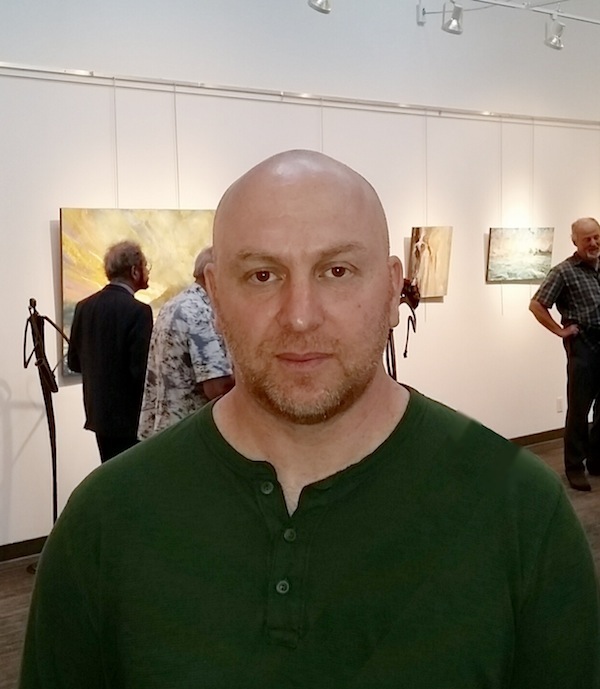
The current double show at the Sidney and Gertrude Zack Gallery has its origins in the two artists’ friendship. “I met with Greg Scalamogna through a mutual friend,” said Miran Elbakyan, an artist-blacksmith and one of the two participants in the show. “I liked his technique – his lines are plastic-like metal.”
“We have similar philosophy in our works,” Scalamogna elaborated. “Miran’s lines flow like paint. We don’t restrict ourselves, [we] let our materials speak.”
Miran Elbakyan (photo from Miran Elbakyan)
The flowing lines and dynamic energy in both Scalamogna’s paintings and Elbakyan’s sculptures gave birth to the show’s title, Flow, but, aside from that, the two artists are very different, almost opposite in their approaches and subject matter.
While Elbakyan deals with fire and iron, creating tangible objects – sculptures, balconies, staircase rails, wrought-iron gates and other usable items – Scalamogna, a painter, concentrates on water in all its guises. Tame or wild, abstract or real, his waves and waterfalls inhabit the cool bluish-grey palette. His paintings reflect the artist’s fluid personality and his love for water. “I love boating and fishing,” he said with a smile.
Like his beloved water, Scalamogna traveled around the world, flowing in and out of adventures, before settling in British Columbia. He took his first trip when he was 19, a student of the Ontario College of Art and Design.
“I wanted to go to some place sunny,” he recalled. “I bought an air ticket to the Dominican Republic and exchanged my Canadian money at the airport before boarding the plane, but they made a mistake and gave me Mexican money instead of Dominican. Nobody in the Dominican Republic wanted to touch that money.”
As a result, he found himself alone in a foreign country without a cent. Young and proud as only a 19-year-old can be, he didn’t call home and ask his mother for help. “I wanted to do it myself,” he said. To earn some money, so he at least wouldn’t starve, he started painting tourists’ portraits on the beach. He also sold all his spare clothes for the price of a meal or two, and made friends with local people.
“They were poor but they helped me, took care of me,” said Scalamogna. “They were very generous. I couldn’t pay for a hotel, so one guy offered me to spend nights in his home.”
The trip was a success in the end. He made it, paying for his first independent vacation with his art, victoriously returning home a week later. He even brought back souvenirs for his family; he bartered for them with his portraits. “Since then, I wasn’t afraid. I knew I could make it anywhere. I could take on the world.”
Scalamogna spent his last year of college studying in Florence, Italy, and afterwards backpacked across Europe with his artistic portfolio, visiting museums and art galleries, finding work wherever he could. He had a few exhibitions abroad before returning home.
However, like water, which never stands still, he soon felt the urge to move again. This time, he took a bus across Canada. For several years, he lived and worked in Banff, but eventually settled here – the ocean enchanted him.
“I’m an expressionist,” he said. “Nature inspires me. I take photos when I’m on the water, fishing, but my photos are only starting points for my paintings. The photos bring back memories and feelings; they reference a certain time and emotion. There is no visual similarity.”
His paintings also reflect his daily existence. “They are commentaries on my life, my job, my relationships, people around me,” he said. A few years ago, when he was living in Tofino, his paintings were filled with vibrant colors and exploratory energy, with frantic tides and glittering sunsets. Some of them are part of the Zack Gallery show, instantly recognizable, but most of the pieces on display are from his latter Vancouver period. The paintings became calmer and quieter, as if seen through the veil of Vancouver’s rain. “I’m older now, more subtle,” he said.
Like his friend, Elbakyan traveled. He moved from Armenia to Israel and, from there, to Canada, prompted as much by political climate as by other considerations. Like Scalamogna, he, too, found a welcome home here, in British Columbia, and this exhibition is his third appearance at the Zack. “It is always nice to show my art here and get some feedback,” he said, although he admitted that he doesn’t like selling his sculptures.
“I’d rather sell home décor,” he said. “I’m always sorry to see my sculptures go. They are all unique. Even if I try to make a second copy, it has no inspiration in it. The first is always the best.”
The only artist-blacksmith on the B.C. mainland and one of the very few in Canada, Elbakyan is in high demand for those who are not satisfied with mass production, who want an original fence around their house or a one-of-a-kind balcony or some funky furnishing.
Recently, he branched out into the movie industry. His latest movie, Seventh Son, released in December 2014, is a medieval fantasy. “I made swords and shields for it,” he said, “and everything else of metal that their lab couldn’t produce. I also played a smith at a fair. It was fun.”
In her retirement, Jocelyne Hallé plans to keep working as a photographer. (photo by Rachel Lando)
Members of the Vancouver Jewish community know Jocelyne Hallé. For years, she has been the official photographer of the Jewish Community Centre of Greater Vancouver, taking pictures at gala dinners and art presentations. As well, her smiling face and helpful optimism have enhanced the centre’s membership desk and greeted many members, new and old, whenever they enter the building. But, after June 25, she will no longer be there. She is retiring.
“I came to work at the JCC in 2001,” Hallé said in an interview with the Independent. “Before, I used to work for several engineering firms, as a translator or executive assistant, but, by 2001, I grew unhappy with my job. I wanted a change, so I applied to an employment agency.”
She had never thought about a job at the JCC. “My agent took me for an interview but she didn’t tell me where she was taking me,” Hallé recalled. “She just said it would be a new environment for me and that I would like it. She brought me to an interview with Gerry Zipursky [executive director of the centre at the time]. The interview lasted for two hours, the longest interview of my life, and, after that, he hired me to be his personal assistant.”
When she started her new job, Hallé didn’t know anything about the local Jewish community or Jewish culture, or even about working at a community centre in general.
“I asked him why he hired me, a non-Jew,” she said, wondering aloud. “But he said he only wanted his assistant to be competent and sensitive to the situation in the Middle East. I guess I was both, although I don’t remember talking much during the interview. He did most of the talking.”
She admitted that the adjustment period wasn’t easy. “I had to learn so much. But the more I learned about the community and the Jewish culture, the more I fell in love with it. When, in 2005, I went with the others for a working trip to Israel, I felt very comfortable, as if it was home.”
The year 2005 was a milestone for her in many respects. She took thousands of photographs in Israel, and the experience propelled her lifelong passion for photography to a new level. Her photos of Israel adorned an entire wall of the JCC atrium for three years. Her affection for the country and the people reverberated through the images she captured. “It was so gratifying to see people standing in front of that wall, looking at my pictures,” she said. (In 2009, Hallé landed a show at the JCC’s Sidney and Gertrude Zack Gallery. “My friends told me that if they didn’t know better and only judged by my photos, they would’ve thought Israel a green country,” she confided happily.)
Another, sadder event also happen in 2005 – she was diagnosed with breast cancer soon after she returned from Israel. “Cancer changed me, in a good way,” she said. “Contrary to everyone’s expectations, it was a positive experience. I realized what was important in life. I learned who was a real friend and who wasn’t. Before, I was working too much, always tired and heading for depression, but my illness gave me leave to take care of myself.”
She took time to recover and, after two years, returned to the JCC. Her former boss was no longer there, so she started working at the membership desk. “It was a different environment,” she explained. “I finally met many community members and I was away from all the politics. I loved it. Everyone was very friendly and helpful; I felt almost a part of the family.”
She continued learning about the community, immersing herself in the culture and traditions. “By now, I know so much about Jewish ways, people often ask me questions. I explain to them about Rosh Hashana and Shabbat and other celebrations. Many are surprised to learn that I’m not Jewish. To tell the truth, sometimes I feel that I’m kind of Jew-ish. We joke about it.”
In January this year, Hallé turned 60, and decided it was time to retire.
“In the last couple of years, a few of my friends died,” she shared. “It was very upsetting, but I’m alive. I’m ecstatic to be 60. I want to travel, to take some class, to work more on my photography. Recently, I went to Nicaragua for a month; I worked there as a volunteer and I want to do it again. I want to visit Galapagos and Kenya. I might volunteer with the JCC Seniors.”
Hallé is sure that her work for the JCC created an opportunity for her to develop as an artist photographer. With the support and encouragement of her colleagues and friends, she continues to explore her chosen art form. “I have nine photographic events booked this summer, right after I retire,” she said. “I’ll do a bar mitzvah, a wedding, a fundraiser, even a dance festival.”
Hallé’s plans are still in flux, but they expand every day, perhaps enough to fill the next 60 years.
To learn more about Hallé, the photographer, visit her website, jocelynehalle.com.
Olga Livshin is a Vancouver freelance writer. She can be reached at olgagodim@gmail.com.
Hebrew Free Loan Association president Michelle Dodek, second from the right, with, left to right, past association presidents Errol Lipschitz, Diane Friedman and Mannie Druker. (photo by Dan Poh)
One hundred years of anything in Vancouver is fairly unusual. On May 7 at the newly rebuilt Beth Israel, the Vancouver Hebrew Free Loan Association celebrated the remarkable milestone of 100 years since it was originally founded.
In January 1915, the year that the Vancouver Millionaires won the Stanley Cup, a group of Jews gathered for the first meeting of the Vancouver HFLA. Designed to give interest-free loans to Jewish people starting out in the community, the association played an integral part in helping establish many early Jewish businesses and getting people settled here.
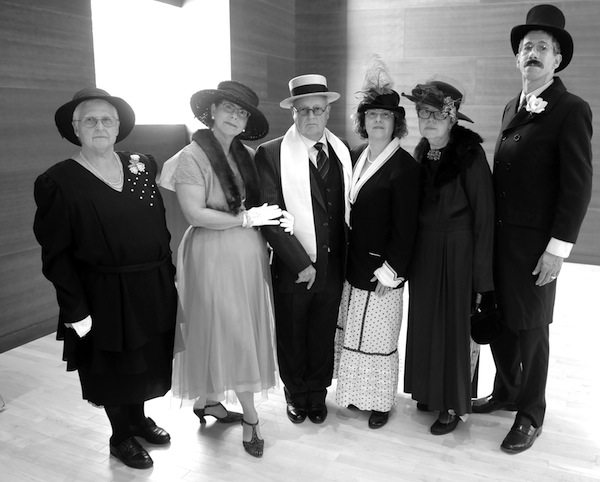
The HFLA Centennial Celebration reflected its grassroots beginning with a relaxed, different kind of evening. Casual picnic-chic décor and a picnic-style menu went with the fact that the event was held on Lag b’Omer. Greeting the guests were actors and musicians from the volunteer troupe Kol Halev. They were dressed in period costume and introduced themselves in character, sharing “their personal stories” as the founders of Jewish lending in Vancouver.
These actors provided an interactive beginning to an evening that was designed to raise the profile of HFLA. Through a multi-media approach, the event managed to educate those in attendance about the valuable role that interest-free loans play in Vancouver’s Jewish community.
Members of the Kol Halev performance troupe, who represented the Jewish community at the time of Hebrew Free Loan Association’s founding 100 years ago. (photo by Dan Poh)
The program began with a short d’var Torah by Beth Israel Rabbi Jonathan Infeld, touching on the relationship between Lag b’Omer and interest-free lending. HFLA president Michelle Dodek followed the rabbi’s comments by explaining the three objectives of the event: to raise awareness in the community by sharing what HFLA does, to honor the donors and board members who have made the work of the organization possible, and to look to the future. She recognized the multi-generational links of those in attendance, including the remarkable fourth-generation connection of the three Krell sisters (Shoshana Lewis, Simone Kallner and Michaela Singerman), whose great-grandfather, David Davis, was a contributor to the original Vancouver HFLA kitty in 1915 and served as a trustee in 1931. Their grandfather, Charles Davis, was one of the founders of the re-creation of the organization in 1979.
Dodek’s speech was followed by a short video featuring two former borrowers, Mihael Mamychshvili, a prominent shiatsu therapist and Barbi Braude, a graphic designer. Joe Segal and Shirley Barnett shared their historical perspectives and goals for the organization.
Guests then heard from four borrowers whose lives were changed by the loans they received from HFLA. Successful entrepreneurs Zach Berman and Ryan Slater began their business, the Juice Truck, with help from HFLA. Val Lev Dolgin used an education loan to earn her master’s in counseling psychology; she now helps children who have survived physical and sexual abuse. George Medvedev, a neurologist, shared how he and his wife, a hematologist, used a loan to help them when they first arrived in Canada from the USSR almost 20 years ago.
Another story was read by a volunteer to respect the anonymity of the borrower because of the sensitive nature of her situation, while the story of former borrower Maxim Fomitchev was shared by his friend, Tobi Lennet. Briefly, Fomitchev, a deaf mime, while touring with his troupe of mime artists from the USSR in 1991, defected, accompanied by his performing partner. The two found themselves volunteering for Jewish Family Service Agency and, within two years, Fomitchev borrowed money for a car to get from one mime gig to another. He has since achieved one of the pinnacles of success for a mime – he is the head clown in Cirque de Soleil’s Las Vegas show, Zarkana.
The evening’s program ended with the educational element of the night, the stories of four “typical” borrowers: parents of a child needing counseling, a retired woman needing dental work, someone between jobs in a stressful situation and parents borrowing to finance a modest bar mitzvah. All of these stories served to drive home the significance of HFLA.
The HFLA Centennial Celebration was a chance to celebrate a significant milestone in the community, raise awareness of an organization that is “the best kept secret” in Vancouver while recognizing donors and volunteers who make it all happen. The message for the future is that HFLA is looking for borrowers. For more information on how to apply for a loan, to watch the HFLA video or to find out about how the organization works, check out its newly revamped website at hfla.ca.
Germany’s foreign minister was in Gaza the other day, surveying the miserable conditions there, including the lack of repair to the thousands of homes and other buildings damaged or destroyed during the Gaza War last summer – Operation Protective Edge, as it is formally called by Israel.
Frank-Walter Steinmeier, the German diplomat, was one of a steady stream of Western representatives who have trudged through the Hamas-controlled enclave since the end of major hostilities last year. He said the success of repairs to Gaza requires that Israel open the borders to the free flow of materials required for the project – and he’s right.
But, he also made the case very clearly that Israel cannot be expected to live up to that part of the bargain as long as missiles keep falling into Israel from Gaza-based terrorists. And, of course, he was right again.
While much of the world seems to think that Israel’s policies toward Gaza are spite-motivated efforts to drive the residents of that place into despair, they are actually founded on legitimate defence requirements. Materials intended for civil reconstruction in Gaza – not just since last year, but since Hamas seized the Strip and even before – have been misappropriated and turned into weaponry, tunnels and other infrastructures for further terrorism. Steinmeier, however, is one of too few among world leaders who recognize, or at least publicly acknowledge, this reality.
After Operation Protective Edge, nations gathered in Cairo to pledge funds to restore the civilian infrastructure of Gaza. In sum, $5.4 billion was pledged by countries worldwide. However, a new report says that barely one-quarter of the pledges made in Cairo have been realized.
The Association of International Development Agencies (AIDA) released a report last week titled Charting a New Course: Overcoming the Stalemate in Gaza. It set out the results of the top seven donor countries and their record of delivering.
The most generous pledge – $1 billion – came from Qatar. The amount received to date from that country is $102 million.
The second-place European Union pledged $348 million and has handed over $141 million.
The United States comes closest to their pledge, having delivered $233 million on their $277 million pledge.
Oil-rich Kuwait and the United Arab Emirates, which each pledged $200 million, have delivered nothing.
Turkey, whose leader has made grandstanding theatrics around Gaza a cornerstone of his country’s foreign policy, has likewise delivered not a dime of the $200 million pledged, according to the report.
Seventh-place Saudi Arabia, which pledged $500 million, has given just $48.5 million.
In their defence, the idea of throwing good money after bad in Gaza could reasonably lead donor countries to hesitate. There has been precious little evidence that funds flowing into Gaza will be applied to the projects for which they are intended rather than being used by Hamas warlords to strengthen their own fiefdoms or launch new assaults against Israel (not that the latter concerns some of the donor states).
However, while some voices, like the new United Nations Middle East peace envoy Nickolay Mladenov, acknowledge that the Gaza terror regime needs to lay down its arms, he and others most vocally blame Israel’s blockade for all the problems facing the people of Gaza.
The AIDA report, for example, outlines actions deemed necessary to alleviate the misery of Palestinians in Gaza that seem to recognize that there is plenty of blame and room for improvement all around. But at the top of the list were things Israel needed to do, such as “lift the blockade and open all crossings into and out of Gaza” and “allow free movement of Palestinians across the occupied Palestinian territory,” as if there were no legitimate security concerns behind the unfortunate policies that prevent the free movement of people and goods in and out of Gaza.
The first step to resolving a problem is acknowledging its root. There are numerous reasons why the people of Gaza continue to suffer, and Israel’s policies are among them. But they are neither alone among the reasons nor the lynchpin upon which resolving the problem rests.
In March, Young Judaea’s Camp Solelim made headlines for turning away a prospective camper because he’s not Jewish. Before having made their final decision, I wish they would have spoken to Aaron Ingram. A Winnipeg-based real estate and corporate commercial lawyer, Aaron is by all accounts a leader in the Jewish community. He sits on the board of directors of Camp Massad of Manitoba as well as the Shalom Residences; he is a member of the Jewish Federation’s Community Relations Committee, he is a Jewish Federation donor and, as he describes it, is “a longtime supporter of the Jewish community and the state of Israel.”
Did I mention that Aaron is not Jewish?
Let’s back up to when Aaron was a chubby-cheeked, blond 5-year-old in 1989. That summer, he accompanied his mom who had taken a job as the head cook at Camp Massad in Winnipeg Beach, the Hebrew immersion camp that I also attended. Fast forward 18 years, and Aaron had logged 10 years as a camper and eight summers as a counselor, including two as assistant director. (His mom, Marilyn, is still head cook.)
A very agreeable kid with a big personality, as a youngster Aaron quickly landed leads in the camp plays. With no formal Hebrew background, his lines were transliterated for him. Soon enough, he acquired the services of a Hebrew tutor during the school year. By the time Grade 5 rolled around, he was enrolled in one of Winnipeg’s half-day Hebrew-immersion schools. In grades 7 and 8, he attended Joseph Wolinsky Collegiate, the Jewish high school, where he earned a spot in the highest Hebrew level. He recalls being able to finally read the camp play scripts in Hebrew letters as a “big moment” for him.
“As a child growing up in the disadvantaged North End of Winnipeg,” Aaron told me in an e-mail interview, “my experiences in the Winnipeg Jewish community, being immersed in the wonderful environment that is Camp Massad, a world of creativity and intelligence, and the lifelong friendships that I have developed … have heavily influenced me.”
I asked Aaron whether he feels Jewish. Not religiously, he tells me; he is an atheist. (That there are Jewish atheists is admittedly a bit of complexity we didn’t get into.) But he considers himself culturally Jewish, and certainly a part of the Jewish community. “I have cried tears of despair in the death camps in Poland,” he tells me, “and have cried tears of joy upon my arrival in Israel.”
And were he to meet and marry a Jewish woman who wanted him to convert, he says he would do so “without hesitation.”
Aaron recalls his early experiences with daily and Shabbat prayers at Massad. “When I was a young camper, participating in the daily prayers and Shabbat tefillah, it felt like being handed the keys to a secret world that was welcoming me. I loved singing the prayers. I still know most, if not all, by heart.”
For his part, Aaron thinks Solelim’s decision to bar access to Tyler Weir is seriously misguided. As a board member at Camp Massad, he personally extended Tyler an invitation to join the Camp Massad community and offered to personally fundraise to offset the cost of airfare from Toronto to Winnipeg.
It’s clear that there’s a value clash between the particularist and insular dimensions of Jewish programming, and especially Jewish camp – fueled, no doubt, by the fear of intermarriage. On one hand is the need to inculcate culturally rich and rigorous experiences in our youth. On the other is the desire to fit in with Canadian multicultural values of openness and pluralism. Even there, though, multiculturalism relies on robust transmission of cultural identity, something that can most easily be achieved in a culturally homogeneous context, some would argue.
Yet, people like Aaron – and I join him in this sentiment – would claim that opening the windows a crack to those who might have their own reasons for wanting to partake of our rich communal traditions may yield unexpected benefits not only for them, but also for the communities of which they may seek to be a part.
Mira Sucharov is an associate professor of political science at Carleton University. She blogs at Haaretz and the Jewish Daily Forward. This article was originally published in the Canadian Jewish News.