Skip to content
  • Home
  • Subscribe / donate
  • Events calendar
  • Business Directory
  • FAQ
  • News
    • Local
    • National
    • Israel
    • World
    • עניין בחדשות
      A roundup of news in Canada and further afield, in Hebrew.
  • Opinion
    • From the JI
    • Op-Ed
  • Arts & Culture
    • Performing Arts
    • Music
    • Books
    • Visual Arts
    • TV & Film
  • Life
    • Celebrating the Holidays
    • Travel
    • The Daily Snooze
      Cartoons by Jacob Samuel
    • Mystery Photo
      Help the JI and JMABC fill in the gaps in our archives.
  • Community Links
    • Organizations, Etc.
    • Other News Sources & Blogs
  • JI Chai Celebration
  • JI@88! video

Recent Posts

  • Legal help for students
  • Revisiting myth of Lilith
  • Wrong person rebuked
  • Canada’s mixed messages
  • Questions for museum
  • Symposium on antizionism
  • Making soccer political
  • CJPAC lauds Pulver’s impact
  • City recognizes Vrba’s legacy  
  • Organ donation saves lives
  • Theodore’s March premiere
  • A healing Shabbaton
  • Supplying healthy food
  • A chime of metal tags
  • Yellowknife seder a first
  • Ishai energizes, unifies
  • A Lag b’Omer to remember
  • Expanding the healing
  • Hannah Senesh – a unique hero
  • Community milestones … May 2026
  • Sharing her testimony
  • Fall fight takes leap forward
  • The balancing of rights
  • Multiple Tony n’ Tina roles
  • Stories of trauma, resilience
  • Celebrate our culture
  • A responsibility to help
  • What wellness means at JCC
  • Together in mourning
  • Downhill after Trump?
  • Birth control even easier now
  • Eco-Sisters mentorship
  • Unexpected discoveries
  • Study’s results hopeful
  • Bad behaviour affects us all
  • Thankful for the police

Archives

Follow @JewishIndie
image - The CJN - Visit Us Banner - 300x600 - 101625

Images

U.S.-Israel relations

U.S.-Israel relations

U.S. Secretary of State John Kerry, right, with Michael Oren, then the Israeli ambassador to the United States, at Ben-Gurion International Airport in Tel Aviv on April 9, 2013. (photo from U.S. State Department via jns.org)

It’s safe to say that in the coming weeks you’ll be reading a great deal about the memoir Ally: My Journey Across the American-Israeli Divide (Random House, June 2015), authored by Israel’s former ambassador to the United States, Michael Oren.
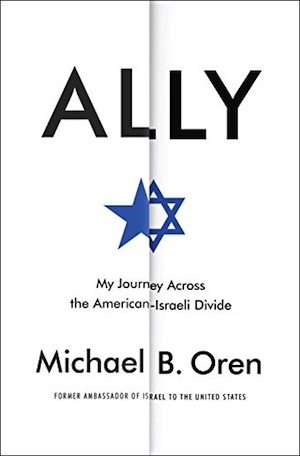
book cover - Ally: My Journey Across the American-Israeli Divide by Michael OrenOren spent the years 2009-13 as Israel’s envoy in Washington. Once a dual national of both the United States and Israel, the New Jersey-raised Oren had to surrender his U.S. passport at the American embassy in Tel Aviv before taking up his ambassadorial post – an emotionally wrenching episode that he describes in detail. Oren’s complicated identity as an American and an Israeli is a theme that runs throughout the book, and his treatment of this subject is a welcome tonic to the dreary and rather smelly charges of “dual loyalty” that too often accompany examinations of the relationship that Jews in the Diaspora have with the Jewish state.

The main attraction of the book, of course, is its account of the Obama administration’s Middle East policies, and Oren’s candor has already gotten him into trouble. Dan Shapiro, the current U.S. ambassador to Israel, who makes several appearances in Oren’s memoir, told Israel’s Army Radio that Ally is “an imaginary account of what happened,” belittling Oren for having, as a mere ambassador, a “limited point of view into ongoing efforts. What he wrote does not reflect the truth.”

This is a serious charge, and it remains to be seen if Shapiro will attempt to substantiate it. In the meantime, it should be pointed out that what makes Ally such a fascinating read is that it provides, from Oren’s perspective, a detailed sense of the bitter atmosphere in both Washington and Jerusalem that underlay diplomatic efforts on the issues we are all intimately familiar with, from the negotiations over Iran’s nuclear program to the stalled Israeli-Palestinian peace process. Unlike other diplomats, Oren didn’t wait 20 years to publish his story – most of the key individuals in his book, most obviously U.S. President Barack Obama and Israeli Prime Minister Binyamin Netanyahu, are still in power, and the bilateral tensions that Oren agonizingly explains haven’t been lessened since his departure from Israel’s Washington embassy. Diplomats aren’t supposed to be this transparent, which is why Oren will be regarded in many circles as a man who broke “omertà,” the code of silence which ensures that we ordinary mortals are kept in the dark about what our leaders are saying in private.

While it’s true that Obama comes in for heavy criticism, Oren rubbishes the claim that the president is “anti-Israel.” The reality is more complex; as Oren writes, “the Israel [Obama] cared about was also the Israel whose interests he believed he understood better than its own citizens.” One might add that this paternalistic approach has informed Obama’s stance on the entire region, resulting in a sly policy that presents itself to Americans as a much-desired withdrawal from the Middle East’s endless bloodshed while, at the same time, fundamentally redistributing the region’s balance of power in favor of Iran, whose rulers have spent almost 40 years chanting, “Death to America.”

Read more at jns.org.
Format ImagePosted on June 26, 2015June 25, 2015Author Ben Cohen JNS.ORGCategories BooksTags Barack Obama, Binyamin Netanyahu, Israel-U.S. relations, Michael Oren, Middle East
Helping kids, entertaining

Helping kids, entertaining

Jerry Maslowsky, executive director of Variety, the Children’s Charity of Manitoba. (photo from Jerry Maslowsky)

Jerry Maslowsky, executive director of Variety, the Children’s Charity of Manitoba, has a long history with the organization.

Maslowsky, 57, started off in performing arts as a teenager, in Rainbow Stage productions. Coming from a musical family, the stage was where he felt most at home.

He later became a member of a band called Special Blend and, for 18-19 years, he was with them, playing for many weddings, bar mitzvahs and graduations. He came across Variety in his early 20s, singing on the charity’s telethon in the 1980s. However, his work with them was yet to come.

Maslowsky was approached by CJOB radio station to take on the role of marketing director, with a major aim being to bring the Winnipeg Blue Bombers and the Winnipeg Jets to the station. Then, in 1999, he was hired as director of sales by the Winnipeg Blue Bombers, becoming their vice-president of marketing and sales, and working with the team for 15 years.

A year ago, Maslowsky felt it was time to move on, as an opportunity with Variety came up. The organization’s previous executive director, who Maslowsky knew very well, was retiring.

Since Variety started as an entertainer’s charity, it was something in which Maslowsky was very interested – working with kids and giving back, as well as “ensuring that all kids are having a childhood just made sense,” he said.

The original chapter started in Pittsburgh in 1927 as an international children’s organization, the initiative of a group of 11 men involved in show business, who set up a social club, which they named the Variety Club.

Maslowsky explained, “On Christmas Eve 1928, a small baby was left on the steps of the Sheridan Square Film Theatre, with a note. The note read, ‘Please take care of my baby. Her name is Catherine. I can no longer take care of her. I have eight others. My husband is out of work. She was born on Thanksgiving Day. I have always heard of the goodness of show business people and pray to god that you will look after her.’ Signed, ‘A heartbroken mother.’

“Since efforts to trace the mother failed, the members of Variety Club named the child Catherine Variety Sheridan, after the club and the theatre on which steps she was found. They undertook to fund the child’s living expenses and education. Later, the club decided to raise funds for other disadvantaged children.”

Today, there are more than 44 Variety “tents” (described as “tents” for its circus component) throughout the world. Manitoba’s Variety started in 1978, and it has helped more than 800,000 children throughout the province, raising more than $30 million. The B.C. chapter celebrates its 50th anniversary this year; over that time, it has raised more than $170 million, every year assisting more than 1,200 children. There are other tents in Canada, with a new one slated to open in Montreal.

Maslowsky credited Gene Telpner with bringing a Variety tent to Winnipeg. He got the idea, “then called his good friend, Monty Hall of Let’s Make a Deal, and they were able to formulate a tent in Winnipeg that was really run by a lot of the people from the Jewish community in the entertainment and hotel industry – people like Mickey Levine from the International Inn and Harvey Nairn. A lot of people in the entertainment industry took a hold of this and created the organization and telethons.”

Variety’s mission is to meet the tangible needs of children with all abilities. “This means that every child does have an ability,” explained Maslowsky. “Some children’s abilities are different than others’. We basically look at every child, the abilities they have, and other abilities maybe they lack. That’s where Variety comes in, in how we can support the child as well as the family.

“When children belong here, we call them part of Variety family, because it’s just not always the immediate need we look after. We also look after ensuring the child’s and family’s needs throughout those years, before they come into 18 years old, that Variety stays a part of their life.”

Part of Maslowsky’s mandate at Variety is to reach out to alumni, “kids” who are now 36- and 37-years-old, to see how they are doing, and to bring them back as mentors for younger Variety children.

“One of the things we did that was important for me when I came back was going back to our roots of showbiz, circus and entertainment,” said Maslowsky.

He went to work, calling on his friends from his entertainment past. “So, we were able to plan a Come One, Come All – Under the Big Top event,” said Maslowsky. “I wanted it to be entertaining and I wanted people to come to an event where they could see it through the eyes of kids. And we’ve all grown up with the circus … we can relate to it. It was important to then get talent, not just dancers and speakers.” The event was held May 9.

Reflecting on his younger days, Maslowsky said, “My sister and I, we’ve always been teased as ‘the Jewish Donny and Marie.’ My sister does a lot of performing in the city and we did Folklorama [multicultural festival] for many, many years (at Shalom Square, the Israeli pavilion).”

He added, “Growing up in a Jewish family, knowing how to give and that you’re not always the best, that you just do what you can, you just be sure that you’re a giving person, that was certainly instilled into us by our parents.”

Rebeca Kuropatwa is a Winnipeg freelance writer.

Format ImagePosted on June 26, 2015June 25, 2015Author Rebeca KuropatwaCategories NationalTags children's charity, Gene Telpner, Jerry Maslowsky, Variety Manitoba
Cancer survivor chooses life

Cancer survivor chooses life

Michael and Francine Permack (photo by Bernie Bellan)

Winnipeg-born Michael Permack has lived 22 years with a brain tumor. That makes him Canada’s longest-living brain cancer survivor – by far.

Now a resident of Calgary, where he and his wife Francine have made their home since the late 1980s, Permack has been “giving back” to the Canadian Cancer Society by serving on the board of the Alberta Cancer Society for the past seven years (and as chair this past year). Permack has also been spreading the message: “You have to keep moving forward to maintain hope.”

When Permack was 29 years old, his future looked bright. Back in 1993, he had already married and had two young daughters, aged 1 and 3. He had an MBA from the University of Western Ontario and a successful career in commercial real estate. Then one day, as he was driving to a business meeting in

Edmonton with a colleague, he couldn’t talk. He continued to the meeting, but felt that something wasn’t right. “I started feeling really bad. I took a cab alone to the hospital and vomited at the reception desk. At first, they thought I was on drugs.”

When his wife Francine arrived at the hospital, he couldn’t even remember her name. Routine tests showed nothing, so his wife insisted on an MRI, which revealed a tumor in Michael’s brain. (Francine added that she has been an aggressive lobbyist on behalf of Michael throughout his struggle with cancer – something that she recommends to anyone finding themself stymied by the medical system.)

Although it was benign, the tumor had the potential to grow quickly. However, doctors did not want to operate or use radiation treatments because it was benign. They told Permack that his life expectancy was one or two years. “I stopped working so that I could spend as much time with my wife and kids as I could.… I bought into what the doctors told me about life expectancy,” he said.

Initially, he was devastated. He and his wife had always hoped for a family of three children but, with the prognosis, they put away those plans, as well as other dreams. Then he spoke to a psychologist who told him that he had two choices: to act as if he was going to die or to act as if he was going to live. “I chose life,” said Permack, “and decided to make a 180-degree turn in how I was going to live my life.”

At one point, he was just about to go to San Francisco to see about having the tumor removed, much to the dismay of the doctor who was treating him in Calgary. He was advised by the San Francisco surgeon, however, that the likelihood was that he would emerge from the operation a “vegetable.”

Faced with the prospect of having only a very short time to live or the alternative of a longer life in a highly incapacitated state, Permack was torn. In the end, he decided not to go to San Francisco. Instead, he relied upon the advice of his Calgary doctor, Peter Forsyth, to decline any surgery.

As it turns out, the pessimistic diagnosis that Permack had been first given was wrong. After a long period of recovery, during which he was off work for almost four years, he was able to resume working again.

Three years after his diagnosis, the Permacks fulfilled one of their family’s dreams when Peter, their third child, was born. However, in 2002, the family received more bad news. Francine was diagnosed with breast cancer and had a double mastectomy. “She had an amazing attitude that she was going to live life fully no matter what,” said her husband. She is now clear of cancer.

Then, in 2004, Michael had a “really bad” seizure, the first in 11 years since his diagnosis. An MRI showed that the tumor had become malignant. Surgery removed only 30% of it to protect his quality of life. “They took out as much as they could,” he explained.

Radiation and chemotherapy treatments followed. By June 2005, another MRI showed that the rest of the tumor appeared to be gone. By September of that year, Permack was back at work.

A few years ago, he had another scare. When the entire family was holidaying in Gimli, Man., Michael suddenly developed a severe headache when he was out on a jog and he was rushed to the hospital in the small town on Lake Winnipeg. From there he was taken to Winnipeg, where doctors decided to remove the rest of the tumor. The result was positive and Permack now is completely free of cancer. Does he have any explanation for his incredibly good fortune?

“None at all,” he said, admitting that he’s not at all religious, nor does he attribute his having survived to anything particularly spiritual. Yet, as one might expect, his experience has endowed him with a determination to remain positive – and to communicate the importance of remaining positive to anyone else suffering from cancer with whom he comes in contact.

This past March, Permack was awarded the Alberta Cancer Society’s Volunteer of the Year medal, something he deeply treasures. No doubt it’s a cliché, but if anyone can be said to be “paying it forward,” it’s Michael Permack.

Bernie Bellan is the editor of the Jewish Post & News, where a longer version of this article was originally published.


Format ImagePosted on June 26, 2015June 25, 2015Author Bernie BellanCategories NationalTags Alberta Cancer Society, Francine Permack, Michael Permack
Giving is a way to live well

Giving is a way to live well

Graduates of the Jewish Seniors Alliance peer support program, and teachers. (photo by Binny Goldman)

On June 11, I walked into a room filled with givers – of themselves. It was the special occasion of the graduation ceremony of the fifth class of peer counselors, which took place at the Peretz Centre for Secular Jewish Culture.

They were 13 men and women of various ages who had met as strangers and quickly become an extended family of friends. Through 11 weekly five-hour sessions in which interactive role-playing was used, they were taught how to listen, comprehend and use their newly acquired techniques.

Charles Leibovitch, coordinator of peer support services, warmly welcomed those gathered – family and friends of those receiving certificates and members of the board of the Jewish Seniors Alliance of Greater Vancouver. He introduced himself and Grace Hann, trainer and supervisor of the peer counseling program, then credited the founder of JSA, president emeritus Serge Haber, for being instrumental in initiating the program and working diligently to ensure that it thrived through continuous and crucial funding issues to meet the ongoing needs of our growing senior community.

Leah Deslauriers, coordinator of seniors at the Jewish Community Centre of Greater Vancouver, informed the audience of the many and varied activities open to all people (Jewish or not) at the centre for a nominal fee. She encouraged all to visit and partake in yoga, swimming, card playing and just general socializing. Expressing the wish for further partnering with the JSA, she extended a mazel tov to the graduates.

Barb Kirby of Community Resource Network said that, in both a personal and professional capacity, she had seen many gaps in the care of seniors over the years. “One of the greatest gaps we see is lack of support causing social isolation of seniors and that is why your job is so important. Your training and expertise provides a lifeline to those who truly are in greatest need,” she said.

“They say it takes a village to raise a child. I believe it take a village to care for the elderly and it takes a special kind of person to care for the elderly. You are that caring voice or the person sitting next to someone who truly needs a caring human connection or to go one step further to help get the further supports they might need.” One individual, organization or government cannot do it alone, said Kirby. “Speaking up, sharing knowledge and best practices will help make our communities a safer, more enjoyable place for those who need our support.”

She thanked Haber and JSA president Marilyn Berger “for providing all the invaluable services to bring awareness through education and support to our communities.”

Becky Herrmann of Angels There For You noted that people want to be needed, sought after and validated. She recommended the book Give to Live, and said there were no side effects to giving of oneself, urging everyone to try doing so. Larry Shapiro, one of the graduates, countered with, “There are side effects, but no negative ones.” Herrmann later presented each of the graduates with a gift.

Shapiro spoke next, sharing with the audience that, having completed the course, he felt prepared to go out and serve as a counselor. He proceeded to give a little history of peer support counseling in British Columbia, which has been present since the 1980s, addressing social isolation and other daily issues affecting seniors. Shapiro felt the course had taught him empathy, as well as the skills and techniques necessary to offer others methods of self-help.

Fellow graduate Neveen Hossameldin said that, as an immigrant, what one missed most were the friendships left behind, and that she didn’t have another 55 years to forge new ones. Yet, after 55 hours as part of this group, she had indeed made new, lasting friendships. Hossameldin appreciated that Haber had told the class that they were not working for JSA but were part of JSA. Echoing what others had said, she praised Hann for making the sessions pleasurable and warm.

Hann, laughing, said that since Shapiro had stolen a good chunk of her speech, she would just thank JSA and its founder, Haber, who deserved a special tribute for his vision, without which the program would not exist. She underscored that self-absorption kills empathy, that focusing on ourselves makes our world contract whereas giving to others broadens our world.

Leibovitch spoke of the ongoing need for peer support services and of the graduates who go out in the community to help combat the loneliness he sees daily. He said that phone calls to the office are often by those who have been guided by others to use the peer services, and that this essential, relevant help has become very valuable in the community. Karon Shear, coordinator of JSA, and Rita Propp were thanked for their constant commitment to excellence and giving of themselves.

Haber said, “Don’t do unto others what you don’t want others to do unto you,” a teaching found in other religions as well. Giving of yourself – so necessary both to the giver and the receiver – helps to alleviate loneliness, isolation and perhaps even remove the tarnish from the gold quite often present but hidden in the “golden years.” JSA is very proud of this program, he said, adding that he, too, had taken the course to familiarize himself with what was being offered and that he, too, had learned to really listen and hear what was being said. He concluded with the wish that all the graduates would go out and spread good will.

Certificates were handed out along with a rose to each graduate, as was a hug from both Hann and Leibovitch.

Ruby Boychuk, one of the graduates, presented Hann with a bouquet of yellow roses, explaining that yellow roses symbolized love and appreciation.

Family and friends proudly took photos of the celebration, while Stan Shear took a video that will be posted on the JSA website. Refreshments shared by all helped bring the evening to a close, leaving a sweet taste in our mouths and in our hearts. Mazel tov, graduates. Mazel tov, JSA.

Binny Goldman is a member of the Jewish Seniors Alliance of Greater Vancouver board.

Format ImagePosted on June 26, 2015June 25, 2015Author Binny GoldmanCategories LocalTags Jewish Seniors Alliance, JSA, peer counseling, peer support
Restoring sacred space

Restoring sacred space

The process of restoring headstones comprises many steps. (photos from J.B. Newall Memorials Ltd.)

photo - Among the headstones restored in the Jewish section of Mountain View Cemetery was that of Bessie Rosenberg.
Among the headstones restored in the Jewish section of Mountain View Cemetery was that of Bessie Rosenberg.

Last month, the restored Jewish section of Mountain View Cemetery was rededicated in a public ceremony that was the culmination of three years of work undertaken by a group of volunteers headed by Shirley Barnett and others. Among the contributors to the project was J.B. Newall Memorials Ltd.

“The restoration project in the Jewish section at Mountain View Cemetery was a very special project for us,” Meghan Newall told the Independent in an email. “Knowing that many of these pieces were designed and created by the Newall family over the past decades gave us a sense of honor and pride to be able to work on them once again. A great deal of work went into the cleaning, restoring and re-stabilizing of the markers and monuments, as each piece is unique and required a number of different methods and procedures (and patience!).”

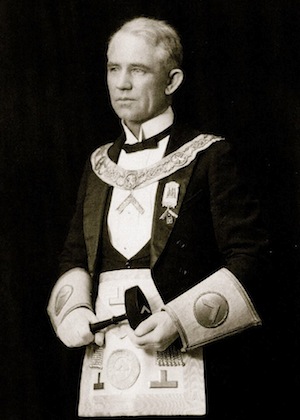
photo - John Brodie Newall established J.B. Newall Memorials in 1909
John Brodie Newall

Newall’s great-grandfather, John Brodie Newall, established J.B. Newall Memorials in 1909.

Described as “an accomplished poet, scholar and master mason,” on the company’s website, the history reads that he “parted with his family in 1905 from the town of Dalbeattie, Scotland. He left his brother David the family business – a granite quarry and monumental works company that gave birth to the town of Dalbeattie in 1820 – which continues to produce today.”

Shared his great-granddaughter, “We are (unfortunately) unsure why he decided to leave the granite business in Scotland to start over in Vancouver but are happy he did!”

She added, “I recently had the opportunity to visit the town in Scotland where our family started out and even saw one of the original quarries that is still in operation today, though it is now a sand and gravel quarry operated by a different company.”

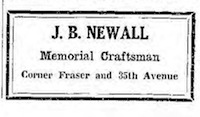
scan - One of the first ads run by J.B. Newall in the Jewish Western Bulletin. This one appeared Aug. 8, 1933. The company stills supports the community paper.
One of the first ads run by J.B. Newall in the Jewish Western Bulletin (Aug. 8, 1933). The company stills supports the community paper.

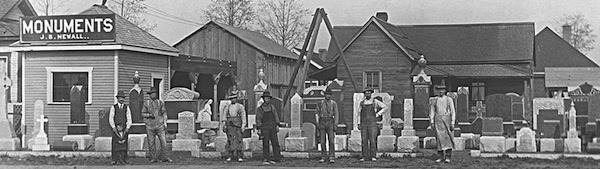
Eventually, her great-grandfather arrived in Vancouver. “He set up shop here, at our current location in 1909, where his son Nathan Newall continued the tradition,” explained Meghan.

Grandson Alan, his wife Rosemarie and their children, Meghan and her brother Brodie, “continue to create memories out of stone,” said Meghan. “Our works can be seen throughout British Columbia cemeteries as well as civic projects throughout the city.”

For more information about the cemetery restoration project, search jewishindependent.ca for “Mountain View Cemetery.” For more information about J.B. Newall Memorials, visit jbnewall.com.

photo - J.B. Newall has been in the same location since its establishment in 1909.
J.B. Newall has been in the same location since its establishment in 1909.
Format ImagePosted on June 26, 2015June 25, 2015Author Cynthia RamsayCategories LocalTags headstones, J.B. Newall Memorials, Jewish Cemetery at Mountain View, Meghan Newall
Walk Winnipeg’s North End

Walk Winnipeg’s North End

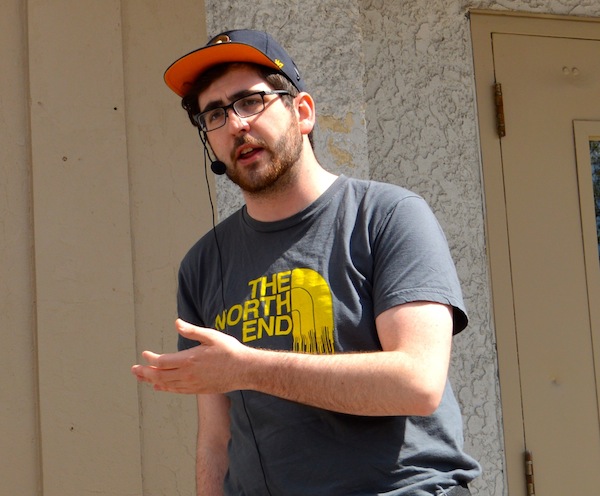
Walk participants explore the Ashkenazi synagogue, the oldest in Winnipeg, on a tour led and organized by Zach Fleisher. (photo from Zach Fleisher)

Not so long ago, Winnipeg’s Jewish community hub was the city’s North End. With Yiddish spoken on the street, Jewish businesses could be found on many corners, as could kosher butchers and synagogues. Since then, however, many Jews and Jewish-owned establishments have moved south or closed down entirely. Some of the North End buildings have been rebuilt or redesigned, while others have been preserved for various reasons. A recent walk – set up via Jane’s Walk – showcased the area’s history and current-day reality.

The early May tour was led by Zach Fleisher, 22. A history buff and University of Winnipeg student, he is chairperson of the Canadian Federation of Students Manitoba. In his spare time, he is involved with other projects, with the main goal of making Winnipeg a better place.

“I’ve always found myself enamored with the work of famous American-Canadian urbanist Jane Jacobs (for whom Jane’s Walks are named),” said Fleisher. “And, I’ve always been interested in how we build and define community. In that spirit, I’m quite interested in the history of Winnipeg and the Jewish population, especially the North End area.” He hopes people who took the tour will see the area differently now that they are aware of its history.

According to its website, “Jane’s Walk is a movement of free, citizen-led walking tours inspired by Jane Jacobs. The walks get people to tell stories about their communities, explore their cities, and connect with neighbors.” The free walks are held annually in more than 100 cities in 22 countries around the world on the first weekend of May each year, including in Vancouver.

Fleisher attended a few Jane’s Walks in Winnipeg last year and has informally given tours of different areas for a friend of his, Nicholas Audette, who suggested he get involved with the movement in a more formal way.

While some people RSVPed for his walk, there was no requirement to do so. “That’s what makes the Jane’s Walk so unique – the lack of commitment and organized structure that culminates in a strong sense of community,” he said.

Fleisher’s May 4 walk attracted more than 70 people. “I think a lot of people know that the North End carries a lot of history, but they are always interested in hearing a bit more about the area and its unique history,” he said.

The tour began from what used to be the old Canadian Pacific Railway station at 181 Higgins Ave. “The CPR station, where thousands of immigrants passed through, is now home to an aboriginal centre, housing a variety of offices,” explained Fleisher. “It was a place of great significance and a proper starting point, as almost every Jewish newcomer to the city would also have begun their story in Winnipeg at that same spot.

“This station was one of two major train stations in Winnipeg, the other being Union Station on Main Street.” The station fell out of use in the 1970s, he said.

Walking through Point Douglas on Austin Street, the tour headed toward Chesed Shel Emes funeral home. Along the way, Fleisher pointed out what was formerly the Sharon Home, which was originally established as a rehab centre, but became a personal care facility; it is today located in the city’s South End, and called the Saul and Claribel Simkin Centre.

Although the North End has not seen a significant Jewish population in two generations, the many buildings and sites that are historically relevant remain, along with a number of other key cultural institutions.

“At its peak, it’s believed that over 15,000 Jews – primarily from the Ukraine, Poland and Russia – called the North End home,” said Fleisher.

Once at Chesed Shel Emes, participants were given a brief history of the facility by Sharon Allentuck, who was representing the chapel because its executive director, Rena Boroditsky, was away. The funeral home was founded in 1930 by volunteers who wanted to ensure that every Jew had access to a proper Jewish burial and, in 1947, the chapel was built, she explained.

The walk then continued along Main Street to Burrows Avenue, to Congregation Ashkenazi. “The Ashkenazi is the oldest synagogue in Winnipeg and has a second floor only for women,” said Fleisher. “According to [its] tradition, non-married Jewish men don’t wear tallit, because the women on the second floor then got to pick their husband.”

Saul Spitz, who organizes the maintenance and care of the building, was on hand to give a talk and lead a tour of the synagogue.

“The North End has a rich tradition that continues today,” said Fleisher. “Along with the times, the type of community has changed. While the Jewish North End may be a memory of years past, it’s important to recognize the heritage of the area.”

photo - Zach Fleisher in front of what used to be the building housing the city’s Hebrew Sick Benefit Association
Zach Fleisher in front of what used to be the building housing the city’s Hebrew Sick Benefit Association (photo from Zach Fleisher)

After passing by the German Club at Flora and Charles streets, which was the home of the Talmud Torah at one time, the walk continued on to one of the few Jewish businesses still around in the North End – Gunn’s Bakery, which opened in 1937.

Fleisher noted that Gunn’s is located next to what was formerly the Hebrew Sick Benefit Hall, now home to a Christian worship group, though the building still retains the initials HSB.

Fleisher said he would love to organize another walk if there’s interest, and “to branch out a bit as well. So many of the folks who made it out had their own additions to the oral history of the walk and were able to contribute as necessary. I aimed to provide a basic framework for the walk and so many people were able to bring their own lived experience to the table.

“The walk was a great experience and it was great to see that I’m not the only one with a passion for the rich diversity of the area,” he continued. “The Jewish component is only one part of the rich diversity of the North End and I’d encourage everyone to read up a bit more on such a dynamic area.”

The next Jane’s Walk weekend is scheduled for May 6-8, 2016. To find out about walks in the various cities or to organize one of your own, visit janeswalk.org for more information.

Rebeca Kuropatwa is a Winnipeg freelance writer.

Format ImagePosted on June 26, 2015June 25, 2015Author Rebeca KuropatwaCategories NationalTags Chesed Shel Emes, Gunn’s Bakery, Jane Jacobs, Jane’s Walk, Jewish history, Winnipeg, Zach Fleisher
Help Ringelblum doc

Help Ringelblum doc

Emanuel Ringelblum (left), Rachel Auerbach (third from the left) and other Jewish intellectuals in Poland, 1938. (photo from whowillwriteourhistory.com)

Many Vancouverites will remember the 2008 traveling exhibit hosted by the Vancouver Holocaust Education Centre called Scream the Truth at the World: Emanuel Ringelblum and the Hidden Archive of the Warsaw Ghetto. It provided an overview of Warsaw historian Ringelblum and a secret group, Oyneg Shabbes (Joy of Sabbath), who during the Holocaust worked to document and preserve material relating to their experiences. The artifacts they buried in milk cans and metal boxes – some 30,000 items – were found in the rubble of the Warsaw Ghetto in 1946.

Now, Katahdin Productions is raising funds to make a feature documentary about Ringelblum and the Oyneg Shabbes archive. The film, Who Will Write Our History, is based on the book of the same name by historian Samuel Kassow.

Writers, artists, scholars, journalists, poets and diarists, more than 60 diverse people, handpicked by Ringelblum, collected and recorded as much as possible about every aspect of life in the ghetto – poems, paintings, photographs, underground newspapers, essays on hunger, smuggling, the Jewish police, clandestine schools and literary evenings and more. Their common goal was to ensure that the truth would survive even if they did not, as was the case with Ringelblum.

Only three members of Oyneg Shabbes survived the war. Among them was Rachel Auerbach, a prolific writer who would spend the rest of her life memorializing Ringelblum and Oyneg Shabbes. It is Auerbach’s writing and point of view that will provide the narration and narrative structure of the film. She will be voiced in the film by Academy Award-nominated actress Joan Allan.

In 1946, before Auerbach left Poland for Israel, she and the other two Oyneg Shabbes survivors led rescuers to the location of the first cache of the ghetto archive. The rescuers unearthed 10 metal boxes that had been buried on the eve of the Warsaw Ghetto Uprising. A second cache of two milk cans was discovered when Polish construction workers were building new apartment buildings on the site of the former ghetto. The third cache was never found and is believed to be buried under what is now the Chinese embassy in Warsaw.

Directed and produced by Roberta Grossman with Nancy Spielberg as executive producer, Who Will Write Our History (whowillwriteourhistory.com) will make the story accessible to millions of people around the world. Katahdin Productions’ documentaries include Blessed is the Match: The Life and Death of Hannah Senesh, which won the audience award at 13 film festivals, was broadcast on PBS, nominated for a Primetime Emmy and shortlisted for an Academy Award; Hava Nagila (The Movie), which was the opening or closing night film at more than half of the 80 film festivals where it screened, and was released theatrically; and Above and Beyond, about Jewish-American pilots who volunteered to fly for Israel in its War of Independence, which earned 20 audience awards and critical acclaim. (For an article on the latter, visit jewishindependent.ca/spielberg-opens-film-festival.)

The goal of the Indiegogo fundraising campaign is to raise $100,000 to fund 10 days of shooting in Warsaw in fall 2015. On average, each day of shooting costs $10,000. Some days are much less expensive; for example, shooting exteriors of streets in Warsaw involves only a small crew. Other days are quite involved. For example, shooting recreations of key events in the story with props, costumes, actors, lighting, sets, stages, etc., requires a crew of 20+ people and costs as much as $20,000 per day. If the $100,000 goal is not reached, it will mean fewer filming days in the fall; if it is exceeded, there will be more, as needed to complete production.

For more information, including a video about Who Will Write Our History, visit indiegogo.com/projects/who-will-write-our-history-production#/story. There is about a week and a half left to contribute to the campaign.

Format ImagePosted on June 26, 2015June 25, 2015Author Katahdin Productions with JICategories TV & FilmTags Emanuel Ringelblum, Holocaust, Katahdin, Nancy Spielberg, Oyneg Shabbes, Rachel Auerbach, Roberta Grossman
Hebrew in Tri-Cities

Hebrew in Tri-Cities

A photo from Aleph in the Tri-Cities’ Facebook page about their Hebrew classes.

Three years ago, a group of parents, all members of the Facebook group Aleph in the Tri-Cities, decided to create their own Hebrew Sunday school. It took more than a year of preparations before everything fell in place, but last September, the Tri-Cities Hebrew School began serving 14 elementary schoolchildren from Burnaby, Richmond and Coquitlam. They recently completed their first year.

The educational program was designed by Limor Friedman, a former IBA (Israel Broadcasting Authority) foreign correspondent. “We wanted to provide language and culture to our children, not only prepare them for a bar mitzvah. Our program was designed for children to learn about Israel through songs, books, reading and writing. The children were introduced to Israeli poets and authors that expanded the experience beyond the regular aleph-bet. We celebrated the Jewish holidays with emphasis on Israeli tradition, not just the Jewish perspective. One of my favorite classes was for the children to learn the map of Israel and to recognize which city or town their parents came from – it was a great way to discover their own roots and learn about their own personal background.”

The three-hour weekly class was led by Noa Marnin Gilad, who was a teacher in Israel, with the help of 19-year-old Ram Alexaiev; story time was led by Dovrat Vitis. Yossi “Joe” Dagan was the administrator, whose vision helped establish this new venture.

“Our Facebook group went through major changes over the last year,” explained Dagan over the phone. “We are now officially a registered not-for-profit organization with a mission statement to provide Jewish experience to the growing Jewish population of the Vancouver suburbs. It’s a challenge to build a budget based on donations but we love what we do and our community members love what we do, so it keeps us motivated for the future.”

Friedman’s proudest moment of the school year came over the Passover dinner table. “Seeing my daughter singing all of the Passover songs brought tears to my eyes. Our guests were amazed, too. That is the greatest benefit of group learning. Some parents think it’s better to teach Hebrew in the privacy of their own home, but then the child feels alone and he is insecure about the whole experience. In a group, children feel that they are not alone, that this is not something that only their own parents care about. The power of the group turns it into a positive lesson and it becomes important for them to do well, not just for us, but for themselves as well, and that is priceless.”

Aleph in the Tri-Cities’ Hebrew school will resume in late August before the High Holidays. For more information, email [email protected].

Shahar Ben Halevi is a writer and filmmaker living in Vancouver.

Format ImagePosted on June 26, 2015June 25, 2015Author Shahar Ben HaleviCategories LocalTags Aleph in the Tri-Cities, Dovrat Vitis, Hebrew classes, Noa Marnin Gilad, Ram Alexaiev, Yossi Dagan
Mystery photo … June 30/15

Mystery photo … June 30/15

Children with bicycles, possibly at a Beth Israel parade, Vancouver, 1970. (JWB fonds; JMABC L.09774)

If you know someone in the photo above or any of those below, please help the JI fill the gaps of its predecessor’s (the Jewish Western Bulletin’s) collection at the Jewish Museum and Archives of B.C. by contacting [email protected].

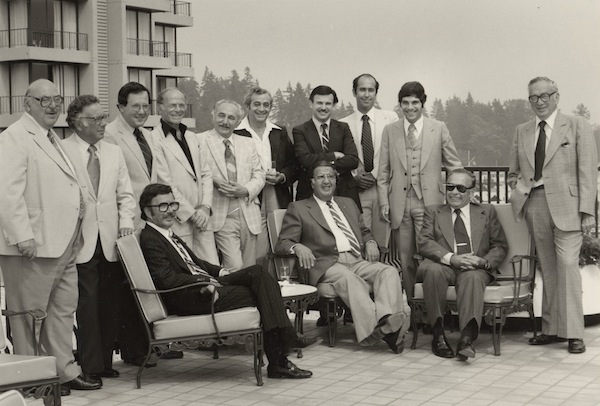
photo - Group of men on an outdoor patio, Vancouver, Aug. 30, 1979. Morris Wosk is standing, fifth from the left, and Joe Cohen is seated in the centre
Group of men on an outdoor patio, Vancouver, Aug. 30, 1979. Morris Wosk is standing, fifth from the left, and Joe Cohen is seated in the centre. (JWB fonds; JMABC L.14739)
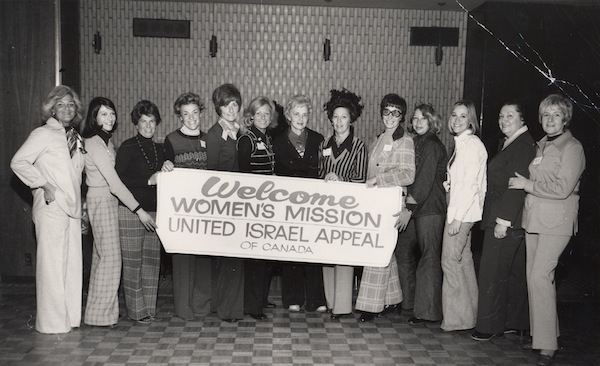
photo - Women holding the banner “Welcome, Women’s Mission, United Israel Appeal of Canada,” Vancouver, March 26, 1975
Women holding the banner “Welcome, Women’s Mission, United Israel Appeal of Canada,” Vancouver, March 26, 1975. (JWB fonds; JMABC L.15296)
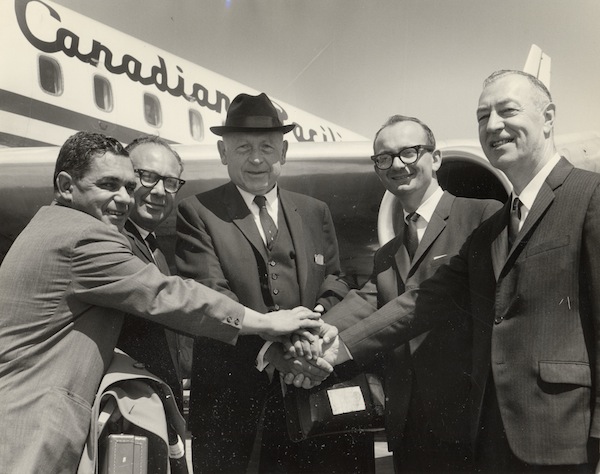
photo - Men alongside a Canadian Pacific aircraft with Karl Silberman, special representative for projects, Keren Hayesod, 1968
Men alongside a Canadian Pacific aircraft with Karl Silberman, special representative for projects, Keren Hayesod, 1968. (JWB fonds; JMABC L.15161)
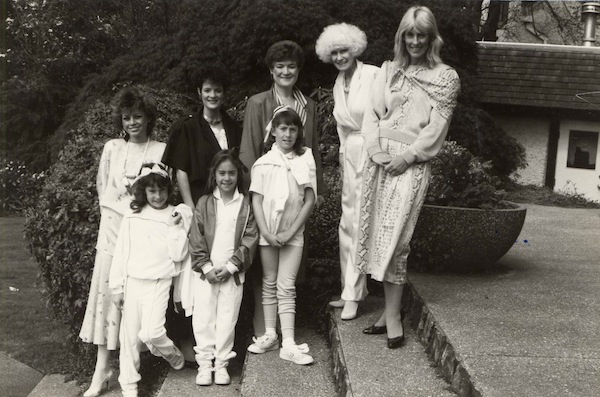
photo - ORT fashion show: Dianne Faber (extreme right), Leta Jones (third from the right), Vancouver, May 30, 1985
ORT fashion show: Dianne Faber (extreme right), Leta Jones (third from the right), Vancouver, May 30, 1985. (JWB fonds; JMABC L.14068)
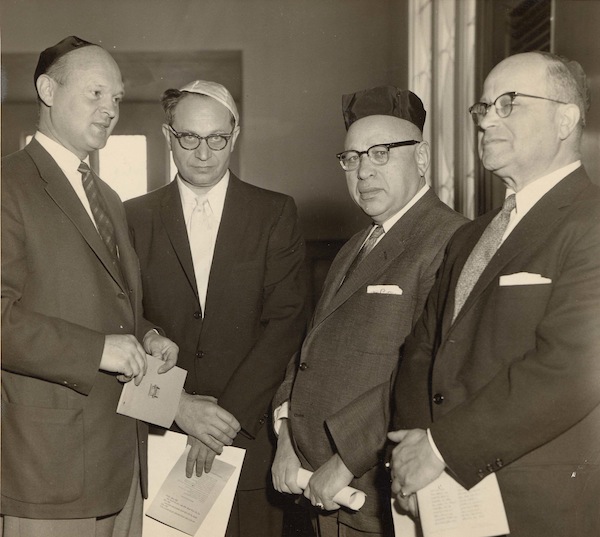
photo - Centenary presentation at Schara Tzedeck, Vancouver, circa 1955. Jack Diamond is second from the left
Centenary presentation at Schara Tzedeck, Vancouver, circa 1955. Jack Diamond is second from the left. (JWB fonds; JMABC L.14275)
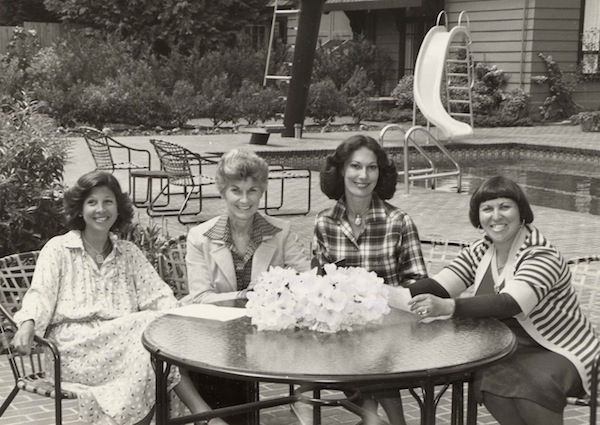
photo - Women at poolside table, Vancouver, 1980
Women at poolside table, Vancouver, 1980. (JWB fonds; JMABC L.14058)
photo - “Good old days” revived at B’nai B’rith picnic, 1972
“Good old days” revived at B’nai B’rith picnic, 1972. (JWB fonds; JMABC L.09560)
Format ImagePosted on June 26, 2015June 25, 2015Author JI and JMABCCategories Mystery PhotoTags B'nai B'rith, Beth Israel, JMABC, Keren Hayesod, ORT, Schara Tzedeck, UIA, United Israel Appeal
Radio host visits Israel

Radio host visits Israel

U.S. radio host Dr. Joy Browne discusses the post-traumatic physical and psychological challenges of terrorism at OneFamily. (photo from OneFamily)

American syndicated radio host and clinical psychologist Dr. Joy Browne had a meeting with victims of terrorism at the headquarters of OneFamily during her first-ever visit to Israel earlier this month.

Hosted by Chantal Belzberg, chief executive officer of OneFamily, Browne met with former residents of the United States, Canada and the United Kingdom who were dealing with physical and emotional wounds in the aftermath of terror attacks across Israel over the past few years. She interviewed Cheryl Mandel, Kay Wilson, Steve Bloomberg and Rebecca Fuhrman, as well as some of OneFamily’s psychologists and therapists for a future segment on her program.

“After experiencing the aftermath of 9/11, we all share a common echo and I am impressed with the resilience of the people here who have worked or who are working to transcend fear and are getting on with their lives,” said Browne.

Mandel, a native of Toronto, who made aliyah nearly 25 years ago, lost a son, Daniel, who was killed during an Israel Defence Forces anti-terrorism mission in Nablus (Shechem) in 2003. Mandel, in tears, told Browne, “Our entire family, including myself, lives life to the fullest and I am an optimistic person by nature, but one never is prepared for the shock that comes with the death of a son, whom I never thought twice about sending to the army.”

Browne’s trip to Israel was sponsored by the Office of the Prime Minister and America’s Voices in Israel.

Format ImagePosted on June 26, 2015June 25, 2015Author OneFamilyCategories WorldTags Cheryl Mandel, Israel, Joy Browne, terrorism

Posts pagination

Previous page Page 1 … Page 428 Page 429 Page 430 … Page 494 Next page
Proudly powered by WordPress