Women and their allies across North America marched last Saturday in a massive show of feminist and progressive activism. It was the second annual such event, the first one coming the day after U.S. President Donald Trump’s inauguration last year.
At the Los Angeles Women’s March, actor Scarlett Johansson, who is Jewish, told the audience that she became part of the movement because she felt a rage in her on behalf of women who have been abused and because of things that have happened to her in the past.
“Suddenly, I was 19 again and I began to remember all the men who had taken advantage of the fact that I was a young woman who didn’t yet have the tools to say no, or understand the value of my own self-worth,” Johansson said.
Johansson’s experience is one of millions that have been shared in recent months since the advent of the #MeToo movement. But it was a message that was not heard by all.
Because Johansson was scheduled to speak at the event, Palestinian women’s groups boycotted it. One group accused Johansson of “unapologetic support of illegal settlements in the West Bank.”
The Palestinian groups’ complaint, ostensibly, is that Johansson was a spokesperson for SodaStream, which produces an at-home beverage carbonation system. The fact that SodaStream was based in Maale Adumim, a West Bank Jewish settlement, made it a target for BDS, the movement to boycott, divest from and sanction Israel.
The Palestinian American Women’s Association declared: “While her position may not be reflective of all organizers at the Women’s March Los Angeles Foundation, PAWA cannot in good conscience partner itself with an organization that fails to genuinely and thoughtfully recognize when their speaker selection contradicts their message.”
In a free country like the United States, anyone is free to boycott anything. The Palestinian women’s groups were fully within their rights to stay home. But the idea that Johansson was not a legitimate voice to be heard at the rally because she does not condemn Jewish settlements in the West Bank is a bit of a stretch.
If Johansson’s association with SodaStream was the real reason the Palestinian groups stayed home, as they say it is, it presents an opportunity to reflect on a bit of recent history. In one of their few successful campaigns, BDS managed to force SodaStream to close its West Bank plant, causing unemployment for 500 Palestinians who had worked there. Some achievement.
However, something potentially more significant may be afoot, which has nothing to do with SodaStream or settlements at all.
The Palestinian movement is trying to co-opt the progressive and feminist movements in the name of a nationalist movement that gives no indication that it would, if successful, reflect anything like what North Americans would consider a progressive or woman-friendly independent country.
One of the things that progressive people have come to accept, with much thanks to #MeToo, is that intent sometimes matters less than impact. We have come to accept, for instance, that what a man might call “persistent flirtation” can be experienced by women as coercion, intimidation or worse.
Palestinian groups – and the progressive and feminist groups they infiltrate – should be conscious that what is intended as criticism of Israel, whether they like it or not, impacts on Jews. Of course, not all Jews are Zionists. Nonetheless, when you attack Israel, Jews feel it.
Consider from where we’ve come. A few short years ago, most “pro-Palestinian groups” insisted they didn’t oppose Israel’s existence, they were merely criticizing certain policies of the Israeli government. Now, it is extremely common for people to express outright antipathy to Zionism. Indeed, Zionism is a dirty word among many of the people who organized and participated in the marches last weekend. This is a far step from criticizing certain policies. To oppose Zionism is to oppose the existence of a Jewish state.
The Palestinian movement is trying to kick the Zionists (and that includes most North American Jews) out of the progressive and feminist movements. Is that OK with progressives? Is that OK with Jews?
If both sides don’t do something about it, Zionists and Jews are going to have a sworn enemy on the left and the left is going to be known as a no-go zone for Jews and Zionists. Who thinks that’s OK?
Hospitality is culture itself and not simply one ethic amongst others. (Jacques Derrida, On Cosmopolitanism)
One of the late French-Jewish philosopher Jacques Derrida’s most famous short works is his On Cosmopolitanism, in which he discusses the problem of refugees. Cosmopolitanism is a word first coined in ancient Greece by wandering, homeless philosophers and popularized by the Stoics. It refers to the idea that the whole world (cosmos) is my city, or community (polis). It is the idea of an international or, better, transnational humanity and citizenship. Cosmopolitanism became popular again during the European enlightenment and slowly had a growing influence on international law and modern ethical sensibilities, including the sense that countries have a duty of hospitality, of offering refuge even to peoples of other nationalities.
This same ethical idea occurs in Derrida’s own Jewish tradition, where “love the stranger” is a commandment uttered many more times than “love your neighbour” and where Isaiah the prophet urged Israeli kings to give shelter to refugees of war.
In On Cosmopolitanism, which was based on a speech Derrida gave to the International Parliament of Writers on the subject of refugees, Derrida discusses the nature of hospitality and the contradiction at its heart. Hospitality involves welcoming guests into your home, in sharing resources and shelter, yet, to do so, it must remain “a home.” Should all boundaries of the home dissolve in unconditional welcome then the possibility of hospitality itself will also be obliterated. Derrida’s insight mitigates against a naive or utopian call for the obliteration of borders or the indiscriminate welcome of refugees.
In this thought of Derrida we see a tragic conflict at the heart of modern Zionism. Do we want a hospitable Zionism? Is the house the Jews built in Israel for Jews alone? Yet if the doors are flung wide, what will happen to “our Jewish home”?
There is much anxiety to protect our “home,” of that we can be sure. An extensive security wall, checkpoints, and airport border guards who are masters of interrogation. When we press Israel to become more hospitable – to African asylum seekers, to displaced Palestinians – we hear a chorus of voices arise: if we let them in, if we include them, the demographics will dissolve our home!
And we so badly want a home. Wandering for 2,000 years, we were homeless, exiled, a tolerated or cursed minority. Finally, we returned to our ancient home and, amid controversy with others who had come to live there and also claim it as home, built walls to protect it. We now again had a home, and we have chanted this word to ourselves over and over again, “home, home,” for the last 70 years.
Yet what good is a home that does not extend hospitality? Sure, we airlifted Ethiopians, we opened our arms to Russians, and so on and so forth. Yet they were us, our family. True hospitality, though, as it says in our own foundational text, is given to the stranger. The other.
Unconditional welcome is not the only way to destroy a home. What good is a home that offers no hospitality? Is a home that offers no hospitality even a home at all?
Israel is in the process of deporting the 60,000 African refugees who arrived before the building of a barrier wall with the Sinai to prevent more entering. As Russel Neiss wrote in the Forward, “For years, in actions held to be illegal multiple times by Israel’s Supreme Court, the Israeli government has arrested and placed these refugees in a detention centre in the Negev and forcefully deported them to other African nations in exchange for money or favourable terms for weapons contracts and military training.”
Twenty thousand refugees, most from Sudan and Eritrea, have already been deported or left of their own accord, and the government has ordered the rest to leave, with a small financial gift and plane tickets paid, or be jailed.
According to Derrida, hospitality is both a duty and a defining feature of a real home. The feeling that an inhospitable Israel is not really a home, I fear, is growing and will continue to grow among Israelis and Jews. Maintaining the feeling that Israel is a Jewish home only will require an unremitting focus on perceived and real threats to Jews in Israel and abroad. It will reinforce the unhealthy sense of home as a shelter from others, rather than fostering the healthy sense of home, one that is open to sheltering others.
The result may be that we have a very well guarded home. But, for those of us who perceive the lack of hospitality on offer, it begins to feel like no home at all. The opposite of Derrida’s formula – “in order for there to be hospitality, there must be a home” (a formula that is surely true and needs due respect) – is “in order for their to be a home, there must be hospitality.”
Jews, being a transnational people for so many years, became, in two senses, a “cosmopolitan people.” One was that fact of transnationality; the other stemmed from the involvement of Jews in socialist political movements, which problematized nationalism, as well as our involvement in activism aimed at the liberalization of immigration laws. It was all of this, seemingly, which coalesced to give birth to the use of “cosmopolitan” as an antisemitic code word for “Jew.”
I don’t think “cosmopolitan” is an insult, but rather a very high compliment. When an antisemite calls Jews “cosmopolitan,” I hear it as a calling, not a calling out. Israel will not truly be our Jewish home until it embodies the highest cosmopolitanism of the Jewish spirit, which can be read in the Torah’s call – millennia ago – to love the stranger and refugee.
Matthew Gindinis a freelance journalist, writer and lecturer. He writes regularly for the Forward and All That Is Interesting, and has been published in Religion Dispatches, Situate Magazine, Tikkun and elsewhere. He can be found on Medium and Twitter.
At Camp Shomria, it’s all “about equality and giving the power to the youth,” says one parent. (photo from Camp Shomria)
In Ontario, Camp Shomria was established based on the principals of Hashomer Hatzair (The Young Guard), with its Zionist and socialist principles, including that building a strong community is just as important as building strong individuals.
Camp director Uri Ron Amit is an Israeli who runs the only chapter of Hashomer Hatzair in Canada, which is based in Toronto. He comes from a background of working as an educator in international development and community management.
“The kids are from Grade 2 (7-year-olds) all the way up to Grade 11 (17-year-olds),” said Amit. “By Grade 12, they become first-year youth counselors in the movement. And then, later on, they can continue working to make an impact in the camp, either as youth counselors, as head of camping or as head of programs.”
Most families involved at the camp are from the Toronto area but some campers also come from the United States and a fairly large number come all the way from Israel. The camp is situated an approximately four-hour drive northeast of Toronto, and about an hour and a half southwest of Ottawa.
“Starting in Grade 2, the kids spend a week away from home at camp,” said Amit. “Grades 3 and higher stay at the camp for at least two weeks at a time, and sometimes for five weeks. Having young kids sent by their parents to be away from home … brings both opportunities and challenges. The further away you are, the more remote [it is, and] it can create a sense of independence and a different world for the kids and youth counselors.”
Hashomer Hatzair was established more than 100 years ago, he explained, “with the idea of having youth of different ages develop an independent youth community that stands for the ideals of humanistic Judaism and Zionism. The main difference in sending your kid to experience camp away from home is the added layer of independence – a level of ownership over the community … self-reflection and personality development.
“I think the main reason parents send their kids away from home for a couple of weeks with minimal communication with them is because they want them to go through a meaningful learning process that can help them pick up a strong group dynamic in the youth community.”
Amit described one particular child who came to the camp. This child had never been to a sleepaway camp before, and was dependent on his parents for almost everything. “After a couple days, this child became a star,” said Amit. “He became independent and took to different stages of sharing feelings and emotions…. We gave him the opportunity to lead discussions … with group members. His parents said it was a life-changing experience.”
Camper Zoe Friedman, 13, who lives in Toronto, started attending the camp last summer, choosing to do so after she learned that some of her friends from Israel go there.
“It’s a camp that really builds character,” she said. “And it gives you time to expand on things … expands character, responsibility and social skills. Every morning, we have something called toranuyot (chores), where we get split into groups and go clean up the camp…. So, we might clean the washroom, pick up trash, or something else that helps everybody. The theme of Shomria is socialism. We all do everything together and support each other. It’s a really good vibe.”
As for being away from her parents and home, Zoe said she felt it was sometimes very difficult, as, at night, it is extremely dark and you feel very far away from it all. But, at other times, she said, it is tremendously fun.
“It was really fun to disconnect from the outside world and focus on what’s in front of you,” she explained. “It’s just interesting to see how such a big group of kids can just disconnect from technology and focus more on social skills, responsibilities, and just on having a good time, without focusing on technology.”
Zoe and her family – mom Eilat Bakerman, dad David Friedman and younger sister Gaia, 9 – have been living in Toronto for the past 12 years, and are very involved in the local Jewish community. Bakerman heard about Shomria from friends and decided to send both Zoe and Gaia there.
“They thought it really helped to build kids’ character, and they support the values of what the camp aims for … about giving the power to the youth,” said Bakerman. “The camp is run by youth and they are leading other youth, a bit younger kids, in whatever they do. The only adults they have there are the operational staff – cooks, doctors, nurse, drivers, and so on. It highlights what you’d imagine a kibbutz life was like when it first started.”
According to Bakerman, one example of the unusual way in which the camp is run is how, when the kids first arrive at the camp, any money parents send with the kids is pooled together and everyone is given back an equal share. “Nobody feels they have more than others,” she said.
“When they go to Perth, which is the closest city,” said Bakerman, “everybody gets the same share of money – no matter how much they each may have brought into the camp – and that’s what they have for spending money.
“No matter if you came from a wealthy home, where you don’t need to do any chores, or not, at camp, in the morning, the kids decide what kind of chores they’ll do and everybody in the group does it,” she added. “Everybody is eating the same food. It’s about equality and giving the power to the youth.”
Bakerman also regularly sends her daughters to stay with family in Israel while she stays to work in Canada. The location of the sleepaway camp was not a deterrent.
“I think the kids are so engaged, it really doesn’t matter – the distance,” said Bakerman. “The distance is neither a barrier nor an excuse to come home or to call home. To me, it was about character and values…. The camp gave them independence and they have something to aspire to become. They’re really looking forward to next year.”
Friends at Camp Shomria show off the fresh vegetables they picked in the camp’s garden. The produce was used to make a salad for one of the meals. (photo from Camp Shomria)
It is said that there is no better way to learn something than by immersing yourself in it. And for kids who want to learn Hebrew in Canada, camp is one of the best and most accessible ways of doing that. But, while there are many Jewish camps in Canada that promote Hebrew language, Camp Massad in Manitoba is the only camp where all the activities and programming are carried out in Hebrew.
“They are not allowed to speak English outside the cabin,” said Danial Sprintz, the camp’s executive director. “Inside the cabin, they speak in whatever languages they want to. But, if they are outside, they are not allowed to speak in English to each other. The kids are all trying to speak Hebrew. So, when everybody’s doing it, you fall in line. Our camp is run completely in Hebrew and there isn’t any other camp that is doing that.
“Not all the kids that come to the camp can speak Hebrew when they arrive. About 50% of the kids don’t go to Hebrew day school, so they are learning Hebrew at camp. We don’t sit them down in a classroom, but we teach them the essentials they need to ask the basic questions. We teach Hebrew through song.”
With repetition, and everyone being together for three meals a day and programming, the kids start picking up the ability to communicate with each other as they go.
Most of the staff has grown up going to the camp and, each year, there are also a number of staff who come in from Israel.
The camp also prides itself on being 100% inclusive. No matter what a child’s situation – if they are autistic, use a wheelchair or are developmentally delayed, or if they are completely secular or ultra-Orthodox in Jewish observance – Sprintz said the camp is dedicated to finding a way to make the experience work for all campers.
Sprintz was executive director of Congregation Emanu-El in Victoria for a number of years, when he and his wife were going to school in British Columbia, before returning to Winnipeg and taking on his role at Camp Massad.
“When I arrived in Victoria, the rabbi was on sabbatical in Israel,” said Sprintz. “I approached the board about helping them with the programming while he was away, and then just stayed on after.”
This experience helped Sprintz develop ways of introducing the children at Camp Massad to Judaism. “We make it fun,” he said. “And we make it something the kids look forward to, as we make the tunes and the process of it all fun. We have tefillin club in the morning for kids who want to try something out, and for kids who need to. But, when it comes down to it, we provide all the religious and traditional cultural components that kids would need to come to camp, to a certain point – we don’t want to separate boys and girls, as we want everybody to be together.”
Camp Massad encourages the children to write their own songs and to put on plays for others in the camp – all in Hebrew.
Winnipeg’s Aviva Tabac has been sending her two daughters, Chaya, 15, and Sara, 13, to Camp Massad for the last three years.
“I didn’t go to camp growing up,” said Tabac. “My parents took us on a summer vacation each year, and the rest of the time was spent at the beach with family and friends. Since I didn’t grow up going to summer camp, I felt it would be a good idea for the girls to try it. Just from my immediate circle of friends who all went to Massad, there’s a special bond they have with one another that carries over into adulthood. All my friends still talk about their fond Massad days and I wanted to give the girls the chance to experience that for themselves.”
Both Chaya and Sara attend public school, so they do not get a lot of other opportunities to speak Hebrew. Tabac said, “When my girls return from camp, they continue to speak in Hebrew, sing Hebrew songs and reminisce. They hang onto their Massad memories and feelings for as long as they can.
“The Hebrew is a big component,” she continued, “but, more so, the celebration of Shabbat, day-to-day celebration of Jewish culture and being proud of being Jewish. The lov[ing], understanding and caring staff and councilors [are] amazing. My girls feel at home when they’re at Massad. They come back rejuvenated, independent and confident. I know that, when they’re there, I have nothing to worry about because they’re in good hands.”
Meanwhile, Lilach Golan moved with her family to Vancouver last fall. She has been sending her four daughters to Camp Shomria in Ontario for years, and plans to continue doing so. She does it with the hope of them picking up some of the values that she grew up with on kibbutz in Israel, including Hebrew.
“For us, the Hebrew language and culture were extremely important and it was very difficult to speak in Hebrew at home all the time … because, when children live in English, they want to speak English and want to be part of the culture around them,” said Golan.
While Camp Shomria operates in English, Hebrew is everywhere at the camp, and the different areas in the camp have Hebrew names, like the chof (beach), cheder ochel (dining room) and moadon tarbut (culture club). Hebrew is also spoken during many of the activities, which include singing and dancing, and at different presentations.
“They do have a lot of Israelis and people who speak Hebrew,” said Golan. “And that’s a big push for the Hebrew – kids love to talk Hebrew with them and the Israelis come every summer. And the songs they sing, there is a lot of language happening there.”
Sharon, 14, is Golan’s youngest daughter. For her, the best part of camp is getting to spend time with her kvutza (group).
“We use Hebrew terminology in contexts where they make sense to me and I can use them meaningfully,” said Sharon. “I also remember better what they mean when I’m not at camp anymore because I can remember the context in which we used them. Hebrew constructs a lot of what and how we do things at Camp Shomria and it’s that culture, atmosphere and values that make me want to come back.
“Even if the Hebrew we use at camp is not new to me,” she said, “it adds so much value to the camp environment and my experience of it. It helps me develop the connection to the three pillars of Hashomer Hatzair [The Young Guard, the Zionist-socialist youth movement] and the core values we share.”
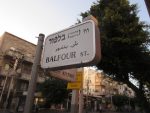
Balfour Street in Jerusalem. (photo by Pat Johnson)
One hundred years ago, on Nov. 2, 1917, one of history’s most consequential letters was typed. Simple and short, the Balfour Declaration, as it would become known, is a central artifact in the history of Zionism, the state of Israel and the ongoing conflict over claims to the land on which Israelis and Palestinians reside.
The letter from the British foreign secretary, Lord Arthur Balfour, was addressed to Lord Walter Rothschild, a leader in the Zionist Federation of Great Britain and Ireland. It informed Rothschild that the British cabinet had approved this one-paragraph statement:
“His Majesty’s government view with favour the establishment in Palestine of a national home for the Jewish people, and will use their best endeavours to facilitate the achievement of this object, it being clearly understood that nothing shall be done which may prejudice the civil and religious rights of existing non-Jewish communities in Palestine, or the rights and political status enjoyed by Jews in any other country.”
The letter was enormously historic for a number of reasons, not least that the first Zionist Congress had taken place a mere 20 years earlier, the first tangible expression in two millennia that the Jewish people should reasonably anticipate self-determination in the land of Zion. And now one of the world’s great powers was on record as supporting the endeavour.
The letter was also hugely presumptuous because the area in question was still under the control of the Ottoman Empire. The Ottomans would not be thoroughly vanquished by the British-French-Russian allies until 1918. Yet the allies were so confident of eventual victory that the secret Sykes-Picot Agreement of 1916 was already (on paper) carving up the region between the European powers.
Nevertheless, the document stood as a testament to British allegiance to the Zionist ideal in the interwar period. That allegiance, of course, amounted to very little in practical terms. In response to Arab protests (including mass murder in Hebron in 1929), the British froze Jewish migration to Palestine at the very moment in history when it was more urgently necessary than ever. The Holocaust – which can be said to have begun in earnest on Kristallnacht, Nov. 9, 1938, 21 years to the day after the Balfour Declaration was made public – occurred, of course, because of the Nazis’ Final Solution. But it could only have occurred in the enormous extent that it did because no other nation on earth would welcome the imperiled Jews of Europe. Palestine was the most obvious place for them to go, but British resolve folded in the face of Arab protest and Jews were trapped in Europe, where six million would die.
Likewise, the British commitment to Zionism amounted to nothing when it mattered again after the Holocaust. Still preventing widespread Jewish migration to Palestine, the British eventually gave up on the entire enterprise and threw the troubled land into the lap of the newly founded United Nations. The UN, for its part, eventually passed the Partition Resolution that would have seen two states – one Jewish, one Arab – formed in Palestine.
The reality remains that one significant sub-clause of the Balfour Declaration stands out to the contemporary eye. The statement that “nothing shall be done which may prejudice the civil and religious rights of existing non-Jewish communities in Palestine” would certainly be viewed by many as remaining unfulfilled. The civil rights of non-Jewish citizens of Israel are protected in law, but serious inequalities remain. More significantly, the statelessness and associated lack of civil rights experienced by Palestinians in the Israeli-controlled parts of the West Bank would certainly not live up to the well-intentioned words of Balfour.
Some say the British government should apologize for their role in advancing an independent Jewish state. British Prime Minister Theresa May batted that one back in a letter to her party’s Conservative Friends of Israel, saying, “We are proud of our role in creating the state of Israel.… The task now is to encourage moves toward peace.”
If apologies are in order, the British government might consider apologizing for giving little but lip-service to the Zionism enterprise throughout the 20th century.
The Balfour anniversary is an interesting time to reflect on history – and the past has an important role to play in informing us of the present. But, as always, we should keep our focus on the future.
Soon after he discovered he was Jewish, Csánad Szegedi reached out to Rabbi Boruch Oberlander. Szegedi’s transformation from virulent antisemite to Orthodox Jew is the topic of the documentary Keep Quiet. (photo from Gábor Máté/AJH Films & Passion Pictures)
While this year’s Vancouver International Film Festival holds much that will be of interest to Jewish Independent readers, the list is short when it comes to specifically Israeli or Jewish-related films that will appeal.
Perhaps surprisingly, the Israeli films are harsh critiques of Israel. Beyond the Mountains and Hills (Israel/Germany) is about a dysfunctional family (a metaphor for the country), Junction 48 (Israel/Germany/United States) is about an Arab-Israeli rapper who faces racism, among other Israeli-inflicted ills; Between Fences (Israel/France) is a documentary about Israel’s internment of African refugees at the Holot Detention Centre and Vita Activa: The Spirit of Hannah Arendt (Israel/Canada) is about Hannah Arendt, who, among other things, was critical of Jewish leadership during the Holocaust and did not approve of the state of Israel as it was founded.
Among the other film offerings is Keep Quiet (United Kingdom/Hungary), a documentary about Csánad Szegedi, the staunch antisemite who helped found Hungary’s far-right party Jobbik and its Hungarian Guard, which has since been banned. As a member of the European Parliament, he continued to foment hatred until a fellow nationalist and racist outed him as being Jewish – his grandmother had not been the adopted daughter of the Klein family, as she told him, but their daughter. The documentary includes interviews Szegedi did with his grandmother (about her imprisonment in Auschwitz, and other matters) and a conversation with his mother, who also found out later in life that she was Jewish. He asks both women about his increasing embrace of antisemitism over the years, why didn’t you stop me? Their responses are thought-provoking and sad.
Keep Quiet does not accept Szegedi’s transformation unquestioningly and gives speaking time to the doubters, as well as the cautious believers, such as Rabbi Boruch Oberlander, head of the Orthodox Rabbinical Council in Budapest. Oberlander has supported and taught Szegedi since the former antisemite contacted the rabbi for help. The event that ends the film is Szegedi’s attempt in 2013 to speak in Montreal about his Jewish journey – he wasn’t allowed to stay in the country. Before being put on the next plane home, however, Szegedi recorded a lecture, which was played at the event, with Oberlander fielding the hostility it wrought in some attendees. In Oberlander’s view, we must love every Jew, no matter how wicked. Of his choice to help Szegedi, he says, “I pray that I shouldn’t be disappointed.” Even Szegedi is unsure as to whether he would ever turn his back on Judaism – maybe, he admits, but not likely.
The way in which the filmmakers present Szegedi’s story is informative and balanced, and viewers get a sense of the man and his deeds, as well as about Hungary and how a political party as racist as Jobbik can find success there.
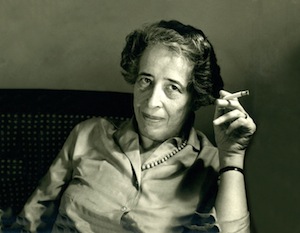
Hannah Arendt (photo from the Hannah Arendt private archive via Zeitgeist Films)
Vita Activa also does a good job of including both fans and critics of Arendt’s work, but mainly uses Arendt’s own words to explain her thoughts and analyses. The film uses as its foundation the Adolph Eichmann trial, about which Arendt wrote Eichmann in Jerusalem: A Report on the Banality of Evil (1963), describing Eichmann as “a typical functionary,” and thus an example of the “banality of evil.” (Viewers should be warned that there are many disturbing Holocaust-related images in this film.)
“Eichmann was quite intelligent but he had that dumbness,” she tells an interviewer in one of the clips included in the documentary. “It was that dumbness that was so infuriating, and that was what I meant by ‘banality.’ It has no depth; it isn’t demonic. It’s simply the unwillingness to ever imagine what others are going through.”
Another of Arendt’s theories – about refugees – remains relevant. With no rights, refugees are considered “superfluous” by a regime, she argued, and denationalization and xenophobia become a powerful weapon of totalitarian politics.
In Keep Quiet, a political journalist describes Hungary as a “part of the world where history has been manipulated” and the effects that such manipulation has upon generations. Arendt broadens that view beyond Europe, saying, “It has been characteristic of our history of consciousness that its worst crimes have been committed in the name of some kind of necessity or in the name of a mythological future.”
In addition to her early work, Vita Activa touches upon Arendt’s personal life, which offers some further understanding of the philosopher, who was seen by many to lack empathy. In one interview, she talks about how Auschwitz shouldn’t have happened, how she could handle everything else but that. Yet, she criticized the Jewish leadership who cooperated with the Nazis – the councils and kapos – and hypothesized that, if there had been no such leadership, there would have been chaos and suffering and deaths but not six million. One professor interviewed for the documentary calls Arendt’s comments “irresponsible,” another says they showed her complete ignorance of history, yet another says she regretted her remarks later in life.
The film also notes Arendt’s change from supporting Zionism to condemning elements within it. Among other things, she said, “A home that my neighbor does not recognize is not a home. A Jewish national home that is not recognized by and not respected by its neighboring people is not a home, but an illusion, until it becomes a battlefield.” And she pointed to tendencies within Zionism that she considered “plain racist chauvinism” that do “not differ from other master race theories.”
The documentary also covers Arendt’s 1951 Book of Thoughts, in which she contemplates the nature of forgiveness, revenge, reconciliation. For her, the latter doesn’t forgive or accept, but judges. When you take on the burden of what someone else did, she believed, you don’t accept the blame or absolve the other of the blame, but take upon yourself the injustice that occurred in reality. “It’s a decision,” she said, “to be a partner in the accountability, not at all a partner to the guilt.”
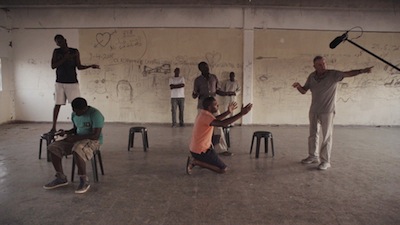
A “theatre of the oppressed” workshop at the Holot Detention Centre in Israel. (photo from Vancouver International Film Festival)
Reconciliation and forgiveness don’t enter the picture in either the documentary Between Fences or the fictional (but based on a real person) Junction 48. They each highlight important, even vital, issues in Israeli society, but do so in such a condemnatory, predictable way that anyone but the choir won’t be able to sit through these films.
Without much context, Between Fences looks at the poor situation in which asylum seekers from Eritrea and Sudan find themselves when they reach the safety of Israel. In many countries, these asylum seekers face problems, but viewers wouldn’t know that from this documentary, nor would they begin to understand the atrocities being committed in their homelands. However, they will learn how Israel doesn’t recognize their refugee status and makes every effort to send them back, how racist Israelis are towards these newcomers and a host of other problems with Israel and its people. Not one government official or Israeli is interviewed, although some Israelis participate in the “theatre of the oppressed” workshops in Holot on which the film focuses. In addition to leaving many questions unanswered, the film also begins and ends confusingly and is slow-paced.
Bias also makes Junction 48 almost unwatchable for anyone who would like to see the Israeli-Palestinian conflict resolved, so that both peoples’ rights and safety are ensured. From the second sentence of the opening, the perspective is made clear: “The Israeli city of Lod is the Palestinian city of Lyd, which once sat on the main railway junction. In 1948, tens of thousands of Palestinians were exiled from Lyd in order to resettle the town with Jews….”
Samar Qupty and Tamer Nafar in Junction 48. (photo from VIFF)
We then meet Kareem, an aspiring young rapper, whose parents are worried about his involvement with drug dealers and his future in general. His friends not only deal and take drugs, but visit prostitutes and dabble in other criminal activity. Nonetheless, every Israeli they encounter is the real bad guy, from the police to other rappers to the government, which is knocking down one of their homes to build a coexistence museum. Oh, the irony.
The only entertaining and thought-provoking aspect of this film is the music by lead actor and film co-writer Tamer Nafar, which is available online.
In the end, the Jewish Independent chose to sponsor what a VIFF programmer called a “classic Jewish comedy,” though, having seen a screener of the film, the Jewish aspect is hard to discern. While much lighter (and non-political) fare than the other offerings, it has much to say – or show, really, as the dialogue is minimal – about social awkwardness and a lack of direction in life. The protagonist, Mike, works at a pizza place in New Jersey and has the energy level of a slug and the magnetism of zinc. Yet, somehow, he has friends, albeit not great ones.
Short Stay is one of those films that moves apace with its main character, so slowly and in all different directions, as Mike both physically wanders the streets and mentally wanders to destinations unknown. Viewers don’t gain insight into what motivates Mike, who seems unperturbed by his lack of career, social skills, direction and future, but they root for him, empathize with what must be his loneliness.
The social awkwardness of the protagonist of Short Stay, Mike, is obvious in his exchanges with others. (photo from VIFF)
Short Stay director Ted Fendt best describes the acting of the nonprofessional cast, many (all?) of whom are his friends. “The film contains a range of performance styles from the fairly natural (Marta and Meg), to Mark and Dan’s B movie ‘villains,’ who might have stepped out of an Ulmer or Moullet film, to the quasi-Bressonian, unaffected manner Mike delivers his lines.” And therein is a Jewish link, Edgar G. Ulmer.
Another Jewish filmmaker – Vancouver’s Ben Ratner – will be premièring his short film, Ganjy, at this year’s festival. About a former boxer suffering from dementia pugilistica, who is in desperate need of help when three friends visit, Ganjy was inspired in part by Muhammad Ali. Its creators are looking to fundraise enough to take the film to other festivals, as well as contribute to the Muhammad Ali Parkinson Centre. For more information, visit indiegogo.com/projects/ganjy-film#.
For more information about and the full schedule of films playing at VIFF, visit viff.org.
Note: This article has been edited so that it is clear Hannah Arendt was speaking of tendencies within Zionism that she considered “plain racist chauvinism” that do “not differ from other master race theories,” and not condemning Zionism as a whole.
I was recently invited to speak to an Ottawa-based Israeli-Palestinian relations group on the topic of Canadian Jews and Israel. Unfortunately, there is a dearth of public opinion data available on Canadian Jewish attitudes. We have some broad strokes on identity issues, though. In addition to Conservative Judaism – rather than Reform – being our largest denomination, Canadian Jews, compared to American Jews, are one generation closer to the Holocaust, are more likely to speak Hebrew, educate their kids Jewishly, and to have visited Israel. Most central to my talk though, was how Canadian Jewish institutions are responding to attempts to challenge Israel as a Jewish state, including the boycott movement.
A lively Q&A followed, but there was one question that stopped me in my tracks. What is it about Israel, a man asked, that makes you feel attached to it? He seemed genuinely curious and rather puzzled, so puzzled that he asked it twice.
Being in the field that I am in, I have a ready answer, but I know I am not typical. My own attachment to Israel centres primarily on a deep passion for Hebrew and Israeli culture. I lived in Israel for three separate years in my 20s, I speak only Hebrew to my kids, I alternate my Netflix watching with Israeli dramas and I am as likely to binge listen to “The Last Waltz” as to Kaveret’s final concert album. My daughter’s d’var Torah at her bat mitzvah was the only one I’ve heard reference Arik Einstein lyrics. Of course, the attention I devote to Israel is partly a function of my profession, but I chose my area of study based on a great sense of attachment to the country and a desire to understand how the Israeli-Palestinian region can become a more just and humane place.
But what of my fellow Canadian Jews? Those of my parents’ generation, who grew up in the shadow of the Holocaust, might view Israel as an insurance policy in the event of the unthinkable. Religious Jews might feel a profound spiritual connection to the land. But what of the many less religious Canadian Jews of my generation (and younger), those for whom Canada, with its absolute commitment to freedom, tolerance and multiculturalism is as safe a haven as any they could imagine; those for whom particular stones on particular bits of territory are not understood to hold sacred meaning, and for whom Hebrew or Israeli contemporary culture is not something that pulls them?
What does Israel mean to these Jews who are unlike my parents, unlike religious Zionists and unlike me?
I encourage my fellow Canadian Jews to articulate their attachments. Doing so with nuance and open hearts may help uncover new political arrangements. Maybe it would point to two states, maybe a confederation system where everyone has access to all the land but possesses citizenship in only one state (as Dahlia Scheindlin and Dov Waxman have proposed), and maybe even a single state where both languages and cultures are carefully preserved. We should ask what threat, exactly, does refugee return pose, rather than leave it as an imaginary bugaboo. Being explicit about our emotional ties – while being open to hearing the emotional experiences of others – may bring us closer to supporting creative peace efforts.
A postscript. A survey of the Canadian Jewish community is currently being circulated by Jewish Federations of Canada-United Israel Appeal, and British Columbians can respond online via svy.mk/20qCWb7. The survey is being conducted by David Elcott and Stuart Himmelfarb, both of New York University’s Wagner Graduate School of Public Service. As I recall, there is only one question on Israel, which asks whether the respondent feels “attached” to the country. Attachment is associated with many different perspectives, and says nothing about one’s commitment to human rights for those under Israel’s control, for example. I hope that we may soon see more in-depth survey research on Canadian Jewish attitudes towards Israel and its policies.
Mira Sucharovis an associate professor of political science at Carleton University. She is a columnist for Canadian Jewish News and contributes to Haaretz and the Jewish Daily Forward, among other publications. This article was originally published in the CJN.
When Vancouver-based songwriter and musician Daniel Maté wrote on his public Facebook page that he had declined an invitation from Jewish Federation of Greater Vancouver to accompany some singers on Yom Hazikaron, since he “couldn’t in conscience do that as long as we don’t honor the far more numerous victims of the terror ‘our’ side inflicts,” he received an invitation from an Independent Jewish Voices (IJV) member to get involved in their group.
Sarah Levine was that IJV member. “It’s important to me to stand with other Jews who are working for Palestinian human rights,” she told me. “I think we have a particular role as Jews to think critically about Zionism, since the state of Israel often claims that it does things ‘in our name’ and with our support.”
Along the political spectrum of Jewish groups in Canada devoted to matters pertaining to Israel and Palestine, IJV – which bills itself as a human rights organization – tries to carve out a space rejecting traditional Zionist principles. In an organized Jewish community where conservative positions on Israel prevail, this doesn’t make it many friends.
Writing in the Huffington Post, IJV campaigns coordinator Tyler Levitan cites the silent treatment he regularly receives from an array of Jewish institutions when he seeks to publicly debate issues including Jewish National Fund discriminatory land-lease policies and the boycott, divestment and sanction movement. IJV considers BDS “a last resort,” as the group’s website says, and, while most observers would characterize IJV as anti-Zionist, it says that it “does not define itself in terms of Zionism.”
I spoke with Levitan. “Eroding that support base [for political Zionism] would be weakening the glue that binds the community,” he said. “That’s the fear. But we at IJV feel that having difficult and honest conversations is what makes the community stronger.”
For several years, I’ve watched IJV operate from close quarters. As a self-defined progressive Zionist, I have not signed onto IJV’s platform. But, as someone who values serious debate within the Jewish community, I have twice participated in an IJV-hosted forum. Mostly, I find it a sign of community weakness that most of the engines of the Jewish community attempt to shut IJV out of the conversation entirely.
Some Jewish papers (namely this one and the Jewish Post & News in Winnipeg) are open to including IJV perspectives, but the Canadian Jewish News and the Ottawa Jewish Bulletin keep a wide berth around IJV. Yoni Goldstein, CJN’s editor, will not grant IJV editorial space. As Goldstein put it, “… even though we promote inclusion as a virtue, there are limits to how inclusive we’re willing to be. Abetting BDS and rejecting Israel’s future as a Jewish state crosses the line.” Goldstein added: “Independence has its benefits, but the comfort of community is not usually one of them.”
With the exception of the Peretz Centre in Vancouver and the Winchevsky Centre in Toronto, no Jewish community locale will host IJV events – or even rent space to them, according to Levitan. But they’re not giving up on trying to be heard within Jewish community walls. “We’re persistent,” he said.
To reject Zionism indeed does place IJV outside of the mainstream community tent. It is this way, but should it be?
Like all political “isms,” Zionism’s meaning comes from the effects of the policies with which it is associated. While the debate between statist Zionism and those who foresaw other possible arrangements for Jewish liberation in the early 20th century was robust and active, non-Zionist voices receded as Jewish statehood emerged. But now, almost seven decades later, Israel is in crisis. It may be time to ask whether Jewish privilege should be rolled back in favor of some more inclusive and democratic arrangement. A frightened community, however, may view this very question as akin to treason.
IJV’s adherence to the Palestinian right of return is the biggest stumbling block for those who support Israel’s identity as a Jewish and democratic state. But even here, consider the wording on IJV’s website: “Peace will only be possible when Israel acknowledges the Palestinian refugees’ right of return and negotiates a just and mutually agreed solution based on principles established in international law, including return, compensation and/or resettlement.”
Any solution – even a two-state one – will likely involve some return, some compensation and some resettlement. While IJV does speak in terms of “rights,” in practice we might see their call as somewhat more pragmatic than many assume.
The thing is, even reasoning out these complicated dilemmas as I’m trying to do here is well-nigh impossible as long as groups like IJV remain excluded by the sort of herem (excommunication) with which they’ve been saddled. One thing on which Levitan and mainstream Jewish community leaders seem to agree is that there’s a lot of fear. And, sadly, we know all too well the kinds of politics to which fear can give rise.
Mira Sucharovis an associate professor of political science at Carleton University. She is a columnist for Canadian Jewish News and contributes to Haaretz and the Jewish Daily Forward, among other publications.
A screenshot from the trailer for Avi Does the Holy Land. The vlog will appeal to some more than others.
Good satire depends not only on distancing the viewer from the object of ridicule, but on making them identify with it, if only just a little. For North American Jews who’ve grown up with affection towards Israel, a new video blog (or vlog) does just that.
Avi Does the Holy Land is a sendup of sex-drenched Zionism, a vlog that purports to tackle various hot-button aspects of Israel – “the most contentious state in the Middle East!” in the words of Avi, a “Canadian Jewess” who “went on a Birthright trip and fell in love with Israel.” (Haaretz has since revealed that Avi is Aviva Zimmerman, originally from Calgary, and now an Israel-based filmmaker.)
Through a website, a YouTube channel and a Facebook page, Avi covers such topics as how to beat terrorism, whether Palestinians are really oppressed or not, what to pack for Birthright, and the accusation, by Israel’s critics, of pinkwashing.
And, while Avi is a cartoonish, lipsticked character who perpetually seems perplexed by the sincerity of her interviewees, many of us will no doubt identify with at least a sliver of her carefree naiveté.
“Did I just give a blow job to a guy named Dudu?” she muses in one segment.
In my kibbutz-loving period of the early 1990s, it wasn’t a guy with the unfortunate name Dudu I fawned over, but another whose name in translation meant “ploughed field.” Giggling over his agricultural moniker while in ulpan class, my pals and I idealized his Zionist credentials.
In another scene, Avi wears a pink T-shirt emblazoned with an Uzi, the kind that pepper tourist shops throughout Jerusalem.
While I never wore clothing depicting an actual gun, I did rummage through the kibbutz lost and found one day and select a worn, burgundy T-shirt from a paratrooper, the kind Israeli soldiers design when they finish their basic training. (This one, from 1984, was extremely tame next to the tasteless ones appearing in more recent years – ones that promote rape and anti-Palestinian violence.) I later found the owner – a different strapping kibbutznik whose name meant cedar tree – but never did return it. Why would I? It had the perfect mix of soft fibres and Jewish power pedigree. All the better to wear while painting metal beams and bantering with the workers over never-ending tea-and-toast breaks in the kibbutz welding shop.
Avi Does the Holy Land’s web episode “Pride vs. Pinkwashing” is the most cutting in terms of political messaging. It involves alternating scenes of Avi doing what she “does best” – “dancing on a truck” at Tel Aviv Pride – and interviewing Rami Younis, a Palestinian writer and activist, over charges of Israeli pinkwashing. Calling Israel’s critics “belly-aching leftist sh–heads,” Avi muses over Younis being “hashtag superserious,” and finally suggests to him that perhaps if he drapes himself in a rainbow flag, Israel will treat him better.
It’s probably fair to say that I move in circles that are highly critical of the occupation and that, while I’ve taken a nuanced position on pinkwashing, still take the claim seriously. But I, too, have enjoyed a Tel Aviv Pride beach party, trying to order a vodka cocktail from a shirtless bartender and, in my distraction, confusing the Hebrew word for cranberries with that for paratroopers and enjoying my private little malapropism – a symbol of Diaspora idealization of Israel – for weeks after.
So is Avi “other”? Or is Avi “us”? For those who are distressed by the occupation and feel a gradual distancing from Israel through decades of government intransigence and illiberal moves intended to silence and intimidate human rights activists, probably a bit of both. And for those who don’t have a single critical word in their lexicon for the Jewish state, I’m really not sure. But I’d love to see their reaction.
Mira Sucharovis an associate professor of political science at Carleton University. She is a columnist for Canadian Jewish News and contributes to Haaretz and the Jewish Daily Forward, among other publications. This article was originally published onforward.com.
More than 100 people were at the Museum of Vancouver on Sept. 9 for a New Israel Fund of Canada-hosted panel discussion, The Backstory: Behind What You Know About Israel. Moderated by Temple Sholom’s Rabbi Dan Moskovitz, the evening featured Ronit Heyd, executive director of Shatil, an Israeli nonprofit supported by NIF, and Canadian journalist and editor Jonathan Kay of The Walrus.
The night before their Vancouver talk, Kay and Heyd spoke to a large crowd in Toronto, where they were joined by Haaretz editor-in-chief and journalist Aluf Benn. In Vancouver, the two were introduced by NIFC board president Joan Garson and executive director Orit Sarfaty. They covered a range of issues, including the rise of women in the Knesset, how North Americans talk about Israel, the problem of racism in Israeli society, the lasting impacts of 2011’s social justice protests and the influence of feminism and the Women of the Wall.
Ronit Heyd (photo from New Israel Fund of Canada)
Starting with a bit of good news, Moskovitz asked Heyd to talk about the fact that, at 31 members, the current Israeli Knesset has more women MKs than any prior government. “It’s not just in the Knesset,” said Heyd, “more women than ever ran in the last municipal elections.” Women are also trying to participate more equally in local religious councils, a task not for the faint-hearted, she said, due to the “very strong political power in the Knesset [and the Israeli establishment] that is still being held by the ultra-Orthodox parties. The ultra-Orthodox do not have – I want to add, yet – do not have women in the parties.”
The impact of the rise of women in politics extends beyond the makeup of parliament, Heyd said. “It is important to note that when a woman enters a very masculine environment, it changes” in several ways, including shifting the agenda. It is changed by raising, for example, the notion of transparency, “of the need to have a more just distribution of resources, of having a more open governance … and we see that especially with the religious councils.”
Though the pace of change is slow, she said, “This is not happening just out of the blue; they needed training. One of the things that Shatil does is work with a group of women who want to be elected to the religious councils – they want to have their voice heard. They need support, they need to know how to build alliances, how to read a budget.”
Kay added that, while there are certain parallels, the situation in Canada is very different, and bringing women into Israeli politics is a “much more urgent project.” Unlike in Israel, he said, “in Canada, there is no significant mainstream constituency that believes that women cannot occupy the public sphere. It’s a fringe, not mainstream, view. In Israel, you have these people who ideologically don’t believe that women should have a role in public life.”
However, though women in Israel are participating at unprecedented levels in government, their voices are still not equally heard in the male-dominated policy landscape. Of the main issues in the Knesset, Heyd said, “The first one is security. The second one is security. The third one is also security. And women are not brought into that conversation.” The impact of women will be more fully realized, she said, once they have influence in policies around pay equality, security and the economy.
Moskovitz asked each panelist to comment on the polarization of the conversation about Israel and how the divisiveness impacts the Canadian and Israeli Jewish communities.
Jonathan Kay (photo from New Israel Fund of Canada)
Part of what creates the tense atmosphere is that “Zionism itself in its most potent form has become a form of religion,” Kay said. “What do religions provide? They provide a theory of evil, they provide a theory of good, they provide a tribal identity, they provide a liturgy … many of the fundamental elements of a religion are provided by the most militant aspects of Zionism as they are projected in the Diaspora.
“By the way,” he continued, “I consider myself a Zionist. I’ve written columns in support of Israel, I’ve raised the flag in time of war. However, I know when I see people’s opinions on geopolitics become so strong that they take on the character of religious beliefs. And you see this with the Iran nuclear deal. It is not only, ‘I don’t like Clause 7, but I do like Clause 8.’ The dialogue is, ‘It’s 1938, are you with Churchill or are you with Chamberlain?’ … the imagery of Hitler, the imagery of black, white, good, evil. And, again, I know there’s this well-intentioned idea among many liberal Jews, ‘Well, if only we had the right press release, or the right argument and we could frame things in the right way.’… To a certain extent, that’s not happening because the people on the other side of the debate have chosen another faith.”
The speakers agreed that the polarization of the debate in the Diaspora impacts Israeli society; it matters. “There is a direct line that goes from the conversation that is being held here in North America and what’s happening in Israel,” said Heyd.
Can Jews in North America find a way to talk about Israel, asked Moskovitz?
“Email is the destruction of dialogue,” Kay said. “Stop sending each other articles! Take 30 seconds and actually put your own thoughts in your own words. You don’t have to send it to 50 people…. Don’t call me an imperialist if you think I’m right wing. Don’t call me a useful idiot if you think I’m left wing…. Don’t fall back on those tropes…. In the ’90s, you actually had to find someone to argue with! Now, you can actually do it from your desk, and I think that has raised the temperature because it has created tribalism. It’s one thing to lose an argument with one person, it’s another thing to lose an argument with 50 people on a reply-all email chain. It sounds silly, but the medium is the message.”
Another issue that has made news is the problem of racism. While there are few parallels between the Black Lives Matter movement in the United States and the protests of Ethiopian Israelis earlier this year, both countries still need to find a way to better integrate and respect racial diversity. The issue is especially acute when it comes to integrating Arab-Israelis into Israeli society.
Kay said he believes that Canada has done an excellent job of assimilating various groups, with some exceptions, but it helps that many immigrants come to Canada from urban centres, and are well educated. “Regardless of their skin color, they’re capitalists…. That’s the main thing,” he said.
On the question of what changes Israel has undergone since the 2011 summer economic protests, Heyd said there is still no economic relief for average Israelis, who are increasingly burdened by the cost of living, but Israelis have received more coverage for childcare, and the centralization of the market is back on the political agenda.
Overall, whether it’s the ways in which Israel is meeting its challenges or struggling to balance security with social justice, what is apparent, Heyd said, is that there is “a mini flourishing of civil society … people in the periphery are becoming involved, not just Tel Aviv, the big cities,” and that is cause of cautious optimism.
NIFC hosts Anat Hoffman, executive director of the Israel Religious Action Centre, on Nov. 17 at Temple Sholom.
Basya Layeis a former editor of the Jewish Independent.