Skip to content
  • Home
  • Subscribe / donate
  • Events calendar
  • Business Directory
  • FAQ
  • News
    • Local
    • National
    • Israel
    • World
    • עניין בחדשות
      A roundup of news in Canada and further afield, in Hebrew.
  • Opinion
    • From the JI
    • Op-Ed
  • Arts & Culture
    • Performing Arts
    • Music
    • Books
    • Visual Arts
    • TV & Film
  • Life
    • Celebrating the Holidays
    • Travel
    • The Daily Snooze
      Cartoons by Jacob Samuel
    • Mystery Photo
      Help the JI and JMABC fill in the gaps in our archives.
  • Community Links
    • Organizations, Etc.
    • Other News Sources & Blogs
  • JI Chai Celebration
  • JI@88! video

Recent Posts

  • SFU honours Gloria Gutman
  • Lifting people’s spirits
  • Wedding a ray of light
  • Indigeneity and Zionism
  • Rule of law broken: councilor
  • Football and its roles
  • The burden of defence
  • Fish Café returns after fire
  • All right in what goes wrong
  • Nuns & mermaids at TUTS
  • Camp offers holiday retreat
  • Students and mentors inspire
  • Once-in-a-lifetime trip
  • 100 dancers, one heart
  • Money for the sciences
  • What “Jewish food” means
  • Have a cookie, schnitzel too
  • Federation now across BC
  • Israel fighting for its existence
  • Deal strengthens Iran
  • Patriotic belonging diminishes
  • A campaign to engage
  • Upstanders’ first live event
  • Responding to Carney
  • Having your own home
  • Music a family tradition
  • Musical to warm heart
  • Community milestones … June 2026
  • Sharing her passion for Israel
  • Or Shalom reopens its doors
  • JFS from past to future
  • Need holistic approach
  • Sharing stories, advice
  • Journalist shares fears
  • Skills to live together
  • Road to independence

Archives

Follow @JewishIndie
image - CJN box ad Rockowers 2026

Tag: Torah

You take care now, y’hear?

I just realized that, lately, I had unconsciously changed the way I say goodbye, particularly when I am speaking with women. As a younger person, it wouldn’t have occurred to me to say “Take care!” when parting with people. What’s more? It’s happening even when I have casual interactions. I started thinking about where my new-to-me phrase comes from and where I’d heard it before.

I was out walking my dogs when one of them (the young, spry Setter mix) kicked me in the shin. I looked down, in pain, when I saw that she, too, was surprised. She’d slipped on the slick sidewalk and certainly hadn’t meant to hurt me. A man at the bus stop remarked how icy it was, and I agreed. I said, “Take care!”

Later, my household was in bed when we heard an ominous thump outside. My husband made a joke, we laughed and went to sleep. In the morning, I saw a thoroughly smashed car, its front end bashed in. It faced the wrong way on a busy street near our home. Across the intersection, there was a truck, also facing the wrong direction, somehow wedged into someone’s yard. It was slippery, indeed.

Often the habit of suggesting people take care is aligned with another statement though, something like, “Things are more dangerous these days.” However, our Torah readings from this time of year, in Genesis, remind us that things have always been dicey out there, particularly for women and for those in positions of less power in society.

For instance, when the three strangers tell Abraham that Sarah will have Isaac, she laughs (Genesis 18:12-15). However, this is quickly followed by Abraham’s question about why she laughed and she says, “I didn’t laugh.” Why? “Because she was frightened.” Why did she lie? Well, she was an old woman. Strangers told her something ridiculous and then she was asked to take it seriously. She was afraid. Sarah wouldn’t be the first or last woman to feel threatened and unsafe. If something like this situation happened today, I wouldn’t leave until I’d said, “Take care.”

Not much further along in Genesis, Abraham bargains with G-d, asking how many people in Sodom have to be righteous for G-d to save the city. Abraham has some power here. He feels emboldened to speak out, but he also gets to stay home rather than go to Sodom to try and fix things. Instead, two angels go to Sodom.

Lot takes the angels in as his guests, but when a crowd gathers to do the visitors harm, Lot suggests an unsettling exchange. He says that, rather than let the crowd “be intimate with them,” he’ll send out his two young daughters instead. He will sacrifice his daughters to be violated by the crowd (Genesis 19:8) rather than let his male guests be endangered.

Reading Genesis, I am reminded by how these dangerous situations, and particularly ones that threaten women, are not at all new. These are issues of power, control and sexuality. In a modern political comparison: we act as though the MMIWG (missing and murdered indigenous women and girls) report and its findings are new or different. In fact, violence against women, and specifically minority women in vulnerable situations, is a bad news story played on repeat. These threats are close to home, and they remain frightening.

When I hear myself telling a friend – a single mom whose father just died – to take care, I realize who I am echoing in my head. I hear older African-American women in my Virginia neighbourhood saying goodbye to me: “You take care now, y’hear?” I hear my mom sighing as she hung up the phone (it was avocado green, with a long cord so she could cook while talking) at home when I was younger. She said goodbye with a worried expression that her friend couldn’t see, saying “Bye! Take care.”

This is the closing comment of women, all over, who know that the world can be dangerous. We’re sending out our concern to those we love. We’re acknowledging that, sometimes, we must depend solely on ourselves, because it doesn’t look like anyone (including G-d) is stepping up to keep us safe.

Sometimes, Bereishit (Genesis) offers stories to dig into. I enjoy their meaty narrative. I love interpreting what it all means. Other sections cause me to sigh just as my mom did. In a world where women still don’t have any assurance of safety from war, crowds and violence, and where those who have less power are at the mercy of the powerful, it’s hard not to feel sadness. How little things change.

This also is a continuing opportunity for social justice. We can fight for a better place for everyone. We can seek out and care for those around us, rather than choosing to discriminate or discard lives, as Lot would have done to his daughters. In the meanwhile, I’m often slipping down the icy street, worrying and wondering over how I can spread a sukkat shalom (a shelter of peace) over those I love and care for. So, I’ll say what many wise women have said before me. You take care now, y’hear?

Joanne Seiff has written regularly for CBC Manitoba and various Jewish publications. She is the author of three books, including From the Outside In: Jewish Post Columns 2015-2016, a collection of essays available for digital download or as a paperback from Amazon. Check her out on Instagram @yrnspinner or at joanneseiff.blogspot.com.

Posted on December 6, 2019December 3, 2019Author Joanne SeiffCategories Op-EdTags #MeToo, abuse, Genesis, harassment, Judaism, Torah, women

Generations struggle together

I’ve heard some unsettling real-life stories lately. These weren’t news, but family stories, in my social media inbox. One friend is wrestling with how to best cope with family members struggling with addiction. (This is, unfortunately, a common problem.) In another note, I heard of how an estate is being divided after a parent died; in this case, a sibling told his sister and her family (who stayed local to care for the parents) that she will be homeless within two months unless she can manage to get a mortgage to buy the family’s home. Another message concerns the arrival of a baby, and how scared the new mother is about being sent home early from the hospital. Finally, another friend and I shared our cultures’ rituals as we worked through a discussion about miscarriage, premature babies, infertility and pregnancy loss.

There is both love and struggling out there. These challenges are just part of dealing with our families and lives. No matter what your religion, you may encounter things like this in your life. But, while none of the stories I’ve mentioned is a “Jewish” one, neither are they not Jewish.

With these burdens in mind, I thought about the stories we hear in synagogue this time of year. This week’s parashah, Toldot (Genesis 25:19-28:9), offers vignettes about life. There’s Rebecca’s story about what it’s like to struggle with infertility and pregnancy difficulties. There’s sibling favouritism, as Isaac and Rebecca raise their twins, Jacob and Esau. There’s inheritance trickery when the twins struggle over their father’s blessing. Their dying father, Isaac, shows what some might call poor judgment, as he mixes up his children’s identity and offers them unequal blessings.

This section of Genesis contains a lot: wealth, poverty, lying, distrust, water rights, and discord between neighbours, intermarriage, family relationship troubles and even possibly some mental health issues. What happens to Rebecca, for instance, when Isaac dies? She needs to know that Jacob will marry someone with whom she can cope, as she mentions with the phrase, “I am disgusted with my life….” (Genesis 27:46)

When we wrestle with similar family and community relations issues in a 21st-century context, many feel isolated. Despite plentiful online information, we can feel overwhelmed and lost when life throws us big challenges.

Our tradition gives us support. When I hear the Torah read or read it on my own, I’m reminded that these stories come with centuries of commentary. When using a modern tool like sefaria.org, I can pull up the portion, but also see commentaries (in both English and Hebrew) that allow me to learn from that scholarship.

It’s true that, for some, nothing beats seeking out an elder or a rabbi who might offer in-person wisdom. For others, the struggles are deeply private. It can be good to have access to knowledge online when dealing with hard issues like addiction, infertility or other family issues. Sometimes, the backlash from older family members can be such that a young person might never again want to talk with them about it. For instance, the pressure to “start a Jewish family” or even “accept being childless” from an older family member can be anguishing.

This Torah portion is called Toldot, which translates to Generations. We’re often in a North American generational struggle, as the phrase “OK, Boomer” currently echoes around the internet. Millennials seek help, guidance and a place in society, while their elders respond with comments like the AARP’s senior vice-president Myrna Blyth, who said, “OK, Millennials, but we’re the people that actually have the money.” (Even as a Gen Xer, I’ve long known how the Millennials might feel. Yes, Boomers have the money. The rest of us, largely, don’t.)

Elders do often have the money, power and influence in society. They sometimes, like Isaac and Rebecca, make selfish or complicated decisions. So, the question is, how does Judaism and its leaders respond to younger generations who seek out help? Are we doing this on a local level to help those in need? These sound like institutional questions, and perhaps our institutions can help. Yet, the last step is a personal one. What can we do as individuals when we see someone in need of support? We can reflect on how our words, actions and contributions help others along life’s path.

I go back to what I heard about how that estate was managed after a parent died. What parent would want to turn out their child and her family from their home? What sibling declares that “it’s only fair” to insist his sister pay off the other siblings or be homeless within two months? (Especially considering this was after she did most of the daily caretaking of their parents for years.)

Of course, families are complicated and have their difficulties, but being an upstanding elder might mean thinking ahead. How does your child/executor behave? Is he or she without compassion? Good, fair estate planning should protect all your children. It should recognize and support those who took time off to care for you. That’s a sign that you’re helping all your generations along their way.

None of these are new problems, but they’re hard. Luckily, we have voices of experience, love and compassion in our tradition to help us do the right thing. It might be time to listen.

Joanne Seiff has written regularly for CBC Manitoba and various Jewish publications. She is the author of three books, including From the Outside In: Jewish Post Columns 2015-2016, a collection of essays available for digital download or as a paperback from Amazon. Check her out on Instagram @yrnspinner or at joanneseiff.blogspot.com.
Posted on November 29, 2019November 27, 2019Author Joanne SeiffCategories Op-EdTags Judaism, lifestyle, Torah

The wisdom of an oxymoron

Shabbat, Nov. 23
Chayei Sarah, Genesis 23:1-25:18
Haftarah, I Kings 1:1-31

I am an American citizen living in Vancouver, B.C., and serving a Reform congregation for the past six years. This juxtaposition of two increasingly disparate identities has given me a unique perspective on this week’s parashah, Chayei Sarah, and its introduction of the term ger toshav, resident alien.

In Chayei Sarah, we read the rather peculiar line, “Ger v’toshav anochi imachem” – “I am a resident alien [foreigner] living for a time among you; sell me a gravesite among you, that I may bury my dead here.” (Genesis 23:4) This is what Abraham says as he petitions the owner of a field for the right to purchase land for a gravesite for his wife Sarah.

To both the student of Torah and the student of the English language, this phrase, ger v’toshav, resident alien, piques interest and draws attention. It is an example of one of those delightful and often poignant turns of a phrase in any language, an oxymoron – the bringing together of two seemingly incompatible and opposite terms, like sweet sorrow, recorded live, act naturally, good grief, passive aggressive and, though not kosher, but still illustrative, jumbo shrimp.

I have always enjoyed how this literary device can be used to construct biting commentary on the incongruity of frequently paired things. That commentary can have a powerful effect, causing a moment of silence to hover over a room as we contemplate the phrase’s meaning. We recognize this when we dwell on the underlining message of ger v’toshav, resident alien. The oxymoron challenges us to see compatibility – even harmony – in seemingly incompatible things.

So, what is a ger v’toshav, a resident alien? In our Torah portion, and in Jewish legal texts that have followed, a ger v’toshav was an individual of special status in the community, one who lived permanently among the citizens of a place but did not have the status of a citizen. A ger toshav enjoyed all the protections a society offered its citizens but was exempt by virtue of his (it was not gender inclusive back then) special status from many of the requirements of citizenship. A ger toshav was a protected visitor and honoured guest in a society. Central to this was the public obligation for the health and welfare of a ger toshav. This was the sacred responsibility of each citizen in that society and of the society as a whole.

Jewish law is emphatic about our responsibility to the stranger who lives within our midst. Thirty-six times in Torah we are commanded to “love the stranger.” Every year at Passover, this theme serves as the narrative thread of the seder. At the very centre of the Torah, in the Holiness Code, we read, “The strangers who reside with you shall be to you as your citizens; you shall love each one as yourself, for you were strangers in the land of Egypt.” (Leviticus 19:34)

In this week’s parashah, Abraham, the emissary of Judaism to the world, the individual whose merit and relationship with God, above all others, is the reason we were given the Torah, is presented not as a powerful, wealthy businessman or as a man who regularly talks with God. Instead, he is presented as a helpless stranger in a land that he now calls home, seeking aid and assistance from its citizenship.

The text is both graphic and poignant. His dead wife literally lays at his feet, he owns nothing in this land and he asks to purchase a place so he may bury her. He does not seek a handout; he is willing to pay a fair price for the land, but wants permission to do so. And the Hittites who owned the land sell him a burial plot, breaking with their tradition, breaking the law against allowing aliens, even resident aliens, from owning land. (See Manfred R. Lehmann, “Abraham’s Purchase of Machpelah and Hittite Law,” Bulletin of the American Schools of Oriental Research, February 1953.) They sell him the land because they see themselves in his shoes; they imagine their own dead lying at their feet and they make a new law – and they help.

We hear the echo of this story in our own times, at borders north and south, east and west of wherever we are. How do we treat the strangers who show up in our land? Are they to be feared, incarcerated and ostracized? Or are they to be allowed some comfort, as our forefather Abraham was in his hour of great sorrow and despair?

When we are reminded of the kindness shown to our ancestors, when we are reminded that it was also a kindness shown to us, because we too were once strangers in the land, then the solution Judaism demands of us is obvious no matter the challenges. We must care for those who cross freeways, deserts, oceans and mountain ranges to get here, just as (or better than) our nations cared for our parents and grandparents as they were running for their lives. We must reach out to the strangers in our midst, to the resident aliens who live and work here, but for whom economic, social, medical and educational systems have no place. Torah commands us to make a place.

As is our tradition, when Abraham buried Sarah, he placed a stone on her grave as a sign to all who would see it: a sign with its own double meaning, like an oxymoron. The stone signified that beneath this ground lay Sarah, the wife of Abraham, the mother of Isaac. But it also said that this ground, this portion, belonged to Abraham, a resident alien in the land of the Hittites, who purchased this land though he had no legal claim to it. The stone is a sign for all times, a symbol of the kindness and sense of responsibility shown by the Hittites to the ger toshav, the resident alien, the stranger in their land, and a symbol of the universality of human life.

We all mourn our dead. Every person’s life has meaning, even if he or she speaks a different language than ours, comes from a different country, is a member of a different tribe. When we fail to act to heed this mitzvah, our Torah is clearly misunderstood.

Rabbi Dan Moskovitz is senior rabbi at Temple Sholom and author of The Men’s Seder (MRJ Publishing). He is also chair of the Reform Rabbis of Canada. His writing and perspective on Judaism appear in major print and digital media internationally. This article originally appeared on reformjudaism.org.

Posted on November 22, 2019November 19, 2019Author Rabbi Dan MoskovitzCategories Op-EdTags ethics, Reform Judaism, Torah

People are not bricks in a wall

Shabbat, Nov. 2
Noach, Genesis 6:9-11:32
Haftarah, Isaiah 54:1-55:5

W.C. Fields said, “Never work with animals or children, [they steal the spotlight].” Though no one ever accused him of being a Torah scholar, his insight was certainly applicable to last week’s Torah portion.

Parashat Noach, the second portion in the Book of Genesis (and my bar mitzvah portion) is perhaps the most universally known and, at least by children, most adored portion in the entire Torah. This is in part, no doubt, because it has not one animal, but all animals – and they come in pairs! So beloved and recognizable is this Torah portion that we tend to forget that there is more to it than the animals coming on the ark, two by two, the dove sent to find dry land, the rainbow, and our ancient ship builder, Noah. Tucked in at the end of the portion that bears his name is a small, poignant story about how the people (Noah’s descendants) focused their energies after the waters and fear receded, and they were once again on dry land.

We are told: “All the earth had the same language and the same words … they came upon a valley in the land of Shinar and settled there…. Then they said, ‘Come, let us build a city with a tower that reaches the sky, so that we can make a name for ourselves and not be scattered over all the earth!’” (Genesis 11:1-:4)

A midrash explains: “Many, many years passed in building the tower. It reached so great a height that it took a year to mount to the top. A brick was, therefore, more precious in the sight of the builders than a human being. If a man fell down and met his death, none took notice of it: but, if a brick dropped, they wept, because it would take a year to replace it. So intent were they upon accomplishing their purpose that they would not permit a pregnant woman to interrupt herself in her work of brick-making when she went into labour. Molding bricks, she gave birth to her child and, tying it round her body in a sheet, she went on molding bricks.” (“Yashar Noah,” in Louis Ginzberg, The Legends of the Jews, 1909)

How do you measure your day? I once asked my friend who is a bricklayer this question, and he explained that the universal standard for a good day of bricklaying is 1,000 bricks day. It got me thinking, what would my 1,000-brick-day look like? What is my universal standard for a successful day?

As a parent, I could say it’s getting all the kids washed, fed, off to school and then to soccer or hockey, and back home again. Then it’s getting them to do their homework, brush their teeth and get to bed at a reasonable hour.

As a working adult, I could say it’s getting to work on time and responding to all my emails and messages – the modern-day equivalent of bricks. Then it’s meeting with constituents, handling synagogue programs and business, and getting home in time for dinner with my family.

What makes those days good days is not the quantity of work I do or the number of interactions I have, it’s the quality. The bricklayer, if reasonably competent at his task, can be irritable, antisocial, half asleep and day dreaming as he lays each brick. He can take his anger out on the bricks; he can curse at the bricks as he shleps them up the wall. He can listen to music, talk on his cellphone; it doesn’t matter. As long as the wall is solid at the end of his day and it contains 1,000 new bricks, it’s a good day of bricklaying.

But people are not bricks: we can’t take out our anger on people without consequence. We can’t ignore them or tune them out if the purpose of our day is to interact with them with care, compassion and attention. The great sin of the Tower of Babel’s builders was that they treated people like bricks and bricks like people. They wasted the one thing that set them apart from machines, which, had they existed in ancient times, could have helped build the Tower even better – they neglected their own humanity. When the bricks of our life become more important than the people in it, we, too, build a tower that is an affront to the purpose of our creation.

The midrash continues that, after God confounded the people’s language and scattered the people throughout the globe, the tower

remained: “a part sank into the earth and another part was consumed by fire; only one-third of it remained standing. The place of the tower has never lost its peculiar quality. Whoever passes it forgets all he knows.” (ibid., Ginzberg)

When we treat people like bricks, we forget what we know about ourselves and about others. We forget that the measure of our day is not how many bricks we lay, how many emails we answer, how many lunches we pack, how many children we shlep: the measure of our day is whether each person we touch, including ourselves, feels valued as a person, a blessing and a gift from God in our lives – not a brick.

Rabbi Dan Moskovitz is senior rabbi at Temple Sholom and author of The Men’s Seder (MRJ Publishing). He is also chair of the Reform Rabbis of Canada. His writing and perspective on Judaism appear in major print and digital media internationally. This article originally appeared on reformjudaism.org.

Posted on November 8, 2019November 6, 2019Author Rabbi Dan MoskovitzCategories Op-EdTags civil society, empathy, Judaism, justice, Noach, Torah, Tower of Babel

From beginning again

Recently, I decided to conquer an inner anxiety and do something new. It wasn’t skydiving or anything dangerous. I was hoping to follow a pattern and sew myself some clothes. I write knitting patterns, so am very familiar with the notion of “winging it” and making my own design, but I needed to go back to the beginning with sewing.

As a teen, my mom insisted I take sewing lessons and my dad did them with me. (My dad was good at it and made himself a bathrobe and the upholstery for a convertible he restored!) The sewing assignment was to counteract my terrifying enthusiasm for my mom’s fabric and yarn stash. I’d dive into her stuff, grab scissors, cut fabric up and make things. For instance, I made myself shorts out of some old Winnie-the-Pooh curtains – and my mom was livid. Why? Well, she’d sewn those curtains for me as a kid in the first place. As a teenager, I couldn’t figure what she was saving them for, and I likely upset her by “taking her stuff” and hurting her feelings. She made something, and I remade it without asking. Worse than that, I didn’t use a pattern to do it!

My mom’s discipline as a seamstress came from required dressmaker/tailoring coursework she’d taken at Cornell University. When she was a student there, young women had to take home economics. My mom already could sew like nobody’s business, but she learned a lot from those required courses. It made her crazy to see me break all the rules.

Her reaction to my freeform creativity is probably what made me so anxious about my ability to follow a pattern as an adult. It was a mental block. Even though I am fully capable of it, I still feel anxiety when I face the tissue paper cutouts and instructions.

Now that I have sewn one dress, following a pattern exactly, I’ll let the truth out. I’m halfway through a second sort of vest/tunic based on the first dress pattern, and I’m already winging it. Once I started again from the beginning, I regained my crazy freeform gusto. I can’t hold back!

Each year, we, as a Jewish people, start something right from the beginning. We begin reading the Torah, starting with the creation of the world. We jump into B’reishit, Genesis, and we hear a familiar story. Some people roll their eyes, saying, I’ve heard this before. However, like learning anything new (sewing, for instance), the learning curve is steep. There is a lot in there.

As a sewer, I saw things I missed the first time I followed a pattern. I didn’t do something wrong, I was just less practised before; I was a beginner. Those of us who have been studying Jewish texts every year, reading the Torah portion or commentaries or Midrash – well, we all start out as beginners and eventually become more immersed in the material. There is always something rich, new and different to consider or pursue as we read it again.

It’s like rereading a favourite novel. Now that I know how it’s going to end, I don’t have to rush. I can enjoy all the twists, the foreshadowing, the way the writer uses the language in telling us the story. I see and understand things that I might have missed in a first reading.

I’m not going to lie. Just like sewing, knitting, cooking or building something you’ve made before, rereading the text can feel rote, like you are on autopilot. Sometimes reading a familiar text is actually an opportunity to meditate on something different altogether.

This morning, I dug into making that vest because I needed something with pockets to go with my Shabbat skirts or dress pants. I wanted to make something that would come out OK in a life or world that sometimes seems very unpredictable.

By the time you read this, Simchat Torah and the Canadian federal election will be weeks over, but our new year is really just beginning. It’s a time of great potential, even as the light fades earlier each day. We have so much good and creative work ahead of us. Rereading B’reishit gives a chance to relive something magical and important to our identity as Jewish people – an origin story. At the same time, the characters of Genesis offer us insights into today, into our lives, identities, families and communities.

It’s true that sewing is an old-fashioned skill that I’m getting a hold of again. However, like Genesis, we can say “Look! Everything old is new again!” and jump into learning with emotion – and enthusiasm.

Joanne Seiff has written regularly for CBC Manitoba and various Jewish publications. She is the author of three books, including From the Outside In: Jewish Post Columns 2015-2016, a collection of essays available for digital download or as a paperback from Amazon. See more about her at joanneseiff.blogspot.com.


Posted on November 8, 2019November 6, 2019Author Joanne SeiffCategories Op-EdTags Jewish calendar, Judaism, knitting, lifestyle, sewing, Torah

The knowledge that we die

Shabbat, Oct. 26
B’reishit, Genesis 1:1-6:8
Haftarah, Isaiah 42:5-43:10

One Yom Kippur, a rabbi was warning his congregation about the fragility of life.

“One day, everyone in this congregation is going to die,” he thundered from the bimah.

Seated in the front row was an elderly woman who laughed out loud when she heard this.

Irritated, the rabbi said, “What’s so funny?”

“Well!” she said, “I’m not a member of this congregation.”

Membership and affiliation aside, the most important lesson we learn in life is that one day it will end: one day we are going to die.

This is the great lesson and gift of the parashah B’reishit, with its iconic tale of Adam and Eve in the Garden of Eden.

Amid all the lush greenery, flowing rivers and natural beauty of the garden, at its centre stood two trees. All of the trees and their fruits were permitted to human beings as food, except for the Tree of All Knowledge and the Tree of Life. We read: “God Eternal then commanded the man, saying, ‘You may eat all you like of every tree in the garden – but of the Tree of All Knowledge you may not eat, for the moment you eat of it you shall be doomed to die.’” (Genesis 2:16-17)

When they eat from the Tree of All Knowledge, the knowledge they get is that, one day, they are going to die. Before the forbidden fruit, they didn’t even know death was part of the equation. Now they know and it scares them – to death. They like the garden: life there is beautiful, they don’t want it to end and, standing right next to the Tree of All Knowledge, is the answer to their anxiety – the Tree of Life. One bite from that fruit and they will live forever. This terrifies God. We read: “God Eternal then said, ‘Look, the humans are like us, knowing all things. Now they may even reach out to take fruit from the Tree of Life and eat, and live forever!’ So the Eternal God drove them out of the Garden of Eden to work the soil from which they had been taken.” (Genesis 3:22-23)

God kicks them out of the garden – not as punishment, but as a blessing. If they think they will never die, then how will they truly live? If you have eternity, then there is no urgency for anything; with unlimited tomorrows, everything can wait.

The German existentialist Martin Heidegger, in his masterwork Being and Time, taught this: he said that, in order to truly live authentically, we have to confront death head-on. In other words, knowing that I am going to die is what allows me to truly live. Heidegger wrote: “If I take death into my life, acknowledge it and face it squarely, I will free myself from the anxiety of death and the pettiness of life – and only then will I be free to become myself.”

But, as Ernest Becker wrote in his Pulitzer Prize-winning masterwork The Denial of Death, even though we objectively know that we are all going to die, we don’t actually believe what we know to be true.

Becker’s work is important because of his astute observation that our obsession with not dying actually gets in the way of our fully living.

We are so focused on outwitting, outlasting and outplaying death, staying in our own Garden of Eden, that we make amazingly selfish choices in life. We set up what Becker calls “immortality systems” – non-rational belief structures that give way to the belief that we are immortal.

For example, we try to buy immortality by accumulating possessions and wealth, as if our things will somehow protect us when death comes knocking. We take on heroic roles in our business or our household: we think that, if we make ourselves indispensable, death can’t touch us. “I can’t die this week; I have a sales meeting on Thursday.”

Judaism suggests a different approach to death and to life. Rather than deny death, Jewish tradition instructs us to embrace it. Judaism teaches that we should live each day as if it is our last because we don’t know, it very well may be (Babylonian Talmud, Shabbat 153a).

Imagine, as God does in this parashah, if human beings directed all the energy they focus on not dying toward the more sacred goal of truly living. How would you fill each moment of every day if you truly knew and understood that you will never get that moment back once it has passed; that it is gone forever?

The psalmist declares: “The span of our life is 70 years or, given the strength, 80 years … and they pass by speedily and we are in darkness; teach us to count our days rightly, that we may attain a wise heart.” (Psalm 90:10, 12)

The wise person, our rabbis teach, counts each day and makes each day count. Knowing that our days are numbered helps us clarify our priorities and our purpose. Our most precious possession is not money or things: you can always get more of those. No, our most precious and finite possession is time.

Henry David Thoreau wrote: “I went to the woods because I wished to live deliberately…. I wanted to live deep and suck out all the marrow of life, to put to rout all that was not life, and not, when I had come to die, discover that I had not lived.” (Walden, reissue edition, Princeton University Press, 2016)

When Adam and Eve are kicked out of the garden, the Torah records the very first thing they do. “And Adam knew his wife Eve and she bore him a son.” (Genesis 4:1) They have a child: the very realization of “I’m not going to live forever” is answered with our best attempt at immortality – progeny.

And so, a final question remains. Where is the true paradise? Is it in the Garden of Eden where no one ever dies and time is limitless? Or is it East of Eden, outside the garden, where every moment is precious, every decision is life-changing and the fruit, sometimes bitter, compels us to appreciate the sweet?

Rabbi Dan Moskovitz is senior rabbi at Temple Sholom and author of The Men’s Seder (MRJ Publishing). He is also chair of the Reform Rabbis of Canada. His writing and perspective on Judaism appear in major print and digital media internationally. This article originally appeared on reformjudaism.org.

Posted on November 1, 2019October 30, 2019Author Rabbi Dan MoskovitzCategories Op-EdTags dying, Ernest Becker, Henry David Thoreau, lifestyle, Martin Heidegger, philosophy, psalms, Reform Judaism, Talmud, Torah
Visit complexities of Nablus

Visit complexities of Nablus

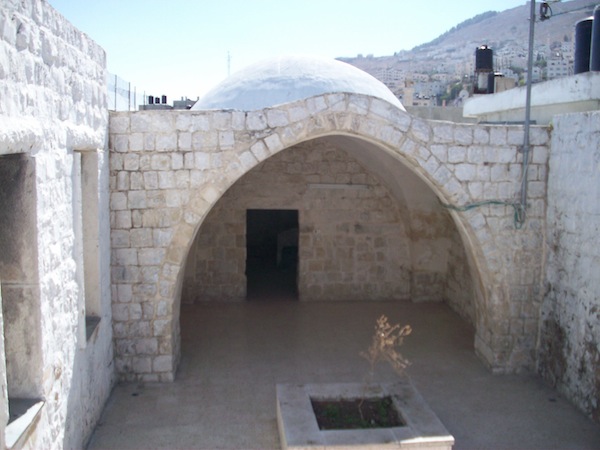
Joseph’s Tomb, inside the gate. (photo by Gil Zohar)

“The bones of Joseph, which the Children of Israel brought up from Egypt, were buried in Shechem in the portion of the field that had been purchased by Jacob.” – Joshua 24:32

 “‘And he bought the field where he pitched his tent.’ (Genesis 13:19) Said Rav Yudan bar Simon, ‘This is one of the three places regarding which the nations of the world cannot slander Israel and say, “You stole them!” The places are the Cave of Machpelah [in Hebron], the Temple [in Jerusalem] and the Tomb of Joseph [in Shechem/Nablus].” – Bereshit Rabba, 79:4

There’s little inspiration to be found in the unadorned tomb of Joseph, the favourite of Jacob’s 12 sons. The holy site, located in the gritty eastern outskirts of Nablus among parched olive groves and graveyards of wrecked cars, is today a flashpoint between those who revere the site – Israeli Jews, Palestinian Muslims, Christians of all stripes, and the 600-member Samaritan community living on Mount Gerizim overlooking this West Bank city of 160,000. The traditional anniversary of Joseph’s death on Tammuz 27 (which fell on July 31 this year) is considered an especially auspicious pilgrimage time.

The group of 1,200 pious Jews, armed with permits and prayer books, arrived at the shrine in a convoy of bulletproof buses protected by the Israel Defence Forces. Most were Bratslaver Chassidim, who set great store in their practice of praying at the graves of tzadikim (righteous ones).

The IDF-escorted pilgrimage on the first Tuesday of every month often leads to riots. IDF sappers neutralized a pipe bomb hidden at Joseph’s Tomb prior to the visit of the 1,200 pilgrims and 12 Palestinians were injured during clashes with the IDF. The list of security incidents, arson and terrorism is long and bloody.

In the secular West, the story of Joseph – whose 11 jealous brothers sold their 17-year-old sibling into slavery in Egypt – has been popularized by the rock opera Joseph and the Amazing Technicolor Dreamcoat. Librettist Tim Rice and fellow Academy Award-winning composer Andrew Lloyd Weber, along with actor Donny Osmond as Joseph, captivated audiences from Broadway to the West End with their account of Joseph’s rise to become the vizier, second only to Pharaoh in the Egyptian empire.

But Joseph, the hero of Bible and Quran stories, has hardly been given the royal treatment by Middle East politics. Dotan, where Joseph was thrown into a pit, called Jubb Yussef (Joseph’s Well) today is a ruined caravanserai that collapsed in an earthquake in 1837. Joseph’s tomb, enshrining the bones brought back from Egypt by the Children of Israel some 3,300 years ago together with the remains of Joseph’s sons Ephraim and Manasseh, has fared better.

The plain one-storey is called Qabr an-Nabi Yúsuf (Tomb of the Prophet Yúsuf) in Arabic and is revered by Jews as Kever Yosef ha-Tzadik (Tomb of Yosef the Righteous). The whitewashed limestone building is capped with a cupula and protected by a massive black gate. Barbed wire crowns the looming walls. Signposts in Arabic and English indicate the nearby sites of Tel Balata and Jacob’s Well. None directs visitors to Joseph’s Tomb.

photo - Balata refugee camp
Balata refugee camp. (photo by Gil Zohar)

Tel Balata is the nondescript Canaanite/Israelite Iron Age stratified archeological mound that few tourists bother to visit. Jacob’s Well is covered by a 20th-century Greek Orthodox basilica marking where the patriarch camped when returning to Shechem (ancient Nablus) from Paddan Aram in today’s Iraq. In one of the Torah’s three real estate deals – along with Abraham’s purchase of the Cave of Machpelah in Hebron and David’s acquiring of Mount Moriah in Jerusalem – Jacob bought the plot of land from the sons of Hamor, the father of Shechem. There, Jacob pitched his tent and erected an altar (Genesis 33:18-20).

Some 1,500 years later, Jesus “came to a city of Samaria called Sychar, near the field which Jacob gave to his son Joseph. Jacob’s Well was there.” (John 4:5-10) Drinking water, he chatted up a Samaritan woman, known in Greek as Photine (the luminous one; hence, the church’s name, St. Photini). Christian pilgrims flock to the site to reverently drink drafts of cool water from the deep well in the church’s vault.

Across the street is Balata Refugee Camp, administered by the United Nations Relief and Works Agency for Palestine Refugees in the Near East (UNRWA). Today the largest camp in the West Bank, it houses 27,000 people in a quarter-square-kilometre site that was designated for 5,000 refugees when it was established in 1950.

photo - Ottoman Sultan Abdul Hamid II’s clocktower, erected in 1906
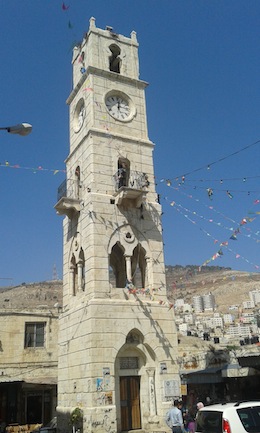
Ottoman Sultan Abdul Hamid II’s clocktower, erected in 1906. (photo by Gil Zohar)

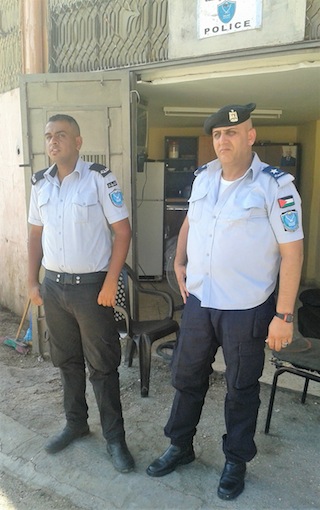
Even for an intrepid, multilingual tour guide like this writer, it is daunting to find the unmarked way to the holy site. The drab building is located next to the Qadari Tuqan School, along a dusty unnamed road where only recently were sidewalks laid. The easiest way to find the landmark is to look for the Palestinian Authority police vehicle parked outside the locked gate. Then, one must locate the pair of PA police officers loitering in the shade nearby, smoking cigarettes and nervously fidgeting with their rifles. Ask politely in Arabic and they’ll let you in, no questions asked, no baksheesh (tip or bribe) required – just don’t mention that you’re Jewish.

Inside the locked gate, you’ll find a simple barrel tomb and the stump of a column of indeterminate age. There’s no evidence of the repeated vandalism that has punctuated the tragic history of Joseph’s Tomb since 1995, when Israel withdrew from the West Bank city, ending the occupation that began in 1967 with the Six Day War.

A photo from 1900 shows the well-maintained compound around Joseph’s Tomb. A carriage road facilitated the pilgrimage of pious Jews from the Old Yishuv who regularly came to pray there. The holy site stood in isolation. Nearby was the Arab hamlet of Balata, with eight houses.

The name Nablus is a corruption of the Latin Colonia Julia Neapolis, which was founded by the Roman emperor Vespasian in 72 CE. In the old city, in 1906, Ottoman Sultan Abdul Hamid II erected a clocktower to celebrate 30 years on the throne of the Sublime Porte.

In the Six Day War, Israel captured the territory, which had been occupied by the Hashemite Kingdom of Jordan since 1948. Once-somnolent Nablus experienced a burst of prosperity, though today, under PA self-rule, the Palestinian economy is floundering. Expanding from a population of 30,000, the city spread out to swallow the nearby villages, including Balata. Joseph’s Tomb became entangled in urban sprawl.

Jewish settlers began to frequent the mausoleum. By 1975, Muslims were prohibited from visiting the site, which some claimed was the tomb of Sheikh Yúsuf Dawiqat, an 18th-century Sufi saint. In 1982, St. Louis, Mo.-born kabbalist Rabbi Yitzchak Ginsburgh established the Od Yosef Chai (Joseph Still Lives) yeshivah at the site.

photo - Palestinian Authority police by Joseph’s Tomb
Palestinian Authority police by Joseph’s Tomb. (photo by Gil Zohar)

Conflict mounted following the Oslo Accords. Tensions boiled over in September 2000, in the wake of then-prime minister Ariel Sharon’s controversial visit to Jerusalem’s Temple Mount. A full-scale battle broke out.

On Oct. 1, 2000, Border Police Cpl. Madhat Yusuf, 19, of Beit Jann in the Upper Galilee, was wounded in the neck in a clash with Palestinians at Joseph’s Tomb. Over the course of four hours, the Druze warrior bled to death because the IDF considered it too risky to evacuate him without a ceasefire.

A week later, on Oct. 7, 2000, the site was handed over to PA police. Within hours, Joseph’s Tomb was pillaged by Palestinian protesters. Using pickaxes, sledgehammers and their bare hands, they demolished the holy site. It was rebuilt by Italian stonemasons.

In the Bible, Joseph – the chaste and handsome prisoner – is wooed by an unnamed would-be lover only identified as Potiphar’s wife. Though many midrashim about Joseph are incorporated in the Quran’s 12th chapter, known as Surat Yusuf, the lady’s name is similarly omitted. However, within several centuries, various Islamic sources identified her as Zuleika. Among these medieval texts, the most popular was the epic Farsi poem “Yusuf and Zulaikha,” composed in 7,000 Persian couplets by 15th-century poet Jami.

The Sufi master regarded the story of Joseph’s temptations as an allegory for the mystical striving after divinity. In Nablus today, pilgrims continue to come to Joseph’s Tomb seeking that union. Alas, Israelis and Palestinians have not found a coat of many cultures to fit them both equally.

Gil Zohar is a writer and tour guide in Jerusalem, Israel.

Format ImagePosted on August 30, 2019August 29, 2019Author Gil ZoharCategories TravelTags history, Israel, Israeli-Palestinian conflict, Jacob's Well, Joseph's Tomb, Nablus, Shechem, Torah, tourism, West Bank
Maturation entails practice

Maturation entails practice

There’s a funny story from when my husband and I were first married. We were in graduate school, but I had returned to grad school after teaching in Washington, D.C., inner-city high schools. I discovered that my husband and his friend Lou, one of his school lab mates, were regularly going out to eat fast food. Worried for his health and our budget, I let my new husband and our friend know that he was absolutely “not allowed” to be doing this. It was bad for them! My high school teacher tone was threatening and both guys heard me loud and clear.

Lo and behold, later, they walked past the student centre’s Burger King. And guess what? As Lou describes it (to this day), “WHOA!… She shut down Burger King!” Both believed that perhaps I had this huge power. I had jokingly let them think that I could shut down Burger King, all on my own. Sometimes, for our own best interest, we need to be told what to do.

The Torah portion Chukat, Numbers 19:1-22:1, is full of practical advice about how to deal with challenges in life, including food, death and sacrifices. There’s information about how adults should clean themselves, change clothing and do other ritual routines, such as those around deaths, which could prevent the spread of disease. Yet, there are complainers who forget to be grateful even about food, as when, in Numbers 20:5, the Israelites say, “Why did you make us leave Egypt to bring us to this wretched place, a place with no grain or figs or vines or pomegranates? There is not even water to drink!”

Then, there are divine-inspired miracles, like when Moses struck the rock (twice) and the water appeared.

There is a medical term called “dysregulation.” It means something may not be “normal,” but it could be part of a metabolic physiological or psychological process. So, a person can be physically dysregulated (klutzy or clumsy) or emotionally dysregulated (unable to respond with socially appropriate emotions). Dysregulation doesn’t come from one thing. It’s a general term. It means, this is abnormal and maybe the person is impaired by it. It’s something to be aware of and to work on.

Those who struggle with dysregulation may mature or become stronger than average and successful because of how hard they work to function “normally.” An example might be adopting an older animal-shelter dog. When I’ve adopted these dogs, sometimes they are already adolescents but lack basic training or manners. Through consistent, daily practice, they become good at the few obedience commands and behaviours I expect. When both my dogs sit on command at a street corner, a bystander, perhaps with an unruly dog, might say, “Wow! That’s amazing! How did you do that?”

I smile. The answer is something like, “Well, I’ve been asking these dogs to sit at every street corner every morning for the last six to 12 years.” With a lot of practice, my older shelter dogs grow and learn. They are every bit as amazing as a pedigreed puppy someone bought. It’s a maturation process, and it comes with years of practice and the assumption of responsibility.

In this Torah portion, there is the strong narrative voice and actions of G-d, telling the people what is expected of them, and pointing out where they may have faltered or failed. In effect, the impairments faced by people who used to be slaves have to be overcome. The people have been in a state of imbalance because of their traumatic experiences. Overcoming that dysregulation means healing, finding maturity and a reliable path forward.

All of this doesn’t happen overnight. We can’t do it alone. I know about dysregulation through reading about it in medical reports. Yet, through consistent learning, maturation and hard work, humans (and animals like shelter dogs) can overcome many things. This is a process. It’s a “two steps forward, one step back” narrative.

I was reminded of this issue when I recently visited a newly renovated grocery store. While the layout looked complete, the cashier said there was a mountain of work still to be done in the warehouse. Even the employees, on close inspection, were out of sync. I watched a manager willing to give a locked cart to a shopper for free rather than make change. Meanwhile, another manager shooed away a person down on his luck who was asking for change or food. There was a huge amount of new and fancy food on display but the food bank bin was nearly empty.

The store boasts of being community-minded, but it was dysregulated. They’d lost their way. Just as in the Torah, nobody, not even Moses, is perfect – he shouldn’t have hit the rock twice. Nobody should complain about the lack of figs or pomegranates – but we’ve got shortcomings. We’re all in the process of becoming something more.

Growth comes through many paths. Sometimes, in order to cut back on the fast food, you need a scary commandment from your new spouse! On more important matters? There’s an important divine voice. It’s a series of small, ritual, self-regulated steps that shape us into being our best selves.

Joanne Seiff has written regularly for CBC Manitoba and various Jewish publications. She is the author of three books, including From the Outside In: Jewish Post Columns 2015-2016, a collection of essays available for digital download or as a paperback from Amazon. See more about her at joanneseiff.blogspot.com.

Format ImagePosted on July 5, 2019July 3, 2019Author Joanne SeiffCategories Op-EdTags Judaism, lifestyle, Torah

Put down “the ducky” in shul

I chatted with a friend recently about what it was like in “the old days” when someone had to take a cellphone call during synagogue. This is when there were only big, clunky cellphones. I remember seeing a doctor on call pacing in the lobby. He – and it was usually a man – looked apologetic as he listened carefully. It was an emergency. It was a doctor who needed to attend to a patient, even though it was Shabbat and he was at services.

Given the circumstances, we recognized it was OK, because it was pikuach nefesh. He was helping save a life and that level of emergency is allowed, no matter how observant you are, on Shabbat. You put a person’s life above everything else.

The media has done many features where they reflect on research that shows how social media and being attached to a cellphone or other device has affected our health. It can keep us from interacting in the real world with other people, from sleeping or focusing properly. Social media increases our anxiety levels and, sometimes, it’s an addiction. Waiting to get that next update, from a friend or a news source, can sometimes seem more important than any actual person or event taking place in the same room.

My kids know the lesson from Sesame Street and the classic song, “Put down the ducky!” Ernie wants to play the saxophone, but Hoots the Owl tells him, “Put down the ducky if you want to play the saxophone!” It’s a lesson that we must break habits – like carrying a cellphone or the rubber ducky – to learn something new, make music and interact with others.

In the Jewish context, I see it everywhere. It’s at services, lectures, at the Passover seder or Shabbat table, at the kids’ events and play dates. It’s so pervasive that those doing it don’t even realize they are blocking out the world to engage with their electronics. It’s like a body part for those folks, while its noise means others can’t concentrate.

I was at a family service on Shabbat when we were interrupted with what sounded like a radio playing. It seemed to drift on and off and it was terribly distracting. Are we hyper-aware of such things? Absolutely. I am always tired and it makes me extra sensitive to noise and stimulation. There are some folks in my family who are also noise-sensitive. Too much noise and chaos often means we just have to leave. It’s too much.

Meanwhile, while the radio-like sound continued to compete with the prayers, adults in the back kept talking over it all. My husband, usually immune, looked bothered. I encouraged him to get up and ask someone to shut it off, since I sat with a kid on my lap. I thought it might be somewhere outside, but I was wrong. It was one of the talking adults, who failed to even notice that her phone was making the noise. Even when it was finally shut off, the adults continued to talk.

The interference was so pervasive and distracting that I couldn’t wait to leave. At Kiddush, at the end of the service, I heard someone say to a kid, “You can go ask the rabbi, he’s not praying now.”

That was it in a nutshell. I found myself wondering what the heck we were doing there. Are you coming to synagogue to play live-streaming radio and talk loudly? If you aren’t praying, or even sitting quietly, as a role model for kids, why bother coming to disrupt everyone else?

Some might say this is just an isolated incident, but it’s pervasive. On Yom Kippur, there was a grandfather who thought it was OK to hop up and snap photos with his phone during the service.

As I looked at the Torah portion, Behukotai, Leviticus 26:3-27:34, for the first week of June this year, I remembered this experience. It’s a portion that emphasizes all the amazing things offered by the Divine Presence “if you follow my laws and observe my commandments.” It’s a carrot-and-stick story, it clearly states the bad things that will happen to those who don’t follow the rules.

Our understanding of the laws and commandments may have changed, but social norms still exist. We live in a society with clear tension between individuality and the common good. If you judge someone else’s behaviour, you can be told that judgment is inappropriate – even when the individual isn’t behaving in a considerate or safe way for the community. If you feel uncomfortable with someone’s behaviour, we’re taught “we can only control ourselves and our response to it.”

You may not want to stop social media use on Shabbat or want to pray at services, and that’s your choice. However, it’s probably not your place to keep others distracted with your phone so they cannot concentrate on prayer. If you’re set on having it your way, and don’t want to think about others, why join a community Jewish event to do it?  Stay home to use your cellphone instead.

Winnipeg prides itself on being a friendly place, and inspired other places to adopt a United Way campaign day of “conscious kindness.” It might be time to live the slogan and think of others – if you can’t put down the phone for your own sake, please do it for ours.

Joanne Seiff has written regularly for CBC Manitoba and various Jewish publications. She is the author of three books, including From the Outside In: Jewish Post Columns 2015-2016, a collection of essays available for digital download or as a paperback from Amazon. See more about her at joanneseiff.blogspot.com.

Posted on May 31, 2019May 30, 2019Author Joanne SeiffCategories Op-EdTags cellphones, etiquette, Judaism, lifestyle, Sesame Street, synagogue, Torah
Preserving the environment

Preserving the environment

According to talmudic sages, “It is forbidden to live in a town which has no garden or greenery.” (Kiddushin 4:12; 66d) (photo by A. Christen)

Many contemporary Jews look upon Tu b’Shevat as a Jewish Earth Day, a day for contemplating our ecological heritage – and the multitude of threats our planet currently faces.

An ancient midrash has become all too relevant. “In the hour when the Holy One, blessed be He, created the first person, He showed him the trees in the Garden of Eden, and said to him: ‘See My works, how fine they are. Now all that I have created, I created for your benefit. Think upon this and do not corrupt and destroy My world, for if you destroy it, there is no one to restore it after you.’” (Ecclesiastes Rabbah 7:28)

Today’s environmental threats can be compared in many ways to the biblical 10 plagues, which appear in the Torah portions read on the Shabbats immediately preceding Tu b’Shevat. When we consider the threats to our land, water and air – pesticides and other chemical pollutants, resource scarcities, threats to our climate, etc. – we can easily enumerate 10 modern “plagues.” Unfortunately, like the ancient Pharaoh, our hearts have been hardened by the greed, materialism and wastefulness that are at the root of these threats. And, in contrast to the biblical plagues, modern plagues are all occurring simultaneously, and there is no modern Goshen as a refuge, where most of these plagues do not occur.

The talmudic sages express a sense of sanctity toward the environment: “The atmosphere [air] of the land of Israel makes one wise.” (Baba Batra 158b) They assert that people’s role is to enhance the world as “partners of God in the work of creation.” (Shabbat 10a)

The rabbis indicate great concern for preserving the environment and preventing pollution: “It is forbidden to live in a town which has no garden or greenery.” (Kiddushin 4:12; 66d) Threshing floors are to be placed far enough from a town so that the town is not dirtied by chaff carried by winds. (Baba Batra 2:8) Tanneries are to be kept at least 50 cubits from a town and placed only on its eastern side, so that odours are not carried by the prevailing winds from the west. (Baba Batra 2:8,9)

“The earth is the Lord’s.” (Psalms 24:1) And we are the stewards of God’s earth, responsible to see that its produce is available for all God’s children. Property is a sacred trust given by God; it must be used to fulfil God’s purposes.

The story is told of two men who were fighting over a piece of land. Each claimed ownership and bolstered his claim with apparent proof. To resolve their differences, they agreed to put the case before the rabbi. The rabbi listened but could come to no decision because both seemed to be right. Finally, he said, “Since I cannot decide to whom this land belongs, let us ask the land.” He put his ear to the ground and, after a moment, straightened up. “Gentlemen, the land says it belongs to neither of you but that you belong to it.”

The prohibition not to waste or destroy unnecessarily anything of value (bal tashchit, “thou shalt not destroy”) is based on concern for fruit-bearing trees, as indicated in the following Torah statement:

“When in your war against a city you have to besiege it a long time in order to capture it, you must not destroy its trees, wielding the ax against them. You may eat of them, but you must not cut them down. Are trees of the field human to withdraw before you under siege? Only trees that you know to not yield food may be destroyed; you may cut them down for constructing siege works against the city that is waging war on you, until it has been destroyed.” (Deuteronomy 20:19-20)

This prohibition against destroying fruit-bearing trees in time of warfare was extended by the Jewish sages. It is forbidden to cut down even a barren tree or to waste anything if no useful purpose is accomplished. (Sefer HaChinuch 530)

The sages of the Talmud made a general prohibition against waste: “Whoever breaks vessels or tears garments, or destroys a building, or clogs up a fountain, or destroys food violates the prohibition of bal tashchit.”  (Kiddushin 32a)

Rabbi Samson Raphael Hirsch, a 19th-century philosopher and author, states that bal tashchit is the first and most general call of God. We are to “regard things as God’s property and use them with a sense of responsibility for wise human purposes. Destroy nothing! Waste nothing!” He indicates further that destruction includes using more things (or things of greater value) than are necessary to obtain one’s aim. (Horeb, Chapter 56)

It has become customary to recite psalms on Tu b’Shevat, among them Psalm 104. This psalm speaks of God’s concern and care extended to all creatures, and illustrates that God created the entire earth as a unity, in ecological balance:

“You make springs gush forth in torrents; they make their way between the hills, giving drink to all the wild beasts; the wild asses slake their thirst. The birds of the sky dwell beside them and sing among the foliage. You water the mountains from Your lofts; the earth is sated from the fruit of Your work. You make the grass grow for the cattle and herbage for man’s labour, that he may get food out of the earth, wine that cheers the hearts of men, oil that makes the face shine and bread that sustains man’s life.” (Psalm 104:10-15)

Tu b’Shevat is indeed an appropriate time to apply Judaism’s powerful ethic of reverence for God’s creation, conservation and sustainability, to help move our precious, but imperiled, planet onto a sustainable path.

Richard H. Schwartz, PhD, is professor emeritus, College of Staten Island, president emeritus of Jewish Veg and president of Society of Ethical and Religious Vegetarians. He is the author of several books, including Judaism and Vegetarianism and Who Stole My Religion? Revitalizing Judaism and Applying Jewish Values to Help Heal Our Imperiled Planet, and more than 250 articles at jewishveg.org/schwartz. He was associate producer of the documentary A Sacred Duty: Applying Jewish Values to Help Heal the World.

Format ImagePosted on January 18, 2019January 16, 2019Author Richard H. SchwartzCategories Celebrating the HolidaysTags environment, Judaism, Torah, trees, Tu b'Shevat

Posts pagination

Previous page Page 1 … Page 3 Page 4 Page 5 Page 6 Next page
Proudly powered by WordPress