Sorting out playground fights

If you’ve got grade school-aged children, chances are they come home recounting fights on the playground and in their classrooms. Sometimes, it involves them, and other times, they are bystanders. There are kids who are hitting, name calling, mimicking and punching each other. The chasing and hurting seems to come out of the blue, or sometimes it has been expected and dreaded for way too long. People can be cruel to one another.

It might not come as a surprise that moms talk to each other about their children but, in the last couple of weeks, I’ve probably talked to four parents who have mentioned their worry or concerns. While it’s possible for some to pile on stereotypes about Jewish mothers, if you ignore all the nonsense, the underlying theme is simple for all parents. We’re trying to raise good, kind people and that’s why we devote so much effort and concern to it. We want healthy, happy children, and wonder how to keep them from killing each other.

Unfortunately, turning to traditional texts doesn’t always offer us solace. We’re not reading about happy families all the time when we read the weekly Torah portion – and, often, the rabbis’ commentary doesn’t soften the harsh responses in Genesis. For instance, when you read the stories about Joseph and his brothers, well, they were brutal to one another.

Joseph is his father’s favourite, and it’s no secret. Joseph doesn’t help matters – he tattles on his older brothers (Genesis 27:2). His dad makes him fancy clothing, too, so it is obvious he is getting preferential treatment.

Joseph’s brothers strip him of his clothes and throw him in a pit and, if that’s not bad enough, they sell him as a slave. Even Reuben, who hopes to fix things, cannot stop his brothers when they are dead-set on doing harm.

Of course, many commentators rush to point out how forgiving Joseph is and that, later, as a powerful man in Egypt, he saves his whole family in a time of famine. Yet Joseph misleads his brothers about who he is; he kidnaps his brothers. Well, the summary is that this is a complex story with difficult characters. It can be hard to figure out who is in the right here, and if anyone behaves well, after all.

Zooming back to the playground, there are some startling comparisons. When the kids race up and start telling the parents that this kid hit that one, this kid is bad, etc., it can be hard to untangle the story. Often, too, the kid who throws the first punch didn’t do it out of the blue. If you provoke someone enough, particularly a kid who hasn’t quite mastered self-control, someone’s probably going to fight back.

There are a few conclusions I can make in comparing this important biblical narrative with a parent’s everyday one. First, it’s complicated. It is way too simplistic to think that one child is a perfect blameless angel and the other the nasty bad person. This isn’t how relationships and people work.

Second, untangling the story can take awhile. It’s important to learn everybody’s point of view before deciding what actually happened. Sometimes, it’s crucial not to just trust those in authority to be omnipotent and sort things out. An example? I got an official report home one day that one of my kids punched another kid. (We were really upset with him.) Days later, I found out from another child that the reason why mine acted out was because other kids were copying my kid, making fun of him and pretending to be him in an unkind way, behind his back. While I might not condone punching somebody in the nose, I sometimes can understand how it might happen if I hear the details of what exactly transpired.

Third, making peace is a multi-step process. The wronged party may need to work through a few things before the situation can be resolved. This takes time and fair judgments like Solomon’s. It can feel beyond a parent’s capabilities!

Finally, when following the story of Joseph and his brothers, we learn that they worked it out. Joseph helps feed his family and saves them – but it’s not a narrative of instant forgiveness and affection. Jealousy, unequal treatment and violence? It’s all in there.

Sometimes the complicated family dramas of Genesis demonstrate that even tangled and dangerous altercations can be resolved. It’s a reminder that everyone – kids, too – can get over their intrigue, fights and disagreements and forgive one another. Forgiveness doesn’t mean we forget everything about the complicated characters who are our friends, relatives and classmates. It might mean that, while we can’t change the past, we can get beyond it to build better future experiences together.

While I mulled this over, my husband pointed out something further. When we must rely on our families or our (smaller) Jewish communities, we must work together on many crucial issues of survival. We can’t change the past interactions or bad behaviours that may have taken place in a family or congregation. We can’t go back in time to repair or undo those wrongs, but we can drop the rancour to work together towards shared future goals. Joseph – and those playground reconciliations – show us that history is just history, not destiny.

Joanne Seiff writes regularly for CBC Manitoba and various Jewish publications. She is the author of three books, including From the Outside In: Jewish Post Columns 2015-2016, a collection of essays available for digital download or as a paperback from Amazon. See more about her at joanneseiff.blogspot.com.


Talks on animals, ethics

Jeffrey Cohan of Jewish Veg speaks at a few local venues next week. (photo from Or Shalom)

There is no disputing the notion that God intended for us to eat a vegetarian diet, though eating meat out of necessity is permitted, according to Jeffrey Cohan, executive director of Jewish Veg, who will be in Vancouver next week for three presentations on animals and ethics.

Cohan’s father passed away at the age of 52 from a heart attack, when Cohan was 12 years old. “That’s always been in the back of my mind – what I can do to avoid the same fate,” Cohan told the Independent. “But, for the first 40 years of my life, I was a passionate meat eater and, although I was in good shape, I knew I needed a dietary change, as my cholesterol was up to 100 and I was approaching the age where my dad experienced heart disease.”

Cohan recalled a Simchat Torah when he was in his early 40s. The Torah reader came to a verse wherein God says to eat only plants and, for the first time, the possibility of being a vegetarian resonated with Cohan, and he and his wife immediately changed their diet. That was about 11 years ago.

“Then, I started researching intensively what the rest of the Torah and other Jewish texts said about this issue,” said Cohan. “I found out about an organization called Jewish Vegetarians of North America (JVNA). I was very excited. It was getting word out that this is what the Torah and our tradition actually says. At the time, I was working at the Jewish Federation of Greater Pittsburgh.”

Looking further into JVNA, Cohan learned, to his dismay, that it was run by only two volunteers, had an outdated website and no real relationships with the institutional Jewish community. This spurred him to go to New York to meet with these volunteers and a few others who were involved. He gave a presentation about what they could do to build up the organization. They asked him to become JVNA’s executive director – and Cohan said yes.

Since then, JVNA, which is now called Jewish Veg, has gone on to form relationships with some of the biggest Jewish organizations, said Cohan, including “those that deal with the demographic group most receptive to our message – young adults – partnering with Hillel.

“We created the first-ever vegan Birthright trips,” he added. “It’s been very gratifying. We are heading to Vancouver next, which is pretty exciting, being the first time we’ll give presentations in Canada…. Judaism, even when we were living in ghettos in Europe, does not exist in isolation. It is affected by external society to a great extent. Especially in America and especially in the 20th and 21st centuries in America and Canada, it’s been a two-way relationship.

“If you look at every social justice movement that has achieved success in the U.S. in the last 120 years – women’s rights, organized labour, the civil right movement, the LBGTQ movement – every one of these movements has had Jews involved in the leadership,” he said. “And this movement cannot be the exception. It goes back to the very raison d’être (reason for being) in Judaism, which is that we weren’t just given the Seven Laws [of Noah]. We were given a much higher bar to live up to. And, therefore, it is incumbent on the Jewish community, on this movement, to be at the forefront as we have been in other social justice movements. That’s exactly why Jewish Veg’s work is so important, because we’re mobilizing the Jewish community.”

According to Cohan, the work Jewish Veg is doing is inspiring the Christian community to follow suit. As an example, he said he was told by a longtime member of the Unity Church that they are creating a movement within their faith called Unity Veg.

Israel has become one of the most the most vegan-friendly countries in the world, said Cohan. “We actually … point towards Israel as an example for Canadian and American Jews to follow,” he said. “Jews speak on college campuses here [in the United States] about what’s going on in Israel and why they should be following its lead.”

While Cohan’s trip to Vancouver is the first for Jewish Veg in Canada, he is planning to soon speak in Toronto, Montreal, Winnipeg, Calgary and Edmonton.

Cohan hopes all people will become vegetarian one day, but his current aim is to meet people where they are. “We have something called our Veg Pledge program, which you can see on our website, which helps people transition to plant-based diets,” he said. “We don’t just come in, love them and leave them. We give them an opportunity to use our free resources to transition to plant-based diets at the pace that works for them.

“The way it’s structured,” he explained, “is that you start with a pledge, which can either be sticking your toe in the water or diving in head first, based on your comfort level. We really believe that helping people with the how is just as important as the why.”

During his visit here, Cohan will make three presentations: one hosted by the Vancouver Humane Society on Oct. 16, 7 p.m., in the Alma Vandusen and Peter Kaye rooms at Library Square Conference Centre; one at Or Shalom Synagogue on Oct. 18, 7:30 p.m.; and one at the University of British Columbia on Oct. 19, 1:30 p.m., hosted by Hillel BC at a Schmooze & Schmear gathering.

“I think a question you’ll hear many Jewish people ask is, ‘How does the Torah apply to our modern lives?’” said Shelley Stein-Wotten, program coordinator at Or Shalom. “We found it fascinating that Jeffrey’s own path to going vegan stemmed from his study of Torah and we wanted to provide an opportunity for him to share his story and create a space to have an open dialogue around if, as individuals and as a community, we can establish a Jewish framework to address climate change and make healthful food choices, which have inherent connections.”

Rebeca Kuropatwa is a Winnipeg freelance writer.

To embrace teshuvah

“King David Playing the Harp,” by Gerard van Honthorst, 1622. All of the biblical heroes are imperfect, as are we. (photo from artsandculture.google.com)

One of the beautiful ideas behind Rosh Hashanah and Yom Kippur is the notion that we need to reflect, review and rethink who we are and what we have achieved in our lives. We should never see who we are and what we have created as the ultimate expression of who we ought to be. There must always be a gap between who we are and who we ought to be, between reality and our aspirations. When our aspirations are fulfilled, there must be something wrong with our aspirations.

This is the fundamental idea behind teshuvah and its challenge to us – to embark on a process of self-criticism and reflection. To embrace teshuvah is the ultimate aspiration of our humanity, for the highest level that humans can achieve is not one of fulfilling all our values, but of constantly maintaining a tension in which goals serve as a foundation to evaluate the lives we have created and to challenge us to move forward and beyond.

An expression of this idea is found in the biblical depiction of heroes, all of whom are imperfect. We are never given a hero who embodies everything. Sometimes, it’s embarrassing. The biblical heroes seem too human, permeated by too much imperfection. The Bible is teaching us that being a hero doesn’t mean that one is devoid of imperfections; it means that one must do something about those imperfections.

By elevating these people to be our ideal, it challenges us to emulate them. You are going to fail like Moshe or Avraham. You are going to sin like David. There are going to be multiple dimensions of your life, whether it’s in your worship of God, with your spouse, with your children or with your friends, where you’re not going to be who you ought to be. Welcome to the human story. Our religion has no fantasies about human beings. It has aspirations from human beings.

For human beings to embody the aspiration of self-criticism and reflection, it is not only the individual who must be open to change but also the societies within which we live. People around us often want us to remain who we are. People don’t want us to change. They have gotten used to and comfortable with our imperfections, for it gives legitimacy to theirs.

Some rabbis in the Talmud were deeply worried about the social pressure to maintain mediocrity and lock everyone within the status quo of their failings. As a result, in Tractate Baba Kama 94b we find the following teaching:

It once happened with a certain man (thief) who desired to repent and make restitution (to those from whom he stole). His wife said to him: “Fool, if you are going to make restitution, even the clothing which is on your back would not remain yours.” He consequently refrained from repenting. It was at that time that it was declared: “If robbers or usurers are prepared to make restitution, it is not right to accept it from them, and he who accepts it does not obtain approval of the sages.”

A thief’s desire to complete his or her process of self-correction by making restitution is clearly understood and valued. The problem is that this standard may inhibit them from beginning the process. A lifetime of harm cannot be erased and, as a result, may lock us in our imperfections under the argument that one can never really begin again. “Fool, if you are going to make restitution, even the clothing which is on your back would not remain yours.”

In response, the rabbis teach that we have a responsibility towards each other to enable these new beginnings. A Jewish society is one where we make sure that reflection, self-criticism, self-evaluation and the ability to accept new horizons and new ideas are things society fosters and encourages, even at a high cost. We are individually responsible to not merely refrain from hindering each other’s growth, but that we must be willing to forgo what is rightfully ours in order to ensure that our fellow citizens will grow and change.

A Jewish society is not simply characterized by a high level of kashrut or Shabbat observance. A Jewish society is one where we allow others to do teshuvah, where we are not threatened by others’ desires to move in a new direction. A Jewish society is one that understands that to be fully human is not to accept our failings: to be fully human is to aspire to overcome them.

Shana tova to us all.

Rabbi Dr. Donniel Hartman is president of the Shalom Hartman Institute and author of the 2016 book Putting God Second: How to Save Religion from Itself. Articles by Hartman and other institute scholars can be found at shalomhartman.org.


Seeing God’s humanity, our own

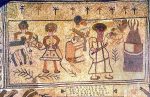
A mosaic of the Akeida in Bet Alfa National Park in Israel. (photo from hartman.org.il)

For many of us, the approach of the Jewish New Year offers an opportunity to take a moment from our harried lives to reflect on life’s “big” questions. It is a time for many of us – across the religious spectrum – to think about our relationships with ourselves and our families, with our tradition and with God. For those of us who choose to spend Rosh Hashanah in synagogue, the holiday offers the opportunity to participate in a communal reading of some of our most sacred and paradigmatic collective narratives, which in turn have the potential to illuminate some of our most pressing personal dilemmas.

Two of the most important biblical stories we revisit every Rosh Hashanah are the binding of Isaac (known in the Hebrew parlance as the Akeida) and Abraham’s argument with God regarding the fate of the inhabitants of Sedom. These two accounts represent two different religious anthropologies: one of sacrificial self-surrender and one of assertive moral challenge. As I have previously written, the personal moral empowerment displayed by Abraham in the story of Sedom – his insistence on his own ethical intuition and God’s acceptance, in turn, of those claims – is, for me, the foundation of the covenantal relationship.

The account of the Akeida, on the other hand, presents a distinct moral dilemma: How do we begin to understand a God who would ask His most loyal follower to sacrifice his beloved son? There are many ways to approach the theological puzzle that is the Akeida. This Rosh Hashanah, as we pause to examine not only our relationship to the divine, but our personal family relationships as well, I propose rereading the story of the Akeida by looking at God’s character through an anthropomorphic lens.

Before I begin describing God in human terms, however, it is important to remember that we have a long and deep tradition of doing so. The Bible is replete with images of God experiencing “human” emotions. Throughout the biblical narrative, we are presented with a God who is alternately angry, jealous or ego-driven.

During the Jewish people’s sojourn in the desert, for example, Moses, like Abraham before him, finds himself in the position of having to plead with God not to destroy a people – in this case, the Jews of the desert generation. The Bible describes God in nakedly human terms, as Moses finds that he has to, in some way, appeal to God’s ego. The Midrash describes Moses grabbing hold of God and saying to Him, “I’m not going to let you do what you want to do to the Jews.” Moses even appeals to God’s public relations considerations: he reminds God that He not so recently delivered this desert people from bondage in Egypt; if He kills them now, the other nations will say that He took them out of slavery only to slaughter them in the wilderness. Moses tells God in no uncertain terms that he will not help facilitate a people’s destruction.

Moses has to convince God not to allow His “emotions” to overpower Him, not to let His anger consume Him. This is but one example of many throughout the Bible and the Midrash of profound anthropomorphism, of portraying God as a character full of human weaknesses, with the potential to be both vulnerable and volatile.

In examining the story of the Akeida, we are compelled to ask, How could the God of the covenant – the God who promised Abraham that a great and multitudinous nation would emerge from his son Isaac – command that Isaac be killed? How are we able to understand the covenant in light of this seemingly unfathomable dictum? In attempting to understand the God of the Akeida, and what the Akeida might mean for us today, I have found it helpful to look at God as a parent.

God made the covenant with Abraham. But, after He did so, He got nervous, He suddenly felt scared. He had given over enormous power to human beings and He felt His ego being threatened. Thus, when God commands Abraham to “Take your son,” Abraham senses intuitively that it is not a moment in which to approach God with his moral claims. When God says, “Take your son,” Abraham understands that the God who is speaking – the God of the Akeida – is a God who experiences His own authority as under siege.

Abraham knows that the moment of the Akeida is not a moment for encounter or dialogue, but a moment that requires silence. It is a moment when Abraham knows that his only choice is to be quiet and submit. Abraham, a lover of God, senses the divine mood. When Abraham stood in front of God at Sedom, it was, in part, because he felt that it was a time when he could approach God; he sensed that God was in a willing position, that there was a possibility that He would be receptive to Abraham making covenantal demands.

Abraham’s response to God is analogous to a child’s response to a parent who the child knows is feeling challenged or threatened. There are times in a family’s life when a child knows intuitively – as Abraham knew intuitively – that there’s an opportunity for discussion, a moment when he can be critical of his parents, and his parents will be receptive to what he has to say. But there are other moments when a child understands that his parent is feeling insecure; moments when the mother or father is terrified of losing his or her authority. A child knows that is not the moment to try to encounter the parent in critical relationship; it’s not the moment to remind the parent that, in the past, he or she has encouraged critical reflection. That is a reality of family life: parents can become terrified of losing their position of power; they can become frightened that their children misjudge their encouragement of critical reflection as a negation of their parental authority. So, in some way, I attribute to God the same weakness or the same dilemma. He feels threatened. He feels that He must assert His power and test His child.

Before the Akeida, Abraham is referred to as ohavai elokim, a lover of God. Subsequent to the Akeida, he is referred to as yerei elokim, a fearer of God. The question we are faced with is why must God demand Abraham’s submission and fear? Why was his love not enough? To understand the God of the Akeida, we have to understand that God has conflicting forces within Him. The Midrash on the Akeida paints a very strange portrait of a God who says to the Jewish people, “Please pray for me. Please pray that my attribute of compassion will overcome my attribute of justice.”

Who is this God that must pray to human beings for help in overcoming His impulses? Who is the God that needs to ask human beings to remind Him of compassion? The Midrash illuminates for us the reality of a God who is struggling to reconcile the opposing forces within Him. It is my view that the Akeida is a moment of God’s struggle within Himself. God tests Abraham because of God’s own internal difficulty balancing justice with compassion, fear with love.

How can we talk about God experiencing an internal struggle? The great contemporary biblical scholar Yohanan Muffs argues that it is only in human terms that we can most authentically grasp the nature of the divine. I share Muffs’ view that God’s humanity, so to speak, is essential to a true understanding of Him. Yet it is not only 20th-century thinkers such as Muffs, Abraham Joshua Heschel and I who have portrayed God in starkly mortal terms. Drawing on the tradition of the Bible and the Midrash, the rabbis of the rabbinic period routinely discussed God as having an interior emotional life. While this approach did not fit in with medieval philosophy, which maintains that God cannot take on any human form, that any change or emotion in God is a sign of imperfection, the great figures of the rabbinic period were not frightened to speak of God in the language of human psychology.

It is this tradition that empowers me to think of God in terms of psychodynamic maturation: to cite His shift from being a figure of complete and total authority to a figure who works in concert with human beings. It is the deep rabbinical tradition of ascribing human qualities to God that enables me to see a God who decides to become accountable to human beings.

And it is this precedent of anthropomorphism in the rabbinic canon that informs my view of the God of the Akeida as a parent struggling with his identity, grappling with the competing values within Him. He loves Abraham and He has planned great things for him, but God is beset by his own internal dilemmas, by his own conflicting emotions. This is the God of the Midrash, the God who says to Moses, “Hold me back, Moses, I’m losing myself.”

If this is a bold way of discussing the divine, it is no bolder than the way the Bible itself discusses God. Rather than diminish God in our eyes, looking at God in human terms enables us to understand Him on a deeper level. The God who experiences emotion, who experiences internal struggle, is a God who can enter into a relationship of mutual accountability with human beings. The God who experiences His own psychodynamic reality is the God of covenantal spirituality.

This Rosh Hashanah, as we examine our relationships with our parents and our children, with ourselves and with our tradition, we are all faced in some form or another with the challenge of balancing compassion with justice, authority with love. As the Jewish New Year draws closer, let us allow ourselves to draw on the wisdom of our shared narratives as we struggle to reconcile the competing values within us.

Rabbi Prof. David Hartman (1931-2013) was founder of the Shalom Hartman Institute. Articles by Hartman, z”l, and other institute scholars can be found at shalomhartman.org.

The benefits from repetition

Repetition is good for us. (I may have said this before!) If you exercise, you’re in touch with “reps” or, if you walk your dog, you’ve been down this block with someone sniffing at the end of the leash before. If you’re rolling your eyes in boredom as you stand in a line, way too much of life seems to be about waiting patiently and repetition.

Jewish tradition has lots of “rinse and repeat” kinds of moments in it. If you read the Torah portion regularly, phrases like, “And Moses said,” pop out frequently. If you’re already preparing meals or family gatherings for upcoming holidays, you may reflect on how often you’ve done this before. It would be wrong to ignore the feeling of drudgery that sometimes accompanies all this. There are definitely times, as I try to figure out how to fit in all the prep, when I wonder if it’s so meaningful to do it again. And again.

Two recent experiences reminded me that we get something out of this repetition thing.

The first was one of those ubiquitous parenting articles that mention the value of self-care and meditation. Sometimes it’s easier to dismiss such suggestions. Yes, I’ve thought, but who will watch the kids, make dinner and earn the money while we’re doing all this trendy stuff?

However, I happened to hear a tidbit at services recently about Rosh Chodesh. Bill Weissman was leading a Sunday minyan at the start of the month of Elul. He reminded everyone about the association of women with the beginning of the month, mentioning that, aside from tending small babies, women were supposed to have a day off. In some Jewish communities, women don’t do certain kinds of work on the holiday, perhaps avoiding laundry or other tedious jobs. In fact, Jewish tradition teaches us that we need breaks. Scheduled activities, like a learning group, a meditation circle or even a standing coffee date, enable us to take better care of ourselves, whether it’s scheduled for Rosh Chodesh or every Tuesday.

The second experience that brought this all together occurred on the same weekend but the day before. One of my twins was feeling sick and was on antibiotics, so he stayed home with Daddy. I took the other twin on a Shabbat date. We went to family services together. Usually, while this kid dances and participates, he doesn’t read or engage with every prayer. My other twin sings along to everything, but makes up his own words. That’s fine. I figure they both enjoy themselves and get something out of being there. (For me, attending services is all part of that repetitive self-care thing, but it’s hard to get the most out of it with twins along for the ride.)

To my surprise, this Shabbat, a switch flipped in my kid’s 7-year-old brain. He sang and davened every prayer. He engaged completely. He wanted to be involved and responded to everything at the service – he even heard something interesting during the announcements. During the month of Elul, we blow the shofar during morning minyan.

Later, when I said how proud I was to hear him sing and say all the prayers, I asked what had happened. He explained that he likes to be quiet until he knows something perfectly. He decided he knew things well enough, so now he can say them all. It was as if buzzers were going off in my “educator” brain. Bing! This kid is an introvert. This is how introverts often process and learn new material. It’s about quiet introspection and repetition.

The next morning, I still had one sick twin and one healthy one. The healthy introvert announced that he wanted to attend that morning’s minyan. He cheerfully got through the hour-long service on Rosh Chodesh. He joked with many of the minyan regulars, participated, and he heard the shofar. It was a meaningful experience for him. I am still feeling celebratory about it many days later!

How did we get to this point? It wasn’t a one-time experience. I didn’t create a high-pressure event where I brought my children to one service, asked them to tell me if they enjoyed it and expected them to make a decision about their religious observance as a result. When we learn at school or while doing a sport, there are a lot of drills involved. It can be boring or reflective, but maybe it doesn’t matter.

We need to keep repeating things – Jewish content, CPR training, swimming lessons, whatever – until it sticks. You can’t give yourself a chance to make or eat a good holiday meal or have a meaningful religious experience if you haven’t practised. Recipes, prayers, exercise and meditation, among other things, don’t generally come out right the first time. Is it sometimes boring to do one’s exercise, cooking or other life tasks? Oh, you bet. However, nobody ever said that taking care of yourself, your household, relationships and work would be easy.

Some things aren’t fascinating. Even so, all that repetition can be good for us. Repetition teaches life skills. Learning the discipline needed to stick to something and practise it? That’s well worth taking time to learn. Repetition offers our bodies and minds a lot of healthy habits. Jewish communities and activities offer these skills. Just keep going. (It’s about showing up.)

Joanne Seiff writes regularly for CBC Manitoba and various Jewish publications. She is the author of three books, including From the Outside In: Jewish Post Columns 2015-2016, a collection of essays available for digital download or as a paperback from Amazon. See more about her at joanneseiff.blogspot.com.
Torah is part of who we are

Much to the disappointment of their Orthodox brethren, most of the Jewish people outside the Orthodox world probably do not believe that the Torah was literally received at Sinai. This creates something of a problem on Shavuot, the festival on which the giving of the Torah at Sinai is celebrated.

On Passover and Sukkot, even non-believers who reject the literal truth of the biblical stories on which these festivals are based, can find ways to connect to universal notions of freedom from slavery and the temporariness of the human condition that they inspire. On other holidays, too – Rosh Hashanah and Chanukah come to mind – it is possible to relate to broader themes and even to the symbols and rituals that seek to evoke them. Shavuot is different. It is limited in symbolic ritual, and it does not offer an easily identifiable, abstract idea worthy of celebration even by non-religious Jews.

What’s more is that the rabbinic sages seem to make a point of exalting an aspect of the Mount Sinai story that is anathema to modern sensibilities. “Na’aseh v’nishmah” – “We will do and we will hear/understand” – a phrase uttered, according to Exodus 24:7, as the Jewish people accept the Torah, is often glorified in our tradition as an act of blind obedience. The willingness to do first, and comprehend later, is seen as a readiness to receive the Torah unconditionally, regardless of its content. The Midrash praises the Jews for the commitment – unlike that of any other nation – to follow the scriptures without asking why. Had the attempt to alienate Jews of Western, liberal convictions been deliberate, it would not have been more successful.

What are those who question the merits of blind obedience to do with this tradition? How to reconcile teaching our children to question, when we are told to applaud the fact that the Children of Israel did not?

Fortunately, our sources – as always – offer alternatives to this particular approach. For one thing, the text of “na’aseh v’nishmah” provides less evidence of blind obedience than popular wisdom suggests. Chapter 24 of Exodus, where the concept of “na’aseh v’nishmah” is cited, actually stipulates twice (in verses 3 and 7) that the Torah was first read in its entirety to the Children of Israel. The result is a far less dramatic narrative of the Jewish people’s agreement to accept the Torah, after it was heard.

Others offer a softer reading of “na’aseh v’nishmah” to suggest that the Jewish people demonstrates through this phrase not unthinking acceptance of the Torah, but rather the view that it is through the act of doing – of actually fulfilling the commandments – that the Torah will be understood.

More significantly, there is a well-known, and contrary, midrashic tradition that suggests that the Torah was not in fact willingly embraced by the Jewish people at Sinai, but instead coerced upon them. The Talmud, in Tractate Shabbat 88a, drawing from the phrase in Exodus 19:17 that the Jewish people camped “b’tachtit ha’har” – “at the base/under the mountain” – suggests that the Holy One blessed be He covered the mountain over them like an (inverted) barrel, and said to them, “If you accept the Torah, fine, but, if not, there will be your burial place.”

The Jewish tradition demonstrates a constant tension between unquestioning obedience to God, and struggle with Him. Both are valued, neither absolutely. We are told of the Abraham who obediently agreed to sacrifice Isaac, and of the Abraham who argued with God to spare the innocents of Sodom. And, in the case of the Torah at Sinai, we are relayed two distinct rabbinic narratives – one, of a people eagerly accepting their canonical text, and the other, of that text being forced upon them.

When taken together, these conflicting narratives seem to be saying that we can either embrace the Torah or fight against it, but in either case we cannot escape that it is ours. In the same way as we cannot choose our parents, we cannot choose our spiritual ancestry. Whether out of choice or out of coercion, the Torah is our spiritual home. We can quarrel with it, turn from it, reinterpret it or embrace it whole, but it is the unavoidable reference point from which we chart our path.

I have always been struck by the fact that the Gemara cited above strangely says that the Jewish people will be buried “there” rather than “here.” After all, if the message is about the coercion at Mount Sinai, wouldn’t the threat be to accept the Torah or to perish at the foot of the mountain? Instead, the implication of the text is that the risk of burial is at a later time and place, as if to suggest that the impact of rejecting the Torah will not be immediate.

In this sense, the text can be seen as a kind of warning. A people that is not familiar with its foundational texts, that is not engaged with them – whether in agreement or in argument – risks withering away. Our burial place is not at the moment of rejection; it is “there,” further down the road, when the connection of future generations with the conflicting and profound stories that shape our tradition is severed.

Shavuot need not only be seen as a celebration of the acceptance of the Torah. It also celebrates acceptance of the idea that who we were is part of who we are. It is an embrace of, and reconnection with, our story and our texts, not necessarily because we accept them literally and wholeheartedly, but because they are part of the DNA of Jewish civilization.

We do not enter the earth free and clear to invent ourselves from naught. Like it or not, we are born into a legacy, a tradition and a set of values that should draw us into a dialogue and shape our identity and sense of meaning. That dialogue may be one of reverence, or of rebellion, or of something in between. But, at its heart, it prizes the idea that, for the Jewish people to stake a claim to a truer and healthier future, we must be honest, learned and engaged in the claim our heritage has upon us.

Dr. Tal Becker is a fellow at the Shalom Hartman Institute and a senior fellow of the Hartman Institute’s iEngage Project. More articles from the SHI can be found at hartman.org.il.

The greatest Jewish novel?

What strange quirk brought it about that what may be one of the greatest and most Jewish of Jewish novels should be written not by a Diaspora Jew, nor an Israeli Jew, nor a Diaspora Jew who had made aliyah, but rather an Israeli who relocated to New York?

Further stymying expectations, Ruby Namdar did not write this novel in English, but in Hebrew (it was recently translated by Hillel Halkin). “For who?” asked an audience member at the Cherie Smith JCC Jewish Book Festival event on Nov. 26, when I had the pleasure of interviewing Namdar in front of a small gathering. If Namdar wanted his novel, which he acknowledged to be soundly in the lineage of Bernard Malamud, Saul Bellow and Philip Roth, to be read by New Yorkers, why write it in Hebrew? If he wanted the novel to make sense to Israelis, why write it about a rootless Diaspora Jew with no connection to Israel?

“I don’t know what I was thinking,” said Namdar, “I don’t know who I was writing for, I just wrote.”

The Ruined House is not just a great Jewish novel or a great novel in modern Hebrew. It possesses a structure that is at once talmudic and kabbalistic, a structure that is deep and intricate yet carried off with such a sense of understatement and naturalness, effortlessly unfolding within Namdar’s lucid, lyrical and vivid prose, that most English-language reviewers thus far have not fully noticed it. This structure is what gives the novel its profoundly Jewish resonance, which is at once modern and ancient, rootless and anchored in the archetypal depths of Jewish experience and textuality.

Talmudic structure

The Ruined House is divided into seven books, with its seventh book being the culmination of an obviously Jewish numerical pattern. Each book follows the anti-hero, Andrew P. Cohen, over the course of one year of his life, as he enters what seems to be a midlife crisis from hell (or perhaps from heaven).

Cohen is a successful and wealthy professor of comparative culture, who lives in an idyllic Manhattan high-rise with a view of the river, a pristine Apollonian realm in the skies. He has a beautiful young lover, Ann Lee, and an adoring group of followers and acolytes. He cherishes his controlled, harmonious and detached existence, which he has gained through leaving his wife and two daughters years before.

At the end of the first six sections of the novel are a few pages of text designed to look like a blat Gemara, a page of Talmud. The central text in these inserts tells the story of a high priest preparing and executing the Yom Kippur sacrifices. While he does so, he is watched by Obadiah, a humble Levite who wonders whether the priest is truly pious or just a functionary in league with the elite. Encircling the narrative are passages from the Talmud, Mishnah and Tanakh, which describe the laws, folklore and spiritual significance of the high priest’s duty. They also feature key excerpts from Shaarei Gilgulim (The Gate of Reincarnation), a kabbalist text written by Chaim Vital (1542-1620) to expound the cosmology of his master, the Ari HaKodesh, Isaac Luria (1534-1572).

The insertion of these texts is deliberate and precise. Just as the narrative in the inserts is flanked by canonical Jewish sources, the narrative of the novel is surrounded by ancient Jewish forces. As the hidden, broken nature of Cohen’s life begins to surface, he begins to have intense, waking visions of the ancient Temple in Jerusalem. His dreams turn nightmarish, alternating between repressed guilt at his betrayal of his family and dreadful tableaus of the rape of Jerusalem by the Romans and the murder of Jews by the Nazis.

The structure of the story and the inserts are not the only mirrors in the book: Cohen’s life is cast as priest-like. His elite status; the pure harmonious realm in which he lives; his having separated from his wife like Moses to live in the skies; even the elaborate meat dinners he cooks up for his dinner guests alone in his perfect kitchen all point to it. His name, of course, highlights both the substance and the irony of his life as priestly metaphor. At one point, his daughter, Rachel, disgustedly mocks people who think that Jews named Cohen are descended from the priestly lineage: “Everyone knows they just gave out those names randomly at Ellis Island.”

As Cohen descends into apparent madness, a grotesque version of the priestly sensibility gets stronger in him. He becomes morbidly obsessed with the impure and averse to the physical, the decaying and the dead. He finds himself horrified by menstrual blood and semen. The explanation of this growing claustrophobic sensibility lies in the paragraphs of Shaarei Gilgulim, which are included in Namdar’s inserts.

Kabbalist elements

Shaarei Gilgulim describes the way that some souls, during the process of reincarnation, unite with other souls in order to complete their own tikkun (repair). In the first pages of The Ruined House, “one shining soul, the figure of a high priest” is suddenly visible above New York among the celestial machinations momentarily revealed as the veil is briefly sundered. The key to the priest’s identity lies in the kabbalist doctrine of ibbur, or impregnation, where a soul from beyond enters into an earthly person in order to help them, to complete their own mission, or some combination of the two. In Cohen’s case, as suggested in a last talmudic insert, he has been “impregnated” by the soul of the high priest in need of tikkun for feeling himself superior to Obadiah, the humble Levite. The high priest and Cohen share a sin in common: arrogance. Their collective confrontation and reckoning with it will be psychically violent and cathartic and come close to doing Cohen in.

Critique of Diaspora?

Some reviewers have read The Ruined House as a critique of the Diaspora Jew, viewing the narrative as a kind of punishment of Cohen, enacted on him by the rising tide of archaic Jewish intrusions into his life. Namdar said this is a moralistic distortion of his ambivalent, questioning text. Instead, Namdar pointed to the shatterings of the illusion of wholeness and perfection that happen in the book. “Where things are broken, there, seeds can take root and grow,” he said.

For example, Cohen’s harmonious life is an illusion that is shattered in the course of the book, leaving a “ruined house.” Yet the figure of the ruined house (bayit asher necharev in the original Hebrew, a phrase that comes from a poem by Yehuda Amichai) is also an allusion to another ruined house, that of the Beit Hamikdash, the Jerusalem Temple, whose pristine world of order and control, Namdar suggests, also was illusory.

The third ruined house is suggested by the timing of the events in the novel. The story begins in the Hebrew month of Elul (signifying its theme of repentance), on Sept. 6, 2000. After the narrative comes to a head on Tisha b’Av, the date of the destruction of the Temple, it jumps from Aug. 1, 2001, to Sept. 18, 2001, leaving a lacuna where Sept. 11, 2001, and the destruction of the Twin Towers, resides.

“I did not want Sept. 11 to appear in the narrative, thus making the novel reducible to being about that event,” said Namdar when I asked him about this. “Rather, I wanted the trajectory to point to its occurrence outside the frame.”

There is much more to talk about in this remarkable novel, which manages at once to be so Jewish, so Israeli, so American and so human. I did not touch here on the attention Namdar lavishes on the details of Cohen’s daily life or Namdar’s subversion of the lineage of Malamud, Bellow and Roth in his intense empathy with the female characters of the novel, and his unsparing deconstruction of Cohen’s narcissistic masculinity. I did not examine his vivid and hilarious slow-motion evocation of a grossly excessive bar mitzvah, or his brilliant parody of the Zionist clichés of a Birthright-like propaganda tour of Israel, and many other delights. I hope this introduction is enough to invite you to step into Namdar’s mesmerizing fusion of a talmudic-esoteric structure with an incandescent evocation of life in Manhattan, and discover what else he has hidden there, of which, I promise you on good authority, there is much.

Matthew Gindin is a freelance journalist, writer and lecturer. He writes regularly for the Forward and All That Is Interesting, and has been published in Religion Dispatches, Situate Magazine, Tikkun and elsewhere. He can be found on Medium and Twitter.

Pondering a hospitable Zion

Jerusalem (photo by Andrew Shiva via Wikipedia)

Hospitality is culture itself and not simply one ethic amongst others. (Jacques Derrida, On Cosmopolitanism)

One of the late French-Jewish philosopher Jacques Derrida’s most famous short works is his On Cosmopolitanism, in which he discusses the problem of refugees. Cosmopolitanism is a word first coined in ancient Greece by wandering, homeless philosophers and popularized by the Stoics. It refers to the idea that the whole world (cosmos) is my city, or community (polis). It is the idea of an international or, better, transnational humanity and citizenship. Cosmopolitanism became popular again during the European enlightenment and slowly had a growing influence on international law and modern ethical sensibilities, including the sense that countries have a duty of hospitality, of offering refuge even to peoples of other nationalities.

This same ethical idea occurs in Derrida’s own Jewish tradition, where “love the stranger” is a commandment uttered many more times than “love your neighbour” and where Isaiah the prophet urged Israeli kings to give shelter to refugees of war.

In On Cosmopolitanism, which was based on a speech Derrida gave to the International Parliament of Writers on the subject of refugees, Derrida discusses the nature of hospitality and the contradiction at its heart. Hospitality involves welcoming guests into your home, in sharing resources and shelter, yet, to do so, it must remain “a home.” Should all boundaries of the home dissolve in unconditional welcome then the possibility of hospitality itself will also be obliterated. Derrida’s insight mitigates against a naive or utopian call for the obliteration of borders or the indiscriminate welcome of refugees.

In this thought of Derrida we see a tragic conflict at the heart of modern Zionism. Do we want a hospitable Zionism? Is the house the Jews built in Israel for Jews alone? Yet if the doors are flung wide, what will happen to “our Jewish home”?

There is much anxiety to protect our “home,” of that we can be sure. An extensive security wall, checkpoints, and airport border guards who are masters of interrogation. When we press Israel to become more hospitable – to African asylum seekers, to displaced Palestinians – we hear a chorus of voices arise: if we let them in, if we include them, the demographics will dissolve our home!

And we so badly want a home. Wandering for 2,000 years, we were homeless, exiled, a tolerated or cursed minority. Finally, we returned to our ancient home and, amid controversy with others who had come to live there and also claim it as home, built walls to protect it.  We now again had a home, and we have chanted this word to ourselves over and over again, “home, home,” for the last 70 years.

Yet what good is a home that does not extend hospitality? Sure, we airlifted Ethiopians, we opened our arms to Russians, and so on and so forth. Yet they were us, our family. True hospitality, though, as it says in our own foundational text, is given to the stranger. The other.

Unconditional welcome is not the only way to destroy a home. What good is a home that offers no hospitality? Is a home that offers no hospitality even a home at all?

Israel is in the process of deporting the 60,000 African refugees who arrived before the building of a barrier wall with the Sinai to prevent more entering. As Russel Neiss wrote in the Forward, “For years, in actions held to be illegal multiple times by Israel’s Supreme Court, the Israeli government has arrested and placed these refugees in a detention centre in the Negev and forcefully deported them to other African nations in exchange for money or favourable terms for weapons contracts and military training.”

Twenty thousand refugees, most from Sudan and Eritrea, have already been deported or left of their own accord, and the government has ordered the rest to leave, with a small financial gift and plane tickets paid, or be jailed.

According to Derrida, hospitality is both a duty and a defining feature of a real home. The feeling that an inhospitable Israel is not really a home, I fear, is growing and will continue to grow among Israelis and Jews. Maintaining the feeling that Israel is a Jewish home only will require an unremitting focus on perceived and real threats to Jews in Israel and abroad. It will reinforce the unhealthy sense of home as a shelter from others, rather than fostering the healthy sense of home, one that is open to sheltering others.

The result may be that we have a very well guarded home. But, for those of us who perceive the lack of hospitality on offer, it begins to feel like no home at all. The opposite of Derrida’s formula – “in order for there to be hospitality, there must be a home” (a formula that is surely true and needs due respect) – is “in order for their to be a home, there must be hospitality.”

Jews, being a transnational people for so many years, became, in two senses, a “cosmopolitan people.” One was that fact of transnationality; the other stemmed from the involvement of Jews in socialist political movements, which problematized nationalism, as well as our involvement in activism aimed at the liberalization of immigration laws. It was all of this, seemingly, which coalesced to give birth to the use of “cosmopolitan” as an antisemitic code word for “Jew.”

I don’t think “cosmopolitan” is an insult, but rather a very high compliment. When an antisemite calls Jews “cosmopolitan,” I hear it as a calling, not a calling out. Israel will not truly be our Jewish home until it embodies the highest cosmopolitanism of the Jewish spirit, which can be read in the Torah’s call – millennia ago – to love the stranger and refugee.

Matthew Gindin is a freelance journalist, writer and lecturer. He writes regularly for the Forward and All That Is Interesting, and has been published in Religion Dispatches, Situate Magazine, Tikkun and elsewhere. He can be found on Medium and Twitter.

We should be more civilized

When we read Exodus, some people imagine what Egypt was like as an ancient civilization. If you’re a synagogue regular, you’re hearing the story unfold each week as the Torah is read. If you’re more likely at a Pesach seder at a relative’s dinner table, you’ve heard the same narrative. We imagine Joseph’s dreams and his esteemed position advising Pharaoh. There are the complicated family dynamics, the rise of a new ruler, the enslavement of the Jewish people, Moses’ ascension as a leader, and the plagues. We’re captivated in part because it’s compelling. There’s lots of tension, and that makes for good drama.

There are laws listed and proper ways to behave. There are also irrational and upsetting actions and behaviour that are completely out of bounds. Sure, one can approach a ruler and ask for something – or there’s darkness, frogs, lice and death. There’s a rational, law-abiding approach, and the emotional, gut-wrenching knee-jerk response. These are both fundamentally human reactions. When the plagues happened, I imagine that it must have felt like the end of the Egyptians’ world. The labour vacuum caused by the loss of slaves might have led to a collapse of functional Egyptian society.

I juxtaposed this familiar story with others that have crossed my mind. Over winter break, my kids (like most) and I were housebound for quite awhile. Due to a virus or two and the extreme cold, we weren’t going out. Mostly, the time passed without incident, but keeping siblings busy and out of trouble is no joke. When we weren’t one step ahead with the next round of button hockey or “Swedish scooting” (indoor games we made up as we went along), we’d turn our backs and a kid would be assaulting his brother.

As I pulled one kid off another, I imagined what the European settlers on the Prairies endured when they spent an entire winter in a one-room sod house with their children. I wondered how many kids killed one another. Many families also died of disease, starvation, or froze to death.

Meanwhile, my U.S. family sent my kids a homemade video of a gathering with friends. Everyone on the video joked about the dog’s squeaky toy, which resembled the current U.S. president. I struggled with this. In terms of behaving in a civilized way, it seemed too close to the bone of the matter. If we’re meant to respect the position but we can’t conscience the current president, how do we communicate this notion to our kids?

What’s our duty as upstanding people and as Jews? As a child growing up near Washington, D.C., I went to school with all sorts, including the children of politicians, diplomats, lawyers and civil servants. Back then, I remember how everyone worked hard to be civil to one another. Strom Thurmond, Jr.’s mother was a great volunteer in our classroom. Marilyn Quayle was a dependable carpool mom for my brother’s soccer team. Our political leanings were the polar opposite of Thurmond’s Dixiecrats or Dan Quayle’s, but, as elementary school parents, our respective parents could agree to disagree. Our parents modeled civility to one another, and that meant we too (mostly) treated one another with respect.

We teeter back and forth on a seesaw when it comes to behaving in an upstanding way. These days, anybody in D.C. would tell you that old-fashioned civility and common-sense manners are long gone. The current world political scene feels more like that period of plagues. Nobody knows what will strike us next.

Even so, we have choices when it comes to how we behave towards others. We can aim to be rational, thoughtful people who think through our actions and try to behave responsibly, as Hillel suggested. When someone who wanted to learn about Judaism asked Hillel to sum it up while standing on one foot, Hillel responded, “That which is hateful to you do not do to another; that is the whole Torah. The rest is its interpretation. Go study.” (Talmud: Tractate Shabbat 31A)

We may also behave impetuously, with emotional, irrational responses that seem more like sporadic and scary plagues. Jewish tradition would suggest we aim for Hillel’s behavioural model, though one can legitimate the name-calling and lack of civility, too. There are plenty of examples of non-rational biblical outbursts from which to choose.

It’s too easy to throw stones at each other based on our religious observance or our political views about Israel, Canada or world affairs. It’s much harder to behave with civility and agree to disagree. As I pull my twins apart and demand compromise, or suggest (again) to use please, thank you and you’re welcome, I spend a lot of time thinking about civilization and civilized behaviour.

When I student-taught high school in a rough D.C. neighbourhood, people often yelled on the street. Some yelled hello and smiled. Others sometimes yelled antisemitic, misogynist threats. A Grade 9 student nicknamed “Punkin” took to walking me to the train station. When the threats started, she’d pull herself up tall and holler right across the road, “Was you drug up in a barn?! Act civilized!”

Indeed, we weren’t brought up in barns. Punkin was from a good home, and the threats stopped when she broke the tension that way and called grown men out on their bad behaviour. I’m working hard to provide the same civilized model for my kids. We can treat each other better than that. We can agree to disagree without doing hateful things. I learned a lot from Punkin – and Rav Hillel, too.

Joanne Seiff writes regularly for CBC Manitoba and is a regular columnist for Winnipeg’s Jewish Post and News. She is the author of the book From the Outside In: Jewish Post Columns 2015-2016, a collection of essays available for digital download or as a paperback from Amazon. See more about her at joanneseiff.blogspot.com.