Skip to content
  • Home
  • Subscribe / donate
  • Events calendar
  • News
    • Local
    • National
    • Israel
    • World
    • עניין בחדשות
      A roundup of news in Canada and further afield, in Hebrew.
  • Opinion
    • From the JI
    • Op-Ed
  • Arts & Culture
    • Performing Arts
    • Music
    • Books
    • Visual Arts
    • TV & Film
  • Life
    • Celebrating the Holidays
    • Travel
    • The Daily Snooze
      Cartoons by Jacob Samuel
    • Mystery Photo
      Help the JI and JMABC fill in the gaps in our archives.
  • Community Links
    • Organizations, Etc.
    • Other News Sources & Blogs
    • Business Directory
  • FAQ
  • JI Chai Celebration
  • JI@88! video

Recent Posts

  • BGU fosters startup culture
  • Photography and glass
  • Is it the end of an era?
  • Taking life a step at a time
  • Nakba exhibit biased
  • Film festival starts next week
  • Musical with heart and soul
  • Rabbi marks 13 years
  • Keeper of VTT’s history
  • Gala fêtes Infeld’s 20th
  • Building JWest together
  • Challah Mom comes to Vancouver
  • What to do about media bias
  • Education offers hope
  • Remembrance – a moral act
  • What makes us human
  • המלחמות של נתניהו וטראמפ
  • Zionism wins big in Vegas
  • Different but connected
  • Survival not passive
  • Musical celebration of Israel
  • Shoppe celebrates 25 years
  • Human “book” event
  • Reclaiming Jewish stories
  • Bema presents Perseverance
  • CSS honours Bellas z”l
  • Sheba Promise here May 7
  • Reflections from Be’eri
  • New law a desecration
  • Resilient joy in tough times
  • Rescue dog brings joy
  • Art chosen for new museum
  • Reminder of hope, resilience
  • The national food of Israel?
  • Story of Israel’s north
  • Sheltering in train stations

Archives

Follow @JewishIndie
image - The CJN - Visit Us Banner - 300x600 - 101625

Tag: Schara Tzedeck

Jewish veterans gather

Jewish veterans gather

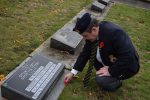
Danny Redden places a poppy at a family grave. (photo by Shula Klinger)

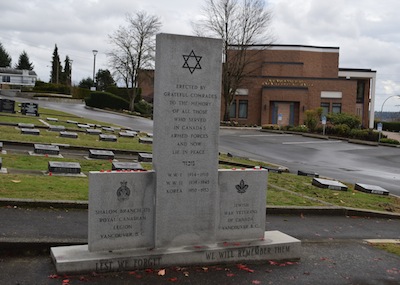
photo - Royal Canadian Legion Shalom Branch #178 paid their respects at Schara Tzedeck Cemetery.
Royal Canadian Legion Shalom Branch #178 paid their respects at Schara Tzedeck Cemetery. (photo by Shula Klinger)

With Remembrance Day falling on a Saturday this year, members of Royal Canadian Legion Shalom Branch #178 paid their respects on Monday, Nov. 13. They met at Schara Tzedeck Cemetery in New Westminster. Legion president Ralph Jackson was in attendance with vice-presidents Alan Tapper and Mark Perl, along with legion members.

The group sang O Canada and Hatikvah, and the Last Post was sounded, before poppies were placed at veterans’ graves. Danny Redden laid a poppy at the grave of a former neighbour. He later emailed the man’s son and daughter, who do not live locally. “I told them, we remembered him and laid a poppy at his grave. They were so appreciative. When you hear that, you need to continue doing it. It’s the honourable thing to do.”

After the service, attendees went on to lunch at Louis Brier Home and Hospital. Redden described it as “a lovely lunch, followed by live piano music and songs from the war years. They did a wonderful job.” Redden credited Rachel Worth at Louis Brier for coordinating the afternoon’s entertainment.

Format ImagePosted on December 1, 2017November 29, 2017Author Shula KlingerCategories LocalTags Danny Redden, Remembrance Day, Royal Canadian Legion, Schara Tzedeck, veterans

Marking memorial’s 30th year

On Sunday, Sept. 24, 11 a.m., at Schara Tzedeck Cemetery in New Westminster, the annual High Holidays Cemetery Service, presented by the Vancouver Holocaust Education Centre, Congregation Schara Tzedeck and the Jewish War Veterans, will mark the 30th anniversary of the Holocaust Memorial. On April 26, 1987, 1,300 numbers of the community, including Holocaust survivors and their families, attended the unveiling of the memorial, on which more than 900 names of family members who perished during the Holocaust were inscribed. Survivor Lillian Boraks-Nemetz wrote the following poem after that unveiling 30 years ago.

The Six Million
Written in dedication of the Holocaust Monument in Schara Tzedeck Cemetery

In this cemetery
far away from where They died
you stand dwarfed by this giant monument
your feet sinking lower and lower into the earth
your soul graining deeper and deeper
into the black granite.

You stand an alien to this earth
a born again human
sixty odd years away from the factories of death
of mercy – pleading voices scattered to deaf winds.

You stand in this cemetery
on the anniversary of the Holocaust
staring with hollow eyes
at simulated graves of strangers finally named
who once went to sleep in a common ditch
souls torn from peace like bones from flesh –

a child’s name upon your lips
a child’s fist pressing upon your breath
to break the granite silence
to speak to shout to scream the truth
to silence forever the mad dogs who
deny the happening of Shoah.

You remember as you stand here
waiting your turn to honour the Dead
how you stood with Them then
in line for death only you didn’t die
running away on all fours
through the contaminated sewers like a rat.

You say Kaddish and for a single moment
become one with the living and the dead.
Then you, the survivor, slip away into an alien world
where your soul must learn to sustain alone,
The Six Million.

Posted on September 22, 2017September 21, 2017Author Lillian Boraks-NemetzCategories LocalTags Holocaust, Jewish war veterans, memorial, Schara Tzedeck, Vancouver Holocaust Education Centre, VHEC
Israel has some allies

Israel has some allies

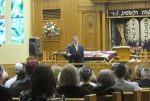
Left to right: Stephen J. Adler, Dr. Asher Susser, and Rabbi Shmulik Yeshayahu. (photo © 2017 Alan Katowitz)

In a wide-ranging lecture addressing Israel’s place in a rapidly changing Middle East, Prof. Asher Susser claimed that, without a continued focus on cutting-edge technology and modernization, Israel will not survive in the long run.

Susser, who is a professor emeritus at Tel Aviv University, spoke at the Ohel Ya’akov Community Kollel in Vancouver on Aug. 9. The event was presented by the Kollel, Canadian Friends of Tel Aviv University, Congregation Schara Tzedeck and Vancouver Hebrew Academy.

The professor believes that the key to Israel’s survival is its universities, which he described as the “powerhouses of Israel’s future.”

“Without that basic education, we will not have the wherewithal to withstand the absurdity of the neighbourhood,” he said.

In opening the evening, Kollel director Rabbi Shmulik Yeshayahu noted the “tough neighbourhood” in which Israel lived.

Stephen J. Adler, executive director of the Canadian Friends of Tel Aviv University’s Ontario and Western Canadian division, said that TAU is not only the largest educational institution in Israel, with more than 33,000 students, but that it also houses the largest research centre in the country. He highlighted the university’s affiliations with the Kellogg School of Management at Northwestern University in Evanston, Ill., and also with the Sackler School of Medicine in New York. Adler said TAU alumni have created, among other things, technological innovations like the Iron Dome and the navigation app Waze. Adler invited members of the Vancouver Jewish community to come visit the TAU campus, then introduced Susser, “one of our treasures.”

Susser has taught at TAU for more than 35 years and was director of the Moshe Dayan Centre for Middle Eastern and African Studies for 12 years. In addition to various visiting professorships in the United States over the years, he teaches an online course on the Middle East that has been taken by more than 85,000 students in more than 160 countries, including attendees of the Vancouver event. He is the author of several books, including Israel, Jordan and Palestine: The Two-State Imperative, On Both Banks of the Jordan: A Political Biography of Wasfi al-Tall and The Rise of Hamas in Palestine and the Crisis of Secularism in the Arab World.

Susser discussed the root causes of some of Israel’s past successes – including its ability to modernize and the Arabs’ failure to do so – and remaining challenges. One of those challenges, he noted, is the conflicting narrative regarding the establishment of the state of Israel.

“These narratives are not just slightly different between Israel and the Palestinians, but they are completely contradictory and have virtually nothing in common,” he said. “I would say that this is one of the major reasons why Israel and the Palestinians have such great difficulty coming to terms with each other and the difficulties remain.

“Our narrative,” he continued, “is a heroic story of the self-defence of the Jewish people,” which represents “literally rising from the ashes of Auschwitz to sovereignty and independence from 1945 to 1948, in three very short years.” This was viewed, he said, as “a miraculous redemption and justice for the Jewish people” but is viewed by Palestinians as “the epitome of injustice.”

Susser also noted that the establishment of Israel, wherein “the few against the many” prevailed, is, ultimately, “a monument to Arab failure.” He said, “For the Arabs, when they look at us every day for the last 70 years, it is to look at the monument [of] their failure to modernize successfully.”

He pointed to the Six Day War as a turning point that “proved that Arabism is an empty vessel.” And he listed three reasons why Arab states have failed to advance: a lack of political freedom, a lack of first world education systems and a lack of economic equality and inclusion of women in the workforce.

These weaknesses in Arab civil society, he said, have led to “a human disaster” that has “prevented Arab countries from advancing,” and is worsened by the sectarian divisions that exist in Arab countries. The one exception, he said, is Jordan, which is a stable state in large part due to the fact that its Jordanian and Palestinian citizens are Sunni Muslims.

“Israel’s major challenges now come not from the strength of the Arab states but the weakness of the Arab states,” said Susser. Unlike the period between 1948 and 1967, when Israel was threatened by Arab states like Egypt, Israel is now threatened by non-Arab states like Iran and non-state actors like Hezbollah, Hamas and ISIS. The problem, according to Susser, is that, “You can’t destroy Hamas or Hezbollah in six days.”

“Fighting the non-state actors is a much more difficult prospect,” he said. “These non-state actors are less of a threat to Israel but ending the conflict with them is a lot more difficult.”

The threat from Iran – which he considers to be one of the three principal non-Arab Middle Eastern powers (along with Turkey and Israel) – is “not necessarily that the Iranians will drop a bomb on Israel,” he said. The main problem is “the constraints that a nuclear Iran will pose to Israeli conventional use of military force.”

“If Israel is attacked by Hamas from Gaza or by Hezbollah from Lebanon, or by both of them together, and Israel wishes to retaliate by conventional means against these two Iranian proxies with a nuclear umbrella provided by Iran, will Israel have the freedom of operation to do it?” he asked.

One other challenge Israel faces, said Susser, is demography. He noted there are six million Israeli Jews and an equivalent number of Arabs residing in the area between the Mediterranean and the Jordan River, including the West Bank and the Palestinian citizens of Israel. “Can Israel remain a Jewish democracy with these demographic realities?” he wondered.

Susser concluded on a somewhat optimistic note. The conflict between the Shiites and Sunnis, he said, has allowed Israel to forge alliances with Sunni Arab nations like Egypt, Jordan, Saudi Arabia and other Gulf states, all of which, he said, “have common cause with Israel to block Iranian regional hegemonic design.” In addition, he noted, “We have cooperation with Jordan against ISIS and its allies, so the idea that Israel is against everyone in the Middle East is not the reality.”

David J. Litvak is a prairie refugee from the North End of Winnipeg who is a freelance writer, former Voice of Peace and Co-op Radio broadcaster and an “accidental publicist.” His articles have been published in the Forward, Globe and Mail and Seattle Post-Intelligencer. His website is cascadiapublicity.com.

Format ImagePosted on September 15, 2017September 14, 2017Author David J. LitvakCategories LocalTags Asher Susser, Israel, Kollel, Middle East, Schara Tzedeck, security, Tel Aviv University, Vancouver Hebrew Academy
Judaism’s importance

Judaism’s importance

Rabbi Lord Jonathan Sacks speaks at Congregation Schara Tzedeck on April 28. (photo by Cynthia Ramsay)

“There is one thing about Judaism for which we were mocked for centuries, whose wisdom is just becoming clear in the 21st century,” Rabbi Lord Jonathan Sacks told a packed Schara Tzedeck synagogue on April 28, after describing the world as “a terribly dangerous place” in which religion has “returned in some of its most violent and aggressive forms.”

“We did not try to conquer or convert the world,” he explained. “Why? Because we believe that God made a covenant with Noah before he made a covenant with Abraham and, therefore, you don’t have to be a child of Abraham to be in a relationship with the Holy One, blessed be He.

“We believe that the righteous of every nation have a share in the World to Come and, therefore, we never sought to conquer or convert the world. Christianity and Islam sought to become, and did become, world powers, and they achieved great things, but right now their clash, which is threatening in some ways to take us back into the age of crusades, is so dangerous because our powers of destruction are so great.”

Sacks was introduced to the crowd of approximately 700 people by Schara Tzedeck Rabbi Andrew Rosenblatt, who talked about Sacks’ importance as an embodiment of the ethos of Modern Orthodoxy, which Rosenblatt said combines fidelity to Orthodox tradition with openness to the world. He commented on Sacks’ ability to bring Jews of all kinds together, quipping, “Tonight, we have here rabbis from all stretches of Oak Street.”

That was far from the only joke of the evening. When Sacks, who lives in London, England, took the stage, he asked the audience to forgive him if he rambled a bit, saying, “In my body clock it is now almost two in the morning and I am feeling very much like the man who once dreamt he was giving a speech in the House of Lords and woke up to discover that he was.”

After saluting the relative unity of the Vancouver Jewish community, Sacks took up his theme, which was the value of Judaism to both Jews and non-Jews, and the need for Jews to move confidently in the world as ambassadors of Jewish wisdom.

He noted how often it seems that non-Jews appreciate our strengths more than we do, and then he focused on seven things he felt Judaism has to offer the world: a sense of purposeful identity; a strength of community; the centrality of family; the prioritization of the intellect; a belief in the dignity of difference and an acceptance of religious and cultural pluralism; the sacred value of protest; and the importance of hope.

Sacks spoke of the essential human need for identity, pointing out that Moses’ first question to God was, “Who am I?”

Of community, the rabbi cited research showing that “regular attendance at a house of worship extends your lifespan by seven years.” He followed this up with a joke, saying that he told his wife, Elaine, “Maybe it just feels as though your lifespan has been extended by seven years.”

With regards to family, Sacks shared the story of taking Penelope Leech, a childcare expert in the United Kingdom, to a Jewish school in London on a Friday morning. There they watched a mock Shabbat, complete with “5-year-old abba and ima, 5-year-old baba and zaida shepping naches [feeling proud].”

Sacks said Leech asked one of the boys, “What do you not like and like about Shabbes the most?” The boy responded, “What I don’t like is not getting to watch TV! What I do like is it’s the only time Daddy doesn’t have to rush off.”

Leech apparently told Sacks, “that Sabbath of yours is saving their parents’ marriages.”

To illustrate Judaism’s appreciation of the intellect, Sacks told the well-known story of Nobel laureate physicist Isidor Isaac Rabi, who said his mother had made him a scientist by asking him every day when he came home from school not ‘what did you learn today?’ but ‘Izzy, hot du fregn a gut kashya [did you ask a good question]?’ What do we teach our children?” asked Sacks. “The Four Questions. Do you know how rare that is, to teach your children to question?”

Addressing one of his favourite themes, the dignity of difference, Sacks said, “You will meet with more diversity on a city street in one hour today than an 18th-century anthropologist would in a lifetime. We have to live with difference; we have to learn to respect difference. We have learned that the miracle of monotheism is not ‘one God, one people, one book’ – the miracle of monotheism is that it is the unity up there creates diversity down here.”

On his sixth point, Sacks said, “Many faiths teach the virtue of acceptance – yes, there’s injustice and suffering in the world, but in Olam Haba, in the World to Come, it will be OK; or, in Nirvana, where you escape from the sufferings of the world. Judaism is a religion not of acceptance but of protest.” Rather than accepting the pain and injustice in the world, God tells us to be partners in making the world a better place, he said.

And, lastly, Sacks described Judaism as “the voice of hope in the human conversation.”

“Optimism is the belief that things are going to get better,” he said. “Hope is the belief that, if we work hard enough, we can make things better. It takes no courage, just a kind of naiveté, to be an optimist. It takes great courage to have hope. Let us go out and do what we are called to do, to be Hashem’s ambassadors to the world. Let us, and not only non-Jews, recognize the value of what it is we’ve got.”

Sacks’ talk, which was sponsored in part by Cathy and David Golden to mark their 30th anniversary, was followed by services and dinner.

Matthew Gindin is a freelance journalist, writer and lecturer. He writes regularly for the Forward and All That Is Interesting, and has been published in Religion Dispatches, Situate Magazine, Tikkun and elsewhere. He can be found on Medium and Twitter.

Format ImagePosted on May 19, 2017May 19, 2017Author Matthew GindinCategories LocalTags Jonathan Sacks, Judaism, Schara Tzedeck
Value in mentorship

Value in mentorship

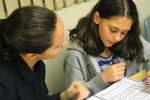
T-Jex after-school supplementary program is a partnership between Schara Tzedeck Synagogue and Shalhevet Girls High School, where the older students mentor the younger. (photo from Shalhevet)

When friends approached Gila Ross several years ago to start a new Hebrew school in Vancouver, Ross turned for inspiration to a program she had previously run in Calgary for college students, refitting it for children.

The program, T-Jex – the Jewish Experience – is built around mentorship and is based out of Schara Tzedeck Synagogue. Vancouver’s Orthodox Shalhevet Girls High School (grades 8 to 12) sends carefully selected mentor volunteers to T-Jex to work one-on-one with students or in groups of two or three. The mentors work predominantly on building Hebrew-language skills with the children. Children also learn as a class with Ross, who is the main teacher and program director, and takes the lead teaching Jewish values, holidays and Torah study.

T-Jex, now in its fifth year, involves about 10 students a year. “It is an amazing opportunity,” Rivka Abramchik, principal of Shalhevet, told the Jewish Independent. “A big part of the Shalhevet curriculum, and the goals we set for our students during the five years they are with us, is to stand up and take leadership. This is an opportunity to take responsibility, to learn the concept of giving back to the community.”

She added, “The girls get to really see how one person can make a meaningful impact. T-Jex so beautifully intertwines with the desire the girls have to be part of Jewish continuity and gives them a chance to give in a way which also gives to the girls themselves. It’s a big commitment – to give up 90 to 130 minutes on a Tuesday afternoon is give up a lot of time for these girls. You would think teenagers would be reluctant but, actually, the idea of teaching a child, students get more inspired than you might think. We have repeats every year.”

Ross gives a presentation at Shalhevet annually to introduce the program to the school’s new students. The importance of committing for a whole year is stressed, as is the importance of engagement, motivation and responsibility.

“I really enjoy working with the kids at T-Jex,” said Grade 11 student Hadassa Estrin. “The gratifying feeling you get when you see them learning about their heritage is so special … like nothing else I’ve ever experienced.”

“Most of our students have been coming from word of mouth, from all over Vancouver and from across the Jewish spectrum,” said Ross. “They have heard from others that kids enjoy coming.”

Ross started a Facebook group for Jewish moms a year or so ago, which has become a virtual community. The group has also helped spread word about the Hebrew school.

Ross, who has six kids of her own, is the youth director at Schara Tzedeck, where she has spearheaded the synagogue’s Families That Give social action projects. She also teaches at Torah High, an after-school program, and works with her husband, Rabbi Samuel Ross, the director of Vancouver National Conference of Synagogue Youth.

“The most wonderful thing to see,” said Ross, “is the students wanting to be here and having fun. To see them take joy in learning and Jewish activities is what it’s all about.”

For more information, visit scharatzedeck.com/education-learning/t-jex-2.

Matthew Gindin is a freelance journalist, writer and lecturer. He writes regularly for the Forward and All That Is Interesting, and has been published in Religion Dispatches, Situate Magazine, Tikkun and elsewhere. He can be found on Medium and Twitter.

Format ImagePosted on April 21, 2017April 20, 2017Author Matthew GindinCategories LocalTags education, Gila Ross, Judaism, Schara Tzedeck, Shalhevet, T-Jex
The truest act of kindness

The truest act of kindness

Howard Jampolsky tells the story of how community members came together to support a family after the death of their husband, father. (photo from Schara Tzedeck Cemetery Board)

Taking care of the deceased is known as a chesed shel emet, or “the truest act of kindness.” The Schara Tzedeck Cemetery Board and Chevra Kadisha practise this every day.

We take care of our community’s deceased, and help their families from the time of death through the funeral service. Of course, because we have financial obligations like any other organization, we charge for our services. However, every family is charged the same price for burial plots and funeral services, and we only offer a traditional burial with all the proper rites. We treat every deceased person and their families equitably.

This practice varies only if a family is not in a financial position to pay the full costs. Sometimes, families simply need an extended period to pay for the funeral – for example, when funds are only available from the estate. Sometimes, families cannot pay the full amount, as this would cause a significant hardship. And then, there are times when a family is simply not able to pay anything at all. In all of these cases, we provide the same services as we provide everybody: it is our core belief and mission to provide a full and proper Jewish funeral according to all the customs and laws.

We carry out about 125 funerals each year and, while each is unique, there are some that truly stand out. This chronicles one such story.

On a cold and rainy day in October, I received a call from Rabbi Hillel Brody, who serves as the religious leader of the Louis Brier Home and Hospital. He told me there was a resident who was dying and his wife, who we will call “Margaret” (names have been changed in this story to protect privacy), was worried for a variety of reasons. Margaret and her husband “Shmuel” had moved to Vancouver about 10 years earlier and, because of Shmuel’s failing health, much of their time was spent visiting doctors and caring for him. They tried to connect with the community, but were unable and, earlier that year, Shmuel was moved into the Louis Brier. Margaret began to find some connection to people just by being in the more active setting of the home, but, still, her focus was almost entirely on caring for Shmuel. This devotion to her husband was admirable, but it came with a price – they did not have any close friends.

Margaret had no idea where to begin when it came to planning for Shmuel’s burial. To make matters worse, Margaret and Shmuel did not have the money to pay for a funeral or a burial plot. Rabbi Brody assured Margaret that the Schara Tzedeck Cemetery Board and Chevra Kadisha would take care of things. He told me that the only family was a daughter, who lived in Toronto, and he told me that she had decided to visit a few weeks earlier to see her father and say her goodbyes while he was still alive. As she could only make one trip, she had made this difficult choice, and was not going to be able to come for the funeral.

When Shmuel passed away, I called Margaret and arranged to meet her at her apartment to go over the details and get all the necessary paperwork signed. Margaret and Shmuel had been together for almost 50 years, and life had always been hard. They were both Holocaust survivors, both were born in Hungary. Shmuel had been held by the Nazis as a very young boy of less than 10 years old and, because of the conditions that he and other Jews were under, he became very ill from malnutrition and as a result of Nazi torture. He was fortunate to not have been murdered by the Nazis, as so many were, but though he survived and was rescued, he never truly recovered.

Margaret and I completed the paperwork required for registering Shmuel’s death, and talked about the funeral. She was shocked and humbled when I told her that we would provide Shmuel with a full and proper Jewish funeral and she would not have to pay anything. Her tears flowed again, but this time from relief.

Margaret told me she did not even know how she would be able to get to the cemetery. She had sold her car some years earlier, and would take the bus every day to be with Shmuel at Louis Brier. I told her that Rabbi Brody had offered to drive her to the cemetery. Again, she was surprised and grateful.

At this point, the funeral would be one of the smallest I had ever attended. It was looking like Margaret, Rabbi Brody and I would be the only people there. I knew that Margaret needed more help. The thought of her being dropped off at her small apartment to be alone after burying her husband was upsetting. She needed more support, and I asked Margaret if it would be OK if we purchased an airline ticket for her daughter, “Monica,” to come to Vancouver to be here for a few days, including for the funeral.

Margaret was at first confused by the question. I’m not sure she even comprehended what I was saying. But Monica accepted our offer and, later that day, an airline ticket was purchased for her.

With Monica in town, Margaret would be able to get to the cemetery, as Monica’s good friend, “Bill,” had agreed to drive them. Two more people would be there to help bury Shmuel.

I went home that evening feeling both exhausted and energized. I had worked hard that day to make sure everything would work for Margaret, but the weight of the day was offset by the buoyancy of the good deeds that were also done. Margaret was going to get through this a little easier now, and it felt good.

On arrival the next morning at shul, I saw Rabbi Brody. He told me he was inspired by what we had offered Margaret, and mentioned that he had advised Congregation Schara Tzedeck’s Rabbi Andrew Rosenblatt that the funeral was taking place the following morning. He said he had asked Rabbi Rosenblatt to announce the funeral to his congregation and, if anyone could attend, they should contact me.

I approached a congregant who is a wills and estates lawyer, and he offered to provide Margaret with legal help in dealing with her husband’s affairs, for no charge.

At the end of the service, another congregant approached me and asked me to contact Omnitsky Kosher and order food for the family to be sent over following the funeral, with the bill directed to her.

Neither of these people had ever heard of Margaret, or Shmuel, or Monica. They just were part of a community that was beginning to rally around a fellow community member to give her the support we would all need in such a situation.

The weather was forecast to be very windy and wet for the Sunday funeral, but we were lucky that it was still dry. Monica had told me she let a few people know about the funeral, and that they may come, so I was not surprised when I saw two people walking into the small cemetery. As they approached, I asked them if they were friends of Monica. They told me they did not know anyone by the name of Monica, but had heard there was funeral this morning for a Holocaust survivor, and that there would be only a few people here, and they wanted to come to support the family.

A few moments later, another car drove up – a man with his two sons arrived for “a funeral they had heard about.” Car after car arrived. More and more people gathered, some who had driven almost an hour to lend support to a total stranger and to participate in the mitzvah of laying Shmuel to rest.

When the funeral started at 11 a.m., there were close to 30 people there – none of whom had ever met Shmuel, Margaret or Monica.

The beauty of a chesed shel emet is that everyone gains. I know that everyone at the funeral, and everyone who helped in some way or another, benefited from this experience. But, most of all, Margaret benefited and will continue to benefit from a community that supported her in her darkest hour, and will continue to help her.

Margaret will mourn and grieve. She does not know how she will be able to live on without Shmuel, and cannot imagine ever recovering from this physical and emotional blow.

But she will.

Howard Jampolsky is executive director of Schara Tzedeck Cemetery Board.

Format ImagePosted on March 31, 2017March 31, 2017Author Howard JampolskyCategories LocalTags bereavement, chesed shel emet, death, Judaism, Schara Tzedeck
Return of looted art

Return of looted art

“Young Man as Bacchus” by Jan Franse Verzijl was among about 400 works owned by Max Stern that were forcibly sold by the Nazis in the 1930s. (photo from Max and Iris Stern Foundation)

When the painting “Young Man as Bacchus” by Dutch master Jan Franse Verzijl (1599-1647) went on display in New York City two years ago, the FBI moved in and seized the work. In the possession of an art gallery in Turin, Italy, the painting was among about 400 works owned by Max Stern that were forcibly sold by the Nazis in the 1930s.

In 1935, Stern was a successful gallery owner in Düsseldorf, Germany, but because he was Jewish, his collections were confiscated and sold by the Nazis. Stern would later move to Montreal, where he became a leading figure in the Canadian art world. After Stern died, in 1987, the beneficiaries of his estate learned of Stern’s Düsseldorf gallery and an extraordinary project began to seek restitution for the confiscated artworks.

Dr. Clarence Epstein, director of the Max Stern Art Restitution Project and senior director of urban and cultural affairs for Concordia University, will speak in Vancouver March 23 about the successes and challenges of the project.

The beneficiaries of Stern’s will are Concordia University, McGill University and the Hebrew University of Jerusalem. As a result, the art restitution project may be the only program of its type with three academic institutions working collegially to a common goal, said Epstein. His visit here is presented by the Canadian Friends of the Hebrew University, the Vancouver Holocaust Education Centre and Congregation Schara Tzedeck and is sponsored by Heffel Gallery and the estate of Frank and Rosie Nelson.

The Dominion Gallery, Stern’s Montreal business, remained in operation for more than a decade after his death. During this time, the beneficiary universities became aware of Stern’s prewar history.

“There was an entirely additional gallery business in Düsseldorf that his family had run before the war but had been closed by force as a result of Nazi persecution,” Epstein told the Independent in a telephone interview. “It wasn’t public knowledge. I think some people were aware of Dr. Stern’s past, but it coincided with the time when the issue of restitution was just starting to gain a little bit of traction in the art world and so it merited questioning. We just didn’t know how far to take it.”

The Max Stern Art Restitution Project has become a significant entity, with staff in Montreal, Ottawa, Washington and New York, as well as researchers in Europe. In addition to the obligation Epstein has to maximize the financial outcome for the beneficiaries of Stern’s will, there are other factors driving the project.

“There were fiduciary obligations, which is part of estate management,” he said. “There were moral implications, because this was something that was right for the universities to do on behalf of their great benefactor Max Stern. And then there were educational opportunities that this could open up in the fields of art history, of social justice, of art and law, the mechanics of the art market – and this enticed all kinds of academics to get involved in the project.”

The return of “Young Man as Bacchus” is among 16 successes the project has seen so far. While the restitution of that piece involved law enforcement, it also exemplified the good faith response of the gallery into whose possession the painting had fallen.

Every country has different rules and statutes of limitations around the return of art that has been stolen or forcibly sold, and the Stern project navigates the law as well as less litigious means of restitution. Through the recommendation of the German Friends of Hebrew University, the German government recently announced tax receipts for the owners of returned artworks. In the cases of galleries or museums, the reputation of the institution could suffer if they are known to be in possession of a work of dubious provenance, so this encourages cooperation. Individual collectors may not have the same impetus for preserving a reputation, but once a piece of art is identified as coming from Stern’s Düsseldorf collection, it bears a figurative black mark that makes it valueless on the open art market. Even so, Epstein said, the project does not seek to punish anyone for unwittingly possessing such a work.

“We don’t intend to be the bearers of bad news about the state of the work that is in their possession,” he said, “so if there’s any way that we could alleviate that kind of misfortune with some kind of tax relief, we would do so. But it hasn’t been tested yet.”

One example of an innovative solution found is the case of a work that was discovered in a Düsseldorf gallery. While the ownership was transferred to the Max and Iris Stern Trust, the universities agreed to lend it back to the gallery for long-term display.

“In their case, everybody kind of got their cake and ate it, too,” said Epstein. “It is owned by the Stern Foundation but it is lent to the Düsseldorf Museum.”

While Canada does not have the sort of art sector that New York or the capitals of Europe have, Epstein credited the federal government, specifically Minister of Canadian Heritage Mélanie Joly, for expressing the Canadian government’s commitment to restitution.

What happens to the artworks when they are returned varies. In the Düsseldorf case, the gallery in possession maintained custody. In some instances, the pieces have been sold to fund additional work of the project. (Once returned, the black mark is eliminated and the piece can be exchanged in the legitimate art market.) Others are loaned to museums and public institutions.

Next year, an exhibition of works from Stern’s collections will open in Düsseldorf, later traveling to Haifa, Israel, then Montreal.

Popular culture has taken on the topic of art restitution, Epstein said, and this is a good thing. For example, Monuments Men is about Allied soldiers charged with rescuing cultural artifacts before the Nazis destroyed or hid them, and Woman in Gold focuses on an American woman’s legal fight with the government of Austria to return a painting by Gustav Klimt that was stolen from her family by the Nazis. There have also been documentaries on different aspects of pillaging during the war. Epstein credited Helen Mirren, the star of Woman in Gold, for personally taking up the cause of restitution and making it more public.

“Any way we can make more public the challenges of the recovery of these kinds of objects, and the more we keep it in the spotlight, the more I think we’re going to be able to generate sympathy and attention from the groups that are in possession of those works,” he said.

While the Stern project has seen the return of 16 works and has located several more that are the subject of negotiation, it is impossible to know precisely how many cultural artifacts were stolen and remain unidentified.

“There is a number circulating on the internet in the hundreds of thousands in terms of objects that remain unrecovered,” said Epstein. “I don’t think it’s ever going to be possible to nail down that number … because we are talking about an historic loss that is multiplied over millions of people’s losses, that is also somewhat effaced as a result of time and lack of memory and archives. But that’s really the tip of the iceberg in terms of losses because in terms of material losses, everything that was in the possession of a Jewish family that was oppressed could still be in circulation now – musical instruments, jewelry, the list goes on. But those items were a lot harder to trace in terms of ownership and attribution than a painting has been. Works of art that are under a certain value and have not been researched historically are probably still circulating in the tens of thousands.”

Epstein added that Stern also had significant B.C. connections. His gallery represented E.J. Hughes and Emily Carr, two of this province’s most noted artists.

Admission to the March 23, 7:30 p.m., talk at Schara Tzedeck is free but an RSVP is requested to [email protected].

Pat Johnson is a communications and development consultant to the Vancouver Holocaust Education Centre.

Format ImagePosted on March 10, 2017March 8, 2017Author Pat JohnsonCategories LocalTags art, CFHU, Heffel Gallery, Holocaust, Nazis, restitution, Schara Tzedeck, VHEC
87 headstones added

87 headstones added

Shirley Barnett, chair of the Jewish cemetery restoration project, led the proceedings. (photo by Cynthia Ramsay)

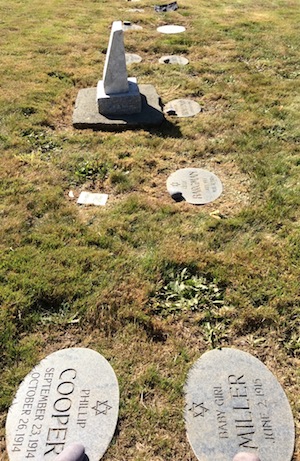
photo - Headstones for the graves of 87 babies and children were unveiled at Mountain View Cemetery’s Jewish section on Sept. 11
Headstones for the graves of 87 babies and children were unveiled at Mountain View Cemetery’s Jewish section on Sept. 11. (photo by Cynthia Ramsay)

On Sept. 11, a small crowd gathered at the Jewish section of Mountain View Cemetery for the unveiling of 87 headstones for babies and children who had passed away between 1893 and 1996.

Shirley Barnett, chair of the Jewish cemetery restoration project, which began in 2012, welcomed attendees. She acknowledged several of the people who greatly contributed to the project, and noted there is still a need for financial support.

“There is work to be done yet,” she said. “There are at least 40 or 50 adult burials that do not have headstones.… We have about 10 or 11 baby and children’s headstones that we did not cover today; we’re still researching the data on those.”

Rabbi Andrew Rosenblatt of Congregation Schara Tzedeck said a few words about how the loss of children is treated in the Tanach, while Rev. Joseph Marciano chanted the prayers for the unveilings.

Before the service, however, Barnett paid tribute to Helen Aqua, who donated the funds for all of the 87 headstones unveiled that day.

“I am but a small piece of this project, and most proud to have been part of this restoration,” said Aqua.

The project also received $27,000 toward the restoration from the federal government’s Canada Western Economic Diversification Infrastructure Canada 150 Grant.

photo - Helen Aqua donated the funds for all of the headstones unveiled that day
Helen Aqua donated the funds for all of the headstones unveiled that day. (photo by Cynthia Ramsay)

Representing the Government of Canada, Dan Ruimy, member of Parliament for Pitt Meadows-Maple Ridge (Liberal), spoke.

“Just to be here today is very special to me,” said Ruimy, who is Jewish. He said the ceremony was “a solemn reminder of the early pioneers and their families who have helped shape and build this community.”

He said he was proud that the government was “able to help with this meaningful project.”

People were invited to walk through the cemetery, and Daniella Givon led a tour, using a guidebook created by the Jewish Museum and Archives of British Columbia.

Format ImagePosted on September 23, 2016September 21, 2016Author Cynthia RamsayCategories LocalTags Jewish cemetery, Mountain View, Schara Tzedeck
Networking over breakfast

Networking over breakfast

Jonathan Kallner, event speaker and managing partner, KPMG, talks with Eli Joseph, senior account manager, business and personal, RBC Royal Bank, at Schara Tzedeck’s LinkYid networking event June 3. (photo by Baila Lazarus)

There is a theory that you are the average of the five people you hang around with the most. Thus, creating and interacting with a successful network of businesspeople should, over time, increase your own level of success.

With this in mind, Jonathan Kallner, managing partner, KPMG Vancouver, opened LinkYid’s first complimentary career networking breakfast with the topic, How to Unleash the Power of Your Network.

LinkYid is a Congregation Schara Tzedeck program that connects immigrants, professionals and entrepreneurs with mentors, employment and business opportunities that match their potential. They held their first event at KPMG on June 3.

“This topic ties into a core pillar in our strategy [at KPMG], which is community,” said Kallner. “We believe in building networks and helping networks succeed.”

Talking about his own experiences in school, in his job and the industry, Kallner admitted that, when he needed to make major decisions, he turned to his contacts.

“If you nurture the networks, they become your supporters,” he said. But, he added, “I didn’t appreciate how important that was until later in my career. I never realized what a difference there could have been in my life.”

Using Blockbuster as an example of failed relationship-building, Kallner pointed out how successful the video rental company had been, with an outlet in every neighborhood and relationships with everyone in the local community.

“If you wanted to watch a movie, you went to Blockbuster and, in four years, they destroyed it,” said Kallner. “Because they did not maintain the relationships with their customers, they allowed someone else to come in and own that relationship.

“It’s no different in our everyday lives,” he said. “The world can change around you but your relationships can stay constant.”

Kallner outlined four key points in building networks and relationships:

1. Know your goals. Each person needs to establish their own personal plan for their business, looking forward one, two and five years. Focus on the skills you have that you can capitalize on and what you need to develop. Use your networking connections to seek advice and consider it.

“When you’re looking at strengths and weaknesses, be very honest,” said Kallner. People looking to hire want to know that candidates have a good understanding of this, he said.

2. Consider getting a coach or mentor. Many of those who have gone before you in the industry will be willing to share their experiences with you, said Kallner. “They can challenge you to think differently and push your boundaries. They can act as a connector, help you develop your personal goals and work with you to define the next steps in your career.” Mentors will also be candid with you to encourage your business and personal growth.

“I still seek the guidance of mentors,” said Kallner, adding that the mentor or coach will also get value out of the relationship.

3. Build and work your network. Any search for business groups on Meetup will yield dozens of groups you can connect with in the Lower Mainland in any given week, but there are more and less effective ways of working your networks. Talk to new people at each event, said Kallner.

Respect their time and don’t be a salesperson, he added, as the key to networking is building relationships. “Don’t overlook how networks build naturally and don’t rush it,” he advised.

4. Take advantage of social media. While online presence is essential, especially when building your digital networks, there are things to look out for, said Kallner. Select the right platform. LinkedIn is considered the best platform for business operators. Others can be beneficial but you have to manage your brand closely, keep active on the site on a regular basis and make sure your profile is professional.

“Facebook can kill a brand if you’re not careful to be professional with your posts,” he said.

The LinkYid networking session drew students, entrepreneurs and professionals seeking work, looking for new hires or simply to start their relationship-building.

Erez Iancu Ben Haim, an MBA student at Sauder School of Business, was there to start building his connections and discuss his goals with people in the room. Eli Joseph, a senior account manager with RBC Royal Bank, wanted to meet some new people and find new businesses that might be looking for government loans.

“Being in the business world, people come to me if they’re looking for connections, as well,” said Joseph.

In closing his talk, Kallner reminded people of two key takeaways:

  • Follow up after meeting with someone at an event with a personalized invitation to connect.
  • Networking doesn’t only happen at events. It can happen anywhere.

To find out more about LinkYid, visit linkyid.net, email Rachael Lewinski at [email protected] or call 604-736-7607.

Baila Lazarus is a freelance writer and media trainer in Vancouver. Her consulting work can be seen at phase2coaching.com.

Format ImagePosted on June 24, 2016June 22, 2016Author Baila LazarusCategories LocalTags Kallner, KPMG, LinkYid, networking, Schara Tzedeck
Mystery photo … April 22/16

Mystery photo … April 22/16

Schara Tzedeck dedication, circa 1965. (photo from JWB fonds, JMABC L.14350)

If you know someone in this photo, please help the JI fill the gaps of its predecessor’s (the Jewish Western Bulletin’s) collection at the Jewish Museum and Archives of B.C. by contacting [email protected] or 604-257-5199. To find out who has been identified in the photos, visit jewishmuseum.ca/blog.

Format ImagePosted on April 22, 2016April 20, 2016Author JI and JMABCCategories Mystery PhotoTags JMABC, Schara Tzedeck

Posts pagination

Previous page Page 1 Page 2 Page 3 Page 4 Next page
Proudly powered by WordPress